Review

Review on Dynamic Instability and Vibration Mitigation Mechanisms in Metastable Structures

1
School of Earth Sciences and Resources, China University of Geosciences (Beijing), Beijing 100083, China
2
National Institute of Natural Hazards, Ministry of Emergency Management of China, Beijing 100085, China
3
Key Laboratory of Compound and Chained Natural Hazards Dynamics, Ministry of Emergency Management of China, Beijing 100085, China
*
Author to whom correspondence should be addressed.
Vibration 2026, 9(3), 43; https://doi.org/10.3390/vibration9030043
Submission received: 27 May 2026 / Revised: 23 June 2026 / Accepted: 29 June 2026 / Published: 30 June 2026

Abstract

Rescue-induced vibrations easily trigger dynamic instability and secondary collapse of post-disaster metastable structures, threatening rescue safety and efficiency. This paper comprehensively reviews research on vibration-induced instability and dynamic responses and mitigation strategies of these discontinuous structural systems. We analyze vibration propagation, energy concentration and progressive collapse mechanisms, and summarize parameterized modeling, physical tests and mainstream numerical methods including FEM, DEM and F-DEM, with their pros and cons compared. Typical vibration-mitigation technologies such as passive support, damping reinforcement, and semi-active and active control are classified and discussed, and nonlinear energy sinks as well as anti-phase control are elaborated on. Validation studies in rescue-training bases are also presented. Finally, the study is synthesized to clarify the interconnections among dynamic monitoring, structural modeling, and vibration mitigation. This review-derived synthesis identifies current knowledge gaps and outlines future research directions for rescue-oriented dynamic safety assessment. This review provides theoretical and engineering references for safe disaster rescue.

1. Introduction

Sudden disasters such as earthquakes, explosions, and mining accidents occur frequently and often lead to large-scale damage to buildings and underground engineering structures. At disaster sites, a considerable portion of the debris and buried structures remain in a critical condition, commonly referred to as “metastable structures”. Such structures maintain a fragile equilibrium through residual-component friction, interlocking, or temporary supports; however, their stability can be disrupted at any moment [1,2,3,4,5]. During rescue operations, activities such as cutting, spreading, chiseling, sawing, drilling, shearing, shoring, and debris removal typically generate intense vibrations. These vibrations propagate through discontinuous media to structurally weak zones, readily triggering cascading instability and resulting in secondary collapses [6]. This not only poses severe risks to rescuers and trapped victims, but also significantly constrains rescue efficiency [7]. Therefore, determining how to effectively control rescue-induced vibrations and ensure the stability of metastable structures has become a central problem that disaster rescue engineering urgently needs to address.
Although vibration control has been studied in engineering for decades, notable gaps remain when it is transferred to disaster rescue scenarios. Existing studies are largely based on idealized models and thus fail to fully capture the complex fracture networks and discontinuous-media characteristics inside debris, leading to limited predictive accuracy for vibration energy concentration and localized instability. From the perspective of rescue practice, current mitigation measures mainly rely on temporary shoring, local reinforcement, or damping pads to reduce vibration impacts [8,9]; however, these approaches often lack systematic parameter-based guidance and therefore cannot achieve precise regulation under varying debris morphologies and operational intensities. In addition, some studies have proposed applying counter-phase vibrations to offset disturbances, yet such methods have not been effectively implemented in real rescue environments due to equipment constraints and operational feasibility [10,11]. Existing operational guidelines are largely derived from empirical thresholds and do not adequately account for differences in equipment types, vibration-source characteristics, and damage accumulation effects, leaving rescuers without scientifically grounded risk references during operations.
Against this backdrop, developing vibration-control technologies for metastable structures that apply to on-site rescue operations is of considerable importance. From the rescuer’s perspective, it is necessary to establish the relationship between vibrations and structural responses in complex debris environments, and to determine safe operational thresholds for different equipment actions, thereby guiding operational modes and parameter settings and preventing secondary collapses caused by improper actions [12,13,14]. From the victim’s perspective, effective vibration control can alleviate the compression of survivable voids induced by external disturbances, reduce collapse risk, and secure additional time windows for rescue [15,16]. Moreover, scientific determination of vibration thresholds and the adoption of appropriate measures can not only overcome the traditional “conservative operation” paradigm that relies heavily on experience, improving rescue efficiency while maintaining safety, but also provide a basis for developing more standardized and actionable rescue protocols.
Motivated by these needs, this paper systematically reviews research progress on vibration control of metastable structures in disaster rescue, with the aim of synthesizing key mechanisms, methodologies, and technological pathways. In this work, metastable structures refer to post-disaster structural systems that stay in a fragile equilibrium. Similar to the physical definition of metastability, these structures stay balanced via residual load paths, friction, interlocking and temporary supports, and may experience local or progressive collapse under rescue-induced vibrations. Based on morphological and mechanical characteristics, they are classified into three types: continuously damaged structures, continuous–discontinuous hybrid structures, and debris-dominated assemblies, which differ distinctly in vibration responses and stability control mechanisms.
Based on this definition, the final search strategy adopted the query: TS = ((“metastable structure” OR “damaged structure” OR “collapsed building” OR “debris structure”) AND (“rescue-induced vibration” OR “rescue vibration”) AND (“dynamic instability” OR “secondary collapse”) AND (“vibration mitigation” OR “structural control”)). To ensure the comprehensiveness and reliability of the dataset, Web of Science (WoS) and CNKI were selected as data sources, with the retrieval time ranging from 2000 to 2025. Duplicates and irrelevant papers were excluded, leaving 117 valid publications for further analysis.
On the basis of the comprehensive literature analysis, this review is organized around three core questions: (1) How can the mechanisms of dynamic instability of metastable structures under vibrational excitation be revealed, and how can their response characteristics be effectively characterized? (2) How can rescue-induced vibration sources be parameterized and their propagation laws described, and how can a system of key control parameters be established? (3) How can experimental validation, numerical simulation, and engineering back-analysis be integrated to form a closed-loop framework that supports both theory and practice? The integrative scheme discussed in this review should therefore be understood as a literature-derived synthesis for organizing existing knowledge and identifying future research needs. Through this review, we aim to provide a systematic theoretical reference and engineering guidance for safe operations in disaster rescue contexts.

2. Theoretical Foundations of Vibration Response in Metastable Structures

2.1. External Loading and Analogies to Instability

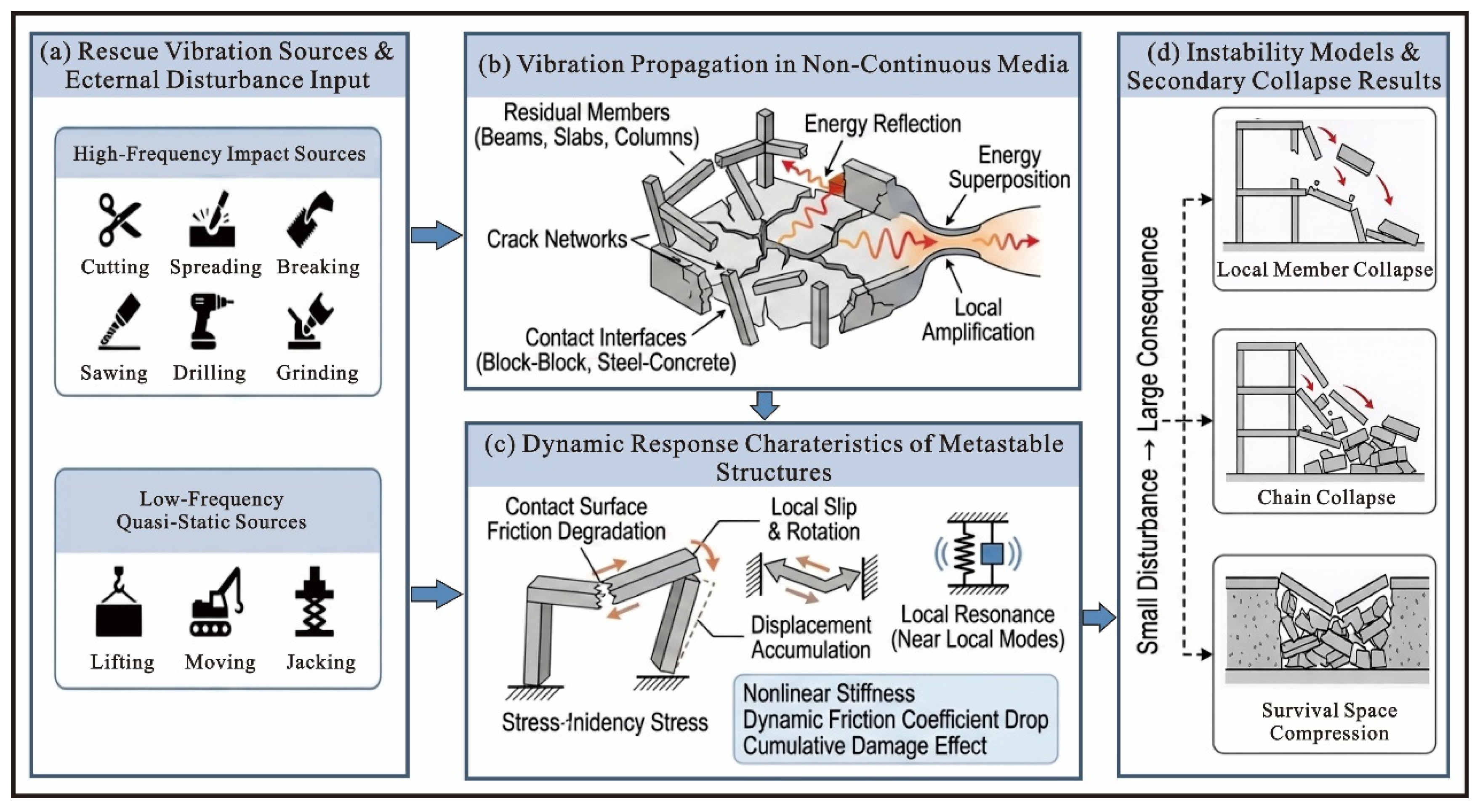
During disaster rescue operations, interventions such as cutting, spreading, chiseling, sawing, drilling, shearing, shoring, and debris removal inevitably introduce impact, vibration, and intermittent disturbance into collapsed building debris. These operations are essential for creating rescue access and stabilizing hazardous components; however, they may also disturb debris accumulations that remain in a metastable equilibrium after the initial collapse (Figure 1). In such systems, apparent stability is often maintained by a limited reserve of contact resistance, geometric interlocking, residual support, and local confinement rather than by the continuity and redundancy of an intact load-bearing structure. Post-collapse debris can be regarded as a frictional discontinuous assembly composed of irregular fragments, slabs, beams, wall segments, and infill materials. Load transfer within this assembly is governed primarily by unilateral contact, frictional resistance, local interlocking, and highly heterogeneous force chains. The stability of the system is therefore sensitive to changes in contact conditions and force-transfer paths. Rescue-induced impact or vibration may loosen contacts, mobilize relative slip, promote block rotation, or reduce frictional resistance at critical interfaces [17,18]. Once a local contact approaches or exceeds its limiting equilibrium, the resulting displacement can modify adjacent support conditions and trigger redistribution of internal forces.
This type of instability is consistent with progressive failure processes observed in other friction- and interface-controlled discontinuous systems. In landslides, small perturbations and cumulative weakening may promote crack propagation, shear-band development, and coalescence of localized deformation zones before global sliding failure [19,20]. In ancient masonry walls, impact loading, joint degradation, local offset, and frictional weakening may disturb the equilibrium of discrete blocks and lead to abrupt overturning or partial collapse [21]. Although the materials and geometrical configurations differ, these systems share a dependence on frictional contact, weak interfaces, geometric constraint, and localized damage evolution.
For collapsed building debris, the corresponding destabilization process may involve progressive degradation of contact resistance and reconfiguration of force chains. This process can be characterized by changes in the effective contact friction coefficient, accumulated relative slip between debris components, rotation of unstable blocks, and variation in contact force magnitude and orientation. External vibration or impact may concentrate stress and input energy at weak zones, such as partially supported members, inclined slabs, unstable void boundaries, and contacts close to limiting equilibrium. Local sliding, rotation, or contact failure may then propagate through neighboring components, producing cascading destabilization and potentially resulting in secondary or chain-type collapse.

2.2. Vibration Propagation and Coupled Structural Response

The coupled response between rescue-induced loads and debris structures constitutes a critical process leading to secondary collapse. High-frequency impact vibrations generated by shearing, drilling, and chiseling operations can propagate along “partially connected” residual members and through fracture networks, where they may superpose and become locally amplified at discrete joints or contact nodes [22,23]. This local amplification effect can be quantitatively characterized by vibration amplification ratio, peak acceleration and peak particle velocity (PPV), which are widely adopted to judge abnormal vibration responses in engineering. By contrast, low-frequency thrusts introduced by shoring and pushing operations may alter the global load-transfer path, thereby inducing progressive displacement accumulation over time [24]. Such cumulative deformation can be quantified via contact slip and residual displacement of structural components.
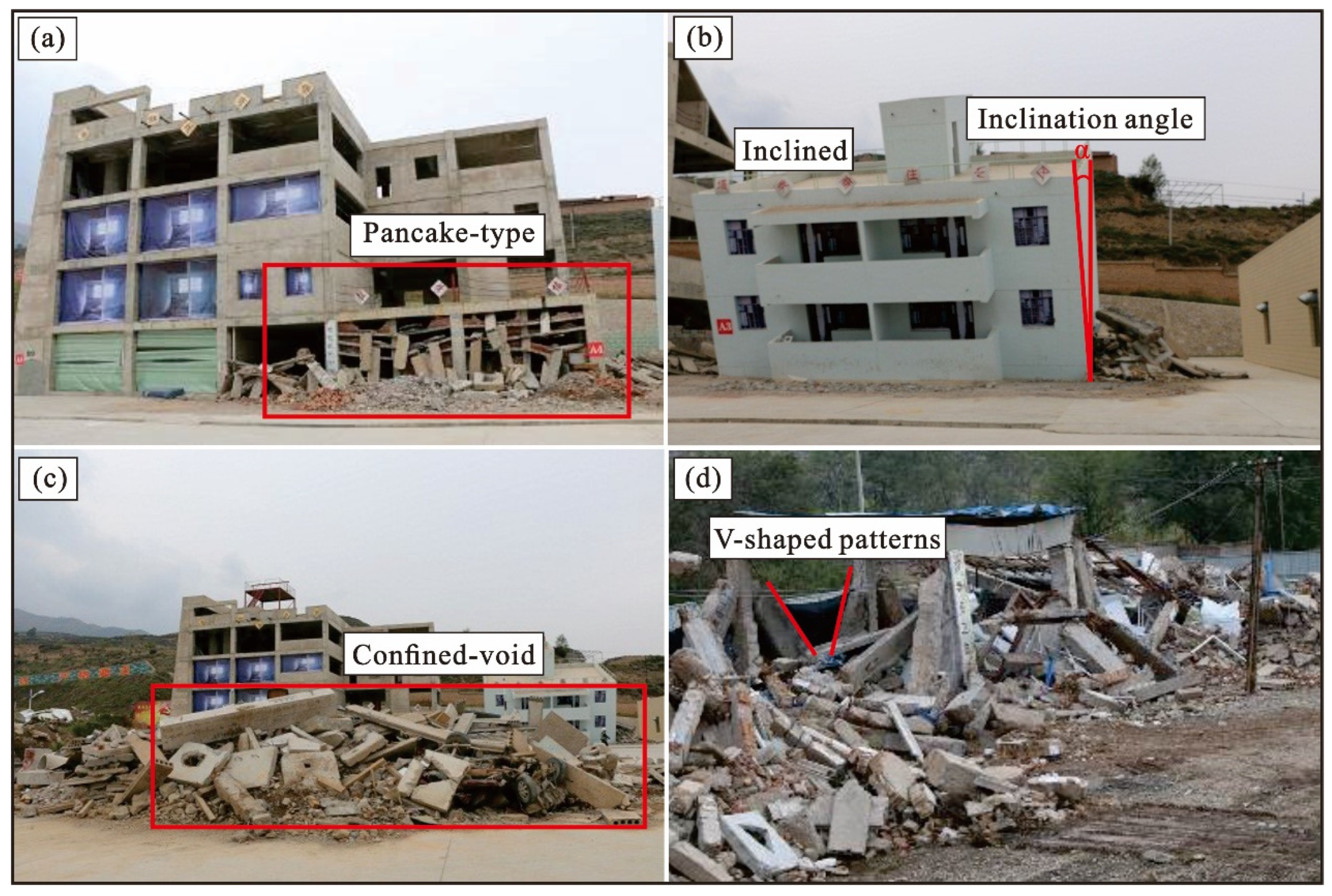
Because metastable structures exhibit damage-degraded and nonlinear stiffness, their resonant characteristics evolve with the extent of deterioration. The evolution of structural dynamic properties can be reflected by frequency shifts and damping changes during vibration excitation. Meanwhile, time-dependent stiffness degradation is also a key index to describe the continuous deterioration of damaged structures under cyclic vibration. As a result, the dominant frequencies of certain rescue operations may approach local modal frequencies, which can markedly amplify the structural response. Post-earthquake investigations and related studies indicate that typical rubble configurations include pancake-type, inclined, confined-void, and V-shaped patterns (Figure 2) [6,25,26,27]. This implies that vibration-induced external loading is governed not only by the characteristics of the excitation source, but also by the structural morphology and the spatial distribution of residual stiffness within the debris system.

2.3. Engineering Simplification and Response Criteria

It is impractical to apply sophisticated numerical simulation techniques for real-time structural stability evaluation at disaster rescue sites due to limited on-site conditions. For this reason, simplified response criteria and quantifiable engineering indicators are essential to support rapid on-site decision-making.
Based on field investigations of typical post-disaster rubble configurations, metastable structures can be divided into three major types: globally inclined compressed systems, locally arched structures supported by temporary shoring, and structural assemblies stabilized by component interlocking [28,29]. Corresponding idealized calculation models can be established for these structural forms (Figure 2). Rescue activities such as cutting, drilling, spreading and debris removal generate different types of excitation, which act as the primary external loads on metastable structures. According to dynamic characteristics, rescue-induced vibrations are classified into impulsive vibration, quasi-static thrust and mixed vibration. Drilling, chiseling and cutting produce high-frequency impulsive loads; spreading, lifting and permanent shoring generate low-frequency quasi-static loads; and debris removal creates mixed vibration signals with variable properties. Different vibration characteristics lead to distinct dynamic responses and potential failure modes of metastable structures [8,9].
To establish reliable stability discrimination conditions, this study adopts conventional geometric parameters (e.g., inclination angle and arch rise), material degradation parameters and loading parameters (e.g., vibration frequency, amplitude and duration) [30]. Meanwhile, a comprehensive set of quantitative vibration indices are introduced, which are categorized as follows: (1) vibration amplitude indicators: peak acceleration and peak particle velocity (PPV); (2) deformation indicators: contact slip and residual displacement; (3) dynamic characteristic indicators: frequency shift, damping variation, and time-dependent stiffness degradation; and (4) energy indicators: cumulative vibration energy and vibration amplification ratio. These indices can effectively characterize local energy concentration, stiffness deterioration and component slippage of metastable structures under external vibration. Combined with geometric and material parameters, they form a complete evaluation system for structural stability.
On the basis of the above index system and existing research findings, we summarize a rapid safety assessment framework for rescue scenarios [14]: (1) on-site acquisition of real-time vibration signals and calculation of the above quantitative indicators; (2) comparing measured indices with empirical safety thresholds summarized from existing studies; and (3) judging the stability state of the structure and determining whether to adjust rescue operation modes or adopt reinforcement measures. Although such simplified models cannot provide highly accurate predictions, they offer clear advantages in rescue practice, namely speed, transparency, and operational feasibility. Accordingly, they can serve as practical references for developing equipment operation protocols, selecting temporary shoring and reinforcement measures, and designing appropriate operational rhythms to mitigate the risk of secondary collapse.

3. Modeling of Vibration Sources

3.1. Parameterization for Metastable Structure Modeling

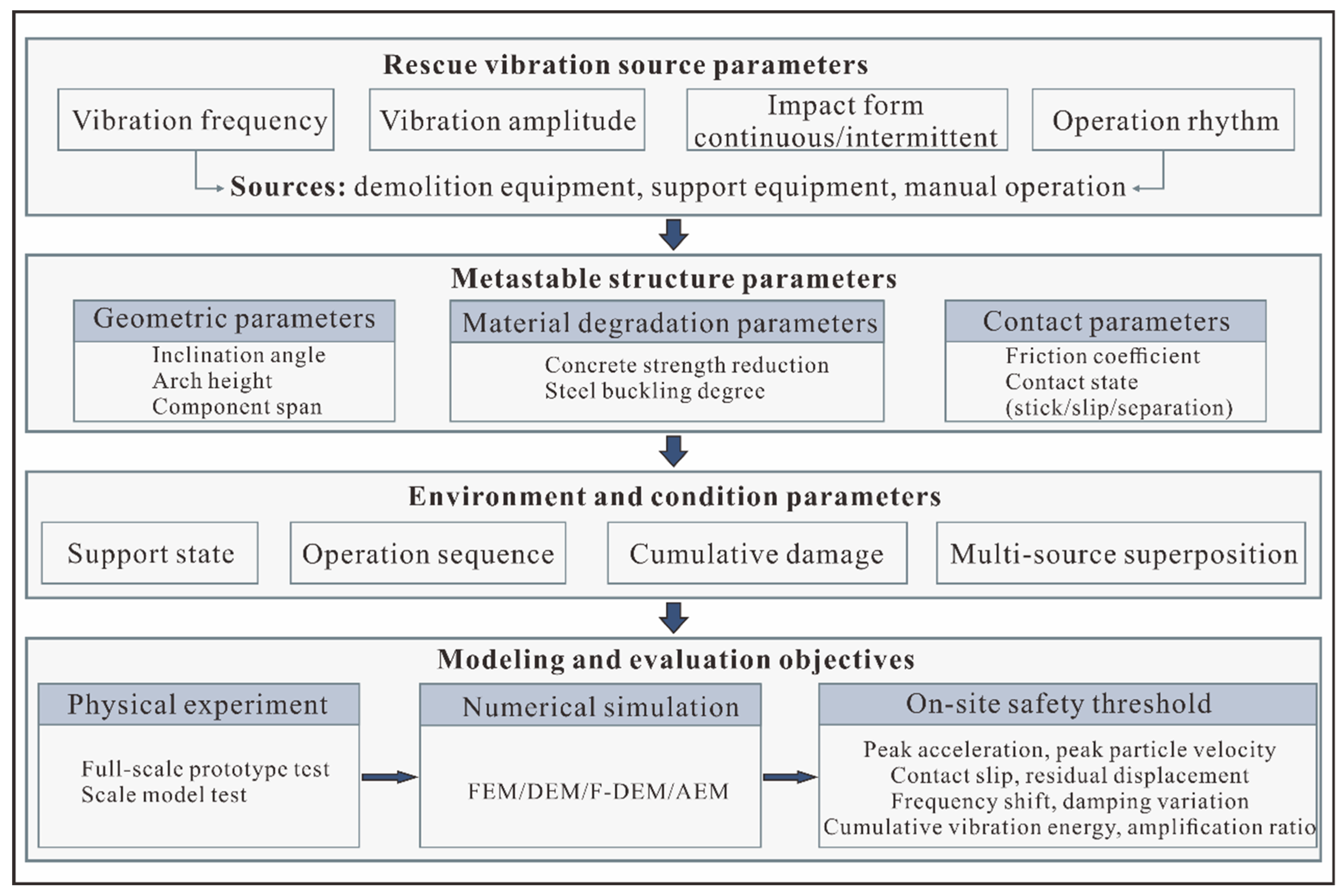
The parameter system for modeling metastable structures is inherently high-dimensional and multi-physics coupled, requiring the systematic integration of geometric attributes, material properties, contact behavior, and external loading parameters [29]. Core parameters include, but are not limited to: the geometric dimensions of survivable voids (diameter, clear height, mid-span clearance), the residual cross-section and damage ratio of critical members, the spatial distribution of contact interfaces and estimates of the friction coefficient, member inclination and global displacement measures, and material degradation indices (Figure 3).
With respect to contact behavior, the dynamic evolution of friction is particularly critical. Existing studies indicate a nonlinear relationship between vibration frequency and frictional energy dissipation; once the excitation frequency exceeds a certain threshold, the equivalent friction coefficient at steel–rock interfaces may decrease substantially relative to its quasi-static value [31]. Rate-dependent material degradation further complicates parameterization. For example, Q345 structural steel may exhibit an apparent increase in yield strength at high strain rates, whereas its fracture toughness can deteriorate markedly, increasing susceptibility to brittle failure under dynamic disturbance [32].
Recent advances in intelligent parameter-sensitivity analysis provide new pathways for improving model reliability. Techniques such as quantitative attribution of parameter contributions using global sensitivity indices, machine learning-assisted rapid calibration and optimization, and uncertainty propagation modeling have significantly enhanced model robustness under parameter and epistemic uncertainties [33,34]. Meanwhile, the adoption of heterogeneous parallel computing architectures has alleviated computational bottlenecks, enabling engineering-scale, large-domain simulations with improved efficiency.
For model validation and back-analysis, multi-source information fusion has increasingly become the dominant paradigm. Spatial topology can be reconstructed using laser-scanned point clouds of residual structures; wavelet-based feature extraction from vibration signals can be used to infer underlying dynamic processes; and video-frame analysis can support time-series alignment and calibration [35,36]. Building upon such data streams, emerging dynamic inversion frameworks enable end-to-end reverse inference from load application to instability response [37,38]. These data-driven approaches not only verify the applicability of theoretical models but also elucidate the cascading evolutionary mechanisms that govern collapse in metastable structural systems.

3.2. Physical Experiments

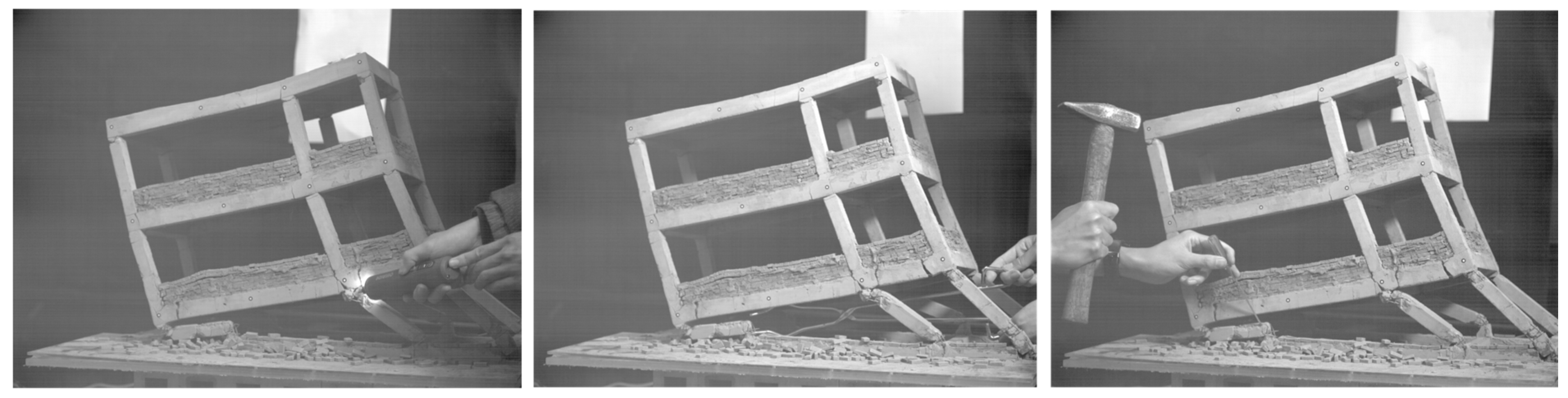
The experimental verification framework for vibration response in metastable structures has evolved into an integrated paradigm that combines physical testing, numerical simulation, and engineering back-analysis [39]. By leveraging methodological complementarity, this triad effectively overcomes the limitations of any single validation approach and substantially improves the reliability of vibration-control models. In particular, scaled physical experiments, enabled by innovative loading devices and advanced sensing technologies, have achieved breakthroughs in reproducing the dynamic response of metastable structures (Figure 4) [40]. Representative progress includes the engineering deployment of multi-field coupled environmental simulation chambers, the high-fidelity mechanical reconstruction achieved with intelligent similitude materials, and distributed monitoring via high-density sensor networks, all of which markedly enhance the visualization and identification of vibration energy transfer pathways [41]. The design of vibration loading protocols has increasingly focused on the high-fidelity replication of rescue equipment excitation characteristics. Electro-hydraulic servo systems have been employed to apply precisely controlled transient impact loads at the millisecond scale, while phase-control techniques have addressed the long-standing experimental challenge of synchronization in multi-source collaborative operations [42,43].
Meanwhile, a recent full-scale experimental study has introduced new insights into the “controlled failure–local isolation” behavior of metastable structures under extreme disaster conditions [44], which can be viewed as a direct extension of vibration-control concepts toward robust structural design. In this study, a two-story precast reinforced-concrete frame measuring 15 m × 12 m was tested, and a “hierarchical collapse isolation” strategy was proposed. By deliberately weakening beam–column joints using partial-strength connections, the structure exhibited only localized two-bay collapse following corner-column failure, rather than progressive global collapse. This experiment provides one of the first building-scale validations of the “weak connection–strong column” concept, offering critical implications for creating safe operational windows in disaster rescue contexts.

3.3. Numerical Simulation and Method-Selection Framework

Numerical simulation is essential for analyzing vibration propagation, contact evolution, fracture development, and collapse progression in metastable structures, especially when full-scale experiments are constrained by cost, safety, and repeatability. However, the choice of numerical method should be governed by the dominant mechanical state of the target system rather than by the general capability of the method itself. In the present review, the applicability of different numerical approaches is therefore evaluated according to the three structural categories defined above: damaged but continuous systems, hybrid continuous–discontinuous systems, and debris-dominated assemblies.
For damaged but still continuous systems, the finite element method (FEM) remains the most efficient approach for evaluating stress redistribution, modal characteristics, stiffness degradation, and member-level dynamic response. Its limitations become evident when large discontinuous displacement, repeated contact opening and closure, and debris accumulation dominate the response [45]. For debris-dominated systems, the discrete element method (DEM) is more appropriate because it can explicitly represent block motion, contact, sliding, collision, frictional dissipation, and interlocking. Nevertheless, DEM results are highly sensitive to block geometry, contact stiffness, friction coefficients, damping assumptions, and calibration data [46,47]. The applied element method (AEM) and finite–discrete element method (FDEM) provide intermediate or coupled solutions for systems that undergo cracking, separation, contact interaction, and progressive collapse. AEM is useful for structural collapse processes involving member fracture and post-fracture interaction [48], whereas FDEM is particularly suitable for simulating the transition from a damaged continuous structure to a discontinuous or semi-rubble state [49,50]. Particle-based methods and FEM–physics engine hybrid frameworks are also useful for large-deformation collapse analysis, debris-field generation, and rescue-training simulations, although their accuracy depends on the transition criteria, simplified contact rules, and parameter calibration [45,51,52,53,54].
Based on this comparison, FEM or simplified AEM models are generally preferable for Type I damaged but continuous systems, where structural continuity, modal response, and stiffness degradation remain important [55]. For Type II hybrid continuous–discontinuous systems, AEM, FDEM, or FEM–DEM coupling are more appropriate because both residual structural continuity and discontinuous contact interactions must be represented [48,56]. For Type III debris-dominated assemblies, DEM or particle-based methods are more suitable because stability is governed mainly by contact, friction, interlocking, and block motion rather than by the original structural topology [30,57].
For rescue applications, modeling accuracy must be balanced against data availability and decision time. High-fidelity three-dimensional DEM or FDEM models are valuable for mechanism analysis, post-event back-analysis, and validation studies, but they usually require detailed geometric reconstruction, contact-parameter calibration, and substantial computational resources. In contrast, simplified FEM, AEM, reduced-order models, and pre-calibrated hybrid models are more suitable for near-real-time risk assessment, provided that their uncertainty is explicitly recognized and updated using field-monitoring data. Therefore, numerical modelling should be regarded not as a stand-alone predictive tool, but as one component of a monitoring–modelling–mitigation framework for rescue-oriented dynamic safety assessment.

4. Vibration-Mitigation Strategies and Practical Constraints

Post-disaster damaged structures often remain in a metastable state, in which residual stability is maintained by degraded load paths, contact friction, member interlocking, geometric constraints, and temporary support conditions [58,59]. Under such circumstances, vibration mitigation should not only be understood as a reduction in acceleration amplitude. More importantly, it should aim to preserve residual equilibrium, prevent contact slip, suppress local dynamic amplification, reduce cumulative damage, and avoid vibration-triggered progressive instability.
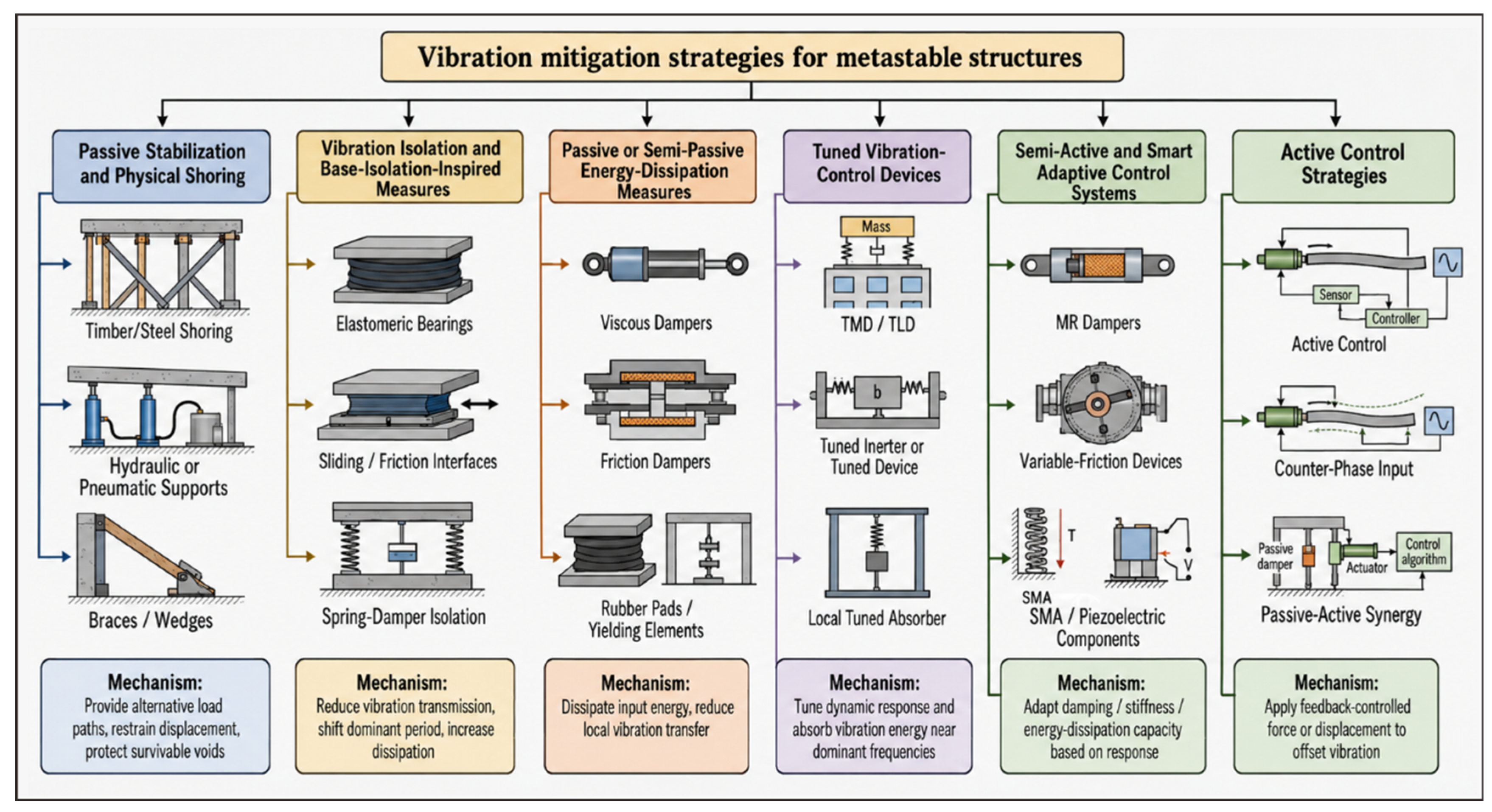
From the perspective of the control mechanism and field deployability, vibration-mitigation strategies for metastable structures can be classified into five categories: passive stabilization and physical shoring, vibration isolation and base-isolation-inspired measures, passive or semi-passive energy-dissipation measures, tuned vibration-control devices, semi-active or smart adaptive control systems, and active control strategies. This classification is important because different strategies differ considerably in power demand, installation complexity, robustness, sensing requirements, and suitability for emergency rescue environments.

4.1. Passive Stabilization and Physical Shoring

Passive stabilization is the most direct and widely used mitigation strategy in post-disaster rescue. Typical measures include timber shoring, steel shoring, hydraulic or pneumatic supports, wedges, braces, and temporary load-transfer members. Their primary function is to provide alternative load paths, limit further displacement, protect survivable voids, and reduce the probability of local or progressive collapse [60,61]. Compared with advanced vibration-control systems, physical shoring has clear advantages in rapid deployment, reliability, low power demand, and operational familiarity for rescue teams.
However, conventional shoring is not primarily designed for vibration attenuation. Its effectiveness depends on the support position, contact condition, load-transfer path, interface stiffness, and installation quality. If a support is installed at an inappropriate location or if the contact interface is loose, the shoring system may alter the vibration-transfer path or introduce local stress concentration. Therefore, for metastable structures exposed to rescue-induced vibration, shoring should be combined where possible with damping-enhanced or isolation-enhanced components, such as elastomeric pads, frictional interfaces, viscous damping units, or replaceable energy-dissipation elements. Such systems can provide both temporary load-bearing capacity and partial vibration energy dissipation.

4.2. Vibration Isolation and Base-Isolation-Inspired Measures

Base isolation is a well-established passive vibration-control technique for reducing the transmission of ground-borne, machinery-induced, and traffic-induced vibration to structural systems [44]. Its basic principle is to introduce a flexible or dissipative isolation layer between the vibration source and the protected structure, thereby shifting the dominant vibration period, reducing force transmission, and increasing energy dissipation. Typical isolation devices include elastomeric bearings, sliding bearings, friction pendulum systems, spring-damper isolators, and other flexible support systems.
In the context of post-disaster metastable structures, conventional building-level base isolation is usually difficult to implement after severe damage or partial collapse, because the structural geometry, support conditions, load paths, and accessibility are highly uncertain. Nevertheless, the concept of base isolation remains relevant for rescue-oriented vibration mitigation. Instead of installing full-scale isolation systems beneath an entire damaged structure, base-isolation-inspired measures may be used locally to reduce vibration transmission from rescue equipment or temporary supports to vulnerable structural components. Examples include elastomeric pads beneath cutting or drilling equipment, isolation layers between temporary shoring and damaged members, spring-damper interfaces for temporary platforms, and frictional or sliding interfaces designed to limit the transfer of high-frequency operational vibration.
Therefore, in this review, base isolation is treated as an important reference category of passive vibration-control technology, while its direct applicability to post-disaster rescue environments is considered limited. For damaged but still continuous structures, isolation-based measures may be useful when the load path and support conditions are sufficiently identifiable. For hybrid continuous–discontinuous systems and debris-dominated assemblies, local vibration isolation may be more practical than conventional structural base isolation, because it can be deployed at the equipment–structure interface or support–structure interface without requiring global structural intervention.

4.3. Passive and Semi-Passive Energy-Dissipation Measures

Passive and semi-passive energy-dissipation measures reduce vibration transmission or dissipate input energy without relying on complex feedback control. Representative devices include rubber isolation pads, friction dampers, viscous dampers, yielding elements, local isolation layers, and damping-enhanced temporary supports [62,63]. These measures are relatively robust because they do not require real-time control algorithms or continuous external power supply.
For rescue scenarios, the main advantage of passive energy-dissipation devices is their simplicity and reliability. They can be integrated with temporary shoring systems or placed between rescue equipment and vulnerable structural components to reduce local vibration transmission. Nevertheless, their performance is affected by contact pressure, interface condition, excitation frequency, amplitude, temperature, and installation quality. In debris-dominated assemblies, it may also be difficult to identify a mechanically effective installation position. Therefore, passive damping measures should be selected according to the dominant vibration path and the most vulnerable structural region, rather than being applied as generic accessories.
Tuned devices, such as tuned mass dampers and tuned liquid dampers, have been widely studied in structural vibration control [64,65]. Their effectiveness relies on the compatibility between device parameters and the dominant structural frequency. This requirement is difficult to satisfy in metastable structures because stiffness, boundary conditions, and contact states may change during rescue operations. In addition, studies on vibration-control systems and base-isolated structures have shown that mitigation performance should not be assessed only by horizontal response reduction; vertical dynamic effects and component-dependent amplification may also be relevant, especially for floor systems and local structural components. Therefore, tuned or isolation-based devices may be more appropriate for relatively well-characterized damaged structures, rescue-training bases, or temporary facilities than for highly irregular rubble-dominated systems.

4.4. Semi-Active and Smart Adaptive Control

Semi-active and smart adaptive control systems provide a possible compromise between passive robustness and active adaptability. Examples include magnetorheological dampers, variable-friction devices, controllable braces, shape-memory-alloy components, and piezoelectric-based devices. These systems can adjust damping, stiffness, or energy-dissipation capacity according to measured structural response, while requiring less power than fully active control systems [66].
In the context of metastable structures, semi-active systems may be useful when the damaged structure remains partially accessible and when monitoring data can be obtained with acceptable reliability. For example, a semi-active damping brace may be used to stabilize a damaged but still continuous structural bay, while a controllable damping support may help reduce vibration transmission to a vulnerable contact interface. However, their practical use in emergency rescue is still constrained by installation time, environmental robustness, power supply, sensor reliability, and the need for simple and fail-safe control rules. Therefore, semi-active and smart-material-based strategies should be presented as promising but still developing technologies, rather than as universally deployable rescue measures.

4.5. Active Counter-Phase Vibration Control and Its Operational Constraints

Active counter-phase vibration control refers to the application of an external force or displacement input that is intentionally out of phase with the measured structural response, with the aim of reducing vibration amplitude or suppressing local dynamic amplification. In principle, this strategy may provide high control authority when the structural system is well characterized, the excitation source is identifiable, and the actuator can deliver a precisely timed control input. Therefore, active counter-phase control may have potential value for controlled experimental platforms, rescue-training bases, and relatively well-defined damaged structures [67,68,69].
However, its direct application to post-disaster rescue environments is highly constrained. Successful active control requires accurate sensing, rapid system identification, reliable phase estimation, low-latency data transmission, robust control algorithms, sufficient actuator authority, stable power supply, and safe actuator installation. These requirements are difficult to satisfy in metastable structures where geometry is irregular, damage distribution is uncertain, boundary conditions may change during rescue operations, and contact states can evolve through sliding, separation, or re-interlocking. Rescue-induced vibrations are also often transient, non-stationary, and generated by multiple sources, which further increases the difficulty of real-time phase matching.
A particular risk is that an incorrectly phased or delayed control input may amplify rather than suppress local vibration. This risk is especially important for hybrid continuous–discontinuous systems and debris-dominated assemblies, where vibration energy may be redirected through contact nodes, weak interfaces, or temporary shoring members. Therefore, active counter-phase vibration control should not be regarded as an immediately deployable solution for general rescue operations. At the current stage, it is more appropriate to consider it as a research-stage or conditionally applicable strategy that requires validation under controlled but rescue-relevant conditions, as shown in Figure 5.

5. Experimental and Field Validation in Rescue-Training Bases

5.1. Role of Rescue-Training Bases in Validation

Rescue-training bases provide an intermediate validation environment between controlled laboratory tests and real disaster sites. Unlike conventional component tests or shake-table experiments, these bases can reproduce partially collapsed buildings, debris piles, confined voids, narrow rescue passages, temporary shoring conditions, and equipment-induced disturbances under relatively controllable and safe conditions [70,71,72]. Therefore, they are suitable for evaluating whether vibration-mitigation strategies developed from theoretical analysis or numerical simulation can remain effective when structural discontinuity, contact uncertainty, rescue accessibility, and operational disturbance are considered simultaneously.
For the purpose of validating vibration-control technologies for metastable structures, rescue-training bases should not be treated merely as demonstration sites. Their scientific value lies in providing repeatable scenarios for comparing structural responses before and after mitigation measures are applied. Relevant validation scenarios may include damaged-but-continuous structural systems, hybrid continuous–discontinuous systems, and debris-dominated assemblies. These scenarios should be selected according to the structural taxonomy adopted in this review, so that the validation process is directly connected with the mechanisms of vibration propagation, contact slip, local amplification, and progressive instability discussed in previous sections.
Accordingly, the role of rescue-training bases can be summarized in three aspects. First, they allow rescue-induced excitations, such as cutting, drilling, chiseling, shoring, lifting, and debris removal, to be reproduced under controlled operational conditions. Second, they provide space for deploying temporary supports, damping elements, isolation pads, monitoring sensors, and data-acquisition systems without exposing rescuers or trapped victims to unacceptable risks. Third, they enable comparative evaluation of mitigation performance using measurable indicators, including peak particle velocity, peak acceleration, cumulative vibration energy, amplification ratio, residual displacement, frequency shift, and warning response time.

5.2. Base-Level Validation Under Rescue Scenarios

Conducting validation studies of vibration-control technologies for metastable structures in complex rescue environments is a critical step toward their engineering deployment. Compared with conventional laboratory settings, rescue-training bases are characterized by high structural randomness, complex working conditions, and frequent external disturbances [73], thereby imposing more stringent requirements on the adaptability and reliability of the proposed technologies.
In rescue-training bases, application-oriented validation of vibration-control technologies for metastable structures can generally be organized into four stages: (1) Site selection and experimental design: Priority should be given to bases equipped with modular debris units (e.g., the National Earthquake Emergency Rescue Training Base in Beijing) to ensure controllability and repeatability of experimental conditions [74]. (2) Component layout and installation: The deployment of stabilization and vibration-mitigation components should balance mitigation effectiveness with rescue accessibility and operational safety, ensuring that the devices reduce vibrations without hindering personnel movement or equipment use. (3) Vibration excitation and data acquisition: Excitations may be introduced via manual loading (drop-weight and impact), small-scale vibration tables, or the rescue actions themselves (human walking and equipment operation). Multi-modal data acquisition can be achieved by integrating wireless sensor networks with three-dimensional point-cloud scanning and video surveillance. (4) Result analysis and evaluation: By comparing structural responses with and without control components, the effectiveness of vibration mitigation and safety enhancement can be quantitatively assessed.
Overall, base-level validation is not only essential for demonstrating the effectiveness of vibration-control technologies for metastable structures, but also serves as a key mechanism for translating these technologies into real disaster-response scenarios. Field-based verification enables quantitative performance assessment and scientifically grounded refinement of design parameters, thereby accelerating the engineering adoption of emerging control technologies in disaster rescue operations.

5.3. Integration with Monitoring and Decision-Making

Base-level validation should ultimately support rescue decision-making rather than only report vibration reduction. Therefore, the validation process should be linked with a monitoring-based decision framework [75,76,77]. A practical workflow may include: baseline identification, real-time vibration monitoring, extraction of response indicators, comparison with warning thresholds, operational adjustment, and post-test reassessment [78]. When the measured response remains within the safe range, rescue operations may continue under normal monitoring. When local amplification, residual displacement, or frequency shift increases beyond the pre-defined warning level, equipment intensity should be reduced, the operation should be paused, or additional shoring should be installed. When rapid residual displacement growth, contact slip, or support instability is detected, the operation should be stopped immediately and the structural configuration should be reassessed.
In this sense, rescue-training bases provide a necessary platform for closing the gap between theoretical models, numerical simulations, vibration-mitigation devices, and field decision protocols. Their primary contribution is not the enumeration of different training facilities, but the ability to conduct controlled, repeatable, and measurable validation under rescue-relevant structural and operational conditions. Future validation studies should therefore report not only the type of training scenario used, but also the excitation protocol, structural configuration, sensor layout, mitigation design, performance indicators, repeatability conditions, and safety criteria. Such reporting would make the evaluation of vibration-control technologies more transparent, comparable, and useful for post-disaster rescue engineering.

6. Conclusions

In disaster rescue scenarios, metastable building debris and buried structures are highly susceptible to secondary collapse triggered by vibrations generated during rescue operations (e.g., cutting, spreading, chiseling, and sawing). This issue has become a major engineering bottleneck that constrains both rescue safety and operational efficiency. This paper provides a systematic review of research progress in vibration control for metastable structures, clarifying the key scientific questions and engineering pathways in this field. The main conclusions are as follows:
(1)
The dynamic instability of metastable structures is increasingly understood to originate from the “accumulation–localization” of vibrational energy in discontinuous media. In parallel, parametric models of rescue-induced vibration sources have been established, providing a theoretical basis for the development of control strategies.
(2)
A multi-dimensional framework has emerged that integrates vibration-control measures (passive shoring) and monitoring and early-warning technologies (edge intelligence). However, existing approaches remain insufficiently adaptable to complex structural configurations and coupled operating conditions involving structure–vibration source–environment interactions.
(3)
Numerical modeling for metastable structures requires a state-dependent method-selection strategy. FEM is appropriate for continuous damaged systems, AEM/FDEM or coupled FEM–DEM for hybrid systems, and DEM or particle-based methods for debris-dominated assemblies. In rescue scenarios, modelling should prioritize timely risk assessment under uncertainty and be integrated with monitoring data and mitigation actions within a monitoring–modelling–mitigation framework.
(4)
Future research should prioritize the development of multi-physics coupled models, intelligent vibration-regulation technologies, and integrated validation platforms. Advancing along a “theory–technology–engineering” trajectory will support the formulation of rescue operation standards and the development of intelligent early-warning systems, ultimately contributing to safer and more efficient rescue missions.

Author Contributions

Data curation, R.M., C.X. (Chenchen Xie) and K.W.; Writing—original draft, R.M. and C.X. (Chenchen Xie); Resources, R.M. and X.X.; Writing—review and editing, C.X. (Chong Xu) and W.W.; Conceptualization, C.X. (Chong Xu) and X.X.; Funding acquisition, C.X. (Chong Xu); Supervision, C.X. (Chong Xu). All authors have read and agreed to the published version of the manuscript.

Funding

This work was supported by the National Key Research and Development Program of China (2024YFC3015704).

Data Availability Statement

The original contributions presented in this study are included in the article. Further inquiries can be directed to the corresponding author.

Conflicts of Interest

The authors declare no conflicts of interest.

References

  1. Hulsey, A.M.; Galvis, F.A.; Baker, J.W.; Deierlein, G.G. Elevated collapse risk based on decaying aftershock hazard and damaged building fragilities. Earthq. Spectra 2024, 40, 674–704. [Google Scholar] [CrossRef]
  2. Rashid, M.; Nishio, M. Mainshock–aftershock seismic fragility assessment of civil structures: A state-of-the-art review. Earthq. Eng. Resil. 2024, 3, 548–573. [Google Scholar]
  3. Macintyre, A.G.; Barbera, J.A.; Smith, E.R. Surviving collapsed structure entrapment after earthquakes: A “time-to-rescue” analysis. Prehosp. Disaster Med. 2006, 21, 4–17. [Google Scholar] [PubMed]
  4. Xia, B.; Xiong, Z.; Peng, C.; Zhang, C. The slope instability emergency rescue analysis when the neighboring deep the foundation pit retaining structure construction. Environ. Energy Earth Sci. 2016, 445–450. Available online: https://dpi-journals.com/index.php/dteees/article/view/3877/0 (accessed on 28 June 2026).
  5. Qiu, J.; Wang, X.; Lai, J.; Zhang, Q.; Wang, J. Response characteristics and preventions for seismic subsidence of loess in Northwest China. Nat. Hazards 2018, 92, 1909–1935. [Google Scholar] [CrossRef]
  6. Xu, D.; Dai, J.; Yang, Y.; Weng, X.; Sun, G. Study on numerical simulation of seismic collapse of RC frame structure with infilled wall. Adv. Civ. Eng. 2022, 2022, 1890091. [Google Scholar] [CrossRef]
  7. Huang, M.; Huang, H.; Hao, R.; Chen, Z.; Li, M.; Deng, W. Studies on secondary progressive collapse-resistance mechanisms of reinforced concrete subassemblages. Struct. Concr. 2021, 22, 2138–2154. [Google Scholar]
  8. Luo, Y.; Wang, W. Research on building components demolition in building collapses. J. China People’s Police Univ. 2019, 35, 32–36. [Google Scholar] [CrossRef]
  9. He, H. Analysis on demolition technology in building collapse rescue. China Emerg. Rescue 2020, 54–57. [Google Scholar] [CrossRef]
  10. Jiang, Z.; Xue, H.; Yue, H.; Bao, X.; Zhu, J.; Wang, X.; Zhang, L. A review of artificial intelligence-driven active vibration and noise control. Machines 2025, 13, 946. [Google Scholar] [CrossRef]
  11. Mousaviyan Safakhaneh, M.; Fahimi Farzam, M.; Ahmadi, H.; Farnam, A. Vibration control of structure using active tuned mass damper: A new control algorithm. J. Vib. Control 2025, 31, 2908–2919. [Google Scholar]
  12. Humar, J.; Bagchi, A.; Xu, H. Performance of vibration-based techniques for the identification of structural damage. Struct. Health Monit. 2006, 5, 215–241. [Google Scholar] [CrossRef]
  13. Kong, X.; Cai, C.-S.; Hu, J. The state-of-the-art on framework of vibration-based structural damage identification for decision making. Appl. Sci. 2017, 7, 497. [Google Scholar]
  14. Yang, Y.; Zhang, Y.; Tan, X. Review on vibration-based structural health monitoring techniques and technical codes. Symmetry 2021, 13, 1998. [Google Scholar] [CrossRef]
  15. Hudson, M.J.; Reynolds, P. Implementation considerations for active vibration control in the design of floor structures. Eng. Struct. 2012, 44, 334–358. [Google Scholar] [CrossRef]
  16. Madhekar, S.; Matsagar, V. Passive Vibration Control of Structures; CRC Press: Boca Raton, FL, USA, 2022. [Google Scholar]
  17. Fu, Y.; Xie, K.; Xiao, F.; Liu, G.; Hou, Z.; Zhang, R. Motion characteristics of collapse body during the process of expanding a rescue channel. Appl. Sci. 2022, 12, 11034. [Google Scholar] [CrossRef]
  18. Makoond, N.; Shahnazi, G.; Buitrago, M.; Adam, J.M. Corner-column failure scenarios in building structures: Current knowledge and future prospects. Structures 2023, 49, 958–982. [Google Scholar] [CrossRef]
  19. Dong, H.; Wang, J.; Li, L.; Zhang, D.; Xu, Z.; Han, K.; Li, S.; Qi, L. Reactivation mechanism of loess-mudstone historical landslide under rainfall-vibration effects. Eng. Geol. 2025, 356, 108277. [Google Scholar] [CrossRef]
  20. Fang, K.; Jia, S.; Tang, H.; Dong, A.; Ding, B.; An, P.; Zhang, B.; Miao, M. New insights into convergent slope instability: Physical modeling and stability analysis. Eng. Geol. 2025, 356, 108295. [Google Scholar] [CrossRef]
  21. Hu, J.; Wang, F.; Zhu, L.; Mu, B. Stability analysis of the soil slope of ancient city wall surrounded by mountains. Build. Struct. 2022, 52, 132–136. [Google Scholar] [CrossRef]
  22. Kataoka, M.N.; Ferreira, M.A.; de Cresce El Debs, A.L.H. Nonlinear FE analysis of slab-beam-column connection in precast concrete structures. Eng. Struct. 2017, 143, 306–315. [Google Scholar]
  23. Chen, J.; Dai, J.; Yang, Y. Numerical simulation and analysis of seismic performance of precast concrete beam to column joints with layered slab. Earthq. Eng. Eng. 2023, 43, 128–139. [Google Scholar] [CrossRef]
  24. He, Z. Design of multifunctional training platform for forcible entry skills. Exp. Technol. Manag. 2022, 39, 118–120+135. [Google Scholar] [CrossRef]
  25. Wu, Y.; Xu, Z.; Yang, Y.; Deng, X.; Xu, M.; Xu, X. Quantifying urban seismic rescue difficulty: A policy-oriented assessment methodology based on building collapse patterns. Geomat. Nat. Hazards Risk 2025, 16, 2555727. [Google Scholar] [CrossRef]
  26. Bloch, T.; Sacks, R.; Rabinovitch, O. Interior models of earthquake damaged buildings for search and rescue. Adv. Eng. Inform. 2016, 30, 65–76. [Google Scholar] [CrossRef]
  27. Pei, X.; Xu, D.; Liu, Y.; Dai, J.; Yang, Y. A numerical simulation method on the seismic collapse of steel frame structures. Prog. Steel Build. Struct. 2022, 24, 101–112. [Google Scholar] [CrossRef]
  28. Adam, J.M.; Parisi, F.; Sagaseta, J.; Lu, X. Research and practice on progressive collapse and robustness of building structures in the 21st century. Eng. Struct. 2018, 173, 122–149. [Google Scholar] [CrossRef]
  29. Wu, C.; Dai, J.; Peng, Q.; Wu, B.; Cheng, W. Analysis of collapse pattern of spatial grid structure under the influence of the earthquake. J. Seismol. Res. 2020, 43, 508–516+602. [Google Scholar]
  30. Xu, D.; Dai, J.; Chen, L.; Yang, Y.; Agyare, R.; Tao, N. Study on construction and optimization of the life-saving passage in building ruins based on numerical simulation method. Shock Vib. 2023, 2023, 3670668. [Google Scholar] [CrossRef]
  31. Wu, H.; Chen, P.; Liu, Y.; Ma, T. Effect of axial vibration on sliding frictional force between shale and 45 steel. Shock Vib. 2018, 2018, 4179312. [Google Scholar] [CrossRef]
  32. Chen, J.; Shu, W.; Li, J. Constitutive model of Q345 steel at different intermediate strain rates. Int. J. Steel Struct. 2017, 17, 127–137. [Google Scholar] [CrossRef]
  33. Kleijnen, J.P. Sensitivity analysis and related analyses: A review of some statistical techniques. J. Stat. Comput. Simul. 1997, 57, 111–142. [Google Scholar] [CrossRef]
  34. Yang, Y.; Zhu, Q.; Liu, F.; Yang, J.; Li, X. Vibration characteristics and damping isolation of large lightning arresters under seismic loading: Experimental and machine learning analysis. KSCE J. Civ. Eng. 2025, 29, 100271. [Google Scholar] [CrossRef]
  35. Perc, M.N.; Topolšek, D. Using the scanners and drone for comparison of point cloud accuracy at traffic accident analysis. Accid. Anal. Prev. 2020, 135, 105391. [Google Scholar] [CrossRef]
  36. Zhou, Y.; Xiang, Z.; Zhang, X.; Wang, Y.; Han, D.; Ying, C. Mechanical state inversion method for structural performance evaluation of existing suspension bridges using 3D laser scanning. Comput.-Aided Civ. Infrastruct. Eng. 2022, 37, 650–665. [Google Scholar]
  37. Ireland, M.L.; Flessa, T.; Thomson, D.; McGookin, E. Comparison of nonlinear dynamic inversion and inverse simulation. J. Guid. Control Dyn. 2017, 40, 3307–3312. [Google Scholar] [CrossRef]
  38. Wang, X.; Van Kampen, E.-J.; Chu, Q.; Lu, P. Stability analysis for incremental nonlinear dynamic inversion control. J. Guid. Control Dyn. 2019, 42, 1116–1129. [Google Scholar] [CrossRef]
  39. Kidambi, N.; Harne, R.L.; Wang, K.W. Adaptation of energy dissipation in a mechanical metastable module excited near resonance. J. Vib. Acoust.-Trans. ASME 2016, 138, 011001. [Google Scholar] [CrossRef]
  40. Chen, H.; Zhou, J.; Fan, H.; Jin, F.; Xu, Y.; Qiu, Y.; Wang, P.; Xie, W. Dynamic responses of buried arch structure subjected to subsurface localized impulsive loading: Experimental study. Int. J. Impact Eng. 2014, 65, 89–101. [Google Scholar] [CrossRef]
  41. Li, J.; Tian, Z.; Sun, X.; Ma, Y.; Liu, H.; Lu, H. Modeling vibration energy transfer of fresh concrete and energy distribution visualization system. Constr. Build. Mater. 2022, 354, 129210. [Google Scholar] [CrossRef]
  42. Liu, Y.; Wang, L. A robust-based configuration design method of piezoelectric materials for mechanical load identification considering structural vibration suppression. Comput. Methods Appl. Mech. Eng. 2023, 410, 115998. [Google Scholar] [CrossRef]
  43. Pang, R.; Sun, Y.; Xu, Z.; Gao, C.; Yang, J.; Zhang, P. Shaking table test of structure with discretely connected precast RC diaphragm. J. Build. Struct. 2023, 44, 125–136. [Google Scholar]
  44. Makoond, N.; Setiawan, A.; Buitrago, M.; Adam, J.M. Arresting failure propagation in buildings through collapse isolation. Nature 2024, 629, 592–596. [Google Scholar] [CrossRef] [PubMed]
  45. Zheng, Z.; Tian, Y.; Yang, Z.; Lu, X. Hybrid framework for simulating building collapse and ruin scenarios using finite element method and physics engine. Appl. Sci.-Basel 2020, 10, 4408. [Google Scholar] [CrossRef]
  46. Peng, B.; Gu, X. Development of simulation program for earthquake-induced collapse of masonry structures. J. Vib. Shock 2008, 11, 120–125+203. [Google Scholar] [CrossRef]
  47. Lu, X.; Wang, J.; Zhang, F. Seismic collapse simulation of spatial RC frame structures. Comput. Struct. 2013, 119, 140–154. [Google Scholar] [CrossRef]
  48. Sediek, O.A.; El-Tawil, S.; McCormick, J. Seismic debris field for collapsed RC moment resisting frame buildings. J. Struct. Eng. 2021, 147, 04021045. [Google Scholar] [CrossRef]
  49. Bakeer, T.; Jaeger, W. Collapse analysis of reinforced and unreinforced adobe masonry structures under earthquake actions—Case study: Bam Citadel. In Proceedings of the 10th International Conference on Studies, Repairs and Maintenance of Heritage Architecture, Prague, Czech Republic, 4–6 July 2007. [Google Scholar]
  50. Ye, J.; Qi, N. Collapse process simulation of reticulated shells based on coupled DEM/FEM model. J. Build. Struct. 2017, 38, 52–61. [Google Scholar] [CrossRef]
  51. Wan, F.; Li, Y. Particle element method for continuum to non-continuum numerical simulation. J. Build. Struct. 2011, 32, 36–43. [Google Scholar] [CrossRef]
  52. Luo, Y.; Yang, C. A vector-form hybrid particle-element method for modeling and nonlinear shell analysis of thin membranes exhibiting wrinkling. J. Zhejiang Univ.-Sci. A 2014, 15, 331–350. [Google Scholar] [CrossRef]
  53. Yu, Y.; Luo, Y. Structural collapse analysis based on finite particle method I: Basic approach. J. Build. Struct. 2011, 32, 17–26. [Google Scholar] [CrossRef]
  54. Jiang, J.; Lv, D.; Lu, X.; Li, G.; Ye, J. Research progress and development trends on progressive collapse resistance of building structures. J. Build. Struct. 2022, 43, 1–28. [Google Scholar] [CrossRef]
  55. Zhang, J.; Ouyang, Q.; Guo, Q.; Li, Z.; Fan, G.; Su, Y.; Jiang, L.; Lavernia, E.J.; Schoenung, J.M.; Zhang, D. 3D Microstructure-based finite element modeling of deformation and fracture of SiCp/Al composites. Compos. Sci. Technol. 2016, 123, 1–9. [Google Scholar] [CrossRef]
  56. Xu, D.; Sun, F.; Zhao, H.; Qi, H.; Chen, L.; Hu, T. Study on secondary collapse of the bottom frame masonry structure in semi-ruined state based on FEM-FDEM. Sci. Rep. 2024, 14, 29405. [Google Scholar] [CrossRef] [PubMed]
  57. Rousseau, J.; Frangin, E.; Marin, P.; Daudeville, L. Multidomain finite and discrete elements method for impact analysis of a concrete structure. Eng. Struct. 2009, 31, 2735–2743. [Google Scholar] [CrossRef]
  58. Kiakojouri, F.; De Biagi, V.; Chiaia, B.; Sheidaii, M.R. Strengthening and retrofitting techniques to mitigate progressive collapse: A critical review and future research agenda. Eng. Struct. 2022, 262, 114274. [Google Scholar] [CrossRef]
  59. Weber, F.; Distl, H. Amplitude and frequency independent cable damping of Sutong Bridge and Russky Bridge by magnetorheological dampers. Struct. Control Health Monit. 2015, 22, 237–254. [Google Scholar]
  60. Moradnezhad, F.; Zeinoddini, M.; Fanaie, N.; Moghaddam, H.; Khanmohammadi, M.; Zandi, A.; Hussaini, S.; Rezaeinejad, H.; Kazemzadeh, O. A novel ductile CHS knee bracing system for rehabilitation of earthquake-damaged buildings: The case of Sarpol-e-Zahab (Iran) earthquake. J. Build. Eng. 2023, 65, 105748. [Google Scholar]
  61. Qiao, Y.; Yao, G. Subsonic aeroelastic stability analysis and vibration control of a plate by using nonlinear energy sink. Int. J. Struct. Stab. Dyn. 2024, 24, 2450273. [Google Scholar] [CrossRef]
  62. Cheng, X.; Jia, C.; Du, X. The application of energy dissipation technology in seismic strengthening. China Civ. Eng. J. 2012, 45, 253–257. [Google Scholar] [CrossRef]
  63. Wu, Z.; Wang, K. A metastable modular structural system for adaptive nonreciprocal wave propagation. In Active and Passive Smart Structures and Integrated Systems 2017; SPIE: Bellingham, WA, USA, 2017. [Google Scholar]
  64. Akhlagh Pasand, A.; Zahrai, S.M. Seismic control of tall buildings using vertically distributed multiple tuned mass dampers. Struct. Des. Tall Spec. Build. 2024, 33, e2123. [Google Scholar] [CrossRef]
  65. Housner, G.; Bergman, L.A.; Caughey, T.K.; Chassiakos, A.G.; Claus, R.O.; Masri, S.F.; Skelton, R.E.; Soong, T.; Spencer, B.; Yao, J.T. Structural control: Past, present, and future. J. Eng. Mech. 1997, 123, 897–971. [Google Scholar] [CrossRef]
  66. Dong, H.; Hu, X.; Han, Q.; Du, X. Novel self-centering variable friction energy dissipation brace and its application in seismic resistance of bridge piers. China J. Highw. Transp. 2024, 37, 66–80. [Google Scholar] [CrossRef]
  67. Dharmajan, N.B.; AlHamaydeh, M. State-of-the-art review of structural vibration control: Overview and research gaps. Appl. Sci. 2025, 15, 7966. [Google Scholar]
  68. Koutsoloukas, L.; Nikitas, N.; Aristidou, P. Passive, semi-active, active and hybrid mass dampers: A literature review with associated applications on building-like structures. Dev. Built Environ. 2022, 12, 100094. [Google Scholar]
  69. Wani, Z.R.; Tantray, M.; Farsangi, E.N.; Nikitas, N.; Noori, M.; Samali, B.; Yang, T. A critical review on control strategies for structural vibration control. Annu. Rev. Control 2022, 54, 103–124. [Google Scholar] [CrossRef]
  70. Li, J.; Huang, Z.; Wang, H.; Ding, H.; Jia, Q.; Zhao, W.; Le, T.; Jameel, D.; Wang, P. Multi-index comprehensive evaluation model for assessing risk to trainees in an emergency rescue training base for building collapse. Sci. Rep. 2024, 14, 4792. [Google Scholar] [CrossRef] [PubMed]
  71. Zhang, R.; Li, H.; Duan, K.; You, S.; Liu, K.; Wang, F.; Hu, Y. Automatic detection of earthquake-damaged buildings by integrating UAV oblique photography and infrared thermal imaging. Remote Sens. 2020, 12, 2621. [Google Scholar] [CrossRef]
  72. Feng, B.; Zhou, S.; Wang, Y. Function design of seismic ruins for search and rescue training in the confined space. J. Inst. Disaster Prev. 2016, 18, 59–64. [Google Scholar]
  73. Liu, J.; Liu, Y.; Jia, Q. Functional design and realization of earthquake ruins structure for the earthquake rescue training base of China. Technol. Earthq. Disaster Prev. 2008, 3, 53–60. [Google Scholar]
  74. Fu, Z.; Wang, Z.; Deng, Y. Modular design and application study of earthquake rescue demolition technology training platform. Fire Sci. Technol. 2024, 43, 91–95. [Google Scholar] [CrossRef]
  75. Roohi, M.; Hernandez, E.M. Performance-based post-earthquake decision making for instrumented buildings. J. Civ. Struct. Health Monit. 2020, 10, 775–792. [Google Scholar]
  76. Giordano, P.F.; Iacovino, C.; Quqa, S.; Limongelli, M.P. The value of seismic structural health monitoring for post-earthquake building evacuation. Bull. Earthq. Eng. 2022, 20, 4367–4393. [Google Scholar] [CrossRef]
  77. Ditommaso, R.; Ponzo, F.C. Vertical ground-motion effects in base-isolated buildings: Preliminary observations from twin fixed-base and base-isolated structures during the 18 March 2025 potenza sequence. Buildings 2026, 16, 482. [Google Scholar]
  78. Rabi, R.R.; Vailati, M.; Monti, G. Effectiveness of vibration-based techniques for damage localization and lifetime prediction in structural health monitoring of bridges: A comprehensive review. Buildings 2024, 14, 1183. [Google Scholar] [CrossRef]
Figure 1. Dynamic instability mechanism of metastable structures under rescue vibration.
Vibration 09 00043 g001
Figure 2. Architectural metastable structure. (a) Pancake-type; (b) inclined; (c) confined-void; and (d) V-shaped patterns [photograph provided by Defeng Xu, Jilin Agricultural University].
Vibration 09 00043 g002
Figure 3. Parametric modeling framework for metastable structure sources in disaster rescue.
Vibration 09 00043 g003
Figure 4. Scaled model test on vibration loads induced by rescue operations.
Vibration 09 00043 g004
Figure 5. Vibration-control strategy taxonomy in disaster relief structures.
Vibration 09 00043 g005
Disclaimer/Publisher’s Note: The statements, opinions and data contained in all publications are solely those of the individual author(s) and contributor(s) and not of MDPI and/or the editor(s). MDPI and/or the editor(s) disclaim responsibility for any injury to people or property resulting from any ideas, methods, instructions or products referred to in the content.