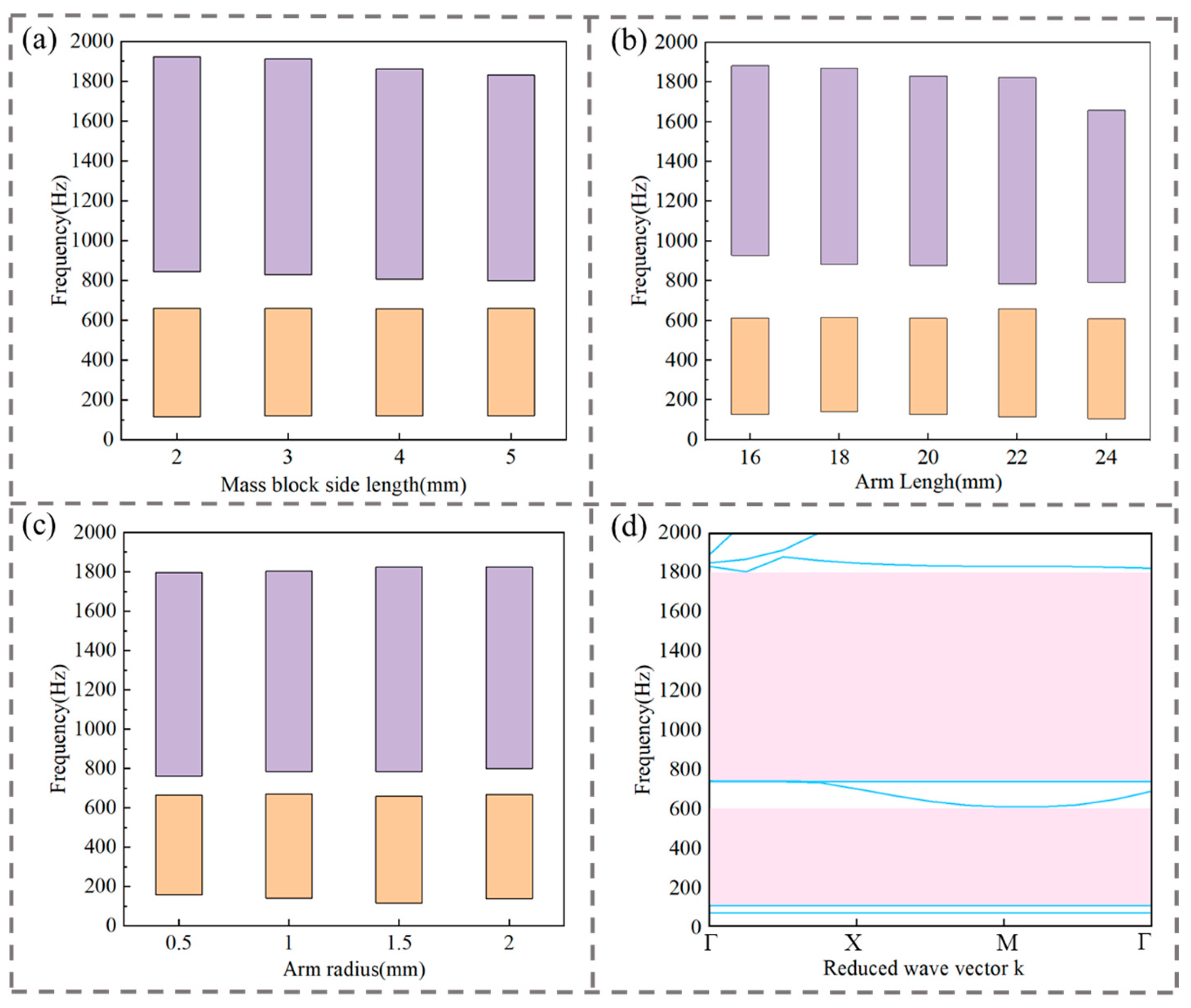
1. Introduction
Vibration and noise often cause serious adverse effects in various engineering fields, such as civil engineering [
1], dynamic machinery [
2], transportation [
3], and aerospace [
4]. In civil engineering, continuous vibration or impact on structural components may lead to fatigue damage, crack propagation, and affect the safety and stability of the structure [
5]. In the field of dynamic machinery, excessive vibration not only affects equipment precision and service life but also increases maintenance costs [
6]. In the transportation sector, especially in high–speed rail, automotive, and aerospace fields, vibration and noise not only affect passenger comfort but may also cause damage to equipment and increase the risk of accidents [
7]. Excessive noise levels also pose a threat to the health of workers and the public, potentially causing hearing loss, psychological stress, and other issues [
8]. Therefore, controlling and reducing vibration and noise is of significant engineering importance, and it is urgently needed to address these issues through new materials and technological means.
Metamaterials are a class of artificially designed materials that achieve unique physical properties beyond the performance of natural materials by precisely controlling their microstructures [
8], attracting the attention and research of various researchers. Unlike traditional materials, the properties of metamaterials are not determined by their constituent components, but rather by the geometric shape and arrangement of their structural units. Due to their unique properties, metamaterials have attracted extensive research and found wide applications in fields such as mechanics [
9], electromagnetics [
10], and acoustics [
11]. In the field of mechanical metamaterials, precise control over the microstructure enables the realization of unconventional properties—such as negative Poisson’s ratio and bandgap effects—that are unattainable in traditional materials. These properties offer significant advantages in structural design and open up new approaches and methodologies, thereby promoting the advancement of structural engineering.
Among various structures, honeycomb structures are widely used in multiple engineering fields due to their light weight, high strength, high stiffness, excellent energy absorption, and superior vibration isolation performance. For example, in the aerospace field [
12,
13], honeycomb structures are widely applied in the load–bearing structures of aircraft wings, spacecraft, and satellites, significantly reducing weight while ensuring structural strength, thereby improving fuel efficiency and flight performance. In building engineering [
14], honeycomb structures are often used in the exterior facades and interior walls of large buildings, providing excellent thermal insulation, soundproofing, and seismic resistance, thus effectively enhancing the comfort and safety of the building. In the automotive industry [
15], honeycomb structures are used in collision protection systems, such as bumper beams and energy–absorbing structures, effectively absorbing collision energy and reducing damage to the vehicle body. Honeycomb metamaterials, by combining traditional honeycomb structures with the design principles of metamaterials, offer significant advantages in vibration damping [
16,
17], sound insulation [
18], and impact resistance [
19,
20]. Their periodic structure induces bandgap effects at specific frequency ranges, effectively suppressing the propagation of elastic waves, thereby achieving vibration and noise isolation. Experimental evidence for the existence of frequency bandgaps in microstructured lattices has been reported. For instance, Placidi et al. experimentally investigated bandgap phenomena in a microstructure model, providing a representative benchmark for bandgap verification in periodic mechanical architectures [
21]. In addition, honeycomb metamaterials also feature light weight, high strength, and other characteristics, making them widely used in aerospace, transportation, and other fields. However, due to their single functionality and limited tunability, there is significant potential for improving the practical applications of honeycomb metamaterials. Particularly in vibration isolation, the bandgaps of structures are usually limited to fixed frequency ranges, while some practical applications require a combination of multiple adjustable properties. In recent years, extensive research has been conducted by scientists on tunable honeycomb metamaterials [
21].
In the field of vibration isolation, tunable mechanical metamaterials can adjust their response to incident elastic waves as required, controlling the transmission of elastic waves by altering the mechanical properties of the structure. Existing tuning strategies can be broadly classified into two types: contact–based and non–contact–based tuning. Although contact–based tuning is more direct and efficient, its dependence on external forces may limit its practical application due to potential constraints on the power source and the complexity of operation. Compared to contact–based methods, non–contact tuning methods offer advantages such as ease of operation, rapid response, and flexibility, as they avoid dependency on specific matrix materials. Non–contact tuning methods mainly include the application of pneumatic forces [
22], magnetic fields [
23], electric fields [
24], and temperature fields [
25], all of which require the matrix materials to exhibit active or shape memory properties. Among these, shape memory materials stand out due to their precise response, programmable control, long–term durability, and ability to respond and adapt shape changes under external fields. This allows for accurate adjustment of structural performance, making them a highly advantageous material choice.
Low–frequency bandgaps in the dispersion curve of acoustic metamaterials (AMs) can suppress wave propagation, providing an effective means of vibration reduction for structures [
26]. The vibration of metamaterial honeycomb sandwich panels can be reduced by designing local resonance bandgaps. However, due to the limitations of added mass, the resonance bandgaps in linear metamaterials are typically narrow [
27]. Xu et al. [
28] designed a hierarchical metamaterial with local resonators. By introducing these local resonators, multiple independent bandgaps were formed in the zero– and first–order metamaterials within frequency ranges of 128–246 Hz and 529–600 Hz, as well as 146–186 Hz and 546–840 Hz, respectively. Li et al. [
29] proposed a novel layered reentrant honeycomb metamaterial, which exhibited a distinct bandgap between 2.88 × 10
5 Hz and 3.06 × 10
5 Hz. As the size of the square unit cells increased, the frequency range of the bandgap in the SRH gradually expanded. Wang et al. [
30] proposed a series of hierarchical hexagonal honeycomb metamaterials and studied the effect of scatterers in the hierarchical honeycomb lattice on the energy band characteristics. The bandgap ranges were 173.3–313.6 Hz and 1840.4–2220.9 Hz, with an optimization of the scatterer filling scheme using a genetic algorithm. Although these studies demonstrate vibration reduction effects, effectively reducing low–frequency and broad–frequency vibrations in lightweight, high–stiffness structures at a low mass cost remains a challenge.
The tuning–fork element, as a prominent resonant component, has been demonstrated to exhibit excellent vibration–response characteristics. However, there have been very limited studies exploring the resonant functionality of tuning–fork–integrated lattice/honeycomb–type architectures. This study proposes a novel tuning fork–honeycomb metastructure based on shape memory polymers and local resonance resonators. The shape memory effect is employed to achieve programmable control of the tuning fork structure, thereby enabling wide–frequency tunable vibration isolation performance. Firstly, a tuning fork unit cell is designed, and the evolutionary relationship between several dimensional parameters and dispersion characteristics is analyzed. Secondly, finite element simulations and experimental studies on various structural configurations are performed. The results obtained from both approaches corroborate each other, validating the accuracy of the proposed theoretical model. Subsequently, a vibration performance control method for the structure is developed based on the shape memory effect. Experimental validations of shape–memory–driven structural stiffness programming and shape programming are conducted, demonstrating excellent performance in achieving a wide–frequency tunable bandgap. Finally, the design concept of programmable mechanical pixel metamaterials is introduced. Transmission Loss simulations are carried out for shape–memory gradient configurations and temperature–induced stiffness gradient configurations, enabling tunable full–band vibration isolation. The methods and conclusions presented in this study are expected to provide guidance for the design of functionalized honeycomb metastructures with strong vibration isolation and autonomous deformation capabilities.
2. Materials and Methods
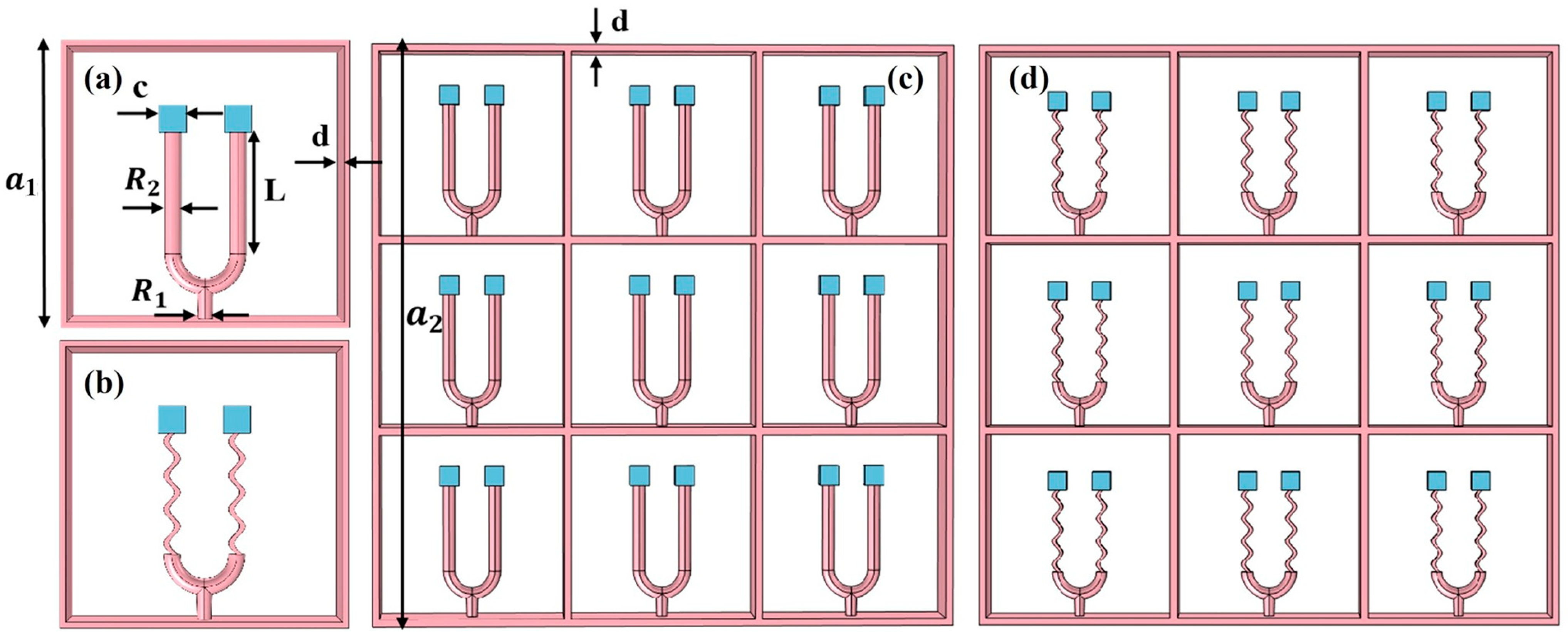
This section provides a brief introduction to the proposed metamaterials, theoretical models, simulation models, and experimental conditions. The cylindrical tuning fork structure (CTFS,
Figure 1a) is characterized by straight cylindrical arms, while the sine–shaped tuning fork structure (STFS,
Figure 1b) adopts sinusoidally curved arms, enabling distinct geometric tuning behaviors. The geometrical parameters of the metamaterial provided by
Table 1.
2.1. Method of Structural Design
Figure 1a shows that the unit cell of the CTFS structure consists of a square honeycomb framework, within which is installed a novel cantilever–beam–mass local resonance resonator composed of a tuning fork structure and two square neodymium iron boron (NdFeB) magnets (N35) (blue parts). Geometrical parameters of unit cell are shown in
Table 1. Both the square honeycomb and the tuning fork are 3D printed using PLA material (pink parts). PLA material exhibits superior mechanical properties. The density of PLA is 1250 kg/m
3, with a Young’s modulus of 1.71 × 10
9 Pa at room temperature and a Poisson’s ratio of 0.35. Furthermore, as the temperature increases, the Young’s modulus of PLA material changes, while other mechanical properties remain unchanged. This allows for modification of the structural mechanical properties through temperature adjustments.
The vibration mitigation performance of a structure largely depends on its natural frequency characteristics. The natural frequency refers to the frequency at which a structure vibrates freely without external excitation. Properly adjusting the natural frequency can improve the vibration reduction performance within specific frequency ranges, thereby effectively reducing vibration transmission. Based on this concept, a tuning–fork resonator with an attached magnetic mass block was developed to achieve vibration attenuation through local resonance. We further clarified the role of the magnetic masses. When attractive/repulsive interactions exist between the magnetic mass blocks, the magnetic force can introduce a controllable static preload in the local connections and interfacial regions. Such preload can modulate the equivalent dynamic stiffness of the local coupling through a “prestress–induced stiffening/softening” mechanism, thereby affecting the local resonance frequency and the frequency–response peaks, and consequently shifting the bandgap location and altering the attenuation level. In other words, the prestress between the magnetic mass blocks primarily influences the overall vibration attenuation performance by tuning the key attributes of equivalent dynamic stiffness/local resonance frequency, which in turn determines the bandgap frequency ranges. The magnetic mass blocks are sintered NdFeB permanent magnets. In the finite–element model, they are approximated as an isotropic linear–elastic material with ρ = 7.5 × 10³ kg/m3, E = 150 GPa, and ν = 0.24. Typical room–temperature mechanical properties may be referred to as follows: tensile strength 80 MPa, compressive strength 950 MPa, and Vickers hardness 600 HV. Given that the temperature range considered in this study (25–75 °C) falls within the typical operating–temperature range of common NdFeB grades, the mechanical and magnetic properties of the magnetic components are expected to remain stable in this interval, and thus do not introduce additional uncertainty.
To effectively dissipate surface waves via the resonant behavior of the tuning fork structure, its fundamental natural frequency should be designed to coincide with the frequency range of the targeted surface waves, thereby maximizing resonance–induced energy attenuation. The natural frequency of the tuning fork is determined by the vibration theory of the bending beam. For each arm of the tuning fork, its natural frequency can be approximated [
31] as follows:
where:
β = 1.875 (the eigenvalue of the first–order mode, the constant for the natural mode of the bending beam).
E is the elastic modulus of the tuning fork material.
I is the moment of inertia of the tuning fork arm, and for a cylindrical cross–section,
.
μ is the mass per unit length, which includes the distribution of the tuning fork’s own mass and the mass of the magnets. The expression for
μ can be derived as follows:
where
is the cross–sectional area of the tuning fork arm. The mass of the magnet,
, where
is the density of the magnet (N35 is approximately 7500 kg/m
3). The above parameters are substituted into the natural frequency formula:
In Equation (3), the bottom of the honeycomb frame is considered completely rigid (rigid constraint), assuming that the honeycomb frame has no impact on the vibration of the tuning fork. However, in reality, the honeycomb frame has some flexibility, and this flexibility effect causes a decrease in the tuning fork’s natural frequency. Therefore, to more accurately reflect the actual impact of the honeycomb frame, its flexibility’s effect on vibration must be considered. To achieve this, an equivalent stiffness
is introduced, which transforms the honeycomb frame’s flexibility effect into the influence of elastic boundary conditions, thus correcting the tuning fork’s natural frequency. The specific correction formula is as follows:
Here, represents the stiffness of the bottom of the tuning fork, and denotes the flexible stiffness of the honeycomb frame.
In the theory, the magnetic mass is simplified as a concentrated mass, which may underestimate its effect on the distribution of vibration modes. The inertial effect of the magnetic mass reduces the inherent frequency of the tuning fork. Considering the effect of the magnetic mass distribution on vibration, the correction of the tuning fork’s equivalent mass
is given by:
In the theoretical model, the arms of the tuning fork are typically treated as ideal uniform beams. However, in practice, the transition region at the base (the connecting part) increases flexibility, thereby reducing stiffness and the natural frequency. A correction for the bending and the connecting part is introduced by adding an equivalent flexibility factor α at the base of the tuning fork to modify the effective length
:
Therefore, the natural frequency of the tuning fork mass–block structure established in this study is:
The flexibility of the honeycomb frame is equivalently represented by an elastic boundary stiffness at the tuning–fork root. It is defined by the static compliance at the mounting interface as = where F is the resultant force applied along the dominant vibration direction and is the corresponding displacement of the interface. In practice, is obtained from a static FE compliance analysis of the honeycomb frame by applying a unit load (or unit displacement) at the tuning–fork mounting region while enforcing the same boundary constraints as in the assembled specimen, and then extracting or F to compute . Finally, is calibrated using a baseline configuration at room temperature by matching the theoretical fundamental frequency with the reference value from full FE/experimental modal identification, ensuring a consistent correspondence between the reduced–order model and the measured dynamics.
To effectively dissipate the energy of surface waves, the natural frequency of the tuning fork should closely match their frequency range, thereby maximizing resonance–based energy absorption. Based on the target frequency of 200 Hz for ultra–low–frequency vibration attenuation, the calculated natural frequency of the structure is 200 Hz. Accordingly, the CTFS structure employs a square honeycomb unit cell with an edge length of 52 mm and thickness of 2 mm, incorporating square magnets of 5 mm edge length oriented perpendicular to each tuning fork arm. The periodic structure is arranged by a 3 × 3 unit cell layout, with the lattice constants of the periodic structure being ax = az = a = 156 mm and ay = 20 mm.
2.2. Wave Propagation Theory
In a linear elastic, undamped, passive, and anisotropic heterogeneous medium, the propagation equation of the elastic wave can be expressed as [
31]:
Here,
λ is the first Lamé constant,
μ is the second Lamé constant,
ρ is the material density,
r is the position vector, and
represents the displacement field. In the two–dimensional model, assuming
, Equation (9) can thus be decomposed into an in–plane equation:
Similarly, the equation in the perpendicular plane is:
Additionally, the equation perpendicular to the plane is:
According to Bloch’s theorem, the displacement field can be expanded as [
32]:
where
is the wave frequency,
is the Bloch wave vector, and for the two–dimensional periodic model,
is a periodic function, expressed as:
By combining the above Equation (14) with Equations (11)–(13), the following eigenvalue problem is obtained:
Here, and represent the global stiffness matrix and mass matrix, respectively, while and denote the generalized nodal displacement and force vectors.
Based on the above equations, the wave propagation theory of metamaterials can describe the propagation characteristics of the wavevector within the reciprocal Brillouin zone. Specifically, the first irreducible Brillouin zone (IBZ) in the reciprocal space is determined by the fundamental reciprocal lattice vectors
a1 and
a2. Frequencies associated with the wavevector
are selected only within this region, and the wavevector path will follow the Г–X–M–Г path within the Brillouin zone. In addition to full–field Bloch–Floquet finite–element formulations, reduced–order generalized beam/continuum models have been developed to efficiently describe wave propagation in architected planar lattices with symmetric deformation patterns (e.g., pantographic sheets) [
33]. In this work, the Bloch–Floquet FE eigenvalue framework is adopted to accurately capture the coupled dynamics between the host frame and the embedded tuning–fork resonators.
2.3. Sample Preparation and Material Analysis
2.3.1. Sample Preparation
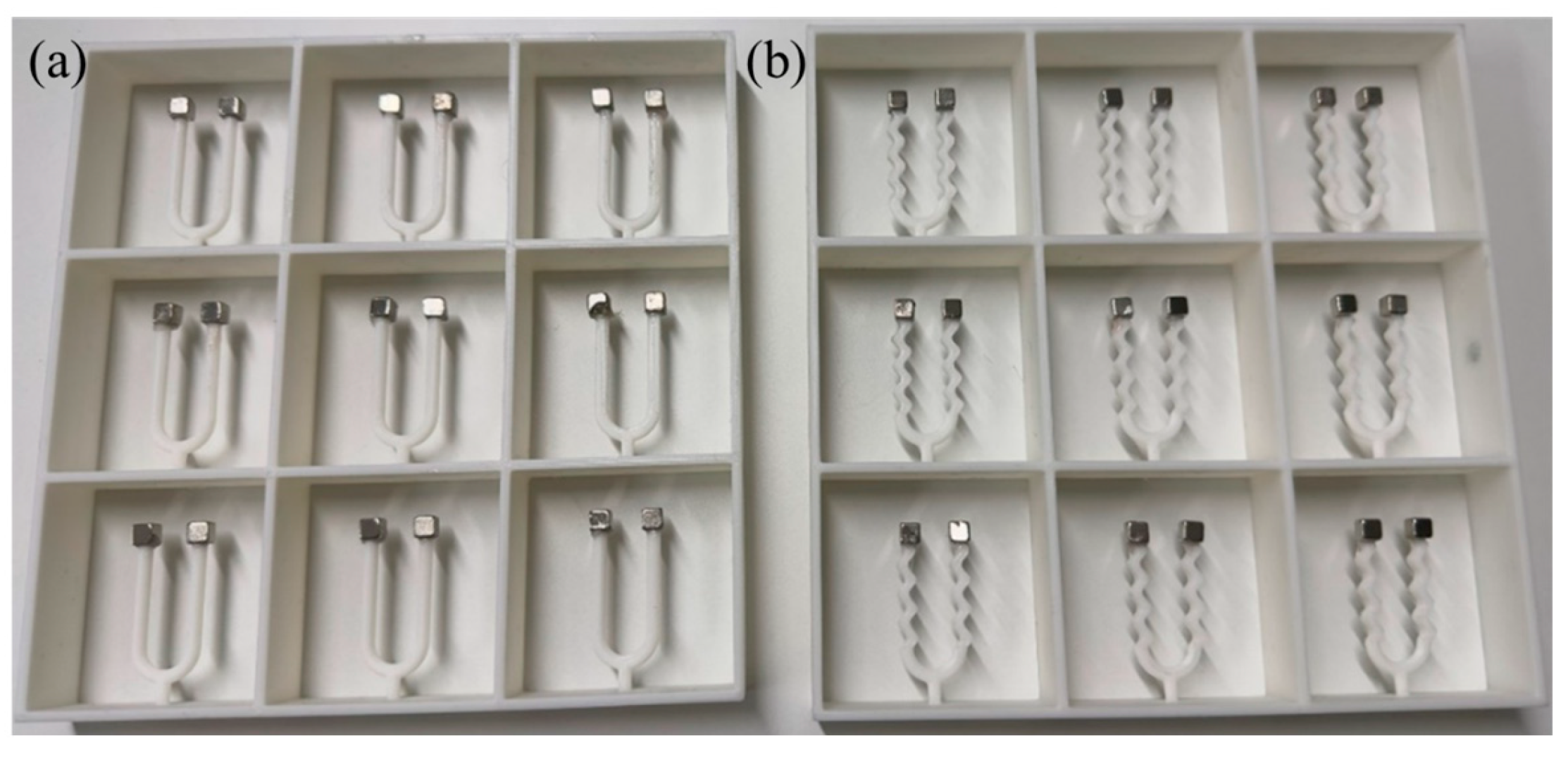
All samples in this study were fabricated using Fused Deposition Modeling (FDM) technology, employing Shape Memory Polylactic Acid (SMP PLA) filament (Bambu Lab, Shenzhen, China) with excellent shape memory properties and temperature–induced stiffness variation as the printing material. To ensure accurate and efficient printing, the printer speed was set to 50 mm/s, and the melting temperature was set to 220 °C. The printer nozzle diameter was 0.4 mm, and the printer platform temperature was set to 50 °C. The samples are shown in
Figure 1c,d and
Figure 2.
2.3.2. DSC Testing
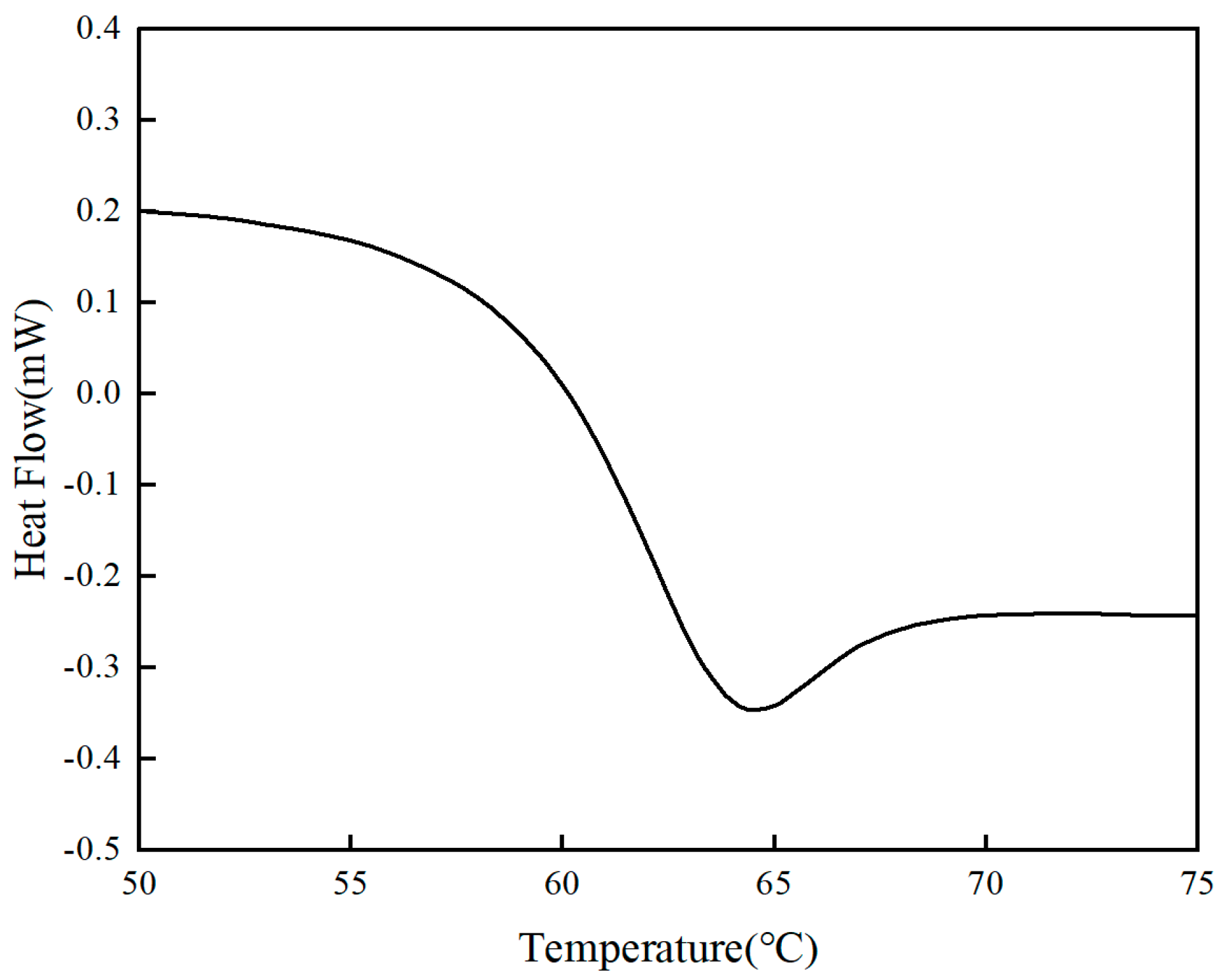
The glass transition temperature (Tg) is the temperature at which a material transitions from a glassy state to a high–elasticity state, directly influencing its performance and processing properties. The glass transition temperature of the shape–memory PLA material was tested using a DSC 200F3 (NETZSCH Group, Selb, Germany) differential scanning calorimeter. The 5–10 mg test sample was placed into a crucible, and 60 mL/min of nitrogen was introduced as a protective gas. The sample was first heated at a rate of 20 °C/min to 200 °C and held for 5 min to eliminate thermal history, then cooled at a rate of 10 °C/min to 20 °C, and finally heated again at a rate of 10 °C/min to 200 °C to obtain the DSC curve of the sample.
2.3.3. Mechanical Property
To obtain the parameters of PLA material at different temperatures, a quasi–static isothermal uniaxial tensile test was first conducted on the PLA material used for 3D printing. The tensile specimens were 3D printed using the same method as the sample preparation, with dog–bone–shaped specimens printed for testing. The dog–bone–shaped specimens were cut, with a total length of 115 mm and a thickness of 2 mm. The effective length of the tensile test specimen was 33 mm, and the width was 16 mm. Prior to loading, the samples were held at the corresponding constant temperature for 15 min to achieve thermal equilibrium. The uniaxial tensile tests were performed on a universal material testing machine, with a loading rate of 2 mm/min, stretching the PLA samples to complete failure. The tests were repeated on five samples at different temperatures to reduce experimental and data errors. Based on the material’s glass transition temperature, six experimental temperatures were selected: from 298 K to 343 K, with a 10 K interval.
2.4. Experimental Verification Methods for the Vibration Isolation Performance of Metamaterials
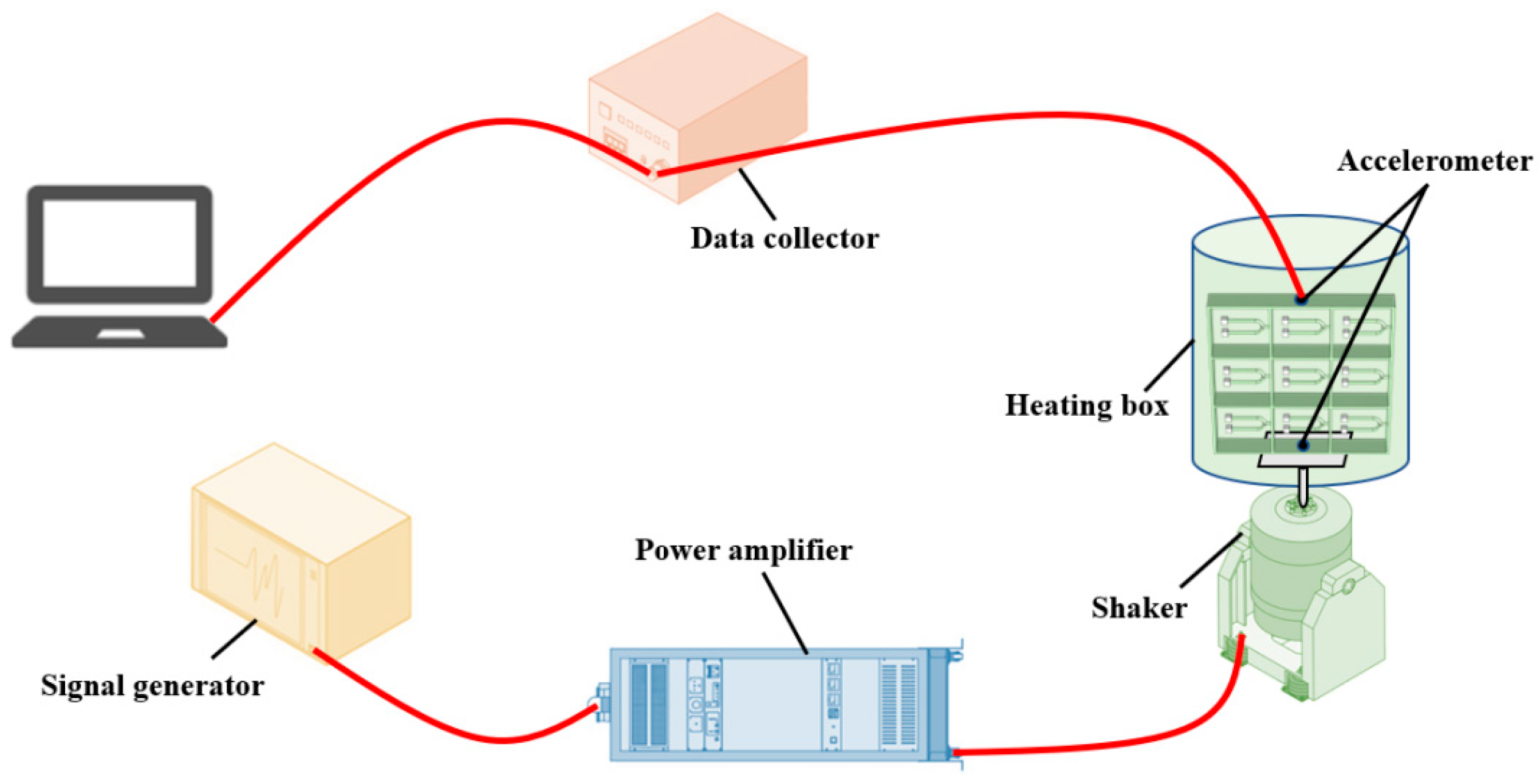
The vibration testing system is used to study the vibration isolation characteristics of the metamaterial structure.
Figure 3 shows that the vibration testing system includes a signal generator, a power amplifier, a modal shaker, two accelerometers, a data acquisition system, and a computer. The metamaterial structure is firmly mounted on the modal shaker, with two accelerometers fixed on its lower and upper surfaces, respectively. The sine acceleration signal generated by the signal generator is amplified using the power amplifier and then applied to the metamaterial structure by the shaker. The signal is detected by the accelerometer on the lower surface, and the resulting acceleration response is continuously monitored by the accelerometer on the upper surface. The tuning fork mass–block structure is firmly bonded to the vibration table in the vertical direction using epoxy adhesive. This setup is designed to eliminate any impact of vibration induced by shaft bending on out–of–plane vibrations. The vibration excitation is generated by the signal generator in the form of a sine sweep waveform, with the signal generator outputting a sine sweep signal from 0 to 2000 Hz to the signal amplifier. The signal is then amplified by the power amplifier and applied to the tuning fork mass–block structure through the modal shaker. The vibration load is generated by the shaker. The vibration is transmitted through the cellular metamaterial to the top of the structure, where it is measured by an accelerometer (PCB PIEZOTRONICS LW254351). The input and output signals are collected and recorded by the data acquisition system (DH5956). The accelerometers and data acquisition system capture the input and output acceleration signals in the time domain and convert them into frequency response curves.
2.5. Material Property Analysis
2.5.1. Glass Transition Temperature
During the parameter characterization of the 3D printing material, a detailed analysis of its constitutive properties and glass transition temperature was first conducted. According to the method described in
Section 2.3.2, the thermal properties of the SMP PLA material were tested using a DSC 200F3 differential scanning calorimeter, and the resulting DSC curve is shown in
Figure 4. For SMP PLA, within the glass–transition region, a step–like change in the heat–capacity baseline and possible enthalpy relaxation/physical aging effects occur, resulting in a “nonlinear evolution” of the heat–flow response. Within the tested temperature range, no significant endothermic or exothermic peaks were observed in the heat flow curve. The occurrence of obvious bending within specific intervals corresponds to the glass transition zone of the material. The glass transition temperature (
Tg) was determined by drawing tangent lines to the baselines of the glassy and rubbery states, with the intersection of these lines indicating
Tg. The test results show that the glass transition temperature of the PLA material is 62.3 °C.
2.5.2. Mechanical Properties Analysis
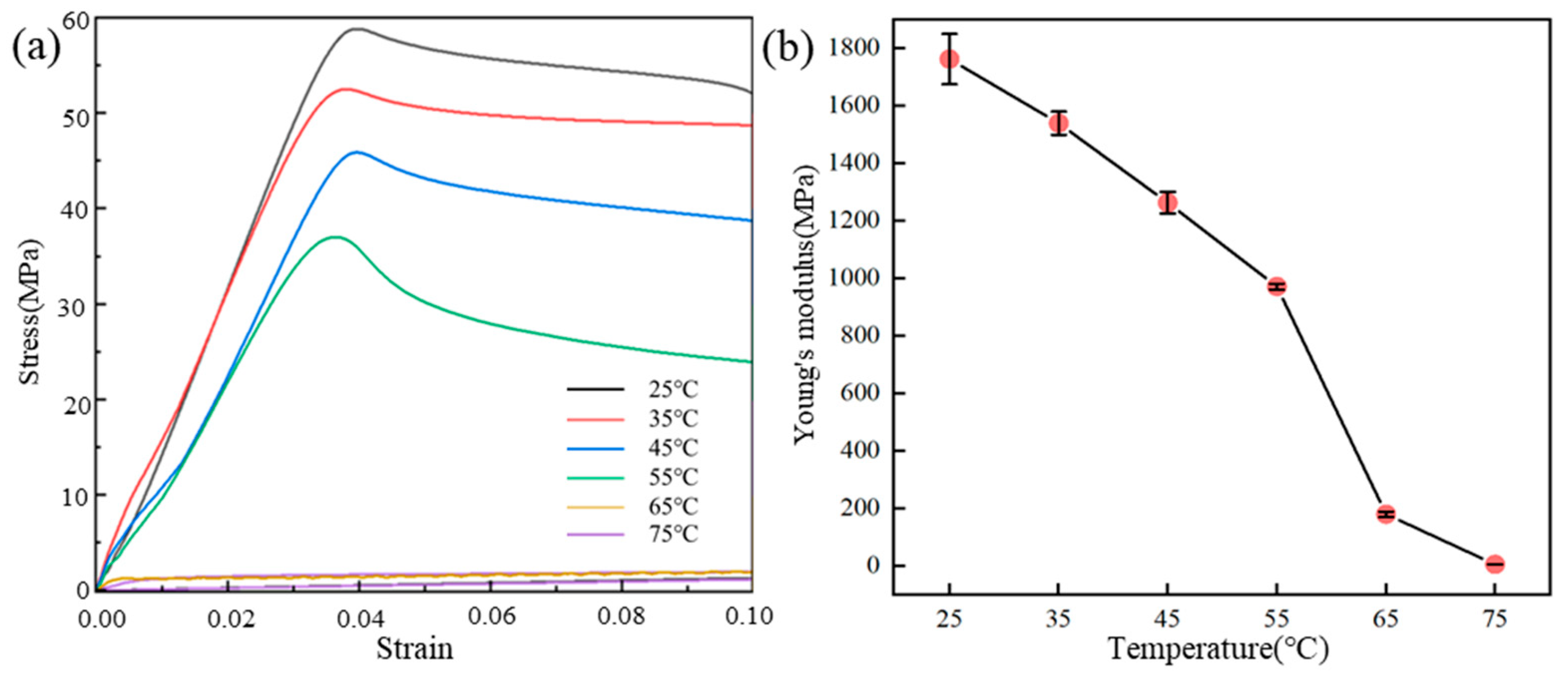
After conducting quasi–static isothermal uniaxial tensile tests on the shape memory PLA material used for 3D printing, the resulting stress–strain curves are shown in
Figure 5a, with the testing procedure described in
Section 2.3.3. The elastic modulus of the material was obtained by fitting the initial linear segment of the stress–strain curve. The mechanical response of PLA exhibits significant temperature dependence: both the ultimate tensile strength and the initial elastic modulus decrease markedly with increasing temperature. In addition, similar to most viscoelastic polymers, the stress–strain curve of PLA displays a pronounced strain–softening behavior, which is a characteristic mechanical phenomenon of thermally sensitive polymers under thermo–mechanical coupling.
According to the error bar chart in
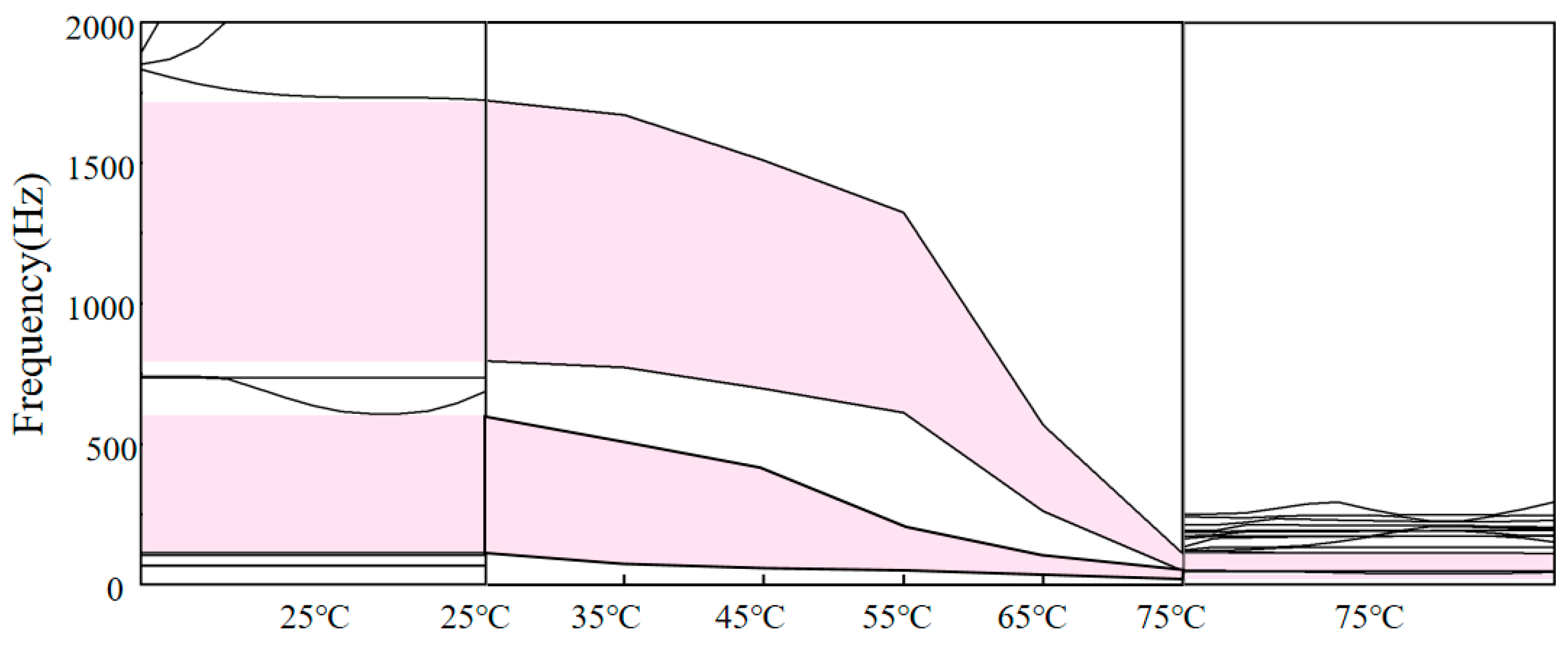
Figure 5b, each red data point represents the average Young’s modulus measured at the corresponding temperature. As the temperature increases from 25 °C to 75 °C, the Young’s modulus of the SMP PLA material shows a significant downward trend (as shown in
Table 2). Within the range of 25 °C to 55 °C, it exhibits an approximately linear decrease with temperature. This linearity enables precise control of the material’s Young’s modulus through temperature changes, which directly affects the position and width of the structural bandgap. Consequently, the structure can dynamically adjust its vibration isolation performance in response to varying working environments. This temperature–controlled tuning mechanism enhances the flexibility and adaptability of the structure, especially in scenarios with significant temperature fluctuations, providing a convenient and efficient method for optimizing vibration reduction performance.
Moreover, the error bar chart indicates that the overall error remains within an acceptable range of approximately 1%. Although the inherent brittleness of PLA, combined with potential defects from the FDM printing process (e.g., layering errors, dimensional inaccuracies, and uneven filling), may cause minor local imperfections and asymmetric deformations, these do not significantly compromise the structure’s mechanical performance. The experimental results demonstrate good repeatability and data reliability (
Appendix A).
4. Experimental Validation and Analysis
4.1. Validation of Local Resonance—Impact of Mass Block on Band Gap
4.1.1. Transmission Loss Simulation Analysis
For numerical validation, the vibration isolation performance of the structure is calculated using the commercial software COMSOL Multiphysics 6.2. Typically, excitation acceleration is applied at one end of the model in a specific direction, and the response is measured at the other end of the structure to determine its vibration isolation performance. Transmission Loss can be obtained by
TL = 20log10|Aout/Ain|, where
Aout and
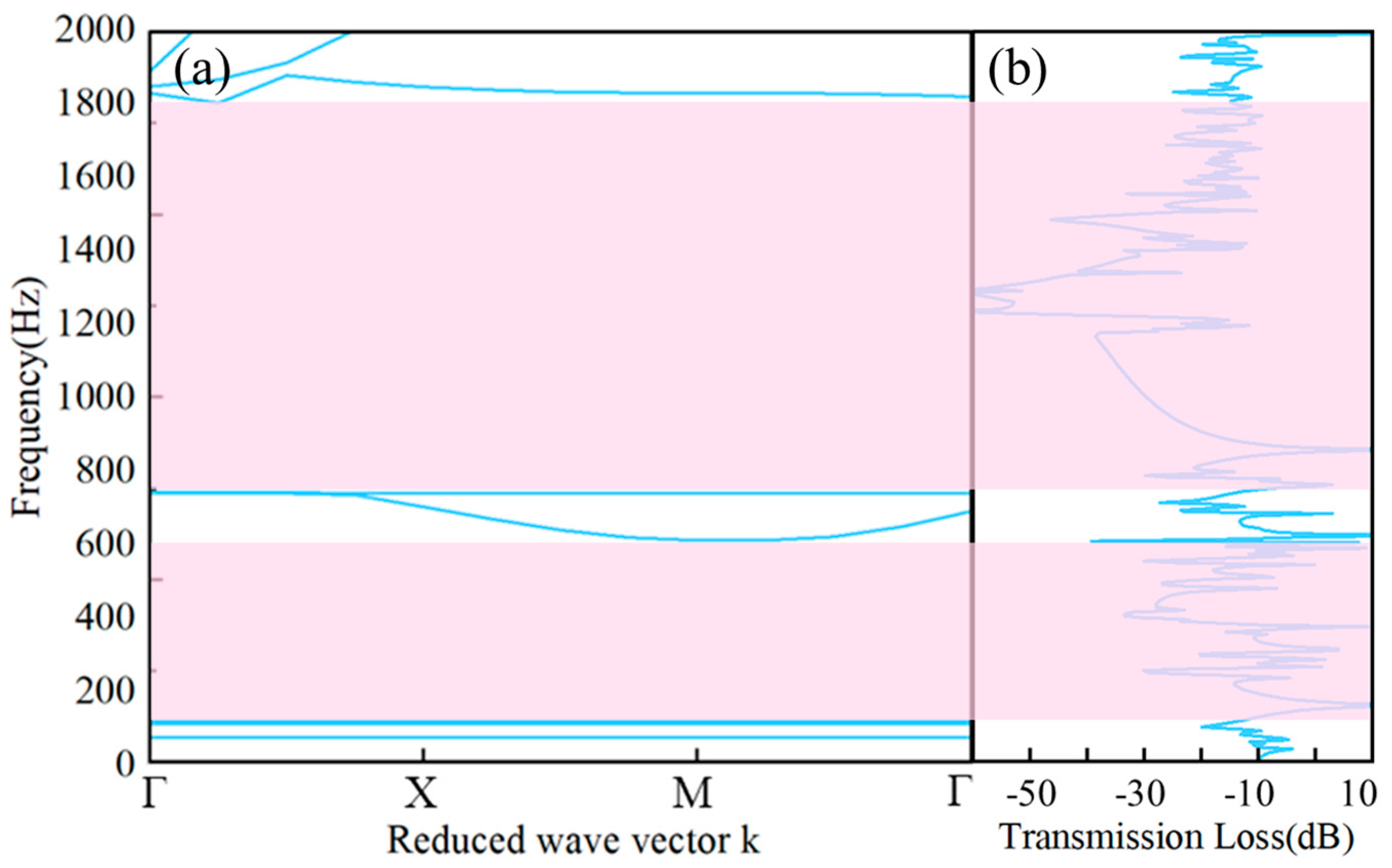
Ain represent the response acceleration and the excitation acceleration, respectively. A Transmission Loss (TL) value below 0 dB indicates that the metamaterial effectively reduces the vibration acceleration signal. A notable increase in TL within a specific frequency range reflects a significant decrease in the transmissibility of acoustic or vibrational energy, signifying the emergence of a “bandgap” [
34]. We define a frequency interval as an “effective bandgap region” if the TL remains consistently below −5 dB throughout the entire interval. In contrast, frequency ranges that do not meet this threshold but still demonstrate clear attenuation are referred to as “weak bandgap regions.”
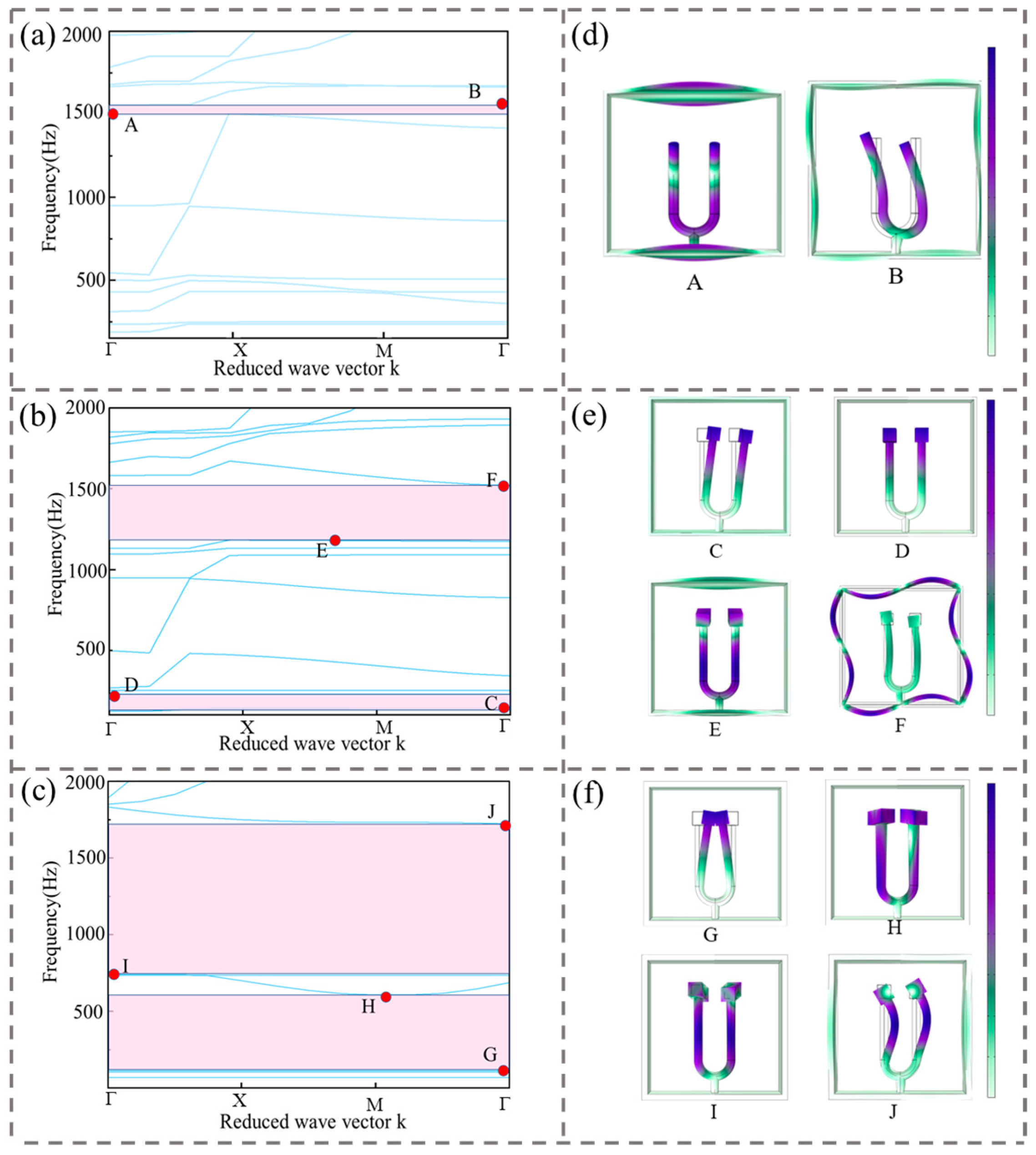
The pink–marked bandgap region in
Figure 9a exhibits precise frequency correspondence with the high Transmission Loss range (manifested by a significant leftward curve shift) in
Figure 9b.
4.1.2. Experimental and Simulation Verification
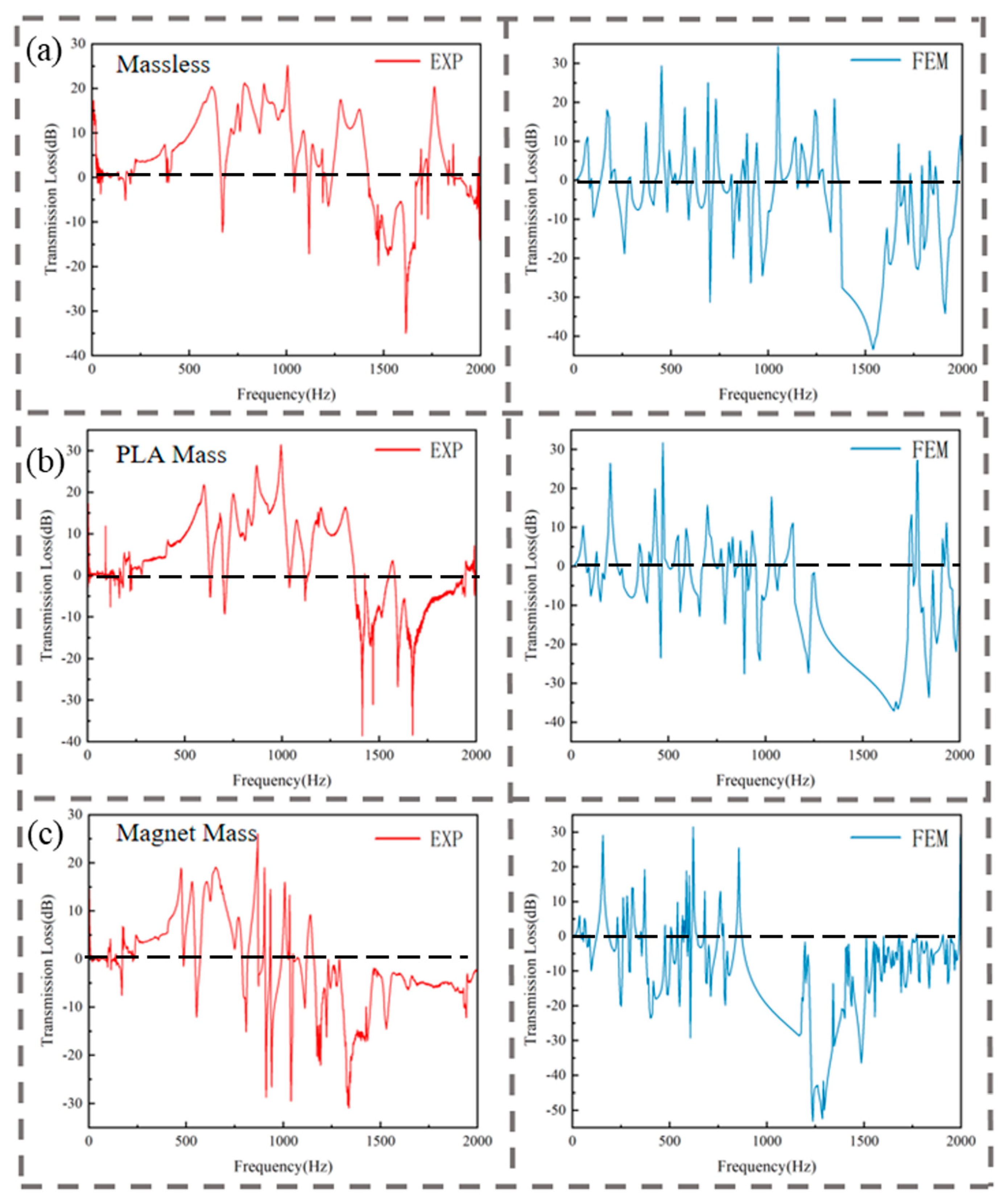
To validate the vibration isolation enhancement caused by the local resonance effect, the transmission of elastic waves through the finite–sized cellular mechanical metamaterials of CTFS structures with magnetic and PLA mass blocks, as well as without any mass blocks, was simulated in
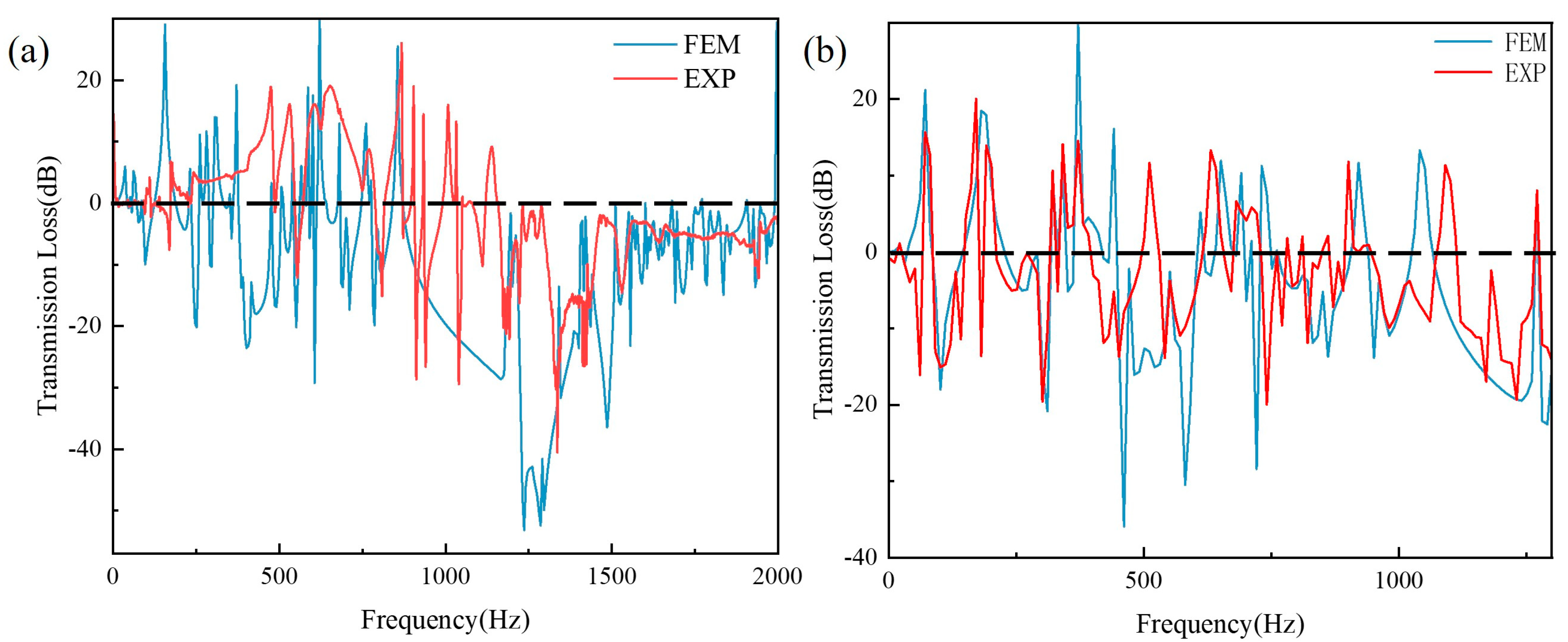
Figure 10. For the CTFS structure without mass blocks, the region with negative Transmission Loss in
Figure 10a spans from 1470 Hz to 1680 Hz, which corresponds to the narrow bandgap between the 7th and 8th dispersion bands (1505.9–1581 Hz) in the bandgap diagram. The good agreement between these two results indicates that the local resonance capability of the structure without mass blocks is limited, leading to low dynamic stiffness and weak vibration isolation performance.
After introducing PLA mass blocks, the equivalent mass of the structure increases, and the Transmission Loss curve in the experiments clearly shows significant vibration isolation effects at lower frequencies. A new vibration isolation band appears between 180 Hz and 250 Hz, while the starting frequency of the original vibration isolation band shifts to lower frequencies. Additionally, the cutoff frequency reaches 2000 Hz, corresponding to the bandgap diagram where two bandgaps are generated. The low–frequency bandgap appears between the 2nd and 3rd bands, and the bandgap between the 7th and 8th dispersion spectra significantly widens.
Furthermore, by introducing magnetic blocks, the first vibration isolation band shifts to the range of 110 Hz to 390 Hz, which is broader than that of the PLA mass block CTFS structure. The starting frequency of the second vibration isolation band also significantly shifts to lower frequencies, corresponding to the further downward shift of the bandgap in the bandgap diagram, with an even broader bandgap range, thus validating the predicted results from the bandgap analysis. In conclusion, the excellent agreement between experimental and simulation results in terms of bandgap position and width indicates that the Transmission Loss testing further confirms the accuracy and practical value of the analysis.
4.2. Vibration Isolation Experiment Using Shape Memory to Alter Structural Shapes
4.2.1. The Effect of Structural Change on Transmission Loss
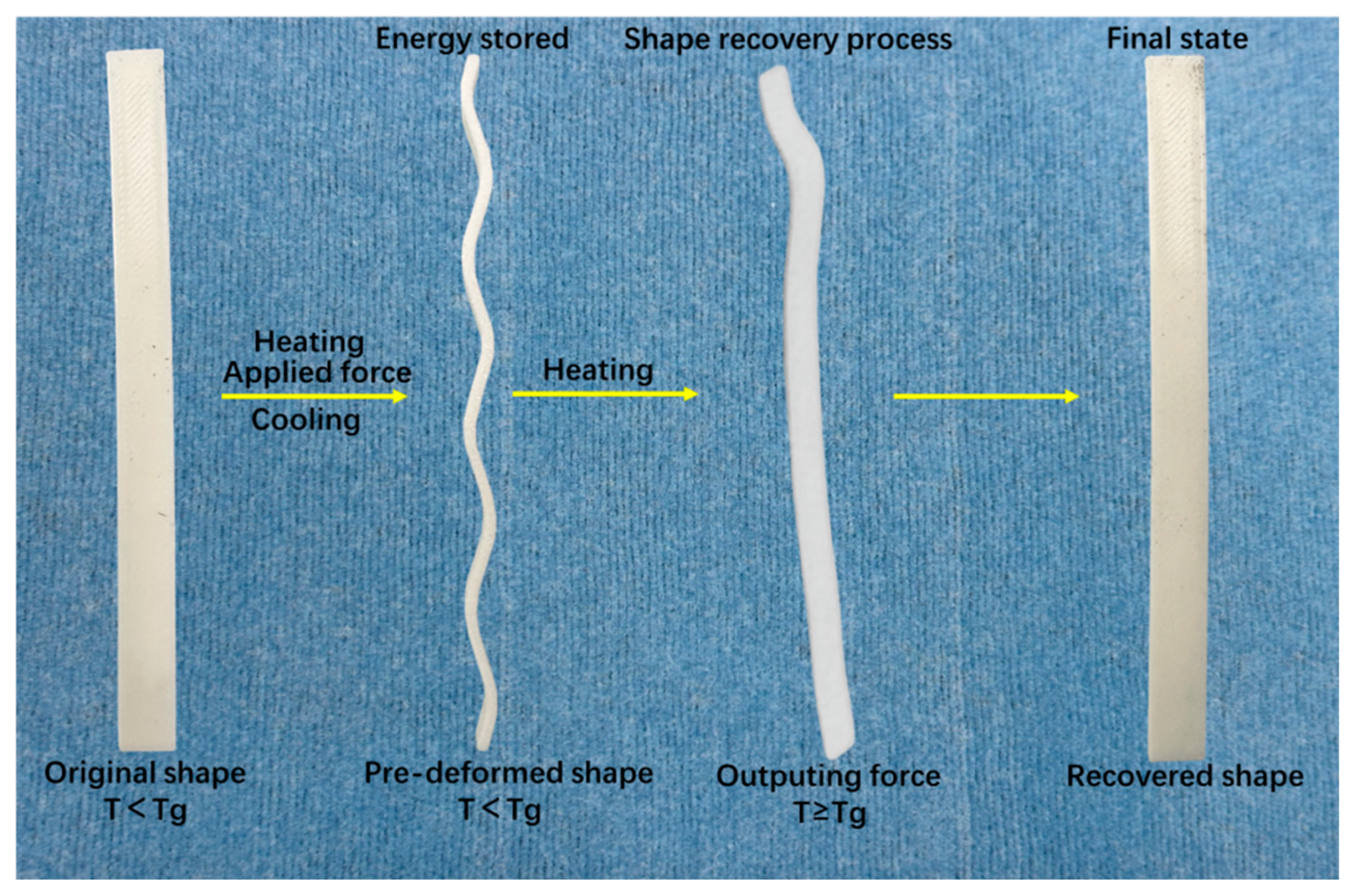
The vibration reduction performance is closely related to the structure’s geometry and temperature. Shape memory polymers, which can change shape and adjust stiffness in response to temperature variations, are therefore introduced to modulate the vibration damping performance of the CTFS structure. To verify the effect of shape memory–induced structural changes on vibration isolation performance, the Transmission Loss of elastic waves through finite–sized honeycomb mechanical metamaterials in both CTFS and STFS structures was simulated and experimentally tested. The simulation curve is shown in blue, and the experimental curve is shown in red. In
Figure 11, at 25 °C, the bandgap of the CTFS structure is between 80–130 Hz and 1351–1780 Hz, while the bandgap of the STFS structure is between 100–210 Hz and 720–1130 Hz. It can be observed that the bandgap of the STFS structure shifts significantly towards the lower frequency range, indicating that the Transmission Loss changes with the shape memory–induced structural change. The deformed structure exhibits a 20% reduction in the center frequency of the first bandgap and a 47% reduction in the center frequency of the second bandgap compared to the undeformed configuration.
4.2.2. The Effect of Stiffness Changes on Transmission Loss
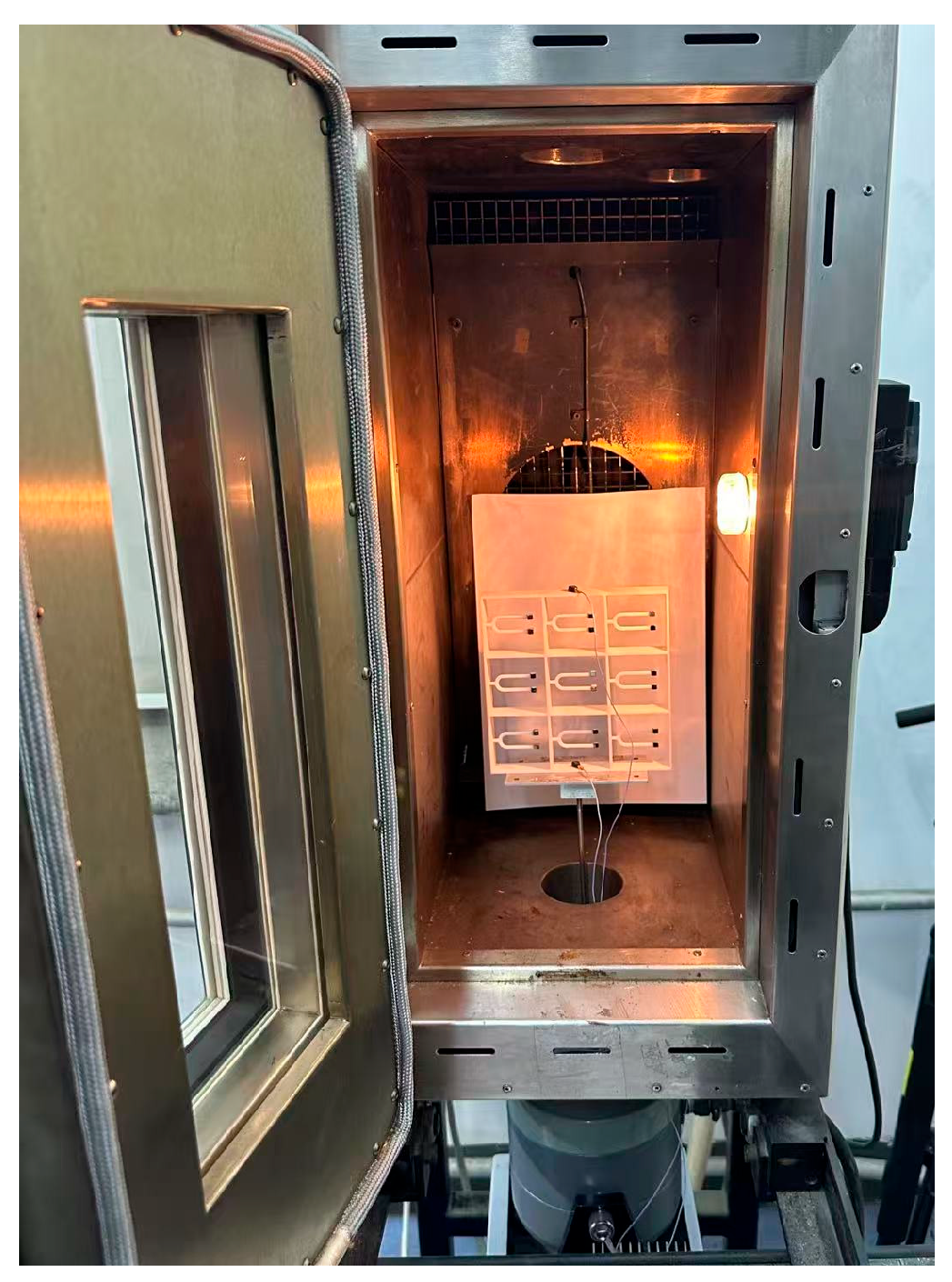
The structure was mounted on the vibration test system and placed within a temperature–controlled box. Prior to testing, it was held at the target temperature for 15 min to ensure thermal equilibrium. The experimental setup is shown in
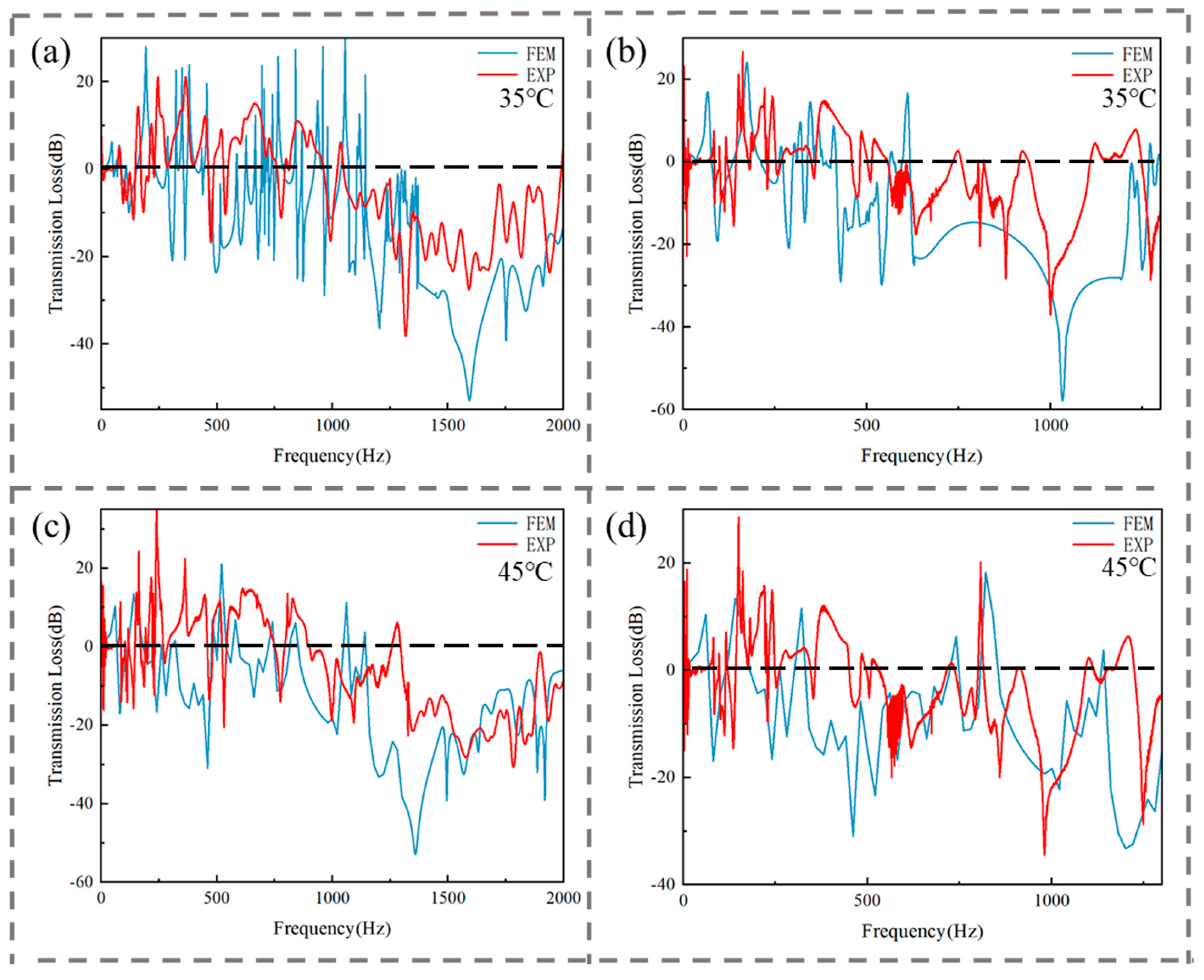
Figure 12. A sine sweep signal with a frequency range of 0–2000 Hz was produced by the signal generator and transmitted to the CTFS structure via a modal exciter. Input and output acceleration signals were acquired in the time domain using accelerometers and a data acquisition system, and subsequently transformed into frequency response functions. Transmission Loss curves of both CTFS and STFS structures under various temperature conditions were obtained, as illustrated in
Figure 13.
Figure 13 shows that from the Transmission Loss curves, it can be observed that different tuning fork mass block structures (CTFS and STFS) and temperatures (35 °C and 45 °C) have a significant impact on vibration attenuation performance. As can be seen from
Figure 13a,c, under the combined effect of temperature, the Transmission Loss of the CTFS structure changes significantly. At 35 °C, it shows prominent negative regions in the low–frequency range (approximately 80–220 Hz) and mid–frequency range (approximately 1052–1891 Hz), particularly in the 1052–1891 Hz range, the attenuation of vibrations is more pronounced, indicating strong vibration reduction performance of the structure in this frequency band. As the temperature increases to 45 °C, the negative regions of the curve generally decrease, especially in the low–frequency range. This is because, with the increase in temperature, the Young’s modulus of the PLA material decreases, leading to reduced rigidity and causing the vibration suppression bandgap to shift forward. In this case, the structure exhibits vibration reduction effects in the 912 Hz to 2000 Hz range.
As can be seen from
Figure 13b,d, for the STFS structure obtained after shape memory deformation, at 35 °C, the curve shows significant negative regions in the low–frequency range (100–500 Hz) and high–frequency range (1000–1500 Hz), especially in the 1000–1500 Hz range, where the STFS structure exhibits prominent vibration attenuation performance. This indicates that the structure exhibits excellent vibration attenuation performance in this frequency range. At 45 °C, similar to the CTFS structure, as the temperature increases, the negative regions of the Transmission Loss curve decrease, especially in the low–frequency range. Nevertheless, the STFS structure still maintains a certain level of vibration attenuation over a wide frequency range, particularly in the 1000–1500 Hz high–frequency range, where the vibration reduction effect is quite pronounced.
A horizontal comparison between the two, as the temperature rises, the vibration attenuation performance in the mid–to–high frequency range significantly decreases, especially in the CTFS structure. However, the STFS structure still maintains a relatively stable vibration attenuation performance at higher temperatures, particularly in the lower frequency range. At the same temperature, the STFS structure exhibits stronger vibration attenuation, especially in the 500–1100 Hz mid–to–low frequency range, while the CTFS structure shows better vibration attenuation in the mid–to–high frequency range (1000–2000 Hz).
4.3. The Effect of In–Plane and Out–of–Plane Deformation of Shape Memory Structures on Vibration Isolation
In the design of shape–memory programmable metamaterials, after studying the changes in mass blocks, temperature, and shape–memory arm structures, we investigate the two fixed deformation modes: in–plane and out–of–plane deformation. In–plane and out–of–plane deformations correspond to the bending stiffness and mechanical responses of shape–memory materials in different directions. Studying these two deformation modes can provide a more comprehensive understanding of local resonance, deformation energy dissipation, and the overall bandgap formation mechanism.
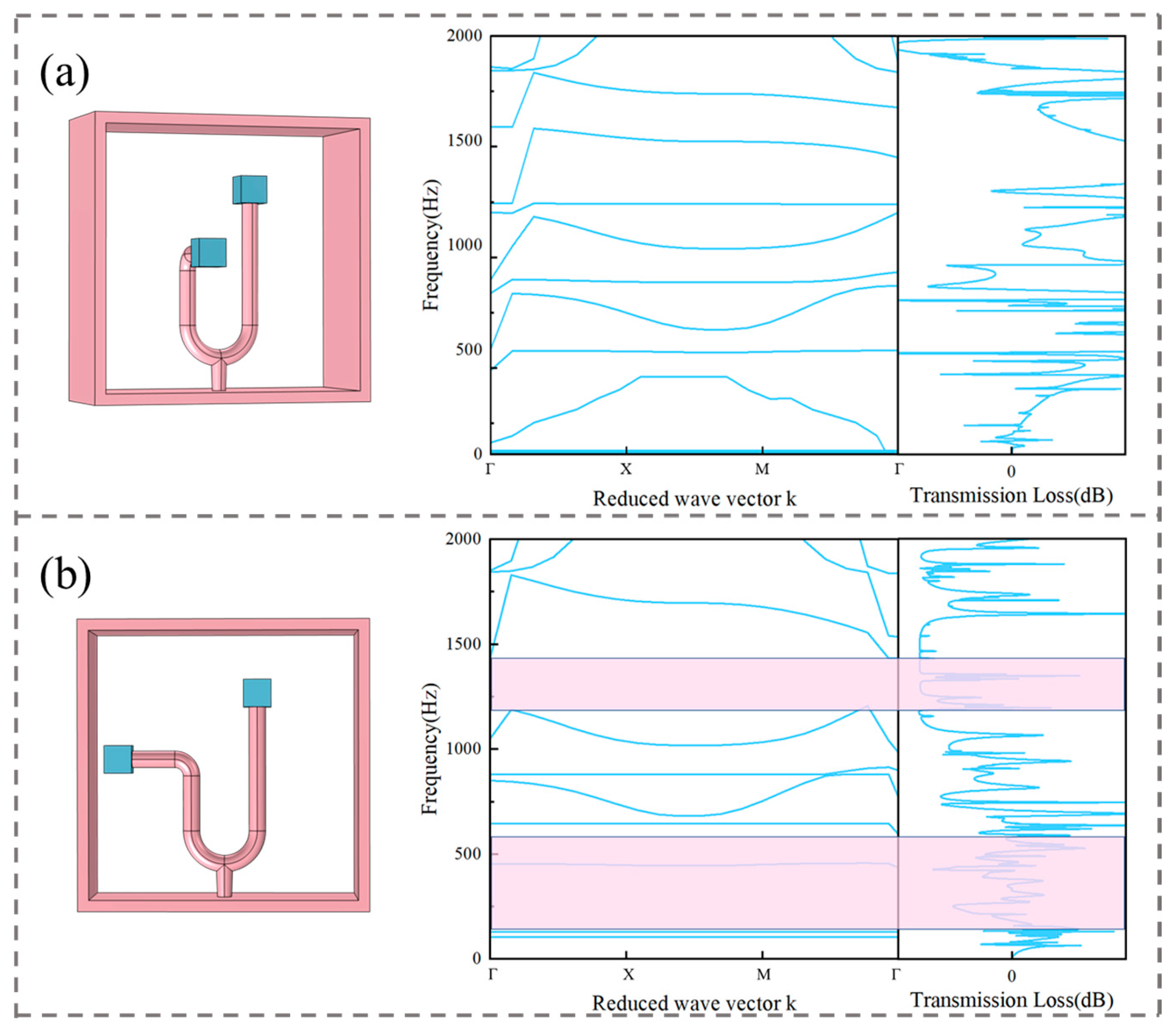
In
Figure 14a is a schematic of the out–of–plane deformation structure, with the energy band curve and Transmission Loss graph on the right side, corresponding to the out–of–plane deformation of the structure. It can be seen that the energy band curve for this structure does not show a clear bandgap, and the corresponding curve almost does not have negative values, meaning there is almost no vibration reduction effect. When the deformation mode changes to in–plane deformation, the deformed structure is shown on the left side of
Figure 14b. From the energy band curve on the right, it can be seen that the pink areas represent the bandgaps of the structure, indicating that the structure exhibits vibration reduction effects in the 134–684 Hz and 1215–1657 Hz ranges. These correspond well with the negative values in the Transmission Loss curve, confirming the accuracy of the simulation and demonstrating that changing the bending direction of the beams can control the presence and position of the bandgaps.
When shape memory materials deform in different directions, their bending stiffness, equivalent stiffness, damping, and other mechanical parameters change, thereby affecting the distribution and coupling modes of each mode. When the structure mainly undergoes in–plane deformation, the bent beams coincide with the rest of the structure’s plane, and their stiffness and damping are more likely to concentrate on affecting transverse or bending modes, thus generating local resonance bandgaps in specific frequency ranges. Out–of–plane deformation corresponds to another set of bending/shear stiffness, which can activate or suppress different modal coupling modes, resulting in significant differences in the bandgap position, width, and curve in the corresponding frequency range, leading to the absence of a bandgap in the structure.
This control method utilizes the directional deformation of the shape–memory CTFS structure to effectively modulate the local resonance and modal coupling characteristics of the system, thereby enabling the generation or suppression of bandgaps. This approach provides a flexible and programmable strategy for vibration isolation structures, allowing selective attenuation or transmission of vibrational energy within targeted frequency bands according to practical requirements, demonstrating significant engineering applicability.
4.4. Influence of Gradient Variations on Elastic Wave Evolution
Different unit cell morphologies exhibit significant differences in both bandgap locations and widths. Based on this observation, the present study introduces the concept of mechanical pixel metamaterials, treating each unit cell as a functional “pixel.” By synergistically controlling the configurational states and spatial arrangements, the vibration attenuation frequency bands can be intelligently and programmably tuned. Consequently, this endows the structure with adjustable vibration isolation capabilities under multiple operating conditions.
To achieve programmable control of unit cell configurations, this study combines shape–memory–induced deformation with temperature–dependent stiffness modulation to construct mechanically pixelated metamaterials with intelligent response capabilities.
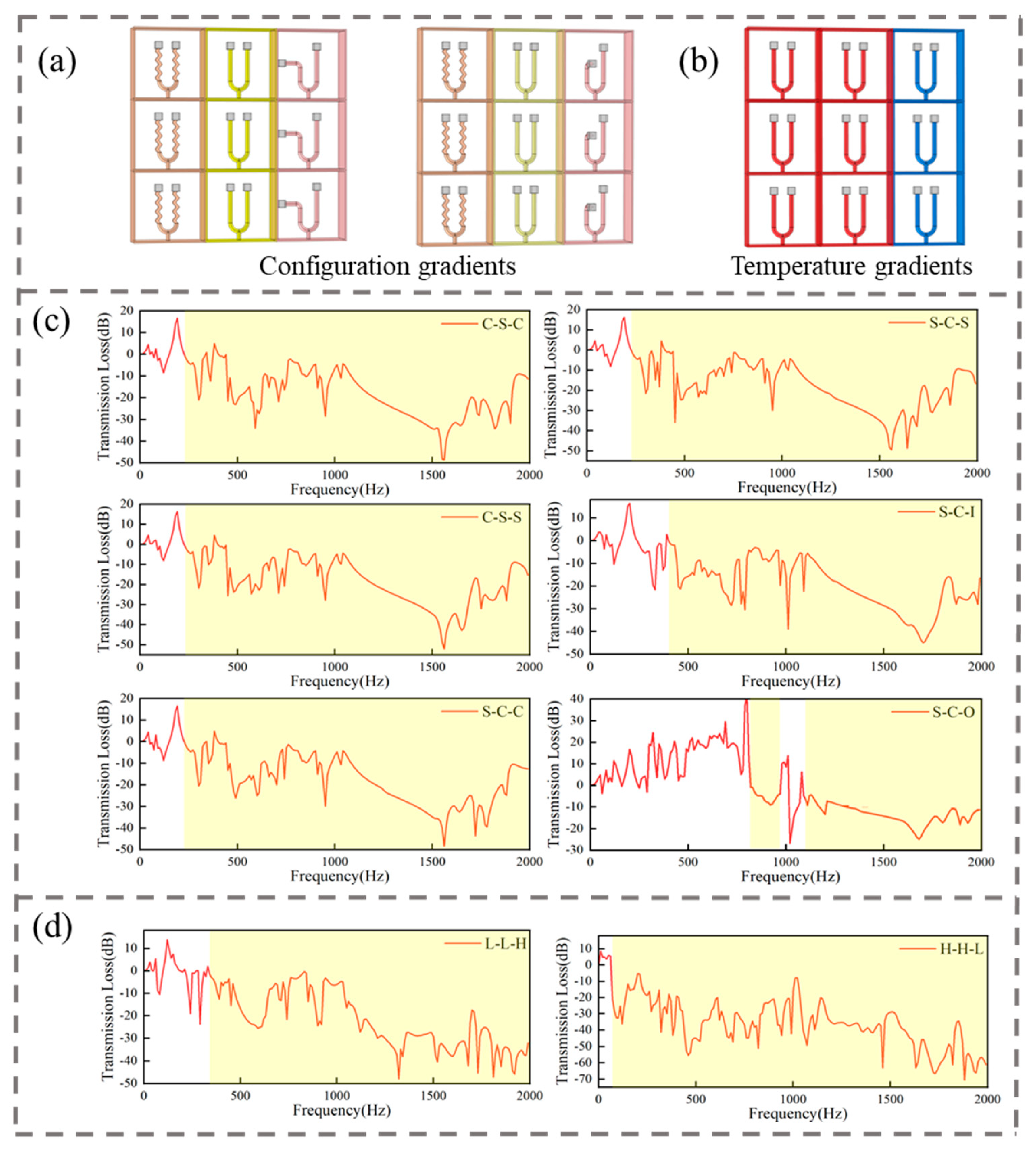
Figure 15a,b illustrate the effects of CTFS, STFS, and in/out–plane CTFS configurations on wave propagation characteristics under interface coupling conditions. Specifically,
Figure 15a demonstrates control via shape–memory deformation, while
Figure 15b shows stiffness modulation induced by temperature (as described in
Section 2.5.2, the Young’s modulus of SMP PLA below 55 °C varies approximately linearly with temperature, enabling predictable stiffness adjustment). The red regions (High) correspond to 75 °C, and the blue regions (Low) correspond to 25 °C.
Figure 15c presents the Transmission Loss curve corresponding to the structure shown in
Figure 15a. Except for the S–C–I and S–C–O configurations, the attenuation onset frequency of the other arrangements is approximately 185 Hz, which is close to the onset of the first bandgap of the CTFS (181 Hz,
Section 3.1.1). Despite differences in arrangements—such as S–C–C, S–C–S, C–C–S, and C–S–C—and in the unit–cell proportions, the onset frequency remains essentially unchanged. This behavior arises because the onset frequency is primarily governed by the lowest local resonance of the unit cells. Since all the above arrangements contain both CTFS and STFS units, the lowest resonant mode is preserved, effectively “locking” the onset frequency. From an equivalent–model perspective, the three columns of cells can be regarded as parallel branches. The effective onset frequency is governed by the branch with the lowest resonance and therefore does not vary with the arrangement. Differences in cell proportions only modify the coupling stiffness and energy distribution, thereby altering the attenuation magnitude without affecting the onset frequency.
For the S–C–I and S–C–O configurations, their Transmission Loss curves exhibit smaller peak amplitudes and narrower attenuation valleys, indicating tunable damping characteristics. Interface coupling introduces a “preloading” effect during unit cell deformation, which alters the overall stiffness response and reduces in–plane compliance. Compared to uniform configurations, the S–C–I and S–C–O designs significantly increase the onset frequency of the bandgap, enabling low–frequency signals to transmit without attenuation while effectively suppressing high–frequency vibrations. This behavior demonstrates a “low–pass, high–block” characteristic, which is of great significance for engineering applications requiring the preservation of low–frequency transmission while isolating high–frequency disturbances.
Temperature–induced stiffness gradients likewise enable tuning of the onset frequency (
Figure 15d). Taking the S–C–I configuration as an example, at room temperature the three columns of unit cells possess uniform stiffness, and the onset frequency is governed by the equivalent stiffness
K and equivalent mass
M. When the temperature distribution is “High–High–Low,” the heated units enter a rubbery state and their modulus decreases. The resulting “soft–soft–hard” gradient facilitates the excitation of low–frequency local resonances, thereby lowering the onset frequency. Conversely, a “Low–Low–High” distribution establishes a “hard–hard–soft” gradient, enhancing resistance to low–frequency excitation, delaying the occurrence of local resonance, and shifting the onset frequency upward. Over this process, the onset frequency decreases from 384 Hz to 78 Hz. These results indicate that interface coupling and temperature gradients can achieve controllable tuning of the onset frequency and wave–blocking performance by modulating the local dynamic response and interfacial impedance, thereby providing an effective route to broadband vibration isolation and engineering damping optimization.
4.5. CTFS with Mechanical Pixels
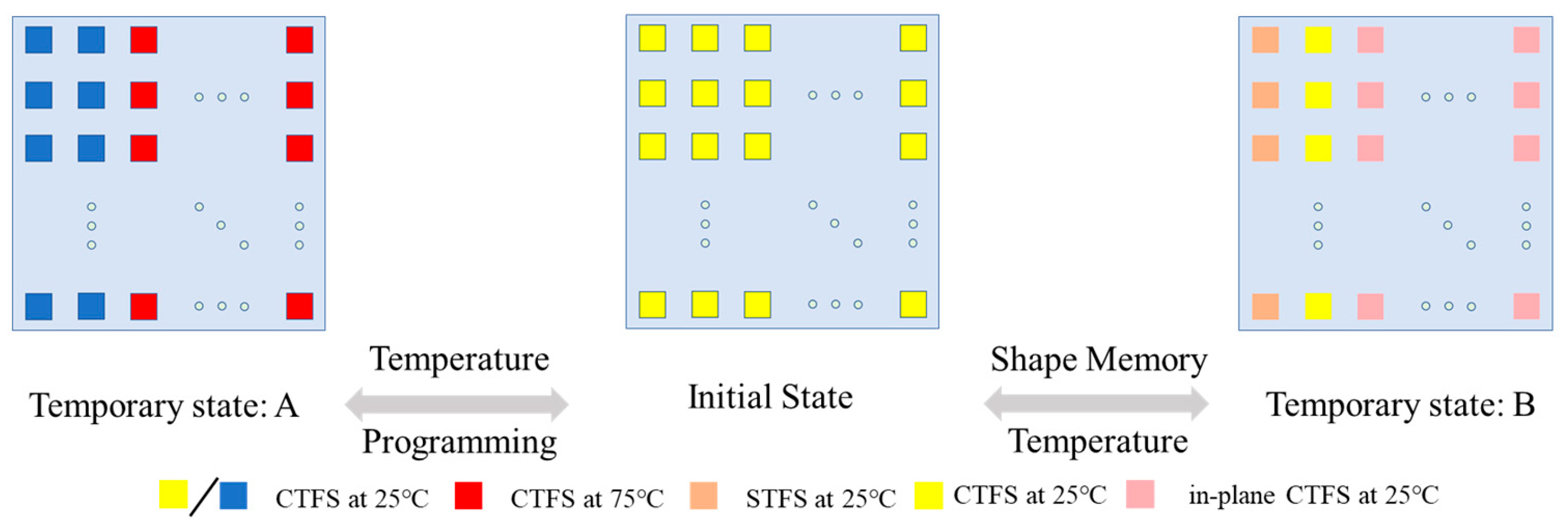
Mechanical pixels provide a highly scalable metamaterial design strategy, enabling precise control of macroscopic mechanical properties through the tuning of unit–cell configurations and spatial arrangements. This approach enhances structural diversity, modularity, and reconfigurability, allowing customized responses under varying operational conditions. The mechanical–pixel–based programmable CTFS exhibits significant advantages in tailoring frequency response and achieving specified vibration isolation bandwidths (
Figure 16). Assisted by shape memory materials, the mechanical pixels are designed to be modular and programmable. These materials enable CTFS units to switch into temporary configurations (Shape A and Shape B), thereby optimizing load distribution and vibration shielding under different operational scenarios. The regulation guided by shape memory significantly reduces the initial frequency of vibration attenuation, decreasing from 241 Hz to 18 Hz, thereby achieving nearly full–band vibration isolation. This method, leveraging the synergistic effects of configuration reconfiguration and local stiffness tuning, significantly enhances the system’s adjustable vibration control capability.