
Fire Risks over the Full Lifecycle of Low-Temperature Facilities: Characteristics, Challenges, and Hazard Identification

Abstract
1. Introduction
2. Methods
2.1. Data Collection
2.2. Identification of Fire Hazards Based on the WBS/RBS Method
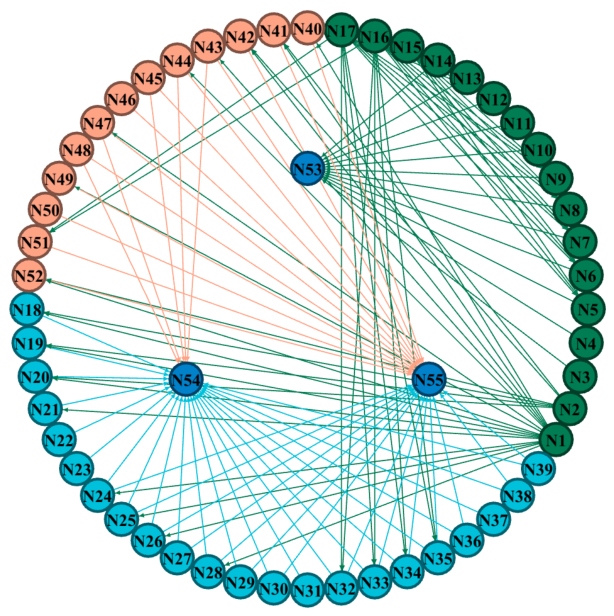
2.3. Mechanism Analysis and Major Fire Hazards Identification Based on CN Method
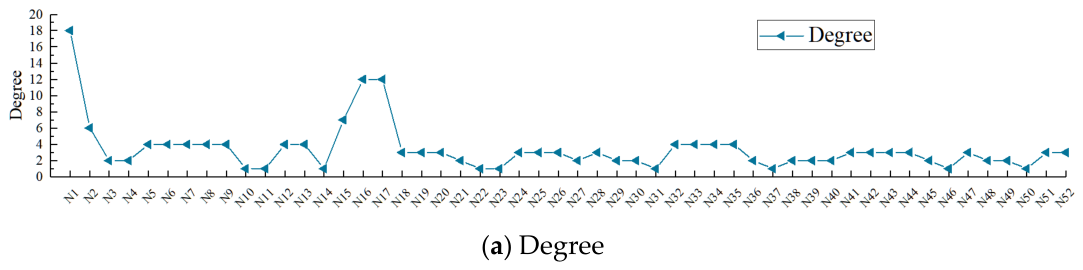
- Degree. Degree refers to the number of nodes directly connected to a given node. A higher degree indicates greater involvement in the formation and evolution of a fire, as shown in Equation (1).In the equation, Dj represents the degree of node j; Wij represents the number of edges connected to node j, namely in-degree; and Wji represents the number of edges originating from node j and connecting to other nodes, namely out-degree.
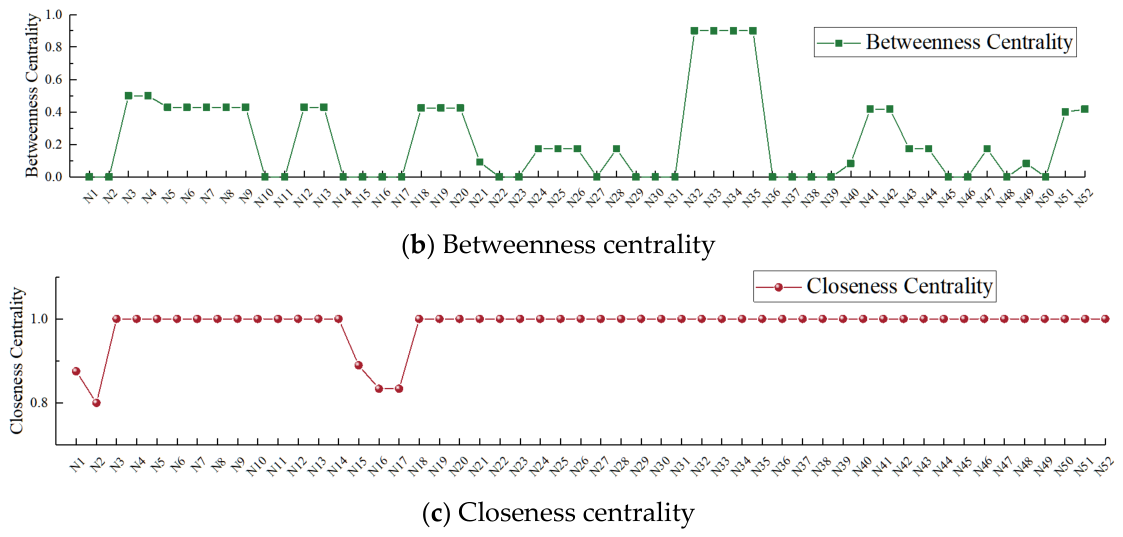
- Betweenness Centrality. Betweenness centrality refers to the number of shortest paths that pass through a given node among all shortest paths connecting pairs of nodes in the network. Nodes with high betweenness centrality play a more significant mediating role in the formation and evolution of fires, as shown in Equation (2).In the equation, Bj represents the betweenness centrality of node j; Nik(j) represents the number of shortest paths between nodes i and k that pass through node j; and Nik represents the total number of shortest paths between nodes i and k.
- Closeness Centrality. Closeness centrality is mainly used to describe the reachability of nodes within the network, that is, the average distance from a given node to all other nodes in the network. A node with high closeness centrality can interact with other nodes more quickly and directly, as shown in Equation (3).In the equation, dij represents the shortest distance from node j to node i, and n represents the total number of nodes in the network.
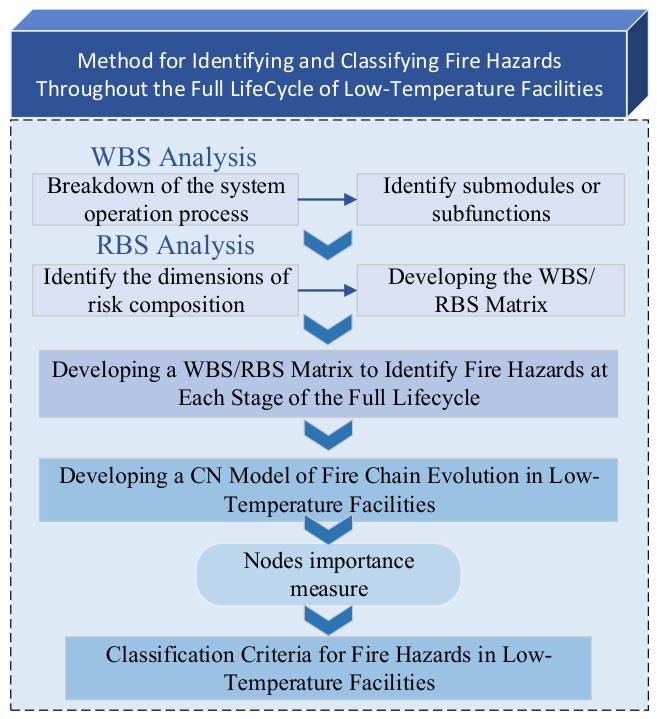
2.4. General Framework for Identifying and Classifying Fire Hazards Throughout the Full Lifecycle of Low-Temperature Facilities
3. Results
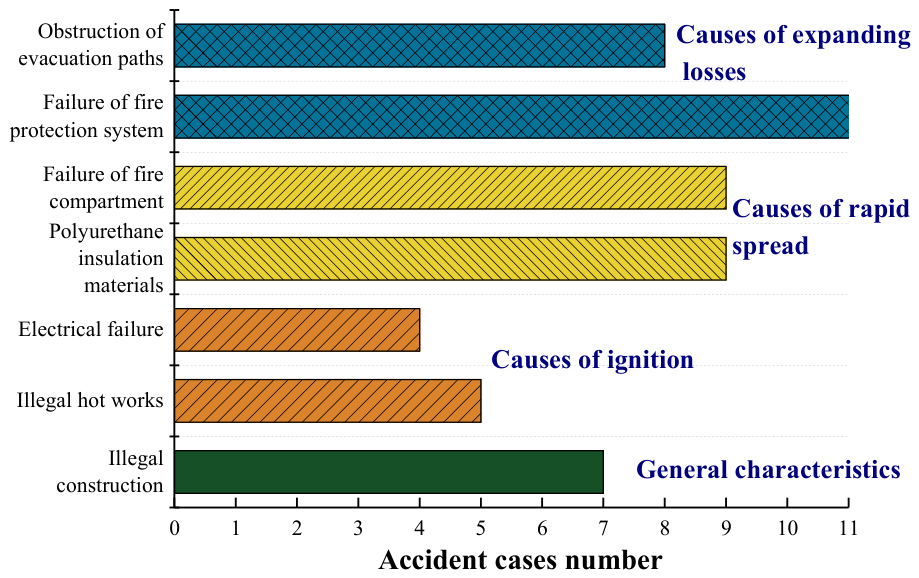
3.1. Typical Causes of Fires in Low-Temperature Facilities
3.1.1. Illegal Hot Work Operations
3.1.2. Electrical Circuit and Equipment Failures
3.1.3. Flammability of Insulation Materials
3.1.4. Lack of Fire Compartments
3.1.5. Failure of Fire Protection Systems
3.1.6. Inadequate Evacuation Conditions
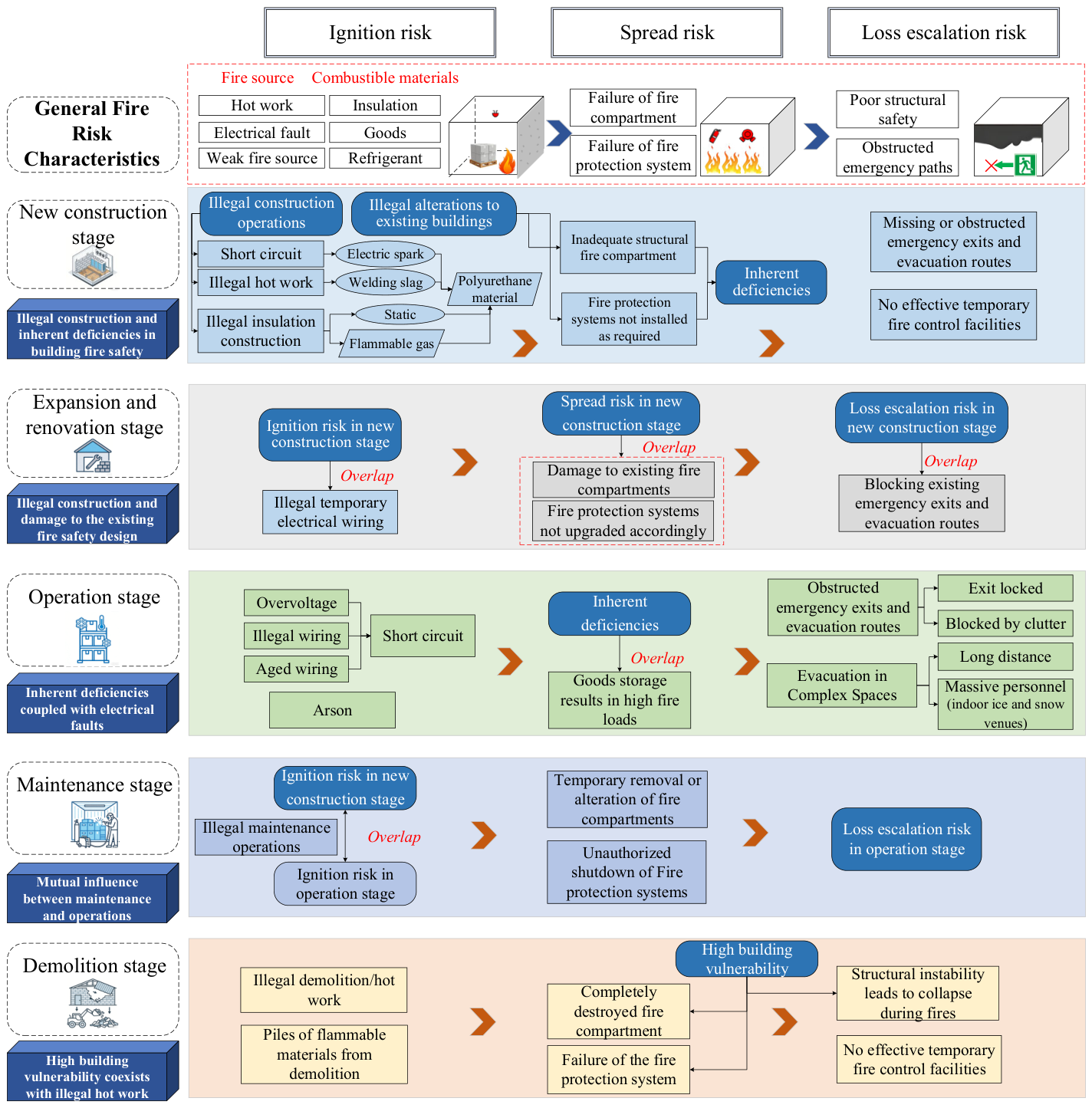
3.2. Fire Risk Characteristics Throughout the Full Lifecycle
3.2.1. Fire Risk Characteristics During the New Construction Stage: Illegal Construction and Inherent Deficiencies in Building Fire Safety
3.2.2. Fire Risk Characteristics During the Expansion and Renovation Stage: The Overlapping Effects of Illegal Renovation Construction and Damage to the Existing Fire Safety Design
3.2.3. Fire Risk Characteristics During the Operation Stage: Inherent Deficiencies in Building Fire Safety Coupled with Electrical Faults and High Fire Loads
3.2.4. Fire Risk Characteristics During the Maintenance Stage: Mutual Influence Between Maintenance and Operations Leads to Amplified Risks
3.2.5. Fire Risk Characteristics During the Demolition Stage: High Building Vulnerability Coexists with Illegal Hot Work
3.3. Criteria for Identifying Fire Hazards: A Case Study of the New Construction Stage of Cold Storage Facilities
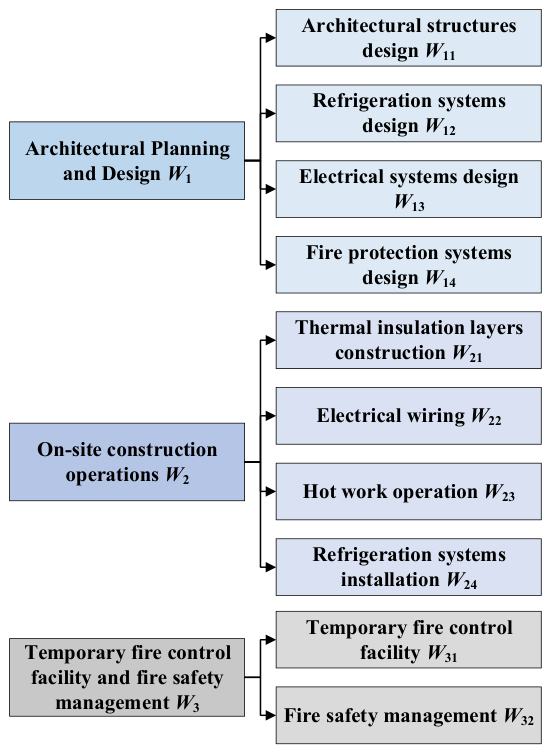
3.3.1. System Functional Breakdown for the New Construction Stage of Cold Storage Facilities
- 1.
- Architectural Planning and Design
- 2.
- On-site construction operations
- 3.
- Temporary fire control facility and fire safety management
3.3.2. Identification of Fire Hazards in Cold Storage Facilities Based on the WBS/RBS Matrix
3.3.3. Classification of Fire Hazards in Cold Storage Facilities Based on Node Importance Measures in Complex Networks
4. Summary and Discussion
4.1. Significant Fire Risks in Low-Temperature Facilities
- 1.
- Fire risks associated with flammable insulation materials
- 2.
- Fire risks associated with goods storage
- 3.
- Fire risks in ammonia refrigeration systems
- 4.
- Electrical fire risks
- 5.
- Risk of limited performance of fire protection system in low-temperature environments
- 6.
- Safety management risks associated with illegal operations
4.2. Emerging Fire Risks and Challenges
- 1.
- Risk of insufficient firefighting water supply
- 2.
- Fire risks in cold storage facilities with ultra-high racking and extra-large floor areas
- 3.
- Fire risks associated with ASRS (automated storage and retrieval systems)
- 4.
- Complex evacuation process of indoor ice and snow venues
5. Conclusions
- An in-depth analysis of 11 major fire incidents involving low-temperature facilities showed that 64% of the cases involved the illegal construction of cold storage facilities within existing buildings. Illegal hot work and electrical faults were identified as the primary causes of fire initiation, while inadequate fire compartmentation and the use of flammable insulation materials were the main factors contributing to rapid fire spread. Blocked evacuation routes and the ineffective operation of fire protection systems further intensified fire losses.
- Low-temperature facilities exhibit distinct fire risk characteristics at different stages of their lifecycle. During the new construction stage, the primary risk arises from the amplifying effect of inherent fire safety deficiencies caused by illegal construction operations and illegal changes in building use. During the renovation and expansion stage, additional risks result from the disruption of existing fire compartment and protection systems. During the operational stage, fire risks mainly arise from the combined effects of inherent deficiencies in facility fire safety systems, electrical faults, and high fire loads. During the maintenance stage, fire risks further increase due to the interaction between maintenance activities and ongoing operations. During the demolition stage, fire risks are characterized by the high facility vulnerability and illegal hot work operations.
- Using the construction stage of a new cold storage facility as an example, this study establishes criteria for identifying serious and major fire hazards related to architectural structure and functional design, hot work operations, insulation installation, emergency evacuation, fire safety management, and temporary fire control facilities. The most critical hazards include illegal changes in building use, illegal hot work operations, and temporary fire control facilities not provided as required.
Author Contributions
Funding
Data Availability Statement
Acknowledgments
Conflicts of Interest
Appendix A

| Accident Location and Year | Building Type | Lifecycle Stage | Casualties | Direct Economic Loss | Ignition Cause | Fire Protection System Deficiencies | Fire Spread Factors | Loss Escalation Factors |
|---|---|---|---|---|---|---|---|---|
| Xinyu, Jiangxi (2025) | Underground Cold Storage Facility | New Construction | 39 fatalities, 9 injuries | RMB 43.53 million (approximately USD 6.40 million) | Flammable gases released from polyurethane foam sealant were ignited by electrostatic discharge. | Automatic fire alarm systems, emergency lighting, and indoor fire hydrant systems were not installed in accordance with the approved design. | Combustible insulation materials burned rapidly and generated large quantities of toxic smoke. Fire compartmentation of evacuation stairwells was absent. | Anti-theft grilles and exterior advertising boards seriously obstructed evacuation and rescue operations. |
| Daxing, Beijing (2017) | Underground Cold Storage Facility | New Construction | 19 fatalities, 8 injuries | Not reported | An electrical short circuit ignited nearby combustible materials. | Fire protection facilities had been abandoned or were not installed as required. | Polyurethane insulation materials did not comply with applicable fire safety requirements, and effective fire compartmentation was absent. | Obstructions outside windows hindered evacuation and firefighting and rescue operations. |
| Harbin, Heilongjiang (2021) | Cold Storage Facility in a Self-Built Building | New Construction | 4 fatalities, 2 injuries | RMB 3.23 million (approximately USD 0.47 million) | An electrical short circuit ignited polyurethane insulation materials. | Emergency lighting and evacuation signage were not provided. | Inadequate fire compartmentation allowed the fire to spread rapidly. | Evacuation exits were blocked, hindering occupant evacuation. |
| Changchun, Jilin (2020) | Steel-Structure Cold Storage Facility | New Construction | 5 fatalities, 1 injury | RMB 8.20 million (approximately USD 1.21 million) | Unauthorized welding operations ignited polyurethane insulation materials. | Fire protection facilities were not installed. | Large quantities of combustible insulation materials burned rapidly, accelerating fire spread. | The fire spread rapidly within the enclosed space, resulting in severe casualties. |
| Dalian, Liaoning (2021) | Underground Cold Storage Facility | New Construction | 9 fatalities (including 1 firefighter) | Not reported | Unauthorized welding operations ignited polyurethane insulation materials. | Automatic fire protection systems failed to operate effectively during the incident. | Combustible insulation materials promoted rapid fire development and smoke spread. | Underground building conditions and restricted evacuation and rescue access contributed to the severity of losses. |
| Tongzhou, Beijing (2021) | Steel-Structure Cold Storage Facility | Renovation and Expansion | 3 fatalities | RMB 3.09 million (approximately USD 0.45 million) | Construction activities ignited thermal insulation materials. | Fire protection facilities were not provided. | Large quantities of combustible insulation materials burned rapidly. | Not reported in the investigation summary. |
| Qingpu, Shanghai (2019) | Steel-Structure Cold Storage Facility | Operation | No casualties | RMB 39.04 million | Poplar catkins ignited by external sources set fire to combustible materials on the exterior wall of the warehouse. | Only portable fire extinguishers were provided; fixed fire protection systems were not installed. | Large quantities of stored combustible materials accelerated fire development and spread. | Significant property losses resulted from delayed fire control and a high combustible fire load. |
| Taiyuan, Shanxi (2020) | Indoor Ice and Snow Venue | Operation and Maintenance | 13 fatalities, 15 injuries | RMB 17.90 million (approximately USD 2.63 million) | An overvoltage condition caused by unauthorized electrical operations ignited electrical circuits and polyurethane insulation materials. | Automatic fire alarm and automatic fire suppression systems were not installed. | Large quantities of combustible insulation materials burned rapidly, promoting fire growth and smoke spread. | The evacuation routes were complex, and several emergency exits were blocked, hindering occupant evacuation. |
| Dazhou, Sichuan (2018) | Underground Cold Storage Facility | Operation | 1 fatality | RMB 92.10 million (approximately USD 13.53 million) | Improper electrical wiring caused a short circuit that ignited stored cardboard materials. | Fire protection systems were inadequately designed and configured. | A high combustible fire load, inadequate fire compartmentation, and a complex internal layout facilitated multi-point fire spread. | Fire access routes and evacuation passages were obstructed, adversely affecting firefighting and evacuation operations. |
| Hangzhou, Zhejiang (2022) | Indoor Ice and Snow Venue | Operation and Maintenance | 6 fatalities (including 2 firefighters), 19 injuries | RMB 30.57 million (approximately USD 4.49 million) | Unauthorized welding operations ignited thermal insulation and interior decorative materials. | The fire alarm system and automatic sprinkler system had been shut down without authorization. | Inadequate fire compartmentation allowed rapid fire and smoke spread throughout the building. | The enclosed interior space and long, complex evacuation routes increased evacuation difficulty and contributed to loss escalation. |
| Cangzhou, Hebei (2023) | Abandoned Cold Storage Facility | Decommissioning and Demolition | 11 fatalities | RMB 13.27 million (approximately USD 1.95 million) | Unauthorized welding operations ignited thermal insulation materials. | On-site firefighting equipment was not provided. | Large quantities of combustible insulation materials burned rapidly, resulting in rapid fire development. | The fire spread rapidly within the enclosed structure, leading to severe casualties. |
References
- Jin, H.; Zhang, X.; Ji, G. Research and Application Advances in Novel Cold Storage Refrigerated Warehouses. J. Energy Storage 2026, 141, 119061. [Google Scholar] [CrossRef]
- Wu, Q.; Zhang, X.; Wu, H. Research Progress on Cold Store Technology in the Context of Dual Carbon. J. Energy Storage 2024, 86, 111291. [Google Scholar] [CrossRef]
- Yang, Y.; Xing, N. Transforming Ice-Snow Ecological Resources into Economic Benefits: Three-Dimensional Analysis of China’s Ice-Snow Economic Policy Texts. Environ. Technol. Innov. 2025, 40, 104467. [Google Scholar] [CrossRef]
- Alqatawna, A.; Sánchez-Cambronero, S.; Gallego, I.; Rivas, A. BIM-Centered High-Speed Railway Line Design for Full Infrastructure Lifecycle. Autom. Constr. 2023, 156, 105114. [Google Scholar] [CrossRef]
- Saxena, V. Enhancing EV Battery Lifecycle Management: Robotic Disassembly, Design for Disassembly, and Sustainable Solutions. J. Energy Storage 2025, 119, 116368. [Google Scholar] [CrossRef]
- Riascos Castaneda, R.A.; Ostrosi, E.; Stjepandic, J. Dynamic Product Risk Management in Product Lifecycle Management of Medical Products. J. Ind. Inf. Integr. 2025, 48, 100977. [Google Scholar] [CrossRef]
- Bolat, F. Human Error Probability in Ship Ballast Water Management Systems: A HEART-Based Human Reliability Analysis across the BWMS Lifecycle. Ocean Eng. 2026, 346, 123959. [Google Scholar] [CrossRef]
- Elseknidy, M.; Al-Mhdawi, M.K.S.; Qazi, A.; Ojiako, U.; Mahammedi, C.; Rahimian, F.P. Developing a Sustainability-Driven Risk Management Framework for Green Building Projects: A Literature Review. J. Clean. Prod. 2025, 519, 145891. [Google Scholar] [CrossRef]
- Li, Y.; Wang, H.; Bai, K.; Chen, S. Dynamic Intelligent Risk Assessment of Hazardous Chemical Warehouse Fire Based on Electrostatic Discharge Method and Improved Support Vector Machine. Process Saf. Environ. Prot. 2021, 145, 425–434. [Google Scholar] [CrossRef]
- Han, H.-S.; Hwang, C.-H. Categorization of Fire Load Density Based on the Fire Hazard Classification of Warehouse Commodities. Case Stud. Therm. Eng. 2026, 78, 107666. [Google Scholar] [CrossRef]
- Xie, J.; Li, J.; Wang, J.; Jiang, J.; Shu, C.-M. Fire Risk Assessment in Lithium-Ion Battery Warehouse Based on the Bayesian Network. Process Saf. Environ. Prot. 2023, 176, 101–114. [Google Scholar] [CrossRef]
- Chen, W.-D.; Chen, Y.-C.; Yu, K.-M.; Lee, C.-L.; Wu, M.-L.; Feng, M.-Z.; Chiu, W.-F.; Lei, M.-Y.; Wang, S.-C. Intelligent Early-Stage Fire Detection System for Enhanced Safety in Large Warehouse Environments. Fire Saf. J. 2026, 160, 104618. [Google Scholar] [CrossRef]
- Mei, A.; Salvatori, L.; Orlando, M. Robustness of Automated Rack-Supported Warehouses in Case of Localized Fires. J. Constr. Steel Res. 2026, 236, 110004. [Google Scholar] [CrossRef]
- Sun, B.; Guo, T. Adaptive Dynamic Fire Danger Evaluation of Logistics Warehouses with Fusion of Evidential Reasoning and Smart Optimization. J. Build. Eng. 2024, 93, 109897. [Google Scholar] [CrossRef]
- Moradi Hanifi, S.; Laal, F.; Ghashghaei, M.; Ahmadi, O.; Mandali, H. Providing a Model to Evaluate the Spread of Fire in a Chemical Warehouse Using Numerical Simulation and Bayesian Network. Process Saf. Environ. Prot. 2024, 183, 124–137. [Google Scholar] [CrossRef]
- Zhan, X.; Wu, W.; Shen, L.; Liao, W.; Zhao, Z.; Xia, J. Industrial Internet of Things and Unsupervised Deep Learning Enabled Real-Time Occupational Safety Monitoring in Cold Storage Warehouse. Saf. Sci. 2022, 152, 105766. [Google Scholar] [CrossRef]
- Li, W. Study on Fire Safety Risk and Countermeasures of Cold Storage in Shanghai. Fire Sci. Technol. 2021, 40, 1829–1831. [Google Scholar]
- Ding, P.; Luo, H.; Yang, J.; Jiang, M.; Cheng, Y.; Chen, A. Investigation of Fire Risks and Safety Strategies in Large Indoor Snow Parks. Case Stud. Therm. Eng. 2025, 73, 106707. [Google Scholar] [CrossRef]
- Liu, J. Evacuation of Indoor Ski Hall under Fire Situation Based on Pathfinder. Fire Sci. Technol. 2016, 35, 775–777. [Google Scholar]
- Jeong, J.; Jeong, J. Novel Approach of the Integrated Work & Risk Breakdown Structure for Identifying the Hierarchy of Fatal Incident in Construction Industry. J. Build. Eng. 2021, 41, 102406. [Google Scholar] [CrossRef]
- Somi, S.; Gerami Seresht, N.; Fayek, A.R. Developing a Risk Breakdown Matrix for Onshore Wind Farm Projects Using Fuzzy Case-Based Reasoning. J. Clean. Prod. 2021, 311, 127572. [Google Scholar] [CrossRef]
- Brodny, J.; Tutak, M.; Kalbron, P. Hazard Network Taxonomy: A Systemic Approach to Risk Analysis in Complex Sociotechnical Systems. Reliab. Eng. Syst. Saf. 2026, 274, 112432. [Google Scholar] [CrossRef]
- Qiu, Y.; Sun, X.; Xiong, X.; Si, S. Systemic Financial Risk Analysis of the U.S. Based on the Complex Network. J. Manag. Sci. Eng. 2025, 10, 414–433. [Google Scholar] [CrossRef]



| Dimensions | Data Information Types | Description |
|---|---|---|
| Basic information | Background information | General information of the building and the condition of the building when the fire occurred |
| Building type | Conventional construction, prefabricated construction, mixed-use residential and commercial buildings, etc. | |
| Full lifecycle stage | New construction, expansion and renovation, operation, maintenance, demolition | |
| Losses | Casualties and direct economic losses | |
| Ignition situation | Ignition Source | Initial ignition source of the fire |
| Combustible material | Type of combustible material ignited | |
| Spread situation | Fire spread conditions | Fire spread following ignition |
| Fire detection and alarm conditions | Automatic detection, manual discovery, etc. | |
| Performance of fire protection systems | Automatic fire suppression systems, smoke control and exhaust systems, etc. | |
| Fire compartment conditions | Fire compartment conditions within the affected building | |
| Expansion of losses | Emergency response conditions | Initial firefighting and emergency rescue organization after the initial fire |
| Emergency evacuation conditions | Emergency evacuation process, evacuation routes, and emergency exits | |
| Accident causes | Direct cause | Officially reported direct cause of the fire based on investigation |
| Indirect cause | Officially reported indirect cause of the fire based on investigation |
| Dimensions | Risk of Ignition | Risk of Spread | Risk of Expanded Losses |
|---|---|---|---|
| Architectural structures design | N1: Illegal change in building use; N2: Illegal basement cold storage construction | N18: Inadequate structural fire compartment; N19: Excessive fire compartment size; N20: Lack of fire separation for evacuation stairwells; N21: Building fire resistance rating deviates from regulations | N40: Complex internal spatial layout; N41: Insufficient number or width of exits; N42: Evacuation travel distances deviates from regulations; N43: Co-location with high-occupancy areas |
| Refrigeration systems design | N3: Overloaded refrigeration system design | N22: Unsealed pipe penetrations through walls; N23: Inadequate separation between equipment rooms and storage areas | — |
| Electrical systems design | N4: Incorrect electrical circuit selection and load calculations | — | N44: Non-compliant power load for fire protection equipment; N45: No dedicated circuits for fire protection power supply |
| Fire protection systems design | — | N24: Automatic fire alarm system improperly installed; N25: Fire hydrant system or automatic fire suppression system improperly installed; N26: Smoke control and exhaust system improperly installed | N46: Deficiencies in evacuation signage and emergency lighting; N47: No fire truck access route |
| Thermal insulation layers construction | N5: Lack of anti-static measures; N6: No forced ventilation during foaming agent joint filling; N7: No real-time monitoring of combustible gas concentration during joint filling; N8: Simultaneous sheet metal or equipment installation work on site; N9: Presence of open flame sources on site | N27: Use of combustible materials for insulation protection layers; N28: Use of combustible wall and floor materials; N29: Insulation materials deviates from regulations; N30: Joint-filling materials deviates from regulations | — |
| Electrical wiring | N10: Unprotected electrical wiring passing through insulation layers; N11: Illegal temporary electrical wiring | N31: Unsealed electrical distribution lines passing through fire compartments | — |
| Hot work operations | N12: Illegal hot work; N13: No fire separation measures at hot work sites | N32: Lack of on-site supervision; N33: Lack of fire extinguishing equipment at work sites; N34: Storage of combustible materials near work sites | — |
| Refrigeration system installation | N14: Failure to install combustible-gas concentration alarm devices as required | — | — |
| Temporary fire control facility | — | N35: Temporary fire control facilities not provided as required; N36: Fire hydrant pumps not connected to dedicated fire protection power circuits during construction; N37: Temporary fire control facilities configured out of step with construction progress | N48: No reliable firefighting water supply near the construction site; N49: No freeze protection for temporary firefighting water systems in cold regions; N50: No temporary emergency lighting on site |
| Fire safety management | N15: No safety management system for hazardous operations; N16: Neglected to enforce fire safety management responsibilities; N17: Neglected to inspect fire hazards on-site | N38: No effective fire emergency response plan established; N39: No fire safety education and training implemented | N51: Obstructed evacuation routes or blocked exits; N52: Security bars, billboards, or similar obstructions affecting evacuation and rescue |
| Node | Importance | Node | Importance | Node | Importance |
|---|---|---|---|---|---|
| N1 | 3.98% | N19 | 2.40% | N37 | 0.84% |
| N2 | 1.66% | N20 | 2.40% | N38 | 1.03% |
| N3 | 2.42% | N21 | 1.28% | N39 | 1.03% |
| N4 | 2.42% | N22 | 0.84% | N40 | 1.26% |
| N5 | 2.60% | N23 | 0.84% | N41 | 2.38% |
| N6 | 2.60% | N24 | 1.70% | N42 | 2.38% |
| N7 | 2.60% | N25 | 1.70% | N43 | 1.70% |
| N8 | 2.60% | N26 | 1.70% | N44 | 1.70% |
| N9 | 2.60% | N27 | 1.03% | N45 | 1.03% |
| N10 | 0.84% | N28 | 1.70% | N46 | 0.84% |
| N11 | 0.84% | N29 | 1.03% | N47 | 1.70% |
| N12 | 2.60% | N30 | 1.03% | N48 | 1.03% |
| N13 | 2.60% | N31 | 0.84% | N49 | 1.26% |
| N14 | 0.84% | N32 | 3.91% | N50 | 0.84% |
| N15 | 1.90% | N33 | 3.91% | N51 | 2.33% |
| N16 | 2.81% | N34 | 3.91% | N52 | 2.38% |
| N17 | 2.81% | N35 | 3.91% | ||
| N18 | 2.40% | N36 | 1.03% |
| Classification | Dimensions | Composition | Scope |
|---|---|---|---|
| Level I: Extremely major | Architectural structures and functional design | N1, N3, N4, N18, N19 | Importance > 2% |
| Hot work operations | N12, N13, N32, N33,N34 | ||
| Thermal insulation layers construction | N5, N6, N7, N8, N9 | ||
| Personnel evacuation | N20, N41, N42, N51, N52 | ||
| Fire safety management and temporary fire control facility | N16, N17, N35 | ||
| Level II: Major | Architectural structures and functional design | N2, N21, N27, N28,N29, N30 | 1% ≦ Importance ≦ 2% |
| Fire protection systems design | N24, N25, N26, N44, N45, N47, N49 | ||
| Fire safety management and temporary fire control facility | N15, N48, N36, N38, N39 | ||
| Personnel evacuation | N40, N43 | ||
| Level III: General | Other construction defects | N10, N11, N22, N31, N37, N50 | Importance < 1% |
| Other design defects | N14, N23, N46 |
Disclaimer/Publisher’s Note: The statements, opinions and data contained in all publications are solely those of the individual author(s) and contributor(s) and not of MDPI and/or the editor(s). MDPI and/or the editor(s) disclaim responsibility for any injury to people or property resulting from any ideas, methods, instructions or products referred to in the content. |
© 2026 by the authors. Licensee MDPI, Basel, Switzerland. This article is an open access article distributed under the terms and conditions of the Creative Commons Attribution (CC BY) license.
Share and Cite
Wang, Q.; Chen, Q.; Zhang, X.; Sun, Z. Fire Risks over the Full Lifecycle of Low-Temperature Facilities: Characteristics, Challenges, and Hazard Identification. Fire 2026, 9, 263. https://doi.org/10.3390/fire9060263
Wang Q, Chen Q, Zhang X, Sun Z. Fire Risks over the Full Lifecycle of Low-Temperature Facilities: Characteristics, Challenges, and Hazard Identification. Fire. 2026; 9(6):263. https://doi.org/10.3390/fire9060263
Chicago/Turabian StyleWang, Qirui, Qinpei Chen, Xiaoying Zhang, and Zhuoer Sun. 2026. "Fire Risks over the Full Lifecycle of Low-Temperature Facilities: Characteristics, Challenges, and Hazard Identification" Fire 9, no. 6: 263. https://doi.org/10.3390/fire9060263
APA StyleWang, Q., Chen, Q., Zhang, X., & Sun, Z. (2026). Fire Risks over the Full Lifecycle of Low-Temperature Facilities: Characteristics, Challenges, and Hazard Identification. Fire, 9(6), 263. https://doi.org/10.3390/fire9060263