1. Introduction
Topography is one of the most persistent controls on wildfire behaviour because it shapes heat transfer, fuel moisture, wind exposure, and opportunities for suppression. Slope affects preheating and upslope spread, aspect modifies radiation and moisture status, and terrain breaks such as ridges, saddles, and valleys can redirect or constrain fire through wind–terrain interaction [
1,
2,
3,
4]. Ridges are therefore widely invoked in post-fire interpretation and control-line planning. The unresolved question is more specific: after local terrain availability is accounted for, do final wildfire perimeters show a ridge-specific spatial and directional signal?
Recent Earth observation and terrain datasets make this question testable at cohort scale. Sentinel-2 and Harmonised Landsat–Sentinel products provide optical observations suitable for pre-/post-fire burn-mask construction [
5,
6,
7], while SRTM and related DEM products provide consistent national terrain coverage for ridge and valley extraction [
8,
9,
10,
11,
12]. In South Korea, recent studies have improved understanding of wildfire occurrence, fire-weather interpretation, and machine-learning risk prediction, including a Google Earth Engine comparison of forest-fire risk models [
13,
14,
15,
16,
17]. These studies are useful for ignition or risk prediction, but they do not directly test whether the final mapped boundary of an individual fire is organised with respect to ridge geometry.
Three gaps motivate the present design. First, ridge crests are often pooled with valleys, roads, fuel breaks or other linear features, which can obscure whether a perimeter signal is carried by ridges specifically. Second, global baselines can confound perimeter alignment with regional terrain density: a fire in a highly dissected landscape will appear close to ridges more often than a fire in gentle terrain even under random placement. Third, perimeter metrics can be sensitive to ridge-extraction thresholds, distance buffers, angular tolerances, and Monte Carlo sample size. A defensible test therefore needs independent terrain layers, a local null model, a ridge-specific comparator, and sensitivity checks.
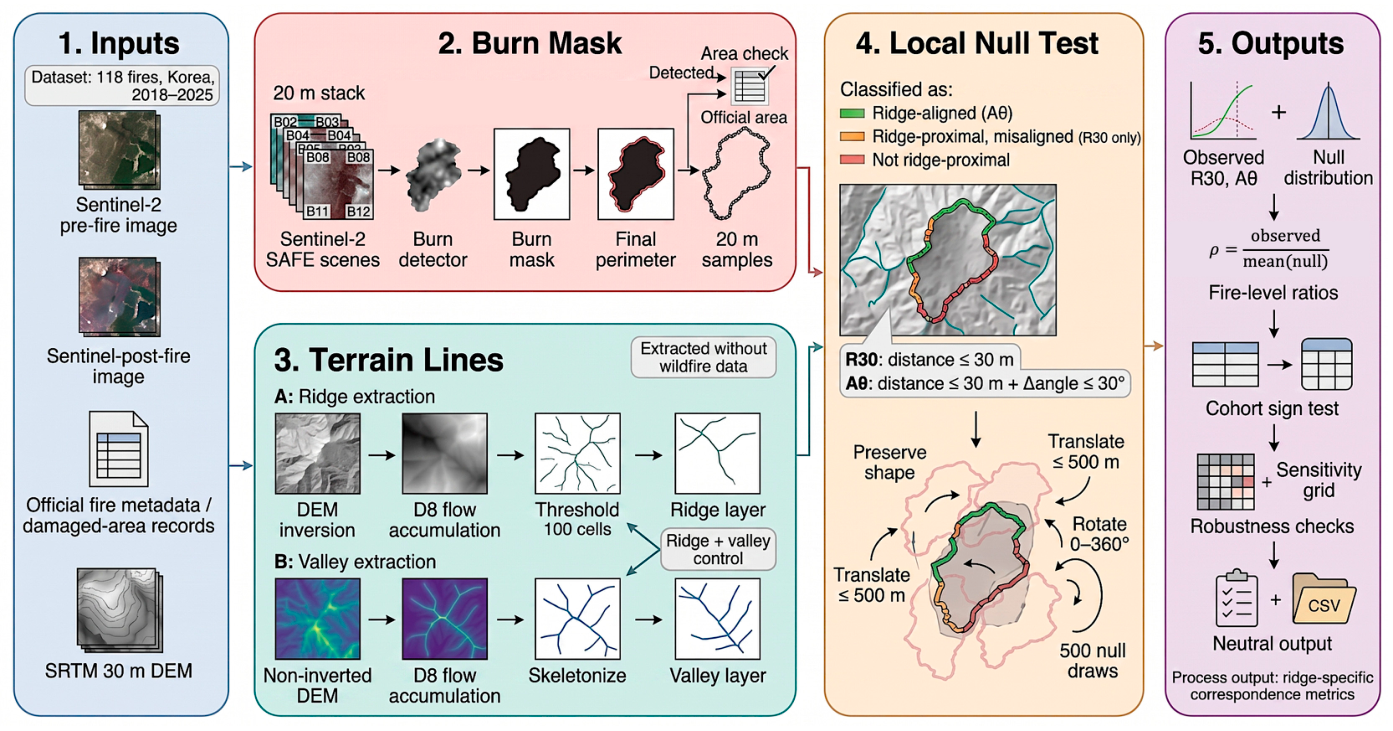
To address these gaps, the workflow separates burned-area mapping from terrain-line extraction until the correspondence test (
Figure 1). Burned-area masks and final perimeters are derived from Sentinel-2 imagery and fire metadata, whereas ridges and valleys are derived independently from the DEM. The observed perimeter is then compared with locally translated and rotated null perimeters to quantify whether final fire boundaries are more ridge-proximal and ridge-aligned than expected from local terrain availability alone.
2. Materials and Methods
Data assembly and analysis followed the structure in
Figure 1. Burned-area masks were generated from Sentinel-2 imagery and official fire metadata, while terrain lines were extracted independently from the DEM. Perimeter-ridge correspondence was then evaluated with distance- and orientation-based metrics under a local null model. The subsections below describe the data sources, processing steps and inference procedure.
2.1. Study Area and Wildfire Cohort
The study area is the Republic of Korea, a mountainous temperate peninsula with approximately 63% forest cover and strong regional contrasts in elevation, forest composition, and seasonal fire weather [
18,
19]. Korean wildfire occurrence is concentrated in winter and spring, when dry air, strong winds, and cured fine fuels increase ignition and spread potential. This setting is well suited to a ridge-alignment test because many fires occur in topographically complex forest landscapes where ridge crests, valleys, roads, and suppression access can interact.
The wildfire cohort comprised 118 fires for which a binary burned-area mask and matched fire metadata were available. The fires occurred between 1 January 2018 and 25 August 2025. Official damaged areas ranged from 5 ha to 16,302 ha, producing a right-skewed size distribution typical of Korean fire records, with many small fires and a small number of large events.
No cohort-defining exclusion was applied for fire size, detected-to-official area ratio, or expected ridge signal. Exclusions were allowed only for data integrity failures such as missing burn masks, missing metadata, perimeter extraction failure, DEM crop failure or corrupted geometry. No such failure occurred, so all 118 paired records were retained for the headline topographic analysis. A high-agreement subset was used only for parameter sensitivity, not for the main inference.
2.2. Burn-Mask Construction and Area Validation
Burned-area and damage-area calculation followed a standardised Python 3.12 workflow applied to all 118 fires. For each fire, pre- and post-fire Sentinel-2 Level-2A SAFE scenes were converted to a six-band GeoTIFF stack at 20 m resolution using B02, B03, B04, B08, B11, and B12; 10 m bands were resampled to the 20 m reference grid. The stacked imagery, ignition coordinate and official damaged-area metadata were then processed with UnifiedBurnDetector using one recorded configuration for the whole cohort (buffer radius = 150 m, minimum object size = 10 pixels and texture features enabled). The workflow produced a binary burn mask, final perimeter, detected area, and metadata for each fire. No fire-specific detector retuning was applied in the analysis reported here.
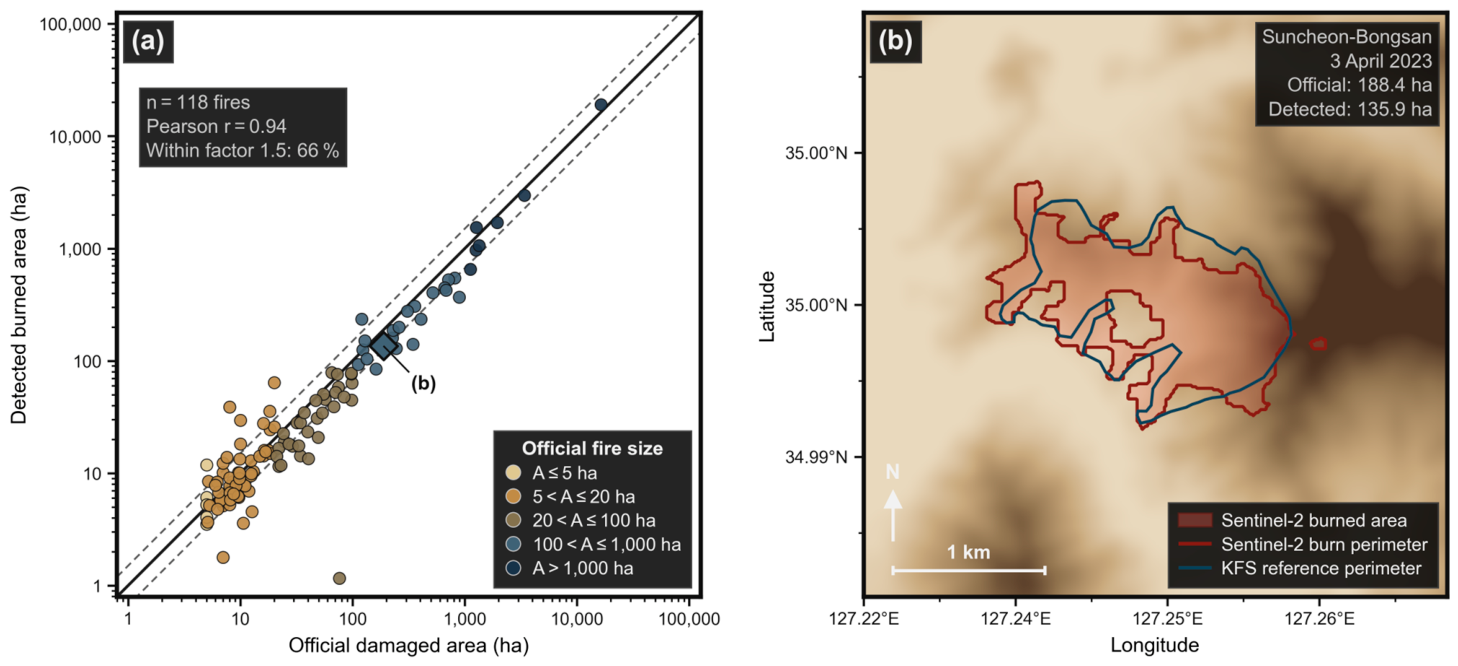
Detected burned area was compared with official damaged area to evaluate whether the masks preserved the scale and rank order of the recorded fires before topographic analysis. This area-based check does not validate every boundary segment; where reference perimeter data were available, these were used for representative overlay inspection rather than cohort-level boundary metrics. The distinction between area-scale validation and local boundary precision is consistent with the broader burn-mapping and burn-severity literature, where spectral change metrics are commonly evaluated at different spatial and thematic levels [
20,
21,
22].
2.3. DEM-Derived Terrain Lines and Control Layers
Topographic predictors were derived from a 30 m Shuttle Radar Topography Mission (SRTM) DEM clipped to Korea (SRTM30_Korea_30m.tif; WGS84 geographic coordinates) [
8]. For each fire, a DEM tile centred on the burn perimeter and extending beyond the burn boundary was extracted and reprojected to a metric coordinate reference system consistent with the burn-mask grid before distance and orientation metrics were computed. This per-fire reprojection is necessary because the correspondence metrics are expressed in metres, not angular degrees.
Ridges were extracted independently of wildfire data by inverting the DEM so that flow accumulation on the inverted surface identifies drainage divides rather than channels. We computed single-flow-direction D8 flow accumulation, thresholded the accumulation grid, and skeletonised the resulting binary mask to one-pixel-wide ridge polylines. Valleys were extracted analogously from the non-inverted DEM. Three terrain-line layers were then defined for each fire: a ridge-only layer for the primary hypothesis, a valley-only layer for diagnostic interpretation, and a combined ridge + valley layer for testing whether a pooled terrain-line representation reproduces or dilutes the ridge signal. The headline flow-accumulation threshold was 100 cells, with 50- and 200-cell thresholds included in the sensitivity analysis.
2.4. Perimeter Sampling and Alignment Metrics
For each fire, the burn-mask boundary was vectorised by marching-squares contour extraction and resampled at an even 20 m step. At each perimeter sample point, local perimeter tangent direction was estimated by finite differences over a 60 m window. Ridge line orientation was computed analogously from the nearest skeletonised ridge segment. Sampling at a fixed step prevents large fires from dominating the cohort inference through pooled point counts, because the final statistical unit remains the fire rather than the individual perimeter sample.
The primary proximity statistic,
R30, is a special case of the distance-overlap statistic
R(
d) (Equation (1)). For perimeter sample
i, let
di denote the Euclidean distance from the sample point to the nearest ridge pixel.
R(
d) is the fraction of perimeter samples with
di less than or equal to threshold
d. The primary threshold was
d = 30 m, corresponding to one DEM cell; a 60 m variant was retained for sensitivity analysis.
The directional statistic,
Aθ, is a special case of the joint distance-and-angle statistic
A(
d,
α) (Equation (2)). Let Δ
θi denote the smallest angular difference, modulo 180°, between the local perimeter tangent and the nearest-ridge orientation.
A(
d,
α) is the fraction of perimeter samples that satisfy both
di ≤
d and Δ
θi ≤
α. The primary endpoint used
d = 30 m and
α = 30°;
α = 20° was retained for sensitivity analysis. Both R30 and Aθ are geometric correspondence endpoints rather than fire-behaviour predictors: they quantify how the final mapped boundary sits relative to ridge geometry, whereas ridge attributes such as length, continuity, and slope, which might bear more directly on fire behaviour, are examined separately (
Section 3.6).
2.5. Local Translate-and-Rotate Null Model
A global random-coordinate null would compare a fire perimeter with terrain that the fire could never plausibly have encountered. We therefore used a local shape-preserving null model. For each Monte Carlo draw, the observed perimeter polygon was translated by a vector drawn uniformly from a disc of radius 500 m around the true centroid and rotated by an angle drawn uniformly from 0 to 360°. The transformed perimeter was re-sampled at the same 20 m step and compared with the same fixed ridge raster. Placements outside the per-fire DEM crop were rejected and redrawn.
This procedure preserves the perimeter’s size, shape, and local topographic neighbourhood while randomising the placement and orientation at issue in the alignment hypothesis. The rigid transformation is shown in Equation (3). For each fire and endpoint, we retained the observed statistic, the null mean, the observed-to-null ratio
ρ (Equation (4)), and a right-tailed Monte Carlo
p-value (Equation (5)). Following standard recommendations for randomised permutation tests, the
p-value included the observed statistic in the reference distribution [
23]. Ratios greater than 1.0 indicate more observed correspondence than expected under local shape-preserving randomisation.
2.6. Cohort-Level Statistical Inference
Cohort inference was based on per-fire enrichment ratios rather than pooled perimeter samples, so that each fire contributed one independent unit. We report means, medians, and bootstrap 95% confidence intervals of the per-fire ratios—the latter obtained from 10,000 resamples of the fire-level values. The alternative that ratios depart from unity was tested with a two-sided exact sign test against the binomial null of n/2 (Equation (6)) [
24,
25] and, because the sign test uses only the direction of each departure, with a two-sided Wilcoxon signed-rank test on the centred ratios (enrichment − 1). Two-sided tests were used throughout as the conservative choice. Fires with an enrichment of exactly zero were retained as valid observations; only non-finite ratios, which arise where a given ridge class is absent within a fire, were excluded. The sign test remains appropriate here because ratio distributions are right-skewed and per-fire precision varies with perimeter length.
Per-fire Monte Carlo p-values were retained as descriptive diagnostics, not as the primary multiple-testing endpoint. The headline inference is the cohort-level sign test on the number of positive fires. This design avoids over-interpreting individual fires and focuses instead on whether the cohort distribution is systematically shifted above the local null expectation.
2.7. Robustness and Sensitivity Analyses
Robustness was evaluated in two ways. First, the full 118-fire perimeter-ridge analysis was repeated with 100, 200, and 500 null draws using the same fixed random seed (42). All processing settings were held constant except for the number of null draws; the 500-draw schedule was used for the headline results.
Second, scale sensitivity was assessed on the full cohort by recomputing the directional endpoint for every combination of flow-accumulation threshold (50, 100, 200 cells) and perimeter sampling step (10, 20, 40 m); the distance buffer (30, 60 m) and angle tolerance (20°, 30°) were additionally varied on a high-agreement subset. Third, two alternative null designs—rotation only and a reduced 250 m translation radius—were compared with the main 500 m design. Fourth, the ridge network was stratified by DEM-derived attributes: connected-component length (retaining components ≥ 250, ≥500 and ≥1000 m, and within-fire length terciles) and slope terciles. Finally, to test whether the alignment reflected roads or constructed fire-lines coinciding with ridges, road geometries were obtained from OpenStreetMap for every fire; the ridge–road overlap (fraction of ridge within 30 m of a road) was quantified, and the enrichment was recomputed after removing all ridge segments within 60 m of any road. The burn-mask detector was not re-tuned in any of these analyses.
3. Results
Results are presented as a sequence of evidence statements. For each dataset or figure, we first identify what the data show, then interpret what the pattern means, and finally relate it to the central question of whether final fire perimeters are non-randomly and specifically organised by ridges.
3.1. Burn-Mask Validation Against Official Damaged Area
Figure 2 shows that the archived burn masks preserved the scale and rank order of the official damaged-area records across the 118 fires. The raw-area Pearson correlation was r = 0.9961, and the log-transformed correlation was r = 0.94. The mean detected-to-official ratio was 0.943 and the median ratio was 0.801; 88 fires had ratios below 1.0 and 30 above 1.0, giving an exact sign-test
p-value of 8.6 × 10
−8 for under-detection. Median absolute percentage error was 0.263 and mean absolute error was 69.9 ha.
These values indicate that the burn-mask archive is scale-faithful at cohort level, although it shows mild systematic under-detection. Agreement varied with official size class: the smallest fires had wider relative dispersion because one or two Sentinel-2 pixels can generate large percentage errors, while the largest fires had lower relative error.
For the ridge-alignment question, the implication is limited but important. Area agreement supports the use of the masks as a consistent input for cohort-level perimeter analysis, but it does not prove that every local boundary segment is mapped precisely. Because full reference perimeters were not available for all fires, boundary agreement is shown only through a representative overlay in
Figure 2b.
3.2. Representative Spatial Cases
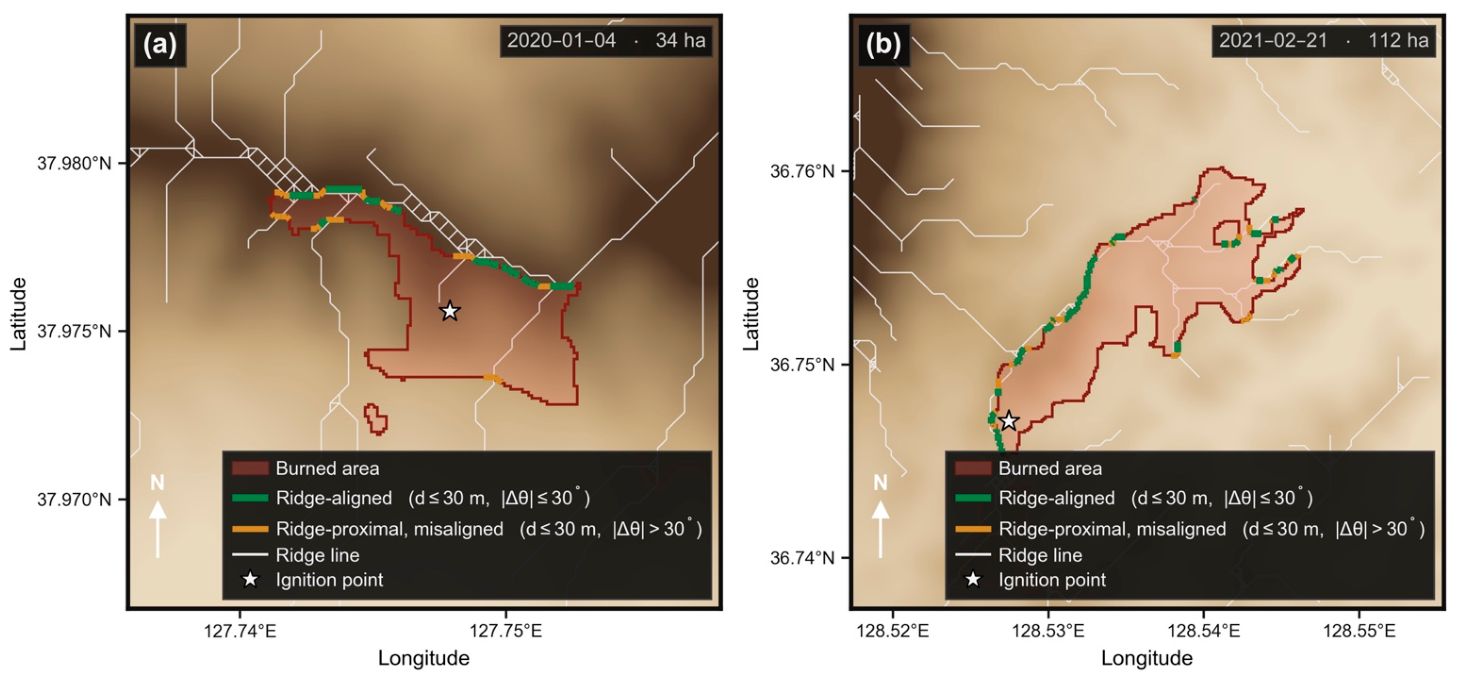
Figure 3 shows the local geometry behind the cohort statistics. In the January 2020 and February 2021 examples, some final-perimeter segments follow ridge crests for several hundred metres, whereas other ridge-proximal segments intersect ridges without sharing their orientation. The implication is that proximity alone is not sufficient to describe the pattern. The directional endpoint counts perimeter segments that trace ridge orientation, thereby distinguishing ridge-following boundaries from boundaries that merely touch or cross a ridge.
3.3. Cohort-Wide Ridge Alignment
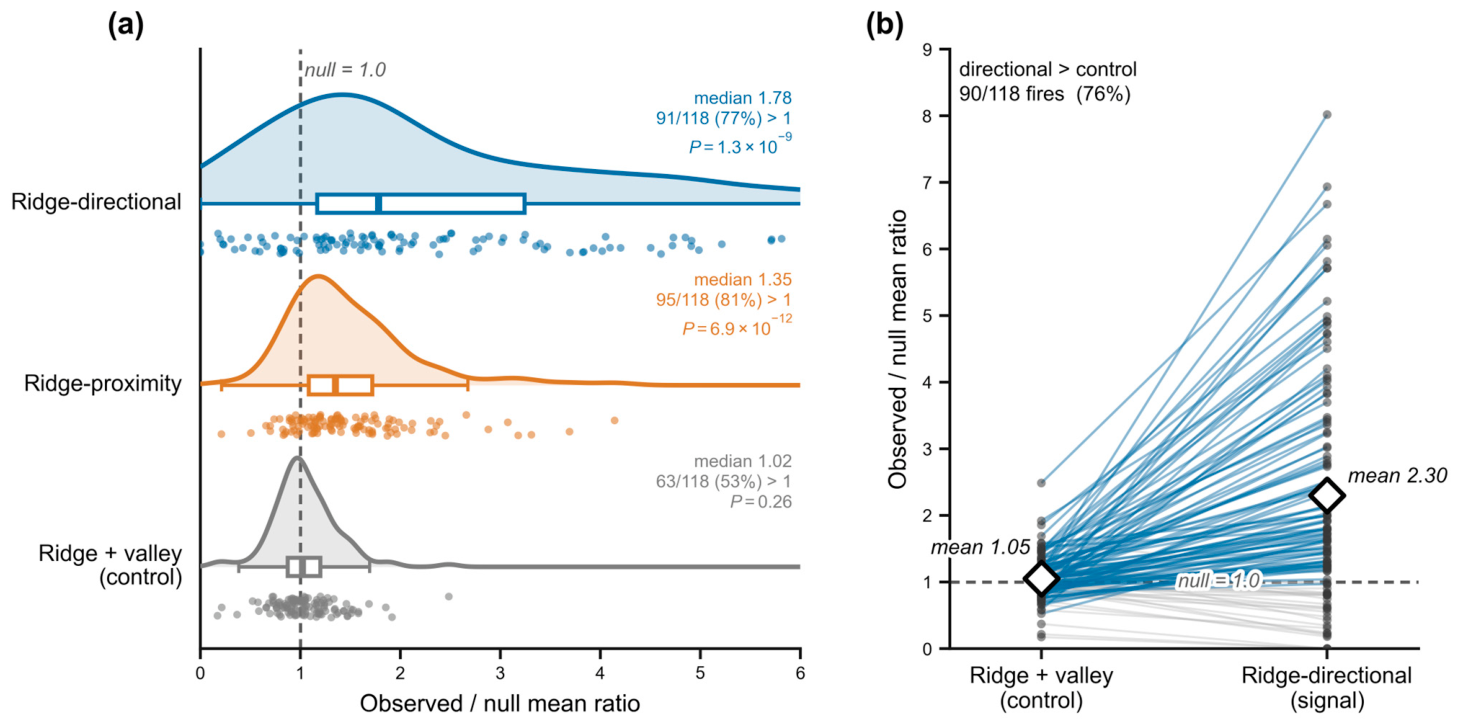
Table 1 and
Figure 4 show that final wildfire perimeters were more strongly associated with independently derived ridge lines than expected under the local translate-and-rotate null model. The directional endpoint Aθ had a cohort mean enrichment of 2.30 and a median of 1.78. It exceeded the null in 91 of 118 fires, yielding a two-sided sign-test
p-value of 2.7 × 10
−9 (Wilcoxon signed-rank
p = 7 × 10
−13; bootstrap 95% CI for the cohort mean 2.01–2.61). The proximity endpoint R30 was also elevated, with a mean enrichment of 1.48, a median of 1.35, and 95 of 118 fires above unity (two-sided
p = 1.4 × 10
−11; 95% CI 1.37–1.60).
These two endpoints answer different parts of the same question. R30 shows that observed final perimeters lie within one DEM cell of ridge lines more often than locally translated and rotated versions of the same perimeters. Aθ adds an orientation criterion and shows that the observed perimeter is more likely to run along the nearest ridge than to cross it at an arbitrary angle. The larger effect size for Aθ indicates that the ridge signal is not merely a proximity effect; it includes directional organisation along the ridge network.
3.4. Specificity Against Valley-Inclusive Controls
The ridge + valley 30 m overlap comparator did not reproduce the ridge signal. Its cohort mean enrichment was 1.05, the median was 1.02, and 63 of 118 fires exceeded unity (two-sided sign-test p = 0.52; bootstrap 95% CI for the mean 0.99–1.11, spanning unity). Because adding valleys changes the density and topology of the terrain-line network, this comparison is best read as a specificity diagnostic. The result indicates that the observed signal is concentrated on ridges rather than on generic terrain lines.
This specificity result explains why a ridge-only test is needed. Valleys and ridges are both linear terrain features, but they can relate to spread, fuel moisture, wind exposure and suppression in different ways. Combining them into one feature class may be operationally convenient, but it can dilute or mask a ridge-specific perimeter signal.
3.5. Robustness to Null Sample Size and Parameter Choice
The main results were stable across the tested Monte Carlo schedules. Cohort mean Aθ was 2.287, 2.296, and 2.299 for 100, 200, and 500 null iterations, respectively. Cohort mean R30 was 1.483 under all three schedules, and the ridge + valley control changed only from 1.054 to 1.049. The sign-test conclusions did not change qualitatively, indicating that the cohort signal is not a consequence of a particular null sample size.
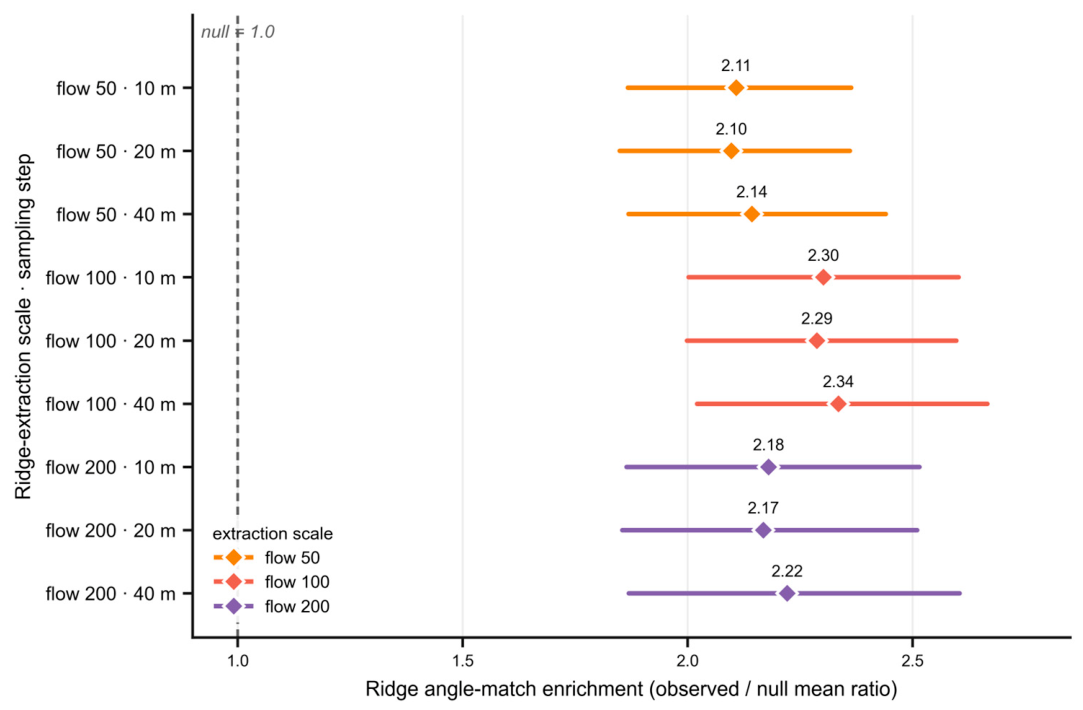
Figure 5 shows that the directional ridge signal also persisted across spatial scale on the full 118-fire cohort. Varying the ridge-extraction scale (flow-accumulation threshold 50, 100, 200 cells) and the perimeter sampling step (10, 20, 40 m), the Aθ enrichment remained between 2.10 and 2.34 and was significant in every one of the nine scale combinations (84–93 of 118 fires above unity; two-sided sign-test
p ≤ 4.7 × 10
−6). The signal was equally insensitive to the construction of the null model: a rotation-only null (mean 1.91; 85 of 118 fires) and a reduced 250 m translation radius (mean 2.15; 88 of 118 fires) bracketed the main 500 m design (mean 2.30; 91 of 118 fires), all significant at two-sided
p ≤ 1.8 × 10
−6. Varying the distance (30, 60 m) and angle (20°, 30°) tolerances likewise left the conclusion unchanged.
The ridge + valley control remained weak across the same scale combinations, with cohort-mean enrichment between 1.04 and 1.11 and no consistent excess above unity. The robustness analysis therefore supports two conclusions: the ridge signal is not a scale, null-design or threshold artefact, and the weak pooled ridge + valley control is likewise stable rather than a single-setting artefact.
3.6. Ridge Continuity, Slope, and Road Independence
Stratifying the ridge network by its own geometry localised the signal further. Restricting ridges to progressively longer, more continuous components (≥250, ≥500 and ≥1000 m) left the directional enrichment essentially unchanged (2.30, 2.29, 2.29 and 2.28; 91 of 118 fires throughout; two-sided sign-test p = 2.7 × 10⁻⁹). When the network was instead split into within-fire length terciles, the shortest tercile carried no detectable signal (mean 0.97; 13 of 38 fires; two-sided p = 0.07), whereas the middle and longest terciles remained significant (2.13 and 2.04). Enrichment was present in every slope class (two-sided p ≤ 7.3 × 10⁻³) and was, if anything, weaker on the steepest ridges (mean 1.78) than on gentle and moderate ridges (mean 2.69). The directional signal is therefore carried by continuous ridge lines rather than by short or especially steep fragments.
Because roads and constructed fire-lines frequently follow ridge crests, we tested whether the alignment was an artefact of such features (
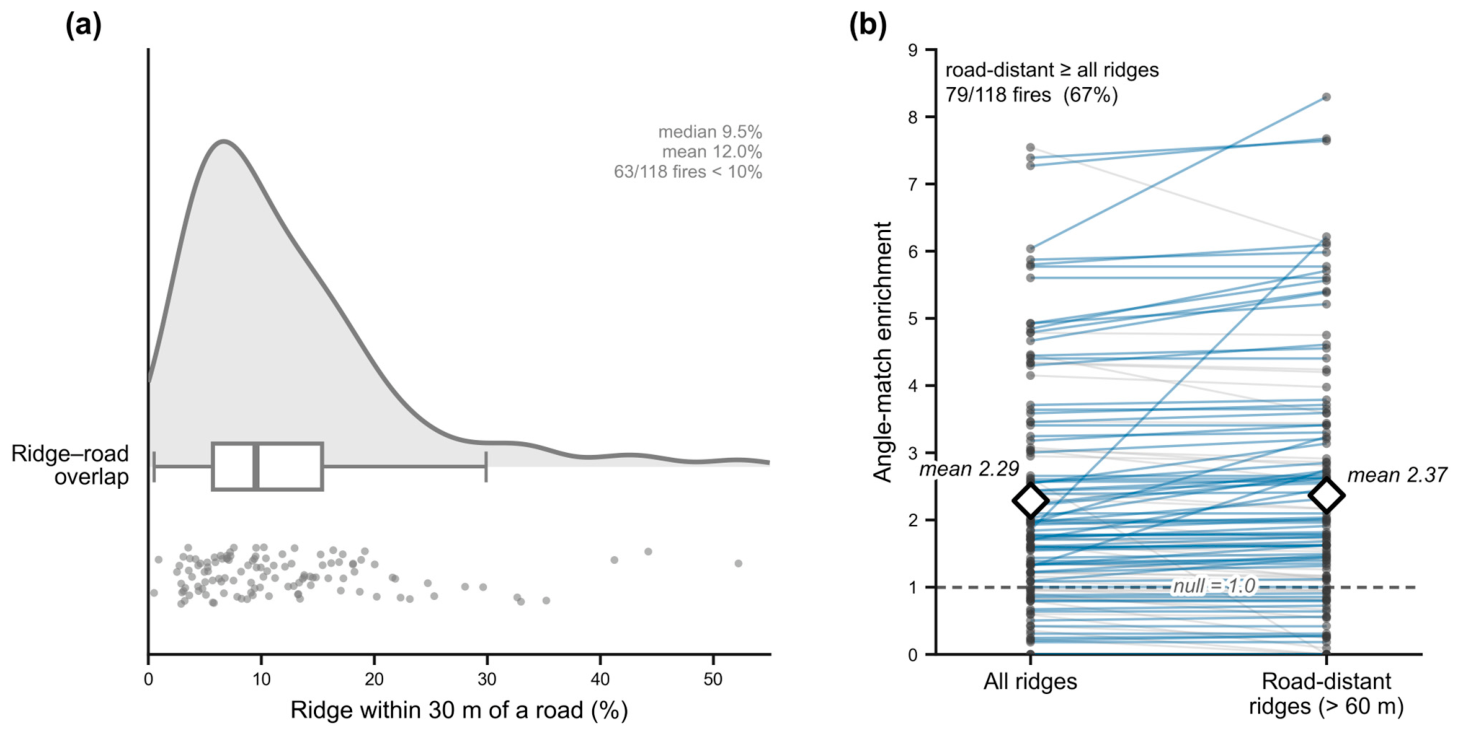
Figure 6). Across the cohort, only a small fraction of ridge length lay near a mapped road (mean 12.0%, median 9.5%; 63 of 118 fires below 10%). Removing every ridge segment within 60 m of a road and recomputing the enrichment on the remaining road-distant ridges did not weaken the signal; it was marginally stronger (mean 2.37; 89 of 118 fires; two-sided
p = 2.8 × 10
−8; 95% CI 2.04–2.70) than for all ridges in the same fires (2.29), and the road-distant value met or exceeded the all-ridge value in 79 of 118 fires (67%). The ridge alignment is therefore not explained by roads or fire-lines that happen to coincide with ridges.
4. Discussion
4.1. Main Finding and Answer to the Research Question
The main result is specific and directly addresses the research question: final wildfire perimeters in this Korean cohort are non-randomly organised with respect to independently derived DEM ridge lines. The directional endpoint was enriched in 91 of 118 fires and the proximity endpoint in 95 of 118 fires, while the pooled ridge + valley comparator was not significantly enriched. The evidence therefore supports a ridge-specific geometric association rather than a generic tendency for final fire boundaries to fall near any terrain line.
This finding should not be overstated as proof that individual ridges causally stopped fire spread. The observed pattern is consistent with several non-exclusive ridge-related mechanisms documented in fire-terrain studies: spread and fireline intensity can change near slope breaks; terrain-modified wind can accelerate, separate or channel fire fronts along ridge axes; and ridge lines often coincide with fuel discontinuities, roads or suppression opportunities [
1,
26,
27,
28,
29,
30,
31,
32,
33,
34,
35]. The result is therefore best interpreted as a ridge-associated final-boundary pattern that may arise from spread arrest, spread redirection, suppression use of ridges, or their combination.
4.2. Why Directional Alignment Matters
R30 is an important screening statistic, but it is vulnerable to dense terrain-line networks: in rugged landscapes, many random local placements will fall near some ridge. Aθ is more selective because it requires the perimeter to be both near a ridge and oriented along it. The larger Aθ enrichment therefore suggests that the ridge signal is expressed primarily through line geometry, not only through contact frequency. A boundary that merely crosses a ridge increases proximity; a boundary that follows a ridge indicates directional organisation along the terrain line.
This interpretation is consistent with fire-terrain-wind studies showing that ridge lines can generate local flow acceleration, separation, and fire channelling, especially where wind approaches complex slopes at oblique or perpendicular angles [
27,
28,
29,
30]. It is also consistent with empirical fire-spread studies that identify ridgetops, valley bottoms, fuels, and weather as interacting controls on where fire spread slows or terminates [
26,
36,
37]. The present analysis does not measure wind or fire intensity directly, so it should be read as a perimeter-geometry benchmark. Its practical implication is that topography-aware models should consider ridge tangent fields or orientation-aware terrain channels, not only slope, aspect or binary ridge masks.
4.3. Specificity, Confounding, and Relation to Previous Work
The failure of the ridge + valley control argues against an overly broad terrain-line explanation. At the same time, ridge specificity does not eliminate confounding. Roads, dozer lines, fuel breaks and hiking trails often occur on or near ridge crests, and suppression crews may preferentially engage fire from accessible high ground. Potential control-location studies treat roads, ridges, fuel discontinuities and suppression opportunity as interacting predictors rather than isolated features [
34,
38].
Accordingly, the present result should be interpreted as a ridge-geometry benchmark, not as a complete causal model. The local null model controls for perimeter shape and local ridge density, and the road-control analysis (
Section 3.6) directly addresses the most obvious anthropogenic confounder by showing that the signal survives the removal of road-adjacent ridges. It does not, however, control for all factors that may co-vary with ridges. A stronger next-stage model would additionally include pre-existing fuel breaks, land-cover or fuel type, suppression lines, ignition location, wind direction and time-resolved fire progression.
The result extends previous work on topographic controls on wildfire boundaries by isolating the ridge component more directly. Holsinger et al. reported that valley bottoms and ridgetops were associated with fire boundaries in western US landscapes [
26], while broader work has linked fire effects and burned area to topographic controls across Mediterranean, boreal, and Australian regimes [
26,
36,
37,
39,
40,
41]. The present contribution is narrower but more explicit: ridge-only geometry is tested against local shape-preserving null perimeters and against a valley-inclusive comparator.
In the Korean context, previous studies have described long-term fire occurrence, fire probability, fire-weather thresholds, human-caused ignition patterns, and machine-learning risk prediction [
13,
14,
15,
16,
17,
18,
19]. The recent Google Earth Engine comparison of forest-fire risk models is especially relevant because it shows how DEM and remotely sensed predictors can support national-scale fire-risk modelling [
16]. The present paper is complementary: it does not predict ignition or occurrence probability, but evaluates whether final perimeter geometry in fires that did occur is systematically related to ridge structure.
4.4. Limitations and Implications
Two data characteristics frame the interpretation. First, final perimeters summarise spread dynamics, suppression, wind shifts, fuel discontinuities, humidity recovery and post-fire mapping rather than moving fire fronts. The analysis therefore identifies ridge-associated final-perimeter organisation; testing whether ridges stopped, redirected or merely coincided with fire spread would require time-resolved progression data such as VIIRS active-fire fronts or incident perimeter records [
42].
Second, perimeter and terrain layers have finite spatial accuracy. Area agreement with official damaged-area records supports the use of the burn masks at cohort scale, but local boundary displacement remains possible. Similarly, the 30 m SRTM DEM may smooth narrow spurs or merge adjacent divides. These uncertainties are partly controlled by applying the same geometry and DEM to observed and null perimeters, but higher-resolution DEMs and broader reference perimeter data would improve future tests.
Finally, the local null model controls for perimeter shape and local ridge density, but not for all covariates that may co-vary with ridges. Roads, trails, fuel breaks, wind direction, fuels and suppression activity can also influence where final boundaries stabilise. Future applications should include these layers where available and stratify ridge alignment by season, ignition cause, fuel type and suppression-access proxies.
Despite these limitations, the results have implications for both fire science and operational planning. For empirical fire ecology, the analysis converts the common observation that fires often stabilise along ridges into a formal cohort-level test. For fire-spread modelling, it motivates orientation-aware terrain inputs such as ridge tangent fields, not only slope, aspect or binary ridge masks [
43,
44]. For management, the result supports the use of ridges as probabilistic components of potential operational delineations, control-line planning, and fuel-treatment design [
31,
32,
33,
34,
35,
45], while emphasising that ridges should be interpreted together with wind, fuel and access conditions rather than as deterministic barriers.
5. Conclusions
In this study, we tested whether final wildfire perimeters in the Republic of Korea are systematically organised with respect to DEM-derived ridge lines, using 118 paired burn-mask and fire metadata records from 2018 to 2025. The workflow separates burn-mask and perimeter generation from DEM-derived ridge line extraction and joins the two only at the correspondence stage through a local translate-and-rotate null model.
The directional ridge-alignment statistic exceeded the local null in 91 of 118 fires (mean enrichment = 2.30; two-sided p = 2.7 × 10⁻⁹; 95% CI 2.01–2.61), and the proximity ridge-overlap statistic exceeded the null in 95 of 118 fires (mean enrichment = 1.48; two-sided p = 1.4 × 10⁻¹¹). In contrast, the ridge + valley control produced no comparable cohort signal (63 of 118; p = 0.52), and the effect was stable across Monte Carlo schedules, across ridge-extraction and sampling scales on the full cohort, under alternative null designs, and after excluding road-adjacent ridges.
The strongest defensible conclusion is therefore that final Korean wildfire perimeters are non-randomly and directionally organised with respect to DEM-derived ridges. Because the analysis uses final mapped perimeters rather than time-resolved fire fronts, it cannot separate causal spread arrest from spread redirection, suppression use of ridges, or co-located roads and fuel breaks. Future work should combine this ridge-geometry benchmark with progression fronts, wind fields, fuels, roads and suppression-line data to identify which mechanisms produce the observed final-boundary pattern. More immediately, the cohort provides an observational, terrain-only benchmark against which fire-spread and fire-behaviour models can be evaluated for realistic ridge–perimeter geometry. The benchmark is specific to this Korean cohort, however; whether the same ridge alignment holds in other fire regimes would require cross-regional replication with the identical framework. The interpretation also depends on the positional accuracy of burn-mask-derived perimeters; although area-scale agreement supports cohort-level analysis, segment-level boundary uncertainty may still affect local ridge-alignment estimates. In addition, enrichment ratios should be interpreted as relative increases over local null expectations, not as evidence that most perimeter length was ridge controlled.
Author Contributions
Conceptualization, J.C. and H.C.; methodology, J.C. and H.C.; software, J.C.; validation, J.C. and H.C.; formal analysis, J.C.; investigation, J.C.; resources, H.C.; data curation, J.C.; writing—original draft preparation, J.C.; writing—review and editing, J.C. and H.C.; visualisation, J.C.; supervision, H.C.; project administration, H.C.; funding acquisition, H.C. All authors have read and agreed to the published version of the manuscript.
Funding
This work was supported by the National Research Foundation of Korea (NRF) from a grant funded by the Korea government (MSIT) (No. RS-2023-NR076912), and the R&D Programme for Forest Science Technology (Project No. RS-2024-00402624) provided by Korea Forest Service (Korea Forestry Promotion Institute).
Institutional Review Board Statement
Not applicable.
Informed Consent Statement
Not applicable.
Data Availability Statement
The original contributions of this study are included in this article. Further inquiries related to the data can be directed to J.C. at
ju6891@kangwon.ac.kr.
Acknowledgments
The authors thank the Korea Forest Service for maintaining wildfire occurrence and damaged-area records, and the providers of Copernicus Sentinel-2 and SRTM data for open Earth observation and terrain products used in this study.
Conflicts of Interest
The authors declare no conflicts of interest.
References
- Sharples, J.J. An Overview of Mountain Meteorological Effects Relevant to Fire Behaviour and Bushfire Risk. Int. J. Wildland Fire 2009, 18, 737–754. [Google Scholar] [CrossRef]
- Rothermel, R.C. How to Predict the Spread and Intensity of Forest and Range Fires; General Technical Report INT-143; USDA Forest Service, Intermountain Forest and Range Experiment Station: Ogden, UT, USA, 1983. [Google Scholar]
- Linn, R.; Reisner, J.; Colman, J.J.; Winterkamp, J. Studying Wildfire Behavior Using FIRETEC. Int. J. Wildland Fire 2002, 11, 233–246. [Google Scholar] [CrossRef]
- Mandel, J.; Beezley, J.D.; Kochanski, A.K. Coupled Atmosphere–Wildland Fire Modeling with WRF 3.3 and SFIRE 2011. Geosci. Model Dev. 2011, 4, 591–610. [Google Scholar] [CrossRef]
- Drusch, M.; Del Bello, U.; Carlier, S.; Colin, O.; Fernandez, V.; Gascon, F.; Hoersch, B.; Isola, C.; Laberinti, P.; Martimort, P.; et al. Sentinel-2: ESA’s Optical High-Resolution Mission for GMES Operational Services. Remote Sens. Environ. 2012, 120, 25–36. [Google Scholar] [CrossRef]
- Claverie, M.; Ju, J.; Masek, J.G.; Dungan, J.L.; Vermote, E.F.; Roger, J.-C.; Skakun, S.V.; Justice, C. The Harmonized Landsat and Sentinel-2 Surface Reflectance Data Set. Remote Sens. Environ. 2018, 219, 145–161. [Google Scholar] [CrossRef]
- Roteta, E.; Bastarrika, A.; Franquesa, M.; Chuvieco, E. Landsat and Sentinel-2 Based Burned Area Mapping Tools in Google Earth Engine. Remote Sens. 2021, 13, 816. [Google Scholar] [CrossRef]
- Farr, T.G.; Rosen, P.A.; Caro, E.; Crippen, R.; Duren, R.; Hensley, S.; Kobrick, M.; Paller, M.; Rodriguez, E.; Roth, L.; et al. The Shuttle Radar Topography Mission. Rev. Geophys. 2007, 45, RG2004. [Google Scholar] [CrossRef]
- Weiss, A. Topographic Position and Landforms Analysis. Poster Presentation. In Proceedings of the ESRI User Conference, San Diego, CA, USA, 9–13 July 2001. [Google Scholar]
- O’Callaghan, J.F.; Mark, D.M. The Extraction of Drainage Networks from Digital Elevation Data. Comput. Vis. Graph. Image Process. 1984, 28, 323–344. [Google Scholar] [CrossRef]
- Jenson, S.K.; Domingue, J.O. Extracting Topographic Structure from Digital Elevation Data for Geographic Information System Analysis. Photogramm. Eng. Remote Sens. 1988, 54, 1593–1600. [Google Scholar]
- Zhang, T.Y.; Suen, C.Y. A Fast Parallel Algorithm for Thinning Digital Patterns. Commun. ACM 1984, 27, 236–239. [Google Scholar] [CrossRef]
- Lee, B.; Park, P.S.; Chung, J. Temporal and Spatial Characteristics of Forest Fires in South Korea between 1970 and 2003. Int. J. Wildland Fire 2006, 15, 389–396. [Google Scholar] [CrossRef]
- Kim, S.J.; Lim, C.-H.; Kim, G.S.; Lee, J.; Geiger, T.; Rahmati, O.; Son, Y.; Lee, W.-K. Multi-Temporal Analysis of Forest Fire Probability Using Socio-Economic and Environmental Variables. Remote Sens. 2019, 11, 86. [Google Scholar] [CrossRef]
- Lim, C.-H.; Kim, Y.-S.; Won, M.; Kim, S.J.; Lee, W.-K. Can Satellite-Based Data Substitute for Surveyed Data to Predict the Spatial Probability of Forest Fire? A Geostatistical Approach to Forest Fire in the Republic of Korea. Geomat. Nat. Hazards Risk 2019, 10, 719–739. [Google Scholar] [CrossRef]
- Choi, J.; Yun, Y.; Chae, H. Forest Fire Risk Prediction in South Korea Using Google Earth Engine: Comparison of Machine Learning Models. Land 2025, 14, 1155. [Google Scholar] [CrossRef]
- Lim, C.J.; Chae, H. Characterizing Human-Caused Wildfire Based on the Fire Weather Index in South Korea. Fire 2026, 9, 147. [Google Scholar] [CrossRef]
- Kim, J.; Kim, T.; Lee, Y.E.; Im, S. Spatial and Temporal Variability of Forest Fires in the Republic of Korea over 1991–2020. Nat. Hazards 2025, 121, 9801–9821. [Google Scholar] [CrossRef]
- Korea Forest Service. Statistical Yearbook of Forestry; Korea Forest Service: Daejeon, Republic of Korea, 2024.
- Key, C.H.; Benson, N.C. Landscape Assessment: Ground Measure of Severity, the Composite Burn Index; and Remote Sensing of Severity, the Normalized Burn Ratio. In FIREMON: Fire Effects Monitoring and Inventory System; Lutes, D.C., Keane, R.E., Caratti, J.F., Key, C.H., Benson, N.C., Sutherland, S., Gangi, L.J., Eds.; General Technical Report RMRS-GTR-164-CD; USDA Forest Service, Rocky Mountain Research Station: Fort Collins, CO, USA, 2006. [Google Scholar]
- Miller, J.D.; Thode, A.E. Quantifying Burn Severity in a Heterogeneous Landscape with a Relative Version of the Delta Normalized Burn Ratio (dNBR). Remote Sens. Environ. 2007, 109, 66–80. [Google Scholar] [CrossRef]
- Parks, S.A.; Dillon, G.K.; Miller, C. A New Metric for Quantifying Burn Severity: The Relativized Burn Ratio. Remote Sens. 2014, 6, 1827–1844. [Google Scholar] [CrossRef]
- Phipson, B.; Smyth, G.K. Permutation P-Values Should Never Be Zero: Calculating Exact P-Values When Permutations Are Randomly Drawn. Stat. Appl. Genet. Mol. Biol. 2010, 9, 39. [Google Scholar] [CrossRef]
- Manly, B.F.J. Randomization, Bootstrap and Monte Carlo Methods in Biology, 3rd ed.; Chapman & Hall/CRC: Boca Raton, FL, USA, 2007. [Google Scholar]
- Good, P. Permutation, Parametric and Bootstrap Tests of Hypotheses, 3rd ed.; Springer: New York, NY, USA, 2005. [Google Scholar]
- Holsinger, L.; Parks, S.A.; Miller, C. Weather, Fuels, and Topography Impede Wildland Fire Spread in Western US Landscapes. For. Ecol. Manag. 2016, 380, 59–69. [Google Scholar] [CrossRef]
- Sharples, J.J.; McRae, R.H.D.; Wilkes, S.R. Wind–Terrain Effects on the Propagation of Wildfires in Rugged Terrain: Fire Channelling. Int. J. Wildland Fire 2012, 21, 282–296. [Google Scholar] [CrossRef]
- Whiteman, C.D. Mountain Meteorology: Fundamentals and Applications; Oxford University Press: New York, NY, USA, 2000; ISBN 978-0-19-513271-7. [Google Scholar]
- Forthofer, J.M.; Butler, B.W.; Wagenbrenner, N.S. A Comparison of Three Approaches for Simulating Fine-Scale Surface Winds in Support of Wildland Fire Management. Part I. Model Formulation and Comparison against Measurements. Int. J. Wildland Fire 2014, 23, 969–981. [Google Scholar] [CrossRef]
- Abouali, A.; Viegas, D.X.; Raposo, J.R. Analysis of the Wind Flow and Fire Spread Dynamics over a Sloped-Ridgeline Hill. Combust. Flame 2021, 234, 111724. [Google Scholar] [CrossRef]
- Thompson, M.P.; Bowden, P.; Brough, A.; Scott, J.H.; Gilbertson-Day, J.; Taylor, A.; Anderson, J.; Haas, J.R. Application of Wildfire Risk Assessment Results to Wildfire Response Planning in the Southern Sierra Nevada, California, USA. Forests 2016, 7, 64. [Google Scholar] [CrossRef]
- Greiner, S.M.; Schultz, C.A.; Kooistra, C. Pre-Season Fire Management Planning: The Use of Potential Operational Delineations to Prepare for Wildland Fire Events. Int. J. Wildland Fire 2021, 30, 170–178. [Google Scholar] [CrossRef]
- Thompson, M.P.; O’Connor, C.D.; Gannon, B.M.; Caggiano, M.D.; Dunn, C.J.; Schultz, C.A.; Calkin, D.E.; Pietruszka, B.; Greiner, S.M.; Stratton, R.; et al. Potential Operational Delineations: New Horizons for Proactive, Risk-Informed Strategic Land and Fire Management. Fire Ecol. 2022, 18, 17. [Google Scholar] [CrossRef]
- O’Connor, C.D.; Haas, J.R.; Gannon, B.M.; Dunn, C.J.; Thompson, M.P.; Calkin, D.E. Modelling Potential Control Locations: Development and Adoption of Data-Driven Analytics to Support Strategic and Tactical Wildfire Containment Decisions. Environ. Sci. Proc. 2022, 17, 73. [Google Scholar] [CrossRef]
- Finney, M.A. Design of Regular Landscape Fuel Treatment Patterns for Modifying Fire Growth and Behavior. For. Sci. 2001, 47, 219–228. [Google Scholar] [CrossRef]
- Bradstock, R.A.; Hammill, K.A.; Collins, L.; Price, O. Effects of Weather, Fuel and Terrain on Fire Severity in Topographically Diverse Landscapes of South-Eastern Australia. Landsc. Ecol. 2010, 25, 607–619. [Google Scholar] [CrossRef]
- Povak, N.A.; Hessburg, P.F.; Salter, R.B. Evidence for Scale-Dependent Topographic Controls on Wildfire Spread. Ecosphere 2018, 9, e02443. [Google Scholar] [CrossRef]
- O’Connor, C.D.; Calkin, D.E.; Thompson, M.P. An Empirical Machine Learning Method for Predicting Potential Fire Control Locations for Pre-Fire Planning and Operational Fire Management. Int. J. Wildland Fire 2017, 26, 587–597. [Google Scholar] [CrossRef]
- Viedma, O.; Quesada, J.; Torres, I.; De Santis, A.; Moreno, J.M. Fire Severity in a Large Fire in a Pinus pinaster Forest Is Highly Predictable from Burning Conditions, Stand Structure, and Topography. Ecosystems 2015, 18, 237–250. [Google Scholar] [CrossRef]
- Moreira, F.; Viedma, O.; Arianoutsou, M.; Curt, T.; Koutsias, N.; Rigolot, E.; Barbati, A.; Corona, P.; Vaz, P.; Xanthopoulos, G.; et al. Landscape–Wildfire Interactions in Southern Europe: Implications for Landscape Management. J. Environ. Manag. 2011, 92, 2389–2402. [Google Scholar] [CrossRef]
- Parisien, M.-A.; Parks, S.A.; Krawchuk, M.A.; Flannigan, M.D.; Bowman, L.M.; Moritz, M.A. Scale-Dependent Controls on the Area Burned in the Boreal Forest of Canada, 1980–2005. Ecol. Appl. 2011, 21, 789–805. [Google Scholar] [CrossRef]
- Schroeder, W.; Oliva, P.; Giglio, L.; Csiszar, I.A. The New VIIRS 375 m Active Fire Detection Data Product: Algorithm Description and Initial Assessment. Remote Sens. Environ. 2014, 143, 85–96. [Google Scholar] [CrossRef]
- Sullivan, A.L. Wildland Surface Fire Spread Modelling, 1990–2007. 3: Simulation and Mathematical Analogue Models. Int. J. Wildland Fire 2009, 18, 387–403. [Google Scholar] [CrossRef]
- Jain, P.; Coogan, S.C.P.; Subramanian, S.G.; Crowley, M.; Taylor, S.; Flannigan, M.G. A Review of Machine Learning Applications in Wildfire Science and Management. Environ. Rev. 2020, 28, 478–505. [Google Scholar] [CrossRef]
- Korea Forest Service. Forest Fire Standard Manual; Korea Forest Service: Daejeon, Republic of Korea, 2022.
Figure 1.
Five-module workflow for testing ridge-aligned wildfire perimeters. Sentinel-2 pre- and post-fire imagery and official fire metadata are processed into burn masks, area checks, final perimeters, and 20 m samples, while the SRTM DEM is processed independently into ridge and valley line layers. The two products are joined only in the local translate-and-rotate null test, which outputs R30/Aθ ratios, cohort sign tests, sensitivity-grid results and numeric output tables.
Figure 1.
Five-module workflow for testing ridge-aligned wildfire perimeters. Sentinel-2 pre- and post-fire imagery and official fire metadata are processed into burn masks, area checks, final perimeters, and 20 m samples, while the SRTM DEM is processed independently into ridge and valley line layers. The two products are joined only in the local translate-and-rotate null test, which outputs R30/Aθ ratios, cohort sign tests, sensitivity-grid results and numeric output tables.
Figure 2.
Validation of archived wildfire masks against official damaged-area records for all 118 fires. (a) Detected burned area versus official damaged area on log-log axes; point colour denotes official fire-size class. The central dashed line indicates 1:1 agreement, and outer dashed lines mark a factor band. The panel reports the log-area Pearson correlation (r = 0.94), while the raw-area correlation is r = 0.9961. (b) Representative Suncheon-Bongsan fire on 3 April 2023, showing the Sentinel-2 burned area and derived perimeter relative to the Korea Forest Service reference perimeter.
Figure 2.
Validation of archived wildfire masks against official damaged-area records for all 118 fires. (a) Detected burned area versus official damaged area on log-log axes; point colour denotes official fire-size class. The central dashed line indicates 1:1 agreement, and outer dashed lines mark a factor band. The panel reports the log-area Pearson correlation (r = 0.94), while the raw-area correlation is r = 0.9961. (b) Representative Suncheon-Bongsan fire on 3 April 2023, showing the Sentinel-2 burned area and derived perimeter relative to the Korea Forest Service reference perimeter.
Figure 3.
Two representative fires from the cohort. (a) Fire occurring on 4 January 2020, 34 ha official damaged area. (b) Fire occurring on 21 February 2021, 112 ha. Each panel shows hillshade-rendered SRTM terrain, extracted ridge polylines, burned area, ignition point, and perimeter classifications. Green segments are ridge-aligned (within 30 m and within 30° of the nearest-ridge orientation); orange segments are ridge-proximal but misaligned; remaining red perimeter segments are not counted as ridge-aligned. The examples illustrate the geometric distinction between touching a ridge and tracing its orientation.
Figure 3.
Two representative fires from the cohort. (a) Fire occurring on 4 January 2020, 34 ha official damaged area. (b) Fire occurring on 21 February 2021, 112 ha. Each panel shows hillshade-rendered SRTM terrain, extracted ridge polylines, burned area, ignition point, and perimeter classifications. Green segments are ridge-aligned (within 30 m and within 30° of the nearest-ridge orientation); orange segments are ridge-proximal but misaligned; remaining red perimeter segments are not counted as ridge-aligned. The examples illustrate the geometric distinction between touching a ridge and tracing its orientation.
Figure 4.
Cohort-wide enrichment of final wildfire perimeter correspondence with independently derived ridge lines. (a) Per-fire observed-to-null mean ratios for the ridge-directional endpoint (Aθ), ridge-proximity endpoint (R30), and ridge + valley proximity control. The dashed line marks the null expectation of 1.0. (b) Fire-level contrast between the ridge-directional endpoint and the ridge + valley control; the directional value exceeds the control in 90 of 118 fires, distinct from the 91 of 118 fires whose directional enrichment exceeds the null in panel (a). This illustrates the ridge-specific nature of the signal.
Figure 4.
Cohort-wide enrichment of final wildfire perimeter correspondence with independently derived ridge lines. (a) Per-fire observed-to-null mean ratios for the ridge-directional endpoint (Aθ), ridge-proximity endpoint (R30), and ridge + valley proximity control. The dashed line marks the null expectation of 1.0. (b) Fire-level contrast between the ridge-directional endpoint and the ridge + valley control; the directional value exceeds the control in 90 of 118 fires, distinct from the 91 of 118 fires whose directional enrichment exceeds the null in panel (a). This illustrates the ridge-specific nature of the signal.
Figure 5.
Multiscale robustness of the directional ridge-alignment signal (Aθ) across the full 118-fire cohort. Each row is one of the nine combinations of the ridge-extraction scale (flow-accumulation threshold 50, 100, 200 cells) and perimeter sampling step (10, 20, 40 m); points are cohort-mean observed-to-null enriched with bootstrap 95% confidence intervals (10,000 resamples), and the dashed line marks the null expectation of 1.0. The cohort-mean enrichment is labelled above each diamond. Enrichment ranged from 2.10 to 2.34 (95% CIs within 1.85–2.67) and 84–93 of 118 fires exceeded unity in every combination, showing that the directional ridge signal is not an artefact of any single extraction or sampling scale.
Figure 5.
Multiscale robustness of the directional ridge-alignment signal (Aθ) across the full 118-fire cohort. Each row is one of the nine combinations of the ridge-extraction scale (flow-accumulation threshold 50, 100, 200 cells) and perimeter sampling step (10, 20, 40 m); points are cohort-mean observed-to-null enriched with bootstrap 95% confidence intervals (10,000 resamples), and the dashed line marks the null expectation of 1.0. The cohort-mean enrichment is labelled above each diamond. Enrichment ranged from 2.10 to 2.34 (95% CIs within 1.85–2.67) and 84–93 of 118 fires exceeded unity in every combination, showing that the directional ridge signal is not an artefact of any single extraction or sampling scale.
Figure 6.
The directional ridge signal is not an artefact of roads following ridges. (a) Distribution of ridge–road overlap across the 118 fires (fraction of ridge length within 30 m of a mapped OpenStreetMap road; mean 12.0%, median 9.5%). (b) Fire-level Aθ enrichment for all ridges versus road-distant ridges (segments within 60 m of any road removed); excluding road-adjacent ridges leaves the enrichment unchanged to marginally stronger (2.29 → 2.37), with the road-distant value meeting or exceeding the all-ridge value in 67% of fires.
Figure 6.
The directional ridge signal is not an artefact of roads following ridges. (a) Distribution of ridge–road overlap across the 118 fires (fraction of ridge length within 30 m of a mapped OpenStreetMap road; mean 12.0%, median 9.5%). (b) Fire-level Aθ enrichment for all ridges versus road-distant ridges (segments within 60 m of any road removed); excluding road-adjacent ridges leaves the enrichment unchanged to marginally stronger (2.29 → 2.37), with the road-distant value meeting or exceeding the all-ridge value in 67% of fires.
Table 1.
Cohort-level ridge-alignment results, 500-iteration local null analysis, all 118 fires.
Table 1.
Cohort-level ridge-alignment results, 500-iteration local null analysis, all 118 fires.
| Endpoint | Mean Ratio | Median Ratio | Fires with Ratio > 1 | Sign-Test p (Two-Sided) |
|---|
| Ridge angle-match (Aθ) | 2.30 | 1.78 | 91/118 | 2.7 × 10⁻⁹ |
| Ridge 30 m overlap (R30) | 1.48 | 1.35 | 95/118 | 1.4 × 10⁻¹¹ |
| Ridge + valley 30 m overlap | 1.05 | 1.02 | 63/118 | 0.52 |
| Disclaimer/Publisher’s Note: The statements, opinions and data contained in all publications are solely those of the individual author(s) and contributor(s) and not of MDPI and/or the editor(s). MDPI and/or the editor(s) disclaim responsibility for any injury to people or property resulting from any ideas, methods, instructions or products referred to in the content. |