
Article

Oxidation Mechanisms of Low Molecular Valeric Acidic Compounds in Coal Spontaneous Combustion

1
College of Mines, China University of Mining and Technology, Xuzhou 221008, China
2
Huayang Group, Shanxi Ningwu Yushupo Coal Industry Co., Ltd., Xinzhou 030024, China
3
College of Safety and Emergency Management Engineering, Taiyuan University of Technology, Taiyuan 030024, China
4
College of Materials Science and Engineering, Liaoning Technical University, Fuxin 123000, China
5
College of Safety Science and Engineering, Liaoning Technical University, Fuxin 123000, China
6
Shanxi Provincial State-Owned Capital Operation Co., Ltd., Taiyuan 030024, China
*
Author to whom correspondence should be addressed.
Fire 2026, 9(6), 237; https://doi.org/10.3390/fire9060237
Submission received: 8 April 2026 / Revised: 21 May 2026 / Accepted: 29 May 2026 / Published: 3 June 2026
(This article belongs to the Special Issue Fire Risk Management and Emergency Prevention)

Abstract

Coal spontaneous combustion seriously threatens the safety of coal mine production, and studies on low molecular compounds in coal spontaneous combustion are limited. The chemical reaction process of low molecular compound valeric acid in coal spontaneous combustion was studied using B3LYP/6-311G quantum chemical density functional theory. The mechanism of valeric acid in coal spontaneous combustion was disclosed, which is the process of chemical bond formation and breakage. The findings implied that the active sites of valeric acid during combustion are C1, C5, C8, and C11 atoms. Twelve reaction channels have also been theoretically determined in the following order: Path6 > Path3 > Path8 > Path5 > Path4 > Path1 > Path11 > Path10 > Path9 > Path12 > Path7 > Path2. This is significant for developing low molecular spontaneous combustion inhibitors and preventing coal spontaneous combustion.

1. Introduction

Coal occupies a strategic position in the energy production structure [1,2]. Global coal consumption amounted to 88.5 billion tons in 2025, representing 35% of the total [3]. Despite the decreasing reliance on fossil energy, coal remains the primary option for numerous countries due to its high energy density and low cost [4,5,6]. China’s coal consumption constituted over 51.4% of the total national energy consumption in 2025, amounting to 49.5 billion tons [7]. However, coal is susceptible to spontaneous combustion during mining, transportation, and storage due to its oxidizing and exothermic properties [8,9,10]. Mine fires are mostly attributed to coal spontaneous combustion [11,12]. Approximately 60% of mines are vulnerable to coal self-combustion risk [13]. Such conditions threaten to emit toxic and hazardous fumes and induce severe environmental contamination [14,15]. Furthermore, combustion can potentially trigger gas and coal dust explosions, risking the security of mine personnel and resulting in heavy losses in property and resources [16,17].
Researchers have employed various experimental testing [8,18] and simulation methods [7,10,17,19] to analyze coal spontaneous combustion and ignition processes, which are widely recognized as a continuous low-temperature processes of oxygen adsorption, surface reactions, radical transformation, and heat accumulation [20]. Coal–oxygen complex causation theory is widely accepted [21,22]. Li [23] revealed the mechanism of CO release during low-rank coal oxidation at room temperature via an experiment. Xu [24] combined statistical and experimental methods to uncover the formation mechanisms of CO and CO2 in CSC, which vary with coal rank. Miao [25] used gas chromatography and FTIR to characterize high-molecular-weight gas release during bituminous coal oxidation and link it to functional group evolution. Qin [26] computationally analyzed the molecular structure, bond cleavage, and their relationships in low-rank coals, revealing the key roles of oxygen-containing groups and side chains in oxidation. Zhang [27] employed quantum chemical methods to analyze the oxidation pathways and reaction behaviors of characteristic coal groups such as -OH, -CHO, -CHOHCH2-, and -COOH. Gao [28] used DFT to reveal how aldehyde and carboxyl regulate the attack sites of ·OH radicals during the early stage of CSC. Zhu [29] investigated the oxidation and self-reaction pathways of aldehyde groups during CSC. Huo [30] demonstrated the bidirectional regulatory effect of water molecules on the oxidative activity of low-molecular-weight oxygen-containing groups. Wang [31] and Cui [32] explored the structural and energetic properties of low molecular hydrocarbon and ketone compounds during ignition. The macromolecular structure of coal has been extensively studied, and the role of low-molecular-weight compounds (LMCs) in spontaneous combustion has also gained attention. Current research primarily investigated the oxidation mechanisms of hydrocarbons or ketones [31,32], demonstrating that LMCs’ oxidation reaction promotes the overall CSC. Its lower molecular weight reduces activation energy and accelerates decomposition, significantly affecting combustion rate, products, and yields [33,34].
The proportion of long-chain fatty acids and their derivatives in LMCs remains unclear, and their types and concentrations of short-chain fatty acids in coal vary with coal type and metamorphism. Previous studies on pentane and pentanone provide a basis for selecting valeric acid, which has the same carbon chain length, allowing comparison and analysis of the carboxyl group’s functional group effects. Therefore, valeric acid is chosen to investigate chemical structural laws during coal oxidation and combustion. These findings provide theoretical guidance and practical value for coal mine safety production, particularly for the development of combustion retardants.

2. Computational Methods and Configuration Constructions

2.1. Computational Methods

Using quantum chemical density functional theory calculations with Gaussian03, valeric acid molecule’s fundamental chemical structure unit was optimized at B3LYP/6-311G computational level. Its optimal equilibrium geometry was constructed using Gaussview, and its full-parameter geometric optimization with a single vibrational frequency confirmed its stability.
The correct connectivity of each transition state to its corresponding reactants and products was verified through intrinsic reaction coordinate (IRC) calculations. IRC calculations were centered on the saddle point with a step size of 0.05 Bohr, and 50 points were explored in both forward and backward directions. Energy analysis and full-parameter geometric optimization at each stationary point confirm the accuracy of the identified reaction paths, transition states, and intermediates. The potential energy profile was obtained after zero-point energy correction of all reaction energy barriers, using the total energy of the reactants (C5H10O2 and O2) as the reference zero.

2.2. Geometric Configuration of the Valeric Acid Molecule

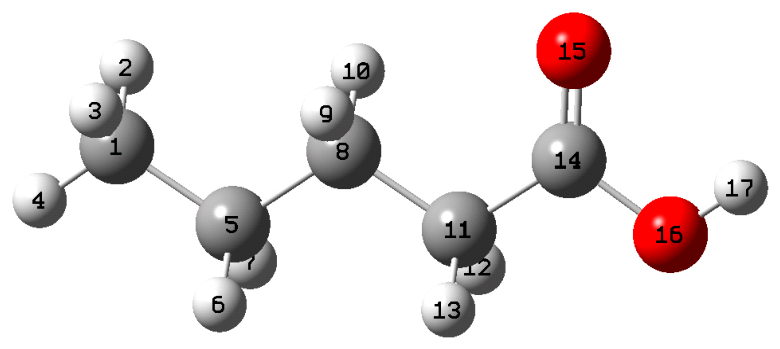
The molecular configuration parameters and vibrational frequencies were obtained, including bond lengths (R), bond angles (A), and dihedral angles (D), as shown in Table 1, Table 2 and Table 3. The optimal equilibrium geometry of valeric acid molecular structural is depicted in Figure 1, where white, gray, and red spheres represent H, C, and O atoms, respectively. The system automatically numbers each atom.

3. Active Site and Chemical Reactions That React with Oxygen in Valeric Acid Molecule

The energies and distribution of frontier orbitals were calculated to ascertain the active site of valeric acid molecules. Molecular Orbital Theory posits that orbital energy reflects the difficulty of electron acquisition or loss. The HOMO and adjacent filled orbitals are inclined to release electrons, whereas the LUMO and surrounding vacant orbitals are primed to capture them. The atoms with the densest electron cloud in the HOMO of valeric acid molecules are the primary targets of oxygen molecules during coal’s self-ignition. The charge density distribution among the atoms in valeric acid molecule is detailed in Table 4.
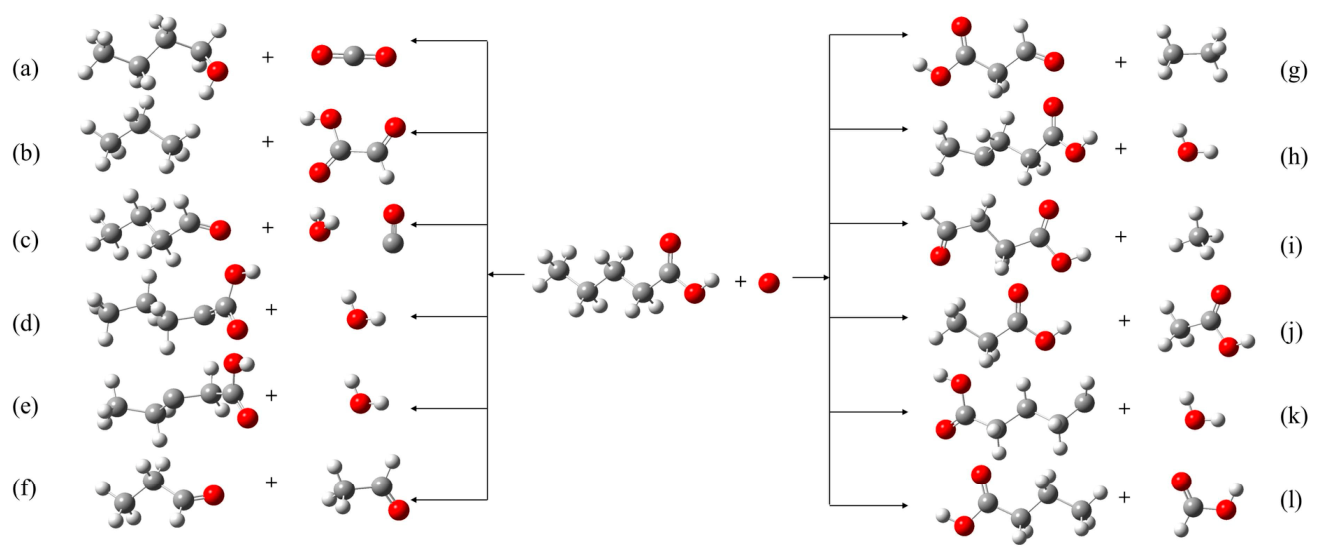
Atoms C1 and C11 exhibit the highest reactivity during the oxidation of coal. This process generates primary gases and water via 12 specific reaction paths involving valeric acid and oxygen, as shown in Figure 2. Oxygen initially targeting the -CH2- group in CH2COOH of valeric acid, yielding products like CH3CH2CH2CHO and CO2, CH3CH2CH3 and CHOCHO, CH3CH2CH2CHO, H2O and CO, or CH3CH2CH2CCOOH and H2O, as indicated by reactions (a) to (d). Oxygen then attacks the terminal -CH2- in CH3CH2CH2, forming products like CH3CH2C·CH2COOH and H2O, CH3CH2CHO and CH3COOH, or CHOCH2COOH and CH3CH3, denoted by reactions (e) to (g). Then oxygen targets the -CH2- group within CH3CH-, producing CH3C·CH2CH2COOH and H2O, CHOCH2CH2COOH and CH4, or CH3CH2COOH and CH3COOH, represented by reactions (h) to (j). Finally, oxygen interacts with the CH3- group, forming CHCH2CH2CH2COOH and H2O, or CH3CH2CH2COOH and HCOH, as shown in reactions (k) and (l).

4. Calculations of Reactions in Valeric Acid in Coal

4.1. Analysis of Geometrical Configurations and Chemical Reaction Processes of Each Stationary Point

Valeric acid molecules in coal react with oxygen through 12 distinct paths during combustion, denoted as R (reactants), O (oxygen atom), TS1–TS23 (transition states), MI1–MI23 (intermediates), and P1–P12 (products).
R + O → TS1 → MI1 → TS2 → MI2 → TS3 → MI3 → P1 + CO2 Path1
R + O → TS1 → MI1 → TS4 → MI4 → TS5 → MI5 → P2 + CHOCOOH Path2
R + O → TS1 → MI1 → TS6 → MI6 → P3 + H2O + CO Path3
R + O → TS1 → MI1 → TS7 → MI7 → TS9 → MI9 → P4 + H2O Path4
R + O → TS8 → MI8 → TS9 → MI9 → P5 + H2O Path5
R + O → TS8 → MI18 → TS10 → MI10 → TS11 → MI11 → P6 + CH3COOH Path6
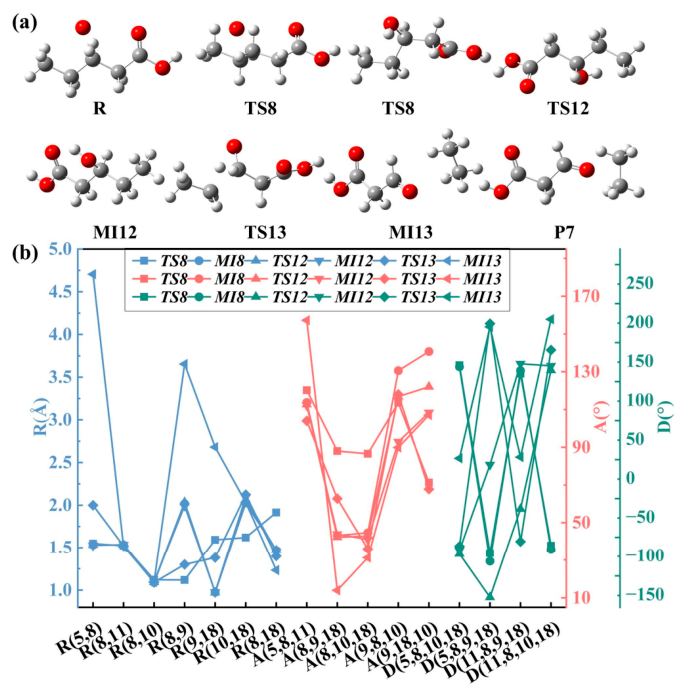
R + O → TS8 → MI8 → TS12 → MI12 → TS13 → MI13 → P7 + CH3CH3 Path7
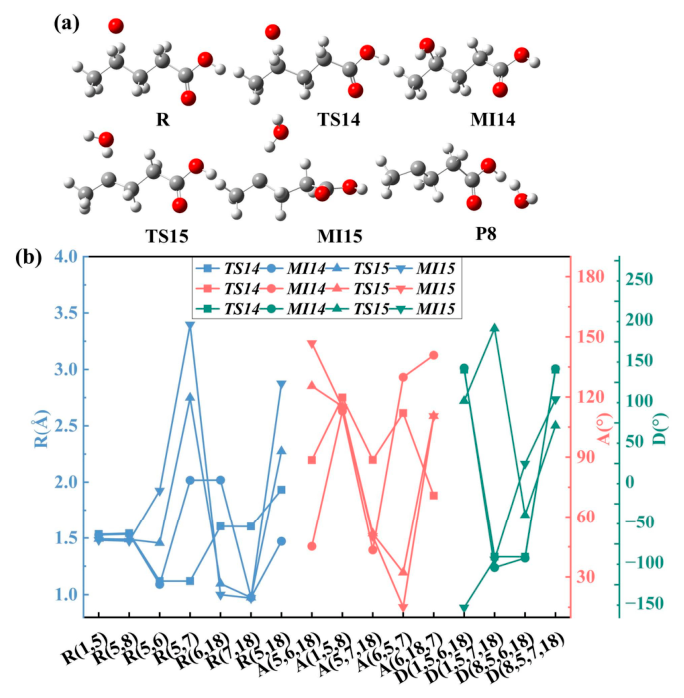
R + O → TS14 → MI14 → TS15 → MI15 → P8 + H2O Path8
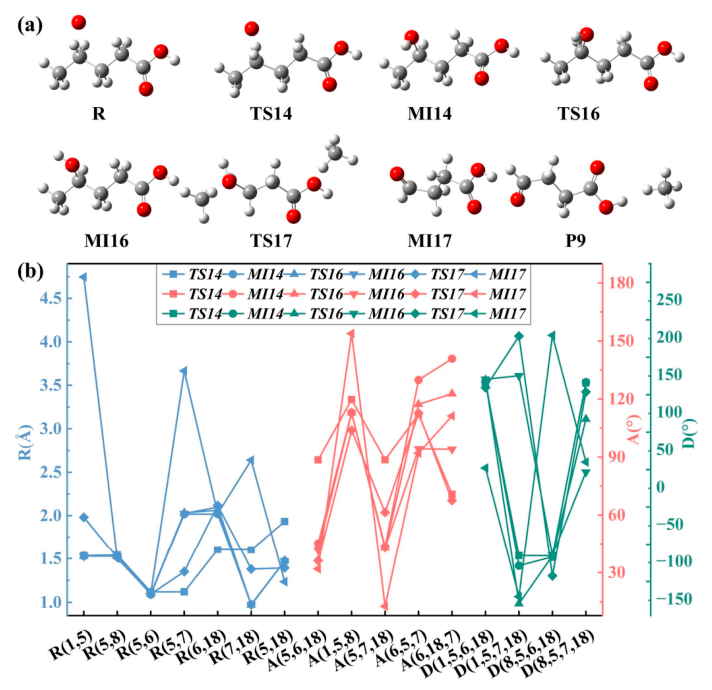
R + O → TS14 → MI14 → TS16 → MI16 → TS17 → MI17 → P9 + CH4 Path9
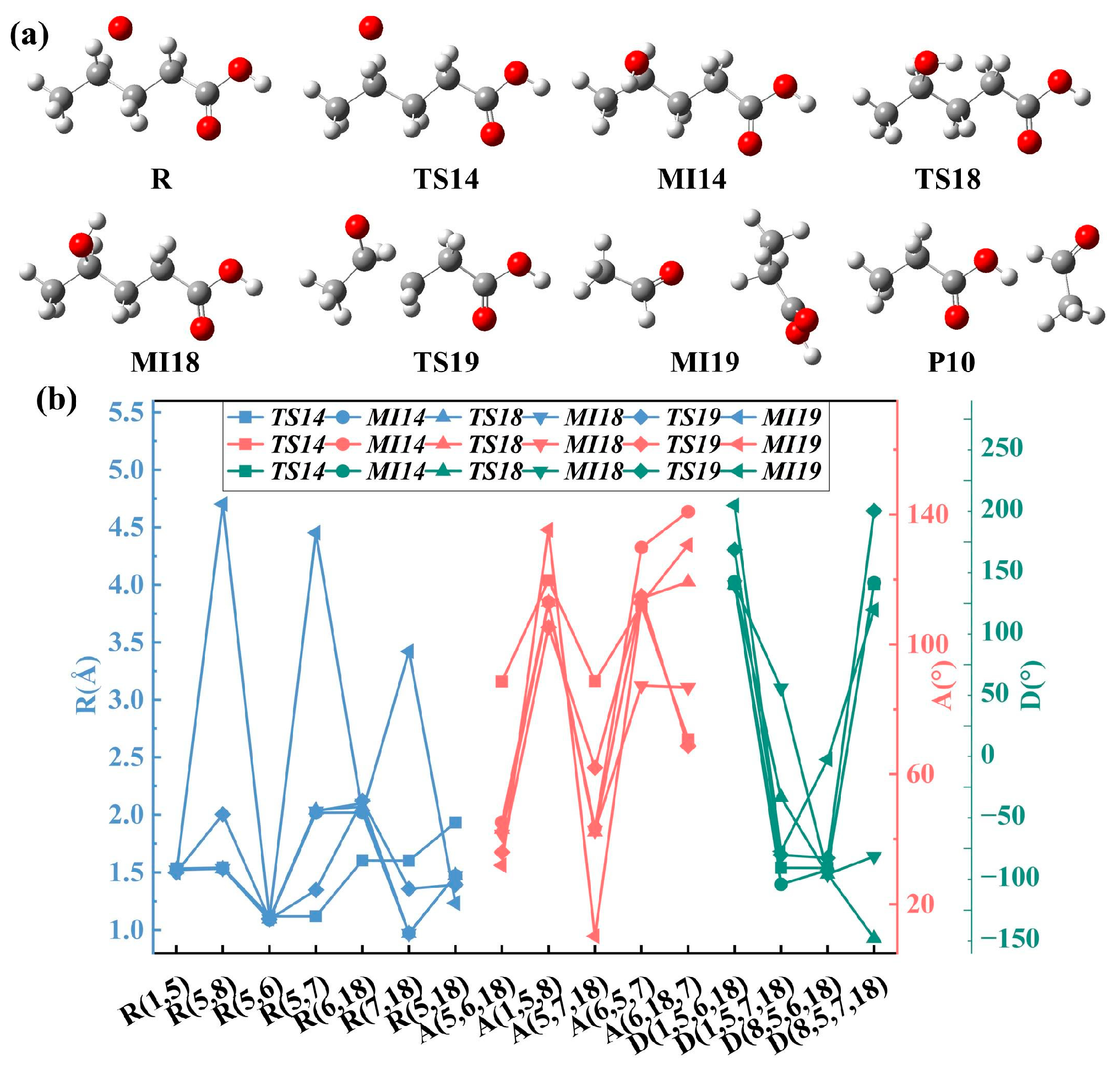
R + O → TS14 → MI14 → TS18 → MI18 → TS19 → MI19 → P10 + CH3COOH Path10
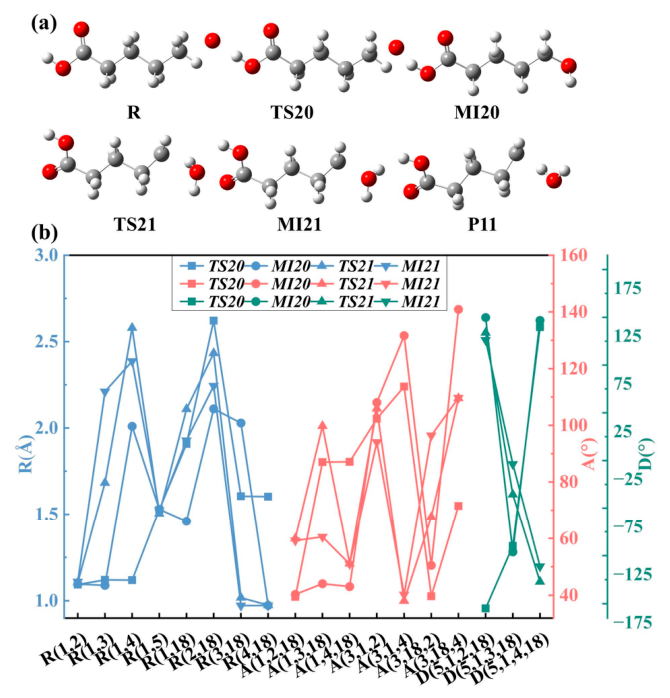
R + O → TS20 → MI20 → TS21 → MI21 → P11 + H2O Path11
R + O → TS20 → MI20 → TS22 → MI22 → TS23 → MI23 → P12 + H2O Path12

4.1.1. Geometric Configurations and Chemical Reactions of Path1

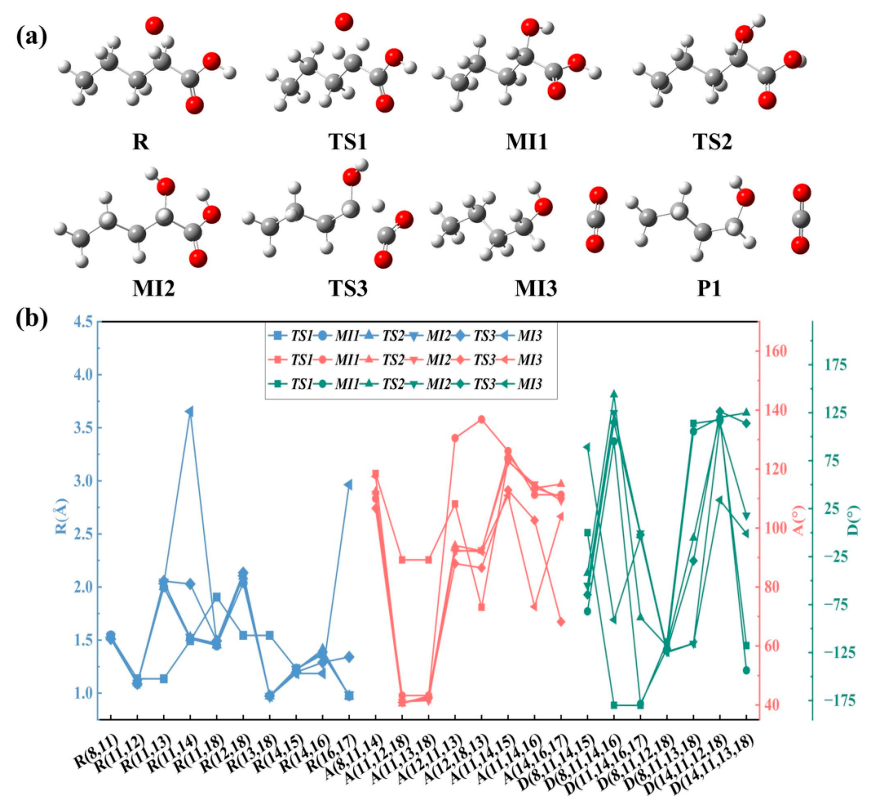
In Path1, oxygen atoms attack the -CH2- group in valeric acid’s -CH2COOH, generating CH3CH2CH2CHO and CO2. Its optimized molecular configurations and structural parameters obtained from theoretical calculations are presented in Figure 3.
Quantum chemical calculations reveal the reaction mechanism as path R + O → TS1 → MI1 → TS2 → MI2 → TS3 → MI3 → P1 + CO2. Oxygen attacks the -CH2- group in the valeric acid molecule, drawing two H atoms from the -CH2- group. Two C-H bonds elongate from 1.09429 Å to 1.13596 Å and break, entering unstable state TS1, which has one and only one virtual frequency of 1366 cm−1. Upon elongated fracture, H atom leaves C and bonds with O, while O bonds with C, generating stable MI1. The bond and dihedral angles of MI1 change significantly, forming unstable TS2 with a virtual frequency of 544 cm−1. The OH group’s angular then inverses largely, proceeding to stable MI2. With the C-C bond in -CHOH-COOH stretching from 1.52671 Å to 2.02882 Å and the O-H bond in -COOH extending from 0.9837 Å to 1.34182 Å, TS3 forms lively, with a virtual frequency of 2067 cm−1. Following the rupture of the O-H bond, H in -CHOH- bonds with C in the -CHOH- group, progressing to stable MI3, which decomposes into final products.

4.1.2. Geometric Configurations and Chemical Reactions of Path2

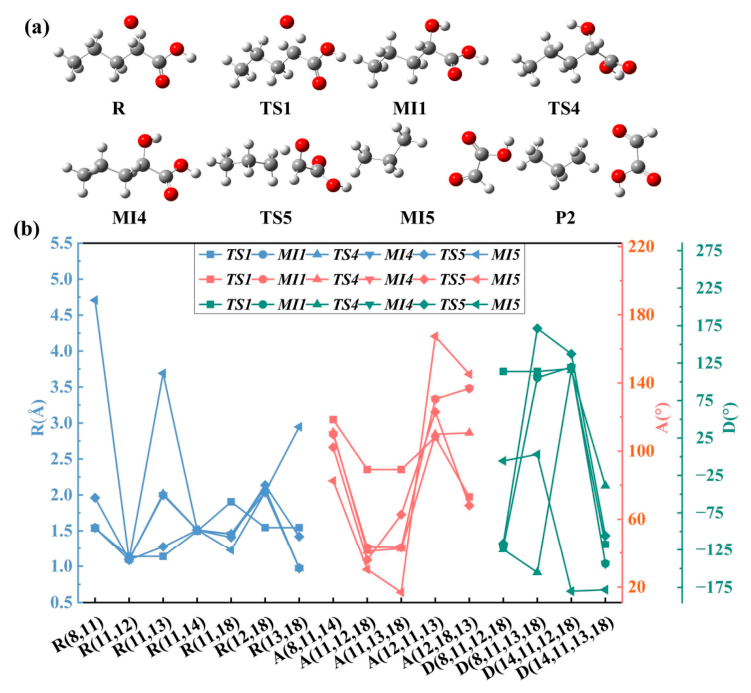
Path2 involves an oxygen targeting the -CH2- group in -CH2COOH, yielding CH3CH2CH3 and CHOCOOH. Its molecular mechanisms and chemical parameters derived from theoretical calculations are detailed in Figure 4.
The reaction path R + O → TS1 → MI1 → TS4 → MI4 → TS5 → MI5 → P2 + CHOCOOH involves oxygen attacking the -CH2- group in valeric acid molecule. This interaction pulls two H atoms in -CH2- away, stretching and breaking C-H bonds from 1.09429 Å to 1.13596 Å, forming TS1 erratically with a unique imaginary frequency of 1366 cm−1. Following bond elongation and rupture, H detaches C and bonds with O, creating an active state MI1, which further transforms into TS4 (254 cm−1). The OH in TS4 inverts significantly to transition to stable MI4. Then the C-C bond in -CH2CHOH- stretches from 1.54391 Å to 1.96133 Å, and the O-H bond in -CHOH- extends from 0.97495 Å to 1.41841 Å, entering TS5 (1931 cm−1). The broken O-H bond’s H bonds with C in -CH2-, progressing to MI5, subsequently decomposing to ultimate yields.

4.1.3. Geometric Configurations and Chemical Reactions of Path3

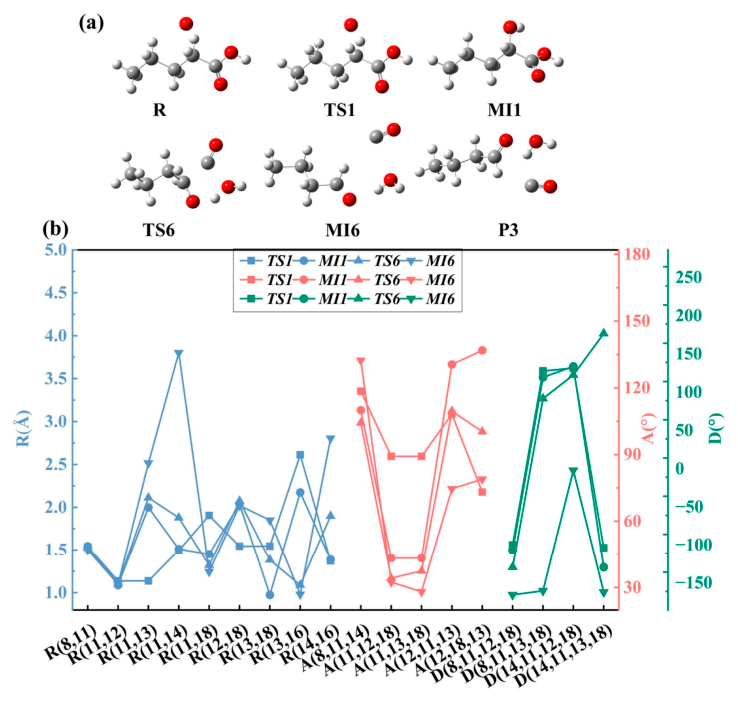
Path3 features an attack by oxygen on the -CH2- group in -CH2COOH, which yields CH3CH2CH2CHO, H2O, and CO. Its molecular theoretical calculations’ outcomes regarding geometric mechanisms and chemical parameters are shown in Figure 5.
In the reaction R + O → TS1 → MI1 → S6 → MI6 → P3 + H2O + CO, oxygen targets the -CH2- group in valeric acid. Two C-H bonds are stretched from 1.09429 Å to 1.13596 Å and broken due to the attraction between O and H atoms, forming unstable TS1 (1366 cm−1). H then moves from C to O atom and forms a bond, creating stable MI1, with the C-C bond stretching from 1.51202 Å to 1.87899 Å, the O-H bond extending from 0.97498 Å to 1.38010 Å, and the C-O bond altering from 1.38480 Å to 1.89732 Å, MI1 undergoes intricate chemical transformations, entering unstable TS6. Finally, the broken O-H bond’s H in -CHOH- proceeds to the stable intermediate MI6, which decomposes into final products.

4.1.4. Geometric Configurations and Chemical Reactions of Path4

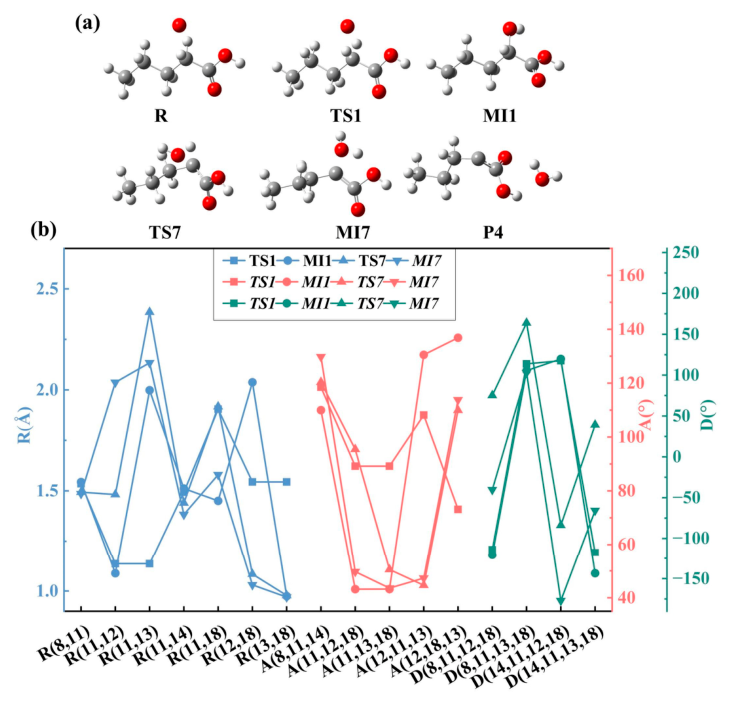
In Path4, oxygen attacks the -CH2- group of -CH2COOH, generating CH3CH2CH2C·COOH and H2O. Figure 6 shows Path4’s theoretical molecular configurations and chemical parameters.
During the reaction R + O → TS1 → MI1 → TS7 → MI7 → P4 + H2O, oxygen attracts two H atoms from the -CH2- group, stretching and breaking the C-H bonds from 1.09429 Å to 1.13596 Å, forming TS1 (1366 cm−1). H then departs from C and bonds with O, producing MI1. MI1 undergoes complex chemical changes with the C-H bond, stretching from 1.08833 Å to 1.48200 Å, and the C-O bond, extending from 1.45065 Å to 1.91748 Å, entering TS7 (1091 cm−1). H from the broken C-H bond then bonds with O from the broken -OH group of -COOH, creating MI7, breaking down to yield final products.

4.1.5. Geometric Configurations and Chemical Reactions of Path5

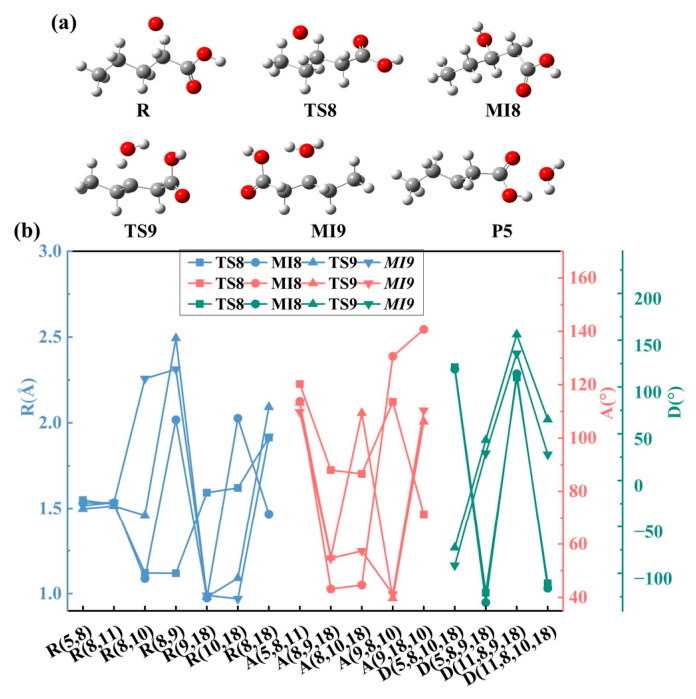
Oxygen in Path5 targets the terminal -CH2- group of CH3CH2CH2- in valeric acids, which creates CH3CH2C·CH2COOH and H2O. Figure 7 outlines Path5’s structural optimizations and chemical parameters.
In the process R + O → TS8 → MI8 → TS9 → MI9 → P5 + HO, oxygen engages with the -CH2- group, drawing two H atoms and stretching the C-H bonds from 1.09329 Å to 1.12069 Å, forming unstable TS8 (1257 cm−1). Followed by the elongation and rupture of the C-H bond to 2.01774 Å, C bonds with O and creates a stable state MI8. The C-O bond in MI8 stretches and breaks from 1.46733 Å to 2.09141 Å and the C-H bond extends from 1.08833 Å to 1.45916 Å, generating unstable TS9 (801 cm−1). In TS9, the C-O bond further stretches to 1.91777 Å and the H from the C-H bonds with O in -OH, forming stable MI9, decomposing into ultimate products.

4.1.6. Geometric Configurations and Chemical Reactions of Path6

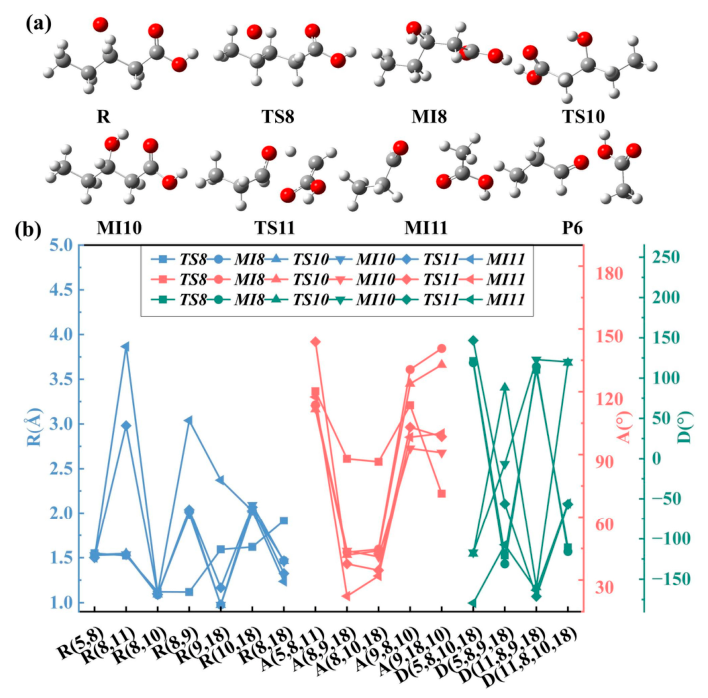
Path6 involves oxygen attacking the terminal -CH2- group in CH3CH2CH2-, producing CH3CH2CHO and CH3COOH. Its structural mechanisms and molecular parameters are detailed in Figure 8.
During the process R + O → TS8 → MI8 → TS10 → MI10 → TS11 → MI11 → P6 + CH3COOH, two C-H bonds in the -CH2- group stretch from 1.09329 Å to 1.12069 Å due to oxygen’s attraction to H atoms, creating TS8 (1257 cm−1). The C-H bond extends to 2.01774 Å and ruptures, with O bonding with C and detached H to form MI8. After significant inversion of the -OH group, TS10 forms (140 cm−1) and rearranges structurally, proceeding to MI10, an isomer of TS10. With the C-C bond in the CHOH-CH2 group stretching from 1.53735 Å to 2.98179 Å, and O-H bond extending from 0.97662 Å to 1.16675 Å, the -CH2COOH group enters unstable TS11 (1152 cm−1). The H atom from the broken O-H bond in TS11 bonds with -CH2COOH group, producing CH3COOH and stable MI11, breaking down into final products.

4.1.7. Geometric Configurations and Chemical Reactions of Path7

Path7 features the -CH2- group in CH3CH2CH2- attacked by oxygen, creating CHOCH2COOH and CH3CH3. Figure 9 outlines its reaction mechanisms and structural parameters.
During R + O → TS8 → MI8 → TS12 → MI12 → TS13 → MI13 → P7 + CH3CH3, oxygen’s attraction to H in -CH2- alters C-H bonds from 1.09329 Å to 1.12069 Å, generating TS8 (1257 cm−1). With the C-H bond extending to 2.01774 Å, O bonds with C and separated H, forming MI8. After significant inversion of the -OH group, unstable TS12 (337 cm−1) forms and undergoes complex changes to enter stable MI12, which is an isomer of TS12. Then C-C and O-H bonds in the CHOH-CH2CH3 group stretch, creating TS13 (2026 cm−1). The broken O-H bond’s H in TS13 bonds with -CH2CH3, producing CH3CH3 and stable MI13, which decomposes into ultimate products.

4.1.8. Geometric Configurations and Chemical Reactions of Path8

In Path8, oxygen attacks the -CH2- group in CH3CH2-, which yields CH3·CCH2CH2COOH and H2O. Its molecular structures and chemical parameters are presented in Figure 10.
The reaction R + O → TS14 → MI14 → TS15 → MI15 → P8 + H2O involves C-H bonds in the -CH2- group stretching from 1.09569 Å to 1.12005 Å due to oxygen’s attacks, generating unstable TS14 (1311 cm−1). With the C-H bond extending to 2.01757 Å and breaking, the O atom bonds with C and separated H to form stable MI14. Then the C-O bond in the -CHOH- group stretches from 1.47119 Å to 2.27494 Å and the C-H bond extends from 1.0907 Å to 1.45531 Å, creating unstable TS15 (517 cm−1). The H detaching from the C-H bond connects with the -OH group in the -CHOH- group, producing H2O and stable MI15, which decomposes to form end products.

4.1.9. Geometric Configurations and Chemical Reactions of Path9

Path9 is characterized by the -CH2- group in CH3CH2- engaged with oxygen, yielding CH3·CCH2CH2COOH and H2O. Figure 11 delineates its molecular mechanisms and structural parameters.
In the path R + O → TS14 → MI14 → TS16 → MI16 → TS17 → MI17 → P9 + CH4, Oxygen’s engagement with the -CH2- group stretches the C-H bonds from 1.09569 Å to 1.12005 Å, creating TS14 (1311 cm−1). After the C-H bond extends to 2.01757 Å and breaks, O bonds with C and detached H atoms to form MI14. After a significant inversion of the -OH group, TS16 emerges with a unique imaginary frequency of 305 cm−1 and changes to enter stable MI16, an isomer of TS1. Then the C-C bond in the CH3CHOH- group stretches from 1.52735 Å to 1.98042 Å and the O-H bond extends from 0.97275 Å to 1.37937 Å, progressing to unstable TS17 (2089 cm−1). The H from the broken O-H bond connects with -CH3, producing CH4 and the stable intermediate MI17, which decomposes to yield the ultimate products.

4.1.10. Geometric Configurations and Chemical Reactions of Path10

Path10 involves oxygen attacking the -CH2- group in the CH3CH2- group, producing CH3CH2COOH and CH3CHO. Figure 12 presents its molecular structures and chemical parameters.
During R + O → TS14 → MI14 → TS18 → MI18 → TS19 → MI19 → P10 + CH3CHO, the interaction between O and H atoms stretches C-H bonds in the -CH2- group from 1.09569 Å to 1.1200 Å, generating TS14 (1311 cm−1). Following the C-H bond’s extension to 2.01757 Å and rupture, O bonds with C and separated H to form stable MI14. The -OH group alters significantly to form unstable TS18 (335 cm−1), entering stable isomer MI18 after complex reactions. Then the C-C bond in the CH3CHOHCH2- group stretches from 1.53355 Å to 2.00447 Å and the O-H bond extends from 0.97216 Å to 1.35771 Å, creating TS19 (2126 cm−1). The H broken from the O-H bond connects with the -CH2CH2- group, yielding CH3CH2COOH and stable MI19, which decomposes into the final products.

4.1.11. Geometric Configurations and Chemical Reactions of Path11

Path11 features oxygen attacking the CH3- group in CH3CH2CH2CH2COOH, which produces ·CHCH2CH2CH2COOH and H2O. Figure 13 presents its reaction structures and molecular parameters.
The reaction path R + O → TS20 → MI20 → TS21 → MI21 → P11 + H2O involves oxygen attacking the CH3- group in valeric acid, which causes the elongation of three C-H bonds as follows: 1.09268 Å→1.09347 Å, 1.09171 Å→1.11880 Å, and 1.09268 Å→1.11967 Å. Unstable TS20 forms with a frequency of 1339 cm−1. Followed by one C-H bond’s extension from 1.11880 Å to 2.01008 Å and breaking, O bonds with C and H atoms, generating stable MI20. After the C-O bond in -CHOH- stretches from 1.46254 Å to 2.10751 Å and the C-O bond in -CH2OH extends from 1.45892 Å to 2.10940 Å, unstable TS21 forms (304 cm−1) and then enters stable MI21, decomposing to produce the final products.

4.1.12. Geometric Configurations and Chemical Reactions of Path12

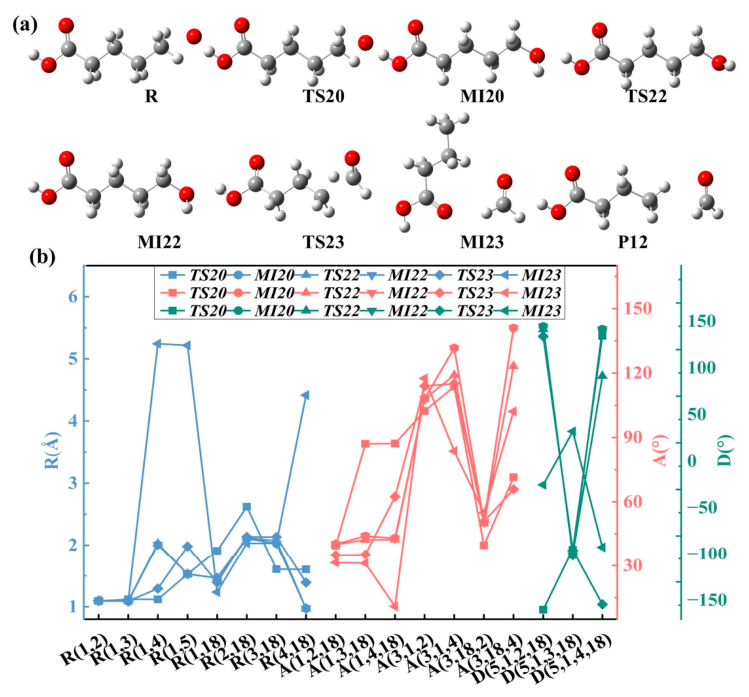
The CH3- group in valeric acid is attacked by oxygen in Path12, creating CH3CH2CH2COOH and HCHO. Figure 14 presents its reaction mechanisms and structural parameters.
In the reaction R + O → TS20 → MI20 → TS22 → MI22 → TS23 → MI23 → P12 + H2O, oxygen targets the CH3- group in CH3CH2CH2CH2COOH, attracting three C-H bonds to stretch as follows: from 1.09268 Å to 1.09347 Å, from 1.09171 Å to 1.11880 Å, and from 1.09268 Å to 1.11967 Å. Unstable TS20 forms with an imaginary frequency of 1339 cm−1. Followed by one C-H bond’s elongation and breakage from 1.11880 Å to 2.01008 Å, O bonds with H and C atoms, producing stable MI20. The -OH group inverses significantly to form TS22 (291 cm−1) and rotates with dihedral and bond angles altering substantially, creating stable MI22, an isomer of TS22. With the C-C bond in -CH2CH2OH then stretching from 1.52851 Å to 1.97967 Å and the O-H bond extending from 0.97344 Å to 1.39010 Å, unstable TS23 forms (2026 cm−1). Then the H detached from O-H bond connects with the -CH2- group, entering stable MI23.

4.2. IRC Reaction Path Analysis

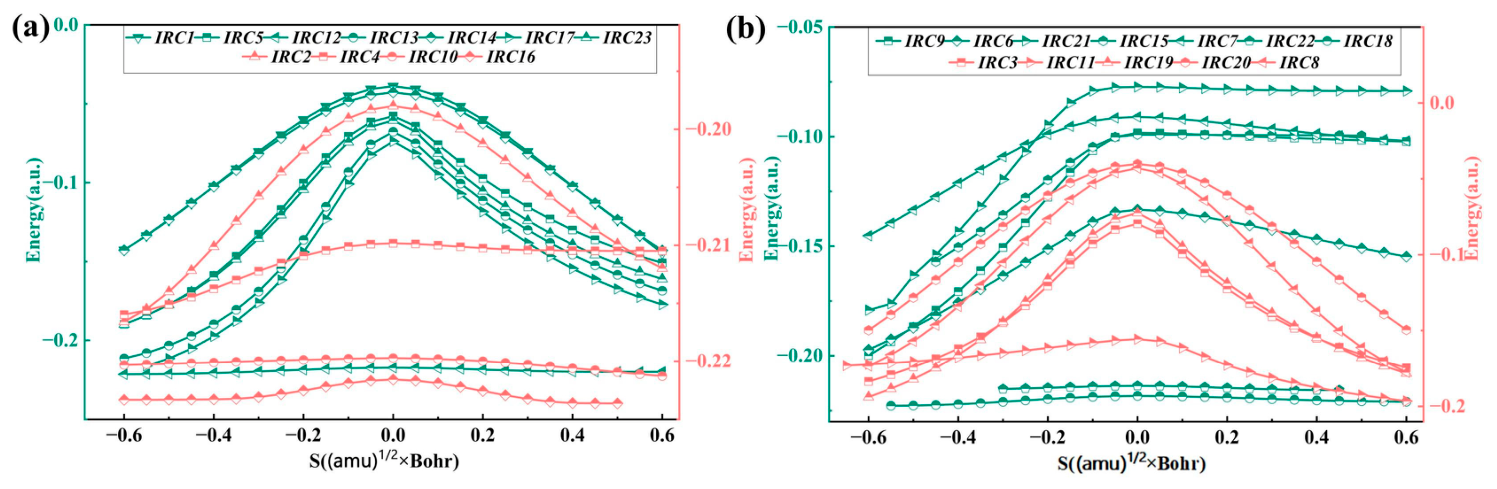
The IRC analysis indicated that the changes in dihedral angles, bond lengths, and bond angles of -CH2- and -CH3 groups in -CH2COOH, CH3CH2CH2-, and CH3CH2- during spontaneous combustion are consistent with the theoretical analysis. The system potential energy in Figure 15 peaks at the formation of each transition state from TS1 to TS23, verifying their authenticity.

4.3. Calculation of Reaction Barriers

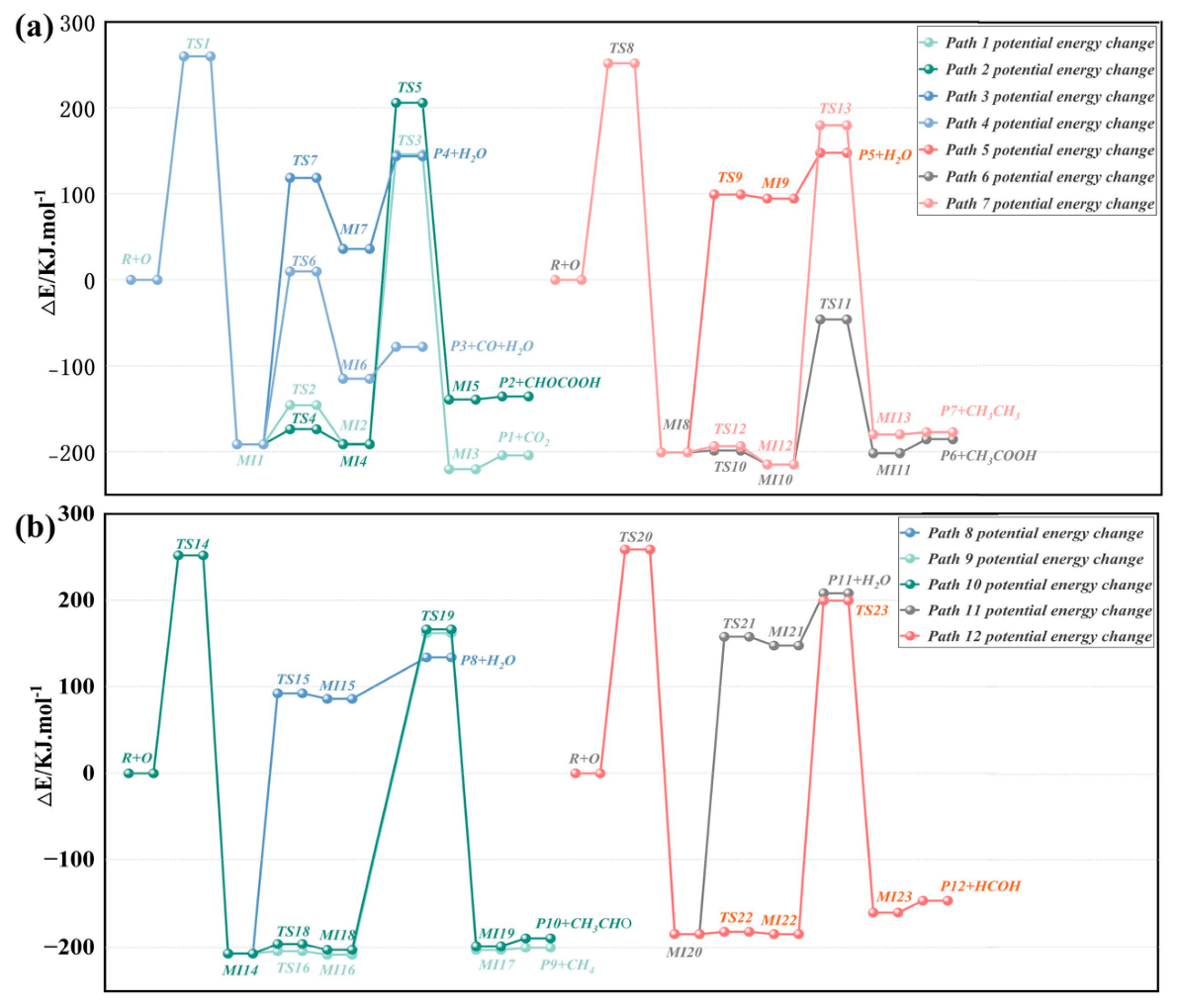
Coal spontaneous combustion arises from the synergistic oxidation of the coal macromolecular framework and various types of LMCs. Valeric acid exhibits higher reactivity than coal macromolecules as a representative LMC, with its key energy barriers significantly lower than those for typical bond cleavage in coal. Figure 16 illustrates that all reaction paths leading to multiple products are multi-step processes, not elementary reactions. Each path’s transition from transition state to intermediate necessitates 259.94 kJ/mol, 251.82 kJ/mol, 252 kJ/mol, and 258.75 kJ/mol energy. MI1, MI8, MI14, and MI20 are thermodynamically stable yet kinetically reactive. They absorb energy to form unstable transition states, propelling the reaction toward its final products. Path5, Path8, and Path11 are endothermic reactions, while the others are exothermic. The ease of reactions follows the order: Path6 > Path3 > Path8 > Path5 > Path4 > Path1 > Path11 > Path10 > Path9 > Path12 > Path7 > Path2. Therefore, the primary reaction involves O atoms attacking the terminal -CH2- group in CH3CH2CH2- of valeric acid in coal spontaneous combustion, producing CH3CH2CHO and CH3COOH as the main products.
In Path1, the process requires 45.59 kJ/mol energy to transit from MI1 to TS2 and releases 44.77 kJ/mol to form MI2. The reaction then absorbs 336.94 kJ/mol to reach TS3, which emits 366.3 kJ/mol to create MI3. Finally, 16.04 kJ/mol energy is consumed to generate P1 and CO2. Path2’s transition from MI1 to TS4 requires only 17.49 kJ/mol, making it easy to proceed. However, the reaction from MI4 to TS5 demands a much higher barrier of 397.34 kJ/mol, rendering it difficult due to the high energy requirement. In Path3, MI1 transitions to TS6 with an energy barrier of 201.07 kJ/mol, and MI6 absorbs 36.91 kJ/mol to decompose into products. MI1 necessitates 309.97 kJ/mol to reach TS7 in Path4 and MI7 absorbs 107.81 kJ/mol to decompose. In Path5, MI8 uptakes 300.11 kJ/mol to form MI9, consuming 53.19 kJ/mol to produce P5 and water. In Path6, MI8 absorbs 2.21 kJ/mol to form TS10, which releases 16.3 kJ/mol to form MI10. MI10 then consumes 168.77 kJ/mol to reach TS11, emitting 155.8 kJ/mol to create MI11, which ultimately decomposes to yield P6 and CH3COOH. In Path7, MI8 consumes 7.21 kJ/mol to reach TS12. MI12 overcomes 394.64 kJ/mol barrier to form TS13, while MI13 absorbs only 2.65 kJ/mol to decompose into products. In Path8, unstable TS14 releases 459.02 kJ/mol to form MI14 and requires 299.4 kJ/mol to reach TS15. MI15 consumes 47.94 kJ/mol to produce P8 and water. MI14 transitions to TS16 by absorbing only 2.72 kJ/mol in Path9. TS16 uptakes 370.32 kJ/mol to reach TS17, releasing 364.88 kJ/mol to create MI17. MI17 consumes 2.61 kJ/mol to yield P9 and CH4. Path10’s transition from MI14 to TS18 requires an energy input of 10.76 kJ/mol and TS18 absorbs 369.16 kJ/mol to form TS19. TS19 releases 365.27 kJ/mol to reach MI19, which consumes 8.95 kJ/mol to produce P10 and CH3CHO. In Path11, TS20 releases 443.65 kJ/mol to form MI20, which consumes 342.79 kJ/mol to reach TS21. TS21 then absorbs 60.52 kJ/mol to produce P11 and water. MI20 consumes 2.58 kJ/mol to form TS22 in Path12, which absorbs 384.65 kJ/mol to reach TS23. TS23 emits 360.1 kJ/mol to reach MI23, absorbing 13.4 kJ/mol to yield P12 and HCHO.

5. Conclusions

This study reveals 12 reaction pathways, active sites, and energy barriers of valeric acid oxidation in coal, confirming a multi-step bond-breaking and formation mechanism. The following conclusions were drawn:
(1) Twelve paths represent the reaction process between oxygen and valeric acid molecules during coal spontaneous combustion.
R + O → TS1 → MI1 → TS2 → MI2 → TS3 → MI3 → P1 + CO2
R + O → TS1 → MI1 → TS4 → MI4 → TS5 → MI5 → P2 + CHOCOOH
R + O → TS1 → MI1 → TS6 → MI6 → P3 + H2O + CO
R + O → TS1 → MI1 → TS7 → MI7 → TS9 → MI9 → P4 + H2O
R + O → TS8 → MI8 → TS9 → MI9 → P5 + H2O
R + O → TS8 → MI8 → TS10 → MI10 → TS11 → MI11 → P6 + CH3COOH
R + O → TS8 → MI8 → TS12 → MI12 → TS13 → MI13 → P7 + CH3CH3
R + O → TS14 → MI14 → TS15 → MI15 → P8 + H2O
R + O → TS14 → MI14 → TS16 → MI16 → TS17 → MI17 → P9 + CH4
R + O → TS14 → MI14 → TS18 → MI18 → TS19 → MI19 → P10 + CH3COOH
R + O → TS20 → MI20 → TS21 → MI21 → P11 + H2O
R + O → TS20 → MI20 → TS22 → MI22 → TS23 → MI23 → P12 + H2O
(2) The active sites of valeric acid in coal are C1, C5, C8, and C11, with rate-controlling transition states TS1, TS3, TS5, TS7, TS8, TS9, TS13, TS15, TS17, TS19, TS21, and TS23.
(3) The priority order of the reaction paths is Path6 > Path3 > Path8 > Path5 > Path4 > Path1 > Path11 > Path10 > Path9 > Path12 > Path7 > Path2. The primary reaction involves oxygen atoms attacking the terminal -CH2- group of valeric acid, mainly producing CH3CH2CHO and CH3COOH.

Author Contributions

S.Q.: writing—original draft and methodology. X.W.: formal analysis, investigation, and resources. T.Y.: writing—review and editing. W.D.: writing—review and editing. S.L.: validation and methodology. H.D.: software and supervision. Y.S.: software and supervision. H.J.: software and supervision. All authors have read and agreed to the published version of the manuscript.

Funding

This research received no external funding.

Data Availability Statement

Data will be made available on request.

Conflicts of Interest

Author Shaobo Qu was employed by the Huayang Group, Shanxi Ningwu Yushupo Coal Industry Co., Ltd. Author Hongguang Ji was employed by the Shanxi Provincial State-Owned Capital Operation Co., Ltd. The remaining authors declare that the research was conducted in the absence of any commercial or financial relationships that could be construed as a potential conflict of interest.

References

  1. Zhao, J.; Hang, G.; Song, J.; Lu, S.; Ming, H.; Chang, J.; Deng, J.; Zhang, Y.; Shu, C.-M. Spontaneous oxidation kinetics of weathered coal based upon thermogravimetric characteristics. Energy 2023, 275, 127489. [Google Scholar] [CrossRef]
  2. Wu, B.; Wang, J.; Qu, B.; Qi, P.; Meng, Y. Development, effectiveness, and deficiency of China’s Coal Mine Safety Supervision System. Resour. Policy 2023, 82, 103524. [Google Scholar]
  3. International Energy Agency (IEA). Statistical Review of World Energy 2025; IEA Publications: London, UK, 2025. [Google Scholar]
  4. Shivakumar, K.; Kenchappa, B.; Shivakumar, D. Fire and fire mitigation by low-fuel building products. Fire 2025, 8, 176. [Google Scholar] [CrossRef]
  5. Cliff, D.; Davis, R.; Bennett, T.; Galvin, G.; Clarkson, F. Large scale laboratory testing of the spontaneous combustibility of Australian coals. In Proceedings of the Queensland Mining Industry Health and Safety Conference, Yeppoon, QLD, Australia, 31 August–2 September 1998; pp. 175–179. [Google Scholar]
  6. Plakunov, M.; Yavuzturk, C.; Chiasson, A. On the effects of temperature-dependent diffusion of carbon dioxide from underground coal fires. Geothermics 2023, 115, 102835. [Google Scholar] [CrossRef]
  7. Danish, E.; Onder, M. Application of Fuzzy Logic for Predicting of Mine Fire in Underground Coal Mine. Saf. Health Work 2020, 11, 322–334. [Google Scholar] [CrossRef]
  8. Singh, A.K.; Singh, R.; Singh, M.P.; Chandra, H.; Shukla, N. Mine fire gas indices and their application to Indian underground coal mine fires. Int. J. Coal Geol. 2006, 69, 192–204. [Google Scholar] [CrossRef]
  9. Song, Z.; Kuenzer, C. Coal fires in China over the last decade: A comprehensive review. Int. J. Coal Geol. 2014, 133, 72–99. [Google Scholar] [CrossRef]
  10. Taraba, B.; Michalec, Z.; Michalcová, V.; Blejchař, T.; Bojko, M.; Kozubková, M. CFD simulations of the effect of wind on the spontaneous heating of coal stockpiles. Fuel 2014, 118, 107–112. [Google Scholar] [CrossRef]
  11. Sahu, H.; Mahapatra, S.; Sirikasemsuk, K.; Panigrahi, D. A discrete particle swarm optimization approach for classification of Indian coal seams with respect to their spontaneous combustion susceptibility. Fuel Process. Technol. 2011, 92, 479–485. [Google Scholar] [CrossRef]
  12. Sahu, H.; Padhee, S.; Mahapatra, S. Prediction of spontaneous heating susceptibility of Indian coals using fuzzy logic and artificial neural network models. Expert Syst. Appl. 2010, 38, 2271–2282. [Google Scholar] [CrossRef]
  13. Qu, B.; Zhu, H.; Wang, J.; Li, B.; Xie, L.; Liao, Q.; Hu, L. Dynamic evolution of terahertz permittivity of lignite during oxidation: Microstructural insights. Appl. Energy 2024, 363, 121936. [Google Scholar] [CrossRef]
  14. Carroll, M.; Gao, C.X.; Campbell, T.C.; Smith, C.L.; Dimitriadis, C.; Berger, E.; Maybery, D.; Ikin, J.; Abramson, M.J.; Sim, M.R.; et al. Impacts of coal mine fire-related PM2.5 on the utilisation of ambulance and hospital services for mental health conditions. Atmos. Pollut. Res. 2022, 13, 101415. [Google Scholar] [CrossRef]
  15. Oliveira, M.L.; Pinto, D.; Tutikian, B.F.; da Boit, K.; Saikia, B.K.; Silva, L.F. Pollution from uncontrolled coal fires: Continuous gaseous emissions and nanoparticles from coal mines. J. Clean. Prod. 2019, 215, 1140–1148. [Google Scholar] [CrossRef]
  16. Deng, J.; Li, X.; Wang, K.; Wang, W.; Yan, J.; Tang, Z.; Kang, F.; Ren, S. Research progress and prospect of mine fire intelligent monitoring and early warning technology in recent 20 years. Coal Sci. Technol. 2024, 52, 154–177. [Google Scholar]
  17. Bosikov, I.I.; Martyushev, N.V.; Klyuev, R.V.; Savchenko, I.A.; Kukartsev, V.V.; Kukartsev, V.A.; Tynchenko, Y.A. Modeling and complex analysis of the topology parameters of ventilation networks when ensuring fire safety while developing coal and gas deposits. Fire 2023, 6, 95. [Google Scholar] [CrossRef]
  18. Zanganeh, J.; Al-Zuraiji, M.J.A.; Moghtaderi, B. Investigation of the minimum ignition energy required for combustion of coal dust blended with fugitive methane. Fire 2024, 7, 381. [Google Scholar] [CrossRef]
  19. Rúa, M.O.B.; Aragón, A.J.D.; Baena, P.B. A study of fire propagation in coal seam with numerical simulation of heat transfer and chemical reaction rate in mining field. Int. J. Min. Sci. Technol. 2019, 29, 873–879. [Google Scholar] [CrossRef]
  20. Onifade, M.; Genc, B. A review of research on spontaneous combustion of coal. Int. J. Min. Sci. Technol. 2020, 30, 303–311. [Google Scholar] [CrossRef]
  21. Jones, R.; Townend, D. Mechanism of the Oxidation of Coal. Nature 1945, 155, 424–425. [Google Scholar] [CrossRef]
  22. Wang, H.; Dlugogorski, B.Z.; Kennedy, E.M. Theoretical analysis of reaction regimes in low-temperature oxidation of coal. Fuel 1999, 78, 1073–1081. [Google Scholar] [CrossRef]
  23. Li, L.; Ren, T.; Zhong, X.; Wang, J. Study of ambient temperature oxidation in low metamorphic coal and the oxidation mechanism. Energy 2022, 252, 124039. [Google Scholar] [CrossRef]
  24. Xu, D.; Zhang, L.; He, W.; Xu, Y.; Zhao, Y.; Zhu, J.; Qi, Q. The generation mechanism of CO and CO2 in coal spontaneous combustion by mathematical statistical and other methods. Fuel 2023, 350, 128747. [Google Scholar] [CrossRef]
  25. Miao, G.; Li, Z.; Yang, J.; Yang, Y.; Li, J. Emission characteristics of higher-molecular-weight gases during the oxidation of bituminous coals. Combust. Sci. Technol. 2024, 196, 906–926. [Google Scholar]
  26. Qin, X.; Yang, T.; Liu, Z.; Liu, Q. Molecular structure, bond cleavage and their relation of four low-rank coals. Fuel Process. Technol. 2022, 236, 107391. [Google Scholar] [CrossRef]
  27. Zhang, Y.; Shu, P.; Deng, J.; Duan, Z.; Li, L.; Zhang, L. Analysis of oxidation pathways for characteristic groups in coal spontaneous combustion. Energy 2022, 254, 124211. [Google Scholar] [CrossRef]
  28. Gao, Z.H.; Deng, C.; Wang, Y. Advanced chain-reaction modeling of coal autoxidation: Functional group mobility via quantum chemistry. Fuel 2026, 403, 136158. [Google Scholar] [CrossRef]
  29. Zhu, H.; Huo, Y.; Fang, S.; He, X.; Wang, W.; Zhang, Y. Quantum chemical calculation of original aldehyde groups reaction mechanism in coal spontaneous combustion. Energy Fuels 2020, 34, 14671–14682. [Google Scholar] [CrossRef]
  30. Huo, Y.; Zhu, H.; He, X.; Fang, S.; Wang, W. Quantum chemistry calculation study on chain reaction mechanisms and thermodynamic characteristics of coal spontaneous combustion at low temperatures. ACS Omega 2021, 6, 30841–30855. [Google Scholar] [CrossRef] [PubMed]
  31. Wang, X.; Deng, H.; Deng, C.; Cui, C.; Shan, Y.; Song, Z. Study on the spontaneous combustion and oxidation mechanism of low molecular ketone compounds in coal. Fuel 2022, 321, 124022. [Google Scholar] [CrossRef]
  32. Cui, C.; Deng, H.; Deng, C.; Wang, X.; Shan, Y.; Song, Z. Study on the effect of low molecular hydrocarbon compounds on coal spontaneous combustion. Fuel 2022, 318, 123193. [Google Scholar] [CrossRef]
  33. Ramírez-Morales, D.; Masís-Mora, M.; Montiel-Mora, J.R.; Cambronero-Heinrichs, J.C.; Pérez-Rojas, G.; Tormo-Budowski, R.; Méndez-Rivera, M.; Briceño-Guevara, S.; Gutiérrez-Quirós, J.A.; Arias-Mora, V.; et al. Multi-residue analysis of pharmaceuticals in water samples by liquid chromatography-mass spectrometry: Quality assessment and application to the risk assessment of urban-influenced surface waters in a metropolitan area of Central America. Process Saf. Environ. Prot. 2021, 153, 289–300. [Google Scholar] [CrossRef]
  34. Given, P.H.; Marzec, A.; Barton, W.A.; Lynch, L.J.; Gerstein, B.C. The concept of a mobile or molecular phase within the macromolecular network of coals: A debate. Fuel 1986, 65, 155–163. [Google Scholar] [CrossRef]
Figure 1. Geometry of valeric acid molecule.
Fire 09 00237 g001
Figure 2. Reaction formula of valeric acid molecule with oxygen in the process of coal spontaneous combustion for (al).
Fire 09 00237 g002
Figure 3. (a) Optimized geometric structures of Path1. (b) Configuration changes in Path1.
Fire 09 00237 g003
Figure 4. (a) Optimized geometric structures of Path2. (b) Configuration changes in Path2.
Fire 09 00237 g004
Figure 5. (a) Optimized geometric structures of Path3. (b) Configuration changes in Path3.
Fire 09 00237 g005
Figure 6. (a) Optimized geometric structures of Path4. (b) Configuration changes in Path4.
Fire 09 00237 g006
Figure 7. (a) Optimized geometric structures of Path5. (b) Configuration changes in Path5.
Fire 09 00237 g007
Figure 8. (a) Optimized geometric structures of Path6. (b) Configuration changes in Path6.
Fire 09 00237 g008
Figure 9. (a) Optimized geometric structures of Path7. (b) Configuration changes in Path7.
Fire 09 00237 g009
Figure 10. (a) Optimized geometric structures of Path8. (b) Configuration changes in Path8.
Fire 09 00237 g010
Figure 11. (a) Optimized geometric structures of Path9. (b) Configuration changes in PPath9.
Fire 09 00237 g011
Figure 12. (a) Optimized geometric structures of Path10. (b) Configuration changes in Path10.
Fire 09 00237 g012
Figure 13. (a) Optimized geometric structures of Path11. (b) Configuration changes in Path11.
Fire 09 00237 g013
Figure 14. (a) Optimized geometric structures of Path12. (b) Configuration changes in Path12.
Fire 09 00237 g014
Figure 15. (a) Potential energy profiles along IRC 1, 2, 4, 5, 10, 12, 13, 14, 16, 17, 23; (b) Potential energy profiles along IRC 3, 6, 7, 8, 9, 11, 15, 18, 19, 20, 21, 22.
Fire 09 00237 g015
Figure 16. (a) Potential energetic profile for Path 1–7; (b) Potential energetic profile for Path 8–12.
Fire 09 00237 g016
Table 1. Molecular bond length of valeric acid.
NumberAtomic RelationBond Length
(Å)
NumberAtomic RelationBond Length
(Å)
R1R (1,2)1.0927R9R (8,10)1.0933
R2R (1,3)1.0927R10R (8,11)1.5324
R3R (1,4)1.0917R11R (11,12)1.0943
R4R (1,5)1.5356R12R (11,13)1.0943
R5R (5,6)1.0957R13R (11,14)1.5019
R6R (5,7)1.0957R14R (14,15)1.231
R07R (5,8)1.5377R15R (14,16)1.384
R8R (8,9)1.0933R16R (16,17)0.9771
Table 2. Molecular bond angle of valeric acid.
NumberAtomic RelationBond Angle
(°)
NumberAtomic
Relation
Bond Angle (°)
A1A (2,1,3)107.6259A15A (5,8,11)112.5431
A2A (2,1,4)107.7845A16A (9,8,10)105.8594
A3A (2,1,5)111.0731A17A (9,8,11)109.3413
A4A (3,1,4)107.7846A18A (10,8,11)109.3415
A5A (3,1,5)111.0734A19A (8,11,12)111.0098
A6A (4,1,5)111.3308A20A (8,11,13)111.0052
A7A (1,5,6)109.4575A21A (8,11,14)113.5252
A8A (1,5,7)109.4569A22A (12,11,13)105.4184
A9A (1,5,8)112.7999A23A (12,11,14)107.7437
A10A (6,5,7)106.1729A24A (13,11,14)107.7402
A11A (6,5,8)109.3682A25A (11,14,15)127.0007
A12A (7,5,8)109.3687A26A (11,14,16)111.3925
A13A (5,8,9)109.7679A27A (15,14,16)121.6068
A14A (5,8,10)109.7666A28A (14,16,17)110.2529
Table 3. Molecular dihedral angle of valeric acid.
NumberAtomic RelationDihedral Angle
(°)
NumberAtomic RelationDihedral Angle
(°)
D1D (2,1,5,6)−178.1188D19D (5,8,11,12)58.4653
D2D (2,1,5,7)−62.1357D20D (5,8,11,13)−58.4414
D3D (2,1,5,8)59.8729D21D (5,8,11,14)−179.984
D4D (3,1,5,6)62.1295D22D (9,8,11,12)−179.2725
D5D (3,1,5,7)178.1126D23D (9,8,11,13)63.8208
D6D (3,1,5,8)−59.8788D24D (9,8,11,14)−57.7218
D7D (4,1,5,6)−57.9948D25D (10,8,11,12)−63.7953
D8D (4,1,5,7)57.9883D26D (10,8,11,13)179.298
D9D (4,1,5,8)179.9969D27D (10,8,11,14)57.7554
D10D (1,5,8,9)57.983D28D (8,11,14,15)0.0483
D11D (1,5,8,10)−57.9757D29D (8,11,14,16)−179.9537
D12D (1,5,8,11)−179.996D30D (12,11,14,15)123.4056
D13D (6,5,8,9)−64.0757D31D (12,11,14,16)−56.5965
D14D (6,5,8,10)179.9657D32D (13,11,14,15)−123.3005
D15D (6,5,8,11)57.9454D33D (13,11,14,16)56.6975
D16D (7,5,8,9)−179.9587D34D (11,14,16,17)−179.9954
D17D (7,5,8,10)64.0826D35D (15,14,16,17)0.0026
D18D (7,5,8,11)−57.9377
Table 4. Front orbit analysis of valeric acid molecule.
AtomHOMOC1C5C8C11C14
Charge density
(Hartree)
−0.253−0.515053−0.346333−0.314136−0.46548310.505752
Disclaimer/Publisher’s Note: The statements, opinions and data contained in all publications are solely those of the individual author(s) and contributor(s) and not of MDPI and/or the editor(s). MDPI and/or the editor(s) disclaim responsibility for any injury to people or property resulting from any ideas, methods, instructions or products referred to in the content.