Article

Inter Layer Effect of Poly(acrylic acid) on the Multilayers Assembly on Cotton Fabric Using Bentonite/Halloysite/Chitosan Composite Matrix


1
College of Mechatronic Engineering, Changwon National University, Changwon 51140, Gyeongsangnam-do, Republic of Korea
2
Dongjin Metal, 369 Gongdan-ro, Seongsan-gu, Changwon 51555, Gyeongsangnam-do, Republic of Korea
*
Author to whom correspondence should be addressed.
Fire 2026, 9(4), 156; https://doi.org/10.3390/fire9040156
Submission received: 27 January 2026 / Revised: 23 March 2026 / Accepted: 30 March 2026 / Published: 9 April 2026
(This article belongs to the Special Issue Sustainable Flame-Retardant Polymeric Materials)

Abstract

In this work, poly(acrylic acid)-based layers were injected to form a sandwich layer between the cationic and anionic species for a compact and effective fire-retardant coating on cotton fabric using the layer-by-layer coating technique. From the SEM analysis, as the number of tri-layers increases, the attachment intensity increases, as can be seen for poly(acrylic acid) chitosan and bentonite clay PCB-5TL (the highest tri-layers), while in the case of halloysite-based coatings, as the number of tri-layers increases, instead of attachment, the agglomeration increases due to the high surface area of halloysite nanoclay tubes. FTIR and UV confirmed the finding from the new peak entry and an increase in thickness. The highest thermal residue, ~18%, was obtained for poly(acrylic acid) chitosan and halloysite nanoclay PCH-5TL with a maximum degradation peak intensity at ~389 °C. From the flammability and after-burning SEM investigation test, it was observed that the halloysite-based coating with a higher number of layers offered higher resistance against the flame spread and ignition and, thus, produced a higher amount of char.
Keywords:
HRR; MCC; SEM; TGA; LBL; fire retardant

1. Introduction

Worldwide, the number of fire incidents is drastically on the rise, which causes serious damage to human life and billions of dollars of human property. Most of the time, these fire incidents occurred due to a single fire splash at the initial stage, or a single minor mistake by humans in their working environment, or from a small fault in the human-made machinery. Whatever the cause may be, however, the resultant mega fire incidents in human vicinities become extremely fatal to both life and lifeless objects. Though incidents can occur anywhere and anytime, the question is why these fatal fire incidents occur and how to halt and abate the intensity and impact of these incidents. In life-living vicinities, cotton is one of the major fire vulnerable polymeric materials and altogether the most desirable and widely applied material. Thus, focusing on the fire protective properties of the cotton fabric could help to cope with the fire incident fatalities. It is evident that a short moment of 10 s fire delay could save thousands of lives during fire incidents, thus investigating fire protective materials and ways for cotton fabric is of utmost importance. Unlike synthetic materials, cotton fabric is a natural organic and thus, its intrinsic properties can be altered. However, a more effective way is to deposit various types of coating materials and coating techniques on the surface of the cotton fabric to abate its fire properties.
Among the fire retarding materials, halogen-based complexes were the primary candidates widely used on both commercial and non-commercial scales. Specifically, the addition of halogen-based composites, such as tris (2-chloroethyl) phosphate, tris(1,3-dichloroisopropyl) phosphate, Penta bromobenzyl acrylate, and tris(1-chloro-2-propyl) phosphate, has been commonly adopted on a macro-scale to impart fire-retardant properties to domestic goods such as furniture, mattresses, and electronic accessories [1,2]. However, later on, it was discovered that highly carcinogenic substances such as dioxin, furan, and others are produced from the combustion of these halogenated compounds (tris (2-chloroethyl) phosphate, tris(1,3-dichloroisopropyl) phosphate, Penta bromobenzyl acrylate), which highly restricted their onward applications as fire retardant candidates [3,4]. To avoid the halogen-based materials, the next generation of possible candidates for fire retardant applications could be selected based on complexes that involve mainly phosphorus, nitrogen, silicone, boron, zinc, iron, and aluminum, etc.
After rigorous research work, it was found that phosphorus-based compounds could be the most promising halogen-free candidates that offer enhanced fire-retardant properties with extremely less harmful hazards and minimal impact on mechanical integrity. The reason could lie in the intrinsic dehydration and carbonization mechanism of the compounds that form a protective carbon layer, which offers a micro-fire barrier role during fire, thus providing a high delay time and reducing the flammability of these polymers [5,6,7,8]. In addition to P-based compounds, Nitrogen-containing compound were scrutinized for possible fire-retardant properties and consequently any hazardous and toxic ramifications [9,10]. It was found that though the N-based complex would be less efficient as a fire-retardant material, the less toxic output and relatively benign nature of the N-based complexes were rigorously studied [11,12,13]. In addition, silicon-based fire retardants could lead to an insulating layer on the underlying burning surface and thus could effectively impede the communication of oxygen, mass, and heat, thus decreasing the flammability of the underlying materials [12,13,14]. Moreover, other candidates such as boron [15,16], zinc [17,18], iron [19,20,21,22], aluminum [11,23,24,25] and relevant classes were studied and found in limited ways to be fire retardant efficient compounds, such as smoke suppressant; however could not find their place in widespread commercial applications [26].
Recently, bio-based polyelectrolyte clay systems have attracted increasing attention as environmentally benign flame-retardant coatings for textiles. In particular, chitosan has been widely investigated due to its renewable origin, intrinsic nitrogen content, and char-forming capability during thermal decomposition [27,28]. When combined with layered silicate clays such as bentonite and halloysite, synergistic flame-retardant effects can be achieved through the formation of a compact inorganic and organic hybrid barrier. Halloysite nanotubes, owing to their tubular morphology and high aspect ratio, provide enhanced thermal shielding and structural reinforcement compared to conventional plate-like clays such as bentonite. Although several studies have explored chitosan clay coatings, systematic comparison between different clay morphologies within a controlled layer-by-layer architecture remains limited. Therefore, a comparative investigation of bentonite and halloysite-based multilayer systems is essential to clarify their structure-property relationship and flame-retardant efficiency.
By large, there are few major concerns regarding the use of these materials for flame retardant applications, such as: Increasing viscosity, final mechanical issues, processing complexity, and potential toxicity [2,27,28,29,30,31,32]. Therefore, highly efficient, environmentally benign flame-retardant materials and techniques are increasingly required to fulfill the demands. LBL (layer by layer) deposition technique is a comparatively new technique, which is highly efficient and productive, and could be used as a potential deposition method to deposit various micro and nano structures on the substrates of varying nature. In this work, the LBL method is used to deposit tri-layer-based coatings on cotton fabric, so that chitosan is used as a cationic solution, bentonite and halloysite have been used as anionic species, while polyacrylic acid (PAA) has been used as an injection species during the layer’s deposition.

2. Experimental Method

2.1. Materials and Substrate

Cotton fabric (100%, 180 g/m2) was used as obtained from the local industry and was cut into sizes (height/width) of 230/120 mm. Bentonite (CAS No: 1302-78-9) and halloysite clay nanotubes (CAS No: 1332-58-7), polyacrylic acid (CAS No: 9003-01-4), and HNO3 were all ordered from Sigma-Aldrich (3050 Spruce Street, St. Louis, MO, USA). Highly distilled water, DI water ~18.6 Ω · cm, was used during all the experimental work. In order to carry out the LBL process, the dried cotton substrate was treated for 5 min in the 0.1 M HNO3 solution, in order to activate the surface of the cotton fabric.

2.2. Layer-by-Layer Deposition

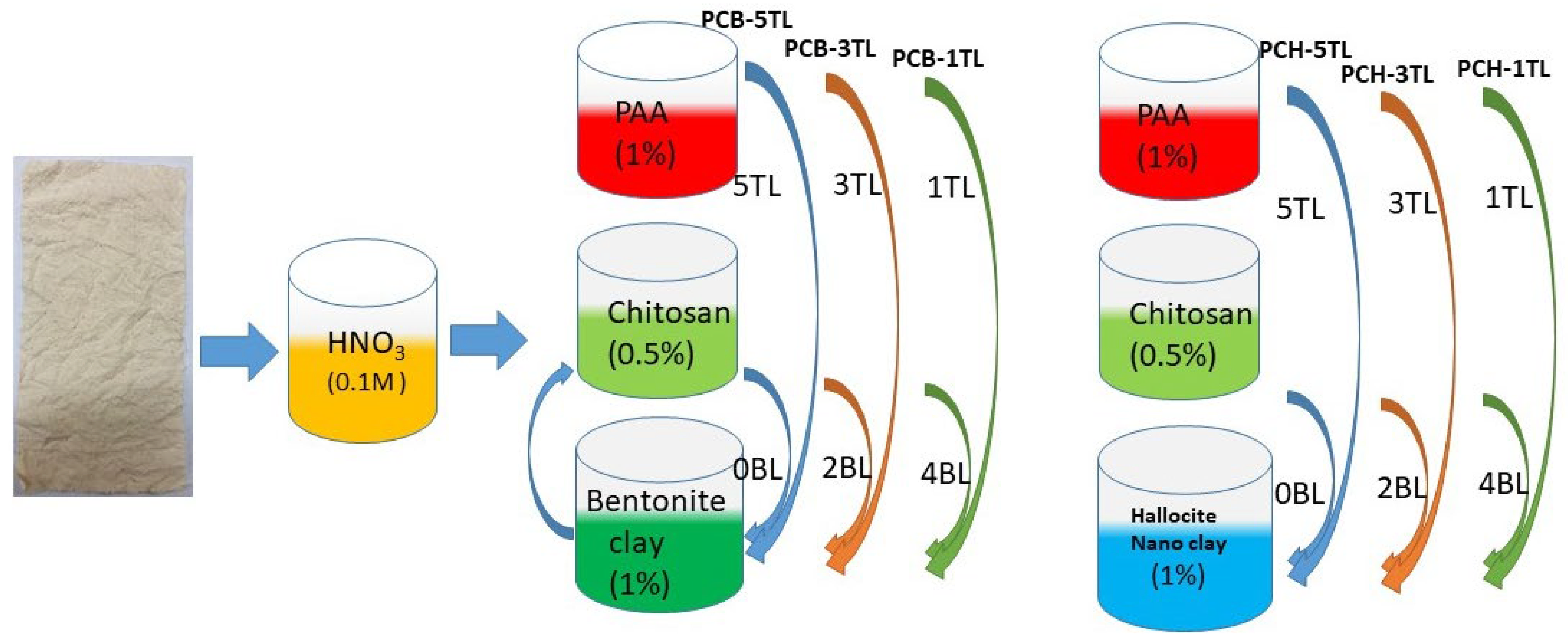
Three solutions were prepared in order to carry out the deposition process on the cotton fabric: cationic solution, anionic solution, buffer solution, HNO3, andpoly(acrylic acid) (PAA) solution. All solutions were prepared using deionized (DI) water. Chitosan (0.5 wt.%) was dissolved in 1 vol.% acetic acid solution under continuous magnetic stirring (500 rpm) for 4 h at room temperature until a homogeneous solution was obtained. Bentonite and halloysite dispersions (1 wt.%) were prepared separately in DI water and stirred for 12 h, followed by ultrasonication for 30 min to achieve uniform dispersion. Poly(acrylic acid) (PAA) solution (1 wt.%) was prepared by dissolving the required amount in DI water under magnetic stirring for 2 h. Prior to coatings, the samples were treated with HNO3 (70%, pH~3.7) 0.1 M solution. All films were assembled on cotton substrate by dipping the substrates step-wise into PAA, Chitosan, bentonite, and halloysite solution. PAA treatment was applied to enhance the pre-charging of the cotton fabric before the anionic and cationic treatment. Three samples were prepared using each clay anionic system, i.e., Bentonite and halloysite systems. PCB-5TL (sample code) was prepared by depositing five tri-layers, using the deposition route as PAA (2 min). -Chitosan (2 min). -Bentonite (2 min). PCB-3TL was prepared by deposition of three tri-layer PAA (2 min). -Chitosan (2 min). -Bentonite (2 min) and two bi-layers of chitosan (2 min). -Bentonite (2 min): PCB-1TL was prepared by depositing one tri-layer and four bi-layers. Similarly, 3 PCH samples were samples, such as: PCH-5TL (5TL, 0BL), PCH-3TL (3TL, 2BL), and PCH-1TL (1TL, 4BL); the clay system was halloysite instead of bentonite. The preparation scheme is presented in Figure 1. After completing the deposition process for each sample, rinsing of the samples and then the drying process was carried out at 80 °C for 1~2 h. Rinsing of the samples was carried out using DI water, while the drying process was carried out using the lab-scale oven.

2.3. Characterization and Measurement

The coated samples were then analyzed through attenuated total reflection Fourier transform infrared (ATR-FTIR) spectra (JASCO 6300, Tokyo, Japan), in the frequency range of 4000 to 400 cm−1. The spectra profiles were recorded after 32 scans at a resolution of 4 cm−1. Thermal stability of uncoated and coated fabrics was then analyzed in the nitrogen atmosphere (20 mL min−1) using a Perkin Elmer Pyris-1 (940 Winter St, Waltham, MA, USA) instrument in the temperature range (50 to 600 °C) at a heating rate of 20 °C min−1. The amount of the sample used for each TGA count was 8–10 mg. Microscale combustibility experiments were conducted with an FTT Microscale combustion calorimeter (MCC). The specimens (10–15 mg, in triplicate) in platinum pans were kept at 100 °C for 5 min, followed by a heating rate of 20 °C s−1 up to 600 °C, and the oxygen: nitrogen flow rate of 20:80 ratio. Vertical burning test was performed on uncoated and coated fabrics according to ASTM D6413 standards. A lab-made vertical flammability cabinet was used to burn the samples (300 mm × 120 mm). The Bunsen burner flame, 20 mm below the fabric sample, was applied for 10 s, after which the after-flame and afterglow times were measured. Surface morphologies of the coated and uncoated fabric samples, along with their char residues after the flammability test, were analyzed using a low-voltage scanning electron microscope (LV-SEM, Merlin compact). Elemental analysis of the coating surface and localized position was carried out using EDAX connected with the LV-SEM on a representative coated sample. Prior to analysis, the specimens were Pt-sputtered for 1.5 min under a high vacuum to increase the conductivity.

3. Results and Discussions

3.1. Microstructural and Compositional Analysis

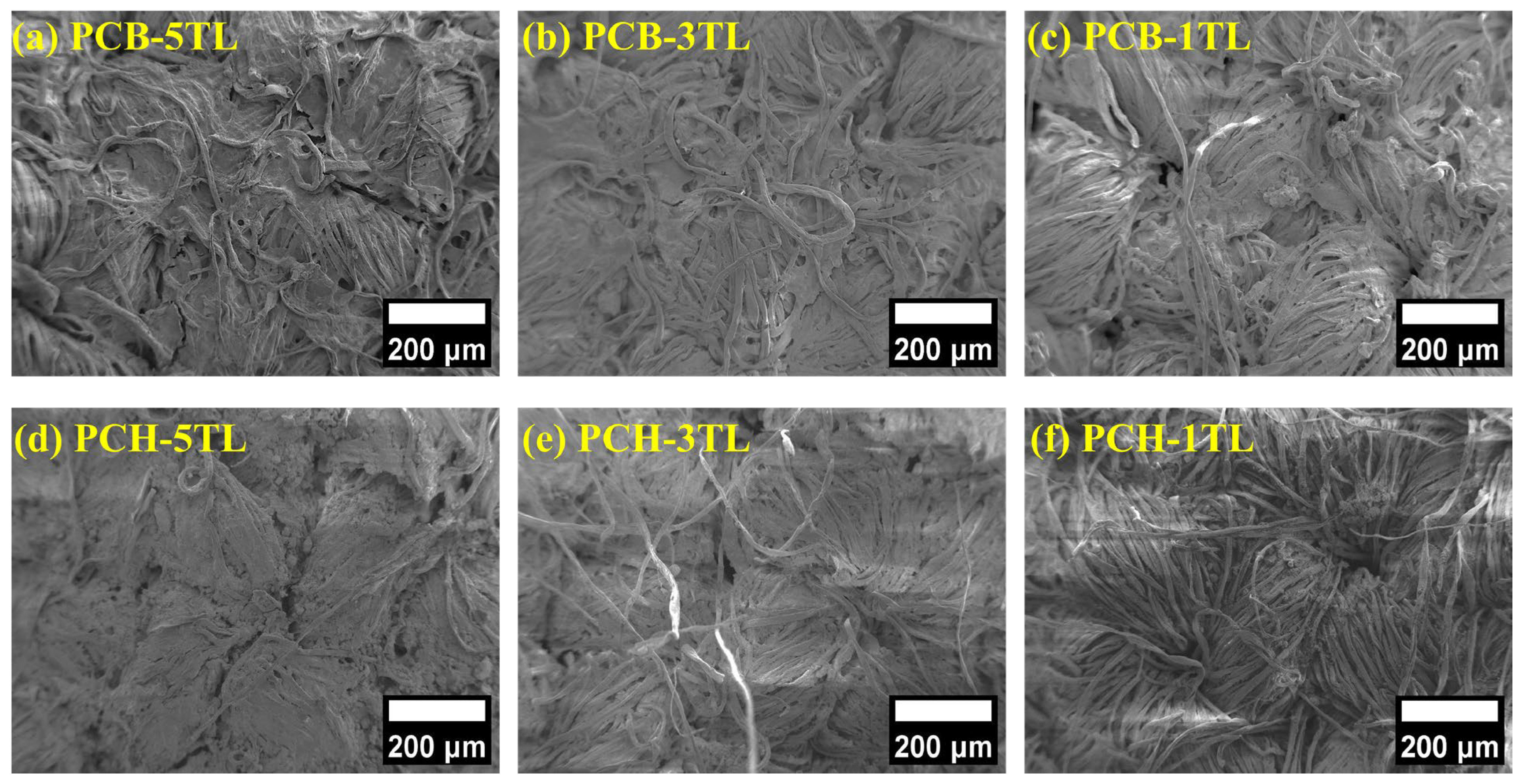
SEM images of the coated samples can be seen in Figure 2a–f. It can be seen that the surface of the cotton fabric has been covered by the coating species. Individual fabric fibers can be seen, however, with different clarity, as the PAA layers increase and the clay changes. A high adhesion force can be estimated from the tightly bound fabric fibers. As the number of tri-layers increases, the attachment intensity increases, as can be seen for PCB-5TL compared to PCB-1TL, which has only one tri-layer. In the case of halloysite-based coatings, as the number of tri-layers increases, instead of attachment, the agglomeration increases, which causes fabric weaves to fall apart, as reported elsewhere. The agglomeration or large chunks of coating materials can also be seen in the case of PCB-1TL (1trilyers). The distinct nature of the fibers can be seen as disappearing with the increase in the number of layers. In the case of bentonite clay, all the weaves are attached to each other, offering a uniform texture, while in the case of halloysite, the fibers are highly separated at a lower number of tri-layers, thus offering no clue of individual layers at a higher number of tri-layers, as in the case of PCH-5TL. Additionally, the microstructure of the individual fibers has been changed from a round shape to a wavy flat shape, suggesting the higher adsorption of the solution species. There was no flexibility in the samples, so the samples were split due to the high intake of the halloysite structure leverage as nanotubes compared to bentonite as a simple powder. It is important to note that the nanotubes could be easily loaded by the polyacrylic acid layer compared to the bentonite particles, as can be confirmed from the SEM images. Furthermore, the halloysite nano tubes are deposited deep inside around each fiber of the fabric, unlike the bentonite, which can be seen to form a thin film having strong individual connectivity as well as mutual connectivity [33].
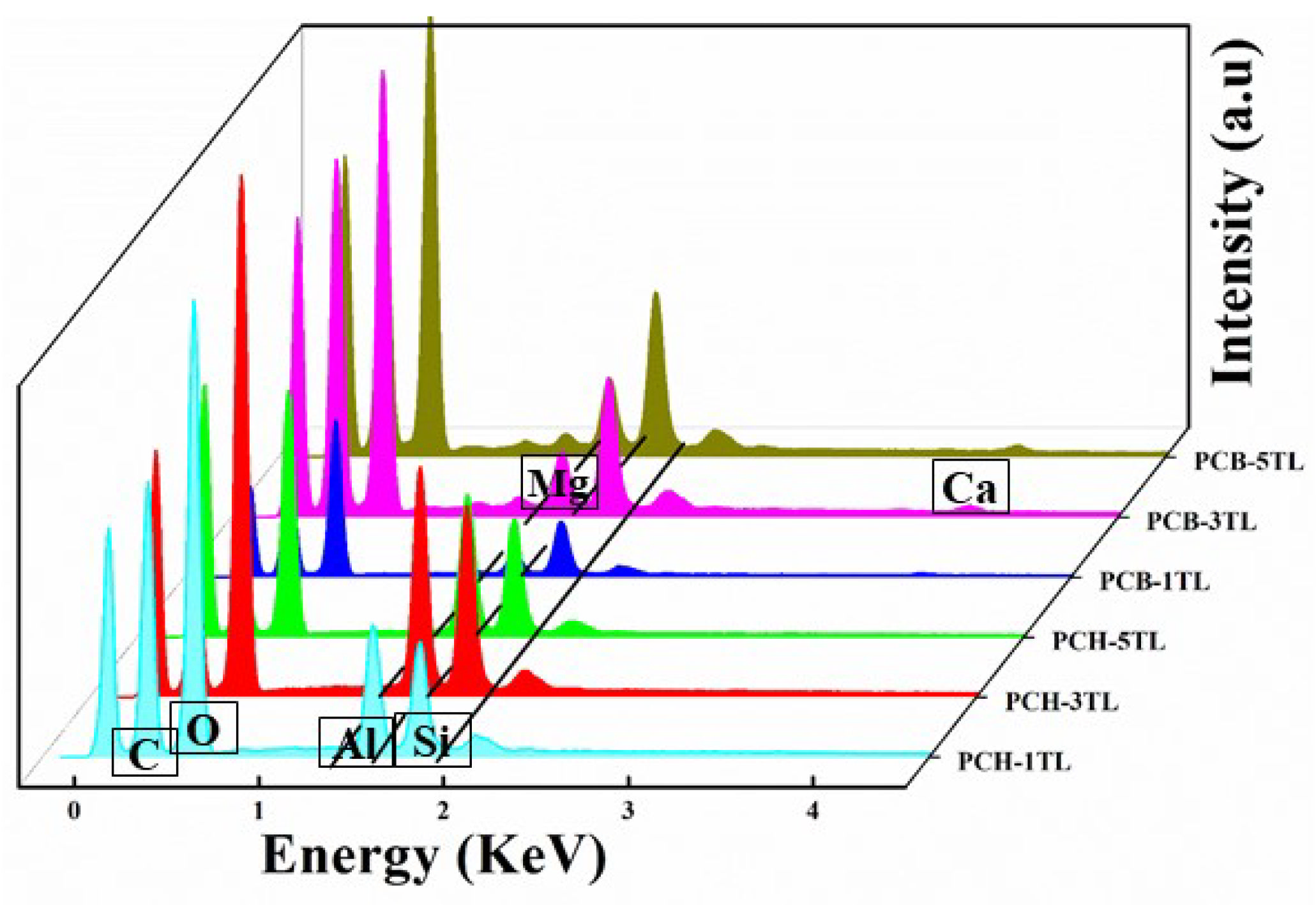
The elemental analysis profile of the coated samples can be seen in Figure 3. From the elemental analysis profile, it can be seen that the Mg, Al, and Si vary with the PAA injection intensity and type of clay. The Al and Si are higher for PCB-5TL and PCH-5TL as mentioned in Table 1, while decreasing for PCH-1TL and PCB-1TL, suggesting the higher intake of the clay particles with increasing the PAA content. Similarly, in the case of PCH (halloysite nanotubes), the content of Al and Si is much higher compared to PCB (bentonite nano-clay), suggesting a higher intake of FR species to the coating matrix. This happened due to the higher surface area of the halloysite nanotube’s structure, thus offering higher deposition opportunity to the coating species.
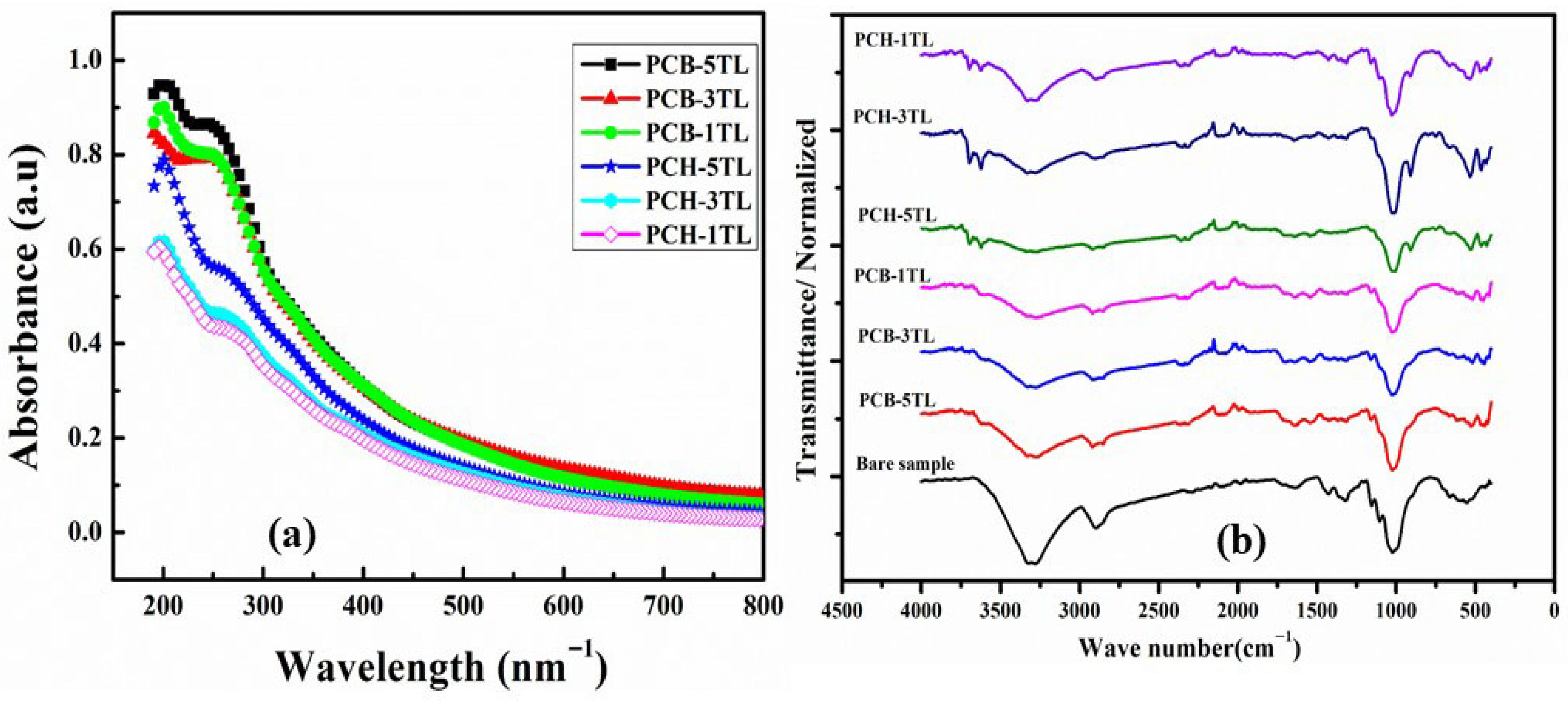
Coating assembly of the halloysite and bentonite nano-clays was examined using UV–vis absorption spectroscopy (V-670 UV–Vis spectrophotometer (JASCO, Japan)). Figure 4a shows that the UV–vis spectra of the halloysite/and bentonite/multilayer composites exhibit a progressive increase in absorption intensity as the number of poly(acrylic acid) interlayers increases, indicating successful layer-by-layer growth of the coating structure. An absorption peak observed at approximately 277 nm confirms the presence of halloysite and bentonite species within the coating matrix. The increasing absorbance intensity correlates with the higher inorganic (Al and Si) content obtained from the EDS analysis, confirming greater nanoclay incorporation in PCB-5TL and PCH-5TL samples. While the EDS results indicate relatively higher Al and Si content in the halloysite-based coatings, the bentonite samples exhibit comparatively higher absorbance intensity. This difference may be attributed to variations in optical properties, dispersion behavior, and light-scattering characteristics of the respective nanoclays within the coating matrix. Furthermore, the gradual increase in absorbance with increasing trilayer number suggests a systematic increase in coating thickness and microstructural buildup, consistent with the expected layer-by-layer assembly mechanism.
Figure 4b shows the ATR-FTIR spectra of the coated and uncoated samples. Generally, the control fabric presents the characteristic peaks of cellulose at 1424, 1309, 1026 cm−1, which can be attributed to the C–H in-plane bending, deformation stretching, and C–O–C asymmetry stretching, respectively. Due to the similarity in coating solution species, overlapping of absorption peaks could possibly occur; thus, significant new peaks cannot be observed. However, the intensities, peak split, peak positions, and area under the peaks were found to be highly varied with varying the PAA inter-layer insertion and clay type. A broad absorption band can be seen at around 3290–3310 cm−1, attributed to the stretching vibrations of the OH groups attached to the cotton fabric [34]. Intensity of such peaks was highly reduced with the coatings from PCH-1TL to PCH-5TL and PCB-5TL to PCB-1TL, for the samples, suggesting the maximum coverage of cotton fabric by the coating layers same behavior has been reported in earlier studies [35]. Furthermore, new minor peaks can also be seen in the range of 1600–1750 cm−1 in the case of PCB samples which is attributed to the stretching vibration of carbonyl (C=O) [36] while the same minor peaks observed with high intensity in the case of PCH in the range of 3600~3800 cm−1 are associated with the structural O-H stretching vibrations of halloysite nanoclay, particularly the inner surface Al-OH groups [37]. Moreover, from the FTIR spectra, it can be seen that the “C-H” peak, as appeared in the region between 3200~3500, is split in the halloysite, suggesting the overlapping of the Si, Al band energies. Similarly, a new band around ~800~900 cm−1 can be seen clearly in the halloysite samples, suggesting the new band energies might be attributed to the Al and Si [38,39,40]. A slight variation in the broad O–H stretching region above 3500 cm−1 can be observed after coating deposition, indicating modification of the surface chemical environment All these new peaks suggest the successful deposition of coating species.

3.2. Thermal Stability

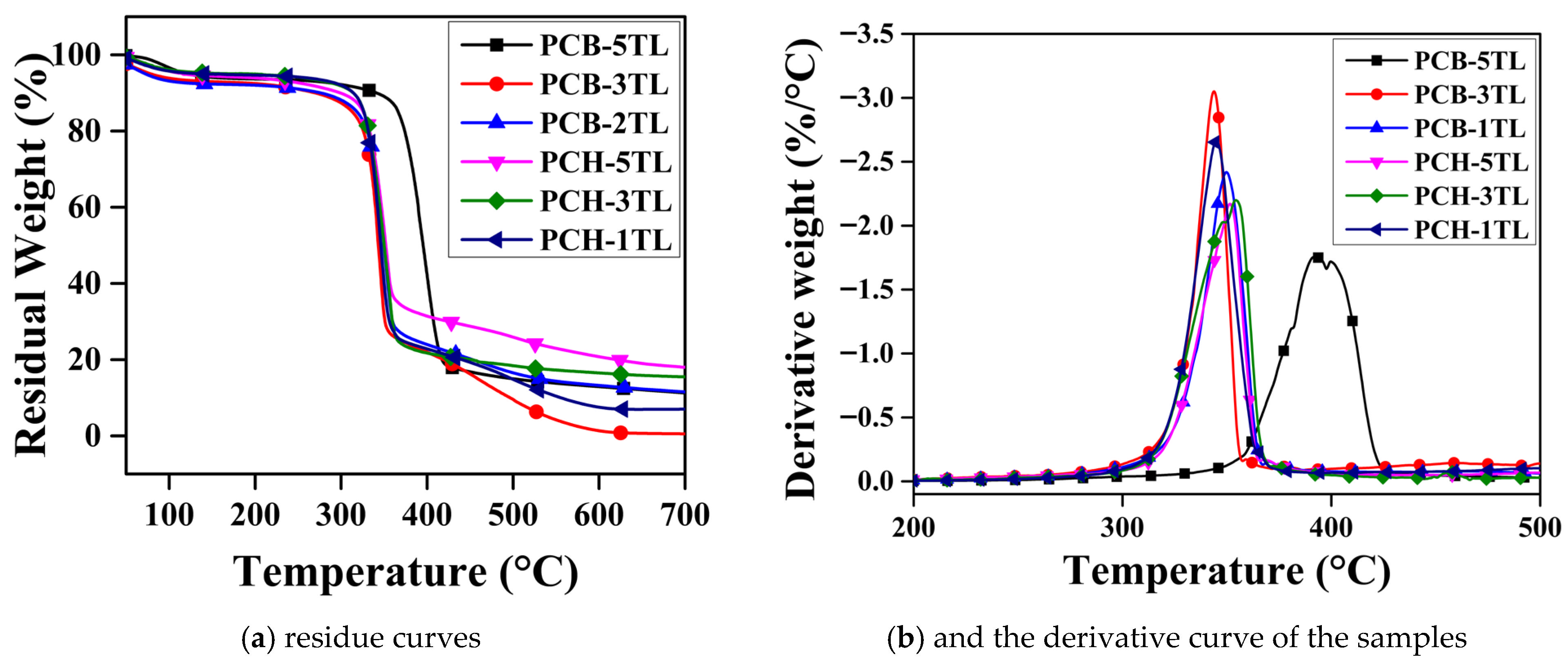
Thermo-gravimetric analysis was carried out to analyze the degradation behavior of the coated sample’s substrate. In the primary region of temperatures (30~300 °C), as can be seen from the TGA curve, there cannot be seen any significant difference in the degradation behavior of the samples, suggesting similar dehydration and mild mass loss behavior. For the coated samples, the maximum mass residue obtained was recorded in the range of ~7–30%, compared to the value of 1.2% for the uncoated samples, as reported by the author previously. Residue left at the end of the TGA is an important factor to endorse the efficiency of particular coatings, thus the residue of the PCH-5TL ~19% is much higher compared to the bare cotton fabric and other coated samples, which lie in the range from 1~19% as mentioned in Table 2. In addition, a degradation region (shoulder-like behavior) can be observed in the TGA curves of PCH-5TL, PCH-3TL, and PCH-1TL at higher temperatures, 316.14 °C, 314 °C, and 315.59 °C. This indicates the gradual decomposition of the thermally stable char residue formed during the degradation stage. The broadened degradation profile suggests a slower decomposition rate at elevated temperatures, reflecting a delayed thermal degradation process. If the residue sustains till high temperature, as in the case of PCH-5TL, the coating samples can be stated as equally effective against fire. The effective resistance by the PCH coatings occurred due to the obstruction of the depolymerization (trans glycosylation reactions), and thus caused the dehydration of glycosyl units to form thermally stable char instead of volatile species [41]. Both the quantity and quality of the leftover material in the pyrolysis region could foretell the performance of the coated samples against the burning process. In the high temperature region (250~380 °C), the mass loss occurred due to the complete degradation (thermo-oxidative degradation of residues) of the aromatic carbonaceous structure to CO and CO2. From the observation of these three regions, it is evident that the coating successfully postponed the thermal degradation for PCH-5TL. Differential curves of thermal decomposition (DTGA) can be seen in Figure 5b. Differential curves provide information about the peak degradation zones on the temperature graph. Instead of a single peak, several peaks can be seen around the major degradation peaks for all the samples. Such peaks suggest the inhomogeneous coverage of the substrate’s samples. The areas with thicker coating layers offered higher resistance, while the thinner coating layers offered less resistance against heat. Thus, at peak degradation temperature, micro regions with thicker coatings degraded later, compared to micro regions with less-thick coating or less resistive coating microstructure. From Figure 5b, such inhomogeneity can be seen as less dominant in the PCH samples compared to the PCB samples. The highest degradation temperature, ~393.72 °C, was recorded for PCB-5TL, which is in line with the microstructure analysis. It is also possible that such peaks appeared from the impulsive heat release events that occurred at micro-zones, where the thicker coating layer offered higher resistance, but could not withstand the higher temperatures and thus burst to release energy.

3.3. Pyrolysis-Combustion and Flammability Analysis

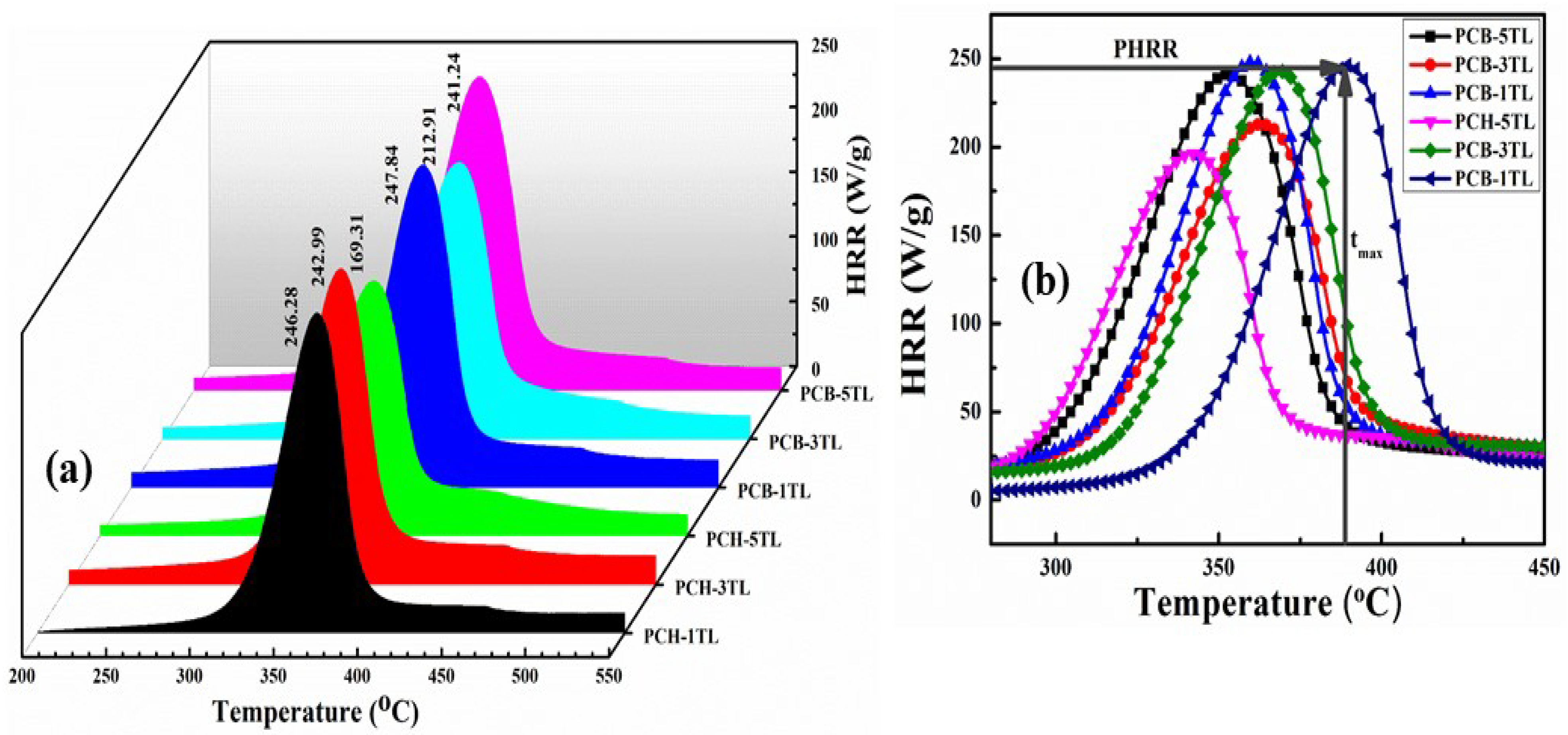
In order to investigate the pyrolysis mechanism and various thermal parameters related to the coating samples, micro-cone calorimetry was carried out. The furnace temperature was set at 900 °C, with an oxygen concentration of 20% (v/v) and a heating rate of 1 °C/min. The resultant curves obtained from the micro-cone calorimetry can be seen in Figure 6a,b as HRR curves. Curves in Figure 6a present the peak Heat release rate of each sample, while the curves in Figure 6b show the temperatures at which the highest heat release occurred for each sample. Quantitative values of the HRR for each sample can be seen in Table 3. Peak values of the HRR can be seen as declining with increasing the number of layers as well as the clay type. Lowest values of HRR could be seen as obtained for the halloysite base system PCH-5TL. From the HRR curves, it can be seen that the thermal decomposition event for each sample occurred in the temperature region of around 280 °C~390 °C. However, the values of temperatures at which the peak heat release event occurred varied for each sample, as shown in Figure 6a. The lowest value of the heat release can be evidenced for PCH-5TL ~196 W/g, which is 55% lower than other PCH samples, while 56% lower than that of PCB-5TL. Such a large decrease in the HRR values of PCH-5TL compared to other samples signifies its effective protective role against combustion, which is in agreement with the TGA and microstructural results. The effective resistance of the PCH-5TL might be the result of two parallel processes: thermal barrier effect of the coating layers and release of inert gaseous species that could dilute the oxygenated micro zones. Thermal barrier shielding can be evidenced from the microstructure and the effective network from the chitons and halloysite nano-clay catalyzed by the inclusion of poly-acrylic acid, as in PCH-5TL. The higher heat release is an indication of either large mass loss or high energy release per unit mass [42]. In both cases, a weak flame resistance mechanism works, which ultimately signifies the sample as less effective against fire. Likewise, the values of temperature at which the peak heat release occurred can be seen to decrease linearly with an increase in the number of tri-layers and the type of clay. For a lower number of tri-layers, the Tphrr is higher, suggesting lower resistance against combustion. However, for a higher number of coating layers, the Tphrr reached a lowest value, as for PCH-5TL ~342 and 353 °C for PCB-5TL. Such results not only suggest the effective role of a higher number of layers but also confirm the excellent resistive behavior of halloysite nano-clay-based coatings. Though the peak heat release and temperature at which the peak heat release occurred are important parameters; however, the average thermal resistance behavior of the samples against the temperature increase and thus combustion can be analyzed through total heat release. Total heat release can be obtained from the areas under the HRR curves. From the THR values as in Table 3, it is evident that all the halloysite clay-based coating samples have lower THR values compared to the bentonite clay-based coated samples. The lowest THR value was recorded as 10.21 Kj/g obtained for PCH-5TL, suggesting the effective resistance of the PCH-5TL during all the temperature increase journey from 240~450 °C. The lowest recorded value of THR~ can be considered a significant achievement as compared to 13.7 Kj/g reported by the author previously [43].
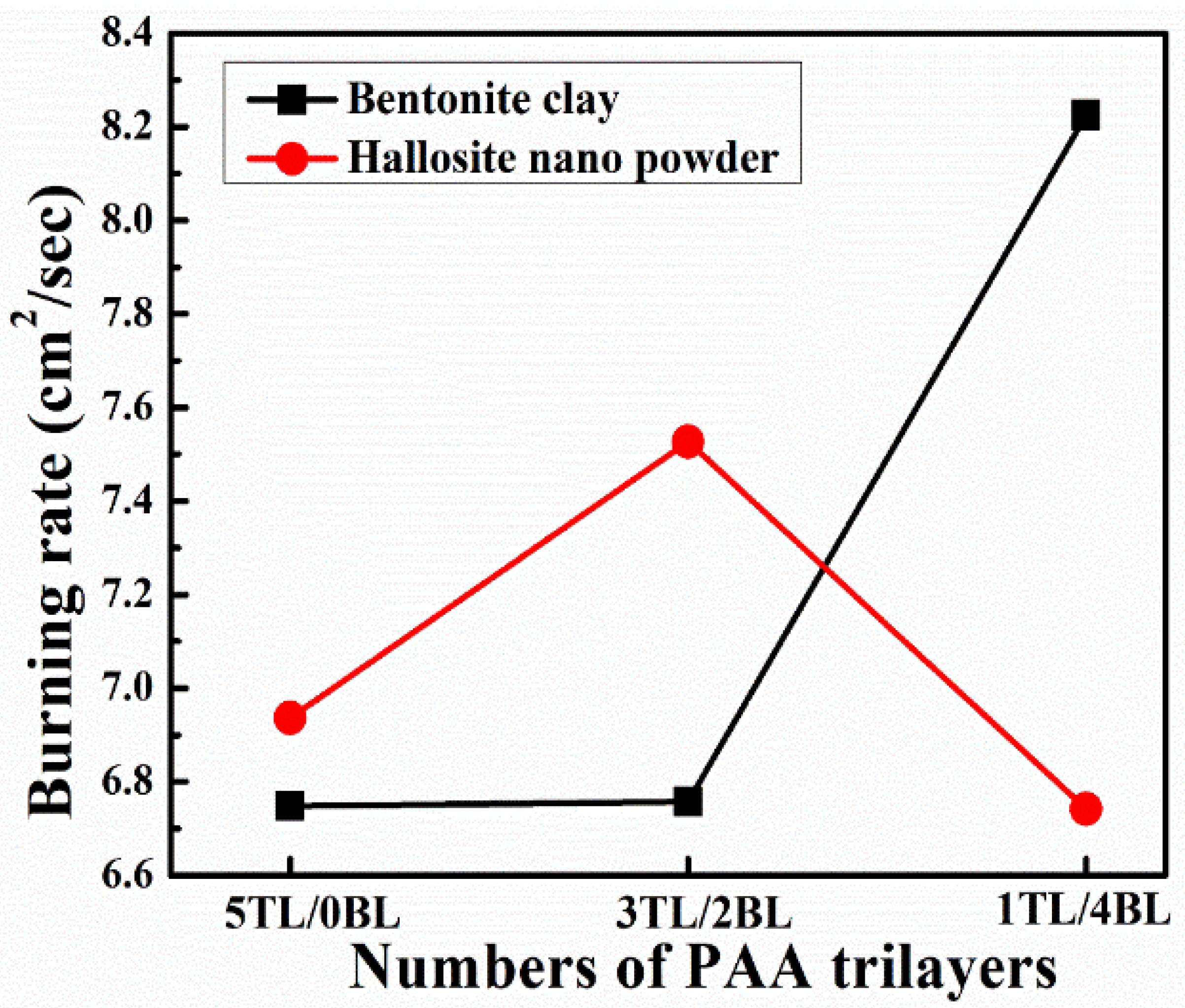
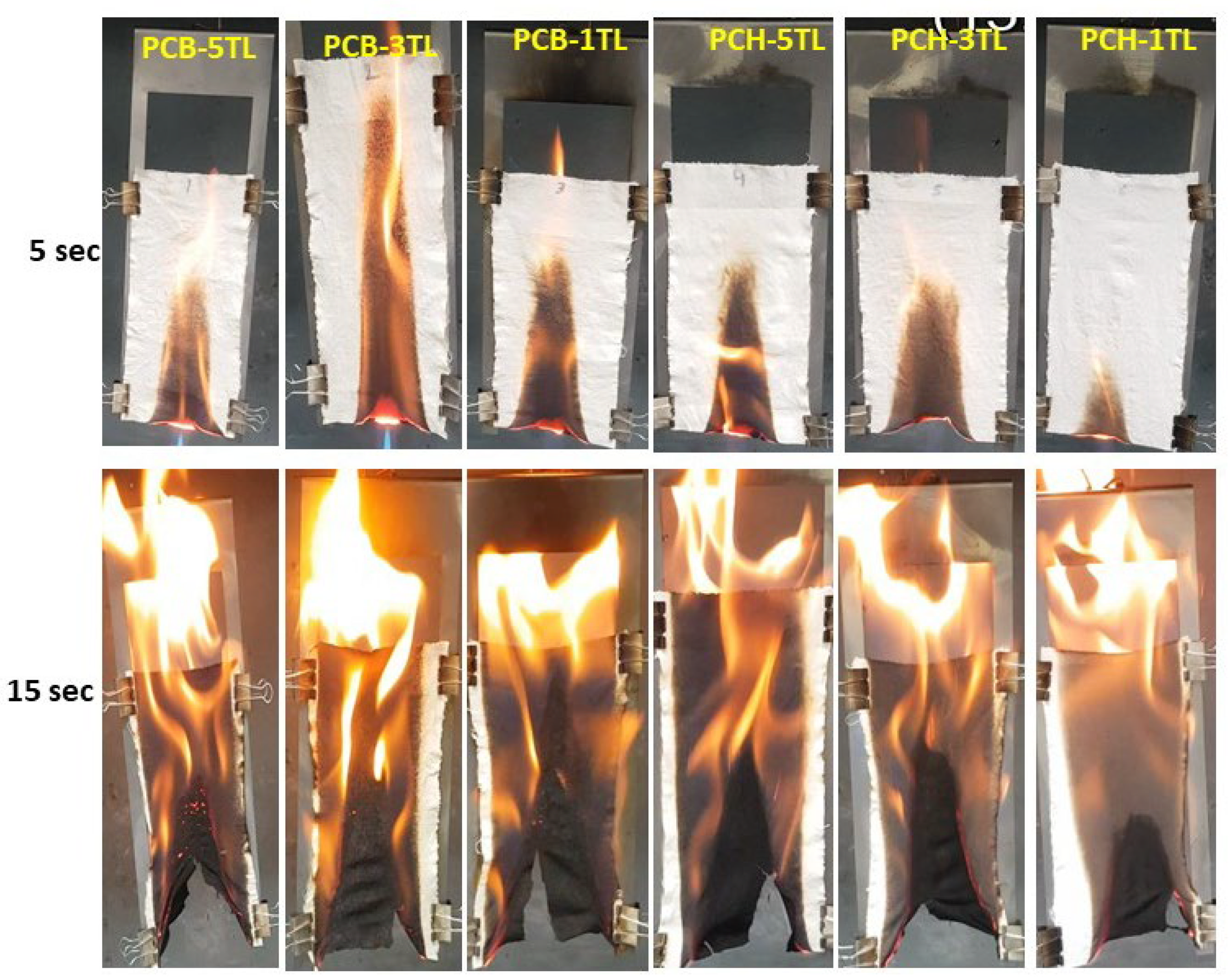
To further explore the combustion and thermal retardant properties of the coating, macro investigations such as UL-94 (ASTM D6413) were carried out. A butane torch was used for a 10 s interval to ignite the sample from a 20 mm distance. The UL-94 investigation can be used to characterize various parameters such as ease of ignition, flame spread, fire endurance, heat release rate, ease of extinction, smoke evolution, and toxic gaseous species generation. As shown in Figure 7 (5 s), from the flame height and flame spread, it can be seen that coating layers significantly suppressed the ignition and flame spread particularity for the PCH-5TL sample. From the 15s image, it can be seen that the coating samples completely burned out, the remaining char and flame height could characterize the significant resistive role of PCH-5TL. The same results were obtained from the flammability test, which shows, as in Figure 8, that the burning rate was highly decreased for PCH, signifying and confirming its thermal shielding effect against fire.

3.4. Conclusions

Polyacrylic acid-based layers were successfully injected in the tri-layer system of coatings deposited on cotton fabric using the LBL coating technique. Absorption intensity of the interlayers increased with the number of tri-layers and thus led to a higher thickness of the whole coating system. The highest thermal residue, ~18%, was obtained for PCH-5TL with maximum degradation peak intensity at ~389 °C. From the micro combustion analysis, it was further confirmed that the PCH-5TL system significantly retarded the flame by offering the lowest peak heat release rate, PHRR ~196.30, and total heat release rate THR ~10.21 KJ/g. The macro combustion test, the UL-94 test, supported the findings of previous results through the lowest flame and burning rate of the PCH-5TL system.

Author Contributions

Conceptualization, Z.U.R., H.H., J.D.Y. and B.H.K.; methodology, Z.U.R., H.H., J.H.H. and B.H.K.; software, H.H., J.D.Y., S.W.P., J.H.P. and Z.U.R.; validation, Z.U.R., H.H., J.H.H., J.H.P., D.G.H. and B.H.K.; formal analysis, H.H., J.D.Y., S.W.P., Z.U.R. and B.H.K.; investigation, Z.U.R., H.H. and B.H.K.; resources, Z.U.R., H.H. and B.H.K.; data curation, Z.U.R., H.H., J.D.Y. and B.H.K.; writing—original draft preparation, Z.U.R. and H.H.; writing—review and editing, H.H., J.D.Y., S.W.P., D.G.H. and Z.U.R.; visualization, H.H., Z.U.R. and B.H.K.; supervision, Z.U.R. and B.H.K.; project administration, Z.U.R. and B.H.K.; funding acquisition, Z.U.R. and B.H.K. All authors have read and agreed to the published version of the manuscript.

Funding

This research was supported by the Basic Science Research Program through the National Research Foundation of Korea (NRF), funded by the Ministry of Education (No. 2018R1A6A1A03024509), and Collabo R&D between Industry, University, and Research Institute funded by the Korea Ministry of SMEs and Startups in 2024 (RS-2024-00418298). This study was conducted as part of the Global University Project, supported by the RISE (Regional Innovation System & Education) program funded by the Ministry of Education. Regional Innovation System & Education (RISE) program through the RISE Center, Gyeongsangnam-do, funded by the Ministry of Education (MOE) and the Gyeongsangnam-do Provincial Government, Republic of Korea (2025-RISE-16-002).

Data Availability Statement

The data presented in this study are available upon request from the corresponding author due to the research data are the sole property of the university.

Conflicts of Interest

Authors Jung Hoon Han, Jin Doo Yoon, Seung Woo Park and Ji Hyeon Park, and Dong Geon Ha were employed by Dongjin Metal Co., Ltd. The remaining authors declare that the research was conducted in the absence of any commercial or financial relationships that could be construed as a potential conflict of interest

References

  1. Dvir, H.; Gottlieb, M.; Daren, S.; Webster, T.F. Optimization of a flame-retarded polypropylene composite. Compos. Sci. Technol. 2003, 63, 1865–1875. [Google Scholar] [CrossRef]
  2. Stapleton, H.M.; Klosterhaus, S.; Eagle, S.; Fuh, J.; Meeker, J.D.; Blum, A.; Webster, T.F. Detection of organophosphate flame retardants in furniture foam and U.S. house dust. Environ. Sci. Technol. 2009, 43, 7490–7495. [Google Scholar] [CrossRef] [PubMed]
  3. Hooshangi, Z.; Feghhi, S.A.H.; Sheikh, N. The effect of electron-beam irradiation and halogen-free flame retardants on properties of poly butylene terephthalate. Radiat. Phys. Chem. 2015, 108, 54–59. [Google Scholar] [CrossRef]
  4. Li, Y.-L.; Kuan, C.-F.; Hsu, S.-W.; Chen, C.-H.; Kuan, H.-C.; Lee, F.-M.; Yip, M.-C.; Chiang, C.-L. Preparation, thermal stability and flame-retardant properties of halogen-free polypropylene composites. High Perform. Polym. 2012, 24, 478–487. [Google Scholar] [CrossRef]
  5. Alongi, J.; Tata, J.; Carosio, F.; Rosace, G.; Frache, A.; Camino, G. A comparative analysis of nanoparticle adsorption as fire-protection approach for fabrics. Polymers 2015, 7, 47–68. [Google Scholar] [CrossRef]
  6. Levchik, S.V.; Weil, E.D. A review of recent progress in phosphorus-based flame retardants. J. Fire Sci. 2006, 24, 345–364. [Google Scholar] [CrossRef]
  7. Wang, Z.; Wu, K.; Hu, Y. Study on flame retardance of co-microencapsulated ammonium polyphosphate and dipentaerythritol in polypropylene. Polym. Eng. Sci. 2008, 48, 2426–2431. [Google Scholar] [CrossRef]
  8. Wu, K.; Hu, Y.; Song, L.; Lu, H.; Wang, Z. Flame retardancy and thermal degradation of intumescent flame retardant starch-based biodegradable composites. Ind. Eng. Chem. Res. 2009, 48, 3150–3157. [Google Scholar] [CrossRef]
  9. Pan, D.; Jia, D.; Yuan, Y.; Pan, Y.; Wang, W.; Xu, L. Flame-Retardant Polyurea Coatings: Mechanisms, Strategies, and Multifunctional Enhancements. Fire 2025, 8, 334. [Google Scholar] [CrossRef]
  10. Yi, L.; Feng, S.; Wang, Z.; Ding, Y.; Li, Y. Predicting the fire performance of intumescent fire-retardant coating with inert and oxidative reaction schemes. Fire Saf. J. 2025, 158, 104541. [Google Scholar] [CrossRef]
  11. Gao, M.; Ling, B.; Yang, S.; Zhao, M. Flame retardance of wood treated with guanidine compounds characterized by thermal degradation behavior. J. Anal. Appl. Pyrolysis 2005, 73, 151–156. [Google Scholar] [CrossRef]
  12. Horacek, H.; Grabner, R. Advantages of flame retardants based on nitrogen compounds. Polym. Degrad. Stab. 1996, 54, 205–215. [Google Scholar] [CrossRef]
  13. Moafi, H.F.; Mostashari, S.M. Flame-resistant polymeric composite fibers based on nanocoating flame retardant: Thermogravimetric study and production of α-Al2O3 nanoparticles by flame combustion. J. Polym. Eng. 2014, 34, 803–812. [Google Scholar] [CrossRef]
  14. Xie, K.; Gao, A.; Zhang, Y. Flame retardant finishing of cotton fabric based on synergistic compounds containing boron and nitrogen. Carbohydr. Polym. 2013, 98, 706–710. [Google Scholar] [CrossRef]
  15. Tai, Q.; Yuen, R.K.; Song, L.; Hu, Y. A novel polymeric flame retardant and exfoliated clay nanocomposites: Preparation and properties. Chem. Eng. J. 2012, 183, 542–549. [Google Scholar] [CrossRef]
  16. Wang, S.; Hu, Y.; Zong, R.; Tang, Y.; Chen, Z.; Fan, W. Preparation and characterization of flame retardant ABS/montmorillonite nanocomposite. Appl. Clay Sci. 2004, 25, 49–55. [Google Scholar] [CrossRef]
  17. Demirel, M.; Pamuk, V.; Dilsiz, N. Investigation of flame retardancy and physical–mechanical properties of zinc borate/boric acid polyester composites. J. Appl. Polym. Sci. 2010, 115, 2550–2555. [Google Scholar] [CrossRef]
  18. Gao, X.; Guo, Y.; Tian, Y.; Li, S.; Zhou, S.; Wang, Z. Synthesis and characterization of polyurethane/zinc borate nanocomposites. Colloids Surf. A Physicochem. Eng. Asp. 2011, 384, 2–8. [Google Scholar] [CrossRef]
  19. De Fenzo, A.; Formicola, C.; Antonucci, V.; Zarrelli, M.; Giordano, M. Effects of zinc-based flame retardants on the degradation behaviour of an aerospace epoxy matrix. Polym. Degrad. Stab. 2009, 94, 1354–1363. [Google Scholar] [CrossRef]
  20. Li, S.; Long, B.; Wang, Z.; Tian, Y.; Zheng, Y.; Zhang, Q. Synthesis of hydrophobic zinc borate nanoflakes and its effect on flame retardant properties of polyethylene. J. Solid State Chem. 2010, 183, 957–962. [Google Scholar] [CrossRef]
  21. Ghanbari, D.; Salavati-Niasari, M.; Ghasemi-Kooch, M. In situ and ex situ synthesis of poly(vinyl alcohol)–Fe3O4 nanocomposite flame retardants. Particuology 2016, 26, 87–94. [Google Scholar] [CrossRef]
  22. Jiao, C.; Chen, X.; Zhang, J. Synergistic Effects of Fe2O3 with layered double hydroxides in EVA/LDH composites. J. Fire Sci. 2009, 27, 465–479. [Google Scholar] [CrossRef]
  23. Nabiyouni, G.; Ghanbari, D. Thermal, magnetic, and optical characteristics of ABS-Fe2O3 nanocomposites. J. Appl. Polym. Sci. 2012, 125, 3268–3274. [Google Scholar] [CrossRef]
  24. Yang, J.; Li, J.-Y.; Qiao, J.-Q.; Cui, S.-H.; Lian, H.-Z.; Chen, H.-Y. Magnetic solid phase extraction of brominated flame retardants and pentachlorophenol from environmental waters with carbon doped Fe3O4 nanoparticles. Appl. Surf. Sci. 2014, 321, 126–135. [Google Scholar] [CrossRef]
  25. Jiao, C.; Chen, X.; Zhang, J. Synergistic Flame-retardant effects of aluminum oxide with layered double hydroxides in EVA/LDH composites. J. Thermoplast. Compos. Mater. 2010, 23, 501–512. [Google Scholar] [CrossRef]
  26. Liang, J.; Zhang, Y. A study of the flame-retardant properties of polypropylene/Al(OH)3/Mg(OH)2 composites. Polym. Int. 2010, 59, 539–542. [Google Scholar] [CrossRef]
  27. Shi, Z.; Fu, R.; Agathopoulos, S.; Gu, X.; Zhao, W. Thermal conductivity and fire resistance of epoxy molding compounds filled with Si3N4 and Al(OH)3. Mater. Des. 2012, 34, 820–824. [Google Scholar] [CrossRef]
  28. Suppakarn, N.; Jarukumjorn, K. Mechanical properties and flammability of sisal/PP composites: Effect of flame retardant type and content. Compos. Part B Eng. 2009, 40, 613–618. [Google Scholar] [CrossRef]
  29. Shi, L.; Liu, Q.; Zhu, P. Bio-Based Chitosan/Agar/Phytic Acid Coating Enhanced Flame Retardancy of Wood Applied to Aircraft Cabin Interiors. Fire 2025, 8, 461. [Google Scholar] [CrossRef]
  30. Hassan, H.; Rehman, Z.U.; Yoon, J.D.; Park, S.W.; Koo, B.H. Chitosan-Branched Polyethyleneimine Hybrid Cationic Layer as an Effective Solution Towards Fire Vulnerability of Cotton Fabric. Polymers 2025, 17, 3313. [Google Scholar] [CrossRef]
  31. Bongiovanni, R.; Turcato, E.; Di Gianni, A.; Ronchetti, S. Epoxy coatings containing clays and organoclays: Effect of the filler and its water content on the UV-curing process. Prog. Org. Coat. 2008, 62, 336–343. [Google Scholar] [CrossRef]
  32. Cequier, E.; Marcé, R.M.; Becher, G.; Thomsen, C. Determination of emerging halogenated flame retardants and polybrominated diphenyl ethers in serum by gas chromatography mass spectrometry. J. Chromatogr. A 2013, 1310, 126–132. [Google Scholar] [CrossRef]
  33. Kemmlein, S.; Herzke, D.; Law, R.J. Brominated flame retardants in the European chemicals policy of REACH—Regulation and determination in materials. J. Chromatogr. A 2009, 1216, 320–333. [Google Scholar] [CrossRef]
  34. Prabhakar, M.; Shah, A.U.R.; Song, J.-I. A Review on the flammability and flame retardant properties of natural fibers and polymer matrix based composites. Compos. Res. 2015, 28, 29–39. [Google Scholar] [CrossRef]
  35. Hassan, H.; Rehman, Z.U.; Koo, B.H. Eco-friendly fire-retardant coating on cotton using layer by layer deposition technique. Molecules 2024, 29, 5976. [Google Scholar] [CrossRef]
  36. Dotto, G.; Rodrigues, F.; Tanabe, E.; Fröhlich, R.; Bertuol, D.; Martins, T.; Foletto, E. Development of chitosan/bentonite hybrid composite to remove hazardous anionic and cationic dyes from colored effluents. J. Environ. Chem. Eng. 2016, 4, 3230–3239. [Google Scholar] [CrossRef]
  37. Szczepanik, B.; Słomkiewicz, P.; Garnuszek, M.; Czech, K.; Banaś, D.; Kubala-Kukuś, A.; Stabrawa, I. The effect of chemical modification on the physico-chemical characteristics of halloysite: FTIR, XRF, and XRD studies. J. Mol. Struct. 2015, 1084, 16–22. [Google Scholar] [CrossRef]
  38. Risyon, N.P.; Othman, S.H.; Basha, R.K.; Talib, R.A. Effect of halloysite nanoclay concentration and addition of glycerol on mechanical properties of bionanocomposite films. Polym. Polym. Compos. 2016, 24, 795–802. [Google Scholar] [CrossRef]
  39. Hansen-Bruhn, I.; Marks, M.J.; Hinge, M. Is titania acting as a synergist in intumescent fire retardant coatings designed for improving reaction to fire of wood? Fire Saf. J. 2024, 143, 104075. [Google Scholar] [CrossRef]
  40. Shafizadeh, F. Introduction to pyrolysis of biomass. J. Anal. Appl. Pyrolysis 1982, 3, 283–305. [Google Scholar] [CrossRef]
  41. Rehman, Z.U.; Hassan, H.; Khan, L.; Hwain, L.; Chiho, Y.; Koo, B.H. Hybrid Activity of P–Si–N Moieties for Improved Fire Retardancy of Cotton Fabric Coated Using Sol-Gel Process. Coatings 2024, 14, 1283. [Google Scholar] [CrossRef]
  42. Li, W.-L.; Liu, L.-Y.; Song, W.-W.; Zhang, Z.-F.; Qiao, L.-N.; Ma, W.-L.; Li, Y.-F. Five-year trends of selected halogenated flame retardants in the atmosphere of Northeast China. Sci. Total. Environ. 2016, 539, 286–293. [Google Scholar] [CrossRef] [PubMed]
  43. Stieger, G.; Scheringer, M.; Ng, C.A.; Hungerbühler, K. Assessing the persistence, bioaccumulation potential and toxicity of brominated flame retardants: Data availability and quality for 36 alternative brominated flame retardants. Chemosphere 2014, 116, 118–123. [Google Scholar] [CrossRef] [PubMed]
Figure 1. Schematic diagram of the experimental protocol used to obtain various coating layers on cotton fabric using the LBL process.
Fire 09 00156 g001
Figure 2. (af) LV-SEM images of the LBL-coated cotton samples.
Fire 09 00156 g002
Figure 3. EDAX analysis of the coated specimens.
Fire 09 00156 g003
Figure 4. (a) UV-visible spectroscopy of the coated specimens, (b) FTIR profile of the coated samples.
Fire 09 00156 g004
Figure 5. Thermogravimetric analysis.
Fire 09 00156 g005
Figure 6. Thermal parameters measured by micro-combustion calorimetry. (a) Heat Release Rate curves (HRR) and (b) Respective Total Heat Release (THR) values are those represented by the area under each curve.
Fire 09 00156 g006
Figure 7. Vertical flame (UL-94) test of the samples; images after 10 s of the flame and 15 s of the flame.
Fire 09 00156 g007
Figure 8. Burning rate of the coated cotton fabric and strain profile of the sample (After-burn).
Fire 09 00156 g008
Table 1. EDAX analysis parameters of the coated samples (SD < 1%).
SamplesCOAlCaMgFeSi
PCB-5TL46.4846.281.780.290.400.644.13
PCB-3TL45.2247.562.960.380.360.194.35
PCB-1TL46.9646.301.930.37--3.41
PCH-5TL37.347.227.280.09 0.216.40
PCH-3TL36.0951.646.57 5.71
PCH-1TL43.2649.463.84 0.073.36
Table 2. TGA parameters of coated samples.
SamplesTp, °C
(DTG Peak)
Residue at 700 °C (%)Total Decom (%)
PCB1-5TL393.727.0192.99
PCB-3TL343.850.54+399.56
PCB-1TL350.0411.38+388.62
PCH-5TL351.2318.0881.92
PCH-3TL354.3615.4784.53
PCH-1TL345.1011.2788.73
Table 3. MCC analysis parameters.
SamplesPHRR (W/g)THR (KJ/g)TPHRR (°C)
PCB-5TL241.24915.88353.88
PCB-3TL212.91514.71363.575
PCB-1TL247.84415.36360.387
PCH-5TL196.3010.21342.597
PCH-3TL242.99813.88369.567
PCH-1TL246.28212.84366.641
Disclaimer/Publisher’s Note: The statements, opinions and data contained in all publications are solely those of the individual author(s) and contributor(s) and not of MDPI and/or the editor(s). MDPI and/or the editor(s) disclaim responsibility for any injury to people or property resulting from any ideas, methods, instructions or products referred to in the content.