
Study on the Effect of Modified Vanadium–Titanium Slag Explosion Suppressant on the Explosion Characteristics of Polyacrylonitrile Dust

Abstract
1. Introduction
2. Materials and Methods
2.1. Preparation and Testing of the Composite Powder Explosion Suppressant
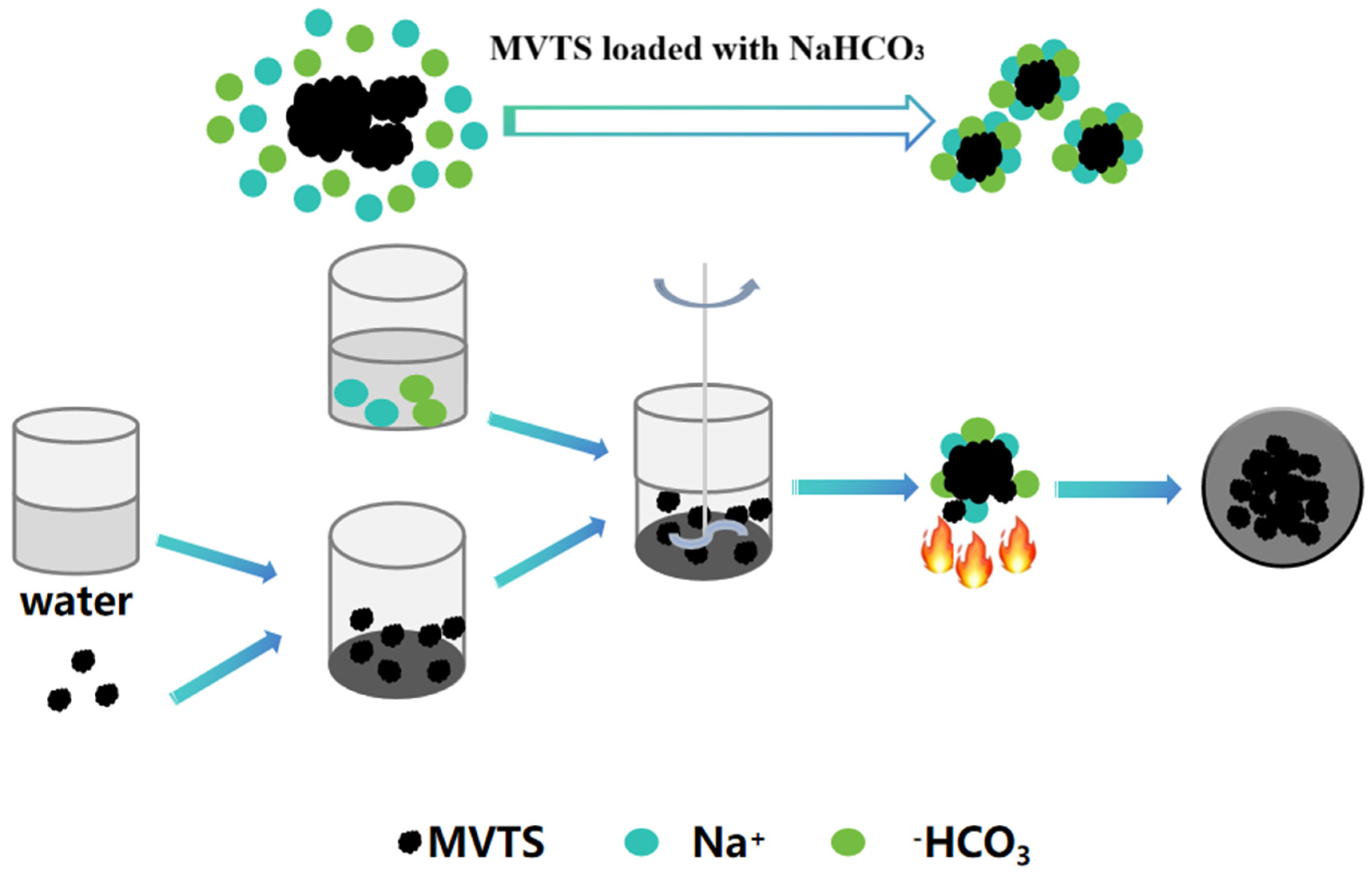
2.2. Preparation of the Composite Powder Explosion Suppressant
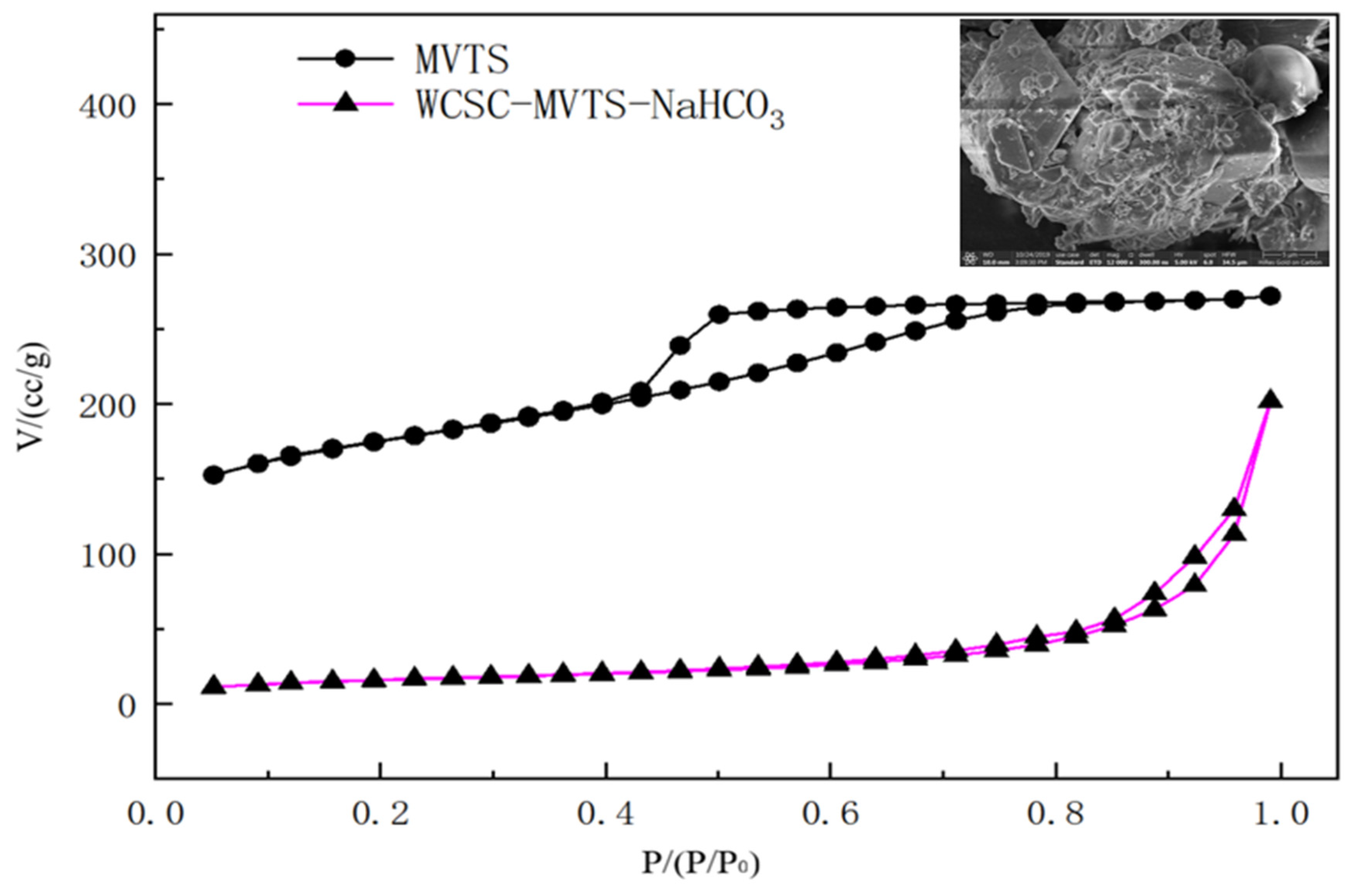
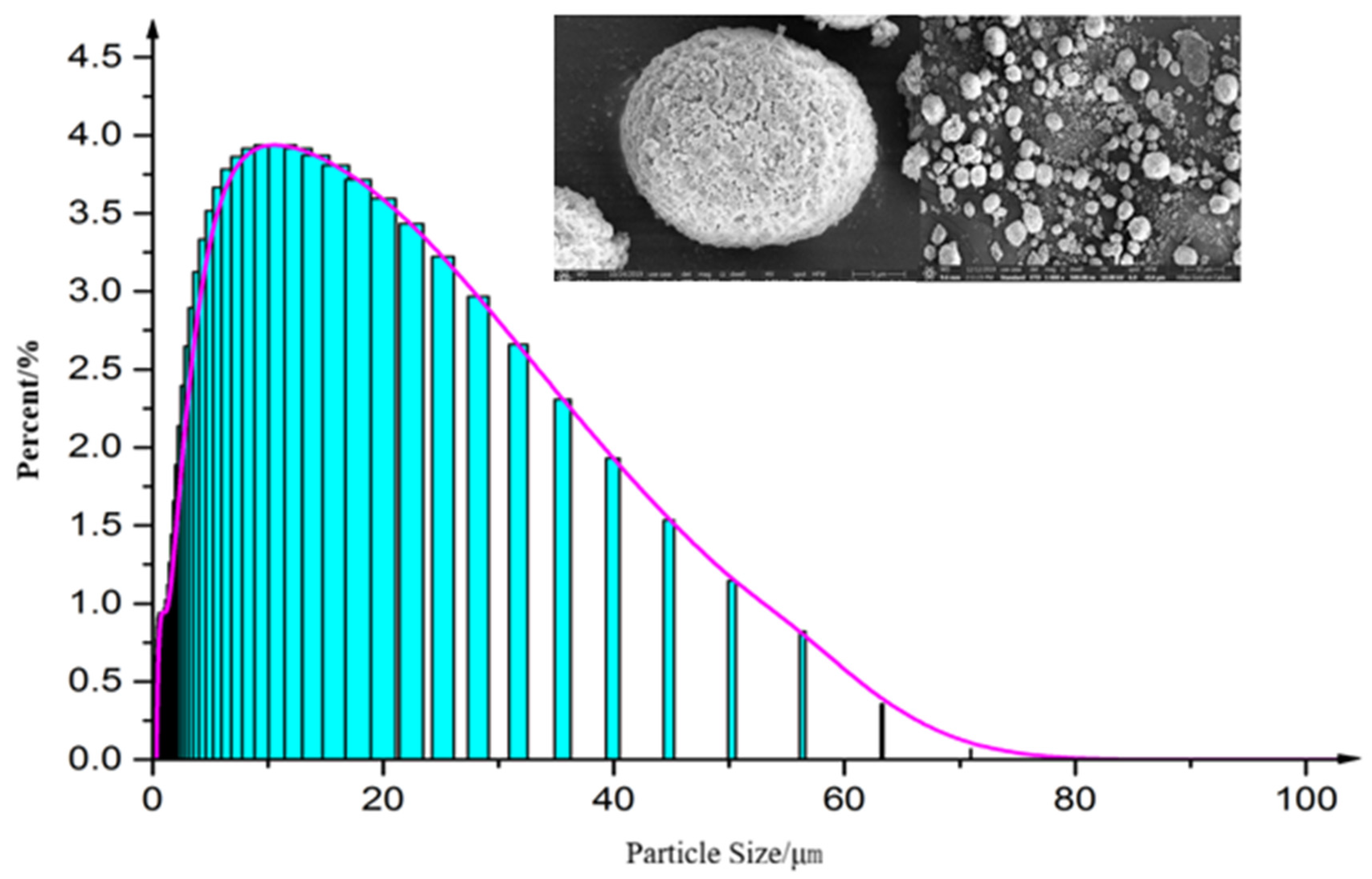
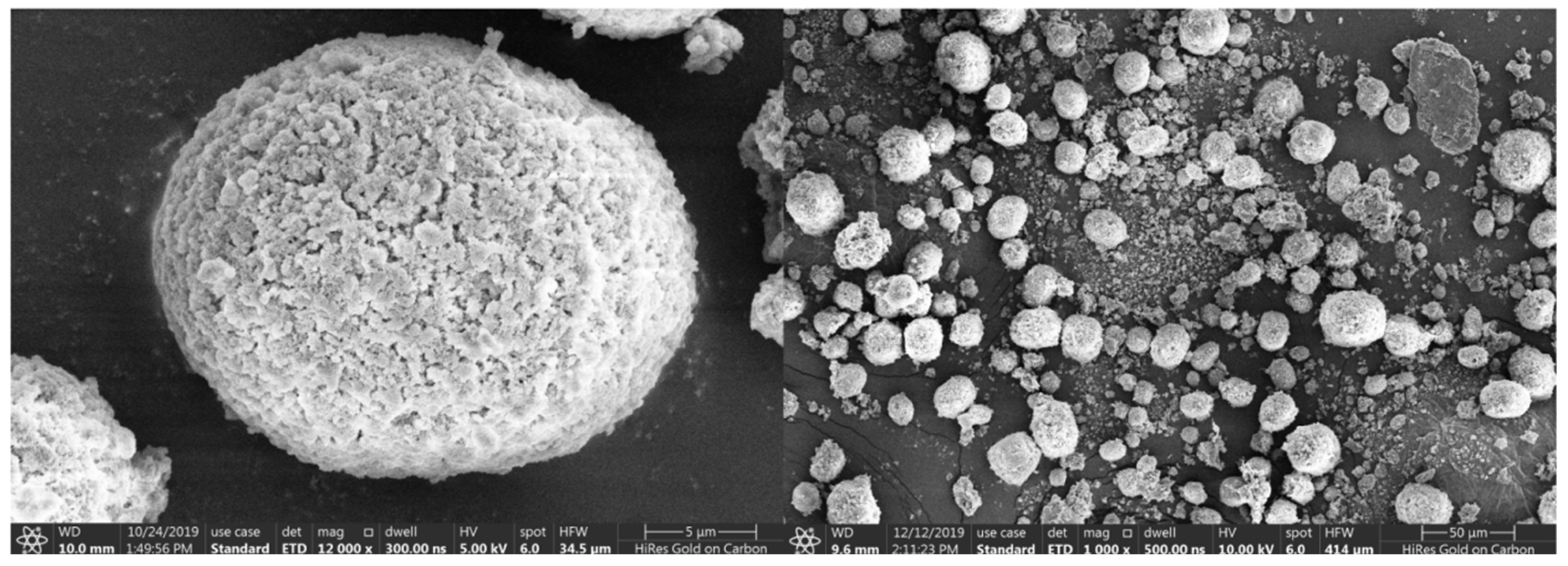
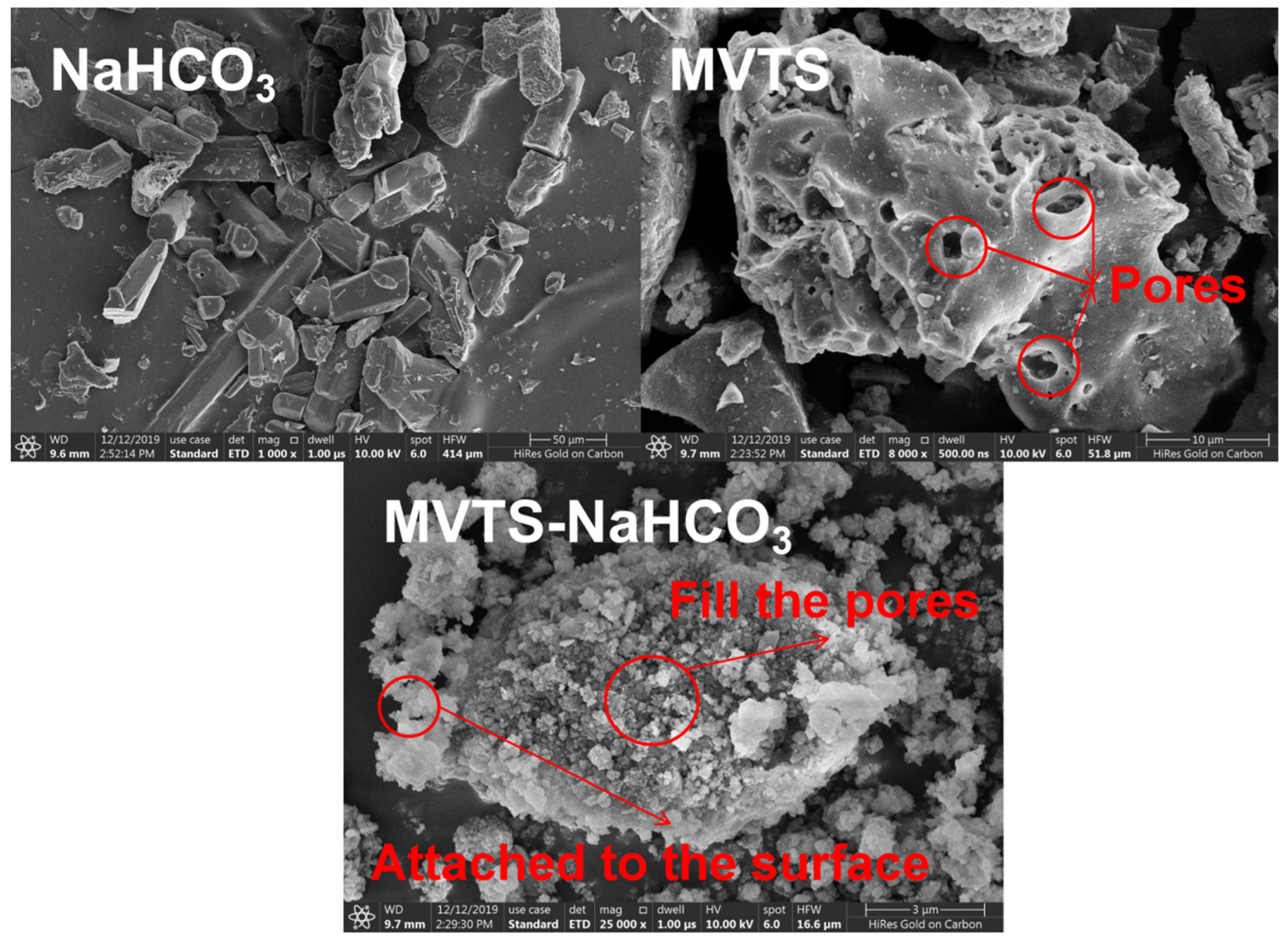
2.3. Microstructural Analysis of MVTS–NaHCO3 Composite Powder Explosion Suppressant
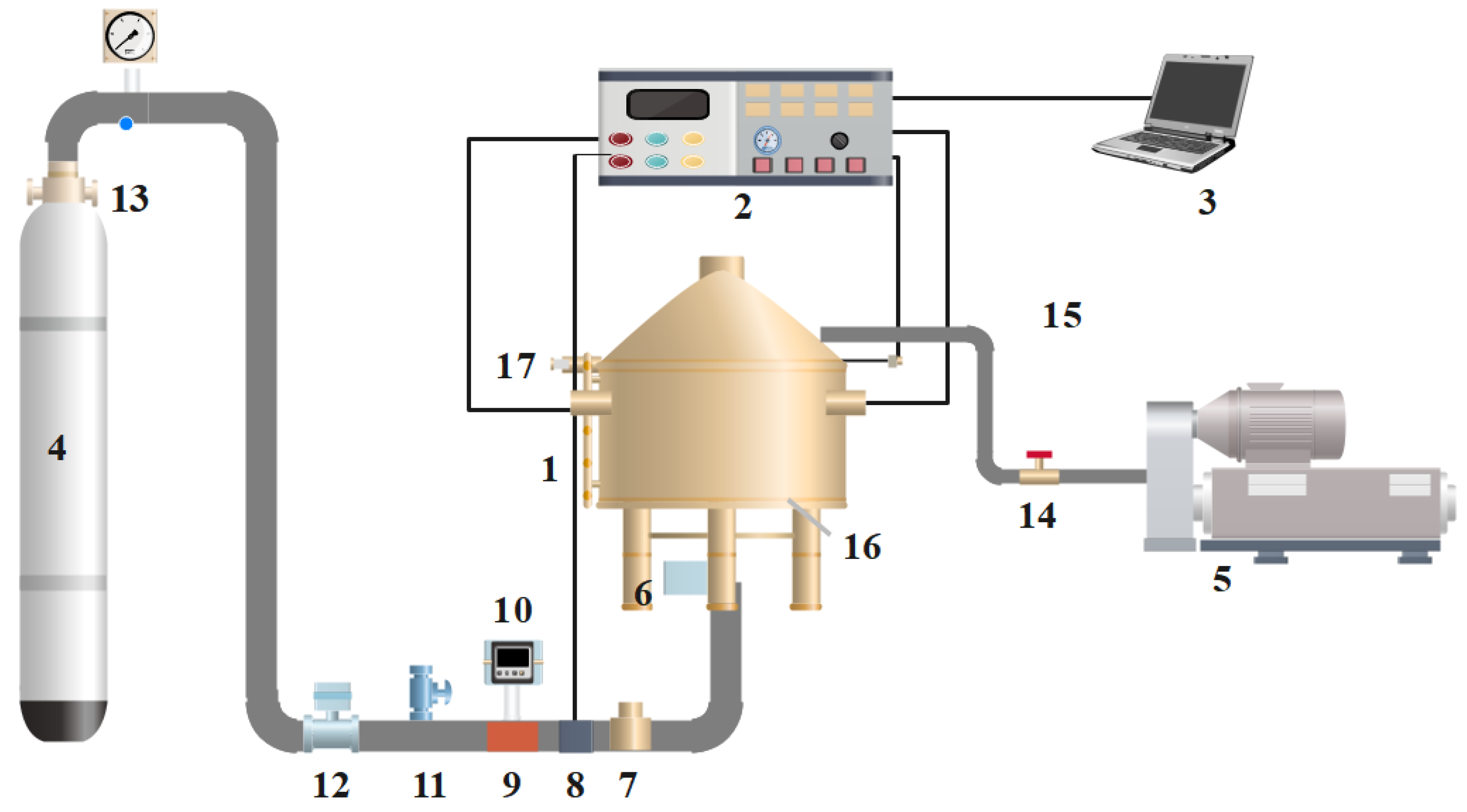
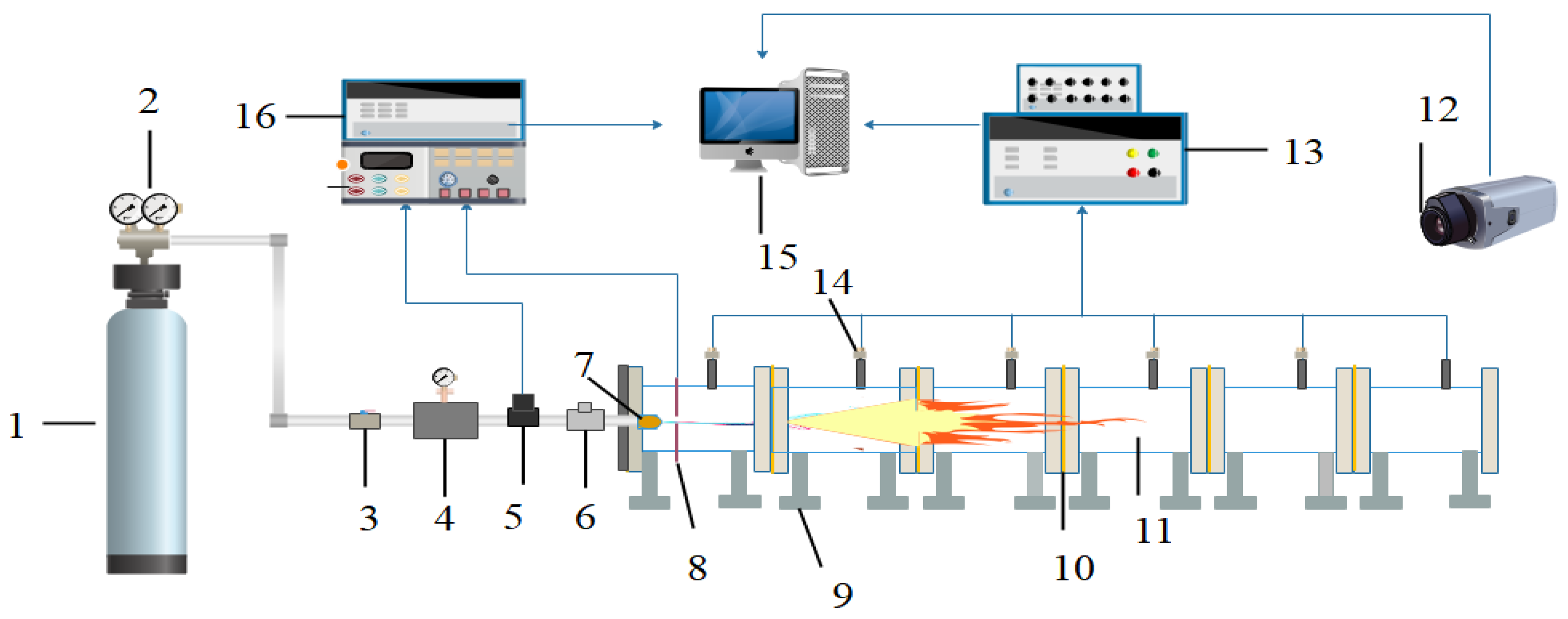
2.4. Explosion Suppression Experiment of MVTS-NaHCO3 Composite Powder
3. Result and Discussion
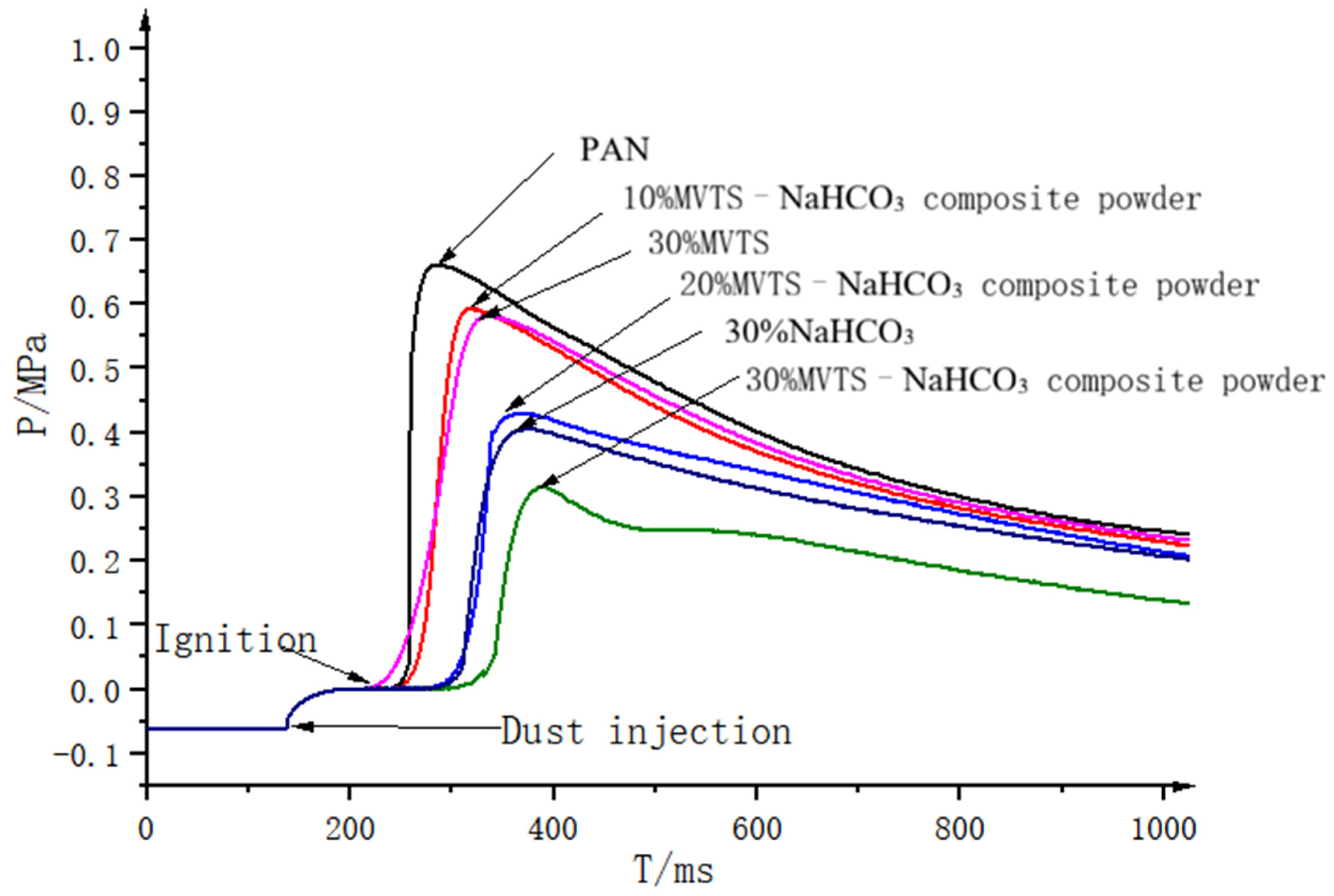
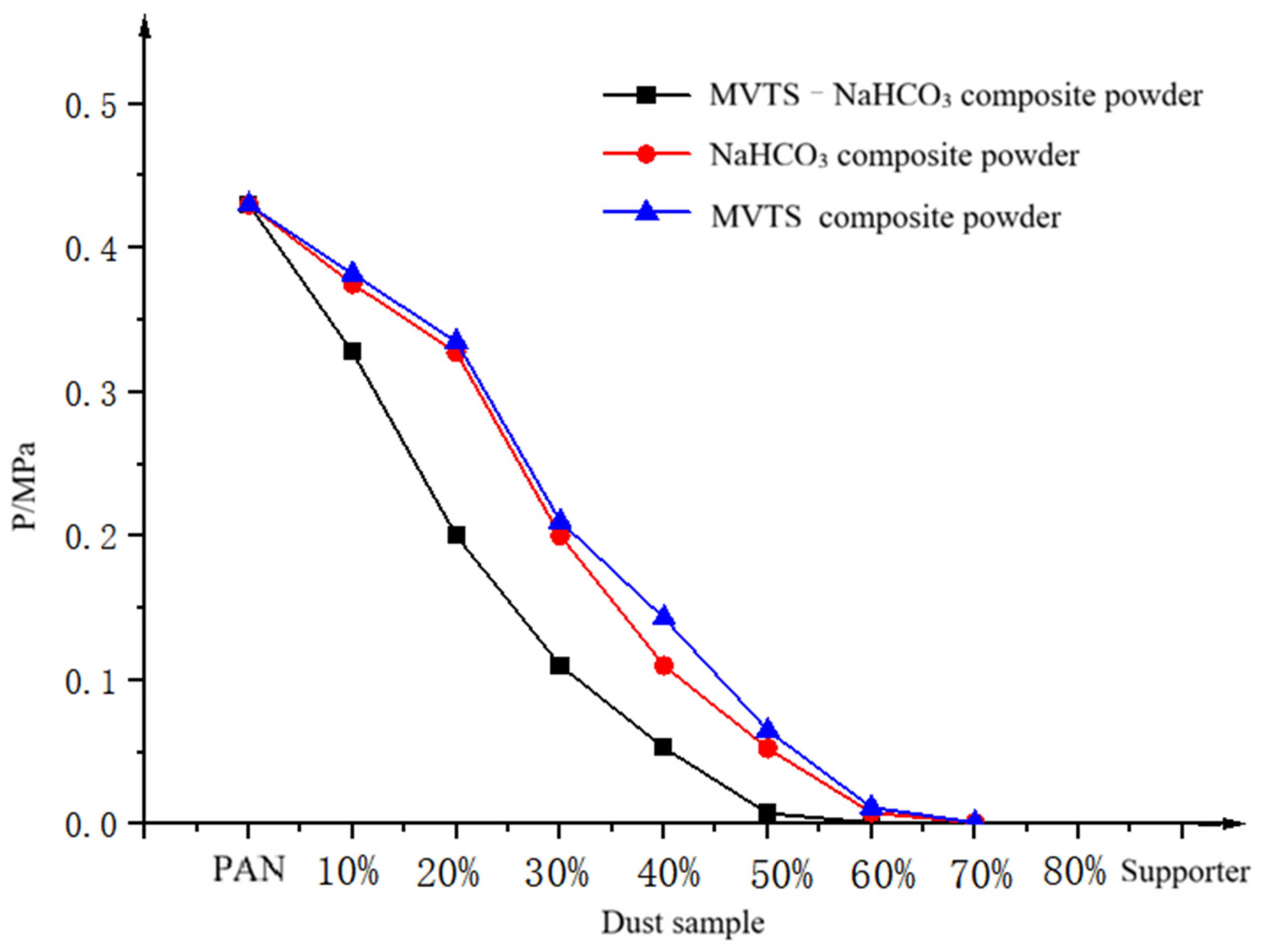
3.1. Suppression of PAN Dust Explosion Pressure in a Confined 20 L Vessel
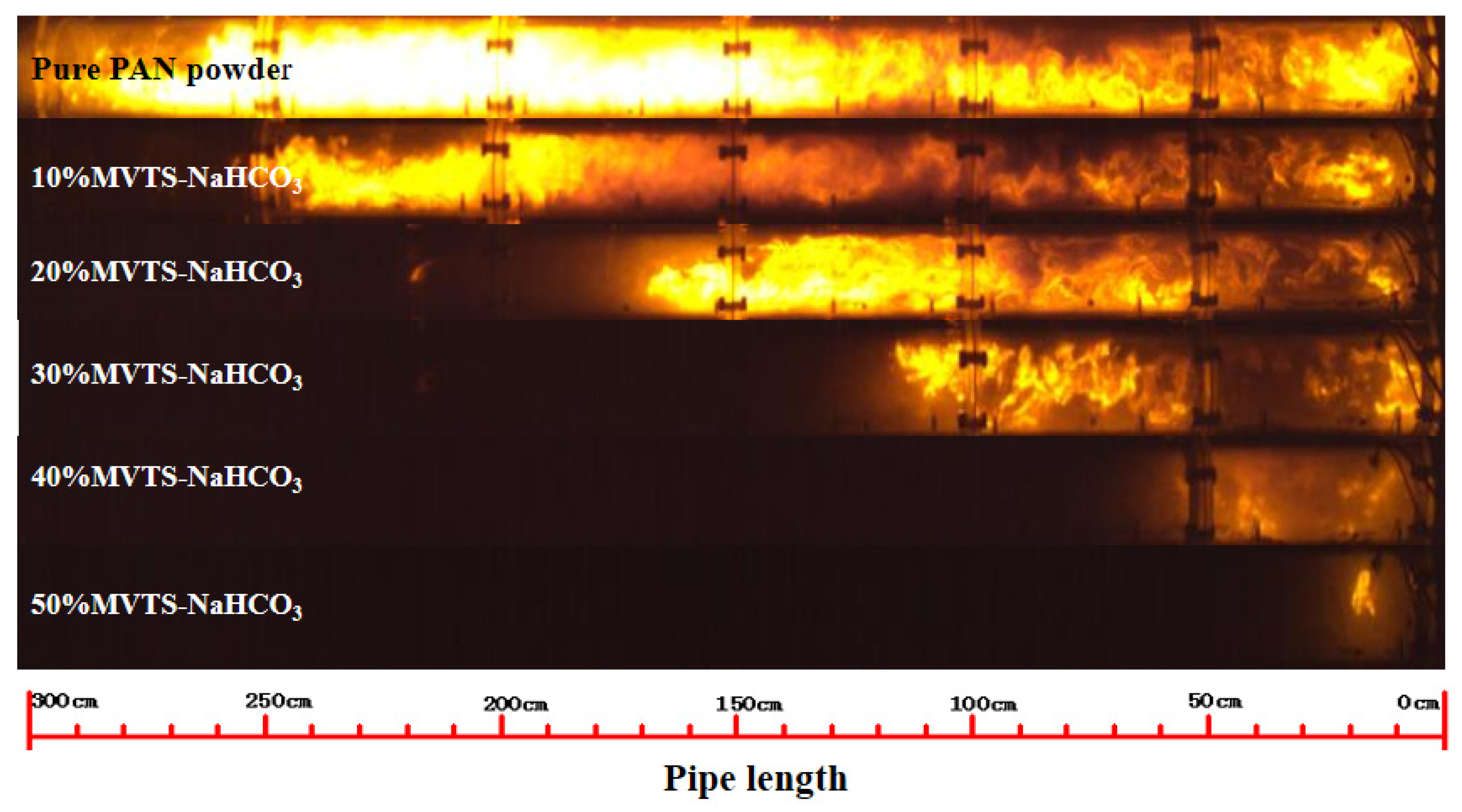
3.2. Suppression of PAN Dust Explosion Propagation in a Semi-Open Pipeline
3.3. Analysis of Gaseous and Solid Explosion Products
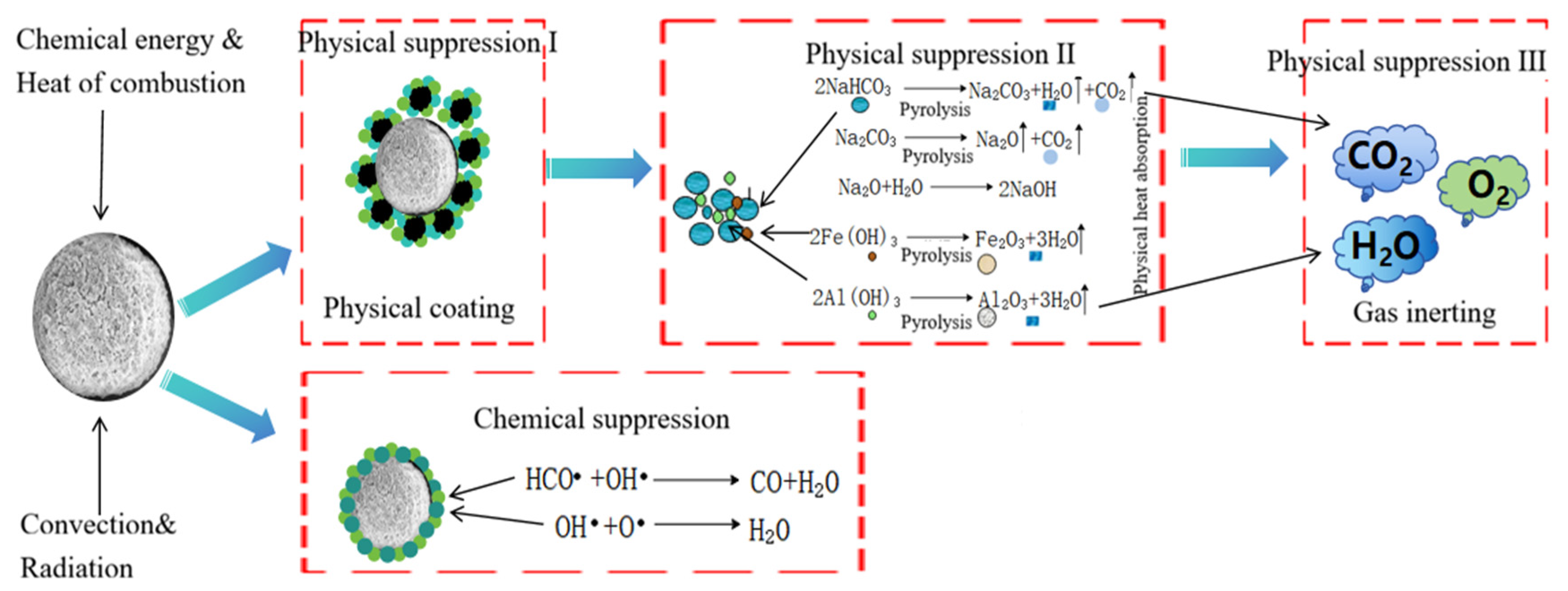
3.4. Suppression Mechanism of MVTS–NaHCO3 Composite Powder on PAN Dust Explosion
4. Conclusions
- (1)
- MVTS-NaHCO3 composite powder has a significant inhibitory effect on PAN dust explosions. In a 20 L closed container, adding 30% of the composite powder can achieve effective suppression, reducing the maximum explosion pressure by 53.2%. In a semi-open transparent pipeline, adding 50% of the composite powder achieves complete suppression, and a 40% addition can reduce the maximum explosion pressure by 82.6%.
- (2)
- The porous structure of MVTS enhances the dispersion of the inhibitor, while the endothermic decomposition of NaHCO3 (100 kJ/mol) releases CO2 and H2O, diluting the oxygen concentration.
- (3)
- In terms of chemical inhibition mechanisms, the hydroxyl groups on the surface of MVTS combine with NaHCO3 to slow its decomposition, while the thermal decomposition of metal hydroxides such as Al(OH)3 produces Al2O3, which can effectively adsorb and quench key radicals (such as ·OH and ·H) in the combustion chain reaction, interrupting the propagation of the reaction.
Author Contributions
Funding
Data Availability Statement
Acknowledgments
Conflicts of Interest
References
- Chen, M.; Wang, K.; Guo, H.; Yuan, Y. Human factors of fire and explosion accidents in petrochemical enterprises. Process Saf. Prog. 2019, 38, e12043. [Google Scholar] [CrossRef] [Scilit]
- Guhathakurta, S.; Houim, R.W. Impact of particle diameter and thermal radiation on the explosion of dust layers. Proc. Combust. Inst. 2023, 39, 2905–2914. [Google Scholar] [CrossRef] [Scilit]
- Ge, J.; Zhang, Y.; Xu, K.; Li, J.; Yao, X.; Wu, C.; Li, S.; Yan, F.; Zhang, J.; Xu, Q. A new accident causation theory based on systems thinking and its systemic accident analysis method of work systems. Process Saf. Environ. Prot. 2022, 158, 644–660. [Google Scholar] [CrossRef] [Scilit]
- Ma, H.; Zhang, Y.; Zhang, Y.; Liu, B.; Zhu, D.; Xu, K.; Yao, Y.; Wang, J.; Hao, T.; Li, J.; et al. Study on the explosion characteristics of alcohol vapor cloud-feed powder dust cloud mixture during the deep processing of waste mash. Case Stud. Therm. Eng. 2025, 73, 106538. [Google Scholar] [CrossRef] [Scilit]
- Liu, B.; Xu, K.; Zhang, Y.; Ge, J. Powder Explosion Inhibitor Prepared from Waste Incinerator Slag: Applied to Explosion Suppression of Oil Shale Dust Explosion. Appl. Sci. 2022, 12, 1034. [Google Scholar] [CrossRef] [Scilit]
- Li, J.; Xu, K.; Yao, X.; Chen, S. Prediction and optimization of syngas production from steam gasification: Numerical study of operating conditions and biomass composition. Energy Convers. Manag. 2021, 236, 114077. [Google Scholar] [CrossRef] [Scilit]
- Wang, J.; Meng, X.; Yan, K.; Chen, J. Suppression of Aluminum Dust Explosion by Ca(H2PO4)2/RM Composite Powder with Core–Shell Structure: Effect and Mechanism. Processes 2019, 7, 761. [Google Scholar] [CrossRef] [Scilit]
- Wang, X.; Zhang, Y.; Liu, B.; Liang, P.; Zhang, Y. Effectiveness and mechanism of carbamide/fly ash cenosphere with bilayer spherical shell structure as explosion suppressant of coal dust. J. Hazard. Mater. 2019, 365, 555–564. [Google Scholar] [CrossRef] [Scilit] [PubMed]
- Wang, Y.; Cheng, Y.S.; Yu, M.G.; Li, Y.; Cao, J.L.; Zheng, L.G.; Yi, H.W. Methane explosion suppression characteristics based on the NaHCO3/red-mud composite powders with core-shell structure. J. Hazard. Mater. 2017, 335, 84–91. [Google Scholar] [CrossRef] [Scilit] [PubMed]
- Abuswer, M.; Amyotte, P.; Khan, F.; Imtiaz, S. Retrospective risk analysis and controls for Semabla grain storage hybrid mixture explosion. Process Saf. Environ. Prot. 2016, 100, 49–64. [Google Scholar] [CrossRef] [Scilit]
- Addai, E.K.; Gabel, D.; Krause, U. Lower Explosion Limit/Minimum Explosible Concentration Testing for Hybrid Mixtures in the Godbert-Greenwald Furnace. Process Saf. Prog. 2017, 36, 81–94. [Google Scholar] [CrossRef] [Scilit]
- Addai, E.K.; Gabel, D.; Ali, H.; Krause, U. Minimum Ignition Temperature of Dusts, Gases, and Solvents Hybrid Mixtures. Combust. Sci. Technol. 2016, 188, 1693–1704. [Google Scholar] [CrossRef] [Scilit]
- Yan, K.; Meng, X.; Wang, Z.; Xiao, Q.; Ma, X.; Cui, Z. Inhibition of Aluminum Powder Explosion by a NaHCO3/Kaolin Composite Powder Suppressant. Combust. Sci. Technol. 2022, 194, 815–831. [Google Scholar] [CrossRef] [Scilit]
- Chao, C.Y.; Tsai, H.W.; Pan, K.L.; Hsieh, C.W. On the microexplosion mechanisms of burning droplets blended with biodiesel and alcohol. Combust. Flame 2019, 205, 397–406. [Google Scholar] [CrossRef] [Scilit]
- Liu, B.; Xu, K.; Zhang, Y.; Ge, J. Gas-liquid dual phase inhibition method for explosion accident of wet Al dust collection system based on KH2PO4. Adv. Powder Technol. 2022, 33, 103536. [Google Scholar] [CrossRef] [Scilit]
- Schweizer, C.; Mashuga, C.V.; Kulatilaka, W.D. Investigation of niacin and aluminum dust cloud ignition characteristics in an explosion hazard testing device using high-speed imaging. Process Saf. Environ. Prot. 2022, 166, 320–327. [Google Scholar] [CrossRef] [Scilit]
- Castellanos, D.; Carreto, V.; Skjold, T.; Yuan, S.; Chaudhari, P.; Mannan, M.S.; Mashuga, C. Construction of a 36 L dust explosion apparatus and turbulence flow field comparison with a standard 20 L dust explosion vessel. J. Loss Prev. Process Ind. 2018, 55, 113–123. [Google Scholar] [CrossRef] [Scilit]




| Sample | TiO2 | FeO | Fe2O3 | Al2O3 | SiO2 | CaO | MgO | V2O5 |
|---|---|---|---|---|---|---|---|---|
| Slag | 28.3 | 10.1 | 20.5 | 17.2 | 8.5 | 4.1 | 2.8 | 1.2 |
| Sample | Specific Area (m2/g) | Pore Capacity (cm3/g) |
|---|---|---|
| MVTS | 567.6 | 0.417 |
| MVTS–NaHCO3 composite powder explosion suppressant | 68.4 | 0.198 |
| Mass Fraction | Mass/g | |||
|---|---|---|---|---|
| PNA | MVTS–NaHCO3 | MVTS | NaHCO3 | |
| 0 | 10.0 | 0 | 0 | 0 |
| 10% | 10.0 | 1.0 | 1.0 | 1.0 |
| 20% | 10.0 | 2.0 | 2.0 | 2.0 |
| 30% | 10.0 | 3.0 | 3.0 | 3.0 |
| 40% | 10.0 | 4.0 | 4.0 | 4.0 |
| 50% | 10.0 | 5.0 | 5.0 | 5.0 |
| 60% | 10.0 | 6.0 | 6.0 | 6.0 |
| 70% | 10.0 | 7.0 | 7.0 | 7.0 |
| 80% | 10.0 | 8.0 | 8.0 | 8.0 |
| 90% | 10.0 | 9.0 | 9.0 | 9.0 |
| 100% | 10.0 | 10.0 | 10.0 | 10.0 |
| Mass Fraction | Mass/g | |||
|---|---|---|---|---|
| PNA | MVTS–NaHCO3 | MVTS | NaHCO3 | |
| 0 | 9.0 | 0 | 0 | 0 |
| 10% | 9.0 | 0.9 | 0.9 | 0.9 |
| 20% | 9.0 | 1.8 | 1.8 | 1.8 |
| 30% | 9.0 | 2.7 | 2.7 | 2.7 |
| 40% | 9.0 | 3.6 | 3.6 | 3.6 |
| 50% | 9.0 | 4.5 | 4.5 | 4.5 |
| 60% | 9.0 | 5.4 | 5.4 | 5.4 |
| 70% | 9.0 | 6.3 | 6.3 | 6.3 |
| 80% | 9.0 | 7.2 | 7.2 | 7.2 |
| 90% | 9.0 | 8.1 | 8.1 | 8.1 |
| 100% | 9.0 | 9.0 | 9.0 | 9.0 |
| GCMS analysis | Sample | Relative Content | |||||||
| CO2 | NO2 | CO | SO2 | ||||||
| 100% PAN | 63.5 | 7.2 | 8.4 | 0.23 | |||||
| 20% MVTS–NaHCO3 + PAN | 78.7 | 1.4 | 8.58 | 0.11 | |||||
| XRF analysis | SiO2 | Fe2O3 | Al2O3 | CaO | Na2O | TiO2 | MgO | MnO | |
| 20% MVTS–NaHCO3 + PAN (pre–combustion) | 66.5 | 16.1 | 10.4 | 3.82 | 1.56 | 1.47 | 0.09 | 0.08 | |
| 20%MVTS–NaHCO3+PAN (post-combustion) | 66.5 | 17.3 | 13.4 | 1.35 | 1.31 | 1.5 | 0.01 | 0.05 | |
Disclaimer/Publisher’s Note: The statements, opinions and data contained in all publications are solely those of the individual author(s) and contributor(s) and not of MDPI and/or the editor(s). MDPI and/or the editor(s) disclaim responsibility for any injury to people or property resulting from any ideas, methods, instructions or products referred to in the content. |
© 2026 by the authors. Licensee MDPI, Basel, Switzerland. This article is an open access article distributed under the terms and conditions of the Creative Commons Attribution (CC BY) license.
Share and Cite
Zhu, D.; Wang, L.; Liu, B.; Zhang, Y. Study on the Effect of Modified Vanadium–Titanium Slag Explosion Suppressant on the Explosion Characteristics of Polyacrylonitrile Dust. Fire 2026, 9, 153. https://doi.org/10.3390/fire9040153
Zhu D, Wang L, Liu B, Zhang Y. Study on the Effect of Modified Vanadium–Titanium Slag Explosion Suppressant on the Explosion Characteristics of Polyacrylonitrile Dust. Fire. 2026; 9(4):153. https://doi.org/10.3390/fire9040153
Chicago/Turabian StyleZhu, Daoyong, Long Wang, Bo Liu, and Yuyuan Zhang. 2026. "Study on the Effect of Modified Vanadium–Titanium Slag Explosion Suppressant on the Explosion Characteristics of Polyacrylonitrile Dust" Fire 9, no. 4: 153. https://doi.org/10.3390/fire9040153
APA StyleZhu, D., Wang, L., Liu, B., & Zhang, Y. (2026). Study on the Effect of Modified Vanadium–Titanium Slag Explosion Suppressant on the Explosion Characteristics of Polyacrylonitrile Dust. Fire, 9(4), 153. https://doi.org/10.3390/fire9040153