Article

Monitoring Plant Biodiversity and Indicator Species Across Post-Fire Rehabilitation Structures in Greece: A Two-Year Study


by
Alexandra D. Solomou
*,
Nikolaos Proutsos
,
Panagiotis Michopoulos
and
Athanassios Bourletsikas
Institute of Mediterranean Forest Ecosystems (IMFE), ELGO-DIMITRA, Terma Alkmanos, Ilisia, 11528 Athens, Greece
*
Author to whom correspondence should be addressed.
Fire 2026, 9(4), 152; https://doi.org/10.3390/fire9040152
Submission received: 26 February 2026 / Revised: 1 April 2026 / Accepted: 4 April 2026 / Published: 8 April 2026

Abstract

Wooden, nature-based barrier structures are widely implemented after wildfire in Mediterranean forests to reduce runoff connectivity and trap sediment, yet their ecological footprint on early plant recovery remains poorly quantified in Greece. We assessed two-year vascular plant recovery in forest landscapes burned during the 2021 wildfire season (Parnitha, Attica; Mavrolimni, Corinthia/Peloponnese) using repeated field surveys in 2022 and 2023. Sixteen permanent plots were established within operational rehabilitation works and assigned to the dominant structure types: wattles (brush/branch piles), contour-oriented hillslope log barriers, and channel log dams. In each year, vascular plant composition and recovery endpoints (species richness and diversity indices, density, cover, and aboveground biomass) were quantified using standardized quadrat sampling. Vegetation cover and biomass increased strongly from 2022 to 2023 at both sites, indicating rapid early reassembly. Against this dominant year effect, structure type was associated with pronounced biodiversity and compositional differences, most clearly in Parnitha where log barriers exhibited markedly reduced diversity in 2022 and community turnover patterns differed among structures. Plot-level PERMANOVA on Bray–Curtis dissimilarities calculated from log(x + 1)-transformed abundances did not detect a statistically significant structure type effect in either year (p > 0.05), whereas descriptive Bray–Curtis heatmaps suggested compositional contrasts among structure type × year combinations. Indicator–species analysis further identified a limited set of taxa associated with specific structures, suggesting provisional structure-linked microsite filtering during early assembly. By quantifying community composition and indicator taxa alongside structural recovery, this study provides operational-scale evidence that common wooden post-fire measures may be associated with early biodiversity signals in the first two years after fire, although these patterns should be regarded as provisional given the short monitoring period and limited replication. Incorporating these signals into post-fire land management can improve intervention design and placement, aligning risk reduction with biodiversity recovery in Mediterranean landscapes.

1. Introduction

Wildfire regimes across the Mediterranean Basin have shifted markedly over recent decades, with a growing tendency toward large, high-impact events driven by warmer and drier conditions, longer fire seasons, and accumulated fuels in many landscapes. Drought- and heat-amplified fire weather increases the probability of large fires and extreme behavior, pushing many systems from predominantly fuel-limited toward increasingly drought-driven regimes. Contemporary fire statistics and annual assessments from the European Forest Fire Information System (EFFIS/Copernicus) document the scale and frequency of recent fire seasons and provide a consistent reference framework for comparing events among years and countries [1].
In addition to the direct loss of vegetation, a serious fire can trigger cascading hy-drological and geomorphological consequences. Meanwhile, the burning of underbrush and canopy cover reduces interception and surface roughness. Changes in the structure and hydrophobicity of soil due to fire can also greatly depress infiltration while promoting shallow land flow. These processes increase the likelihood of post-fire first flushes, gullies, landslides and sediment redistribution, often concentrated in those initial rain periods after the fire. Because these hazards pose threats to downstream infrastructure and water supplies that can endanger human life, reducing rapid erosion in order to reduce flood risks is a major aspect of post-fire management [2].
Post-fire rehabilitation commonly includes “emergency” or early-stage stabilization measures on hillslopes and in channels that aim to slow runoff, increase infiltration, and retain sediment. Among these, barrier type treatments such as contour-felled log erosion barriers on hillslopes, woody check dams/log dams in channels, and wattles/brush structures are widely implemented because they can be deployed relatively quickly using locally available burned wood or woody debris [3,4]. However, the performance of these measures is known to be context-dependent (e.g., burn severity, rainfall regime, slope, soil properties, installation quality) [4,5]. A systematic review and meta-analysis showed that barrier treatments and cover-based treatments generally reduce post-fire soil erosion, while runoff reductions are more consistently associated with cover and barrier approaches than with other intervention types; importantly, the same synthesis highlighted strong geographic bias in the evidence base and the need for broader evaluation outside a few well-studied regions [4]. Field-scale evaluations of contour-felled log erosion barriers also indicate that effectiveness varies and that maintenance and installation details can strongly influence outcomes [5].
A critical issue for Mediterranean post-fire decision-making is that “effectiveness” should not be defined solely by sediment retention or short-term hydrology. Vegetation recovery is central both to long-term slope stabilization and to biodiversity conservation. In fire-prone ecosystems, post-fire community assembly reflects the balance between resprouting and seeding strategies, pre-fire legacies, and environmental filtering, and it can be sensitive to post-fire interventions that modify microsites, resource availability, or disturbance regimes. Evaluating restoration success therefore benefits from combining structural attributes (e.g., cover/biomass), taxonomic diversity (richness and diversity indices), and compositional turnover, rather than relying on single indicators [6,7,8,9,10].
From the standpoint of plant community ecology, post-fire community recovery transcends mere plant re-establishment. It constitutes a process of community assembly, influenced by the enduring impacts of the disturbance, the mechanisms of plant regeneration, and the environmental determinants governing plant survival [11]. In Mediterranean ecosystems, early post-fire trajectories are often determined by the balance between resprouters and obligate seeders, the persistence of soil and canopy seed banks, and the extent to which recruitment is constrained by dispersal limitation, microsite availability, drought stress, and post-fire soil conditions [12,13,14,15]. Recovery therefore may follow different trajectories even within the same burned landscape, depending on how local conditions filter establishment and survival. In this sense, resilience is expressed not only as rapid increases in cover or biomass, but also as the capacity of plant communities to reassemble in ways that maintain or redirect biodiversity patterns and successional pathways [14,16]. Post-fire rehabilitation structures may interact with these processes by altering surface roughness, sediment retention, shade, litter accumulation, and near-ground moisture conditions, thereby influencing which taxa establish successfully during the first years after fire [3,4,17,18]. This ecological framework supports the use of multi-metric vegetation assessment, because structural recovery alone may mask important differences in diversity, composition, and early recovery trajectories [6,7,8,9,10].
Recent syntheses on post-fire rehabilitation in Mediterranean forests underline substantial heterogeneity in the indicators used to judge outcomes, persistent shortages of long-term monitoring, and limited integration of ecological metrics alongside physical/engineering endpoints [3,4]. In parallel, restoration ecology frameworks emphasize that robust success assessment should be explicitly objective-led and multidimensional, combining structural attributes, diversity, and compositional change measured through time, rather than relying on single proxies [6,7,8,9,10]. Despite these recommendations, much of the applied evidence base for post-fire treatments still centers on soil properties, runoff and erosion responses [19,20], while biodiversity-oriented vegetation recovery is less consistently evaluated, and the geographic distribution of field evidence remains uneven across Mediterranean regions [3,4].
This evidence gap is particularly relevant for Greece, where post-fire rehabilitation is frequently implemented at operational scales using locally available burned wood in nature-based barrier structures (e.g., wattles/brush structures, contour-oriented log barriers on hillslopes, and log dams in channels). However, there is limited comparative, repeated (multi-year) field evidence from Greek Mediterranean forests on how specific wooden structure types relate to early vascular plant recovery trajectories, including richness, cover/biomass, and community composition [3,4,5,6,7,8,9,10]. As a result, post-fire decision-making that aims to jointly address hazard mitigation and biodiversity recovery often proceeds with incomplete ecological performance information for the measures most commonly deployed.
In this study, we address this gap by evaluating early vascular plant recovery in fire-affected forest landscapes in Greece that burned during the 2021 wildfire season, using repeated field surveys conducted in summers 2022 and 2023. We focus on areas including Parnitha (Attica) and Mavrolimni (Corinthia/Peloponnese), representing contrasting climatic settings and land use mosaics within the Mediterranean Basin. Following operational post-fire rehabilitation implemented by the National Forest Service, a network of experimental plots was established and assigned to dominant wooden, nature-based structure types used locally wattles, contour-oriented log barriers on hillslopes, and log dams in channels intended to slow runoff, trap sediment, and reduce erosion [3,4,5]. Within these plots, vascular plant composition and key recovery endpoints (species richness, density, cover, biomass) were quantified using quadrat sampling during the main growing season in both monitoring years.
Within this ecological framework, this study aimed to evaluate early post-fire responses of vascular vegetation across the dominant wooden rehabilitation structure types used operationally in Greek burned forests. Specifically, we aimed to (i) measure short-term variations in vascular plant diversity, vegetation cover, and biomass across different structure types over two post-fire years; (ii) assess shifts in plant community composition among structure types and years using dissimilarity analyses; and (iii) identify taxa linked to particular structure types that could serve as indicators of early post-fire recovery pathways. We hypothesized that (H1) vegetation cover and biomass would increase strongly from 2022 to 2023 across all structure types, reflecting rapid early recovery; (H2) diversity patterns and community composition would differ among structure types because the rehabilitation structures act as microsite filters influencing recruitment and early community assembly; and (H3) particular taxa would show non-random associations with specific structure types, reflecting contrasting regeneration strategies and early niche differentiation after fire. By combining structural, diversity, compositional, and indicator–species metrics, the study aims to strengthen the evidence base for post-fire management in Greek Mediterranean forests and to support decision-making that jointly considers hazard mitigation and biodiversity recovery.

2. Materials and Methods

2.1. Study Sites

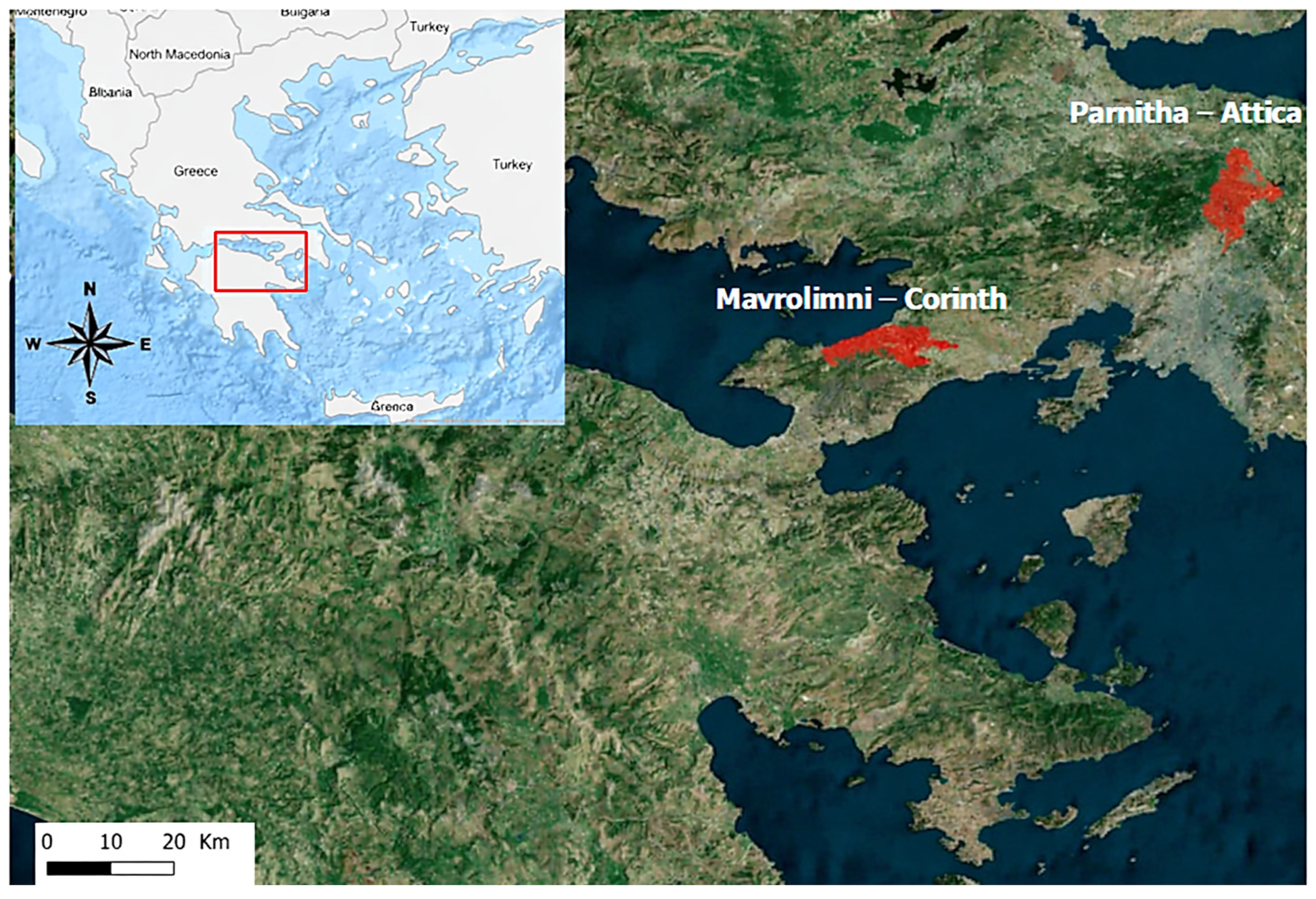
Field surveys were conducted during the summers of 2022 and 2023 in two fire-affected forest landscapes in Greece that burned during the 2021 wildfire season. The selected study areas represent contrasting climatic settings and land use mosaics within the Mediterranean Basin, and include (i) Parnitha (Attica) and (ii) Mavrolimni (Corinthia/Peloponnese) (Figure 1). Site locations are provided with geographic coordinates and elevation, and the timing and extent of the 2021 fire events are documented in official fire-recording platforms and associated reporting sources (Table 1) [10].
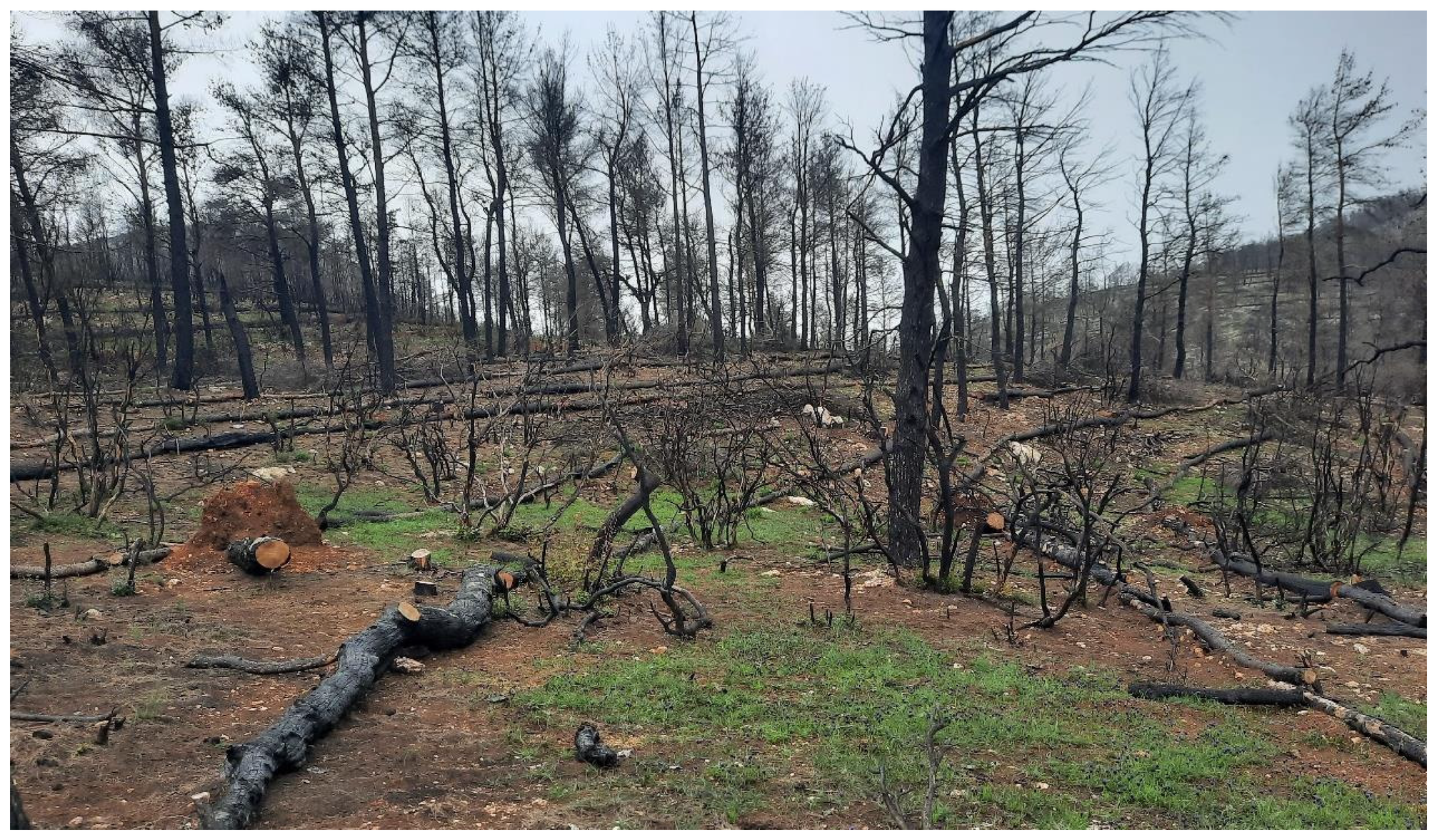
Parnitha (Attica) is a fire-affected landscape situated at ~621 m a.s.l. (38°10′50″ N, 23°47′57″ E) that was affected by a large wildfire in early August 2021 (≈8000 ha) (Figure 2). Long-term meteorological records from the nearest reference station (Tatoi; HNMS) indicate a semi-arid Mediterranean context, with mean annual temperature around 16 °C and an average annual precipitation near 534 mm, concentrated mainly in winter and autumn, and an extended seasonal dry period. Land cover information (e.g., CORINE categories) indicates that the fire footprint included a mixture of transitional woodland/shrub, mixed forest, agricultural land, and coniferous forest patches [20].
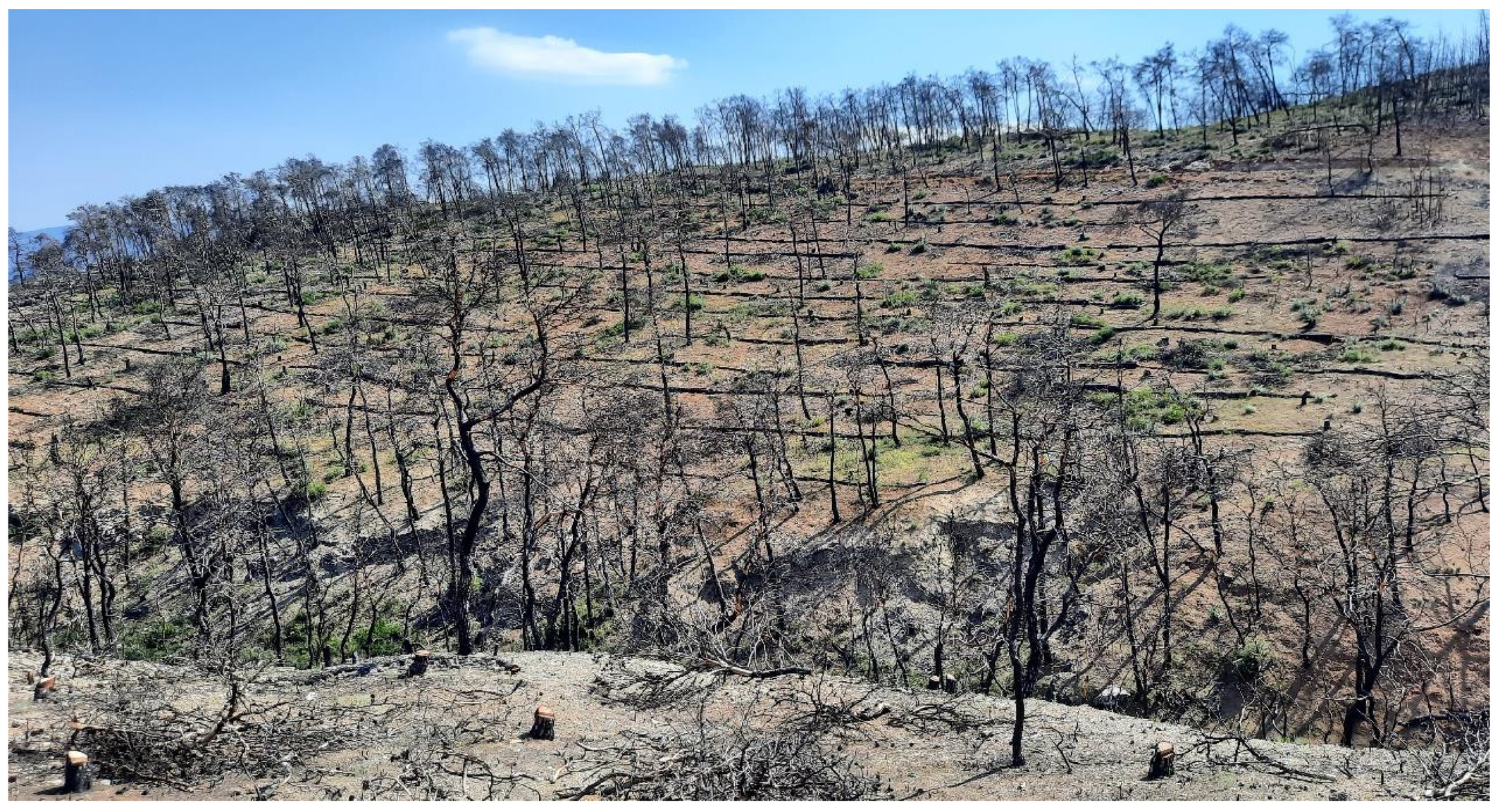
Mavrolimni (Corinthia/Peloponnese; 38°03′24″ N, 23°06′00″ E; ~200 m a.s.l.) also experienced a wildfire in May 2021 that affected several thousand hectares (reported burned area ≈6407 ha), and the burned landscape was largely characterized by conifer forest before the fire (Figure 3). The area falls within a semi-arid climatic regime; historical precipitation records from the nearest long-term station (Corinth; HNMS) indicate comparatively low annual rainfall (~410 mm for 1960–1997), with evidence of a decreasing trend relative to earlier decades [20].
Although plot-level pre-fire vegetation inventories were not available for the present study, the broader pre-fire land cover setting of the two burned landscapes can be inferred from site-level land cover information. In Parnitha, the fire-affected landscape consisted of a mosaic of transitional woodland/shrub, mixed forest, agricultural land, and coniferous forest patches, whereas in Mavrolimni conifer forest represented the dominant pre-fire land cover type. Accordingly, the present study should be interpreted as an assessment of early post-fire vascular vegetation responses across rehabilitation structure types within burned forest landscapes, rather than as a strict before–after comparison against a measured plot-level pre-fire floristic baseline [21].

2.2. Experimental Plots

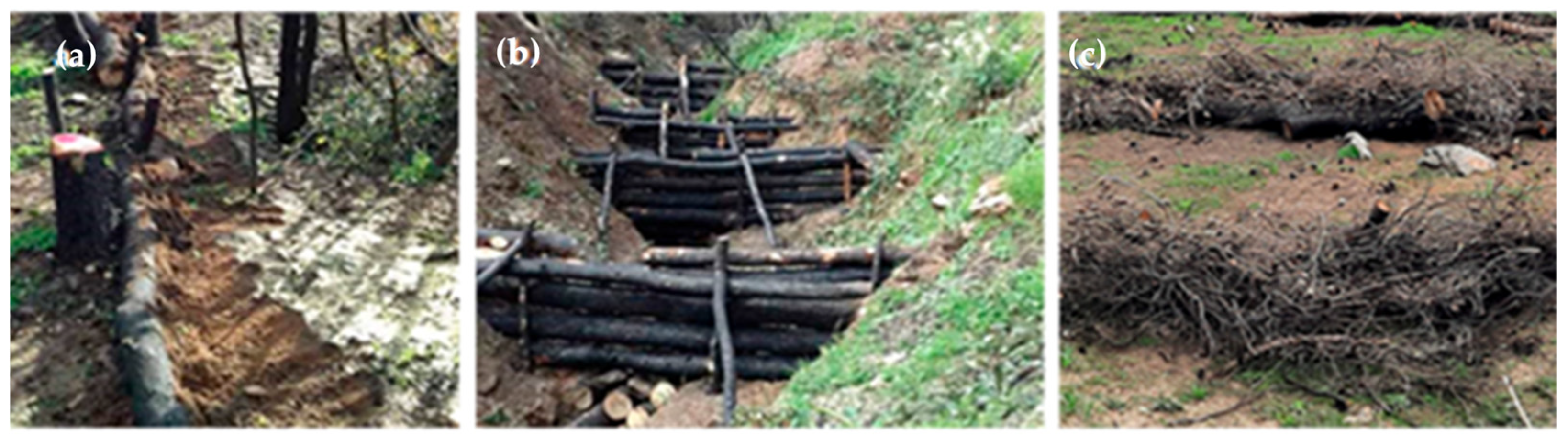
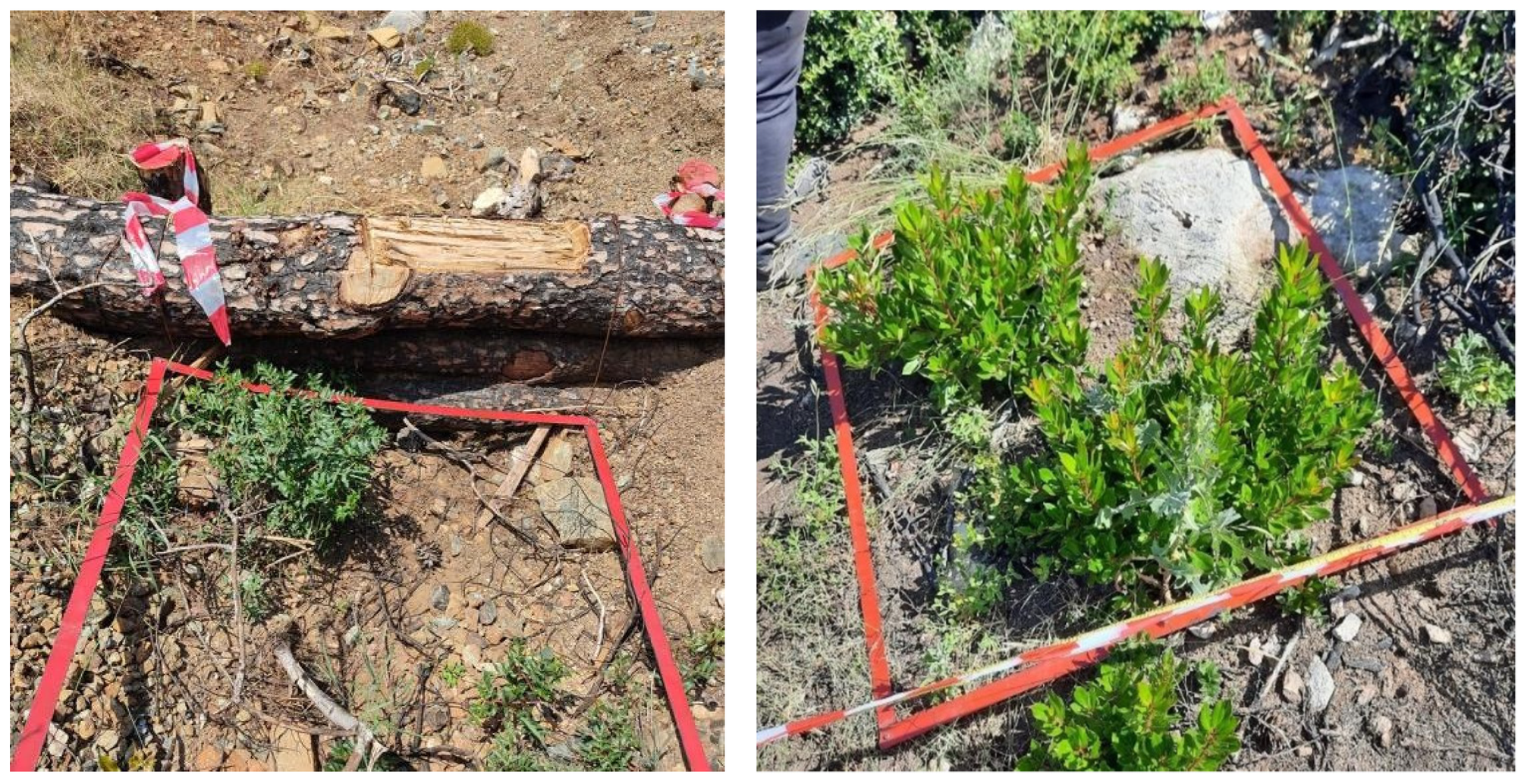
A network of 16 experimental plots was established in summer 2022, following the implementation of post-fire rehabilitation works by the National Forest Service. Plots were distributed across the two study sites (Parnitha: 9 plots; Mavrolimni: 7 plots) and were assigned to the dominant rehabilitation structure installed locally: wattles, log barriers, and log dams. Each plot was defined as the area between two consecutive rehabilitation work units. Because the study was based on operationally implemented rehabilitation works, plot numbers were constrained by field availability and were not fully balanced among structure types and sites. The rehabilitation structures are wooden, nature-based installations designed to slow runoff, retain transported sediments, and reduce erosion. Wattles consist of relatively small branch-pile constructions typically placed on gentler slopes; log barriers are hillslope logs installed roughly along contour to interrupt overland flow; and log dams are channel-crossing structures built with logs or woody debris to attenuate flow and trap sediment (Figure 4) [10].
Because fire severity can influence post-fire flora and vegetation responses, this aspect should be considered when interpreting structure type patterns. In the present study, plots were established within clearly burned sectors where post-fire rehabilitation works had been operationally implemented after the 2021 fires. However, fire severity was not treated as a separately quantified explanatory variable in the present design, and the analyses were not intended to test severity effects explicitly. Therefore, this study does not assume identical fire severity across all plots, and some part of the observed vegetation variation may also reflect residual differences in burn severity among sampling locations [21].

2.3. Vegetation and Soil Sampling and Analysis

Vascular plant composition, species richness, density (individuals m−2), cover (%), and biomass (g m−2) were measured from May to July in both monitoring years (2022 and 2023), using two 1 m × 1 m sub-quadrats within each experimental plot (Figure 5). One sub-quadrat was placed at the center of the eroded zone and the other at the center of the depositional zone of each plot [21,22]. Vegetation surveys were conducted within the same May–July window in both monitoring years in order to maintain a standardized seasonal protocol across all plots and structure types and to allow for consistent species recording together with destructive aboveground biomass harvest. However, this sampling period may not fully capture the earliest phenophases of short-lived annuals and other seasonal taxa in Mediterranean vegetation, some of which can complete much of their aboveground cycle before late spring or early summer under strong seasonal drought. Therefore, absolute estimates of species richness, density, and cover should be interpreted cautiously, particularly for early-season annual species. The use of 1 m × 1 m quadrats was intentional and matched the ecological scale and response variables of the present study. The aim was to quantify early post-fire vascular vegetation responses within the immediate microsites associated with the post-fire rehabilitation structures, rather than to produce a stand-scale inventory of the burned forest. As shown by the recorded species list, the sampled quadrats included both herbaceous and woody taxa. In vegetation ecology, quadrat size is selected according to the vegetation component and the attribute measured; small plots are commonly used for species richness, density, cover, and aboveground biomass, particularly when destructive biomass harvest is required [22,23]. Solomou et al. [23] also used 1 m2 sub-quadrats in Greece to assess vascular plant diversity, cover, and biomass in forest openings, while Solomou et al. [24] further supports the use of 1 m2 quadrats in recent Greek fire-related vegetation monitoring. Because the same fixed-area quadrats were used in all plots and both years, and the same survey window was applied in both monitoring years, the design allows for internally consistent comparisons of recovery at the microsite level across different structure types. The ‘Flora Europaea’ [25], the ‘Euro+Med’ [26], the ‘Flora Hellenica’ [27] and the vascular plants of Greece: an annotated checklist [28] for the determination of the plant species were used. Life form, chorology, and status categories of plant species follow the system of Dimopoulos et al. [29] and Raunkiaer 1934 [30]. Life form information was used not only for floristic characterization, but also to support the ecological interpretation of post-fire recovery patterns across rehabilitation structures, particularly in relation to the balance between herbaceous and woody taxa and between resprouting and seeding strategies. Also, a complete surface cut was performed on all aboveground plant parts at each sampling plot in the sites. The samples were subsequently conveyed to the laboratory. The dry herbage biomass was weighed on a precision balance to ascertain the dry weight after being placed in a drying oven (BINDER FED 400) at a temperature of 65 °C for 48 h, containing all the plant species of each plot [31,32,33]. Soil sampling and analytical procedures are described in Michopoulos et al. (2025) [18].

2.4. Statistical Analyses

The Kolmogorov–Smirnov and Shapiro–Wilk tests for the confirmation of the normal distribution of data were used. Plant diversity was assessed using species richness (S), Shannon diversity (H′), Simpson diversity (1 − D) and Pielou’s evenness (J′) [34]. All indices were calculated with the Species Diversity and Richness IV, version 4.1.2 (Pisces Conservation Ltd., Lymington, UK) [35].
Statistical analyses were conducted in R Version 4.2.0 (R Core Team, 2022) [36] and IBM SPSS Statistics for Windows, version 26.0 (IBM Corp., Armonk, NY, USA) [37]. The permanent plot dataset comprised plots surveyed in 2022 and resurveyed in 2023. Statistical significance was assessed at alpha = 0.05.
Vegetation cover (%) and aboveground vegetation biomass (g m−2) were analyzed as responses in a factorial design with year (2022, 2023) and structure type (log barriers, log dams, wattles) as fixed factors. Because the same plots were surveyed in both years, temporal non-independence was accounted for by treating plot identity as the repeated subject. We fitted Gaussian generalized estimating equations (GEEs) with an exchangeable working correlation structure and robust (sandwich) standard errors. Vegetation cover was analyzed after converting percentages to proportions (p = cover/100) and applying an arcsine square-root transformation [asin(√p)] to stabilize variance; biomass was analyzed after ln(x + 1) transformation to reduce right-skew and handle zero values. Full models included the year × structure type interaction; when the interaction was not significant (α = 0.05), it was removed and main effects were interpreted from the additive model. Effects were evaluated using Wald χ2 tests (two-sided). Descriptive statistics are reported as the mean ± standard error (SE) [38,39,40,41].
To provide a compact descriptive summary of structure type × year composition, Bray–Curtis dissimilarities were also calculated among aggregated abundance vectors obtained by pooling species abundances across replicate plots within each structure type × year combination. These pooled vectors were used only for heatmap visualization and descriptive comparison of aggregated community profiles and were not used for inferential testing, because aggregation removes within-group variability and may obscure replicate-level variation. Formal tests of compositional differences were conducted at the plot level. Specifically, Bray–Curtis dissimilarities were calculated from log(x + 1)-transformed plot-level species abundances and analyzed using PERMANOVA within each year and site. Because PERMANOVA can be sensitive to differences in multivariate dispersion, dispersion was evaluated using PERMDISP (betadisper) prior to interpretation of PERMANOVA results. This separation between descriptive aggregation and plot-level inference was adopted to preserve replicate-level variability and to avoid over-interpreting aggregated abundance summaries [41,42,43,44,45,46,47,48]. Indicator species analysis was used to identify plant taxa associated with each structure type (wattles, log dams, log barriers).
The analysis used plot-level abundance data, which included individual counts per species.
For each species, the IndVal statistic of Dufrêne and Legendre was calculated as IndVal = 100 × A × B, where specificity (A) is the mean abundance of the species in a given structure type divided by the sum of its mean abundances across all structure types, and fidelity (B) is the proportion of plots within that structure type where the species is present. Each species was assigned to the structure type maximizing its IndVal. Statistical significance of the maximum IndVal per species was assessed using a permutation test (4999 permutations). To control for potential interannual differences in composition, permutations were stratified by year (i.e., structure type labels were permuted within 2022 and within 2023 separately). Species with p < 0.05 were considered significant indicators. As a sensitivity analysis, p-values were also adjusted for multiple testing using the Benjamini–Hochberg false discovery rate procedure [49,50].
To quantify interannual restoration responses, plot-level recovery magnitude was calculated for each vegetation endpoint as the change from 2022 to 2023 (Δ = value in 2023 − value in 2022). The vegetation endpoints included vegetation cover (%), vegetation density, vascular plant species richness and biomass. Because biomass values can be right-skewed and may include low values, biomass change was analyzed as Δlog(1 + biomass) [log(1 + biomass2023) − log(1 + biomass2022)]. For each response (Δcover, Δdensity, Δrichness, Δlog(1 + biomass)), differences among structure types were tested using one-way ANOVA. When the ANOVA indicated a structure type effect, pairwise comparisons were performed using Tukey’s HSD (α = 0.05). Given the small sample size, ANOVA results were complemented with permutation tests (9999 permutations) on the F-statistic to provide a distribution-free p-value. Group means are reported with 95% confidence intervals (CIs). In figures, different letters above bars denote significant Tukey HSD differences among structure types (α = 0.05); when no significant differences were detected, the results were reported as non-significant (ns) [51,52,53,54,55,56].
Moreover, to provide an integrative metric of vegetation recovery, it was computed a composite Recovery Index for each plot as the mean of standardized (z-scored) interannual changes in vegetation cover, vegetation density, species richness, and Δlog(1 + biomass). Specifically, each Δ metric was z-standardized across all plots [z = (Δ − meanΔ)/sdΔ], and Recovery Index was calculated as the average of the four z-scores (equal weighting).
Finally, it was used one-way ANOVA and a permutation test on the F-statistic (9999 permutations) to look at how Recovery Index varied between different types of structures. The Recovery Index data are shown as means for each type of structure with a 95% confidence interval (CI) [57,58,59].

3. Results

For readability, detailed species- and family-level composition data are summarized in the Supplementary Materials, whereas the main text emphasizes the principal patterns in diversity, community composition, indicator taxa, and interannual recovery.

3.1. Vascular Plant Composition in Parnitha

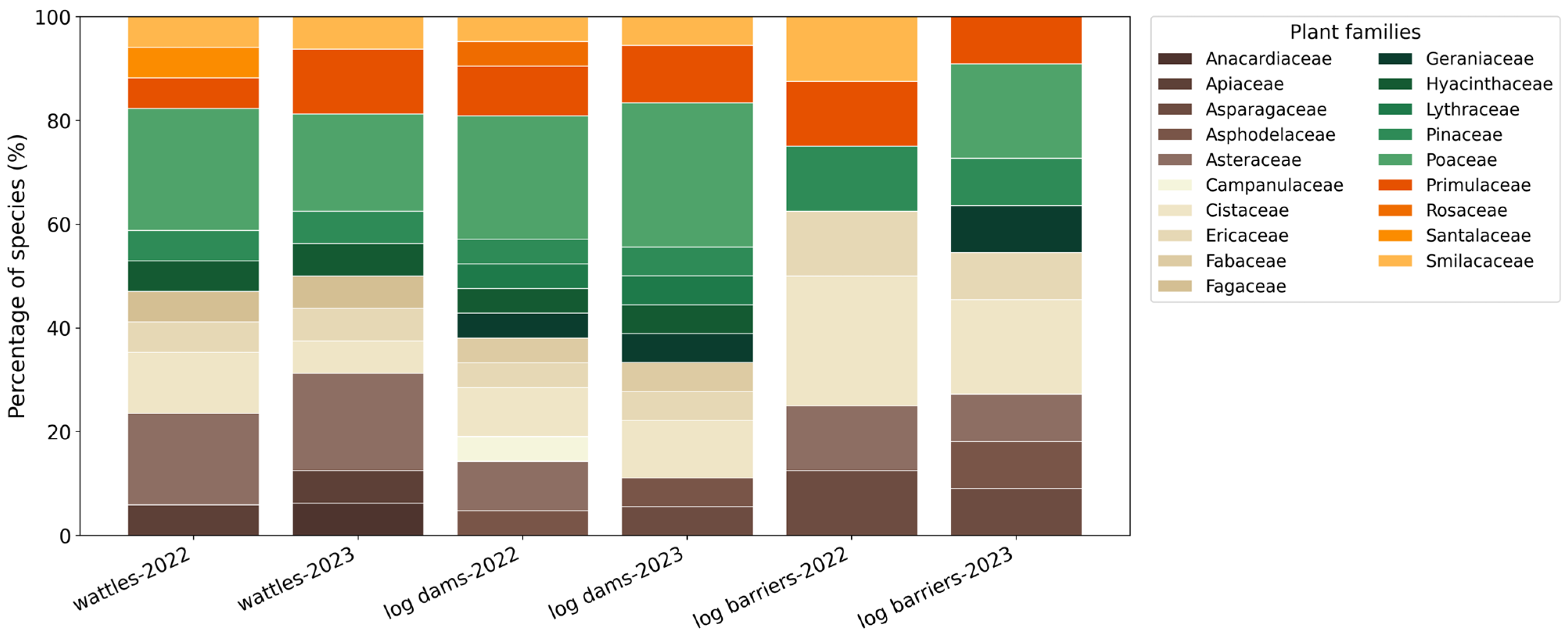
Family-level composition (expressed as the percentage of species belonging to each family within each structure type × year) differed among structure types and between years in Parnitha (Figure 6). Because proportional composition alone can obscure differences in total richness and abundance, the corresponding absolute values are also provided in the Supplementary Materials (Tables S33 and S34), which report the pooled number of species per family and the total number of individuals per family for each structure type × year. These absolute summaries show that pooled species richness was lowest in log barriers in 2022 (8 species), increased in log barriers in 2023 (11 species), and remained higher in wattles and log dams (16–21 pooled species depending on year). They also indicate strong numerical dominance of Pinaceae in log barriers (426 individuals in 2022; 470 in 2023), despite its representation by a single species, whereas Poaceae contributed the greatest number of species in wattles and log dams. Finally, Poaceae and Asteraceae contributed substantially to species richness in wattles and log dams, whereas log barriers showed lower species richness in 2022 and a stronger representation of Cistaceae, followed by a broader family distribution in 2023.

3.2. Alpha Plant Diversity, Cover and Biomass of Vascular Plants in Parnitha

Species richness (S) ranged from 3.67 ± 0.33 to 11.00 ± 0.58 across structure types (Table 2). Richness was significantly lower in log barriers-2022 (3.67 ± 0.33) compared with all other structure types, which did not differ among them (all a). Shannon–Wiener diversity (H′) showed the highest values in wattles (Wattles-2022: 1.90 ± 0.13; Wattles-2023: 2.24 ± 0.04), followed by Log dams-2023 (1.77 ± 0.15) and Log dams-2022 (1.554 ± 0.49), while Log barriers-2023 (1.39 ± 0.43) and especially Log barriers-2022 (0.67 ± 0.28) exhibited the lowest diversity, with significant pairwise differences indicated by distinct letters. A similar pattern was observed for Simpson diversity (1 − D) and Pielou evenness (J′): both indices were highest in wattles (0.82–0.87 for 1 − D; 0.90–0.93 for J′), intermediate in log dams (Log dams-2023; Log dams-2022), and lowest in log barriers (Log barriers-2023; Log barriers-2022), with all groups differing significantly as denoted by different letters (Table 2).

3.3. Changes in Plant Community Composition Across Structure Types and Years in Parnitha

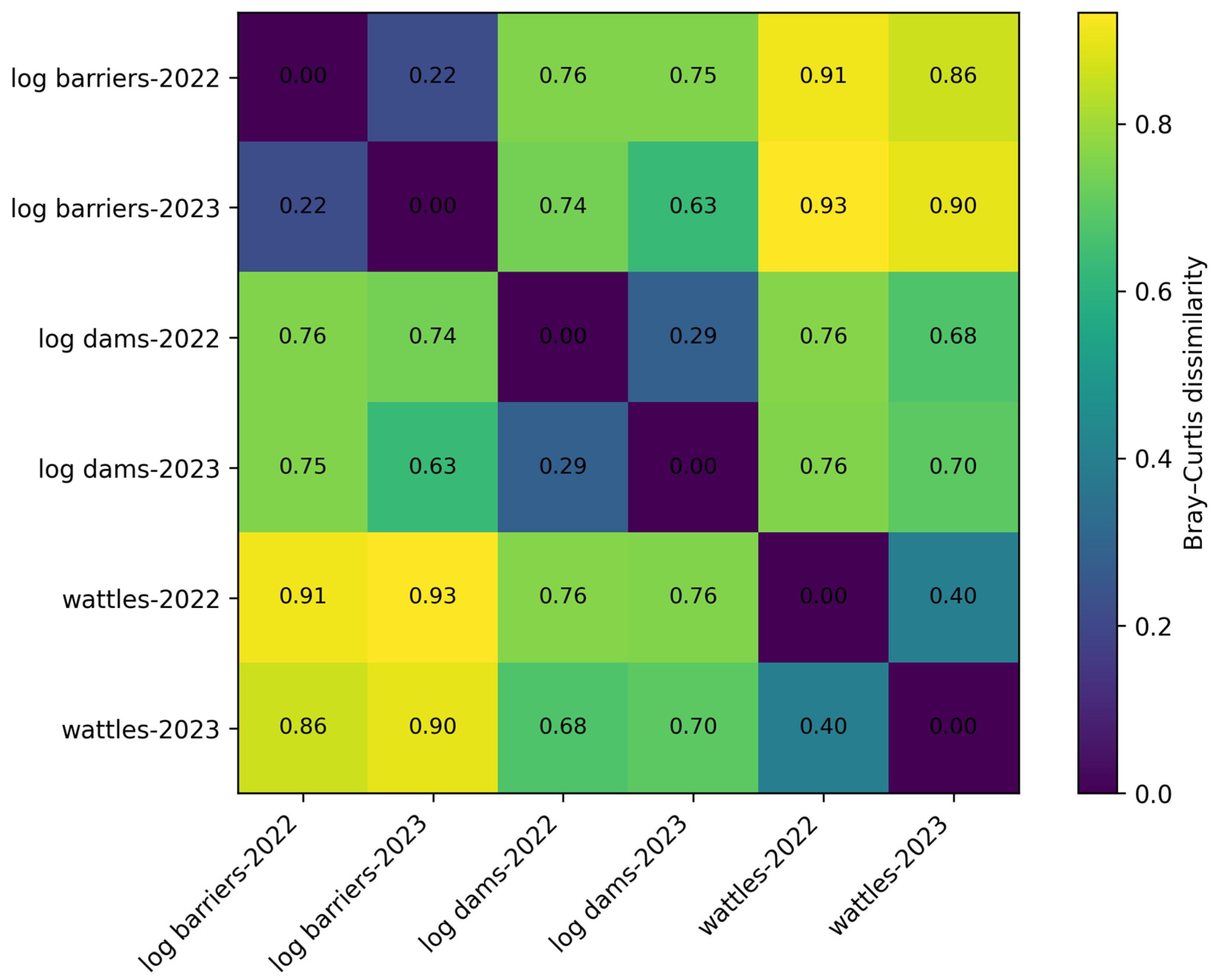
The Bray–Curtis heatmap provided a descriptive summary of aggregated compositional differences among the structure type × year samples (BC range: 0.21–0.93) (Figure 7). However, plot-level PERMANOVA on Bray–Curtis dissimilarities derived from log(x + 1)-transformed abundances did not detect a significant structure effect in 2022 (pseudo-F = 1.56, R2 = 0.34, p = 0.12; permutations = 1680) or 2023 (pseudo-F = 2.40, R2 = 0.44, p = 0.07; permutations = 1680). PERMDISP did not indicate heterogeneity of multivariate dispersion (2022: F = 0.64, p = 0.79; 2023: F = 2.28, p = 0.35). Accordingly, the heatmap patterns should be interpreted as descriptive compositional contrasts rather than as statistically supported structure type differences within years.
The log barriers produced the least dissimilarity between years (log barriers-2022 and log barriers-2023: BC = 0.21), followed by the log dams (log dams-2022 and log dams-2023: BC = 0.28). Also, Wattles had the greatest annual turn (wattles-2022 and wattles-2023: BC = 0.39). Wattles exhibited significant differences in structure to log barriers (BC = 0.86–0.93), with greatest dissimilarity between wattles in 2022 and log barriers in 2023 (BC = 0.93). Log dam comparisons were typically intermediate as well (e.g., log dams-2023 vs. log barriers-2023: BC = 0.63; log dams-2022 vs. wattles-2022: BC = 0.76), which indicates that communities associated with log dams could be found compositionally, in between those characterized for log barriers and wattles.

3.4. Temporal Changes in Vegetation Cover and Biomass in Parnitha

Mean vegetation cover increased strongly between 2022 and 2023 across all structure types (overall mean ± SE: 31.1 ± 6.7% in 2022 vs. 67.9 ± 3.1% in 2023) (Figure 8). The year × structure type interaction was not significant (Wald χ2(2) = 4.04, p = 0.133); thus, an additive model was fitted. In this model, year had a significant effect (Wald χ2(1) = 17.45, p = 2.95 × 10⁻⁵), whereas structure type showed no statistically significant main effect at α = 0.05 (Wald χ2(2) = 5.54, p = 0.06). At the year × structure level, mean cover (±SE) ranged from 16.7 ± 4.6% (log barriers, 2022) to 71.5 ± 6.5% (log dams, 2023).
Mean vegetation biomass also increased from 2022 to 2023 (overall mean ± SE: 71.6 ± 19.4 g m−2 in 2022 vs. 102.1 ± 18.7 g m−2 in 2023) (Figure 9). The year × structure type interaction was not significant (Wald χ2(2) = 3.04, p = 0.21), and the additive model indicated a significant year effect (Wald χ2(1) = 11.41, p = 7.31 × 10⁻⁴). The main effect of structure type was not significant at α = 0.05 (Wald χ2(2) = 5.29, p = 0.07). Across year × structure combinations, mean biomass (±SE) ranged from 25.2 ± 14.8 g m−2 (log barriers, 2022) to 162.5 ± 46.3 g m−2 (wattles, 2023).

3.5. Vascular Plant Composition in Mavrolimni

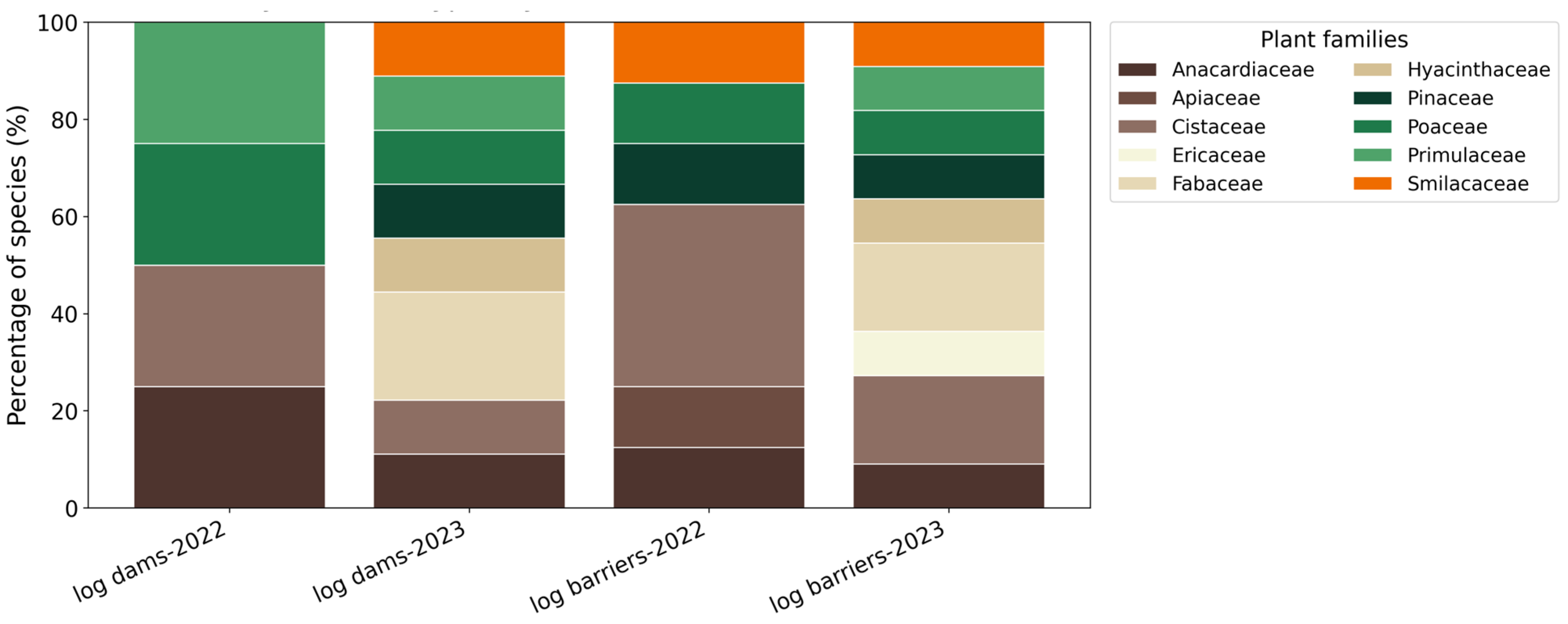
The family-level composition in Mavrolimni, expressed as the percentage of species per family within each structure type × year, varied across structure types (Figure 10). To complement these percentages, absolute values are presented in the Supplementary Materials (Tables S35 and S36) as pooled number of species per family and total individuals per family for each structure type × year. These data indicate an increase in pooled species richness from 4 to 9 in log dams and from 8 to 11 in log barriers between 2022 and 2023.
In 2022, log barriers were predominantly composed of Cistaceae (3 species; 148 individuals). In 2023, Cistaceae continued to be the most numerous, with 178 individuals, and other families also increased. Log dams in 2023 exhibited a wider variety of families, notably Fabaceae (2 species; 28 individuals), Poaceae (23 individuals), and Pinaceae (21 individuals), all of which made significant contributions. Overall, the main trend at Mavrolimni was a temporal increase in floristic diversity across both structure types during the early stages of recovery.

3.6. Alpha Plant Diversity, Cover and Biomass of Vascular Plants in Mavrolimni

Alpha diversity differed among the structure type × year groups (Table 3). Species richness (S) was significantly higher in 2023 than in 2022 for both structure types: log dams-2023 (7.33 ± 0.67) and log barriers-2023 (7.75 ± 0.85) exceeded log dams-2022 (2.00 ± 0.58) and log barriers-2022 (4.25 ± 0.48). The Shannon–Wiener diversity (H′) exhibited a consistent pattern, with elevated values recorded in 2023 (log dams-2023: 1.92 ± 0.10; log barriers-2023: 1.78 ± 0.16) compared to 2022 (log dams-2022: 0.57 ± 0.30; log barriers-2022: 1.09 ± 0.14). Similarly, Simpson diversity (1 − D) increased in 2023, with log dams-2023 (0.84 ± 0.01) and log barriers-2023 (0.77 ± 0.05) significantly surpassing the values observed in 2022 (log dams-2022: 0.37 ± 0.19; log barriers-2022: 0.59 ± 0.09). Pielou evenness (J′) varied among the groups, registering as lowest in log barriers-2022 (0.79 ± 0.13), whereas the groups log dams-2022, log dams-2023, and log barriers-2023 demonstrated similarly higher evenness indices (ranging from 0.88 to 0.96).

3.7. Changes in Plant Community Composition Across Structure Types and Years in Mavrolimni

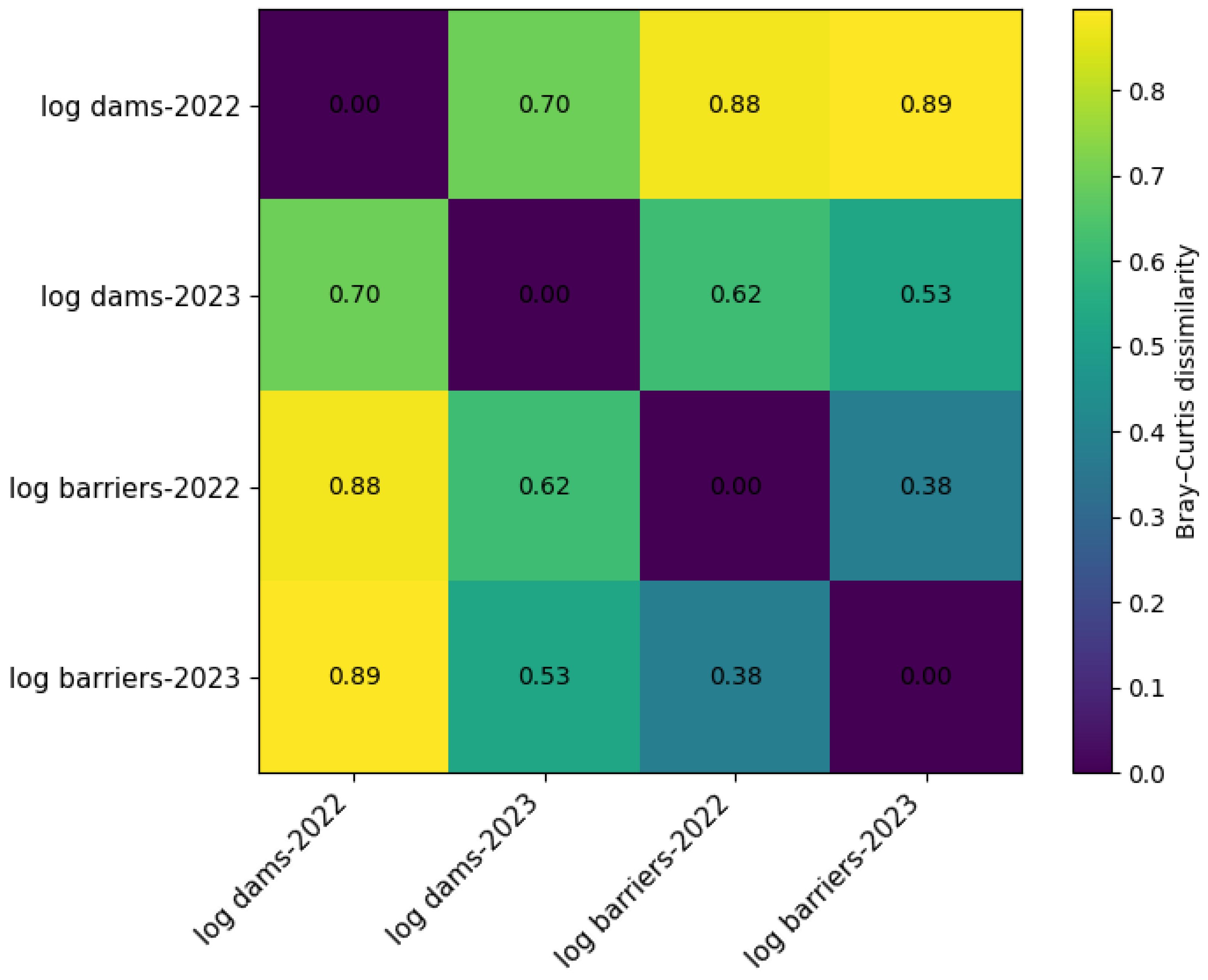
The Bray–Curtis heatmap provided a descriptive summary of aggregated compositional differences among the structure type × year samples (BC range: 0.38–0.90) (Figure 11). However, plot-level PERMANOVA on Bray–Curtis dissimilarities calculated from log(x + 1)-transformed abundances did not detect a significant difference between structures in 2022 (pseudo-F = 0.17, R2 = 0.03, p = 0.91; permutations = 35) or 2023 (pseudo-F = 1.11, R2 = 0.18, p = 0.361; permutations = 35). PERMDISP tests did not yield statistically significant results (2022: F = 1.09, p = 0.38; 2023: F = 0.43, p = 0.77). Accordingly, the heatmap patterns observed in Mavrolimni should be regarded as descriptive rather than inferential.
The smallest difference was found between log barriers-2022 and log barriers-2023 (BC = 0.38), showing very little change from one year to the next within log barriers. Conversely, log dams showed greater dissimilarity over the years (log dams-2022 vs. log dams-2023: BC = 0.70). In 2022, the most notable differences among structural types were observed with log dams, especially when compared to log barriers (BC = 0.88–0.90). In 2023, log dams appeared more similar to log barriers in that year (BC = 0.53) than to those in 2022 (BC = 0.62).

3.8. Temporal Changes in Vegetation Cover and Biomass in Mavrolimni

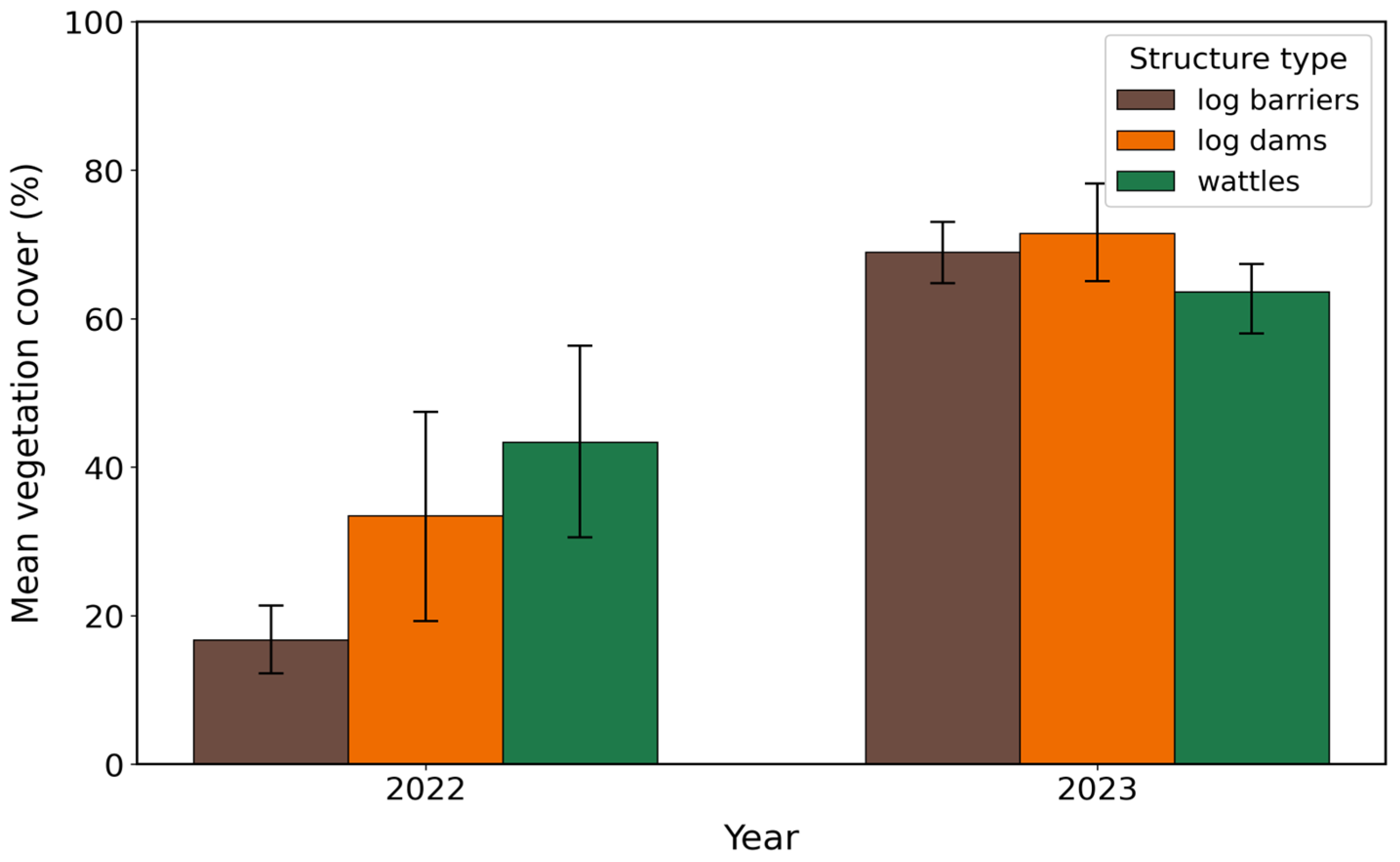
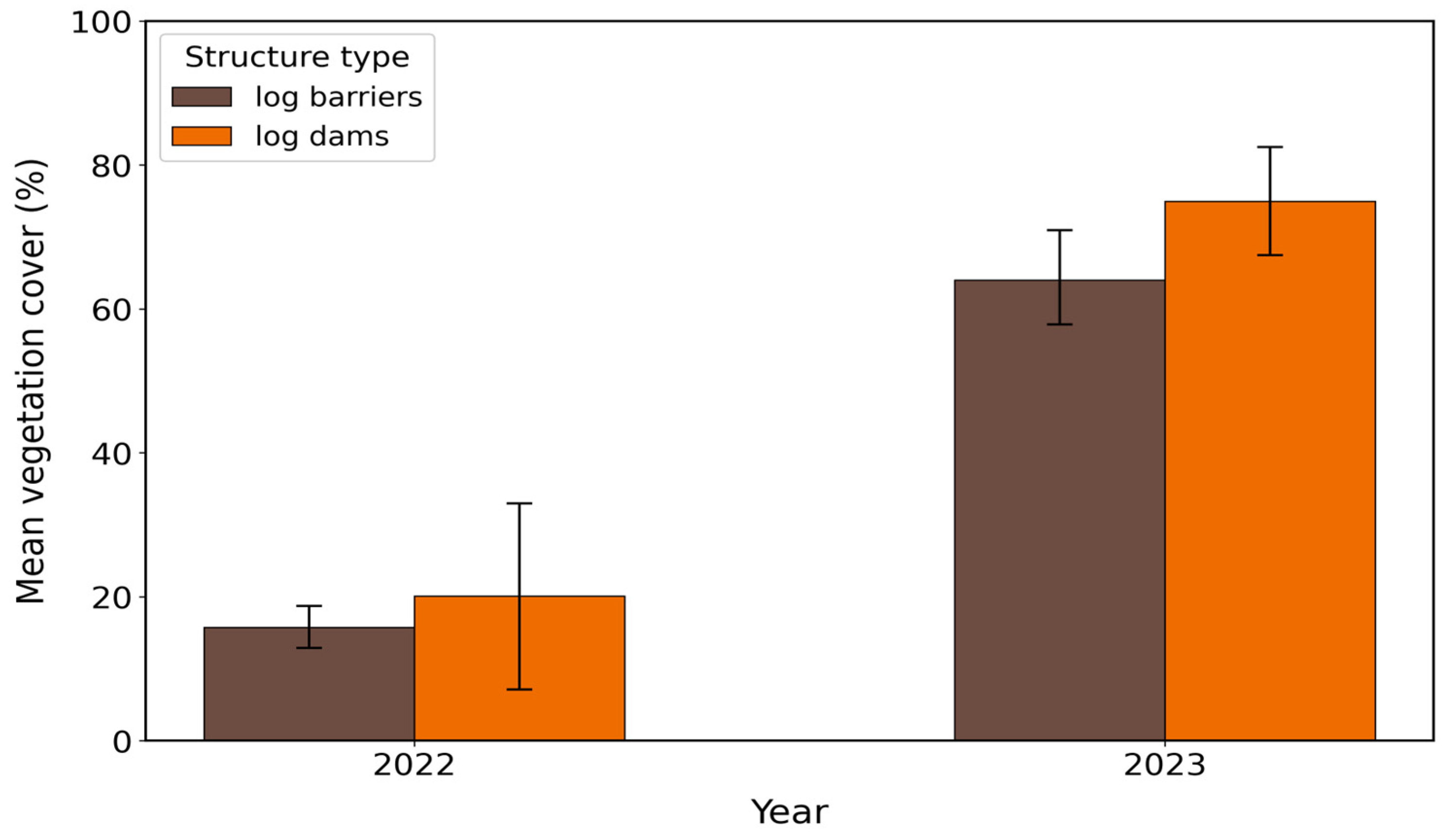
Mean vegetation cover increased markedly from 2022 to 2023 for both structure types (log barriers: 11.5 ± 2.9% to 60.4 ± 6.6%; log dams: 15.8 ± 12.9% to 71.2 ± 7.6%) (Figure 12). The year × structure type interaction was not significant (Wald χ2(1) = 1.06, p = 0.30), therefore an additive model was used. In this model, year had a strong effect (Wald χ2(1) = 61.05, p = 5.56 × 10⁻¹⁵), while the main effect of structure type was not significant (Wald χ2(1) = 0.75, p = 0.38).
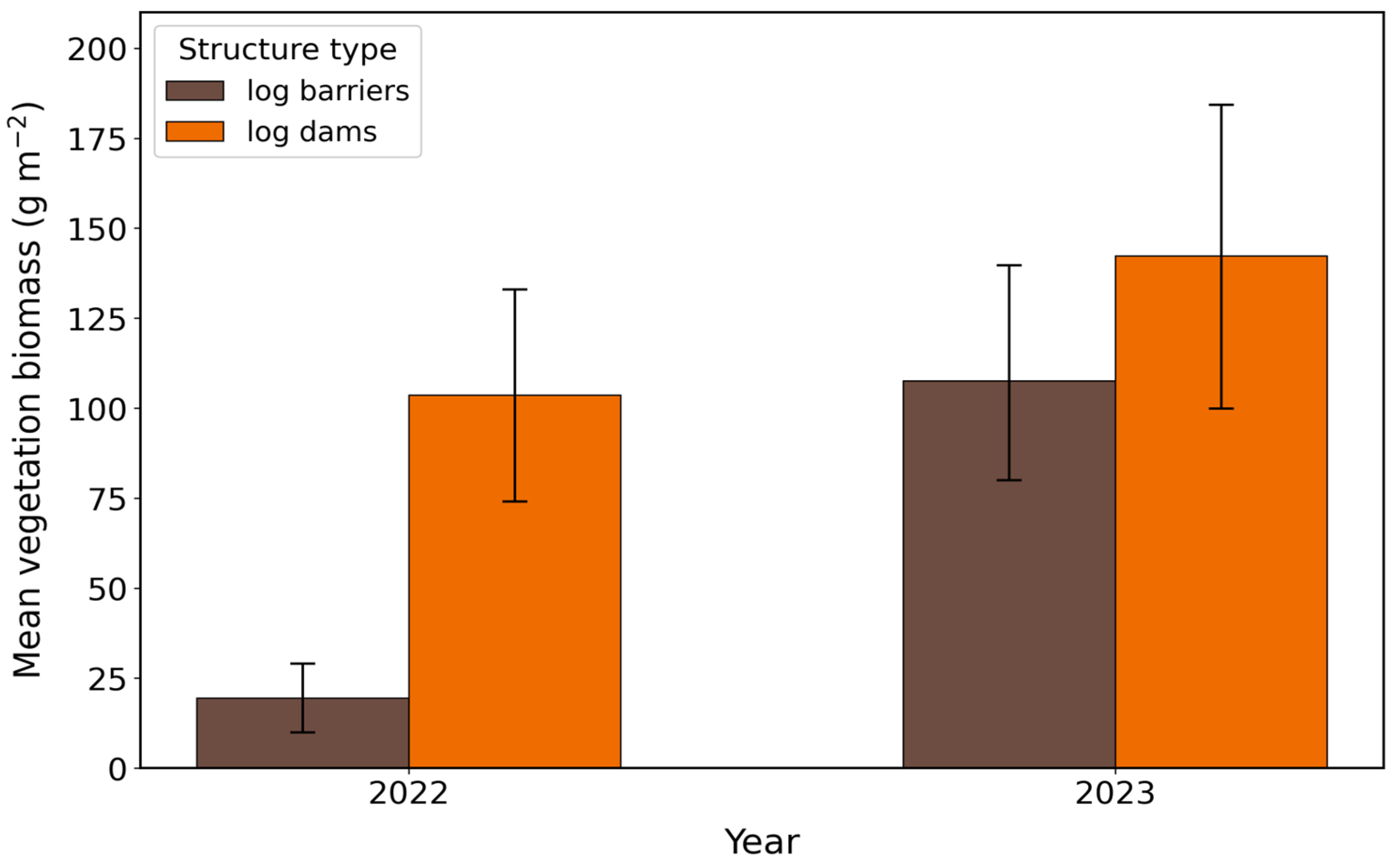
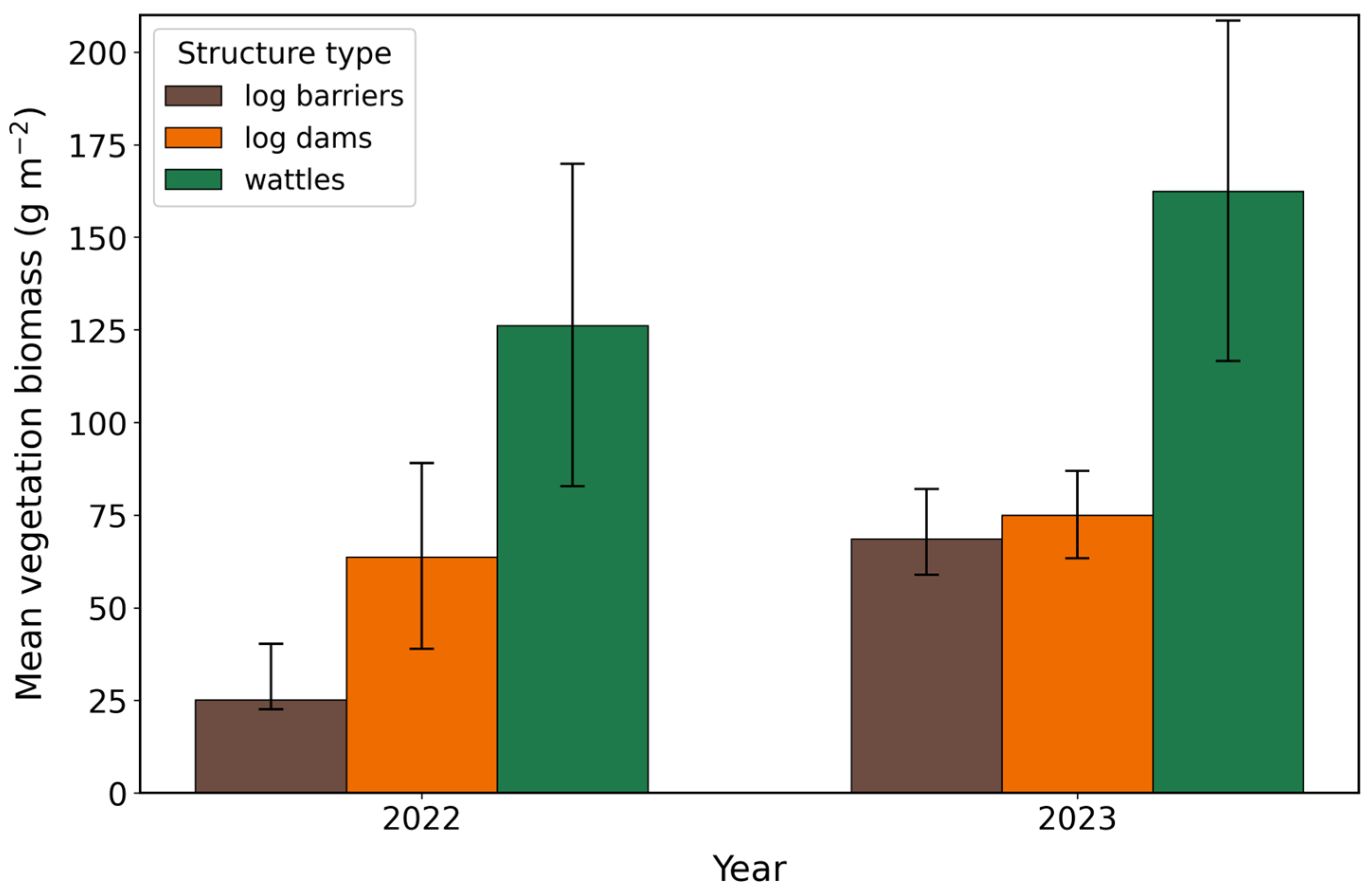
Mean vegetation biomass increased from 2022 to 2023, but the magnitude of change differed between structure types (log barriers: 19.6 ± 9.6 to 109.9 ± 29.7 g m−2; log dams: 103.7 ± 29.5 to 142.2 ± 42.7 g m−2) (Figure 13). The year × structure type interaction was significant (Wald χ2(1) = 3.86, p = 0.04). Simple-effects tests indicated a significant year-to-year increase within log barriers (Wald χ2(1) = 46.74, p = 8.12 × 10⁻¹²), but not within log dams (Wald χ2(1) = 2.68, p = 0.10). In 2022, biomass was higher in log dams than in log barriers (Wald χ2(1) = 4.08, p = 0.04), whereas the structure difference was not significant in 2023 (Wald χ2(1) = 1.91, p = 0.16).

3.9. Indicator Species Analysis Across Structure Types in Parnitha

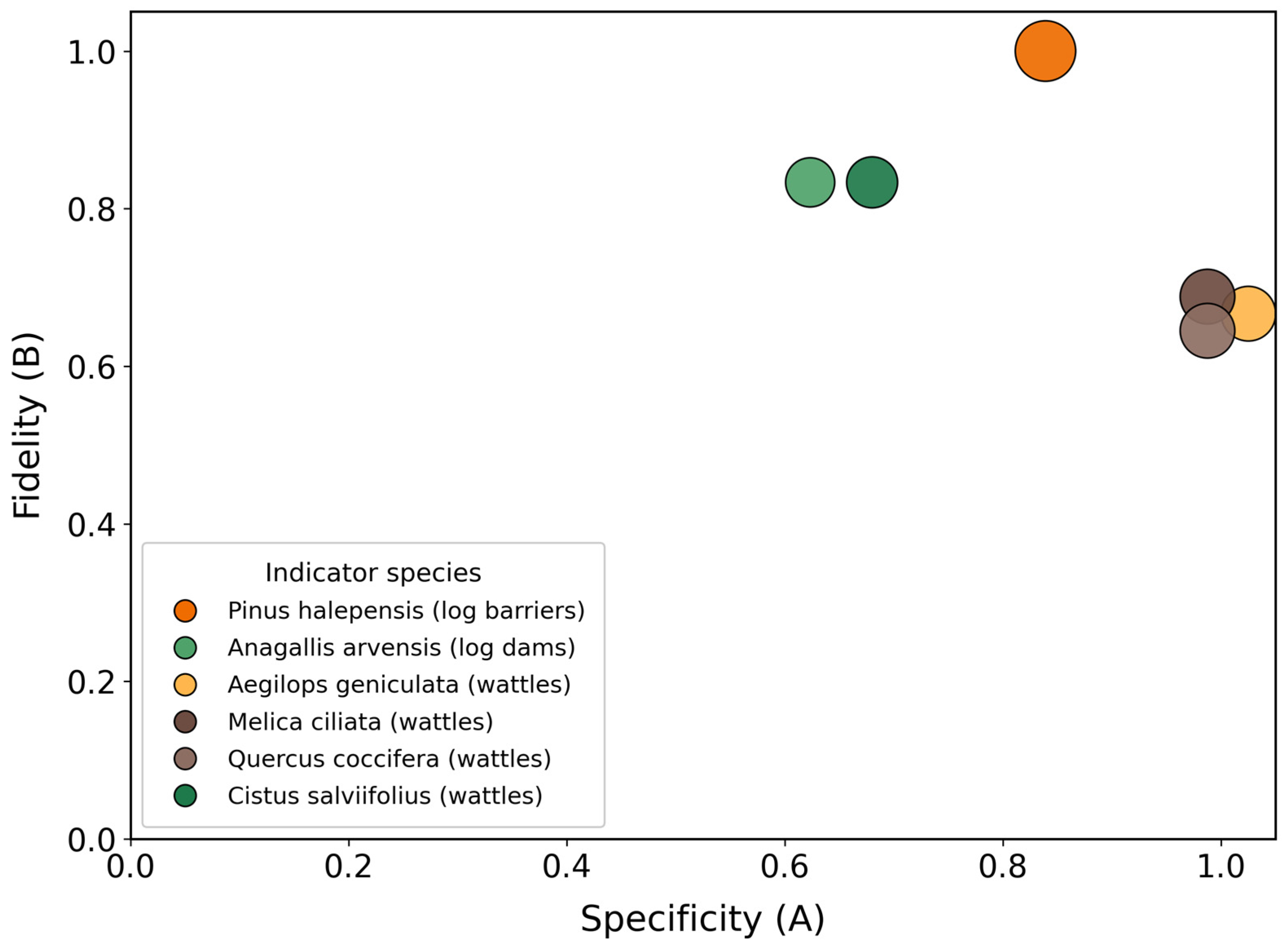
The Indicator Species Analysis shows that only a few plant species are significantly associated with each structure type in Parnitha (Table 4, Figure 14). This was corroborated by the IndVal results (IndVal permutation test, stratified by year; 4999 permutations; p < 0.05). Four indicator species of wattle were Aegilops geniculata (IndVal = 66.67; A = 1.00; B = 0.67; p = 0.02), Melica ciliata (66.67; 1.00; 0.67; p = 0.02), Quercus coccifera (66.67; 1.00; 0.67; p = 0.02), and Cistus salviifolius (56.67; 0.68; 0.83; p = 0.03). Log dams were denoted by Anagallis arvensis (IndVal = 51.93; A = 0.62; B = 0.83; p = 0.040), whereas log barriers were strongly indicated by Pinus halepensis (IndVal = 83.90; A = 0.84; B = 1.00; p = 0.03), reflecting high fidelity and specificity to this structure type within the pooled two-year dataset. When the analysis was repeated separately within each year (2022 and 2023; plots per structure type), no species reached significance (p < 0.05), again suggesting a lack of within-year replicability.
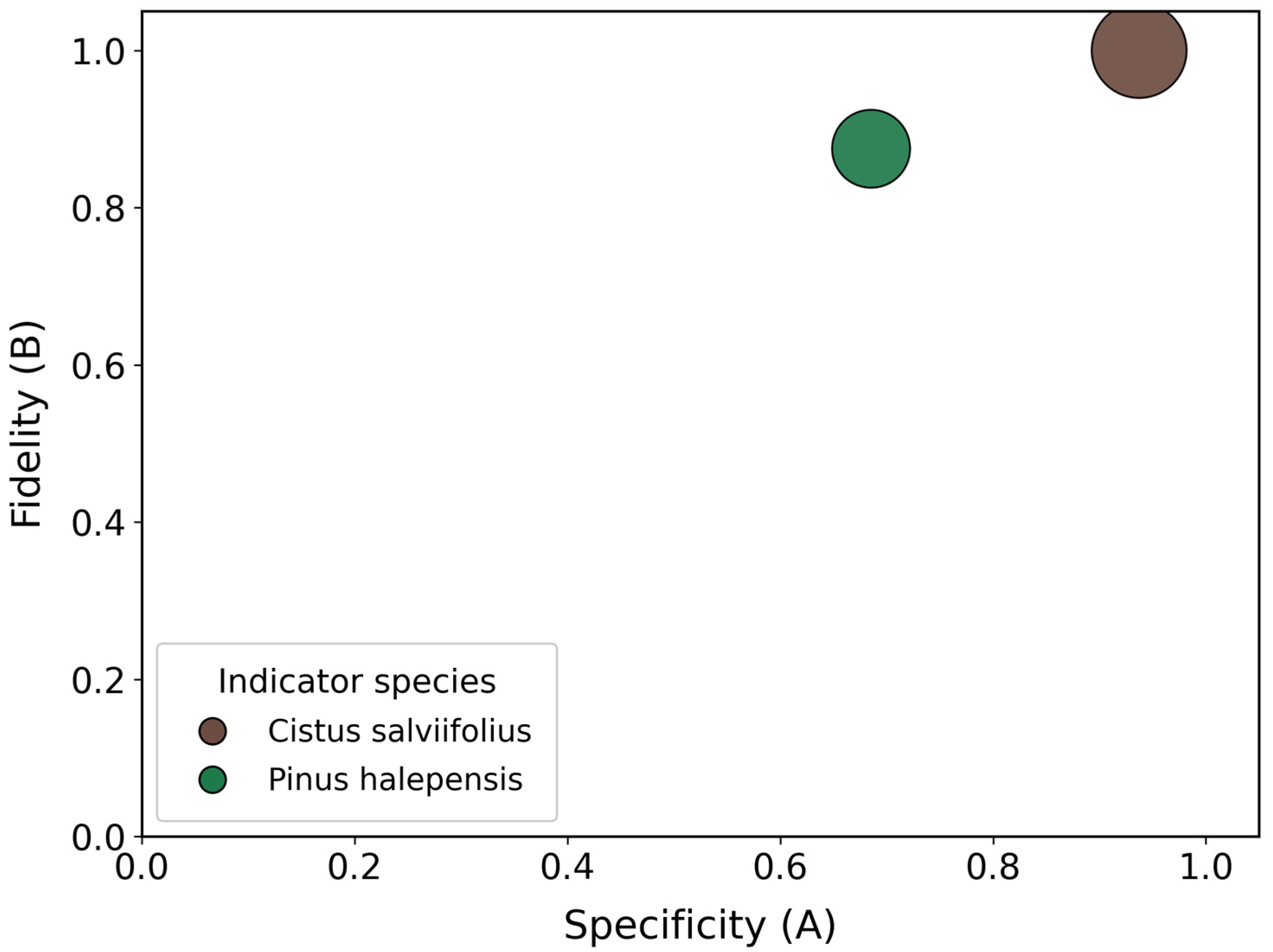
Moreover, indicator species analysis revealed two taxa that are significantly linked to log barriers in Mavrolimni (Table 5, Figure 15). The strongest indicator was Cistus salviifolius (IndVal = 93.73; A = 0.94; B = 1.00; p = 0.00), indicating both high specificity and total faithfulness to the specific plots that enforced logs as barriers. The second indicator of log barriers was Pinus halepensis (IndVal = 59.97; A = 0.69; B = 0.88; p = 0.02). No species were significant indicators of log dams at p < 0.05. When the analysis was repeated within each year (2022 and 2023) separately, no indicator species reached significance, consistent with limited within-year replication. Accordingly, the significant associations identified here are best regarded as provisional structure-linked signals within the present sampling design, rather than as definitive bioindicators.
These indicator taxa should be interpreted cautiously. Their significance in the pooled two-year dataset reflects statistical specificity and fidelity to particular structure types within the present sampling design, rather than synchronous recovery timing or equivalent successional roles. This is especially relevant for Cistus salviifolius and Pinus halepensis, which represent different post-fire regeneration strategies in Mediterranean ecosystems. Cistus salviifolius is a typical early fire-follower, whereas P. halepensis is an obligate seeder whose recruitment may begin soon after fire but whose establishment and persistence follow a longer, microsite-dependent trajectory. Their simultaneous emergence as indicator taxa therefore suggests asynchronous but co-occurring structure-associated early assembly patterns, rather than a contradiction in ecological interpretation.

3.10. Interannual Recovery (Δ2023–2022) and Composite Recovery Index

3.10.1. Parnitha

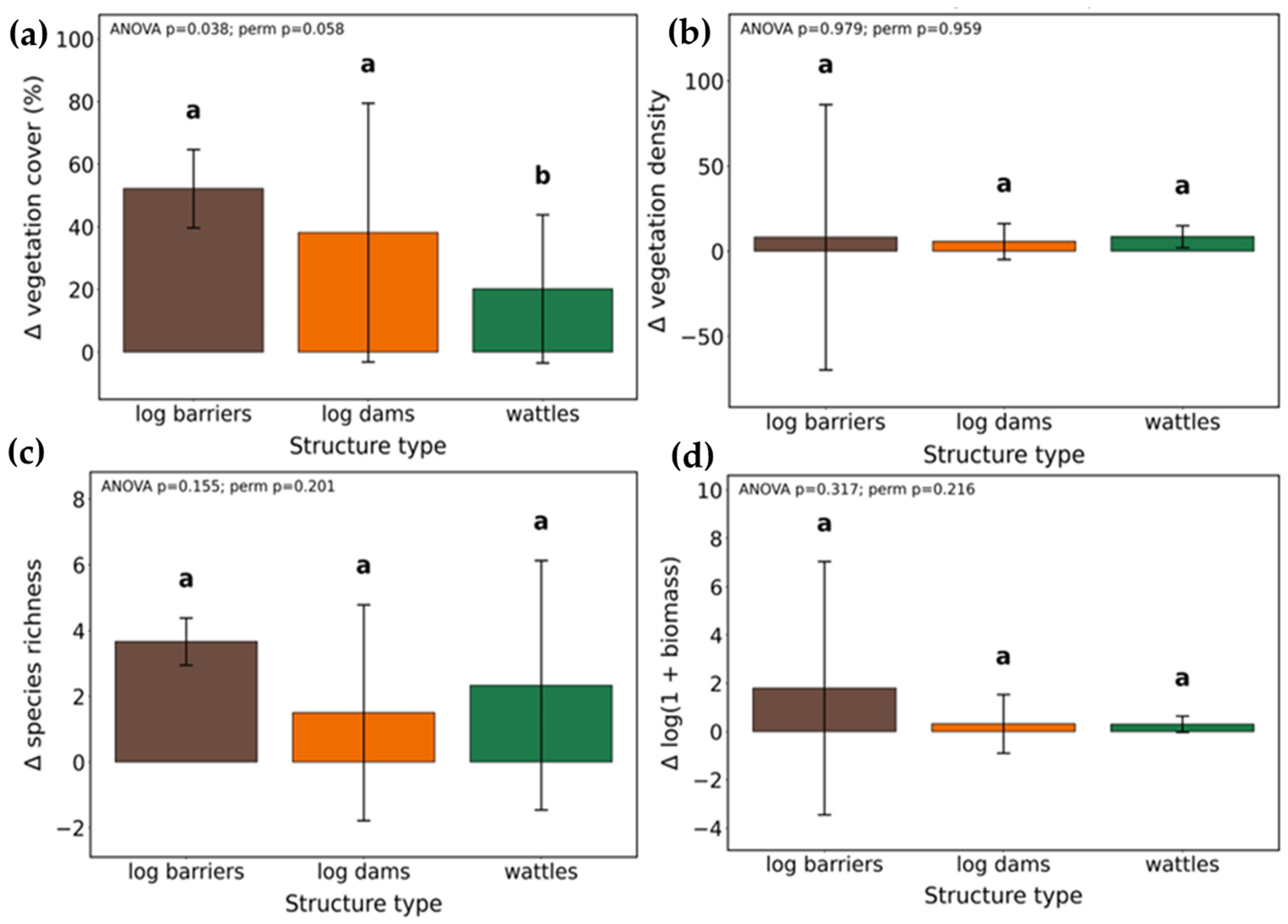
Interannual recovery magnitude (Δ2023–2022) differed among structure types primarily for vegetation cover in Parnitha (Figure 16). The increase in cover was greatest in log barriers (mean Δcover = 52.17%, 95% CI: 39.66–64.67) and log dams (38.17%, 95% CI: −3.15–79.48), while wattles exhibited a smaller increase (20.17%, 95% CI: −3.48–43.81). A one-way ANOVA indicated a significant structure type effect on Δcover (F(2,6) = 5.90, p = 0.03), with borderline support from the permutation test (p_perm = 0.05). Post hoc Tukey HSD separated wattles from the two log-based structures (α = 0.05).
In contrast, Δ vegetation density did not differ among structure types (F(2,6) = 0.02, p = 0.97; p_perm = 0.95), and neither Δ species richness (F(2,6) = 2.58, p = 0.15; p_perm = 0.20) nor Δlog(1 + biomass) (F(2,6) = 1.40, p = 0.31; p_perm = 0.21) showed statistically supported differences, indicating higher among-plot variability for these endpoints over the 2022–2023 interval.
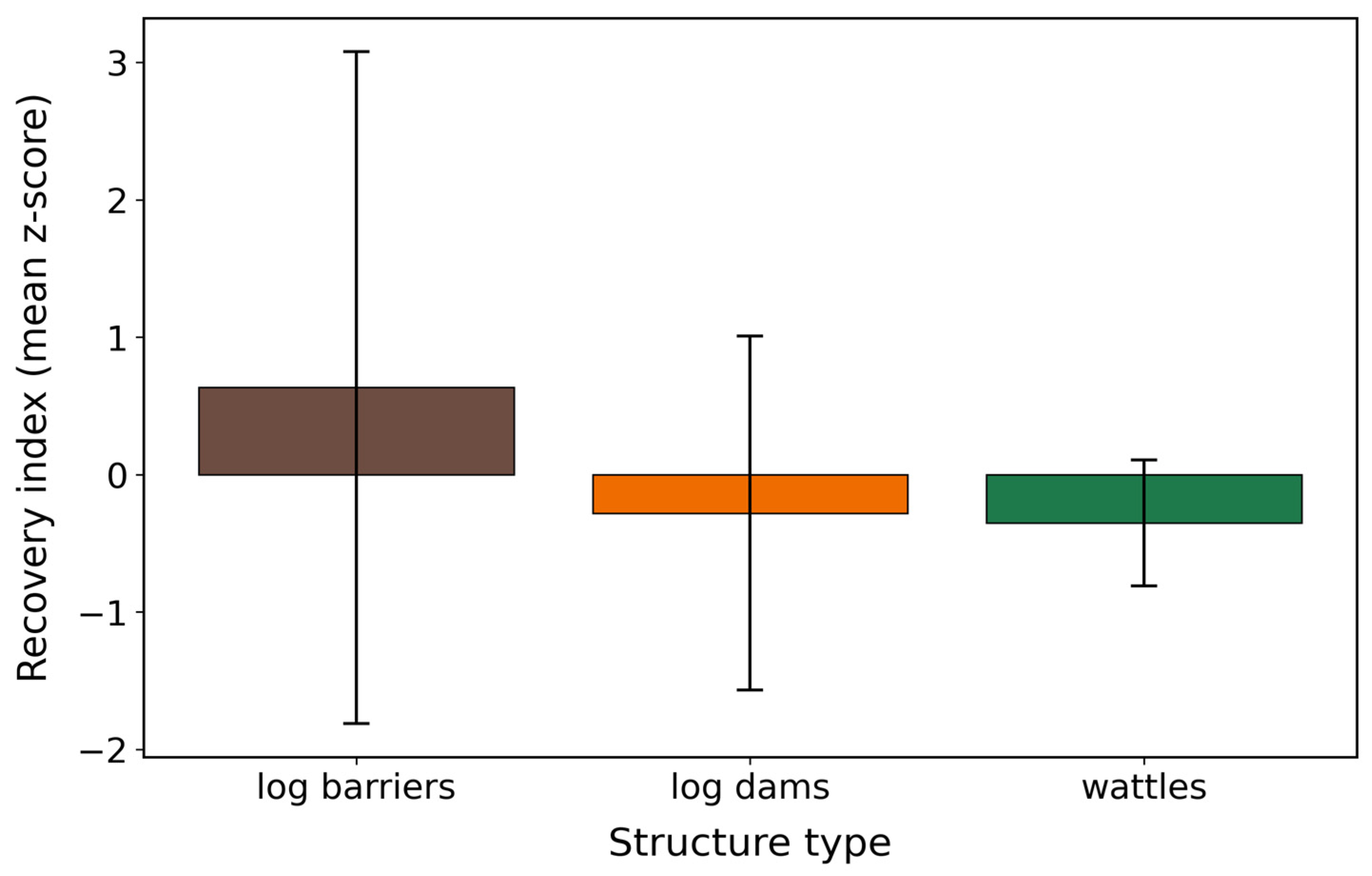
A composite Recovery Index was calculated per plot as the mean of z-scored interannual changes (Δ2023–2022) in vegetation cover, vegetation density, species richness, and log-transformed biomass [Δlog(1 + biomass)] in Parnitha. The Recovery Index differed numerically among structure types, with log barriers showing the highest mean recovery score (0.63; 95% CI: −1.81 to 3.07), whereas log dams (−0.28; 95% CI: −1.56 to 1.00) and wattles (−0.35; 95% CI: −0.81 to 0.10) exhibited lower mean scores (Figure 17). However, differences among structure types were not statistically significant (one-way ANOVA: F(2,6) = 2.14, p = 0.19; permutation test: p_perm = 0.13), although the effect size was moderate (η2 = 0.41).

3.10.2. Mavrolimni

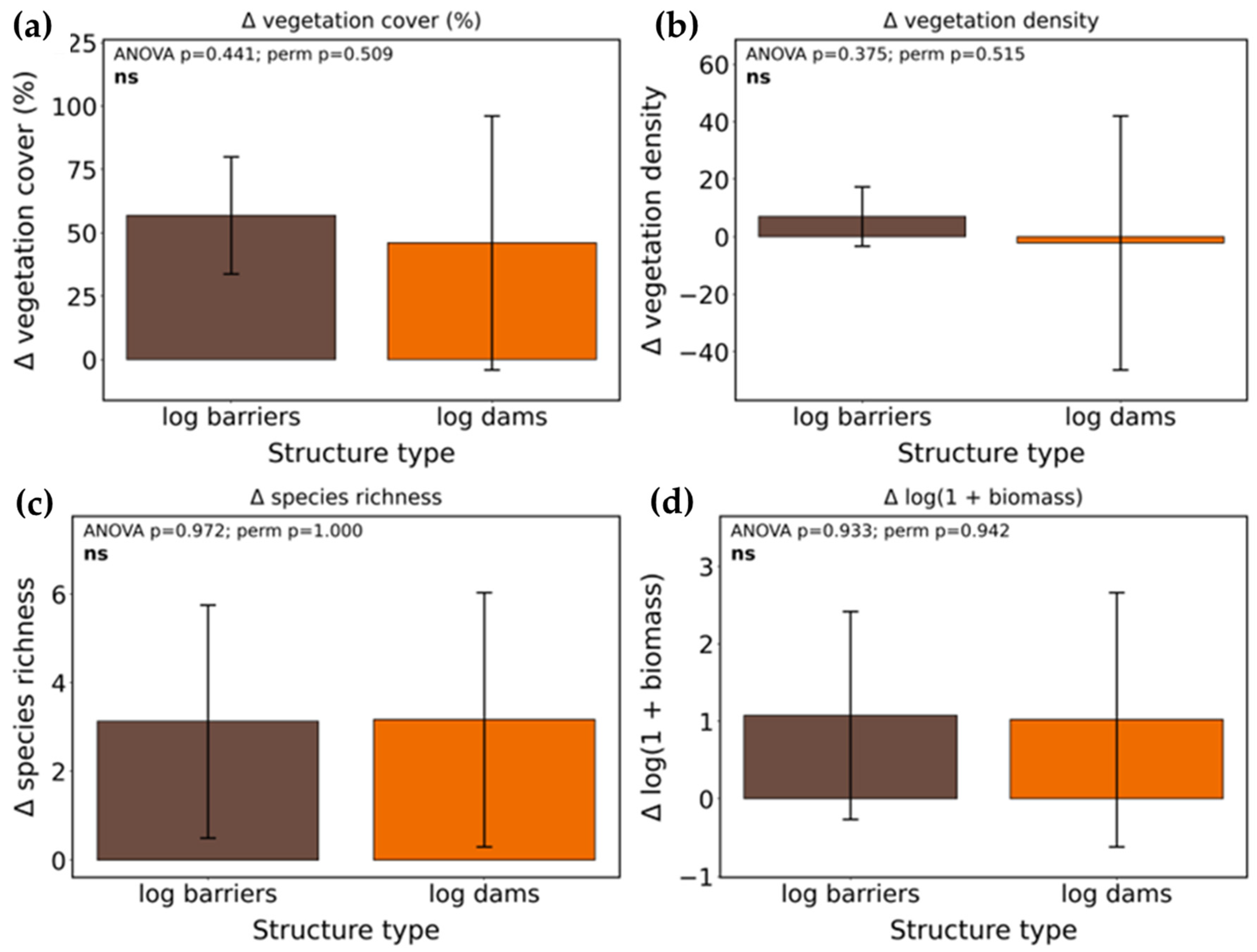
Interannual recovery magnitude (Δ2023–2022) was quantified at plot level for vegetation cover, vegetation density, species richness, and log-transformed biomass [Δlog(1 + biomass)] and compared between structure types (log barriers; log dams) (Figure 18). Both structure types showed large increases in vegetation cover (log barriers: mean Δcover = 56.9%, 95% CI: 33.8–80.0; log dams: 46.0%, 95% CI: −4.1–96.1), but Δcover did not differ significantly between structure types (one-way ANOVA: F(1,5) = 0.70, p = 0.44; permutation test: p = 0.51). Likewise, Δ vegetation density (log barriers: 7.00, 95% CI: −3.31–17.31; log dams: −2.17, 95% CI: −46.35–42.02) was not significantly different between structure types (F(1,5) = 0.95, p = 0.375; p_perm = 0.51). Changes in species richness were comparable (log barriers: 3.13, 95% CI: 0.50–5.75; log dams: 3.17, 95% CI: 0.30–6.04) with no structure type effect (F(1,5) = 0.00, p = 0.97; p_perm = 1.00). Similarly, biomass change expressed as Δlog(1 + biomass) did not differ between structures (log barriers: 1.07, 95% CI: −0.26–2.41; log dams: 1.02, 95% CI: −0.61–2.66; F(1,5) = 0.00, p = 0.93; p_perm = 0.94). Finally, recovery magnitude was substantial across metrics but did not show statistically supported differences between log barriers and log dams (2022–2023).
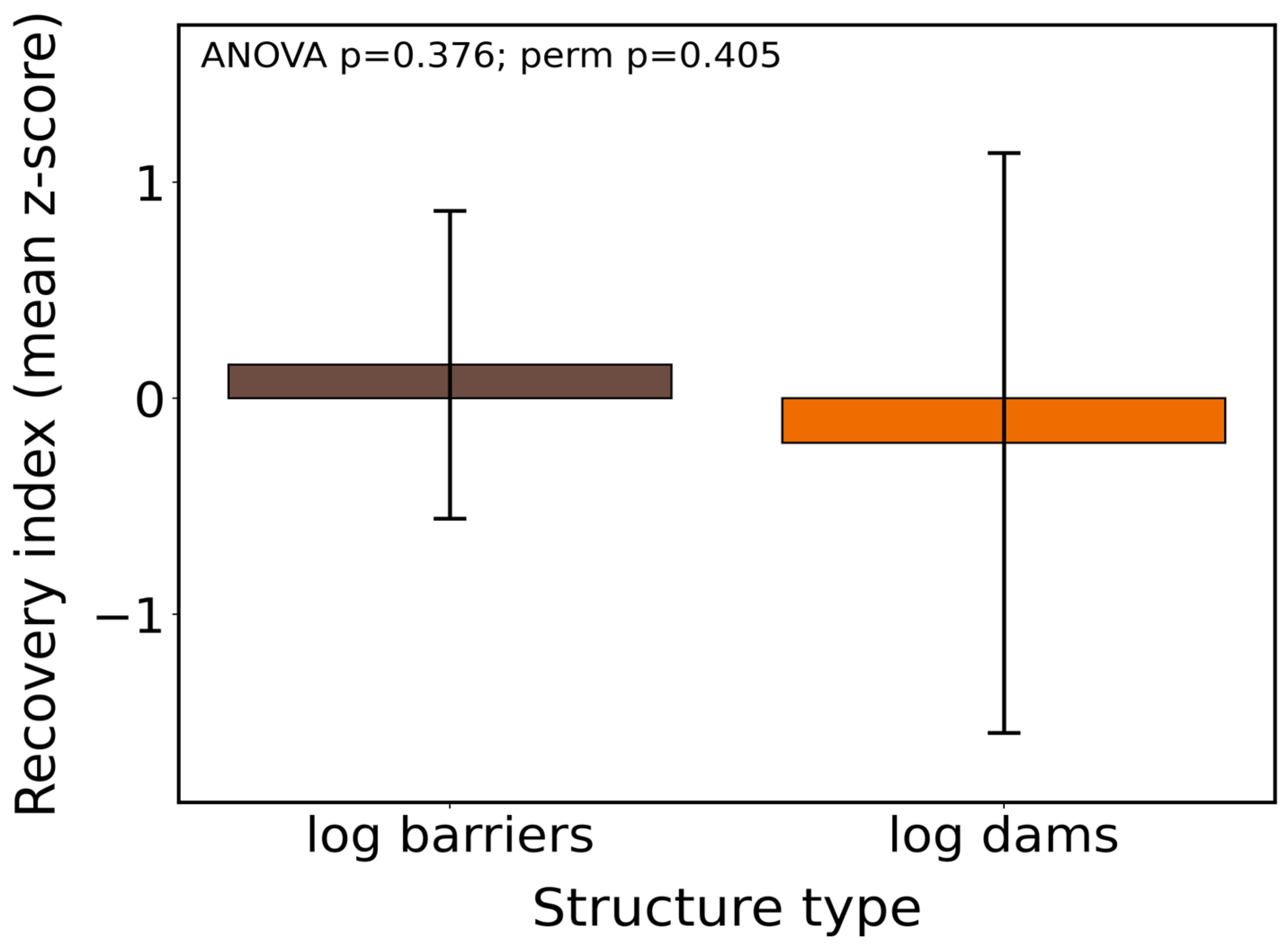
The composite Recovery Index was calculated per plot as the mean of z-scored interannual changes (Δ2023–2022) in vegetation cover, vegetation density, species richness, and log-transformed biomass [Δlog(1 + biomass)] (Figure 19). The Recovery Index did not differ between structure types (one-way ANOVA: F(1,5) = 0.94, p = 0.37; permutation test: p_perm = 0.40; η2 = 0.15). The mean Recovery Index was slightly higher for log barriers (0.15; 95% CI: −0.55 to 0.86) than for log dams (−0.20; 95% CI: −1.55 to 1.13), indicating only a weak, non-significant tendency towards higher composite recovery in log barriers.

4. Discussion

4.1. Rapid Early Recovery, with Structure Type Shaping the “Biodiversity Signal”

Across both Greek fire-affected landscapes, vegetation cover and biomass increased strongly from the first to the second monitoring year, indicating rapid early reassembly typical of many Mediterranean systems when post-fire climatic conditions permit [46,47,48]. This pattern is consistent with the broader shift toward drought-amplified fire regimes and the increasing importance of post-fire climatic constraints (especially drought duration) in controlling short-term recovery rates in Mediterranean forests [60,61,62]. Against that strong interannual signal, our results show that the different wooden, nature-based rehabilitation structures did not simply act as “neutral” engineering additions. Instead, structure type was associated with pronounced descriptive compositional contrasts (Bray–Curtis heatmaps), with limited plot-level PERMANOVA support within years, particularly in the first post-fire years when microsite limitation, propagule availability, and environmental filtering are strongest [63,64].
The family-level patterns observed in the first two monitoring years are also ecologically consistent with typical Mediterranean post-fire colonization processes. The prominence of Poaceae and Asteraceae, especially in wattles and log dams in Parnitha, suggests a strong contribution of herbaceous early colonizers able to exploit the open, high-light and low-competition conditions that follow fire. In Mediterranean post-fire environments, taxa from these families frequently contribute to the early regenerating flora, and seed-bank studies have likewise shown a strong representation of Poaceae and Asteraceae among the readily emerging post-fire species. This pattern is ecologically plausible because many grasses and forbs can establish rapidly after disturbance, while many Asteraceae are also effective colonizers of open ground due to efficient dispersal and ruderal behavior. By contrast, the stronger representation of Cistaceae, particularly in log barriers, is consistent with the role of Cistus sp. as characteristic fire-following seeders in Mediterranean ecosystems, often promoted by persistent soil seed banks and high establishment during the first post-fire stages. Taken together, these family-level patterns indicate that the early recovery observed here was driven not only by overall increases in vegetation cover and richness, but also by the rapid assembly of herbaceous colonizers and fire-following shrubs favored by post-fire microsites and structure-related environmental filtering [65,66,67]. Viewed through the lens of post-disturbance succession, the vegetation dynamics observed here correspond to an early secondary successional stage, characterized by rapid re-establishment of herbaceous cover, increasing species richness, and incomplete compositional stabilization during the first two post-fire years. In this phase, vegetation assembly is expected to be driven primarily by regeneration traits, propagule availability, microsite conditions, and post-fire climatic constraints, rather than by immediate convergence toward a single mature-community endpoint. Our results are consistent with that interpretation: the strong year effect indicates a dominant regional recovery signal, whereas the differences among rehabilitation structures suggest locally modified successional trajectories created by structure-related environmental filtering. In this sense, the structures appear not to replace the broader post-fire recovery template, but to modulate it by favoring different combinations of colonizers, fire-followers, resprouters, and obligate seeders. Ecological resilience in the present study should therefore be interpreted cautiously, not as a rapid return to pre-fire composition, which could not be tested here, but as short-term structural resilience expressed through rapid recovery of vegetation cover and biomass alongside multiple plausible compositional pathways during early assembly [67,68,69]. A key ecological interpretation is that these barrier type interventions may be better viewed as spatially explicit “microsite modifiers” rather than purely hydrological devices. By trapping fine sediments and organic matter, altering surface roughness, and locally moderating soil moisture and temperature, wooden barriers can create small-scale heterogeneity in establishment conditions [70]. Similar facilitation pathways are widely described for coarse woody debris and deadwood legacies, which can provide safe sites and microclimatic buffering for regeneration after disturbance [71]. Importantly, the same physical mechanisms that reduce runoff connectivity and sediment transport after severe fire (e.g., increased roughness and obstruction of overland flow) can also restructure recruitment opportunities for herbs, shrubs, and tree seedlings [72,73].

4.2. Why Did Structure Type Matter Most for Diversity/Composition?

In Parnitha, wattles consistently supported higher diversity indices relative to log-based hillslope barriers, while log barriers showed a markedly “compressed” diversity signal in the first monitoring year and a partial rebound in the second year. One plausible mechanism is that wattles (branch/brush piles, typically placed on gentler hillslopes) may preferentially retain fine material and seeds while maintaining a patchier disturbance footprint, promoting a richer assemblage of short-lived herbs and graminoids. In contrast, contour-oriented log barriers can create more continuous bands of deposition and shading and may also be preferentially installed on steeper or more erosion-prone positions where burn severity and soil limitation can be higher; such sites can select for fewer taxa early on, even when overall cover is increasing [70,72,73]. Field work elsewhere similarly emphasizes that log erosion barriers can be effective for sediment retention yet highly variable in ecological outcomes, depending on placement, slope, rainfall regime, and installation quality. Mediterranean evidence from Spain also indicates that log erosion barriers can enhance vegetation recovery early, but benefits may weaken with time and can be spatially heterogeneous [73].
The compositional (beta-diversity) results warrant cautious interpretation. The Bray–Curtis heatmaps were intended as descriptive visualizations of aggregated structure × year community profiles, whereas the formal plot-level PERMANOVA tests did not detect statistically significant structure type effects within years. Because replicate numbers were small and uneven among some groups, the compositional contrasts observed in the heatmaps are best regarded as descriptive patterns and hypothesis-generating signals rather than as statistically confirmed structure type differences. This distinction is important because aggregation can obscure within-group variability, and distance-based multivariate analyses require careful interpretation alongside dispersion tests [74,75,76].
Where interannual Bray–Curtis dissimilarity was relatively low within a structure type, this suggests persistence of a few dominant taxa and/or stable microsite constraints; higher turnover suggests a more dynamic assembly trajectory driven by colonization, competitive sorting, and year-to-year climatic variation [74]. Such differences matter for post-fire management because they imply that equivalent increases in cover may mask different biodiversity and successional pathways, precisely the issue raised by restoration-evaluation frameworks that argue for multidimensional success metrics (structure, diversity, composition) rather than single indicators [77,78].

4.3. Indicator Taxa Suggest Structure-Linked Microsite Filtering and Regeneration Niches

The indicator–species results should be interpreted cautiously. Although a small number of taxa showed significant associations with particular structure types, these associations emerged mainly in the pooled two-year dataset, whereas no species reached significance when the analyses were repeated separately within each monitoring year. Given the limited and uneven replication of the present sampling design, these taxa are best viewed as provisional structure-linked signals rather than as definitive bioindicators of rehabilitation structures. Within that cautious framework, the ecological identities of the significant taxa remain informative. In Parnitha, wattles were associated with grass and shrub elements, whereas log barriers were associated mainly with Pinus halepensis. In Mavrolimni, log barriers were linked to Cistus salviifolius and again P. halepensis. These associations are ecologically coherent with known Mediterranean post-fire regeneration strategies, but they should not be interpreted as strong evidence of fixed or synchronous structure-specific recovery trajectories. Rather, they indicate that some rehabilitation structures may create microsites that are repeatedly used by taxa with contrasting early post-fire strategies. This caution is especially relevant for Cistus salviifolius and Pinus halepensis, which represent different regeneration modes in Mediterranean ecosystems. Cistus salviifolius is a typical early fire-follower, whereas P. halepensis is an obligate seeder whose successful establishment depends on longer-term microsite suitability after recruitment begins. Their simultaneous appearance among the significant taxa therefore does not demonstrate a single uniform recovery pathway. Instead, it suggests that the same structure type may favor establishment opportunities for taxa with different regeneration tempos. At this stage, these associations are more appropriately interpreted as hypothesis-generating patterns that warrant validation with stronger replication across years, sites, and burn severity conditions [79,80,81,82]. Viewed through a functional lens, the indicator taxa also point to clear differences in life form and regeneration mode among structure types. In Parnitha, wattles were associated with annual and perennial graminoids (e.g., Aegilops geniculata and Melica ciliata), together with woody shrub elements such as Quercus coccifera and Cistus salviifolius, suggesting that these branch pile structures create heterogeneous microsites that can support both short-lived herbaceous colonizers and woody Mediterranean shrubs. By contrast, log barriers were associated mainly with Pinus halepensis in Parnitha and with P. halepensis and C. salviifolius in Mavrolimni, indicating microsites favorable to early fire-followers and obligate seeders. From a post-fire regeneration perspective, Quercus coccifera represents a typical resprouting woody species, whereas Pinus halepensis is an obligate seeder whose recruitment depends on canopy seed release and microsite suitability after fire. Cistus salviifolius is likewise a characteristic early post-fire seeder/fire-follower, typically promoted by persistent soil seed banks. Therefore, similar increases in vegetation cover may conceal ecologically different recovery pathways, ranging from rapid therophytic and graminoid colonization to shrub resprouting and pine recruitment. This functional interpretation further supports the view that rehabilitation structures act as microsite filters, shaping not only taxonomic diversity but also the balance among life forms and regeneration strategies during early post-fire assembly [63].

4.4. Linking Hazard Mitigation Interventions to Biodiversity Outcomes: The Study’s Contribution

Most operational post-fire programs still prioritize near-term hydrological risk reduction because the post-fire window of elevated runoff and erosion hazard is often concentrated in the first storm seasons [70]. Our results add a complementary, biodiversity-oriented evidence layer for Greece by showing that commonly deployed wooden structures are associated with measurable differences in plant diversity and descriptive compositional patterns; composition-level differences were weaker (PERMANOVA p > 0.05) over two consecutive years, i.e., within the same time horizon that agencies care most about rapid stabilization.
Our findings are also consistent with recent evidence from other Mediterranean megafire-affected landscapes. In Sardinia, Rossetti et al. [83] documented notable natural vegetation regrowth already within the first post-fire year, while also showing that recovery was heterogeneous among vegetation types, with more resilient responses in semi-natural grasslands than in shrublands and woodlands. At a broader regional scale, Blanco-Rodríguez et al. [69] showed across western Mediterranean forest ecosystems that short-term post-fire recovery is primarily constrained by drought duration, with fire severity acting as an additional driver and semi-arid areas showing lower average recovery rates. The present study agrees with this broader Mediterranean pattern in two respects: first, vegetation cover and biomass increased strongly from 2022 to 2023 in both Greek study areas, indicating rapid early reassembly; second, recovery was clearly not uniform, because diversity patterns, indicator taxa, and descriptive compositional contrasts differed among rehabilitation structure types and between sites. In this sense, our results complement existing Mediterranean studies by adding a plot-based, management-oriented perspective showing that wooden post-fire rehabilitation structures may shape the early biodiversity signal through microsite modification, even when overall structural recovery is rapid. This directly addresses a recognized geographic and thematic gap: Mediterranean syntheses note that treatment effect evidence is unevenly distributed among regions and that ecological endpoints are less consistently monitored than erosion/runoff metrics [72]. By pairing multi-metric vegetation monitoring with the operational structure types used by Greek Forest Services, the work advances “integrated evaluation” in a way that is actionable for management and compatible with restoration science recommendations for objective-led, multidimensional monitoring [77,78,84].
A further point of significance is that these biodiversity results can be interpreted alongside hydrological performance within the same project context. Evidence from Greece indicates that the same structure classes (log dams, log barriers, wattles) can influence infiltration patterns two years post fire, underscoring why coupled ecohydrological assessment is more informative than treating “hazard mitigation” and “ecosystem recovery” as separate objectives [84]. In practice, decision-makers need to know not only whether a measure slows runoff, but also whether it accelerates, delays, or redirects recovery trajectories for native plant communities in a global biodiversity hotspot region [85,86].
From a management perspective, these results suggest that the clearest structure-linked signal in the first two years concerns alpha diversity, whereas indicator–species associations remained limited and provisional and composition-level differences appear weaker and may require larger sample sizes to be detected consistently.

4.5. Limitations and Future Research Directions

This study captures an early (two-year) post-fire window, and causal attribution may be influenced by landscape placement and site selection effects (e.g., burn severity, slope position, and substrate) associated with where structures were installed. A further limitation concerns the experimental design itself. The total number of permanent plots was relatively small and unevenly distributed among sites and rehabilitation structure types, reflecting the operational placement of structures in the field rather than a fully balanced experimental design. As a result, statistical power was limited for some analyses, particularly for detecting subtle compositional differences and within-year indicator–species patterns, and some ecological signals may therefore have remained undetected. In addition, the absence of a burned untreated control means that the study cannot disentangle the effects of rehabilitation structures from background natural post-fire regeneration with the same strength as a treated–untreated design. Consequently, the present results should be interpreted primarily as comparisons among structure types within operationally restored burned areas, rather than as direct estimates of rehabilitation effects relative to no intervention. Because burn severity was not explicitly quantified as a covariate in the present analysis, part of the observed variation in vegetation recovery may reflect residual severity differences among plots, in addition to the effects associated with rehabilitation structure type.
In addition, the short monitoring horizon limits inference on whether initial diversity and compositional differences persist, converge, or amplify as shrubs and trees restructure canopy and fuel mosaics [71]. A further limitation concerns the lack of plot-level pre-fire vegetation data. Although the broader pre-fire vegetation context of the two landscapes is known from site-level land cover information, the study cannot quantify the exact departure of each plot from its pre-fire floristic composition. Consequently, the results should be interpreted as comparisons of early post-fire vegetation among rehabilitation structure types and between monitoring years, rather than as complete pre-fire to post-fire vegetation trajectories.
Although the present revision strengthens the functional interpretation of the observed taxa, a full quantitative trait-based analysis across all recorded species was beyond the scope of the present sampling design and remains an important priority for future post-fire monitoring.
An additional limitation concerns survey timing. Although the May–July field window allowed for standardized sampling and biomass assessment, it may have underrepresented early-season annuals and other short-lived taxa whose aboveground presence in Mediterranean ecosystems is concentrated in the winter–spring period and may decline rapidly before or during summer drought. As a result, the reported richness, density, and cover values should be interpreted as conservative estimates for the full seasonal flora. An additional limitation concerns sampling grain: the 1 m2 quadrats used here are appropriate for standardized microsite-scale assessment of early post-fire vascular vegetation, cover, and biomass, but they may underrepresent rare, sparse, or patchily distributed taxa and do not capture the full stand-scale heterogeneity of burned Mediterranean forests. Therefore, the present results should be interpreted as localized vegetation responses around the rehabilitation structures rather than as complete forest–community inventories. Accordingly, the most useful next steps are as follows: (i) extending monitoring to capture medium-term trajectories (≥5 years), when resprouted dominance, pine recruitment success/failure, and competitive exclusion become clearer; (ii) explicitly stratifying sampling by burn severity, slope position, and substrate to better separate treatment effects from site selection effects; and (iii) combining plot vegetation data with objective measures of microsite conditions (soil moisture and temperature, litter depth, fine-sediment accumulation) together with hydrological indicators (e.g., infiltration, runoff connectivity) to test the facilitation and filtering mechanisms implied by the results. With these additions, Greek post-fire programs could move toward evidence-based selection and placement guidelines that better align risk reduction objectives with biodiversity recovery.
Accordingly, any structure-linked biodiversity patterns identified in the present study should be regarded as provisional and in need of validation through longer-term and more balanced monitoring. Taken together, the results indicate that early post-fire vegetation recovery was rapid in both burned landscapes, but the evidence for consistent structure-specific biodiversity effects remains preliminary. Wooden rehabilitation structures were associated more clearly with differences in alpha-diversity and with a limited set of provisional indicator–taxon associations than with simple cover responses or consistently supported compositional separation. Accordingly, the present findings are best interpreted as early structure-linked biodiversity signals within a short post-fire window, rather than as definitive evidence that rehabilitation structures impose fixed biodiversity “fingerprints”. Given the two-year monitoring period, the limited and uneven replication, the absence of a burned untreated control, and the potential contribution of residual site and burn severity differences, longer-term and more highly replicated monitoring will be necessary to determine whether these early patterns persist, converge, or disappear over time. Within these constraints, this study supports the inclusion of biodiversity and species-level metrics in operational post-fire monitoring, so that structure selection and placement can be evaluated more realistically alongside hazard mitigation objectives.

Supplementary Materials

The following supporting information can be downloaded at: https://www.mdpi.com/article/10.3390/fire9040152/s1, Tables S1–S18: Vascular plant species at the P1–P9 plots (Parnitha site, 2022 and 2023); Tables S19–S32: Vascular plant species at the M1–M7 plots (Mavrolimni site, 2022 and 2023); Table S33: Parnitha: absolute number of species per family by structure type × year; Table S34: Parnitha: total number of individuals per family by structure type × year; Table S35: Mavrolimni: absolute number of species per family by structure type × year; Table S36: Mavrolimni: total number of individuals per family by structure type × year.

Author Contributions

Conceptualization, A.D.S.; methodology, A.D.S.; formal analysis, A.D.S.; investigation, A.D.S.; resources, A.D.S., N.P., P.M. and A.B.; data curation, A.D.S., N.P., P.M. and A.B.; writing—original draft preparation, A.D.S.; writing—review and editing, A.D.S., N.P., P.M. and A.B.; visualization, A.D.S., N.P., P.M. and A.B.; supervision, A.D.S.; project administration, N.P.; funding acquisition, N.P. All authors have read and agreed to the published version of the manuscript.

Funding

This research was financially supported by the Hellenic Green Fund, grant number 21SYMV008996029 2021-07-28, with beneficiary the Directorate General for Forests and Forest Environment of the Hellenic Ministry of Environment and Energy. Research Project: MoRe Forests “MOnitoring the impact of REstoration works in the post fire Forest environment in Greece”.

Data Availability Statement

The data presented in this study are available upon request from the corresponding author.

Acknowledgments

The authors acknowledge the personnel of the Directorate General for Forests and Forest Environment for administrative support, and the personnel of the Forest Departments of Parnitha and Corinth for their support. We also thank everyone who contributed in any way to the implementation of this research.

Conflicts of Interest

The authors declare no conflicts of interest.

References

  1. European Forest Fire Information System (EFFIS), Copernicus Emergency Management Service. Annual Fire Reports. Available online: https://forest-fire.emergency.copernicus.eu/reports-and-publications/annual-fire-reports (accessed on 15 January 2026).
  2. Shakesby, R.A. Post-wildfire soil erosion in the Mediterranean: Review and future research directions. Earth-Sci. Rev. 2011, 105, 71–100. [Google Scholar] [CrossRef]
  3. Menéndez-Miguélez, M.; Cañellas, I.; Erdozain, M.; De-Miguel, S.; Alberdi, I. Post-fire treatments in Mediterranean forests: A review for enhancing restoration strategies. Fire Ecol. 2025, 21, 82. [Google Scholar] [CrossRef]
  4. Girona-García, A.; Vieira, D.C.S.; Silva, J.S.; Fernández, C.; Robichaud, P.R.; Keizer, J.J. Effectiveness of post-fire soil erosion mitigation treatments: A systematic review and meta-analysis. Earth-Sci. Rev. 2021, 217, 103611. [Google Scholar] [CrossRef]
  5. Robichaud, P.R.; Wagenbrenner, J.W.; Brown, R.E.; Wohlgemuth, P.M.; Beyers, J.L. Evaluating the effectiveness of contour-felled log erosion barriers as a post-fire runoff and erosion mitigation treatment in the western United States. Int. J. Wildland Fire 2008, 17, 255–273. [Google Scholar] [CrossRef]
  6. Ruiz-Jaén, M.C.; Aide, T.M. Restoration success: How is it being measured? Restor. Ecol. 2005, 13, 569–577. [Google Scholar] [CrossRef]
  7. Wortley, L.; Hero, J.-M.; Howes, M. Evaluating ecological restoration success: A review of the literature. Restor. Ecol. 2013, 21, 537–543. [Google Scholar] [CrossRef]
  8. Ruiz-Jaén, M.C.; Aide, T.M. Vegetation structure, species diversity, and ecosystem processes as measures of restoration success. For. Ecol. Manag. 2005, 218, 159–173. [Google Scholar] [CrossRef]
  9. Solomou, A.D.; Proutsos, N.D.; Michopoulos, P.; Bourletsikas, A.; Tsilikounas, S.; Louka, V.; Lattas, P.; Kalliris, P.; Blanos, G. Short-term vascular plant biodiversity assessment in burned and restored forest areas of Greece. In Dynamic Evolution of Atmospheric, Ecological, and Hydrological Systems in Circum-Mediterranean Regions; Zhang, Z., Chenchouni, H., Sarikaya, M.A., Knight, J., Gentilucci, M., Ali, I., Ciner, A., Eds.; Advances in Science, Technology & Innovation; Springer: Cham, Switzerland, 2025; pp. 289–293. [Google Scholar] [CrossRef]
  10. Proutsos, N.D.; Stefanidis, S.P.; Solomou, A.D.; Michopoulos, P.; Bourletsikas, A.; Lattas, P. Impact of post-fire rehabilitation treatments on forest soil infiltration in Mediterranean landscapes: A two-year study. Fire 2025, 8, 269. [Google Scholar] [CrossRef]
  11. Ruffault, J.; Curt, T.; Moron, V.; Trigo, R.M.; Mouillot, F.; Koutsias, N.; Pimont, F.; Martin-StPaul, N.; Barbero, R.; Dupuy, J.-L.; et al. Increased likelihood of heat-induced large wildfires in the Mediterranean Basin. Sci. Rep. 2020, 10, 13790. [Google Scholar] [CrossRef] [PubMed]
  12. Bullock, J.M.; Aronson, J.; Newton, A.C.; Pywell, R.F.; Rey-Benayas, J.M. Restoration of ecosystem services and biodiversity: Conflicts and opportunities. Trends Ecol. Evol. 2011, 26, 541–549. [Google Scholar] [CrossRef] [PubMed]
  13. Daskalakou, E.N.; Thanos, C.A. Aleppo pine (Pinus halepensis) postfire regeneration: The role of canopy and soil seed banks. Int. J. Wildland Fire 1996, 6, 59–66. [Google Scholar] [CrossRef]
  14. Shi, Y.-F.; Shi, S.-H.; Jiang, Y.-S.; Liu, J. A global synthesis of fire effects on soil seed banks. Glob. Ecol. Conserv. 2022, 36, e02132. [Google Scholar] [CrossRef]
  15. Huerta, S.; Marcos, E.; Fernández-García, V.; Calvo, L. Resilience of Mediterranean communities to fire depends on burn severity and type of ecosystem. Fire Ecol. 2022, 18, 28. [Google Scholar] [CrossRef]
  16. Shakesby, R.A.; Doerr, S.H. Wildfire as a hydrological and geomorphological agent. Earth-Sci. Rev. 2006, 74, 269–307. [Google Scholar] [CrossRef]
  17. Girona-García, A.; Cretella, C.; Fernández, C.; Robichaud, P.R.; Vieira, D.C.S.; Keizer, J.J. How much does it cost to mitigate soil erosion after wildfires? J. Environ. Manag. 2023, 334, 117478. [Google Scholar] [CrossRef]
  18. Michopoulos, P.; Proutsos, N.D.; Solomou, A.D.; Bourletsikas, A.; Tsilikounas, S.; Louka, V.; Lattas, P.; Kalliris, P.; Blanos, G. Effects of restoration works on soil properties of burned forest areas. In Recent Research on Environmental Earth Sciences, Geomorphology, Soil Science, Paleoclimate, and Karst. MedGU 2023; Çiner, A., Turan, V., Knight, J., Candeias, C., Chenchouni, H., Khan, M.F., Sarıkaya, M.A., Eds.; Springer: Cham, Switzerland, 2025. [Google Scholar] [CrossRef]
  19. Stefanidis, S.P.; Proutsos, N.D.; Solomou, A.D.; Michopoulos, P.; Bourletsikas, A.; Tigkas, D.; Spalevic, V.; Kader, S. Spatiotemporal monitoring of post-fire soil erosion rates using earth observation data and cloud computing. Nat. Hazards 2025, 121, 2873–2894. [Google Scholar] [CrossRef]
  20. Proutsos, N.; Solomou, A.; Michopoulos, P.; Bourletsikas, A.; Stefanidis, S. Investigation of the effectiveness of flood and erosion control projects in burnt areas. In Final Technical Report; Institute of Mediterranean Forest Ecosystems, ELGO-DIMITRA: Athens, Greece, 2024; p. 363. [Google Scholar]
  21. Mueller-Dombois, D.; Ellenberg, H. Aims and Methods of Vegetation Ecology; John Wiley & Sons: New York, NY, USA, 1974; pp. 1–547. [Google Scholar]
  22. Jonasson, S. Evaluation of the point intercept method for the estimation of plant biomass. Oikos 1988, 52, 101–106. [Google Scholar] [CrossRef]
  23. Solomou, A.D.; Korakaki, E.; Avramidou, E.V.; Boutsios, S.; Oikonomidis, S.; Daskalakou, E. Assessment of herbaceous plant composition, diversity, and indicator species in the Juniperus drupacea forest openings of the Mountain Parnonas in Greece. Sustainability 2023, 15, 13765. [Google Scholar] [CrossRef]
  24. Solomou, A.D.; Athanasiou, M.; Korakaki, E.; Michopoulos, P.; Karetsos, G. Prescribed Burning in Greece: Monitoring of Water Potential, Fireline Intensity, Soil and Plant Biodiversity in Mediterranean Ecosystems. Diversity 2025, 17, 768. [Google Scholar] [CrossRef]
  25. Tutin, T.G.; Burges, N.A.; Chater, A.O.; Edmondson, J.R.; Heywood, V.H.; Moore, D.M.; Valentine, D.H.; Walters, S.M.; Webb, D.A. Flora Europaea; Cambridge University Press: Cambridge, UK, 1968. [Google Scholar]
  26. Euro+Med PlantBase-the Information Resource for Euro-Mediterranean Plant Diversity. Available online: https://europlusmed.org/?utm_source=chatgpt.com (accessed on 5 March 2026).
  27. Strid, A.; Tan, K. Flora Hellenica; Koeltz Scientific Books: Koenigstein, Germany, 2002. [Google Scholar]
  28. Flora of Greece Web. Vascular Plants of Greece: An Annotated Checklist. Available online: https://portal.cybertaxonomy.org/flora-greece/content (accessed on 25 January 2026).
  29. Dimopoulos, P.; Raus, T.; Bergmeier, E.; Constantinidis, T.; Iatrou, G.; Kokkini, S.; Strid, A.; Tzanoudakis, D. Vascular Plants of Greece: An Annotated Checklist; Botanic Garden and Botanical Museum Berlin-Dahlem: Berlin, Germany, 2013. [Google Scholar]
  30. Raunkiaer, C. The Life Forms of Plants and Statistical Plant Geography; Oxford University Press: London, UK, 1934. [Google Scholar]
  31. Kent, M.; Coker, P. Vegetation Description and Analysis: A Practical Approach; John Wiley & Sons: New York, NY, USA, 1992; pp. 167–169. [Google Scholar]
  32. Petaloudi, L.-M.; Ganatsas, P.; Tsakaldimi, M. Exploring biodiversity and disturbances in the peri-urban forests of Thessaloniki, Greece. Sustainability 2022, 14, 8497. [Google Scholar] [CrossRef]
  33. Ibáñez, J.J.; De Alba, S.; Bermúdez, F.F.; García-Álvarez, A. Pedodiversity: Concepts and measures. Catena 1995, 24, 215–232. [Google Scholar] [CrossRef]
  34. Nur, N. A Statistical Guide to Data Analysis of Avian Monitoring Programs; BTP-R6001; U.S. Department of the Interior, Fish and Wildlife Service: Washington, DC, USA, 1999. [Google Scholar]
  35. Seaby, R.M.; Henderson, P.A. Species Diversity and Richness, Version 4; Pisces Conservation Ltd.: Lymington, UK, 2006. [Google Scholar]
  36. R Core Team. R: A Language and Environment for Statistical Computing; R Foundation for Statistical Computing: Vienna, Austria, 2022; Available online: https://www.R-project.org/ (accessed on 2 February 2026).
  37. IBM Corp. IBM SPSS Statistics for Windows, Version 26.0; IBM Corp.: Armonk, NY, USA, 2019; Available online: https://www.ibm.com/products/spss-statistics (accessed on 15 January 2026).
  38. Liang, K.-Y.; Zeger, S.L. Longitudinal data analysis using generalized linear models. Biometrika 1986, 73, 13–22. [Google Scholar] [CrossRef]
  39. Hardin, J.W.; Hilbe, J.M. Generalized Estimating Equations, 2nd ed.; Chapman & Hall/CRC: Boca Raton, FL, USA, 2012. [Google Scholar]
  40. Zuur, A.F.; Ieno, E.N.; Walker, N.; Saveliev, A.A.; Smith, G.M. Mixed Effects Models and Extensions in Ecology with R; Springer: New York, NY, USA, 2009. [Google Scholar]
  41. Sokal, R.R.; Rohlf, F.J. Biometry, 3rd ed.; W.H. Freeman: New York, NY, USA, 1995. [Google Scholar]
  42. Bray, J.R.; Curtis, J.T. An ordination of the upland forest communities of southern Wisconsin. Ecol. Monogr. 1957, 27, 325–349. [Google Scholar] [CrossRef]
  43. Legendre, P.; Legendre, L. Numerical Ecology, 3rd ed.; Elsevier: Amsterdam, The Netherlands, 2012. [Google Scholar]
  44. Anderson, M.J. A new method for non-parametric multivariate analysis of variance. Austral Ecol. 2001, 26, 32–46. [Google Scholar] [CrossRef]
  45. Anderson, M.J. Distance-based tests for homogeneity of multivariate dispersions. Biometrics 2006, 62, 245–253. [Google Scholar] [CrossRef]
  46. Meyer, K.M.; Schiffers, K.H.; Münkemüller, T.; Schädler, M.; Calabrese, J.M.; Basset, A.; Breulmann, M.; Duquesne, S.; Hidding, B.; Huth, A.; et al. Predicting population and community dynamics: The type of aggregation matters. Basic Appl. Ecol. 2010, 11, 563–571. [Google Scholar] [CrossRef]
  47. Engel, M.; Behnke, A.; Bauerfeld, S.; Bauer, C.; Buschbaum, C.; Volkenborn, N.; Stoeck, T. Sample pooling obscures diversity patterns in intertidal ciliate community composition and structure. FEMS Microbiol. Ecol. 2012, 79, 741–750. [Google Scholar] [CrossRef]
  48. Clarke, K.R.; Warwick, R.M. Change in Marine Communities: An Approach to Statistical Analysis and Interpretation, 2nd ed.; PRIMER-E: Plymouth, UK, 2001. [Google Scholar]
  49. Borcard, D.; Gillet, F.; Legendre, P. Numerical Ecology with R, 2nd ed.; Springer: Cham, Switzerland, 2018. [Google Scholar]
  50. Dufrêne, M.; Legendre, P. Species assemblages and indicator species: The need for a flexible asymmetrical approach. Ecol. Monogr. 1997, 67, 345–366. [Google Scholar] [CrossRef]
  51. De Cáceres, M.; Legendre, P. Associations between species and groups of sites: Indices and statistical inference. Ecology 2009, 90, 3566–3574. [Google Scholar] [CrossRef]
  52. Gann, G.D.; McDonald, T.; Walder, B.; Aronson, J.; Nelson, C.R.; Jonson, J.; Hallett, J.G.; Eisenberg, C.; Guariguata, M.R.; Liu, J.; et al. International principles and standards for the practice of ecological restoration. Restor. Ecol. 2019, 27, S1–S46. [Google Scholar] [CrossRef]
  53. Hobbs, R.J.; Harris, J.A. Restoration ecology: Repairing the earth’s ecosystems in the new millennium. Restor. Ecol. 2001, 9, 239–246. [Google Scholar] [CrossRef]
  54. Rey Benayas, J.M.; Newton, A.C.; Díaz, A.; Bullock, J.M. Enhancement of biodiversity and ecosystem services by ecological restoration: A meta-analysis. Science 2009, 325, 1121–1124. [Google Scholar] [CrossRef] [PubMed]
  55. Good, P. Permutation, Parametric, and Bootstrap Tests of Hypotheses, 3rd ed.; Springer: New York, NY, USA, 2005. [Google Scholar] [CrossRef]
  56. Manly, B.F.J. Randomization, Bootstrap and Monte Carlo Methods in Biology, 3rd ed.; Chapman & Hall/CRC: Boca Raton, FL, USA, 2007. [Google Scholar]
  57. Tukey, J.W. Comparing individual means in the analysis of variance. Biometrics 1949, 5, 99–114. [Google Scholar] [CrossRef]
  58. Byrnes, J.E.K.; Gamfeldt, L.; Isbell, F.; Lefcheck, J.S.; Griffin, J.N.; Hector, A.; Cardinale, B.J.; Hooper, D.U.; Dee, L.E.; Duffy, J.E. Investigating the relationship between biodiversity and ecosystem multifunctionality: Challenges and solutions. Methods Ecol. Evol. 2014, 5, 111–124. [Google Scholar] [CrossRef]
  59. Maestre, F.T.; Quero, J.L.; Gotelli, N.J.; Escudero, A.; Ochoa, V.; Delgado-Baquerizo, M.; Garcia-Gomez, M.; Bowker, M.A.; Soliveres, S.; Escolar, C.; et al. Plant species richness and ecosystem multifunctionality in global drylands. Science 2012, 338, 214–217. [Google Scholar] [CrossRef]
  60. Benjamini, Y.; Hochberg, Y. Controlling the false discovery rate: A practical and powerful approach to multiple testing. J. R. Stat. Soc. Ser. B 1995, 57, 289–300. [Google Scholar] [CrossRef]
  61. Pausas, J.G.; Fernández-Muñoz, S. Fire regime changes in the Western Mediterranean Basin: From fuel-limited to drought-driven fire regime. Clim. Change 2012, 110, 215–226. [Google Scholar] [CrossRef]
  62. Fernandes, P.M. Fire-smart management of forest landscapes in the Mediterranean basin under global change. Landsc. Urban Plan. 2013, 110, 175–182. [Google Scholar] [CrossRef]
  63. Pausas, J.G.; Keeley, J.E. Evolutionary ecology of resprouting and seeding in fire-prone ecosystems. New Phytol. 2014, 204, 55–65. [Google Scholar] [CrossRef] [PubMed]
  64. Benali, A.; Benhalima, Y.; Aparício, B.; Timilsina, S.; Keizer, J.; Ager, A. Comparing pre- and post-fire strategies to mitigate wildfire-induced soil erosion in two Mediterranean watersheds. Forests 2025, 16, 1202. [Google Scholar] [CrossRef]
  65. Buhk, C.; Hensen, I. Lack of hard-seeded species in pre-fire and post-fire seed banks in the region of Murcia (south-eastern Spain). An. Biol. 2005, 27, 29–37. [Google Scholar]
  66. Santana, V.M.; Alday, J.G.; Baeza, M.J. Effects of fire regime shift in Mediterranean Basin ecosystems: Changes in soil seed bank composition among functional types. Plant Ecol. 2014, 215, 555–566. [Google Scholar] [CrossRef]
  67. Chang, C.C.; Turner, B.L. Ecological succession in a changing world. J. Ecol. 2019, 107, 503–509. [Google Scholar] [CrossRef]
  68. Carrari, E.; Biagini, P.; Selvi, F. Early vegetation recovery of a burned Mediterranean forest in relation to post-fire management strategies. Forestry 2022, 95, 548–561. [Google Scholar] [CrossRef]
  69. Blanco-Rodríguez, M.Á.; Ameztegui, A.; Gelabert, P.; Rodrigues, M.; Coll, L. Short-term recovery of post-fire vegetation is primarily limited by drought in Mediterranean forest ecosystems. Fire Ecol. 2023, 19, 68. [Google Scholar] [CrossRef]
  70. Tavşanoğlu, Ç.; Gürkan, B. Post-fire dynamics of Cistus spp. in a Pinus brutia forest. Turk. J. Bot. 2005, 29, 337–343. [Google Scholar]
  71. Lingua, E.; Marques, G.; Marchi, N.; Garbarino, M.; Marangon, D.; Taccaliti, F.; Marzano, R. Post-fire restoration and deadwood management: Microsite dynamics and their impact on natural regeneration. Forests 2023, 14, 1820. [Google Scholar] [CrossRef]
  72. Myronidis, D.I.; Emmanouloudis, D.A.; Mitsopoulos, I.A.; Riggos, E.E. Soil erosion potential after fire and rehabilitation treatments in Greece. Environ. Model. Assess. 2010, 15, 239–250. [Google Scholar] [CrossRef]
  73. López-Vicente, M.; Cerdà, A.; Kramer, H.; Keesstra, S. Post-fire practices benefits on vegetation recovery and soil conservation in a Mediterranean area. Land Use Policy 2021, 111, 105776. [Google Scholar] [CrossRef]
  74. Faith, D.P.; Minchin, P.R.; Belbin, L. Compositional dissimilarity as a robust measure of ecological distance. Vegetatio 1987, 69, 57–68. [Google Scholar] [CrossRef]
  75. Hurlbert, S.H. Pseudoreplication and the design of ecological field experiments. Ecol. Monogr. 1984, 54, 187–211. [Google Scholar] [CrossRef]
  76. Warton, D.I.; Wright, S.T.; Wang, Y. Distance-based multivariate analyses confound location and dispersion effects. Methods Ecol. Evol. 2012, 3, 89–101. [Google Scholar] [CrossRef]
  77. Palmer, M.A.; Bernhardt, E.S.; Allan, J.D.; Lake, P.S.; Alexander, G.; Brooks, S.; Carr, J.; Clayton, S.; Dahm, C.N.; Follstad-Shah, J.; et al. Standards for ecologically successful river restoration. J. Appl. Ecol. 2005, 42, 208–217. [Google Scholar] [CrossRef]
  78. Holl, K.D.; Aide, T.M. When and where to actively restore ecosystems? For. Ecol. Manag. 2011, 261, 1558–1563. [Google Scholar] [CrossRef]
  79. Salesa, D.; Baeza, M.J.; Pérez-Ferrándiz, E.; Santana, V.M. Longer summer seasons after fire induce permanent drought legacy effects on Mediterranean plant communities dominated by obligate seeders. Sci. Total Environ. 2022, 822, 153655. [Google Scholar] [CrossRef]
  80. Tichý, L.; Chytrý, M. Statistical determination of diagnostic species for site groups of unequal size. J. Veg. Sci. 2006, 17, 809–818. [Google Scholar] [CrossRef]
  81. De Cáceres, M.; Legendre, P.; Wiser, S.K.; Brotons, L. Using species combinations in indicator value analyses. Methods Ecol. Evol. 2012, 3, 973–982. [Google Scholar] [CrossRef]
  82. McGeoch, M.A.; van Rensburg, B.J.; Botes, A. The verification and application of bioindicators: A case study of dung beetles in a savanna ecosystem. J. Appl. Ecol. 2002, 39, 661–672. [Google Scholar] [CrossRef]
  83. Rossetti, I.; Cogoni, D.; Calderisi, G.; Fenu, G. Short-term effects and vegetation response after a megafire in a Mediterranean area. Land 2022, 11, 2328. [Google Scholar] [CrossRef]
  84. Proutsos, N.D.; Solomou, A.D.; Michopoulos, P.; Bourletsikas, A.; Tsilikounas, S.; Louka, V.; Lattas, P.; Kalliris, P. Soil optical and hydraulic properties of burnt forest areas in Greece after the implementation of postfire restoration works—Preliminary results. Environ. Sci. Proc. 2023, 26, 27. [Google Scholar] [CrossRef]
  85. Myers, N.; Mittermeier, R.A.; Mittermeier, C.G.; da Fonseca, G.A.B.; Kent, J. Biodiversity hotspots for conservation priorities. Nature 2000, 403, 853–858. [Google Scholar] [CrossRef] [PubMed]
  86. Médail, F.; Quézel, P. Biodiversity hotspots in the Mediterranean Basin: Setting global conservation priorities. Conserv. Biol. 1999, 13, 1510–1513. [Google Scholar] [CrossRef]
Figure 1. Locations of study sites. The red rectangle indicates the study area.
Fire 09 00152 g001
Figure 2. General aspect from burned forest area in Parnitha in 2022.
Fire 09 00152 g002
Figure 3. General aspect of burned forest area in Mavrolimni in 2022.
Fire 09 00152 g003
Figure 4. Different types of erosion control structures: (a) log barriers, (b) log dams, and (c) wattles.
Fire 09 00152 g004
Figure 5. Vascular plant sampling in structure types (log barriers, log dams and wattles).
Fire 09 00152 g005
Figure 6. Percentage distribution of plant species across plant families by structure type × year in Parnitha. Absolute number of species per family and total number of individuals per family for each structure type × year are provided in Supplementary Tables S33 and S34.
Fire 09 00152 g006
Figure 7. A heatmap of Bray–Curtis dissimilarities among plant community samples (structure type × year) in Parnitha (wattles, log dams, log barriers; 2022–2023). Bray–Curtis dissimilarity was calculated from species abundance data pooled across plots within each structure type × year for visualization purposes only; these pooled data were not used for inferential analyses. Cell annotations report the pairwise dissimilarity values.
Fire 09 00152 g007
Figure 8. Mean vegetation cover (%) (±SE) by year (2022, 2023) and structure type (log barriers, log dams, wattles) in the Parnitha dataset (plots per structure type per year).
Fire 09 00152 g008
Figure 9. Mean vegetation biomass (g m−2) (±SE) by year (2022, 2023) and structure type (log barriers, log dams, wattles) in the Parnitha dataset (plots per structure type per year).
Fire 09 00152 g009
Figure 10. Percentage distribution of plant species across plant families by structure type × year in Mavrolimni. Absolute number of species per family and total number of individuals per family for each structure type × year are provided in Supplementary Tables S35 and S36.
Fire 09 00152 g010
Figure 11. A heatmap of Bray–Curtis dissimilarities among plant community samples (structure type × year) in Mavrolimni (log dams and log barriers; 2022–2023). Bray–Curtis dissimilarity was calculated from species abundance data pooled across plots within each structure type × year for visualization purposes only; these pooled data were not used for inferential analyses. Cell annotations report pairwise dissimilarity values.
Fire 09 00152 g011
Figure 12. Mean vegetation cover (%) (±SE) by year (2022, 2023) and structure type (log barriers, log dams) in the Mavrolimni dataset (plots per structure type per year).
Fire 09 00152 g012
Figure 13. Mean vegetation biomass (g m−2) (±SE) by year (2022, 2023) and structure type (log barriers, log dams) in the Mavrolimni dataset (plots per structure type per year).
Fire 09 00152 g013
Figure 14. An indicator species bubble plot (IndVal) for Parnitha showing specificity (A) versus fidelity (B) of significant indicator taxa. Bubble size is proportional to IndVal (%) (IndVal = 100 × A × B), where A represents specificity (relative concentration of a species’ mean abundance in the target structure type) and B represents fidelity (proportion of plots within the structure type where the species occurs).
Fire 09 00152 g014
Figure 15. An indicator species bubble plot (IndVal) for Mavrolimni showing specificity (A) versus fidelity (B) of significant indicator taxa. Bubble size is proportional to IndVal (%) (IndVal = 100 × A × B), where A represents specificity (relative concentration of a species’ mean abundance in the target structure type) and B represents fidelity (proportion of plots within the structure type where the species occurs).
Fire 09 00152 g015
Figure 16. Interannual recovery magnitude (Δ2023–2022) by structure type in Parnitha for (a) vegetation cover, (b) vegetation density, (c) species richness, and (d) log-transformed biomass [Δlog(1 + biomass)]. Bars show means (n = 3 plots per structure type) and error bars indicate 95% confidence intervals. Different letters above bars denote significant pairwise differences among structure types based on Tukey HSD (α = 0.05) following one-way ANOVA.
Fire 09 00152 g016
Figure 17. The composite vegetation Recovery Index (Δ2023–2022) by structure type in Parnitha. Recovery Index was computed per plot as the mean of z-scored changes in vegetation cover, vegetation density, species richness, and log-transformed biomass [Δlog(1 + biomass)]. Bars show group means and error bars indicate 95% confidence intervals.
Fire 09 00152 g017
Figure 18. Interannual recovery magnitude (Δ2023–2022) by structure type in Mavrolimni for (a) vegetation cover, (b) vegetation density, (c) species richness, and (d) log-transformed biomass [Δlog(1 + biomass)]. Bars show means and error bars indicate 95% confidence intervals. “ns” indicates no significant differences between structure types (one-way ANOVA; α = 0.05).
Fire 09 00152 g018
Figure 19. The composite vegetation Recovery Index (Δ2023–2022) by structure type in Mavrolimni. Recovery Index was computed per plot as the mean of z-scored changes in vegetation cover, vegetation density, species richness, and log-transformed biomass [Δlog(1 + biomass)]. Bars show means and error bars indicate 95% confidence intervals.
Fire 09 00152 g019
Table 1. Geographical, topographic, and geological characteristics of study plots and types of rehabilitation structures for all study areas.
SitePlotLongitudeLatitudeAltitudeSlopeAspectStructure Parental
(deg.)(min)(deg.)(min)(m)(deg.)(deg.)TypeLenth (m)Width (m)Rock
ParnithaP012347.613810.88869413310wattle4.21.0Schists
P022347.5973810.88568818325wattle5.81.0Schists
P032347.5463810.94767219140log dam7.61.0Schists
P042347.553810.93766523150log dam14.11.0Schists
P052347.5693810.50362110270log barrier10.01.0Schists
P062347.493810.0086052340log barrier4.01.0Tertiary deposits
P072347.453810.0146082948log barrier3.81.0Tertiary deposits
P082347.4453810.02460312110log dam7.01.0Tertiary deposits
P092347.5743810.92773429245wattle6.71.0Schists
MavrolimniΜ01236.013383.21322428260log barrier6.61.0Peridotites–gabbros
Μ02236.009383.2221930290log barrier8.61.0Peridotites–gabbros
Μ03236.013383.22220518280log dam7.51.0Peridotites–gabbros
M04236.011383.23720528270log barrier6.91.0Peridotites–gabbros
Μ05236383.23620022330log dam28.21.0Deposition cones
Μ06235.993383.25320017320log dam7.21.0Deposition cones
Μ07235.988383.26721618280log barrier4.751.0Peridotites–gabbros
Table 2. Alpha diversity indices (mean ± SΕ). Different letters (superscripts) within a column indicate significant pairwise differences among the structure types (one-way ANOVA with Tukey HSD, α = 0.05).
Structure Type Species Richness (S)Shannon–Wiener (H′)Simpson Diversity (1 − D)Pielou Evenness (J′)
Wattles-20228.67 ± 1.76 a1.90 ± 0.13 a0.82 ± 0.01 a0.90 ± 0.02 a
Wattles-202311.00 ± 0.58 a2.24 ± 0.04 a0.87 ± 0.00 a0.93 ± 0.00 a
Log dams-20228.00 ± 2.08 a1.554 ± 0.49 c0.64 ± 0.19 c0.73 ± 0.15 c
Log dams-20238.33 ± 0.67 a1.77 ± 0.15 b0.76 ± 0.07 b0.84 ± 0.08 b
Log barriers-20223.67 ± 0.33 b0.67 ± 0.28 e0.35 ± 0.16 e0.50 ± 0.19 e
Log barriers-20238.67 ± 1.20 a1.39 ± 0.43 d0.57 ± 0.16 d0.64 ± 0.17 d
Table 3. Alpha diversity indices (mean ± SE). Different letters (superscripts) within a column indicate significant pairwise differences among the structure type × year groups (one-way ANOVA with Tukey HSD, α = 0.05).
Structure Type × YearSpecies Richness (S)Shannon–Wiener (H′)Simpson Diversity (1 − D)Pielou Evenness (J′)
log dams-20222.00 ± 0.58 b0.57 ± 0.30 b0.37 ± 0.19 b0.95 ± 0.00 a
log dams-20237.33 ± 0.67 a1.92 ± 0.10 a0.84 ± 0.01 a0.96 ± 0.00 a
log barriers-20224.25 ± 0.48 b1.09 ± 0.14 b0.59 ± 0.09 b0.79 ± 0.13 b
log barriers-20237.75 ± 0.85 a1.78 ± 0.16 a0.77 ± 0.05 a0.88 ± 0.07 a
Table 4. Indicator Species Analysis (IndVal) results for vascular plants in Parnitha. Significant indicator species (p < 0.05) (IndVal = 100 × A × B; A = specificity, B = fidelity).
Indicator Structure TypePlant SpeciesFamilyIndVal (%)ABp
log barriersPinus halepensisPinaceae83.900.841.000.03
log damsAnagallis arvensisPrimulaceae51.930.620.830.04
wattlesAegilops geniculataPoaceae66.671.000.670.02
wattlesMelica ciliataPoaceae66.671.000.670.02
wattlesQuercus cocciferaFagaceae66.671.000.670.02
wattlesCistus salviifoliusCistaceae56.670.680.830.03
Table 5. Indicator Species Analysis (IndVal) results for vascular plants in Mavrolimni. Significant indicator species (p < 0.05) (IndVal = 100 × A × B; A = specificity, B = fidelity).
Indicator Structure TypePlant SpeciesFamilyIndVal (%)ABp
log barriersCistus salviifoliusCistaceae93.730.941.000.00
log barriersPinus halepensisPinaceae59.970.690.880.02
Disclaimer/Publisher’s Note: The statements, opinions and data contained in all publications are solely those of the individual author(s) and contributor(s) and not of MDPI and/or the editor(s). MDPI and/or the editor(s) disclaim responsibility for any injury to people or property resulting from any ideas, methods, instructions or products referred to in the content.