Article

Numerical Simulations of an Under-Ventilated Corridor-like Enclosure Fire

Department of Structural Engineering and Building Materials, Ghent University, St. Pietersnieuwstraat 41, B-9000 Ghent, Belgium
*
Author to whom correspondence should be addressed.
Submission received: 26 January 2026 / Revised: 13 February 2026 / Accepted: 16 February 2026 / Published: 19 February 2026

Abstract

The paper presents computational fluid dynamics (CFD) simulations of a propane-fueled and under-ventilated fire in a reduced-scale corridor-like enclosure. The fire source is positioned at the closed end of the corridor. Due to the restricted inflow of oxygen, the flame lifts off from the gaseous burner and travels—along with unburned fuel—all the way to the open doorway at the opposite end of the corridor. Oxygen calorimetry shows that a quasi-steady state plateau is established, during which the heat release rate (HRR) within the enclosure is equal to the theoretical value Q ˙ i n = 1500   A o H o where A o H o is the ventilation factor. Then, external flaming occurs. CFD simulations with the Fire Dynamics Simulator (FDS) captured well the overall flame dynamics. More specifically, the HRR plateau is well predicted, provided that the actual autoignition temperature of propane, AIT = 450 °C, is prescribed instead of the default AIT = −273 °C. However, the occurrence time of external flaming remains significantly underestimated and is better predicted by setting AIT = 600 °C. This aspect of the modelling, linked to extinction and (re-)ignition, remains to be further investigated in the future.

1. Introduction

The scenario of a naturally ventilated compartment fire via a vertical opening (representing a door or a window) has been extensively studied in the literature. Fire development in this configuration is known to depend on several factors, such as the fuel type, the size of the fire source, the size of the opening, the size of the enclosure, and the thermal properties of the compartment boundaries (walls, ceiling and floor). The scope of this paper is limited to the simulations of gaseous-fueled fires from a single burner. Although the complexities inherent to condensed fuels, such as the pyrolysis process and the radiative heat feedback effect, are not addressed in this case, simulating these fires remains challenging because it involves extinction modelling. A brief review of some well-documented compartment fire experiments is provided hereafter, followed by an overview of their simulations using computational fluid dynamics (CFD).
Numerous experimental campaigns have been carried out on gas-fueled and naturally ventilated compartment fires with a single vertical opening. In this paper, three examples are briefly reported: (1) the well-known Steckler experiments from the National Bureau of Standards (USA) [1], (2) the compartment fire experiments of LEMTA (France) [2], and (3) the experiments carried out at FireSERT (UK) [3,4,5]. In the Steckler experiments [1], steady-state flow experiments were conducted in a 2.80 m × 2.80 m × 2.18 m room with walls and ceiling made of lightweight concrete that is covered with ceramic fibre insulation. The dimensions of the vertical opening were varied: the height of the door was fixed to 1.83 m and its width varied from 0.24 m to 0.99 m; the width of the window was fixed to 0.74 m and its height varied from 0.46 m to 1.38 m. The burner (the position of which has been varied) was supplied with commercial grade methane at a fixed rate corresponding to HRRs between 31.6 and 158.0 kW. The analysis of the results showed that, for these ‘steady state small fires’, the maximum inflow of fresh air within the enclosure (in kg/s) is m ˙ a i r , m a x = 0.52   A o H o where A o (in m2) and H o (in m) are, respectively, the area and the height of the opening. The product A o H o is the well-known ventilation factor. Additionally, when applying Bernoulli’s equation and hydrostatic principles, the average discharge coefficient for the outflow was found to be C d = 0.73 . Finally, it has been reported that ‘occasionally flames were caught in the outflow and extended through the opening’. A more recent experimental campaign has been carried out at the LEMTA laboratory (Université de Lorraine, France) [2] for a similar configuration: a naturally ventilated 1.4 m cubic enclosure with a 0.8 m wide door-like opening with a variable height from 0.25 to 1.40 m. The fire source, positioned in the centre of the compartment, is a propane-fueled square burner of 0.17 m side length that delivers a steady mass flow rate that corresponds to HRRs between 25 and 250 kW. As opposed to [1], different combustion regimes were identified (given the relatively higher HRRs and smaller enclosure). More particularly, under specific conditions, an oscillatory regime has been highlighted with a high level of repeatability and described as ‘an alternation between the well-ventilated regime (combustion exclusively inside the compartment) and the under-ventilated regime (combustion inside and outside the enclosure). In the reduced-scale compartment fire experiments carried out at FireSERT (UK) [3,4,5], 0.5 m cubic ‘modules’ were used to vary the ratio of length to height of the naturally ventilated enclosure from 1, i.e., cubic enclosure to 3, i.e., corridor-like enclosure. The propane supply rate corresponds to HRRs between 25 and 60 kW. The vertical opening width and height varied between 0.10 and 0.25 m. In addition to highlighting different combustion regimes, particular attention was given to characterizing the external flaming (flame height and heat fluxes onto the façade) [3,4] as well as the production of carbon monoxide [5]. The results confirm the earlier experimental and theoretical finding about the maximum inflow of fresh air and the subsequent maximum HRR within the enclosure. Furthermore, the interesting phenomenon of a ‘travelling flame’ has been reported [4,5], which is neither a ‘travelling fire’ nor ‘a ghosting flame’. A ‘travelling fire’ (as commonly used nowadays in the literature) involves flame spread over large fuel surfaces within large (open-space) compartments, whereas in [3,4,5] the fire source area is limited to the burner dimensions. It is also different from a ‘ghosting flame’, which typically detaches from the initial fuel source and does not remain anchored to the floor as it is the case in [3,4,5].
The Steckler tests are very popular tests for the validation of CFD codes such as SOFIE (Simulation of Fires in Enclosures) [6]. They are also incorporated in the validation suite of the Fire Dynamics Simulator (FDS) [7,8], which is a Large Eddy Simulation (LES) code developed by the National Institute of Standards and Technology (NIST, US). A (very) good agreement is obtained with the FDS. There is less consensus in the fire dynamics modelling community on the under- and naturally ventilated compartment fire tests to be used as a benchmark for CFD, keeping a gaseous fuel to avoid the complexities that are inherent to liquid and solid fuels. For example, encouraging results have been reported in [9] by simulating the cubic-like enclosure in [5] and obtaining a good agreement for gas temperatures within the enclosure, vent flows and external flame heights. Other similar numerical studies were reported in [10]. Furthermore, the numerical study carried out in [10] with FDS showed that the prediction of the transition from a well-ventilated to an under-ventilated fire is influenced by the extinction (re-ignition) model. However, in general, the previous validation studies neither hint at specific modelling aspects to be improved—especially with respect to extinction and (re-)ignition—nor address and attempt to predict the more challenging fire behaviours mentioned above, such as the oscillatory fire regimes reported in [2] or the travelling flame reported in [4,5].
The paper is focused on the CFD simulations of the latter scenario, i.e., a travelling flame in a corridor-like enclosure, for which preliminary results have been reported in [11] and partially described in [12]. The main objectives are to (1) highlight key modelling aspects to successfully capture the flame dynamics, and (2) complement the experimental results with CFD results of the flow field and species distribution to better understand the latter dynamics.

2. Experimental Set-Up and Results

As mentioned above, the FireSERT experimental campaign reported in [3,4,5] comprises several tests where the propane fuel supply rate through a rectangular (0.10 m × 0.20 m) sand box was regulated by a mass flow controller. Several parameters were varied: the position of the burner, the fuel supply rate (corresponding to HRRs between 25 and 60 kW), the length of the enclosure, and the opening dimensions. During the fire, the gas temperature (±7% uncertainty) was monitored at different positions. Furthermore, the whole assembly was positioned under a calorimeter hood to analyze the combustion gases (O2, CO2, and CO) and estimate the actual HRR (±8% uncertainty). In this paper, the focus will be on one specific scenario, the details of which have been published in [4] and are briefly recalled here for the sake of completeness.

2.1. Experimental Set-Up

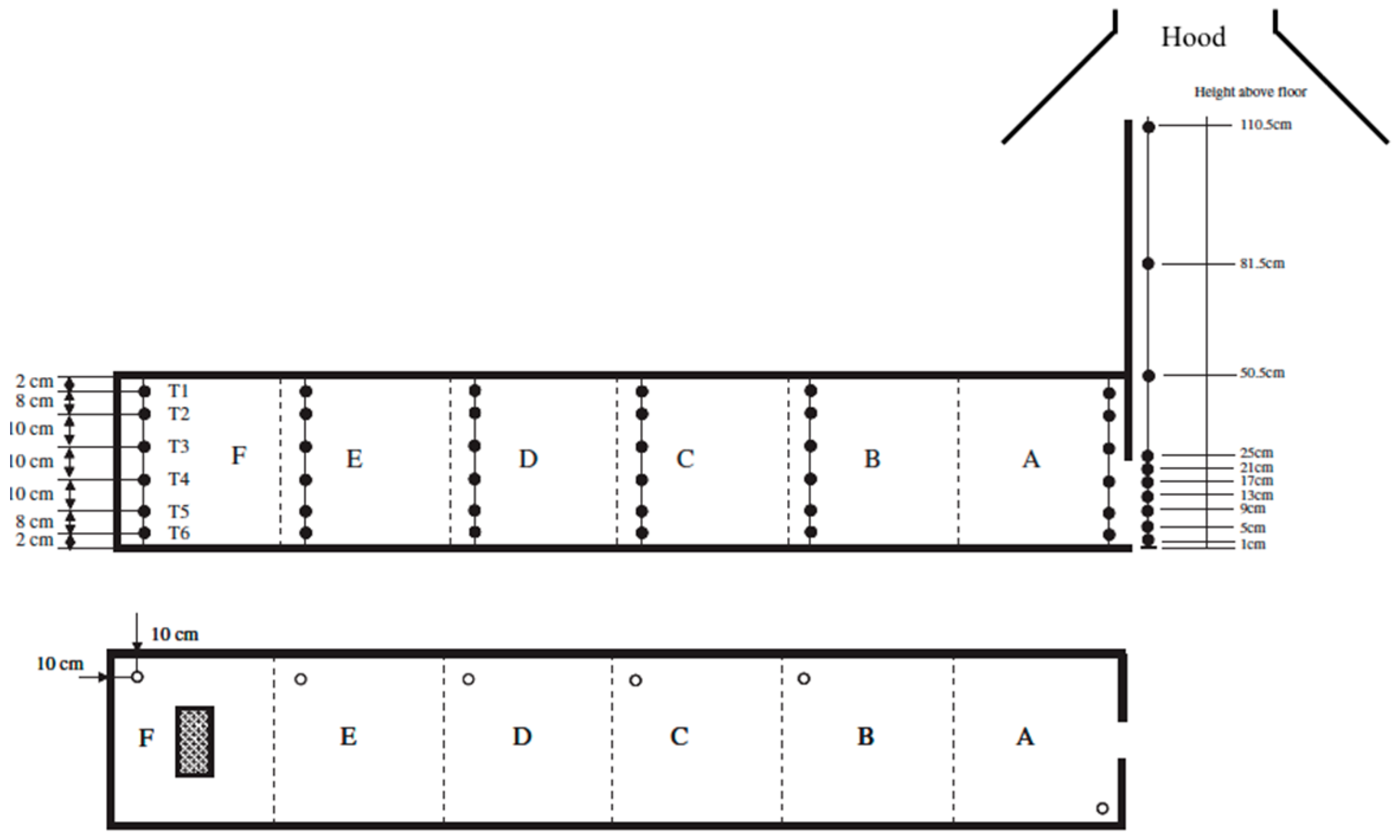
The experimental set-up [4], as shown in Figure 1, consists of a reduced-scale corridor-like enclosure (0.5 m × 3.0 m × 0.5 m), which is naturally ventilated via an open doorway (0.10 m × 0.25 m). The burner was positioned at the back of the corridor. The fuel flow rate was increased linearly for about 10 min after ignition until a theoretical heat release rate (that is the mass flow rate of the fuel multiplied by the heat of combustion) of 30 kW was reached. Then, the fuel supply rate was maintained constant up to about 37 min from ignition before stopping it to end the fire experiment. During the fire, the gas temperature was monitored at different positions inside and outside the corridor (see solid and open dots in Figure 1). The six cubic modules of 0.5 m each (of which the corridor is made) are hereafter called F to A, see Figure 1. As mentioned above, the combustion gases (O2, CO2, and CO) are analyzed and the actual HRR is estimated using calorimetry.

2.2. Results

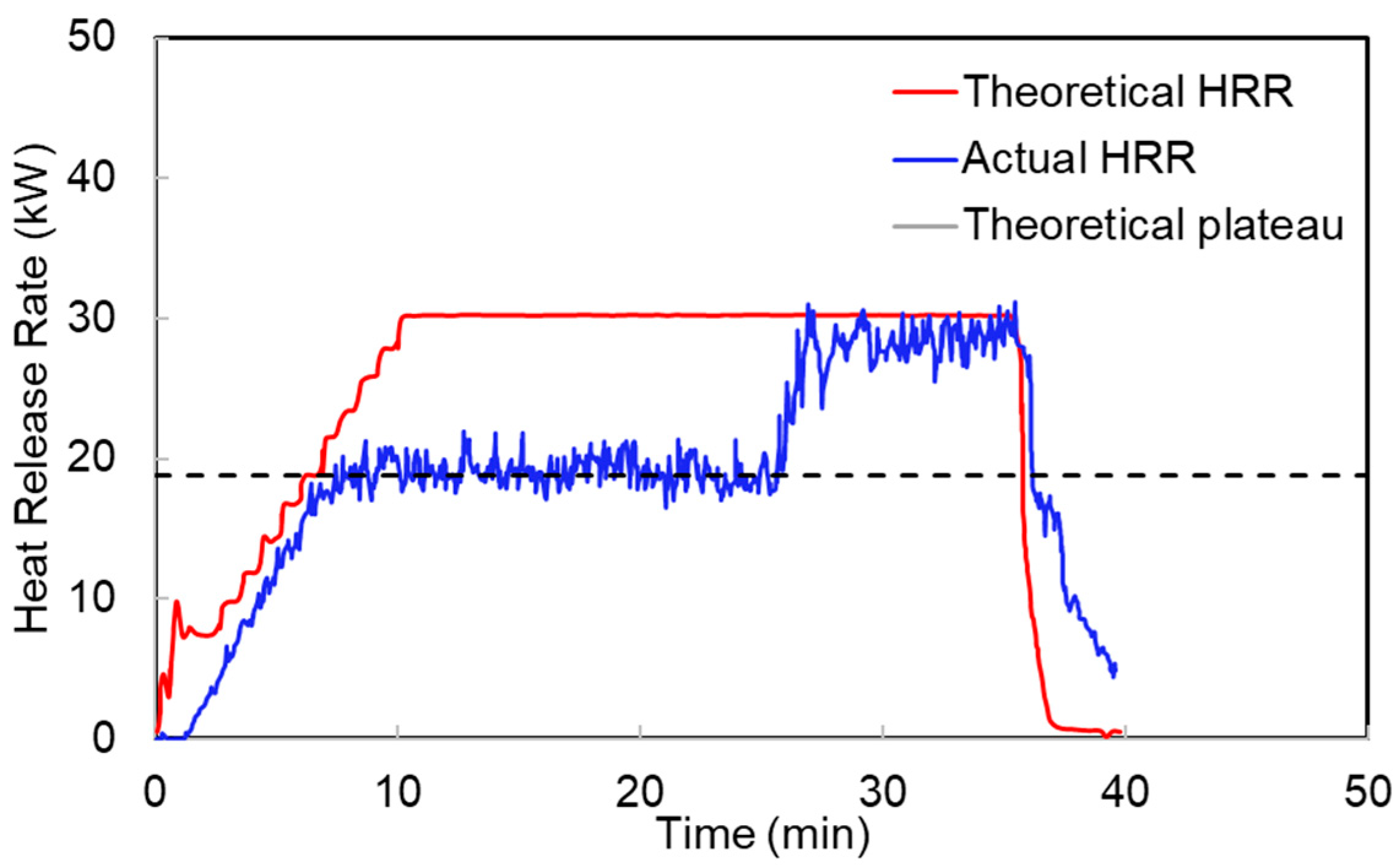
Figure 2 shows the temporal profile of the HRR measured with calorimetry, i.e., actual HRR, as opposed to that by multiplying the fuel mass flow rate by the heat of combustion, i.e., theoretical HRR. In the early initial transient stage, up to about 7 min after ignition, the actual HRR curve follows quite closely the theoretical HRR curve, except for the peak in the first minute. Nevertheless, there is a short delay of about one minute in the actual HRR measurements due to the transport time of the hot combustion products to the sample point. From about 7 min after ignition onwards, a plateau in the actual HRR is observed at a value Q ˙ i n = 18.75   k W that is significantly lower than the steady theoretical HRR of 30 kW. The difference indicates that there is a substantial amount of unburnt fuel. In fact, temperature measurements at several distances from the burner (that will be further analyzed hereafter) indicate that, during the plateau, the flame lifts off from the burner and travels, along with unburned fuel, all the way to the open doorway, seeking oxygen. At the end of the plateau, external flaming occurs. Thus, a fraction of the fuel is burning inside the enclosure, and the other fraction is burning outside. During the steady-state region between about 27 min and 37 min, the actual HRR is about 28.5 kW, as opposed to the theoretical 30 kW, indicating a combustion efficiency of about 95%. Finally, after completely shutting off the propane supply, it is observed that the actual HRR decays more slowly than the theoretical one due to the accumulation of some unburned fuel pockets that take time to burn outside the enclosure.
It is very interesting to note that the heat release rate within the enclosure, measured prior to external flaming, is in excellent agreement with the theoretical expression Q ˙ i n = 1500   A o H o where H o and A o are, respectively, the height and the area of the opening. The theoretical expression stems from the assumption of well-mixed conditions within the compartment, which can subsequently be characterized by an average temperature, T, corresponding to an average density ρ = ρ a m b · T a m b / T where the subscript ‘amb’ denotes ambient conditions. By writing the pressure profiles inside and outside the enclosure and obtaining the pressure difference causing the inflow of fresh air through the opening, one can estimate from orifice flow theory the maximum mass flow rate for the inflow of fresh air as:
m ˙ i n ,   a i r = 2 3 C d 2 g   ρ a m b   ρ a m b ρ / ρ a m b 1 + ρ a m b / ρ 1 / 3 3   A o H o
where C d is an orifice flow coefficient and g is the gravitational acceleration. The second square root term in Equation (1) is called the density factor, and it appears to have a maximum value of 0.21. By taking C d = 0.7 and   ρ a m b = 1.2   k g / m 3 , Equation (1) can be significantly simplified to:
m ˙ i n ,   a i r = 0.5   A o H o
where m ˙ i n , a i r is expressed in k g / s   and the ventilation factor A o H o is expressed in m 5 / 2 . Knowing that for most fuels the heat released H a i r = 3000   k J / k g a i r , the maximum heat release rate inside the enclosure is:
Q ˙ i n = 1500   A o H o .
In fact, very few experimental studies demonstrated and confirmed Equation (3). One reason could be that, in (nearly) cubic-like enclosures, external flaming occurs quickly and there is not enough time for a clear plateau of HRR inside the enclosure to be established. Subsequently, the distinction between the HRR inside and outside the enclosure could not be made. An alternative approach is to carry out CFD simulations to make such a distinction. The results reported in [9,10] and other references show that the proportionality coefficient in Equation (3) is lower than the theoretical value of 1500   k W / m 5 / 2 by about 25 to 45% in (nearly) cubic-like enclosures. This is generally explained by the fact that some of the fresh air flowing in the enclosure recirculates outside the enclosure without mixing with the unburned fuel. For the corridor-like enclosure fire studied here, the results imply a very good fuel-air mixing (near the opening and not throughout the whole compartment). Thus, it is of interest to see to what extent this behaviour is captured by CFD simulations.
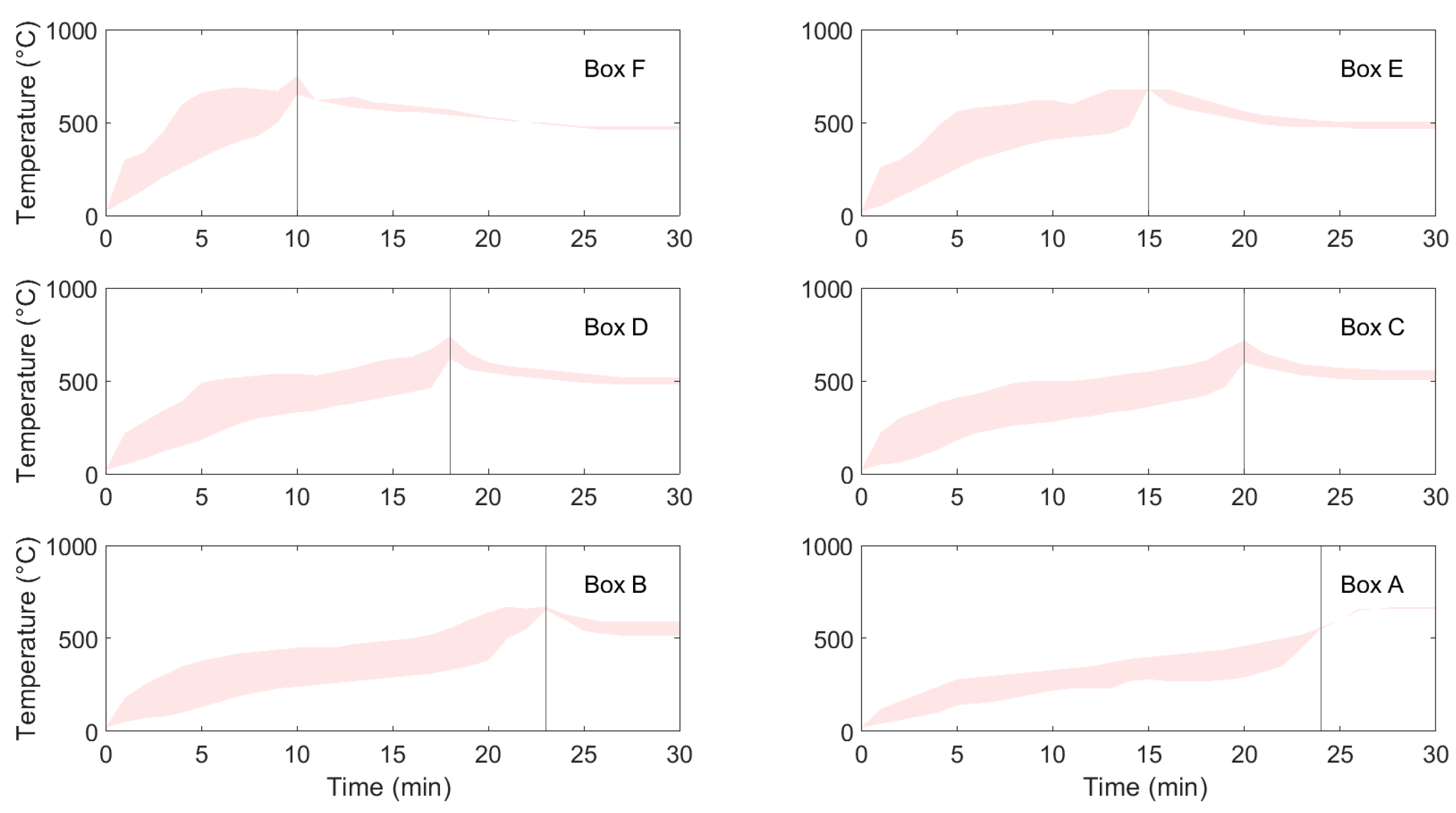
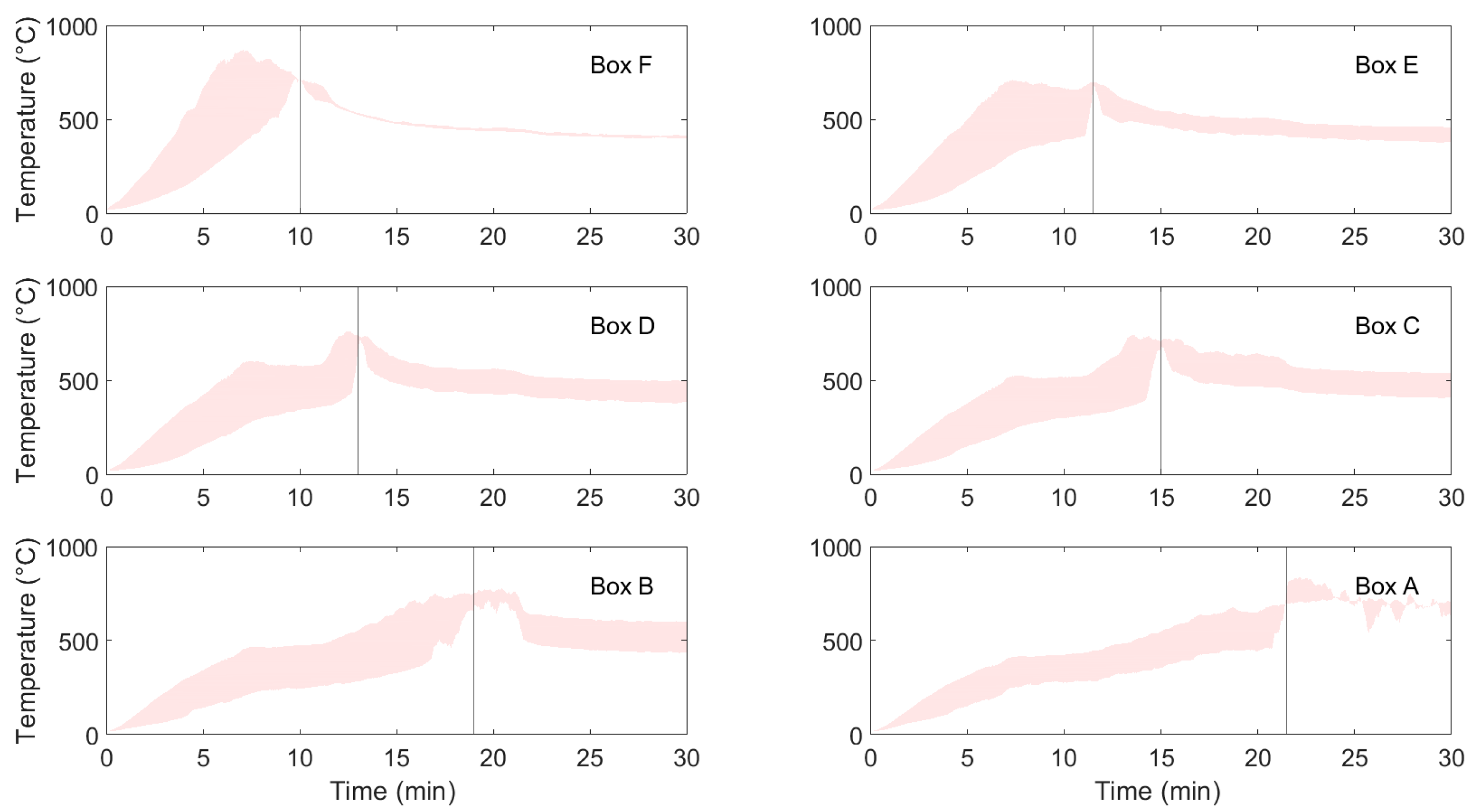
The gas temperature histories displayed in Figure 3 show that peak temperatures between 600 °C and 800 °C are indicative of flame presence.
Prior to reaching the peak, the flow is stratified, i.e., higher temperatures are recorded near the ceiling (with a temperature difference between ceiling and floor that could reach about 350 °C). After reaching the peak, the flow is well-mixed and the temperature difference between ceiling and floor does not exceed 70 °C. The peak temperatures from box F to box B occurred respectively at about 10 min, 15 min, 18 min, 20 min, and 23 min, which is indicative of a travelling flame at an initial velocity of about 0.10 m/min (from box F to E), which then increases to 0.17 m/min (from box E to D) and increases further to 0.25 m/min (from box D to C and box C to B).

3. CFD Modelling

The numerical simulations presented in this study have been carried out with the Fire Dynamics Simulator (FDS 6.9.1) [7,8]. A brief overview of the main model settings is provided in this section. All the default model settings have been used, unless specified otherwise. The reader is referred to [7,8] for more details.

3.1. Turbulence, Combustion, Thermal Radiation, and Heat Losses to the Boundaries

The treatment of turbulence is based on the default Very Large Eddy Simulation (VLES) option in FDS, using the Deardorff model for the sub-grid scale viscosity (with a constant equal to 0.1) and constant turbulent Schmidt and Prandtl numbers, S c t =   P r t = 0.5 .
A single-step global fast chemical reaction for combustion is used with prescribed constant carbon monoxide and soot yields of y C O = 0.05 and y s = 0.024 , respectively [13]. A sensitivity analysis on the soot and CO yields—using, for instance, a CO yield as high as y C O = 0.20 to account for underventilation effects—has shown that the impact on the flame behaviour (burning rate within the enclosure and occurrence time of external flaming) is limited.
Turbulent combustion is modelled using the Eddy Dissipation Concept (EDC) and is based on a reaction time scale model involving a chemical time scale, a diffusion time scale, a turbulent mixing time scale, and a time scale based on gravitational acceleration.
The radiation transport equation (RTE) is solved for optically thick conditions. Given that the flame structure and the flame temperatures are not captured accurately, the source term in RTE is adjusted to ensure that the radiative emission is a prescribed radiative fraction taken as χ R = 0.29 for propane [13]. The default number of radiation angles of 100 is used in the discretization for the Finite Volume Method (FVM)-based solution of the RTE.
The heat losses to the 2 cm thick boundaries (walls, ceiling, and floor) made of Fiberboard (ceramic fibre) are computed by solving a 1D heat conduction equation. The specified material properties are the following: the specific heat is c p = 1.04   k J / ( k g · K ) , the density is ρ = 128   k g / m 3 , and the thermal conductivity is k = 0.09   W / ( m · K ) for temperatures below 300 °C; then, it increases linearly up to 0.17 W/(m∙K) between 300 and 600 °C and up to 0.25 W/(m∙K) between 600 and 900 °C.

3.2. Extinction and (Re-)Ignition Modelling

A simple extinction model is used [7,8]. First, given that in practical fire simulations the details of the flame structure and the flame temperatures are not captured accurately, combustion is not suppressed if the cell bulk temperature is above a so-called ‘free burn temperature’, i.e., T ~ T F B . The default free-burn temperature is kept at T F B = 600   ° C . Extinction occurs if the cell bulk oxygen concentration is below a threshold. The latter is calculated as:
X O 2 , l i m T ~ = X O I T O I T ~ T O I T a m b
where X O I and T O I are the oxygen index concentration and the critical temperature, respectively. The corresponding values used for propane are X O I = 0.127 and T O I = 1447   ° C [7,8].
Additionally, combustion is allowed to occur only if the cell temperature is above the autoignition temperature (AIT). However, to circumvent the need to create an ignition source, the default AIT is set in FDS to −273 °C, which means that (re-)ignition occurs as soon as unburned fuel gas mixes with sufficient oxygen anywhere in the computational domain. Nevertheless, in under-ventilated compartment fires, this might lead to spurious re-ignition, as reported in [14,15] and as will be shown for the scenario at hand. Therefore, a sensitivity analysis will be carried out on AIT considering the default value, the actual value of propane, AIT = 450 °C, and other values. Ignition is subsequently modelled by prescribing a limited AIT exclusion zone [7,8] in which ignition occurs instantaneously. In the simulations at hand, the AIT exclusion zone is a volume that spans across 3 cm above the top surface of the burner.

3.3. Computational Domain, Meshing, and Fire Source Boundary Condition

The computational domain comprises the closed corridor-like enclosure and an extension downstream of the open doorway in the longitudinal and vertical directions (by 1.0 and 0.5 m, respectively) to properly solve the vent flow and the ejecting flame. The sides and the top of the extended domain are set to ‘OPEN’ (corresponding to a total pressure boundary condition).
A uniform structured mesh is used with cubic cells of 1 cm cell size. Parallel computing is used with 50 blocks of mesh (each with about 35,000 to 37,000 cells, leading to about 1.5 million cells). A mesh sensitivity study carried out in [11] including a 2 cm mesh showed that similar results are obtained. Nevertheless, the 1 cm mesh results are presented in this paper because the opening dimensions 0.10 m × 0.25 m are more accurately modelled.
The fire source boundary condition is prescribed by setting a theoretical Heat Release Rate Per Unit Area (HRRPUA), which corresponds to a prescribed fuel mass flux when dividing it by the heat of combustion.

4. Results

4.1. Flame Dynamics and HRR Prediction

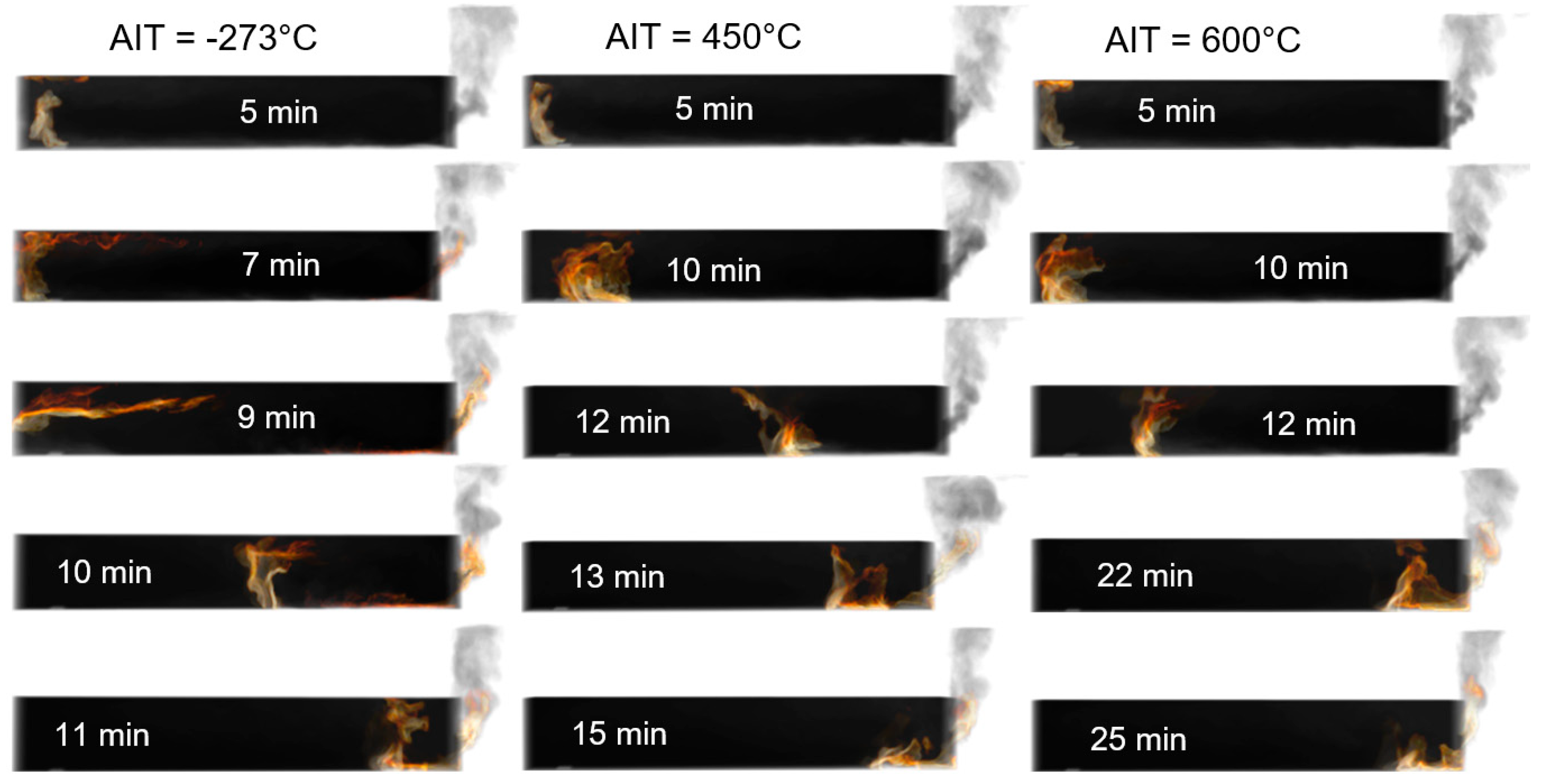
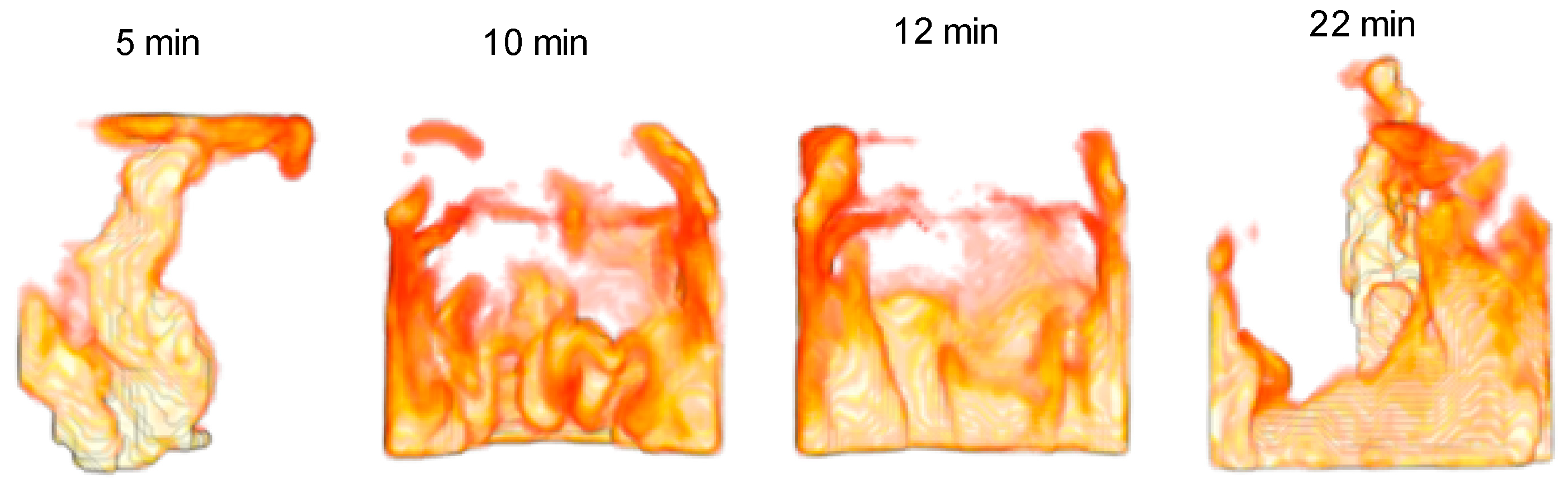
The visualization of flame dynamics is presented in Figure 4.
The results show that for AIT = −273 °C, at about 7 min from ignition, unburned fuel reached the opening where oxygen is available and started burning. Subsequently, there is an external flame at the opening, whereas at the closed end of the corridor, the main burning is taking place via a flame that was detached from the burner but leaning against the back wall. At about 9 min, due to vitiation, the latter flame started travelling towards the opening in a ‘ghosting’ manner until it became attached to the external flame at about 10 min via a (hardly noticeable) ‘trailing flame’ at the bottom of the enclosure near the opening, which corresponds to the inflow of fresh air (as will be further highlighted in Section 4.3). The early external flaming is considered as spurious burning and is attributed to the low autoignition temperature, AIT = −273 °C. Prescribing the actual autoignition temperature of propane, i.e., AIT = 450 °C improves the results in that early external flaming is prevented, as shown in Figure 4 (centre) at 5, 10, and 12 min from ignition. In fact, Figure 4 shows that, for AIT = 450 °C, external flaming occurs at about 13 min from ignition. From that time onwards, the flame inside the corridor is anchored near the opening and attached to the external flame. Nevertheless, external flaming occurs at 13 min from ignition, which is significantly earlier than in experimental test, i.e., 26 min from ignition. Further increasing AIT to 600 °C leads to similar flame dynamics as for AIT = 450 °C, except that the travelling flame is slower and, therefore, external flaming occurs later at about 22 min from ignition, which is significantly closer to the experimental observation. This increase in the AIT beyond the actual value of AIT = 450 °C should be viewed as a model calibration rather than a model prediction. From a numerical perspective, increasing the AIT is due to modelling approximations. For example, the extinction criterion in Equation (3) relies on a cell-averaged temperature and not on well-resolved flame structure details and flame temperature. An overestimation of T ~ leads to an underestimation of X O 2 , l i m , i.e., less stringent criterion for extinction, and thus, potential spurious (re-)ignition. This can be compensated for by increasing the AIT, i.e., more stringent criterion for (re-)ignition.
The flame visualization displayed in Figure 5 shows that, at about 10 min from ignition, the flame starts to fill the cross section of the corridor by remaining attached to the side walls and the floor, which confirms that the thermocouple trees positioned near the walls (see Figure 1) record the flame temperature.
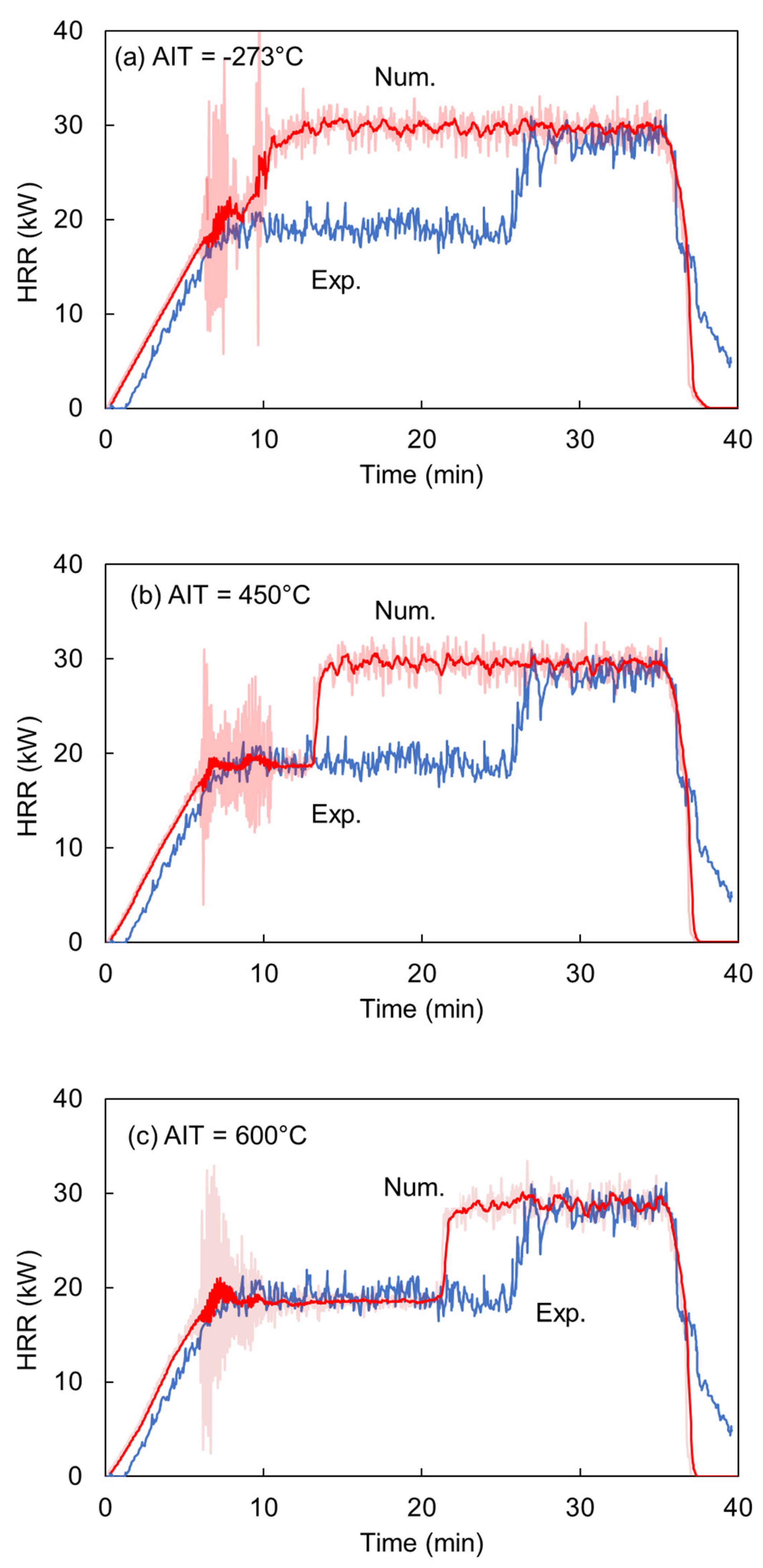
The HRR predictions displayed in Figure 6 confirm the flame dynamics described in Figure 4. Prescribing the default autoignition temperature results in a substantial deviation in the predicted temporal profile of the HRR. More specifically, the plateau Q ˙ i n = 1500 A o H o = 18.75   k W during the ventilation-controlled stage is not captured. The spurious and too early unburned fuel re-ignition near the opening keeps the predicted HRR close to the prescribed HRR, as it would be the case for a fuel-controlled enclosure fire. Prescribing the actual autoignition temperature of propane, AIT = 450 °C, significantly improves the HRR predictions, by capturing the plateau during the ventilation-controlled stage with an excellent agreement. This is in line with the predicted flow rate of fresh air within the enclosure, which is nearly exactly equal to the theoretical value m ˙ i n ,   a i r = 0.5   A o H o . Nevertheless, the occurrence time of external flaming is significantly underpredicted. As mentioned above, it is improved by setting AIT = 600 °C. Additionally, Figure 6 shows significantly large oscillations (which have been time-averaged every 24 s to improve readability) when capturing numerically the onset of the HRR plateau, which highlights some numerical ‘difficulties’ (albeit the success) in reaching the correct prediction. The numerical stability of the simulations is ensured by setting a CFL number between 0.8 and 1.0 and setting the time step accordingly.
It is important to mention that increasing the autoignition temperature, as a ‘calibration exercise’ to AIT = 600 °C, which is beyond the actual value for propane, i.e., AIT = 450 °C, has been necessary to improve the agreement between the CFD simulations and experimental measurements and observations (especially for the time of occurrence of external flaming; the HRR plateau has been well captured with AIT = 450 °C). This is believed to be due to the fact that the mixing and chemical reaction time scales are not well-captured at the level of the CFD cell. However, more in-depth and fundamental work is required to understand this behaviour. Finally, it is of interest to mention that, as reported in [11] for the simulations with AIT = 450 °C, the 2 cm mesh yields similar results to the 1 cm mesh, with a HRR plateau that is 7% higher and an external flaming that occurs about 1 min later in the 2 cm mesh.

4.2. Temperature Predictions

The predicted gas temperature histories are displayed in Figure 7. Figure 7 shows that temperature predictions present the overall main features observed in the experiments. Nevertheless, after reaching the peak (between 600 °C and 800 °C as in the experiments), the flow is slightly less mixed than in the experiments as the temperature difference between ceiling and floor can reach 160 °C, whereas it does not exceed 70 °C in the experiments. A more substantial difference between the simulation and the experimental test lies in the travelling flame velocity (estimated from temperature measurements, as explained earlier).
Table 1 shows that in the experimental test, the travelling flame accelerates until reaching a steady velocity of 0.25 m/min when reaching box D. However, in the simulation, the flame velocity is significantly overestimated at first before being underestimated when getting closer to the opening. Therefore, although the overall travel time is reasonably well-predicted, the dynamics of the travelling flame are not accurately captured. It is difficult at this stage to identify a specific modelling limitation but, most likely, combustion and extinction modelling play a major role here.

4.3. Flow Field and Species Distribution Predictions

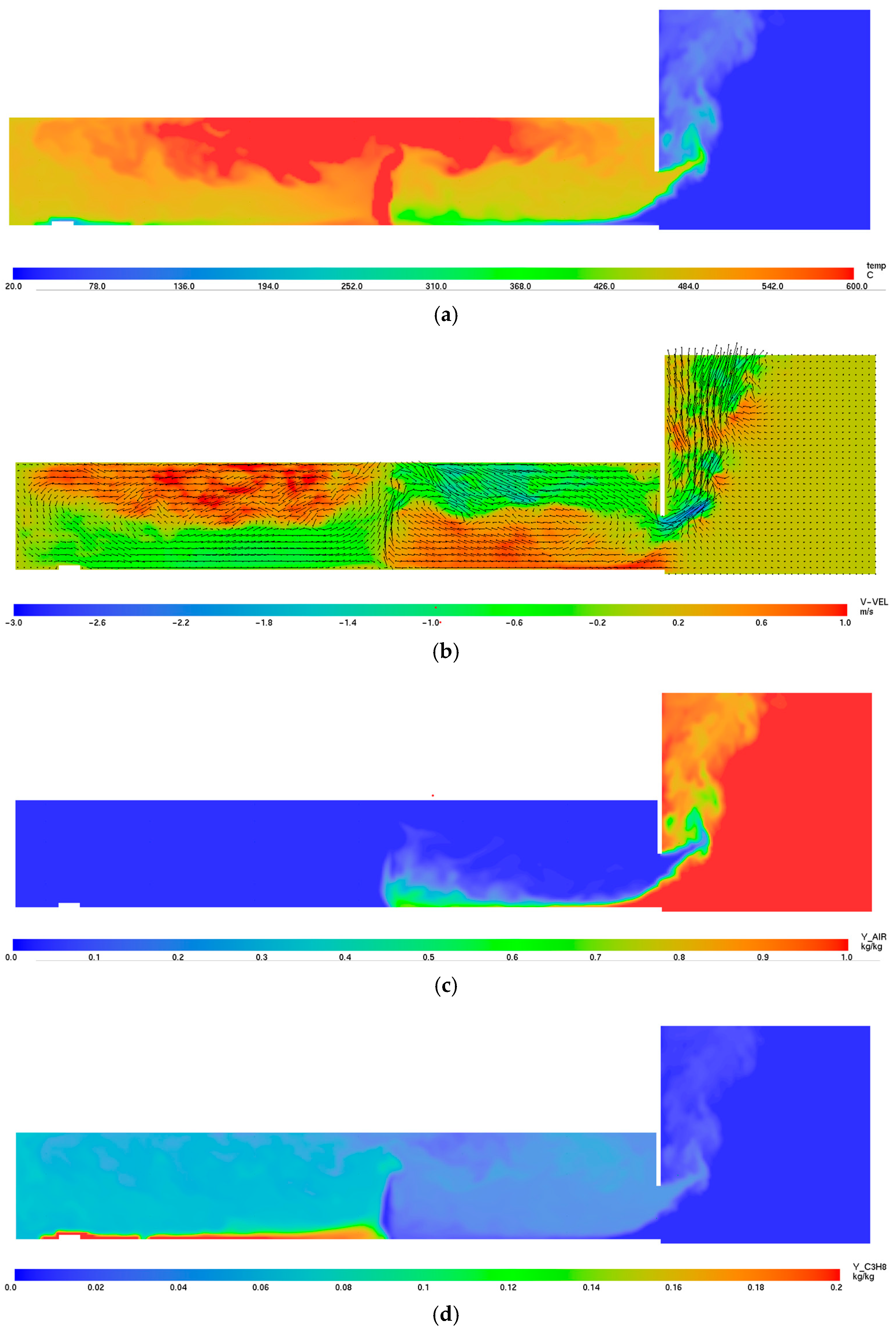
Figure 8 shows a snapshot at t = 900 s of the temperature, the velocity vectors (horizontal component normal to the vertical opening), fuel mass fraction and air mass faction for the simulation with AIT = 600 °C.
In Figure 8a, one can visualize the flame front position at about the middle of the corridor from the high temperature ‘column’ spanning from floor to ceiling. This result confirms the statement made in [5] and which highlights the importance of calling the phenomenon of interest here ‘travelling flame’ and not a ‘ghosting flame’. While a ghosting flame also typically detaches from the initial fuel source, it does not remain anchored to the floor as shown here from the temperature distribution, as well from the flame visualization in Figure 4. Despite the relatively good mixing, one can clearly distinguish a higher temperature upper layer zone with T 600   ° C above a lower layer with temperatures below 600 °C. The flow field displayed in Figure 8b shows that, for the upper layer some of the hot combustion products are flowing (to the right) towards the opening and leaving the enclosure, whereas the other part is flowing towards the back of the corridor within a recirculation zone between the flame front and the closed end of the corridor. The flow field (Figure 8b) in combination with the distribution of fresh air (Figure 8c) and the distribution of the fuel (Figure 8d) shows that fresh air reaches the flame front by flowing in the enclosure through the opening and remaining very close to the floor (which leads to the ‘trailing flame’ mentioned above). Furthermore, the recirculation zone between the flame front and the closed end of the corridor contains no fresh air but propane at high concentrations near the floor and lower concentrations further above because it is mixed with hot combustion products. Finally, Figure 8d shows, between the flame front and the opening, fuel concentrations around 4% (by mass) and which have not completely burned.

5. Conclusions

The reduced-scale experimental compartment fire test simulated in this study is part of a comprehensive campaign described in [3,4,5] and aimed at characterizing the fire dynamics inside and outside the enclosure using oxygen calorimetry, thermocouples, heat flux metres, a video camera, etc. Several parameters were varied such as the position of the burner, the fuel supply rate, the length of the enclosure, and the dimensions of the vertical opening. Therefore, a wide variety of fire scenarios have been observed, e.g., in [4]. The use of a gas burner as a fire source makes these tests suitable for CFD validation, allowing to focus on combustion and extinction modelling and avoiding the need to deal with modelling difficulties that are inherent to condensed fuels, such as the pyrolysis/evaporation process and the radiative heat feedback effect. Nevertheless, numerical simulations of these tests remain scarce. The intent here is to initiate a large validation study of this campaign with the current state-of-the-art CFD tools to highlight potential modelling limitations and foster improvement in accuracy and reliability.
The experimental test case considered in this study is that of a corridor-like enclosure with a narrow vertical opening that leads to under-ventilated conditions [4]. The gaseous burner is positioned at the back of the corridor. Simulations were carried out with the Fire Dynamics Simulator (FDS) using most of its default modelling options for turbulence, combustion, extinction, and thermal radiation. It appears that most of these default options, particularly the rather ‘basic’ models (in comparison to more advanced models available in the literature) for combustion and extinction, were sufficient to capture the rather complex flame dynamics observed experimentally. Due to limited oxygen supply, the flame lifts off the burner and travels towards the opening along with unburned fuel. During the flame travel, a quasi-steady state plateau is established and the HRR within the enclosure is equal to the theoretical value Q ˙ i n = 1500   A o H o where A o H o is the ventilation factor. About half an hour after ignition, external flaming occurs. It is found that the HRR plateau is relatively well captured by FDS if the autoignition temperature is raised from the default value of −273 °C to the actual autoignition temperature of propane that is 450 °C. The numerically predicted maximum inflow of fresh and the subsequent maximum HRR inside the enclosure are in excellent agreement with theoretical and experimental values, albeit some strong numerical oscillations at the onset of the plateau. However, the occurrence time of external flaming remains significantly underestimated with AIT = 450° C but is better predicted by setting AIT = 600 °C. This aspect of the modelling, linked to extinction and (re-)ignition, remains to be investigated in the future. Therefore, the simulations are not fully predictive in that the autoignition temperature was tuned a posteriori. More work is required to provide guidance on the choice of this parameter.

Author Contributions

Conceptualization, T.B.; methodology, T.B.; validation, T.B. and O.K.; formal analysis, T.B. and O.K.; investigation, T.B. and O.K.; writing—original draft preparation, T.B.; writing—review and editing, T.B. and O.K.; supervision, T.B.; project administration, T.B. All authors have read and agreed to the published version of the manuscript.

Funding

This research received no external funding.

Data Availability Statement

Data is available upon request.

Acknowledgments

The authors would like to thank the high-performance computing team of Ghent University.

Conflicts of Interest

The authors declare no conflicts of interest.

Abbreviations

The following abbreviations are used in this manuscript:
AITAutoignition temperature
CFDComputational fluid dynamics
EDCEddy dissipation concept
FVMFinite volume method
HRRHeat release rate
HRRPUAHeat release rate per unit area
RTERadiation transport equation
VLESVery large eddy simulation

References

  1. Steckler, K.D.; Quintiere, J.G.; Rinkinen, W.J. Flow induced by fire in a compartment. Symp. (Int.) Combust. 1982, 19, 913–920. [Google Scholar] [CrossRef]
  2. Lafdal, B.; Mehaddi, R.; Boulet, P.; Koutaiba, E.; Beji, T. Oscillatory burning regime in a gas-fueled compartment fire. Fire Saf. J. 2024, 142, 104045. [Google Scholar] [CrossRef]
  3. Lee, Y.P.; Delichatsios, M.A.; Silcock, G. Heat Fluxes and Flame Heights in Façades from Fires in Enclosures of Varying Geometry. Proc. Combust. Inst. 2007, 31, 2521–2528. [Google Scholar] [CrossRef]
  4. Beji, T.; Ukleja, S.; Zhang, J.; Delichatsios, M.A. Fire behaviour and external flames in corridor and tunnel-like enclosures. Fire Mater. 2012, 36, 636–647. [Google Scholar] [CrossRef]
  5. Ukleja, S.; Delichatsios, M.A.; Zhang, J.; Suzanne, M. Carbon monoxide production during underventilated fires in corridors. Fire Saf. Sci. 2014, 11, 316–330. [Google Scholar] [CrossRef]
  6. Lewis, M.J.; Moss, J.B.; Rubini, P.A. CFD Modelling of Combustion and Heat Transfer in Compartment Fires. Fire Saf. Sci. 1997, 5, 463–474. [Google Scholar] [CrossRef][Green Version]
  7. McGrattan, K.; Hostikka, S.; Floyd, J.; McDermott, R.; Vanella, M.; Mueller, E.; Paul, C. Fire Dynamics Simulator User’s Guide (1019, Sixth ed.) NIST Special Publication 10.6028/NIST.SP.1019. 2025. Available online: https://pages.nist.gov/fds-smv/ (accessed on 15 February 2026).
  8. McGrattan, K.; Hostikka, S.; Floyd, J.; McDermott, R.; Vanella, M.; Mueller, E.; Paul, C. Fire Dynamics Simulator Technical Reference Guide Volume 1: Mathematical Model (1019, Sixth ed.) NIST Special Publication 10.6028/NIST.SP.1018. 2025. Available online: https://pages.nist.gov/fds-smv/ (accessed on 15 February 2026).
  9. Zhao, G.; Beji, T.; Merci, B. Application of FDS to Under-Ventilated Enclosure Fires with External Flaming. Fire Technol. 2016, 52, 2117–2142. [Google Scholar] [CrossRef]
  10. Lafdal, B.; Djebbar, R.; Boulet, P.; Mehaddi, R.; Koutaiba, E.; Beji, T.; Torero, J.L. Numerical study of the combustion regimes in naturally-vented compartment fires. Fire Saf. J. 2022, 131, 103604. [Google Scholar] [CrossRef]
  11. Khayyat, O. Numerical Simulations of Corridor-like Enclosure Fires. Master’s Thesis, Ghent University, Ghent, Belgium, 2024. Available online: https://lib.ugent.be/fulltxt/RUG01/003/213/075/RUG01-003213075_2024_0001_AC.pdf (accessed on 15 February 2026).
  12. Beji, T. Modelling challenges of peculiar compartment fire dynamics. In Proceedings of the International Fire Safety Symposium (IFireSS 2025), Belfast, UK, 25–27 June 2025. [Google Scholar]
  13. Tewarson, A. Generation of heat and chemical compounds in fires. Section 3, (Chapter 3)-4. In SFPE Handbook of Fire Protection Engineering, 3rd ed.; DiNenno, P.J., Ed.; National Fire Protection Association (NFPA): Quincy, MA, USA, 2002. [Google Scholar]
  14. Sikanen, T.; Hostikka, S. Predicting the heat release rates of liquid pool fires in mechanically ventilated compartments. Fire Saf. J. 2017, 91, 266–275. [Google Scholar] [CrossRef]
  15. Hong, M.C.; Merci, B.; Beji, T. On the use of natural and forced convection correlations in predictive CFD simulations of liquid pool fires. Fire Saf. J. 2023, 137, 103765. [Google Scholar] [CrossRef]
Figure 1. Experimental set-up [4]: side view (top) and top view (bottom). The white circles represent the locations of the thermocouple trees inside the enclosure. The black circles represent the positions of the thermocouples. The filled rectangle in box F represents the burner.
Fire 09 00091 g001
Figure 2. HRR results [4]. The dashed line represents the theoretical plateau, Equation (3).
Fire 09 00091 g002
Figure 3. Experimental temperature evolution profiles inside the enclosure from the box F (at the back where the burner is located) to box A (at the front where the opening is located) [4], including the range of values from floor to ceiling. Vertical lines denote the time at which the peak temperature is reached.
Fire 09 00091 g003
Figure 4. Visualization of the simulated compartment fire dynamics: AIT = −273 °C (left), AIT = 450 °C (centre), and AIT = 600 °C (right) (flame rendered by Smokeview using a 200 kW/m3 cut-off for fire colouring).
Fire 09 00091 g004
Figure 5. Visualization of the flame in the transversal direction of the corridor for AIT = 600 °C.
Fire 09 00091 g005
Figure 6. HRR predictions for (a) AIT = −273 °C, (b) AIT = 450 °C, and (c) AIT = 600 °C.
Fire 09 00091 g006
Figure 7. Numerical predictions of the temporal profiles of temperature for AIT = 600 °C. Vertical lines denote the time at which the peak temperature is reached.
Fire 09 00091 g007
Figure 8. Snapshot at 15 min from ignition of the predicted (a) temperature, (b) horizontal velocity, (c) air mass fraction, and (d) fuel mass fraction at the centerline using AIT = 600 °C.
Fire 09 00091 g008
Table 1. Travelling flame velocity results (exp. vs. num. with AIT = 600 °C).
F to EE to DD to CC to B
Exp. v f [m/min]0.100.170.250.25
Num. v f [m/min]0.330.330.250.13
ε [%]230940−48
Disclaimer/Publisher’s Note: The statements, opinions and data contained in all publications are solely those of the individual author(s) and contributor(s) and not of MDPI and/or the editor(s). MDPI and/or the editor(s) disclaim responsibility for any injury to people or property resulting from any ideas, methods, instructions or products referred to in the content.