
Communication

Observations of Vorticity-Driven Lateral Spread in a Wildfire
Bushfire Research Group, School of Science, University of New South Wales, Canberra, ACT 2600, Australia
Submission received: 31 December 2025 / Revised: 3 February 2026 / Accepted: 5 February 2026 / Published: 10 February 2026
(This article belongs to the Topic Disaster Risk Management and Resilience)

Abstract

Video footage of a recent California wildfire confirmed that dangerous fire spread can lead to unsurvivable foreground conditions. This process thus needs enhanced awareness across the wildfire sector. The fire moved sideways, downwind of a ridgeline, and formed dense, rapidly spreading spot-fires. Effective lateral rates-of-spread up to 20 km h−1 were measured. This is discussed in detail. A HPWREN camera system was installed on Santiago Peak in California. The Airport Fire, on two consecutive days, burned past the cameras by means of vorticity-driven lateral spread (VLS). This provided the most complete sets of time-series observations of VLS on a landscape-scale. Some remarkable measurements are derived from the observations. The overall lateral rate-of-spread averaged at 1.9 km h−1. Around plume touch-down events, that speed rose to 4 km h−1, but also peaked at 20 km h−1. The effective downwind spread of the overall fire envelope was 45 km h−1. A major spot-fire had a slope-affected headfire rate-of-spread of 15 km h−1 (equivalent to c. 2 km h−1 on flat ground) and a burn rate of 60 ha h−1. The implications for fireground safety are extreme. An emphasis must be placed on predicting these events, as any burnover entrapments may well be unsurvivable. Avoiding a burnover requires good predictive capability, and observations such as these are critical for calibration.

1. Introduction

It has been shown [1] that fire entering a lee-slope eddy wind can lead to catastrophic fire escalation if wind speeds exceed roughly 25 km h−1, as required for the development of the eddy, and if fine fuels are dry enough to support the ready setting of spot-fires. This process, called Vorticity-driven Lateral Spread (VLS) produces a rapid lateral fire rate-of-spread (ROS), while spot-fires also occur for kilometres downwind. This form of fire behaviour greatly increases risks to fire crews and to the local community. Recent retrospective analyses implicate VLS in a number of significant past fires, such as the Mann Gulch Fire (5 August 1949, at −111.9°, 46.9°; [2]) and the Yarnell Hill Fire (30 June 2013, at −112.6°, 34.7°; [3]) in the US and the Linton fire in Australia (2 December 1998, at 143.6°, −37.7°; [4]).
VLS has been studied in the field [5,6], in the laboratory [7] and in modelling [8]. There remains considerable uncertainty about the exact behaviour of such fire events. HPWREN hilltop fire cameras in California made detailed close-up time-lapse video observations of VLS on two consecutive days—one downwind and one upwind of the cameras. The latter allowed for the unprecedented, detailed parameterisation of VLS behaviour. As it should not be assumed that this fire was fully typical, more such observations are required. However, these observations clarify just how dangerous VLS can make a fire.

2. Methods

This study relied on HPWREN imagery. The High-Performance Wireless Research and Education Network (HPWREN) functions as a collaborative cyberinfrastructure on research, education, and public safety activities. The network supports range of goals, including public safety. This network includes the cameras used here.
The metadata for the main video (10_W_Q4.mp4 in the Supplementary Materials) are as follows (HPWREN, available online https://www.youtube.com/watch?v=uPeYinh0ovY, accessed on 1 February 2026). Date: 10 September 2024; Time (Pacific Time, UTC—7 h): 09:00 to 12:00; Camera: West, Colour. Frames from the video were analysed against topographic information on the area, using Santigo 1:24,000 Topographic Map, from USGS (https://store.usgs.gov/).
The following terms were used to describe VLS dynamics:
Lee-Slope Eddy Wind—A wind vortex formed where terrain drops away past a ridgeline faster than the prevailing surface air flow can respond. The surface wind direction within the eddy is upslope.
Lateral Motion—Movement parallel to the ridgeline VLS process, and broadly normal to the prevailing wind.
Flow Separation Line (FSL)—The ridgetop line where prevailing winds separate from the surface and meet lee-slope eddy winds.
Lateral Jet—A finger of fire moving laterally within the FSL.
Fire Envelope—A line drawn around all areas that are part of the main fire and areas that are primarily involved in merging spot-fires. Spot-fires may burn in the prevailing winds or the lee-slope eddy winds. All areas within the envelope are part of a unified convective plume.
All spatial analyses were conducted using MapInfo Pro V17.0.

2.1. The Fire

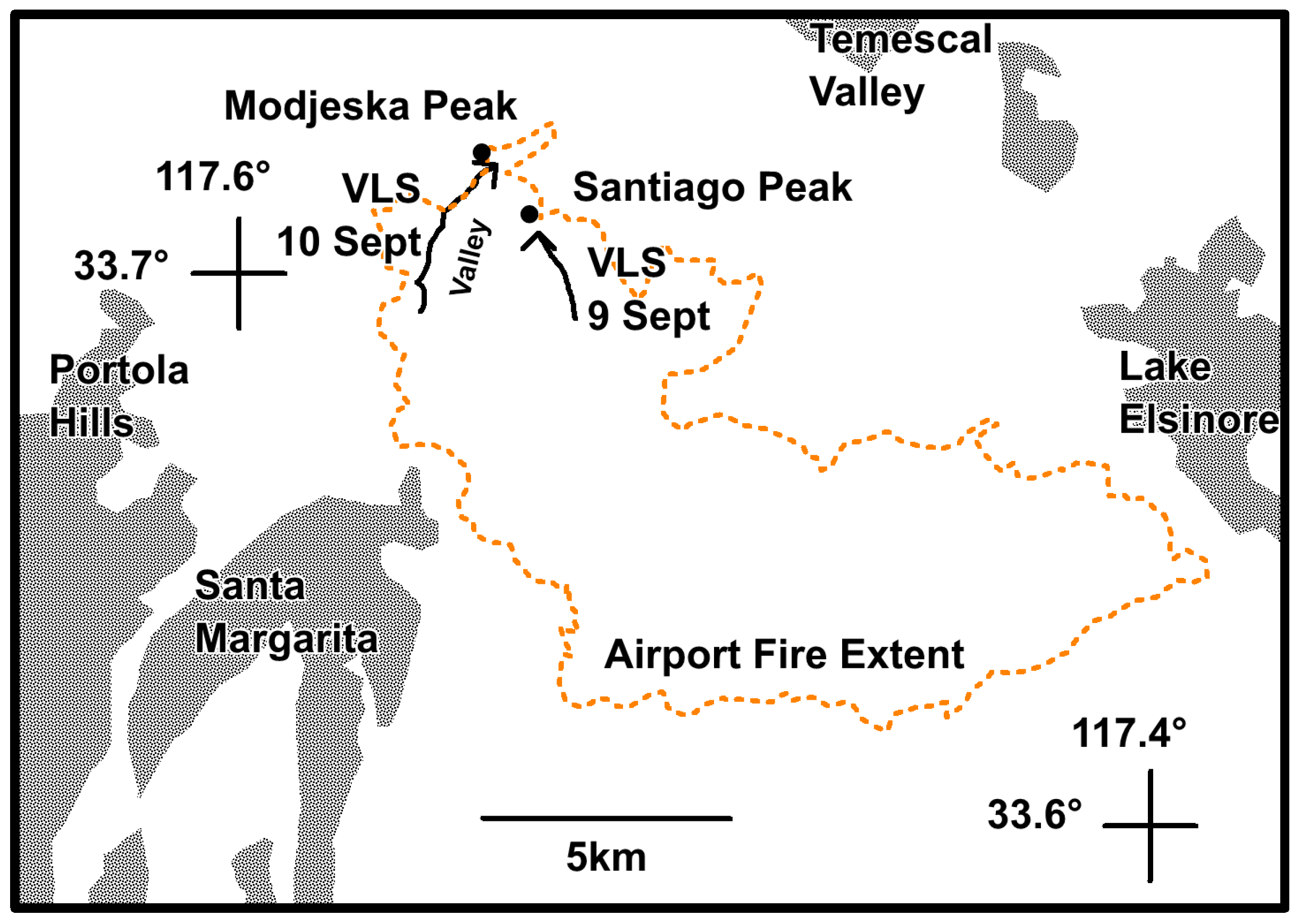
The Airport Fire started on 9 September 2024 and consumed 23,500 ha (Cal Fire web site, https://www.fire.ca.gov/incidents/2024/9/9/airport-fire/, accessed on 16 July 2025). It burnt towards the Santiago Peak fire cameras on the 9th from the SSE and from the SW on the 10th (see Figure 1).
In Figure 1, the final fire edge NW of Santiago Peak coincides with where the extreme fire behaviour due to VLS was recorded. This confirms the claim that the events described here are due to VLS, and not to fire crossing the ridgeline from upwind, out of sight of the cameras.

2.2. The Cameras

The four cameras, operated by the HPWREN system, are wide-angled (approximately 45° radii) and face the cardinal compass points on a common tower. Three-hour sequences are stored for each camera, with an image being produced every minute. All imagery timestamps are in Pacific Time. Other HPWREN cameras in the region did not resolve the VLS process.

2.3. The Burn Past

West-facing video of the VLS event upwind on 10 September 2024 supported measurement of the lateral ROS of the leading edge of the VLS event over 80 min. This record is unprecedented. This recorded its spread up the valley to the Peak through VLS on the ridgeline opposite the camera and onto slopes directly below the camera.

2.4. Photogrammetry

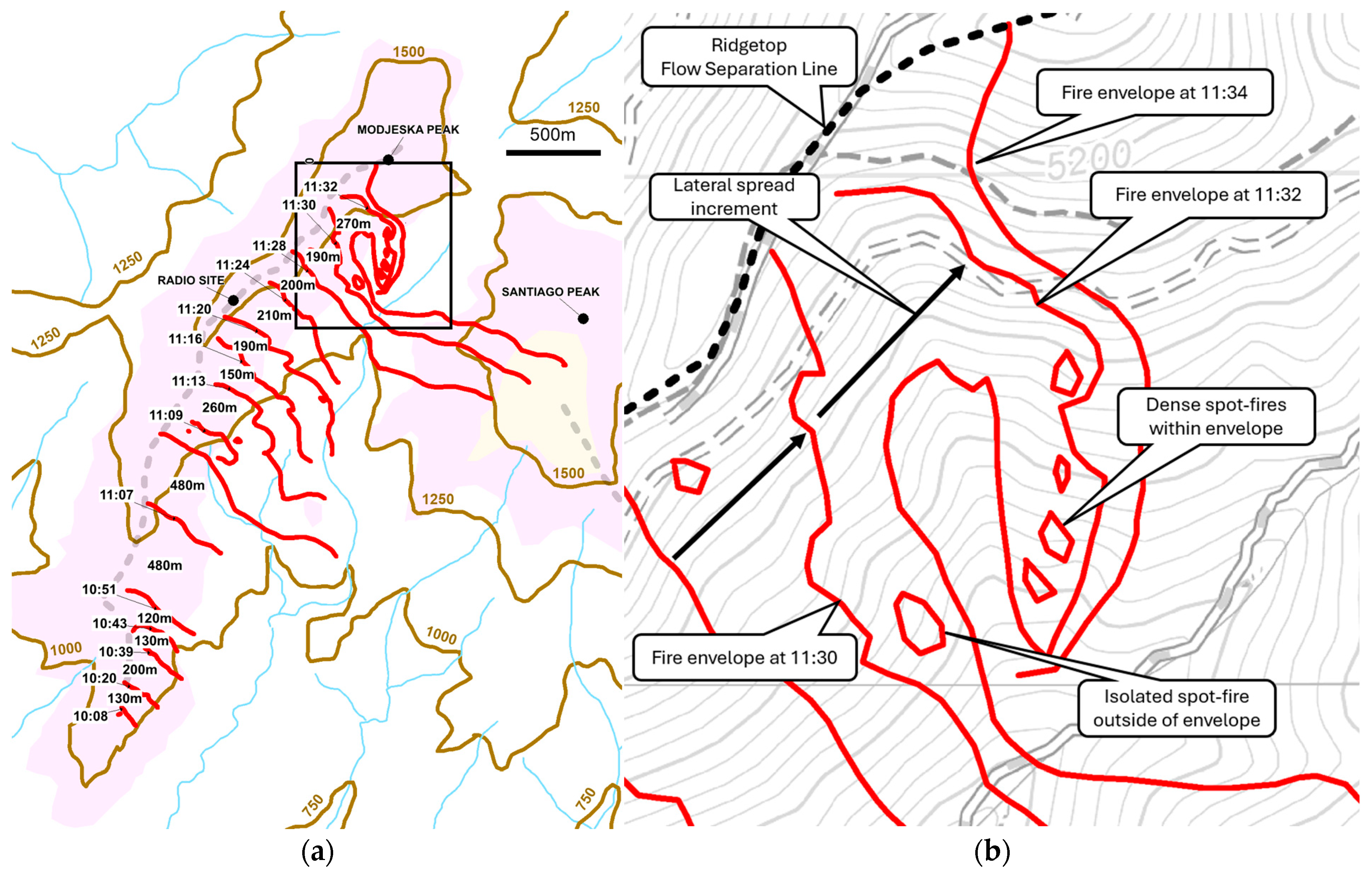
Isochrones visible in video frames were digitised onto topographic mapping using ground features and image geometry—see Figure 2. This allowed the FSL lateral spread rate to be quantified. The terrain’s relative position was also quantified.

3. Results

3.1. Overall

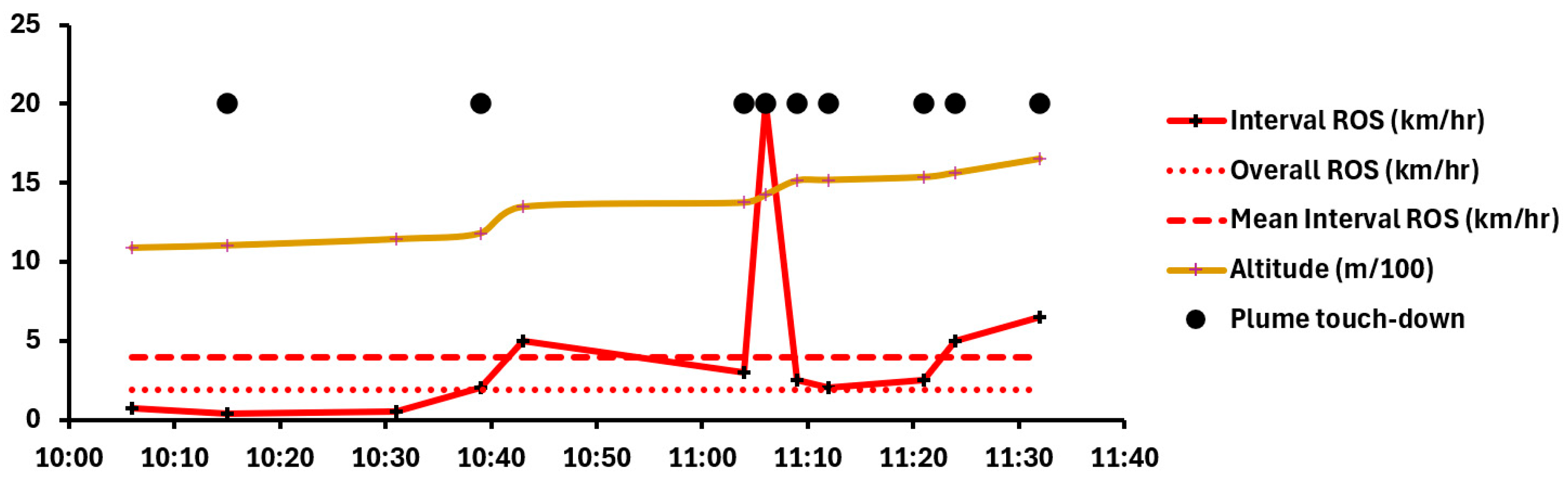
The following key photogrammetric measurements were made (Figure 3):
  • At around 10:40, a steep uphill run on the ridgeline accelerated the lateral spread. At that point, average speed rose from 0.7 km h−1 to around 2 or 3 km h−1.
  • At around 11:00, the elevation of the terrain on the eastern (camera) side of Santiago Creek rose to exceed that of where the VLS event was unfolding (Figure 2a). This facilitated its interaction with the plume.
  • A major lateral ROS spike—to 20 km h−1—occurred around 11:07, apparently due to spot-fire-merging affected by a confluence of events, including steep uphill runs, terrain rise, and a major plume touch-down depositing embers.
  • After 11:20, the climb onto Modjeska Peak caused another major rise in lateral ROS.
  • The overall lateral ROS was 1.9 km h−1.
  • The average of observed ROS values around plume touchdowns was 4 km h−1.
  • In fire-fighter safety terms in a burnover situation, if an unexpected VLS event was moving dense spotting close to crews operating in a sector, there would likely be insufficient time to assess the threat and react to it.

3.2. Fire Approach to the Camera

Observations of the fire’s approach to the camera were also possible.
  • It appears that a plume touch-down at 11:29 caused short-range spotting in the lee-eddy and also longer-range spotting onto the slope near the camera, which was subject to prevailing winds.
  • Within 1 min there were multiple established spot-fires.
  • This means that the fire-envelope spread downwind by 1.5 km in 2 min, equivalent to 45 km h−1. In fire-fighter safety terms, in a burnover situation, it would not be possible to escape such a fire approach.
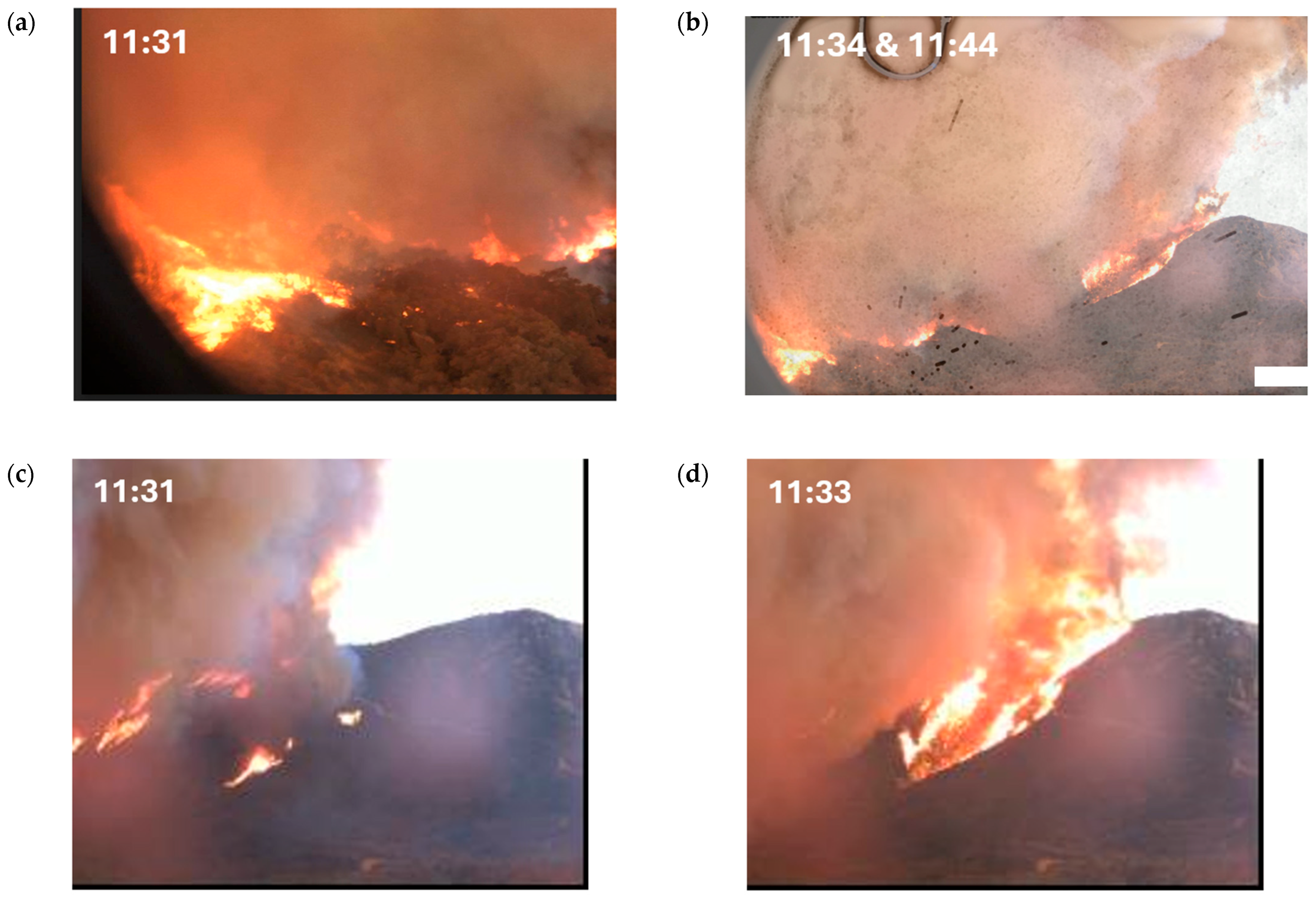
  • At 11:31, fire was spreading close to the camera by short-range spotting (Figure 4a).

3.3. Impact near the Camera

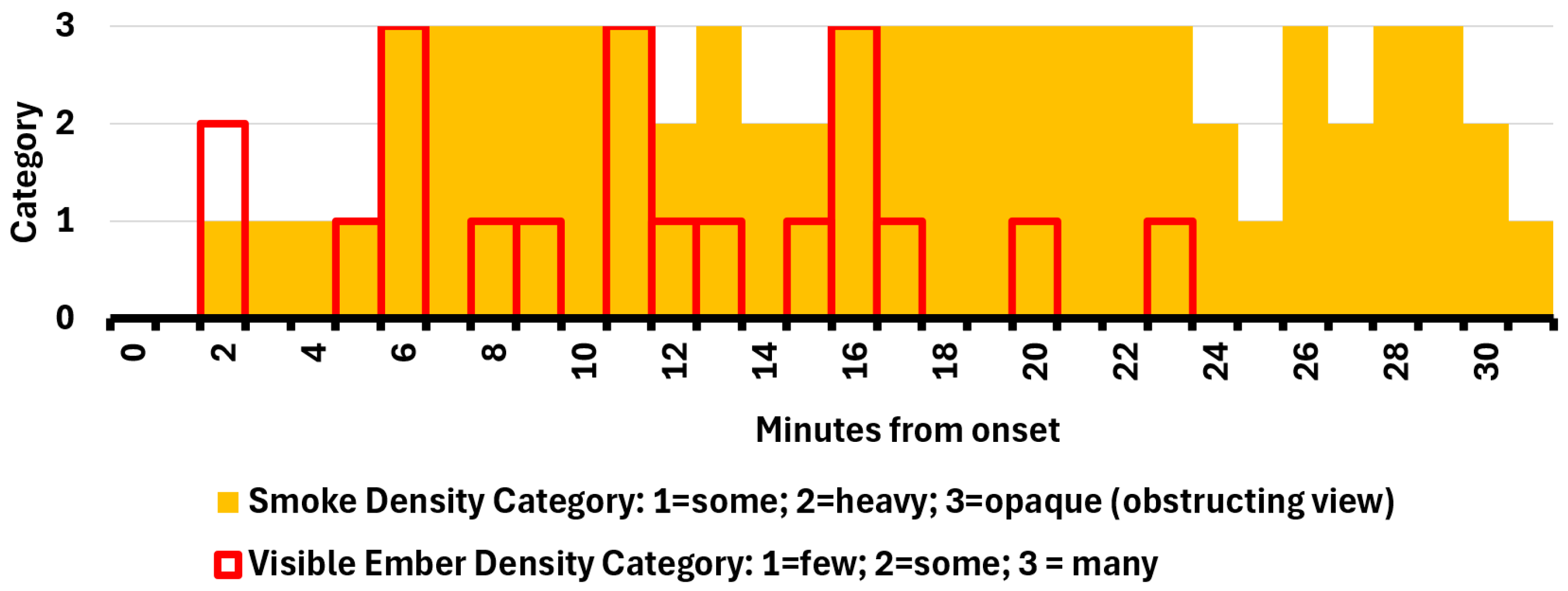
Eventually, the downwind spread of the fire moved close enough to the camera for detailed measurement estimates to be made of how it evolved in that area. These are shown in Figure 5.
  • Just after 11:33, smoke from nearby fire appeared in close proximity and in the field of view of the west-facing camera. It persisted until 12:04, spanning 31 min.
  • The first detectable ember storm coincided with the appearance of heavy smoke. This was the only time when the ember density category exceeded the smoke density category.
  • There were three pulses of heavy smoke every 10 min, lasting, on average, 8 min.
  • There were seven pulses of embers detectable, on average, 3 min apart.
  • Detected ember pulses lasted between 1 and 3 min (average 2 min).
  • In fire-fighter safety terms, in a burnover situation in conditions similar to these, this event indicates that ember protection is needed for perhaps 25 min, while protection from heavy smoke and heat is needed for over 30 min.
  • Imagery from 11:34 and just after showed embers radiating out from a single perspective source below the horizon (Figure 4b). This confirms that the embers were not ballistic.
It was important to look for evidence of fire jetting laterally along the wind separation line on the ridge top, as laboratory tests and modelling both show this has an important role in the leading edge of the lateral spread [7]. Images generally contained too much smoke to allow for detailed views of this area. Some showed an ambiguous situation (09:53, 11:03, 11:06, 11:28) and some suggested that spot-fires formed the leading edge (10:00, 10:06, 10:15, 11:23, 11:33); however, 11:24 and 11:34 (Figure 4c) may provide examples, but could be due to general spot-fires in the eddy burning upslope, rather than ones on the flow separation line. Videos of future events are needed to resolve or quantify this ambiguity.

4. Discussion

Some overall assessments may be made:
  • In this whole event, the overall lateral ROS averaged at 1.9 km h−1.
  • Around plume touch-down events, that average rose to 4 km h−1, but also peaked at 20 km h−1.
  • The downwind spread of the overall fire envelope was measured at a peak of 45 km h−1.
  • In two minutes, a spot-fire on Modjeska Peak (see Figure 4c,d) ran uphill for 500 m and burnt 5 ha. Extrapolation to an hourly value gives a slope-affected headfire ROS of 15 km h−1 (equivalent to c. 2 km h−1 on flat ground) and a burn rate of 60 ha h−1.
  • Video analysis supports the following hypothesis to explain this entire event:
  • VLS is initiated when fire enters a lee-slope eddy wind with dry fuel.
  • Heat released into the eddy causes the eddy to rise with the plume. This includes the eddy’s original vorticity. This means that on a leaning plume’s underside or downwind side, the plume is, in places, rotating towards unburnt ground.
  • There was an ember storm. This is indicated by purple flames (as seen near the camera at 11:41) and the embers not following ballistic trajectories, and even showing divergence from a radiant point as they approach the camera (especially at 11:44; see Figure 4b). This is consistent with field observations from other events, especially Canberra in 2003. This is consistent with the hypothesis that ember storms originate within the most intense fire events, perhaps reflecting limited oxygen ingress.
  • If the heat release eases, or if the lateral spread takes the plume into contact with higher terrain downwind, the plume touches down and the ember storm starts new fires, increasing the heat release and lifting the plume. This interaction may be more intense if both sides of the valley are involved.
  • VLS lateral spread of this type is thus a pulsed feedback loop.
  • The videos indicate vorticity in the rising plume core. The direction of rotation of this supports the hypothesis that the lee eddy is in place over already-burnt ground, is broken, and is lofted upwards over new burning. Simpson et al. [9] considered the idea that the intact eddy is lofted between both ends of the burnt ground. Further observations are required to explore these alternatives.

5. Conclusions

The initiation of a VLS event can spread the fire in two directions at very high ROS. Downwind spotting after a plume touch-down can cause a drastic change in situation with ensuing loss of situational awareness for fire crews. The complex overall bidirectional spread across the landscape can exceed fire crews’ ability to appreciate a threat and then safely egress. Prediction of the potential for VLS to form, allowing for the embedding of the consequences of that into the Incident Action Plan, is the only way to mitigate risks to crew safety.
The implications of this work include that VLS can cause rapid expansion of the public risk envelope and degradation of the ability to conduct resulting evacuations safely. Avoiding the entrapment of evacuees is a further reason to ensure that VLS models are well-tuned.
While laboratory tests and modelling indicate a primary role for a jet of flames on the ridge-top wind separation line, this was not unambiguously resolvable in the HPWREN imagery, as smoke did not allow for the distinction between a jet and a spot-fire within the lee-slope eddy. Future analyses will need to explore this feature, perhaps needing infrared imagery.
These fires are too dangerous for planned research activities to be conducted. More observational data are needed to better understand such complex fire behaviour. The most detailed observations will come when a fire comes into view of fixed, high-quality systems such as HPWREN or AlertCalifornia, which have sub-metre middle-ground resolution and repeat times of 1 min or less.

Supplementary Materials

The following supporting information can be downloaded at: https://www.mdpi.com/article/10.3390/fire9020079/s1, 10_W_Q4.mp4, the HPWREN video showing the view to the west from Santiago Peak on 10 September 2024.

Funding

This research received no external funding.

Data Availability Statement

Additional information on this event can be found at: https://www.hpwren.ucsd.edu/news/20241007/, accessed on 1 February 2026; https://www.highfirerisk.com.au/vls/, accessed on 1 February 2026. Key data are from the HPWREN project at the University of California, San Diego: http://hpwren.ucsd.edu/, accessed on 1 February 2026.

Acknowledgments

The author thanks: Hans-Werner Braun, Geoff Davis, and Frank Vernon, UCSD; Brian Norton, Alert California; Jim Davidson, CAL FIRE; and Rod Linn, Los Alamos National Laboratory for thoughts on this event.

Conflicts of Interest

The author declares no competing interests.

References

  1. Sharples, J.J.; McRae, R.H.D.; Wilkes, S.R. Wind–terrain effects on the propagation of wildfires in rugged terrain: Fire channelling. Int. J. Wildland Fire 2012, 21, 282–296. [Google Scholar] [CrossRef]
  2. Rothermel, R.C. Mann Gulch Fire: A Race That Couldn’t Be Won; USDA Forest Service General Technical Report INT-299; USDA Forest Service: Washington, DC, USA, 1993.
  3. Prescott Fire Department. Yarnell Hill Fire June 30, 2013; Serious Accident Investigation Report; Prescott Fire Department: Prescott, AZ, USA, 2013.
  4. Victorian Country Fire Authority. Reducing the Risk of Entrapment in Wildfires: A Case Study of the Linton Fire; CFA: Burwood East, Australia, 1999. Available online: https://web.archive.org/web/20050616112555/http://www.cfa.vic.gov.au/documents/entrapment-linton.pdf (accessed on 1 February 2026).
  5. Fromm, M.D.; McRae, R.H.D.; Sharples, J.J.; Kablick, G.P. Pyrocumulonimbus pair in Wollemi and Blue Mountains National Parks, 22 November 2006. Aust. Meteorol. Oceanogr. J. 2012, 62, 117–126. [Google Scholar] [CrossRef]
  6. McRae, R.H.D.; Sharples, J.J.; Fromm, M. Linking local wildfire dynamics to pyroCb development. Nat. Hazards Earth Syst. Sci. 2015, 15, 417–428. [Google Scholar] [CrossRef]
  7. Sharples, J.J.; Viegas, D.X.; McRae, R.H.D.; Raposo, J.R.N.; Farinha, H.A.S. Lateral bushfire propagation driven by the interaction of wind, terrain and fire. In MODSIM2011, 19th International Congress on Modelling and Simulation; Chan, F., Marinova, D., Anderssen, R.S., Eds.; Modelling and Simulation Society of Australia and New Zealand: Canberra, Australia, 2011; pp. 1652–1658. ISBN 978-0-9872143-1-7. Available online: https://mssanz.org.au/modsim2011/A2/sharples.pdf (accessed on 1 February 2026).
  8. Sharples, J.J.; Hilton, J.E. Modelling Vorticity-Driven Wildfire Behavior Using Near-Field Techniques. Front. Mech. Eng. 2020, 5, 69. [Google Scholar] [CrossRef]
  9. Simpson, C.C.; Sharples, J.J.; Evans, J.P. Sensitivity of atypical lateral fire spread to wind and slope. Geophys. Res. Lett. 2016, 43, 1744–1751. [Google Scholar] [CrossRef]
Figure 1. Location map. Black arrows show movement of VLS edges. Grey areas are urban. The HPWREN cameras are on Santiago Peak at 117.57° 33.71°.
Fire 09 00079 g001
Figure 2. Method used to acquire measured lateral spread data. (a) Topography of the site, showing creek lines (blue) and 250 m contour lines (brown). The grey dashed lines are the Flow Separation Lines (for both days), showing the observed VLS generators along ridgetops. Magenta areas are less than 200 m in elevation below the western FSL, while orange areas are less than 200 m in elevation above the FSL. Also shown are assessed fire envelope edge isochrones for video frames, where resolvable (red lines), which are labelled with the frame times, and the assessed envelope lateral spread distances between isochrones. (b) Details of the analysis of lateral spread increments.
Fire 09 00079 g002
Figure 3. Measured lateral spread data. Measured fire dynamics from video of significant lateral spread events along the ridge-crest west of the camera (labelled as “VLS 10 Sept” in Figure 1).
Fire 09 00079 g003
Figure 4. Details from HPWREN imagery as fire nears Modjeska Peak. (a) Dense, short-range spotting close to the camera at 11:31. (b) A highly filtered composite image showing fire approaching the camera from the west and forming new spot-fires outside the lee-slope eddy at 11:34 and embers (black) radiating out at 11:44 from a source point in the area affected by those new spot-fires. The fire is clearly making intense runs in two opposing directions. (c,d) show an intense spot-fire within the lee-slope eddy at 11:31 and 11:33, with significant spread in those two minutes.
Fire 09 00079 g004
Figure 5. Summary of smoke and ember density close to the camera, detailing an ember storm life-cycle, starting at 11:33.
Fire 09 00079 g005
Disclaimer/Publisher’s Note: The statements, opinions and data contained in all publications are solely those of the individual author(s) and contributor(s) and not of MDPI and/or the editor(s). MDPI and/or the editor(s) disclaim responsibility for any injury to people or property resulting from any ideas, methods, instructions or products referred to in the content.