
Analysis of Smoke Spreading Pattern and Fire Safety in T-Type Subway Interchange Station

Abstract
1. Introduction
2. T-Type Interchange Station
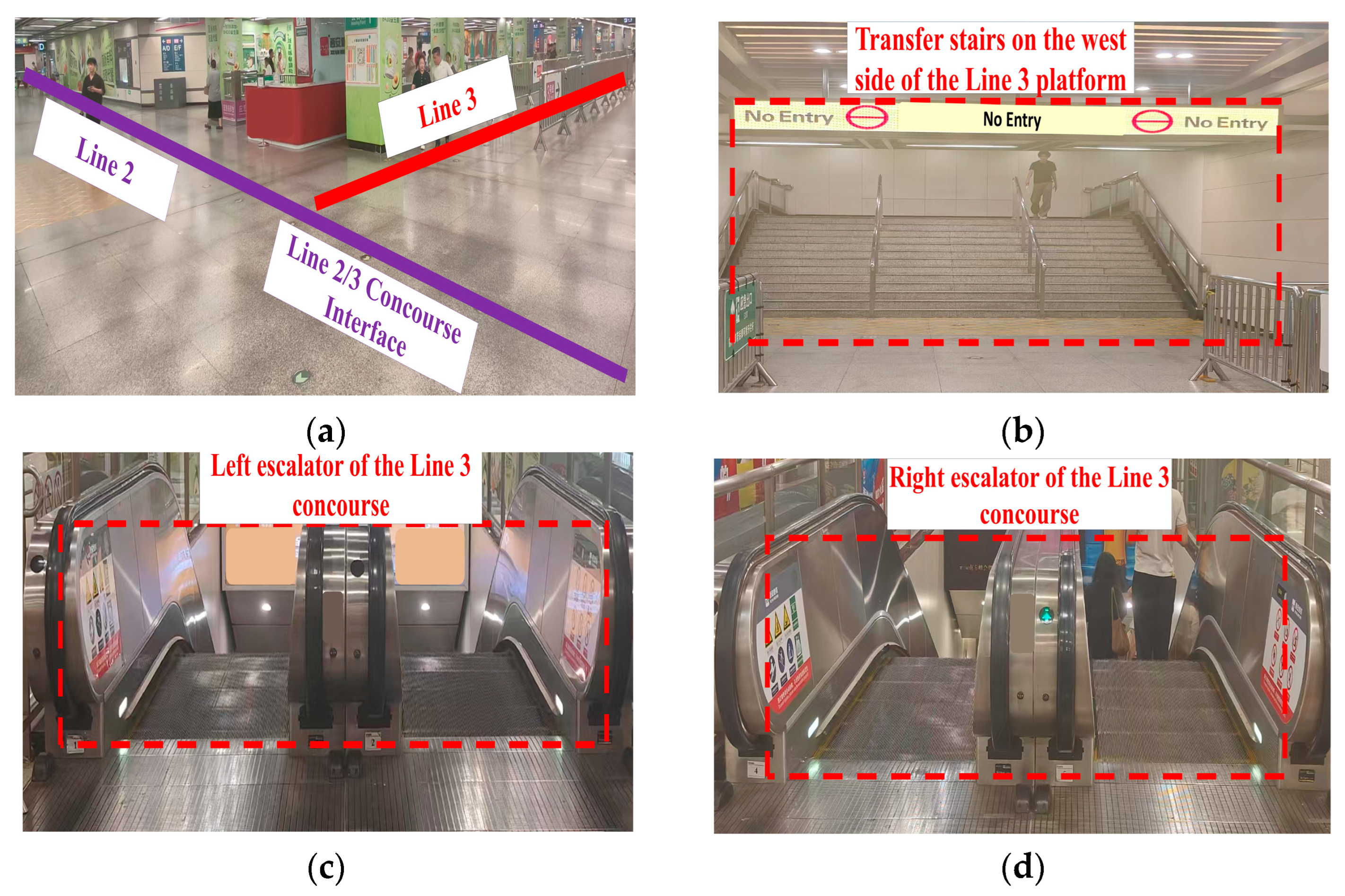
2.1. Structural Features
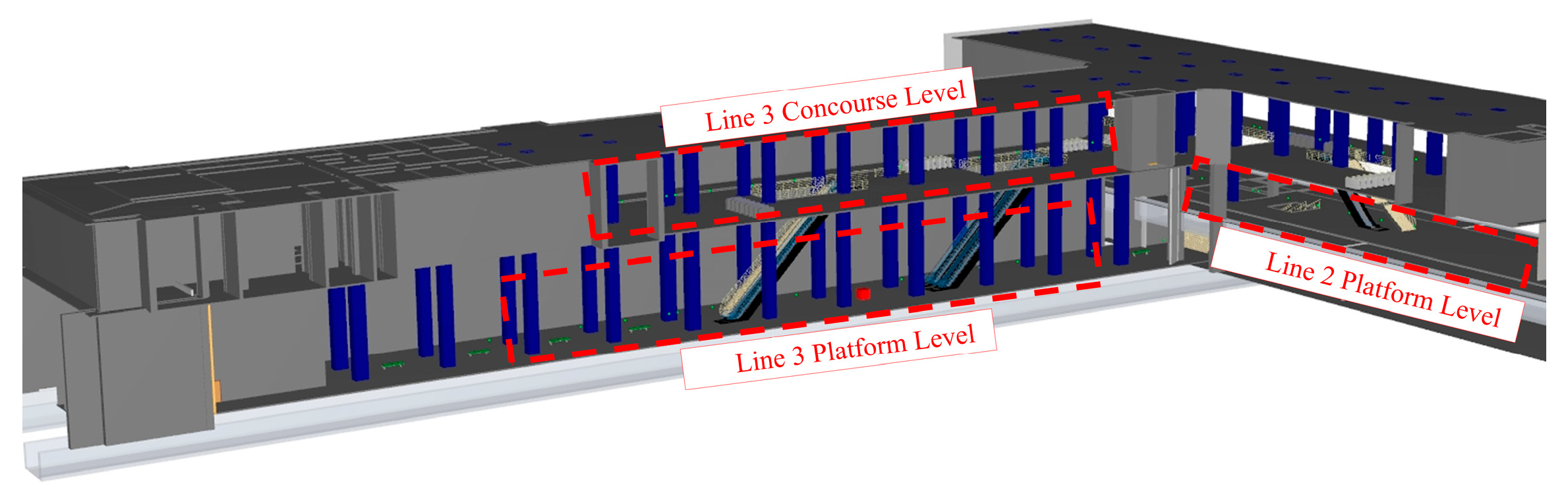
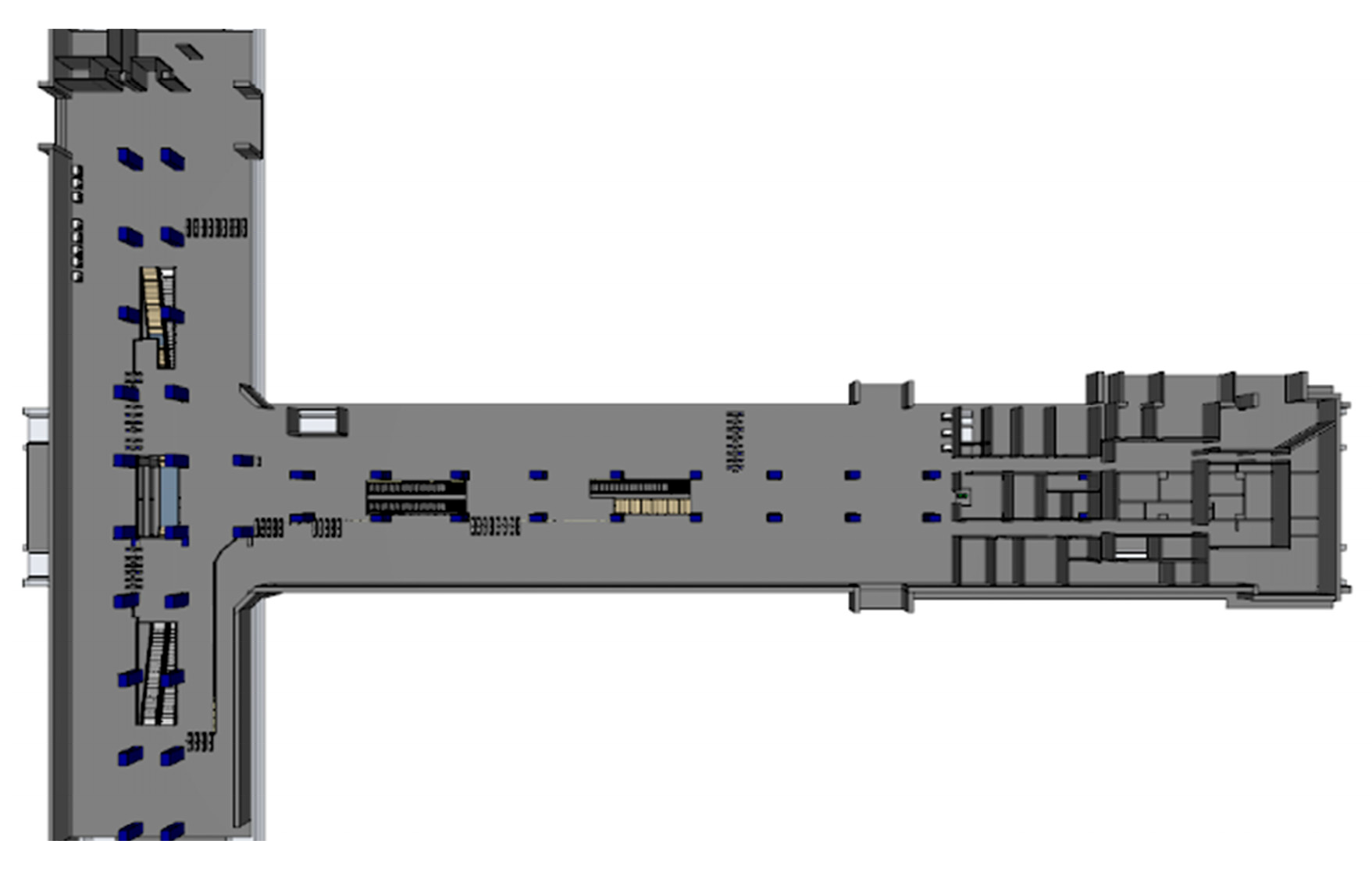
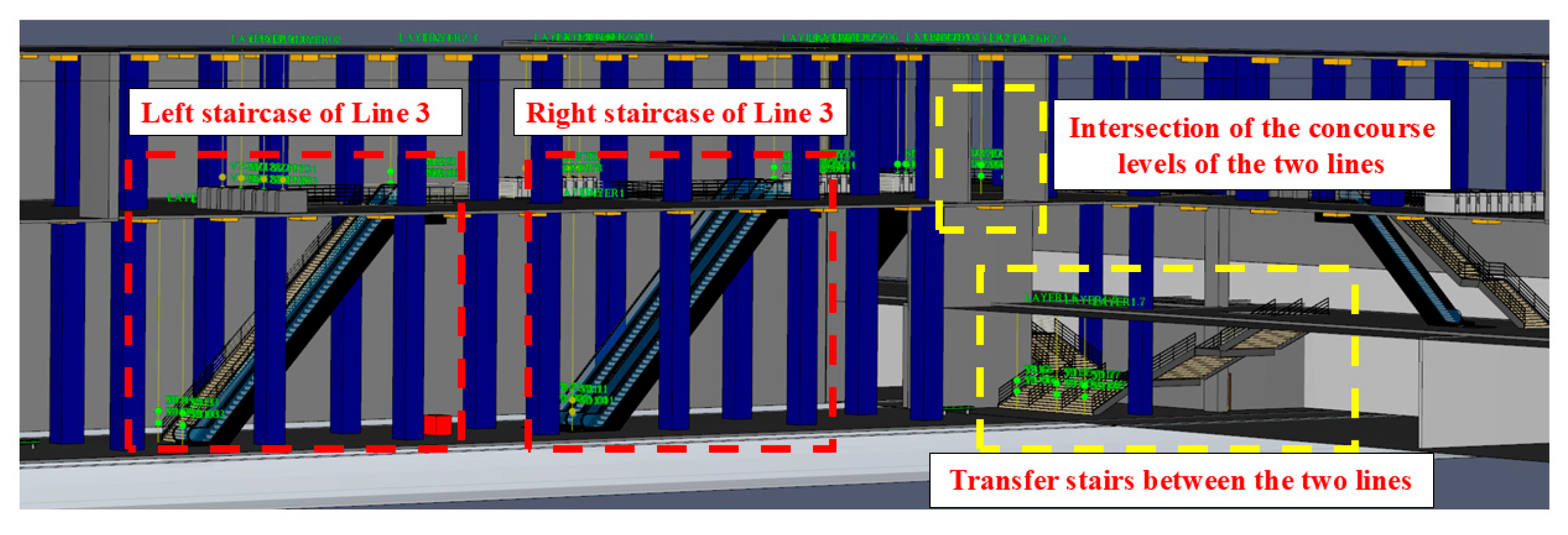
2.2. Station Overview and Model Construction
3. Numerical Model Setup
3.1. Model Configuration and Grid Sensitivity
3.2. Fire Scenarios and Safety Criteria
- (1).
- Temperature Threshold: Previous research [24] indicates that respiratory function is severely impaired at temperatures exceeding 65.0 °C at a height of 1.6 m. Consequently, 1.6 m was adopted as the monitoring baseline to cover the respiratory zone.
- (2).
- Critical Visibility: With an initial visibility of 30.0 m, a conservative threshold of 10.0 m at a height of 1.6 m was adopted as the evacuation safety criterion, referencing critical values for both small and large spaces [25].
- (3).
- Smoke Layer Height: A critical threshold of 1.6 m (eye-level upper limit) was established to ensure the smoke layer remains above this height. Detectors were installed at key nodes to monitor real-time height variations, enabling a comprehensive risk assessment in conjunction with temperature and visibility data.
4. Results Analysis and Discussion
4.1. Simulation Scenarios and Parameter
4.2. Influence of Structural Parameters on Spread Timing
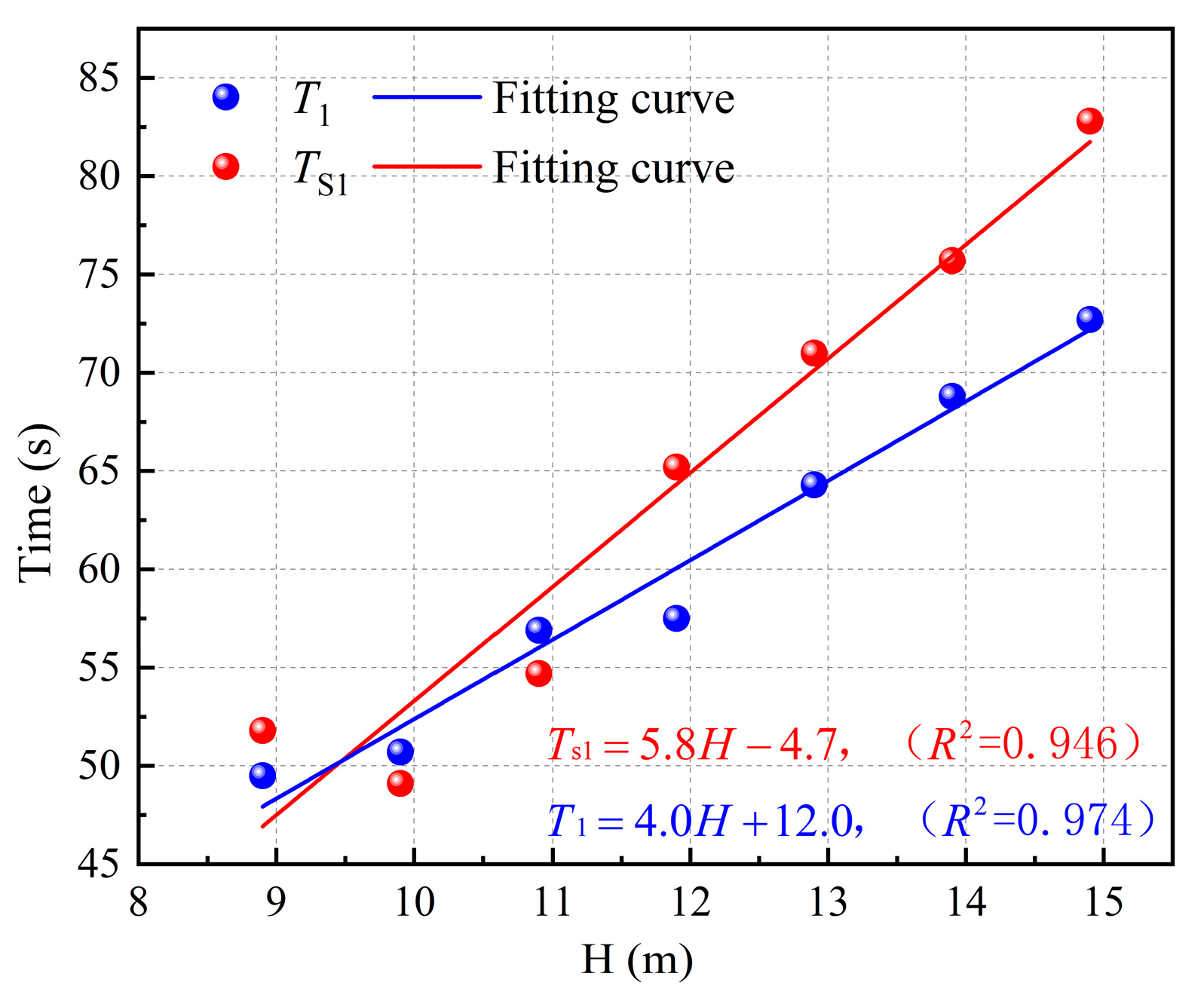
4.2.1. Height Difference (H)
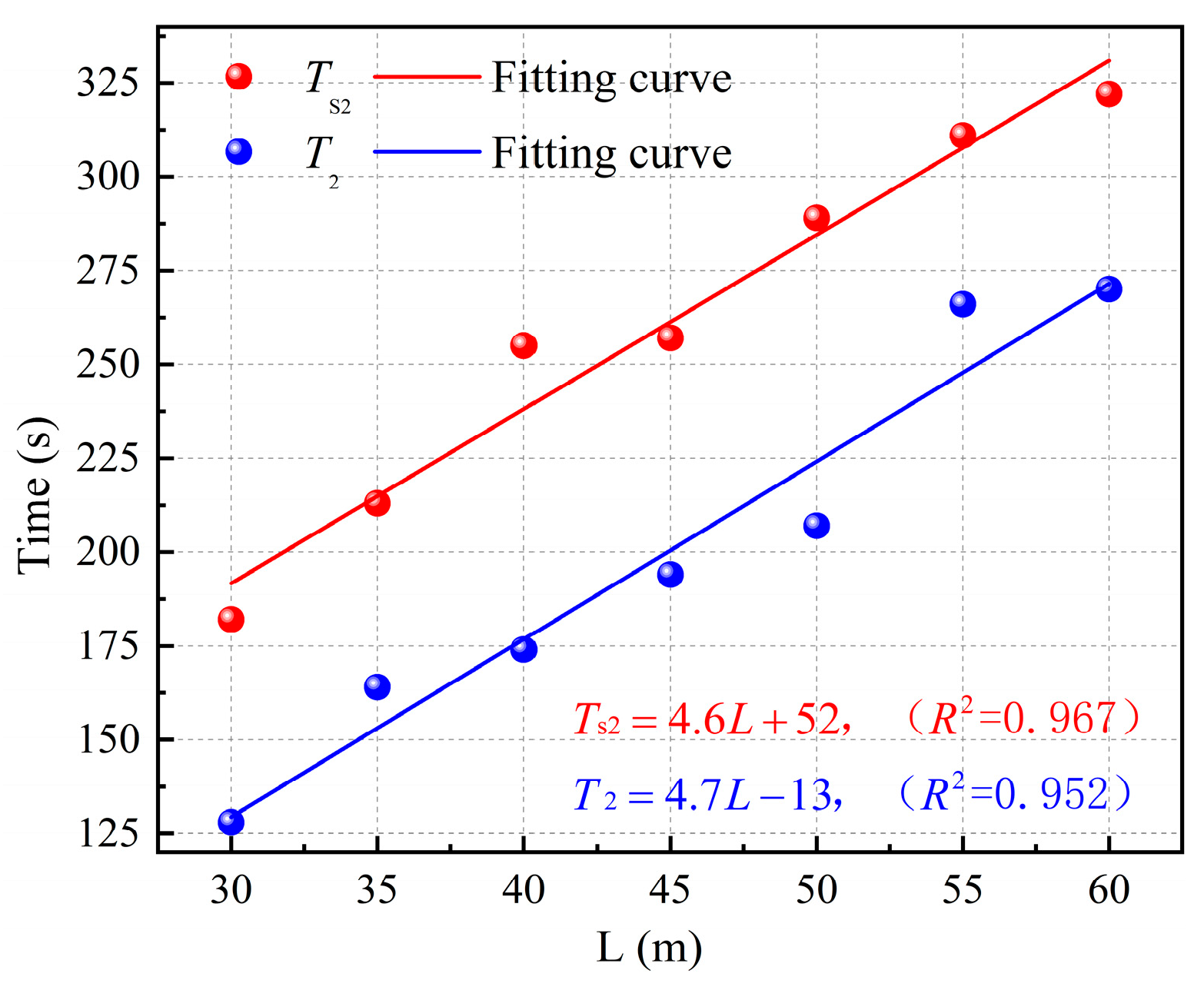
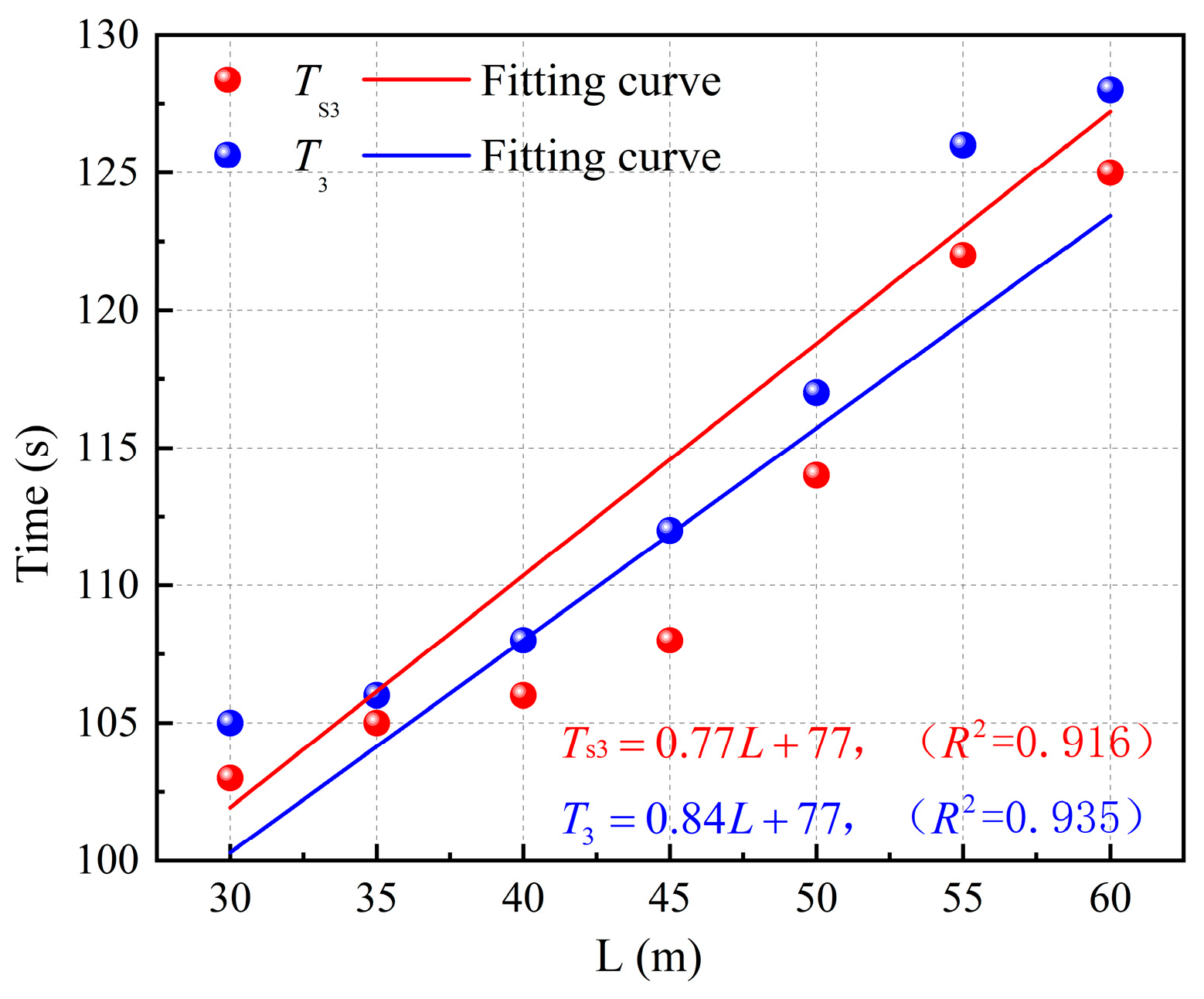
4.2.2. Horizontal Distance (L)
4.2.3. Geometry at Staircases
4.3. Smoke-Spread Characteristics and Model Verification
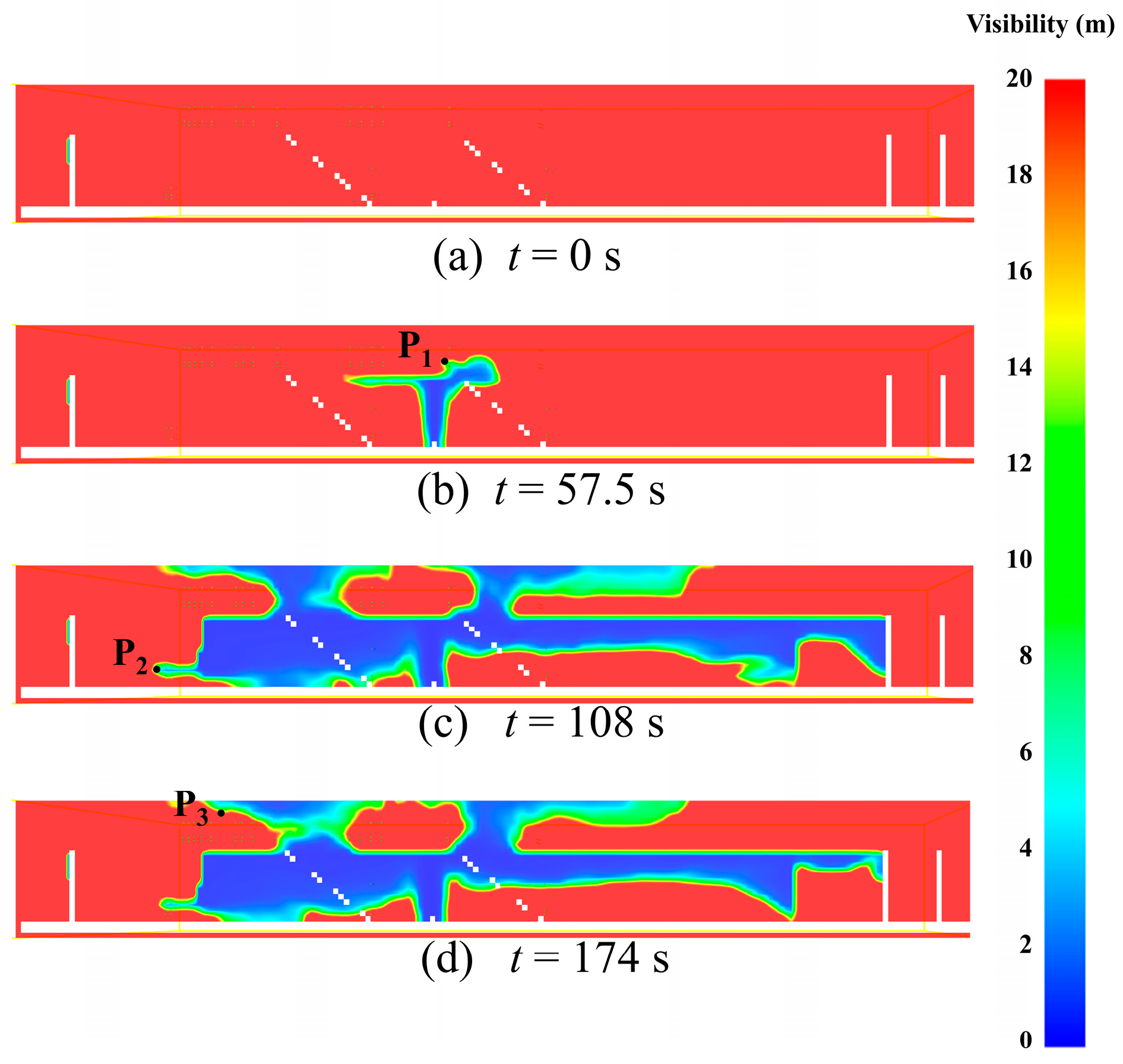
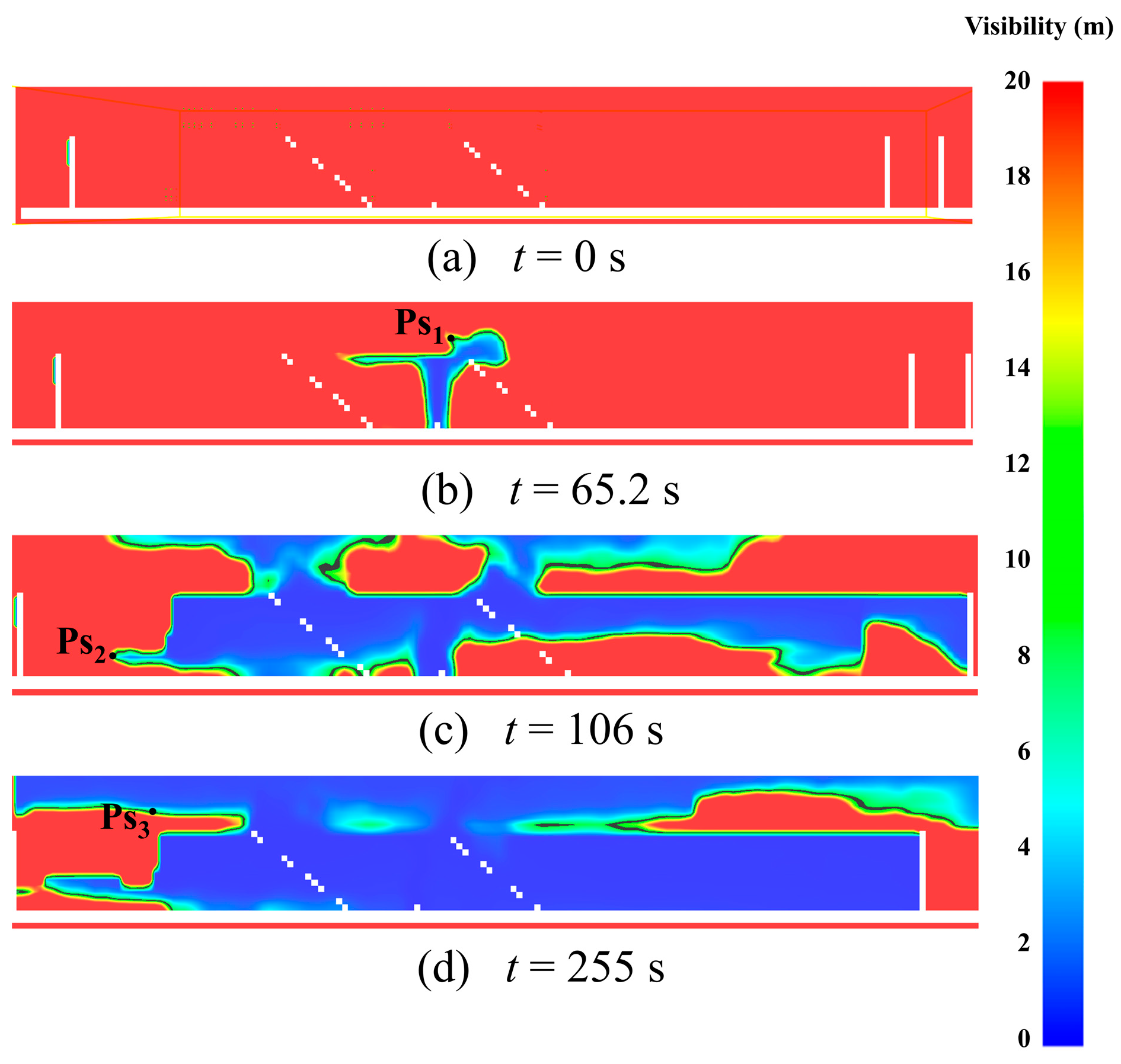
4.3.1. Dynamic Smoke Evolution
4.3.2. Regression Model Verification
5. Conclusions
Author Contributions
Funding
Institutional Review Board Statement
Informed Consent Statement
Data Availability Statement
Conflicts of Interest
References
- Ministry of Transportation and Communications. Statistical Bulletin on Transportation Sector Development in 2024. Available online: https://xxgk.mot.gov.cn/2020/jigou/zhghs/202506/t20250610_4170228.html (accessed on 16 August 2025). (In Chinese)
- Beijing Municipal Commission of Planning and Natural Resources. Guidance Atlas for Design of Rail Transit Node Transfer Stations; Beijing Municipal Commission of Planning and Natural Resources: Beijing, China, 2020. (In Chinese) [Google Scholar]
- Fridolf, K.; Nilsson, D.; Frantzich, H. Fire evacuation in underground transportation systems: A review of accidents and empirical research. Fire Technol. 2011, 49, 451–475. [Google Scholar] [CrossRef]
- Woodburn, P.J.; Britter, R.E. CFD simulations of a tunnel fire—Part II. Fire Saf. J. 1996, 26, 63–90. [Google Scholar] [CrossRef]
- Hu, L.H.; Huo, R.; Chow, W.K. Studies on smoke movement in an inclined tunnel fire. Build. Environ. 2008, 43, 1197–1206. [Google Scholar] [CrossRef]
- Wang, K.; Cai, W.; Zhang, Y.; Hao, H.; Wang, Z. Numerical simulation of fire smoke control methods in subway stations and collaborative control system for emergency rescue. Process Saf. Environ. Prot. 2021, 147, 146–161. [Google Scholar] [CrossRef]
- Hou, Y.; Ding, W.; Hou, Z.; Li, X.; Li, L.; Yang, Z.; Shi, C. Study on Performance of Coordinated Ventilation Strategies during T-Shaped Subway Station Hall Fire. Fire 2025, 8, 56. [Google Scholar] [CrossRef]
- Zhong, M.; Cheng, H.; Chen, J.; Liu, S.; Wang, Y. Full-scale experimental design and engineering practice for subway station fires. Exp. Technol. Manag. 2022, 39, 1–8. Available online: https://kns.cnki.net/kcms2/article/abstract?v=Ap1IM-J3Ck0ocJPYZnE1TaZsGM49vgBoz8ijvK7ANwt2Qw1fIj0w8kOhjneab7QNC8ORvcYVjreMdiSLu5MiiM16mF0zarfC356gXS4o0WJ-Cmj2WWfQC6t3r-5yh8wwEbnI2V6ocqCJ9w9P61EizJgATZwuQFtn&uniplatform=NZKPT (accessed on 16 August 2025). (In Chinese)
- Yang, Z.; Deng, L.; Kong, L. Research on fire simulation and safe evacuation in subway stations based on BIM. J. Guangxi Univ. Sci. Technol. 2022, 33, 23–30. Available online: https://kns.cnki.net/kcms2/article/abstract?v=Ap1IM-J3Ck2W-WNViiihlsJCK6MNshhSC8VL1FXBKZgG9MbFjEa7AJ_rxTiHzaqEz53SfK5otOlIl_tFJwPx0joG7ySrjJURx2l_UGj-mNsxM1J2EdE5D8g2BD29aWrFv93y5wBH5tX8D3-A8RvZGsreH_fosbnpYjcoC3ZnAD8=&uniplatform=NZKPT (accessed on 16 August 2025). (In Chinese)
- Zhang, N.; Liang, Y.; Zhou, C.; Niu, M.; Wan, F. Study on Fire Smoke Distribution and Safety Evacuation of Subway Station Based on BIM. Appl. Sci. 2022, 12, 12808. [Google Scholar] [CrossRef]
- Gao, Z.; Liu, M.; Zhao, P.; Yan, C. Influence of tunnel slope on the one-dimensional spread of smoke transportation and temperature distribution in tunnel fires. Tunn. Undergr. Space Technol. 2024, 143, 105650. [Google Scholar] [CrossRef]
- Wang, F.; Zhao, Y.; He, K. Numerical simulation of smoke control in subway cross-transfer stations during fires. Railw. Archit. 2012, 2, 61–63. Available online: https://kns.cnki.net/kcms2/article/abstract?v=Ap1IM-J3Ck2rbDiJZMd1BeAEXXonjcdgSqscwe4bH2z8yxA5X74bsW-lhJ6VqgXn4PSKmTg5J69d8XvCPE9p6RkiRmv6LmXpYdaOoAx7_UUFRoW6LcRQDOyp1G-zAhYF9MX83gezuB-EEclvWj3BWPbSVjgSBtyD&uniplatform=NZKPT (accessed on 16 August 2025). (In Chinese)
- Li, Y.; Du, X.; Li, J.; Yan, Z. Research on smoke control and evacuation in subway transfer station fires. Chin. J. Undergr. Space Eng. 2011, 7, 587–592. Available online: https://kns.cnki.net/kcms2/article/abstract?v=Ap1IM-J3Ck1yRGbyzg4Z2cG5MsdrJVi-isEwwe6LVhkMfhEiFluMkGdMy7fq2uSjPPbD0RyI9fs8UQD9GQ0ZThsfCvnRVSLSPmhLsvIXMCHIFqKMqV5NtCDQRUMoSssChUz4rvoi-IBLZ1P-vsZKx_GqIu4VHKcY&uniplatform=NZKPT (accessed on 16 August 2025). (In Chinese)
- Chen, F.L.; Guo, S.C.; He, Y.C.; Zhang, H.P. Smoke control of fires in subway stations. Theor. Comput. Fluid Dyn. 2003, 16, 349–368. [Google Scholar] [CrossRef]
- Chen, F.; Chien, S.-W.; Jang, H.-M.; Chang, W.-J. Stack effects on smoke propagation in subway stations. Contin. Mech. Thermodyn. 2003, 15, 425–440. [Google Scholar] [CrossRef]
- Klote, J.H.; Milke, J.A. Principles of Smoke Management; ASHRAE: Atlanta, GA, USA, 2002. [Google Scholar]
- Chow, W.K.; Li, J. Viscous effect on smoke motion in a tilted tunnel. Build. Environ. 2010, 45, 236–242. [Google Scholar] [CrossRef]
- Roh, J.S.; Ryou, H.S.; Park, W.H.; Jang, Y.J. CFD simulation and assessment of life safety in a subway train fire. Tunn. Undergr. Space Technol. 2009, 24, 447–453. [Google Scholar] [CrossRef]
- GB 51298-2018; Standard for Fire Protection Design of Metro. China Planning Press: Beijing, China, 2018.
- McGrattan, K.; Hostikka, S.; Floyd, J.; McDermott, R.; Vanella, M. Fire Dynamics Simulator User’s Guide; NIST Special Publication 1019; National Institute of Standards and Technology: Gaithersburg, MD, USA, 2013. [Google Scholar]
- Smagorinsky, J. General circulation experiments with the primitive equations: I. The basic experiment. Mon. Weather Rev. 1963, 91, 99–164. [Google Scholar] [CrossRef]
- EN 45545-2; Railway Applications—Fire Protection on Railway Vehicles—Part 2: Requirements for Fire Behavior of Materials and Components. European Committee for Standardization: Brussels, Belgium, 2013.
- NFPA 130; Standard for Fixed Guideway Transit and Passenger Rail Systems. National Fire Protection Association: Quincy, MA, USA, 2020.
- Purser, D.A. Toxicity assessment of combustion products. In SFPE Handbook of Fire Protection Engineering; Di Nenno, P.J., Ed.; National Fire Protection Association: Quincy, MA, USA, 2002; pp. 2-83–2-171. [Google Scholar]
- Jin, T. Visibility through fire smoke. J. Fire Flammabl. 1978, 9, 135–155. Available online: https://www.semanticscholar.org/paper/Visibility-through-fire-smoke-Jin/ddc5db397c30d64639b5bfbaab44f5a12b05fa1e (accessed on 16 August 2025).
- Su, Z.; Li, Y.; Zhong, H.; Li, J.; Guo, Z.; Yang, X.; Yang, S. Advancements in smoke control strategies for metro tunnel cross-passage: A theoretical and numerical study on critical velocity and driving force. Tunn. Undergr. Space Technol. 2024, 147, 105734. [Google Scholar] [CrossRef]
- Chen, J.; Li, G.; Pan, R.; Shen, Y.; Zhang, T. Numerical study on the airflow characteristics and smoke control condition in stair area of subway stations. J. Build. Eng. 2024, 82, 108577. [Google Scholar] [CrossRef]
- Rie, D.H.; Lew, J.O. A study of optimal vent mode for the smoke control of subway station fire. Tunn. Undergr. Space Technol. 2006, 21, 303. [Google Scholar] [CrossRef]
- Jiang, X.; Zhang, F.; Chen, X. Reliability of personnel evacuation in subway tunnel fires. Fire Sci. Technol. 2020, 39, 9–13. Available online: https://kns.cnki.net/kcms2/article/abstract?v=Ap1IM-J3Ck3TswUiAIXxxz0XzaTCJtWYAFUJvmtDYYgNkWEK1ggeaxoHH4a5JkPrleRSbRlfmSkoViwUgLgnoX6deuebQegCoRte-vxQKx-xvmBgugEcPWKPB4Ur_-HJpzVXEG9cPgbEzFqVOy8hefH86WQQM5EzJNaraXfZ76w=&uniplatform=NZKPT (accessed on 16 August 2025). (In Chinese)
- Thunderhead Engineering. Pathfinder User Manual; Thunderhead Engineering: Manhattan, KS, USA, 2018. [Google Scholar]







| Parameters | Definition |
|---|---|
| Vertical height difference between the concourse and platform levels | |
| Straight-line distance between the fire source and the intersection of the two lines in the T-type interchange station | |
| Time from ignition until smoke spreads to the Line 3 concourse level | |
| Time from ignition until smoke spreads to the Line 2 concourse level | |
| Time from ignition until smoke spreads to the transfer stairs on the west side of the Line 3 platform | |
| Critical time when smoke conditions at the Line 3 concourse level pose a threat to personnel safety | |
| Critical time when smoke conditions at the Line 2 concourse level pose a threat to personnel safety | |
| Critical time when smoke conditions at the transfer stairway on the west side of the Line 3 platform pose a threat to personnel safety |
| Operating Conditions | H/m | T1/s | Ts1/s |
|---|---|---|---|
| 1 | 8.9 | 49.5 | 51.8 |
| 2 | 9.9 | 50.7 | 49.1 |
| 3 | 10.9 | 56.9 | 54.7 |
| 4 | 11.9 | 57.5 | 65.2 |
| 5 | 12.9 | 64.3 | 71.0 |
| 6 | 13.9 | 68.8 | 75.7 |
| 7 | 14.9 | 72.7 | 82.8 |
| Operating Conditions | L/m | T2/s | Ts2/s |
|---|---|---|---|
| 8 | 30 | 128 | 182 |
| 9 | 35 | 164 | 213 |
| 10 | 40 | 174 | 255 |
| 11 | 45 | 194 | 257 |
| 12 | 50 | 207 | 289 |
| 13 | 55 | 266 | 311 |
| 14 | 60 | 270 | 322 |
| Operating Conditions | L/m | T3/s | Ts3/s |
|---|---|---|---|
| 8 | 30 | 105 | 103 |
| 9 | 35 | 106 | 105 |
| 10 | 40 | 108 | 106 |
| 11 | 45 | 112 | 108 |
| 12 | 50 | 117 | 114 |
| 13 | 55 | 126 | 122 |
| 14 | 60 | 128 | 125 |
Disclaimer/Publisher’s Note: The statements, opinions and data contained in all publications are solely those of the individual author(s) and contributor(s) and not of MDPI and/or the editor(s). MDPI and/or the editor(s) disclaim responsibility for any injury to people or property resulting from any ideas, methods, instructions or products referred to in the content. |
© 2026 by the authors. Licensee MDPI, Basel, Switzerland. This article is an open access article distributed under the terms and conditions of the Creative Commons Attribution (CC BY) license.
Share and Cite
Qu, L.; Wang, Y.; Zhai, Y. Analysis of Smoke Spreading Pattern and Fire Safety in T-Type Subway Interchange Station. Fire 2026, 9, 78. https://doi.org/10.3390/fire9020078
Qu L, Wang Y, Zhai Y. Analysis of Smoke Spreading Pattern and Fire Safety in T-Type Subway Interchange Station. Fire. 2026; 9(2):78. https://doi.org/10.3390/fire9020078
Chicago/Turabian StyleQu, Lu, Yuru Wang, and Yue Zhai. 2026. "Analysis of Smoke Spreading Pattern and Fire Safety in T-Type Subway Interchange Station" Fire 9, no. 2: 78. https://doi.org/10.3390/fire9020078
APA StyleQu, L., Wang, Y., & Zhai, Y. (2026). Analysis of Smoke Spreading Pattern and Fire Safety in T-Type Subway Interchange Station. Fire, 9(2), 78. https://doi.org/10.3390/fire9020078