1. Introduction
Apart from their technological relevance, the lean hydrogen flames evolving in narrow Hele-Shaw burners constitute a fascinating dynamical system displaying the flame disintegration and formation of clusters of disconnected flamelets. The latter is sustained by diffusive-thermal instability and conductive heat losses to the burner walls. These, possibly unexpected, propagation modes extend flammability limits beyond those of the planar flames. This observation is particularly important for the safety of hydrogen-powered devices [
1] as it is implies that hydrogen flames may propagate in gaps much narrower than initially anticipated.
Our previous exploration of the systems dealt with a quasi-2D constant-density reaction–diffusion model that ignores the buoyancy effect [
2]. The present study is an extension of the model over the Boussinesq limit, still dealing with quasi-2D constant-density flows everywhere except in the forcing term when the flame propagates against or in the direction of the gravity vector, as in a previous series of experimental studies [
3,
4].
The purpose of this study is to elucidate the buoyancy effect compared to the zero-gravity case of Ref. [
2] in the framework of an ultra-simple model. A physically similar problem has also been numerically tackled by Martinez-Ruiz et al. [
5] and Dejoan et al. [
6]. The authors utilized large-scale numerical simulations to account for both the global gas thermal expansion, buoyancy, heat, and momentum losses.
2. Boussinesq Model
Following the adiabatic quasi-2D formulation adopted by Vladimirova and Rosner [
7], it is convenient to write the associated reaction–diffusion–advection model in terms of the stream function and vorticity. With suitably scaled variables and parameters, the pertinent set of equations can be expressed as follows:
where
Here, T is the temperature in units of , the adiabatic temperature of combustion products; C is the concentration of the deficient reactant in units of , with its value stated in the fresh mixture; is the flow velocity in units of , the planar adiabatic flame velocity relative to the burned gas; is the vorticity in units of ; is the stream function in units of ; and t are the spatio-temporal coordinates in units of and , respectively; is the thermal width of a planar adiabatic flame; is the thermal diffusivity of the mixture, , where is the temperature sustained at the walls of the Hele-Shaw burner; os the Prandtl number; is the Lewis number; is the molecular diffusivity of the deficient reactant; is the scaled activation energy; is the activation temperature; is the scaled reaction rate in units of ; is normalized to ensure that at large N, the scaled speed of the planar adiabatic flame is close to unity; and q is scaled heat loss intensity, specified as , where h is the width of the Hele-Shaw gap. The adopted expression for q stems from the 1D heat equation, , considered over the Hele-Shaw gap and subjected to isothermal boundary conditions, . Hence, .
The exponential rate of the temperature decay is then extrapolated over the quasi-2D formulation of (1)–(7) over the (
) plane.
is the buoyancy parameter [
7]. Here,
g is the acceleration parameter, which may be positive/negative, mimicking an upward/downward-propagating planar flame.
In the adopted formulation, the planar flame moves in the positive direction of the y-axis.
Equations (1)–(8) are solved numerically in the rectangular domain
, obeying the following boundary and initial conditions:
The parameters employed are as follows:
, .
The purpose of this study is to elucidate the impact of buoyancy on the drift velocity of 2D flamelets along the y-axis.
Numerical method employed is described in
Appendix A.
3. Results
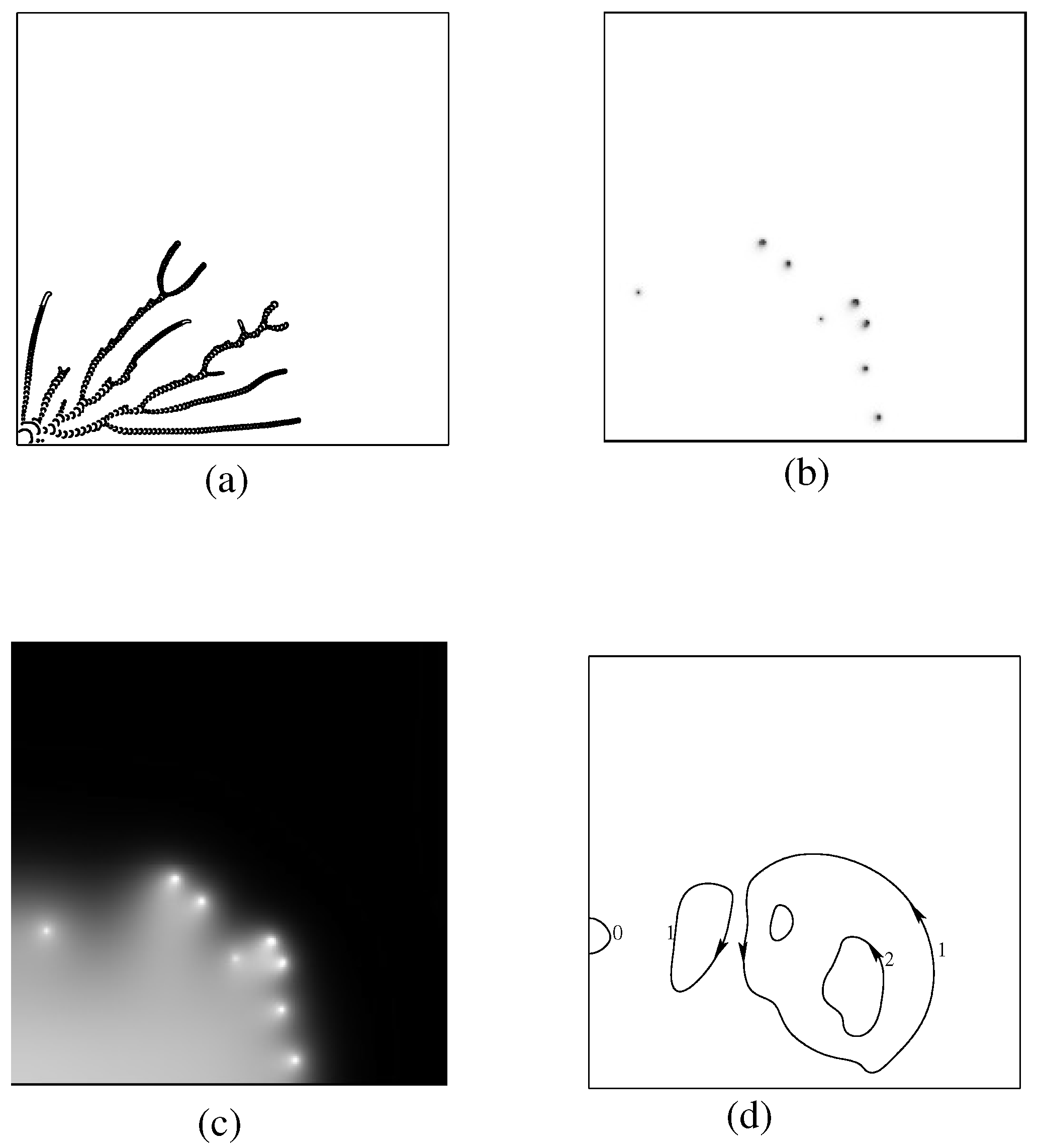
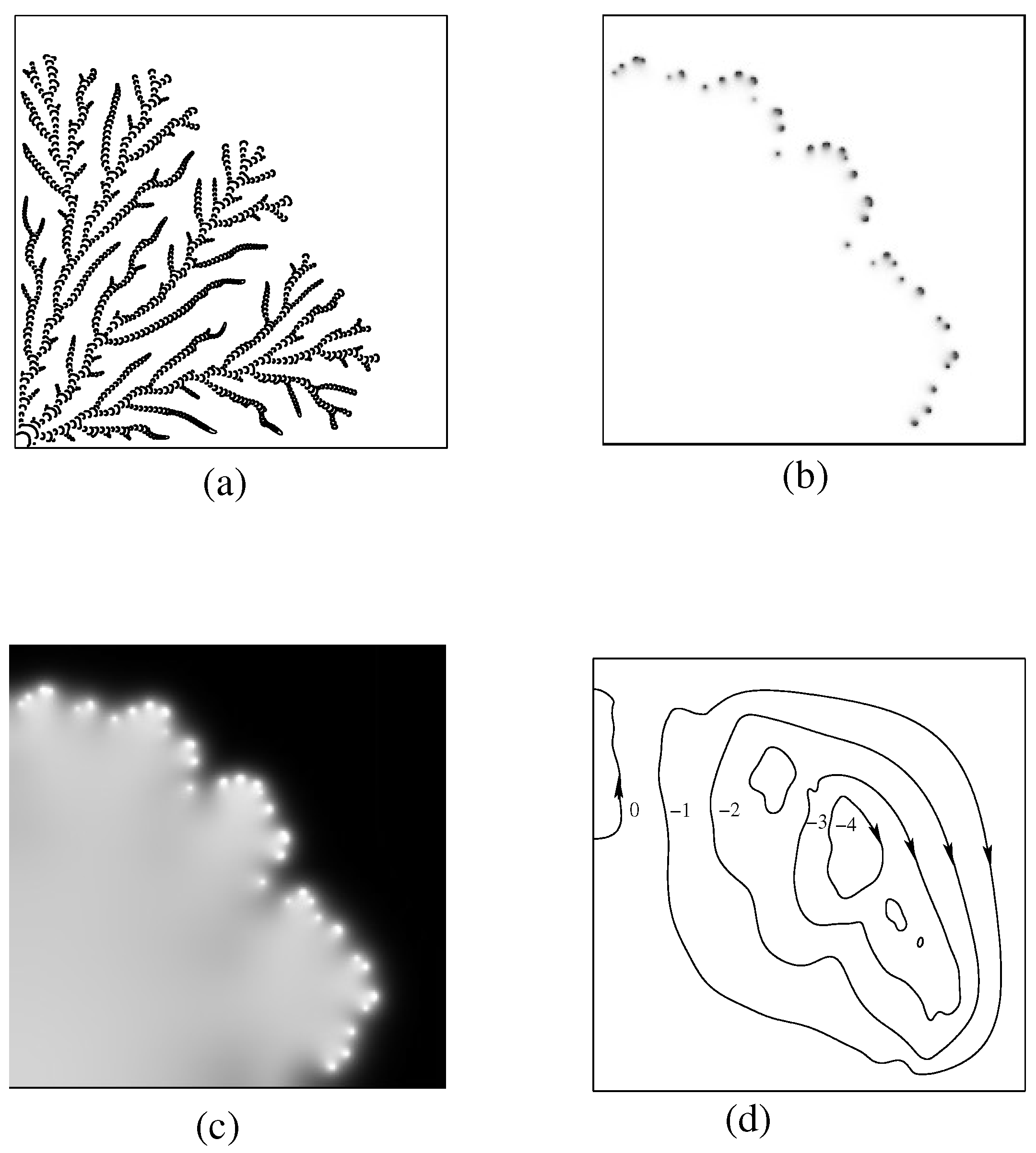
Figure 1 and
Figure 2 display self-drifting flamelets for some representative values of
G and
q.
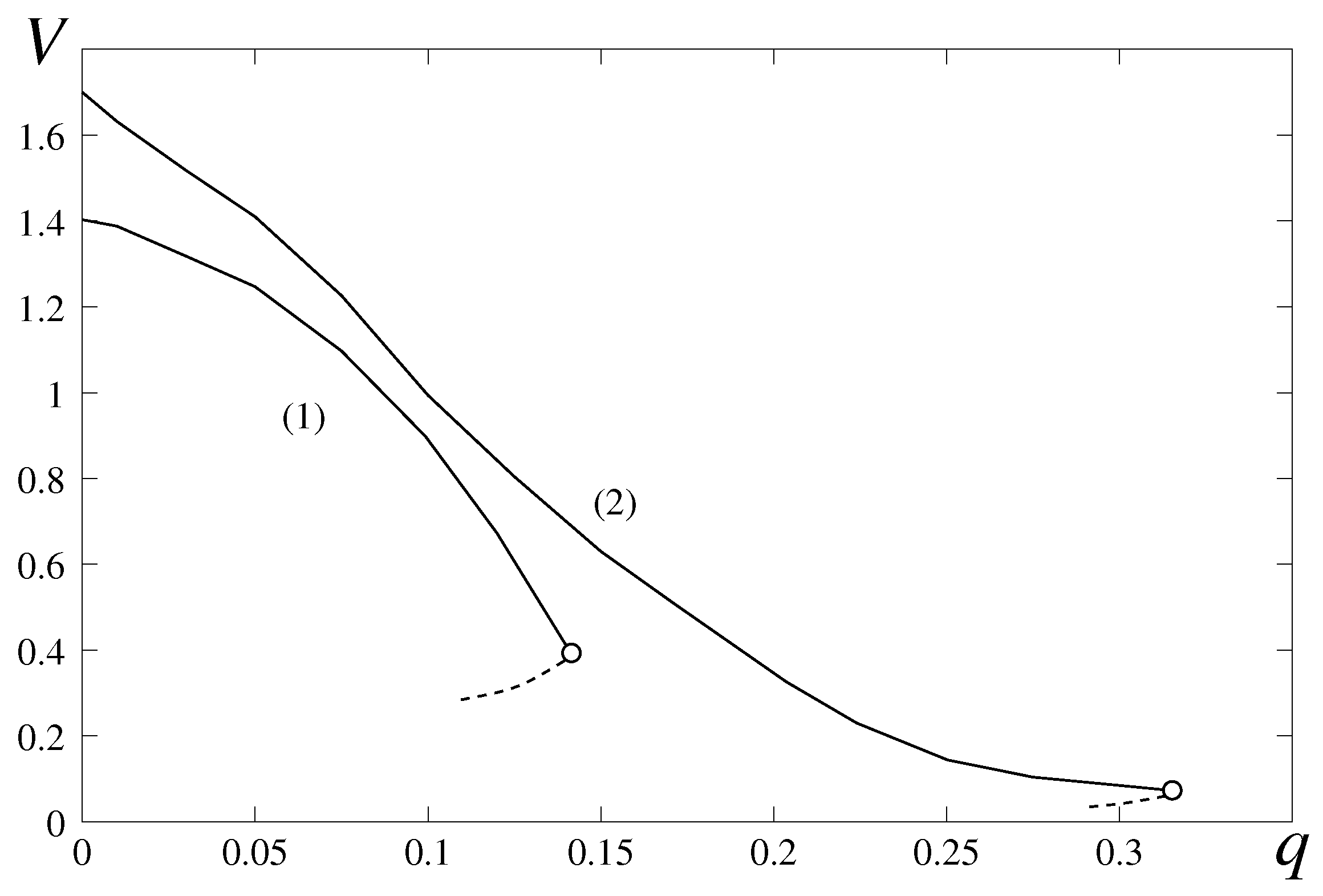
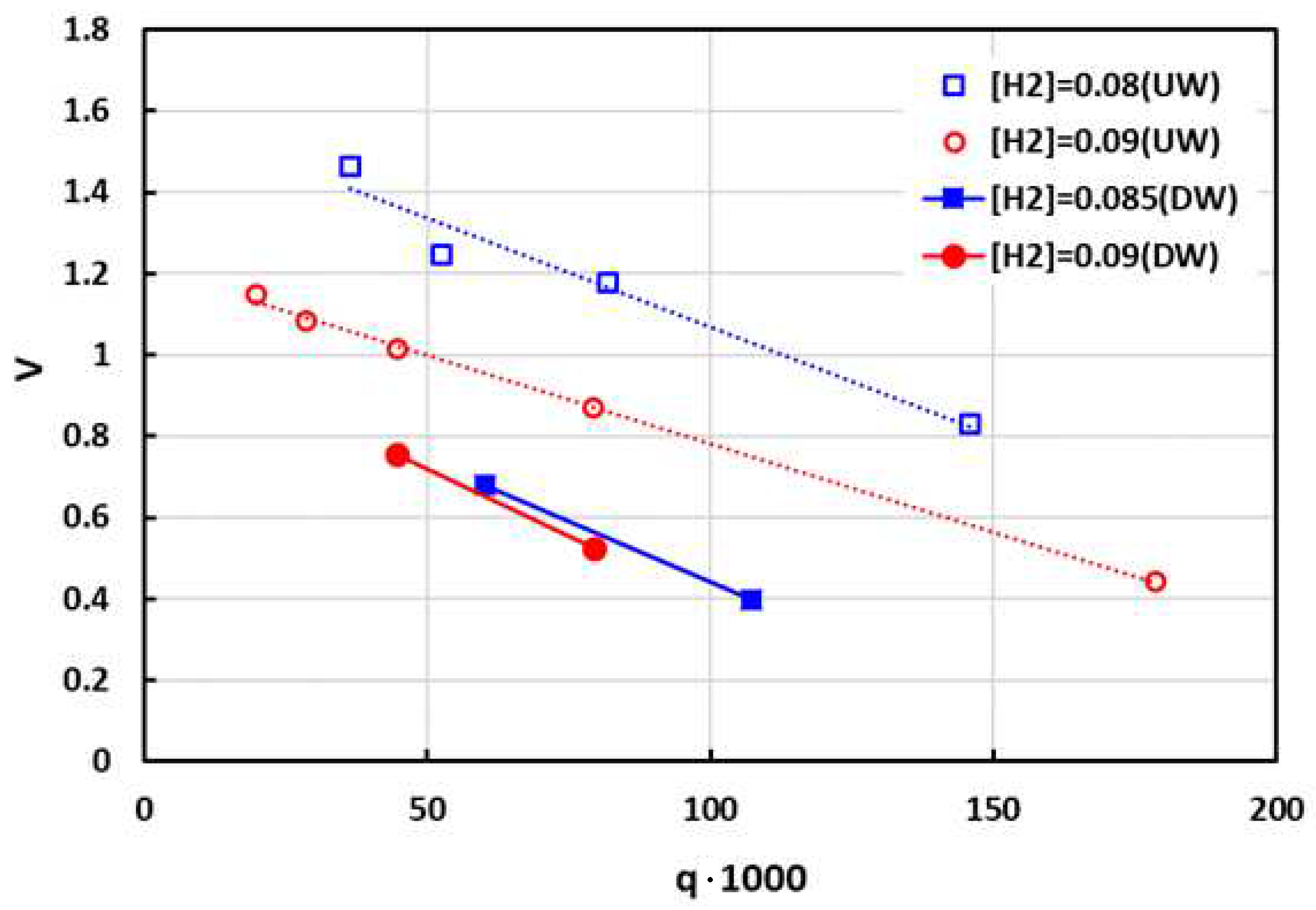
Figure 3 depicts drift velocities
V vs.
q of the leading flamelets along the
y-axis. Here, positive/negative
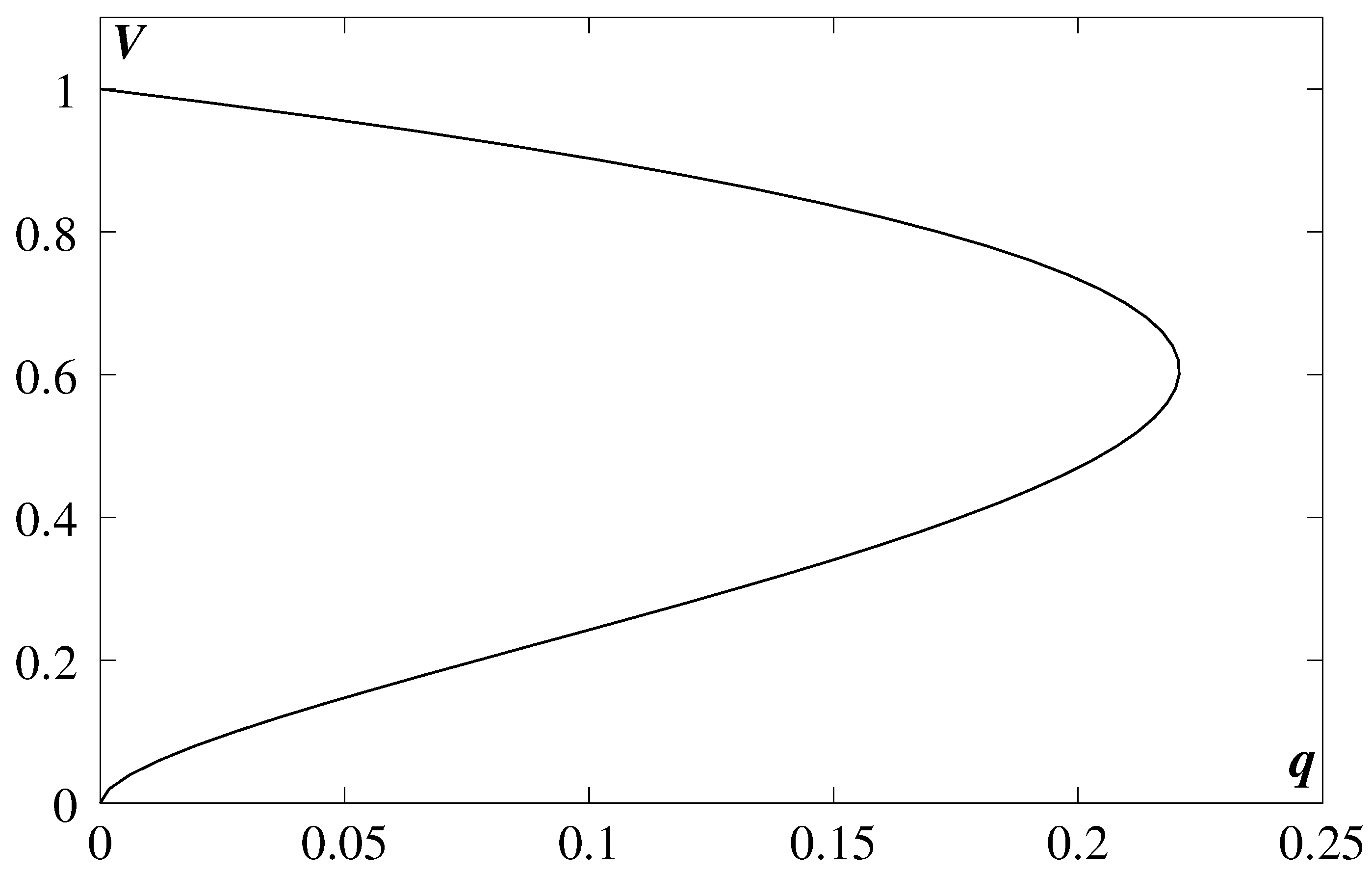
G corresponds to upward/downward propagating flamelets. Dashed lines are suggested by the theoretical results for the zero-gravity case (
Figure 4).
As is readily seen,
is invariably negative irrespective of the sign of
G. This outcome is qualitatively in line with Kuznetsov’s experimental data (
Figure 5) and the analytical results for the zero-gravity simulation [
2]. The final points of the
plots (open circles) correspond to the flamelets’ extinction.
As one might anticipate for upward-propagating flames (), the buoyancy markedly expands the propagability limits and reduces the limits for downard propagation (). The upward-propagating flamelets are faster and more resiliant compared to downward-propagating flamelets.
4. Concluding Remarks
The structure of the real-life flamelets evolving in the Hele-Shaw cell is certainly three-dimensional. This, however, does not imply that the dynamics of their evolution is essentially three-dimensional and cannot be understood by employing a model of a lower dimension—even if the flamelet size is comparable with the Hele-Shaw gap. In this study, a reduction from the 3D to 2D formulation was conducted by replacing the isothermal boundary condition on the Hele-Shaw walls by introducing the volumetric heat loss term , and the emerging quasi-2D model was then numerically simulated. A further simplification involves considering the Boussinesq limit suppressing the thermal expansion everywhere except the gravity term. Obviously, the Boussinesq model cannot capture all physical features of the system, such as Darrieus–Landau instability and dynamic compressibility. However, it does isolate the interaction between buoyancy convection and flame propation, which is the principal focus of this paper.
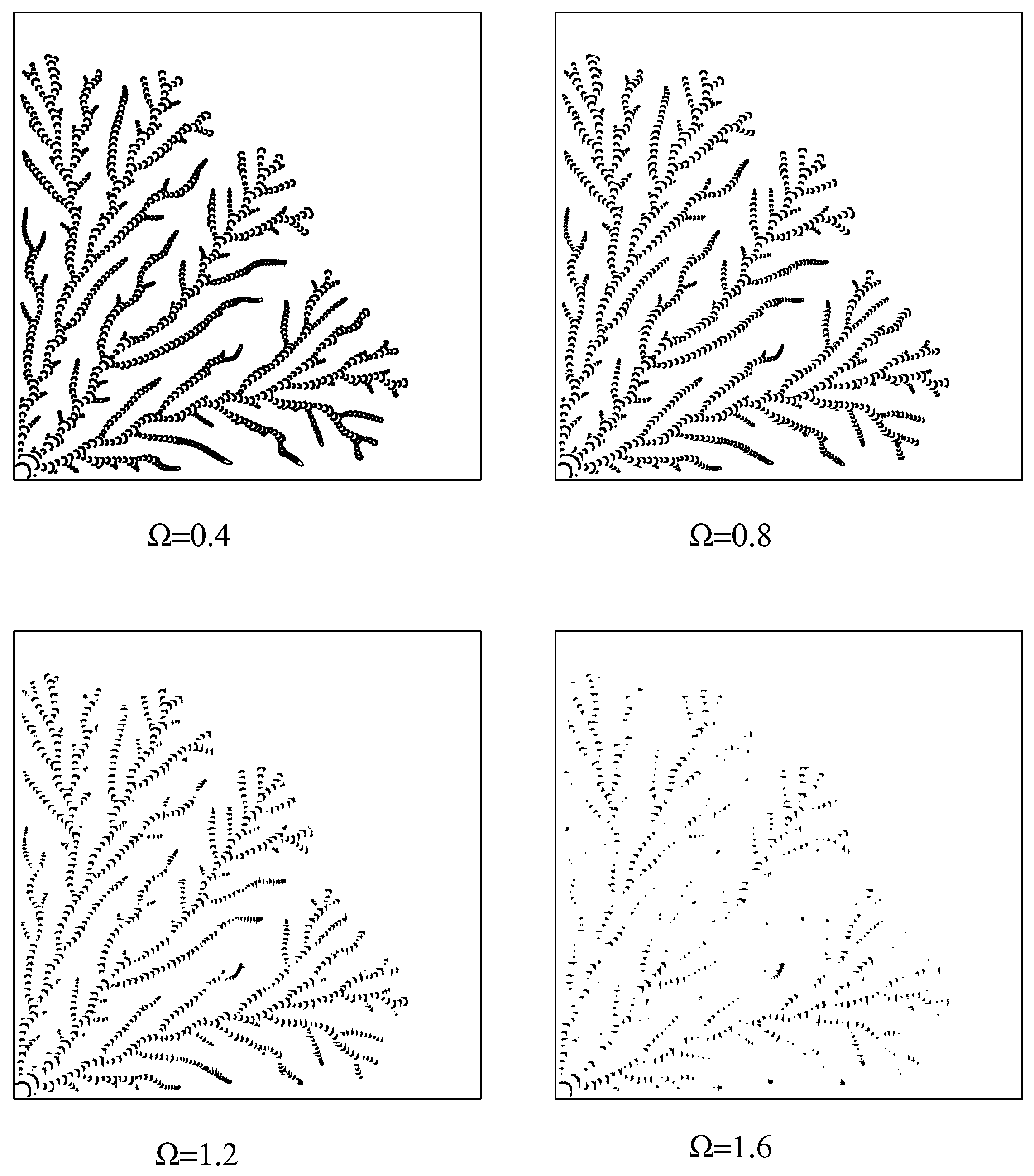
Prior to plotting
Figure 1 and
Figure 2, we tried several levels of
below
, and we chose
= 0.4 as the most graphic of
= 1.6, 1.2, 0.8, and 0.4 (
Figure 6).
The V(q) plots of
Figure 3 and
Figure 5 are quite comparable by order of magnitude. This is surprising considering the extreme idealization underlying the Boussinesq limit employed. In principle, the Boussinesq limit is supposed to provide a merely correct ‘topology’ of the event rather than quantitative proximity to the experimental values.
Author Contributions
Conceptualization, M.K. and G.S.; software, J.Y. and L.K.; writing—original draft, L.K., M.K., J.Y. and G.S. All authors have read and agreed to the published version of the manuscript.
Funding
This research was supported in part by the US–Israel Binational Science Foundation (Grant 2024033).
Data Availability Statement
The article presents original contributions. Further inquiries can be directed to the corresponding author.
Conflicts of Interest
The authors declare that they have no known competing financial interests or personal relationships that could have appeared to influence the work reported in this paper.
Appendix A. Numerical Procedure
The rectangular area
is covered by a rectangular net
, where
, and
is a fixed spatial step. Obviously,
and
. The computational area used is larger than the physical area of the solution. Extra net points are situated outside the boundary and employed for the approximation of boundary conditions (10)–(13). Temporal advances in Equations (1)–(3) are calculated using the first-order Euler method. The convective parts of Equations (1)–(3) are approximated using the upwind scheme, while other spatial derivatives are approximated using central differences [
8]. The overall degree of approximation for Equations (1)–(3), therefore, is one for both spatial and temporal variables.
Equation (
6) is the 2D Poisson equation, which is solved with a Fourier transform with respect to the
x variable. The zero-boundary conditions (13) allow us to use the Fast Fourier Sine Transform with
, where
n is an integer [
9]. The solution of Equation (
6) is sought for as follows:
with the
on the left of Equation (
6) written as
Hence,
where
.
For a fixed i, Equation (A3) is approximated using a set of equations tackled with the finite differences method. The overall numerical scheme then reads as follows: at each time step Equations (1)–(3) are solved using the method described above for fixed ().
The second step deals with the solution of Equation (
6) and by updating (
) using the new
defined by Equation (
5).
References
- Tingas, E.-A. (Ed.) Hydrogen for Future Thermal Engines; Springer: Berlin/Heidelberg, Germany, 2023. [Google Scholar]
- Yanez, J.; Kagan, L.; Sivashinsky, G.; Kuznetsov, M. Modeling of 2D self-drifting flame-balls in Hele-Shaw cells. Combust. Flame 2023, 258, 113059. [Google Scholar] [CrossRef]
- Veiga-López, F.; Kuznetsov, M.; Martinez-Ruiz, D.; Fernández-Tarrazo, E.; Grune, J.; Sánchez-Sanz, M. Unexpected propagation in ultra-lean hydrogen flames in narrow gaps. Phys. Rev. Lett. 2020, 124, 174501. [Google Scholar] [CrossRef]
- Escanciano, J.Y.; Kuznetsov, M.; Veiga-López, F. Characterization of unconventional hydrogen flame propagation in narrow gaps. Phys. Rev. E 2021, 103, 033101. [Google Scholar] [CrossRef]
- Martinez-Ruiz, D.; Veiga-López, F.; Fernández-Galisteo, D.; Kurdyumov, V.N.; Sánchez-Sanz, M. The role of conductive heat losses on the formation of isolated flame cells in Hele-Shaw chambers. Combust. Flame 2019, 209, 187–199. [Google Scholar] [CrossRef]
- Dejoan, A.; Fernández-Galisteo, D.; Kurdyumov, V.N. Numerical study of the propagation patterns of lean hydrogen-air flames under confinement. In Proceedings of the 29th ICDERS, SNU, Siheung, Republic of Korea, 23–28 July 2023. [Google Scholar]
- Vladimirova, N.; Rosner, R. Model flames for the Boussinesq limit: The effect of feedback. Phys. Rev. E 2003, 67, 066305. [Google Scholar] [CrossRef] [PubMed][Green Version]
- Patancar, S.V. Numerical Heat Transfer and Fluid Flow; Hemisphere Publishing Corporation: Washington, DC, USA; New York, NY, USA; London, UK, 1980. [Google Scholar]
- Wang, Z. Fast discrete sine transform algorithms. Signal Process. 1990, 19, 91–102. [Google Scholar] [CrossRef]
| Disclaimer/Publisher’s Note: The statements, opinions and data contained in all publications are solely those of the individual author(s) and contributor(s) and not of MDPI and/or the editor(s). MDPI and/or the editor(s) disclaim responsibility for any injury to people or property resulting from any ideas, methods, instructions or products referred to in the content. |