1. Introduction
Due to recent rapid global climate change, the frequency and intensity of wildfires are continuously increasing. Climate change leads to extended fire seasons, fuel aridity, and an increased frequency of extreme fire weather. Compared to the 2002–2022 average, the annual global forest disturbance area caused by wildfires increased by an average of 2.2 times in 2023 and 2024 [
1]. According to wildfire statistics from the Korea Forest Service (KFS), the number of wildfires, damaged area, and damage scale per incident in Korea from 2010 to 2024 show an overall increasing trend, despite some yearly fluctuations [
2]. Korea is influenced by the dry spring season and strong westerlies, and with approximately 63% of its national land area consisting of forests, it inherently possesses a high vulnerability to wildfires. A study analyzing winter meteorological data in Korea over the past 100 years revealed a shift from a cold and humid climate to a warm and dry one, providing suitable conditions for wildfire occurrences; consequently, small-scale fires that typically occurred in spring are transitioning into large-scale wildfires under favorable fuel conditions. The large-scale wildfire that occurred in Korea in 2022 was observed as an unprecedented event, which has been interpreted not merely as a singular isolated incident but as the beginning of a new wildfire pattern driven by climate change [
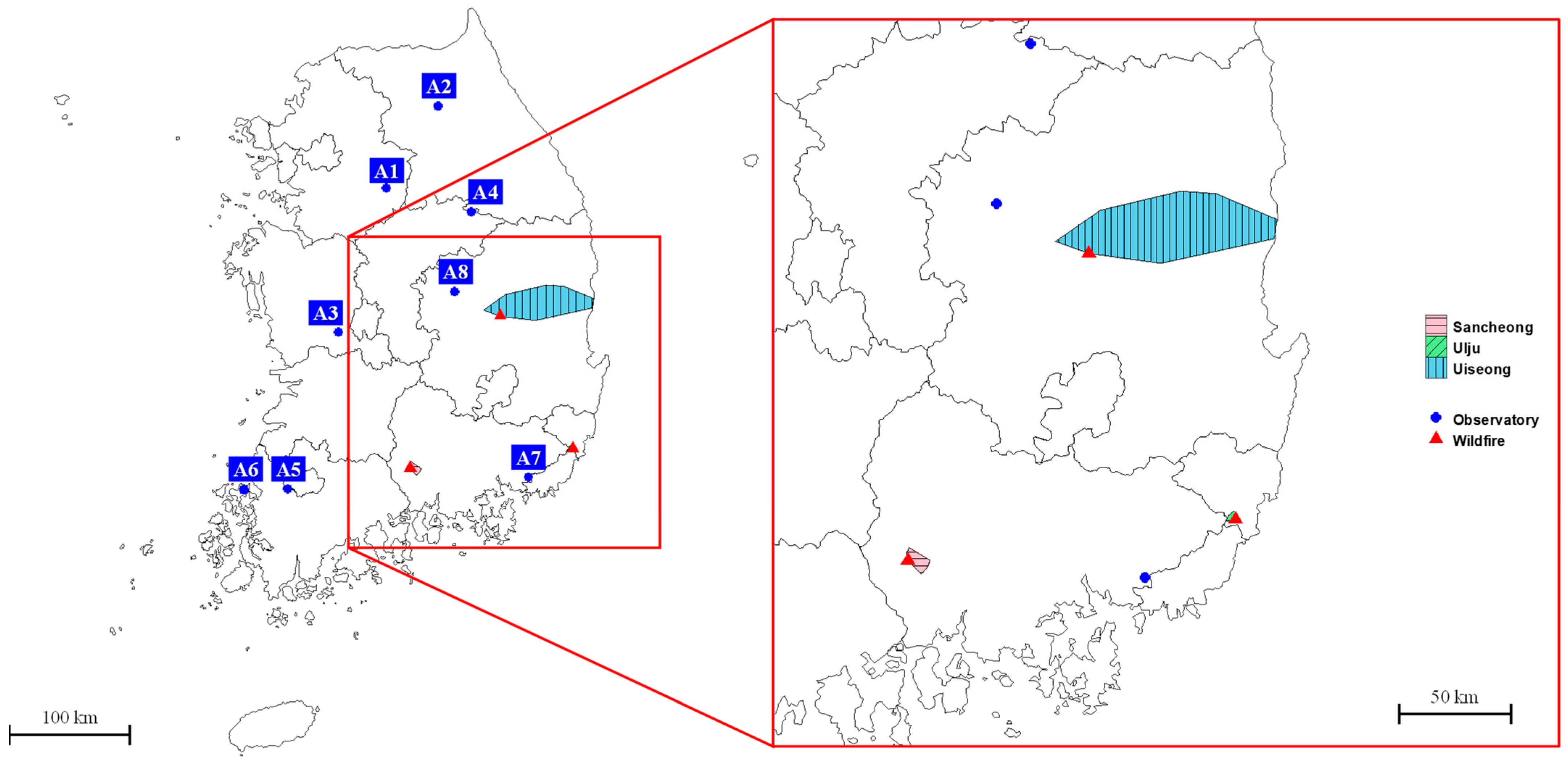
3]. The frequency and severity of damage from spring wildfires are showing a gradually increasing trend. The concurrent large-scale wildfires that broke out on 21 March 2025, in Sancheong-gun (Gyeongnam), Uiseong-gun (Gyeongbuk), and Ulju-gun (Ulsan), resulted in massive forest damage amounting to approximately 100,000 ha. This scale corresponds to about 1% of the total area of South Korea and accounts for approximately 98.77% of the total wildfire damage area in 2025. These wildfires caused direct damage beyond the mountainous regions to nearby farm households and cities, resulting in extensive losses including 3848 residential buildings, 7175 private facilities, 5643 public facilities, 3419 ha of agricultural and forest crops, and 22,000 livestock [
4].
Wildfire smoke contains hazardous air pollutants (HAPs), ranging from particulate matter (PM) to nitrogen dioxide, ozone, and aromatic hydrocarbons. Consequently, it can affect the health not only of residents in nearby areas but also of the public across a wider region. Smoke generated from incomplete combustion in wildfires can reach near the stratosphere through high-temperature updrafts. Through long-range transport, this smoke not only rapidly deteriorates air quality in the source and surrounding areas but can also impact air quality at great distances. HAPs are chemicals known to cause cancer or other serious health problems and are regulated by the U.S. Environmental Protection Agency (EPA). A study analyzing data from ground-based monitoring networks in the western United States from 2006 to 2020 revealed that wildfire smoke significantly increased atmospheric concentrations of formaldehyde, acetaldehyde, acrolein, chloroform, manganese, and tetrachloroethylene; in particular, formaldehyde concentrations tended to increase by approximately 46%. Furthermore, a small number of high-impact events were found to drive the overall high-concentration exposure [
5]. Moreover, wildfires are not confined to mountainous terrain; they can spread to surrounding rural or urban areas, potentially igniting numerous buildings and structures. Fires occurring at the wildland–urban interface (WUI) can combust structures, vehicles, and biomass. These fires release complex, highly toxic gases—including CO, PAHs, and VOCs, as well as acid gases and heavy metals—thereby exerting a direct adverse effect on the air quality of nearby urban areas and indoor environments [
6,
7].
Wildfires are associated with premature mortality in the general population. According to a recent review paper, the association between wildfire smoke exposure and general respiratory health effects has been established, and there is growing evidence linking it to increased risks of respiratory infections and mortality. Although evidence regarding the induction of cardiovascular disease remains uncertain, some recent studies have reported associations with specific cardiovascular clinical indicators [
8]. A meta-analysis of mortality and morbidity revealed that wildfire smoke showed a strong association with cardiovascular mortality, as well as the risk of all-cause respiratory hospitalizations and emergency department visits in the general population. Additionally, age-specific analyses indicated that the elderly population is more vulnerable to the cardiopulmonary effects of wildfire smoke [
9]. A rapid increase in PM concentration serves as a key indicator suggesting not only the intrinsic toxicity of the particles themselves but also the potential dispersion of these associated hazardous substances. Therefore, it is essential to prioritize quantifying variations in PM concentrations, especially in regions inhabited by vulnerable populations, during wildfire events.
Existing research on wildfire air quality has predominantly focused on urban air environments in densely populated areas or on individual health effects. However, in Korea, a significant proportion of land adjacent to forests comprises agricultural land, placing rural areas directly within the impact zone of wildfire emissions. Moreover, elevated levels of airborne PM and other chemicals can clog crop stomata and hinder photosynthesis, thereby adversely affecting growth; this can subsequently lead to a reduction in agricultural productivity [
10]. Agricultural workers are characterized by a high proportion of outdoor activities and extended periods of outdoor residence. Consequently, compared to other population groups, they exhibit a higher frequency of respiratory exposure to HAPs, in addition to hazardous substances generated during agricultural activities. While exposure to hazardous substances among industrial workers is legally regulated, there is a paucity of research regarding outdoor air exposure for agricultural workers. Given that Korea’s farming population is approximately 2 million, with the elderly population (aged 65 and over) accounting for 55.8% [
11], this group inherently possesses characteristics that make them highly vulnerable to hazardous substance exposure. Therefore, this study aims to elucidate the spatiotemporal distribution characteristics of PM spreading to agricultural regions nationwide during large-scale wildfires, utilizing meteorological data and air quality monitoring data. Furthermore, going beyond a simple assessment of concentration distribution, the ultimate objective is to quantitatively predict and evaluate the contribution of wildfire occurrences to PM concentrations in agricultural areas by constructing a multiple regression model that incorporates physical dispersion distances and transport mechanisms.
3. Results
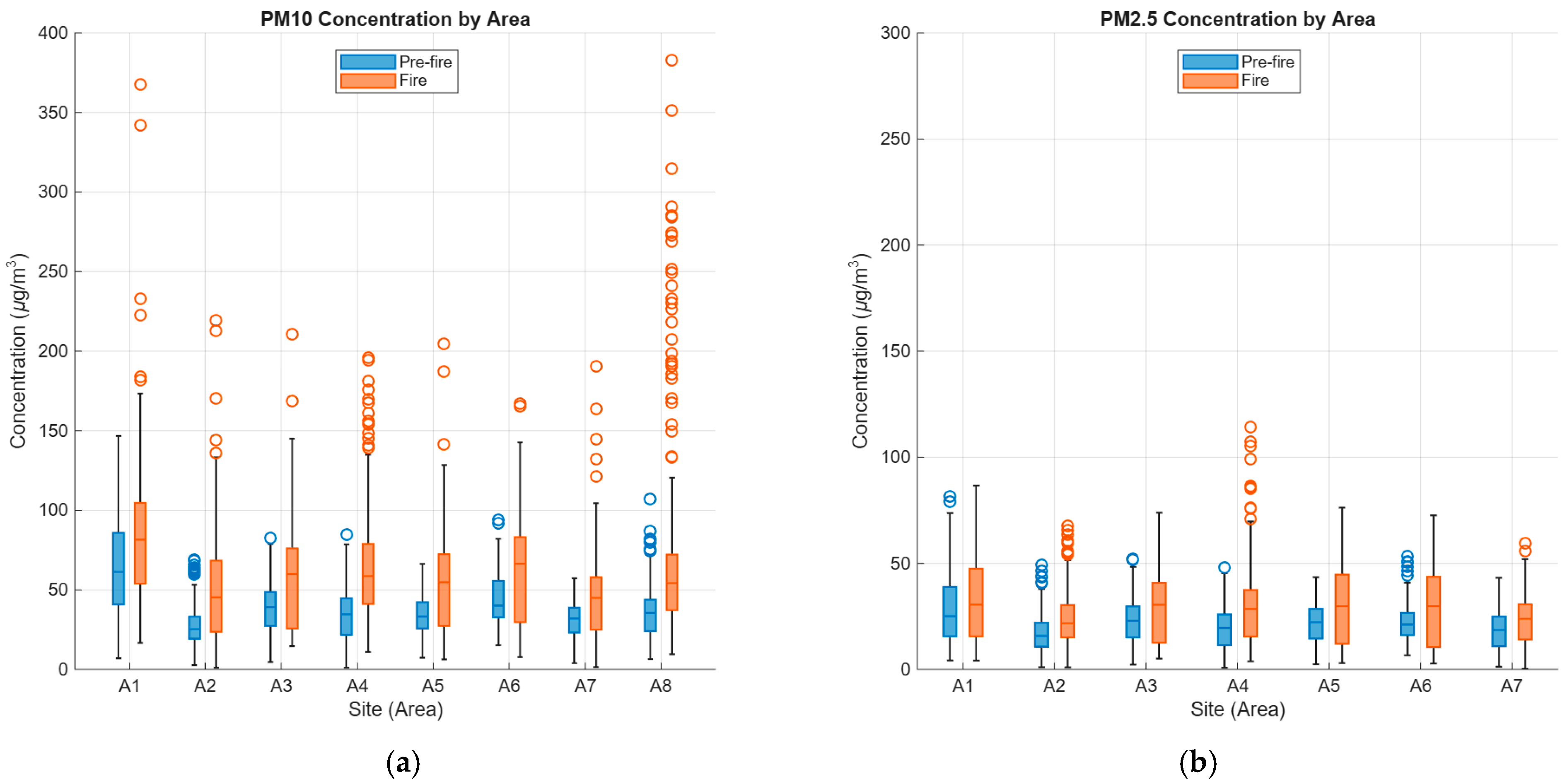
The descriptive statistics for PM concentrations and excess PM concentrations at each sampling site are presented in
Table 2, and the concentration distributions of PM
10 and PM
2.5 before and after the wildfire are illustrated in
Figure 2. Overall, all sampling sites exhibited a distinct increasing trend compared to pre-fire background concentrations. When comparing the geometric means of the eight sites to pre-fire levels, PM
10 and PM
2.5 increased by 47.3% and 24.9%, respectively, confirming that the wildfires contributed to widespread deterioration of air quality. Notably, site A8, which was closest to the wildfire source, recorded the highest average concentrations and maximum values for both PM
10 and PM
2.5 (Max Excess PM
10: 351.69 μg/m
3), as well as the largest standard deviation. This is interpreted as a result of the site falling within the direct influence of the smoke plume, reflecting rapid fluctuations in concentration driven by changes in wind direction. In contrast to site A8, which experienced rapid concentration fluctuations, site A7 did not exhibit significant variations. This is attributed to the influence of strong westerlies typical of the spring season in Korea, as well as the relatively small scale of nearby wildfires (Ulju and Uiseong), which appears to have limited their direct impact on PM concentrations.
The results of the ANOVA and Tukey HSD post hoc tests performed on the log-transformed excess PM concentrations are presented in
Table 3. The analysis revealed that the differences in concentrations among regions were statistically significant (
p < 0.0001). Based on the post hoc analysis, the regions were classified into three distinct groups according to the similarity of their excess PM concentrations. In particular, sites A8 and A4 were classified into the “High group,” exhibiting elevated levels for both PM
10 and PM
2.5.
To identify the factors influencing PM concentration variations and their contributions during the wildfire period, multiple linear regression analysis was conducted on meteorological variables. The models were established sequentially as follows: the Baseline Model (BL Model) incorporating local meteorological data, the Physical Factor Model (PF Model) reflecting physical dispersion factors, and the Transport Mechanism Model (TM Model) designed to elucidate transport mechanisms. The results of the regression analysis for log-transformed excess PM
10 concentrations are presented in
Table 4. In the BL Model, temperature, relative humidity, and wind speed at the sampling site were selected as independent variables; however, while temperature showed high significance, wind speed and relative humidity were not statistically significant (
p > 0.05). This suggests that during high-concentration events such as wildfires, relying solely on local surface conditions—such as wind speed or relative humidity at the observation station—has limitations in explaining concentration variations. To address this limitation, the PF Model was established by incorporating the wind speed at the wildfire source and the distance to the sampling site, while the TM Model was developed by including ‘Wind potential,’ which reflects the transport time and wind direction from the wildfire area. Furthermore, to quantitatively assess the influence of distinct variables in each model, local wind speed and relative humidity, which lacked statistical significance, were excluded from subsequent analyses.
First, in the BL Model, which considered only local meteorological factors, only temperature exhibited a significant positive correlation, whereas wind speed and relative humidity were not significant. This implies that in situations where external pollution sources such as wildfires are dominant, reliance solely on the micrometeorology of the observation site is limited in explaining concentration variations.
To address this limitation, the PF Model, which incorporated physical dispersion factors, revealed that the log-transformed distance function and the wind speed at the wildfire area were statistically significant. This indicates that the influence of wildfires on airborne PM concentrations is substantial at close range but diminishes with increasing distance. Additionally, PM10 concentrations were estimated to decrease as wind speed at the wildfire area increased; this confirms that stronger winds at the ignition point lead to lower concentrations due to physical dispersion and dilution.
The TM Model ultimately demonstrated the highest explanatory power and goodness of fit for excess PM10 concentrations, with both Transport time and Wind potential—variables included to elucidate transport mechanisms—showing statistical significance. In particular, Transport time exhibited a significant positive association; this indicates that as the time required for pollutants to reach the site increases due to atmospheric stagnation, pollutants accumulate in the atmosphere, leading to higher concentrations. Wind potential showed marginal significance with a negative coefficient. This suggests that the effects of turbulent diffusion and updrafts, which disperse pollutants into the atmosphere, were more dominant than the rapid transport effect of strong winds, effectively contributing to a reduction in ground-level concentrations.
The results of the regression analysis for PM
2.5 are presented in
Table 5. The analysis revealed a distinct contrast to PM
10; relative humidity, which was not significant in the PM
10 models, exhibited a very strong positive significance in all PM
2.5 models (
p < 0.001). In the analysis of the PF and TM Models, unlike PM
10, transport-related variables did not show statistical significance for PM
2.5 (
p > 0.05). Furthermore, even when extending to the TM Model, there was no change in the R
2 value, and the variation in the Akaike Information Criterion (AIC) was minimal.
This suggests that PM2.5, being fine particles, are less influenced by gravitational settling compared to the coarser PM10 and remain in the atmosphere for extended periods. Consequently, chemical and meteorological factors—such as secondary formation or hygroscopic growth combined with local humidity—play a more dominant role in determining concentrations than physical transport does. In other words, high-concentration phenomena of PM2.5 caused by wildfires are more likely to be sustained by local meteorological conditions rather than by the physical force of wind.
4. Discussion
4.1. Interpretation of Meteorological and Physical Transport Mechanisms
The purpose of this study is to construct linear regression models utilizing local meteorological data and PM concentrations to quantify the region-wide impact of large-scale wildfires across Korea. The indices developed in this study to determine the extent of impact on air quality at sampling sites, based on the alignment of wind direction and azimuth, were adapted from general physics and atmospheric diffusion theories.
The Wind potential index was designed to simultaneously account for horizontal transport by wind and the concentration dilution effect due to distance, based on atmospheric diffusion theory [
16]. Reflecting the tendency for concentrations driven by turbulent diffusion to decrease exponentially or logarithmically as the distance from the pollution source increases, the weight was adjusted by applying the natural logarithm to the distance [
17]. Transport time is an index that simply represents the theoretical time required for an air parcel containing pollutants to travel from the ignition point to the sampling site. This was calculated using the linear distance between the wildfire site and the monitoring station, along with the average wind speed at the wildfire location, to estimate the average travel time from a Lagrangian perspective [
18,
19].
The observation that the Wind potential variable showed a negative correlation with PM10 concentrations suggests that the transport of pollutants from the wildfire source cannot be adequately explained by a simple linear horizontal transport model. Although the initial hypothesis posited that stronger wind speeds would increase concentrations by rapidly transporting pollutants horizontally, the findings suggest that for wildfire smoke behavior, turbulent diffusion effects—which disperse and dilute pollutants into the atmosphere—were more dominant than the horizontal advection that transports pollutants in the direction of the wind.
This interpretation is mutually complementary with the finding that the Transport time variable exhibited positive significance, implying that concentrations accumulate during periods of atmospheric stagnation. In particular, while physical dilution effects were statistically significant for coarse particles like PM10, the influence of wind was not significant for PM2.5, which exhibits behavior similar to gaseous substances. This implies that for fine particles such as PM2.5, factors such as residence time within the local atmosphere and widespread spatial distribution are more critical determinants of concentration than physical factors like wind speed.
Studies on pollutant transport modeling for large-scale wildfires have reported that incorrect assumptions regarding the initial vertical distribution of emissions can lead to significant errors in the timing and magnitude of PM and ozone predictions [
20]. However, while such advanced modeling emphasizes the importance of vertical distribution and turbulent diffusion in wildfire areas, it simultaneously entails increased computational costs and has practical limitations for application in general environmental settings.
The regression analysis results indicated that the distance from the wildfire source showed a statistically significant negative correlation in both the PM10 and PM2.5 models. This reflects the effects of atmospheric dispersion and dry deposition as the distance from the source increases. Although the coefficient for the distance variable was slightly higher in the PM2.5 model (−0.160) compared to the PM10 model (−0.136), this is primarily attributed to a mathematical scale effect resulting from the difference in offset constants applied during the log transformation (PM10: +42; PM2.5: +20). Furthermore, from a physical perspective, the influence of local emission sources—such as fugitive soil dust from farmlands—is intermixed with wildfire emissions in the case of PM10. Consequently, the concentration reduction effect associated with increasing distance can be interpreted as being observed to be relatively gradual.
4.2. Influence of Humidity on PM2.5 Formation
It is noteworthy that relative humidity exhibited greater explanatory power for variations in PM
2.5 concentrations than physical variables did. This suggests that after wildfire smoke flows into rural areas, high humidity conditions promote the hygroscopic growth of water-soluble organic carbon or facilitate the active formation of secondary organic aerosols (SOA) through the oxidation of precursors [
21]. This mechanism implies that even after the wildfire is extinguished and visible smoke has dissipated, residual gaseous substances can react with moisture to induce high concentrations of PM. Consequently, agricultural workers face an increased risk of exposure to invisible threats that are not visually perceptible.
This study aimed to verify the contribution of wildfires to variations in PM concentrations by utilizing publicly available meteorological data and air quality monitoring data. However, the behavior of PM generated by wildfires is influenced in highly diverse ways by factors such as vertical dispersion driven by strong updrafts, the planetary boundary layer height (PBLH), and geographical features; a limitation of this study is that it could not fully account for these complex dynamics. Additionally, due to a lack of data on wildfire intensity, the study was unable to quantitatively incorporate the amount of emissions released from the source. Nonetheless, this study holds significance in that it devised a model with considerable explanatory power for the atmospheric environment using only simple meteorological and physical variables.
Above all, the positive correlation between relative humidity and PM
2.5 concentrations identified in this study holds significant public health implications when combined with the specific characteristics of the agricultural working environment. Topographically, many rural areas in Korea are basins surrounded by mountains, where atmospheric inversion layers frequently form due to nocturnal radiative cooling [
22]. Consequently, wildfire smoke fails to disperse and becomes trapped near the surface, forming high-concentration smog. Given that agricultural workers customarily engage in outdoor activities during the early morning or morning hours—times characterized by high humidity and weak winds—there is a structurally high probability of defenseless exposure.
4.3. Implications for Public Health and Policy
Furthermore, considering that 55.8% of the agricultural population in Korea is elderly (aged 65 and over) [
11], such exposure to high concentrations of fine PM can lead directly to fatal health consequences, including the exacerbation of underlying diseases or the induction of cardiovascular diseases. Specifically, a large-scale agricultural cohort study in the United States demonstrated that a 10 μg/m
3 increase in PM
2.5 was associated with a cardiovascular hazard ratio (HR) of 1.87 in males [
23]. Moreover, a systematic meta-analysis of cohort studies on long-term outdoor PM exposure reported that the relative risk (RR) for lung cancer increased by 1.22 per 10 μg/m
3 of PM
10 and by 1.16 per 10 μg/m
3 of PM
2.5 [
24]. Therefore, it is necessary to move beyond existing broad-scale forecasting systems and implement customized forecasting and the dissemination of action guidelines that account for the basin topography of rural areas and specific farming schedules.
Although this study attempted to quantify the potential health impacts of wildfire-induced PM on agricultural workers using risk assessment, there were limitations in quantifying the acute or sub-acute toxicity resulting from short-term, high-concentration events such as wildfires. This is because current health risk assessment frameworks rely on Reference Doses (RfD) established primarily for chronic exposure. Existing studies have either concluded that short-term exposure to wildfire smoke results in a transient decline in lung function, which may eventually return to baseline levels, or have focused on the effects of repeated exposure to wildfire smoke [
25].
However, the acute toxic effects on vulnerable populations—such as children with developing lungs, the elderly with declining lung function, and pregnant women and fetuses—have not yet been adequately studied; thus, their safety cannot be guaranteed. Therefore, this study suggests the necessity for future research to not only conduct epidemiological studies on wildfire smoke but also to develop exposure factors specifically for assessing acute toxicity impacts.
5. Conclusions
This study quantitatively elucidated the impact of concurrent large-scale wildfires that occurred in Korea in March 2025 on air quality in agricultural regions nationwide and analyzed the contribution of meteorological and physical variables to variations in PM concentrations. The results revealed that during the wildfire period, PM10 and PM2.5 concentrations at eight agricultural sites nationwide increased by 47.3% and 24.9%, respectively, compared to non-fire periods. This confirms that wildfires induce widespread air pollution that extends far beyond the ignition points.
The behavioral characteristics of PM derived from the multiple regression analysis exhibited distinct differences depending on particle size. For PM10, physical dispersion mechanisms were dominant; the dilution effects caused by strong winds and separation distance were identified as the primary factors driving concentration reduction. In contrast, PM2.5 showed a strong positive correlation with relative humidity rather than physical transport variables. This suggests that after wildfire smoke flows into rural areas, high concentrations are sustained through secondary formation and hygroscopic growth under high-humidity conditions. This provides important scientific evidence that PM can be secondarily amplified at agricultural sites depending on meteorological conditions, going beyond simple physical transport.
Therefore, a policy transition aimed at complementing the current broad-scale air quality forecasting system should be considered to protect the health of agricultural workers. In the event of wildfires, “pinpoint forecasts” targeting agricultural lands located downwind must be implemented; these forecasts should be accompanied by concrete behavioral guidelines, moving beyond the mere provision of concentration data. In particular, effective measures are required—such as strictly restricting outdoor activities for elderly agricultural workers and recommending indoor shelter—during humid early morning hours when pollutant stagnation and secondary formation are most active.