


Abstract
When forest fires occur, timely detection and initial attack are critical for fire prevention. This study focuses on optimizing the cruise path of Unmanned Aerial Vehicles (UAVs) from the perspective of initial attack. It aims to maximize coverage of regions where initial attack success rates are low, shorten the time taken to detect fires, and, in turn, boost detection effectiveness and the initial attack success. In this paper, a path planning strategy, Improved Multi-Objective Crested Porcupine Optimizer (IMOCPO), is proposed. This strategy employs a weighted sum approach to formulate a composite objective function that balances global search and local optimization capabilities, considering practical requirements such as UAV endurance and uneven distribution of risk areas, thus enhancing adaptability in complex forest environments. The weight selection is justified through systematic grid search and validated by sensitivity analysis. The proposed strategy was compared and evaluated with a related strategy using four metrics: high-risk coverage rate, grid coverage rate, Average Distance Risk (ADR), and Average Grid Risk (AGR). Results show that the proposed path planning strategy performs better in these metrics. This study provides an effective solution for optimizing UAV cruise strategies in forest fire monitoring and has practical significance for improving the intelligence of forest fire prevention.
1. Introduction
Forests play a critical role in sustaining life, regulating climate, conserving water resources, and preserving biodiversity [1,2]. Nevertheless, with the escalating impacts of global climate change and the continuous expansion of human activities, forest fires have emerged as one of the most severe threats to forest health and sustainable development [3,4].
In actual firefighting operations, the initial attack phase—referring to the early-stage response to fire outbreaks—is the most crucial and directly effective stage of firefighting [5]. Reducing fire detection time is a direct and effective means to improving the initial attack success rate [6]. This objective is primarily achieved through the establishment of forest fire monitoring and early warning systems [7]. Reviewing the evolution of detection methods, early systems primarily relied on visual monitoring stations and volunteer reporting mechanisms. However, these approaches suffer from high demands on human and material resources, large blind spots, inefficiency, and incomplete or inaccurate data [8,9]. With technological advancements, deployable or mobile real-time detection systems have become research hotspots, including IoT-based visual sensor networks, fire lookout towers, and UAV-based inspections [10,11].
In recent years, the utilization of UAVs for forest monitoring has emerged as a prominent research focus [12,13]. Notably, achieving efficient path planning and searching uncertain targets under resource constraints remains a significant challenge [14,15,16]. UAV-based forest fire inspection tasks typically integrate computer vision and pattern recognition algorithms to enhance detection accuracy and efficiency. Real-time data are collected using high-definition network cameras and infrared thermal imaging systems mounted on UAVs, and forest fire or smoke detection is conducted through image processing or deep learning algorithms [4]. Mahmud put forward a deep learning-based wildfire detection method using imagery from unmanned aerial systems [17]. Their study developed a novel visual smoke detection system by applying image segmentation and object detection techniques to a wildfire image dataset collected via UAS, aiming to reduce false alarm rates and improve detection accuracy. The research highlights recent progress in UAS-based wildfire smoke detection and validates the proposed method through experimental results.
One of the common challenges in UAV-based forest fire inspection tasks is the path planning problem. Since this problem has been proven to be NP-hard [18], existing studies often simplify it into the Traveling Salesman Problem (TSP) or multi-objective optimization problems. Heuristic methods like genetic algorithms, simulated annealing, reinforcement learning, and differential evolution are widely employed for UAV path planning and scheduling [18,19]. However, in the specific scenario of forest fire monitoring, they still have certain adaptability limitations [20]. Although genetic algorithms can achieve global search through crossover and mutation, they are prone to premature convergence due to the early loss of population diversity. The simulated annealing algorithm, which operates on a single individual search model, results in low efficiency in local optimization [21]. Differential evolution algorithms rely on difference information between individuals to update the population but tend to overlook high-risk points due to excessive pursuit of path smoothness [22]. In addition, methods such as reinforcement learning, despite showing certain adaptability in dynamic environments, require a large amount of training data for support. These drawbacks make existing algorithms unable to balance multi-objective requirements such as “priority monitoring of high-risk areas”, “UAV endurance constraints”, and “adaptability to complex terrain”, thus highlighting the urgent need for a new strategy that can both ensure global search capabilities and enhance the optimization of local key areas [23].
To address the challenges faced by energy-constrained mobile robots (e.g., UAVs) in area coverage path planning, a Voronoi-Based Path Generation (VPG) method [24] is proposed. Aimed at scenarios where full area coverage is not feasible due to energy limitations, the algorithm takes the path as an interconnected mass–spring–damper system and leverages a potential field generated from a Voronoi diagram to optimize the distribution of waypoints for near-optimal coverage. The algorithm demonstrates linear time complexity and robust coverage performance in both simulation and real-world experiments, proving effective in both convex and non-convex regions. Compared to other methods, it achieves a favorable balance between runtime efficiency and path optimization, rendering it especially appropriate for partial coverage scenarios. However, the algorithm currently supports only single mobile sensors, necessitating further development for coordinated multi-sensor coverage.
In solving complex spatial optimization problems, nature-inspired metaheuristic algorithms have shown good performance in fields such as path planning due to their unique advantage of simulating biological behaviors. Among them, the Crested Porcupine Optimizer (CPO) was proposed in early 2024. It is a high-performance algorithm [25]. This algorithm takes inspiration from the four defensive actions that crested porcupines exhibit when confronted with predators: visual intimidation, acoustic deterrence, olfactory and physical attack. The first two behaviors correspond to the algorithm’s exploration stage, while the latter two constitute the exploitation phase. Through this phase division, a balance between global search and local optimization is achieved [26]. During the operation of the algorithm, porcupine individuals update through dynamic interactions such as information sharing, competition, and cooperation, promoting the evolution of the population toward optimal solutions. Additionally, the incorporated Cyclic Population Reduction (CPR) strategy can not only accelerate convergence but also avoid falling into local optima and enhance population diversity, providing effective support for optimization tasks in complex scenarios [27].
Recently, machine learning has been extensively applied [28], giving rise to a number of approaches that leverage these algorithms to optimize UAV flight paths or deployment strategies, aiming to adapt to dynamic environments and achieve multi-UAV coordination [29]. Among these, the most representative and widely adopted methods integrate deep and reinforcement learning, such as Deep Reinforcement Learning (DRL), Deep Q-Learning, and Deep Q-Networks (DQN) [30,31]. For instance, He et al. proposed an autonomous UAV path planning method based on DRL, with a particular focus on enhancing the transparency and usability of the model through explainability techniques [32]. Their study models the UAV navigation task by training with the TD3 algorithm, and validates its performance. By integrating SHapley Additive exPlanations and Class Activation Mapping, the study introduces a novel saliency mapping execution method that provides both visual and textual explanations for users, thereby improving trust in the DRL model. Moreover, flight tests in real-world settings demonstrate strong generalization capabilities and computational efficiency compared to traditional methods, although there is still room for improvement in terms of explainability depth and adaptability to real-world environments.
Recently, the authors proposed UAV cruise strategies to improve the initial attack success rate in forest fire prevention. The experimental results showed that the NHRF (Nearest High Risk First) strategy can cover more high-risk areas while ensuring path efficiency, demonstrating good performance [15].
Overall, while a variety of approaches have been explored for using UAVs in forest fire management [29], most studies focus on post-fire surveillance through image or video processing, without integration into actual firefighting operations. Many works mainly aim to maximize area coverage with limited practical feasibility. This study presents a UAV patrol path planning approach based on the Porcupine Optimization Algorithm by integrating the objectives of risk, distance, and coverage. To address these limitations, this study proposes an Improved Multi-Objective Crested Porcupine Optimizer (IMOCPO), which is developed by enhancing the original Crested Porcupine Optimizer (CPO) to better adapt to UAV forest fire monitoring scenarios. Unlike the original CPO, IMOCPO incorporates three key improvements: first, a weighted composite objective function that integrates multiple conflicting criteria (high-risk coverage, flight distance cost, and grid coverage) into a single tractable optimization problem to meet practical mission requirements where a single optimal solution is needed; second, a risk-aware initialization strategy that prioritizes high-risk grid points to improve initial solution quality; and third, integration of a 2-opt local search strategy and dynamic path length adjustment to enhance local optimization and adaptability to uneven risk distribution. The weight selection is systematically determined through grid search and validated by sensitivity analysis to ensure robustness. These modifications enable IMOCPO to overcome the adaptability limitations of the original CPO in complex forest environments, thereby optimizing UAV cruise paths for more efficient fire detection and prevention. Through optimizing UAV patrol paths, the approach seeks to maximize the region coverage where the initial attack success rate is relatively low, thereby enhancing fire detection efficiency and ultimately improving the success rate.
2. Materials and Methods
2.1. Research Region and Data Collection
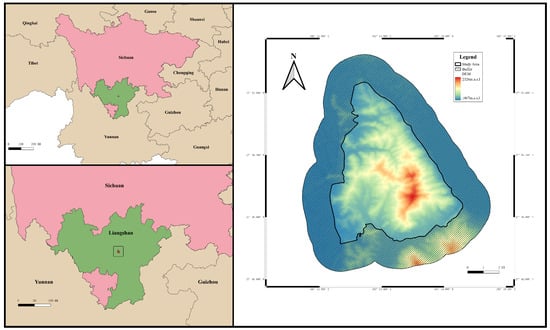
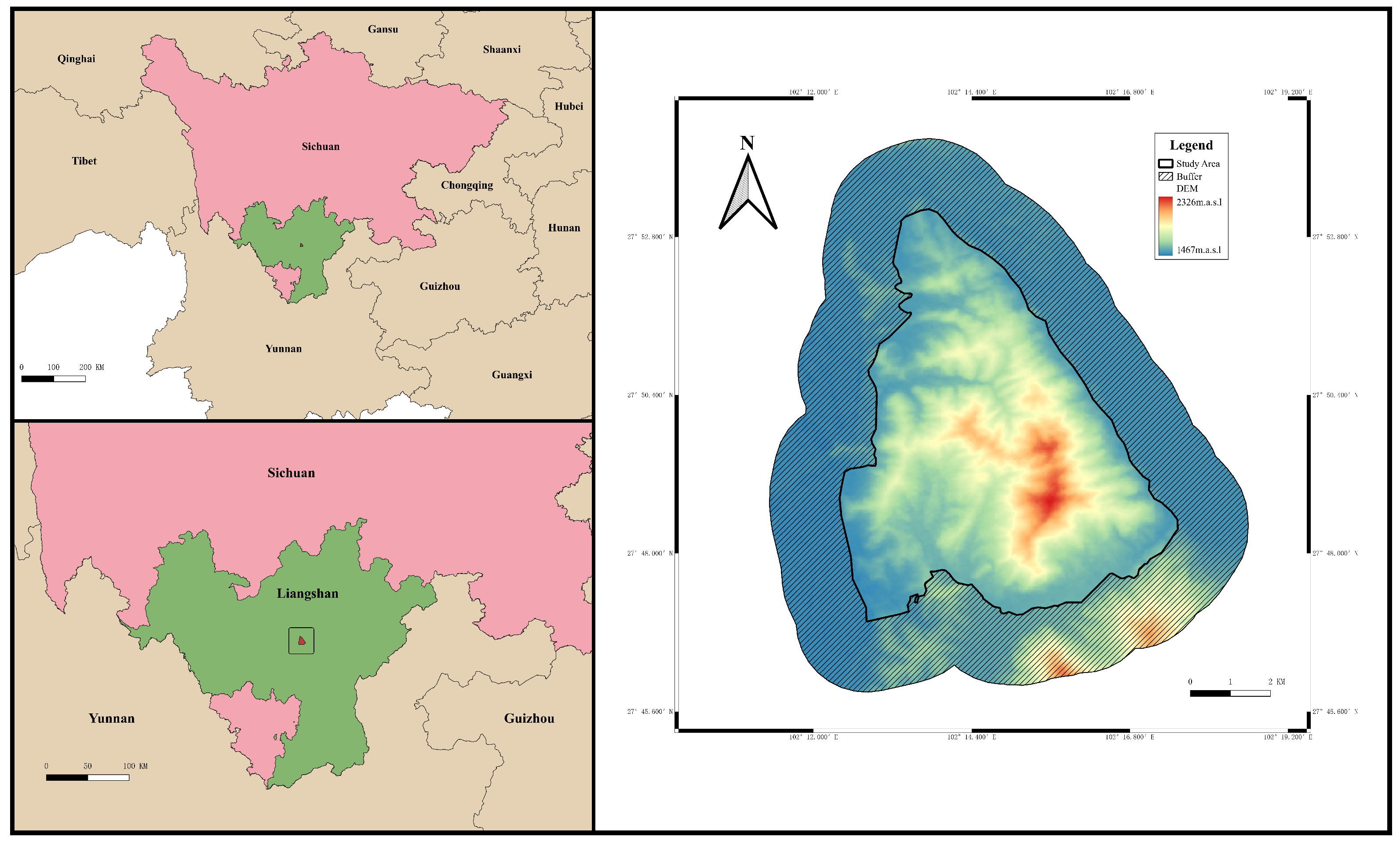
Figure 1 shows the geographical location of the study area and the 30-m DEM derived from ASTGTMv003 satellite data. The study area is within the region of the main peak of Lushan Mountain, Xichang City, Sichuan Province, China. The central area has a relatively high elevation, while the surrounding terrain is relatively flat. The region is characterized by a tropical plateau monsoon climate.
Figure 1.
Geographical position of the research area and DEM map.
In this study, the level of risk within each grid was determined based on the initial attack success rate data and methodology proposed in ref. [6]. Specifically, the initial attack success rates of all points within the study area were first calculated using the model from ref. [6], which considers factors such as terrain, vegetation type, weather conditions, and accessibility. These success rates were then divided into 20 quantile-based categories, where lower success rates (indicating higher difficulty in initial attack) correspond to higher risk values. The risk value for each grid point i ranges from 1 (lowest risk, highest initial attack success rate) to 20 (highest risk, lowest initial attack success rate). The study area was rasterized into grids of 125 m × 125 m, a size determined by the UAV’s flight altitude (approximately 120 m) and camera coverage area, ensuring that each grid can be effectively monitored in a single pass. Within each grid, the risk value is assigned based on the concentration of high-risk points (those in the lowest 20% of initial attack success rates). The spatial distribution of these risk levels and detailed risk assessment methodology are comprehensively documented in ref. [6].
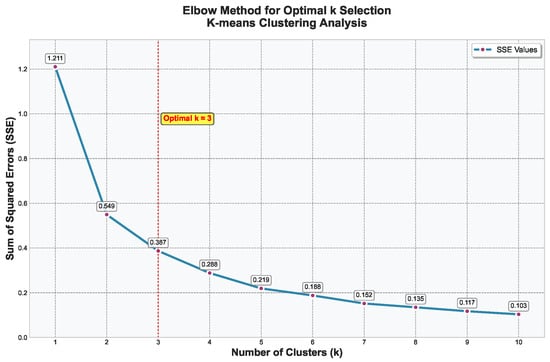
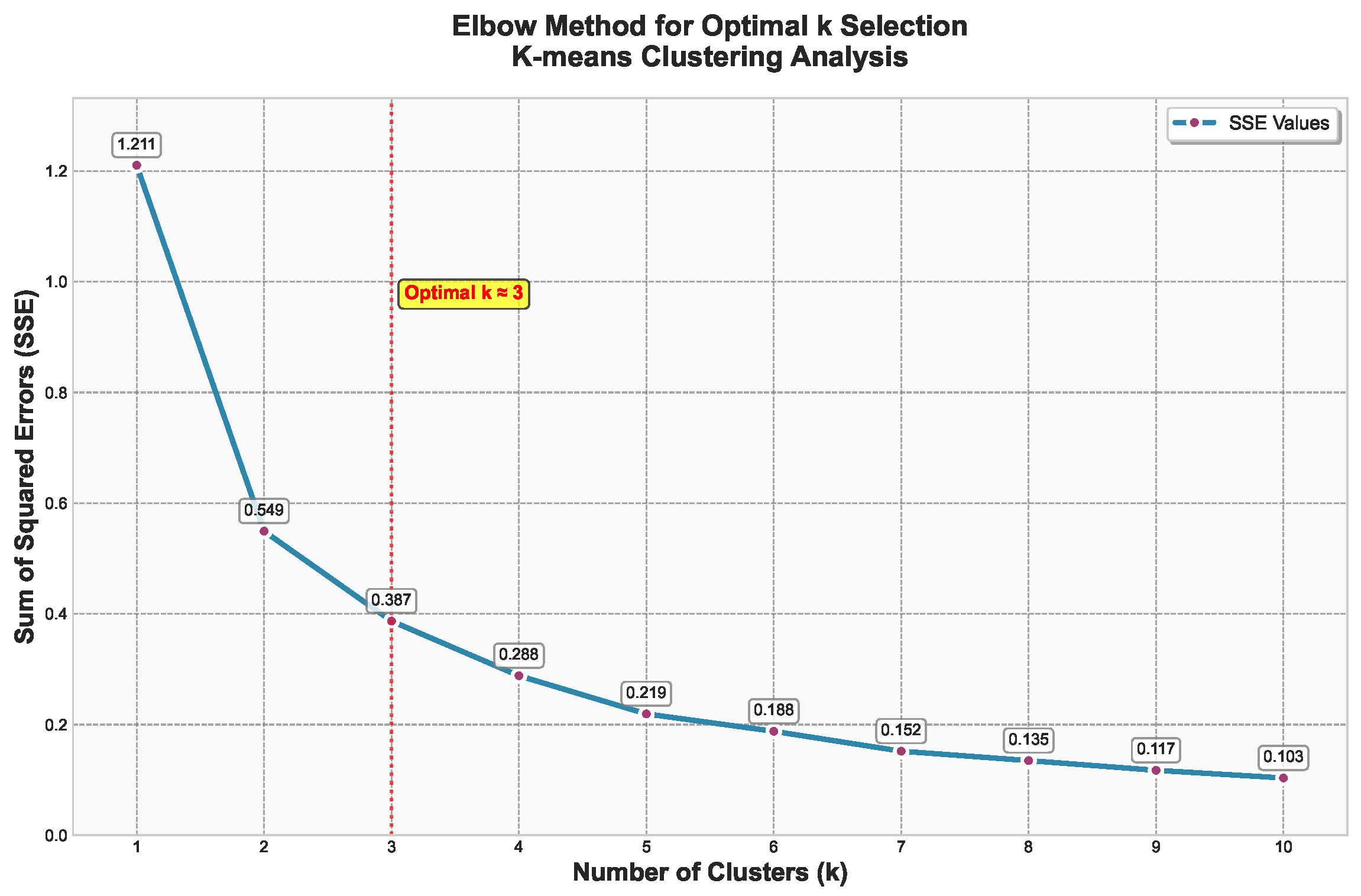
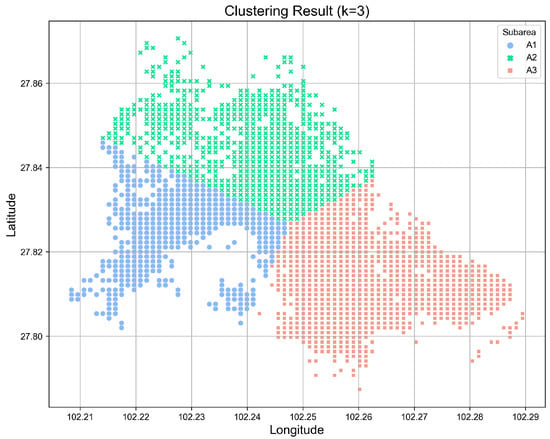
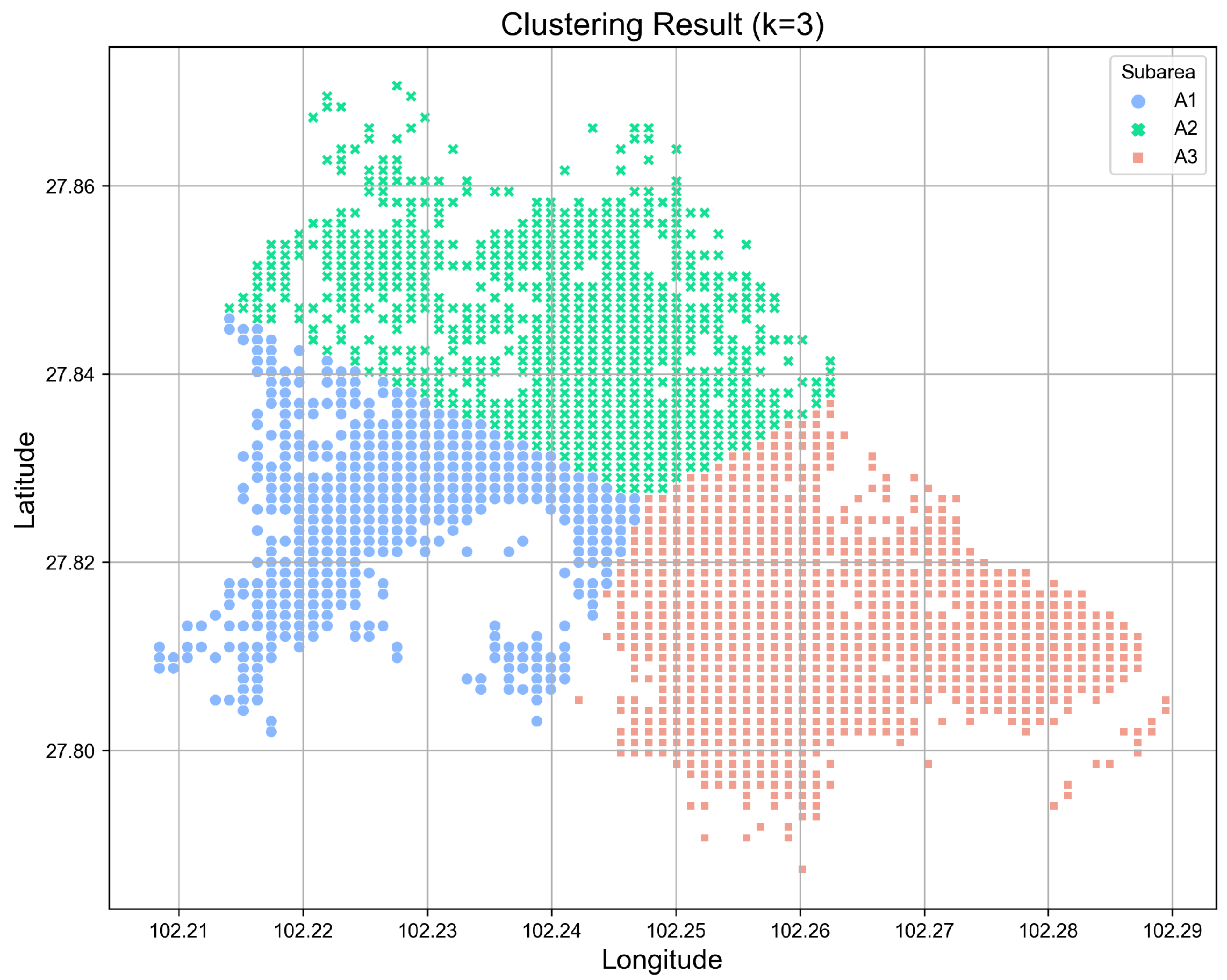
Given the large size of the study area and the constrained endurance of individual drones, a single UAV is incapable of covering the entire region to fullfill its assigned tasks. Therefore, it is necessary to use clustering algorithms to break it down into executable sub regions, and adopt k-means algorithm for clustering, which can make the grid risk distribution in the divided sub regions correlated and avoid excessive dispersion of high-risk points leading to waste of cruise resources. By using the elbow method [33] to calculate the sum of squared errors (SSE) at different K values, a curve of SSE variation with K value is plotted. The marginal benefit inflection point where the rate of SSE decrease sharply in the curve can accurately locate the optimal K value that maximizes the homogeneity of grid risk characteristics within the subregion and adapts the subregion size to UAV endurance constraints. The optimal number of clusters K was determined by the Elbow Method. As shown in the following figure, the best value of K is 3. Taking into account both the results of the Elbow Method and the practical endurance efficiency of drones, the study area was ultimately divided into three relatively independent subregions, which were designated as A1, A2, and A3. The results of the Elbow Method and the visualization of the clustering outcome are presented in Figure 2 and Figure 3.
Figure 2.
The results of the Elbow Method.
Figure 3.
K-means cluster maps.
This figure shows the variation in sum of squared errors (SSE) corresponding to different k values in K-means clustering. SSE shows a decreasing trend with increasing k value: when k = 1, SSE is 1.211, sharply drops to 0.549 when k = 2, and drops to 0.387 when k = 3, and then the decline gradually slows down. According to the elbow rule, a clear inflection point is formed at k = 3, with the greatest change in SSE decrease amplitude. Choosing k = 3 can effectively reduce regional dispersion and avoid excessive segmentation, which is suitable for the regional division requirements in drone path planning.
2.2. Multi-Objective Optimization Modeling for Path Planning
In the process of performing monitoring tasks with UAVs, the optimization objectives of path planning must comprehensively consider factors such as risk coverage, flight cost, and coverage area. To this end, we construct a multi-objective optimization model to balance the prioritized coverage of high-risk areas, minimize flight cost, and enhance overall grid coverage. The optimization modeling incorporates both local and global objectives, subject to constraints imposed by endurance capacity and spatial limitations.The constants and variables used in the model are defined as follows:
- N denotes the total number of initially identified high-risk attack grid points in each subregion. High-risk grids are defined as those containing points with initial attack success rates in the lowest 20% percentile. Through statistical analysis of the clustered subregions, N varies by subregion: , , and , representing the count of 125 m × 125 m grids meeting the high-risk criterion in each respective subregion;
- A denotes the set of visited grid points during a UAV cruise mission, and represents the number of visited grid points, with ;
- i represents the index of a grid point, with ;
- denotes the risk value of grid point i, where . This value is derived from the initial attack success rate classification: the initial attack success rates from [6] are divided into 20 quantiles, with corresponding to the highest success rate (lowest risk) and corresponding to the lowest success rate (highest risk);
- denotes the Euclidean flight distance from the current UAV position to grid point i, where , measured in meters. The distance is calculated aswhere and are the coordinates of the target grid center and current UAV position, respectively;
- denotes the maximum endurance range of the UAV, which is set to 50,000 m in this study. This value is based on typical commercial UAV specifications for forest monitoring missions, accounting for a 20% safety margin for return flight and emergency situations;
- denotes the Euclidean return flight distance from the last visited grid point back to the starting point (UAV base station), measured in meters;
- indicates whether grid point i is visited during the cruise mission:Note that , representing the total number of visited grid points.
The objectives of local optimization are listed below:
The objectives of global optimization are listed below:
The constraints are as follows:
The local optimization objective focuses on decision-making for individual flights, ensuring that the drone selects the appropriate grid point to visit at each decision step. Equation (1) represents the decision to choose the grid point with the highest initial attack risk value for visitation during the current flight decision. This objective prioritizes high-risk areas to enhance the coverage of these regions.
Equation (2) represents the decision to choose the grid point with the shortest flight distance for visitation during the current flight decision. This objective limits the excessive expansion of the flight area and reduces the cost of a single flight. This enables the drone to visit more grid points, thereby improving grid coverage, reducing energy consumption, and increasing flight efficiency. These two optimization objectives have a significant trade-off in practical applications: the former focuses on maximizing risk coverage and monitoring task benefits, while the latter emphasizes energy consumption and range optimization. Therefore, within the framework of multi-objective optimization, a balance between the two must be carefully considered to achieve the global optimal solution for drone path planning.
The global optimization objective considers the overall performance of the monitoring task and ensures that the drone completes as much high-risk area coverage as possible within its limited endurance, while controlling flight costs. Equation (3) represents the maximization of the Average Grid Risk (AGR), with AGR ranging from 1 to 20. The nearer the AGR value is to 20, the larger the proportion of high-risk grids in the areas visited by the drone. Conversely, a lower AGR indicates fewer high-risk grids are covered. This objective ensures that the drone prioritizes high-risk areas throughout the mission, improving the coverage of high-risk regions and enhancing the effectiveness of the monitoring task.
Equation (4) represents the minimization of Average Distance Risk (ADR), which aims to reduce the flight cost associated with each unit of risk, while ensuring adequate coverage of high-risk areas. Specifically, ADR measures the average flight distance required for the drone to cover high-risk fire points [15]. Intuitively, a lower ADR indicates that more high-risk grids will be covered within the same flight distance, thus improving task efficiency and coverage density. On the other hand, a higher ADR suggests that the drone must fly longer distances to reach high-risk fire points, potentially leading to increased energy consumption, decreased cruising efficiency, and even impacting the overall monitoring effectiveness. Therefore, optimizing ADR not only improves the rationality of the flight path but also enables more efficient grid coverage under resource constraints. Equation (5) represents the maximization of grid coverage, aiming to cover as many grid points as possible within the limited endurance to improve the overall monitoring effectiveness.
These three optimization objectives also have evident trade-offs in practical applications. For instance, between (3) (maximization of Average Grid Risk) and (4) (minimization of Average Distance Risk), if the spatial distribution of high-risk grid points in a sub-area is more scattered, then optimizing the path to cover high-risk areas often requires longer travel distances, resulting in increased average distance risk. Similarly, there is a constraint between (3) (maximization of Average Grid Risk) and (5) (maximization of Grid Coverage). If more grid points are to be covered within the endurance limit, the overall grid coverage increases, which may result in a higher proportion of low-risk grids, thereby reducing the average grid risk. Therefore, in practical planning, a balance must be struck between different objectives to achieve an optimal compromise of the overall results.
In summary, the forest fire path planning task is characterized by high-risk dynamics, multi-objective conflicts, and complex and variable environments. The constructed multi-objective optimization model takes into account the key factors such as path distance, coverage and risk distribution, and has strong expressive ability and realistic constraint adaptability. However, in the face of such a complex nonlinear discrete search space, it is often difficult for traditional optimization methods to effectively balance the global search capability and local finesse, so it is especially critical to select an intelligent optimization algorithm with a good exploration-exploitation balance.
3. The Proposed Strategy
Given the varying initial attack success probabilities of fires at different locations within forested areas, this study innovatively proposes differentiated inspection strategies for regions with different risk levels, with customized drone flight paths planned to detect potential fires in the shortest time and significantly improve overall fire monitoring efficiency. This study uses the NHRF strategy as the baseline strategy [15] and compares it with two advanced strategies: the DNHRF strategy (which introduces dynamic neighborhood adjustment through reinforcement learning) and the proposed IMOCPO strategy (based on the Crested Porcupine Optimizer). For the IMOCPO strategy, a weighted composite objective function is designed to integrate multiple conflicting optimization criteria. Considering the actual requirements of forest fire path planning (such as UAV endurance and uneven distribution of risk areas), it balances the local search and global optimization capabilities, and enhances its adaptability in complex spatial scenarios through risk-aware initialization, dynamic path length adjustment, and 2-opt local search optimization.
3.1. Stages of the Crested Porcupine Optimizer
Population Initialization Phase: The CPO algorithm employs a uniform random sampling initialization method to randomly generate multiple candidate solutions within the search space, ensuring that the candidate solutions are evenly distributed throughout the search space. The initialization expression is listed:
Here, stands for the quantity of initialized candidate solutions, i.e., the initial population size, which is set to 100 in this study. indicates the i-th candidate solution. is the upper bound and is the lower bound, which define the range of the variables in the search space. In this study, and , where N is the total number of grid points in each subregion. is a random vector whose elements are uniformly distributed in the range , ensuring the randomness of the candidate solutions.
Cyclic Population Reduction (CPR) Strategy: CPR accelerates convergence by allowing some porcupines to leave the population during the optimization process; they subsequently rejoin the population to enhance diversity and prevent premature convergence to local optima. The mathematical formulation of CPR is as follows:
Equation (9) is the core formula for the circular population reduction strategy. The specific parameter settings are as follows:
- N: the current population size, dynamically adjusted during iteration;
- : the initial population size, set to ensure sufficient individuals to cover risk points in the early stage of iteration;
- : the minimum population size;
- : the cycle length for population reduction and recovery;
- : the maximum number of iterations;
- t: the current iteration number, where .
The term achieves the periodic rhythm of population “reduction–recovery” through the remainder operation, and prioritizes the elimination of individuals with low coverage of high-risk grids during reduction. This maintains a large population size in the early stages to promote exploration of the search space. As the number of iterations t gradually increases in the later stage, the population size N will tend towards , which is beneficial for accelerating convergence. Once the cycle length T is reached and the population size returns to its maximum, the cycle ends and a new cycle begins until the optimization process is completely completed.
Exploration Phase: (1) First Defense Mechanism (Visual Intimidation): In natural environments, when threatened by predators, the crested porcupine raises its quills to appear larger, thereby intimidating potential predators. In such cases, the predator may retreat or continue approaching the porcupine [25]. If the predator retreats, the porcupine can expand its range of activity, which corresponds to encouraging exploration of a broader search space. Conversely, if the predator is not deterred and continues to approach, the porcupine’s activity space will shrink accordingly. At this point, the algorithm will focus on exploring the area between the two to speed the convergence. The mathematical expression of the defense mechanism is:
The parameters in Equation (10) are defined as follows:
- : the position of the ith candidate solution at the th iteration;
- : the position of the ith candidate solution at the tth iteration;
- : the best candidate solution in the current population;
- : the position of the predator at the tth iteration, calculated by Equation (11);
- : a normally distributed random parameter with mean 0 and standard deviation 1;
- : a uniformly distributed random number, introduced to enhance the diversity of the search through stochasticity.
The CPO algorithm’s first defense stage adjusts the position of each candidate solution (i.e., individuals in the population) by calculating the distance between each candidate solution and the current optimal one, gradually approaching the global optimal solution.
The purpose is to find the better one in the search space while preventing entrapment in a local optimum. Specifically, in the first defense stage, candidate solutions first calculate predator positions by comparing them with random candidate solutions .Then, based on the difference between and the current optimal , adjust the position of . This mechanism is similar to the defensive behavior of porcupines in nature: individuals protect themselves and seek better positions by collaborating with the population (collaborating with ) and moving toward the population’s optimal position (approaching ). This mechanism ensures search diversity (through the random parameters ) while driving the population toward convergence to the optimal solution.
(2) Second defense mechanism (sound deterrence): The crested porcupine makes a loud noise to scare the predator away when threatened. If the sound is too soft, the predator will continue to approach the crested porcupine; if the sound is loud enough, the predator will stop moving or flee from the crested porcupine.The mathematical expression is as follows:
The parameters in Equation (12) are defined as follows:
- : two candidate solutions randomly selected from the population for introducing diversity;
- : the location of the predator;
- : a uniformly distributed random parameter used to increase diversity;
- : a binary decision vector. When , the predator is intimidated by the sound and stops moving; when , the predator will make a movement.
When , the predator moves closer to the crested porcupine; when , the predator moves away from the crested porcupine.
The second defense mechanism of the CPO algorithm enhances the search capability by further adjusting the positions of the candidate solutions through weighted update rules to better explore the search space while avoiding falling into local optima. When , , the candidate solution remains unchanged, which is equivalent to the “stop moving”. When , the candidate solution is completely updated based on and random parameters, which is equivalent to “approaching and exploring the optimal solution”. When , the candidate solution is shifted in the positive direction, indicating a more favorable exploration. When , the candidate solution moves in the negative direction, indicating a more favored convergence.
Utilization phase: (3) Third Defense Mechanism (Odor Attack): When a crested porcupine encounters a predator, it emits a foul odor that spreads around it to repel the predator. The predator may continue to move towards the crested porcupine ignoring the odor; conversely, the predator may stop moving or flee from the crested porcupine. The mathematical expression for this defense mechanism is as follows:
The parameters in Equation (13) are defined as follows:
- : three candidate solutions randomly selected from the population for introducing diversity;
- : the odor diffusion factor, a fitness-based weight defined by Equation (14);
- : the fitness value of the ith candidate solution, computed by the fitness function (Equation (23));
- : the sum of fitness values of all candidate solutions in the population;
- : a very small positive number to prevent division by zero.
The higher the fitness of a candidate solution, the larger its , and thus the greater the impact on the movement of the candidate solution during the update process.
is a random parameter in the used to regulate random perturbations. is random search direction control parameter (with Equation (15)); here, rand refers to a random number within .
is the defense factor from Equation (16)
Similar to the second defense mechanism, is the decision vector controlling whether the candidate solution “stays” (retains the current position) or “moves” (moves to the optimal position or in a new direction), with a value of 0 or 1.
The third defense mechanism of the CPO algorithm simulates the porcupine’s behavior of exploring new directions through collaboration in a group through ; the introduction of the allows the algorithm to flexibly change the direction of the search, increasing the flexibility of the search; the introduction of the odor diffusion factor and the defense factor simulates the guiding effect of stronger individuals (with higher weights) on the porcupine group.
(4) Fourth defense mechanism (physical attack): when the crested porcupine is threatened by a predator, it will eventually attack physically. When the crested porcupine attacks a predator, a collision occurs, and a one-dimensional nonlinear collision is used in the CPO algorithm to model this behavior. The mathematical expression for this defense mechanism is as follows:
Equation (17) calculates the interaction force for individual i at iteration t, with magnitude determined by and direction by . The parameter attenuates the force to avoid path fluctuations in later stages, while introduces perturbations to balance diversity, enabling efficient transition from exploration to refinement in UAV path planning.
Equation (18) is the principle of the fourth defense mechanism in the CPO algorithm, which simulates the behavior of porcupines adjusting their position through physical collisions when encountering predators, thereby optimizing candidate solutions in the algorithm. In this experiment, the candidate solution corresponds to the local nodes of the UAV forest fire cruising path.Where is the convergence speed factor, which usually takes the value of 0.2; and are random parameters, which usually take the value in the range of ; is a random vector;The defense factor decays with increasing iteration times, ensuring a more stable position update process in the later stages of the iteration and denotes the mean force of the crested porcupine that attacked the ith predator.
where is the mass of the ith individual in the selected generation, is computed by the fitness function or the objective function, and are the velocities of the individual i in the current and next iteration, respectively, and is a randomly generated in the interval [0, 1] of the random vector, and is the current iteration number. Notice that the effect of the average force is gradually minimized as the number of iterations increases, and in order to optimize the algorithmic performance and efficiency, Equation (17) is simplified to eliminate the effect of so as to perform a more extensive search of the space around the optimal solution. The simplified formula is as follows:
3.2. Improvements for Multi-Objective Based UAV Path Planning
In order to make the CPO algorithm suitable for the UAV path planning problem in this study, several modifications have been made to the original version. To address the multiple conflicting objectives (risk coverage, distance cost, and grid coverage), we adopt a weighted sum approach to formulate a composite single-objective function. This scalarization method transforms the multi-criteria optimization problem into a tractable single-objective optimization problem, which is particularly suitable for real-world UAV deployment scenarios where a single optimal solution is required rather than a Pareto front. The composite objective function is defined as shown in Equation (23):
The research problem is modeled as a discrete optimization problem with the flight path scheme represented as a sequence of paths , where denotes the index of the ith access point. In the above equation, denotes the average raster risk covered by the path P; denotes the average distance risk of the path P; denotes the raster coverage of the path P; and , , and are the weighting coefficients of risk, distance, and coverage, respectively. The negative signs before and indicate that these objectives are to be maximized, while is to be minimized.
Weight Selection and Justification: The weight values were determined through a systematic grid search method over the parameter space with a step size of 0.1, subject to the constraint . For each weight combination, 30 independent runs were conducted on subregion A1, and the combination that achieved the best average performance across the four evaluation metrics (high-risk coverage rate, grid coverage rate, ADR, and AGR) was selected. This process yielded , , and . To further enhance the algorithm’s adaptability to varying risk distributions, the risk weight is dynamically adjusted during optimization:
where represents the number of high-risk grid points along the path P, defined as grid points with risk values (i.e., in the top 30% risk category). The threshold value of 15 was determined by analyzing the risk distribution across all three subregions: statistical analysis showed that grid points with account for approximately 30% of all grids but contain over 60% of the total risk value, making them critical targets for prioritized coverage. is the path length, representing the total number of grid points in the path. The adjustment factor increases the risk weight proportionally to the concentration of high-risk points in the path, ensuring that paths with higher proportions of high-risk coverage receive greater priority in the optimization process. This dynamic adjustment mechanism was validated through comparative experiments showing a 15–20% improvement in high-risk coverage compared to fixed weight schemes.
The selected weight configuration (, , ) represents a practical balance between competing objectives in UAV forest fire monitoring. The higher weight assigned to reflects the primary mission objective of maximizing coverage of high-risk areas, which is critical for early fire detection and initial attack success. The moderate weight for ensures that flight distance costs remain controlled, preventing excessive energy consumption and enabling the UAV to visit more grid points within its endurance constraint. The lower weight for acknowledges that while overall grid coverage is important, it should not compromise the prioritization of high-risk areas. This weight hierarchy aligns with the operational priorities of forest fire prevention, where detecting fires in high-risk zones early can significantly reduce the likelihood of large-scale fire spread. The effectiveness of this configuration was validated through comparative experiments across all three subregions, demonstrating consistent performance improvements in both high-risk coverage and overall monitoring efficiency compared to alternative weight schemes. The weighted sum approach provides a single, actionable solution suitable for real-world UAV deployment.
For path planning, a dynamic approach to determining path lengths is used to accommodate the risk distribution characteristics of different regions:
where and are the minimum and maximum limits of the path lengths, respectively. Based on the UAV endurance constraint ( m) and the average grid spacing (125 m), is set to 50 grid points (ensuring at least 6250 m coverage) and is set to 200 grid points (approximately 25,000 m, allowing sufficient return distance). The parameter is the risk density of the subregion, calculated as , where is the sum of all risk values in the subregion and N is the total number of grid points in that subregion. The parameter represents the theoretical maximum risk value in the risk classification system, which is 20 in this study. The normalization term ensures the ratio stays within [0, 1], preventing path lengths from exceeding . This method dynamically adjusts path lengths based on regional risk density: regions with high risk density (large ) result in smaller values, using shorter paths to focus on covering concentrated high-risk points; regions with low risk density (small ) result in larger values, using longer paths to improve overall coverage and search for dispersed high-risk areas.
In the original CPO, the population initialization is randomly generated, in order to better adapt to the objective function, we improve the initialization method of CPO and proposes a risk-value based initialization strategy. For each search agent, the initialization steps are as follows:
- 1.
- Calculate the risk probability distribution: , where is the risk value of grid i, n is the total number of grid points in the subregion (i.e., ), and is the probability that grid i is selected for inclusion in the initial path.
- 2.
- Sample 50% of the high-risk points to be added to the initial population according to the risk probability distribution.
- 3.
- Randomly sample the remaining points.
- 4.
- optimize the path order to reduce the total distance.
- 5.
- path generation: for each individual i, its path consists of two parts:where denotes the set of high-risk points sampled by risk probability; and denotes the set of points randomly sampled from the remaining points. The initial population matrix is denoted by Equation (27)
This probabilistic sampling based on risk-value weighting ensures that the initial solution can prioritize high-risk regions, and optimizes the path order through the greedy algorithm, which improves the quality of the initial solution, increases the diversity and reasonableness of the initial population, and improves the convergence efficiency of the algorithm.
To further improve the quality of the solution, a 2-opt local search strategy is applied every 10 iterations during optimization. The interval of 10 iterations was selected to balance computational efficiency and solution quality: too frequent application (e.g., every 5 iterations) incurs excessive computational overhead, while too infrequent application (e.g., every 15 iterations) misses opportunities for timely local refinement. This frequency allows sufficient time for global exploration while periodically optimizing promising solutions. The 2-opt strategy works by selecting two positions i and j in the current path P (where ), and reversing the order of grid points between these positions to generate a new candidate path . The generation rule for the new path is:
where denotes the grid point at position k in the original path P, denotes the grid point at position k in the new path , and are the two selected positions for path segment reversal (). The objective function comparison determines whether to accept the new path:
where is the fitness value of the new path calculated using Equation (23), is the current best path in the population, and the new path replaces only if it achieves a lower (better) fitness value.
To ensure that the algorithm has good adaptability and convergence in different sub-areas and complex risk environments, this paper has carefully set and adjusted the core parameters of the CPO algorithm. The selection of specific parameters not only references the default configuration of the original CPO algorithm for continuous optimization problems but also incorporates adjustments based on the actual requirements of forest fire path planning problems. Particularly in scenarios where drone flight radii are limited and risk zones are unevenly distributed, the settings for population size, iteration count, and risk weights are of critical importance.
For example, to enhance diversity in the early search stages and stability in the later stages, a population size that dynamically changes with the number of iterations was set. To balance the priority coverage of high-risk areas with overall coverage density, multiple weighting factors were set, and a composite multi-objective function was constructed. Based on this Table 1 lists the core parameters used in this study and their meanings.
Table 1.
Parameter Settings.
As can be seen from the table, this paper focuses on the trade-off between comprehensive multi-objective optimization and global convergence in parameter setting. Among them, controls the convergence speed of the local search, reflects the proportion of the algorithm switching between the two defense mechanisms in the exploitation phase, and , and reflect the degree of attention to the high-risk rasters, the cost of the flight distances, and the coverage area, respectively.The three weight values are artificially set based on the importance of monitoring tasks, according to the priority of UAV forest fire patrol: high-risk coverage is the core target, so the is the highest; The endurance constraint needs to be balanced, so comes second; The grid coverage is auxiliary, so is the lowest. Furthermore, through experimental verification, this weight configuration has a relatively small impact on the overall optimization results of the algorithm.
The reasonable settings of the parameters have a significant influence on the algorithm’s performance in the experiments. Subsequent experiments also further verify that these parameter configurations not only enhance the ability of algorithm to adapt to complex spatial scenarios, but also enhance the stability and robustness of the optimized paths in different sub-areas. Based on this configuration, the next section of Algorithm 1 will give the overall flow of the IMOCPO algorithm and comparatively analyze its path planning effect.
| Algorithm 1 IMOCPO UAV routing strategy. |
| Require: , , |
| Ensure: |
| Initialize IMOCPO_PathPlanner with parameters: |
| Initialize population X considering risk distribution |
| Initialize fitness array with zeros |
| for to do |
| Calculate using objective function |
| if then |
| end if |
| end for |
| for to do |
| for to do |
| Generate random numbers, and |
| if then |
| Generate random numbers, and // Exploration phase |
| if then |
| Generate new path based on Defensive Strategy1 |
| else |
| Generate new path based on Defensive Strategy2 |
| end if |
| else |
| // Exploitation stage |
| Generate random number, |
| if then |
| Generate new path based on Defensive Strategy3 |
| else |
| Generate new path based on Defensive Strategy4 |
| end if |
| end if |
| if then |
| if then |
| Update global best solution |
| end if |
| else |
| end if |
| end for |
| // Improve current solution using local search |
| if then |
| Perform local search on global best solution |
| if then |
| Update global best solution |
| end if |
| end if |
| end for |
| return |
4. Planning Results and Assessment
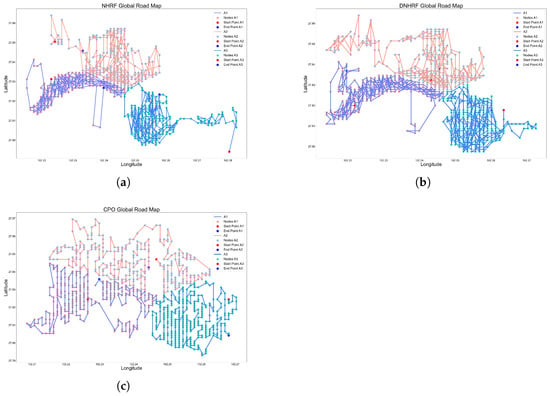
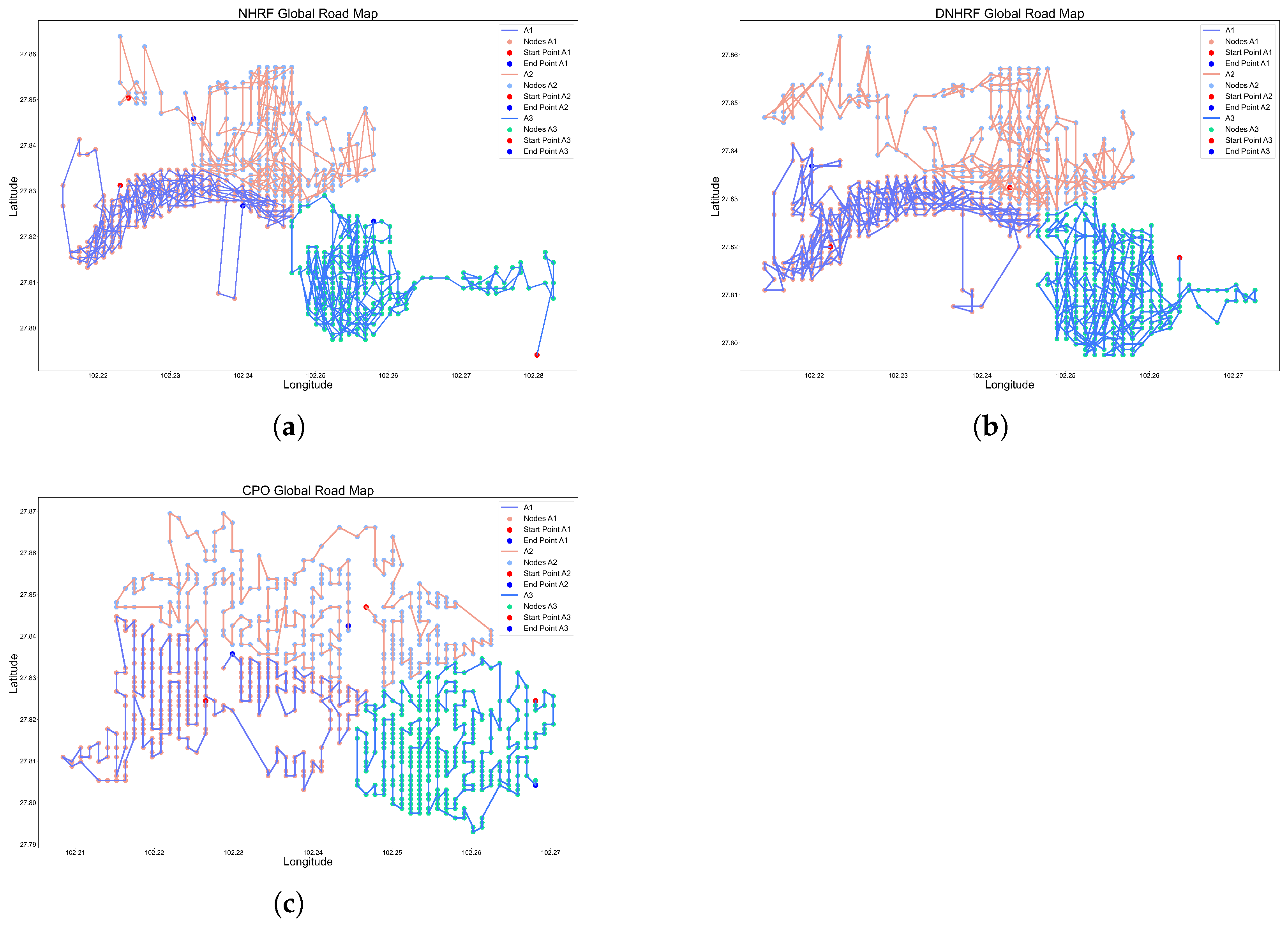
In this study, the simulated flights are conducted according to the longest flight distance of UAV, 50,000 m, and the flight routes are planned by using the NHRF strategy, DNHRF strategy, and IMOCPO strategy, respectively. The NHRF strategy prioritizes access to high-risk grids while avoiding the problem of inefficient energy utilization caused by UAVs frequently flying between distant grid points. The DNHRF strategy extends NHRF by introducing dynamic neighborhood adjustment through reinforcement learning, enabling adaptive responses to varying risk distributions. The IMOCPO strategy enables the UAV path planning task to better focus on the global optimization effect by diversifying the defense strategies, and especially excels in balancing the coverage of high-risk areas with the overall coverage. The results are presented in Figure 4, with the optimal paths planned by the strategies in the sub-area detailed in Table 2.
Figure 4.
UAV Flight Routes Planned Based on Three Optimization Strategies. (a) High-risk-neighborhood-first strategy. (b) Dynamic High-risk-neighborhood-first strategy. (c) Improved Multi-Objective Crested Porcupine Optimizer.
Table 2.
The optimal paths obtained in each subregion.
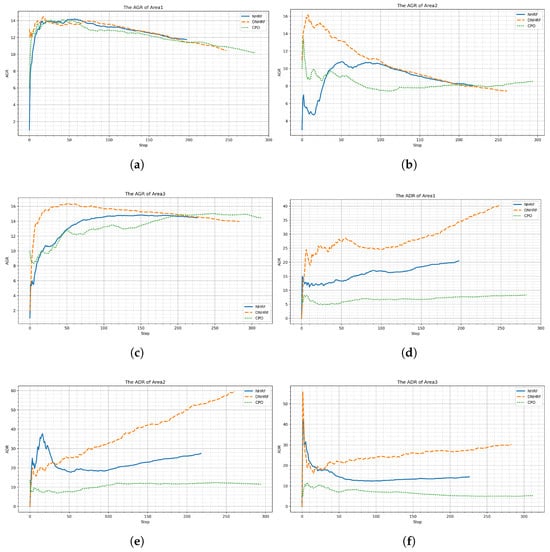
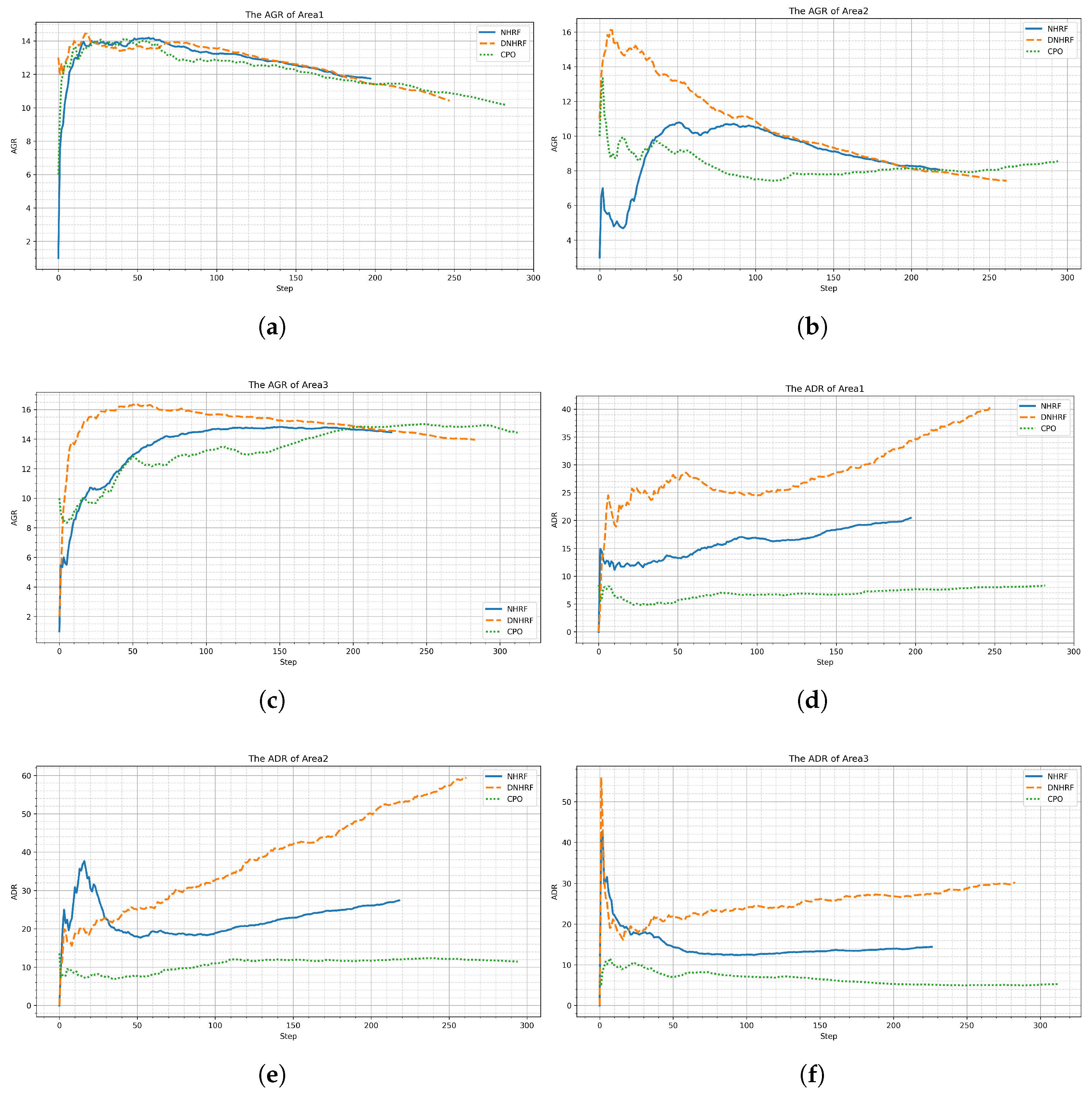
As shown in Figure 4, the three strategies exhibit distinct path characteristics. The NHRF strategy demonstrates efficient local optimization with fixed neighborhood constraints. The DNHRF strategy shows more flexible path patterns, with denser coverage in high-risk concentrated areas (A3 region) and expanded search ranges in sparse areas (A2 region), reflecting its adaptive neighborhood mechanism. The IMOCPO strategy generates more regular and orderly paths with more even distribution and wider coverage, while maintaining effective access to high-risk regions. The data in Table 2 reveal the performance differences: DNHRF achieves the highest high-risk coverage rates (80.87%, 64.83%, 59.43%), while IMOCPO achieves moderate high-risk coverage (74.12%, 60.87%, 52.20%) but excels in overall grid coverage (60.99%, 44.76%, 37.53%)—the highest among all three strategies—indicating more effective utilization of flight resources to cover wider regions. Figure 5 shows the AGR and ADR performance across subregions, where DNHRF achieves optimal AGR performance consistent with its highest high-risk coverage rates, while NHRF demonstrates superior ADR performance in early stages but visits significantly fewer grid points than DNHRF and IMOCPO.
Figure 5.
Average Distance Risk and Average Grid Risk within Sub-area. (a) A1 region AGR. (b) A2 region AGR. (c) A3 region AGR. (d) A1 region ADR. (e) A2 region ADR. (f) A3 region ADR.
There are still several shortcomings in this study, which need to be further improved and refined in future studies. First, the path simulation in this study was conducted under ideal conditions, i.e., it is assumed that the UAV cruises under windless and uniform flight speed. However, in practice, weather factors such as precipitation, temperature and wind, have important effects on the UAV path selection. Thus, future research should take above factors into account to enable more reliable design of cruise strategies. Second, in the IMOCPO strategy, although the algorithm obtains a more balanced performance, there is a poor local search, and a more excellent local search algorithm needs to be introduced in the future to obtain a better performance for high-risk coverage.
Table 2 presents representative optimal paths from each strategy for visualization purposes. However, for a reasonable algorithmic evaluation, single-path results are insufficient. Metaheuristic algorithms are inherently stochastic, requiring multi-run statistics (mean ± standard deviation) and significance testing to validate performance improvements. Moreover, while comparisons with domain-specific strategies (NHRF, DNHRF) demonstrate practical applicability, comparison with the baseline CPO algorithm is essential to quantify the contribution of our proposed enhancements. To address these requirements, we executed both CPO and IMOCPO 30 independent times per subregion with different random seeds. Table 3 presents the statistical comparison results.
Table 3.
Algorithm Performance Matrix: Objectives vs. Constraints.
As demonstrated in Table 3, IMOCPO achieves significant improvements over CPO across multiple metrics. The algorithm reduces average flight distance by 31.8% (from 30,819.58 m to 21,019.51 m) while increasing high-risk area coverage by 23.0% (from 65.33% to 80.39%). The substantially lower standard deviation in path distance (1089.66 m vs. 4923.96 m) indicates more consistent performance across different scenarios. Statistical validation through independent t-tests confirms these improvements are significant: path distance (, Cohen’s ) and risk coverage (, Cohen’s ) both show large effect sizes, demonstrating that the enhancements are statistically reliable and practically meaningful for forest fire monitoring applications.
The trade-off is a 46.1% increase in computation time (from 219.73 s to 321.09 s), which is acceptable for offline path planning where solution quality is prioritized. Both algorithms achieved 100% constraint satisfaction with zero violations of the 50,000m distance limit across all test regions, confirming that IMOCPO maintains robust constraint handling while improving performance.
To validate the performance improvements and ensure that the observed differences are not due to random variation, we conducted comprehensive statistical hypothesis testing. Table 4 presents the results of independent t-tests comparing CPO and IMOCPO across key performance metrics.
Table 4.
Statistical Significance Tests: CPO vs. IMOCPO.
The statistical analysis in Table 4 confirms that IMOCPO’s improvements are statistically significant and practically meaningful. Both path distance (, Cohen’s ) and risk coverage (, Cohen’s ) show p-values well below 0.05, rejecting the null hypothesis of no difference between algorithms. The exceptionally large effect sizes (both ) indicate that the improvements are not only statistically reliable but also substantial in practical terms. These results validate that IMOCPO represents a significant advancement over CPO, achieving better path efficiency and high-risk coverage while maintaining perfect constraint satisfaction across all test scenarios.
5. Conclusions
This study proposed an Improved Multi-Objective Crested Porcupine Optimizer (IMOCPO) for UAV forest fire monitoring path planning, addressing the critical challenge of balancing multiple competing objectives in complex forest environments. Compared to baseline strategies including NHRF and DNHRF, IMOCPO demonstrates superior performance through its population-based metaheuristic framework that enables global optimization, while NHRF’s greedy approach produces suboptimal paths due to local decision-making and DNHRF’s reinforcement learning requires extensive training with potential instability, IMOCPO achieves consistent performance through four defense mechanisms that balance exploration and exploitation. The algorithm’s weighted composite objective function explicitly optimizes competing goals—flight distance, high-risk coverage, and grid coverage—simultaneously overcoming the single-objective focus of baseline strategies. Comprehensive evaluation using four metrics (high-risk coverage rate, grid coverage rate, ADR and AGR) across three test regions confirms that IMOCPO achieves significant improvements in both path efficiency and high-risk area coverage, demonstrating its effectiveness for enhancing forest fire detection and initial attack success rates.
Results show that while DNHRF achieves the highest high-risk coverage rates, the proposed IMOCPO strategy demonstrates the best overall performance with superior grid coverage, achieving optimal balance across all evaluation metrics (high-risk coverage, grid coverage, ADR, and AGR). Compared to existing approaches in the literature, IMOCPO demonstrates competitive or superior performance: (1) Relative to generic coverage maximization approaches that ignore fire risk heterogeneity, IMOCPO achieves substantial grid coverage while simultaneously prioritizing high-risk areas, addressing the critical limitation of uniform coverage strategies. (2) Compared to the greedy NHRF strategy, IMOCPO significantly improves grid coverage while maintaining comparable high-risk coverage, demonstrating better resource utilization within the same endurance constraints. (3) Against the baseline CPO algorithm, IMOCPO achieves statistically significant improvements in both flight distance reduction and high-risk coverage enhancement (, large effect sizes), validating the effectiveness of domain-specific enhancements. (4) Unlike Pareto-based multi-objective algorithms (NSGA-II, MOPSO) that generate solution sets requiring post-decision analysis, IMOCPO’s weighted sum approach with systematically determined weights produces directly deployable paths suitable for operational UAV missions, addressing the practical deployment gap in real-world forest fire monitoring. IMOCPO is particularly suitable for monitoring missions requiring balanced coverage of both high-risk areas and overall regions. Future work should address incorporating dynamic environmental factors such as wind and weather conditions, extending the approach to multi-UAV coordinated planning for large-scale regions, and integrating real-time fire detection feedback with dynamic risk map updates for adaptive mission execution.
As shown in Table 5, we compared this strategy with similar studies based on K-means and elbow methods in recent related literature. Although K-means and elbow methods are widely used in various fields ranging from educational data analysis to multi-robot coverage, the IMOCPO strategy proposed in this study uniquely combines risk-aware multi-objective optimization, exhibiting stronger relevance and adaptability in handling high-risk, dynamically constrained environments such as forest fire monitoring.
Table 5.
Comparison of Studies Using K-means Clustering and Elbow Method.
As shown in Table 5, K-means clustering and its variants have been applied in various fields. For instance, Tümen and Bahçeci [34] successfully utilized the elbow method to determine the optimal grouping in educational data analysis, demonstrating the robustness of this method in handling non-uniformly distributed features. Ni et al. [35] and Ibrahim and Saparudin [37] significantly improved the balance of task allocation and the energy efficiency of the system by combining clustering algorithms with deep reinforcement learning (DRL) or particle swarm optimization (PSO) in multi-robot and unmanned aerial vehicle-Internet of Things (UAV-IoT) networks, respectively. However, most of the aforementioned research focuses on general coverage or energy consumption minimization, lacking optimization for complex environments with dynamic risk constraints.
In contrast, this study establishes the unique advantages of IMOCPO in the specific field of forest fire patrol. Unlike reinforcement learning paradigms that emphasize dynamic obstacle avoidance and real-time interaction, this study addresses global planning problems with known geographical information and static risk distribution, scientifically determining the optimal task partitioning () using the elbow method validated by [34], effectively balancing coverage and flight energy consumption. Furthermore, by introducing a risk-weighted search mechanism, this weighting strategy enables drones to prioritize coverage of high-risk areas, thereby directly significantly improving the initial attack success rate, which is crucial in forest fire prevention tasks.
The results show that this strategy, which combines data-driven clustering with metaheuristic optimization, not only avoids the dependence of reinforcement learning on massive training data but also provides a more targeted, robust, and computationally efficient solution for strategic path planning in complex terrains compared to traditional general coverage algorithms. Considering the dynamic characteristics of forest fire spread, future developments will introduce DRL algorithms to supplement IMOCPO’s global planning capabilities, with DRL agents responsible for local path correction.
Author Contributions
Conceptualization, D.H.; Validation, Y.X.; Formal analysis, D.H.; Investigation, Y.X. and D.H.; Resources, Y.X., L.Z. and F.Z.; Data curation, Y.X.; Writing—original draft, D.H.; Visualization, D.H.; Supervision, L.Z. and F.Z.; Project administration, L.Z. and F.Z. All authors have read and agreed to the published version of the manuscript.
Funding
This paper is partly sponsored by Jiangsu Autonomous Driving Technology Innovation and Application Engineering Research Center (ZK25-06-09) and Qing Lan Project.
Data Availability Statement
No new data were created or analyzed in this study. Data sharing is not applicable to this article.
Conflicts of Interest
The authors declare no conflicts of interest.
References
- Tian, G.; Ren, Y.; Zhou, M. Dual-Objective Scheduling of Rescue Vehicles to Distinguish Forest Fires via Differential Evolution and Particle Swarm Optimization Combined Algorithm. IEEE Trans. Intell. Transp. Syst. 2016, 17, 3009–3021. [Google Scholar] [CrossRef] [Scilit]
- Wang, G.; Bai, D.; Lin, H.; Zhou, H.; Qian, J. FireViTNet: A hybrid model integrating ViT and CNNs for forest fire segmentation. Comput. Electron. Agric. 2024, 218, 108722. [Google Scholar] [CrossRef] [Scilit]
- Ramalho, A.H.C.; da Silva, E.F.; Silva, J.P.M.; Fiedler, N.C.; Maffioletti, F.D.; Biazatti, L.D.; Moreira, T.R.; Juvanhol, R.S.; dos Santos, A.R. Allocation of water reservoirs to fight forest fires according to the risk of occurrence. J. Environ. Manag. 2021, 296, 113122. [Google Scholar] [CrossRef] [Scilit]
- Zhai, G.; Dou, L.; Gu, Y.; Zhou, H.; Feng, L.; Jiang, L.; Dong, J.; Sun, J.; Li, H. From spark to suppression: An overview of wildfire monitoring, progression prediction, and extinguishing techniques. Int. J. Appl. Earth Obs. Geoinf. 2025, 140, 104600. [Google Scholar] [CrossRef] [Scilit]
- Sakellariou, S.; Sfougaris, A.; Christopoulou, O.; Tampekis, S. Spatial resilience to wildfires through the optimal deployment of firefighting resources: Impact of topography on initial attack effectiveness. Int. J. Disaster Risk Sci. 2023, 14, 98–112. [Google Scholar] [CrossRef] [Scilit]
- Xu, Y.; Zhou, K.; Zhang, F. Modeling Wildfire Initial Attack Success Rate Based on Machine Learning in Liangshan, China. Forests 2023, 14, 740. [Google Scholar] [CrossRef] [Scilit]
- Paudel, A.; Martell, D.L.; Woolford, D.G. Factors that affect the timing of the dispatch of initial attack resources to forest fires in northeastern Ontario, Canada. Int. J. Wildland Fire 2019, 28, 15–24. [Google Scholar]
- Mahaveerakannan, R.; Anitha, C.; Thomas, A.K.; Rajan, S.; Muthukumar, T.; Rajulu, G.G. An IoT based forest fire detection system using integration of cat swarm with LSTM model. Comput. Commun. 2023, 211, 37–45. [Google Scholar] [CrossRef] [Scilit]
- De la Fuente, R.; Aguayo, M.M.; Contreras-Bolton, C. An optimization-based approach for an integrated forest fire monitoring system with multiple technologies and surveillance drones. Eur. J. Oper. Res. 2024, 313, 435–451. [Google Scholar]
- Zhang, F.; Zhao, P.; Xu, S.; Wu, Y.; Yang, X.; Zhang, Y. Integrating multiple factors to optimize watchtower deployment for wildfire detection. Sci. Total Environ. 2020, 737, 139561. [Google Scholar] [CrossRef] [Scilit]
- Li, G.; Cheng, P.; Li, Y.; Huang, Y. Lightweight wildfire smoke monitoring algorithm based on unmanned aerial vehicle vision. Signal Image Video Process. 2024, 18, 7079–7091. [Google Scholar] [CrossRef] [Scilit]
- Bento, J.; Basiri, M.; Ventura, R. Information-Oriented and Energy-Aware Path Planning for Small Unmanned Aerial Vehicles. In Proceedings of the EPIA Conference on Artificial Intelligence, Faro, Portugal, 1–3 October 2025. [Google Scholar]
- Gu, Y.; Jing, Y.; Li, H.D.; Shi, J.; Lin, H. DEMNet: A Small Object Detection Method for Tea Leaf Blight in Slightly Blurry UAV Remote Sensing Images. Remote Sens. 2025, 17, 1967. [Google Scholar] [CrossRef] [Scilit]
- Kumar, P.; Pal, K.; Govil, M. Comprehensive Review of Path Planning Techniques for Unmanned Aerial Vehicles (UAVs). ACM Comput. Surv. 2023, 58, 73. [Google Scholar] [CrossRef] [Scilit]
- Liu, H.; Zhou, K.; Zhang, L.; Zhang, F. UAV Cruise Strategies Based on Initial Attack. Fire 2024, 7, 435. [Google Scholar] [CrossRef] [Scilit]
- Bai, M.; Di, X.; Yu, L.; Ding, J.; Lin, H. A Pine Wilt Disease Detection Model Integrated with Mamba Model and Attention Mechanisms Using UAV Imagery. Remote Sens. 2025, 17, 255. [Google Scholar] [CrossRef] [Scilit]
- Mahmud, K.R.; Wang, L.; Liu, X.; Li, J.; Hassan, S. Deep Learning-based Wildfire Smoke Detection using Uncrewed Aircraft System Imagery. In Proceedings of the 2024 21st International Conference on Ubiquitous Robots (UR), New York, NY, USA, 24–27 June 2024; pp. 580–587. [Google Scholar]
- Ozkan, O.; Kilic, S. UAV routing by simulation-based optimization approaches for forest fire risk mitigation. Ann. Oper. Res. 2023, 320, 937–973. [Google Scholar] [CrossRef] [Scilit]
- Cao, B.; Li, M.; Liu, X.; Zhao, J.; Cao, W.; Lv, Z. Many-objective deployment optimization for a drone-assisted camera network. IEEE Trans. Netw. Sci. Eng. 2021, 8, 2756–2764. [Google Scholar] [CrossRef] [Scilit]
- Ergezer, H.; Leblebiciolu, K. Online path planning for unmanned aerial vehicles to maximize instantaneous information. Int. J. Adv. Robot. Syst. 2021, 18, 172988142110103. [Google Scholar] [CrossRef] [Scilit]
- Rusyana, A.; Wigena, A.H.; Sumertajaya, I.M.; Sartono, B. An optimal variable importance for machine learning classification models using modified simulated annealing algorithm. IOP Conf. Ser. Earth Environ. Sci. 2024, 1356, 012089. [Google Scholar] [CrossRef] [Scilit]
- Ellie, K.S.; Zhang, W. Hybrid Enhanced Evolutionary Algorithm with Differential Evolution for Distributed No-Wait Flow-Shop Scheduling Problem. Int. J. Res. Appl. Sci. Eng. Technol. 2023, 11, 4696–4711. [Google Scholar] [CrossRef] [Scilit]
- Li, K.; Zhu, C.; Wang, J.; Gao, J. An integrated optimization strategy for mission planning and control resource allocation for long-endurance unmanned aerial vehicle. Ind. Manag. Data Syst. 2025, 125, 627–662. [Google Scholar] [CrossRef] [Scilit]
- Jensen-Nau, K.R.; Hermans, T.; Leang, K.K. Near-optimal area-coverage path planning of energy-constrained aerial robots with application in autonomous environmental monitoring. IEEE Trans. Autom. Sci. Eng. 2020, 18, 1453–1468. [Google Scholar] [CrossRef] [Scilit]
- Abdel-Basset, M.; Mohamed, R.; Abouhawwash, M. Crested Porcupine Optimizer: A new nature-inspired metaheuristic. Knowl.-Based Syst. 2024, 284, 111257. [Google Scholar] [CrossRef] [Scilit]
- Fan, Y.; Ma, Z.; Tang, W.; Liang, J.; Xu, P. Using Crested Porcupine Optimizer Algorithm and CNN-LSTM-Attention Model Combined with Deep Learning Methods to Enhance Short-Term Power Forecasting in PV Generation. Energies 2024, 17, 3435. [Google Scholar] [CrossRef] [Scilit]
- Liu, S.; Jin, Z.; Lin, H.; Lu, H. An improve crested porcupine algorithm for UAV delivery path planning in challenging environments. Sci. Rep. 2024, 14, 20445. [Google Scholar] [CrossRef] [Scilit] [PubMed]
- Chen, Z.; Lin, H.; Bai, D.; Qian, J.; Zhou, H.; Gao, Y. PWDViTNet: A lightweight early pine wilt disease detection model based on the fusion of ViT and CNN. Comput. Electron. Agric. 2025, 230, 109910. [Google Scholar] [CrossRef] [Scilit]
- Heidari, A.; Jafari Navimipour, N.; Unal, M.; Zhang, G. Machine learning applications in internet-of-drones: Systematic review, recent deployments, and open issues. ACM Comput. Surv. 2023, 55, 247. [Google Scholar] [CrossRef] [Scilit]
- Zhang, C.; Dong, M.; Ota, K. Deploying SDN control in Internet of UAVs: Q-learning-based edge scheduling. IEEE Trans. Netw. Serv. Manag. 2021, 18, 526–537. [Google Scholar] [CrossRef] [Scilit]
- Li, K.; Ni, W.; Tovar, E.; Guizani, M. Joint flight cruise control and data collection in UAV-aided Internet of Things: An onboard deep reinforcement learning approach. IEEE Internet Things J. 2020, 8, 9787–9799. [Google Scholar] [CrossRef] [Scilit]
- He, L.; Aouf, N.; Song, B. Explainable Deep Reinforcement Learning for UAV autonomous path planning. Aerosp. Sci. Technol. 2021, 118, 107052. [Google Scholar] [CrossRef] [Scilit]
- Onumanyi, A.J.; Molokomme, D.N.; Isaac, S.J.; Abu-Mahfouz, A.M. AutoElbow: An automatic elbow detection method for estimating the number of clusters in a dataset. Appl. Sci. 2022, 12, 7515. [Google Scholar] [CrossRef] [Scilit]
- Tümen, T.; Bahçeci, F. Üniversite Öğrencilerinin Eleştirel Düşünme Profillerinin k-Means Kümeleme Algoritması ile Analizi. Int. J. Pure Appl. Sci. 2025, 11, 269–280. [Google Scholar] [CrossRef] [Scilit]
- Ni, J.; Gu, Y.; Tang, G.; Ke, C.; Gu, Y. Cooperative coverage path planning for multi-mobile robots based on improved k-means clustering and deep reinforcement learning. Electronics 2024, 13, 944. [Google Scholar] [CrossRef] [Scilit]
- Ibrahim, N.S.A.; Saparudin, F.A. Resource-Efficient Coverage Path Planning for UAV-Based Aerial IoT Gateway. J. Commun. 2023, 18, 462–470. [Google Scholar] [CrossRef] [Scilit]
- Ahmadi, K.; Allan, V.H.; Rocha, A.; Steels, L.; van den Herik, H. Scalable Stochastic Path Planning under Congestion. In Proceedings of the 13th International Conference on Agents and Artificial Intelligence—Volume 2: ICAART; SciTePress: Rome, Italy, 2021; pp. 454–463. [Google Scholar]

Disclaimer/Publisher’s Note: The statements, opinions and data contained in all publications are solely those of the individual author(s) and contributor(s) and not of MDPI and/or the editor(s). MDPI and/or the editor(s) disclaim responsibility for any injury to people or property resulting from any ideas, methods, instructions or products referred to in the content. |
© 2026 by the authors. Licensee MDPI, Basel, Switzerland. This article is an open access article distributed under the terms and conditions of the Creative Commons Attribution (CC BY) license.