


Reassessing Fire Design Provisions for Concrete Structures Under Emerging Electric Vehicle Fire

 , ,
, ,  and
and
Abstract
1. Introduction
2. EV Fire Characteristics and Statistical Overview

| EV Type | HRR | Key Features |
|---|---|---|
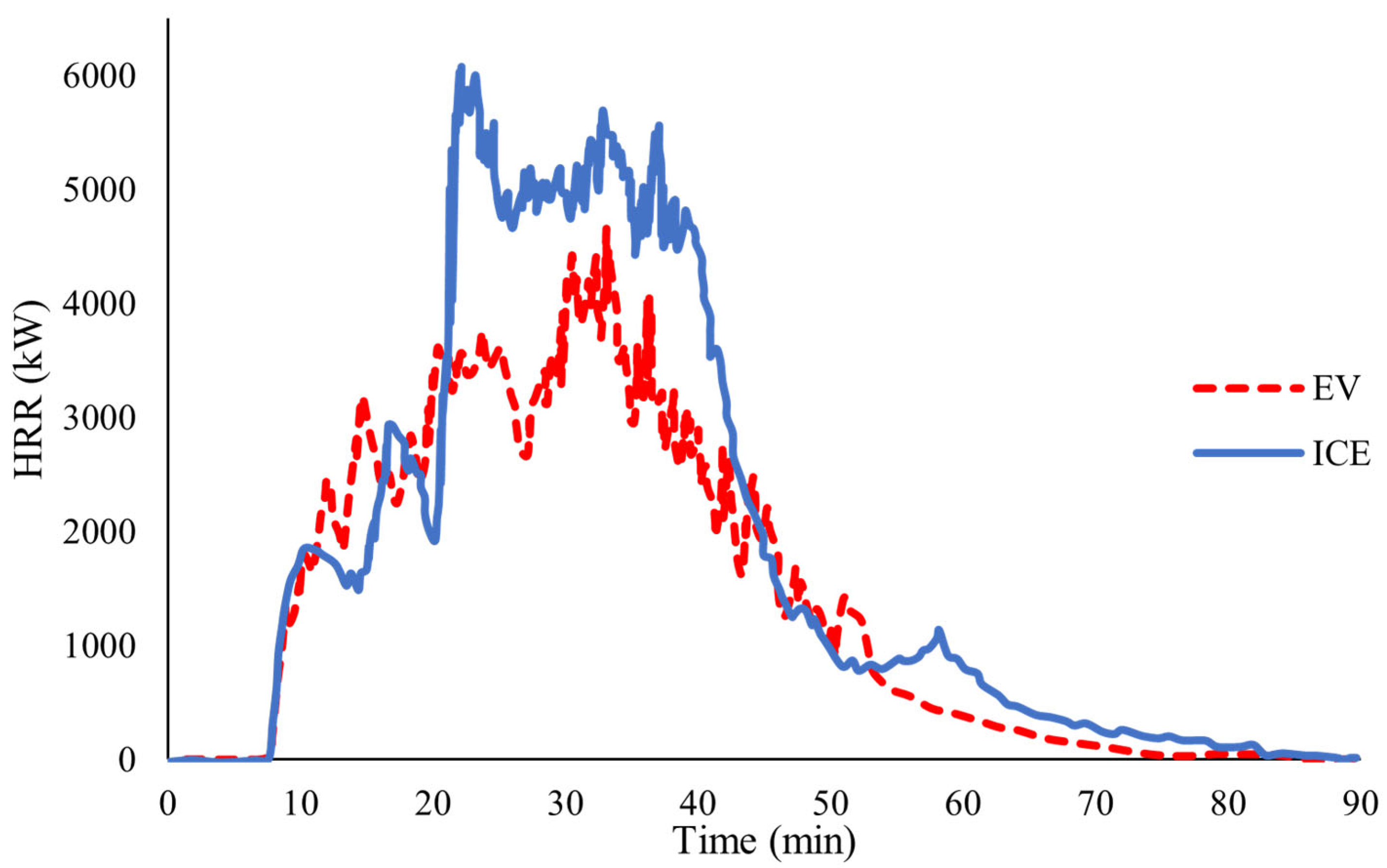
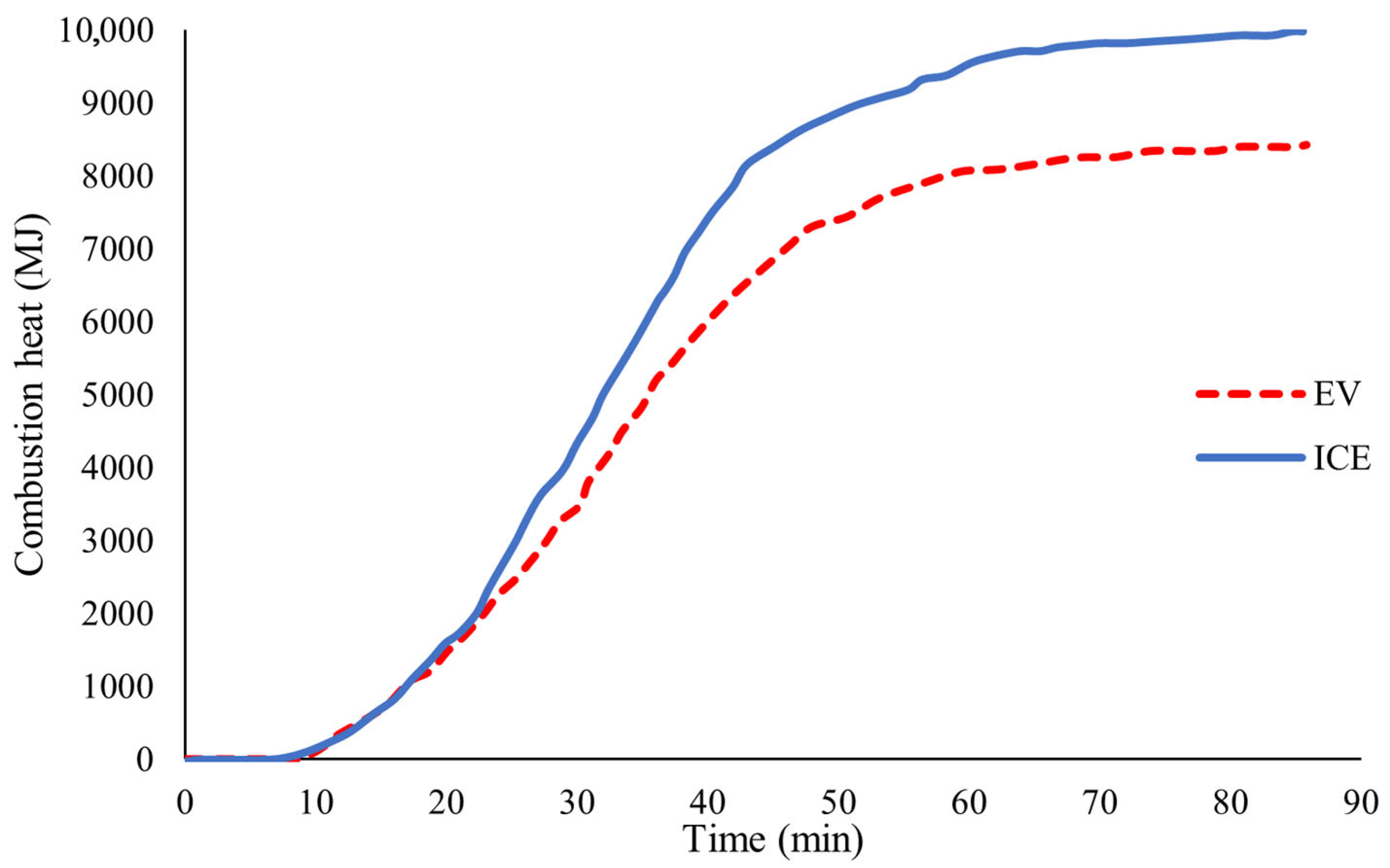
| ICE (petrol/diesel) [30] | PHRR of 3.5–8 MW for passenger cars; higher with fuel spills; THRR of 4–10 GJ | Fast growth once interior involved; dominated by interior combustible materials and fuel; no thermal runaway |
| BEV [4,5] | PHRR 4.2–6.3 MW often similar to or slightly lower than ICE; THRR of 6–9 GJ | HRR comparable to ICE; but long burning, possible re-ignition and high toxicity; jet flame during thermal runaway |
| PHEV [14] | Comparable or slightly lower than similar ICE cars; similar THRR to ICE | Two fuel sources: liquid fuel and high-energy battery; local jet flames from battery and pool fire from fuel |
| HEV [5,17] | Similar to ICE cars | Fire dominated by fuel and cabin; battery adds extra heat and electrical hazards |
| FCEV (hydrogen) [4,31] | PHRR around 6 MW, but a higher THRR of about 11 GJ due to intense local jet fire in the hydrogen vents | Flame is often invisible, with high flame speed, dominated by a hydrogen jet and combustible vehicle materials |
3. Concrete Spalling in EV Fires
4. Assessment of Current Australian Fire Design Provisions for EV Fire Exposure
5. Summary and Recommendations
Author Contributions
Funding
Data Availability Statement
Acknowledgments
Conflicts of Interest
References
- Ritchie, H. Tracking Global Data on Electric Vehicles. Our World in Data. 2025. Available online: https://ourworldindata.org/electric-car-sales (accessed on 20 October 2025).
- Rücker, F.; Figgener, J.; Schoeneberger, I.; Sauer, D.U. Battery Electric Vehicles in Commercial Fleets: Use profiles, battery aging, and open-access data. J. Energy Storage 2024, 86, 111030. [Google Scholar] [CrossRef]
- Darnikowski, D.; Mieloszyk, M. Experimental Investigations on the Repeatability of the Fire-Resistance Testing of Electric Vehicle Post-Crash Safety Procedures. Sensors 2025, 25, 688. [Google Scholar] [CrossRef]
- Kang, S.; Kwon, M.; Yoon Choi, J.; Choi, S. Full-scale fire testing of battery electric vehicles. Appl. Energy 2023, 332, 120497. [Google Scholar] [CrossRef]
- Kang, S.; Kwon, M.; Choi, J.; Choi, S. Full-Scale Fire Testing to Assess the Risk of Battery Electric Vehicle Fires in Underground Car Parks. Fire Technol. 2025, 61, 4133–4163. [Google Scholar] [CrossRef]
- Hasan, M. EV Car Fires vs Gas: Data Shows 61x Lower Risk in Electric Vehicles. 2025. Available online: https://fsri.org/research-update/ev-fires-vs-gas-powered-vehicle-fires-air-contamination-risks-explored-new-article (accessed on 22 October 2025).
- Peng, S.; Shen, Y.; Xia, G.; Maddipatla, S.; Kong, L.; Diao, W.; Pecht, M.G. Thermal Runaway and Mitigation Strategies. In The Safety Challenges and Strategies of Using Lithium-Ion Batteries; IEEE Press: Piscataway, NJ, USA, 2025; pp. 113–126. [Google Scholar]
- Fares, H.; Noumowé, A.; Rémond, S. Self-consolidating concrete subjected to high temperature: Mechanical and physicochemical properties. Cem. Concr. Res. 2009, 39, 1230–1238. [Google Scholar] [CrossRef]
- ISO 834-1:2025; Fire-resistance Tests—Elements of Building Construction—Part 1: General Requirements. International Organization for Standardization (ISO): Geneva, Switzerland, 2025.
- Alanazi, F. Electric Vehicles: Benefits, Challenges, and Potential Solutions for Widespread Adaptation. Appl. Sci. 2023, 13, 6016. [Google Scholar] [CrossRef]
- Sriabisha, R.; Kumar, J.A.; Jayaprabakar, J.; Deivayanai, V.C.; Saravanan, A. A comprehensive exploration of electric vehicles: Classification, charging methods, obstacles, and approaches to optimization. Energy Sustain. Dev. 2025, 85, 101671. [Google Scholar] [CrossRef]
- Eck, N.J.V.; Waltman, L. VOSviewer, Version 1.6.18; Centre for Science and Technology Studies (CWTS), Leiden University: Leiden, The Netherlands, 2010.
- Hynynen, J.; Willstrand, O.; Blomqvist, P.; Andersson, P. Analysis of combustion gases from large-scale electric vehicle fire tests. Fire Saf. J. 2023, 139, 103829. [Google Scholar] [CrossRef]
- Cui, Y.; Cong, B.; Liu, J.; Qiu, M.; Han, X. Characteristics and Hazards of Plug-In Hybrid Electric Vehicle Fires Caused by Lithium-Ion Battery Packs With Thermal Runaway. Front. Energy Res. 2022, 10, 878035. [Google Scholar] [CrossRef]
- Funk, E.; Flecknoe-Brown, K.W.; Wijesekere, T.; Husted, B.P.; Andres, B. Fire extinguishment tests of electric vehicles in an open sided enclosure. Fire Saf. J. 2023, 141, 103920. [Google Scholar] [CrossRef]
- Dorsz, A.; Lewandowski, M. Analysis of Fire Hazards Associated with the Operation of Electric Vehicles in Enclosed Structures. Energies 2022, 15, 11. [Google Scholar] [CrossRef]
- Sun, P.; Bisschop, R.; Niu, H.; Huang, X. A Review of Battery Fires in Electric Vehicles. Fire Technol. 2020, 56, 1361–1410. [Google Scholar] [CrossRef]
- Zhao, G.; Wang, X.; Negnevitsky, M. Connecting battery technologies for electric vehicles from battery materials to management. iScience 2022, 25, 103744. [Google Scholar] [CrossRef]
- Yao, A.; Benson, S.M.; Chueh, W.C. Critically assessing sodium-ion technology roadmaps and scenarios for techno-economic competitiveness against lithium-ion batteries. Nat. Energy 2025, 10, 404–416. [Google Scholar] [CrossRef]
- Evro, S.; Ajumobi, A.; Mayon, D.; Tomomewo, O.S. Navigating battery choices: A comparative study of lithium iron phosphate and nickel manganese cobalt battery technologies. Future Batter. 2024, 4, 100007. [Google Scholar] [CrossRef]
- Alkhalidi, A.; Khawaja, M.K.; Ismail, S.M. Solid-state batteries, their future in the energy storage and electric vehicles market. Sci. Talks 2024, 11, 100382. [Google Scholar] [CrossRef]
- Feng, T.; Guo, W.; Li, W.; Hua, L.; Zhao, F. Lithium-sulfur batteries for next-generation automotive power batteries carbon emission assessment and sustainability study in China. J. Energy Storage 2024, 102, 114199. [Google Scholar] [CrossRef]
- Ralls, A.M.; Leong, K.; Clayton, J.; Fuelling, P.; Mercer, C.; Navarro, V.; Menezes, P.L. The Role of Lithium-Ion Batteries in the Growing Trend of Electric Vehicles. Materials 2023, 16, 6063. [Google Scholar] [CrossRef]
- Chavan, S.; Venkateswarlu, B.; Prabakaran, R.; Salman, M.; Joo, S.W.; Choi, G.S.; Kim, S.C. Thermal runaway and mitigation strategies for electric vehicle lithium-ion batteries using battery cooling approach: A review of the current status and challenges. J. Energy Storage 2023, 72, 108569. [Google Scholar] [CrossRef]
- Şen, M.; Özcan, M.; Eker, Y.R. A review on the lithium-ion battery problems used in electric vehicles. Next Sustain. 2024, 3, 100036. [Google Scholar] [CrossRef]
- Bukya, M.; Hanni, J.R.; Kumar, R.; Mathur, A. A computational study of the high-discharge thermoelectric performance of cylindrical battery packs for electric vehicles. Discov. Appl. Sci. 2025, 7, 1090. [Google Scholar] [CrossRef]
- Yin, L.; Wei, R.; Zhang, L.; Chen, S.; Ren, Z.; Wang, Z.; Huang, S. Analysis of the fire evolution process of an electric vehicle in a confined garage. Tunn. Undergr. Space Technol. 2026, 167, 107062. [Google Scholar] [CrossRef]
- Zhang, L.; Zhang, D.; Xie, W.; Yin, L.; Zhao, L.; Zhou, S.; Yang, S.; Lu, Z. Comparative analysis of full-scale battery electric vehicle fire evolution under open and semi-enclosed conditions. Process Saf. Environ. Prot. 2025, 202, 107679. [Google Scholar] [CrossRef]
- Sturm, P.; Fößleitner, P.; Fruhwirt, D.; Galler, R.; Wenighofer, R.; Heindl, S.F.; Krausbar, S.; Heger, O. Fire tests with lithium-ion battery electric vehicles in road tunnels. Fire Saf. J. 2022, 134, 103695. [Google Scholar] [CrossRef]
- Miechówka, B.; Węgrzyński, W. Systematic Literature Review on Passenger Car Fire Experiments for Car Park Safety Design. Fire Technol. 2025, 61, 2651–2688. [Google Scholar] [CrossRef]
- Seike, M.; Kawabata, N.; Hasegawa, M.; Tanaka, H. Heat release rate and thermal fume behavior estimation of fuel cell vehicles in tunnel fires. Int. J. Hydrogen Energy 2019, 44, 26597–26608. [Google Scholar] [CrossRef]
- Electric Vehicle Council, Australia, Are Electric Vehicle Fires Common? Available online: https://electricvehiclecouncil.com.au/docs/are-electric-vehicle-fires-common/#:~:text=Electric%20vehicle%20battery%20fires%20are,(as%20of%20June%202024) (accessed on 23 October 2025).
- Lecocq, A.; Bertana, M.; Truchot, B.; Marlair, G. Comparison of the fire consequences of an electric vehicle and an internal combustion engine vehicle. In 2 International Conference on Fires In Vehicles-FIVE 2012; SP Technical Research Institute of Sweden: Chicago, IL, USA; Boras, Sweden, 2012; pp. 183–194. [Google Scholar]
- Mohd Tohir, M.Z.; Martín-Gómez, C. Electric vehicle fire risk assessment framework using Fault Tree Analysis. Open Res. Eur. 2023, 3, 178. [Google Scholar] [CrossRef] [PubMed]
- Lee, S.; Choi, D.; Jeong, Y.; Moon, M.; Kwon, H.; Han, K.; Kim, H.; Im, H.; Park, Y.; Shin, D.; et al. Assessing fire dynamics and suppression techniques in electric vehicles at different states of charge: Implications for maritime safety. Case Stud. Therm. Eng. 2024, 64, 105474. [Google Scholar] [CrossRef]
- Zhao, C.; Hu, W.; Meng, D.; Mi, W.; Wang, X.; Wang, J. Full-scale experimental study of the characteristics of electric vehicle fires process and response measures. Case Stud. Therm. Eng. 2024, 53, 103889. [Google Scholar] [CrossRef]
- Huang, X. Saltwater Flooding Is a Serious Fire Threat for EVs and Other Devices with Lithium-Ion Batteries; University of South Carolina: Columbia, SC, USA, 2014. [Google Scholar]
- State Government of New South Wales. Electric Vehicles (EV) and EV Charging Equipment Inthe Built Environment. Fire and Rescue NSW. 2025. Available online: https://www.google.com/url?sa=t&source=web&rct=j&opi=89978449&url=https://www.fire.nsw.gov.au/gallery/resources/SARET/Fire%2520Safety%2520Position%2520Paper%2520-%2520Electric%2520vehicles%2520(EV)%2520and%2520EV%2520charging%2520equipment%2520in%2520the%2520built%2520environment%2520v1.0.pdf&ved=2ahUKEwjfz-aBx9qRAxWwlK8BHfY5M4MQFnoECBsQAQ&usg=AOvVaw2M-UkFjo_kLC0CQ8eTxxyj (accessed on 4 December 2025).
- Raza, H.; Li, S. The impact of battery electric bus fire on road tunnel. In Expanding Underground—Knowledge and Passion to Make aPositive Impact on the World, 1st ed.; CRC Press: London, UK, 2023; pp. 3280–3288. [Google Scholar]
- Dessì, R.; Fruhwirt, D.; Papurello, D. A Study on Large Electric Vehicle Fires in a Tunnel: Use of a Fire Dynamics Simulator (FDS). Processes 2025, 13, 2435. [Google Scholar] [CrossRef]
- Li, X.; Cheng, Y. Comparative Study on Fire Resistance of Different Thermal Insulation Materials for Electric Vehicle Tunnel Fire. Appl. Sci. 2024, 14, 11533. [Google Scholar] [CrossRef]
- National Technical Research Organisation. Electric Vehicle Fires in Tunnels—Do We Need to be Concerned? Available online: https://www.ntro.org.au/news-and-insights/electric-vehicle-fires-in-tunnels---do-we-need-to-be-concerned (accessed on 20 November 2025).
- Wu, Y. Temperature and stress of RC T-beam under different heating curves. J. Build. Eng. 2021, 46, 103620. [Google Scholar] [CrossRef]
- Omar Tanash, A.; Abu Bakar, B.H.; Muthusamy, K.; Al Biajawi, M.I. Effect of elevated temperature on mechanical properties of normal strength concrete: An overview. Mater. Today Proc. 2024, 107, 152–157. [Google Scholar] [CrossRef]
- Pulkit, U.; Das Adhikary, S. Effect of micro-structural changes on concrete properties at elevated temperature: Current knowledge and outlook. Struct. Concr. 2021, 23, 1995–2014. [Google Scholar] [CrossRef]
- Tantawy, M. Effect of High Temperatures on the Microstructure of Cement Paste. J. Mater. Sci. Chem. Eng. 2017, 05, 33–48. [Google Scholar] [CrossRef]
- Thomas, C.; Rico, J.; Tamayo, P.; Ballester, F.; Setién, J.; Polanco, J.A. Effect of elevated temperature on the mechanical properties and microstructure of heavy-weight magnetite concrete with steel fibers. Cem. Concr. Compos. 2019, 103, 80–88. [Google Scholar] [CrossRef]
- Amiri, M.; Aryanpour, M.; Porhonar, F. Microstructural study of concrete performance after exposure to elevated temperatures via considering C–S–H nanostructure changes. High Temp. Mater. Process. 2022, 41, 224–237. [Google Scholar] [CrossRef]
- Lo Monte, F.; Felicetti, R.; Rossino, C. Fire spalling sensitivity of high-performanceconcrete in heated slabs under biaxial compressive loading. Mater. Struct. 2019, 52, 14. [Google Scholar] [CrossRef]
- Amran, M.; Huang, S.-S.; Onaizi, A.M.; Murali, G.; Abdelgader, H.S. Fire spalling behavior of high-strength concrete: A critical review. Constr. Build. Mater. 2022, 341, 127902. [Google Scholar] [CrossRef]
- Noumowe, A.N.; Clastres, P.; Debicki, G.; Costaz, J.L. Transient heating effect on high strength concrete. Nucl. Eng. Des. 1996, 166, 99–108. [Google Scholar] [CrossRef]
- Phan, L.; Lawson, J.; Davis, F. Effects of elevated temperature exposure on heating characteristics, spalling, and residual properties of high performance concrete. Mater. Struct. 2001, 34, 83–91. [Google Scholar] [CrossRef]
- Kanema, M.; Pliya, P.; Noumowé, A.; Gallias, J.-L. Spalling, Thermal, and Hydrous Behavior of Ordinary and High-Strength Concrete Subjected to Elevated Temperature. J. Mater. Civ. Eng. 2011, 23, 921–930. [Google Scholar] [CrossRef]
- Peng, G.; Yang, J. Residual Mechanical Properties and Explosive Spalling Behavior of Ultra-High-Strength Concrete Exposed to High Temperature. J. Harbin Inst. Technol. New Ser. 2017, 24, 62–70. [Google Scholar]
- Sanaul, C. Effect of Elevated Temperature on Mechanical Properties of High Strength Concrete. In Proceedings of the 23rd Australasian Conference on the Mechanics of Structures and Materials (ACMSM23), Byron Bay, Australia, 9–12 December 2014. [Google Scholar]
- Kanagaraj, B.; Raj, R.S.; Anand, N.; Lubloy, E. Fire performance of concrete: A comparative study between cement concrete and geopolymer concrete & its application—A state of art-review. Case Stud. Chem. Environ. Eng. 2025, 11, 101212. [Google Scholar]
- Debicki, G.; Haniche, R.; Delhomme, F. An experimental method for assessing the spalling sensitivity of concrete mixture submitted to high temperature. Cem. Concr. Compos. 2012, 34, 958–963. [Google Scholar] [CrossRef]
- Klingsch, E. Explosive Spalling of Concrete in Fire. 2014. Available online: https://www.google.com/url?sa=t&source=web&rct=j&opi=89978449&url=https://www.research-collection.ethz.ch/server/api/core/bitstreams/463e1db4-54d8-4247-b48d-5aec1056fcef/content&ved=2ahUKEwjm1MquydqRAxUsdfUHHZPAJkQQFnoECBgQAQ&usg=AOvVaw1ekpgWF1oKTAZgGJk1loj_ (accessed on 28 November 2025).
- Akturk, B.; Yüzer, N.; Kabay, N. Usability of Raw Rice Husk Instead of Polypropylene Fibers in High-Strength Concrete under High Temperature. J. Mater. Civ. Eng. 2016, 28, 04015072. [Google Scholar] [CrossRef]
- Liang, X.; Wu, C.; Su, Y.; Li, Z. Development of ultra-high performance concrete with high fire resistance. Constr. Build. Mater. 2018, 179, 400–412. [Google Scholar] [CrossRef]
- Luo, B.; Deng, C.; Luo, Y. Mechanical properties and microstructure of UHPC with recycled glasses after exposure to elevated temperatures. J. Build. Eng. 2022, 62, 105369. [Google Scholar] [CrossRef]
- Suescum-Morales, D.; Ríos, J.D.; Martínez-De La Concha, A.; Cifuentes, H.; Jiménez, J.R.; Fernández, J.M. Effect of moderate temperatures on compressive strength of ultra-high-performance concrete: A microstructural analysis. Cem. Concr. Res. 2021, 140, 106303. [Google Scholar] [CrossRef]
- Lee, N.K.; Koh, K.T.; Park, S.H.; Ryu, G. Microstructural investigation of calcium aluminate cement-based ultra-high performance concrete (UHPC) exposed to high temperatures. Cem. Concr. Res. 2017, 102, 109–118. [Google Scholar] [CrossRef]
- Ríos, J.; Cifuentes, H.; Leiva, C.; Ariza, M.P.; Ortiz, M. Effect of polypropylene fibers on the fracture behavior of heated ultra-high performance concrete. Int. J. Fract. 2020, 223, 173–187. [Google Scholar]
- Canbaz, M. The effect of high temperature on reactive powder concrete. Constr. Build. Mater. 2014, 70, 508–513. [Google Scholar] [CrossRef]
- Qiao, R.; Guo, Y.; Zhou, H.; Xi, H. Explosive Spalling Mechanism and Modeling of Concrete Lining Exposed to Fire. Materials 2022, 15, 3131. [Google Scholar] [CrossRef]
- Phan, L. High-Strength Concrete at High Temperature—An Overview. In Proceedings of the 6th International Symposiumon Utilization of High Strength/High Performance Concrete, Leipzig, Germany, 16–20 June 2002. [Google Scholar]
- Bastami, M.; Chaboki-Khiabani, A.; Baghbadrani, M.; Kordi, M. Performance of high strength concretes at elevated temperatures. Sci. Iran. 2011, 18, 1028–1036. [Google Scholar] [CrossRef]
- Husem, M. The effects of high temperature on compressive and flexural strengths of ordinary and high-performance concrete. Fire Saf. J. 2006, 41, 155–163. [Google Scholar] [CrossRef]
- Ali, F.; Nadjai, A.; Glackin, P.; Silcock, G.; Abu-Tair, A. Structural Performance of High Strength Concrete Columns in Fire. Fire Saf. Sci. 2003, 7, 1001–1012. [Google Scholar] [CrossRef]
- Peng, G.-F.; Yang, W.-W.; Zhao, J.; Liu, Y.-F.; Bian, S.-H.; Zhao, L.-H. Explosive spalling and residual mechanical properties of fiber-toughened high-performance concrete subjected to high temperatures. Cem. Concr. Res. 2006, 36, 723–727. [Google Scholar] [CrossRef]
- Rinaudo, P.; Torres, B.; Payá-Zaforteza, I.; Calderón, P.; Sales, S. Evaluation of new regenerated fiber Bragg grating high-temperature sensors in an ISO 834 fire test. Fire Saf. J. 2015, 71, 332–339. [Google Scholar] [CrossRef]
- Kim, J.; Youm, K.; Reda Taha, M. Extracting Concrete Thermal Characteristics from Temperature Time History of RC Column Exposed to Standard Fire. Sci. World J. 2014, 2014, 242806. [Google Scholar] [CrossRef] [PubMed]
- Zehfuß, J.; Robert, F.; Spille, J.; Razafinjato, R. Evaluation of Eurocode 2 approaches for thermal conductivity of concrete in case of fire. Civ. Eng. Des. 2020, 2, 58–71. [Google Scholar] [CrossRef]
- Alhamad, A.; Yehia, S.; Lublóy, É.; Elchalakani, D.M. Performance of Different Concrete Types Exposed to Elevated Temperatures: A Review. Materials 2022, 15, 5032. [Google Scholar] [CrossRef]
- Almeshal, I.; Bakar, B.H.; Tayeh, B. Behaviour of Reinforced Concrete Walls Under Fire: A Review. Fire Technol. 2022, 58, 2589–2639. [Google Scholar] [CrossRef]
- Mahmoud, K. Fire Resistance-effective Parameters Relationships of slender rectangular and circular RC Columns. Fire Saf. J. 2021, 125, 103442. [Google Scholar] [CrossRef]
- Kigha, F.; Sadeeq, J.A.; Abejide, O.S. Effects of Temperature Levels and Concrete Cover Thickness on Residual Strength Characteristics of Fire Exposed Reinforced Concrete Beams. Niger. J. Technol. 2015, 34, 429. [Google Scholar] [CrossRef][Green Version]
- Kodur, V. Performance of reinforced concrete slabs under hydrocarbon fire exposure. Tunn. Undergr. Space Technol. 2018, 77, 177–187. [Google Scholar] [CrossRef]
- Golubkov, A.W.; Planteu, R.; Krohn, P.; Rasch, B.; Brunnsteiner, B.; Thaler, A.; Hacker, V. Thermal runaway of large automotive Li-ion batteries. RSC Adv. 2018, 8, 40172–40186. [Google Scholar] [CrossRef]
- Kong, D.; Wang, G.; Ping, P.; Wen, J. A coupled conjugate heat transfer and CFD model for the thermal runaway evolution and jet fire of 18650 lithium-ion battery under thermal abuse. eTransportation 2022, 12, 100157. [Google Scholar] [CrossRef]
- Choe, G.; Kim, G.; Yoon, M.; Hwang, E.; Nam, J.; Guncunski, N. Effect of moisture migration and water vapor pressure build-up with the heating rate on concrete spalling type. Cem. Concr. Res. 2019, 116, 1–10. [Google Scholar] [CrossRef]
- Australian Building Codes Board. National Construction Code (NCC); Australian Building Codes Board: Canberra, ACT, Australia, 2022. [Google Scholar]
- AS 1530; Methods for Fire Tests on Building Materials, Components and Structures. Standards Australia: Sydney, NSW, Australia, 2022.
- AS 1670; Fire Detection, Warning, Control and Intercom Systems Standards Australia. Standards Australia: Sydney, NSW, Australia, 2018.
- AS 1851:2012; Routine Service of Fire Protection Systems and Equipment Standards Australia. Standards Australia: Sydney, NSW, Australia, 2012.
- AS 2118; Automatic Fire Sprinkler Systems. Standards Australia: Sydney, NSW, Australia, 2016.
- AS 2419; Fire hydrant Installations. Standards Australia: Sydney, NSW, Australia, 2015.
- ASTM E119-22; Standard Test Methods for Fire Tests of Building Construction and Materials. ASTM International: West Conshohocken, PA, USA, 2022.
- EN 1992-1-2; Eurocode 2: Design of Concrete Structures—Part 1-2: General Rules—Structural Fire Design. European Committee for Standardization (CEN): Brussels, Belgium, 2023.
- Choi, A.Y.; Lee, S.-H.; Park, T.-H.; Kim, H.-S. Comparative Analysis of Real Fires for Electric Vehicles and Gasoline Vehicles. J. Korean Soc. Hazard Mitig. 2021, 21, 119–124. [Google Scholar] [CrossRef]
- AS 3600:2018; Concrete Structures. Standards Australia: Sydney, NSW, Australia, 2018.
- AS/NZS 1668; The Use of Ventilation and Air Conditioning in Buildings–Fire and Smoke Control in Multi-Compartment Buildings. Standards Australia: Sydney, NSW, Australia; Standards New Zealand: Wellington, New Zealand, 2021.
- AS 2441; Installation of Hose Reels. Standards Australia: Sydney, NSW, Australia, 2009.
- NFPA 855; Standard for the Installation of Stationary Energy Storage Systems. National Fire Protection Association (NFPA): Quincy, MA, USA, 2023.


| Search String | No. of Articles |
|---|---|
| TITLE-ABS-KEY ((“electric vehicle” OR “EV”) AND “fire*” AND NOT (“electron volt” OR “eV” OR “bandgap” OR “semiconductor” OR “plasma” OR “photon” OR spectroscopy)) Limit to: English, (2015–2026) | 976 |
| TITLE-ABS-KEY ((“electric vehicle” OR “EV”) AND “fire*” AND (garage OR tunnel OR “park*” OR infrastructure OR “civil engineering” OR “structural engineering” OR “guideline*” OR “regulation*” OR “code” OR “fire safety measure*” OR “fire protection”) AND NOT (“electron volt” OR “eV” OR “bandgap” OR “semiconductor” OR “plasma” OR “photon” OR spectroscopy)) Limit to: English, (2015–2026) | 128 |
| Initiating Condition | Fire Development Mechanism | Implications for Built Environments |
|---|---|---|
| Mechanical damage [2,7,24,26] | A high-speed impact can deform the battery pack, creating an internal short circuit or cell failure | In garages or ramps, vehicles may face crashes, be struck by debris, be towed incorrectly, or experience underside impacts that go unnoticed |
| Internal electrical short-circuit [27,28,36] | Manufacturing defects, faulty cells, poor assembly, insulation breakdown or ageing may cause a short within the battery pack | Even stationary vehicles (in parking) are at risk if latent defects exist |
| Overheating due to inadequate cooling [6,7,32] | If the battery pack overheats due to the effects of ambient heat or charging heat, the risk of thermal runaway increases | Underground parking and multi-storey garages often have poor ventilation or heat-trapping conditions, which amplify this risk. |
| Improper charging or faulty charging [24,26] | High current, improper chargers, or faults in the charging infrastructure may cause overheating or overvoltage situations. | In parking structures with charging stations, hidden faults in charging cables and equipment, or inadequate cooling of charging bays, can lead to fire hazards. |
| Environmental exposure (flood, saltwater, moisture) [35,36,37] | Submersion or ingress of conductive fluids (saltwater) can bridge battery terminals, cause shorts, and trigger thermal runaway | Underground garages may flood or have high humidity, which increases the risk of moisture-related faults. |
| Location | EV Battery Fire Scenario |
|---|---|
| Brussels—2022 (Underground carpark) |  |
| Burwood, New South Wales—2023 (Ground-level car park of a commercial building) |  |
| Incheon—2024 (Underground parking lot of an apartment complex) |  |
| Type of Concrete | Concrete Compressive Strength (MPa) | Spalling Temperature (°C) | Reference |
|---|---|---|---|
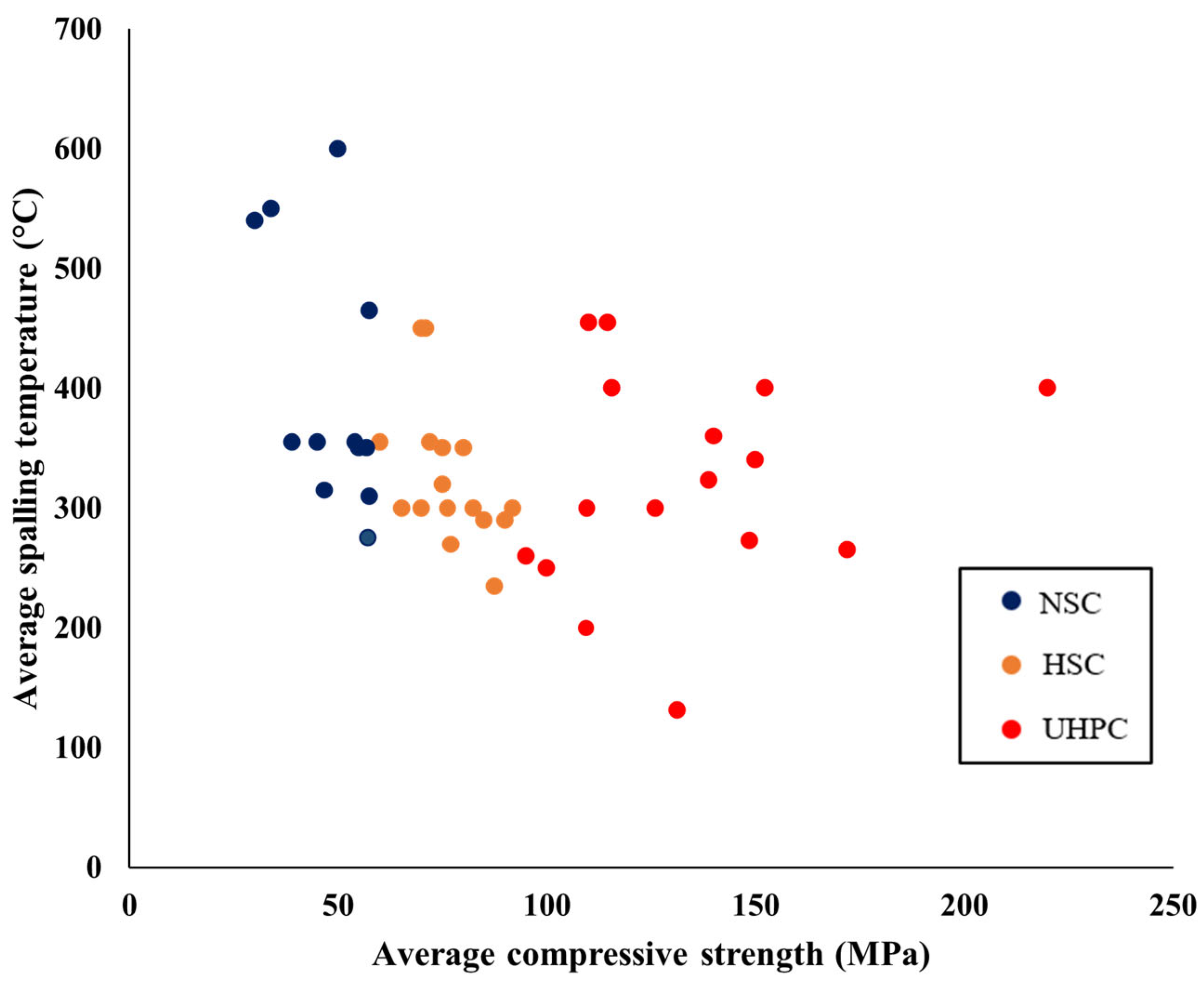
| NSC | 37.4–56 | <315 | Fares et al. [8] |
| 39 | <355 | Kaméma et al. [53] | |
| 45 | <355 | Kaméma et al. [53] | |
| 50 | 600 | Qiao et al. [66] | |
| 54 | <355 | Kaméma et al. [53] | |
| 57.1 | 250–300 | Noumowe et al. [51] | |
| 56.6–82.9 | 240–450 | Phan et al. [67] | |
| HSC | 60 | <355 | Kaméma et al. [53] |
| 65.3 | 300 | Bastami et al. [68] | |
| 71 | 400–500 | Husem [69] | |
| 72 | <355 | Kaméma et al. [53] | |
| 75.3 | 240–310 | Phan [67] | |
| 76.14 | 300 | Bastami et al. [68] | |
| 82.4 | 300 | Bastami et al. [68] | |
| 86.7–88.2 | 150–319 | Debicki et al. [57] | |
| UHPC | 90–187.5 | <323 | Liang et al. [60] |
| 91.85 | 300 | Bastami et al. [68] | |
| 94.7–136.6 | <400 | Luo et al. [61] | |
| 102.6–159.8 | 256–433 | Klingsch [58] | |
| 106–114 | <455 | Atkturk et al. [59] | |
| 106 | 320 | Ali et al. [70] | |
| 109–143 | <300 | Suescum-Morales et al. [62] | |
| 109.3 | 200 | Peng et al. [71] | |
| 109.5 | <300 | Rios et al. [64] | |
| 114.5 | <455 | Lee et al. [63] | |
| 220 | <400 | Canbaz [65] |
| Standard | Highest Temperature (T) | Time to Peak T | Duration of the Fire | Source of Ignition | Fire Characteristics |
|---|---|---|---|---|---|
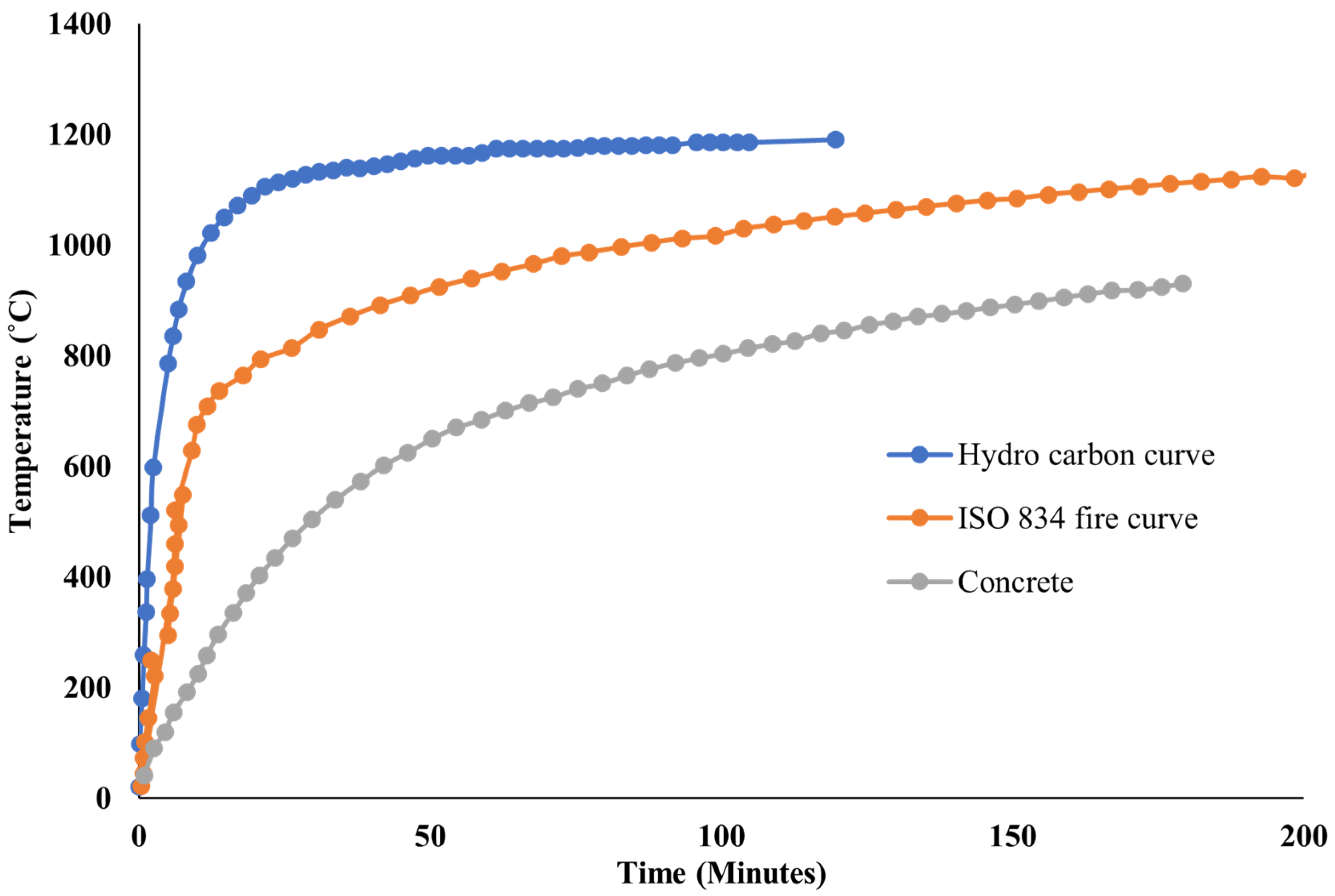
| AS 1530.4 [84] (Australian Standard Fire Test) | Around 1000 °C | ~60 min | 60–120 min | Controlled furnace heating using the ISO 834 time–temperature relationship | Provides uniform, one-dimensional heating to determine Fire Resistance Levels (FRLs) Does not represent localised battery fire conditions or prolonged re-ignition. |
| ISO 834 [9] (Hydrocarbon Fire Curve) | 1000 °C | ~60 min | 60–90 min | Uniform hydrocarbon gas combustion | Serves as the basis for most international design standards Assumes consistent, steady heating, not multi-peak EV fire behaviour. |
| Eurocode EN 1992-1-2 Parametric Fire [90] | Up to 1100 °C | 30–120 min | Variable, dependent on compartment geometry and ventilation | Hydrocarbon-based compartment fire | More adaptable to compartment size and ventilation but still does not capture EV battery thermal runaway or extended duration. |
| EV Battery Fire (Li-ion, 60–90 kWh) [3,4,27] | 1000–1300 °C (localised peaks up to 1400 °C [91]) | 10–20 min | 2–4 h (with potential re-ignition) | Exothermic lithium-ion cell reaction, metal combustion, and off-gas ignition | Produces localised high-intensity heating and long-duration exposure Increases risk of spalling, reinforcement exposure, and loss of load-bearing capacity. |
| Aspect | Relevant Standard | Current Status | Key Considerations and Upgrades |
|---|---|---|---|
| FRL | NCC [83] AS 1530.4 [84] | The code specified the minimum required FRL for load-bearing elements in car parks with a fire source within 1.5 m distance is only 1 h (S5C11–S5C25) | Verify current FRLs against potential 3–4 h for EV fires Use thicker covers or fire-resistant coatings on slabs and beams |
| Material Behaviour | AS 3600 [92] | The standard only addresses fires up to 2 h for every structural concrete element, including the members in car parks. And no provision is provided to directly address the fires longer than 2 h, and jet fires result due to EV fires | Reassess the concrete mix for spalling resistance Use polypropylene fibres or lightweight aggregates to reduce pore pressure |
| Compartmentation | NCC [83] | Fire walls in carparks are not addressing the possibility of EV fires and only have an FRL of 1 h, similar to the load-bearing walls. (S5C9, S5C19, S5C25) | Review fire-separation walls and ceilings in parking levels Ensure EV bays are separated by FR walls or fire curtains where feasible |
| Thermal Protection | NCC [83] | Allows performance-based modelling (C1V4), but the lack of a robust EV fire dataset and design guidance on EV-specific scenarios (car parks, charging stations) makes it difficult to confidently develop and justify reliable design solutions | Run heat-transfer models using EV fire curves (peak > 1200 °C, duration 3 h) Develop EV-specific fire design data and standardised HRR curves Define when EV fire scenarios must be considered (e.g., car parks) Provide clear performance-based design guidance for EV fire duration, thermal runaway, and smoke toxicity |
| Aspect | Relevant Standard | Current Status | Key Considerations and Upgrades |
|---|---|---|---|
| Sprinkler Design | NCC [83] AS 2118.1 [87] | The sprinklers are only provided for parking areas with more than 40 cars (E1D9) S17 in NCC specifies that the car park sprinkler system should comply with AS 2118.1 Cl 10.2 in AS 2118.1: 12 sprinklers working simultaneously, each covering 12 m2 area, releasing nearly 12 L/s for 60 min | Confirm flow and tank capacity for extended suppression (>3 h) Use directional nozzles for the underside cooling of EV bays. |
| Detection and Alarm | NCC [83] AS 1670.1 [85] | The car park only requires detection when used as a mixed-use building (S20C3) Smoke detectors only detect smoke particles, combustion aerosols, and obscuration, not individual gases Cl 3.8 in AS 1670.1 allows detector selection, while Cl 4.6 and 4.7 guide the spacing. Cl 3.10 allows for a special design, but no specifications on EV fires | Integrate multi-gas and off-gas (H2, HF, CO) detectors for early EV-battery fault detection. |
| Ventilation and Smoke Control | NCC [83] AS/NZS 1668 [93] | Requires having a natural ventilation or mechanical ventilation and smoke control system designed in accordance with AS 1668.1. (S20C6, F6V2, F6D11) | Upgrade exhaust capacity Design to extract toxic gases (HF, CO2, flammable vapours) Include backup power for fans. |
| Fire Hydrant and Hose Reels | NCC [83] AS 2419.1 [88] AS 2441 [94] | NCC requires hydrant systems as per AS 2419.1 (E1D2) and hose reels as per AS 2441 (E1D3) The hydrants’ water supply should be adequate to provide for all simultaneous operations (Cl 2.2.7 and Cl 2.2.8) AS 2441 only considered Class A fires (Cl 4.3), hence hose reels are not intended for suppressing car fires (EV) | Ensure the hydrant pressure and supply duration are adequate to suppress EV fires Evaluate the need for dedicated EV-bay hydrants. |
| Aspect | Relevant Standard | Current Status | Key Considerations and Upgrades |
|---|---|---|---|
| Routine Maintenance | AS 1851 [86] | The maintenance is applied to active fire safety methods based on traditional fire loads and does not address EV-specified hazards. | Verify inspection intervals Ensure sprinkler heads and detectors near EV bays are tested more frequently |
| Emergency Procedures | NCC [83] | The NCC does not provide detailed emergency procedures, but guides on performance expectations for evacuation safety and emergency response capability | Incorporate EV-fire protocols (extended water application, isolation distance, post-fire monitoring) |
| Post-Incident Cooling and Re-Ignition Risk | - | There are no Australian codes or standards that explicitly address post-incident cooling or re-ignition risk for any fire, including EV fires NFPA 855 [95] is the only code with lithium-ion re-ignition and cooling requirements | Establish designated isolation zones for burned EVs Ensure adequate drainage and run-off containment. |
Disclaimer/Publisher’s Note: The statements, opinions and data contained in all publications are solely those of the individual author(s) and contributor(s) and not of MDPI and/or the editor(s). MDPI and/or the editor(s) disclaim responsibility for any injury to people or property resulting from any ideas, methods, instructions or products referred to in the content. |
© 2025 by the authors. Licensee MDPI, Basel, Switzerland. This article is an open access article distributed under the terms and conditions of the Creative Commons Attribution (CC BY) license.
Share and Cite
Navaratnam, S.; Munmulla, T.; Bandaranayake, S.; Rajeev, P.; Sanjayan, J. Reassessing Fire Design Provisions for Concrete Structures Under Emerging Electric Vehicle Fire. Fire 2026, 9, 21. https://doi.org/10.3390/fire9010021
Navaratnam S, Munmulla T, Bandaranayake S, Rajeev P, Sanjayan J. Reassessing Fire Design Provisions for Concrete Structures Under Emerging Electric Vehicle Fire. Fire. 2026; 9(1):21. https://doi.org/10.3390/fire9010021
Chicago/Turabian StyleNavaratnam, Satheeskumar, Thisari Munmulla, Sathya Bandaranayake, Pathmanathan Rajeev, and Jay Sanjayan. 2026. "Reassessing Fire Design Provisions for Concrete Structures Under Emerging Electric Vehicle Fire" Fire 9, no. 1: 21. https://doi.org/10.3390/fire9010021
APA StyleNavaratnam, S., Munmulla, T., Bandaranayake, S., Rajeev, P., & Sanjayan, J. (2026). Reassessing Fire Design Provisions for Concrete Structures Under Emerging Electric Vehicle Fire. Fire, 9(1), 21. https://doi.org/10.3390/fire9010021