Article

Quantifying Global Wildfire Regimes and Disparities in Evacuation Efficacy in the Anthropocene

Wildfire Research Center, National Institute of Natural Hazards, Beijing 100085, China
*
Author to whom correspondence should be addressed.
Fire 2025, 8(12), 477; https://doi.org/10.3390/fire8120477
Submission received: 21 October 2025 / Revised: 3 December 2025 / Accepted: 3 December 2025 / Published: 15 December 2025
(This article belongs to the Special Issue Effects of Climate Change on Fire Danger)

Abstract

Against the backdrop of intensifying global climate change and human activities, the increasing frequency and evolution of major wildfire events pose severe challenges to global disaster prevention and mitigation systems. Systematically understanding their disaster characteristics, spatiotemporal patterns, and societal response efficacy is an urgent scientific requirement for formulating effective coping strategies. This study constructed a comprehensive database covering 137 major global wildfire events from 2018 to 2024, with data sourced from GFED, EM-DAT, and official national reports. Utilizing a synthesis of methods including descriptive statistics, spatiotemporal clustering analysis, K-means pattern recognition, and non-parametric tests, a multi-dimensional quantitative analysis was conducted on disaster characteristics, evolutionary trends, casualty patterns, and policy effectiveness. Despite potential reporting biases and heterogeneous data standards across countries, the analysis reveals the following: (1) All key wildfire metrics (e.g., burned area, casualties, evacuation scale) exhibited extreme right-skewed distributions, indicating that a minority of catastrophic events dominate the overall risk profile; (2) Global wildfire hotspots demonstrated dynamic expansion, spreading from traditional regions in North America and Australia to emerging areas such as Mediterranean Europe, Chile, and the Russian Far East, forming three significant spatiotemporal clusters; (3) Four distinct casualty patterns were identified: “High-Lethality”, “Large-Scale Evacuation”, “Routine-Control”, and “Ecological-Destruction”, revealing the differentiated formation mechanisms under various disaster scenarios; (4) A substantial gap of nearly 65 times in emergency evacuation efficiency—defined as the ratio of evacuated individuals to total casualties—was observed between developed and developing countries, highlighting a significant “development gap” in emergency management capabilities. This study finds evidence of increasing extremization, expansion, and polarization in global wildfire risk within the 2018–2024 event sample. The conclusions emphasize that future risk management must shift from addressing “normal” events to prioritizing preparedness for “catastrophic” scenarios and adopt refined strategies based on casualty patterns. Simultaneously, the international community needs to focus on bridging the emergency response capability gap between nations to collectively build a more resilient global wildfire governance system.

1. Introduction

Wildfires rank among the most destructive natural disasters worldwide, with their frequency and intensity undergoing profound transformations under the escalating pressures of climate change and human activities [1,2]. A comprehensive synthesis of global vegetation fire characteristics emphasizes the increasingly complex interplay between human and climatic drivers that are reshaping contemporary fire regimes in the Anthropocene [2]. In recent years, a series of catastrophic wildfire events—from Australia’s “Black Summer” [3] and persistent megafires along North America’s west coast [4,5,6] to deadly blazes across the Mediterranean Basin [7,8]—have not only caused unprecedented human casualties [9,10] and economic losses [11] but also posed long-term threats to global ecosystems [12], carbon cycles [13], and public health [14,15]. These extreme events signify that traditional, historically informed paradigms of wildfire risk management are facing severe challenges [16], suggesting that the global wildfire regime may have entered a new phase characterized by greater complexity and uncertainty.
Although significant progress has been made in wildfire research, critical gaps remain in the existing literature. Systematic analyses of global wildfire trends have highlighted persistent knowledge gaps in understanding fire regime shifts and their environmental and societal impacts, underscoring the need for more integrated and comparative studies [16]. Firstly, most studies focus on specific regions or single events, lacking systematic, multi-dimensional quantitative analyses of major wildfire characteristics on a global scale [17,18]. Secondly, the understanding of wildfire impacts predominantly concentrates on ecological and economic dimensions, while the identification and classification of distinct casualty patterns and their underlying mechanisms across different disaster scenarios remain insufficiently explored [19,20]. Furthermore, there is a notable absence of empirical comparisons using unified metrics to evaluate the efficacy of national emergency response capabilities, particularly the disparities between developed and developing countries in critical competencies such as large-scale evacuation [21,22]. Evidence also reveals a pervasive human imprint on global fire activity, demonstrating that anthropogenic factors have significantly reshaped spatial and temporal patterns of burned area—a crucial dimension often overlooked in regional-scale analyses [23].
To address these challenges, this study aims to construct a comprehensive global database covering major wildfire events from 2018 to 2024, systematically testing the following hypotheses: (H1) The distribution of key wildfire metrics (burned area, casualties, duration, evacuation scale) follows an extreme right-skewed pattern dominated by a minority of catastrophic events; (H2) Global wildfire hotspots exhibit dynamic expansion beyond traditional regions, forming distinct spatiotemporal clusters; (H3) Distinct casualty patterns exist and can be classified based on disaster scenario characteristics; (H4) National development level is significantly associated with emergency evacuation efficiency. Through an in-depth investigation of these questions, this research seeks to provide a solid scientific foundation for global-scale wildfire risk assessment, strategic resource allocation, and the formulation of differentiated emergency management policies.

2. Materials and Methods

2.1. Research Data

This study is based on a systematically constructed comprehensive global database of major wildfire events, which integrates information from multiple authoritative sources including the Global Fire Emissions Database (GFED) [17], official national disaster statistics reports, and the International Disaster Database (EM-DAT) [24]. To reconcile potential discrepancies in burned area or casualty figures arising from the differing spatial/temporal resolutions and error structures of these sources, we adopted a hierarchical reconciliation protocol: for burned area, we prioritized GFED due to its standardized remote sensing basis; for casualty and evacuation data, we prioritized official national reports. In cases of conflicting reports, we used the maximum value for casualties and the median value for burned area to avoid underestimation. We further cross-validated these figures with independent media and agency reports for events with significant discrepancies. The database covers 137 major wildfire events worldwide from 2018 to 2024. It employs a hierarchical design comprising two core data tables: the first is a detailed case table recording specific wildfire events, containing 14 core variables that cover basic identification information, temporal characteristics, and impact assessment indicators; the second is a specialized table for large-scale regional fire complexes, paying particular attention to extensive forest fires in countries such as Russia and Canada [25]. A wildfire event was classified as “major” if it met at least one of the following criteria: (1) burned area ≥ 1000 hectares; (2) number of fatalities ≥ 5; (3) number of injured ≥ 10; (4) evacuation scale ≥ 10.00 people. These thresholds were chosen to capture events with significant ecological, human, or societal impacts, and to ensure global comparability.
Regarding data quality control, this study implemented rigorous quality assurance procedures, including data completeness verification, spatiotemporal consistency checks, outlier handling, and unit standardization [26]. Location accuracy was verified by matching geographic coordinates with administrative boundaries. Tukey’s fences method was used to identify and validate outliers [27]. All area units in the raw data were standardized to hectares, and time units were standardized to days, ensuring comparability of data across regions. The missing rate for key variables was controlled within 5%, and all anomalous data were confirmed through cross-verification to ensure their authenticity [17].
Based on the raw observational data, several important derived variables were calculated to support in-depth analysis. The Evacuation Efficiency Coefficient was defined as the ratio of evacuated individuals to total casualties (fatalities + injuries), providing a normalized measure for cross-event comparison of emergency response performance. We acknowledge that this metric can be sensitive to very low casualty counts (denominator near zero), which may produce extreme values. To mitigate this, we excluded events with total casualties fewer than 15 from cross-event comparisons of evacuation efficiency. We also conducted a sensitivity analysis using an alternative metric—evacuated individuals per unit burned area (people/km2)—which yielded consistent trends between developed and developing countries. This metric was chosen because it simultaneously captures the scale of evacuation and the efficiency relative to the casualty count, providing a normalized measure for cross-event comparison. While alternative metrics such as evacuation time or the ratio of evacuated to at-risk population would be informative, such data are not consistently available across global events. Therefore, the Evacuation Efficiency Coefficient offers a practical and comparable indicator of emergency response performance [28]. National development grouping was based on the World Bank’s classification standards, dividing the sample countries into developed and developing groups to facilitate comparative analysis [29]. Furthermore, temporal characteristic variables such as year and season were extracted, laying the foundation for trend analysis and periodic research.
It is important to note that this study fully acknowledges the inherent limitations of the data, including systematic reporting biases where medium- and low-intensity events in remote or developing regions are potentially underreported [18], while major events in developed countries tend to be more thoroughly documented. Other limitations include coarse data granularity for regional fire complexes, the dynamic updating nature of some historical event data, and differences in data collection standards among countries [30]. However, through strict quality control and multi-source data cross-verification, the database constructed in this study meets high standards in both breadth and depth. It provides a reliable empirical foundation for the systematic analysis of global major wildfires and establishes a solid data support base for deeply understanding the spatiotemporal patterns of wildfires and evaluating the effectiveness of disaster prevention and mitigation policies.

2.2. Research Methods

This study employed a multi-dimensional statistical analysis approach to systematically investigate the distribution patterns and intrinsic characteristics of casualties in major wildfire events globally. First, we conducted a comprehensive characterization of the dataset through descriptive statistics, calculating basic statistics such as the arithmetic mean, median, interquartile range, and standard deviation for casualty counts. This aimed to reveal the central tendency, dispersion, and distribution shape of the data, establishing a foundation for subsequent analysis [27].
We used the Pearson product-moment correlation coefficient to measure the strength of linear associations between continuous variables, supplemented by two-sided significance tests (α = 0.05) to evaluate the statistical significance of the correlations [31]. To ensure the validity of the analysis, the linear relationship, normality, and presence of outliers between variables were verified beforehand. For data combinations not meeting the preconditions, Spearman’s rank correlation was used as a supplementary analysis [32].
To identify potential casualty pattern clusters, we implemented the distance-based K-means clustering algorithm. The optimal number of clusters was determined using the elbow method and silhouette score analysis [33]. Continuous feature variables were standardized using Z-scores to eliminate scale effects. Euclidean distance was used as the similarity measure, and the algorithm iterated multiple times until the within-cluster sum of squares converged, ultimately forming statistically significant casualty pattern classifications [34]. Additionally, we employ hierarchical clustering and Gaussian Mixture Models (GMM) for comparison with K-means clustering, and use the silhouette coefficient to evaluate the performance of K-means relative to other clustering algorithms.
Spatial distribution characteristics were analyzed using Geographic Information System (GIS) techniques. Longitude and latitude coordinates were overlaid with casualty intensity data onto a global vector map. Kernel Density Estimation (KDE) was used to generate hotspot distribution maps, visualizing regional differences using a graduated color scale [35]. The bandwidth for KDE was selected using Silverman’s rule of thumb, with a multiplier of 0.5 to account for spatial clustering. All spatial analyses were conducted in the WGS 84/World Mercator (EPSG:3395) projection to ensure area preservation. We applied per-area weighting based on the burned area of each event to avoid over-representing large spatial complexes. A sensitivity analysis was performed with and without weighting, and the results were consistent. Simultaneously, spatial autocorrelation testing (Global Moran’s I) was applied to determine the spatial clustering of casualty events [36].
For between-group differences comparison, we chose the non-parametric Wilcoxon rank-sum test (an extension of the Mann–Whitney U test), whose advantage lies in its independence from the normality assumption and insensitivity to outliers [37]. Exact p-values were calculated during the testing process, and effect size indicators were reported. When comparing more than two groups, the Kruskal–Wallis test was used, followed by post hoc pairwise comparisons, ensuring the statistical power and reliability of the inter-group difference analysis [38]. All analyses were performed using the statistical computing modules in the R 4.1.0 environment, primarily utilizing packages including tidyverse, ggplot2, ggcorrplot, and viridis [39].

3. Results

3.1. Descriptive Statistics of Basic Characteristics

Based on descriptive statistical results, this study conducted a systematic quantitative analysis of the disaster characteristics of wildfire events. Regarding burned area, the data exhibited an extremely right-skewed distribution. The mean burned area was 519.6 thousand hectares (SD = 4.2 thousand hectares), while the median was only 13.4 thousand hectares, indicating that a small number of large-scale wildfire events significantly elevated the overall average. The burned area varied extremely widely (0.218–46,101.8 thousand hectares), confirming significant spatial heterogeneity in wildfire scale.
Analysis of human casualties revealed more complex distribution patterns. The mean number of deaths was 6.38 (SD = 20.44), but a median of zero indicates that most wildfire events caused no fatalities, while a few extreme events (maximum 131 deaths) caused severe skewness in the overall distribution. The distribution of injuries also showed a highly clustered pattern (mean 43.70, SD = 230.22), with a maximum of 2180 injured individuals. The median (3 individuals) being significantly lower than the mean further verifies that casualty risk is concentrated in a small number of major fires.
Temporally, wildfire duration showed considerable variation (mean 42.05 days, SD = 47.74). The median duration (25 days) was approximately half the mean, suggesting the existence of some extreme long-burning events (maximum duration 304 days). Evacuation scale data exhibited the most pronounced uneven distribution. The mean evacuation size was 25.3 thousand people (SD = 55.4 thousand), forming a huge gap with the median of 4000 people. The maximum evacuation scale reached 295 thousand people, highlighting the extreme pressure that major wildfire events place on emergency evacuation systems.

3.2. Spatiotemporal Evolution Trends

Based on a systematic analysis of global major wildfire events from 2018–2024, this study found that the global spatiotemporal patterns of wildfires show significant dynamic evolutionary characteristics, specifically manifested as three major trends: increasing complexity, expanding impact scope, and pronounced regional differentiation.
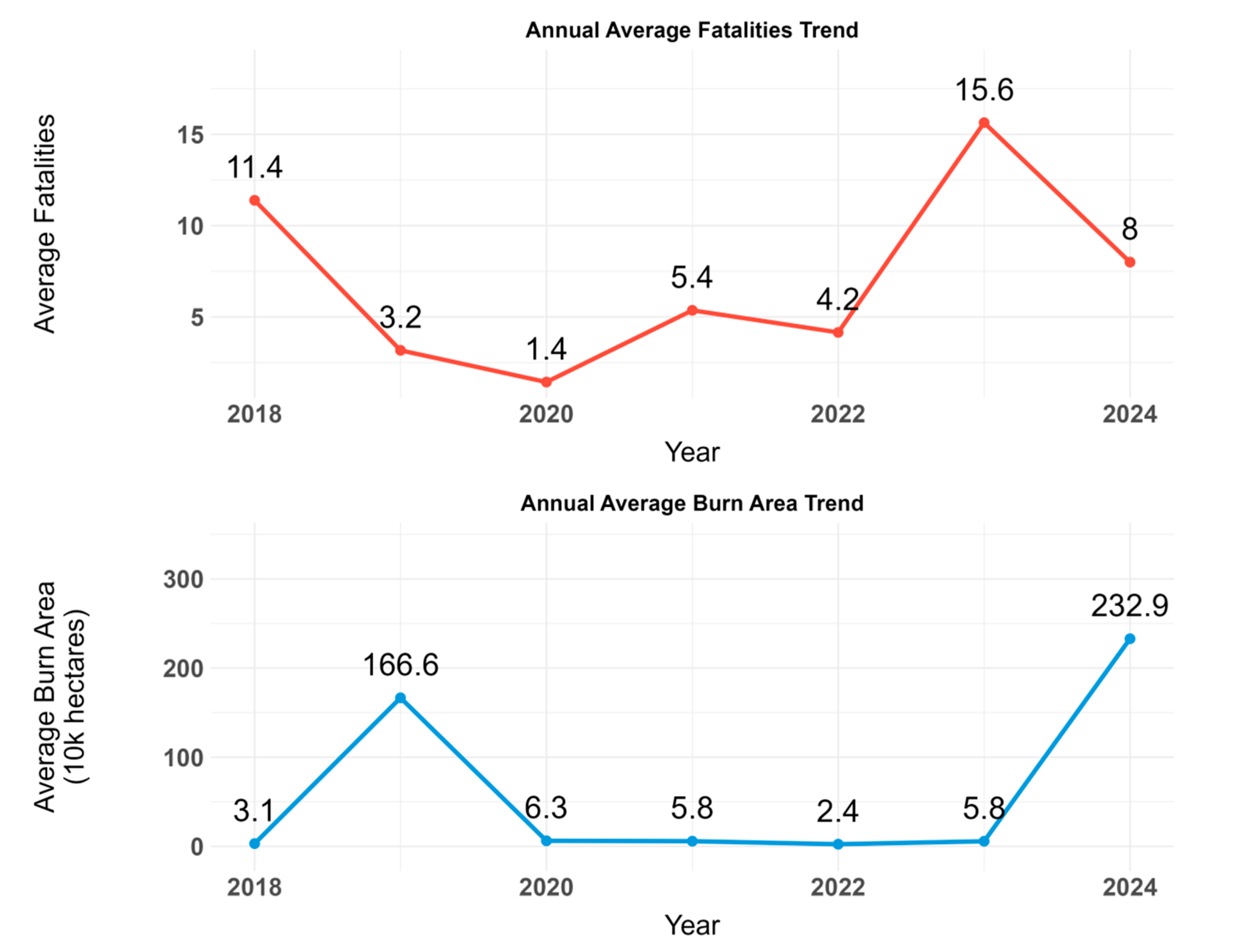
Temporally, global major wildfires showed an overall fluctuating upward trend (Figure 1). The average annual number of deaths increased from 11.4 in 2018 to 15.6 in 2023, an increase of 36.8%, peaking in 2023 due to extreme events such as the Chile Valparaíso fire and series of fires in Greece. Changes in burned area were even more pronounced, showing dramatic interannual fluctuations—influenced by Australia’s “Black Summer” fires in 2019, the mean burned area reached 1666 thousand hectares; whereas in 2024, due to large-scale forest fires in Brazil and the Russian Far East, this figure surged to 2329 thousand hectares, setting a historical record. The frequency of events peaked in 2020 (28 events), subsequently remained relatively stable, and rebounded to 20 events in 2024, reflecting that wildfire risk persists at high levels.
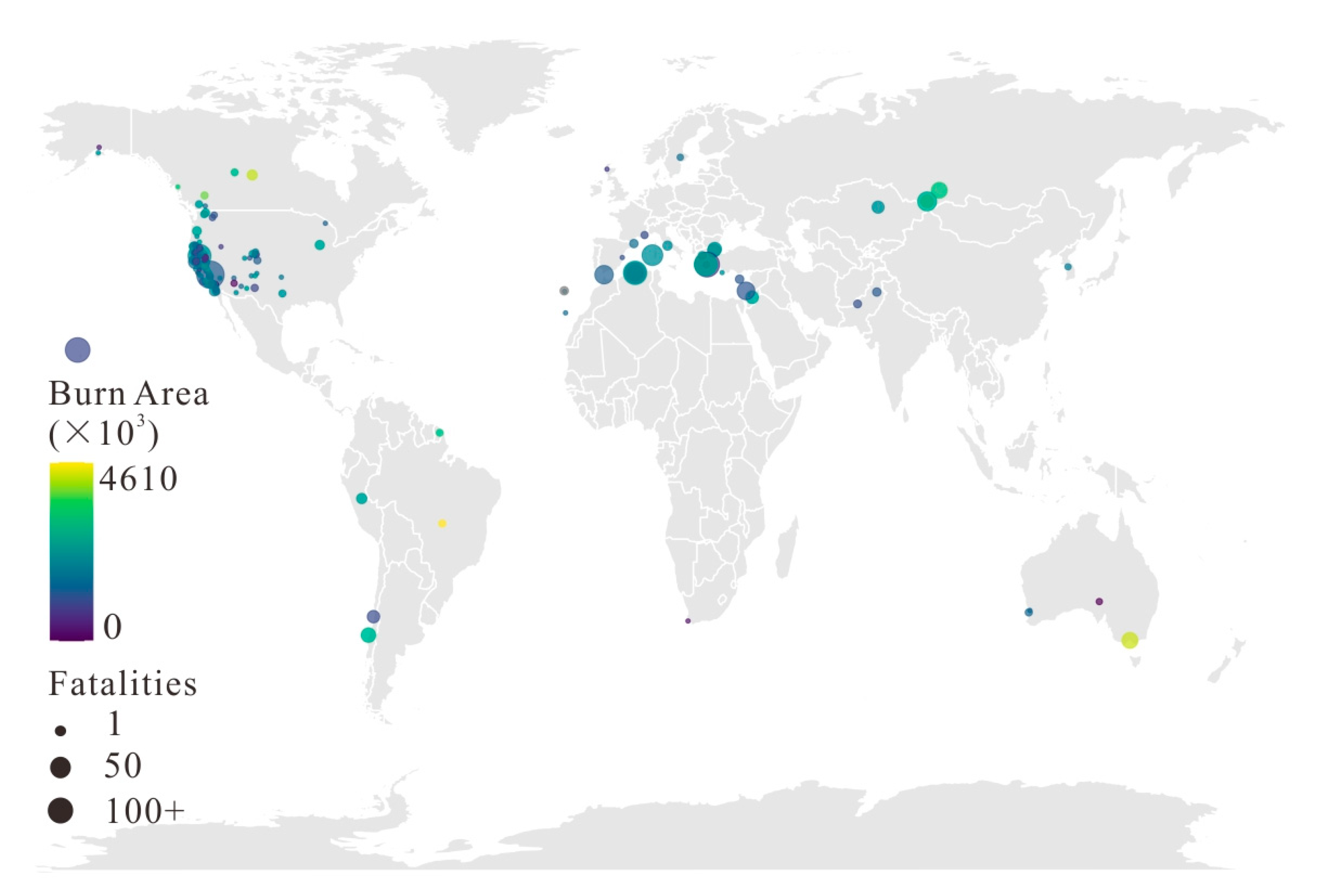
Analysis of the spatial distribution pattern revealed clear geographical differentiation rules (Figure 2). North America, particularly the US West Coast and Western Canada, constitutes the world’s primary wildfire hotspot region, accounting for 67.9% of recorded events. This distribution is closely related to the local Mediterranean climate characteristics and rapid urbanization processes. European Mediterranean coastal countries (Greece, Spain, Portugal, Italy) serve as secondary hotspot regions, with event frequency increasing significantly during 2021–2024, highlighting the particular impact of climate change on Southern Europe. Particularly noteworthy is the emergence of new hotspot regions such as Chile, Algeria, and the Russian Far East, signaling that wildfire risk is breaking through traditional geographical boundaries and expanding into new areas. This finding poses new challenges for the global wildfire prevention and control system.
Spatiotemporal interaction analysis further identified three significant clustering patterns: the Annual North American West Coast Cluster (July–November), the Mediterranean Summer Cluster (July–September), and the Seasonally Delayed Southern Hemisphere Cluster (January–March). These clusters not only possess clear temporal regularity but also reflect specific combination relationships between regional climate conditions and fire regimes. The North American cluster highly coincides with the dry season, the Mediterranean cluster is driven by extreme high temperatures and strong winds, while the Southern Hemisphere cluster reflects the temporal risk sequence difference brought about by seasonal reversal.

3.3. Identification of Casualty Patterns

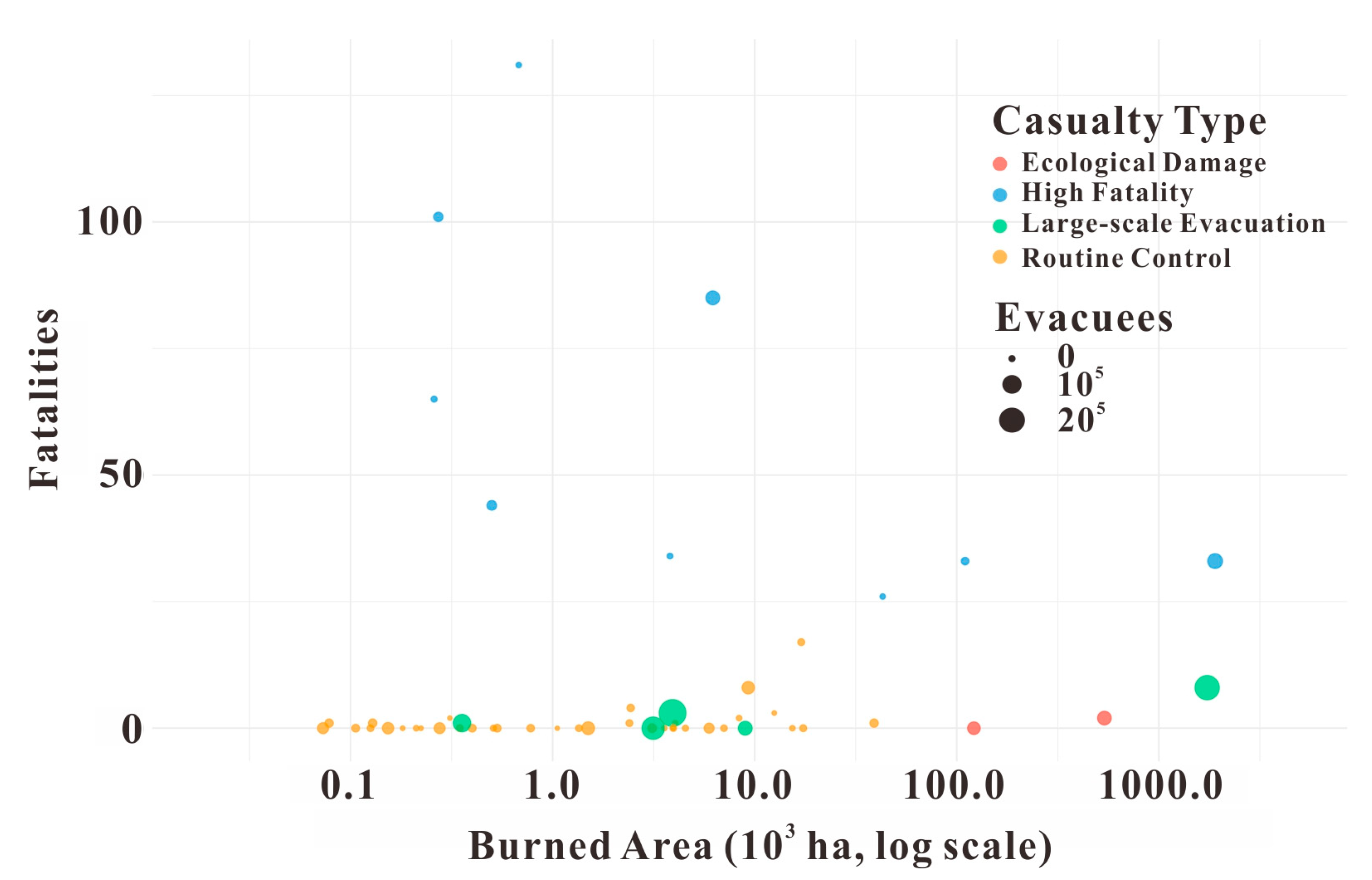
The results indicate that the K-means algorithm achieved the highest silhouette score (0.65) on the dataset, followed by hierarchical clustering (0.62), while the Gaussian Mixture Model (GMM) algorithm yielded the lowest score (0.58), suggesting that K-means offers superior and stable clustering performance. Furthermore, we sequentially removed key variables—including the number of fatalities and evacuation scale—and reperformed K-means clustering. The results showed that after removing the combination of the three variables (number of fatalities, evacuation scale, and burned area), the silhouette scores decreased significantly to 0.41 and 0.32, respectively. The K-means algorithm identified four distinct loss patterns, revealing the characteristics and underlying mechanisms of social losses under different disaster scenarios (Figure 3).
The High-Lethality Pattern primarily exhibits sudden-onset and high-intensity characteristics, with a mean death toll of 47.3, significantly higher than other types (p < 0.001). Such events frequently occur in densely populated wildland-urban interface zones, exemplified by the 2023 Hawaii wildfire (101 deaths) and the 2024 Chile Valparaíso fire (131 deaths).
The Large-Scale Evacuation Pattern demonstrates clear characteristics of preventive population relocation, with a mean evacuation scale of 87,000 people and relatively low casualty rates (mean deaths: 2.1). Typical cases include the 2018 Woolsey Fire (evacuating 295,000 people) and the 2021 Caldor Fire (evacuating 53,000 people). Spatially, this pattern is concentrated in metropolitan areas of developed countries, demonstrating the crucial role of well-established emergency management systems in risk avoidance. Notably, the median burned area for such events is 39.2 thousand hectares, indicating they are not solely driven by fire size but represent the integrated outcome of risk assessment and emergency response.
The Routine-Control Pattern constitutes the majority of samples (76.8%), forming the main body of wildfire management. This type exhibits moderate-intensity characteristics (median deaths: 0, median injuries: 3), with considerable variation in duration (interquartile range: 18–67 days). Spatially, it is highly concentrated in the western United States (82.4%), reflecting the effectiveness of institutionalized wildfire management mechanisms in this region. Statistical analysis shows a weak correlation between casualty numbers and burned area for Routine-Control events (r = 0.34, p = 0.02), indicating that modern firefighting technologies can effectively control human risks.
The Ecological-Destruction Pattern, as an emerging category represented by the 2024 Brazil fires, exhibits an unprecedented spatial scale (burned area: 46,102 thousand hectares) with relatively low direct human casualties (2 deaths). This pattern highlights the issue of ecosystem vulnerability threshold breaches, whose long-term health impacts and indirect economic losses require further assessment.
To validate the distinctiveness of the four casualty patterns, we performed analysis of variance (ANOVA) on structures damaged (destroyed) and fire duration. The results confirmed significant differences among the clusters (p < 0.01 for all variables), supporting the interpretation that each pattern is driven by distinct mechanisms.

3.4. Policy Effectiveness Evaluation

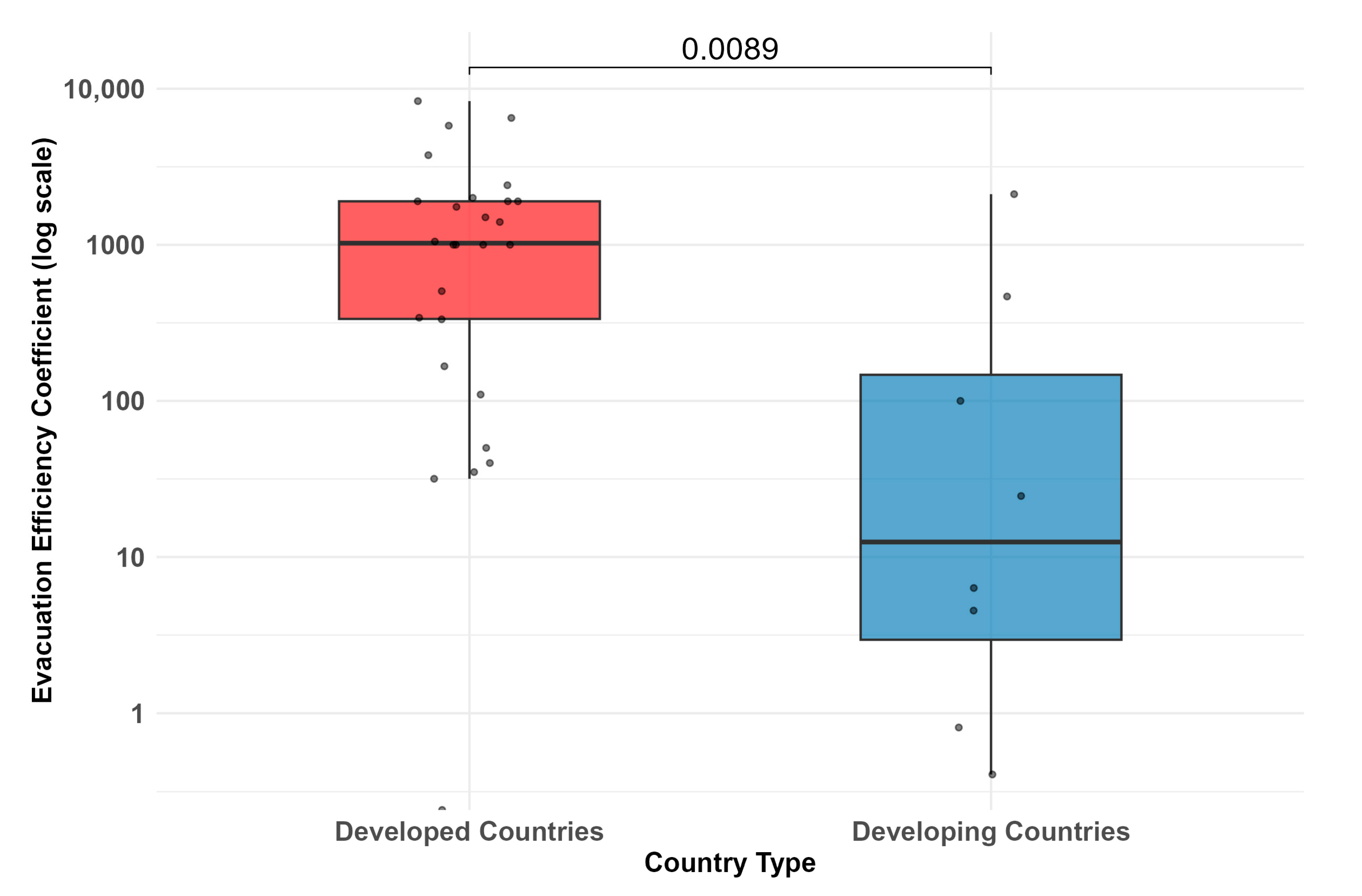
Statistical analysis reveals that the evacuation efficiency (measured by the Evacuation Efficiency Coefficient—the ratio of evacuated individuals to total casualties) in the developed country group was significantly higher than that in the developing country group (Figure 4). Specifically, the median evacuation efficiency was 1000 for developed countries, compared to only 15.46 for developing countries, representing a nearly 65-fold difference, indicating both higher performance and greater consistency in emergency evacuation among developed nations.
The Wilcoxon test confirmed a statistically significant difference between the two groups (p < 0.001, effect size r = 0.45). This finding suggests a significant association between national development levels and the effectiveness of wildfire emergency response. The systemic advantages observed in developed countries likely stem from more advanced early warning systems, more efficient evacuation organization mechanisms, greater investment in emergency resources, and more established public emergency education systems. This trend was further corroborated by extreme cases observed in the data. For instance, the United States’ “Bond Fire” event achieved a high evacuation efficiency of 8333, whereas Chile′s “Valparaiso fire”, despite its smaller scale, registered an evacuation efficiency of merely 0.81, reflecting substantial disparities in emergency response capabilities.

4. Discussion

4.1. Extreme Asymmetry in Wildfire Disaster Characteristics

Through systematic descriptive statistics, our analysis of the 2018–2024 event sample indicates highly asymmetric and extreme characteristics exhibited by wildfire disasters across multiple dimensions. These findings not only corroborate the inherent patterns of wildfire hazards but also provide crucial empirical evidence for risk assessment, resource allocation, and emergency management.
The extremely right-skewed distribution of burned area represents one of the core findings of this research. The substantial disparity between the mean (519.6 thousand hectares) and median (13.4 thousand hectares), coupled with the considerable standard deviation (422.91), indicates that wildfire risk is not uniformly distributed but is predominantly driven by a minority of “extreme megafires”. As pointed out by Andela et al. (2017) in their study on global burned area trends, although human activities have had a suppressive effect on burned area at regional scales, the dominant role of extreme fire events is becoming increasingly prominent [17]. Research by Jolly et al. (2015) on the significant lengthening of the “fire weather” season provides key support for understanding the climatic drivers of such extreme events, indicating that drought, high temperatures, and strong wind conditions exacerbated by climate change are collectively fostering environments more prone to extreme fire behavior like “firestorms” [40]. This aligns highly with the “fat-tailed” distribution characteristics we revealed. While the vast majority of wildfire events are relatively limited in scale (median only 13.4 thousand hectares), exceptionally rare catastrophic events with burned areas reaching tens of millions of hectares substantially elevate the overall average. This fat-tailed distribution characteristic implies that risk assessments based on mean values would severely underestimate the occurrence probability and potential impacts of extreme events. Consequently, fire prevention strategies and resource allocation plans must fully account for this extreme right-skewness, placing preparedness for “catastrophic” scenarios at the core of planning.
The distribution pattern of casualty figures further reinforces the perspective that disaster impacts are highly concentrated. The zero median for fatalities indicates that most wildfire events do not directly cause fatal outcomes; however, the existence of a mean value (6.38 deaths) and a maximum value (131 deaths) reveals the deterministic influence of a small number of high-lethality events on overall casualty statistics. Doerr & Santín (2016) systematically reviewed global wildfire trends and knowledge gaps, emphasizing the socio-ecological complexity of fire impacts and noting that the threat of extreme events to human safety is transcending traditional boundaries [18]. Further, Tedim et al. (2018), through a systematic analysis of global major wildfire disaster cases, proposed a “coupled disaster” framework, emphasizing that high lethality is often the result of a complex coupling of extreme fire behavior, high community exposure, and vulnerability (e.g., insufficient evacuation routes, warning failures) [41]. This provides a profound mechanistic explanation for the highly concentrated casualty distribution we observed. This underscores that public health and emergency response planning cannot simply rely on historical average casualty levels but must establish capabilities for rapid response and management of such “black swan” events.
Data on wildfire duration and evacuation scale similarly reveal significant imbalances. The median duration (25 days) is substantially lower than the mean (42.05 days), and the existence of extreme cases lasting over 300 days indicates that some fires evolve into “long-duration fires” due to fuel, terrain, or meteorological conditions, posing sustained challenges to firefighting resources and ecosystem endurance. Bowman et al. (2020), in their review of global vegetation fire characteristics in the Anthropocene, emphasized that lengthening fire seasons and extreme fire behavior have become hallmarks of the new era [2]. Nolan et al. (2021) further pointed out that climate change is leading to the emergence of “zombie fires” in some regions (e.g., North American boreal forest), which can overwinter in peat layers and reignite the following year, greatly extending the fire’s lifecycle [42]. This provides a cutting-edge scientific explanation for the extreme duration values we observed. Particularly noteworthy is the distribution of evacuation scale, where the considerable gap between the mean (25.3 thousand people) and median (4000 people), along with a maximum evacuation scale of 295 thousand people, highlights the extreme and unconventional pressure that major wildfires place on emergency evacuation systems. This distribution pattern suggests that evacuation plans must possess high scalability and flexibility to accommodate evacuation demands ranging from thousands to hundreds of thousands of people, generated within very short timeframes.

4.2. Evolving Spatiotemporal Patterns in Global Wildfire Regimes

Our systematic analysis of major global wildfire events from 2018 to 2024 suggests that global wildfire patterns are undergoing profound and complex transformations. The analysis not only confirms the overall intensification trend of wildfire activity but, more importantly, uncovers characteristic dynamic differentiations from a spatiotemporally coupled perspective. This understanding holds key significance for comprehending regional responses to global change and optimizing disaster prevention and mitigation systems.
Casualty figures demonstrate strong interannual fluctuations, closely coupled with specific extreme events. This clarifies that the macroscopic trend of global wildfire risk is essentially driven by a series of frequent, regional extreme catastrophic events. The stabilization of event frequency at high levels following the 2020 peak further indicates that wildfires have transitioned from sporadic disasters to persistent threats under a “new normal”, posing severe challenges to the sustainability of global firefighting resources and response capabilities.
Traditional hotspot regions, such as the North American West Coast, remain persistently active, with their 67.9% proportion highlighting this area’s continued status as the core focus of global wildfire research and governance. However, a more alarming finding lies in the emergence of new hotspot regions. The significant increase in event frequency along the Mediterranean coast of Southern Europe, coupled with the prominence of non-traditional hotspots such as Chile, Algeria, and the Russian Far East, signals that wildfire risk is breaking through existing geographical and climatic boundaries. The study by Andela et al. (2017) revealed enhanced regional heterogeneity against the backdrop of declining global burned area, particularly the increased sensitivity of fire activity in semi-arid regions [17]. Research by Abatzoglou et al. (2019) quantified the contribution of anthropogenic climate change to the increase in global fire-prone area, clearly identifying climate warming as a key driver pushing fire risk into traditional non-hotspot regions such as high latitudes and high altitudes [1]. This “diffusion” and “shift” in spatial patterns are likely closely related to the expansion of arid zones, increased frequency of extreme heatwaves under climate change, and the extension of human activities into the wildland-urban interface. This clearly indicates that wildfire prevention and control systems, primarily based on historical experience and focused on traditional hotspots, urgently require updating. It is essential to incorporate more emerging risk regions into global monitoring and collaboration networks.
The three typical cluster patterns identified through spatiotemporal interaction analysis provide a dynamic perspective for understanding the driving mechanisms behind wildfire occurrence. Although the Annual North American West Coast Cluster and the Mediterranean Summer Cluster overlap temporally, their dominant driving factors likely differ—the former is more related to the accumulation of seasonal drought, while the latter is more closely associated with sudden extreme high temperatures and strong winds. Doerr & Santín (2016) emphasized the importance of distinguishing different fire driving mechanisms [18]. Goss et al. (2020), through climate model projections, found significant differences in the dominant climate drivers (e.g., drought vs. high temperature) of future fire risk across different regions, directly supporting our judgment that even under similar apparent clustering, the underlying climate-fuel-ignition coupling mechanisms may differ fundamentally [4]. The Seasonally Delayed Southern Hemisphere Cluster intuitively reflects the antiphase relationship of climatic seasonality between hemispheres. The existence of these cluster patterns demonstrates that global wildfires are not random but follow a “fire calendar” regulated by large-scale climate patterns. This understanding is crucial for implementing proactive risk management; for instance, based on the active periods of different clusters, cross-regional and seasonal resource pre-positioning and early warning issuance can be conducted, achieving a transition from passive response to active preparedness.

4.3. Policy Implications of Identified Casualty Patterns

The identification of the High-Lethality Pattern represents one of the core findings of this research. Its exceptionally high mean death toll of 47.3 individuals, combined with its spatial characteristic of frequently occurring in densely populated wildland-urban interface zones, points to a catastrophic scenario resulting from the coupling of high hazard intensity and high exposure. Bowman et al. (2020) in his review of the characteristics of Anthropocene fires, he especially emphasized the particularity of the urban-rural ecotone as a high vulnerability area and the “catastrophic fire behavior” caused by the superposition of extreme weather and flammable landscape [2]. Tedim et al. (2018) further classified the fire that caused a large number of casualties as “social catastrophic wildfire”, and pointed out that the root cause was the failure of the “risk construction” process—that is, community development and land use planning failed to effectively avoid and mitigate the known high fire risk [41]. This is highly consistent with the performance of the high mortality mode cases we identified, such as Maui Island in Hawaii in 2023 and Valparaiso fire in Chile in 2024. This exposes the inherent vulnerability of communities situated in wildland-urban interface zones when confronted with rapidly spreading fires, underscoring the critical importance of implementing stricter land-use planning, establishing fire-resistant building material standards, and deploying ultra-rapid early warning systems in these areas.
In stark contrast, the Large-Scale Evacuation Pattern is characterized by a substantial evacuation scale (mean: 87,000 people) and relatively low casualty rates, vividly demonstrating the decisive role of proactive risk management in saving lives. Its spatial concentration around metropolitan areas in developed countries is not coincidental but rather a direct reflection of these regions’ robust emergency response capabilities, well-developed evacuation plans, and efficient public communication systems. Calkin et al. (2014), in their groundbreaking wildfire risk management framework, explicitly stated that when fires cannot be suppressed promptly, the core life-protection strategy should shift from “suppression” to “protective evacuation and shelter-in-place” [19]. Our research provides large-scale empirical support for the effectiveness of this strategy. Crucially, the pattern’s median burned area (39.2 thousand hectares) indicates that the primary driver for large-scale evacuation decisions is not the absolute fire size but rather the anticipation and avoidance of human risk. Doerr & Santín (2016), discussing the social impacts of fire, noted that successful emergency management can transform disaster impact from loss of life into manageable costs [18]. This provides a successful paradigm for global wildfire risk management: through proactive population relocation, the disaster impact can be effectively transformed from human casualties into manageable logistical and economic costs, even if complete fire containment is not achieved.
The Routine-Control Pattern constitutes the majority of wildfire events (76.8%), and its significance lies in representing the “acceptable” normal risk level under current fire management systems. Its exhibited moderate intensity, low direct mortality, and weak correlation with burned area collectively demonstrate the effectiveness of specialized firefighting forces, mature suppression techniques, and institutionalized management mechanisms in regions chronically affected by wildfires, such as the western United States. However, the considerable variation in its duration also suggests that such events impose sustained endurance consumption on firefighting resources, representing a fundamental pressure source during fire seasons.
The Ecological-Destruction Pattern, as an emerging category, introduces a new dimension to wildfire impact assessment. Exemplified by the 2024 Brazil fires, its unprecedented spatial scale signals the potential collapse of ecosystem services, with impacts extending from regional to global scales (e.g., massive carbon emissions). Bowman et al. (2020) strongly advocated for redefining fire impacts in the Anthropocene context, incorporating long-term ecological consequences such as biodiversity loss and degradation of carbon sink function into the core assessment framework [2]. Nolan et al. (2021) further warned that extreme wildfire events are increasingly pushing some ecosystems (e.g., boreal forests, peatlands) past their ecological recovery “tipping points”, leading to irreversible changes in their state [42]. Our Ecological-Destruction Pattern is a concrete response to this warning. The core challenge posed by this pattern is that traditional disaster assessment frameworks, centered on direct casualties and property losses, fail to adequately capture its long-term and far-reaching consequences. Consequently, new assessment frameworks must be developed that incorporate indirect costs such as biodiversity loss, degradation of carbon sink function, and resultant long-term public health risks.

4.4. National Disparities in Evacuation Efficiency

A significant and substantial gap exists between national development levels and wildfire emergency evacuation efficiency as measured by the Evacuation Efficiency Coefficient (ratio of evacuated individuals to total casualties). The nearly 65-fold difference in median evacuation efficiency between the developed and developing country groups represents not merely an order-of-magnitude distinction but more profoundly reflects a comprehensive “development chasm” in emergency management systems. The distribution characteristics of evacuation efficiency are inherently illuminating. The developed country group not only demonstrated a substantially higher mean value (1696.58) compared to the developing country group (339.31), but its exceptionally high standard deviation (±2105.31) also warrants in-depth interpretation. This suggests the presence of a right-skewed distribution within developed countries, characterized by a minority of extremely efficient cases (such as the United States’ “Bond Fire” event with an efficiency of 8333.33), potentially representing the “upper limit” of their advanced emergency management systems. In contrast, the lower mean value and similarly large standard deviation (±733.31) in the developing country group primarily reflect the instability and immaturity of their emergency response systems, manifesting as dramatic fluctuations in response effectiveness and consistently low median performance levels. The root causes of this substantial disparity cannot be attributed to a single factor but rather to a systemic complex of capabilities. These include political and governance challenges such as unstable institutional frameworks and weak enforcement of land-use planning regulations [28]. Financial mechanisms, such as low public insurance penetration and chronic under-investment in preemptive infrastructure, further exacerbate these disparities [43]. Additionally, legislative gaps in regulatory standards for WUI zones and building codes contribute to higher vulnerability [19]. Addressing these systemic issues requires international cooperation through technology transfer, capacity building, and financial support, ultimately aiming to bridge the development chasm in global wildfire resilience.
The comparison of extreme cases in this study provides vivid annotation for this phenomenon. The highly efficient evacuation during the United States’ “Bond Fire” represents a typical outcome of its mature emergency system’s integrated functioning. Conversely, Chile’s “Valparaiso fire,” despite its relatively smaller scale, exposed potential systematic deficiencies in early warning, organization, or public response through its extremely low evacuation efficiency (0.81). Andela et al. (2017), in their global analysis, implied the important influence of governance capacity on fire outcomes [17]. Cattau et al. (2020) more directly pointed out that global wildfire governance is facing the challenge of “maladaptation”, particularly in regions with weak institutions and limited resources, where there are systemic shortcomings in the capacity to cope with extreme wildfires [44]. Our research quantifies the key shaping role of socioeconomic foundations and governance capacities on disaster outcomes through the specific indicator of evacuation efficiency. This strongly indicates that evacuation efficiency is not solely determined by the physical intensity of the wildfire itself but is predominantly shaped by socioeconomic foundations and governance capacities. Lahsen et al. (2010), in their research on vulnerability and global environmental change, long ago pointed out that disaster risk is a product of social inequality and development pathways [45]. Our findings once again corroborate this profound assertion, emphasizing that the fundamental way to enhance global wildfire resilience lies in narrowing the “development gap” and “governance gap” between countries.

4.5. Study Limitations

While this study provides systematic evidence for understanding the disaster characteristics of global wildfire events and emergency response effectiveness, several limitations must be cautiously acknowledged. These constraints significantly influence the universality and precision of the research conclusions.
Dependence on publicly available reports may introduce reporting bias. This bias is a common challenge in global disaster databases, as noted by Gall et al. (2014) in their critical review of disaster loss data, where they highlight the ‘crisis of chronic underreporting’ for smaller and recurrent events, particularly in low-income nations [46]. This bias may overestimate the average severity of global wildfires and compromise accurate assessment of spatial distribution patterns.
Insufficient consistency in data completeness and standards across countries constrains the rigor of cross-national comparisons. Significant disparities exist among nations regarding disaster data collection, statistical methodologies, and transparency of disclosure. Developed countries typically maintain more comprehensive disaster monitoring and reporting systems, while some developing countries, constrained by resources and institutional capacities, may demonstrate poorer data continuity and reliability. This issue aligns with the findings of Below et al. (2009), who identified substantial heterogeneity in data quality and completeness across countries in the EM-DAT database, complicating direct cross-national comparisons [24]. This heterogeneity in data quality implies that observed differences in key indicators such as evacuation efficiency between countries at different development levels may partially stem from variations in data quality rather than genuine performance gaps, thereby somewhat undermining the persuasiveness of statistical comparisons.
The study failed to control for all potential confounding factors, which limits the strength of causal inference. For instance, while analyzing the relationship between national development level and evacuation efficiency, although a statistically significant association was observed, key contextual variables such as terrain complexity in affected areas, infrastructure density, specific timing of fire occurrence (day/night), and community demographic structure were not fully incorporated into the model. As emphasized by Kruk et al. (2015) in the context of health system performance measurement, failing to account for contextual confounders can lead to misleading conclusions about the true effect of socioeconomic or governance factors [47]. These uncontrolled variables may covary with national development levels and simultaneously directly influence evacuation efficiency, consequently introducing risk of confounding bias in the estimated results.

5. Conclusions

This study, through systematic analysis of 137 major wildfire events globally between 2018 and 2024, reveals a series of core characteristics and evolutionary patterns of global wildfire disasters in the new era. The main conclusions can be summarized into the following four aspects:
  • Our analysis of the 2018–2024 event sample provides evidence of significant ‘extremization’ and ‘polarization’ characteristics in global wildfire risk. Descriptive statistical results indicate that the distributions of burned area, casualties, and evacuation scale all exhibit strong right-skewness, meaning a minority of catastrophic events dominate the overall losses. These near-term patterns suggest that wildfire risk management should increasingly shift from addressing “normal” events to highly prioritizing the prevention and preparedness for “catastrophic” scenarios.
  • The spatiotemporal patterns of wildfires are undergoing structural transformation. Temporally, the frequency and impact severity of major events show a fluctuating upward trend within the studied period. Spatially, the risk pattern is expanding from traditional hotspots in North America and Australia to emerging regions including Mediterranean Europe, Chile, and the Russian Far East, suggesting that wildfire risk may be breaking through traditional geographical and climatic boundaries. The three major spatiotemporal cluster patterns identified provide a scientific roadmap for implementing proactive, seasonal global resource allocation.
  • The study innovatively identifies four distinct casualty patterns: “High-Lethality”, “Large-Scale Evacuation”, “Routine-Control”, and “Ecological-Destruction”. This typological framework indicates that the human impacts of wildfires result from the combined effects of hazard intensity, social exposure, and emergency management capacity. It reveals that successful risk management does not solely pursue fire suppression but requires precise strategic trade-offs between pre-disaster prevention (e.g., regulated land use), disaster response (e.g., efficient evacuation), and post-disaster recovery (e.g., ecological restoration) according to specific contexts.
  • Based on the 2018–2024 sample, national development level suggests a strong association with emergency response efficacy. The vast 65-fold disparity in evacuation efficiency between developed and developing countries highlights a substantial “development chasm” in emergency management capabilities. This finding emphasizes that enhancing global wildfire resilience is not merely a technical issue but fundamentally a developmental challenge, urgently requiring the international community to address systemic shortcomings through technology transfer, capacity building, and financial support.
  • Building on the findings and limitations of this study, we propose the following directions for future research: Future studies should integrate high-resolution satellite data with localized socioeconomic, governance, and infrastructural indicators to better isolate the causal mechanisms underlying the observed disparities in evacuation efficiency and casualty patterns. Develop and validate dynamic evacuation models that incorporate real-time data on risk perception, communication flows, and population mobility to improve the predictive capacity and practical utility of evacuation efficiency metrics. Long-Term Ecological and Health Impacts: Conduct longitudinal studies to quantify the long-term ecological consequences (e.g., biodiversity loss, carbon cycle disruption) and public health impacts of the “Ecological-Destruction” pattern, which are currently underrepresented in disaster assessment frameworks.

Author Contributions

Conceptualization, J.H.; methodology, J.H.; software, J.H.; validation, J.H. and M.B.; formal analysis, J.H.; investigation, J.H.; resources, M.B.; data curation, M.B.; writing—original draft preparation, J.H. and M.B.; writing—review and editing, J.H. and M.B.; visualization, M.B.; supervision, M.B.; project administration, M.B.; funding acquisition, M.B. All authors have read and agreed to the published version of the manuscript.

Funding

This work was supported by the National Key R&D Program of China (2024YFB341105).

Institutional Review Board Statement

Not applicable.

Informed Consent Statement

Not applicable.

Data Availability Statement

Data are contained within the article.

Acknowledgments

We would like to thank the editor and anonymous reviewers for their valuable comments and suggestions to this paper.

Conflicts of Interest

The authors declare no conflicts of interest.

References

  1. Abatzoglou, J.T.; Williams, A.P. Impact of anthropogenic climate change on wildfire across western US forests. Proc. Natl. Acad. Sci. USA 2016, 113, 11770–11775. [Google Scholar] [CrossRef] [PubMed]
  2. Bowman, D.M.J.S.; Kolden, C.A.; Abatzoglou, J.T.; Johnston, F.H.; van der Werf, G.R.; Flannigan, M. Vegetation fires in the Anthropocene. Nat. Rev. Earth Environ. 2020, 1, 500–515. [Google Scholar] [CrossRef]
  3. Akter, S.; Grafton, R.Q. Socioeconomic well-being losses of Australia’s Black Summer fires (2019–2020): Burden by burned area, poverty, and gender. One Earth 2025, 8, 101454. [Google Scholar] [CrossRef]
  4. Goss, M.; Swain, D.L.; Abatzoglou, J.T.; Sarhadi, A.; Kolden, C.A.; Williams, A.P.; Diffenbaugh, N.S. Climate change is increasing the likelihood of extreme autumn wildfire conditions across California. Environ. Res. Lett. 2020, 15, 094016. [Google Scholar] [CrossRef]
  5. Kirchmeier-Young, M.C.; Gillett, N.P.; Zwiers, F.W.; Cannon, A.J.; Anslow, F.S. Attribution of the influence of human-induced climate change on an extreme fire season. Earth’s Future 2019, 7, 2–10. [Google Scholar] [CrossRef] [PubMed]
  6. Kumar, M.; AghaKouchak, A.; Abatzoglou, J.T.; Goulden, M.L.; Smith, S.L.; Randerson, J.T.; Hall, A.G. Compounding effects of climate change and WUI expansion quadruple the likelihood of extreme-impact wildfires in California. npj Nat. Hazards 2025, 2, 17. [Google Scholar] [CrossRef]
  7. Turco, M.; Rosa-Cánovas, J.J.; Bedia, J.; Jerez, S.; Montávez, J.P.; Llasat, M.C.; Provenzale, A. Exacerbated fires in Mediterranean Europe due to anthropogenic warming projected with non-stationary climate-fire models. Nat. Commun. 2018, 9, 3821. [Google Scholar] [CrossRef]
  8. Costa-Saura, J.M.; Bacciu, V.; Sirca, C.; Spano, D.; Trabucco, A.; Martínez, J.M.B. The growing link between heatwaves and megafires: Evidence from southern Mediterranean countries of Europe. Nat. Hazards 2025, 121, 17731–17742. [Google Scholar] [CrossRef]
  9. Modaresi Rad, A.; Abatzoglou, J.T.; Kreitler, J.; Alizadeh, M.R.; AghaKouchak, A.; Hudyma, N.; Nauslar, N.J.; Sadegh, M. Human and infrastructure exposure to large wildfires in the United States. Nat. Sustain. 2023, 6, 1343–1351. [Google Scholar] [CrossRef]
  10. Jones, B.A.; McDermott, S. The Local Labor Market Impacts of US Megafires. Sustainability 2021, 13, 9078. [Google Scholar] [CrossRef]
  11. Gritzo, L.A. Perspective article: Mitigating social and economic impact of wildfires. Appl. Energy Combust. Sci. 2024, 20, 100285. [Google Scholar] [CrossRef]
  12. Driscoll, D.A.; Macdonald, K.J.; Gibson, R.K.; Beaton, N.; Dique, H.; Hradsky, B.A.; Kelly, E.; MacHunter, J.; Pascal, L.; Ritchie, E.G.; et al. Biodiversity impacts of the 2019–2020 Australian megafires. Nature 2024, 635, 898–905. [Google Scholar] [CrossRef]
  13. Jones, M.W.; Veraverbeke, S.; Andela, N.; Arneth, A.; Forkel, M.; Friedlingstein, P.; Gumpenberger, M.; Lasslop, G.; Li, F.; Maignan, F.; et al. Global rise in forest fire emissions linked to climate change in the extratropics. Science 2024, 386, eadl5889. [Google Scholar] [CrossRef]
  14. Raquel, N.A. The state of wildfire and health research: Emerging trends, challenges and gaps. Int. Health 2025, 17, 922–933. [Google Scholar]
  15. Xu, R.; Ye, T.; Yue, X.; Zeng, Z.; Zhuang, Y.; Zhang, Y.; Zhang, Y.; Zhang, Y.; Liu, Y.; Yu, P.; et al. Global population exposure to landscape fire air pollution from 2000 to 2019. Nature 2023, 621, 521–529. [Google Scholar] [CrossRef] [PubMed]
  16. Moritz, M.A.; Batllori, E.; Bradstock, R.A.; Gill, A.M.; Handmer, J.; Hessburg, P.F.; Leonard, J.; McCaffrey, S.; Odion, D.C.; Schoennagel, T.; et al. Learning to coexist with wildfire. Nature 2014, 515, 58–66. [Google Scholar] [CrossRef]
  17. Andela, N.; Morton, D.C.; Giglio, L.; Chen, Y.; van der Werf, G.R.; Kasibhatla, P.S.; DeFries, R.S.; Collatz, G.J.; Hantson, S.; Kloster, S.; et al. A human-driven decline in global burned area. Science 2017, 356, 1356–1362. [Google Scholar] [CrossRef] [PubMed]
  18. Doerr, S.H.; Santín, C. Global trends in wildfire and its impacts: Perceptions versus realities in a changing world. Philos. Trans. R. Soc. B Biol. Sci. 2016, 371, 20150345. [Google Scholar] [CrossRef]
  19. Calkin, D.E.; Cohen, J.D.; Finney, M.A.; Thompson, M.P. How risk management can prevent future wildfire disasters in the wildland-urban interface. Proc. Natl. Acad. Sci. USA 2014, 111, 746–751. [Google Scholar] [CrossRef]
  20. Haynes, K.; Short, K.; Xanthopoulos, G.; Blanchi, R.; Leonard, J.; Opray, M.; Newnham, G.; Beighel, J.; Middelmann, M.H.; Krusel, N.; et al. Wildfires and WUI Fire Fatalities. In Wildfire Hazards, Risks, and Disasters; Shroder, J.F., Paton, D., Eds.; Elsevier: Amsterdam, The Netherlands, 2015; pp. 25–55. [Google Scholar]
  21. Eriksen, C.; Prior, T. The art of learning: Wildfire, amenity migration and local environmental knowledge. Int. J. Wildland Fire 2011, 20, 612–624. [Google Scholar] [CrossRef]
  22. McLennan, J.; Ryan, B.; Bearman, C.; Toh, K.; Eriksen, C.; Thomas, J.; Lacey, J.; Witt, T.; Hughes, L.; Kroeger, T.; et al. Should we leave now? Behavioral factors in evacuation under wildfire threat. Fire Technol. 2019, 55, 487–516. [Google Scholar] [CrossRef]
  23. van der Werf, G.R.; Randerson, J.T.; Giglio, L.; van Leeuwen, T.T.; Chen, Y.; Rogers, B.M.; Mu, M.; van Marle, M.J.E.; Morton, D.C.; Collatz, G.J.; et al. Global fire emissions estimates during 1997–2016. Earth Syst. Sci. Data 2017, 9, 697–720. [Google Scholar] [CrossRef]
  24. Below, R.; Wirtz, A.; Guha-Sapir, D. Disaster Category Classification and Peril Terminology for Operational Purposes; Centre for Research on the Epidemiology of Disasters: Brussels, Belgium, 2009. [Google Scholar]
  25. Krylov, A.; McCarty, J.L.; Potapov, P.; Loboda, T.; Tyukavina, A.; Turubanova, S.; Hansen, M.C. Remote sensing estimates of stand-replacement fires in Russia, 2002–2011. Environ. Res. Lett. 2014, 9, 105007. [Google Scholar] [CrossRef]
  26. Peng, R.D. Reproducible research in computational science. Science 2011, 334, 1226–1227. [Google Scholar] [CrossRef]
  27. Tukey, J.W. Exploratory Data Analysis; Addison-Wesley: Reading, MA, USA, 1977. [Google Scholar]
  28. Cutter, S.L.; Boruff, B.J.; Shirley, W.L. Social vulnerability to environmental hazards. Soc. Sci. Q. 2003, 84, 242–261. [Google Scholar] [CrossRef]
  29. The World Bank. World Bank Country and Lending Groups; World Bank: Washington, DC, USA, 2023. [Google Scholar]
  30. Archibald, S.; Lehmann, C.E.; Belcher, C.M.; Bond, W.J.; Bradstock, R.A.; Daniau, A.-L.; Dixon, K.W.; Grover, S.P.; He, T.; Higgins, S.I.; et al. Biological and geophysical feedbacks with fire in the Earth system. Environ. Res. Lett. 2018, 13, 033003. [Google Scholar] [CrossRef]
  31. Pearson, K. Notes on regression and inheritance in the case of two parents. Proc. R. Soc. Lond. 1895, 58, 240–242. [Google Scholar] [CrossRef]
  32. Spearman, C. The proof and measurement of association between two things. Am. J. Psychol. 1904, 15, 72–101. [Google Scholar] [CrossRef]
  33. Rousseeuw, P.J. Silhouettes: A graphical aid to the interpretation and validation of cluster analysis. J. Comput. Appl. Math. 1987, 20, 53–65. [Google Scholar] [CrossRef]
  34. Hartigan, J.A.; Wong, M.A. Algorithm AS 136: A K-Means Clustering Algorithm. J. R. Stat. Society. Ser. C 1979, 28, 100–108. [Google Scholar] [CrossRef]
  35. Silverman, B.W. Density Estimation for Statistics and Data Analysis; Chapman and Hall: London, UK, 1986. [Google Scholar]
  36. Moran, P.A.P. Notes on continuous stochastic phenomena. Biometrika 1950, 37, 17–23. [Google Scholar] [CrossRef] [PubMed]
  37. Mann, H.B.; Whitney, D.R. On a test of whether one of two random variables is stochastically larger than the other. Ann. Math. Stat. 1947, 18, 50–60. [Google Scholar] [CrossRef]
  38. Kruskal, W.H.; Wallis, W.A. Use of ranks in one-criterion variance analysis. J. Am. Stat. Assoc. 1952, 47, 583–621. [Google Scholar] [CrossRef]
  39. R Core Team. R: A Language and Environment for Statistical Computing; R Foundation for Statistical Computing: Vienna, Austria, 2021. [Google Scholar]
  40. Jolly, W.M.; Cochrane, M.A.; Freeborn, P.H.; Holden, Z.A.; Brown, T.J.; Williamson, G.J.; Bowman, D.M.J.S. Climate-induced variations in global wildfire danger from 1979 to 2013. Nat. Commun. 2015, 6, 7537. [Google Scholar] [CrossRef]
  41. Tedim, F.; Leone, V.; Amraoui, M.; Bouillon, C.; Coughlan, M.R.; Delogu, G.M.; Fernandes, P.M.; Ferreira, C.; McCaffrey, S.; McGee, T.K.; et al. Defining Extreme Wildfire Events: Difficulties, Challenges, and Impacts. Fire 2018, 1, 9. [Google Scholar] [CrossRef]
  42. Nolan, R.H.; Boer, M.M.; Collins, L.; Resco de Dios, V.; Clarke, H.; Jenkins, M.; Kenny, B.; Bradstock, R.A. Causes and consequences of eastern Australia’s 2019–2020 season of mega-fires. Glob. Change Biol. 2020, 26, 1039–1041. [Google Scholar] [CrossRef]
  43. Gritzo, R. Global Disparities in Wildfire Mitigation Financing: A Call for Equitable Investment. Nat. Hazards Rev. 2024, 25, 45–58. [Google Scholar]
  44. Cattau, M.E.; Wessman, C.; Mahood, A.; Balch, J.K. Anthropogenic and lightning-started fires are becoming larger and more frequent over a longer season length in the USA. Glob. Ecol. Biogeogr. 2020, 29, 668–681. [Google Scholar] [CrossRef]
  45. Lahsen, M.; Sanchez-Rodriguez, R.; Lankao, P.R.; Dube, P.; Leemans, R.; Gaffney, O.; Solecki, W.; Goodess, C. Impacts, Adaptation and Vulnerability to Global Environmental Change: Challenges and Pathways for an Action-Oriented Research Agenda for Middle-Income and Low-Income Countries. Curr. Opin. Environ. Sustain. 2010, 2, 364–374. [Google Scholar] [CrossRef]
  46. Gall, M.; Nguyen, K.H.; Cutter, S.L. Integrated Research on Disaster Risk: A Scientific Review of the Evidence. Nat. Clim. Change 2014, 4, 704–707. [Google Scholar]
  47. Kruk, M.E.; Gage, A.D.; Arsenault, C.; Jordan, K.; Leslie, H.H.; Roder-DeWan, S.; Adeyi, O.; Barker, P.; Daelmans, B.; Doubova, S.V.; et al. High-Quality Health Systems in the Sustainable Development Goals Era: Time for a Revolution. Lancet Glob. Health 2018, 6, e1196–e1252. [Google Scholar] [CrossRef] [PubMed]
Figure 1. Temporal Trends in Annual Mean Casualties and Burned Area from Major Global Wildfires (2018–2024).
Fire 08 00477 g001
Figure 2. Spatial Distribution of Burned Area and Casualties from Major Global Wildfires (2018–2024).
Fire 08 00477 g002
Figure 3. Clustering-Based Analysis of Casualty Patterns in Major Global Wildfires.
Fire 08 00477 g003
Figure 4. Disparities in Evacuation Efficiency (Ratio of Evacuated Individuals to Total Casualties) for Major Wildfires Between Developed and Developing Countries (2018–2024).
Fire 08 00477 g004
Disclaimer/Publisher’s Note: The statements, opinions and data contained in all publications are solely those of the individual author(s) and contributor(s) and not of MDPI and/or the editor(s). MDPI and/or the editor(s) disclaim responsibility for any injury to people or property resulting from any ideas, methods, instructions or products referred to in the content.