Article

Impact of Sr Content on the Morphology and Electrochemical Properties of La1−xSrxMnO3 Perovskites for High-Performance Supercapacitors


1
Institute of Metallurgy & Materials Engineering, Faculty of Chemical & Materials Engineering, University of the Punjab, Lahore 54590, Pakistan
2
School of Engineering, The Australian National University, Canberra, ACT 2601, Australia
3
Department of AI Convergence Electronic Engineering, Sejong University, Seoul 05006, Republic of Korea
4
Hybrid Materials Center (HMC), Department of Nanotechnology & Advanced Materials Engineering, Sejong University, Seoul 05006, Republic of Korea
5
School of Chemical, Biological and Battery Engineering, Gachon University, 1342 Seongnam-daero, Sujeong-gu, Seongnam-si 13120, Gyeonggi-do, Republic of Korea
6
Institute of Chemical and Environmental Engineering, Khwaja Fareed University of Engineering and Information Technology, Rahim Yar Khan 64200, Pakistan
7
Department of Chemical and Biological Engineering, American University of Sharjah, Sharjah 26666, United Arab Emirates
8
Centre of Excellence in Solid State Physics, University of the Punjab, Quaid-e-Azam Campus, Lahore 54590, Pakistan
9
Department of Built Environment and Energy Technology, Faculty of Engineering, Linnæus University, 352 52 Växjö, Sweden
*
Authors to whom correspondence should be addressed.
Ceramics 2026, 9(5), 44; https://doi.org/10.3390/ceramics9050044
Submission received: 17 March 2026 / Revised: 10 April 2026 / Accepted: 20 April 2026 / Published: 23 April 2026

Abstract

The effect of A-site substitution on the morphological and electrochemical properties of La1-xSrxMnO3 (x = 0, 0.25, 0.50) perovskites was investigated to evaluate their potential as electrode materials for supercapacitors. X-ray diffraction analysis confirmed the formation of the perovskite structure, with minor peak shifts and distortion of crystal structure induced by Sr substitution. Scanning electron microscopy analysis revealed irregularly shaped particulate morphology across all perovskite compositions. The increasing amount of Sr as in La0.5Sr0.5MnO3 (LSM-50) favored the formation of nanosized particles, and energy dispersive X-ray (EDX) analysis confirmed the presence of all constituent elements; EDX elemental mapping also showed a uniform distribution of all elements in the various perovskite compositions. Among all compositions, La0.75Sr0.25MnO3 (LSM-25) possessed the highest specific capacitance (Csp) of 483 Fg−1 at 1 Ag−1 current density in 3 M KOH electrolyte, as determined by electrochemical analysis. This perovskite material also exhibited a capacitance retention of 87.8% after 5000 charge–discharge cycles. Electrochemical impedance spectroscopy revealed that LSM-25 showed the lowest solution resistance (0.68 Ω*cm2) and charge transfer resistance (1.52 Ω*cm2), indicating strong electrode–electrolyte interaction. Detailed analysis of cyclic voltammetry data revealed that the predominant charge storage mechanism was diffusive in nature, with 88% of the diffusive contribution registered for LSM-25. These findings demonstrate that Sr substitution at the A-site significantly enhances the energy storage performance of LaMnO3, making it a promising candidate for supercapacitor applications.

1. Introduction

The growing depletion of fossil fuels and rising energy demands have driven research into sustainable energy storage solutions [1,2]. Supercapacitors (SCs) have attracted significant interest owing to their excellent power density, rapid charging and discharging capabilities, and extended operational lifespan [3,4]. However, their practical application is hindered by a relatively low energy density [5,6]. A promising approach to enhance SC energy density is the development of hybrid SCs, which integrate a capacitive (non-Faradaic) electrode for power delivery with a battery-type (Faradaic) electrode for energy storage [7,8]. This design offers greater energy density than conventional capacitors while maintaining a higher power density than batteries [9,10]. Additionally, the performance of SCs largely depends on the electrode materials, prompting research into materials that provide high specific capacitance (Csp) and excellent cycle stability.
The efficiency of SCs largely relies on the properties of the electrode materials employed. A wide range of materials, such as carbon-based structures, binary metal oxides, perovskite-type oxides, and conductive polymers, have been thoroughly investigated for their potential in SC applications [11,12,13,14]. Each type has its own pros and cons. Carbon-based electrodes provide high power density and long cycle life but have limited Csp. Metal oxide-based SCs offer greater energy density than carbon-based alternatives and better cycle stability than conducting polymers, though their low conductivity and restricted active site accessibility reduce their theoretical capacitance [15,16,17].
To address this, researchers have studied different morphologies and compositions of metal oxides to enhance active site utilization [18,19]. Transition metal-based perovskite oxides with the general formula ABO3 have shown great potential as electrode materials, thanks to their advantageous electronic configurations, high ionic conductivity, and remarkable thermal stability [20,21,22]. Lanthanum (La)-based perovskite oxides, such as LaMnO3, LaNiO3, LaFeO3, and LaCoO3, have demonstrated excellent performance due to their ability to exhibit multiple oxidation states (e.g., Mn2+, Mn3+, Mn4+), which contribute to strong electrochemical redox activity and enhanced efficiency [23,24]. Oxygen vacancies also play a critical role in improving Csp, which can be enhanced through doping at A and/or B sites or by introducing vacancies to balance the charge [25]. Unlike conventional electroactive metal oxides that store charge via cation intercalation and surface redox reactions, perovskite oxides exhibit unique energy storage capabilities through anion intercalation, enabled by their ABO3 structure and oxygen vacancies [26].
The properties of perovskite materials are largely determined by the cations occupying the ‘A’ and ‘B’ sites. Their structure can be tailored by substituting different cations based on the Goldschmidt tolerance factor, enabling the design of specific compositions [27]. This study focused on partially replacing the ‘A’ site cation in LaMnO3 perovskite oxide with Sr. The substitution of Sr was chosen for two key reasons. First, introducing divalent Sr2+ at the trivalent ‘A’ site causes a valence shift in the transition metal at the ‘B’ site from B3+ to B4+ to maintain charge balance. This leads to the formation of a Mn4+/Mn3+ pair, which facilitates hole hopping in p-type conductivity. Second, replacing La3+ with Sr2+ enhances the tolerance factor and structural stability of the perovskite [27,28]. However, doped perovskites still suffer from low ionic conductivity, limiting their effectiveness in high-performance electrochemical energy storage systems. A promising strategy to improve ionic conductivity is the introduction of oxygen vacancies within the crystal lattice.
Many researchers have studied the effect of ‘A’ and ‘B’ site doping on electrochemical properties of perovskites. In their study, Lin et al. [29] investigated how Sr doping affects the Csp of LaxSr1-xCoO3. They observed that with an increase in the amount of Sr, there was a corresponding increase in the number of oxygen vacancies in the material, leading to an increase in the Csp from 320 to 747 Fg−1. Lang et al. [30] synthesized Ag nanoparticle decorated La0.85Sr0.15MnO3 for SC applications. Utilizing a 1 M KOH electrolyte, the electrode demonstrated a high Csp of 186 Fg−1 at a current density of 1 Ag−1, alongside superior cycling stability. Furthermore, an asymmetric device based on this material reached a peak energy density of 19.9 Whkg−1 at a power density of 1700 Wkg−1, underlining its potential for high-performance energy storage. Hu et al. [31] fabricated LaCoO3 perovskite nanofibers (NFs) through electrospinning and subsequent calcination. Comprehensive characterization verified the structural and chemical integrity of material. When evaluated as SC electrodes in 6 M KOH, the LaCoO3 NFs achieved a Csp of 95.8 Fg−1 at 1 Ag−1, a performance primarily attributed to the Co2+/Co3+ redox couples.
Mondal et al. [32] investigated the electrochemical performance of La1−xKxCoO3 (0 ≤ x ≤ 0.5), reporting that the La0.5K0.5CoO3 electrode exhibited the highest Csp of 378 F g−1. Zhang and colleagues [33] synthesized Sr-doped LaNiO3 and observed that doping with 40% Sr2+ enhanced the capacitance from 155.4 to 231.7 Fg−1. Additionally, they reported that the Csp reached 80 Fg−1 at x = 0.08, which is nearly four times higher than that of the undoped sample (x = 0), which had a Csp of 23 Fg−1. Hadji et al. [34] synthesized LaCo1−xZnxO3 (0 ≤ x ≤ 0.1) by sol–gel method. The authors reported that LaCo0.95Zn0.05O3 showed a maximum Csp of 300 Fg−1 compared to 75 Fg−1 of LaCoO3. The fabricated electrodes demonstrated excellent cycling stability, retaining 85.7% of their initial charge capacity after 5000 charge–discharge cycles at a current density of 5 A g−1. The LaCo0.95Zn0.05O3/activated carbon hybrid device delivered a high energy density of 36.12 Whkg−1 at a power density of 390.35 Wkg−1. Moreover, the device exhibited remarkable long-term performance, maintaining 81% of its initial capacitance after 5000 consecutive charge–discharge cycles.
In this study, we investigated the properties of La1−xSrxMnO3 (x = 0, 0.25, 0.50) as potential electrode materials by examining the effects of A-site substitutions on their structural, morphological, and electrochemical characteristics. The strontium content was systematically varied to evaluate its influence on both the crystal structure and energy storage performance.

2. Experimental Section

Analytical-grade chemicals were used in the preparation of the various perovskite materials in this study, such as lanthanum nitrate La(NO3)3·6H2O (DaeJung, Siheung-si, Gyeonggi-do, Republic of Korea), strontium nitrate Sr(NO3)2 (Samchun, Seoul, Republic of Korea), manganese nitrate Mn(NO3)2·4H2O (Sigma-Aldrich, St. Louis, MO, USA), and citric acid C6H8O7 (Samchun, Gangnam-gu, Seoul, Republic of Korea). All chemicals were 99% pure. Perovskite compositions (LaMnO3, La0.75Sr0.25MnO3, La0.5Sr0.5MnO3, labeled as LM, LSM-25, and LSM-50 respectively) were synthesized using a cost-effective solution combustion method, described in detail elsewhere [26]. Stoichiometric amounts of La, Sr, and Mn nitrates were dissolved in deionized (DI) water, mixed with citric acid (fuel to nitrates ratio of 6:1), stirred for 2 h, and evaporated at 140 °C for 6 h to form a gel. The gel was ground and calcined at 1050 °C for 3 h to produce perovskite powder.
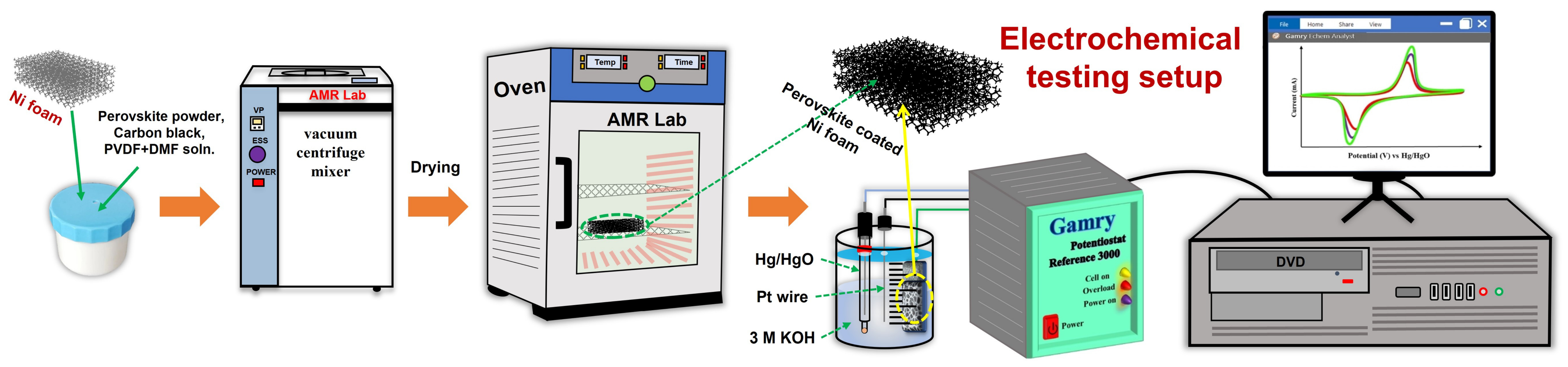
Porous nickel (Ni) foam (1 × 1 cm2) was cleaned by sonication in ethanol for 2 h and dried at 110 °C for 1 h. A slurry was prepared by mixing 90% perovskite powder, 10% carbon black, and polyvinylidene fluoride (PVDF) in dimethylformamide (DMF) using a vacuum planetary centrifugal mixer at 40 kPa and 2000 rpm for 2 min. The Ni foam was coated with the slurry via immersion and centrifugal mixing at 2000 rpm for 20 s, then dried at 80 °C for 3 h. The vacuum mixer ensured uniform mixing and penetration of the slurry into the Ni foam pores, achieving a mass loading of 3–5 mg. Figure 1 and Figure 2 illustrate the perovskite powder and electrode preparation processes, respectively. Details of morphological and electrochemical characterization are presented in the Supplementary Data.

3. Results and Discussions

3.1. XRD Analysis

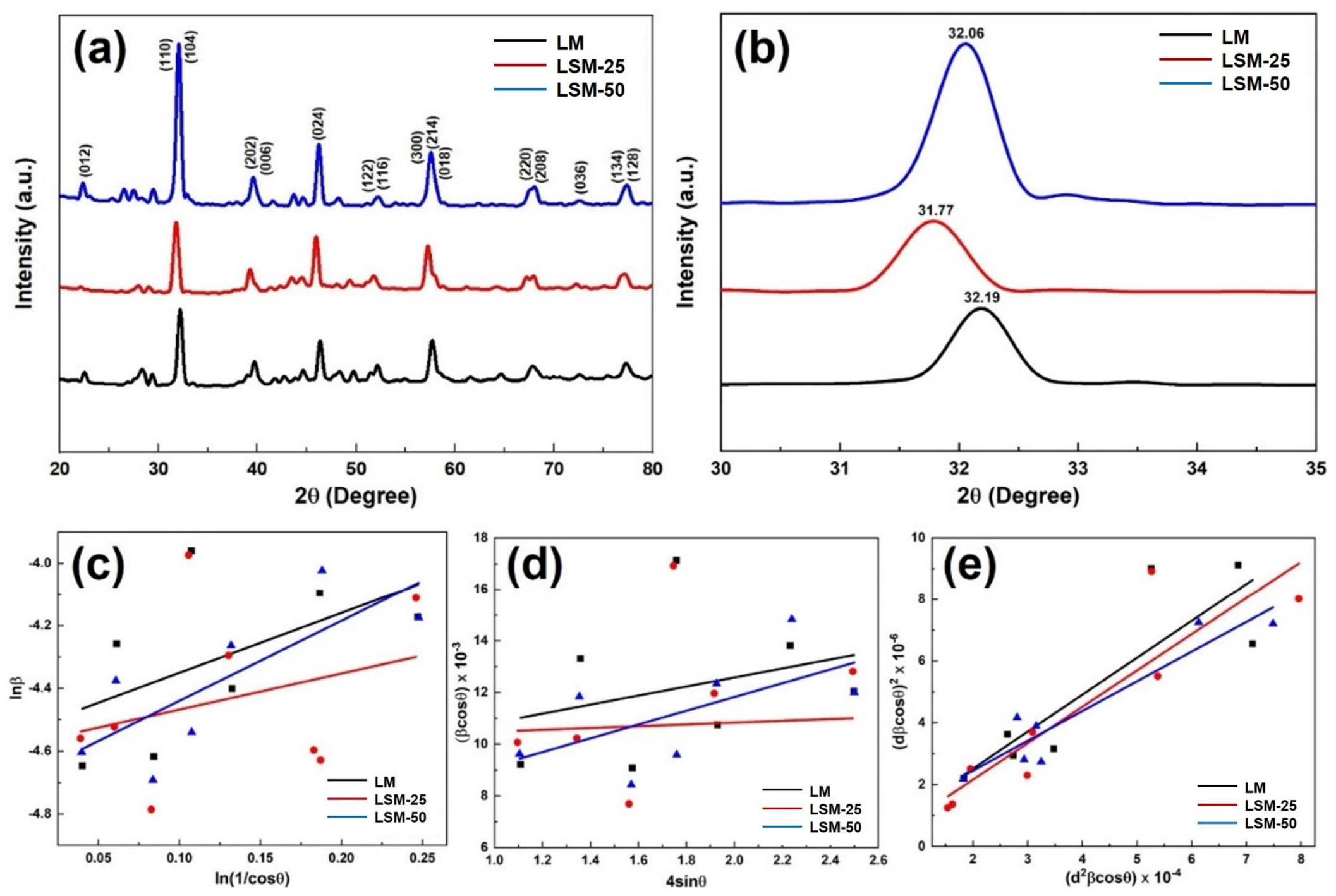
The crystal structure of the synthesized perovskite materials, LM, LSM-25 and LSM-50, was investigated via XRD analysis. The XRD patterns, presented in Figure 3a, exhibit diffraction peaks that are consistent with reference data from Crystallography Open Database (COD) entries 1521791 (LM), 1521156 (LSM-25), and 1533288 (LSM-50), confirming the formation of phase-pure perovskite structures. A detailed examination of the primary (110) and (104) peaks reveals a systematic shift to lower diffraction angles with increasing “Sr” content, which is attributed to the substitution of larger Sr2+ ions (ionic radius ~1.44 Å) for La3+ (ionic radius ~1.36 Å) at the A-site of the perovskite lattice, resulting in a slight lattice expansion. The interplanar spacing (d-spacing) for these peaks, calculated using Bragg’s law (nλ = 2d sinθ, Equation (S5) in Supplementary Data), was found to be 0.278 nm for LM, 0.281 nm for LSM-25, and 0.279 nm for LSM-50, indicating negligible variation in d-spacing despite the observed peak shift. Microstructural parameters, including average crystallite size (D), dislocation density (δ), and lattice strain (ε), were quantified using standard XRD equations (refer to Supplementary Data, references [21,35]), improved Scherrer equation, Williamson-Hall (W-H), and size-strain plot methods, and respective fitted plots are shown in Figure 3c–e). These obtained parameters are presented in Table 1, and their corresponding trends are presented in Figure 3, providing a comprehensive analysis of the crystallographic and microstructural properties of the perovskite materials. The deviation of data points from perfect linearity reflects the presence of anisotropic strain and microstructural heterogeneity, as noted in Table 1, where LSM-25 exhibits relatively weaker linearity than LM and LSM-50, which is associated with increased structural disorder arising from mixed-valence states (Mn3+, Mn4+, etc.) and local lattice distortions at intermediate “Sr” doping [21].

3.2. SEM and EDX Analysis

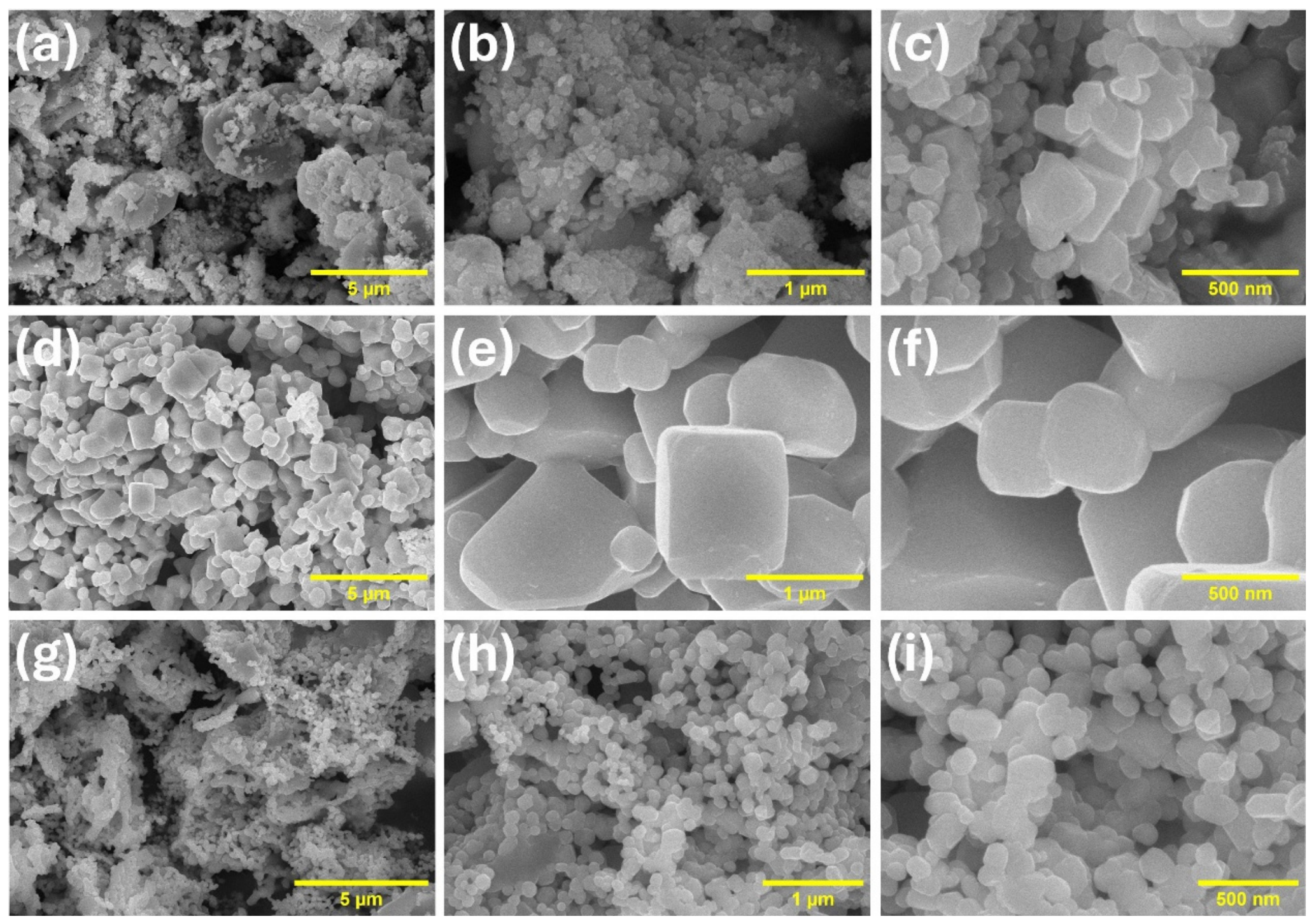
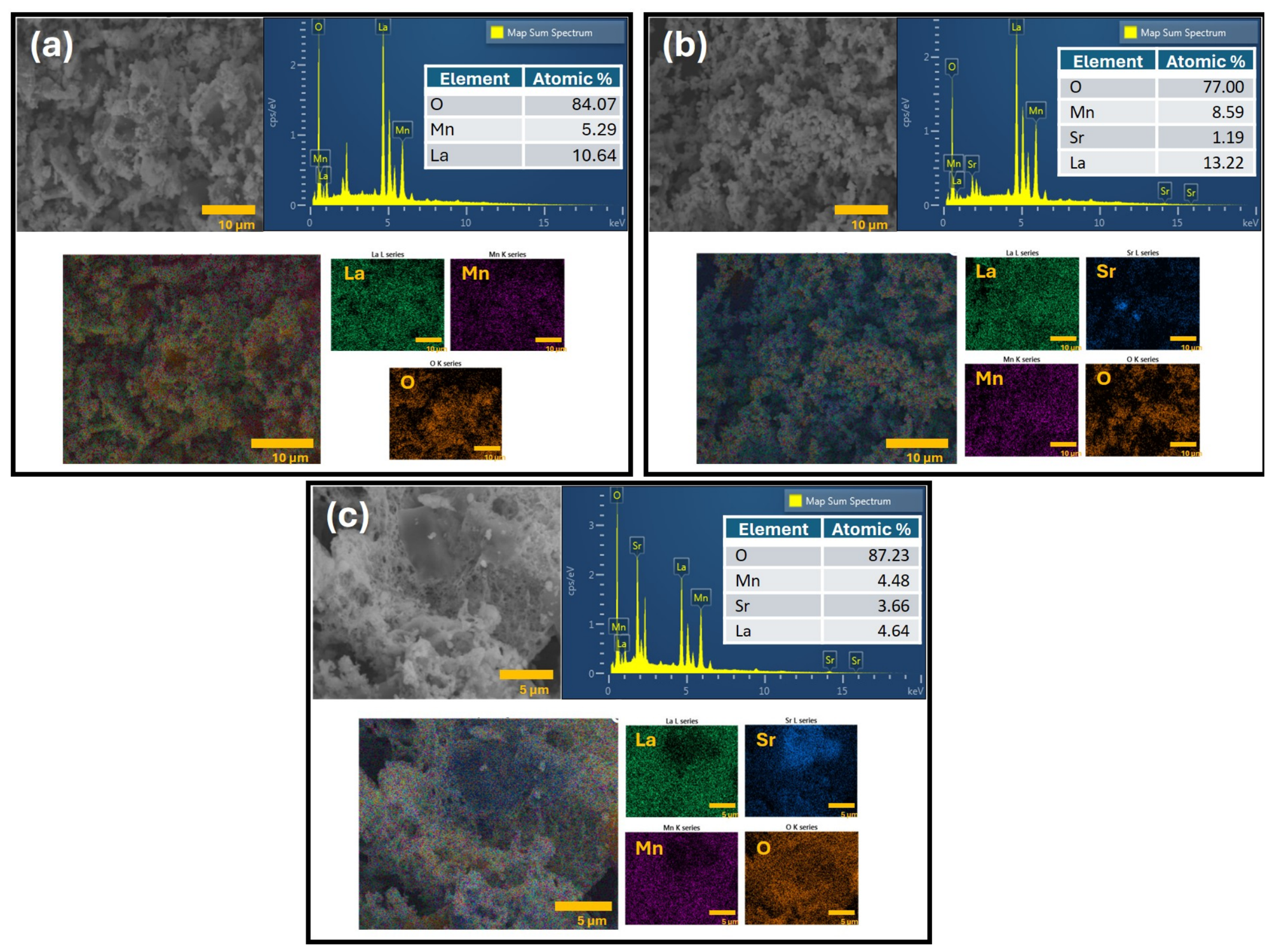
The morphology of the synthesized perovskite materials, LM, LSM-25, and LSM-50, was characterized using scanning electron microscopy (SEM), with representative images presented in Figure 4. The LM and LSM-50 samples displayed a heterogeneous morphology, featuring a combination of polygonal, orthorhombic, and spherical particles with sizes ranging from submicron to several micrometers. In contrast, LSM-25 exhibited a more varied morphology, incorporating cuboidal structures alongside these forms, indicating that strontium substitution influences particle growth and shape diversity. Notably, all samples showed clusters of fine, nanoscale particles (50–100 nm), with LSM-50 exhibiting a higher proportion of nanoparticulate structures, suggesting that increased Sr content enhances nucleation rates, leading to smaller particle sizes. Energy-dispersive X-ray spectroscopy (EDX) was employed to investigate the elemental composition, as shown in Figure 5. The EDX elemental mapping confirmed the presence of only the intended elements (La, Sr, Mn, and O) across all samples, with no detectable impurities, verifying the chemical purity of the perovskites. Quantitative EDX analysis further revealed that LSM-25 had a lower atomic percentage of Sr compared to LSM-50, aligning precisely with the stoichiometric compositions of La0.75Sr0.25MnO3 and La0.5Sr0.5MnO3, respectively, thus confirming the precision of the synthesis process and compositional accuracy.

3.3. TEM Study

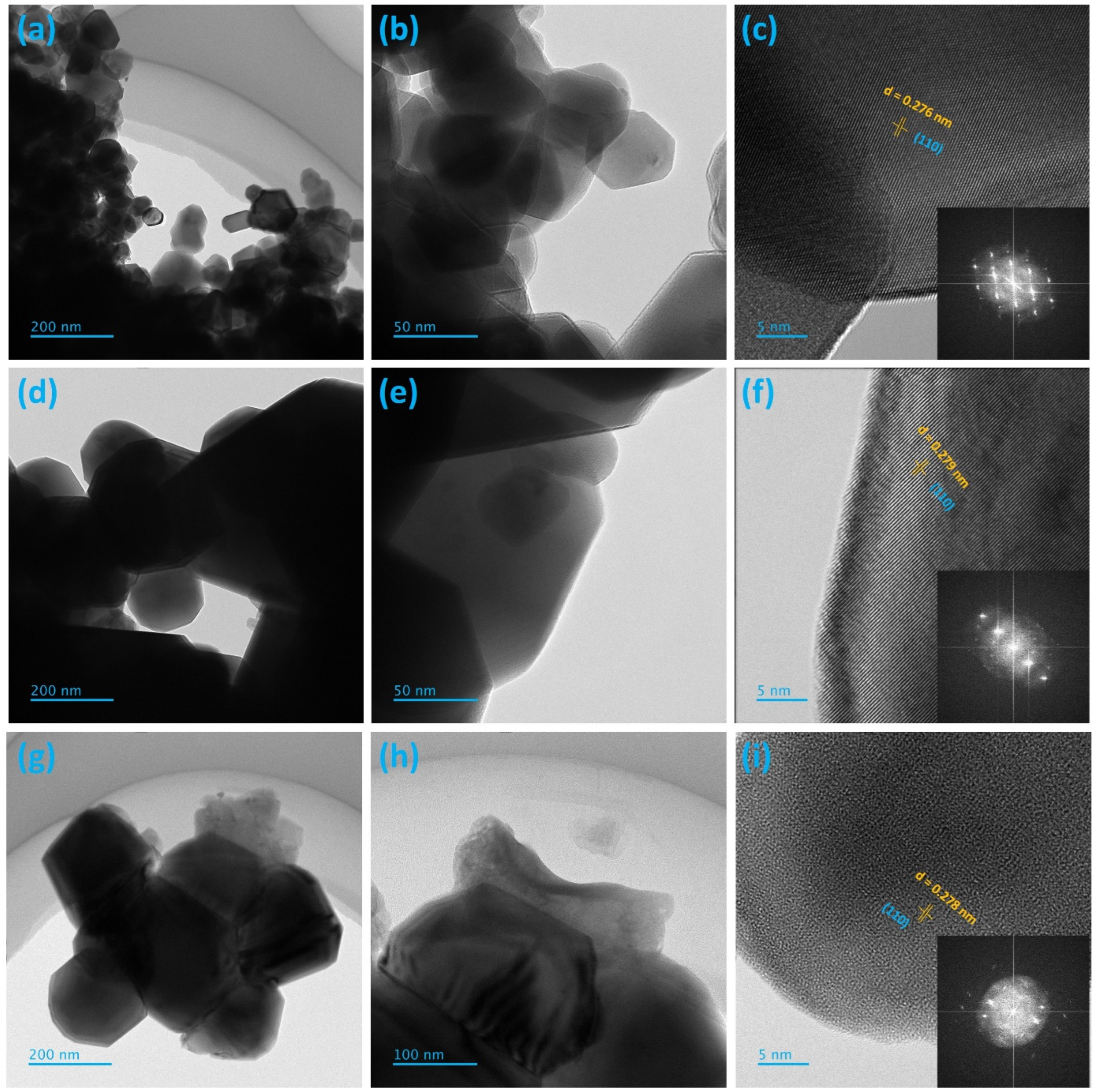
Transmission electron microscopy (TEM) was utilized to perform an in-depth morphological and structural characterization of the synthesized perovskite materials, LM, LSM-25 and LSM-50, with results illustrated in Figure 6, encompassing TEM images, high resolution (TEM) images, and fast Fourier transform (FFT) patterns. The TEM analysis revealed that the perovskite nanoparticles exhibit a range of morphologies, including polygonal, cuboidal, and orthorhombic structures, with particle sizes spanning 20–100 nm, corroborating SEM findings. The average particle size of LM, LSM-25 and LSM-50 was calculated by measuring ca. 50 particles and presented in Table 2. The average particle size of LSM-25 was ca. 46 nm. High-magnification TEM images displayed well-resolved lattice fringes, confirming the high crystallinity of the samples. The corresponding FFT patterns exhibited distinct diffraction spots, further validating the crystalline perovskite lattice. Lattice-plane spacing (d-spacing) measurements from high-resolution images yielded values of 0.276 nm for LM, 0.279 nm for LSM-25, and 0.278 nm for LSM-50 for the (110) plane, closely matching XRD-derived values (0.278 nm to 0.281 nm, respectively). These results reflect slight lattice expansion due to the incorporation of larger Sr2+ ions at the A-site. The absence of significant defects or amorphous regions in the TEM images and FFT patterns highlights the structural integrity and uniformity achieved through the solution combustion synthesis method. The calculated Goldschmidt tolerance factor (t) values of 0.955, 0.975, and 0.996 for LM, LSM-25, and LSM-50, respectively, suggest a gradual evolution toward a more ideal cubic perovskite structure [36,37] with increasing “Sr” content. This structural improvement is consistent with the observations from SEM and TEM analyses.

3.4. Electrochemical Characterization

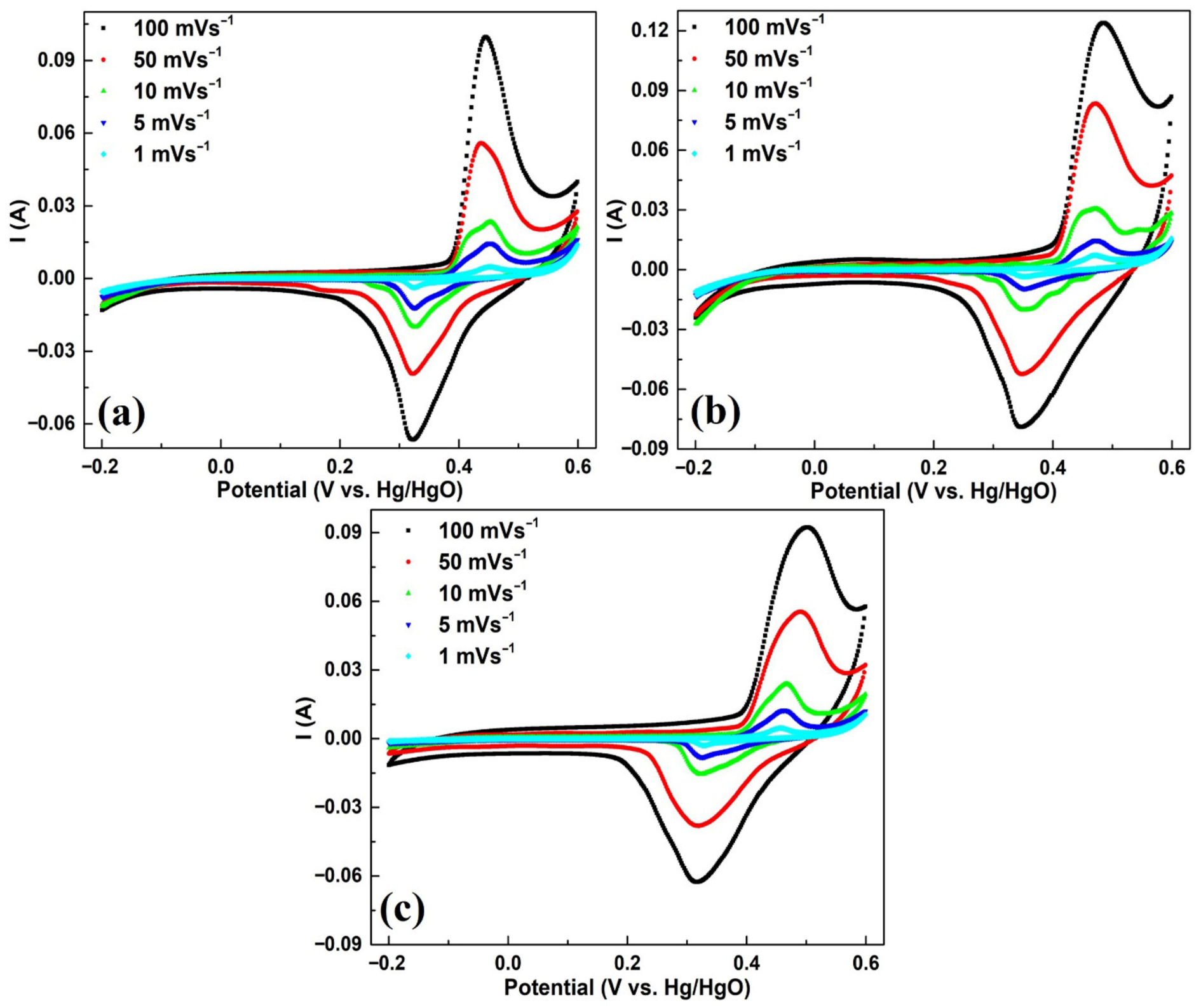
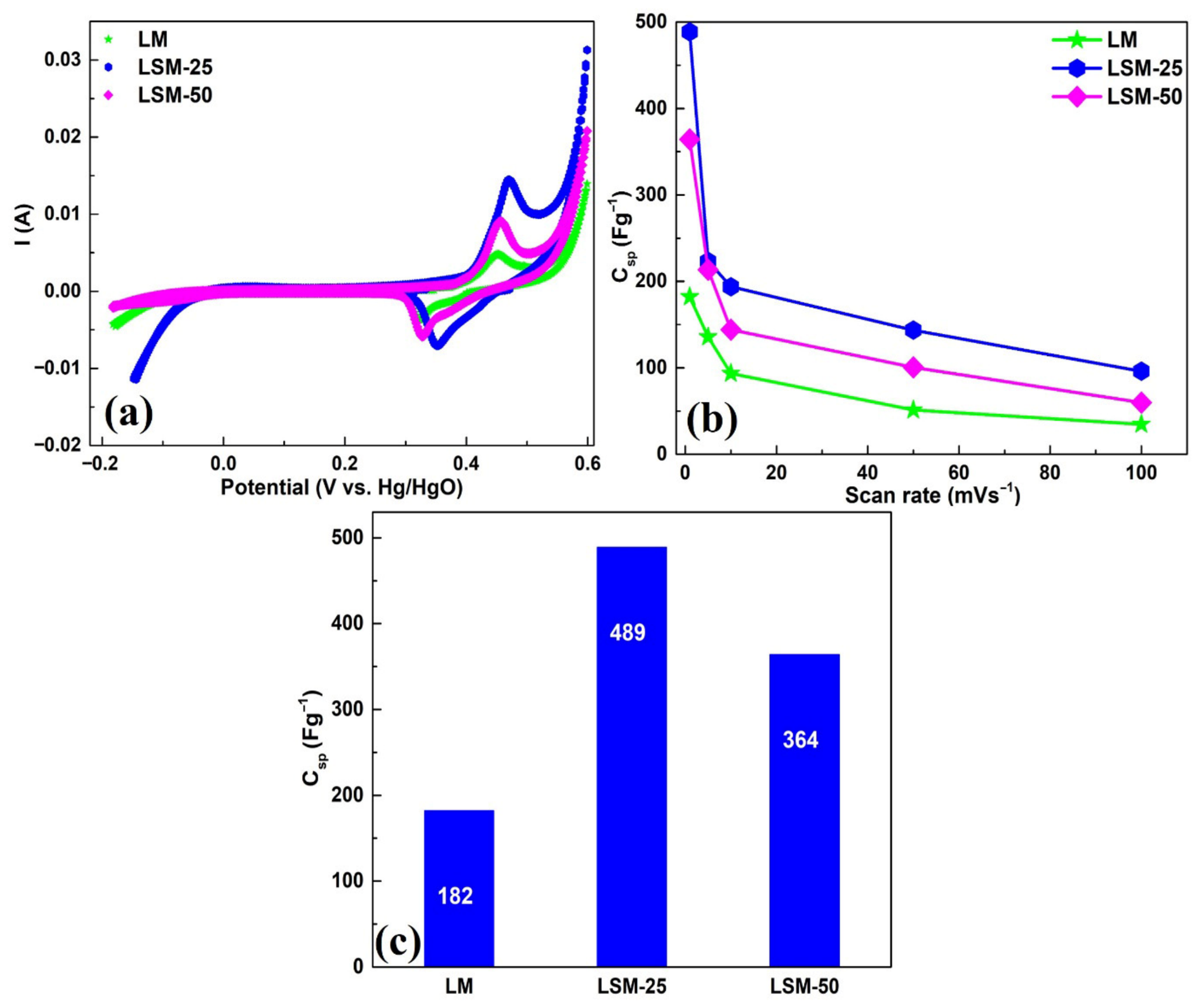
CV curves of different samples at various scan rates are presented in Figure 7a–c. CV at various scan rates showed inverse relation of Csp with scan rate as Csp of LSM-25 decreased from 489 Fg−1 at 1 mVs−1 to 96 Fg−1 at 100 mVs−1. Csp vs. scan rate plot is presented in Figure 8b. Calculated Csp values at different scan rates are presented in Table 3. Comparative CV curves of LM, LSM-25 and LSM-50 at 1 mVs−1 are presented in Figure 8a.
LSM-25 displayed the highest area under the curve at 1 mVs−1 and gave the highest Csp of 489 Fg−1 at 1 mVs−1 among other electrodes. LM and LSM-50 electrodes showed 182 Fg−1 and 364 Fg−1 at 1 mVs−1, respectively. This 160% increase in Csp of LSM-25 compared to the LM electrode is mainly attributed to Sr doping. Sr substitution in LM was selected for two primary reasons. First, introducing divalent cations at the trivalent ‘A’ site leads to a compensatory change in the valence state of the transition metal at the ‘B’ site, converting Mn3+ to Mn4+ to maintain charge neutrality. This substitution creates Mn4+/Mn3+ redox pairs, which facilitate hole hopping, thereby enhancing p-type electrical conductivity [19,38].
Second, substituting La3+ with Sr2+ increases the tolerance factor and stability of the perovskite structure [27,28]. Sr doping caused distortion in the LM structure because of the higher ionic radius of Sr2+ (~1.44 Å) compared to La3+ (~1.36 Å). To maintain charge neutrality, this aliovalent doping necessitates the formation of oxygen vacancies and increases the B-O-B bond angles (bond angle between B site atoms with oxygen) [39,40], structural shifts that fundamentally alter the crystallization and performance of material. Chemically, these modifications influence nucleation kinetics by introducing lattice strain that restricts grain growth, resulting in the observed variations in crystallite size. Electronically, the increased concentration of oxygen vacancies serves a dual purpose: they act as excessive active sites for ion intercalation and lower the energy barrier for ionic transport [19,35,41]. Collectively, these structural and chemical refinements, complemented by modified crystallite boundaries, drive the enhanced energy storage capacity and electrochemical activity of the LSM-25 electrode.
A further increase in Sr content to 0.5 caused a slight decrease in Csp to 364 Fg−1. This study showed that Sr doping is suitable for energy storage to a specific amount, more addition of Sr can cause further distortion in crystal structure which is not suitable for ion diffusion.
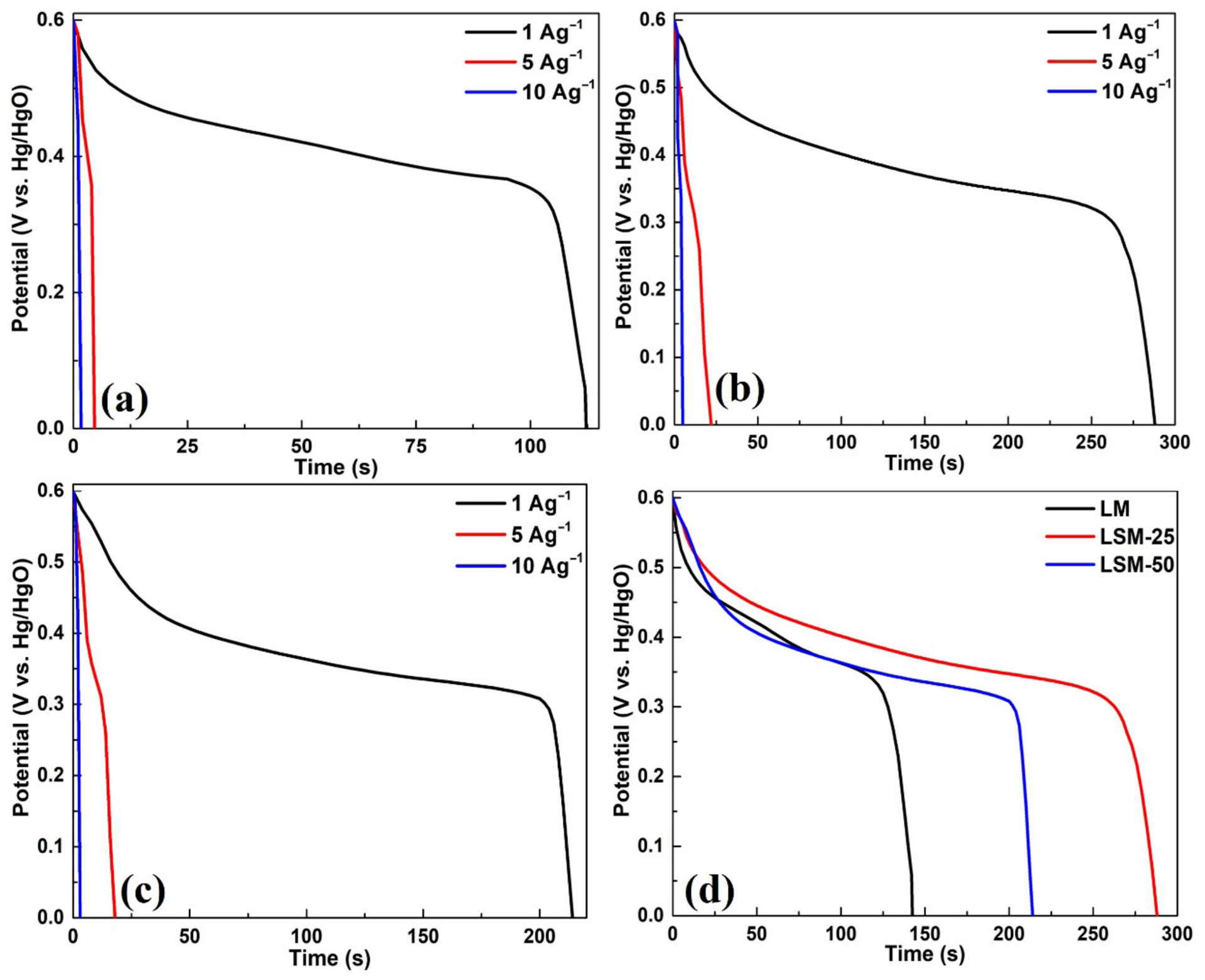
Galvanostatic charge discharge (GCD) is an important technique to evaluate the charge discharge behavior of SC electrodes. GCD of different perovskite electrodes was carried out at current density of 10 Ag−1, 5 Ag−1 and 1 Ag−1 to study the impact of current density on Csp. Current density has inverse relation to Csp. GCD plots of different electrodes at several current densities are presented in Figure 9a–c and comparative GCD plots are presented in Figure 9d. Calculated Csp values are presented in Table 4. All discharge curves showed non-linear behavior which is a characteristic of perovskite type materials. LSM-25 electrode showed a maximum discharge time of 389 s among other electrodes, and a maximum Csp of 486 Fg−1 at 1 Ag−1 current density. LM and LSM-50 electrodes showed discharge time of 146 s and 289 s, respectively, with Csp of 184 Fg−1 and 356 Fg−1, respectively. Calculated energy and power densities at various current densities are summarized in Table 5. LSM-25 electrode showed a maximum energy density of 42.94 Whkg−1 and power density of 0.53 kWkg−1. This 160% increase in energy density compared to LM electrode (16.32 Whkg−1) is mainly because of Sr doping, which produced excessive oxygen vacancies in the LSM-25 structure. It also showed an energy density of 7.40 Whkg−1 and a power density of 5.33 kWkg−1 at a high current density of 10 Ag−1.
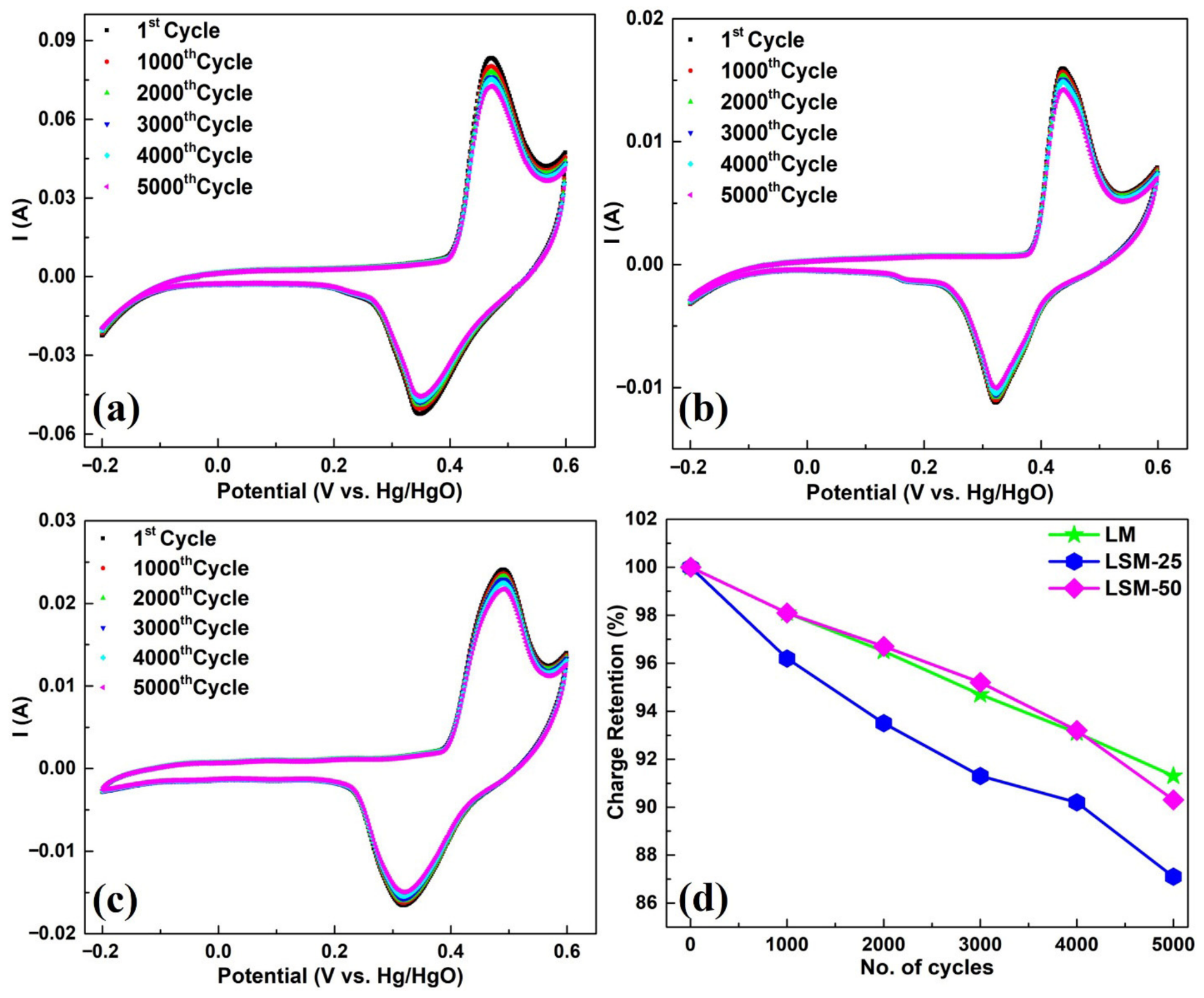
Cyclic stability is an important parameter to study the stability of electrodes for a larger number of cycles. Cyclic stability and charge retention was studied by performing 5000 CV cycles at 50 mVs−1. CV curves after different no. of cycles and charge retention of different electrodes are presented in Figure 10a–d. Percentage charge retention of different electrodes is presented in Table 6. CV curves of all electrodes after different no. of cycles are identical which showed good cyclic stability and identical CV curves. Charge retention curves (Figure 10d) showed that LSM-25 electrodes possessed reasonable charge retention of 87.8% after 5000 cycles. LM and LSM-50 electrodes also showed charge retention of 91.3% and 90.2%, respectively. All electrodes possessed more than 85% charge retention which is considered suitable for commercial applications.
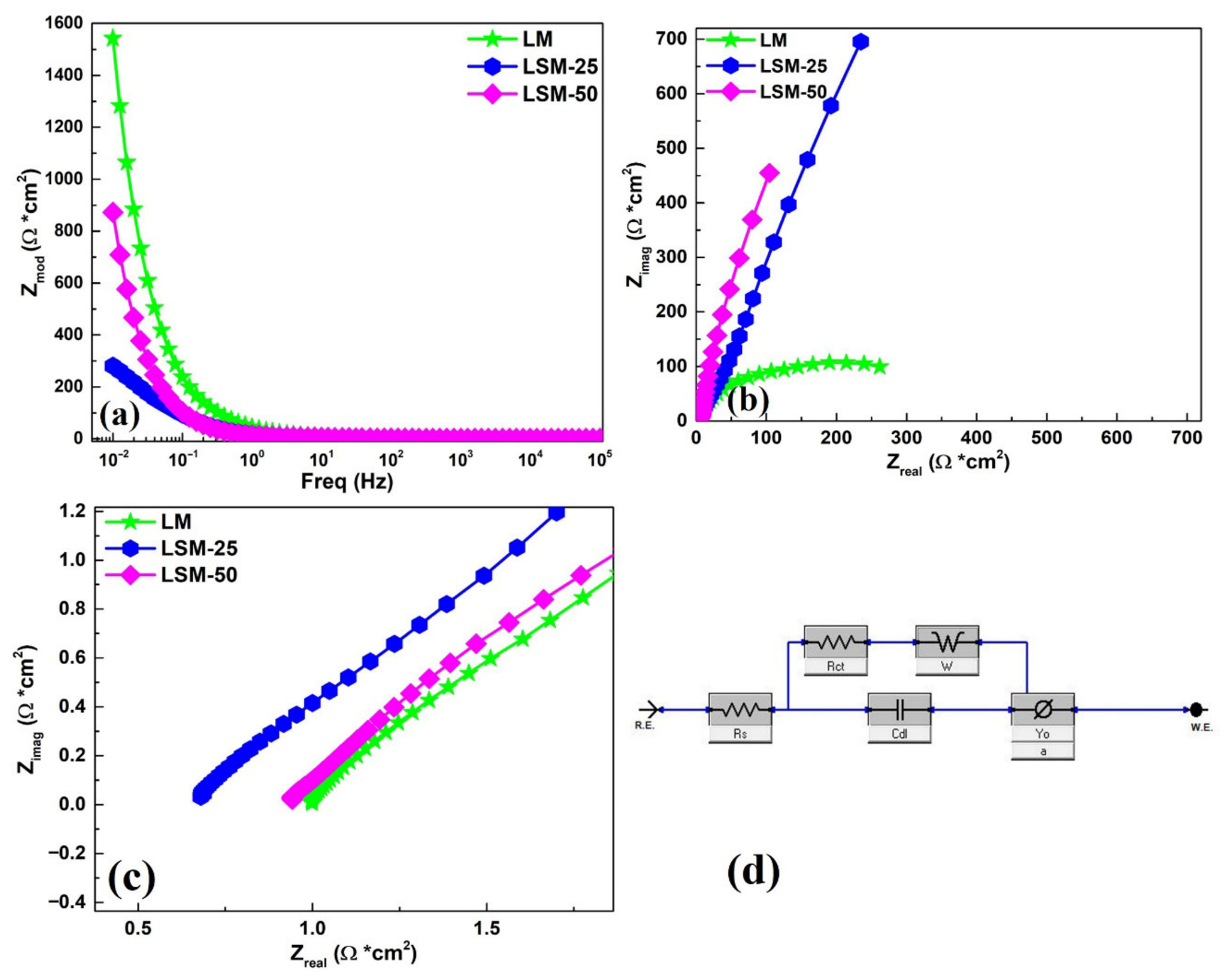
Bode and Nyquist plots along the electrical equivalent circuit (EEC) model are presented in Figure 11a–c. Bode plots of various electrodes showed that LSM-25 exhibited lowest impedance at a lower frequency range which indicated good electrode–electrolyte interaction of the LSM-25 electrode among other electrodes. EIS values calculated by EEC model fitting are presented in Table 7. EIS values suggested that LSM-25 electrode showed lower Rs values and Rct values compared to LM and LSM-50. LSM-25 showed lowest Rct (1.52 Ω*cm2) which confirmed that LSM-25 electrode favors ion mobility and resulted in higher energy storage performance. Rs value of LSM-25 electrode is also low (0.68 Ω*cm2) with higher double layer capacitance (Cdl) value of 169.30 F. A critical part of the energy storage mechanism is the Warburg impedance (W), which represents how easily ions can diffuse through the electrode material. LSM-25 exhibited a significantly lower Warburg value (4.72 Ω*cm2) compared to the LM (19.23 Ω*cm2) and LSM-50 (11.25 Ω*cm2) samples. This lower value confirms that ions move much more freely within the LSM-25 structure. By reducing the resistance to ion mobility during charging and discharging, the electrode can access deeper storage sites more quickly. This enhanced diffusion-based storage is what ultimately leads to the higher energy capacity and better overall performance of the LSM-25 electrode.

3.5. Charge Storage Mechanism

Charge storage mechanism of perovskite is mainly pseudocapacitive due to availability of excessive cations. Perovskites store charge primarily through an anion-intercalation mechanism, initially proposed by Mefford et al. [38]. In the case of Sr-doped perovskites, the incorporation of Sr leads to the formation of additional oxygen vacancies that must be filled during the charge storage process. To achieve this, OH ions from the electrolyte adsorb onto the surface of the perovskite. These ions donate a proton to a neighboring lattice oxygen, resulting in the formation of peroxide-like species (O) through oxidation [38]. The generated O species then intercalate into the oxygen vacancies, promoting the oxidation of the B-site manganese ions. Meanwhile, the released proton interacts with another hydroxide ion in the electrolyte, forming a water molecule. The potential redox reactions occurring during the charge storage process in LSM-25 are represented by Equations (1) and (2) [38,42]:
L a 0.75 S r 0.25 M n 2 δ 2 + ,   M n 1 2 δ 3 + O 3 δ + 2 δ O H   L a 0.75 S r 0.25 M n 3 + + 2 δ e + δ H 2 O            
L a 0.75 S r 0.25 M n 0.5 3 + + 2 δ O H L a M n 2 δ 4 + ; M n 1 2 δ 3 + O 3 + δ + 2 δ e + H 2 O

3.6. Charge Storage Contribution

The CV data was further analyzed to identify and quantify the charge storage mechanisms in the examined electrodes. All electrodes displayed distinct redox peaks in their CV profiles, particularly at lower scan rates, indicating that the primary charge storage mechanism is pseudocapacitive and involves reversible Faradaic redox reactions (diffusion controlled). Additionally, there is evidence of some contribution from non-Faradaic processes (surface controlled/capacitive), although the redox peaks strongly highlight Faradaic-based reactions [43]. To precisely quantify the contributions of Faradaic and non-Faradaic processes, the power law, which relates current (i) to scan rate (v) as described in Equation (3), is considered the most suitable approach.
i = a v b
In the log i/log v plot, the parameters a and b represent the intercept and slope, respectively. The b value, typically ranging between 0 and 1, is used to identify the charge storage mechanism. A b value near 1 indicates a non-Faradaic charge storage process, whereas a b value closer to 0.5 suggests a Faradaic charge storage mechanism [44,45]. The contribution to charge storage can be more accurately determined using Equation (4) [46,47].
Q T = Q C + Q D
where QT, QC, and QD are total charge stored, charge stored due to surface-controlled and diffusion-controlled processes, respectively.
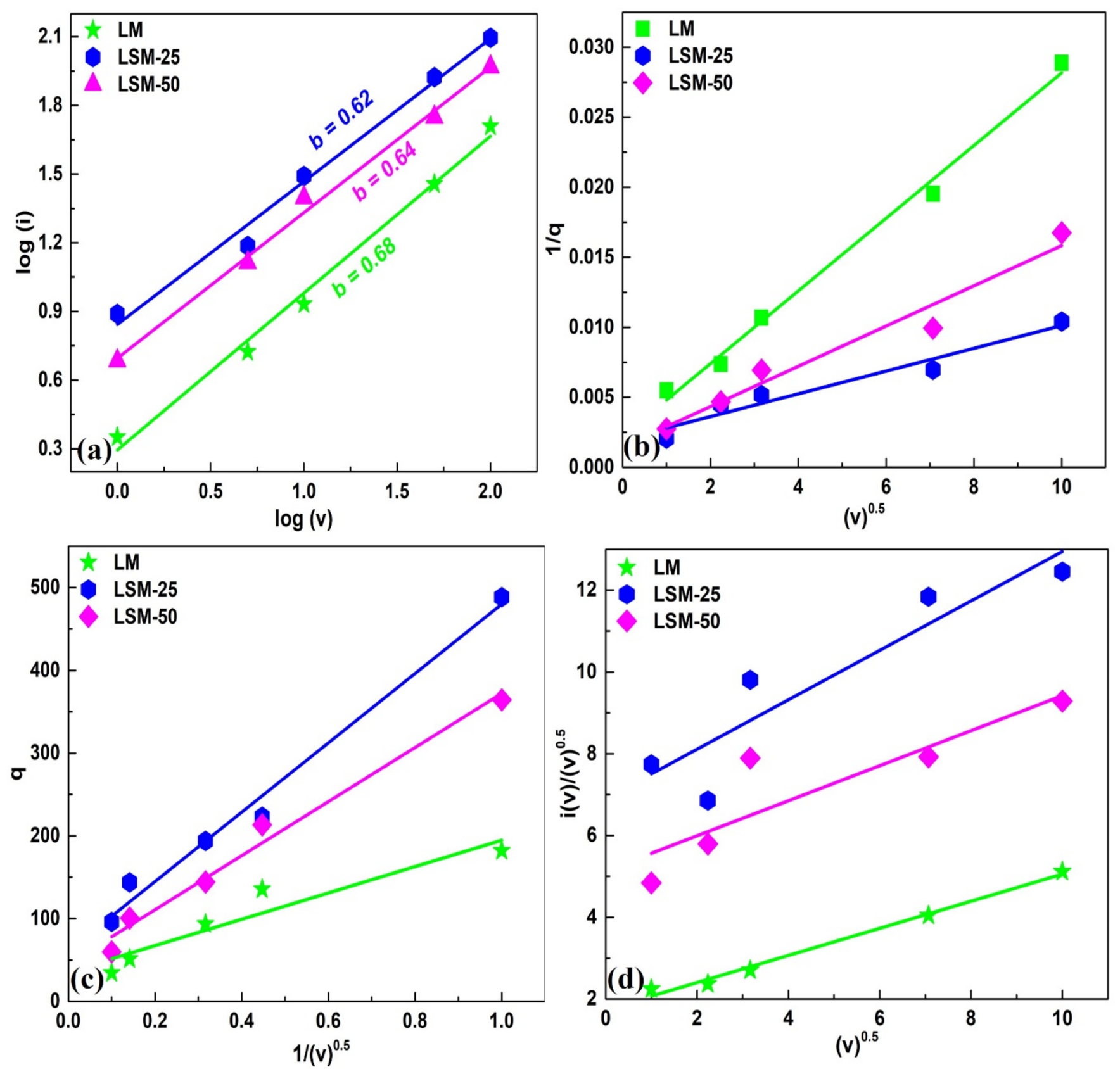
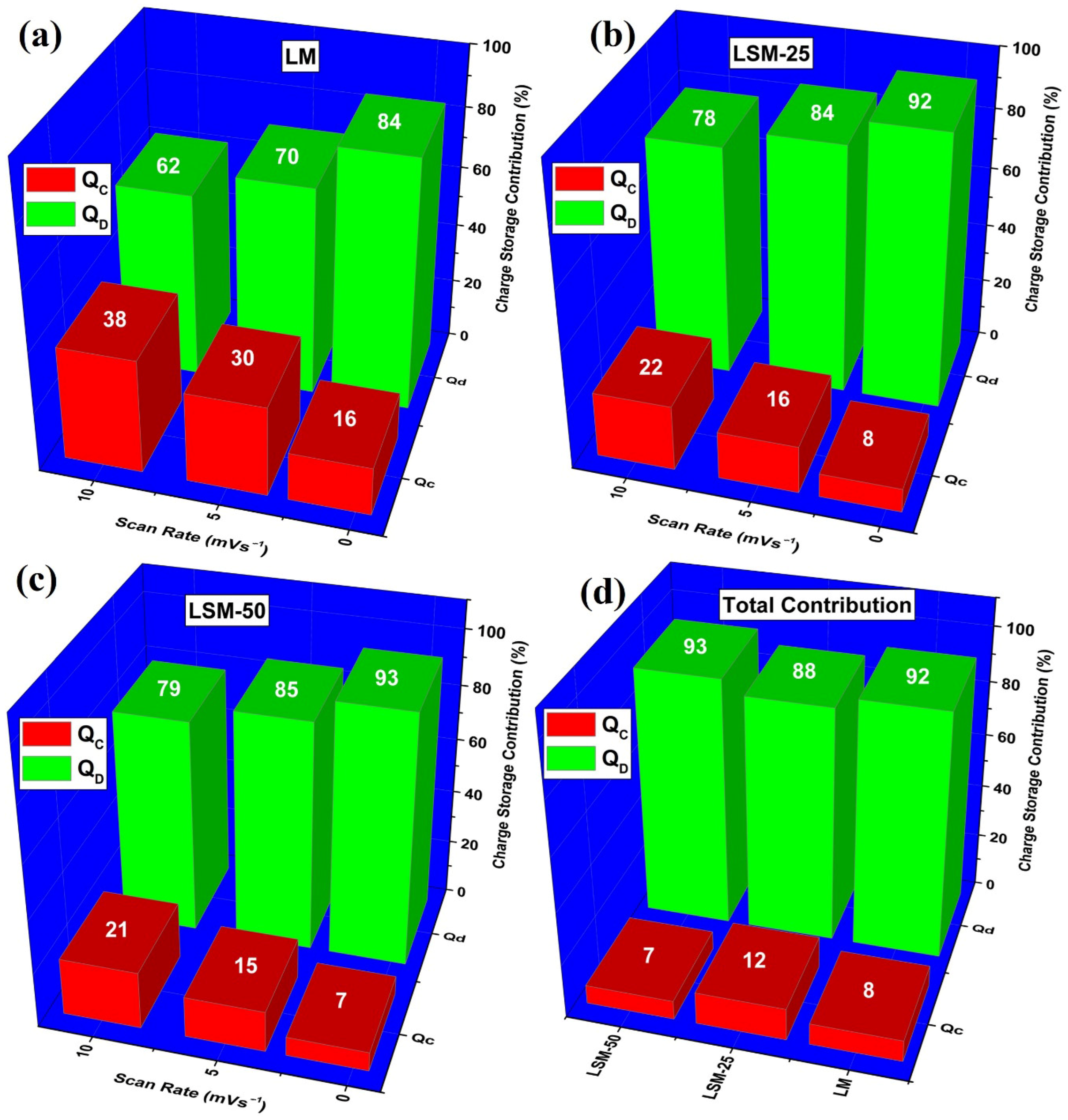
Figure 12a illustrates the log (v) and log (i) plots along with the corresponding b values for LM series samples. The b value for LM, LSM-25 and LSM-50 are 0.68, 0.62 and 0.64, respectively. B values of all samples are closer to 0.5 which indicates predominant Faradaic (diffusion controlled) charge storage mechanism with a slight contribution of non-Faradaic mechanism (capacitive). Further evaluation of percentage charge storage contribution was analyzed by Equation (4) and the Ardizzone method—respective curves are presented in Figure 12b–d. Table 8 presents the calculated charge storage contribution values for the LM series electrodes, while Figure 11d shows the total percentage charge storage contributions for all electrodes. LM, LSM-25 and LSM-50 electrodes showed 93%, 88% and 92% of diffusive (Faradaic) charge storage mechanism which indicates that the predominant charge storage mechanism is diffusive in nature which enables ions to reach inside the surface of the electrode and results in higher energy storage capacity.
On the other hand, Figure 13a–c present percentage charge storage contribution for LM, LSM-25 and LSM-50 electrodes at different scan rates. Figure 13b depicts the charge storage contribution of the LSM-25 electrode at different scan rates, showing an increase in capacitive (non-Faradaic) contribution from 8% at 1 mVs−1 to 22% at 10 mVs−1 as the scan rate increases. It showed that at lower scan rates contribution of diffusive (Faradaic) charge storage mechanism is higher which is responsible for the high charge storage capacity of the LSM-25 at a lower scan rate.

4. Conclusions

This study demonstrates that Sr substitution in La1−xSrxMnO3 perovskites significantly enhances their electrochemical performance, making them promising electrode materials for SC applications. Among the samples, LSM-25 exhibited the highest Csp of 483 Fg−1, energy density of 42.94 Whkg−1, and power density of 0.53 kWkg−1 at 1 Ag−1 current density, along with excellent capacitance retention (94.2%) after 5000 cycles. Electrochemical analysis revealed strong electrode–electrolyte compatibility for LSM-25, characterized by low solution and charge transfer resistances, confirming its potential as an effective electrode material. The charge storage was primarily diffusive, with LSM-25 showing an 88% diffusive contribution, indicating that charge storage occurred through reversible Faradaic reactions. Overall, these results suggest that A-site substitution with Sr effectively improves the energy storage properties of LaMnO3-based perovskites, highlighting their potential as high-performance SC electrode materials.

Supplementary Materials

The following supporting information can be downloaded at: https://www.mdpi.com/article/10.3390/ceramics9050044/s1.

Author Contributions

Z.U.R., M.F.M.: Writing—Original Draft, Conceptualization, Data curation, Software. M.A.R.: Writing—Review and Editing, Supervision, Validation. S.M.Z.M., U.A.: Data Curation, Formal Analysis, Writing—Review and Editing, S.K., M.F.K.: Funding Acquisition, Project Administration, Writing—Review and Editing, R.K., M.J.I., S.A., W.A.; Methodology, Formal Analysis, Writing—Review and Editing, Funding Acquisition. All authors have read and agreed to the published version of the manuscript.

Funding

S. Ali acknowledges the Crafoord Foundation (Grant No. 20220692) and Advanced Materials; LNU (87202002).

Data Availability Statement

The data can be provided on special request to the corresponding author.

Conflicts of Interest

There are no known conflicts of interests to disclose.

References

  1. Abubakr, M.; Elahi, E.; Rehman, S.; Dahshan, A.; Khan, M.A.; Rabeel, M.; Abbas, Z.; Maqsood, M.F.; Rehman, M.A.; Jonghwa, E. Innovations in self-powered nano-photonics of emerging and flexible two-dimensional materials. Mater. Today Phys. 2023, 39, 101285. [Google Scholar] [CrossRef] [Scilit]
  2. Fong, K.C.; Armand, S.; Basnet, R.; Yan, D.; Ernst, M.; De Carvalho, G.B.L.; Varghese, A.R.; Maqsood, M.F.; Kremer, F.; Wang, J. Highly Transparent Nanoscale Tunnel Oxide Polysilicon Passivated Contacts: Optimisation, Analysis, and Impact Study. Solar RRL 2025, 9, 2500246. [Google Scholar] [CrossRef] [Scilit]
  3. Lei, N.; Ma, P.; Yu, B.; Li, S.; Dai, J.; Jiang, G. Anion-intercalated supercapacitor electrode based on perovskite-type SrB0.875Nb0. 125O3 (B = Mn, Co). Chem. Eng. J. 2021, 421, 127790. [Google Scholar] [CrossRef] [Scilit]
  4. Maqsood, M.F.; Boltaev, G.S.; El-Kadri, O.M.; El-Kaderi, H.M.; Alnaser, A.S. Boosting the charge storage capability of Ni foams via femtosecond laser structuring in different solvents. Mater. Chem. Phys. 2025, 333, 130306. [Google Scholar] [CrossRef] [Scilit]
  5. Ren, H.; Zhang, L.; Zhang, J.; Miao, T.; Yuan, R.; Chen, W.; Wang, Z.; Yang, J.; Zhao, B. Na+ pre-intercalated Na0.11MnO2 on three-dimensional graphene as cathode for aqueous zinc ion hybrid supercapacitor with high energy density. Carbon 2022, 198, 46–56. [Google Scholar] [CrossRef] [Scilit]
  6. Maqsood, M.F.; Latif, U.; Sheikh, Z.A.; Abubakr, M.; Rehman, S.; Khan, K.; Khan, M.A.; Kim, H.; Ouladsmane, M.; Rehman, M.A. A comprehensive study of Bi2Sr2Co2Oy misfit layered oxide as a supercapacitor electrode material. Inorg. Chem. Commun. 2023, 158, 111487. [Google Scholar] [CrossRef] [Scilit]
  7. Huang, Y.; Luo, C.; Zhang, Q.; Zhang, H.; Wang, M.-S. Rational design of three-dimensional branched NiCo-P@ CoNiMo-P core/shell nanowire heterostructures for high-performance hybrid supercapacitor. J. Energy Chem. 2021, 61, 489–496. [Google Scholar] [CrossRef] [Scilit]
  8. Latif, U.; Rehman, Z.U.; Maqsood, M.F.; Raza, M.A.; Ali, S.; Iqbal, M.J.; Mehdi, S.M.Z.; Lee, N. In situ growth of nickel ammonium phosphate ribbons on nickel foam for supercapacitor applications. J. Energy Storage 2023, 73, 109024. [Google Scholar] [CrossRef] [Scilit]
  9. Mahieddine, A.; Adnane-Amara, L.; Gabouze, N. The effect of alkaline electrolytes and silver nanoparticles on the electrochemical performance of the dilithium nickel bis (tungstate) as electrode materials for high-performance asymmetric supercapacitor. J. Alloys Compd. 2021, 882, 160754. [Google Scholar] [CrossRef] [Scilit]
  10. Latif, U.; Raza, M.A.; Rehman, Z.U.; Iqbal, J.; Lee, N.; Mehdi, S.M.Z.; Maqsood, M.F.; Hussain, S. Binder free heteroatom-doped graphene oxide as high energy density electrodes for supercapacitor applications. Int. J. Energy Res. 2022, 46, 9643–9666. [Google Scholar] [CrossRef] [Scilit]
  11. Chen, P.-C.; Shen, G.; Shi, Y.; Chen, H.; Zhou, C. Preparation and characterization of flexible asymmetric supercapacitors based on transition-metal-oxide nanowire/single-walled carbon nanotube hybrid thin-film electrodes. ACS Nano 2010, 4, 4403–4411. [Google Scholar] [CrossRef] [Scilit] [PubMed]
  12. Snook, G.A.; Kao, P.; Best, A.S. Conducting-polymer-based supercapacitor devices and electrodes. J. Power Sources 2011, 196, 1–12. [Google Scholar] [CrossRef] [Scilit]
  13. Rabani, I.; Tran, N.T.; Maqsood, M.F.; Kaseem, M.; Dastgeer, G.; Truong, H.B. Visible light-driven photocatalytic degradation of rhodamine B and 5-fluorouracil using ZIF-8/GO: Unveiling mechanisms. RSC Adv. 2025, 15, 30217–30230. [Google Scholar] [CrossRef] [Scilit]
  14. Rabani, I.; Hussain, T.; Kumar, A.; Dastgeer, G.; Maqsood, F.; De Wael, K.; Seo, Y.-S. Morphology-controlled Fe3O4@ CNF nanocomposites for sustainable paper-based energy storage with recyclability. J. Mater. Chem. A 2026, 14, 1120–1135. [Google Scholar] [CrossRef] [Scilit]
  15. Jiang, H.; Ma, J.; Li, C. Mesoporous Carbon Incorporated Metal Oxide Nanomaterials as Supercapacitor Electrodes; Wiley Online Library: Hoboken, NJ, USA, 2012. [Google Scholar]
  16. Milewska, K.; Ali, S.; Sundberg, P.; Wolff, S.; Rehman, Z.U.; Raza, M.A.; Tariq, M.H.; Wójcik, N.A. The role of CeO2 doping in soda–lime silicate glass: Structural and thermal properties. J. Mater. Sci. 2025, 60, 18774–18788. [Google Scholar] [CrossRef] [Scilit]
  17. Kareem, A.; Maqsood, M.F.; Sofi, F.A.; Al-Sayah, M.H.; El-Kadri, O.M. Enhanced electrochemical performance of carbonized porous organic polymers towards supercapacitor application. Discov. Appl. Sci. 2026, 8, 21. [Google Scholar] [CrossRef] [Scilit]
  18. Nagarajarao, S.H.; Nandagudi, A.; Viswanatha, R.; Basavaraja, B.M.; Santosh, M.S.; Praveen, B.M.; Pandith, A. Recent developments in supercapacitor electrodes: A mini review. ChemEngineering 2022, 6, 5. [Google Scholar] [CrossRef] [Scilit]
  19. Rehman, Z.U.; Lemieszek, B.; Cempura, G.; Mehdi, S.M.Z.; Alluhaibi, L.; Lee, N.; Jasinski, P.; Molin, S. Solution combustion synthesis and electrospinning of La0.7Sr0.3Co0.5Mn0.5O3: Impact of morphology on electrochemical energy storage performance. J. Energy Storage 2026, 151, 120645. [Google Scholar] [CrossRef] [Scilit]
  20. Mo, H.; Nan, H.; Lang, X.; Liu, S.; Qiao, L.; Hu, X.; Tian, H. Influence of calcium doping on performance of LaMnO3 supercapacitors. Ceram. Int. 2018, 44, 9733–9741. [Google Scholar] [CrossRef] [Scilit]
  21. Maqsood, M.F.; Latif, U.; Mehdi, S.M.Z.; Rehman, Z.U.; Raza, M.A.; Ghafoor, F.; Abubakr, M.; Lee, N.; Khan, M.F. Effect of “Mn” substitution at B-site, on the crystal structure and energy storage performance of the La0.75Sr0.25CoO3 perovskite. J. Ind. Eng. Chem. 2024, 139, 587–600. [Google Scholar] [CrossRef] [Scilit]
  22. Kumar, S.; Choi, S.R.; Stetsenko, M.; Yoo, S.; Taunk, M.; Park, J.-Y.; Mehdi, S.M.Z.; Seo, Y. Heteroatom (N, Co)-doped MXene with tunable doping for enhanced hydrogen evolution reaction and energy storage. Nanoscale 2026, 18, 2277–2289. [Google Scholar] [CrossRef] [Scilit] [PubMed]
  23. Zhang, B.; Yu, C.; Li, Z. Enhancing the electrochemical properties of LaCoO3 by Sr-doping, rGO-compounding with rational design for energy storage device. Nanoscale Res. Lett. 2020, 15, 184. [Google Scholar] [CrossRef] [Scilit] [PubMed]
  24. Cao, Y.; Liang, J.; Li, X.; Yue, L.; Liu, Q.; Lu, S.; Asiri, A.M.; Hu, J.; Luo, Y.; Sun, X. Recent advances in perovskite oxides as electrode materials for supercapacitors. Chem. Commun. 2021, 57, 2343–2355. [Google Scholar] [CrossRef] [Scilit]
  25. Guo, G.; Ouyang, K.; Yu, J.; Liu, Y.; Feng, S.; Wei, M. Facile synthesis of LaCoO3 with a high oxygen vacancy concentration by the plasma etching technique for high-performance oxygen ion intercalation pseudocapacitors. ACS Appl. Energy Mater. 2019, 3, 300–308. [Google Scholar] [CrossRef] [Scilit]
  26. Rehman, Z.U.; Raza, M.A.; Tariq, A.; Chishti, U.N.; Maqsood, M.F.; Lee, N.; Awais, M.H.; Mehdi, S.M.Z.; Inam, A. La0.75Sr0.25Cr0.5Mn0.5O3 perovskite developed for supercapacitor applications. J. Energy Storage 2020, 32, 101951. [Google Scholar] [CrossRef] [Scilit]
  27. Richter, J.; Holtappels, P.; Graule, T.; Nakamura, T.; Gauckler, L.J. Materials design for perovskite SOFC cathodes. Monatsh. Chem.-Chem. Mon. 2009, 140, 985–999. [Google Scholar] [CrossRef] [Scilit]
  28. Jiang, S. A comparison of O2 reduction reactions on porous (La, Sr) MnO3 and (La, Sr)(Co, Fe) O3 electrodes. Solid State Ion. 2002, 146, 1–22. [Google Scholar] [CrossRef] [Scilit]
  29. Cao, Y.; Lin, B.; Sun, Y.; Yang, H.; Zhang, X. Symmetric/asymmetric supercapacitor based on the perovskite-type lanthanum cobaltate nanofibers with Sr-SUBSTITUTION. Electrochim. Acta 2015, 178, 398–406. [Google Scholar] [CrossRef] [Scilit]
  30. Lang, X.; Sun, X.; Liu, Z.; Nan, H.; Li, C.; Hu, X.; Tian, H. Ag nanoparticles decorated perovskite La0.8Sr0.15MnO3 as electrode materials for supercapacitors. Mater. Lett. 2019, 243, 34–37. [Google Scholar] [CrossRef] [Scilit]
  31. Hu, Q.; Yue, B.; Shao, H.; Yang, F.; Wang, J.; Wang, Y.; Liu, J. Facile syntheses of perovskite type LaMO3 (M = Fe, Co, Ni) nanofibers for high performance supercapacitor electrodes and lithium-ion battery anodes. J. Alloys Compd. 2021, 852, 157002. [Google Scholar] [CrossRef] [Scilit]
  32. Mondal, R.; Mishra, N.K.; Singh, M.; Gupta, A.; Singh, P. Perovskite La1−xKxCoO3−δ (0 ≤ x ≤ 0.5): A novel bifunctional OER/ORR electrocatalyst and supercapacitive charge storage electrode in a neutral Na2SO4 electrolyte. Phys. Chem. Chem. Phys. 2022, 24, 28584–28598. [Google Scholar] [CrossRef] [Scilit] [PubMed]
  33. Zhang, B.; Liu, P.; Li, Z.; Song, X. Synthesis of two-dimensional Sr-doped LaNiO3 nanosheets with improved electrochemical performance for energy storage. Nanomaterials 2021, 11, 155. [Google Scholar] [CrossRef] [Scilit]
  34. Hadji, F.; Omari, M.; Mebarki, M.; Gabouze, N.; Layadi, A. Zinc doping effect on the structural and electrochemical properties of LaCoO3 perovskite as a material for hybrid supercapacitor electrodes. J. Alloys Compd. 2023, 942, 169047. [Google Scholar] [CrossRef] [Scilit]
  35. Latif, U.; Maqsood, M.F.; Mehdi, S.M.Z.; Ghafoor, F.; Azhar, U.; Abbas, S.H.; Khan, M.F. Effect of lithium doping on the electrochemical properties of Bi2Sr2Co2Oy misfit-layered oxides for supercapacitor applications. Electrochim. Acta 2025, 526, 146171. [Google Scholar] [CrossRef] [Scilit]
  36. Fedorovskiy, A.E.; Drigo, N.A.; Nazeeruddin, M.K. The role of Goldschmidt’s tolerance factor in the formation of A2BX6 double halide perovskites and its optimal range. Small Methods 2020, 4, 1900426. [Google Scholar] [CrossRef] [Scilit]
  37. Liang, M.; Lin, W.; Lan, Z.; Meng, J.; Zhao, Q.; Zou, X.; Castelli, I.E.; Pullerits, T.; Canton, S.E.; Zheng, K. Electronic structure and trap states of two-dimensional ruddlesden–popper perovskites with the relaxed Goldschmidt tolerance factor. ACS Appl. Electron. Mater. 2020, 2, 1402–1412. [Google Scholar] [CrossRef] [Scilit]
  38. Mefford, J.T.; Hardin, W.G.; Dai, S.; Johnston, K.P.; Stevenson, K.J. Anion charge storage through oxygen intercalation in LaMnO3 perovskite pseudocapacitor electrodes. Nat. Mater. 2014, 13, 726. [Google Scholar] [CrossRef] [Scilit]
  39. Cao, Y.; Lin, B.; Sun, Y.; Yang, H.; Zhang, X. Structure, morphology and electrochemical properties of LaxSr1−xCo0.1Mn0.9O3−δ perovskite nanofibers prepared by electrospinning method. J. Alloys Compd. 2015, 624, 31–39. [Google Scholar] [CrossRef] [Scilit]
  40. Rehman, Z.U.; Ostrowska, K.; Jasinski, P.; Molin, S. Tunable electrochemical properties of La0.6Sr0.4CoO3 coatings via controlled layer deposition for high-performance supercapacitors. Emergent Mater. 2026, 9, 22. [Google Scholar] [CrossRef] [Scilit]
  41. Tu, G.; Wang, H.; Tu, B.; Xu, P.; Ren, L.; Huang, Q.; Yang, R.; Wang, W.; Fu, Z. Achieving near-theoretical transmittance in MgAl2O4 ceramic at reduced sintering temperature via solution substitution. J. Eur. Ceram. Soc. 2025, 45, 117382. [Google Scholar] [CrossRef] [Scilit]
  42. Wang, X.; Zhu, Q.; Wang, X.; Zhang, H.; Zhang, J.; Wang, L. Structural and electrochemical properties of La0.85Sr0.15MnO3 powder as an electrode material for supercapacitor. J. Alloys Compd. 2016, 675, 195–200. [Google Scholar] [CrossRef] [Scilit]
  43. Ilyas, M.T.; Fazal, A.; Rehman, Z.U.; Raza, M.A.; Almutairi, B.S.; Iqbal, M.J.; Ali, S. Substantial performance of copper sulfide nanotubes at high current densities for energy storage applications. J. Energy Storage 2024, 85, 111055. [Google Scholar] [CrossRef] [Scilit]
  44. Latif, U.; Raza, M.A.; Rehman, Z.U.; Maqsood, M.F.; Mehdi, S.M.Z.; Ali, S.; Khan, M.F.; Kumar, S. Role of sulfur and phosphorous doping on the electrochemical performance of graphene oxide-based electrodes. Electrochim. Acta 2024, 497, 144581. [Google Scholar] [CrossRef] [Scilit]
  45. Akhtar, M.S.; Wejrzanowski, T.; Komorowska, G.; Choinska, E.; Laskowska, M.; Rehman, Z.U.; Łapiński, M. Microwave-Assisted Synthesis of Novel Ni3S2/Ce2O2S 2D Hexagonal Nanoflakes for High-Performance Asymmetric Supercapacitors. Nanotechnol. Sci. Appl. 2025, 18, 643–659. [Google Scholar] [CrossRef] [Scilit] [PubMed]
  46. Ardizzone, S.; Fregonara, G.; Trasatti, S. “Inner” and “outer” active surface of RuO2 electrodes. Electrochim. Acta 1990, 35, 263–267. [Google Scholar] [CrossRef] [Scilit]
  47. Akhtar, M.S.; Rehman, Z.U.; Chromiński, W.; Komorowska, G.; Wejrzanowski, T. Binder-free electrode based on Zn-doped Ni3S2 vertically grown 2-dimensional nanostructures on Ni foam with boosted electrochemical performance for energy storage applications. Electrochem. Commun. 2025, 180, 108058. [Google Scholar] [CrossRef] [Scilit]
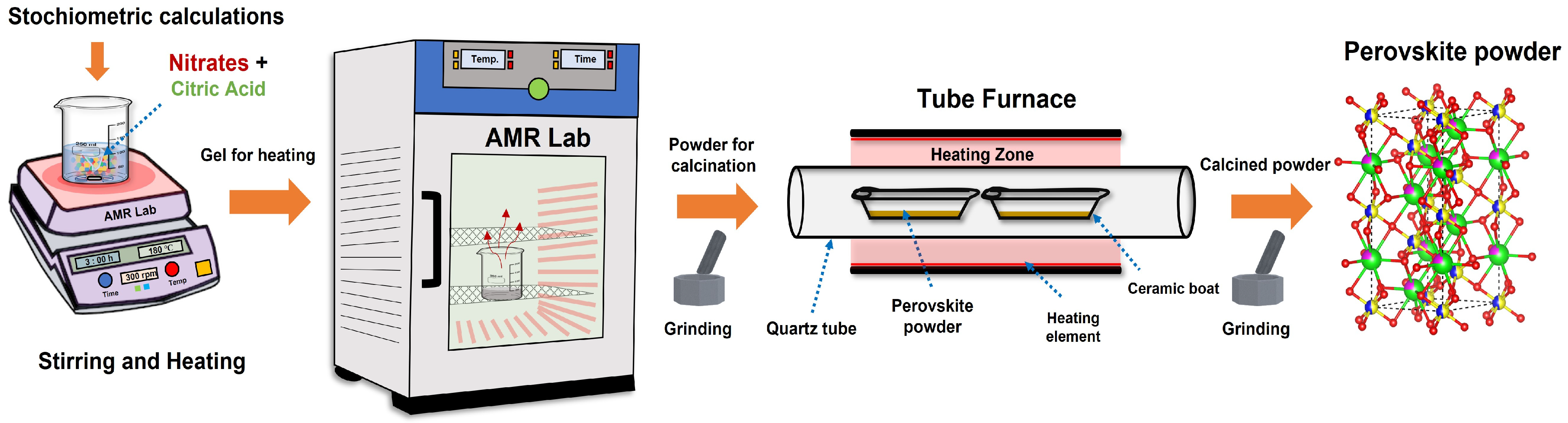
Figure 1. Schematic of the perovskite powder synthesis.
Ceramics 09 00044 g001
Figure 2. Schematic of the perovskite-coated Ni foam preparation and their electrochemical testing.
Ceramics 09 00044 g002
Figure 3. (a) XRD patterns of prepared perovskites, (b) magnified spectra of (110) and (104) planes, (c) improved Scherrer equation plot, (d) W-H plot and (e) Size-strain plot.
Ceramics 09 00044 g003
Figure 4. SEM of (ac) LM, (df) LSM-25 and (gi) LSM-50.
Ceramics 09 00044 g004
Figure 5. EDX and element mapping of (a) LM, (b) LSM-25 and (c) LSM-50.
Ceramics 09 00044 g005
Figure 6. TEM of (ac) LM, (df) LSM-25, and (gi) LSM-50.
Ceramics 09 00044 g006
Figure 7. CV of (a) LM, (b) LSM-25 and (c) LSM-50 at various scan rates.
Ceramics 09 00044 g007
Figure 8. (a) CV curves at 1 mVs−1, (b) Csp vs. scan rates and (c) comparison of Csp at 1 mVs−1 of LM series electrodes.
Ceramics 09 00044 g008
Figure 9. Discharge curves of (a) LM, (b) LSM-25, (c) LSM-50 at different current densities and (d) comparative GCD curves of LM series electrodes.
Ceramics 09 00044 g009
Figure 10. Cyclic stability of (a) LM, (b) LSM-25, (c) LSM-50 at 50 mVs−1 and (d) charge retention of LM series electrodes after 5000 cycles.
Ceramics 09 00044 g010
Figure 11. (a) Bode, (b) Nyquist plots, (c) magnified Nyquist plots of LM series electrodes and (d) EEC model.
Ceramics 09 00044 g011
Figure 12. (a) b values of LM series electrodes, (bd) Ardizzone method plots for charge storage contribution calculation.
Ceramics 09 00044 g012
Figure 13. Percentage charge storage contribution graphs of (a) LM, (b) LSM-25, (c) LSM-50 at different scan rates and (d) total charge storage contribution of LM series electrodes.
Ceramics 09 00044 g013
Table 1. The calculated values of D, δ and ε through different equations.
SampleScherrer FormulaImproved ScherrerWilliamson-HallSize-Strain
D
nm
δ
10−3 nm−2
D
nm
δ
10−3 nm−2
D
nm
δ
10−3 nm−2
ε
10−3
D
nm
δ
10−3 nm−2
ε
10−3
LM8.3275.66613.5905.41415.9493.9311.750146.4440.0460.708
LSM-2510.9595.17414.1584.98814.3384.8640.344148.8090.0450.596
LSM-508.9174.74215.8523.97922.2792.0152.660181.9130.0301.457
Table 2. Particle size of different perovskites.
Sample NameParticle Size (nm)Standard Deviation (nm)
LM183.4038.21
LSM-2546.1822.19
LSM-50177.6942.33
Table 3. Csp calculated from CV of LM series electrodes at various scan rates.
Sample Name1 mVs−1
(Fg−1)
5 mVs−1 (Fg−1)10 mVs−1 (Fg−1)50 mVs−1 (Fg−1)100 mVs−1 (Fg−1)
LM182136945135
LSM-2548922319414496
LSM-5036421314410160
Table 4. Csp calculated from discharge curves of LM series electrodes at different current densities.
Sample Name1 Ag−1 (Fg−1)5 Ag−1 (Fg−1)10 Ag−1 (Fg−1)
LM1835833
LSM-2548318383
LSM-5035814250
Table 5. Energy and power densities of LM series electrodes at current densities.
ElectrodesEnergy Density (Whkg−1)Power Density (kWkg−1)
1 A g−15 A g−110
A g−1
1 A g−15 A g−110
A g−1
LM16.325.182.960.532.665.33
LSM-2542.9416.297.400.532.665.33
LSM-5031.8312.584.440.532.665.33
Table 6. Percentage charge retention of LM series electrodes at 50 mV s−1 after 5000 cycles.
ElectrodeCsp (F g−1) at 50 mV s−1Charge
Retention (%)
1st Cycle5000th Cycle
LM51.0046.5691.3
LSM-25144.00126.4387.8
LSM-50146.00131.6990.2
Table 7. EIS values of La-based perovskite with Sr doped electrodes calculated from Nyquist plots after EEC model fitting.
Components in Equivalent CircuitSample
LMLSM-25LSM-50
Rs (Ω*cm2)1.020.680.94
Rct (Ω*cm2)3.701.522.78
W (Ω*cm2)19.234.7211.25
Goodness of Fit4.95 × 10−32.16 × 10−32.47 × 10−3
Table 8. Charge storage contribution calculated from CV data of LM series electrodes.
SampleQT (Fg−1)Qc (Fg−1)Qd (Fg−1)
LM45336417
LSM-2568045635
LSM-5050061439
Disclaimer/Publisher’s Note: The statements, opinions and data contained in all publications are solely those of the individual author(s) and contributor(s) and not of MDPI and/or the editor(s). MDPI and/or the editor(s) disclaim responsibility for any injury to people or property resulting from any ideas, methods, instructions or products referred to in the content.