Artificial Neural Network Applications in Supply Chain Management: A Literature Review and Classification


Abstract
1. Introduction
1.1. Supply Chain Management (SCM) and Artificial Intelligence (AI)
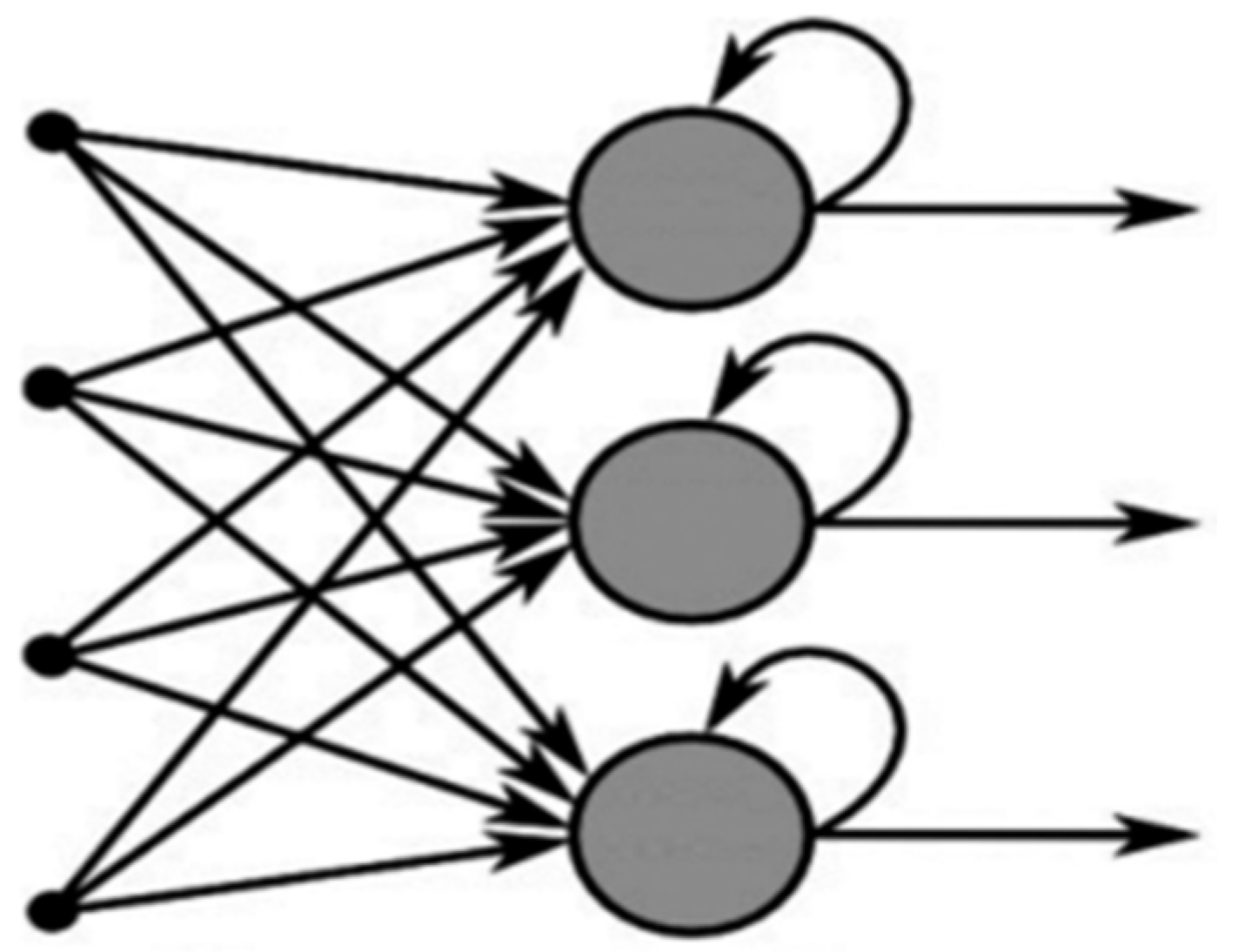
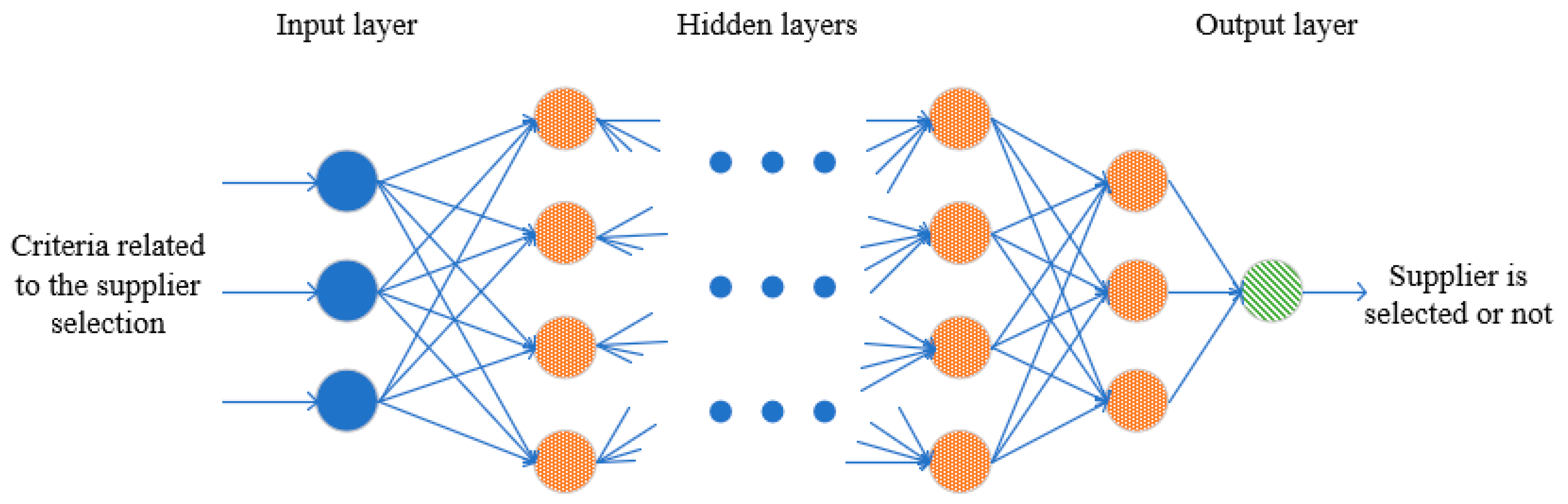
1.2. Artificial Neural Networks (ANNs)
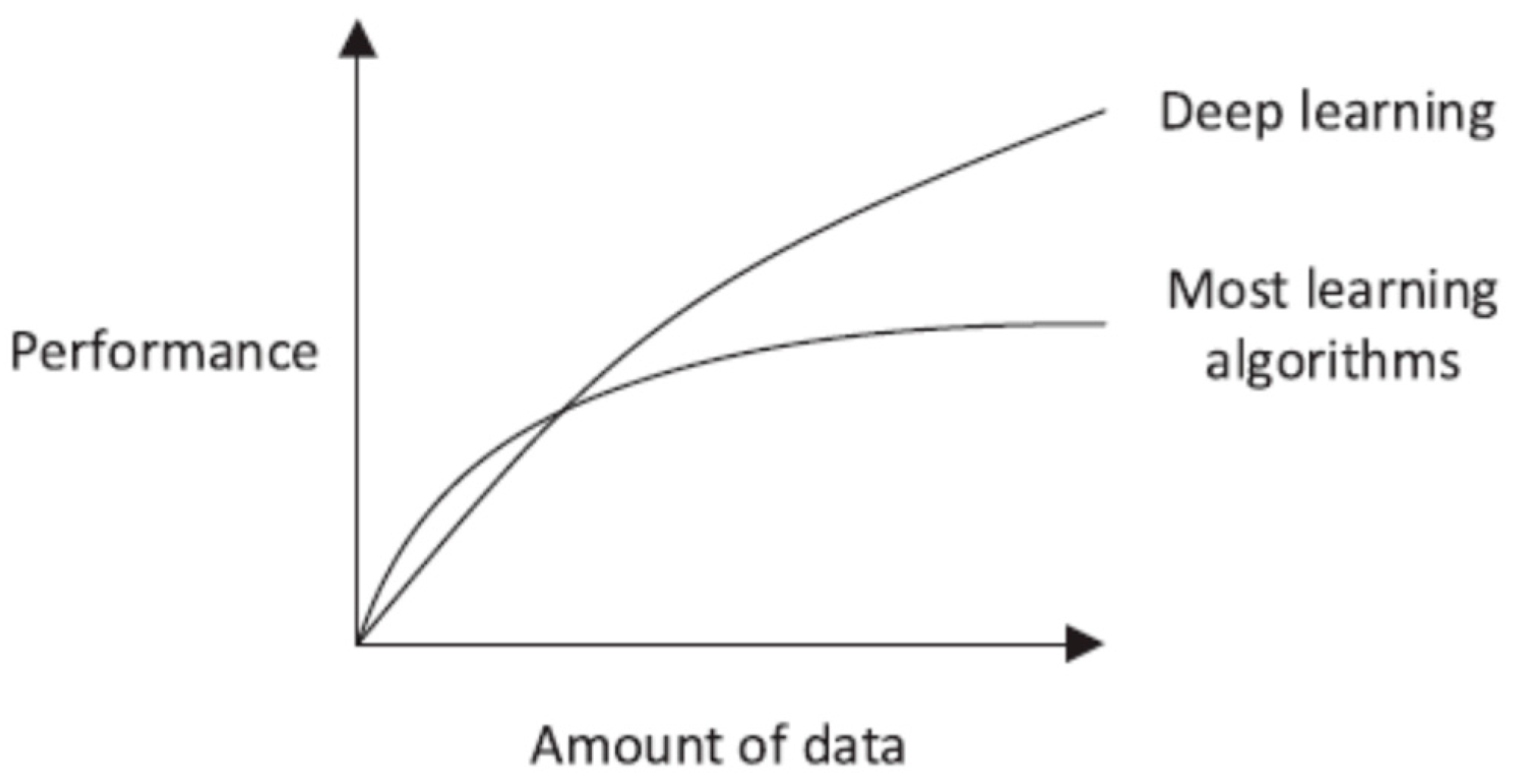
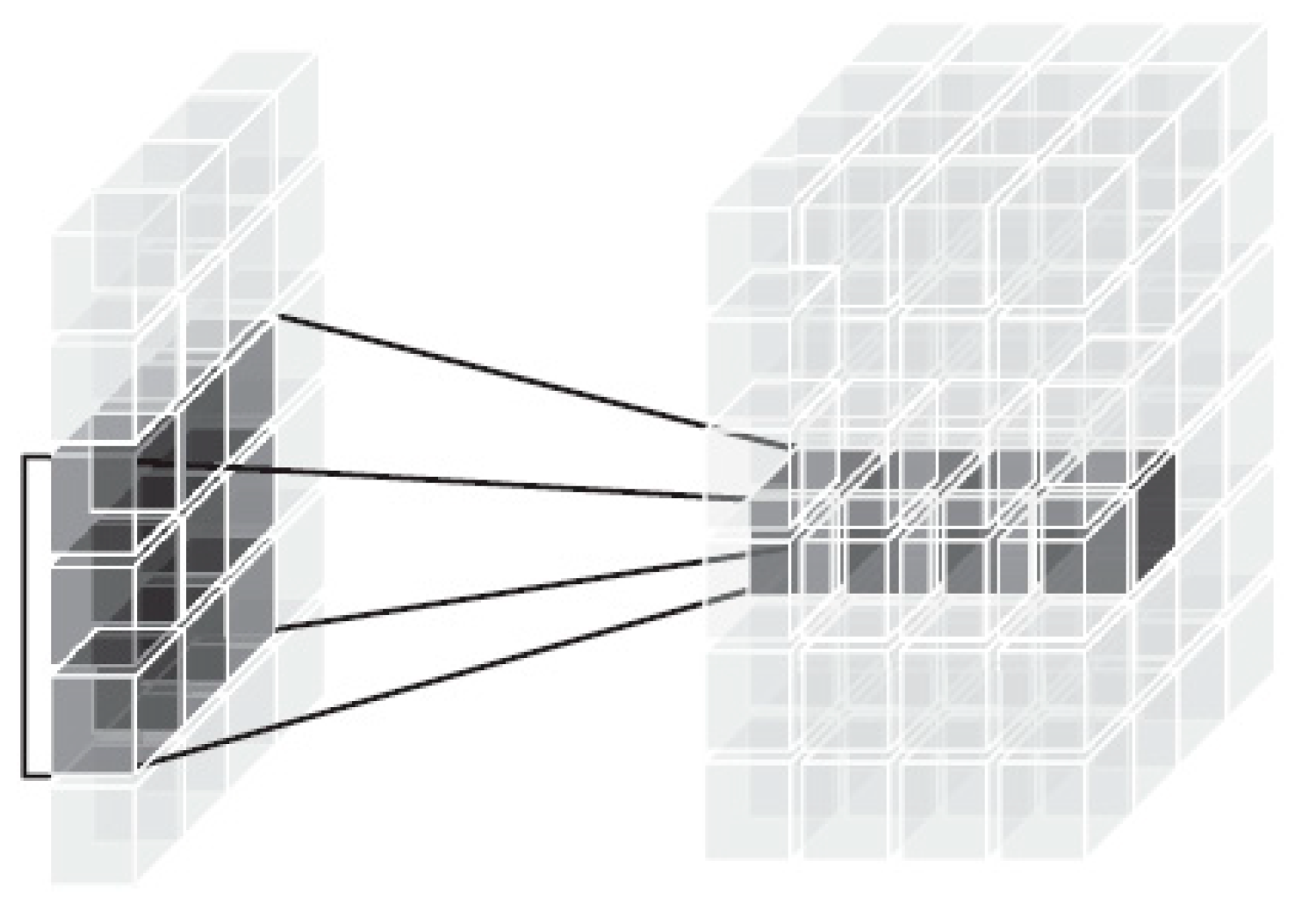
1.3. Deep Neural Networks
1.4. Training Neural Networks
2. Methodology
- Publication selection: Related publications are selected from various sources.
- Descriptive analysis: General information based on descriptive statistics is presented.
- Categorization: Main characteristics of the literature are identified, and categorization is performed regarding the major topics and common features.
- Evaluation: Publications are analyzed based on the suggested categorization, and main contributions are interpreted.
2.1. Publication Selection
- The paper must be written in English.
- The paper must be published in a peer-reviewed journal.
- SC is a broad concept that includes almost all operations within a company. The paper must include the concept of SC in its context. Papers that solely applied ANN in a single operation of a company were not considered in the current study. For example, a researcher may use ANN to predict a company’s stock price. Although pricing is an SC subject, this paper is not included in our review due to a lack of any SC concepts.
- We searched Google Scholar with the same keywords and assessed the results. Although most of the related papers were covered in the Scopus database, we found 11 more papers.
- After analyzing the papers from Scopus and Google Scholar, we realized that almost all the selected papers were published in ScienceDirect, Taylor and Francis, Springer, and Emerald. Therefore, we searched these publishers individually with the same keywords. This step did not yield any new papers to add to our database.
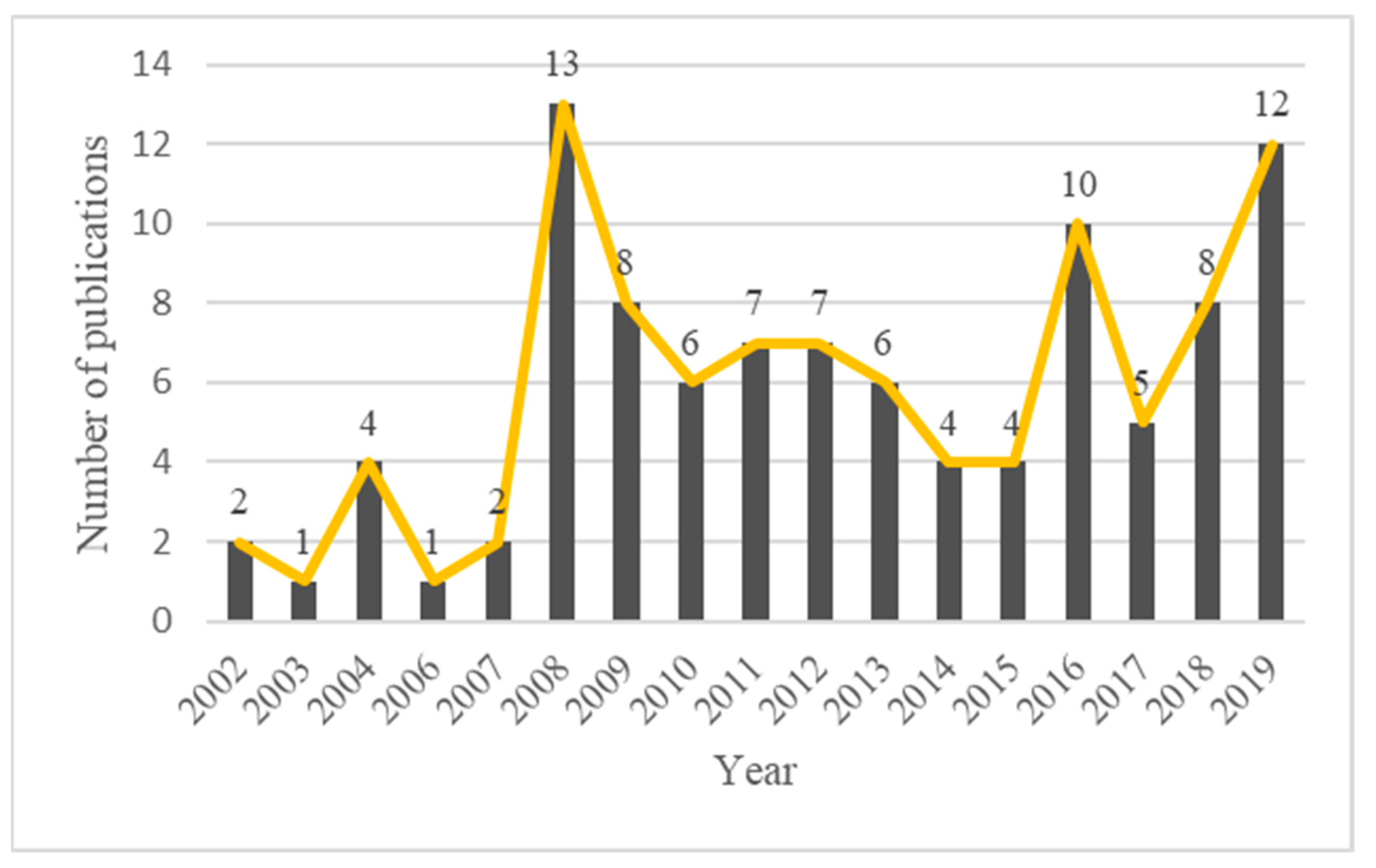
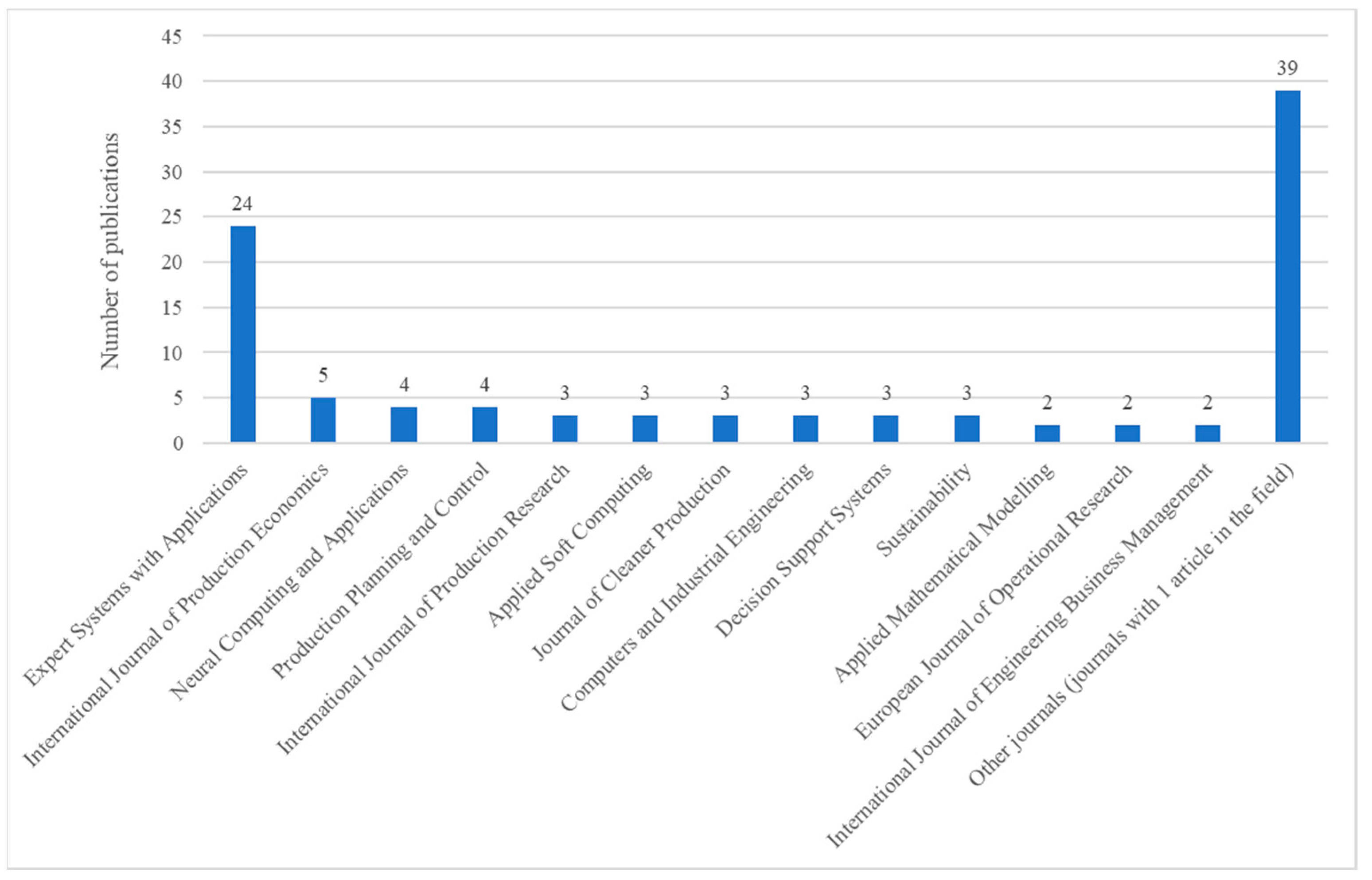
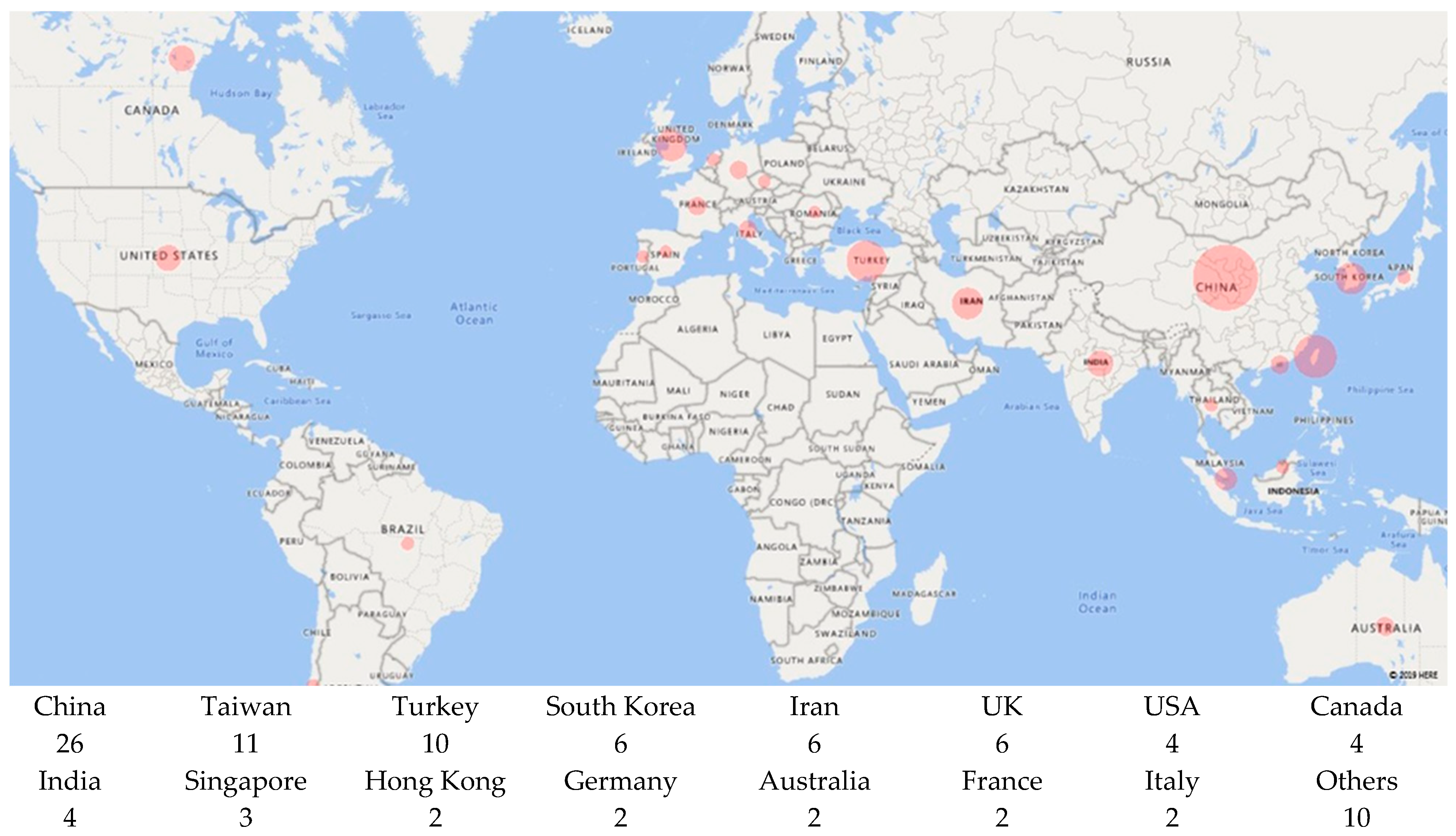
2.2. Descriptive Analysis
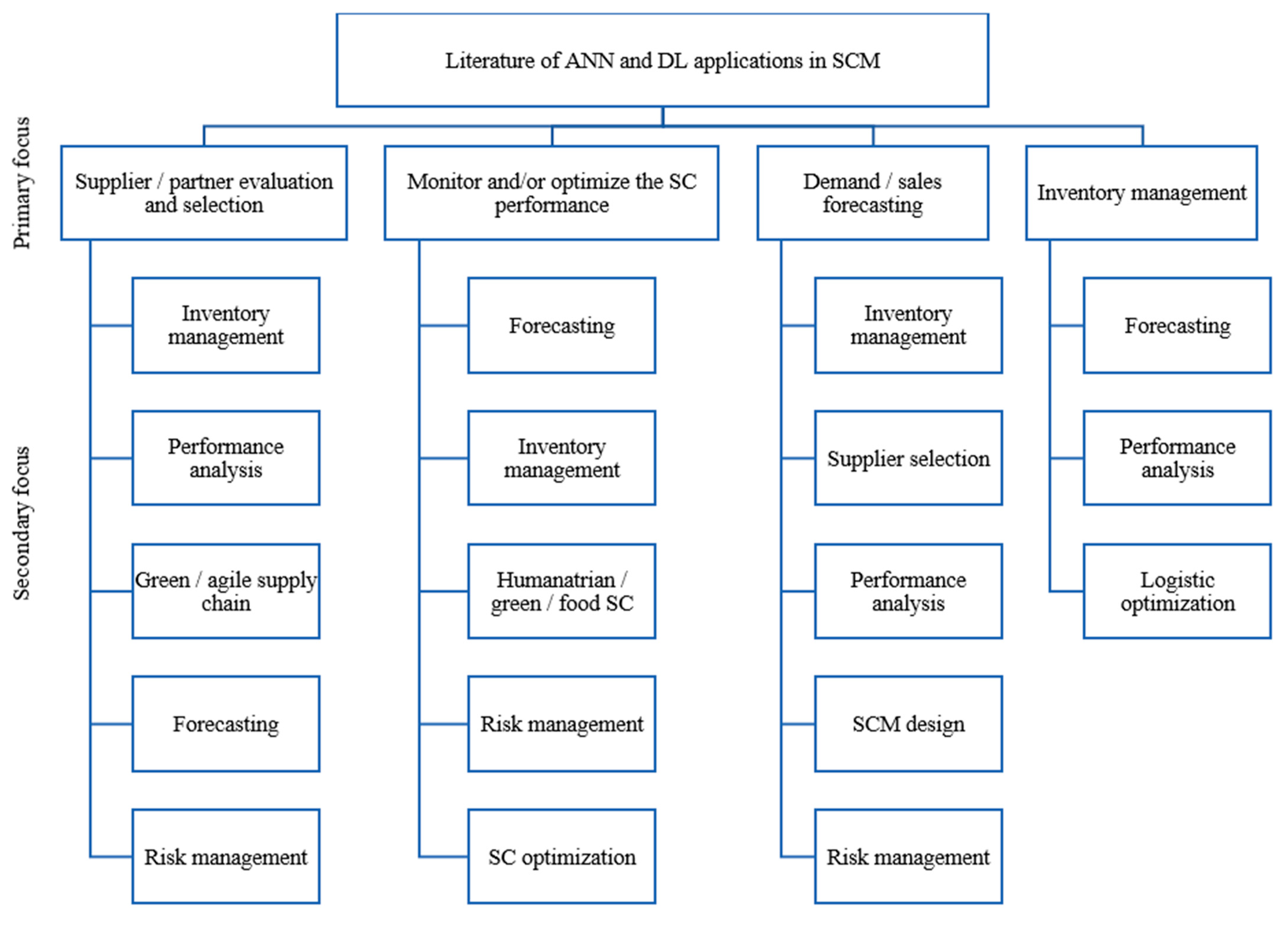
2.3. Categorization
2.4. Content Evaluation
2.4.1. Monitor and/or Optimize the Supply Chain Performance
2.4.2. Supplier/Partner Evaluation and Selection

| Research | Contribution | Secondary Focus | Methods Combined with ANN | Reported Evaluation Metric(s) | Best Reported Quantitative Result | Case Study |
|---|---|---|---|---|---|---|
| [71] | Develop a methodology to ensure complete order fulfillment and increase resource utilization | Inventory management | Manufacturing Resource Planning (MRP) | Order fulfillment rate/Operational savings/Profit change/Resource utilization | 100% order fulfillment (ANN); vs. auction: 65% fulfillment/ANN trade-off: profit +$15,450 with savings $5467 | Company selling assemble-to-order personal computers |
| [60] | Develop a prediction model to coordinate mid-term and short-term production planning | Production planning | Linear Programming (LP) | MAD/RMAD prediction error for demand (ELSD) and setup time/Mean total cost | ELSD MAD 3.22 (16.5%); setup-time MAD 0.72h (9.7%); costs −62% | Simulation |
| [57] | Develop a buyer order allocation policy in order to reduce the average amount of backorders | Demand forecasting | Order allocation policies | Average backorder (30 replications) | Backorder reduced 5–50% | Various data sets from the literature |
| [65] | Predict the behavior of SCs due to internal and external influential factors | Forecasting | System dynamics/Eigenvalue analysis/Simulation | Training error/Validation error | Testing accuracy ≈95%/Minimum validation error 0.0595 | Electronics manufacturing company |
| [63] | Select the proper logistics mode in a global SC | Global logistics operations | Multi-Criteria Decision-Making (MCDM)/Fuzzy inference/Analytical Hierarchy Process (AHP)/TOPSIS | Mode-choice forecast accuracy/ANFIS total training error | 70% correct mode identification (14/20 enterprises)/Minimum total training error 0.042 | Information Technology (IT) industries of Taiwan |
| [90] | Using ANNs to manage SCs as a Complex Adaptive System (CAS) | Supply network design | Complexity theory | None: proposes neural-network monitoring to manage extreme events | Recommends further research or testing for managing extreme events | Analytic approach |
| [91] | Develop a mechanism to control temperature in cold chain management | Food SCs | Exponentially weighted moving average (EWMA) | Accuracy (%)/Mean squared error (MSE) | Best accuracy 99.448% with MSE 0.00097 | - |
| [92] | Develop a hybrid model to simulate product-driven system architecture | - | Simulation | Mean and standard deviation of throughput-time residuals on learning and validation sets | RQM = 5 model achieved best reported mean residual 7.22 s learning, 7.75 s validation; SD ≈ 333–336 s | Sawmill internal SC |
| [93] | Determine the important factors in improving SC performance | - | Structural equation modeling/PC-algorithm | 10-fold cross-validation average prediction error/Minimum error | 10-fold average prediction error 6.8% (model1), 9.67% (model2)/Minimum error 2.3% | Manufacturing companies in Hong Kong |
| [59] | Develop a model to detect and warn of abnormalities in a production SC | Food SCs | Abnormality diagnosis algorithm/Pre-warning system/Fuzzy control/Simulation | Binary diagnosis output om (threshold 0.5) | 28 fault modes | Pork production company in China |
| [94] | Selecting common parts for different product groups to reduce production planning complexity | Green SC | Group Technology (GT), Self-organizing feature maps | Minimum-cost production program under cost and capacity constraints | Minimum cost when orders divided into four groups/Best program group 16 | A company in Taiwan |
| [95] | Develop a hybrid model for positioning the picking cart in warehouses | Warehouse management | RFID system/Artificial Immune System (AIS)/Fuzzy logic | Training and test MSE/Average accuracy rate/10-fold cross-validation on collected RSSI-position datasets | Training MSE 0.001644/Test MSE 0.001115/AIS-FNN: 100% accuracy | Lab experiments |
| [96] | Develop a methodology to boost SC performance | Risk management | - | Relative prediction error E | - | Data sets in the literature |
| [97] | Develop a hybrid model to evaluate, predict, and optimize the performance of a SC | Supplier evaluation | Balanced Scorecard | MSE/Fitness R/Maximum error between predicted and actual performance indices | Stable training: MSE 5.13 × 10⁻⁹, R ≈ 1/Maximum error < 0.02% | Automotive company in China |
| [98] | Optimize a SC construction under uncertain conditions | Risk management | Simulation/Genetic Algorithm (GA)/Simulated Annealing (SA) | Maximized supply chain profit | Market-demand satisfaction: d = 0.91, e = 0.93 | - |
| [58] | Studying RFID adoption in healthcare SCs | - | Unified theory of acceptance and use of technology | RMSE accuracy/10-fold cross-validation with 90% training, 10% testing | Mean RMSE 0.470 training/0.466 testing/Regression RMSE 0.512 | Survey data from a medical group in Malaysia |
| [99] | Using ANNs for predicting apple temperature in an apple SC | Food SC | Thermal imaging | RMSE and correlation coefficient between estimated and RFID-measured pallet temperatures | Cardboard: RMSE 0.086 °C vs. 3.56 °C thermal-image-only/Plastic: R2 0.9995 | Controlled room experiments |
| [68] | Analyze a resource allocation problem in SC under low-carbon constraint | Resource allocation | Cloud model/Learning effect model | MSE in chaos simulations | Lowest MSE 4.0938 × 10⁻⁷ in chaos simulation | Automotive manufacturer |
| [73] | Combine ANNs with Logistic Regression to predict credit risk in SC financing | Risk management | Logistic regression/Analysis of Variance (ANOVA) | Positive, negative, overall accuracy/ROC AUC | Negative accuracy 88.6%; overall 87.4%; ROC AUC 0.958 | SMEs’ financial data in China |
| [62] | Develop a performance evaluation method based on green measurement indicators | Green SC | Rough Set theory/Genetic Algorithm | MSE/Regression R | MSE 4.03 × 10⁻⁴ in 4 iterations/R = 0.9889 | Automotive company in China |
| [72] | Develop a method to evaluate SC performance based on its partners’ relationship quality | Supplier relationship management | Moderated Multiple Regression Analysis | Accuracy power = (1 − MAPE)%, | Overall accuracy power 88.703% on test data | Data from field survey |
| [74] | Develop a hybrid methodology to improve the efficiency and effectiveness of healthcare SCs for natural disasters | Humanitarian logistics | Multi-objective optimization/Genetic Algorithm (GA)/Particle Swarm Optimization (PSO) | R2/CPU time(s)/Objective values | Best (BP): R2 = 0.99/CPU time = 39 s | Random data set |
| [69] | Develop a traceability system to assure food quality in a SC | Food SCs | Fuzzy classification | Prediction accuracy/Maximum error/Product return-rate change | Best ANN (5 × 5 × 3) achieved 95% accuracy/≤9% error/Store return-rate fell ~20% over six months | Pork industrial SC in China |
| [25] | Apply deep belief networks to predict the remanufacturing time for multi-life equipment | Forecasting | - | Average relative error/Prediction error versus BP/Computation time ratio versus BP | Average relative error 6%/Prediction error 27% of BP/Runtime 8.3% of BP | Steel enterprise in China |
| [100] | Apply a convolutional ANN to monitor the quality of fresh-cut iceberg lettuce | Food SCs | - | Quality-level classification accuracy/CNN segmentation validation accuracy | Quality classification: 86% unpackaged, 83% packaged/CNN validation accuracy 0.979 | Data from a lettuce farm in Pontecagnano, Italy |
| [61] | Evaluate green SC practices to empower sustainability | Green SC | Partial Least Squares Structural Equation Modeling (PLS-SEM) | ANN RMSE (train/test) | Best test RMSE 0.0850 (ANN9)/Mean train RMSE 0.1240/Mean test RMSE 0.1177 | 178 large manufacturers in Malaysia |
| [101] | Develop a network model to more accurately deal with supply-and-demand fluctuations | Forecasting | Restricted Boltzmann Machine (RBM) | Prediction accuracy | DBN achieved 82.87% accuracy (SD 3.28) | - |
| [102] | Apply deep ANNs to create a credit evaluation system in food SCs | Food SCs | - | Accuracy/F1-score | Accuracy and F1-score increase with corpus, then stabilize near 90% (epoch = 3) | A Chinese text data set |
| [70] | Develop a model to improve the distribution of perishable food products | Food SCs | Heat transfer model | Average temperature prediction error (K)/Accuracy improvement from ensemble and Gaussian-noise training | Average error < 0.5 K/Ensemble improves accuracy up to 35%/Gaussian-noise training improves 45% | Data set in the literature |
| [64] | Study the impact of resilient enablers on SC vulnerabilities during disruptions | Risk management | Z-numbers Data Envelopment Analysis (DEA) | Efficiency scores via Z-DEA and neural-network algorithm/Final mean efficiency/Survey Cronbach’s alpha reliability | Full-model mean efficiency: Z-DEA 0.897, NN 0.943, final 0.920; alpha 0.72 | Car manufacturing company in Iran |
| [103] | Apply a convolutional ANN to find quality loss reasons in a potato processing SC | Food SCs | - | Training, validation, and test classification accuracy/Training loss | 99.79% training accuracy (loss 0.007)/After tuning 83.3% test, 85% validation accuracy | Potato sorting company in UK |
| [104] | Predict SC performance based on the SCOR model | - | SCOR model/Random subsampling cross-validation/Simulation | MSE and correlation coefficient (R) between expected and predicted SCOR metrics | MSE 1.432 × 10⁻⁸, R = 1.0000 (validation) | - |
| [105] | Apply a convolutional ANN to improve the product traceability in textile SCs | - | Classification network | mAP (VOC2007), recognition success rate, computation time per image | mAP 96.3% (no noise)/Recognition success 94.4%/0.5 s/image | Experimental woven fabric tags |
| [22] | Develop an evaluation method of automobile product design and service satisfaction | - | Multi-attribute decision-making | Average accuracy over 3000 automobile examples | Average accuracy 93.19% for BP neural network decision model | Automobile manufacturing and service industry in China |
| [106] | Apply deep ANNs to create a traceable vaccine SC | Risk management | Blockchain technology/Simulation | Accuracy/Precision/Recall/F1/AUC | Mixed model: accuracy 89.65%, precision 92.92%, recall 86.38%, F1 89.53%, AUC 0.95 | Influenza vaccine data in the USA from 1980 to 2017 |
2.4.3. Demand/Sales Forecasting
| Research | Contribution | Secondary Focus | Methods Combined with ANN | Reported Evaluation Metric(s) | Best Reported Quantitative Result | Case Study |
|---|---|---|---|---|---|---|
| [123] | Develop a tool to continuously select and benchmark the suppliers in outsource manufacturing | - | Case-Based Reasoning (CBR) | Case similarity (%)/Total weighted score/Acceptance threshold 0.8 | Best suppliers achieved 98% similarity and total weighted score 0.87 | Honeywell consumer products in Hong Kong |
| [124] | Develop a methodology to minimize the production assignment cost among multiple SC partners | Order allocation | Fuzzy logic | Output quantity (units/day) and output quality defect points (DP per 100 products) | Adjusted supplies 4265 and 5735 units/day achieved 1.2 DP at 10,000/day | Random data set |
| [125] | Develop a supplier relationship management system in an outsourcing environment | Reduce order allocation cycle time | Case-Based Reasoning (CBR) | Honeywell satisfactory rate/Delivery delay/quality-below-standard/Customer claims | Hybrid CBR + NN: satisfactory 99%/Delay 10%/Quality-below-standard 15%/Customer claims 15% | Honeywell consumer products in Hong Kong |
| [126] | Develop a hybrid system to reduce the outsource cycle time in new product development | Performance optimization | Case-Based Reasoning (CBR) | Honeywell satisfaction rate, delay in delivery, quality-below-standard, customer claims | 95% satisfaction/10% delivery delay/17% quality-below-standard/17% customer claims | Honeywell consumer products in Hong Kong |
| [127] | Develop a hybrid model to select the orders in an electronic product SC | Decision support system | Fuzzy logic/Genetic Algorithm | Training/testing MSE comparing integrated ANN and regression models | Lowest training MSE 0.00226 (14-10-1)/Testing MSE 0.00563 | Electronic items in auto industry |
| [40] | Evaluate suppliers with incomplete information | - | Data Envelopment Analysis (DEA) | DEA Farrell efficiency scores with slack for CCR-efficiency | Max efficiency 1.000 (S13/S15)/Plain DEA rated S3 0.904 despite better performance | Automotive assembly plant in Turkey |
| [22] | Enterprise Resource Planning (ERP) performance evaluation in SCs | - | Strategic thrust theory | Canonical correlation/Model convergence error tolerance 5% | Model converged within 5% error tolerance/Canonical correlation R2 = 0.938 | Transitional textile firm in Taiwan |
| [128] | Develop a model to efficiently select a third-party reverse logistics provider | Green SC | Fuzzy Analytical Hierarchy Process (FAHP) | MSE during training/“validation success” percentage | Lowest training MSE 3.40418 × 10⁵/Model considered successful with 97% validation | Field investigation in a company in Turkey |
| [111] | Compare ANNs and support vector machines to supplier selection problem | Forecasting | Support Vector Machines (SVM) | MSE and percent prediction error for supplier credit-index predictions | SVM outperformed BPNN: sample errors 0.12–5.29% vs. 0.58–20.88% (BPNN) | Zhuhai DAIHAO Electronics in China |
| [115] | Develop a hybrid model to select the maintenance supplier in a competitive environment | Performance optimization | Analytical Hierarchy Process (AHP)/Data Envelopment Analysis (DEA) | DEA efficiency score/Neural-network test prediction accuracy | DEA efficiency 155.17%/Neural-network test accuracy 78.87% | Auto parts manufacturer |
| [110] | Develop a model to make a contract and select suppliers in the early stages of new product introduction | Product development | Analytical Hierarchy Process (AHP) | SOM importance index (Wi) from bidding-criteria weights/AHP eigenvector product ranking of options | Accepted cluster 12: importance index 2.5848/Reduced 140 typical options to 9 preferred | Cellular phone design |
| [112] | Apply supplier’s bid prices to support supplier selection negotiations | Forecasting | Simulation | RMSEtest/MAPE/Correlation coefficient (R)/MAD | RMSEtest = 0.0087/MAPE = 3.3446%/R = 0.994/MAD = 0.0170 | - |
| [129] | Develop a model to assess suppliers using both quantitative and qualitative measures | Agile SC | - | System errors across Spread values/Validation-set node outputs versus expected supplier-type labels | System error 8.526 × 10⁻¹⁴ (Spread = 2)/Validation classified suppliers (0, 0), (1, 0), (1, 1) correctly | Electrical appliance manufacturing companies in China |
| [130] | Develop a prediction model to classify suppliers into efficient and inefficient clusters | - | Data Envelopment Analysis (DEA)/Decision Trees (DT) | Regression test error/Train error | BCC-NN: 1.4% regression test error/0% classification test error | Communication systems company |
| [113] | Develop an integrated model to select a supplier considering quantitative and qualitative factors | Performance optimization | Particle Swarm Optimization (PSO)/Fuzzy set theory | MSE for regression | Lowest MSE 0.001242/Regression MSE 0.004391 | Laptop computer manufacturer in Taiwan |
| [131] | Develop a hybrid model to better evaluate supplier performance | Green SC | Data Envelopment Analysis (DEA)/Analytic Network Process (ANP) | MSE for training, testing/Topology-based MSE | Lowest MSE 0.003343/Training rate 0.9, momentum 0.5 | Digital camera manufacturer in Taiwan |
| [18] | Select and evaluate suppliers in a Just-In-Time production environment | - | - | Binary/one-hot NN output values for supplier selection and A/B/C classification/Trained/validated on historical cases | Highest-confidence outputs: supplier selection 1.0000/Evaluation Class B 0.9999/Class C 0.9991/Class A 0.9351. | Automotive factory in Turkey |
| [132] | A novel approach which solves CBR key problems in supplier selection | - | Case-Based Reasoning (CBR)/k-prototype clustering | Testing RMS, MAE/Rule correctness | Best testing performance: RMS 0.116, MAE 0.084/Rule correctness reached 100% | Petroleum enterprise in China |
| [87] | Develop a model to predict the performance rating of suppliers compared to traditional methods | - | Least square-support vector machine (LS-SVM) | MAE, MSE, MAPE, RMSE, SDE (prediction error between actual and estimated supplier ratings) | LLNF lowest errors: MAE 3.7603/MSE 20.0605/MAPE 6.3710/RMSE 4.0167/SDE 0.0400 | Cosmetic products manufacturer in Iran |
| [133] | Develop a data-driven partner selection model to deal with uncertainty and ambiguity in SCs | Agile SC | Analytic Network Process-Mixed Integer Multi-Objective Programming (ANP-MIMOP) | No numerical metric/Contribution is theoretical overview | No quantitative results reported | - |
| [134] | Develop a decision-making support system to select and evaluate suppliers, considering both multiple quantitative and qualitative measures | Forecasting | Adaptive Neuro-Fuzzy Inference System (ANFIS)/Multi-Criteria Decision-Making (MCDM) | R-value and MSE comparing ANFIS versus NN-fuzzy supplier-score prediction | ANFIS: R = 0.8467, MSE = 0.0134/NN-fuzzy: R = 0.7733, MSE = 0.0193 | Data set from literature |
| [135] | Develop a model to use both qualitative and quantitative data in partner selection | Agile SCs | Fuzzy set theory | Mean error/Standard deviation of errors across spreads/Network system standard error | Best: spread = 2/Mean error 9.44 × 10⁻⁷/SD 7.93 × 10⁻⁷/Network standard error ≈ 8× 10⁻⁷ | Companies in the electrical components industry in China |
| [136] | Develop an integrated group decision support system in order to classify highly suitable and less-suitable suppliers | - | Fuzzy set theory/Analytical Hierarchy Process (AHP)/Group Decision-Making | Cross-validation classification error/Threshold b | Average error 4.80%/Threshold b averaged 0.637 across five cross-validation tests reported | A steel manufacturer and a mid-sized packaged food company in India |
| [137] | Evaluate suppliers’ performance based on the most effective selection criteria | Forecasting | Adaptive Neuro Fuzzy Inference System (ANFIS)/Analytical Hierarchy Process (AHP) | Correlation coefficient (R) and MSE/RMSE used during ANFIS training, testing | Best testing: MSE 0.006 with R 0.73 for ANN using D,T,P criteria | Automotive company |
| [116] | Develop a model to select suppliers based on their performance predictions | Green SC | Data Envelopment Analysis (DEA) | Dynamic DEA overall efficiency q0/Efficiency-trend slope R/Score wi | Best supplier: wi = 0.9135 (a = 0.5), q0 = 0.845, slope R = 0.982, rank1 | Home appliances manufacturer in Iran |
| [138] | Develop a model to select suppliers according to criteria associated with resiliency | Risk management | Logistic regression/Classification and Regression Tree (CART)/Analytic Hierarchy Process (AHP) | Pseudo R2 (Cox–Snell, Nagelkerke)/Cumulative gains | Nagelkerke R2 = 0.824/Ensemble gains > 25% additional correct responses at top 40th percentile | Plastic pipe manufacturer in USA |
| [139] | Develop a partner selection and evaluation method with a cooperative relationship in a SC | - | Evaluation index construction | Classification accuracy (train/test 3:2 split) for BP neural-network partner-selection model | Accuracy 90.18% on 500 samples, trained/tested 3:2 split | Data set from the literature |
| Research | Contribution | Secondary Focus | Methods Combined with ANN | Reported Evaluation Metric(s) | Best Reported Quantitative Result | Case Study |
|---|---|---|---|---|---|---|
| [147] | Develop a forecasting method to optimize the total cost of a distribution inventory SC | Inventory management | Genetic Algorithm (GA)/Particle Swarm Optimization (PSO) | Computation speed (sec) for GA and PSO | Computation speed 2341 s | Tire industry in India |
| [141] | Develop a forecasting model to optimize the inventory replenishment system | Inventory management | Autoregressive Integrated Moving Average (ARIMA) | MAPE and NMSE for training, test demand forecasts/Inventory reaching days/Sales-failure rate | Hybrid model M9: test MAPE 28.80%, NMSE 0.3544/Reaching days 5/Failures 0.9% | Economax supermarket in Chile |
| [142] | Use a RNN to improve sales forecasting | Warehouse management | - | Test MSE/Average percentage forecasting error/Short-term accuracy | MSE 0.00661666/6-week forecast error 12.7%/Accuracy ~9% | Footwear sales data in India |
| [9] | Compare the forecasting accuracy between AI and traditional methods | Supply network design | Support Vector Machines (SVM) | Testing, training MAE | Lowest testing MAE: 447.72 (simulation, RNN)/20.352 (foundries, RNN) | Foundries data provided by Statistics Canada |
| [148] | Develop an algorithm to forecast the demand rate and determine proper material planning | Supplier selection/Inventory management | Genetic Algorithm (GA)/Fuzzy approximation/Principle Component Analysis (PCA) | RMSE/R2 for demand forecasting/GA objective fitness cost | FNN forecasting RMSE = 0.3272, R2 = 0.99999/Model reduced case-study costs 4% | Sewing machine manufacturer in Iran |
| [149] | Develop a model for cooperative forecasting in a service SC that will optimize resource planning | Performance monitor and optimization | - | MSE of combined forecast/Compares ANN combination versus simple averaging | ANN combination MSE = 0.01 versus averaging MSE = 0.02 when resolving forecasting exceptions | British Telecom holding company in United Kingdom |
| [150] | Present a decision support system to forecast demand based on an ANN | Supply network design | Fuzzy inference systems | Validation MAPE/ANFIS training, test error | ANFIS outperformed ANN: control MAPE 4.88%, 7.05%, 2.41% | Durable consumer goods industry in Turkey |
| [3] | Design the optimal product flow between the factories, warehouses, and distributors | Supply network design | Mixed Integer Linear Programming (MILP)/Fuzzy approximation | Demand-forecast MSE (ANFIS vs. ARIMA)/Network-design objective value (minimum total cost) | Minimum cost 167,231 (analytical) vs. 182,021 (ANN); ANFIS MSE lower all distributors | Alcohol-free beverage company in Turkey |
| [151] | Develop a hybrid intelligent model to obtain more accurate fashion sales forecasts | - | Harmony search algorithm/Extreme learning machine | Forecast accuracy: RMSE, MAPE (%), MASE | Best reported quarterly category1 MASE = 0.07/RMSE = 4.4 × 10⁶/MAPE = 11.9% | Medium-priced fashion products seller in China |
| [152] | Develop a methodology to integrate SC echelons with uncertain demand and/or lead times | SC integration/optimization | Fuzzy inference systems | MAPE/MSE | Average MAPE 2.41%/Total MSE: warehouse 0.002688, plant 0.00150 | Consumer electronics company in Turkey |
| [146] | Use an ANN to develop a sales forecasting model for computer wholesalers | - | Multivariate Adaptive Regression Splines (MARS) | MAD, RMSE, MAPE, RMSPE | MARS achieved lowest errors/Robustness test MAPE 0.07% (90/10 split) versus rivals | Computer wholesale industry in Taiwan |
| [153] | Assess the role of sharing sales information on supplier forecasting accuracy | Performance monitor | - | Out-of-sample MAPE and MdAPE, plus residual standard deviation | MAPE = 26.63%/MdAPE = 17.35%/Lowest residual SD = 1880.92 across 43 SKUs tested | Household product manufacturer |
| [154] | Develop a model to predict and optimize service level | Inventory management | Fuzzy linear regression | MAPE comparing ANN | ANN minimum MAPE 1.9% (7 test periods, 29 training periods)/selected ANN MAPE 2.96% | Electrical and automation products distributor in Iran |
| [155] | Develop a model to improve demand forecast accuracy | Inventory management | Minimum Description Length (MDL)/Surrogate data method | MSE/Prediction accuracy (proportion within threshold deviation on test data) | MDL-optimal NN: prediction accuracy 0.85/MSE 3.33 × 10⁻³, outperforming smoothing and regression | Random data set |
| [140] | Propose a new forecasting method to reduce the bullwhip effect in a SC | Inventory management | Autoregressive Integrated Moving Average (ARIMA)/Discrete wavelet transforms | MSE/Bullwhip effect/Net-stock amplification ratios under base-stock policy | MSE = 4.3918/BWE = 0.99/NSAmp = 0.024 | Automotive parts and accessories/Cement manufacturer/Steel processing industry, all in India |
| [143] | Develop an ANN model to improve short-term forecasting in the fashion industry | Inventory management | Multi-objective optimization | RMSE, MAPE, MAE on training and test samples for replenishment forecasting accuracy | MOONN1 best in 12 RMSE, 8 MAPE, 11 MAE cases/Never worst | Fashion retailer in Hong Kong and China |
| [156] | Develop a fuzzy ANN to improve the forecast of a Longan supply | - | Fuzzy Support Vector Regression | MAPE for training, validation/testing/Training runtime for six ANN/SVR variants | FSVR achieved lowest testing MAPE ≈ 2%/Training runtime ≈ 1.6 min | Longan SC in Thailand |
| [145] | Develop a model to better predict market demand after a transportation disruption in a SC | Risk management/Transportation | Gray model | Average relative error (ARE%) | Improved gray neural network average relative error 0.3592%, beating improved GM(1,1) 0.7521% overall forecasting performance | Snow disaster of 2008 in South China |
| [157] | Apply a probabilistic RNN to design an intelligent energy SC | Supply network design | Factored Conditional Restricted Boltzmann Machine | RMSE, Pearson correlation (R), and p-value significance for forecasts across scenarios | FCRBM achieved lowest RMSE 0.1702, highest R 0.7856, p = 0.0001 (weekly power) | Data set from the literature |
| [158] | Develop a model to forecast sales based on online reviews and reviewer characteristics | Online marketplace | Sentiment analysis | Relative error for sales-rank prediction/sensitivity-analysis importance percentages for predictors | Lowest testing error 0.918/Mean testing 0.958/Importance: helpful votes 15%, reviewer picture 13% | Real data from Amazon.com |
| [159] | Forecast the number of end-of-life vehicles in an auto industry | Reverse SC | Gray model/Particle Swarm Optimization (PSO)/Exponential smoothing | MAE, RMSE, MAPE, Theil’s inequality coefficient (TIC) used to evaluate four forecasting models | Best: GM(1,1)-TES-GM(1,N)-PSOBP/MAE = 1692.167/RMSE = 3009.017/MAPE = 0.096/TIC = 0.029. | End-of-life vehicle reverse logistics industry in China |
| [160] | Develop a RNN to forecast intermittent demand | Internet of Things | Weibull distribution/Failure modes | Sensitivity, specificity, accuracy/Plus hidden-layer node selection using test-set error rate. | Validation accuracy 1.00/Test accuracy 0.9804, sensitivity 1.00, specificity 0.9643. | Battery replacement data for toy cars |
| [161] | Applied DNNs to forecast sales in the fashion industry | - | Decision trees/Random forest/Support Vector Regression (SVR) | R2, RMSE, MAPE, MAE, MSE on held-out season (SS16) via bootstrapped testing. | Best R2 0.756 (Random Forest)/Lowest RMSE 1861, MSE 3,526,377 (DNN) | A fashion company with over 900 stores in different parts of the world |
| [162] | Develop a model to reduce the occurrence of stock depletion in wholesale distributing systems | Inventory management | Price determination | MAPE/Economic loss from out-of-stocks (OOS) used | Cascade ANN framework decreased economic loss due to OOS occurrence by >56% | Beauty products distributor in Italy |
| [29] | Develop a hybrid demand forecasting model to mitigate forecast error | Performance optimization | Time series/Support Vector Regression (SVR) | MAPE and MAD/Accuracy computed as 1−MAPE for weekly demand forecasts | Average MAPE 0.2469 (24.69%) with DL-enhanced integration strategy/2–3% added improvement | A market with 6700 stores in Turkey |
| [163] | Apply RNN to forecast renewable energy sources and water demand | - | Multi-objective optimization/Energy reliability index | RMSE for forecasts/PLPSP (energy reliability)/Total annual cost and GHG emissions | Optimized 111 PV panels and 5 wind turbines/Reduced PLPSP 18.3% versus base | Data from London Home Office |
| [164] | Extend a model to forecast the export volume of aquatic products | - | Particle Swarm Optimization (PSO) | RMSE/Learning efficiency/Model–actual matching ratio | Model–actual matching ratio 0.96571 after 87 iterations/Stable prediction within error threshold | Volume of aquatic product exports in Liaoning Province, China |
2.4.4. Inventory Management
2.5. Agentic AI, Multi-Agent Systems, and Orchestration
2.5.1. Agentic AI and Autonomous Decision-Making Under Uncertainty
2.5.2. Multi-Agent Systems (MASs) for Distributed Coordination and Negotiation
2.5.3. Orchestration Mechanisms
2.5.4. Implications for ANN/DNN-Based SCM Research and a Forward-Looking Agenda
3. Discussion
4. Conclusions and Future Work
Funding
Institutional Review Board Statement
Data Availability Statement
Conflicts of Interest
References
- Huang, S.H.; Sheoran, S.K.; Keskar, H. Computer-assisted supply chain configuration based on supply chain operations reference (SCOR) model. Comput. Ind. Eng. 2005, 48, 377–394. [Google Scholar] [CrossRef]
- Shavaki, F.H.; Ghahnavieh, A.E. Applications of deep learning into supply chain management: A systematic literature review and a framework for future research. Artif. Intell. Rev. 2023, 56, 4447–4489. [Google Scholar] [CrossRef]
- Gumus, A.T.; Guneri, A.F.; Keles, S. Supply chain network design using an integrated neuro-fuzzy and MILP approach: A comparative design study. Expert Syst. Appl. 2009, 36, 12570–12577. [Google Scholar] [CrossRef]
- Brauch, M.; Mohaghegh, M.; Größler, A. Causes of the bullwhip effect: A systematic review and categorization of its causes. Manag. Res. Rev. 2024, 47, 1127–1149. [Google Scholar] [CrossRef]
- Bhandal, R.; Meriton, R.; Kavanagh, R.E.; Brown, A. The application of digital twin technology in operations and supply chain management: A bibliometric review. Supply Chain Manag. Int. J. 2022, 27, 182–206. [Google Scholar] [CrossRef]
- Balan, G.S.; Kumar, V.S.; Raj, S.A. Machine Learning and Artificial Intelligence Methods and Applications for Post-Crisis Supply Chain Resiliency and Recovery. Supply Chain Anal. 2025, 10, 100121. [Google Scholar] [CrossRef]
- Camur, M.C.; Ravi, S.K.; Saleh, S. Enhancing supply chain resilience: A machine learning approach for predicting product availability dates under disruption. Expert Syst. Appl. 2024, 247, 123226. [Google Scholar] [CrossRef]
- Sharma, R.; Shishodia, A.; Gunasekaran, A.; Min, H.; Munim, Z.H. The role of artificial intelligence in supply chain management: Mapping the territory. Int. J. Prod. Res. 2022, 60, 7527–7550. [Google Scholar] [CrossRef]
- Carbonneau, R.; Laframboise, K.; Vahidov, R. Application of machine learning techniques for supply chain demand forecasting. Eur. J. Oper. Res. 2008, 184, 1140–1154. [Google Scholar] [CrossRef]
- Babai, M.Z.; Arampatzis, M.; Hasni, M.; Lolli, F.; Tsadiras, A. On the use of machine learning in supply chain management: A systematic review. IMA J. Manag. Math. 2025, 36, 21–49. [Google Scholar] [CrossRef]
- Rolf, B.; Jackson, I.; Müller, M.; Lang, S.; Reggelin, T.; Ivanov, D. A review on reinforcement learning algorithms and applications in supply chain management. Int. J. Prod. Res. 2023, 61, 7151–7179. [Google Scholar] [CrossRef]
- Oliveira, J.M.; Ramos, P. Evaluating the effectiveness of time series transformers for demand forecasting in retail. Mathematics 2024, 12, 2728. [Google Scholar] [CrossRef]
- Nguyen, T.N.A.; Nguyen, T.X.H.; Thi, H.N.; Vu, H.A.; Tran, N.T.; Anh, N.P. Optimizing Supply Chain Operations Using Advanced Time-Series Mixer Models for Demand Forecasting and Inventory Under Uncertain Demand. Expert Syst. Appl. 2026, 296, 128955. [Google Scholar] [CrossRef]
- Yang, M.; Lim, M.K.; Qu, Y.; Ni, D.; Xiao, Z. Supply chain risk management with machine learning technology: A literature review and future research directions. Comput. Ind. Eng. 2023, 175, 108859. [Google Scholar] [CrossRef]
- Liu, Y.; Liu, S.; Lu, Y. Supply chain financial risk assessment: A modified graph attention neural network. Financ. Res. Lett. 2025, 86, 108285. [Google Scholar] [CrossRef]
- Fan, S.; Kong, D.; Wu, Y.; Yu, H. Digital innovation and supply chain risk: A large language model-based analysis. Pac.-Basin Financ. J. 2025, 92, 102799. [Google Scholar] [CrossRef]
- Meidute-Kavaliauskiene, I.; Taşkın, K.; Ghorbani, S.; Činčikaitė, R.; Kačenauskaitė, R. Reviewing the applications of neural networks in supply chain: Exploring research propositions for future directions. Information 2022, 13, 261. [Google Scholar] [CrossRef]
- Aksoy, A.; Öztürk, N. Supplier selection and performance evaluation in just-in-time production environments. Expert Syst. Appl. 2011, 38, 6351–6359. [Google Scholar] [CrossRef]
- Wang, S. Forecasting Demand and Controlling Inventory Using Transformer-Based Neural Network Optimized by Whale Optimization Algorithm. In Proceedings of the 2024 Guangdong-Hong Kong-Macao Greater Bay Area International Conference on Digital Economy and Artificial Intelligence, Guangdong, China, 25 July 2024; Association for Computing Machinery: New York, NY, USA, 2024; pp. 915–923. [Google Scholar]
- Kosasih, E.E.; Margaroli, F.; Gelli, S.; Aziz, A.; Wildgoose, N.; Brintrup, A. Towards knowledge graph reasoning for supply chain risk management using graph neural networks. Int. J. Prod. Res. 2024, 62, 5596–5612. [Google Scholar] [CrossRef]
- Yang, M.; Zhu, H.; Guo, K. Research on manufacturing service combination optimization based on neural network and multi-attribute decision making. Neural Comput. Appl. 2020, 32, 1691–1700. [Google Scholar] [CrossRef]
- Chang, I.-C.; Hwang, H.-G.; Liaw, H.-C.; Hung, M.-C.; Chen, S.-L.; Yen, D.C. A neural network evaluation model for ERP performance from SCM perspective to enhance enterprise competitive advantage. Expert Syst. Appl. 2008, 35, 1809–1816. [Google Scholar] [CrossRef]
- Nelles, O. Nonlinear System Identification: From Classical Approaches to Neural Networks and Fuzzy Models; Springer Science & Business Media: Berlin/Heidelberg, Germany, 2013. [Google Scholar]
- LeCun, Y.; Bengio, Y.; Hinton, G. Deep learning. Nature 2015, 521, 436–444. [Google Scholar] [CrossRef] [PubMed]
- Wang, L.; Xia, X.; Cao, J.; Liu, X. Modeling and predicting remanufacturing time of equipment using deep belief networks. Clust. Comput. 2019, 22, 2677–2688. [Google Scholar] [CrossRef]
- Li, Y.; Jiang, W.; Yang, L.; Wu, T. On neural networks and learning systems for business computing. Neurocomputing 2018, 275, 1150–1159. [Google Scholar] [CrossRef]
- Bengio, Y. Practical recommendations for gradient-based training of deep architectures. In Neural Networks: Tricks of the Trade; Springer: Berlin/Heidelberg, Germany, 2012; pp. 437–478. [Google Scholar]
- Kraus, M.; Feuerriegel, S.; Oztekin, A. Deep learning in business analytics and operations research: Models, applications and managerial implications. Eur. J. Oper. Res. 2020, 281, 628–641. [Google Scholar] [CrossRef]
- Kilimci, Z.H.; Akyuz, A.O.; Uysal, M.; Akyokus, S.; Uysal, M.O.; Atak Bulbul, B.; Ekmis, M.A. An Improved Demand Forecasting Model Using Deep Learning Approach and Proposed Decision Integration Strategy for Supply Chain. Complexity 2019, 2019, 9067367. [Google Scholar] [CrossRef]
- Ketkar, N. Deep Learning with Python; Springer: Berlin/Heidelberg, Germany, 2017. [Google Scholar]
- Ramakrishnan, N.; Soni, T. Network Traffic Prediction Using Recurrent Neural Networks. In 2018 17th IEEE International Conference on Machine Learning and Applications (ICMLA); IEEE: New York, NY, USA, 2018; pp. 187–193. [Google Scholar]
- Bousqaoui, H.; Slimani, I.; Achchab, S. Improving Coordination in Supply Chain Using Artificial Neural Networks and Multi-agent Approach. In International Conference on Engineering Optimization; Springer: Berlin/Heidelberg, Germany, 2018; pp. 1353–1359. [Google Scholar]
- Chatfield, K.; Simonyan, K.; Vedaldi, A.; Zisserman, A. Return of the devil in the details: Delving deep into convolutional nets. arXiv 2014, arXiv:1405.3531. [Google Scholar] [CrossRef]
- Krizhevsky, A.; Sutskever, I.; Hinton, G.E. Imagenet classification with deep convolutional neural networks. In Advances in Neural Information Processing Systems; NIPS: San Diego, CA, USA, 2012; pp. 1097–1105. [Google Scholar]
- Kaynov, I.; Van Knippenberg, M.; Menkovski, V.; Van Breemen, A.; Van Jaarsveld, W. Deep reinforcement learning for one-warehouse multi-retailer inventory management. Int. J. Prod. Econ. 2024, 267, 109088. [Google Scholar] [CrossRef]
- Necula, S.-C.; Rieder, E. Generative and Adaptive AI for Sustainable Supply Chain Design. J. Theor. Appl. Electron. Commer. Res. 2025, 20, 240. [Google Scholar] [CrossRef]
- Ahmed, K.R.; Ansari, M.E.; Ahsan, M.N.; Rohan, A.; Uddin, M.B.; Rivin, M.A.H. Deep learning framework for interpretable supply chain forecasting using SOM ANN and SHAP. Sci. Rep. 2025, 15, 26355. [Google Scholar] [CrossRef]
- Chong, A.Y.L.; Li, B.; Ngai, E.W.; Ch’ng, E.; Lee, F. Predicting online product sales via online reviews, sentiments, and promotion strategies: A big data architecture and neural network approach. Int. J. Oper. Prod. Manag. 2016, 36, 358–383. [Google Scholar] [CrossRef]
- Law, R. Back-propagation learning in improving the accuracy of neural network-based tourism demand forecasting. Tour. Manag. 2000, 21, 331–340. [Google Scholar] [CrossRef]
- Çelebi, D.; Bayraktar, D. An integrated neural network and data envelopment analysis for supplier evaluation under incomplete information. Expert Syst. Appl. 2008, 35, 1698–1710. [Google Scholar] [CrossRef]
- Schalkoff, R.J. Artificial Neural Networks; McGraw-Hill Higher Education: New York, NY, USA, 1997. [Google Scholar]
- Boute, R.N.; Gijsbrechts, J.; Van Jaarsveld, W.; Vanvuchelen, N. Deep reinforcement learning for inventory control: A roadmap. Eur. J. Oper. Res. 2022, 298, 401–412. [Google Scholar] [CrossRef]
- Zheng, G.; Ivanov, D.; Brintrup, A. An adaptive federated learning system for information sharing in supply chains. Int. J. Prod. Res. 2025, 63, 3938–3960. [Google Scholar] [CrossRef]
- Long, Y.; Kroeger, S.; Zaeh, M.F.; Brintrup, A. Leveraging synthetic data to tackle machine learning challenges in supply chains: Challenges, methods, applications, and research opportunities. Int. J. Prod. Res. 2025, 1–22. [Google Scholar] [CrossRef]
- Zhang, X.; Li, C.; Wang, W.; Hu, C.; Kang, Y. Sales forecasting method based on LSTM and conformal forecasting. In Proceedings of the 2024 5th International Conference on Computer Science and Management Technology, Xiamen, China, 18–20 October 2024; Association for Computing Machinery: New York, NY, USA, 2025; pp. 1347–1350. [Google Scholar]
- Mayring, P. Qualitative Inhaltanalyse Grundlagenund Techniken (Qualitative Content Analysis); Beltz: Weinheim, Germany, 2003. [Google Scholar]
- Bakker, M.; Riezebos, J.; Teunter, R.H. Review of inventory systems with deterioration since 2001. Eur. J. Oper. Res. 2012, 221, 275–284. [Google Scholar] [CrossRef]
- Brandenburg, M.; Govindan, K.; Sarkis, J.; Seuring, S. Quantitative models for sustainable supply chain management: Developments and directions. Eur. J. Oper. Res. 2014, 233, 299–312. [Google Scholar] [CrossRef]
- Glock, C.H. The joint economic lot size problem: A review. Int. J. Prod. Econ. 2012, 135, 671–686. [Google Scholar] [CrossRef]
- Musilek, P.; Gupta, M.M. Neural networks and fuzzy systems. In Soft Computing and Intelligent Systems: Theory and Applications; Academic Press: San Diego, CA, USA, 2000. [Google Scholar]
- Kartalopoulos, S.V.; Kartakapoulos, S.V. Understanding Neural Networks and Fuzzy Logic: Basic Concepts and Applications; Wiley-IEEE Press: New York, NY, USA, 1997. [Google Scholar]
- Ko, M.; Tiwari, A.; Mehnen, J. A review of soft computing applications in supply chain management. Appl. Soft Comput. 2010, 10, 661–674. [Google Scholar] [CrossRef]
- Perea-Lopez, E.; Ydstie, B.E.; Grossmann, I.E. A model predictive control strategy for supply chain optimization. Comput. Chem. Eng. 2003, 27, 1201–1218. [Google Scholar] [CrossRef]
- Maestrini, V.; Luzzini, D.; Maccarrone, P.; Caniato, F. Supply chain performance measurement systems: A systematic review and research agenda. Int. J. Prod. Econ. 2017, 183, 299–315. [Google Scholar] [CrossRef]
- Chopra, S.; Meindl, P. Supply chain management. Strategy, planning & operation. In Das Summa Summarum des Management; Springer: Berlin/Heidelberg, Germany, 2007; pp. 265–275. [Google Scholar]
- Nudurupati, S.S.; Bititci, U.S.; Kumar, V.; Chan, F.T. State of the art literature review on performance measurement. Comput. Ind. Eng. 2011, 60, 279–290. [Google Scholar] [CrossRef]
- Lee, Y.H.; Jung, J.W.; Eum, S.C.; Park, S.M.; Nam, H.K. Production quantity allocation for order fulfilment in the supply chain: A neural network based approach. Prod. Plan. Control 2006, 17, 378–389. [Google Scholar] [CrossRef]
- Chong, A.Y.-L.; Liu, M.J.; Luo, J.; Keng-Boon, O. Predicting RFID adoption in healthcare supply chain from the perspectives of users. Int. J. Prod. Econ. 2015, 159, 66–75. [Google Scholar] [CrossRef]
- Zhang, K.; Chai, Y.; Yang, S.X.; Weng, D. Pre-warning analysis and application in traceability systems for food production supply chains. Expert Syst. Appl. 2011, 38, 2500–2507. [Google Scholar] [CrossRef]
- Rohde, J. Hierarchical supply chain planning using artificial neural networks to anticipate base-level outcomes. OR Spectr. 2004, 26, 471–492. [Google Scholar] [CrossRef]
- Foo, P.-Y.; Lee, V.-H.; Tan, G.W.-H.; Ooi, K.-B. A gateway to realising sustainability performance via green supply chain management practices: A PLS–ANN approach. Expert Syst. Appl. 2018, 107, 1–14. [Google Scholar] [CrossRef]
- Liu, P.; Yi, S. New Algorithm for Evaluating the Green Supply Chain Performance in an Uncertain Environment. Sustainability 2016, 8, 960. [Google Scholar] [CrossRef]
- Sheu, J.-B. A hybrid neuro-fuzzy analytical approach to mode choice of global logistics management. Eur. J. Oper. Res. 2008, 189, 971–986. [Google Scholar] [CrossRef]
- Yazdanparast, R.; Tavakkoli-Moghaddam, R.; Heidari, R.; Aliabadi, L. A hybrid Z-number data envelopment analysis and neural network for assessment of supply chain resilience: A case study. Cent. Eur. J. Oper. Res. 2021, 29, 611–631. [Google Scholar] [CrossRef]
- Rabelo, L.; Helal, M.; Lertpattarapong, C.; Moraga, R.; Sarmiento, A. Using system dynamics, neural nets, and eigenvalues to analyse supply chain behaviour. A case study. Int. J. Prod. Res. 2008, 46, 51–71. [Google Scholar] [CrossRef]
- Abouzid, I.; Saidi, R. Digital twin implementation approach in supply chain processes. Sci. Afr. 2023, 21, e01821. [Google Scholar] [CrossRef]
- Stranieri, F.; Stella, F.; Kouki, C. Performance of deep reinforcement learning algorithms in two-echelon inventory control systems. Int. J. Prod. Res. 2024, 62, 6211–6226. [Google Scholar] [CrossRef]
- Liu, X.-H.; Shan, M.-Y.; Zhang, L.-H. Low-carbon supply chain resources allocation based on quantum chaos neural network algorithm and learning effect. Nat. Hazards 2016, 83, 389–409. [Google Scholar] [CrossRef]
- Wang, J.; Yue, H.; Zhou, Z. An improved traceability system for food quality assurance and evaluation based on fuzzy classification and neural network. Food Control 2017, 79, 363–370. [Google Scholar] [CrossRef]
- Mercier, S.; Uysal, I. Neural network models for predicting perishable food temperatures along the supply chain. Biosyst. Eng. 2018, 171, 91–100. [Google Scholar] [CrossRef]
- Chiu, M.; Lin, G. Collaborative supply chain planning using the artificial neural network approach. J. Manuf. Technol. Manag. 2004, 15, 787–796. [Google Scholar] [CrossRef]
- Tsai, J.-M.; Hung, S.-W. Supply chain relationship quality and performance in technological turbulence: An artificial neural network approach. Int. J. Prod. Res. 2016, 54, 2757–2770. [Google Scholar] [CrossRef]
- Zhu, Y.; Xie, C.; Sun, B.; Wang, G.-J.; Yan, X.-G. Predicting China’s SME credit risk in supply chain financing by logistic regression, artificial neural network and hybrid models. Sustainability 2016, 8, 433. [Google Scholar] [CrossRef]
- Sabegh, M.H.Z.; Mohammadi, M.; Naderi, B. Multi-objective optimization considering quality concepts in a green healthcare supply chain for natural disaster response: Neural network approaches. Int. J. Syst. Assur. Eng. Manag. 2017, 8, 1689–1703. [Google Scholar] [CrossRef]
- Motwani, J.; Youssef, M.; Kathawala, Y.; Futch, E. Supplier selection in developing countries: A model development. Integr. Manuf. Syst. 1999, 10, 154–162. [Google Scholar] [CrossRef]
- Bhutta, K.S.; Huq, F. Supplier selection problem: A comparison of the total cost of ownership and analytic hierarchy process approaches. Supply Chain Manag. Int. J. 2002, 7, 126–135. [Google Scholar] [CrossRef]
- Wu, D.D.; Zhang, Y.; Wu, D.; Olson, D.L. Fuzzy multi-objective programming for supplier selection and risk modeling: A possibility approach. Eur. J. Oper. Res. 2010, 200, 774–787. [Google Scholar] [CrossRef]
- Jayaraman, K.; Vejayon, S.; Raman, S.; Mostafiz, I. The proposed e-waste management model from the conviction of individual laptop disposal practices-An empirical study in Malaysia. J. Clean. Prod. 2019, 208, 688–696. [Google Scholar] [CrossRef]
- Marufuzzaman, M.; Ahsan, K.B.; Xing, K. Supplier selection and evaluation method using Analytical Hierarchy Process (AHP): A case study on an apparel manufacturing organisation. Int. J. Value Chain Manag. 2009, 3, 224–240. [Google Scholar] [CrossRef]
- Önüt, S.; Kara, S.S.; Işik, E. Long term supplier selection using a combined fuzzy MCDM approach: A case study for a telecommunication company. Expert Syst. Appl. 2009, 36, 3887–3895. [Google Scholar] [CrossRef]
- Choy, K.L.; Lee, W.B.; Lau, H.C.; Choy, L.C. A knowledge-based supplier intelligence retrieval system for outsource manufacturing. Knowl.-Based Syst. 2005, 18, 1–17. [Google Scholar] [CrossRef]
- Liu, F.-H.F.; Hai, H.L. The voting analytic hierarchy process method for selecting supplier. Int. J. Prod. Econ. 2005, 97, 308–317. [Google Scholar] [CrossRef]
- Lee, E.-K.; Ha, S.; Kim, S.-K. Supplier selection and management system considering relationships in supply chain management. IEEE Trans. Eng. Manag. 2001, 48, 307–318. [Google Scholar]
- Ting, S.-C.; Cho, D.I. An integrated approach for supplier selection and purchasing decisions. Supply Chain Manag. Int. J. 2008, 13, 116–127. [Google Scholar] [CrossRef]
- Wang, G.; Huang, S.H.; Dismukes, J.P. Product-driven supply chain selection using integrated multi-criteria decision-making methodology. Int. J. Prod. Econ. 2004, 91, 1–15. [Google Scholar] [CrossRef]
- Ramanathan, R. Supplier selection problem: Integrating DEA with the approaches of total cost of ownership and AHP. Supply Chain Manag. Int. J. 2007, 12, 258–261. [Google Scholar] [CrossRef]
- Vahdani, B.; Iranmanesh, S.H.; Mousavi, S.M.; Abdollahzade, M. A locally linear neuro-fuzzy model for supplier selection in cosmetics industry. Appl. Math. Model. 2012, 36, 4714–4727. [Google Scholar] [CrossRef]
- Azadeh, A.; Saberi, M.; Anvari, M. An Integrated Artificial Neural Network Fuzzy C-Means-Normalization Algorithm for performance assessment of decision-making units: The cases of auto industry and power plant. Comput. Ind. Eng. 2011, 60, 328–340. [Google Scholar] [CrossRef]
- Golmohammadi, D. Neural network application for fuzzy multi-criteria decision making problems. Int. J. Prod. Econ. 2011, 131, 490–504. [Google Scholar] [CrossRef]
- Wycisk, C.; McKelvey, B.; Hülsmann, M. ‘Smart parts’ supply networks as complex adaptive systems: Analysis and implications. Int. J. Phys. Distrib. Logist. Manag. 2008, 38, 108–125. [Google Scholar] [CrossRef]
- Chen, K.-Y.; Shaw, Y.-C. Applying back propagation network to cold chain temperature monitoring. Adv. Eng. Inform. 2011, 25, 11–22. [Google Scholar] [CrossRef]
- Thomas, P.; Thomas, A.; Suhner, M.-C. A neural network for the reduction of a product-driven system emulation model. Prod. Plan. Control 2011, 22, 767–781. [Google Scholar] [CrossRef]
- Wong, T.C.; Law, K.M.; Yau, H.K.; Ngan, S.-C. Analyzing supply chain operation models with the PC-algorithm and the neural network. Expert Syst. Appl. 2011, 38, 7526–7534. [Google Scholar] [CrossRef]
- Chen, M.-K.; Tai, T.-W.; Hung, T.-Y. Component selection system for green supply chain. Expert Syst. Appl. 2012, 39, 5687–5701. [Google Scholar] [CrossRef]
- Kuo, R.-J.; Tseng, W.L.; Tien, F.C.; Liao, T.W. Application of an artificial immune system-based fuzzy neural network to a RFID-based positioning system. Comput. Ind. Eng. 2012, 63, 943–956. [Google Scholar] [CrossRef]
- Smeureanu, I.; Ruxanda, G.; Diosteanu, A.; Delcea, C.; Cotfas, L.A. Intelligent agents and risk based model for supply chain management. Technol. Econ. Dev. Econ. 2012, 18, 452–469. [Google Scholar] [CrossRef]
- Fan, X.; Zhang, S.; Wang, L.; Yang, Y.; Hapeshi, K. An evaluation model of supply chain performances using 5DBSC and LMBP neural network algorithm. J. Bionic Eng. 2013, 10, 383–395. [Google Scholar] [CrossRef]
- Shu, T.; Chen, S.; Wang, S.; Lai, K.K. GBOM-oriented management of production disruption risk and optimization of supply chain construction. Expert Syst. Appl. 2014, 41, 59–68. [Google Scholar] [CrossRef]
- Badia-Melis, R.; Qian, J.P.; Fan, B.L.; Hoyos-Echevarria, P.; Ruiz-García, L.; Yang, X.T. Artificial neural networks and thermal image for temperature prediction in apples. Food Bioprocess Technol. 2016, 9, 1089–1099. [Google Scholar] [CrossRef]
- Cavallo, D.P.; Cefola, M.; Pace, B.; Logrieco, A.F.; Attolico, G. Non-destructive automatic quality evaluation of fresh-cut iceberg lettuce through packaging material. J. Food Eng. 2018, 223, 46–52. [Google Scholar] [CrossRef]
- Kong, F.; Li, J. The promotion strategy of supply chain flexibility based on deep belief network. Appl. Intell. 2018, 48, 1394–1405. [Google Scholar] [CrossRef]
- Mao, D.; Wang, F.; Hao, Z.; Li, H. Credit evaluation system based on blockchain for multiple stakeholders in the food supply chain. Int. J. Environ. Res. Public Health 2018, 15, 1627. [Google Scholar] [CrossRef]
- Jagtap, S.; Bhatt, C.; Thik, J.; Rahimifard, S. Monitoring Potato Waste in Food Manufacturing Using Image Processing and Internet of Things Approach. Sustainability 2019, 11, 3173. [Google Scholar] [CrossRef]
- Lima-Junior, F.R.; Carpinetti, L.C.R. Predicting supply chain performance based on SCOR® metrics and multilayer perceptron neural networks. Int. J. Prod. Econ. 2019, 212, 19–38. [Google Scholar] [CrossRef]
- Wang, K.; Kumar, V.; Zeng, X.; Koehl, L.; Tao, X.; Chen, Y. Development of a Textile Coding Tag for the Traceability in Textile Supply Chain by Using Pattern Recognition and Robust Deep Learning. Int. J. Comput. Intell. Syst. 2019, 12, 713–722. [Google Scholar] [CrossRef]
- Yong, B.; Shen, J.; Liu, X.; Li, F.; Chen, H.; Zhou, Q. An intelligent blockchain-based system for safe vaccine supply and supervision. Int. J. Inf. Manag. 2020, 52, 102024. [Google Scholar] [CrossRef]
- Abdulla, A.; Baryannis, G. A hybrid multi-criteria decision-making and machine learning approach for explainable supplier selection. Supply Chain Anal. 2024, 7, 100074. [Google Scholar] [CrossRef]
- Steinberg, F.; Burggräf, P.; Wagner, J.; Heinbach, B.; Saßmannshausen, T.; Brintrup, A. A novel machine learning model for predicting late supplier deliveries of low-volume-high-variety products with application in a German machinery industry. Supply Chain Anal. 2023, 1, 100003. [Google Scholar] [CrossRef]
- Tu, Y.; Li, W.; Song, X.; Gong, K.; Liu, L.; Qin, Y.; Liu, S.; Liu, M. Using graph neural network to conduct supplier recommendation based on large-scale supply chain. Int. J. Prod. Res. 2024, 62, 8595–8608. [Google Scholar] [CrossRef]
- Yan, W.; Chen, C.-H.; Huang, Y.; Mi, W. An integration of bidding-oriented product conceptualization and supply chain formation. Comput. Ind. 2008, 59, 128–144. [Google Scholar] [CrossRef]
- Hu, G.; Zhang, G. Comparison on neural networks and support vector machines in suppliers’ selection. J. Syst. Eng. Electron. 2008, 19, 316–320. [Google Scholar] [CrossRef]
- Lee, C.C.; Ou-Yang, C. A neural networks approach for forecasting the supplier’s bid prices in supplier selection negotiation process. Expert Syst. Appl. 2009, 36, 2961–2970. [Google Scholar] [CrossRef]
- Kuo, R.J.; Hong, S.Y.; Huang, Y.C. Integration of particle swarm optimization-based fuzzy neural network and artificial neural network for supplier selection. Appl. Math. Model. 2010, 34, 3976–3990. [Google Scholar] [CrossRef]
- Ray, S.C. Input Aggregation in Models of Data Envelopment Analysis: A Statistical Test with an Application to Indian Manufacturing. 2005. Available online: https://opencommons.uconn.edu/econ_wpapers/200554 (accessed on 10 February 2026).
- Ha, S.H.; Krishnan, R. A hybrid approach to supplier selection for the maintenance of a competitive supply chain. Expert Syst. Appl. 2008, 34, 1303–1311. [Google Scholar] [CrossRef]
- Shabanpour, H.; Yousefi, S.; Saen, R.F. Forecasting efficiency of green suppliers by dynamic data envelopment analysis and artificial neural networks. J. Clean. Prod. 2017, 142, 1098–1107. [Google Scholar] [CrossRef]
- Stank, T.P.; Dittmann, J.P.; Autry, C.W. The new supply chain agenda: A synopsis and directions for future research. Int. J. Phys. Distrib. Logist. Manag. 2011, 41, 940–955. [Google Scholar] [CrossRef]
- Gruen, T.W.; Corsten, D.S.; Bharadwaj, S. Retail Out of Stocks: A Worldwide Examination of Extent. In Causes, and Consumer Responses; Grocery Manufacturers of America: Washington, DC, USA, 2002. [Google Scholar]
- Lee, H.L.; Padmanabhan, V.; Whang, S. Information distortion in a supply chain: The bullwhip effect. Manag. Sci. 1997, 43, 546–558. [Google Scholar] [CrossRef]
- Aldahmani, E.; Alzubi, A.; Iyiola, K. Demand Forecasting in Supply Chain Using Uni-Regression Deep Approximate Forecasting Model. Appl. Sci. 2024, 14, 8110. [Google Scholar] [CrossRef]
- Handy, E.; Ibrahim, M.A. Product-level sales prediction in e-commerce using LSTM modeling. Procedia Comput. Sci. 2025, 269, 853–862. [Google Scholar] [CrossRef]
- Wei, S.; Song, J.; Khan, N.I. Simulating and predicting river discharge time series using a wavelet-neural network hybrid modelling approach. Hydrol. Process. 2012, 26, 281–296. [Google Scholar] [CrossRef]
- Choy, K.L.; Lee, W.B.; Lo, V. An intelligent supplier management tool for benchmarking suppliers in outsource manufacturing. Expert Syst. Appl. 2002, 22, 213–224. [Google Scholar] [CrossRef]
- Lau, H.C.; Hui, I.-K.; Chan, F.T.; Wong, C.W. Monitoring the supply of products in a supply chain environment: A fuzzy neural approach. Expert Syst. 2002, 19, 235–243. [Google Scholar] [CrossRef]
- Choy, K.L.; Lee, W.B.; Lo, V. Design of an intelligent supplier relationship management system: A hybrid case based neural network approach. Expert Syst. Appl. 2003, 24, 225–237. [Google Scholar] [CrossRef]
- Choy, K.L.; Lee, W.B.; Lau, H.; Lu, D.; Lo, V. Design of an intelligent supplier relationship management system for new product development. Int. J. Comput. Integr. Manuf. 2004, 17, 692–715. [Google Scholar] [CrossRef]
- Kuo, R.J.; Chen, J.A. A decision support system for order selection in electronic commerce based on fuzzy neural network supported by real-coded genetic algorithm. Expert Syst. Appl. 2004, 26, 141–154. [Google Scholar] [CrossRef]
- Efendigil, T.; Önüt, S.; Kongar, E. A holistic approach for selecting a third-party reverse logistics provider in the presence of vagueness. Comput. Ind. Eng. 2008, 54, 269–287. [Google Scholar] [CrossRef]
- Luo, X.; Wu, C.; Rosenberg, D.; Barnes, D. Supplier selection in agile supply chains: An information-processing model and an illustration. J. Purch. Supply Manag. 2009, 15, 249–262. [Google Scholar] [CrossRef]
- Wu, D. Supplier selection: A hybrid model using DEA, decision tree and neural network. Expert Syst. Appl. 2009, 36, 9105–9112. [Google Scholar] [CrossRef]
- Kuo, R.J.; Wang, Y.C.; Tien, F.C. Integration of artificial neural network and MADA methods for green supplier selection. J. Clean. Prod. 2010, 18, 1161–1170. [Google Scholar] [CrossRef]
- Zhao, K.; Yu, X. A case based reasoning approach on supplier selection in petroleum enterprises. Expert Syst. Appl. 2011, 38, 6839–6847. [Google Scholar] [CrossRef]
- Wu, C.; Barnes, D. A dynamic feedback model for partner selection in agile supply chains. Int. J. Oper. Prod. Manag. 2012, 32, 79–103. [Google Scholar] [CrossRef]
- Özkan, G.; İnal, M. Comparison of neural network application for fuzzy and ANFIS approaches for multi-criteria decision making problems. Appl. Soft Comput. 2014, 24, 232–238. [Google Scholar] [CrossRef]
- Wu, C.; Barnes, D. Partner selection in agile supply chains: A fuzzy intelligent approach. Prod. Plan. Control 2014, 25, 821–839. [Google Scholar] [CrossRef]
- Kar, A.K. A hybrid group decision support system for supplier selection using analytic hierarchy process, fuzzy set theory and neural network. J. Comput. Sci. 2015, 6, 23–33. [Google Scholar] [CrossRef]
- Tavana, M.; Fallahpour, A.; Di Caprio, D.; Santos-Arteaga, F.J. A hybrid intelligent fuzzy predictive model with simulation for supplier evaluation and selection. Expert Syst. Appl. 2016, 61, 129–144. [Google Scholar] [CrossRef]
- Hosseini, S.; Al Khaled, A. A hybrid ensemble and AHP approach for resilient supplier selection. J. Intell. Manuf. 2019, 30, 207–228. [Google Scholar] [CrossRef]
- Liu, L.; Ran, W. Research on supply chain partner selection method based on BP neural network. Neural Comput. Appl. 2020, 32, 1543–1553. [Google Scholar] [CrossRef]
- Jaipuria, S.; Mahapatra, S.S. An improved demand forecasting method to reduce bullwhip effect in supply chains. Expert Syst. Appl. 2014, 41, 2395–2408. [Google Scholar] [CrossRef]
- Aburto, L.; Weber, R. Improved supply chain management based on hybrid demand forecasts. Appl. Soft Comput. 2007, 7, 136–144. [Google Scholar] [CrossRef]
- Das, P.; Chaudhury, S. Prediction of retail sales of footwear using feedforward and recurrent neural networks. Neural Comput. Appl. 2007, 16, 491–502. [Google Scholar] [CrossRef]
- Du, W.; Leung, S.Y.S.; Kwong, C.K. A multiobjective optimization-based neural network model for short-term replenishment forecasting in fashion industry. Neurocomputing 2015, 151, 342–353. [Google Scholar] [CrossRef]
- Thiesing, F.M.; Vornberger, O. Sales forecasting using neural networks. In Proceedings of International Conference on Neural Networks (ICNN’97); IEEE: New York, NY, USA, 1997; pp. 2125–2128. [Google Scholar]
- Liu, C.; Shu, T.; Chen, S.; Wang, S.; Lai, K.K.; Gan, L. An improved grey neural network model for predicting transportation disruptions. Expert Syst. Appl. 2016, 45, 331–340. [Google Scholar] [CrossRef]
- Lu, C.-J.; Lee, T.-S.; Lian, C.-M. Sales forecasting for computer wholesalers: A comparison of multivariate adaptive regression splines and artificial neural networks. Decis. Support Syst. 2012, 54, 584–596. [Google Scholar] [CrossRef]
- Haq, A.N.; Kannan, G. Effect of forecasting on the multi-echelon distribution inventory supply chain cost using neural network, genetic algorithm and particle swarm optimisation. Int. J. Serv. Oper. Inform. 2006, 1, 1–22. [Google Scholar] [CrossRef]
- Moghadam, M.R.S.; Afsar, A.; Sohrabi, B. Inventory lot-sizing with supplier selection using hybrid intelligent algorithm. Appl. Soft Comput. 2008, 8, 1523–1529. [Google Scholar] [CrossRef]
- Stubbings, P.; Virginas, B.; Owusu, G.; Voudouris, C. Modular neural networks for recursive collaborative forecasting in the service chain. Knowl.-Based Syst. 2008, 21, 450–457. [Google Scholar] [CrossRef]
- Efendigil, T.; Önüt, S.; Kahraman, C. A decision support system for demand forecasting with artificial neural networks and neuro-fuzzy models: A comparative analysis. Expert Syst. Appl. 2009, 36, 6697–6707. [Google Scholar] [CrossRef]
- Wong, W.K.; Guo, Z.X. A hybrid intelligent model for medium-term sales forecasting in fashion retail supply chains using extreme learning machine and harmony search algorithm. Int. J. Prod. Econ. 2010, 128, 614–624. [Google Scholar] [CrossRef]
- Efendigil, T.; Önüt, S. An integration methodology based on fuzzy inference systems and neural approaches for multi-stage supply-chains. Comput. Ind. Eng. 2012, 62, 554–569. [Google Scholar] [CrossRef]
- Trapero, J.R.; Kourentzes, N.; Fildes, R. Impact of information exchange on supplier forecasting performance. Omega 2012, 40, 738–747. [Google Scholar] [CrossRef]
- Azadeh, A.; Sheikhalishahi, M.; Asadzadeh, S.M.; Saberi, M.; Neghab, A.P. Forecasting and optimization of service level in vague and complex SCM by a flexible neural network–fuzzy mathematical programming approach. Int. J. Adv. Manuf. Technol. 2013, 68, 1453–1470. [Google Scholar] [CrossRef]
- Lau, H.C.; Ho, G.T.; Zhao, Y. A demand forecast model using a combination of surrogate data analysis and optimal neural network approach. Decis. Support Syst. 2013, 54, 1404–1416. [Google Scholar] [CrossRef]
- Leksakul, K.; Holimchayachotikul, P.; Sopadang, A. Forecast of off-season longan supply using fuzzy support vector regression and fuzzy artificial neural network. Comput. Electron. Agric. 2015, 118, 259–269. [Google Scholar] [CrossRef]
- Mocanu, E.; Nguyen, P.H.; Gibescu, M.; Kling, W.L. Deep learning for estimating building energy consumption. Sustain. Energy Grids Netw. 2016, 6, 91–99. [Google Scholar] [CrossRef]
- Hou, F.; Li, B.; Chong, A.Y.-L.; Yannopoulou, N.; Liu, M.J. Understanding and predicting what influence online product sales? A neural network approach. Prod. Plan. Control 2017, 28, 964–975. [Google Scholar] [CrossRef]
- Hao, H.; Zhang, Q.; Wang, Z.; Zhang, J. Forecasting the number of end-of-life vehicles using a hybrid model based on grey model and artificial neural network. J. Clean. Prod. 2018, 202, 684–696. [Google Scholar] [CrossRef]
- Lee, K.; Kang, D.Y.; Choi, H.R.; Park, B.K.; Cho, M.J.; Kim, D. Intermittent Demand Forecasting with a Recurrent Neural Network Model Using IoT Data. Int. J. Control Autom. 2018, 11, 153–168. [Google Scholar] [CrossRef]
- Loureiro, A.L.; Miguéis, V.L.; da Silva, L.F. Exploring the use of deep neural networks for sales forecasting in fashion retail. Decis. Support Syst. 2018, 114, 81–93. [Google Scholar] [CrossRef]
- Bottani, E.; Centobelli, P.; Gallo, M.; Kaviani, M.A.; Jain, V.; Murino, T. Modelling wholesale distribution operations: An artificial intelligence framework. Ind. Manag. Data Syst. 2019, 119, 698–718. [Google Scholar] [CrossRef]
- Li, Q.; Loy-Benitez, J.; Nam, K.; Hwangbo, S.; Rashidi, J.; Yoo, C. Sustainable and reliable design of reverse osmosis desalination with hybrid renewable energy systems through supply chain forecasting using recurrent neural networks. Energy 2019, 178, 277–292. [Google Scholar] [CrossRef]
- Zhang, Y. Application of improved BP neural network based on e-commerce supply chain network data in the forecast of aquatic product export volume. Cogn. Syst. Res. 2019, 57, 228–235. [Google Scholar] [CrossRef]
- Chan, F.; Routroy, S.; Kodali, R. Differential evolution algorithm for supply chain inventory planning. J. Manuf. Technol. Manag. 2005, 16, 7–17. [Google Scholar] [CrossRef]
- Giannoccaro, I.; Pontrandolfo, P.; Scozzi, B. A fuzzy echelon approach for inventory management in supply chains. Eur. J. Oper. Res. 2003, 149, 185–196. [Google Scholar] [CrossRef]
- He, W. An inventory controlled supply chain model based on improved BP neural network. Discret. Dyn. Nat. Soc. 2013, 2013, 537675. [Google Scholar] [CrossRef]
- Yoo, J.S.; Hong, S.R.; Kim, C.O. Service level management of nonstationary supply chain using direct neural network controller. Expert Syst. Appl. 2009, 36, 3574–3586. [Google Scholar] [CrossRef]
- Cuartas, C.; Aguilar, J. Hybrid algorithm based on reinforcement learning for smart inventory management. J. Intell. Manuf. 2023, 34, 123–149. [Google Scholar] [CrossRef]
- Geevers, K.; Van Hezewijk, L.; Mes, M.R. Multi-echelon inventory optimization using deep reinforcement learning. Cent. Eur. J. Oper. Res. 2024, 32, 653–683. [Google Scholar] [CrossRef]
- Hu, J.; Xia, L.; Huang, T.; Wu, H. A multi-agent deep reinforcement learning approach for multi-echelon inventory optimization and its application to the beer game. Transp. Res. Part E Logist. Transp. Rev. 2025, 203, 104367. [Google Scholar] [CrossRef]
- Zarandi, M.F.; Pourakbar, M.; Turksen, I.B. A Fuzzy agent-based model for reduction of bullwhip effect in supply chain systems. Expert Syst. Appl. 2008, 34, 1680–1691. [Google Scholar] [CrossRef]
- Forrester, J. Industrial Dynamics; MIT Press: Cambridge, MA, USA, 1961. [Google Scholar]
- Thomassey, S. Sales forecasts in clothing industry: The key success factor of the supply chain management. Int. J. Prod. Econ. 2010, 128, 470–483. [Google Scholar] [CrossRef]
- Hong, S.R.; Kim, S.T.; Kim, C.O. Neural network controller with on-line inventory feedback data in RFID-enabled supply chain. Int. J. Prod. Res. 2010, 48, 2613–2632. [Google Scholar] [CrossRef]
- Lee, C.K.; Ho, W.; Ho, G.T.; Lau, H.C. Design and development of logistics workflow systems for demand management with RFID. Expert Syst. Appl. 2011, 38, 5428–5437. [Google Scholar] [CrossRef]
- Şenyiğit, E.; Atici, U. Artificial neural network models for lot-sizing problem: A case study. Neural Comput. Appl. 2013, 22, 1039–1047. [Google Scholar] [CrossRef]
- Sustrova, T. An Artificial Neural Network Model for a Wholesale Company’s Order-Cycle Management. Int. J. Eng. Bus. Manag. 2016, 8, 2. [Google Scholar] [CrossRef]
- Gumus, A.T.; Guneri, A.F. A multi-echelon inventory management framework for stochastic and fuzzy supply chains. Expert Syst. Appl. 2009, 36, 5565–5575. [Google Scholar] [CrossRef]
- Mitrea, C.A.; Lee, C.K.M.; Wu, Z. A comparison between neural networks and traditional forecasting methods: A case study. Int. J. Eng. Bus. Manag. 2009, 1, 11. [Google Scholar] [CrossRef]
- Gumus, A.T.; Guneri, A.F.; Ulengin, F. A new methodology for multi-echelon inventory management in stochastic and neuro-fuzzy environments. Int. J. Prod. Econ. 2010, 128, 248–260. [Google Scholar] [CrossRef]
- Xu, L.; Mak, S.; Minaricova, M.; Brintrup, A. On implementing autonomous supply chains: A multi-agent system approach. Comput. Ind. 2024, 161, 104120. [Google Scholar] [CrossRef]
- Zaidi, S.A.H.; Khan, S.A.; Chaabane, A. Unlocking the potential of digital twins in supply chains: A systematic review. Supply Chain Anal. 2024, 7, 100075. [Google Scholar] [CrossRef]
- Benhamou, L.; Giard, V.; Lamouri, S. Digital twins in supply chain management: Scope and methodological issues. Int. J. Prod. Econ. 2025, 291, 109842. [Google Scholar] [CrossRef]
- Kalaboukas, K.; Kiritsis, D.; Arampatzis, G. Governance framework for autonomous and cognitive digital twins in agile supply chains. Comput. Ind. 2023, 146, 103857. [Google Scholar] [CrossRef]
- Simchi-Levi, D.; Mellou, K.; Menache, I.; Pathuri, J. Large language models for supply chain decisions. In AI in Supply Chains: Perspectives from Global Thought Leaders; Springer: Berlin/Heidelberg, Germany, 2026; pp. 93–104. [Google Scholar]
- Kosasih, E.E.; Papadakis, E.; Baryannis, G.; Brintrup, A. A review of explainable artificial intelligence in supply chain management using neurosymbolic approaches. Int. J. Prod. Res. 2024, 62, 1510–1540. [Google Scholar] [CrossRef]
- Bahroun, Z.; Saihi, A.; As’ad, R.; Tanash, M. A Systematic Analysis of Generative Artificial Intelligence for Supply Chain Transformation. Supply Chain Anal. 2025, 13, 100188. [Google Scholar] [CrossRef]


| Keywords Combination | Number of Papers |
|---|---|
| Neural Network AND Supply Chain | 337 |
| Artificial Neural Network AND Supply Chain | 153 |
| Machine Intelligence AND Supply Chain | 83 |
| Computational Intelligence AND Supply Chain | 64 |
| Deep Learning AND Supply Chain | 41 |
| Deep Neural Network AND Supply Chain | 13 |
| Recurrent Neural Network AND Supply Chain | 12 |
| Convolutional Neural Network AND Supply Chain | 7 |
| Deep Belief Network AND Supply Chain | 5 |
| Research | Contribution | Secondary Focus | Methods Combined with ANN | Reported Evaluation Metric(s) | Best Reported Quantitative Result | Case Study |
|---|---|---|---|---|---|---|
| [172] | Minimize the total cost of an SC by reducing the bullwhip effect | Forecasting | Fuzzy time-series/Genetic Algorithm (GA) | Fuzzy sample variance of orders/Bullwhip metric based on variance ratios | Fuzzy sample variance ~2.55–3.21/Minimizing bullwhip across echelons in simulation | Enrollments of the University of Alabama/Taiwan stock index |
| [179] | Minimize the total SC cost by looking at demand, lead time, and expediting cost pattern changes | Forecasting | Fuzzy approximation | Minimized total supply chain cost: TC and expected cost ETC | Lowest ETC $9907.976 with TC $2486.43 | - |
| [180] | Compare ANNs with traditional forecasting methods in terms of inventory management performance | Forecasting | Moving Average (MA)/Autoregressive Integrated Moving Average (ARIMA) | Compares FFNN/NARX against MA and ARIMA | NARX achieved lowest error: 148 (week 9) and 7 (week 13) versus others | Refrigeration device company in Singapore |
| [168] | Develop a control model to optimize the level of customer service | Performance monitor | RFID technology/Simulation | Average service-level tracking error (actual minus target) | Minimum average error 1.88 percentage points from 90% target across five step-demand scenarios | - |
| [181] | Develop an inventory management methodology to optimize SC performance | Forecasting | SCOR model/Simulation/fuzzy approximation/Adaptive Neuro Fuzzy Inference System (ANFIS) | SCOR metrics (OFLT, SCRT, OFR, FOC)/Total cost (TC)/Expected total cost (ETC) | Minimum ETC $9907.976/OFLT 0.0046 days/SCRT 0.0067 days/Depot FOC $66 | - |
| [175] | Develop a controller to minimize the total cost and satisfy a target order fulfillment ratio | Performance optimization | RFID technique/Simulation | Time-average total cost and time-average order fulfillment ratio (AvgTC, AvgOFR) from simulations | Adaptive amplification: AvgTC 26,836.44/AvgOFR 92.74%/12.81% cost reduction | - |
| [174] | Propose different forecasting models that reduce the bullwhip effect in apparel SCs | Sales forecasting | Simulation/Fuzzy logic/Data mining | RMSE of long/short-term forecasts | Best short-term ARMAX RMSE 737.2/16.7% improvement over baseline FIS RMSE 885 | A retailer and a manufacturer of apparel |
| [176] | Develop a system to achieve lean and agile logistics workflow | Logistic operations | RFID technique | Average RMS error/Correct classifications count/Percent correct | Logistics transfer function (setting2): 78.33% correct/Lowest average RMS error 0.279 | Jewelry industry |
| [167] | Develop a model to increase the accuracy of predicting inventory level | Performance optimization | - | Training iterations (convergence rate) and prediction-set squared error for inventory-level forecasts | Improved BP: prediction-set error 0.000780/Average iterations 1968.7 vs. standard 5423.4 | Automotive parts company in China |
| [177] | Introduce a new ANN-based model to solve a Lot-Sizing problem in inventory management | Production planning | - | % deviation from optimum cost/% times obtaining optimum order pattern | ANNBM: 0.130% deviation from optimum cost/91.410% optimum order-pattern attainment | Air supply and maintenance factory in Turkey |
| [178] | Develop an ANN model to determine the replenishment cycle for a Wholesale Company | Performance optimization | - | Coefficient of determination (R2) and MSE | Best MSE = 0.0017/R2 = 0.9943 (12-neuron) | Wholesale retailer of fastening materials in Asia |
| SCM Task | Data Type | ANN/DNN Choice | Key Issue |
|---|---|---|---|
| Demand forecasting | Mostly time-series | Often uses ANN or RNN-type models | Changes over time may require retraining |
| Inventory management | Mixed numeric + policy inputs | Often uses ANN with simulation/optimization | Results depend on assumptions and data quality |
| Supplier selection | Many criteria, often human ratings | Often uses ANN with AHP/DEA/fuzzy tools | Subjectivity and explainability |
| Monitoring and quality control | Sensor/image/traceability data | Often uses CNN/DNN models | Large data needs and tuning effort |
Disclaimer/Publisher’s Note: The statements, opinions and data contained in all publications are solely those of the individual author(s) and contributor(s) and not of MDPI and/or the editor(s). MDPI and/or the editor(s) disclaim responsibility for any injury to people or property resulting from any ideas, methods, instructions or products referred to in the content. |
© 2026 by the author. Published by MDPI on behalf of the International Institute of Knowledge Innovation and Invention. Licensee MDPI, Basel, Switzerland. This article is an open access article distributed under the terms and conditions of the Creative Commons Attribution (CC BY) license.
Share and Cite
Ghalehkhondabi, I. Artificial Neural Network Applications in Supply Chain Management: A Literature Review and Classification. Appl. Syst. Innov. 2026, 9, 55. https://doi.org/10.3390/asi9030055
Ghalehkhondabi I. Artificial Neural Network Applications in Supply Chain Management: A Literature Review and Classification. Applied System Innovation. 2026; 9(3):55. https://doi.org/10.3390/asi9030055
Chicago/Turabian StyleGhalehkhondabi, Iman. 2026. "Artificial Neural Network Applications in Supply Chain Management: A Literature Review and Classification" Applied System Innovation 9, no. 3: 55. https://doi.org/10.3390/asi9030055
APA StyleGhalehkhondabi, I. (2026). Artificial Neural Network Applications in Supply Chain Management: A Literature Review and Classification. Applied System Innovation, 9(3), 55. https://doi.org/10.3390/asi9030055