
Evaluating Maintainable Asset Criticality in Production Systems via a Network-Level, Consequence-Based Profitability Framework Enabled by Complex Repairable Flow Network Simulation



Abstract
1. Introduction
2. Literature Review
2.1. Reliability Engineering and RCM Foundations
2.1.1. Criticality Evaluation
2.1.2. Limitations of Existing Approaches
2.2. Flow Network Modelling and Simulation
2.3. Knowledge Gap and Contribution Goals
- Develops FACE by extending the CRFNMF and MGPRM, enabling dynamic, systemic, performance, and consequence-based evaluation of maintainable asset criticality in complex FNs;
- Demonstrates how FACE supports strategic and operational maintenance decision making by objectively identifying the MIs and FMs most critical to the maximisation of gross profitability;
3. Flow-Based Criticality Evaluation Methodology
- is the minimum cost of failure for MI x (mix), as measured at the FL sinks;
- is the maximum gross profit the FN can generate, as measured at the FL sinks, when all MIs are available;
- is the maximum gross profit the FN can generate, as measured at the FL sinks, when mix is unavailable.
- is the minimum cost of failure for failure mode y (fmy) of mix, as measured at the FL sinks;
- is the minimum cost of failure for mix, as measured at the FL sinks;
- is the unplanned mean time to repair for fmy of mix;
- is the unplanned maintenance cost for fmy of mix;
- is the safety and environment impact cost for fmy of mix.
4. FACE in Action: Running Simulation Experiments on an Illustrative Example Complex Repairable Flow Network


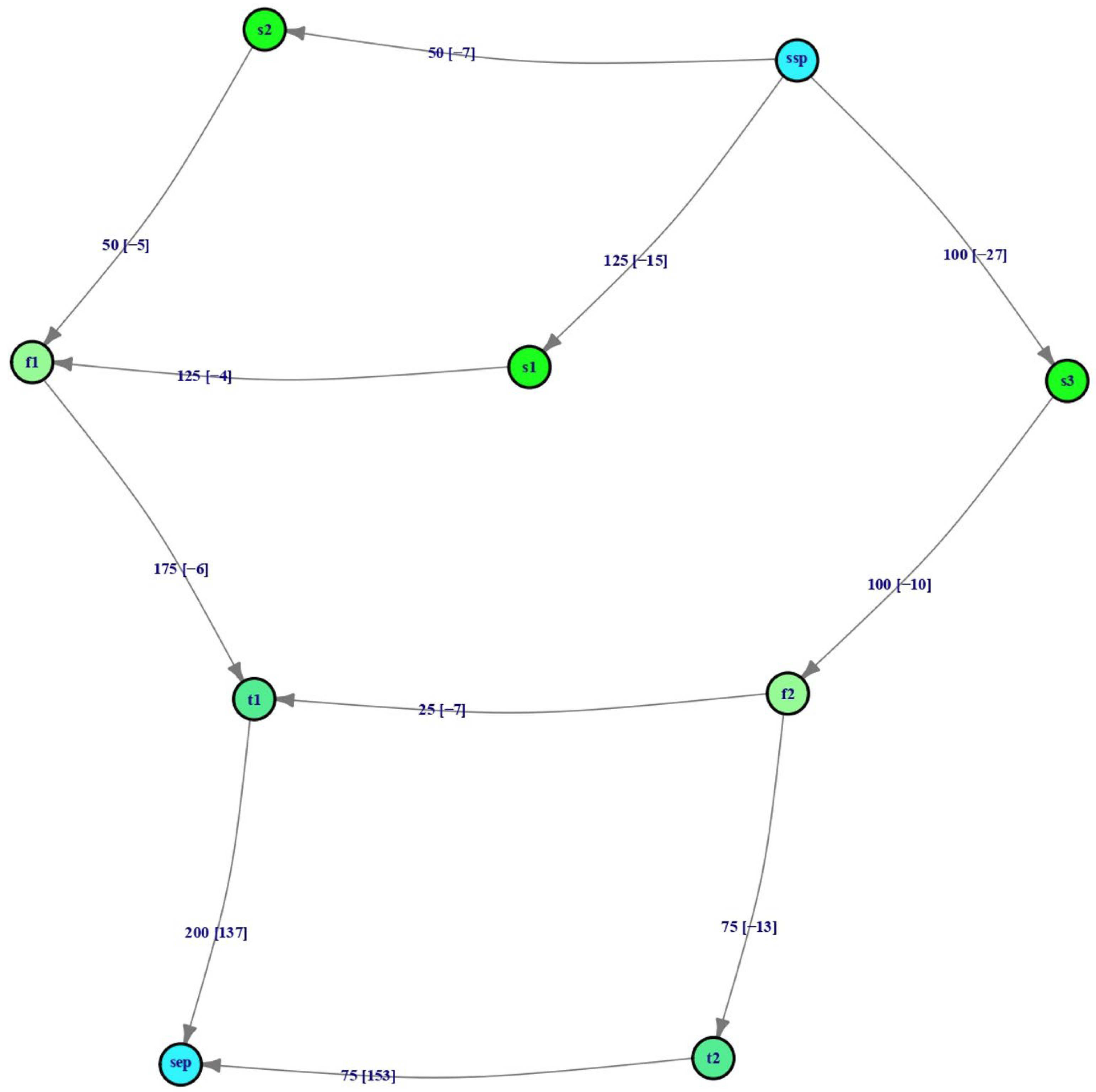
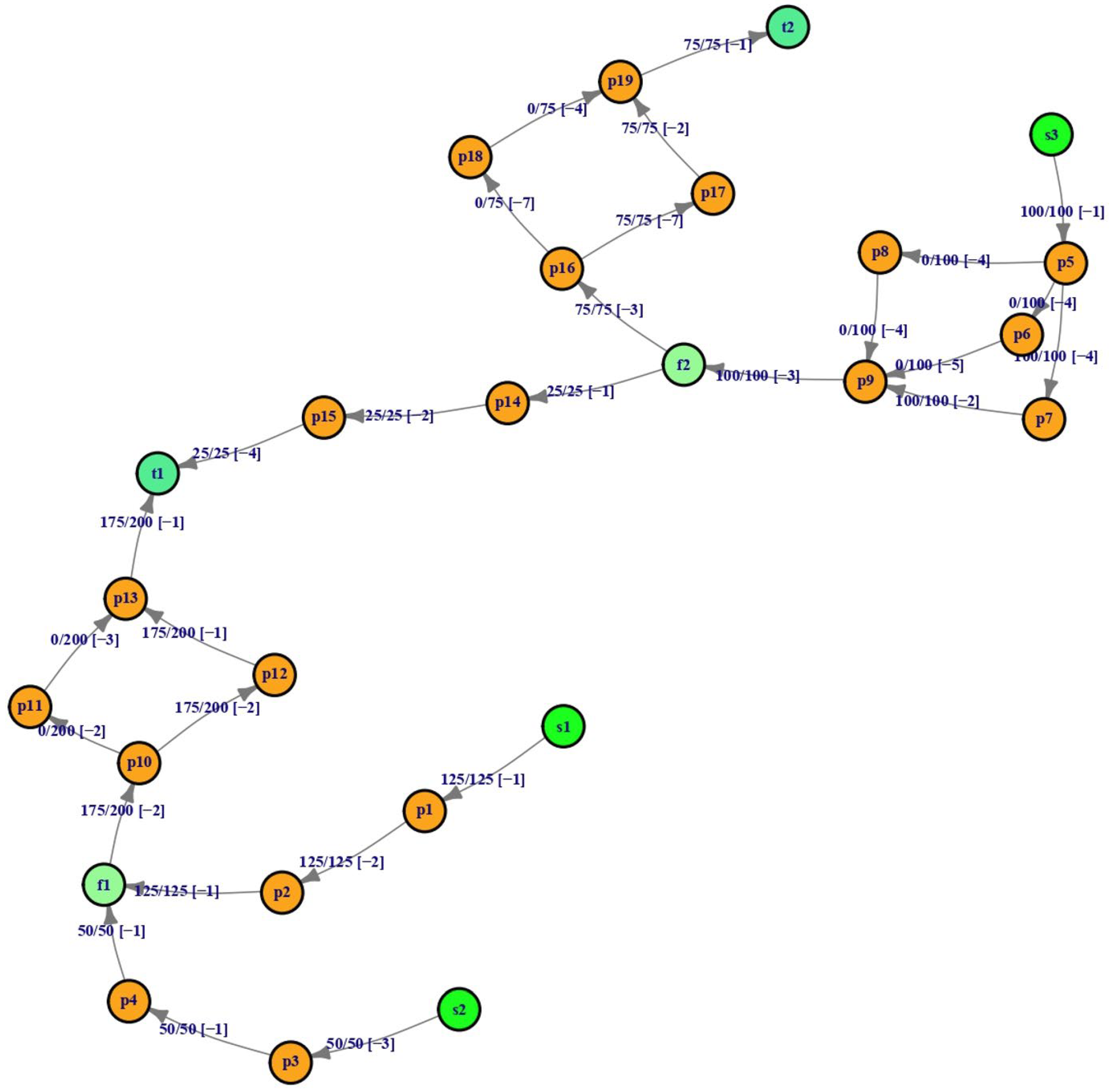
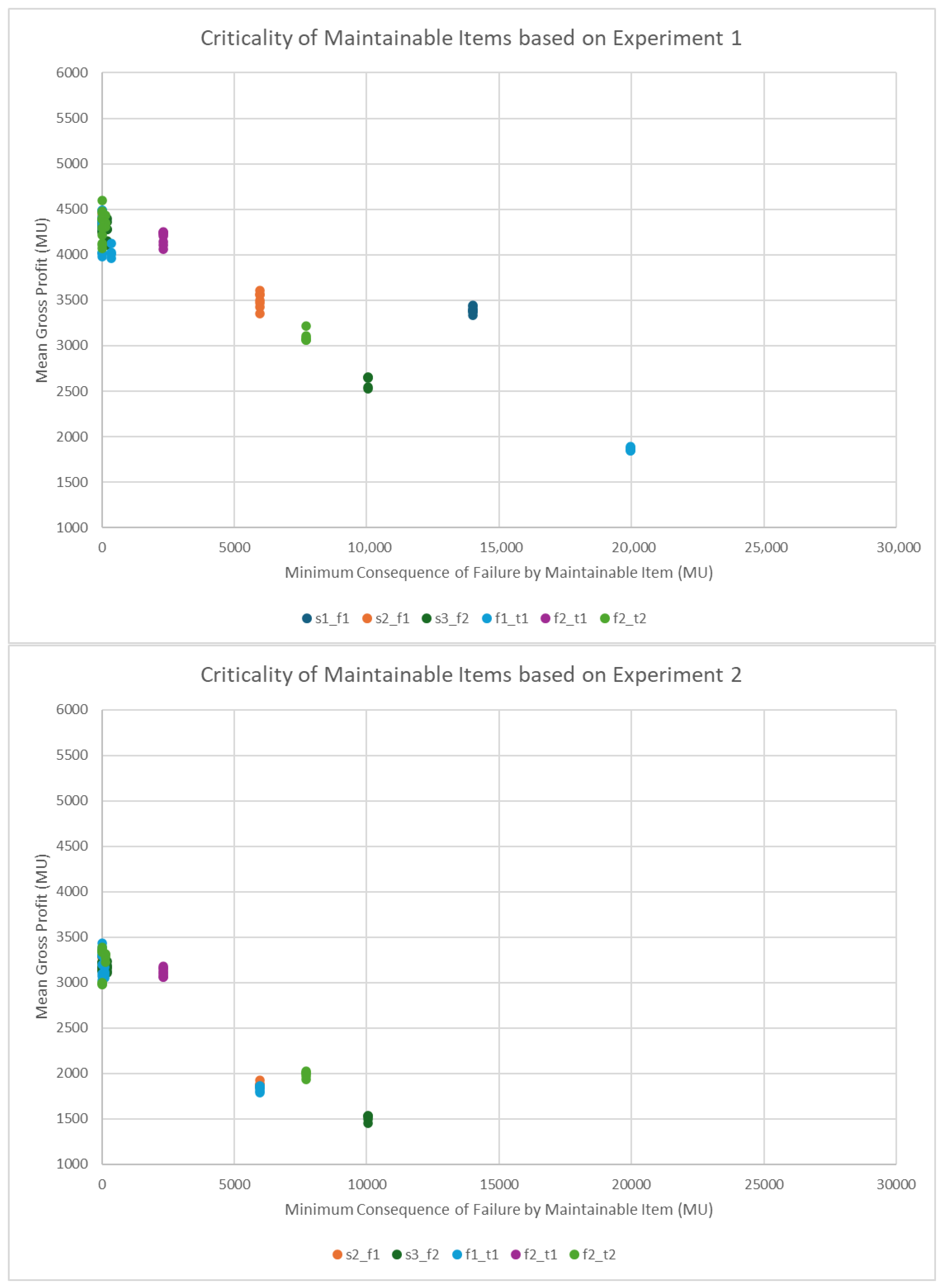
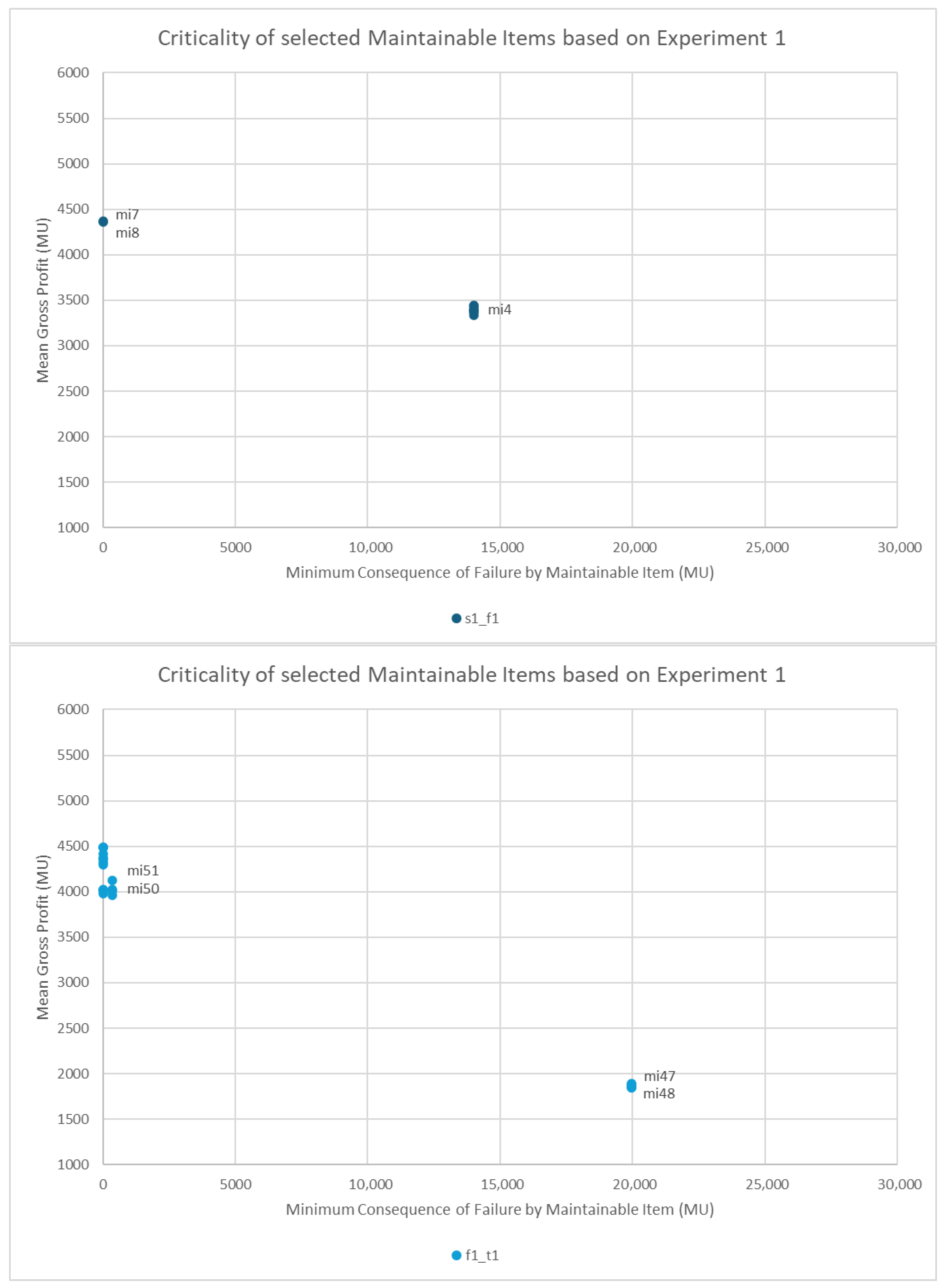
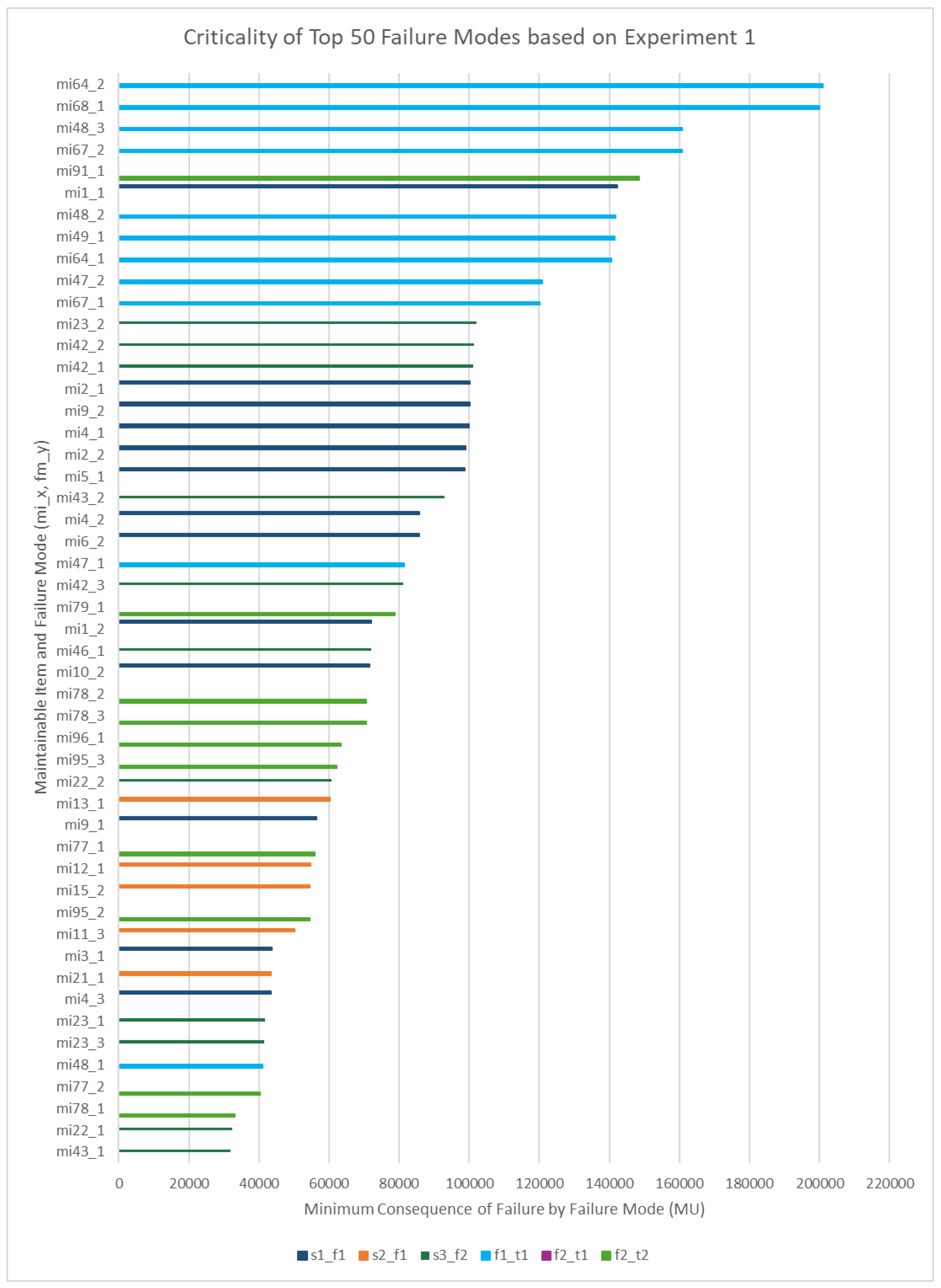
- Experiment 1 (E1): Baseline configuration in which each supply node produces 1000 flow units per iteration (i.e., per shift), exceeding downstream capacity and removing supply-side constraints.
- Experiment 2 (E2): Flow from supply node s1 (i.e., FL link s1_ssp) is set to zero flow units per iteration, effectively removing FL link s1_f1, with all other conditions matching E1.
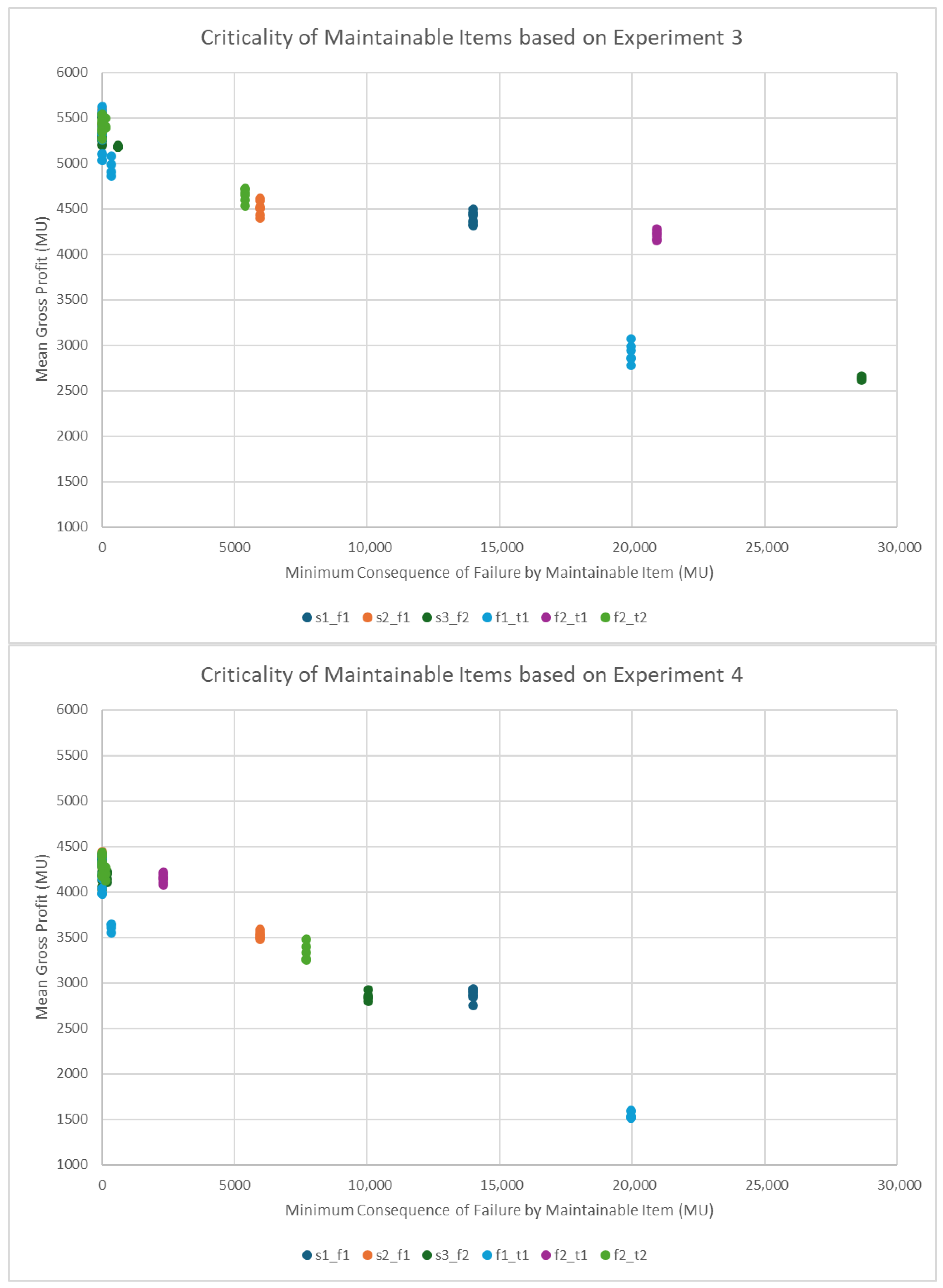
- Experiment 3 (E3): PL link capacities under FL links s3_f2 and f2_t1 are increased to 300 and 250 flow units per iteration, respectively, representing threefold and tenfold capacity increases, with all other inputs unchanged from E1.
- Experiment 4 (E4): Identical to E1 in topology, supply, and capacity, but with randomly generated FM parameters.

4.1. Model Inputs
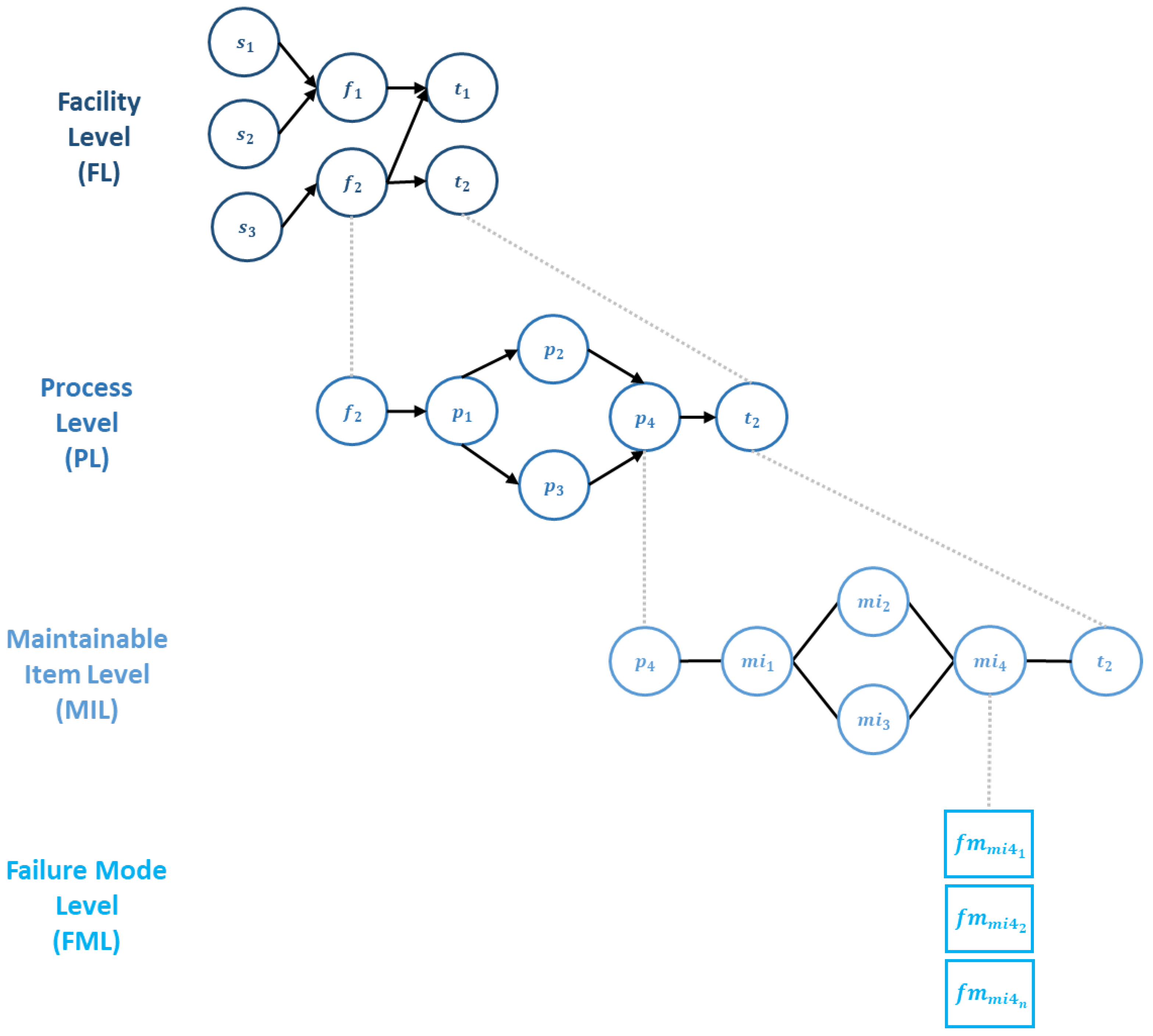
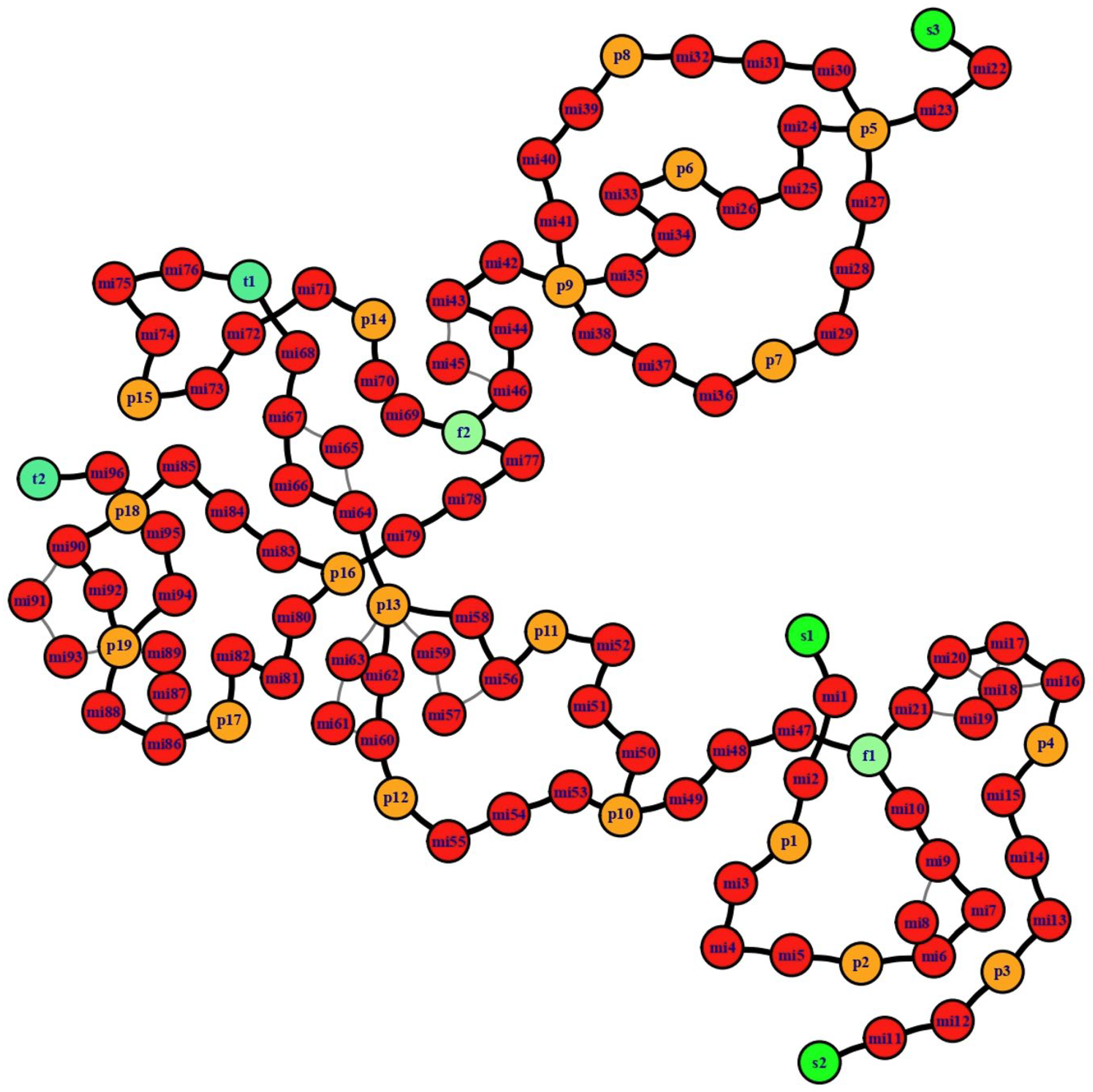
- Adjacency matrices at the FL, PL, and MIL;
- Capacity and cost matrices at the PL;
- Source node cost rates and sink node revenue rates;
- Outbound inventory limits at FL or PL nodes (set to zero);
- Inbound inventory limits at MIL nodes (set to infinity);
- For each MI:
- o
- FMs;
- o
- Shape and scale parameters for each FM in terms of flow units enabled;
- o
- MTTRu, MCu, and SEIC values for each FM.
4.2. Simulation Process
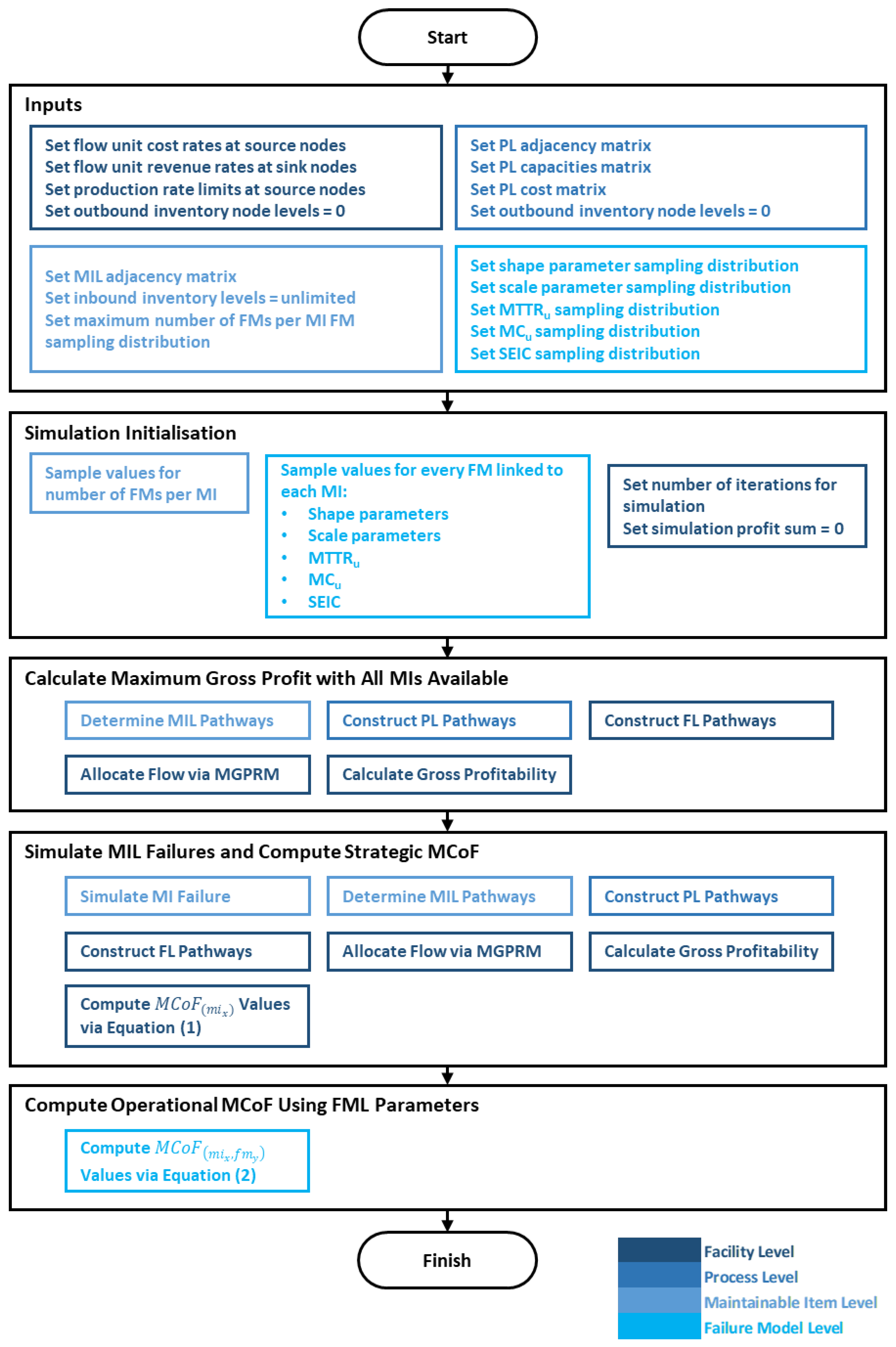
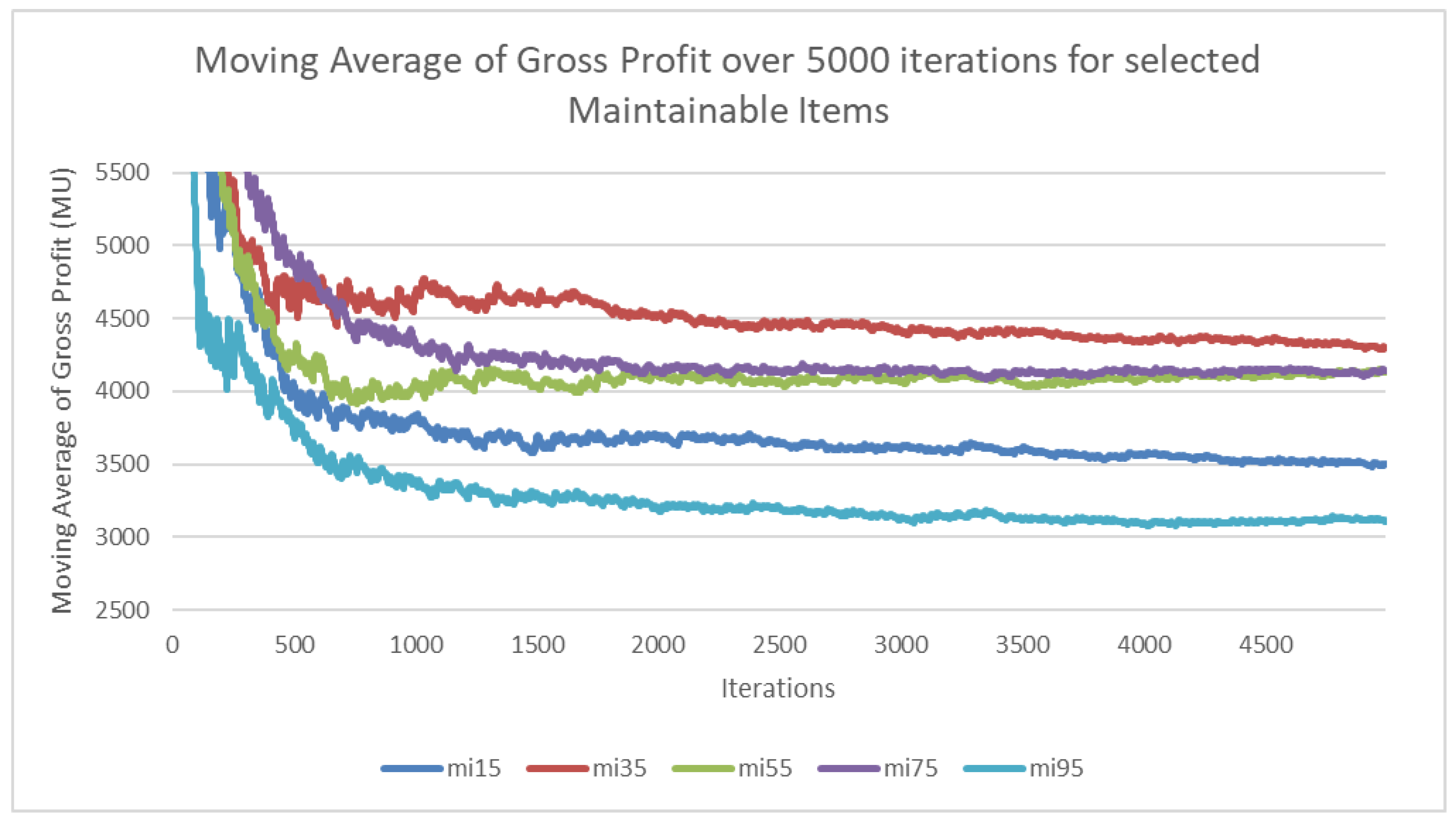
- Step 1—Simulation InitialisationThe number of simulation iterations per run is defined and fixed. For each simulation run, all FM-related random variables (e.g., shape, scale, MTTRu, MCu, SEIC) are fixed, ensuring consistency across iterations.
- Step 2—Calculate Maximum Gross Profit with All MIs AvailableThe simulation is executed over a fixed number of iterations with all MIs operational. Each iteration simulates a single shift. Within each iteration:
- o
- Determine MIL PathwaysFor each PL link, available MIL pathways are evaluated using reliability block diagram (RBD) logic. The average availability of each MI () is calculated using each comprising FM’s MTBF and MTTRu:MIL pathway availability () is then calculated by chaining individual MI availabilities:MIL pathways are constructed between relevant source (sx) and sink (tx) nodes using a breadth-first search (BFS) at the MIL. The MIL pathway with the highest average availability is selected to support the PL link. If no viable pathway exists, the PL link is excluded from any potential flow allocation.
- o
- Construct PL and FL PathwaysUsing the MIL pathway enabled PL links , PL flow pathways ( between relevant nodes (treated as source (sx) and sink (tx) nodes) are constructed using a BFS. Each PL pathway’s per-unit cost () is evaluated using each comprising PL link per-unit cost :FL flow pathways are constructed between the FL source (sx) node and sink (tx) nodes by linking relevant and available PL pathways using a BFS. Each FL pathway’s per-unit cost () is evaluated using each comprising PL pathway’s per-unit cost () and the relevant source node per-unit cost () for the FL pathway:
- o
- Apply MGPRM for Flow AllocationFor each FL pathway , the per-unit gross profit () is calculated using the relevant sink t node per-unit revenue rate ():FL pathways are ranked in descending order based on the FL pathway per-unit gross profit () and flow is allocated using the MGPRM, as detailed in Ref. [11], until all process-level capacities are exhausted.
- o
- Compute Iteration-Level ProfitThe total gross profit per iteration () is computed using the allocated flow for the FL pathway () and the FL pathway per-unit gross profit ():After all iterations have been completed, the maximum gross profit is computed.
- Step 3—Simulate MIL Failures and Compute Strategic MCoFEach MI is simulated as failed and Step 2 is repeated. Based on the results of this process, the strategic MCoF ( is calculated using Equation (1).
- Step 4—Compute Operational MCoF Using FML ParametersFor each FM of each MI, the operational MCoF () is calculated using Equation (2).
4.3. Key Assumptions
- No outbound inventory: All FL and PL node inventories are set to zero to emphasise the immediate effect of MI failures on flow continuity. This simplification removes buffering effects, ensuring that any reduction in flow is directly attributable to asset availability rather than inventory dynamics. It is introduced for demonstration purposes to isolate immediate systemic consequence.
- Unlimited inbound inventory: MIL nodes assume infinite input availability, ensuring that flow constraints arise only from MI availability rather than equipment supply limitations. By eliminating supply constraints, the analysis focuses exclusively on capacity limitations introduced by MI behaviour. This is a demonstration-oriented assumption that isolates equipment-driven effects.
- Perfect maintenance effectiveness: Repairs are assumed to fully restore failed MIs to a good-as-new condition, with no accumulation of degradation. Assuming good-as-new restoration prevents cumulative degradation from influencing results, providing a clear baseline for evaluating consequence. This simplification supports interpretability rather than defining a methodological requirement.
- Fixed inputs per run: Random variables associated with failure mode behaviour (e.g., shape, scale, MTTRu, MCu, SEIC) are sampled once and remain fixed within each simulation run. Holding stochastic parameters constant within each run isolates structural variability from sampling noise, improving comparability between scenarios. This assumption supports methodological clarity in consequence estimation.
- Deterministic and optimal flow allocation: Flow allocation within each iteration is performed deterministically and optimally using the MGPRM. Ensuring optimal allocation establishes a performance frontier against which consequence is measured, making this a methodological assumption inherent to the FACE logic rather than a case-specific simplification.
- Isolated failures: Each simulation evaluates the failure of a single MI at a time when computing MCoF values, avoiding compounding failure effects. Evaluating one MI at a time enables marginal consequence attribution without interaction effects. This is a methodological design choice that defines how MCoF is computed.
- Fixed topology: The structural topology of the CRFN is held constant across all experiments. Maintaining a constant network structure ensures that performance variation reflects parameter changes rather than redesign effects. This assumption supports controlled evaluation within the illustrative case.
- Push-based flow logic: Simulations mimic push-based flow driven by source availability. Modelling push-based operation aligns the example with capacity-driven production systems and reflects the current scope of the methodology. Extension to pull-based systems driven by sink demand represents a future methodological development.
- Unconstrained maintenance resources: Maintenance actions are assumed to have sufficient labour and budget availability. Assuming sufficient maintenance capacity removes scheduling constraints, allowing consequence to be evaluated independently of organisational limitations. This is primarily a demonstration simplification to isolate failure impact.
5. Analysis of the Illustrative Example Study Simulation Results
5.1. Strategic Maintenance Analysis: MI Criticality
5.2. Operational Maintenance Analysis: FM Criticality
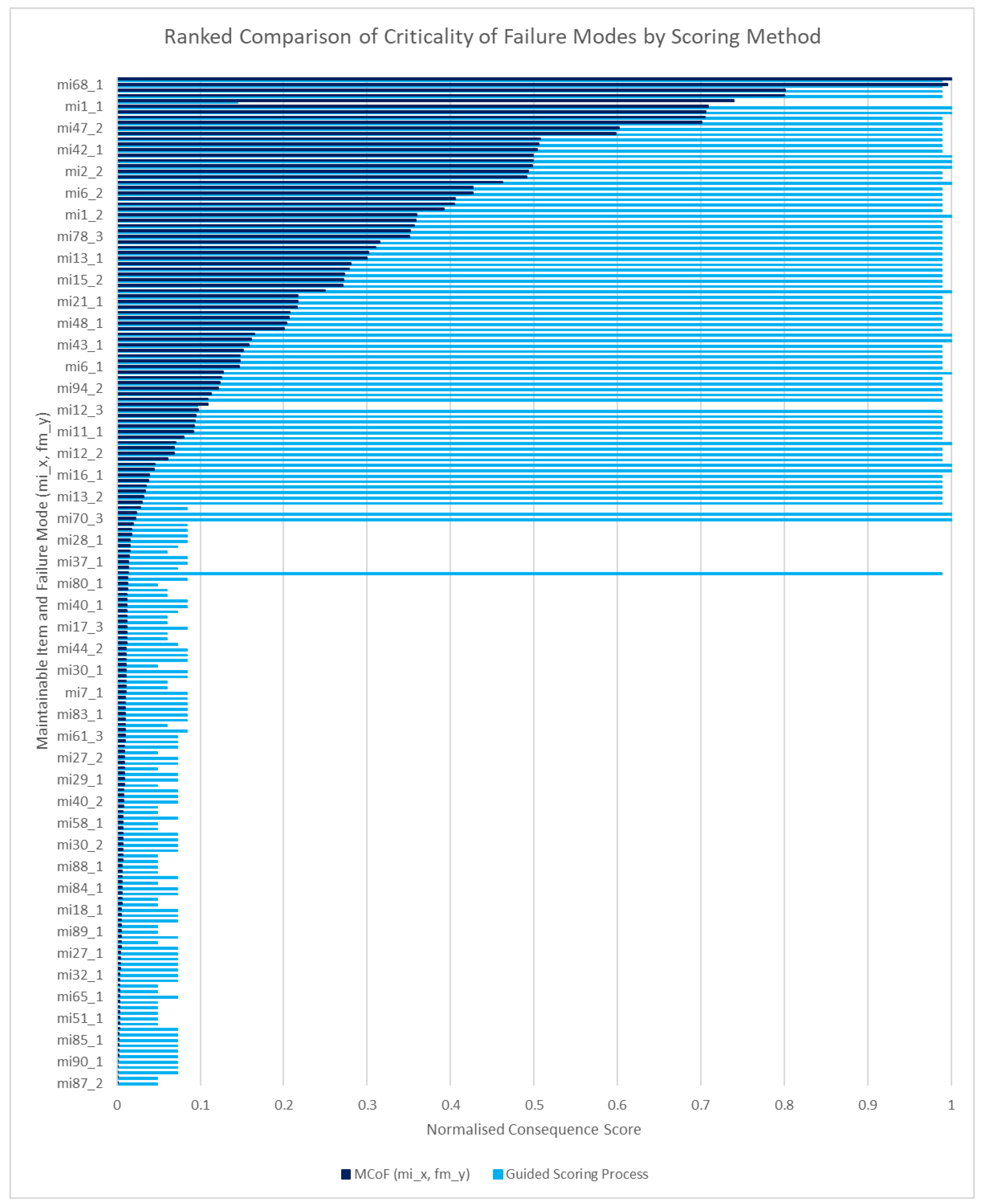
5.3. Comparison of Application Outputs: FACE vs. Guided Scoring Process

5.4. Soundness of Consequence-Based Criticality Without Probability
5.5. Computational Considerations and Scalability
6. Conclusions and Recommendations for Future Work
Author Contributions
Funding
Data Availability Statement
Conflicts of Interest
Abbreviations
| BFS | Breadth First Search |
| CRFN | Complex Repairable Flow Network |
| CRFNMF | Complex Repairable Flow Network Modelling Framework |
| FACE | Flow-Based Asset Criticality Evaluation Methodology |
| FL | Facility Level |
| FN | Flow Network |
| FML | Failure Mode Level |
| fx | Facility Level Inventory (or Intermediate) Node |
| FM | Failure Mode |
| fmy | Failure Mode (Specific) |
| KPI | Key Performance Indicator |
| MGPRM | Maximised Gross Profit Ranking Method |
| MCoF | Minimum Consequence of Failure |
| MI | Maintainable Item |
| MIL | Maintainable Item Level |
| MTBF | Mean Time between Failures |
| MTTR | Mean Time to Repair |
| MTTRu | Unplanned Mean Time to Repair |
| mix | Maintainable Item Node |
| mix_fmy | Maintainable Item Node-Specific Failure Mode |
| MC | Maintenance Cost |
| MCu | Unplanned Maintenance Cost |
| MU | Monetary Unit |
| OF | Operational Flexibility |
| OI | Operational Impact |
| PL | Process Level |
| px | Process Level Inventory (or Intermediate) Node |
| RBD | Reliability Block Diagram |
| RCM | Reliability-Centred Maintenance |
| RFN | Repairable Flow Network |
| ROI | Return on Investment |
| RPN | Risk Priority Number |
| SEI | Safety and Environmental Impact |
| SEIC | Safety and Environmental Impact Cost |
| SFN | Stochastic Flow Network |
| sep | Simulation End Point Node |
| ssp | Simulation Start Point Node |
| sx | Source Node |
| tx | Sink Node |
References
- Yeh, C.T.; Lin, Y.K.; Yang, J.Y. Network reliability maximization for stochastic-flow network subject to correlated failures using genetic algorithm and tabu search. Eng. Optim. 2018, 50, 1212–1231. [Google Scholar] [CrossRef]
- Todinov, M.T. Algorithms for minimising the lost flow due to failed components in repairable flow networks with complex topology. Int. J. Reliab. Saf. 2012, 6, 283–310. [Google Scholar] [CrossRef]
- Shaheen, B.W.; Németh, I. Integration of maintenance management system functions with industry 4.0 technologies and features—A review. Processes 2022, 10, 2173. [Google Scholar] [CrossRef]
- Geisbush, J.; Ariaratnam, S.T. Reliability centered maintenance (RCM): Literature review of current industry state of practice. J. Qual. Maint. Eng. 2023, 29, 313–337. [Google Scholar] [CrossRef]
- Selvik, J.T.; Aven, T. A framework for reliability and risk centered maintenance. Reliab. Eng. Syst. Saf. 2011, 96, 324–331. [Google Scholar] [CrossRef]
- Gopalakrishnan, M.; Subramaniyan, M.; Skoogh, A. Data-driven machine criticality assessment–maintenance decision support for increased productivity. Prod. Plan. Control 2022, 33, 1–19. [Google Scholar] [CrossRef]
- Gopalakrishnan, M.; Skoogh, A.; Salonen, A.; Asp, M. Machine criticality assessment for productivity improvement: Smart maintenance decision support. Int. J. Product. Perform. Manag. 2019, 68, 858–878. [Google Scholar]
- Gopalakrishnan, M.; Skoogh, A. Machine criticality based maintenance prioritization: Identifying productivity improvement potential. Int. J. Product. Perform. Manag. 2018, 67, 654–672. [Google Scholar] [CrossRef]
- Hastings, N.A. Physical Asset Management: With an Introduction to ISO55000; Springer: Berlin/Heidelberg, Germany, 2015. [Google Scholar]
- Jasiulewicz–Kaczmarek, M.; Antosz, K.; Żywica, P.; Mazurkiewicz, D.; Sun, B.; Ren, Y. Framework of machine criticality assessment with criteria interactions. Eksploat. Niezawodn. 2021, 23, 207–220. [Google Scholar] [CrossRef]
- Kaliszewski, N.; Marian, R.; Chahl, J. A reliability centred maintenance-oriented framework for modelling, evaluating, and optimising complex repairable flow networks. Complex Intell. Syst. 2025, 11, 223. [Google Scholar] [CrossRef]
- Zio, E. Reliability engineering: Old problems and new challenges. Reliab. Eng. Syst. Saf. 2009, 94, 125–141. [Google Scholar] [CrossRef]
- Kaplan, S.; Garrick, B.J. On the quantitative definition of risk. Risk Anal. 1981, 1, 11–27. [Google Scholar] [CrossRef]
- Aven, T. Improving the foundation and practice of reliability engineering. Proc. Inst. Mech. Eng. Part O J. Risk Reliab. 2017, 231, 295–305. [Google Scholar] [CrossRef]
- Kobbacy, K.A.H.; Murthy, D.P. (Eds.) Complex System Maintenance Handbook; Springer Science & Business Media: London, UK, 2008. [Google Scholar]
- Deshpande, V.S.; Modak, J.P. Application of RCM to a medium scale industry. Reliab. Eng. Syst. Saf. 2002, 77, 31–43. [Google Scholar] [CrossRef]
- Psarommatis, F.; May, G.; Azamfirei, V. Envisioning maintenance 5.0: Insights from a systematic literature review of Industry 4.0 and a proposed framework. J. Manuf. Syst. 2023, 68, 376–399. [Google Scholar] [CrossRef]
- James, A.T.; Kumar, G.; Khan, A.Q.; Asjad, M. Maintenance 4.0: Implementation challenges and its analysis. Int. J. Qual. Reliab. Manag. 2023, 40, 1706–1728. [Google Scholar] [CrossRef]
- Bokrantz, J.; Skoogh, A.; Berlin, C.; Wuest, T.; Stahre, J. Smart Maintenance: An empirically grounded conceptualization. Int. J. Prod. Econ. 2020, 223, 107534. [Google Scholar] [CrossRef]
- Bokrantz, J.; Skoogh, A.; Berlin, C.; Stahre, J. Maintenance in digitalised manufacturing: Delphi-based scenarios for 2030. Int. J. Prod. Econ. 2017, 191, 154–169. [Google Scholar] [CrossRef]
- Zio, E. The future of risk assessment. Reliab. Eng. Syst. Saf. 2018, 177, 176–190. [Google Scholar] [CrossRef]
- Adams, J.; Parlikad, A.; Amadi-Echendu, J. A bibliographic review of trends in the application of ‘criticality’ towards the management of engineered assets. In Asset Intelligence through Integration and Interoperability and Contemporary Vibration Engineering Technologies: Proceedings of the 12th World Congress on Engineering Asset Management and the 13th International Conference on Vibration Engineering and Technology of Machinery; Springer International Publishing: Cham, Switzerland, 2018; pp. 11–21. [Google Scholar]
- Adams, J.; Srinivasan, R.; Parlikad, A.K.; González-Prida, V.; Crespo, A.M. Towards dynamic criticality-based maintenance strategy for industrial assets. IFAC-PapersOnLine 2016, 49, 103–107. [Google Scholar] [CrossRef]
- Lopes, I.; Figueiredo, M.; Sá, V. Criticality Evaluation to Support Maintenance Management of Manufacturing Systems. Int. J. Ind. Eng. Manag. 2020, 11, 3–18. [Google Scholar]
- Tang, Y.; Liu, Q.; Jing, J.; Yang, Y.; Zou, Z. A framework for identification of maintenance significant items in reliability centered maintenance. Energy 2017, 118, 1295–1303. [Google Scholar] [CrossRef]
- Crespo Márquez, A.; Moreu de León, P.; Sola Rosique, A.; Gómez Fernández, J.F. Criticality Analysis for Maintenance Purposes: A Study for Complex In-service Engineering Assets. Qual. Reliab. Eng. Int. 2016, 32, 519–533. [Google Scholar]
- Liu, H.C.; Liu, L.; Liu, N. Risk evaluation approaches in failure mode and effects analysis: A literature review. Expert Syst. Appl. 2013, 40, 828–838. [Google Scholar] [CrossRef]
- Jaderi, F.; Ibrahim, Z.Z.; Zahiri, M.R. Criticality analysis of petrochemical assets using risk based maintenance and the fuzzy inference system. Process Saf. Environ. Prot. 2019, 121, 312–325. [Google Scholar]
- Teixeira, H.N.; Lopes, I.S.; Pires, R.N. Maintenance strategy selection: An approach based on equipment criticality and focused on components. In International Conference on Flexible Automation and Intelligent Manufacturing; Springer Nature: Cham, Switzerland, 2023; pp. 3–11. [Google Scholar]
- Melani, A.H.A.; Murad, C.A.; Netto, A.C.; de Souza, G.F.M.; Nabeta, S.I. Criticality-based maintenance of a coal-fired power plant. Energy 2018, 147, 767–781. [Google Scholar]
- Márquez, A.C. The Maintenance Management Framework: Models and Methods for Complex Systems Maintenance; Springer: London, UK, 2007. [Google Scholar]
- Ni, J.; Jin, X. Decision support systems for effective maintenance operations. CIRP Ann. 2012, 61, 411–414. [Google Scholar] [CrossRef]
- Todinov, M.T. Analysis and optimization of repairable flow networks with complex topology. IEEE Trans. Reliab. 2011, 60, 111–124. [Google Scholar] [CrossRef]
- Todinov, M.T. Flow Networks: Analysis and Optimization of Repairable Flow Networks, Networks with Disturbed Flows, Static Flow Networks and Reliability Networks; Newnes: Oxford, UK; Cambridge, MA, USA, 2013. [Google Scholar]
- Alaggio, J.; Barros, D.; Brentan, B.; Carpitella, S.; Herrera, M.; Izquierdo, J. Assessment of criticality in water distribution networks via complex network theory. Processes 2025, 13, 408. [Google Scholar] [CrossRef]
- Puleo, D.; Sinagra, M.; Picone, C.; Tucciarelli, T. Criticality Assessment of Pipes in Water Distribution Networks Based on the Minimum Pressure Criterion. Water 2025, 17, 3185. [Google Scholar] [CrossRef]
- Sitzenfrei, R.; Hajibabaei, M.; Hesarkazzazi, S.; Diao, K. Dual graph characteristics of water distribution networks—How optimal are design solutions? Complex Intell. Syst. 2023, 9, 147–160. [Google Scholar] [CrossRef] [PubMed]
- Yang, Z.; Su, H.; Du, X.; Zio, E.; Xiang, Q.; Peng, S.; Fan, L.; Faber, M.H.; Zhang, J. Supply resilience assessment of natural gas pipeline network systems. J. Clean. Prod. 2023, 385, 135654. [Google Scholar] [CrossRef]
- Forghani-elahabad, M.; Yeh, W.C. An improved algorithm for reliability evaluation of flow networks. Reliab. Eng. Syst. Saf. 2022, 221, 108371. [Google Scholar] [CrossRef]
- Yeh, C.T.; Lin, Y.K.; Yeng, L.C.L.; Huang, P.T. Reliability evaluation of a multistate railway transportation network from the perspective of a travel agent. Reliab. Eng. Syst. Saf. 2021, 214, 107757. [Google Scholar] [CrossRef]
- Niu, Y.F.; Xu, X.Z.; He, C.; Ding, D.; Liu, Z.Z. Capacity reliability calculation and sensitivity analysis for a stochastic transport network. IEEE Access 2020, 8, 133161–133169. [Google Scholar] [CrossRef]
- Yu, W.; Gong, J.; Song, S.; Huang, W.; Li, Y.; Zhang, J.; Hong, B.; Zhang, Y.; Wen, K.; Duan, X. Gas supply reliability analysis of a natural gas pipeline system considering the effects of underground gas storages. Appl. Energy 2019, 252, 113418. [Google Scholar] [CrossRef]
- Praks, P.; Kopustinskas, V.; Masera, M. Monte-Carlo-based reliability and vulnerability assessment of a natural gas transmission system due to random network component failures. Sustain. Resilient Infrastruct. 2017, 2, 97–107. [Google Scholar] [CrossRef]
- Praks, P.; Kopustinskas, V.; Masera, M. Probabilistic modelling of security of supply in gas networks and evaluation of new infrastructure. Reliab. Eng. Syst. Saf. 2015, 144, 254–264. [Google Scholar] [CrossRef]
- Chen, X. Critical nodes identification in complex systems. Complex Intell. Syst. 2015, 1, 37–56. [Google Scholar] [CrossRef]
- Kozyra, P.M. The usefulness of (d, b)-MCs and (d, b)-MPs in network reliability evaluation under delivery or maintenance cost constraints. Reliab. Eng. Syst. Saf. 2023, 234, 109175. [Google Scholar] [CrossRef]
- Niu, Y.F. Performance measure of a multi-state flow network under reliability and maintenance cost considerations. Reliab. Eng. Syst. Saf. 2021, 215, 107822. [Google Scholar] [CrossRef]
- Yeh, W.C. Multistate network reliability evaluation under the maintenance cost constraint. Int. J. Prod. Econ. 2004, 88, 73–83. [Google Scholar] [CrossRef]
- Chang, P.C. Theory and applications of an integrated model for capacitated-flow network reliability analysis. Comput. Ind. Eng. 2022, 164, 107877. [Google Scholar] [CrossRef]
- Yang, X.; He, Y.; Zhou, D.; Zheng, X. Mission reliability–centered maintenance approach based on quality stochastic flow network for multistate manufacturing systems. Eksploat. Niezawodn. 2022, 24, 455–467. [Google Scholar] [CrossRef]
- Chang, P.C.; Huang, D.H.; Lin, Y.K.; Nguyen, T.P. Reliability and maintenance models for a time-related multi-state flow network via d-MC approach. Reliab. Eng. Syst. Saf. 2021, 216, 107962. [Google Scholar] [CrossRef]
- Moubray, J. Reliability-Centered Maintenance; Industrial Press Inc.: South Norwalk, CT, USA, 2001. [Google Scholar]


Disclaimer/Publisher’s Note: The statements, opinions and data contained in all publications are solely those of the individual author(s) and contributor(s) and not of MDPI and/or the editor(s). MDPI and/or the editor(s) disclaim responsibility for any injury to people or property resulting from any ideas, methods, instructions or products referred to in the content. |
© 2026 by the authors. Published by MDPI on behalf of the International Institute of Knowledge Innovation and Invention. Licensee MDPI, Basel, Switzerland. This article is an open access article distributed under the terms and conditions of the Creative Commons Attribution (CC BY) license.
Share and Cite
Kaliszewski, N.; Marian, R.; Chahl, J. Evaluating Maintainable Asset Criticality in Production Systems via a Network-Level, Consequence-Based Profitability Framework Enabled by Complex Repairable Flow Network Simulation. Appl. Syst. Innov. 2026, 9, 56. https://doi.org/10.3390/asi9030056
Kaliszewski N, Marian R, Chahl J. Evaluating Maintainable Asset Criticality in Production Systems via a Network-Level, Consequence-Based Profitability Framework Enabled by Complex Repairable Flow Network Simulation. Applied System Innovation. 2026; 9(3):56. https://doi.org/10.3390/asi9030056
Chicago/Turabian StyleKaliszewski, Nicholas, Romeo Marian, and Javaan Chahl. 2026. "Evaluating Maintainable Asset Criticality in Production Systems via a Network-Level, Consequence-Based Profitability Framework Enabled by Complex Repairable Flow Network Simulation" Applied System Innovation 9, no. 3: 56. https://doi.org/10.3390/asi9030056
APA StyleKaliszewski, N., Marian, R., & Chahl, J. (2026). Evaluating Maintainable Asset Criticality in Production Systems via a Network-Level, Consequence-Based Profitability Framework Enabled by Complex Repairable Flow Network Simulation. Applied System Innovation, 9(3), 56. https://doi.org/10.3390/asi9030056