

Mechatronic Reference Model for Innovation: Connecting Complex Design to Business Issues Through the Concepts of Cycles and Revisions


Abstract
1. Introduction
2. Method of Developing the Reference Model
2.1. General Research Method
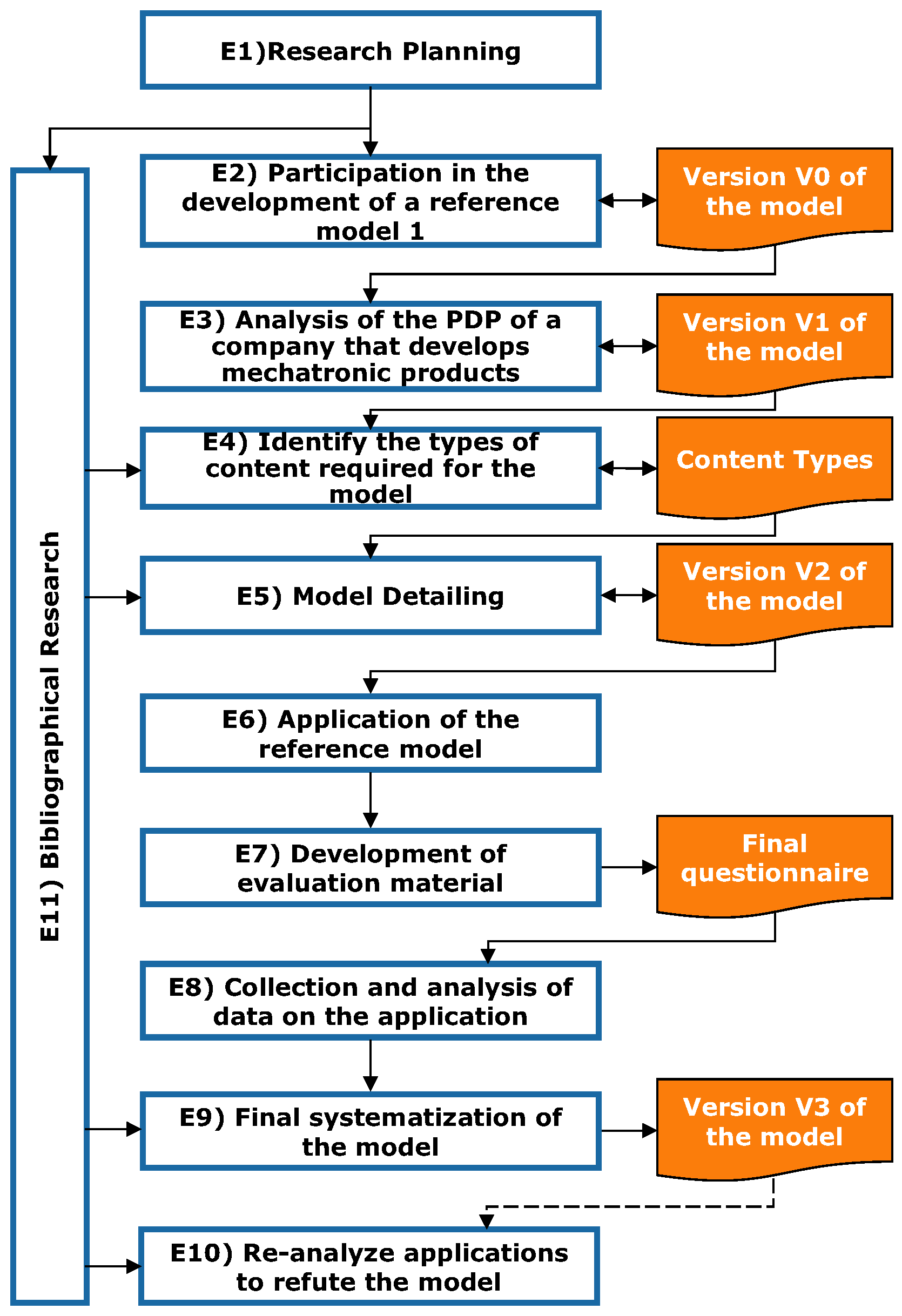
2.2. Methodology for Creating the MRM4i
2.3. Methodology for the Present Article
3. Reference Models for the Mechatronic New Product Development Process
3.1. Content Types of Reference Models for NPD and Mechatronics

| Author Analyzed | Model Feature |
|---|---|
| [46] | Pioneer in presenting the NPD. Prior to his studies, the authors focused solely on engineering design methodology. His model is based on phases, activities, and inputs/outputs. |
| [47] | Systematization of the methodology of mechanical projects, focused on machine design. Exponent of the German School of engineering design. The model is based on activities, design principles, and inputs/outputs. |
| [48] | The first global study on NPD focused on the automotive industry. The authors developed several theories that remain in use today. The model is based on activities, information, and organizational structure. |
| [49] | Both authors were Professors at Harvard Business School. They developed aspects of linking product strategy with the design-build-test cycle and detailed elements of NPD organization. |
| [50] | Professor of design in England. His proposal is a model based on activities and decisions. It details a large set of NPD tools. It also addresses style and creativity in NPD. |
| [51] | MIT professor with a strong industry connection. The model employs a stage-gate approach, focusing on activities, inputs, outputs, and decision points. It employs an Extended Quality Function Deployment (QFD) to translate specifications and NPD activities. |
| [52] | MIT researchers and professors. They developed a stage-gate model in a format that compiles contributions from the above authors. The NPD is activity-based and incorporates the first exemplary contributions to NPD project management, including the Design Structure Matrix (DSM). |
| [53] | The authors, professors at the University of Tokyo, proposed that NPD is a knowledge-creation process. They developed a model based on knowledge-creation activities and knowledge conversion processes, with organizational enablers. |
| [54,55] | The model is based on the information flow required to produce the product. The author proposes creating systems to support product development and presents several data models to achieve this goal. |
| [56] | Model based on phases and activities. The author, however, is known for modeling decision-making activities across the NPD gates. He is considered the father of stage-gate models. |
| [57] | It is a stage-gate model based on phases and activities, with well-defined inputs and outputs. The product design is managed using statistical methods to verify compliance with input specifications aligned with the Six Sigma quality concept. |
| [28] | The Capability Maturity Model Integration (CMMI) model is based on a set of process areas. Each process area contains activities and goals. The areas are characterized by maturity and capability levels, which represent the degree to which best-practice process management is utilized. |
| [58,59] | Douglas’s (2002) and McManus’s (2003) proposals were analyzed. Their approaches are different but complementary. The first is based on information flow to map waste, while the second proposes using NPD tools to minimize waste in NPD activities. |
| [60] | A Brazilian stage-gate model based on phases and activities. Process areas are mapped based on prior literature, organizational units, and the flow of inputs and outputs across phases. Tables present NPD tools and methods. |
| [36,61] | Chapter 7.3 of the ISO 9001 standard [35] describes the “design and development” activities. The focus is on documentation, specifically identifying which activities must be recorded in the company’s management system, along with their inputs and outputs, for process certification. |
| [62] | It presents a flow of phases and activities with defined inputs and outputs. It suggests using Failure Mode and Effects Analysis (FMEA) throughout the NPD and establishes project outputs, including quality control plans. |
| [37,63] | Establish product quality standards for medical devices. Design outputs should demonstrate that products meet safety requirements for patients and operators. The general electromedical safety standard and some collateral norms were analyzed. |
| [64,65,66] | A guide describing project management best practices compiled by the Project Management Institute (PMI). The entire Project Management effort is divided into knowledge areas (process areas), and its activities are modeled using inputs, tools, methods, and outputs. |
| [67] | The Lean Product Development System (LPDS) is based on three dimensions: Process, Skilled people, and Tools and Technology. These dimensions are based on 13 principles that center on people and continuous improvement. Techniques such as Product Development Value Stream Mapping (PDVSM) are used to support NPD analysis and improvement projects. |
| [68] | Institute of Electrical and Electronics Engineers (IEEE) standard for systems engineering activities. The model is based on the description of phases and activities. |
| [69] | An American author who studied mechatronics in Japan, he bases his model on the technological concepts of manufacturing and design integration. However, there is little description of product development activities. |
| [25] | A Danish researcher who studied mechatronic design practices in Japan. The author reports on various activities, methods, and organizational forms in Japanese mechatronic companies. |
| [70] | An English researcher compiled a comprehensive set of technologies and design principles from mechanics, electronics, and software to generate mechatronic product solutions. |
| [19] | Book by the author whose focus is on the design methodology of mechatronic systems, especially on the specification of the systems and the development of the mechatronic product concept. It also discusses aspects of user interfaces and manufacturing technology. |
| [17] | It deals with micro- and macro-level design. The micro level focuses on problem-solving in engineering design. At the macro level, the model presented the deployment of system-level requirements on the first leg and the verification and validation steps on the second leg. Each step has milestones, tasks, and results. |
3.2. Current Discussion on Reference Models in Mechatronic Design and Development
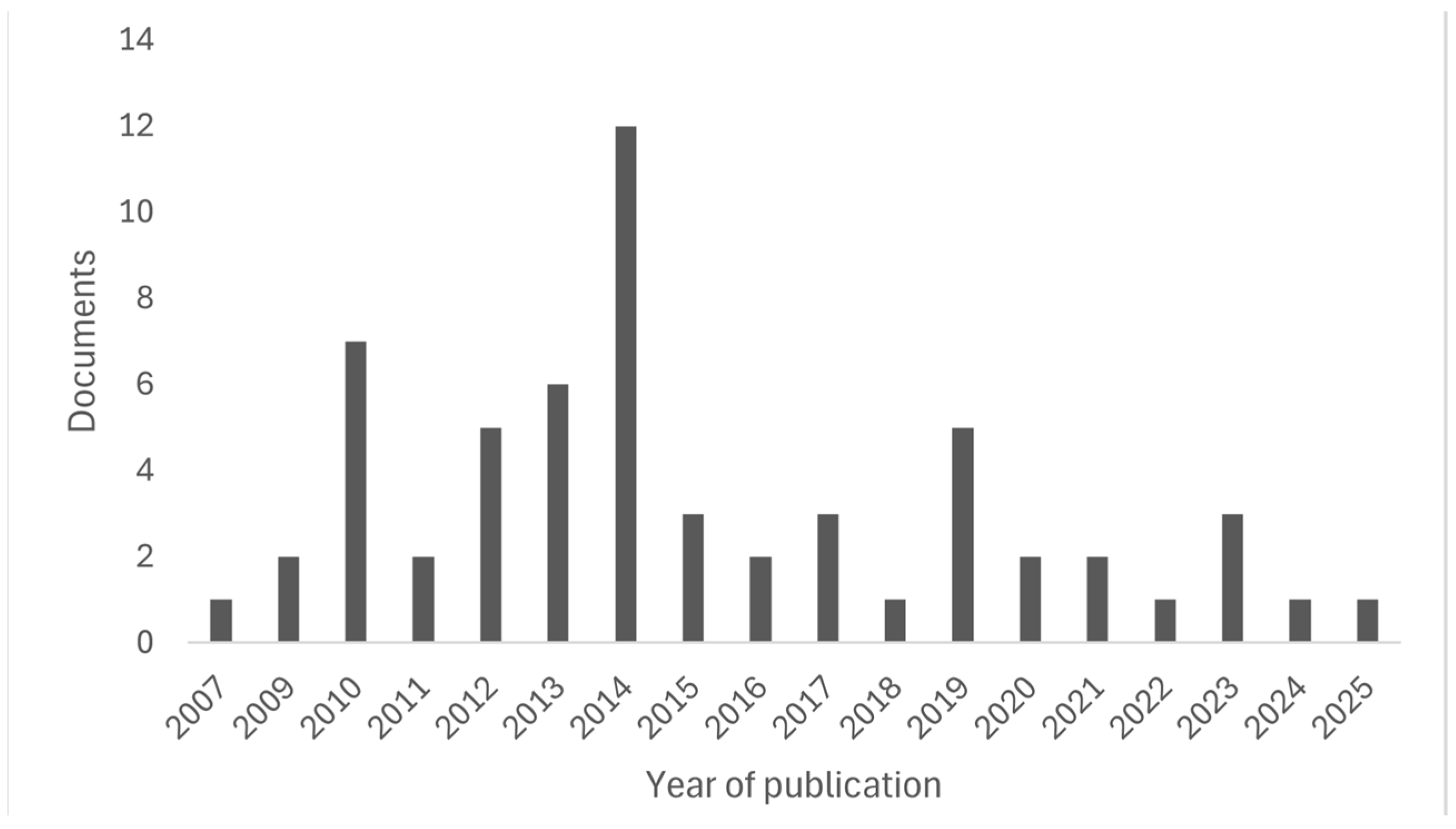
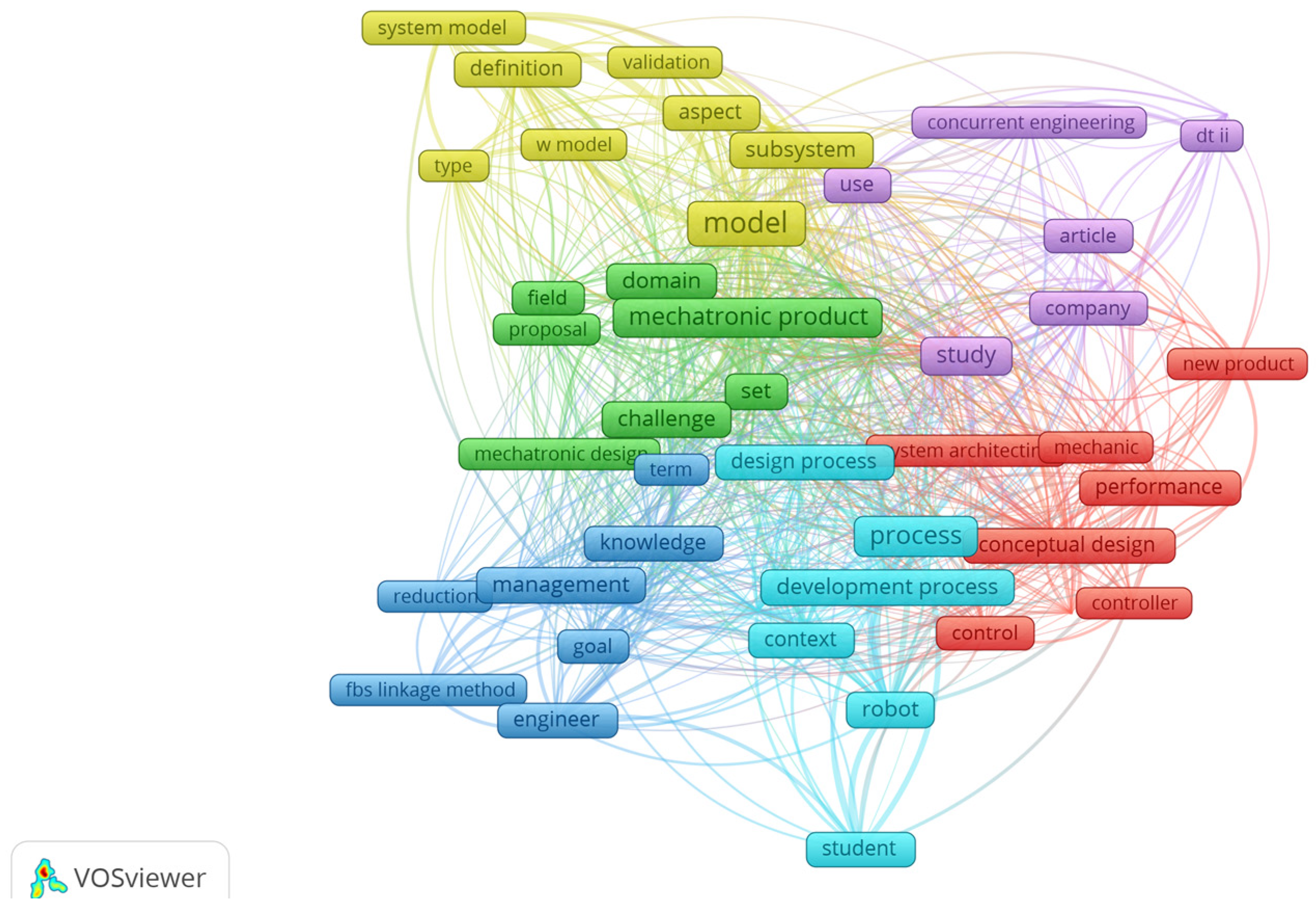
- Fundamentals and Disciplinary Integration Phase (c. 2007–2013): focused on establishing the methodological foundations and addressing the complexity inherent in multidisciplinary integration. Research during this period was characterized by conceptual discussions of mechatronics as a unifying, intelligent engineering paradigm, emphasizing the synergy among mechanics, electronics, and software [5,77,78,79]. Proposals for comprehensive process models, such as the V-model and later the W-model, emphasized continuous verification and validation throughout all technical design phases of mechatronic NPD [80]. Some authors have focused on developing mechatronic CAD frameworks and tools to support early design phases, using FBS models and emphasizing system architecture [72]. Another recurrent topic is the early identification of key challenges, such as hidden dependencies between domains and subsystems, and the need for a common language to facilitate communication between disciplines [81,82].
- Cyber–Physical Integration and Design Automation Phase (c. 2014–2019): As systems became more complex, research began to focus on automation, knowledge management, and collaborative platforms. During this period, the concept of Cyber–Physical Systems (CPS) gained prominence, marking a decisive step toward integrating physical components with computational and communication capabilities. Mechatronics is recognized as the fundamental basis of CPS and Digital Twins. Research focuses on the deep integration between the physical and digital spaces throughout the product lifecycle [83,84]. Mechatronics is fundamental to the development of CPS, enabling closer coupling among mechanical systems, sensors, control algorithms, and communication networks. This shift established the technological and conceptual foundation that would later support advancements such as Digital Twins and Industry 4.0 architectures [3].
- This phase also brings the increasing adoption of Model-Based Systems Engineering (MBSE) approaches and languages, such as System modeling Language (SysML), used to create a central “system model” serving as a single source of information throughout the entire development cycle, and the traceability of design decisions [85]. Multidisciplinary Optimization and Knowledge Management techniques were applied to capture, reuse, and optimize design decisions, reduce development cycles, and manage complexity [86,87].
- Phase of Sustainability and Human-Centered Mechatronics (c. 2020–Present): In this phase, mechatronics increasingly incorporates the principles of sustainability and human-centered design, reflecting the need to align technological innovation with social and environmental responsibility. The concern with sustainable design is acute, focusing on applying the principles of the circular economy and sound development practices, such as modularity, robustness, and remanufacturing of mechatronic products—a particular challenge given electronic obsolescence [88]. Furthermore, the incorporation of agile methodologies and design thinking is evident in the development of complex mechatronic systems, aiming to achieve greater flexibility and responsiveness to change [20,89,90]. Finally, the application of human-centered design (HCD) principles and product-service systems (PSS) in mechatronics development is highlighted, especially in sensitive areas such as digital health (e-health), where usability, reliability, and intuitive interaction are essential factors [91].
3.3. V-Model and W-Model as Mechatronic Frameworks
3.4. Research Gap Identified and Guidelines for the MRM4i Proposal
- The types of content modeled by the reference were marked with the symbol (r);
- Each author, sequentially and from left to right, had their description of each content type compared with the reference.
- In each cell of the table, empty content ( ) means that the content type was not modeled by the author identified in the respective column.
- If the author models the compared content type in more detail than the reference, the symbol (+) was introduced in the respective cell. If the content type is modeled but in less detail than the reference, the symbol (−) is used. If the reference does not model the content type discussed by the analyzed author, the symbol (+) is introduced, and this author becomes the reference for the analysis of others in the considered content type.
- The symbol (+−) means that the content type in the considered author is more detailed than in the reference, but less detailed than another author/standard analyzed.
- The symbol (−+) means that the detail is less, but some discussions add to the analysis performed by the reference on the content type.
- 1.
- NPD issues:
- Use of Cooper et al. [96] as the primary reference for decisions related to the NPD;
- Use the concept of process areas of Chrissis et al. [28] to classify the content of the model and develop the NPD diagnostic framework;
- Use of performance analysis guidelines from Clark and Fujimoto [48] as the basis for creating the measurement framework for the model’s results.
- 2.
- Mechatronic-based issues:
- Use the V-Model and variances as a reference to integrate the complex connecting demands of mechanics, electronics, and software, and their validation process, with the other concepts of NPD in mechatronics.
4. Mechatronic Reference Model (MRM4i)
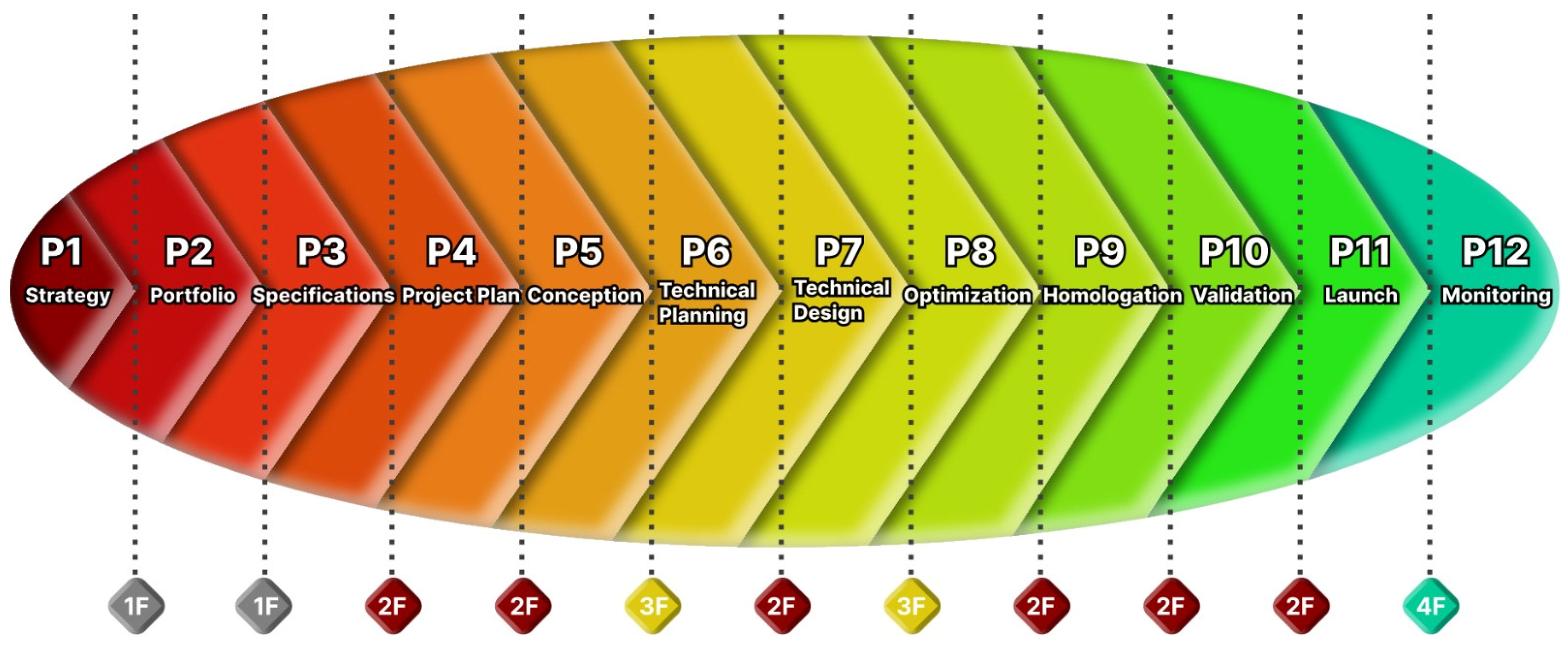
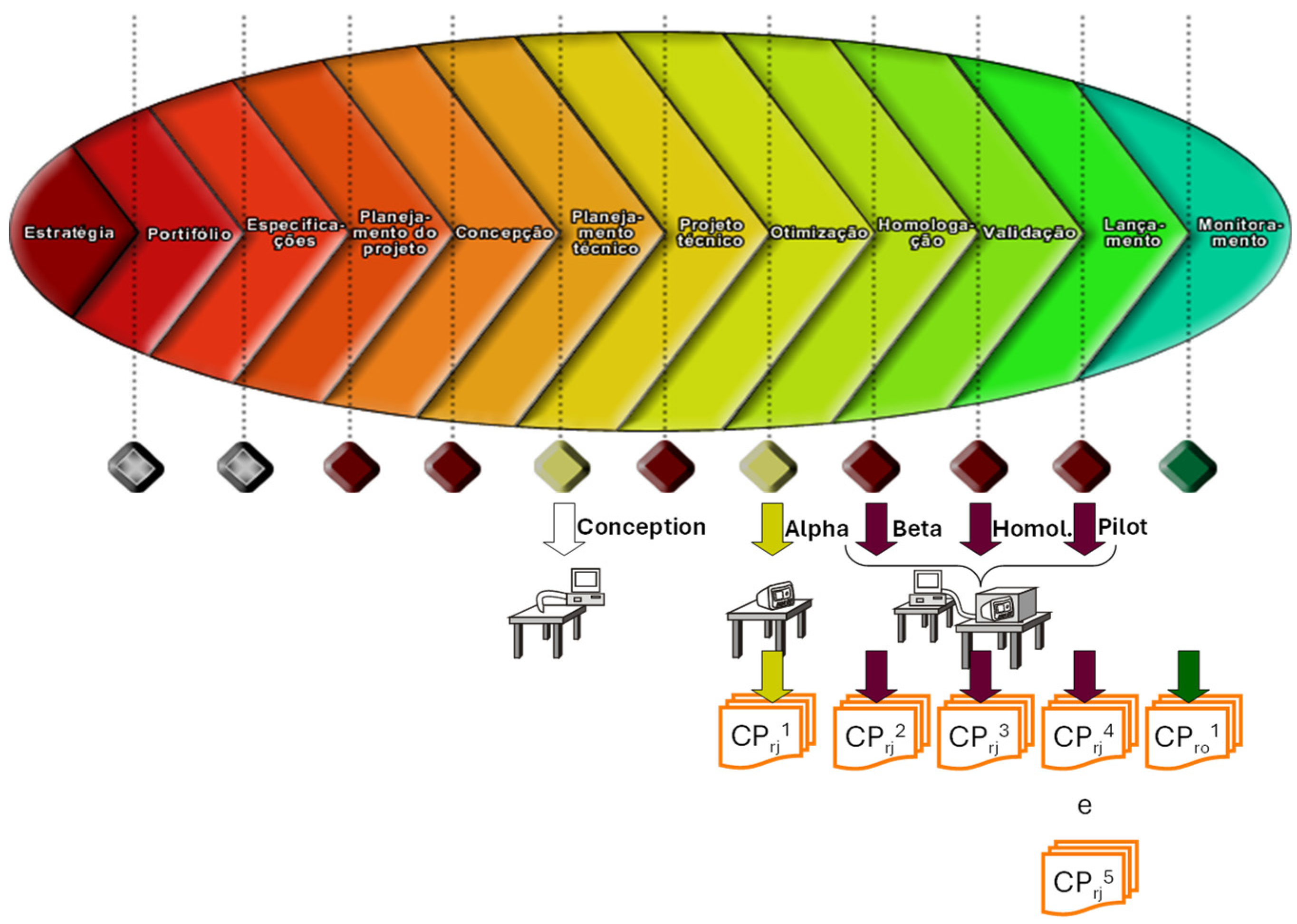
- Strategy: definition of the strategic objectives to be pursued in each product line (PL). Generates a document called “product strategy”.
- Portfolio: definition of the portfolio of each PL. Document: “product portfolio”. The product portfolio, unlike the product strategy, is a list of current and proposed projects within a product line. It is also classified using a company-specific scoring model, financial expectations for each product, and a balancing analysis of the entire product line, with and without the planned portfolio. The “product portfolio” document presents a prioritized list based on the analysis outlined above.
- Specifications: define specifications. Document: “product specifications”. Before this phase, we do not focus on the product under development; instead, we make general decisions about the entire set of products a company delivers. To start the specifications phase, the previous “product portfolio” document presents a business case, statement of work, or market opportunity description to guide the specification effort.
- Project planning: definition of the project plan. Document: “project plan”. This project plan focuses on defining the project manager and the core project team, identifying the primary stakeholders, and assessing risks. The full set of planning, including an executable resource plan, an acquisition plan, a definitive project team, and quality measures for the entire set of specifications, is not yet feasible. Only in the next phase, conception, will we have a technical plan specifying which functions will be implemented in which technical domain.
- Conception: definition of the main components and principles of the solution for the main functions of the mechatronic product. Document: “product conception”. The conception should not be confused with the product concept, which provides a quick overview of the product’s differences from the company’s previous offerings and compares it to other marketed products. The conception has a deep technical basis, identifying which engineering domain is responsible for each element of the primary product function. A singular characteristic of mechatronic products is that the same function can be implemented across different domains, with both positive and negative impacts. In MRM4i, these decisions must be taken in the conception phase.
- Technical planning: detailing the project plan based on the defined design. Document: “project plan (revised)”. This phase is short, and basically, it revises the project plan according to the product conception, and a set of modeling documents is generated, such as function-behavior diagrams, and software planning models like use case diagrams, class diagrams, and sequence diagrams, according to the Unified Modeling Language (UML) artifacts [102]. If, on the one hand, technical planning implements the mechatronic modeling for the new product, on the other hand, the scope artifacts, such as work breakdown structure and its dictionary (when necessary), the resulting schedule and budget, the elements of resources, stakeholders and communication, as well as the demanded acquisitions, and consequently the risks associated with the project effort, must pass thought a general review, once conceptual decisions can have changed the basic design previously planned.
- Technical design: technical solutions for the main functions of the product. Document: “Design Baseline_1”. The primary mechatronic cycle, incorporating domain-specific and integrative solutions for the product’s primary function, is running. An alpha prototype is the most effective way to verify compliance between the parameters reached for the solutions implemented on it and the specifications revised in the previous phase.
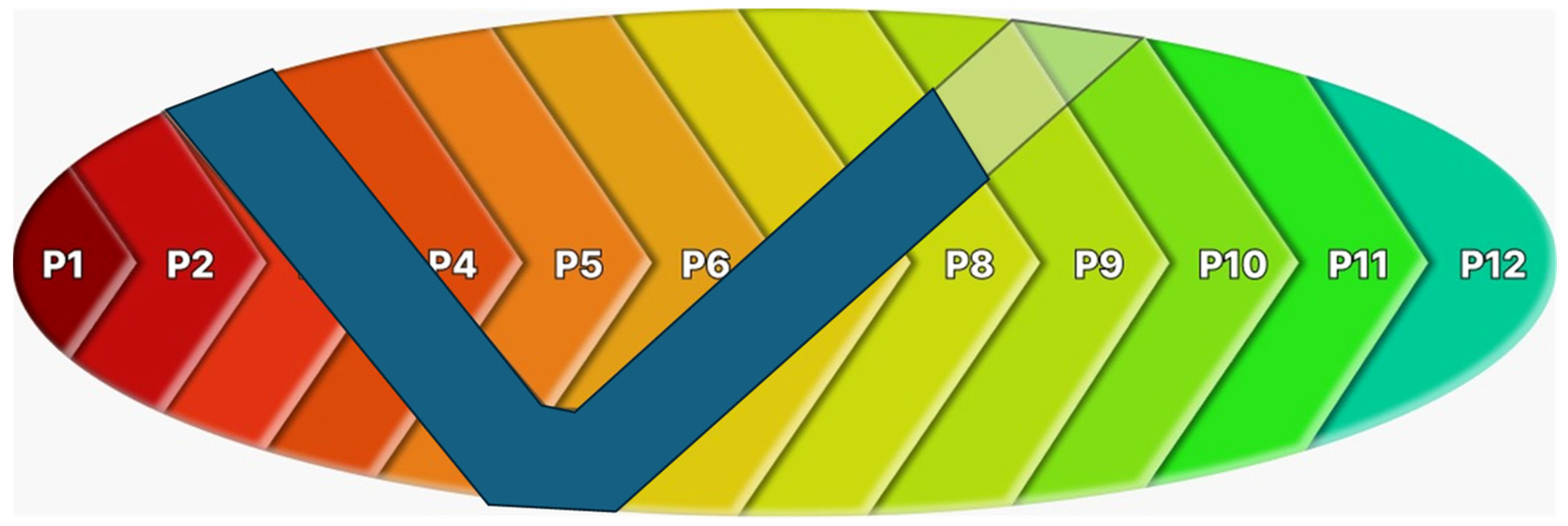
- Optimization: solutions for secondary functions and analysis necessary to increase robustness and reliability. Results in the “Design Baseline_2”. The value created in the previous phase, together with the project team’s knowledge of the design trade-offs involved in incorporating the primary product function into the specification parameters, forms the basis for the initial design of the entire product architecture. Functions such as power supply, structural design, style, human interface, and general support must be incorporated into the prototype to produce a beta version closer to the final solution. Moreover, elements of the solutions to the primary product functions can be adjusted when conducting optimization analyses, such as robust design, reliability, and failure analysis, as well as other tests to identify potential errors or anomalous behavior. As mechatronic products involve applying control theory to machines, fine-tuning is an inevitable process that can lead to changes. Most discussions on the V-Model, W-Model, and their variants focus on the technical design and optimization phases, with their predecessor activities already presented.
- Homologation: approval of the manufacturing and assembly processes of the product. Document: “Design Baseline_3”. Despite the implementation of previous phases and the availability of solutions for the entire product specifications, significant differences in manufacturing and assembly arise when solutions are produced in small batches compared with commercial production. The homologation phase focuses on aligning manufacturing and assembly processes with the goals for commercial volumes. It must, for example, fine-tune dies, clamp parts onto manufacturing machines, and plan more effective labor allocation for assembly tasks performed by less-experienced manual operators. These solutions require close collaboration between design and manufacturing professionals and are far from the V and W Model prescriptions and from mechatronic authors. These issues are better addressed in the production and industrial engineering literature, such as Boothroyd et al. [103], Clark and Fujimoto [48], Clausing [51], and, more recently, Zorowski [104]. Eventually, changes are necessary to the entire design solution, beginning with the optimization phase, thereby justifying the need for a new design baseline. Commonly, homologation requires new prototypes to train line operators, distinct from the beta prototype, which is often led by the design team.
- Validation: validation and certification, resulting in the “ Design Baseline_5”. Following the previous phase, the company has verified that the new mechatronic product can be produced at higher volumes, as identified in its business case for strategic planning. Still, mechatronic products commonly require certification for safety reasons. They have electrically powered solutions and automatically perform functions. These solutions are used in critical areas such as fly-by-wire in aeronautics, space applications that cannot be maintained, and medical and hospital applications for life support. Despite all mechatronic products having certification issues, the primary references, such as the V-Model and W-Model, do not address them. Although certification tests are considered from the NPD beginning, with product specifications developed for verification, and given that the product must have already been tested in previous phases, an accredited product must be tested in an accredited laboratory. There is a formal process for lab accreditation; consequently, a mechatronic product must be tested in these labs, where standards specialists evaluate it. Technical documents, such as user and service manuals, are also analyzed during these certification runs. Finally, after certification laboratories approve the product, it must be documented in accordance with the national board of product approval, which varies by economic sector. Typically, these boards require extensive design, manufacturing, assembly, and quality-assurance documentation to enable the product launch. The design of MRM4i enables these documents to be drafted incrementally.
- Launch: product launch. Document: “Product Baseline_configuration_1”. All documents product are consolidated in the company’s quality systems. Additionally, the commercial sector develops its folders and promotional materials to launch the product.
- Monitoring: monitoring of the results achieved with the product and management of the modifications made in the initial production configuration. Document: “Engineering changes report”. This phase extends until product recalls, decommissioning, and market withdrawal.
 ) are portfolio reviews, conducted for a specific set of products. In the strategy phase, the set is all the company’s products. All the items in the portfolio are from a specific LDP. The gates illustrated by (
 ) are business-focused decisions based on project performance indicators. The gates represented by (
 ) are technical decisions made during peer review meetings that implement the second leg of the V and W models, and gate (
 ) indicates the closure of a particular development project after the product ramp-up.
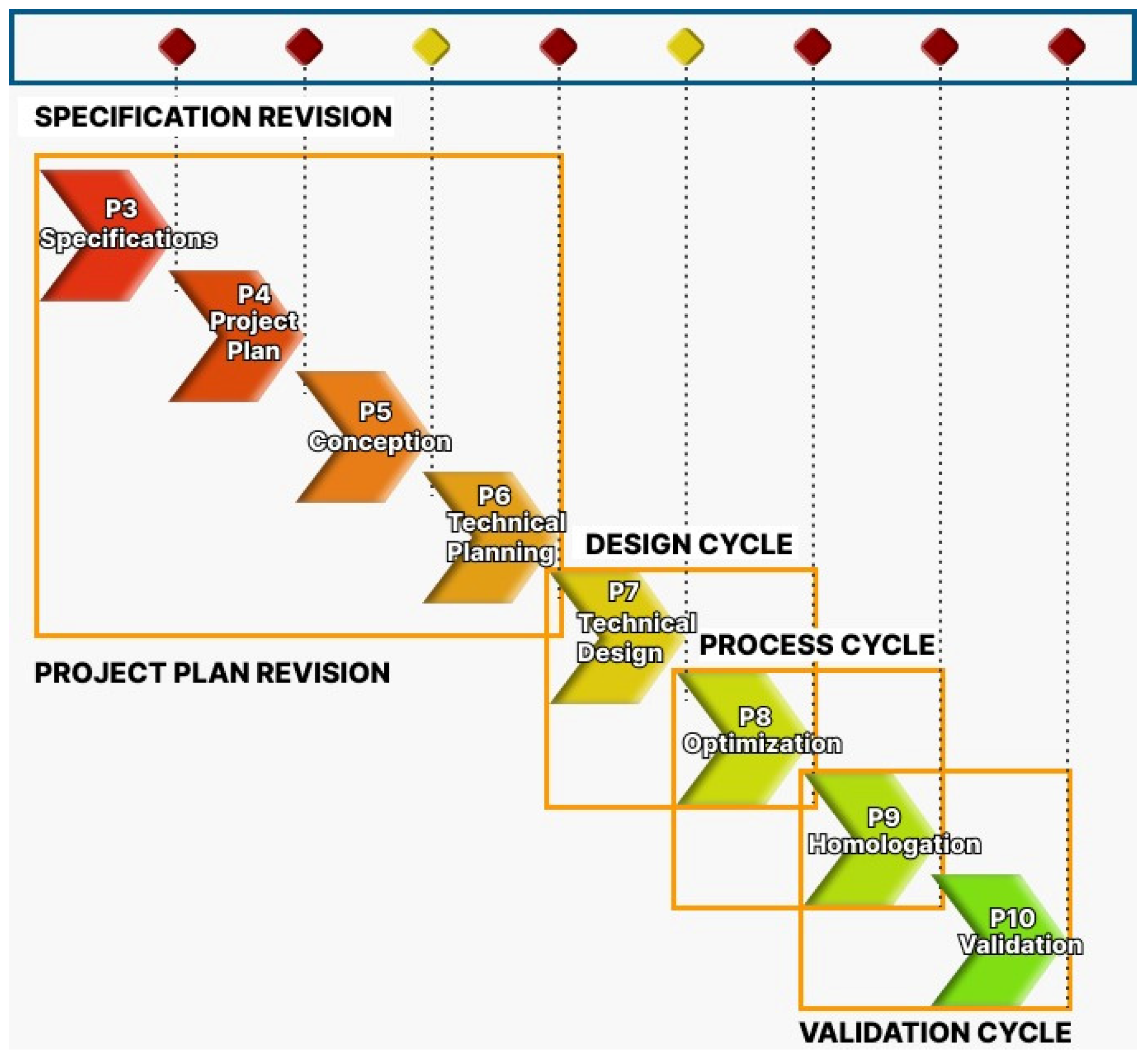
4.1. Relation to V-Models: Cycles and Technical Revisions in MRM4i
 ) in peer-review meetings. However, the architecture and its deployments require a managerial review (type
  gate) because they involve decisions regarding product modularity and platforms [107]. The product architecture includes a hardware component, in which components are specified across the entire product tree. These specifications will initiate procurement of the required materials and processes (primarily mechanical) and the analysis of datasheets for electronics and electromechanical components, including pneumatics and optomechanical solutions. On the software side, the architectural design involves producing UML artifacts, such as use cases and sequence diagrams, as well as class and entity-relationship diagrams for data structuring. All these elements in P6 represent the System, subsystem, and component design, which in MRM we call SSC deployment. The subsequent system and subsystem realizations are based on the concepts of primary and secondary functions from Pahl and Beitz and contributors, in the phases P7 and P8, respectively.
4.2. Prototypes and Configurations in MRM4i
- Conceptual prototypes—“experimental” or digital models (MATLAB, Simulink, CAD Models, etc.) used as proof-of-concept of the product regarding the main components and their physical and functional integration. That is, at least a TRL 3 prototype. It proved the concept that encompasses all primary product functions. No physical prototype is required to prove the new product’s conception.
- Alpha prototypes—used in the technical design phase to prove the effectiveness of the solutions developed for the primary functions. Once approved, MRM4i plans to freeze the “Design baseline configuration_1,” which contains solutions for the primary functions. That is a physical prototype that works in a laboratory or a minimally controlled environment. The differences between TRL 4 and TRL 5 primarily concern the relevant environment [110], but they vary significantly across product businesses. For example, in aerospace, the environmental issue has implications on the room classification (level of clean rooms), test equipment with simulations for thermal, structural, and electromagnetic stresses; but for an automotive design, it means to stress the car in a controlled circuit simulating the obstacles in a real use scene. For medical equipment, there are significant differences across relevant laboratory environments, including issues related to ethical committee enrolment. On the other hand, for a large spectrum of applications, the breadboard state, focusing on the primary functions, is more important than the environment in which it was tested. That is, the Alpha prototype can be a TRL-4 or TRL-5 solution focused on primary functions, i.e., the real differences from the following prototype.
- Beta prototypes—complete product prototypes that are used for optimization. Ultimately, the “Design baseline configuration_2” is frozen. The beta prototype is similar to those commonly utilized in the software industry where new features are launched in a “Beta version”, that is, they are ready for use, but there are myriads of possible “bugs” that only in-use applications can gather data for improvements [52], and the co-creation concept made it well-known as a development strategy for the last steps in a NPD effort [113]. Mechatronic products are often more heavily regulated than software systems, but for myriad applications, user trials are the most effective means of improving the beta prototype. In the medical, aerospace, and automotive sectors, for instance, it cannot be a useful step in an NPD effort. What is most relevant to classifying a prototype as Beta is that all functions necessary to support the design, power supply, and interfaces, as well as to pack and transport the product, are implemented and tested. Therefore, beta prototypes fall between TRL 6 and TRL 7. That is, it works in a relevant environment, and if the company wants to test the product with end users, it will do so using the beta prototype. Ultimately, all primary and secondary functions are functioning as specified.
- Homologation prototypes—used to validate the manufacturing process under normal manufacturing conditions. They are pre-production prototypes that, when approved, generate the “Design baseline configuration_3”. The TRL for homologation prototypes is TRL 8. Once the homologation phase (P9) is complete, the product design is fully supported by commercial production lines, either internally or with suppliers. There are significant differences across the manufacturing sector; for example, in aerospace, the qualification prototype is typically a single product that undergoes environmental testing in a controlled laboratory. Some tests are destructive. For medical equipment, a low batch size is used to qualify the production line for manufacturing and assembly. But for a large set of mechatronic products enabled by embedded systems, the batch size will probably be hundreds, thousands, or millions, and as these products, like common toys, educative robots, wearables in general, automated or IoT-based solutions for agriculture, livestock, forestry management, natural life monitoring, security, etc., certification is not a mandatory requirement to go to the market, and in this time, the homologation prototypes come to also be the pilot run. The most important issue is to freeze the design configuration, including all process steps necessary to manufacture the product to the same specifications as in the beta prototype.
- Pilot prototypes—pre-production prototype used together with the “Design baseline configuration_3” to validate and certify the product, after which the “Design baseline configuration_4” is generated with the final configuration of the entire product design, and manufacturing and assembly processes. One of the most difficult decisions in building the MRM4i process was the relationship between homologation (P9) and validation (P10) phases. Is it better to homologate the manufacturing process and then perform product certification, or the other way around? That is an angular decision. If a company certifies a product but it cannot be manufactured within the project cost baseline, the certification cost would be lost, and the whole effort would have to be repeated in the manufacturing and assembly processes that the company and its partners have mastered under the executable costs. If the company homologates the manufacturing and assembly processes, as well as their procurement and main suppliers, with a prototype that performs as well as the beta prototype and proceeds with certification, the possibility of major changes decreases once the whole system is under quality control parameters. That is the logic behind the phase design at the end of the engineering design in MRM4i. However, changes will occur, and a return to the process and design cycles may follow. The same reasoning applies to the customer validation process, which is also a normative process for compliance with ISO 9000 and related norms. The prototype at the end of the validation phase is a TRL-9 product, ready for market launch.
- The final design configuration is incrementally extended with commercial information (catalogs, service manuals, marketing plans, logistics plans, and production plans), generating the initial product configuration, called “Product baseline configuration_1”. The design documents for this configuration are identical to those for the representative final pilot prototypes.
4.3. Additional Discussion for MRM4i Design
5. MRM4i Applications
5.1. General Information
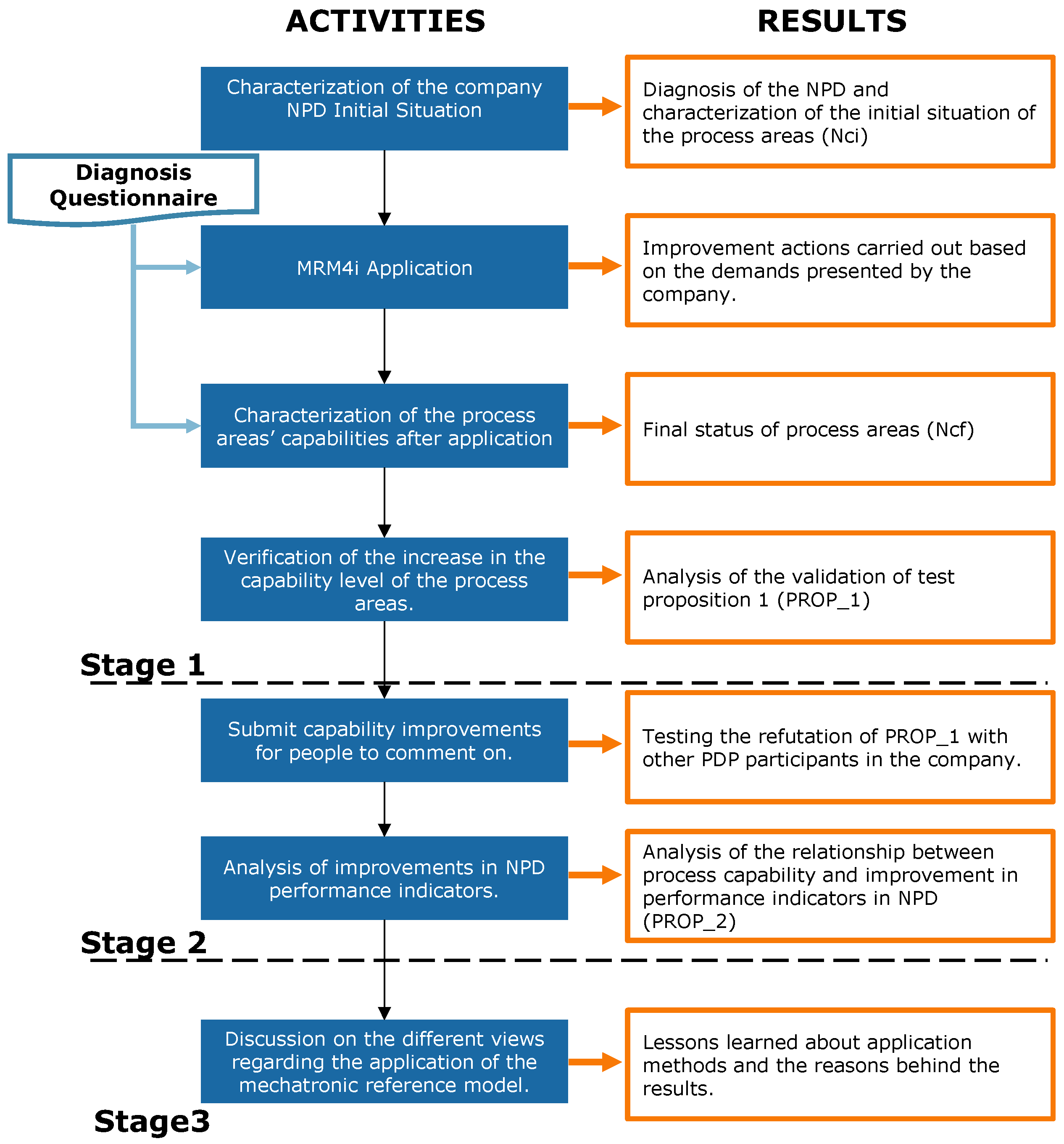
5.2. Method for MRM4i Application and Validation
- “DOES NOT DO”—“incomplete” capability level or 0 (zero);
- “DOES”—“performed” capability level or 1 (one);
- “PLAN”—“managed” capability level, or 2 (two);
- “METHOD”—“defined” capability level, or 3 (three);
- “MEASURES”—“quantitatively managed” capability level, or 4 (four);
- “OPTIMIZES”—“optimized” capability level, or 5 (five).
- the process areas in which there was a greater degree of application of the model should have a greater increase in their capability level (PROP_1)—if the model is applied and the final result points to an increase in the capability of the process areas in which there was a greater number of activities addressed in the application, it can be considered that there was theoretical consistency of the process areas developed, that is, that they actually represent the concept developed by Chrissis et al. [28].
- The application of the model should result in a significant improvement in NPD performance indicators (PROP_2)—regardless of the process areas in which the model was applied, the final result should indicate improvement in performance factors established in the NPD literature.
- Situation_1: if Δc > 1, the research hypothesis (PROP_1) is validated and the model can be considered potentially validated; and
- Situation_2: if Δc < 1, the model is not validated by the application, and therefore, its concepts must be reviewed.
- submitting the results of the increase in capability of the process areas so that people who did not respond to the original questionnaire can express their opinion of agreement or disagreement with them; and
- analyzing the improvement of NPD performance indicators in the company.
5.3. Defined Application
5.4. Applications
5.4.1. Strategy Phase
5.4.2. Portfolio Phase
5.4.3. Specification Phase
5.4.4. Project Plan Phase
5.4.5. Conception Phase
5.4.6. Technical Planning Phase
5.4.7. Technical Design Phase
5.4.8. Optimization Phase
5.4.9. Homologation Phase
5.4.10. Validation Phase
5.4.11. Launch Phase
5.4.12. Monitoring Phase
5.5. Summary of MRM4i Applications
5.6. Comparison to V/W Models

5.7. Results of MRM4i Validation
6. Conclusions
Author Contributions
Funding
Data Availability Statement
Conflicts of Interest
References
- Frank, A.G.; Dalenogare, L.S.; Ayala, N.F. Industry 4.0 Technologies: Implementation Patterns in Manufacturing Companies. Int. J. Prod. Econ. 2019, 210, 15–26. [Google Scholar] [CrossRef]
- Felippes, B.; da Silva, I.; Barbalho, S.; Adam, T.; Heine, I.; Schmitt, R. 3d-cube readiness model for industry 4.0: Technological, organizational, and process maturity enablers. Prod. Manuf. Res. 2022, 10, 875–937. [Google Scholar] [CrossRef]
- Hehenberger, P.; Vogel-Heuser, B.; Bradley, D.; Eynard, B.; Tomiyama, T.; Achiche, S. Design, modelling, simulation and integration of cyber physical systems: Methods and applications. Comput. Ind. 2016, 82, 273–289. [Google Scholar] [CrossRef]
- Ruzarovsky, R.; Horak, T.; Zelník, R.; Skypala, R.; Csekei, M.; Šido, J.; Nemlaha, E.; Kopcek, M. Development and Validation of Digital Twin Behavioural Model for Virtual Commissioning of Cyber-Physical System. Appl. Sci. 2025, 15, 2859. [Google Scholar] [CrossRef]
- Bradley, D. Mechatronics—More questions than answers. Mechatronics 2010, 20, 827–841. [Google Scholar] [CrossRef]
- Knudsen, M.P.; von Zedtwitz, M.; Griffin, A.; Barczak, G. Best Practices in New Product Development and Innovation: Results from PDMA’s 2021 Global Survey. J. Prod. Innov. Manag. 2023, 40, 257–275. [Google Scholar] [CrossRef]
- Cooper, R. Perspective: The Stage-Gate Idea-to-launch process—Update, what’s new, and NexGen Systems. J. Prod. Innov. Manag. 2008, 25, 213–232. [Google Scholar] [CrossRef]
- Marongiu, G.; Bruno, G.; Chiabert, P. Barriers to knowledge reuse in new product development for one-of-a-kind production. Int. J. Prod. Res. 2025, 63, 9134–9154. [Google Scholar] [CrossRef]
- Pidd, M. Modelagem Empresarial: Ferramentas Para a Tomada de Decisão; de Borba, G.S., Ed.; Bookman: Porto Alegre, Brazil, 1998. [Google Scholar]
- Pidd, M. Why modelling and model use matter. J. Oper. Res. Soc. 2010, 61, 14–24. [Google Scholar] [CrossRef]
- Vernadat, F.B. Enterprise Modelling and Integration: Principles and Applications; Chapman and Hall: London, UK, 1996. [Google Scholar]
- Vernadat, F. Enterprise modelling: Research review and outlook. Comput. Ind. 2020, 122, 103265. [Google Scholar] [CrossRef]
- Evangelista, S.H.; Bestard, G.A.; Oliveira, F.H.M.; Silva, I.A.; Amorim, F.F.; Llanos, C.H.; Barbalho, S.C.M. Using Problem/Project-Based Learning for Developing a Mechanical Ventilator in Brazil: The Perception of Undergraduate Students Regarding Their Learning and Satisfaction. IEEE-RITA 2023, 18, 199–210. [Google Scholar] [CrossRef]
- Ribeiro, L.A.; Araujo, V.M.F.; Barbalho, S.C.M. Mechatronic Framework for Smart Beehives: Prototyping and Applications Perspective. In Springer Proceedings in Mathematics & Statistics, Proceedings of the Industrial Engineering and Operations Management, Salvador, Brazil, 26–28 June 2024; Springer Nature: Cham, Switzerland, 2025; Volume 483, pp. 41–53. [Google Scholar]
- Barbalho, S.C.M.; de Carvalho, M.M.; Tavares, P.M.; Quintero, C.H.L.; Leite, G.A. Exploring the Relation Among Product Complexity, Team Seniority, and Project Performance as a Path for Planning New Product Development Projects: A Predictive Model Applying the System Dynamics Theory. IEEE Trans. Eng. Manag. 2019, 66, 1823–1836. [Google Scholar] [CrossRef]
- Bolanos, R.D.S.; Barbalho, S.C.M. Exploring product complexity and prototype lead-times to predict new product development cycle-times. Int. J. Prod. Econ. 2021, 235, 108077. [Google Scholar] [CrossRef]
- Association of German Engineers (VDI). Design Methodology for Mechatronic Systems (VDI 2206); Beuth Verlag: Berlin, Germany, 2004. [Google Scholar]
- Nattermann, R.; Anderl, R. Approach for a data-management-system and a proceeding-model for the development of adaptronic systems. In ASME International Mechanical Engineering Congress and Exposition, Proceedings (IMECE); ASME: New York, NY, USA, 2010; Volume 3, pp. 379–387. [Google Scholar] [CrossRef]
- Bradley, D.A.; Seward, D.; Dawson, D.; Burge, S. Mechatronics and the Design of Intelligent Machines and Systems; Stanley Thornes: Cheltenham, UK, 2000. [Google Scholar]
- De Carvalho, R.A.; da Hora, H.; Fernandes, R. A process for designing innovative mechatronic products. Int. J. Prod. Econ. 2021, 231, 107887. [Google Scholar] [CrossRef]
- Chouinard, U.; Pigosso, D.C.A.; McAloone, T.C.; Baron, L.; Achiche, S. Potential of circular economy implementation in the mechatronics industry: An exploratory research. J. Clean. Prod. 2019, 239, 118014. [Google Scholar] [CrossRef]
- Wang, H.; Zhang, H. Using collaborative computing technologies to enable the sharing and integration of simulation services for product design. Simul. Model. Pract. Theory 2012, 27, 47–64. [Google Scholar] [CrossRef][Green Version]
- Barbieri, G.; Fantuzzi, C.; Borsari, R. A model-based design methodology for the development of mechatronic systems. Mechatronics 2014, 24, 833–843. [Google Scholar] [CrossRef]
- Freddi, D. The integration of old and new technological paradigms in low-and-medium-tech sectors: The case of mechatronics. Res. Policy 2009, 38, 548–558. [Google Scholar] [CrossRef]
- Buur, J. A theoretical Approach to Mechatonical Design. Doctoral Thesis, Institute for Engineering Design, Technical University of Denmark, Kongens Lyngby, Denmark, 1990. [Google Scholar]
- Dorf, R.; Bishop, R. Modern Control Systems; Prentice Hall Inc.: Saddle River, NJ, USA, 2001. [Google Scholar]
- Popper, K. The Logic of Scientific Discovery. Syst. Zool. 1977, 26, 361. [Google Scholar] [CrossRef]
- Chrissis, M.B.; Konrad, M.; Shrum, S. CMMI: Guidelines or Process Integration and Product Improvement; Addison-Wesley Professional: Boston, MA, USA, 2006. [Google Scholar]
- Barbalho, S.C.M.; Rozenfeld, H. Modelo de referência para o processo de desenvolvimento de produtos mecatrônicos (MRM): Validação e resultados de uso. Gestão e Produção 2013, 20, 162–179. [Google Scholar] [CrossRef]
- Yin, R. Case Study Research and Applications: Design and Methods, 6th. ed.; Sage Publications, Inc.: New York, NY, USA, 2017. [Google Scholar]
- Coughlan, P.; Coghlan, D. Reflecting on how action research enables theorising in operations management: A provocation to interiority. Prod. Plan. Control. 2024, 36, 197–206. [Google Scholar] [CrossRef]
- Serva, M.; Júnior, P.J. Observação participante e pesquisa em administração: Uma postura antropológica. Rev. De Adm. De Empresas 1995, 35, 64–79. [Google Scholar] [CrossRef]
- Eisenhardt, K.M. What is the Eisenhardt Method, really? Strateg. Organ. 2021, 19, 147–160. [Google Scholar]
- Seim, J. Participant Observation, Observant Participation, and Hybrid Ethnography. Sociol. Methods Res. 2021, 53, 121–152. [Google Scholar] [CrossRef]
- Scheer, A.W. ARIS—Business Process Modeling; Springer-Verlag: Berlin/Heidelberg, Germany, 1999. [Google Scholar]
- ISO 9001:2015; Quality Management Systems—Requirements. International Standard Organization: Geneva, Switzerland, 2015.
- IEC 60601-1:2020; Medical Electrical Equipment: Part 1–2: General Requirements for Safety. Second Edition. International Electrotechnical Commission: Geneva, Switzerland, 2020.
- Bardin, L. Anáise de conteúdo. In Tradução de Luís Antero Reto e Augusto Pinheiro; Edições: Lisboa, Portugal, 1979; Volume 70. [Google Scholar]
- Moraes, A.C.B.K.; Yusef Bakri, S.F.; Karlinski Scherer, C.; Daneluz Vaz, L.O.; Yonara da Silva Galhardo, J.; Granemann Souza, E.; Nascimento, C.D.D.D.; Lund, R.G. Systematic review of usability evaluations in medical devices: Methodological choices, heuristic application, and confounding factors. Appl. Ergon. 2026, 134, 104715. [Google Scholar] [CrossRef]
- Thiollent, M. Pesquisa-Ação nas Organizações, 19th ed.; Cortez Editora: São Paulo, Brazil, 2025. [Google Scholar]
- Barbalho, S.C.M.; Rozenfeld, H. A reference model to promote performance development by focusing on capability improvement. Prod. Manag. Dev. 2008, 62, 115–125. [Google Scholar]
- Faria, A.C.; Barbalho, S.C.M. Mechatronics: A study on its scientific constitution and association with innovative products. Appl. Syst. Innov. 2023, 6, 72. [Google Scholar] [CrossRef]
- Davenport, T.H. Reengenharia de Processos: Como Inovar na Empresa Através da Tecnologia da Informação; Editora Campus: Rio de Janeiro, Brazil, 1994. [Google Scholar]
- Scheer, A.W.; Hoffmann, M. The Process of Business Process Management. In Handbook on Business Process Management 2; Vom Brocke, J., Rosemann, M., Eds.; Springer: Berlin/Heidelberg, Germany, 2015. [Google Scholar]
- Gonçalves, J.E.L. As empresas são grandes coleções de processos. RAE Rev. De Adm. De Empresas 2000, 40, 6–9. [Google Scholar] [CrossRef]
- Pugh, S. Total Design: Integrated Methods for Successful Product Engineering; Addison Wesley: London, UK, 1990. [Google Scholar]
- Pahl, G.; Beitz, W.; Feldhusen, J.; Grote, K. Engineering Design: A Systematic Approach, 2nd ed.; Springer-Verlag London Limited: London, UK, 2007. [Google Scholar]
- Clark, K.B.; Fujimoto, T. Product Development Performance: Strategy, Organization and Management in the World Auto Industry; Harvard Business School Press: Boston, MA, USA, 1991. [Google Scholar]
- Wheelwright, S.C.; Clark, K.B. Revolutionizing Product Development Process: Quantum Leaps in Speed, Efficiency, and Quality; The Free Press: New York, NY, USA, 1992. [Google Scholar]
- Baxter, M. Projeto de Produto: Guia Prático Para o Design de Novos Produtos, 2nd ed.; Iida, I., Ed.; Edgard Blücher Ltd.a.: São Paulo, Brazil, 2000. [Google Scholar]
- Clausing, D. Total Quality Development: A Step-by-Step Guide to World-Class Concurrent Engineering; The American Society of Mechanical Engineers: New York, NY, USA, 1994. [Google Scholar]
- Ulrich, K.T.; Eppinger, S.D. Product Design and Development; McGraw-Hill Inc.: New York, NY, USA, 2011. [Google Scholar]
- Nonaka, I.; Takeuschi, H. Criação de Conhecimento na Empresa; Rodrigues, A.B., Celeste, P.M., Eds.; Campus: Rio de Janeiro, Brazil, 1997. [Google Scholar]
- Prasad, B. Concurrent Engineering Fundamentals: Integrated Product and Process Organization; Prentice Hall: Englewood Cliffs, NJ, USA, 1996. [Google Scholar]
- Prasad, B. Concurrent Engineering Fundamentals—Volume II: Integrated Product Development; Prentice Hall: Englewood Cliffs, NJ, USA, 1997. [Google Scholar]
- Cooper, R. Winning at New Product: Acceleranting the Process from Idea to Launch; Addison-Wesley Publishing Company Inc.: Reading, MA, USA, 2001. [Google Scholar]
- Creveling, C.M.; Slutsky, J.; Antis, D. Design for Six-Sigma in Technology and Product Development; Prentice Hall: Saddle River, NJ, USA, 2003. [Google Scholar]
- Douglas, F. Lean Principles Implementation in the Program Preparation Phase. Master’s Thesis, Massachusetts Institute of Technology, Cambridge, MA, USA, 2002. [Google Scholar]
- McManus, H. Product development value stream analysis and mapping manual (PDVSM)—Alpha draft. In Lean Aerospace Initiative, Center for Technology, Policy, and Industrial Development; Massachusetts Institute of Technology: Cambridge, MA, USA, 2003. [Google Scholar]
- Rozenfeld, H.; Amaral, D.C. Gestão de Desenvolvimento de Produtos; Editora Saraiva: São Paulo, Brazil, 2006. [Google Scholar]
- ISO 9001:2015; Medical Devices—Quality Management Systems—Requirements for Regulatory Purposes. International Standard Organization: Geneva, Switzerland, 2016.
- IATF 16949:2016; Quality Management System Requirements for Automotive Production and Relevant Service Parts Organizations. International Automotive Task Force: Birmingham, UK, 2016.
- IEC 60601-1-2:2003; Medical electrical equipment: Part 1–2: General requirements for safety—Collateral Standard: Electromagnetic compatibility—Requirements and Tests. Second Edition. International Electrotechnical Commission: Geneva, Switzerland, 2020.
- Project Management Institute (PMI). Project Management Body of Knowledge (PMBOK); Project Management Institute (PMI): Newtown Square, PA, USA, 2008. [Google Scholar]
- Project Management Institute (PMI). Project Management Body of Knowledge (PMBOK); Project Management Institute (PMI): Newtown Square, PA, USA, 2017. [Google Scholar]
- Project Management Institute (PMI). Project Management Body of Knowledge (PMBOK), 7th ed; Project Management Institute (PMI): Newtown Square, PA, USA, 2021. [Google Scholar]
- Morgan, J.M.; Liker, J.K. The Toyota Product Development System: Integrating People, Process, and Technology; Productivity Press: New York, NY, USA, 2006. [Google Scholar]
- IEEE STD 1220; Standard for Application and Management of the Systems Engineering Process. Software Engineering Standard Committee: Washington, DC, USA, 2005.
- Hunt, V.D. Mechatronics: Japan’s Newest Threat; Chapman and Hall: New York, NY, USA, 1988. [Google Scholar]
- Bradley, D.A.; Dawson, D.; Burd, N.G.; Laoder, A.J. Mechatronics: Electronics in Products and Processes; Chapman and Hall: London, UK, 1991. [Google Scholar]
- Habib, T.; Komoto, H. Comparative analysis of design concepts of mechatronics systems with a CAD tool for system architecting. Mechatronics 2014, 24, 788–804. [Google Scholar] [CrossRef]
- Komoto, H.; Tomiyama, T. A system architecting tool for mechatronic systems design. CIRP Ann. Manuf. Technol. 2010, 59, 171–174. [Google Scholar] [CrossRef]
- Komoto, H.; Tomiyama, T. A framework for computer-aided conceptual design and its application to system architecting of mechatronics products. Comput. Aided Des. 2012, 44, 931–946. [Google Scholar] [CrossRef]
- Albers, A.; Behrendt, M.; Klingler, S.; Reiß, N.; Bursac, N. Agile product engineering through continuous validation in PGE-Product Generation Engineering. Des. Sci. 2017, 3, e5. [Google Scholar] [CrossRef]
- Adamsson, N. Mechatronics Engineering: New Requirements on Cross-Functional Integration. Licentiate Thesis, School of Industrial Engineering and Management, Stockholm, Sweden, 2005. [Google Scholar]
- Palsodkar, M.; Yadav, G.; Nagare, M.R. Recent trends in agile new product development: A systematic review and agenda for future research. Benchmarking Int. J. 2023, 30, 3194–3224. [Google Scholar] [CrossRef]
- De Silva, C.W.; Behbahani, S. A design paradigm for mechatronic systems. Mechatronics 2013, 23, 960–966. [Google Scholar] [CrossRef]
- Habib, M.K. Mechatronics—A unifying interdisciplinary and intelligent engineering science paradigm. IEEE Ind. Electron. Mag. 2007, 1, 12–24. [Google Scholar] [CrossRef]
- Pang, C.K.; Lee, T.H.; Ng, T.S.; Lewis, F.L. Managing Complex Mechatronics R&D: A Systems Design Approach. IEEE Trans. Syst. Man Cybern. Part A Syst. Hum. 2012, 42, 57–67. [Google Scholar] [CrossRef]
- Nattermann, R.; Anderl, R. The W-model using systems engineering for adaptronics. Procedia Comput. Sci. 2013, 16, 937–946. [Google Scholar] [CrossRef][Green Version]
- Torry-Smith, J.M.; Mortensen, N.H.; Achiche, S. A proposal for a classification of product-related dependencies in development of mechatronic products. Res. Eng. Des. 2014, 25, 53–74. [Google Scholar] [CrossRef]
- Torry-Smith, J.M.; Qamar, A.; Achiche, S.; Wikander, J.; Mortensen, N.H.; During, C. Challenges in designing mechatronic systems. J. Mech. Des. 2013, 135, 011005. [Google Scholar] [CrossRef]
- Bi, Z.; Mikkola, A.; Devpalli, D.; Luo, C. Digital Triads as Next-Generation Mechatronic Systems for Sustainability—A Case Study. IEEE/ASME Trans. Mechatron. 2025, 30, 679–691. [Google Scholar] [CrossRef]
- Colledani, M.; Tolio, T.; Fischer, A.; Iung, B.; Lanza, G.; Schmitt, R.; Váncza, J. Design and management of manufacturing systems for production quality. CIRP Ann. Manuf. Technol. 2014, 63, 773–796. [Google Scholar] [CrossRef]
- Hick, H.; Bajzek, M.; Faustmann, C. Definition of a system model for model-based development. SN Appl. Sci. 2019, 1, 1074. [Google Scholar] [CrossRef]
- Charles, J.; Bosch-Mauchand, S.; Eynard, M.; Padiolleau, B. Multidisciplinary modelling and simulation for mechatronic design. J. Des. Res. 2014, 12, 127–144. [Google Scholar] [CrossRef]
- Mcharek, M.; Azib, T.; Hammadi, M.; Larouci, C.; Choley, J.Y. Multidisciplinary design optimization using knowledge management applied to an electronic throttle. COMPEL Int. J. Comput. Math. Electr. Electron. Eng. 2020, 39, 353–362. [Google Scholar] [CrossRef]
- Stefani, M.A.; Felema, J. Agro photovoltaic: Feasibility of synergistic system in the sugarcane bioenergy sector. Quaestum 2022, 3, 1–20. [Google Scholar] [CrossRef]
- Drutchas, J.F.; Eppinger, S. Adjusting Scaled Agile for Systems Engineering. Proc. Des. Soc. 2023, 3, 475–483. [Google Scholar] [CrossRef]
- Bolaños, R.D.S.; Valdiero, A.C.; Rasia, L.A.; Ferreira, J.C.E. Identifying the Trend of Research on Mechatronic Projects. IFIP Adv. Inf. Commun. Technol. 2022, 640, 25–39. [Google Scholar] [CrossRef]
- Merlo, C.; Akle, A.A.; Llaria, A.; Terrasson, G.; Villeneuve, E.; Pilnière, V. Proposal of a user-centred approach for CPS design: Pillbox case study. IFAC-PapersOnLine 2019, 51, 196–201. [Google Scholar] [CrossRef]
- Gausemeler, I.J.; Moehringer, S. VDI 1206-A New Guideline for The Design of Mechatronic Systems. IFAC Proc. Vol. 2002, 35, 785–790. [Google Scholar] [CrossRef]
- Graessler, I.; Hentze, J. The new V-Model of VDI 2206 and its validation das Neue V-Modell der VDI 2206 und seine Validierung. At-Autom. 2020, 68, 312–324. [Google Scholar] [CrossRef]
- Nattermann, R.; Anderl, R. Meta-data-Model for the Development of Adaptronic Systems. In Lecture Notes in Production Engineering; Springer Nature: Berlin/Heidelberg, Germany, 2013; pp. 221–230. [Google Scholar] [CrossRef]
- Seyedhosseini, S.M.; Keyghobadi, A. An integrated model for mechatronic products in agile manufacturing system. Decis. Sci. Lett. 2014, 3, 535–550. [Google Scholar] [CrossRef]
- Cooper, R.; Edgett, S.J.; Kleinschmidt, E.J. Portfólio Management for New Products, 2nd ed.; Perseus Books: Cambridge, MA, USA, 2002. [Google Scholar]
- Bi, Z.; Chi, J.; Zhang, W.; Luo, C. Mechatronics as Design Philosophy to Inspire Engineering Innovations. IET Collab. Intell. Manuf. 2026, 8, e70053. [Google Scholar] [CrossRef]
- Moulianitis, V.C.; Aspragathos, N.A.; Dentsoras, A.J. A model for concept evaluation in design—An application to mechatronics design of robot grippers. Mechatronics 2004, 14, 599–622. [Google Scholar] [CrossRef]
- Horovitz, P.; Hill, W. The Art of Electronics; Cambridge University Press: Cambridge, UK, 1999. [Google Scholar]
- Pressman, R. Software Engineering: A Practitioner’s Approach, 5th ed.; McGraw-Hill Higher Education: New York, NY, USA, 2001. [Google Scholar]
- Norton, R.L. Projeto de Máquinas—Uma Abordagem Integrada; Bookman Editora: Porto Alegre, Brazil, 2004. [Google Scholar]
- Booch, G. UML: Guia do Usuário; Elsevier: São Paulo, Brasil, 2006. [Google Scholar]
- Boothroyd, G.; Dewhurst, P.; Knight, W.A. Product Design for Manufacture and Assembly; Marcel Dekker, Inc.: New York, NY, USA, 1994. [Google Scholar]
- Zorowski, C.F. Design for Assembly: Assembly Definition, Part Sequencing, product Guidelines, Part Feeding and Insertion, Product Redesign Process, Quantifying Assembly Improvement; Createspace Independent Publishing Platform: Washington, DC, USA, 2016; 110p. [Google Scholar]
- Miranda, J.; Pérez-Rodríguez, R.; Borja, V.; Wright, P.K.; Molina, A. Sensing, smart and sustainable product development (S3 product) reference framework. Int. J. Prod. Res. 2017, 57, 4391–4412. [Google Scholar] [CrossRef]
- Robbins, P.; O’Gorman, C. Radical innovation in global pharma. RD Manag. 2015, 45, 76–93. [Google Scholar] [CrossRef]
- Kim, Y.; Lee, J.; Kim, S.; Moon, S.K.; Lopez, M. A hybrid multi-criteria decision-making approach for production line configuration based on product modularity and lifecycle. J. Eng. Des. 2025, 37, 495–528. [Google Scholar] [CrossRef]
- Lloret-Climent, M.; Nescolarde-Selva, J.-A.; Mora-Mora, H.; Jimeno-Morenilla, A.; Alonso-Stenberg, K. Design of Products Through the Search for the Attractor. IEEE Access 2019, 7, 60221–60227. [Google Scholar] [CrossRef]
- Favi, C.; Germani, M.; Mandolini, M. Development of complex products and production strategies using a multi-objective conceptual design approach. Int. J. Adv. Manuf. Technol. 2018, 95, 1281–1291. [Google Scholar] [CrossRef]
- Olechowski, A.L.; Eppinger, S.D.; Joglekar, N.; Tomaschek, K. Technology readiness levels: Shortcomings and improvement opportunities. Syst. Eng. 2020, 23, 395–408. [Google Scholar] [CrossRef]
- Fricke, E.; Schulz, A.P. Design for changeability (DfC): Principles to enable changes in systems throughout their entire lifecycle. Syst. Engin. 2005, 8, 342–359. [Google Scholar] [CrossRef]
- Salvador-Carulla, L.; Woods, C.; Miquel, C.; Lukersmith, S. Adaptation of the technology readiness levels for impact assessment in implementation sciences: The TRL-IS checklist. Heliyon 2024, 10, e29930. [Google Scholar] [CrossRef]
- Yfanti, S.; Sakkas, N. Technology Readiness Levels (TRLs) in the Era of Co-Creation. Appl. Syst. Innov. 2024, 7, 32. [Google Scholar] [CrossRef]
- Drescher, B.; Klein, T.P.; Spiegelberger, B.; Stetter, R.; Reinhart, G. Synthesis of a mechatronic reference model for engineering processes of production systems. In Proceedings of the IEEE ASME International Conference on Advanced Intelligent Mechatronics AIM, Besacon, France, 8–11 July 2014; pp. 1592–1597. [Google Scholar]
- Boehm, B.; Turner, R. The incremental commitment spiral model (ICSM): Principles and practices for successful systems and software. In Proceedings of the 2015 International Conference on Software and System Process (ICSSP ‘15), Tallinn, Estonia, 24–26 August 2015; Association for Computing Machinery: New York, NY, USA, 2015; pp. 175–176. [Google Scholar] [CrossRef]
- Pérez-Castillo, R.; Serrano, M.A.; Cruz-Lemus, J.A.; Piattini, M. Guidelines to use the incremental commitment spiral model for developing quantum-classical systems. Quantum Inf. Comput. 2024, 24, 71–88. [Google Scholar]
- Souza, V.E.S.; Lapouchnian, A.; Angelopoulos, K.; Mylopoulos, J. Requirements-driven software evolution. Comput. Sci. Res. Dev. 2013, 28, 311–329. [Google Scholar] [CrossRef]
- Jouda, B.; Owies, N.; Atoum, I. Software Configuration Management in Evolutionary Processes: Tools and Best Practices. In Proceedings of the 2025 16th International Conference on Information and Communication Systems (ICICS), Irbid, Jordan, 1–3 July 2025; pp. 1–6. [Google Scholar] [CrossRef]
- Fuentes-Quijada, G.; Ruiz-González, F.; Caro, A. Improving IT/Business Alignment in DevOps: Business Capability for Adopting BizDevOps. J. Softw. Evol. Process. 2025, 37, e70016. [Google Scholar] [CrossRef]
- Zarbi, H.; Mansour, S.; Mosadegh, H. Modularity and new product performance: The role of new product development speed and task uncertainty. J. Eng. Des. 2024, 35, 1575–1596. [Google Scholar] [CrossRef]
- Schwaber, K.; Sutherland, J. The Scrum GuideTM: The Definitive Guide to Scrum. The Rules of the Game; Scrum Inc.: Cambridge, MA, USA, 2017. [Google Scholar]
- Turk, D.; Robert, F.; Rumpe, B. Assumptions Underlying Agile Software-Development Processes. J. Database Manag. JDM 2005, 16, 62–87. [Google Scholar] [CrossRef]
- Cooper, R.G.; Sommer, A.F. The Agile–Stage-Gate Hybrid Model: A Promising New Approach and a New Research Opportunity. J. Prod. Innov. Manag. 2016, 33, 5132013526. [Google Scholar] [CrossRef]
- Suárez-Gómez, E.D.; Hoyos-Vallejo, C.A. Scalable Agile Frameworks in Large Enterprise Project Portfolio Management. IEEE Access 2023, 11, 98666–98684. [Google Scholar] [CrossRef]
- Cooper, R.G.; Ingby, J.; Källrot, C.; Mott, P.; Vedsmand, T. Agile Innovation in a Manufacturing Company: How Tetra Pak Evolved Its Product Development Process. Res. Technol. Manag. 2025, 68, 42–51. [Google Scholar] [CrossRef]
- Leong, J.; May Yee, K.; Baitsegi, O.; Palanisamy, L.; Ramasamy, R.K. Hybrid Project Management between Traditional Software Development Lifecycle and Agile Based Product Development for Future Sustainability. Sustainability 2023, 15, 1121. [Google Scholar] [CrossRef]
- Mirzaei, M.; Mabin, V.J.; Zwikael, O. Customising Hybrid project management methodologies. Prod. Plan. Control. 2025, 36, 1188–1205. [Google Scholar] [CrossRef]
- Adzgauskaite, M.; Tam, C.; Martins, R. What helps Agile remote teams to be successful in developing software? Empirical evidence. Inf. Softw. Technol. 2025, 177, 107593. [Google Scholar] [CrossRef]
- Pazelli, H.C.; Barbalho, S.C.M. Designing a ground support equipment based on a product development reference model. In Complex Systems Concurrrent Engineering—Colaboration, Technology Innovation and Sustainability, 1st ed.; Loureiro, G., Curran, R., Eds.; Springer: London, UK, 2007; Volume V1, pp. 31–39. [Google Scholar]
- Blumm, A.C.N. Análise do Ambiente Mercadológico e Tecnológico Para a Definição de Especificações-Meta e Conceito de Uma Prótese Transtibial. Bachelor’s Thesis, Universidade de Brasília, Brasília, Brasil, 2015. [Google Scholar]
- Soares, P.C. Análise da Viabilidade Técnica e Comercial, e da Construção de Especificações e Conceito para um Equipamento de Diagnóstico do Glaucoma por Meio de Imagem Térmica. Bachelor’s Thesis, Universidade de Brasília, Brasília, Brazil, 2015. [Google Scholar]
- Resende, A.A.N.; Barbalho, S.; Silva, E. Requisitos e conceito de um aplicativo para o Centro de Referência em Síndrome de Down (CrisDown). In Congresso Brasileiro De Inovação E Gestão De Desenvolvimento Do Produto; Blucher: São Paulo, Brazil, 2019. [Google Scholar] [CrossRef]
- Hayata, A.; Barbalho, S.; ROSA, R.C. Sistematização do projeto de um carro elétrico para coleta seletiva com base em modelos de referência para desenvolvimento de produtos. In Proceedings of the Blucher Engineering Proceedings, 12º Congresso Brasileiro de Inovação e Gestão de Desenvolvimento de Produto, Brasília, Brazil, 11–13 September 2019; Editora Blucher: São Paulo, Brazil, 2019; p. 850. [Google Scholar] [CrossRef]
- Agência Nacional de Vigilância Sanitária (ANVISA). RDC 185—Registro, Alteração, Revalidação e Cancelamento do Registro de Produtos Médicos; Agência Nacional de Vigilância Sanitária (ANVISA): Guará, Brazil, 2001. [Google Scholar]
- Santos, D., Jr.; Modugno, R.G.; Rossi, G. Relatório Técnico Do OPTO ADS; RETINÓGRAFO-7.3.3-VAL-06; OPTO Eletronica S.A.: São Carlos, Brazil, 2014; 63p. [Google Scholar]
- Santos, D., Jr.; Modugno, R.G.; Soares, A.L. Manual Do Usuário Do OPTO ADS; RETINOGRAFO-7.5.1-MOP-07; OPTO Eletronica S.A.: São Carlos, Brazil, 2014; 146p. [Google Scholar]
- Rossi, G.; Mota, A.D. Validação Do Software CONRET01 Do OPTO ADS; RETINÓGRAFO-7.3.3-VER-08 OPTO; Eletronica S.A.: São Carlos, Brazil, 2014; 66p. [Google Scholar]
- Otoboni, J.A.; Burato, C.E. Procedimento de Montagem da Fonte de Alimentação Do OPTO ADS; RETINOGRAFO-7.5.1-PRO-05; OPTO Eletronica S.A.: São Carlos, Brazil, 2014; 30p. [Google Scholar]
- Otoboni, J.A.; Burato, C.E. Procedimento de Montagem da Mesa Elevatória Do OPTO ADS; RETINOGRAFO-7.5.1-PRO-03; OPTO Eletronica S.A.: São Carlos, Brazil, 2014; 23p. [Google Scholar]
- Barbalho, S.C.M.; Rozenfeld, H. O impacto dos aspectos organizacionais sobre a percepção de melhoria em desenvolvimento de produtos. Gestão e Produção 2010, 17, 1–17. [Google Scholar] [CrossRef][Green Version]
- Barbalho, S.C.M. The differential practices of project management offices for supporting new product development in high-tech companies. Int. J. Proj. Organ. Manag. 2021, 13, 170. [Google Scholar] [CrossRef]
- Barbalho, S.C.M.; Toledo, J.C.; Farias, A.C.C. Transitions in Project Management Offices: A Framework Relating Functions, Success Factors, and Project Performance in a High-Technology Company. Eng. Manag. J. 2021, 34, 357–373. [Google Scholar] [CrossRef]


| Content Types | Definition |
|---|---|
| Performance objectives | The process seeks global objectives. |
| Activities | What needs to be done to meet performance objectives. |
| Inputs | Materials, information, and other services are used in the activities. |
| Outputs | Results of an activity. They have similar characteristics to inputs. |
| Events/messages | State of a process demonstrating the completion of one activity and the state of readiness to begin another. |
| Decisions | Logic for resolving pending issues faced throughout the process. |
| Process | Integrating a vision that summarizes the context of the activities. |
| Performance factors | Indicators based on performance objectives enable informed decisions about the process and its activities. |
| Information | Data used and generated by the process and its activities. |
| Organization | An organizational unit in which activities are carried out. |
| Roles | The responsibilities of an organizational unit can be distinguished by its competence in performing a specific activity. |
| Competences | Skills required by the organizational unit to carry out activities and the profile of the personnel participating in the process. |
| Resources | Equipment and devices that are generally used in an activity. |
| Technology | Enterprise communications software and infrastructure. |
| Time | Temporal pattern that characterizes the process and its activities. |
| Cost | A cost standard that characterizes the process and its activities. |
| Knowledge | Type of knowledge generated throughout projects: tacit or explicit, and how they are generated and transformed in the company. |
| Methods | Structured sets of steps, forms, and analysis methodologies related to some “output” or “decision” of the NPD. |
| Process areas | A cluster of best practices related to a theme that is present in various phases of the NPD. |
| Design principles | Design rules applicable to a given engineering field. |
| Design technologies | Physical principles and devices used in engineering design. |
| Models | Graphic, virtual, or physical representations of the product at different stages of its development (prototypes). |
| NPD Classical Literature | Specific NPD Theories | Standards Applicable to Mechatronic NPD | Mechatronic Theories | Mech Standard | |||||||||||||||||||||||
|---|---|---|---|---|---|---|---|---|---|---|---|---|---|---|---|---|---|---|---|---|---|---|---|---|---|---|---|
| PUGH | P&B | C&F | W&C | BAXTER | CLAUSING | ULR&EPP | N&T | PRASAD | COOPER | CREVELING | CHRISSIS | LEAN | ISO 9001:2000 | ISO 13485:2003 | QS9000:APQP | Normas IEC | GSQA | PMBOK | IEEE 1220:1998 | HUNT | BUUR | BRADLEYa | BRADLEYb | V-MODEL | W-MODEL | ||
| Performance objectives | + | +− | − | +− | r | − | − | − | |||||||||||||||||||
| Activities | − | − | − | −+ | − | −+ | + | − | −+ | −+ | r | − | − | − | − | − | −+ | − | − | −+ | − | − | −+ | − | −+ | − | |
| Inputs | +− | +− | − | +− | +− | − | − | − | − | − | +− | − | − | + | − | −+ | − | − | |||||||||
| Outputs | − | − | − | +− | − | − | − | − | r | − | +− | − | − | + | − | − | −+ | − | − | ||||||||
| Events/messages | |||||||||||||||||||||||||||
| Decisions | − | − | − | − | − | − | −+ | r | − | − | − | − | − | −+ | − | ||||||||||||
| Process | − | − | − | − | − | −+ | −+ | − | −+ | − | r | − | − | −+ | − | − | − | ||||||||||
| Performance factors | + | −+ | − | − | − | − | − | ||||||||||||||||||||
| Information | +− | + | − | − | |||||||||||||||||||||||
| Organization | − | +− | +− | − | − | −+ | − | −+ | − | −+ | −+ | + | −+ | − | r | ||||||||||||
| Roles | |||||||||||||||||||||||||||
| Competences | +− | +− | − | − | −+ | − | + | − | − | r | |||||||||||||||||
| Resources | + | − | − | − | |||||||||||||||||||||||
| Technology | +− | + | − | r | − | ||||||||||||||||||||||
| Time | − | r | − | − | − | ||||||||||||||||||||||
| Cost | − | − | + | ||||||||||||||||||||||||
| Knowledge | + | ||||||||||||||||||||||||||
| Methods | − | − | − | − | − | − | r | −+ | −+ | − | − | + | − | − | |||||||||||||
| Models | − | −+ | − | −+ | −+ | + | − | r | |||||||||||||||||||
| Design principles | +− | + | |||||||||||||||||||||||||
| Design technologies | + | r | |||||||||||||||||||||||||
| Process areas | +− | +− | +− | − | +− | + | |||||||||||||||||||||
| MRM4i Activities | Description | Cycles and Revisions/Qualitative Observations | How It Works on General NPD | How It Works on V/W Models |
|---|---|---|---|---|
| Characterize product lines | Creation of a performance management committee | Not applicable | In the same way | Does not work |
| Analyze the competitive environment | Environmental monitoring and creation of technology roadmaps for the main new technologies mastered | Not applicable | Without a mechatronic potential with the flexibility to add to every product | Does not work |
| MRM4i Activities | Description | Cycles and Revisions/Qualitative Observations | How It Works on General NPD | How It Works on V/W Models |
|---|---|---|---|---|
| Identify potential products | Improving the way products are implemented through analysis of the relationship between new products and the company’s strategy and technology roadmaps. | Not applicable | Without a mechatronic potential with the flexibility to add to every product | Does not work |
| Prioritize projects under development | Analysis of potential products in relation to the company’s strategy with prioritization. | Not applicable | Without a mechatronic point of view for product synergy | Does not work |
| Monitor the performance of ongoing projects | Creation of a project performance committee to analyze indicators for ongoing projects. | Not applicable | In the same way | Does not work |
| MRM4i Activities | Description | Cycles and Revisions/Qualitative Observations | How It Works on General NPD | How It Works on V/W Models |
|---|---|---|---|---|
| Define product specifications | In the Foto i-MP project, significant effort was devoted to developing the protocol specifications. This effort was repeated in the MUX project. | For the Foto i-MP project, specifications were lightly frozen because the international market was the primary goal, and the commercial department finalized them only during the optimization phase. For the MUX project, the complete set of technical specifications was available on the client website, in accordance with the Brazilian government’s adherence to the European Space Agency guidelines. Few requirements could be negotiated, and only until the conception phase (preliminary design review for the ESA development framework). | In the same way | In the same way |
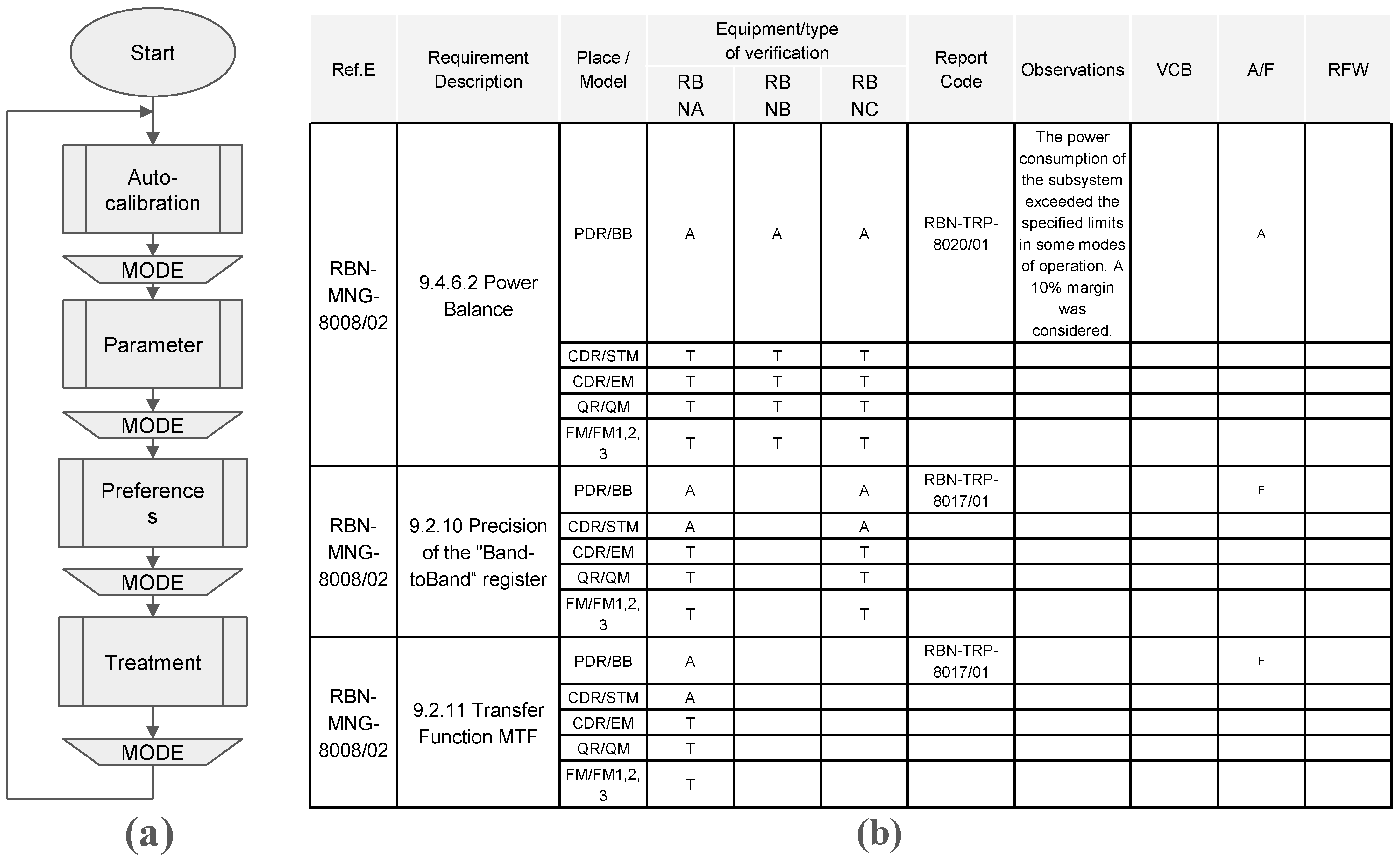
| Establish a product verification matrix. | For the fundus camera and MUX projects, a product verification matrix was created. | The fundus camera was advanced throughout the NPD process and was only frozen during the validation phase, based on feedback and issues identified during certification testing. For the MUX project, the verification matrix was created from the beginning and frozen during the optimization phase, in accordance with the ESA’s critical design phase. | Rarely did NPD models come with this prescription | In the same way |
| Document and record product specifications | This was performed systematically throughout the research projects by recording it in the project logbook. | This was undertaken as a configuration management activity and as a best practice in knowledge management, in accordance with Nonaka and Takeuchi [53] and the company’s stage-gate process [97]. It is a prescribed activity in all MRM4i phases. It complies with medical regulatory standards. | In the same way | In the same way |
| Identify regulatory requirements | In previous projects, this occurred reactively. All the research Projects were conducted in a planned manner. | Regulatory requirements were first identified on P3 and reviewed until P5. For medical equipment, it could be changed to P9 once lab conditions indicate a need for refinement, but this usually does not require significant design changes. | Rarely did NPD models come with this prescription | In the same way |
| MRM4i Activities | Description | Cycles and Revisions/Qualitative Observations | How It Works on General NPD | How It Works on V/W Models |
|---|---|---|---|---|
| Generate project WBS | Establishment of a procedure for project planning. | All artifacts in this phase were reviewed in the technical planning phase. WBS for MUX and the fundus camera were reviewed accordingly. | In the same way | Does not work |
| Develop a detailed schedule. | Establishment of a procedure for project planning and preparation of a schedule for the MUX. | For medical equipment, the schedule was developed on a third-monthly basis, first by the project management office and then by trained project managers. For the MUX project, the schedule was systematically detailed at the project and phase levels. It was also presented and validated with the client’s technical team during the qualification phase, a process known as validation in space missions. For both medical and space projects, the schedule ranged until the launch phase. | In the same way | Does not work |
| Plan necessary resources | Development of a human resources and infrastructure plan for the MUX project. | This was a mandatory plan for the MUX project. It was first proposed during the first phase of management review and was reviewed through the end of the optimization phase. | Rarely did NPD models come with this prescription | Does not work |
| Develop a cost structure. | Development of a cost management structure in the MUX project. | It was a mandatory plan at the beginning of the MUX project, reviewed internally only by the company’s management board, with support from the project management office, until the monitoring phase. | In the same way | Does not work |
| Define risk management | Development of a risk management process in the MUX project. | This was a mandatory plan for the MUX project. It was first proposed during the first phase of management review and was reviewed through the end of the launch phase. | In the same way | Does not work |
| Consolidate project plan | Consolidation of the MUX project plan. | The project contract required this and covered the project phases through the end of the optimization phase. | In the same way | Does not work |
| Document and record project planning | Establishment of a procedure for project planning. | This was undertaken as a configuration management activity and as a best practice in knowledge management, in accordance with Nonaka and Takeuchi [53] and the authors’ stage-gate process [97]. It is a prescribed activity in all MRM4i phases. |
| MRM4i Activities | Description | Cycles and Revisions/Qualitative Observations | How It Works on General NPD | How It Works on V/W Models |
|---|---|---|---|---|
| To model and systematize the conception | The design of the fundus camera, the microscope-Can, and the MUX camera was modeled as a block diagram. | For the fundus camera, the concept was revised during the optimization phase and formally reported during the validation phase, when the product was submitted for certification testing. Some optimization solutions were changed, but the product conception remained unchanged. For the microscope, the conception was frozen and not changed. For the MUX project, the conception was frozen during the technical design phase because, in the conception phase (preliminary design of the space development framework), several options remained under scrutiny, particularly regarding the optical design. | In the same way | In the same way |
| MRM4i Activities | Description | Cycles and Revisions/Qualitative Observations | How It Works on General NPD | How It Works on V/W Models |
|---|---|---|---|---|
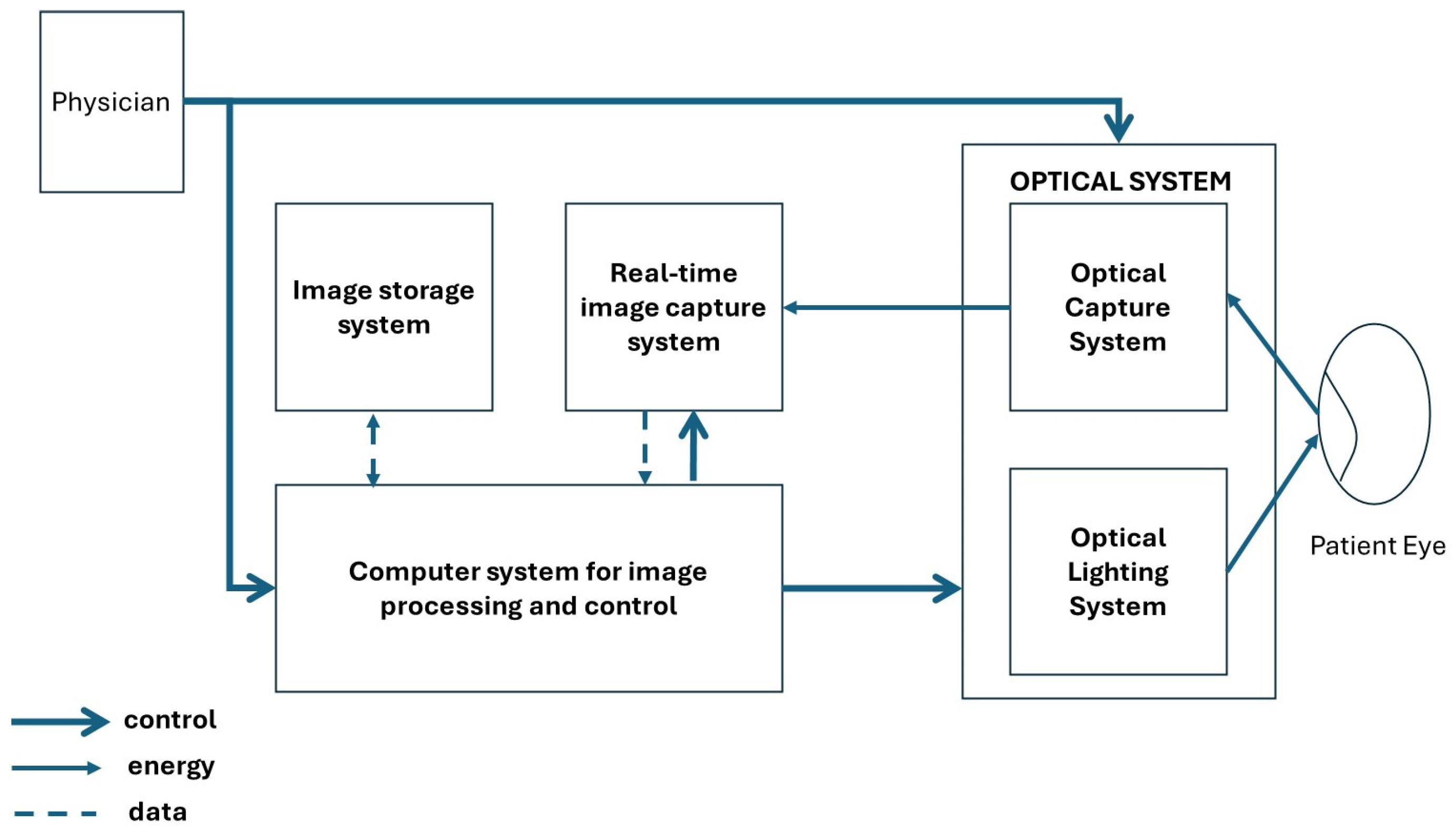
| Define product architecture | The fundus camera architecture was modeled using information, energy, and material flows. | The fundus camera architecture was formalized during the technical planning phase. It was revised until the validation phase, at which point the product was submitted to the Brazilian Health and Food Board. | In the same way | Differently, but it works |
| Revise analysis of standards and norms. | A checklist of normative items to be followed in the projects was created. | A specific template was created for the fundus camera project and applied to all medical design efforts. It was first used in P3 and progressed through P9, with revisions tailored to the certification labs’ specific conditions. | Does not work | Does not work |
| Identify and analyze software requirements. | A software validation procedure was developed and documented in DFD and ER models used for the fundus camera and the MUX project. | DFD and ER models were standardized only for projects that are in the launch phase. For the MUX project, the approach was applied from the technical planning phase through the validation phase (qualification on the ESA framework). The fundus was systematized only at the beginning of the validation phase and was subsequently entered into the validation cycle, thereby affecting product homologation and optimization. | Does not work | Differently, but it works |
| Generate product tree | A product tree was developed for the MUX project. | A product tree was generated at the start of the MUX project in accordance with the Brazilian space frameworks. It effectively aligned with the product architecture during the technical planning phase and continued to evolve until product validation. | Commonly in later phases, but it works | Not work as a documentation structure |
| Technically plan the project. | The MUX project was meticulously planned using the detailed product tree. | According to the elaborated product tree, the project schedule and resource plan were refined, risks were re-analyzed and identified, and the necessary documents to validate each product tree branch were planned. It was revised until the product validation and launch phases. | Not working once planning is only made in a moment and not revised | Does not work |
| Specify interfaces and control. | In the MUX project, the interfaces between the equipment components were documented in dedicated documents. | A specific document, the interface datasheet, was developed from the beginning of the MUX project. It effectively aligned with the product architecture during the technical planning phase, evolved through product validation, and proceeded to the launch phase. | It works on some NPD frameworks | In the same way |
| MRM4i Activities | Description | Cycles and Revisions/Qualitative Observations | How It Works on General NPD | How It Works on V/W Models |
|---|---|---|---|---|
| Document the technical solutions. | All projects were extensively documented from a technical standpoint using the project notebook. | These technical solutions were documented at the end of the technical design phase. For the MUX project, it was noted that, in line with the MRM4i timeframe, contract management was mandatory. For the fundus camera, documentation began during the optimization phase, once the MRM4i application started after the technical design phase, as with the photocoagulator i-MP. For the microscope-Can project, this documentation was performed as planned in the MRM4i activity descriptions. Once these descriptions were systematized, they were refined through the validation phase for the MUX project and the fundus camera. | Commonly not addressed in NPD models | In the same way |
| MRM4i Activities | Description | Cycles and Revisions/Qualitative Observations | How It Works on General NPD | How It Works on V/W Models |
|---|---|---|---|---|
| Analyze product risks according to standards. | A product risk analysis procedure was developed and applied to all products except the photocoagulator i-MP. | For the fundus camera project, the process was applied from the optimization phase and cycled to the technical design phase, but it was reviewed during the validation phase. For the microscope, this was the first step in the optimization process, leading to changes in the product design. At the MUX project, a criticality analysis was initiated during the conceptual design, in accordance with Brazilian aerospace standards. | Commonly not addressed in NPD models, but predicted on regulatory standards | Not explicitly addressed |
| Tolerance design. | The tolerances of the fundus camera’s optical components were thoroughly analyzed, as were those of the MUX project. | Tolerance design was introduced in the company’s technical background with a strict partnership between the design and manufacturing teams. The process ranged from optimization through validation for both the fundus camera and the MUX project, with particular focus on the optical beam paths. | Commonly not addressed in NPD models | Not explicitly addressed |
| Test developed software | A procedure was developed to conduct software tests on equipment designs. | A total set of microcontroller software tests was performed for the fundus camera and microscope-Can projects. At the MUX project, the test equipment was a specific delivery that was thoroughly tested and documented. It encompasses the entire design, homologation, and validation cycle. | Not addressed | In the same way |
| Detail manufacturing and assembly processes | Detailed mechanical, electronic, and optical assembly documents were developed for the fundus camera project to facilitate the product introduction into commercial production. | For the fundus camera, manufacturability analysis and documentation began during the optimization phase and continued through homologation and validation. It was also applied to the MUX project during the conceptual design phase to the most critical components. It became apparent during the validation cycles in the optical manufacturing and assembly processes. | Not addressed | Does not work |
| MRM4i Activities | Description | Cycles and Revisions/Qualitative Observations | How It Works on General NPD | How It Works on V/W Models |
|---|---|---|---|---|
| Review installation and software configuration documents. | The procedure for installing and configuring the fundus camera software was systematized and used as a reference for other projects. | For the fundus camera, this activity began in the homologation phase, was validated, returned to the design cycle, and was revised in the launch phase. | Commonly not addressed in NPD models | Does not work |
| Review of mechanical manufacturing and assembly documentation. | The documentation produced during the optimization phase was revised and expanded with a macro process flowchart. | To homologate the product for commercial production, this documentation was tested with homologation prototypes and refined for validation and launch. For the MUX project, these flowcharts were used to plan the manufacture of the flight models. | Commonly not addressed in NPD models | Does not work |
| Review electronic assembly documentation. | The electronic assembly documentation produced during the optimization phase was reviewed and expanded. | To homologate the product for commercial production, this documentation was tested with homologation prototypes and revised for validation and launch. For the MUX project, these flowcharts were used to plan the manufacture of the flight models. | Not addressed | Does not work |
| Analyze process failure modes. | Failure modes in mechanical, optical, and electronic assembly processes were identified, and corrective/preventive actions were established. | This step was performed for the fundus camera, subsidizing a return to the design cycle. After running the validation cycle, the product baseline configuration_1 was frozen. For the MUX project, the previous criticality analysis resulted in a qualification process for the most critical suppliers. Process failure mode analysis, combined with the design of experiments, was used to improve the optical manufacturing process. | Commonly not addressed in NPD models, but predicted on regulatory standards | Does not work |
| Refine supply chain and procurement documentation. | The leading suppliers for the fundus camera project were identified, and detailed contractual and production planning documentation was prepared. For the MUX project, a contractual qualification process was performed with critical suppliers. | Documents for the company’s supplier departments were developed, and the production planning and quality assurance departments were supported in purchasing quality-assured parts. For the MUX project, formal process qualification contracts were established with the most critical suppliers. In both situations, some adjustments were returned to the design cycles. Certification tests also demanded refinement to the supplier documentation. | Not addressed | Does not work |
| Plan product quality control | At the end of the fundus camera project, the product and assembly risks are compiled into checklists for receipt, assembly, and shipment. The same was made previously for the MUX camera. | Quality control has been in place since the beginning of the MUX project, and concurrently, the fundus camera had to be homologated with the production line operators. The homologation step demanded these documents, which are mandatory for both medical and space markets. | Some NPD models address this issue | Does not work |
| Approve suppliers | The suppliers of parts considered critical for the costs and assembly of the fundus camera were approved. For the MUX project, this step was mandatory. | For the MUX project, once critical parts and subsets were identified, the qualification process was conducted before the homologation phase, during which all parts and the qualification prototype were manufactured using a robust process. The fundus camera was also applied during the homologation and validation phases. | Not explicitly addressed | Does not work |
| Operator training | The homologation batch of the fundus camera was used for training the company’s manufacturing personnel. For the MUX, people involved in prototypes also served as assemblers in qualification and flight models. | Operator training is a typical task for the homologation and approval of new products. It is refined if any significant change is made for product validation. Typically, training is conducted when there is little likelihood of modifying the assembly process. In the case studies, only minor revisions were made with the trained personnel. | Not addressed | Does not work |
| Document and record the approval of the process | The approval process was documented in the project notebook, along with the related documentation. | This was undertaken as a configuration management activity and as a best practice in knowledge management, in accordance with Nonaka and Takeuchi [53] and the authors’ stage-gate process [97]. It is also a required activity under ISO 9000:2015, which requires maintaining a register for the critical analysis of design and development cycles. It is a prescribed activity in all MRM4i phases. | In the same way | Does not work |
| MRM4i Activities | Description | Cycles and Revisions/Qualitative Observations | How It Works on General NPD | How It Works on V/W Models |
|---|---|---|---|---|
| Plan the product’s validation and certification. | The validation of the fundus camera and MUX was previously planned. | This step is phase-specific. The fundus camera involved cycles of validation, process, and design. This occurred because issues with electromagnetic emission and compatibility were not previously addressed, and once the equipment had a commercial computer integrated into its operation. For the MUX camera, all previously used lead times and work breakdowns were used to plan the phase, and it did not involve a step behind under the MRM4i cycles. | Not addressed | Does not work |
| Document the product according to applicable standards | The fundus camera was documented in accordance with ANVISA standards [134]. The MUX camera was documented in accordance with the Brazilian Space Agency. | The documentation for certifying the equipment at the Brazilian Surveillance Agency began in the optimization phase and was revised for validation. The MUX camera was documented from the beginning of the project, in the conceptual design phase. | Not addressed | Does not work |
| Validate the product | The fundus camera project was validated in partnership with ophthalmologists. | After passing the lab certification tests, the fundus camera was submitted for testing with partner ophthalmologists. Minor changes are allowed, provided they do not compromise the product’s certification configuration. This is not a step for space projects; once qualification tests are standardized, they will be used for design approval in general. | Not addressed | Does not work |
| Document and record the product validation | The entire validation process was documented in the project notebook. | This was performed as a configuration management activity and as a best practice in knowledge management according to Nonaka and Takeuchi (1997) [53]. It is also a required activity under ISO 9000:2015 [37], which requires maintaining a register for the critical analysis of design and development cycles. It is a prescribed activity in all MRM4i phases. | Not addressed | Does not work |
| MRM4i Activities | Description | Cycles and Revisions/Qualitative Observations | How It Works on General NPD | How It Works on V/W Models |
|---|---|---|---|---|
| Qualify technical assistance | Technical assistance training was conducted regarding the fundus camera project | Not applicable | Not addressed | Does not work |
| Consolidate commercial product configuration | The documentation generated at the end of the fundus camera project is consolidated into documents that are archived and distributed as controlled copies | These documents were initiated in the validation phase and revised according to the commercial personnel’s and technical assistance demands | Not addressed | Does not work |
| MRM4i Activities | Description | Cycles and Revisions/Qualitative Observations | How It Works on General NPD | How It Works on V/W Models |
|---|---|---|---|---|
| Evaluate product performance in the market | New products were monitored for customer satisfaction after launch. | Not applicable | Not addressed | Does not work |
| Monitor manufacturing performance | The developed checklists were used to monitor manufacturing quality in the fundus project. | Not applicable | Not addressed | Does not work |
| Explore alternative product changes | There is an established procedure for detecting and exploring potential product improvements. | Not applicable | Not addressed | Does not work |
| Manage product changes | There is an established procedure for managing product changes. | Not applicable | Not addressed | Does not work |
Disclaimer/Publisher’s Note: The statements, opinions and data contained in all publications are solely those of the individual author(s) and contributor(s) and not of MDPI and/or the editor(s). MDPI and/or the editor(s) disclaim responsibility for any injury to people or property resulting from any ideas, methods, instructions or products referred to in the content. |
© 2026 by the authors. Published by MDPI on behalf of the International Institute of Knowledge Innovation and Invention. Licensee MDPI, Basel, Switzerland. This article is an open access article distributed under the terms and conditions of the Creative Commons Attribution (CC BY) license.
Share and Cite
Barbalho, S.; Rodríguez-Gasca, M. Mechatronic Reference Model for Innovation: Connecting Complex Design to Business Issues Through the Concepts of Cycles and Revisions. Appl. Syst. Innov. 2026, 9, 54. https://doi.org/10.3390/asi9030054
Barbalho S, Rodríguez-Gasca M. Mechatronic Reference Model for Innovation: Connecting Complex Design to Business Issues Through the Concepts of Cycles and Revisions. Applied System Innovation. 2026; 9(3):54. https://doi.org/10.3390/asi9030054
Chicago/Turabian StyleBarbalho, Sanderson, and Mariannys Rodríguez-Gasca. 2026. "Mechatronic Reference Model for Innovation: Connecting Complex Design to Business Issues Through the Concepts of Cycles and Revisions" Applied System Innovation 9, no. 3: 54. https://doi.org/10.3390/asi9030054
APA StyleBarbalho, S., & Rodríguez-Gasca, M. (2026). Mechatronic Reference Model for Innovation: Connecting Complex Design to Business Issues Through the Concepts of Cycles and Revisions. Applied System Innovation, 9(3), 54. https://doi.org/10.3390/asi9030054