
ZernikeViewer: An Open-Source Framework for Fast Simulation and Real-Time Reconstruction of Phase, Fringe, and PSF Maps


Abstract
1. Introduction
1.1. Background
1.2. Motivation
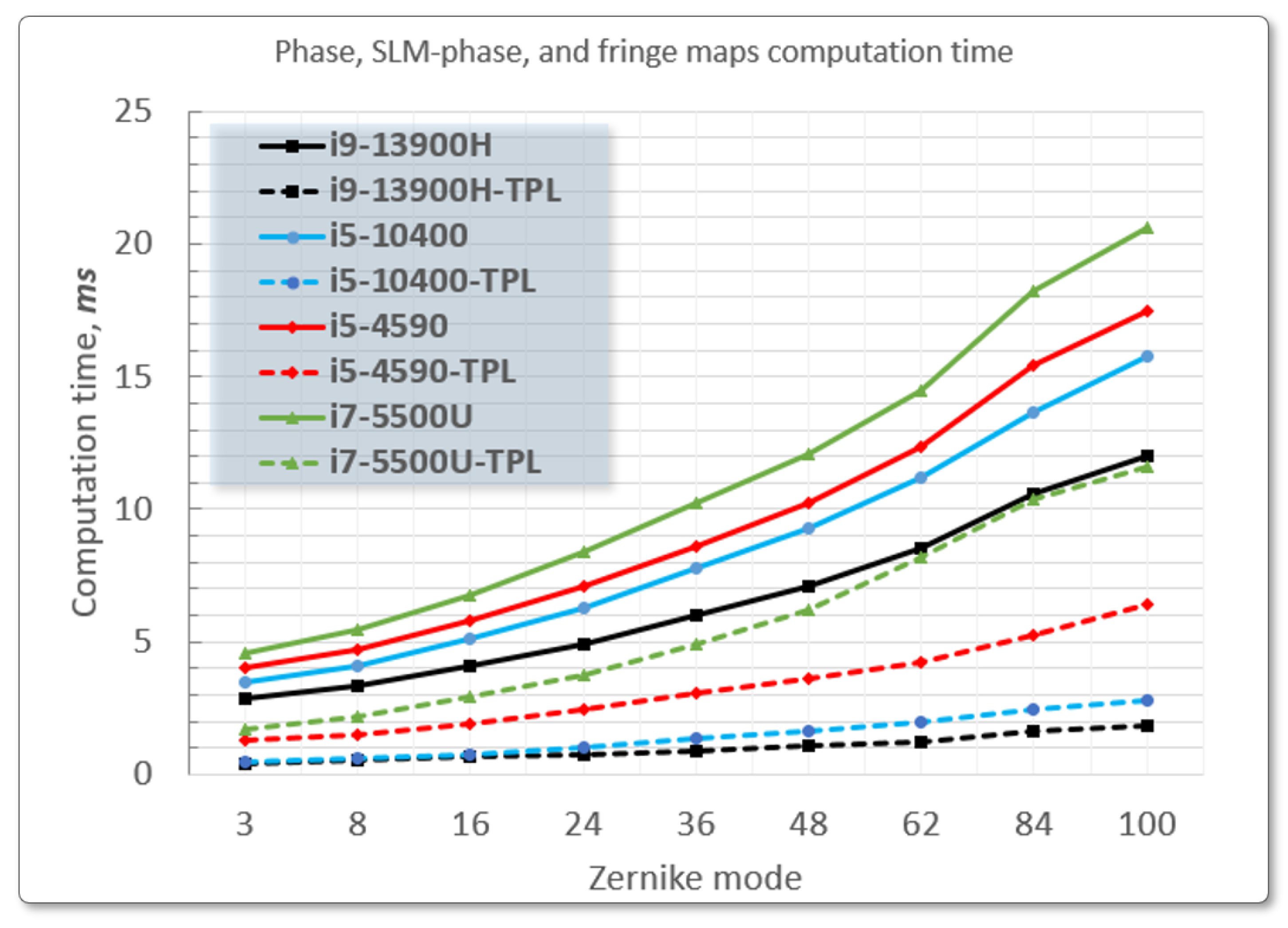
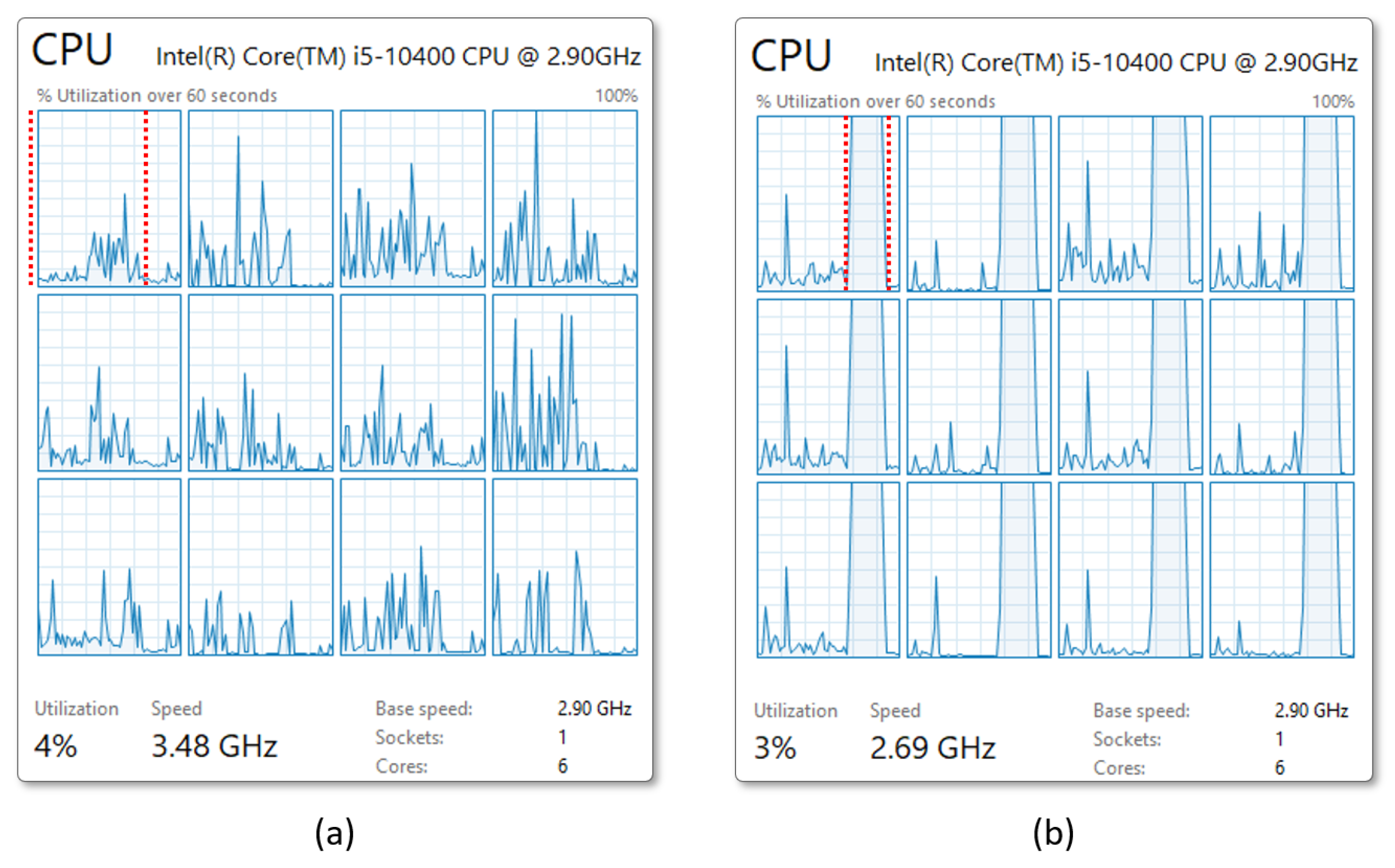
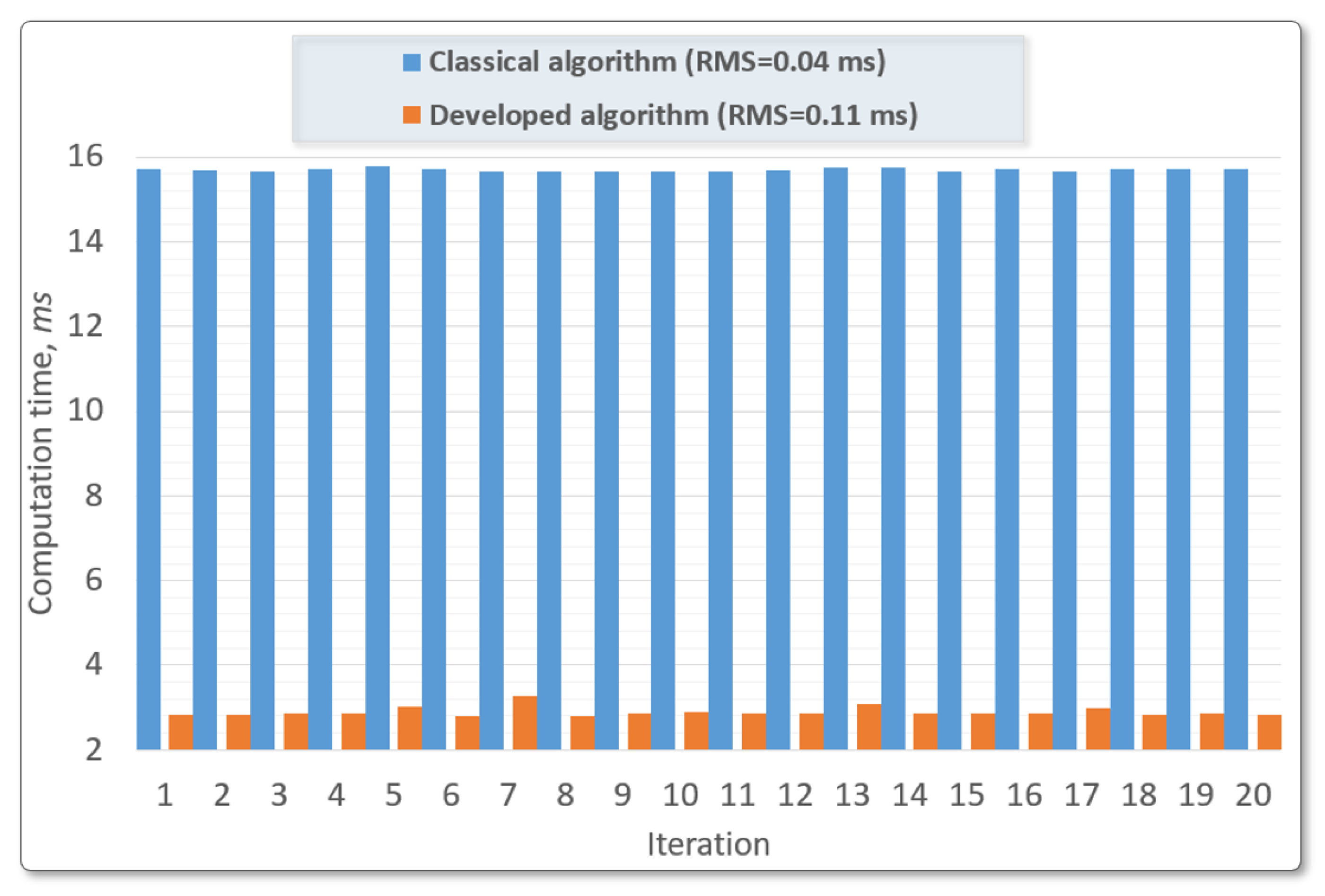
- High-Performance Computation. The framework leverages CPU multicore and multithreading capabilities through the .NET Task Parallel Library (TPL) [69], complemented by low-level codebase optimizations to maximize computational efficiency.
- Precomputation and Caching. A preloading feature for a matrix of precalculated Zernike polynomial values further accelerates computation speed for repetitive analyses.
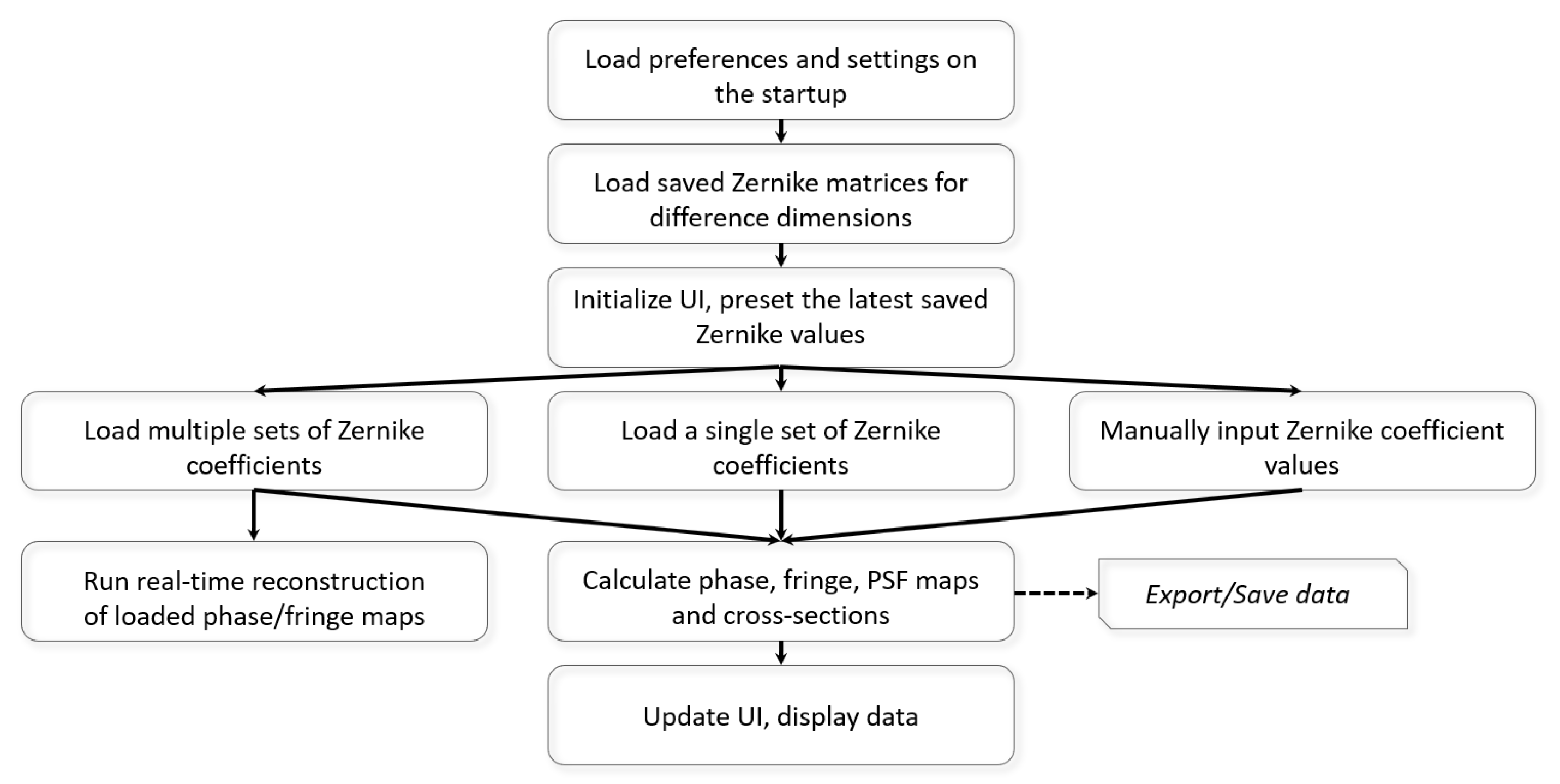
- Real-Time Wavefront Manipulation. The capability to reproduce and manipulate preloaded Zernike coefficients in real time enables precise analysis and post-processing of experimentally recorded wavefronts. This also provides a valuable tool for researchers requiring controllable, artificially generated turbulence in laboratory settings. Further details are provided in subsequent sections.
- Spatial Light Modulator (SLM) Integration. The tool can construct specialized phase maps with a more than 2π range (SLM-phase map) and project them onto a secondary display, making it a convenient and universal interface for applications involving Spatial Light Modulators [70].
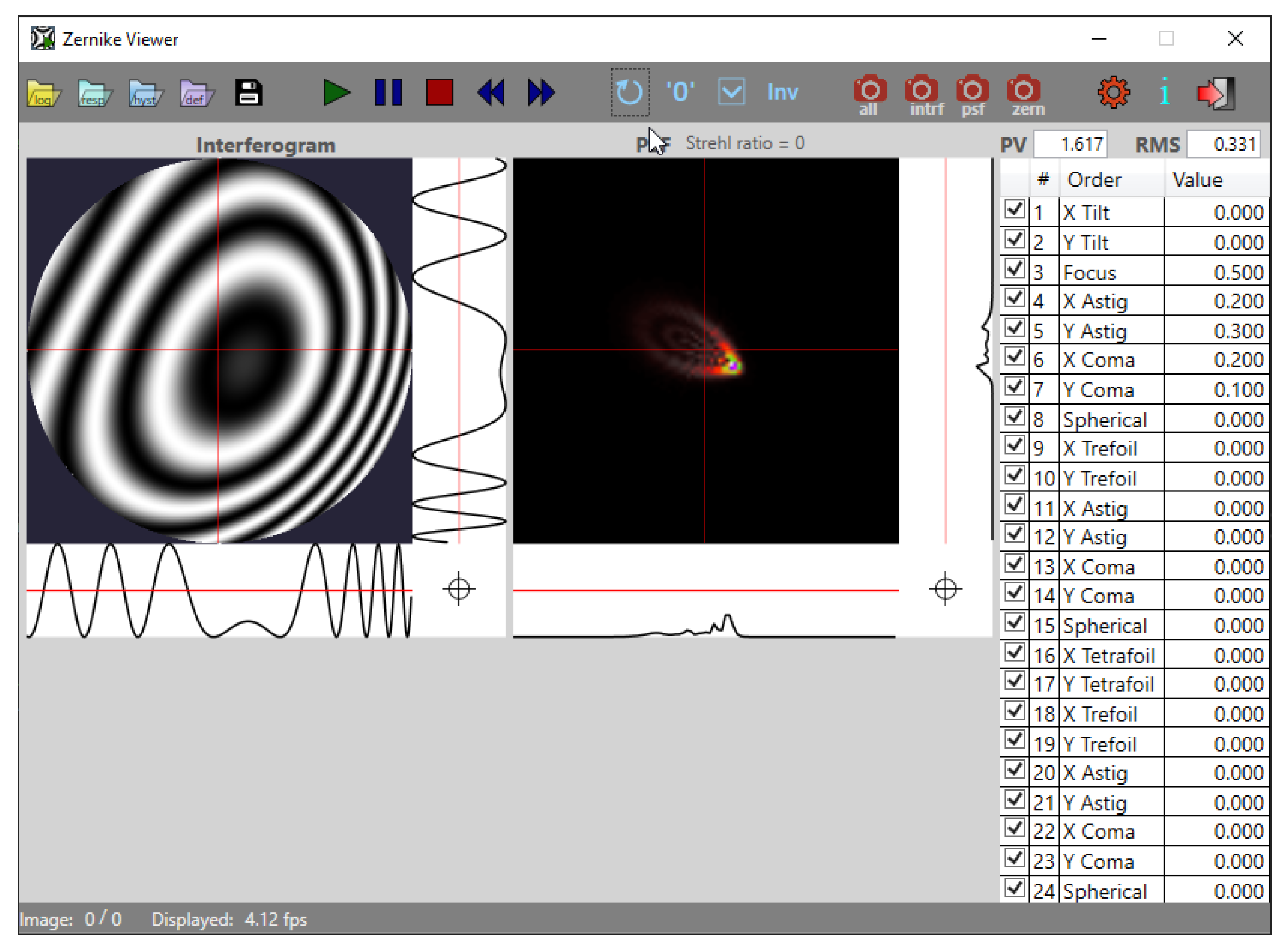
- A Conventional Desktop Application Design. The tool has a user-friendly graphical interface (GUI) and robust data export functionality that is generally more practical and convenient for both novice and advanced users. An ability to operate in offline mode makes this tool even more robust.
2. Theory: Zernike Circle Polynomials
3. Materials and Methods
3.1. Experimental Setup
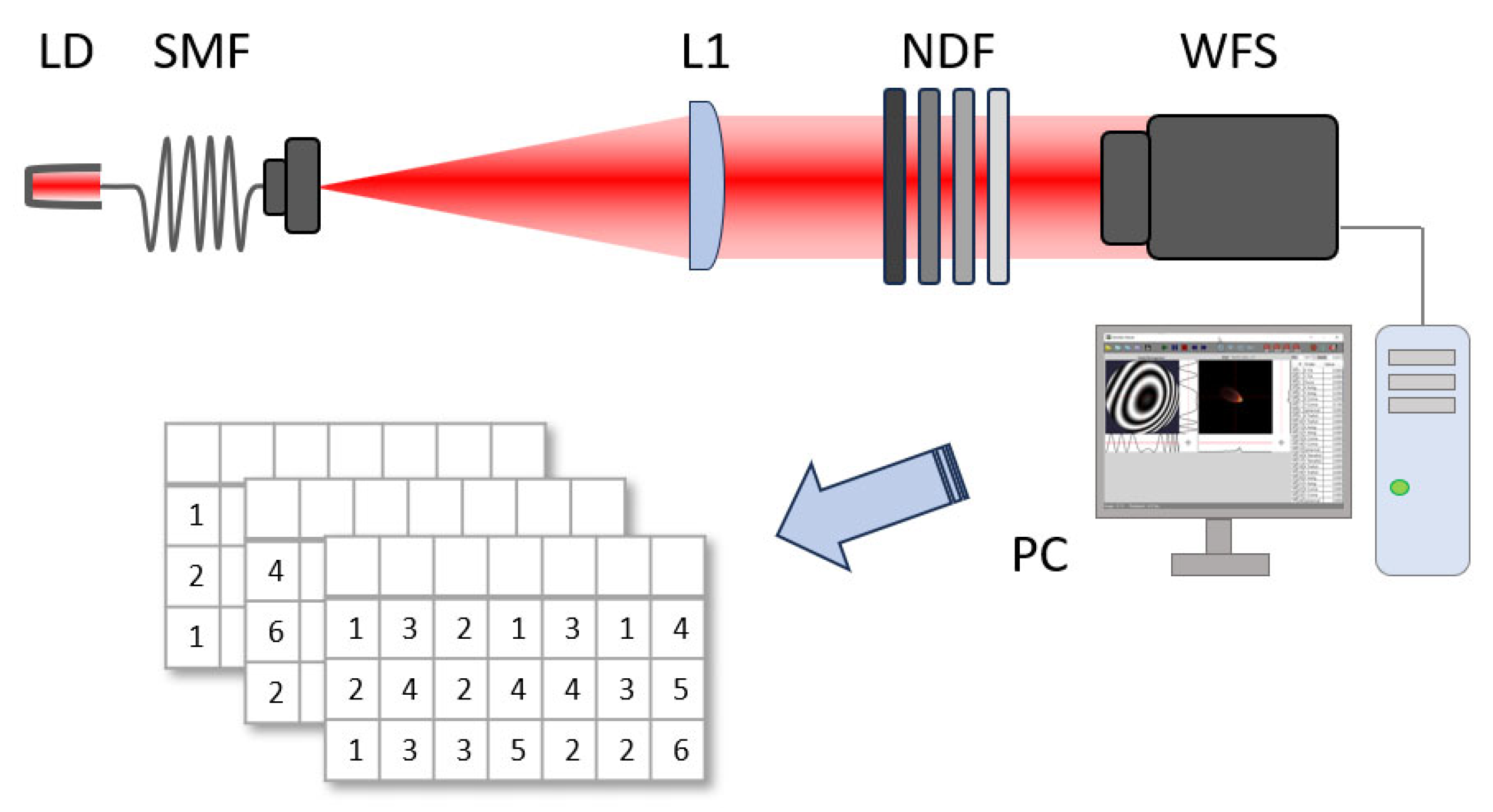
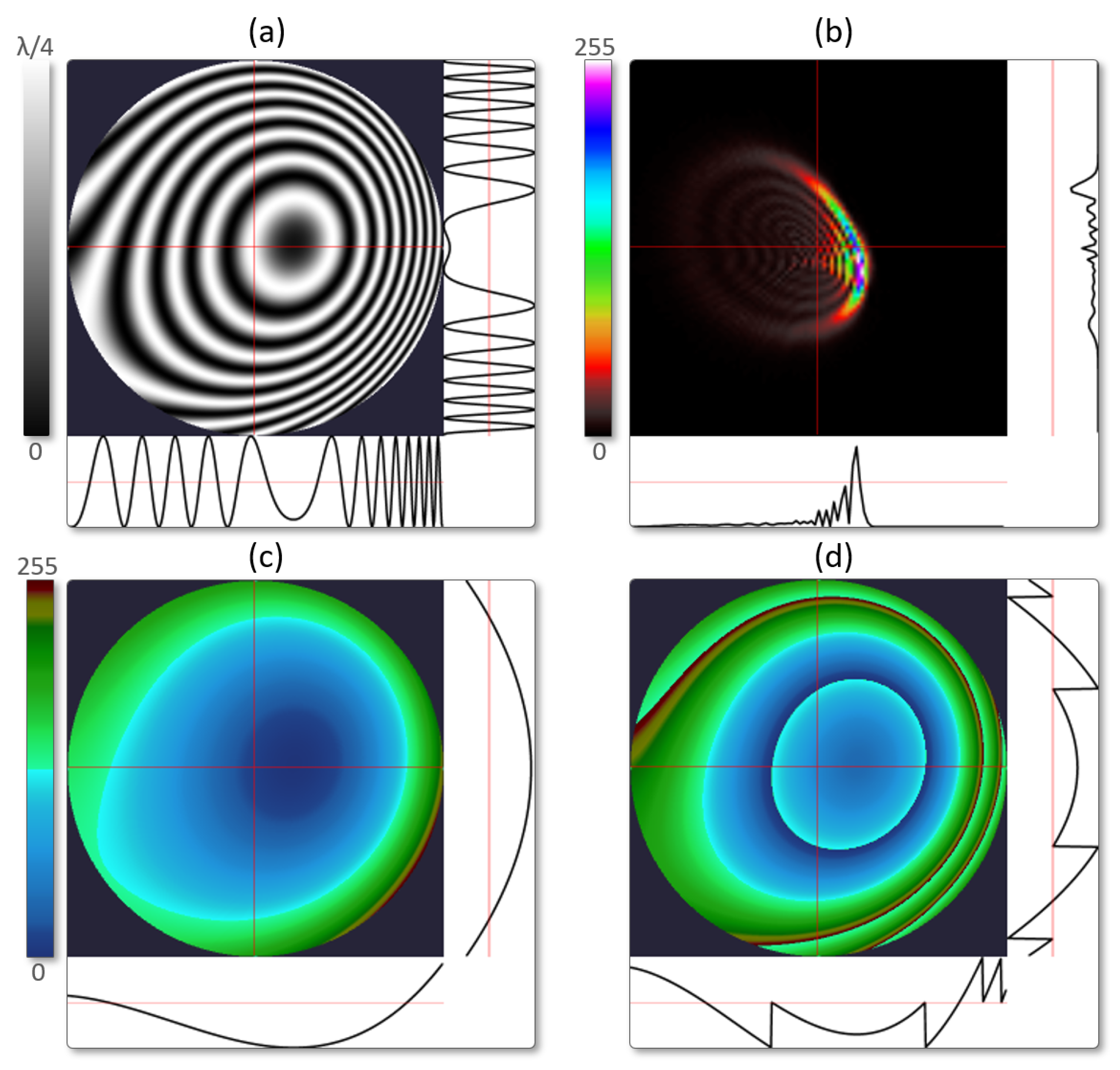
- Characterization of distorted wavefronts. Measuring wavefronts aberrated by natural or artificially generated turbulence [79] is critical for testing turbulence generation methods or wavefront correction algorithms. In this context, ZernikeViewer functions as an analysis tool: a recorded set of wavefronts is imported, the framework performs decomposition and real-time reproduction, simultaneously calculating and displaying the corresponding Zernike coefficients, phase map, fringe pattern, and PSF map for precise quantitative assessment. Furthermore, this generated sequence of phase screens can be inverted and projected onto a secondary monitor connected to an SLM. In a controlled laboratory setting, this allows for the theoretical compensation of wavefront distortions within an optical path, providing a valuable method for system testing, simulation, and dynamic correction.
- Post-processing of historical data. The framework facilitates the detailed reconstruction and characterization of wavefronts from previously recorded measurements, enabling retrospective analysis.
3.2. Methodology
3.3. Process Flowchart
3.4. ZernikeViewer Framework UI and Scripts
| Algorithm 1. Phase calculation algorithm using TPL. |
| Input parameters: N—phase map resolution (per one dimension); hN—center coordinate of a phase map; —a vector of Zernike coefficients; —a matrix of Zernike polynomials values in discrete points; —point in Descartes coordinates; λ—wavelength; —wavenumber. Output parameters: —the matrix of phase values; —the matrix of phase values for the spatial light modulators; —the matrix of fringe values. Algorithm pseudocode:
|
4. Results and Discussion
4.1. Performance Analysis
4.2. Error Analysis
4.3. Limitations and Future Work
5. Conclusions
Funding
Data Availability Statement
Acknowledgments
Conflicts of Interest
References
- Niu, K.; Tian, C. Zernike polynomials and their applications. J. Opt. 2022, 24, 123001. [Google Scholar] [CrossRef]
- Lakshminarayanan, V.; Fleck, A. Zernike polynomials: A guide. J. Mod. Opt. 2011, 58, 545–561. [Google Scholar] [CrossRef]
- Galaktionov, I.; Toporovsky, V. Performance Analysis of an Optical System for FSO Communications Utilizing Combined Stochastic Gradient Descent Optimization Algorithm. Applied System Innovation 2025, 8, 143. [Google Scholar] [CrossRef]
- Artal, P.; Rodríguez-Fernández, I.; Yago, I.; Marín, J.; Paniagua-Diaz, A. Optical correction in excised cataractous crystalline lenses by using wavefront shaping techniques. Biomed. Opt. Express 2025, 16, 3936–3948. [Google Scholar] [CrossRef] [PubMed]
- Zhou, Z.; Toda, K.; Kurata, R.; Horie, K.; Horisaki, R.; Ideguchi, T. Phase retrieval via Zernike phase contrast microscopy with an untrained neural network. Opt. Express 2025, 33, 18698–18708. [Google Scholar] [CrossRef]
- Warzecha, M.; Schatz, M.E.; Lucarelli, S.; Jüttner, C. Increasing Structural Performance of Space Telescope Mirrors through Simultaneous Shape and Size Optimization. Aerospace 2022, 9, 646. [Google Scholar] [CrossRef]
- Tam, J.; Wong, H.; Han, Y.; Jin, G.; Chow, H. Measurement of complex surfaces using precision coordinate measuring machine with Zernike algorithms. Meas. Sci. Technol 2025, 36, 065009. [Google Scholar] [CrossRef]
- Zernike, F. Diffraction theory of the knife-edge test and its improved form, the phase-contrast method. Mon. Not. R. Astron. Soc. 1934, 94, 377–384. [Google Scholar] [CrossRef]
- Zernike, F. Beugungstheorie des schneidenver-fahrens und seiner verbesserten form, der phasenkontrastmethode. Physica 1934, 1, 689–704. [Google Scholar] [CrossRef]
- Schwiegerling, J.; Greivenkamp, J. Using corneal height maps and polynomial decomposition to determine corneal aberrations. Optom. Vis. Sci. Off. Publ. Am. Acad. Optom. 1997, 74, 906–916. [Google Scholar] [CrossRef]
- Schwiegerling, J.; Greivenkamp, J.; Miller, J. Representation of videokeratoscopic height data with Zernike polynomials. JOSA A 1995, 12, 2105–2113. [Google Scholar] [CrossRef] [PubMed]
- Soloviev, A.; Kotov, A.; Martyanov, M.; Perevalov, S.; Zemskov, R.; Starodubtsev, M.; Aleksandrov, A.; Galaktionov, I.; Samarkin, V.; Kudryashov, A.; et al. Improving focusability of post-compressed PW laser pulses using a deformable mirror. Opt. Express 2022, 30, 40584–40591. [Google Scholar] [CrossRef] [PubMed]
- Iskander, D.; Collins, M.; Davis, B. Optimal modeling of corneal surfaces with Zernike polynomials. IEEE Trans. Biomed. Eng. 2001, 48, 87–95. [Google Scholar] [CrossRef] [PubMed]
- Kotov, A.; Perevalov, S.; Starodubtsev, M.; Zemskov, R.; Alexandrov, A.; Galaktionov, I.; Kudryashov, A.; Samarkin, V.; Soloviev, A. Adaptive system for correcting optical aberrations of high-power lasers with dynamic determination of the reference wavefront. Quantum Electron. 2021, 51, 593–596. [Google Scholar] [CrossRef]
- Rodrigues, M.; Rosa, A.; Vieira, N.; Murta, J. Modeling ophthalmic surfaces using Zernike, Bessel and Chebyshev type functions. J. Phys. Conf. Ser. 2019, 1194, 012093. [Google Scholar] [CrossRef]
- Klyce, S.; Karon, M.; Smolek, M. Advantages and disadvantages of the Zernike expansion for representing wave aberration of the normal and aberrated eye. J. Refract. Surg. 2004, 20, S537–541. [Google Scholar] [CrossRef]
- Soloviev, A.; Kotov, A.; Perevalov, S.; Esyunin, M.; Starodubtsev, M.; Alexandrov, A.; Galaktionov, I.; Samarkin, V.; Kudryashov, A.; Ginzburg, V.; et al. Adaptive system for wavefront correction of the PEARL laser facility. Quantum Electron. 2020, 50, 1115–1122. [Google Scholar] [CrossRef]
- Skvortsov, A.; Zuev, S.; Koryachko, M.; Voloshinov, E. Specific features of motion of molten zones in the field of silicon structural inhomogeneity. Tech. Phys. Lett. 2017, 43, 705–707. [Google Scholar] [CrossRef]
- Koryachko, M.; Pshonkin, D.; Skvortsov, A. Features of melt droplet formation during electrical destruction aluminum films on the semiconductor surface. Defect Diffus. Forum 2021, 410, 737–741. [Google Scholar] [CrossRef]
- Wan, K.; Gu, Z.; Yan, C. An analytic expression for the field dependence of three-order Zernike aberrations in decentered and/or tilted optical systems. Opt. Commun. 2024, 565, 130696. [Google Scholar] [CrossRef]
- Capalbo, V.; De Petris, M.; De Luca, F.; Cui, W.; Yepes, G.; Knebe, A.; Rasia, E. The Three Hundred project: Quest of clusters of galaxies morphology and dynamical state through Zernike polynomials. Mon. Not. R. Astron. Soc. 2021, 503, 6155–6169. [Google Scholar] [CrossRef]
- Bará, S.; Nievas, M.; de Miguel, A.S.; Zamorano, J. Zernike analysis of all-sky night brightness maps. Appl. Opt. 2014, 53, 2677–2686. [Google Scholar] [CrossRef] [PubMed]
- Skvortsov, A.; Koryachko, M.; Zuev, S.; Demchenkova, A. Melt drops movement over semiconductor surfaces controlled by electric field. Period. Tche Quim. 2019, 16, 681–687. [Google Scholar] [CrossRef]
- Skvortsov, A.A.; Koryachko, M.V.; Skvortsov, P.A.; Luk’yAnov, M.N. On the Issue of Crack Formation in a Thin Dielectric Layer on Silicon under Thermal Shock. J. Mater. Eng. Perform. 2020, 29, 4390–4395. [Google Scholar] [CrossRef]
- Skvortsov, A.A.; Pshonkin, D.; Koryachko, M.V.; Rybakova, M.R. The Effect of Constant Magnetic Fields on the Dynamics of Molten Zones in the Field of Structural Inhomogeneity of Silicon. Tech. Phys. Lett. 2018, 44, 498–501. [Google Scholar] [CrossRef]
- Bará, S.; Tilve, V.; Nievas, M.; Miguel, A.; Zamorano, J. Zernike power spectra of clear and cloudy light-polluted urban night skies. Appl. Opt. 2015, 54, 4120–4129. [Google Scholar] [CrossRef]
- Qu, Z.; Pfefferlé, D.; Hudson, S.; Baillod, A.; Kumar, A.; Dewar, R.; Hole, M. Coordinate parameterisation and spectral method optimization for Beltrami field solver in stellarator geometry. Plasma Phys. Control. Fusion 2020, 62, 124004. [Google Scholar] [CrossRef]
- Dudt, D.; Kolemen, E. DESC: A stellarator equilibrium solver. Phys. Plasmas 2020, 27, 102513. [Google Scholar] [CrossRef]
- Hudson, S.; Dewar, R.; Hole, M.; McGann, M. Nonaxisymmetric, multi-region relaxed magnetohydrodynamic equilibrium solutions. Plasma Phys. Control. Fusion 2011, 54, 014005. [Google Scholar] [CrossRef]
- Boyd, J.; Yu, F. Comparing seven spectral methods for interpolation and for solving the Poisson equation in a disk: Zernike polynomials, Logan-Shepp ridge polynomials, Chebyshev-Fourier Series, cylindrical Robert functions, Bessel-Fourier expansions, square-to-disk confor. J. Comput. Phys. 2011, 230, 1408–1438. [Google Scholar] [CrossRef]
- Martínez-Finkelshtein, A.; Delgado, A.; Castro, G.; Zarzo, A.; Alió, J. Comparative analysis of some modal reconstruction methods of the shape of the cornea from the corneal elevation data. Invest. Ophthalmol. Vis. Sci. 2009, 50, 5639–5645. [Google Scholar] [CrossRef] [PubMed]
- Ares, M.; Royo, S. Comparison of cubic B-spline and Zernike-fitting techniques in complex wavefront reconstruction. Appl. Opt. 2006, 45, 6945–6964. [Google Scholar] [CrossRef] [PubMed]
- Schneider, M.; Iskander, D.; Collins, M.J. Modeling corneal surfaces with rational functions for high-speed videokeratoscopy data com pression. IEEE Trans. Biomed. Eng. 2009, 56, 493–499. [Google Scholar] [CrossRef] [PubMed]
- Martínez-Finkelshtein, A.; Ramos-López, D.; Iskander, D. Computation of 2D Fourier transforms and diffraction integrals using Gaussian radial basis functions. Appl. Comput. Harmon. Anal. 2017, 43, 424–448. [Google Scholar] [CrossRef]
- Mahajan, V. Zernike annular polynomials and optical aberrations of systems with annular pupils. Appl. Opt. 1994, 33, 8125–8127. [Google Scholar] [CrossRef]
- Mahajan, V.; Dai, G. Orthonormal polynomials for hexagonal pupils. Opt. Lett. 2006, 31, 2462–2464. [Google Scholar] [CrossRef]
- Mahajan, V.; Dai, G. Orthonormal polynomials in wavefront analysis: Analytical solution. J. Opt. Soc. Am. A 2007, 24, 2994–3016. [Google Scholar] [CrossRef]
- Navarro, R.; López, J.; Díaz, J.; Sinusía, E. Generalization of Zernike polynomials for regular portions of circles and ellipses. Opt. Express 2014, 22, 21263–21279. [Google Scholar] [CrossRef]
- Ferreira, C.; López, J.; Navarro, R.; Pérez Sinusía, E. Zernike-like systems in polygons and polygonal facets. Appl. Opt. 2015, 54, 6575–6583. [Google Scholar] [CrossRef]
- Furter, A. Orthogonal polynomials of two variables defined on a rectangle. Proc. Acad. Sci. USSR 1956, 110, 963–966. (In Russian) [Google Scholar]
- He, P.; Zong, X.; Fu, R. Zernike polynomials for rectangular area and applications in off-axis asphere testing. In Proc. SPIE 7656, 5th International Symposium on Advanced Optical Manufacturing and Testing Technologies: Optical Test and Measurement Technology and Equipment; SPIE Optical Metrology: Munich, Germany, 2010; p. 765615. [Google Scholar] [CrossRef]
- Navarro, R.; Arines, J.; Rivera, R. Direct and inverse discrete Zernike transform. Opt. Express 2009, 17, 24269–24281. [Google Scholar] [CrossRef] [PubMed]
- Cuyt, A.; Yaman, I.; Ibrahimoglu, B.; Benouahmane, B. Radial orthogonality and Lebesgue constants on the disk. Numer. Algorithms 2012, 61, 291–313. [Google Scholar] [CrossRef]
- Ramos-López, D.; Sánchez-Granero, M.A.; Fernández-Martínez, M.; Martínez-Finkelshtein, A. Optimal sampling patterns for Zernike polynomials. Appl. Math. Comput. 2016, 274, 247–257. [Google Scholar] [CrossRef]
- Carnicer, J.; Godés, C. Interpolation on the disk. Numer. Algorithms 2014, 66, 1–16. [Google Scholar] [CrossRef]
- Meurant, G.; Sommariva, A. On the computation of sets of points with low Lebesgue constant on the unit disk. J. Comput. Appl. Math. 2019, 345, 388–404. [Google Scholar] [CrossRef]
- Díaz-Elbal, S.; Martínez-Finkelshtein, A.; Ramos-López, D. Sampling patterns for Zernike-like bases in non-standard geometries. Appl. Math. Comput. 2026, 511, 129727. [Google Scholar] [CrossRef]
- Chong, C.-W.; Raveendran, P.; Mukundan, R. A comparative analysis of algorithms for fast computation of Zernike moments. Pattern Recognit. 2003, 36, 731–742. [Google Scholar] [CrossRef]
- Novák, P.; Novák, J. Efficient and stable numerical method for evaluation of Zernike polynomials and their Cartesian derivatives. In Proc. SPIE 8789, Modeling Aspects in Optical Metrology IV, San Francisco, CA, USA, 2–4 February 2013; SPIE Optical Metrology: Munich, Germany, 2013; p. 878913. [Google Scholar] [CrossRef]
- Singh, C.; Walia, E. Fast and numerically stable methods for the computation of Zernike moments. Pattern Recognit. 2010, 43, 2497–2506. [Google Scholar] [CrossRef]
- Deng, A.-W.; Wei, C.-H.; Gwo, C.-Y. Stable, fast computation of highorder Zernike moments using a recursive method. Pattern Recognit. 2016, 56, 16–25. [Google Scholar] [CrossRef]
- Papakostas, G.; Boutalis, Y.; Papaodysseus, C.; Fragoulis, D. Numerical stability of fast computation algorithms of Zernike moments. Appl. Math. Comput. 2008, 195, 326–345. [Google Scholar] [CrossRef]
- Kintner, E.C. A Recurrence Relation for Calculating the Zernike Polynomials. Opt. Acta Int. J. Opt. [CrossRef]
- Prata, A.; Rusch, W.V.T. Algorithm for computation of Zernike polynomials expansion coefficients. Appl. Opt. 1989, 28, 749–754. [Google Scholar] [CrossRef] [PubMed]
- Chen, X.; Zhong, S.; Hou, Y.; Cao, R.; Wang, W.; Li, D.; Dai, Q.; Kim, D.; Xi, P. Superresolution structured illumination microscopy reconstruction algorithms: A review. Light Sci. Appl. 2023, 12, 172. [Google Scholar] [CrossRef] [PubMed]
- Li, Z.S.; Liu, C.; Li, X.W.; Zheng, Y.; Huang, Q.; Zheng, Y.-W.; Hou, Y.-H.; Chang, C.-L.; Zhang, D.-W.; Zhuang, S.-L.; et al. Real-time holographic camera for obtaining real 3D scene hologram. Light. Sci. Appl. 2025, 14, 74. [Google Scholar] [CrossRef]
- Qin, H.; Qin, L.; Xue, L.; Yu, C. A parallel recurrence method for the fast computation of Zernike moments. Appl. Math. Comput. 2012, 219, 1549–1561. [Google Scholar] [CrossRef]
- Janssen, A. Computing Zernike polynomials of arbitrary degree using the discrete Fourier transform. J. Eur. Opt. Soc. Publ. 2007, 2, 07012. [Google Scholar] [CrossRef]
- Al-Rawi, M. Ultra-Fast Zernike Moments using FFT and GPU. arXiv 2023. [Google Scholar] [CrossRef]
- Zhang, H.-Y.; Zhou, Y.; Feng, Z.-Q. Balanced Binary Tree Schemes for Computing Zernike Radial Polynomials. IEEE Access 2023, 11, 106567–106579. [Google Scholar] [CrossRef]
- Belova, O.S.; Bolotov, D.V.; Kazantsev, S.Y.; Klubkov, A.V.; Kolesnikov, O.V.; Paimtsev, G.P.; Yarygin, M.A. The influence of pulsed electromagnetic action on a quantum key distribution. Russ. Electr. Eng. 2025, 96, 289–294. [Google Scholar] [CrossRef]
- Boev, A.A.; Vorobey, S.S.; Kazantsev, S.Y.; Kernosov, M.Y.; Kolesnikov, O.V.; Kuznetsov, S.N.; Mironov, Y.B.; Parshin, A.A.; Rudavin, N.V. Possibility of creating a modular system for quantum key distribution in the atmosphere. Tech. Phys. Lett. 2022, 48, 11–14. [Google Scholar] [CrossRef]
- Elmacioglu, Y.; Conlin, R.; Dudt, D.; Panici, D.; Kolemen, E. ZERNIPAX: A fast and accurate Zernike polynomial calculator in Python. Appl. Math. Comput. 2025, 505, 129534. [Google Scholar] [CrossRef]
- Kim, S.; Youk, Y.; Kim, G.; Ryu, D.; Yoon, J. ZernikeNet: A deep learning-based approach for accurate Zernike coefficients calculation in aspheric optical components. In Proc. SPIE 12677, Astronomical Optics: Design, Manufacture, and Test of Space and Ground Systems IV, Edinburgh, UK, 17–21 April 2023; SPIE Digital Library: Bellingham, WA, USA, 2023; Volume 12677, p. 126770S. [Google Scholar] [CrossRef]
- Wyant College of Optical Sciences. Available online: https://webs.optics.arizona.edu/gsmith/Zernike.html (accessed on 23 February 2026).
- Gatinel, D. Available online: https://www.gatinel.com/recherche-formation/wavefront-sensing/wavefront-analyzer-zernike-optics-simulator/ (accessed on 23 February 2026).
- Wolfram Projects. Available online: https://demonstrations.wolfram.com/PlotsOfZernikePolynomials/ (accessed on 23 February 2026).
- Optics Website. Available online: https://www.opticsthewebsite.com/Zernike (accessed on 23 February 2026).
- Luo, Z.; Zheng, Q.; Hei, X.; Giacaman, N. Parallel Programming Based on Microsoft.NET TPL. In Proceedings of the 2nd International Conference on Computer Science and Electronics Engineering (ICCSEE 2013), Dubai, United Arab Emirates, 24–25 March 2013. [Google Scholar] [CrossRef]
- Toporovsky, V.; Galaktionov, I. Modal wavefront reconstruction of fixed aberrations for piezoelectric deformable mirrors. Lect. Notes Electr. Eng. 2026, 1521, 286–298. [Google Scholar] [CrossRef]
- Lewis, H.R.; Bellan, P.M. Physical constraints on the coefficients of Fourier expansions in cylindrical coordinates. J. Math. Phys. 1990, 31, 2592–2596. [Google Scholar] [CrossRef]
- Galaktionov, I.; Toporovsky, V. Gradient descent algorithm for automatic optimization of a laser beam cross-section in free-space optical communication applications. Lect. Notes Electr. Eng. 2026, 1521, 231–240. [Google Scholar] [CrossRef]
- Wyant, J.C.; Creath, K. Basic Wavefront Aberration Theory for Optical Metrology. Appl. Opt. Opt. Eng. 1992, 11, 28–39. [Google Scholar]
- Southwell, W.H. Wavefront estimation from wavefront slope measurements. J. Opt. Soc. Am. 1980, 70, 998–1005. [Google Scholar] [CrossRef]
- Simpkins, J.; Stevenson, R. A spatially varying PSF model for Seidel aberrations and defocus. In Proc. SPIE 8666, Visual Information Processing and Communication IV, San Francisco, CA, USA, 21–23 January 2013; SPIE Digital Library: Bellingham, WA, USA, 2020; Volume 8666, p. 86660F. [Google Scholar] [CrossRef]
- Mahajan, V. Zernike polynomials and aberration balancing. In Proc. SPIE 5173, Current Developments in Lens Design and Optical Engineering IV, San Francisco, CA, USA, 13–14 August 2003; SPIE Digital Library: Bellingham, WA, USA, 2020; Volume 5173, p. 517302. [Google Scholar] [CrossRef]
- Galaktionov, I.; Toporovsky, V. A Multi-Stage Algorithm of Fringe Map Reconstruction for Fiber-End Surface Analysis and Non-Phase-Shifting Interferometry. Appl. Syst. Innov. 2026, 9, 31. [Google Scholar] [CrossRef]
- Galaktionov, I.; Nikitin, A.; Sheldakova, J.; Toporovsky, V.; Kudryashov, A. Numerical Analysis of Wavefront Approximation Accuracy by Means of Zernike Polynomials for Optical Surface Flatness Measurements Using a Hartmannometer Device. Opt. Mem. Neural Netw. 2024, 33, S146–S157. [Google Scholar] [CrossRef]
- Galaktionov, I.; Toporovsky, V. A Multi-Deformable-Mirror 500 Hz Adaptive Optical System for Atmospheric Turbulence Simulation, Real-Time Reconstruction, and Wavefront Correction Using Bimorph and Tip-Tilt Correctors. Photonics 2025, 12, 592. [Google Scholar] [CrossRef]
- Klykov, S. Zernpy. Available online: https://github.com/sklykov/zernpy.git (accessed on 23 February 2026).
- Antonello, J. Zernike. Available online: https://github.com/jacopoantonello/zernike.git (accessed on 23 February 2026).
- Menduina, A. Zern. Available online: https://github.com/AlvaroMenduina/ZERN.git (accessed on 23 February 2026).
- The Mpmath Development Team. Mpmath: A Python Library for Arbitraryprecision Floating-Point Arithmetic (Version 1.3.0). 2023. Available online: https://mpmath.org/ (accessed on 23 February 2026).



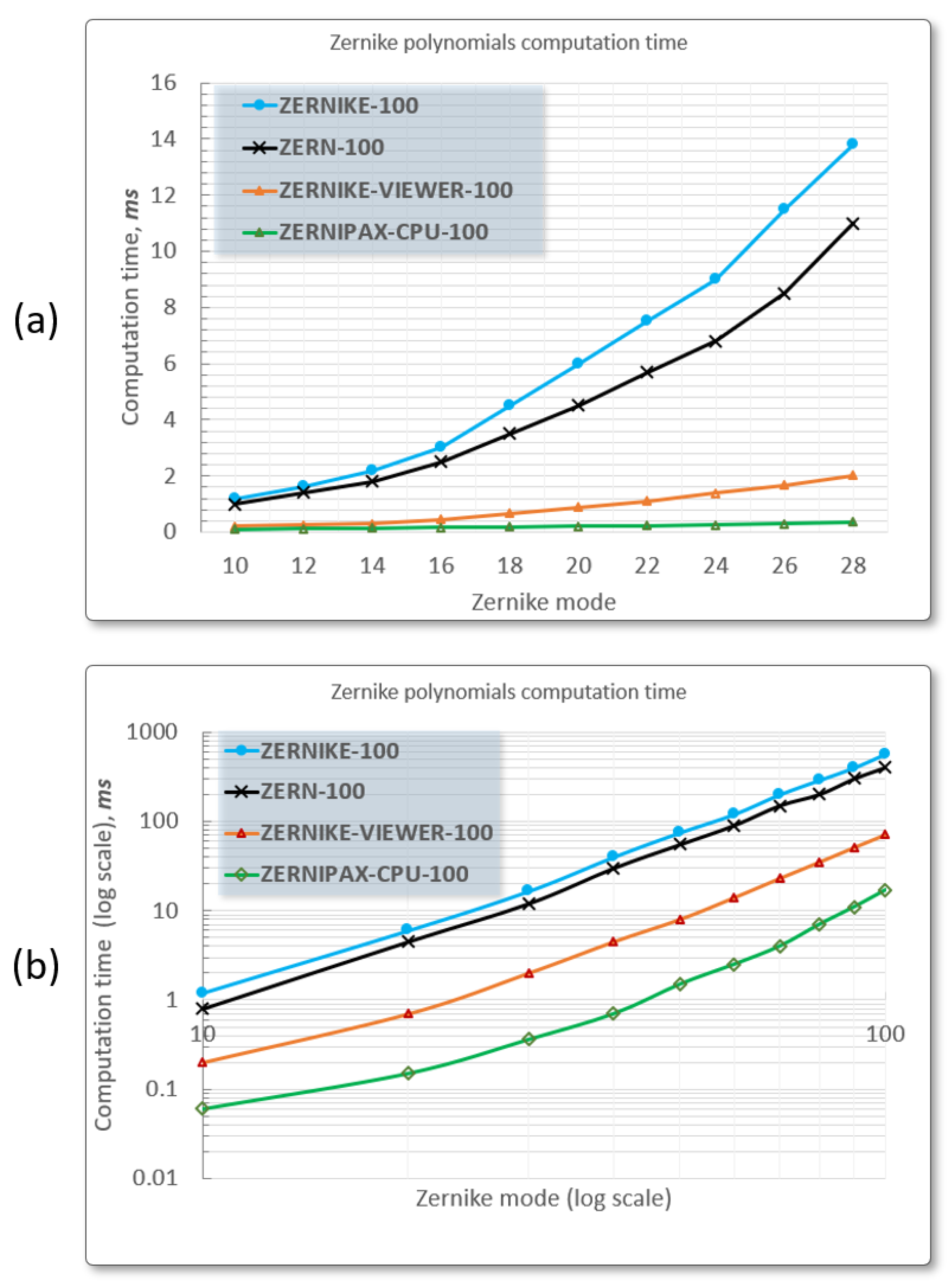
| Comp. Time, ms | Zernike Mode Number | ||||||||
|---|---|---|---|---|---|---|---|---|---|
| Package | 10 | 12 | 14 | 16 | 18 | 20 | 24 | 26 | 28 |
| ZERNIPAX | 0.11 | 0.13 | 0.15 | 0.17 | 0.19 | 0.21 | 0.25 | 0.29 | 0.35 |
| ZERNIKE-VIEWER | 0.20 | 0.24 | 0.31 | 0.45 | 0.67 | 0.88 | 1.38 | 1.67 | 2.02 |
| ZERN-100 | 1.01 | 1.42 | 1.82 | 2.51 | 3.54 | 4.42 | 6.81 | 8.52 | 11.01 |
| ZERNIKE-100 | 1.22 | 1.64 | 2.21 | 3.02 | 4.56 | 6.04 | 9.02 | 11.5 | 13.8 |
Disclaimer/Publisher’s Note: The statements, opinions and data contained in all publications are solely those of the individual author(s) and contributor(s) and not of MDPI and/or the editor(s). MDPI and/or the editor(s) disclaim responsibility for any injury to people or property resulting from any ideas, methods, instructions or products referred to in the content. |
© 2026 by the author. Published by MDPI on behalf of the International Institute of Knowledge Innovation and Invention. Licensee MDPI, Basel, Switzerland. This article is an open access article distributed under the terms and conditions of the Creative Commons Attribution (CC BY) license.
Share and Cite
Galaktionov, I. ZernikeViewer: An Open-Source Framework for Fast Simulation and Real-Time Reconstruction of Phase, Fringe, and PSF Maps. Appl. Syst. Innov. 2026, 9, 51. https://doi.org/10.3390/asi9030051
Galaktionov I. ZernikeViewer: An Open-Source Framework for Fast Simulation and Real-Time Reconstruction of Phase, Fringe, and PSF Maps. Applied System Innovation. 2026; 9(3):51. https://doi.org/10.3390/asi9030051
Chicago/Turabian StyleGalaktionov, Ilya. 2026. "ZernikeViewer: An Open-Source Framework for Fast Simulation and Real-Time Reconstruction of Phase, Fringe, and PSF Maps" Applied System Innovation 9, no. 3: 51. https://doi.org/10.3390/asi9030051
APA StyleGalaktionov, I. (2026). ZernikeViewer: An Open-Source Framework for Fast Simulation and Real-Time Reconstruction of Phase, Fringe, and PSF Maps. Applied System Innovation, 9(3), 51. https://doi.org/10.3390/asi9030051