Article

Adaptive Trajectory Control of a Hydraulic Excavator Based on RBF Sliding-Mode Control Method

1
Institute of Electrical Engineering, Yanshan University, Qinhuangdao 066004, China
2
Intelligent Technology Research Institute, LiuGong Global R&D Center, Liuzhou 530201, China
*
Author to whom correspondence should be addressed.
Appl. Syst. Innov. 2026, 9(3), 48; https://doi.org/10.3390/asi9030048
Submission received: 17 January 2026 / Revised: 22 February 2026 / Accepted: 23 February 2026 / Published: 25 February 2026

Abstract

In this paper, a nonlinear integral sliding-mode controller (SMC) based on a radial basis function (RBF) neural network is proposed to address the challenges of high nonlinearity, parameter uncertainty, and unmodeled dynamics in the electro-hydraulic servo system of a robotic excavator. The controller design incorporates adaptive RBF neural networks to compensate for system perturbations and uncertain nonlinearities, while an integral sliding surface is employed to eliminate steady-state error. This approach not only compensates for uncertainties but also reduces the traditional SMC’s high dependency on precise system parameters. The mathematical model of the bucket electro-hydraulic servo system is established without linear approximation. Based on this model, the sliding-mode controller with RBF neural networks (SMC-RBF) is designed, and its asymptotic stability is proven using the Lyapunov method. Simulation and experimental results are compared with a traditional PID controller to verify the proposed controller’s superiority. The simulations show that the SMC-RBF controller meets the requirements for tracking performance and demonstrates robustness, improving sinusoidal tracking performance by 46% compared to the PID controller. Experimental results further demonstrate that the SMC-RBF controller improves the trajectory accuracy for a two-meter straight line by 52.46% in comparison to the traditional PID controller.

1. Introduction

Robotic excavators have been applied widely in leveling, slope repair and other construction occasions. They rely on the cooperation of a working device consisting of a boom, arm and bucket to complete the construction work. The working device is driven by electro-hydraulic servo systems because they have many advantages, including high output power, flexible signal processing, compact structure and light weight [1]. However, electro-hydraulic servo systems have strong nonlinearity, and their performance is easily disturbed by parameters [2]. Moreover, there are many parameter uncertainties and unmodeled dynamics in these systems. For example, the effective bulk modulus will change with temperature perturbations, and the leakage coefficient will change with oil viscosity and external load. Overcoming the influence of these uncertainties on system performance is the main problem in the design of high-performance controllers.
In recent years, the trajectory control of electro-hydraulic servo systems has attracted extensive attention from scholars all over the world. Classic algorithms such as proportional–integral–differential (PID) control, fuzzy control and feedback control are widely used in the control of electro-hydraulic servo systems, and some achievements have been obtained. Feng et al. [3] proposed an improved PID controller for the positioning of a hydraulic system. Zhang et al. [4] designed a flow-rate-matching feedforward plus PID feedback controller. The controller achieved higher position tracking performance. Chotikunnan et al. [5] designed a fuzzy intelligent controller for the control of a robotic manipulator. It can control the position with minimal tracking errors. Liu et al. [6] developed a model predictive controller for an excavator, and it achieved precise tracking of the desired trajectory. Zhao et al. [7] proposed a feedforward observer controller to reduce the system disturbance and further improve control performances for an electro-hydraulic control loading system. Some of the controllers mentioned above are linear control methods; they ignore some nonlinear factors in the model. However, electro-hydraulic servo systems are strong nonlinear systems. When the system parameters are disturbed, it is difficult to achieve high-performance control of the electro-hydraulic servo system using the above controllers.
With the maturity of nonlinear control theory, such as sliding-mode control (SMC) [8,9], neural network controllers [10,11,12], nonlinear H∞ control [13,14] and the back-stepping design method [15,16,17], especially the emergence of SMC, the research on nonlinear control of electro-hydraulic servo systems has become a hotspot. The main advantage of SMC is the independence of parameter perturbation and disturbances. Ghani et al. [18] introduced a fuzzy self-tuning algorithm for adaptation of sliding-mode control parameters, and the presented controller is demonstrated via control of a nonlinear electro-hydraulic servo mechanism with unknown dynamics and bounded disturbances. Liu et al. [19] designed a sliding-mode controller for an autonomous underwater vehicle (AUV). Fei et al. [20] proposed a sliding-mode controller with composite learning for MEMS gyroscopes. Boulkroune et al. [21] designed an adaptive fuzzy-bias sliding-mode controller for two uncertain dissimilar chaotic systems. However, in practical applications, SMC exhibits a chattering phenomenon when eliminating the adverse effects of uncertainties, which can easily excite the unmodeled characteristics of the system, thus reducing the control performance of the system. Moreover, the performance of SMC depends on the accuracy of the system model, which restricts its application in real systems. In practical applications, some parameters of the system are difficult to attain.
The radial basis function (RBF) neural network can fit any nonlinear functions and has a fast convergence speed. It has been widely used in the identification and control of complex objects [22,23,24,25]. Using neural networks to approximate the uncertainties of a controlled system can effectively reduce the chattering phenomenon of SMC and the requirement of model accuracy. Applications of neural networks combined with SMC are available for various systems such as manipulators [26], dual-stage PV pumping systems [27], isomorphic complex networks [28] and guidance systems [29]. Tuan et al. [30] designed a robust adaptive controller for a ship-mounted container crane, and the controller used was sliding-mode control and a radial basis function network.
The control object of this study is the electro-hydraulic servo system of an excavator bucket, and its core control objective is to achieve satisfactory trajectory tracking of the working device. The system faces multiple uncertainty challenges in practical applications, mainly including time-varying perturbations in hydraulic parameters and complex unmodeled dynamics. Based on the characteristics of the controlled object mentioned above, the design of the controller needs to meet the following core requirements: while ensuring the global stability of the closed-loop system, it should have robustness to suppress the impact of various uncertainties on tracking performance, and it should ultimately achieve better control accuracy than traditional methods.
This article makes three core contributions to the field: Firstly, a new control strategy is proposed for the excavator electro-hydraulic servo system, which is a complex object with strong nonlinearity and parameter uncertainty. This strategy combines the adaptive compensation capability of radial basis function neural networks with integral sliding-mode control, effectively improving the online processing capability for system uncertainty. Secondly, by constructing a suitable Lyapunov function, a rigorous stability proof was conducted on the closed-loop system containing the neural network weight update law, theoretically ensuring the asymptotic stability of the proposed controller. Finally, through system simulation and physical platform experiments, the effectiveness of the controller was not only verified, but detailed quantitative performance evidence was also provided. The results showed that it was significantly better than a traditional PID controllers in terms of tracking accuracy and robustness.
The rest of this paper is structured as follows. In Section 2, the mathematical model of the bucket electro-hydraulic servo system is established. Section 3 describes the controller design combing SMC with an RBF neural network and analyses the system stability. Section 4 shows the simulation results for validating the superiority and robustness of the proposed controller. Section 5 presents the experimental results, where a two-meter straight line is presented to verify the performance of the proposed controller. Finally, conclusions and future works are described in Section 6.

2. Electro-Hydraulic Servo System Model

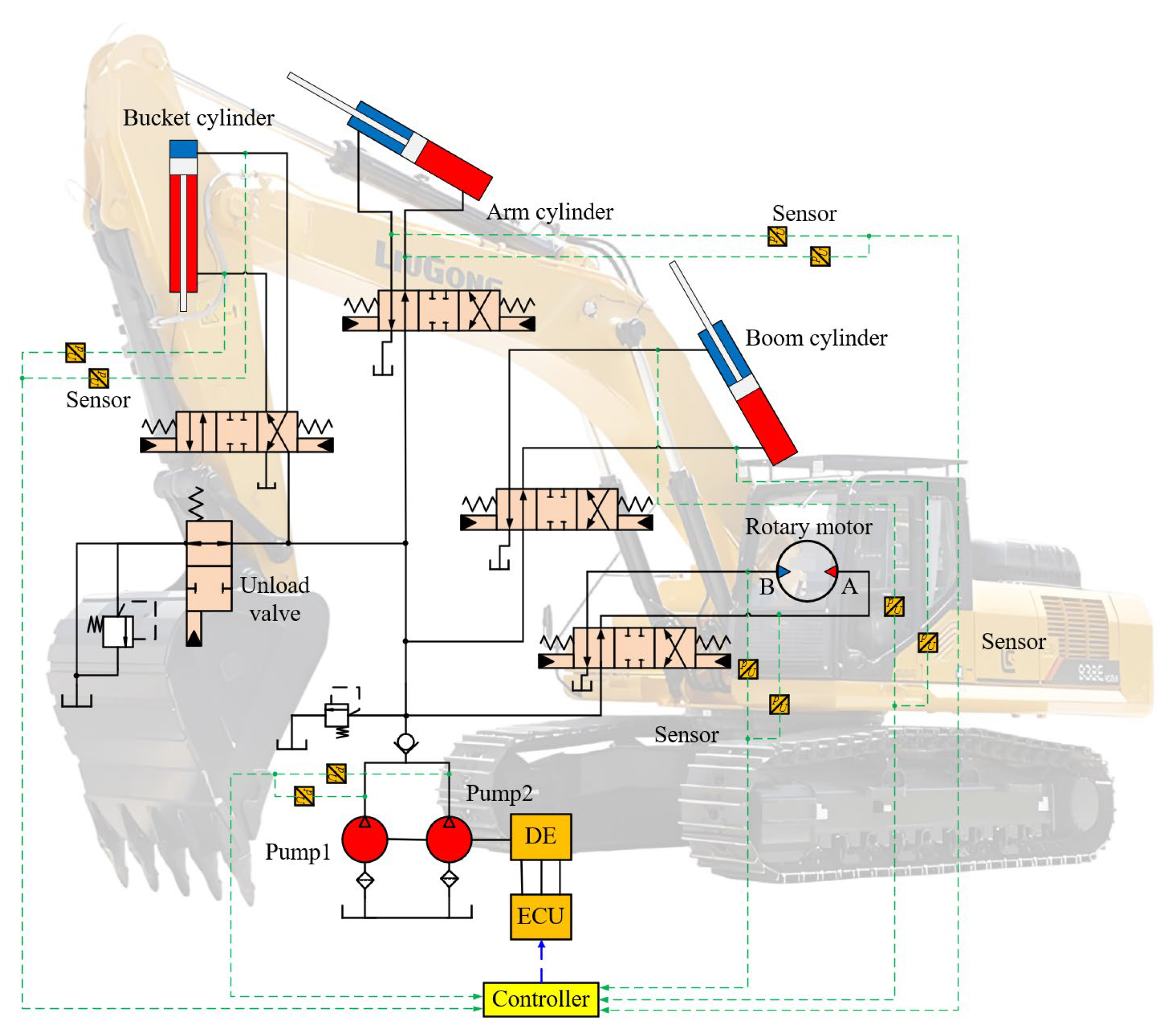
The electro-hydraulic servo system of the robotic excavator consists of a boom, arm, bucket and rotational actuator. The working principles of the boom, arm, and bucket servo systems in the excavator working device are similar. They share the same fundamental electro-hydraulic actuation model (valve-controlled cylinder), differing only in key parameters such as geometric dimensions, hydraulic cylinder sizes, and load inertia. Figure 1 shows a schematic diagram of the electro-hydraulic servo system, in which the engine, pump, controller, pilot valve, main valve and sensor are shown. The bandwidth of the main valve is 15 Hz, the maximum flow rate is 110 L/min per pump, and the maximum pressure is 34.3 MPa. The rodless chamber of the hydraulic cylinder refers to the chamber on the non-extended side of the piston rod, with an effective working area of A1. The rodless chamber refers to the chamber on the extended side of the piston rod, with an effective working area of A2.
It is assumed that the connecting pipes between the components of the system are symmetrical, regardless of the external leakage of the system. Under the extension condition, the flow continuity equation of the valve-controlled hydraulic cylinder is:
Q L = A 1 y ˙ + V 2 ( 1 + n 2 ) β e p ˙ L + 1 + n 1 + n 2 C i p L + Δ
where y is the displacement, pL is the load pressure, n is the ratio of the rodless chamber to the rod chamber, V is the total volume of the chamber, βe is the effective bulk modulus, Δ is the unmodeled part, and Ci is the internal leakage coefficient.
Assuming that the main valve is an ideal valve, the oil supply pressure ps is stable, and the return pressure is zero (i.e., connected to atmospheric pressure), which is a common simplification in engineering, then the main valve flow based on the spool displacement xv is:
Q L = C d w x v 2 ρ ( p s p L 1 + n 3 )
where Cd is the flow modification coefficient, w is the valve area gradient, and ρ is the oil density.
Equation (1) describes the flow continuity of the hydraulic cylinder chamber, and Equation (2) describes the load flow provided by the servo valve. The two are combined through the load flow variable QL to form the core model of the valve-controlled hydraulic cylinder.
Ignoring the dynamic characteristics of the main and pilot valves, it is considered that the output displacement of the main valve is proportional to the input voltage signal u, that is:
x v = K z u
where Kz is the amplification coefficient.
Substituting Equation (3) into Equation (2), the flow equation can be given as:
Q L = C d w K z u 2 ρ ( p s p L 1 + n 3 )
Equations (1)–(4) show that the electro-hydraulic servo system has strong nonlinear characteristics. In addition, the leakage coefficient, effective bulk modulus and other parameters have obvious uncertainties and change slowly with the working conditions, temperature and load.

3. Controller Design

3.1. RBF Neural Network

For the electro-hydraulic servo system of the robotic excavator with uncertain parameters and unmodeled dynamics, the control objective is that the displacement of the cylinder y can track the reference signal yd while ensuring that all signals in the closed-loop system are bounded. The radial basis function (RBF) neural network has universal approximation characteristics, and the RBF neural network f(x) is used to estimate the uncertainty and unmodeled dynamics in the system. It can be given as:
f ( x ) = W T h ( x ) + ε
where x is the input, W* is the ideal weight, ε is the estimation error, and h(x) is the activation functions contained in neural nodes and is the Gauss function.
h j ( x ) = exp ( x c j 2 2 b j 2 )
where cj is the center vector of node j, and bj is the base width parameter of node j.

3.2. Controller Design

Consider the electro-hydraulic servo system described by Equations (1)–(4), which is subject to parameter uncertainties, unmodeled dynamics Δ, and unknown nonlinearities f, g. The control objective is to design an adaptive control law u such that the system output y asymptotically tracks a bounded and continuously differentiable desired trajectory yd despite the aforementioned uncertainties while ensuring all signals in the closed-loop system remain bounded.
The displacement tracking error is defined as:
e = y y d
Differentiation of Equation (7) gives:
e ˙ = y ˙ y ˙ d
To obtain the rate of change in the tracking error, we begin by combining the flow continuity Equation (1) and the servo valve flow Equation (4). Since both equations describe the same load flow QL, they are set as equal:
A 1 y ˙ + V 2 ( 1 + n 2 ) β e p ˙ L + 1 + n 1 + n 2 C i p L + Δ = C d w x v 2 ρ ( p s p L 1 + n 3 )
Rearranging Equation (9) to solve for the cylinder velocity yields:
y ˙ = 1 A 1 C d w x v 2 ρ ( p s p L 1 + n 3 ) 1 A 1 V 2 ( 1 + n 2 ) β e p ˙ L 1 A 1 1 + n 1 + n 2 C i p L 1 A 1 Δ
Substituting the expression for the cylinder velocity from Equation (10) into the derivative of the tracking error leads to the following intermediate form:
e ˙ = 1 A 1 C d w K z 2 ρ ( p s p L 1 + n 3 ) u V 2 ( 1 + n 2 ) β e A 1 p ˙ L 1 + n 1 + n 2 1 A 1 C i p L 1 A 1 Δ y ˙ d
To simplify the notation and facilitate the subsequent controller design and stability analysis, several aggregated, positive constant parameters are defined:
α = 1 A 1 R = w K z 2 ρ ( p s p L 1 + n 3 ) β = V 2 ( 1 + n 2 ) β e A 1 γ = 1 + n 1 + n 2 1 A 1 C i
Here, α is the inverse of the piston area in the rodless chamber. The term R aggregates the flow gain parameters and, critically, the pressure-dependent term. Under normal operating conditions, the term R is positive and bounded. This bounding is a key consideration for the stability analysis, as it ensures that the control input has a defined influence on the system dynamics.
Finally, substituting the defined constants from Equation (12) into Equation (11) yields the compact and final form of the error dynamics, which directly links the control objective to the adjustable control input:
e ˙ = α R u β p ˙ L γ p L α Δ y ˙ d
This formulation provides a clear and direct basis for the subsequent design of the control law and the Lyapunov-based stability analysis.
The traditional sliding-mode control (SMC) will generate a steady-state error when tracking the trajectory with a certain disturbance, which cannot deliver the desired performance. Therefore, the integral sliding-mode surface is used to eliminate this error, which can be given as:
s = e + k 0 t e d t
where k is a positive constant.
The rationale is derived from the sliding condition and the dynamics on the sliding surface when the system state reaches and remains on the sliding surface s = 0. Differentiating this condition yields:
e ˙ + k e = 0
The key insight is that once on the sliding surface, the system’s behavior is governed solely by this stable error dynamics, independent of the specific disturbances or model uncertainties that drove it to the surface. With the integral sliding surface s, the condition s = 0 does not force e to be zero instantaneously. When a constant disturbance causes a persistent error, the integral of this error accumulates over time. This accumulated value provides an additional degree of freedom in the control law, allowing the controller to generate the necessary steady-state control effort to counteract the constant disturbance without requiring a persistent error e. On the sliding surface, the stable dynamics then drive the actual tracking error e itself to zero asymptotically.
The Lyapunov function is defined as:
V = 1 2 s 2
Deriving the Lyapunov function V of Equation (16) and substituting into Equation (13), the following can be obtained:
V ˙ = s [ k e + α R u y ˙ d β p ˙ L γ p L α Δ ]       = s [ k e + α R u y ˙ d β p ˙ L γ p L α ( Δ 1 + Δ 2 ) ]       = s [ k e + α R u y ˙ d ( β p ˙ L + α Δ 1 ) ( γ p L + α Δ 2 ) ]
Equation (17) shows that the uncertainties of the system mainly include parameter and unmodeled uncertainties. In order to reduce the difficulty of neural network approximation, the uncertainties in the models are divided into two parts, as shown in Equation (18). The first part is the leakage and unmodeled uncertainties, and the second part is the effective bulk modulus and unmodeled uncertainties.
f ( p ˙ L ) = β p ˙ L + α Δ 1 g ( p L ) = γ p L + α Δ 2
Two RBF neural networks are used to approximate the corresponding uncertainties.
f ^ ( p ˙ L ) = W ^ f T h f ( p ˙ L ) g ^ ( p L ) = W ^ g T h g ( p L )
The ideal approximation weights W f and W g are defined as:
W f = arg   min [ sup f ^ ( p ˙ L ) f ( p ˙ L ) ] W g = arg   min [ sup g ^ ( p L ) g ( p L ) ]
Then, the minimum approximation error can be defined as:
ε f = f ( p ˙ L ) f ^ ( p ˙ L W f ) ε g = g ( p L ) g ^ ( p L W g )
From Equations (19)–(21), the following can be obtained:
f ( p ˙ L ) f ^ ( p ˙ L W f ) = W ˜ f T h f ( p ˙ L ) + ε f g ( p L ) g ^ ( p L W g ) = W ˜ g T h g ( p L ) + ε g
where W ˜ f = W f W ^ f ,   W ˜ g = W g W ^ g .
Substituting Equation (22) into Equation (17), the following can be obtained:
V ˙ = s [ k e + α R u y ˙ d W ˜ f T h f ( p ˙ L ) ε f W ˜ g T h g ( p L ) ε g ]
The controller output is designed as:
u = 1 α R [ y ˙ d k e + f ^ ( p ˙ L ) + g ^ ( p L ) s k s sgn ( s ) ]
where ks > |εf+ εg|max.
Proposition 1 (Closed-Loop Stability).
For Equations (1)–(4), with the control law given by Equation (24) and the adaptive laws defined by Equation (27), the closed-loop system is uniformly ultimately bounded. Specifically, the sliding variable s, the tracking error e, and the neural network weight estimation errors are all guaranteed to converge to a small neighborhood of the origin.
Proof. 
The proof proceeds via Lyapunov’s direct method. □
1.
V, defined in Equation (16), is the Lyapunov function used for the preliminary design of the controller. To analyze the stability of the entire closed-loop system containing the weight-adaptive law of the RBF neural network, an augmented Lyapunov function Vs is constructed, as shown in Equation (25):
V s = 1 2 s 2 + 1 2 λ 1 W ˜ f T W ˜ f + 1 2 λ 2 W ˜ g T W ˜ g
2.
Deriving the Lyapunov function Vs, the following can be obtained:
  V ˙ s = s s ˙ + 1 λ 1 W ˜ f T W ^ ˙ f + 1 λ 2 W ˜ g T W ^ ˙ g   = s [ s k s sgn ( s ) W ˜ f T h f ( p ˙ L ) ε f W ˜ g T h g ( p L ) ε g ] + 1 λ 1 W ˜ f T W ^ ˙ f + 1 λ 2 W ˜ g T W ^ ˙ g
where λ1 and λ2 are positive constants representing the learning rates of the RBF neural networks.
3.
The parameter adaptive laws of the RBF neural networks are set as follows:
W ^ ˙ f = λ 1 h f ( p ˙ L ) W ^ ˙ g = λ 2 h g ( p L )
4.
Then, Equation (26) can be rewritten as:
V ˙ s = s [ s k s sgn ( s ) ε f ε g ] < s 2
s2 term: Generated dynamically by the equivalent control and error, this term itself is always non-positive (−s2 ≤ 0), providing a fundamental energy attenuation term for stability.
skssgn(s) term: This term is equal to −ks|s|, this item that applies to all s ≠ 0 is strictly negative (−ks|s| < 0).
s(εf + εg) term: This term is the bounded approximation error term of the neural network, and its sign is uncertain. To ensure overall negativity, it is necessary to ensure that the impact of this item is dominated by the aforementioned main negative items. The following sufficient conditions must be met:
k s > ε f + ε g
5.
In addition, in order to avoid the chattering phenomena caused by the symbolic function sgn(s), the saturation function sat(s) is used instead of sgn(s), that is:
sat ( s ) = 1                 s > δ 1 δ           δ s δ 1           s < δ
where δ > 0, it is the boundary layer thickness of the saturation function sat(s), which is a design parameter used to smooth the control signal and suppress chattering while ensuring stability.
6.
The key properties of the saturation function are:
s sat ( s ) 0 s k s sat ( s ) 0
The control term −skssat(s) term remains non-positive.
Therefore, after introducing the saturation function, the stability condition remains at Equation (29), and the stability performance of the system is maintained.
The above formulas show that the designed controller can guarantee the asymptotic stability of the electro-hydraulic servo system and that the displacement tracking error can converge to zero.
Remark 1.
Proposition 1 guarantees the practical stability of the proposed SMC-RBF controller. The size of the ultimate bound for the tracking error is influenced by the design parameters: a larger switching gain ks and a thinner boundary layer δ generally lead to smaller steady-state errors but may increase control chattering. The adaptive laws ensure that the neural network weights remain bounded while compensating for system uncertainties.

4. Simulation Results

The MATLAB 2022b platform was used to validate the effectiveness and robustness of the sliding-mode controller based on RBF neural networks (SMC-RBF), which was used for comparison with a traditional PID controller. The parameters of the traditional PID controller used for comparison have been optimized and set as follows: proportional coefficient KP = 18.12, integral coefficient KI = 1.17, and differential coefficient KD = 2.58. The bucket electro-hydraulic servo system of the robotic excavator was simulated in the MATLAB environment with the parameters depicted in Table 1. The parameter values in the table are based on the actual hydraulic system of a 923F 23-ton excavator bucket, determined through engineering drawing measurements, product data manuals, and system identification experiments. The parameters of the SMC-RBF controller are δ = 0.01, k = 5 and ks = 0.1. The parameters used in Equation (22) are λ1 = 500 and λ2 = 500.
Two different simulation experiments were conducted, that is, step responses and sinusoidal trajectory tracking. In addition, the electro-hydraulic servo system worked with uncertain models, whereas the unmodeled dynamic disturbances (external disturbances) and system parameters were varied over wide ranges. Suppose that the perturbation ranges of the model parameters are Δβe ∈ [−0.3βe, 0.3βe], ΔCi ∈ [−0.3Ci, 0.3Ci] and the external disturbances are Δ = 0.3sin(2πt).

4.1. Step Response

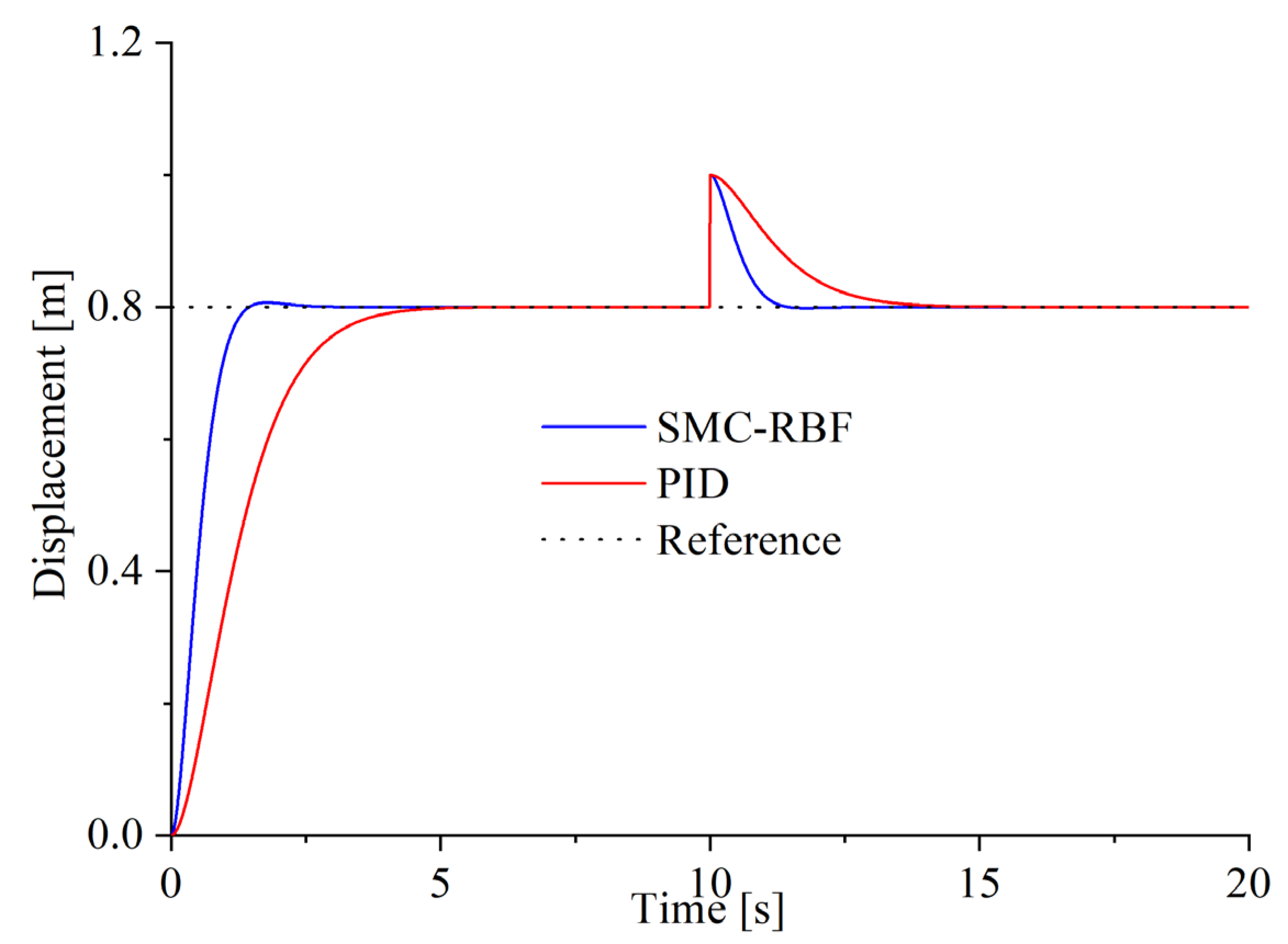
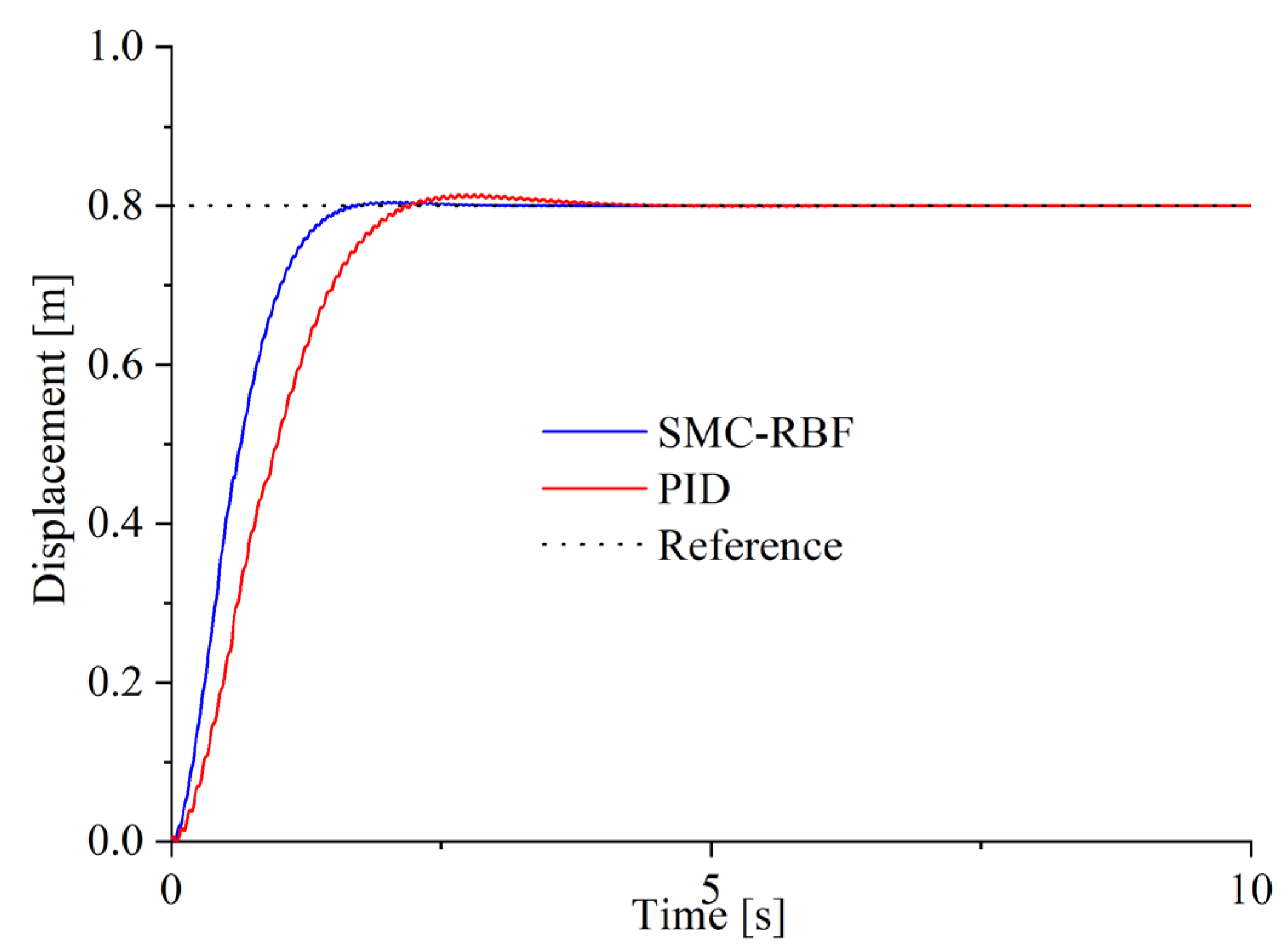
The response performance of the bucket electro-hydraulic servo system was evaluated in a simulation experiment with a reference signal yd = 0.8 m and a disturbance pulse of 0.2 m applied at t = 10 s. Figure 2 shows the simulation results comparing the SMC-RBF and PID controllers. It is evident that the SMC-RBF controller achieves a faster response than the PID controller. Before the disturbance, SMC-RBF tracks the reference signal stably with a 0.56 s rise time and 1.49 s settling time, demonstrating good stability and tracking performance. The PID controller tracks the reference with a 1.25 s rise time and 2.91 s settling time. After the disturbance pulse at 10 s, the SMC-RBF controller quickly recovers and converges, maintaining robustness despite the perturbation. In contrast, the PID controller exhibits significant disturbance in its steady-state response, failing to converge within finite time under the same conditions. Overall, SMC-RBF improves the system response performance by approximately 55% compared to PID, highlighting its superiority in both response time and robustness.

4.2. Sinusoidal Trajectory Tracking

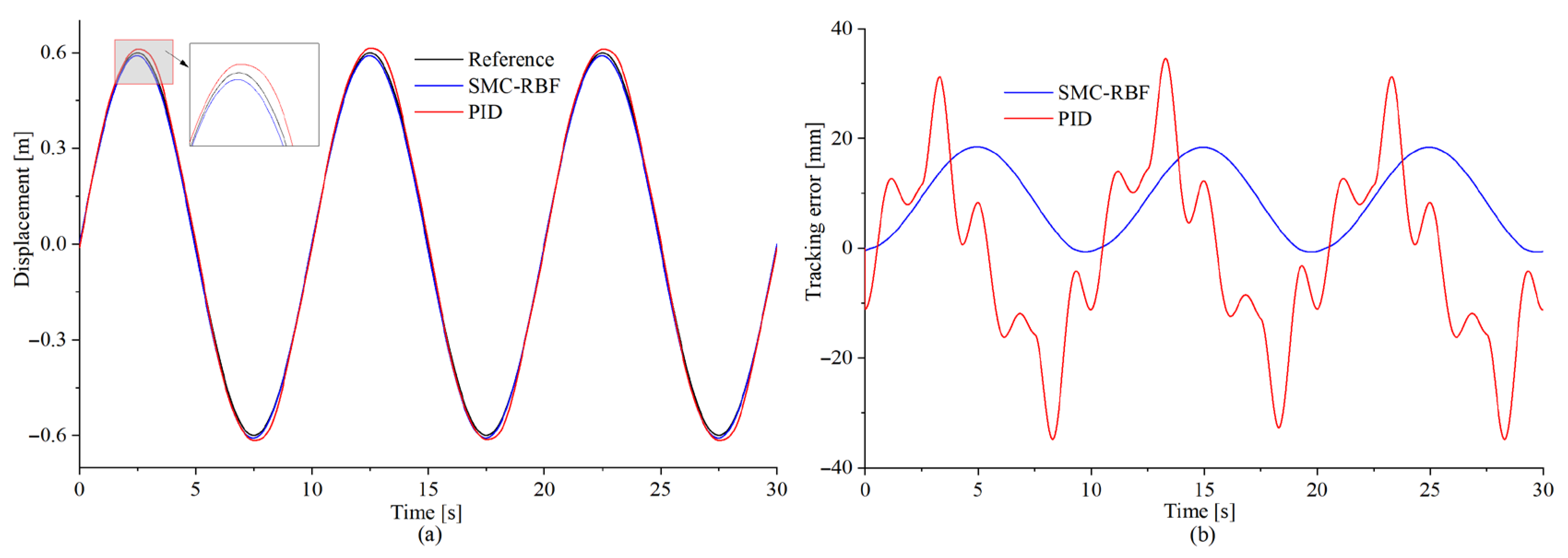
The reference trajectory was chosen as yd = 0.6sin(0.2πt). The simulation results of the sinusoidal trajectory tracking and tracking errors based on the proposed controller and PID controllers are shown in Figure 3. Parameter perturbations and unmodeled dynamic disturbances were the same as in the above simulation, and the trajectory tracking process was not considerably influenced by these disturbances. As shown in Figure 3, the SMC-RBF controller provides better tracking performance than the PID controller.
The maximum tracking error of the PID controller is 34.55 mm, while that of the SMC-RBF controller is only 18.48 mm. Under this condition, the tracking performance of the SMC-RBF controller is improved by 46% compared with the PID controller. The PID controller does not make full use of the system model and belongs to the typical black box control method. The proposed controller is designed based on the system model, and it takes into account nonlinear factors such as internal leakage and the effective bulk modulus. Therefore, the proposed controller reduces the tracking error of the bucket electro-hydraulic servo system significantly.
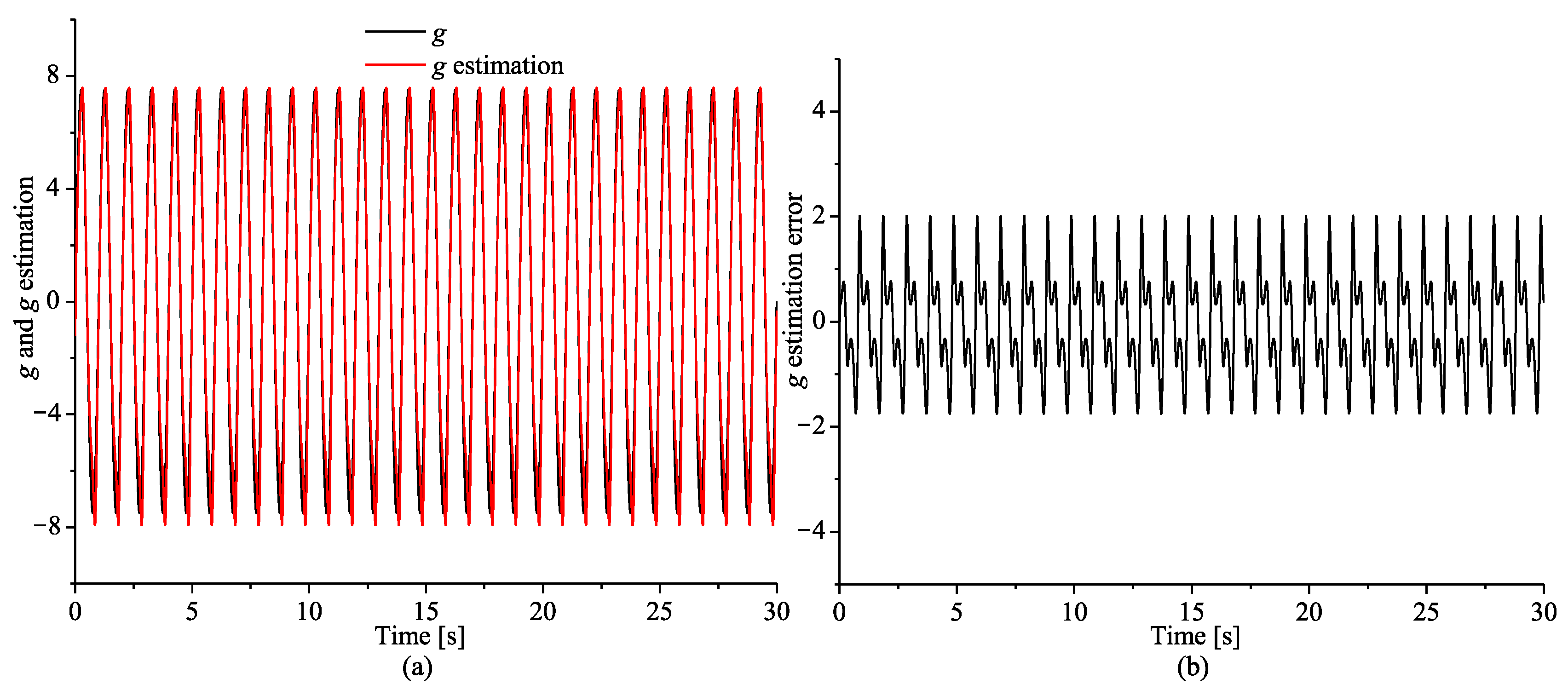
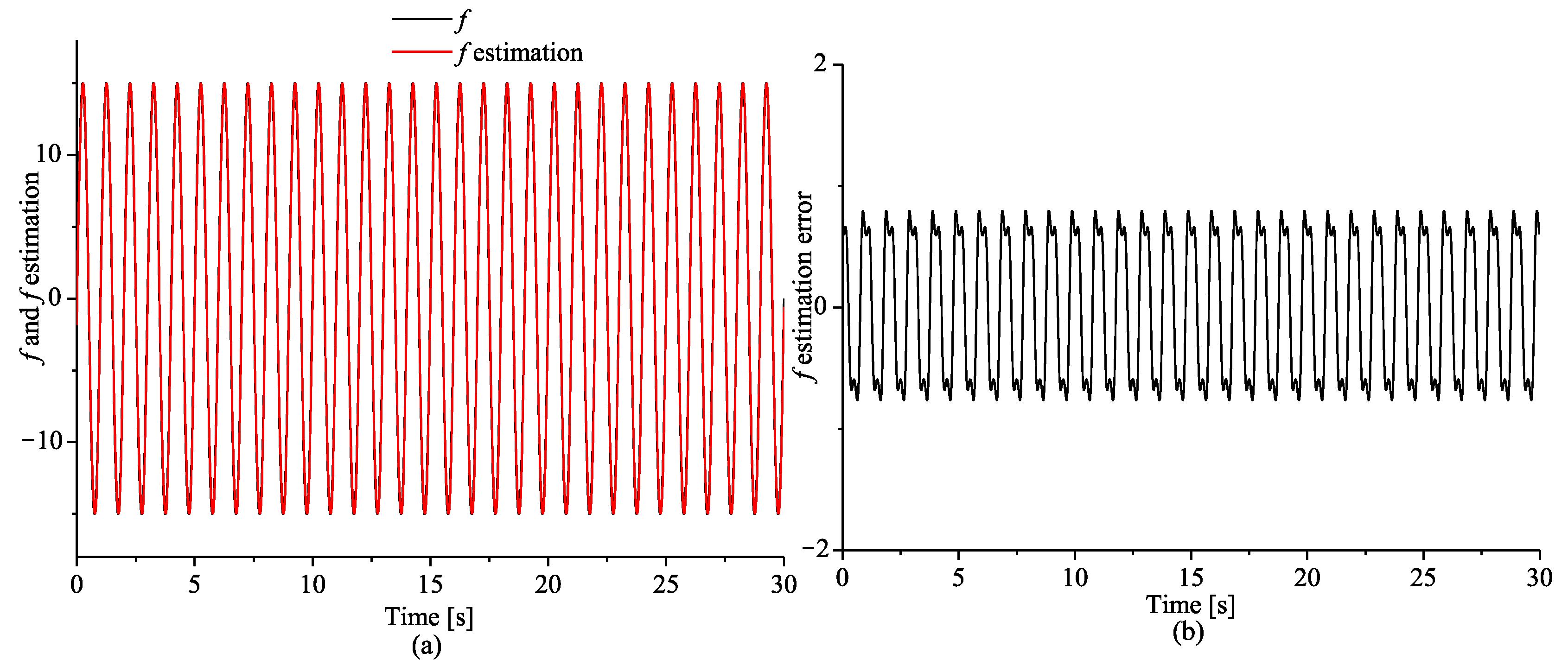
The real equivalent modeling g and f and their estimation are described in Figure 4 and Figure 5, respectively. It can be seen that the RBF neural networks can approximate the true values very quickly. For RBF neural networks, the approximation accuracy of uncertainties is not the only objective, and the combination of SMC for stabilizing control is also one of the objectives.
The simulation results show that the SMC-RBF controller has more advantages in dealing with nonlinear factors in electro-hydraulic servo systems. Specifically, in the presence of parameter perturbations and unmodeled dynamics, the maximum error in sinusoidal trajectory tracking is reduced by 46% compared to PID controllers. These quantitative results are attributed to the effective online approximation and compensation of system uncertainties such as internal leaks and changes in effective bulk modulus by the RBF neural network in the controller. The SMC-RBF controller can track the reference trajectory with satisfactory stability and accuracy. The uncertainties in the electro-hydraulic servo system can be approximated well by the RBF neural networks. The validity of the proposed controller in the electro-hydraulic servo system is verified.
The small and bounded estimation errors shown in Figure 4b and Figure 5b directly verify the effectiveness of the RBF neural network adaptive compensation mechanism designed in this paper. The network can accurately approximate key nonlinear uncertainties in the system online, which is the basis for the proposed SMC-RBF controller to achieve high-precision and robust trajectory tracking control.

5. Trajectory Tracking Experiments

5.1. Experimental Platform

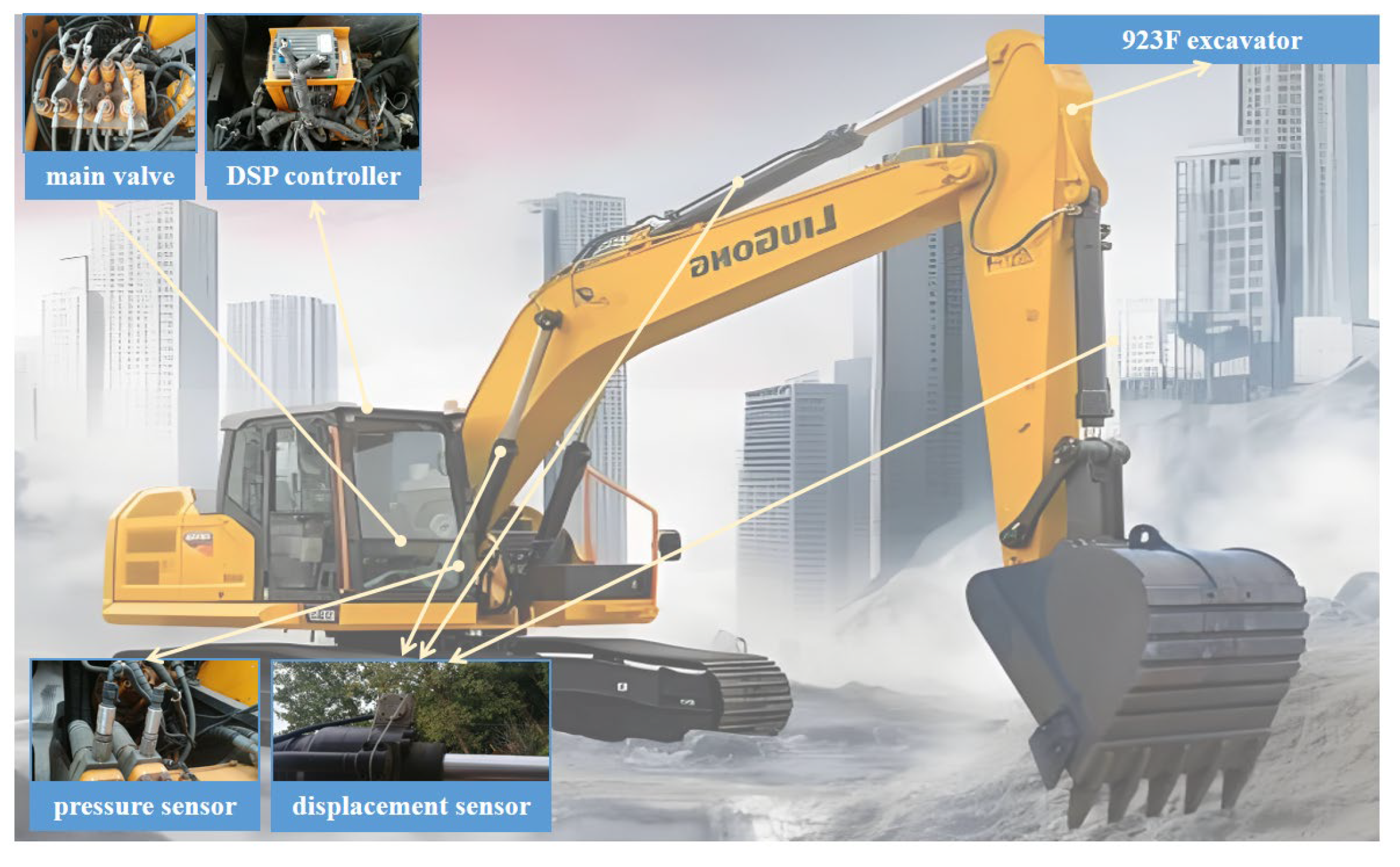
In order to verify the performance of the proposed controller, trajectory tracking experiments were performed on the experimental test platform shown in Figure 6. The experimental platform was mainly composed of the following parts: a robotic excavator (type: LG923F, Liugong, Liuzhou, China), a digital signal processor (DSP) controller (type: LEM100B, Liugong, Liuzhou, China), a self-developed trajectory setting system, six pressure sensors (type: 625T416, Barksdale, Los Angeles, CA, USA), three draw-wire displacement sensors (type: SH30, Xisai, Dongguan, China) and other sensors. Using a DSP controller as the real-time control unit, the SMC-RBF algorithm proposed in this paper was executed. The control cycle was fixed at 1 ms to ensure fast response of control instructions. Command/status communication between the DSP and upper computer was implemented through a USB-CAN module (type: USBCAN-II Pro, ZHIYUAN, Guangzhou, China); a data acquisition card (type: NI USB-6215, National Instruments Corporation, Austin, TX, USA) was simultaneously used to synchronously collect all sensor data, with a sampling rate consistent with the control frequency.
A high-precision rope-type displacement sensor (type: SH30, Xisai, Dongguan, China) was used to directly measure the telescopic displacement y of the bucket hydraulic cylinder piston rod, which has high linear accuracy and provides core feedback for closed-loop control. Pressure sensors (type: 625T416, Barksdale, Los Angeles, CA, USA) were installed at the inlet and outlet of the hydraulic cylinder to measure the pressure in both chambers in real time and to calculate the load pressure pL, providing key system status information for the control algorithm. The experimental actuator was a double-acting hydraulic cylinder (type: HA series, Hengli, Changzhou, China), and its key dimensions such as piston diameter and rod diameter corresponded to the parameters in Table 1. The high-performance main valve (the bandwidth of the main valve was 15 Hz, the maximum flow rate was 110 L/min per pump, and the maximum pressure was 34.3 MPa) drove the aforementioned hydraulic cylinder. This valve received the control voltage signal output by the DSP and accurately adjusted the flow rate of the input hydraulic cylinder. The hydraulic power unit provided a stable oil source for the system, and the oil supply pressure ps was set to a constant value of 34.3 Mpa.

5.2. Experimental Results

Step tracking performance experiments were conducted on the hydraulic cylinders used in the excavator buckets. The experiment aimed to compare the dynamic response characteristics of the sliding-mode radial basis function controller and proportional integral derivative controller. Under the same step input conditions, the SMC-RBF controller exhibits better overall performance: the actual rise time is 1.07 s, the actual stabilization time is 1.44 s, and the overshoot is 3.0%. In contrast, the actual rise time of the PID controller is 1.57 s, the actual stabilization time is 1.99 s, and the overshoot reaches 5.0%. Performance comparison analysis shows that the SMC-RBF controller reduces the rise time by 31.9%, settling time by 28.0%, vibration amplitude by 42.9%, and overshoot by 40.0% compared to the PID controller. The experimental results have verified the significant advantages of the SMC-RBF controller in improving the response speed and robustness of hydraulic systems.
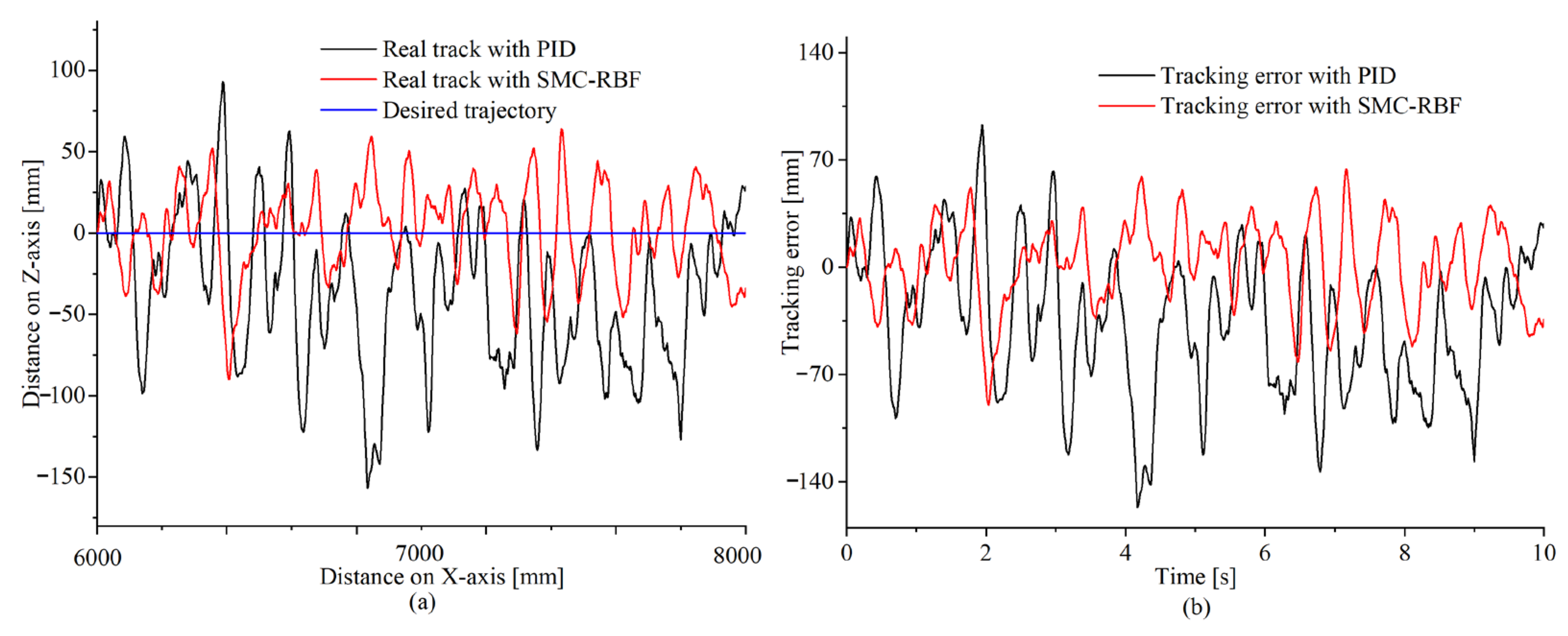
The desired trajectory to be tracked is a two-meter straight line, which is a common leveling operation of robotic excavators. In addition, this is also a classic working condition that requires high operating accuracy. In 10 s, the bucket follows the straight line from the starting point (6000, 0, 0) to the ending point (8000, 0, 0). Two controllers were used to compare and verify the effectiveness of the proposed algorithm: PID and SMC-RBF. The trajectory tracking results and steady-state tracking errors of the two controllers are shown in Figure 7.
As shown in Figure 8, it contains three trajectories: the desired trajectory and the real trajectory tracking results with the PID controller and SMC-RBF controller. It is clear that the error of the SMC-RBF controller is the smallest among the two controllers. The maximum tracking error, average error and root mean square error (RMSE) of the designed SMC-RBF controller are only 89.93 mm, 22.30 mm and 27.59 mm, while these tracking errors of the traditional PID controller are 156.71 mm, 46.91 mm and 58.75 mm. It was verified from the trajectory tracking experiments that the SMC-RBF controller exhibits better control performance than the traditional PID controller. In terms of the average error, the tracking performance of the SMC-RBF controller is improved by 52.46% compared with the traditional PID controller.
Although the proposed SMC-RBF controller introduces two RBF neural networks for online adaptive compensation, its computational complexity is acceptable for modern digital control systems. Taking the DSP used in this experimental platform as an example, the main computational loads of the algorithm in a single control cycle include forward propagation of two RBF networks, sliding-mode control law solution, and error and integral term updates. According to calculations, under typical network node numbers (5–10 nodes per network), the total computation time per cycle is approximately 10–20 μs. Considering the 1 kHz control frequency used in this system, the additional computational overhead brought by the neural network only accounts for 1–2% of the single cycle time. This indicates that the controller fully meets the computational performance requirements of real-time control systems while providing advanced adaptive compensation functions and has the feasibility of deployment in real industrial controllers.
In Section 3.2 of this article, by constructing an augmented Lyapunov function and designing corresponding parameter adaptive laws, it is rigorously proven that the closed-loop control system is asymptotically stable. The experimental results provide strong empirical support for this theoretical conclusion. As shown in the experimental results shown in Figure 7, even in real environments with unmodeled friction, sensor noise, and external interference, the SMC-RBF controller can accurately track the displacement y of the bucket hydraulic cylinder and achieve minimal steady-state error, with an average error of 22.30 mm. This indicates that the stability analysis based on Lyapunov is reliable, and the designed controller has successfully achieved the theoretically expected stability performance in practical systems.
The inherent discontinuous switching term in sliding-mode control can cause high-frequency oscillations in the control signal, which may stimulate the unmodeled dynamics of the system and exacerbate actuator wear. To suppress this phenomenon, this article uses the saturation function sat (s) instead of the discontinuous sign function sgn (s) and sets the boundary layer thickness δ = 0.01. The control signal is smooth and continuous, without obvious high-frequency oscillation. This effectively verifies that the boundary layer method used maintains the robustness advantage of sliding-mode control while significantly weakening the chattering effect, improving the actual operating quality and actuator life of the system.
The system comparison between the simulation and experimental results not only verifies the effectiveness of the controller but also reveals key issues in the transition from the ideal model to the physical system. The controller performs consistently and significantly better than traditional PID controllers in both simulation and experimental environments. Although the relative advantage remains consistent, the absolute tracking error value in the experiment is slightly higher than that in the ideal simulation environment. This is mainly attributed to the fact that simulation model failed to fully capture the nonlinear friction, oil elasticity changes, and mechanical connection clearances in the real system; sensor noise and delay, i.e., measurement noise and a small signal transmission delay introduced by actual displacement and pressure sensors; and the fact that the actual response speed and dead zone of the valve differ from the ideal static gain model in simulation.

6. Conclusions

This paper realizes the robust control of an electro-hydraulic servo system of a robotic excavator subject to parameter uncertainties and unmodeled dynamics. To achieve high trajectory tracking performance, a sliding-mode control strategy is integrated with a radial basis function neural network to form an adaptive nonlinear controller. This controller not only retains the desirable characteristics of SMC, such as fast response, robustness, and strong disturbance rejection, but it also effectively reduces the dependency on precise system modeling through adaptive neural network compensation. The asymptotic stability of the closed-loop system is rigorously proven using the Lyapunov method.
Both simulation and experimental results validate the superiority of the proposed controller. Simulation comparisons with an optimized PID controller demonstrate that the SMC-RBF controller reduces the step response settling time by approximately 55% and decreases the maximum sinusoidal tracking error by 46% while also exhibiting superior recovery performance under load disturbances. Experimental validation on a physical robotic excavator platform shows that for a standard two-meter straight-line tracking task, the average tracking accuracy is improved by 52.46% compared to a traditional PID controller. Additional step response experiments confirm its faster dynamic performance in real-world applications.
These quantifiable outcomes substantiate that the SMC-RBF controller delivers high tracking accuracy and robust response for the nonlinear electro-hydraulic system. A current limitation is the lack of explicit tuning rules for some controller parameters, which will be the focus of further research to enhance practical deployment.

Author Contributions

Conceptualization, L.T. and C.H.; methodology, L.T.; software, W.M.; validation, C.H., G.L., Z.W. and S.W.; formal analysis, C.H.; investigation, L.T.; resources, L.T.; data curation, L.T.; writing—original draft preparation, L.T.; writing—review and editing, L.T.; visualization, W.M.; supervision, C.H.; project administration, C.H.; funding acquisition, G.L. All authors have read and agreed to the published version of the manuscript.

Funding

This research received no external funding.

Data Availability Statement

The raw data supporting the conclusions of this article will be made available by the authors on request.

Conflicts of Interest

The authors declare no conflict of interest.

References

  1. Li, J.; Kong, L.; Liang, H.; Li, W. Review of Development and Characteristics Research on Electro-hydraulic Servo System. Recent Patents Eng. 2024, 18, 140–154. [Google Scholar] [CrossRef]
  2. Su, X.; Zheng, X. Sliding mode control of electro-hydraulic servo system based on double observers. Mech. Sci. 2024, 15, 77–85. [Google Scholar] [CrossRef]
  3. Feng, H.; Ma, W.; Yin, C.; Cao, D. Trajectory control of electro-hydraulic position servo system using improved PSO-PID controller. Autom. Constr. 2021, 127, 103722. [Google Scholar] [CrossRef]
  4. Zhang, D.; Xu, M.; Zhu, P.; Guo, C.; Zhong, Z.; Lu, H.; Zheng, Z. The development of a novel terrestrial/aerial robot: Autonomous quadrotor tilting hybrid robot. Robotica 2024, 42, 118–138. [Google Scholar] [CrossRef]
  5. Chotikunnan, P.; Pititheeraphab, Y. Adaptive P Control and Adaptive Fuzzy Logic Controller with Expert System Implementation for Robotic Manipulator Application. J. Robot. Control 2023, 4, 217–226. [Google Scholar] [CrossRef]
  6. Liu, G.; Wang, Q.; Wang, T.; Li, B.; Xi, X. Visual Sensor Target Tracking and Localization Method for Automatic Excavators. IEEE Sens. J. 2024, 24, 22814–22829. [Google Scholar] [CrossRef]
  7. Zhao, J.; Shen, G.; Yang, C.; Zhu, W.; Yao, J. A robust force feed-forward observer for an electro-hydraulic control loading system in flight simulators. ISA Trans. 2019, 89, 198–217. [Google Scholar] [CrossRef]
  8. Vo, A.T.; Truong, T.N.; Kang, H.-J.; Nguyen, N.H.A. Prescribed performance model-free sliding mode control using time-delay estimation and adaptive technique applied to industrial robot arms. Inf. Sci. 2025, 702, 121911. [Google Scholar] [CrossRef]
  9. Yanyong, S.; Kaitwanidvilai, S. Experimental realization of PSO-based hybrid adaptive sliding mode control for force impedance control systems. Results Control Optim. 2025, 19, 100548. [Google Scholar] [CrossRef]
  10. Pang, H.; Liu, F.; Xu, Z. Variable universe fuzzy control for vehicle semi-active suspension system with MR damper combining fuzzy neural network and particle swarm optimization. Neurocomputing 2018, 306, 130–140. [Google Scholar] [CrossRef]
  11. Daksh, M.S.; Mishra, P. A Feedback-Assisted Inverse Neural Network Controller for Cart-Mounted Inverted Pendulum. Appl. Comput. Intell. Soft Comput. 2025, 2025, 4873425. [Google Scholar] [CrossRef]
  12. Yu, G.; Fan, C. Memristor-driven bidirectional time-varying neural network controller and its application in chaotic synchronization. Nonlinear Dyn. 2025, 113, 33879–33906. [Google Scholar] [CrossRef]
  13. VakilKandi, S.J.; Bayat, F.; Jalilvand, A.; Bartoszewicz, A. Cyber-physical systems under hybrid cyber-attacks: Resilient event-triggered H control approach. ISA Trans. 2025, 163, 51–64. [Google Scholar] [CrossRef] [PubMed]
  14. Zhang, Y.; Sun, R.; Shang, J. Prescribed Performance Bounded-H Control for Flexible-Joint Manipulators Without Initial Condition Restriction. Sensors 2025, 25, 2195. [Google Scholar] [CrossRef] [PubMed]
  15. Meguro, Y.; Masuda, S.; Toyoda, M. Application and Performance Evaluation of Backstepping Control for Drone 3D Trajectory Control. IEEJ Trans. Electron. Inf. Syst. 2024, 144, 816–823. [Google Scholar] [CrossRef]
  16. Patel, B.R. Integral Backstepping Control of Two Compartment Microbial Fuel Cell. J. Electr. Syst. 2024, 20, 2604–2612. [Google Scholar] [CrossRef]
  17. Du, M.; Lei, F.; Yuan, Q.; Wu, X.; Xie, H.; Ma, J. Synchronous control of tri-motor vibration system considering an adaptive back-stepping control strategy. J. Vib. Control 2025, 31, 1241–1257. [Google Scholar] [CrossRef]
  18. Ghani, M.F.; Faudzi, A.A.M.; Ghazali, R.; Mohamaddan, S. Application of Fuzzy Logic Sliding Mode Control Approach with PID Structure for Electro-Hydraulic Actuator Tracking System. IEEE Access 2025, 13, 97818–97834. [Google Scholar] [CrossRef]
  19. Liu, X.; Sun, B.; Su, Z. Adaptive sliding mode control for AUV based on backstepping and neural networks. Meas. Sci. Technol. 2025, 36, 016215. [Google Scholar] [CrossRef]
  20. Fei, J.; Xie, J. Self-Evolving Hermite Fuzzy Neural Fractional-Order Sliding Mode Control of MEMS Gyroscope. IEEE Trans. Autom. Sci. Eng. 2025, 22, 5906–5915. [Google Scholar] [CrossRef]
  21. Boulkroune, A.; Boubellouta, A.; Bouzeriba, A.; Zouari, F. Novel fixed-time fuzzy sliding-mode synchronization schemes of two uncertain dissimilar chaotic systems. Soft Comput. 2026, 30, 121–139. [Google Scholar] [CrossRef]
  22. Banholzer, D.; Fliege, J.; Werner, R. A radial basis function method for noisy global optimisation. Math. Program. 2025, 211, 49–92. [Google Scholar] [CrossRef] [PubMed]
  23. Li, T.; Wang, N.; Li, C.; Liu, M. Investigation of extrapolation for nuclear mass and α -decay energy based on the radial basis function approach. Phys. Rev. C 2025, 112, 024306. [Google Scholar] [CrossRef]
  24. Xie, J.; Chen, W.; Dai, H.; Liu, S.; Ai, W. A distributed cooperative learning algorithm based on Zero-Gradient-Sum strategy using Radial Basis Function Network. Neurocomputing 2019, 323, 244–255. [Google Scholar] [CrossRef]
  25. Bashir, Z.; Malik, M.G.A.; Hussain, S. A computational study of fractional variable-order nonlinear Newton–Leipnik chaotic system with radial basis function network. J. Supercomput. 2025, 81, 1–31. [Google Scholar] [CrossRef]
  26. Mary, A.H.; Al-Talabi, A.; Kara, T.; Muneam, D.S.; Almuhanna, M.Y.; Mayyahi, L.A.K. Adaptive Robust Tracking Control of Robotic Manipulator based on SMC and Fuzzy Control Strategy. Al-Khwarizmi Eng. J. 2024, 20, 63–75. [Google Scholar] [CrossRef]
  27. Bentata, M.; Doudou, S. Dual-stage PV pumping system based on ANFTSMC and PI control enhanced by APSO optimization. Electr. Eng. 2025, 107, 7041–7061. [Google Scholar] [CrossRef]
  28. Zhang, G.; Zhou, Z.; Xia, Y.; He, S. R-L-Based Distributed Sliding Mode Control for Isomorphic Complex Network. Tsinghua Sci. Technol. 2026, 31, 2264–2274. [Google Scholar] [CrossRef]
  29. Gao, Z.; Yi, W. Integrated Guidance and Control Design Based on Optimized Sparrow Search Algorithm for Sliding Mode PID Controller Parameters. Int. J. Aeronaut. Space Sci. 2026, 27, 791–810. [Google Scholar] [CrossRef]
  30. Tuan, L.A.; Cuong, H.M.; Van Trieu, P.; Nho, L.C.; Thuan, V.D.; Anh, L.V. Adaptive neural network sliding mode control of shipboard container cranes considering actuator backlash. Mech. Syst. Signal Process. 2018, 112, 233–250. [Google Scholar] [CrossRef]
Figure 1. Schematic diagram of the electro-hydraulic servo system.
Asi 09 00048 g001
Figure 2. The simulation results of step response with yd = 0.8 m, where a 0.2 m interference pulse appeared in 10 s.
Asi 09 00048 g002
Figure 3. (a) Sinusoidal trajectory tracking results and (b) errors with yd = 0.6sin(0.2πt).
Asi 09 00048 g003
Figure 4. (a) g and its estimate and (b) g estimation error.
Asi 09 00048 g004
Figure 5. (a) f and its estimate and (b) f estimation error.
Asi 09 00048 g005
Figure 6. Robotic excavator trajectory control experimental platform.
Asi 09 00048 g006
Figure 7. The experimental results of step response with yd = 0.8 m.
Asi 09 00048 g007
Figure 8. (a) Bucket tip tracks and (b) tracking errors.
Asi 09 00048 g008
Table 1. Physical parameters of bucket electro-hydraulic servo system.
SymbolParameterNumber
A1Working areas facing rodless chambers0.0133 m2
A2Working areas facing rod chambers0.00636 m2
VTotal volume of chamber0.00905 m3
βeEffective bulk modulus1.7 × 109 N/m2
ρDensity of fluid896 kg/m3
CdFlow modification coefficient0.59
wValve area gradient0.0275 m
KzAmplification coefficient200
psSupply pressure34.3 MPa
CiInternal leakage coefficient of cylinder5.33 × 10−15 (m3/s)/(N/m2)
Disclaimer/Publisher’s Note: The statements, opinions and data contained in all publications are solely those of the individual author(s) and contributor(s) and not of MDPI and/or the editor(s). MDPI and/or the editor(s) disclaim responsibility for any injury to people or property resulting from any ideas, methods, instructions or products referred to in the content.