
Adaptive Trajectory Control of a Hydraulic Excavator Based on RBF Sliding-Mode Control Method

Abstract
1. Introduction
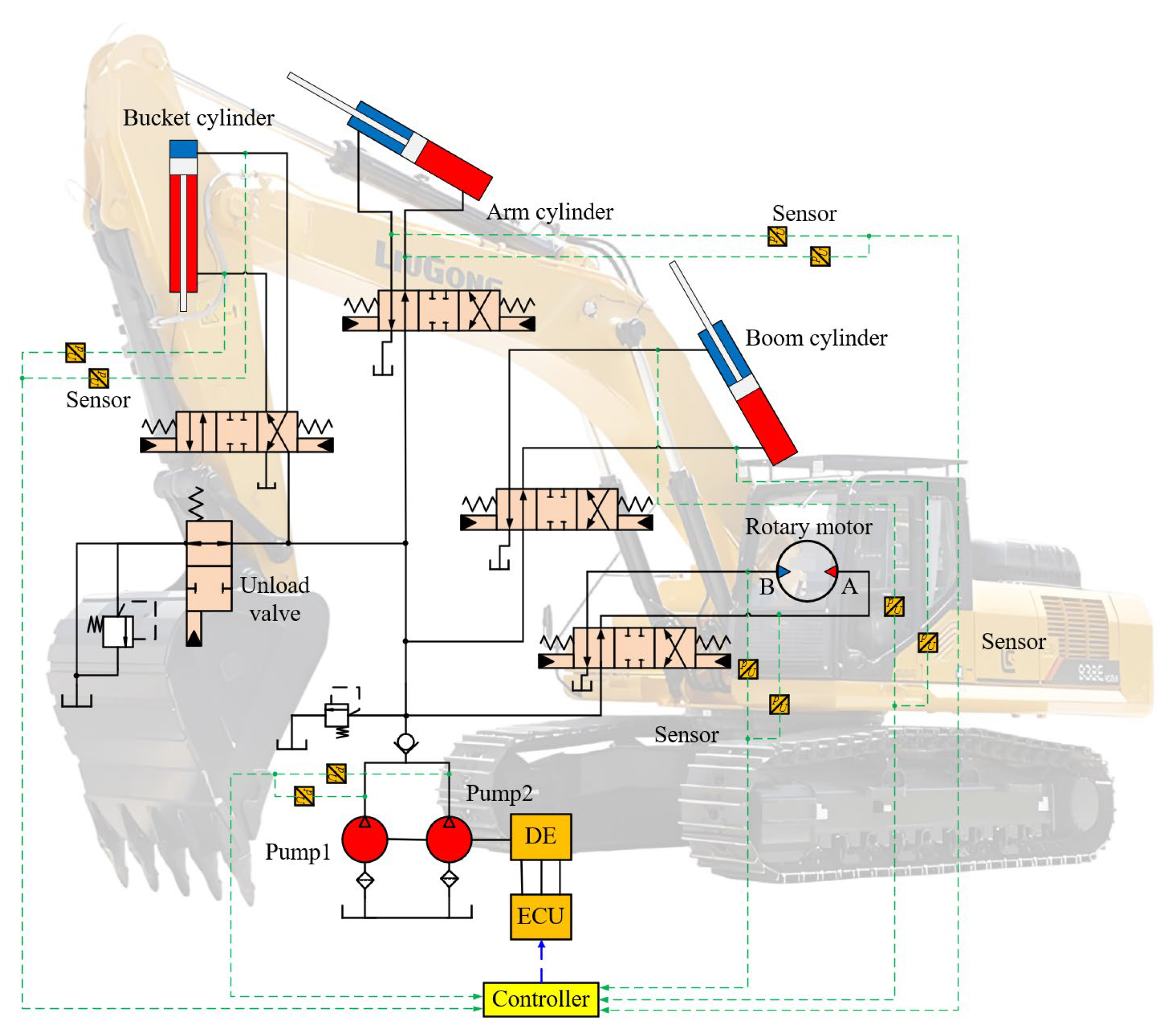
2. Electro-Hydraulic Servo System Model
3. Controller Design
3.1. RBF Neural Network
3.2. Controller Design
- 1.
- V, defined in Equation (16), is the Lyapunov function used for the preliminary design of the controller. To analyze the stability of the entire closed-loop system containing the weight-adaptive law of the RBF neural network, an augmented Lyapunov function Vs is constructed, as shown in Equation (25):
- 2.
- Deriving the Lyapunov function Vs, the following can be obtained:where λ1 and λ2 are positive constants representing the learning rates of the RBF neural networks.
- 3.
- The parameter adaptive laws of the RBF neural networks are set as follows:
- 4.
- Then, Equation (26) can be rewritten as:
- −
- s2 term: Generated dynamically by the equivalent control and error, this term itself is always non-positive (−s2 ≤ 0), providing a fundamental energy attenuation term for stability.
- −
- skssgn(s) term: This term is equal to −ks|s|, this item that applies to all s ≠ 0 is strictly negative (−ks|s| < 0).
- −
- s(εf + εg) term: This term is the bounded approximation error term of the neural network, and its sign is uncertain. To ensure overall negativity, it is necessary to ensure that the impact of this item is dominated by the aforementioned main negative items. The following sufficient conditions must be met:
- 5.
- In addition, in order to avoid the chattering phenomena caused by the symbolic function sgn(s), the saturation function sat(s) is used instead of sgn(s), that is:where δ > 0, it is the boundary layer thickness of the saturation function sat(s), which is a design parameter used to smooth the control signal and suppress chattering while ensuring stability.
- 6.
- The key properties of the saturation function are:
4. Simulation Results
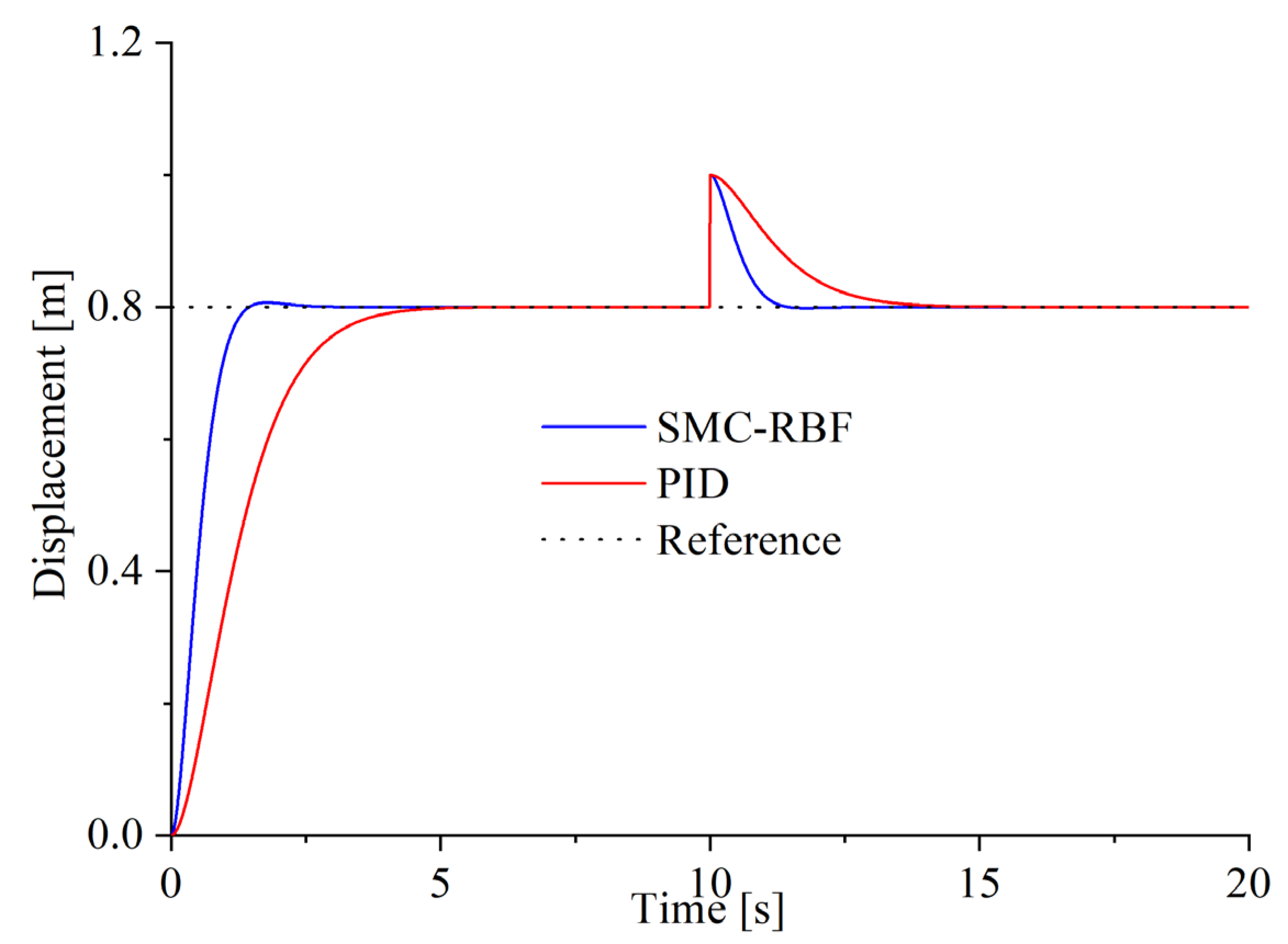
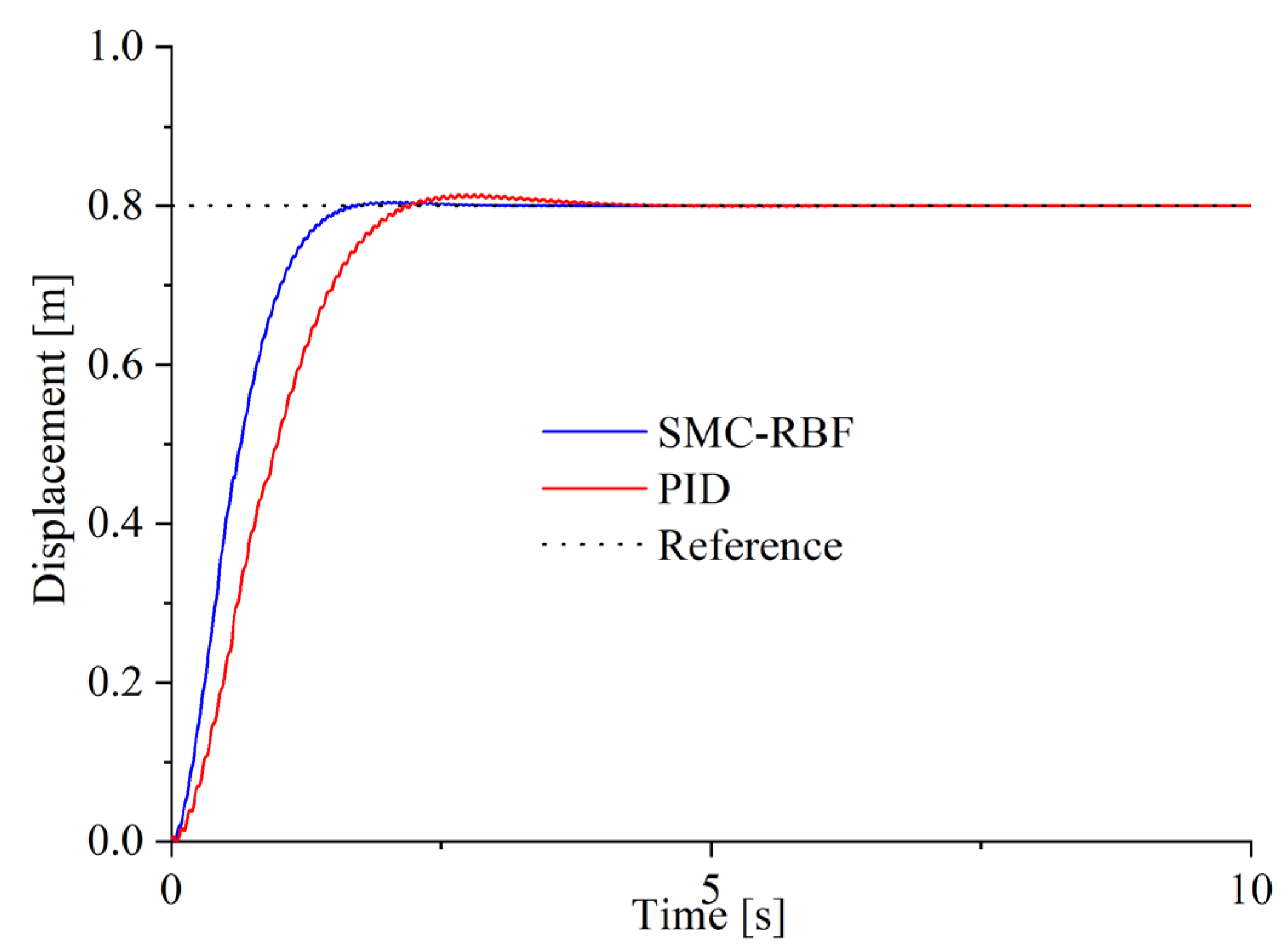
4.1. Step Response
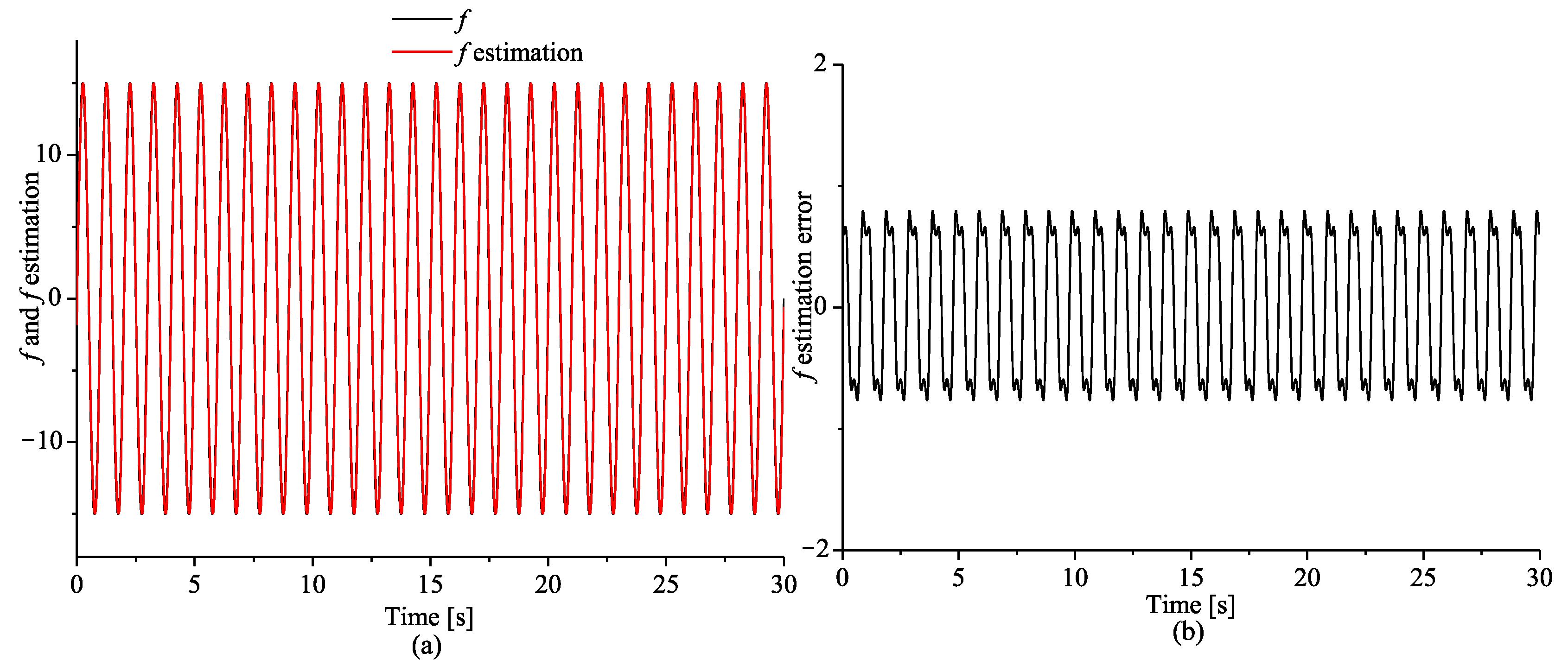
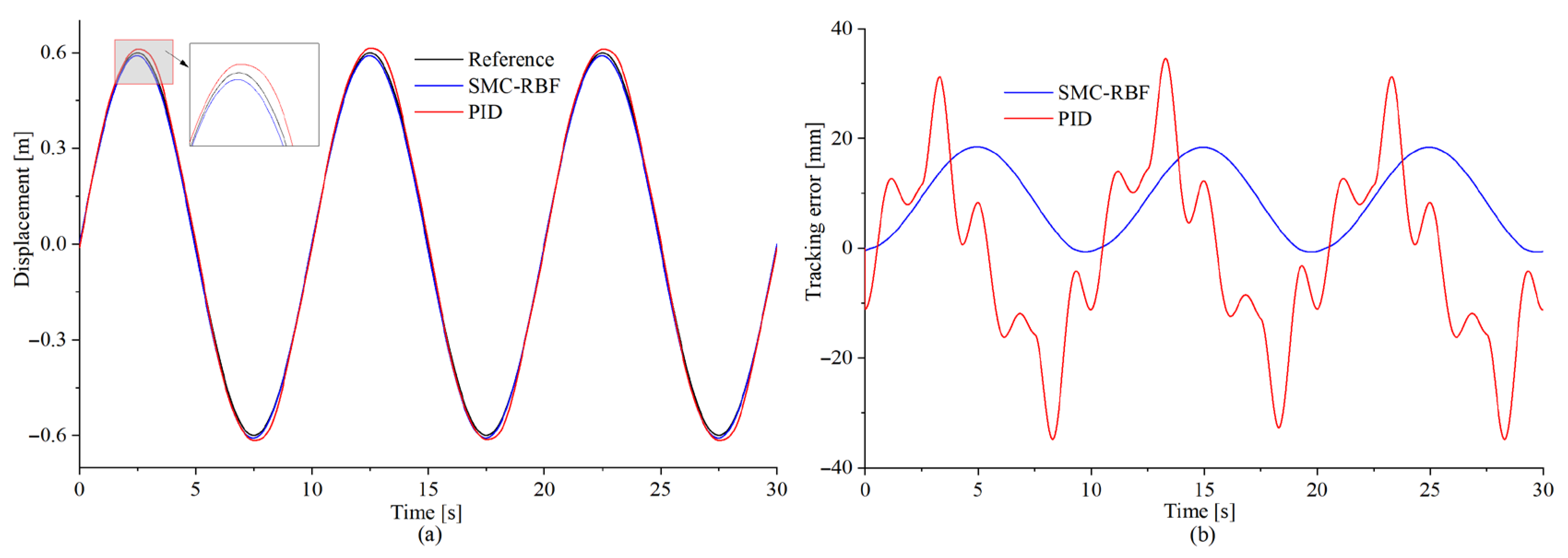
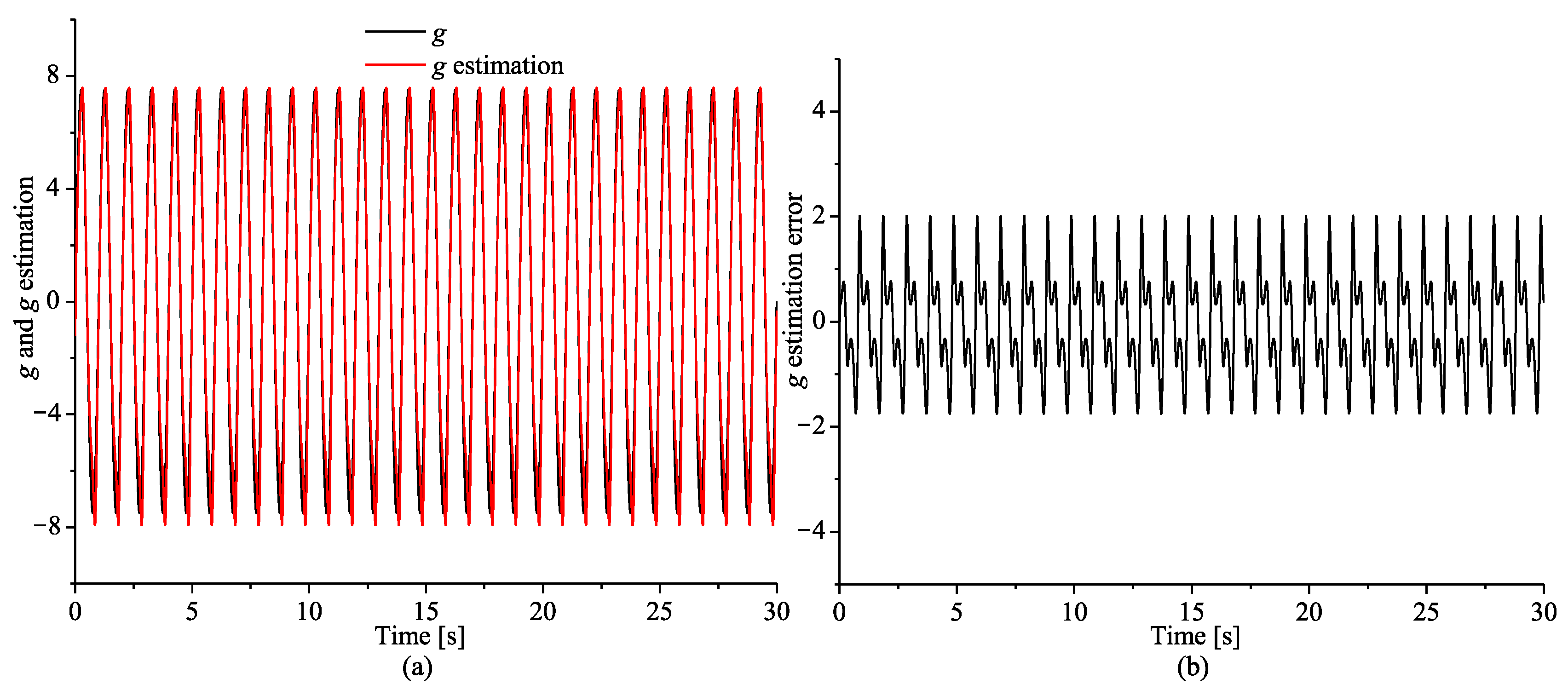
4.2. Sinusoidal Trajectory Tracking
5. Trajectory Tracking Experiments
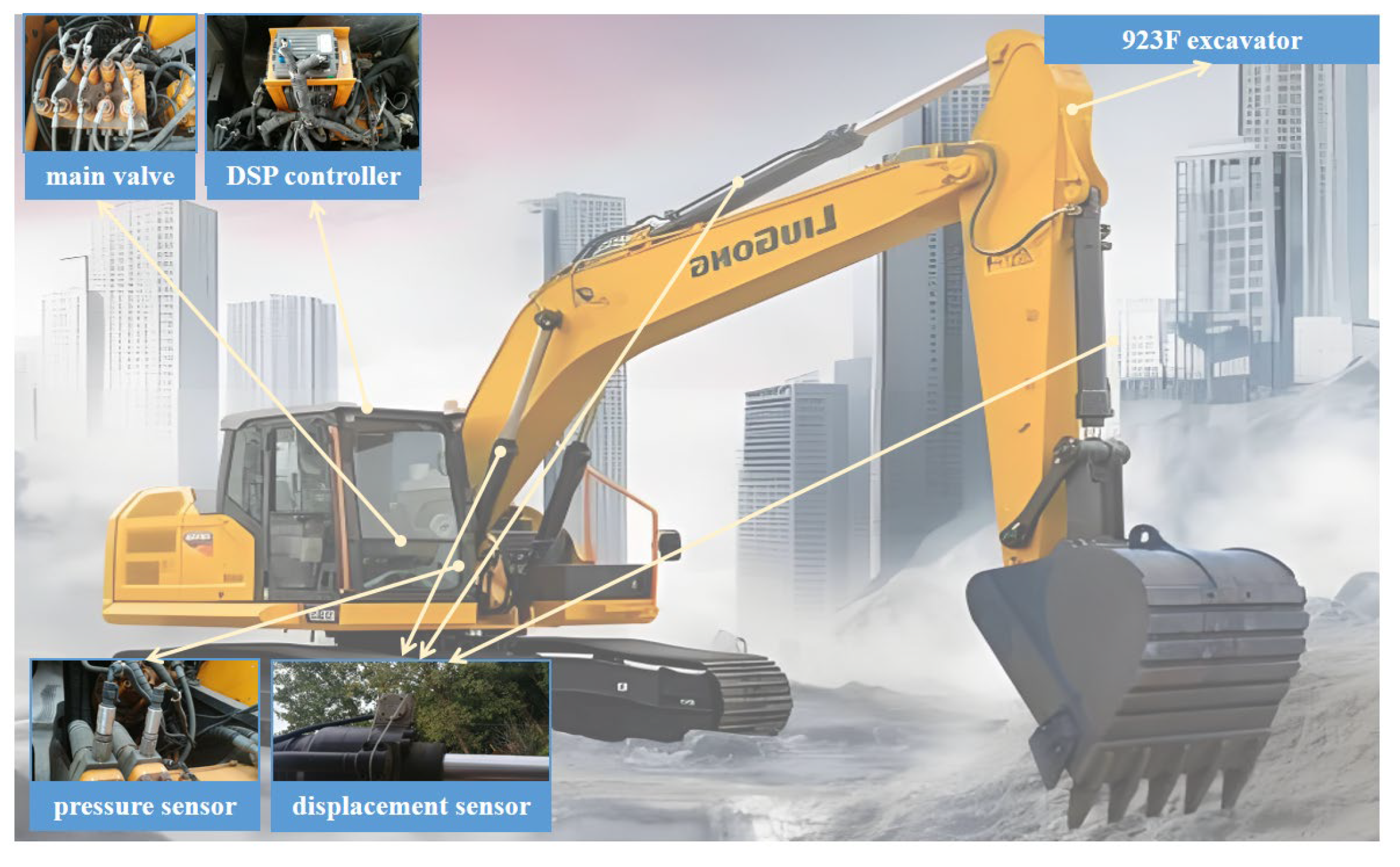
5.1. Experimental Platform
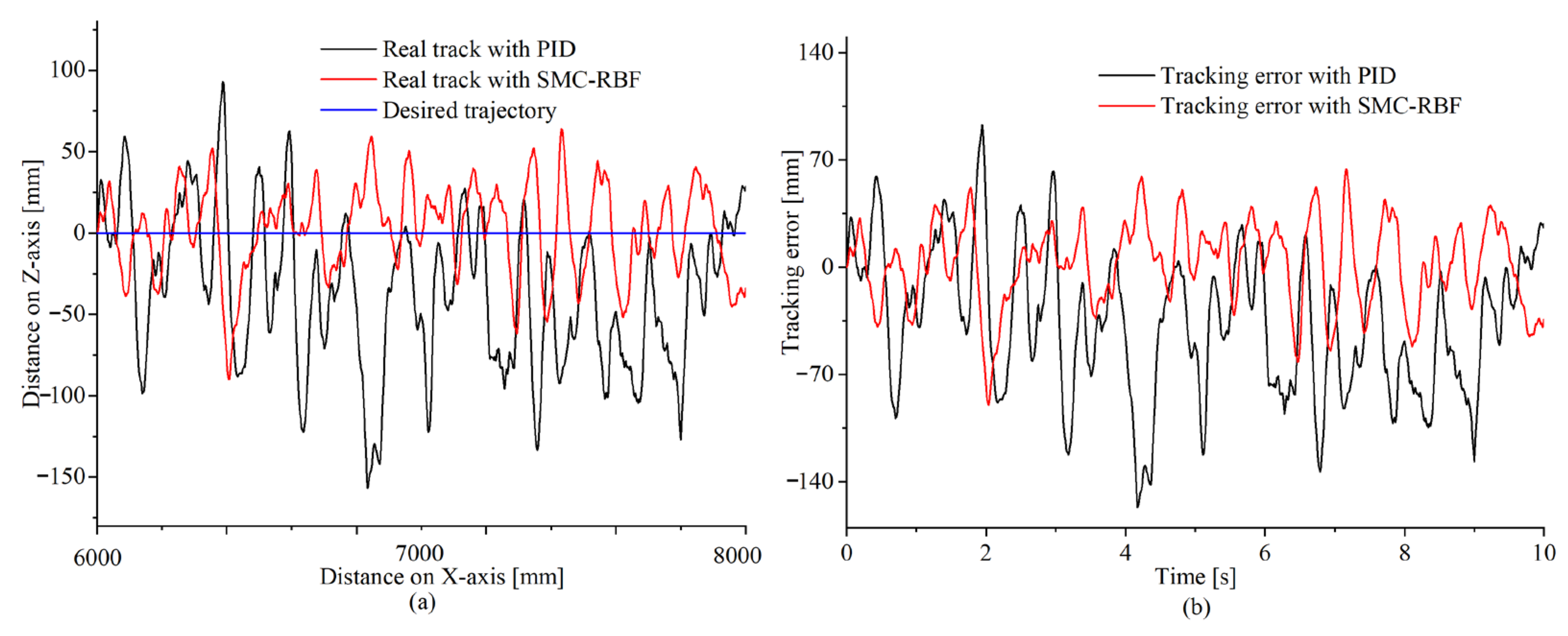
5.2. Experimental Results
6. Conclusions
Author Contributions
Funding
Data Availability Statement
Conflicts of Interest
References
- Li, J.; Kong, L.; Liang, H.; Li, W. Review of Development and Characteristics Research on Electro-hydraulic Servo System. Recent Patents Eng. 2024, 18, 140–154. [Google Scholar] [CrossRef]
- Su, X.; Zheng, X. Sliding mode control of electro-hydraulic servo system based on double observers. Mech. Sci. 2024, 15, 77–85. [Google Scholar] [CrossRef]
- Feng, H.; Ma, W.; Yin, C.; Cao, D. Trajectory control of electro-hydraulic position servo system using improved PSO-PID controller. Autom. Constr. 2021, 127, 103722. [Google Scholar] [CrossRef]
- Zhang, D.; Xu, M.; Zhu, P.; Guo, C.; Zhong, Z.; Lu, H.; Zheng, Z. The development of a novel terrestrial/aerial robot: Autonomous quadrotor tilting hybrid robot. Robotica 2024, 42, 118–138. [Google Scholar] [CrossRef]
- Chotikunnan, P.; Pititheeraphab, Y. Adaptive P Control and Adaptive Fuzzy Logic Controller with Expert System Implementation for Robotic Manipulator Application. J. Robot. Control 2023, 4, 217–226. [Google Scholar] [CrossRef]
- Liu, G.; Wang, Q.; Wang, T.; Li, B.; Xi, X. Visual Sensor Target Tracking and Localization Method for Automatic Excavators. IEEE Sens. J. 2024, 24, 22814–22829. [Google Scholar] [CrossRef]
- Zhao, J.; Shen, G.; Yang, C.; Zhu, W.; Yao, J. A robust force feed-forward observer for an electro-hydraulic control loading system in flight simulators. ISA Trans. 2019, 89, 198–217. [Google Scholar] [CrossRef]
- Vo, A.T.; Truong, T.N.; Kang, H.-J.; Nguyen, N.H.A. Prescribed performance model-free sliding mode control using time-delay estimation and adaptive technique applied to industrial robot arms. Inf. Sci. 2025, 702, 121911. [Google Scholar] [CrossRef]
- Yanyong, S.; Kaitwanidvilai, S. Experimental realization of PSO-based hybrid adaptive sliding mode control for force impedance control systems. Results Control Optim. 2025, 19, 100548. [Google Scholar] [CrossRef]
- Pang, H.; Liu, F.; Xu, Z. Variable universe fuzzy control for vehicle semi-active suspension system with MR damper combining fuzzy neural network and particle swarm optimization. Neurocomputing 2018, 306, 130–140. [Google Scholar] [CrossRef]
- Daksh, M.S.; Mishra, P. A Feedback-Assisted Inverse Neural Network Controller for Cart-Mounted Inverted Pendulum. Appl. Comput. Intell. Soft Comput. 2025, 2025, 4873425. [Google Scholar] [CrossRef]
- Yu, G.; Fan, C. Memristor-driven bidirectional time-varying neural network controller and its application in chaotic synchronization. Nonlinear Dyn. 2025, 113, 33879–33906. [Google Scholar] [CrossRef]
- VakilKandi, S.J.; Bayat, F.; Jalilvand, A.; Bartoszewicz, A. Cyber-physical systems under hybrid cyber-attacks: Resilient event-triggered control approach. ISA Trans. 2025, 163, 51–64. [Google Scholar] [CrossRef] [PubMed]
- Zhang, Y.; Sun, R.; Shang, J. Prescribed Performance Bounded-H∞ Control for Flexible-Joint Manipulators Without Initial Condition Restriction. Sensors 2025, 25, 2195. [Google Scholar] [CrossRef] [PubMed]
- Meguro, Y.; Masuda, S.; Toyoda, M. Application and Performance Evaluation of Backstepping Control for Drone 3D Trajectory Control. IEEJ Trans. Electron. Inf. Syst. 2024, 144, 816–823. [Google Scholar] [CrossRef]
- Patel, B.R. Integral Backstepping Control of Two Compartment Microbial Fuel Cell. J. Electr. Syst. 2024, 20, 2604–2612. [Google Scholar] [CrossRef]
- Du, M.; Lei, F.; Yuan, Q.; Wu, X.; Xie, H.; Ma, J. Synchronous control of tri-motor vibration system considering an adaptive back-stepping control strategy. J. Vib. Control 2025, 31, 1241–1257. [Google Scholar] [CrossRef]
- Ghani, M.F.; Faudzi, A.A.M.; Ghazali, R.; Mohamaddan, S. Application of Fuzzy Logic Sliding Mode Control Approach with PID Structure for Electro-Hydraulic Actuator Tracking System. IEEE Access 2025, 13, 97818–97834. [Google Scholar] [CrossRef]
- Liu, X.; Sun, B.; Su, Z. Adaptive sliding mode control for AUV based on backstepping and neural networks. Meas. Sci. Technol. 2025, 36, 016215. [Google Scholar] [CrossRef]
- Fei, J.; Xie, J. Self-Evolving Hermite Fuzzy Neural Fractional-Order Sliding Mode Control of MEMS Gyroscope. IEEE Trans. Autom. Sci. Eng. 2025, 22, 5906–5915. [Google Scholar] [CrossRef]
- Boulkroune, A.; Boubellouta, A.; Bouzeriba, A.; Zouari, F. Novel fixed-time fuzzy sliding-mode synchronization schemes of two uncertain dissimilar chaotic systems. Soft Comput. 2026, 30, 121–139. [Google Scholar] [CrossRef]
- Banholzer, D.; Fliege, J.; Werner, R. A radial basis function method for noisy global optimisation. Math. Program. 2025, 211, 49–92. [Google Scholar] [CrossRef] [PubMed]
- Li, T.; Wang, N.; Li, C.; Liu, M. Investigation of extrapolation for nuclear mass and α -decay energy based on the radial basis function approach. Phys. Rev. C 2025, 112, 024306. [Google Scholar] [CrossRef]
- Xie, J.; Chen, W.; Dai, H.; Liu, S.; Ai, W. A distributed cooperative learning algorithm based on Zero-Gradient-Sum strategy using Radial Basis Function Network. Neurocomputing 2019, 323, 244–255. [Google Scholar] [CrossRef]
- Bashir, Z.; Malik, M.G.A.; Hussain, S. A computational study of fractional variable-order nonlinear Newton–Leipnik chaotic system with radial basis function network. J. Supercomput. 2025, 81, 1–31. [Google Scholar] [CrossRef]
- Mary, A.H.; Al-Talabi, A.; Kara, T.; Muneam, D.S.; Almuhanna, M.Y.; Mayyahi, L.A.K. Adaptive Robust Tracking Control of Robotic Manipulator based on SMC and Fuzzy Control Strategy. Al-Khwarizmi Eng. J. 2024, 20, 63–75. [Google Scholar] [CrossRef]
- Bentata, M.; Doudou, S. Dual-stage PV pumping system based on ANFTSMC and PI control enhanced by APSO optimization. Electr. Eng. 2025, 107, 7041–7061. [Google Scholar] [CrossRef]
- Zhang, G.; Zhou, Z.; Xia, Y.; He, S. R-L-Based Distributed Sliding Mode Control for Isomorphic Complex Network. Tsinghua Sci. Technol. 2026, 31, 2264–2274. [Google Scholar] [CrossRef]
- Gao, Z.; Yi, W. Integrated Guidance and Control Design Based on Optimized Sparrow Search Algorithm for Sliding Mode PID Controller Parameters. Int. J. Aeronaut. Space Sci. 2026, 27, 791–810. [Google Scholar] [CrossRef]
- Tuan, L.A.; Cuong, H.M.; Van Trieu, P.; Nho, L.C.; Thuan, V.D.; Anh, L.V. Adaptive neural network sliding mode control of shipboard container cranes considering actuator backlash. Mech. Syst. Signal Process. 2018, 112, 233–250. [Google Scholar] [CrossRef]





| Symbol | Parameter | Number |
|---|---|---|
| A1 | Working areas facing rodless chambers | 0.0133 m2 |
| A2 | Working areas facing rod chambers | 0.00636 m2 |
| V | Total volume of chamber | 0.00905 m3 |
| βe | Effective bulk modulus | 1.7 × 10⁹ N/m2 |
| ρ | Density of fluid | 896 kg/m3 |
| Cd | Flow modification coefficient | 0.59 |
| w | Valve area gradient | 0.0275 m |
| Kz | Amplification coefficient | 200 |
| ps | Supply pressure | 34.3 MPa |
| Ci | Internal leakage coefficient of cylinder | 5.33 × 10⁻¹⁵ (m3/s)/(N/m2) |
Disclaimer/Publisher’s Note: The statements, opinions and data contained in all publications are solely those of the individual author(s) and contributor(s) and not of MDPI and/or the editor(s). MDPI and/or the editor(s) disclaim responsibility for any injury to people or property resulting from any ideas, methods, instructions or products referred to in the content. |
© 2026 by the authors. Published by MDPI on behalf of the International Institute of Knowledge Innovation and Invention. Licensee MDPI, Basel, Switzerland. This article is an open access article distributed under the terms and conditions of the Creative Commons Attribution (CC BY) license.
Share and Cite
Tao, L.; Hua, C.; Ma, W.; Lu, G.; Wei, Z.; Wei, S. Adaptive Trajectory Control of a Hydraulic Excavator Based on RBF Sliding-Mode Control Method. Appl. Syst. Innov. 2026, 9, 48. https://doi.org/10.3390/asi9030048
Tao L, Hua C, Ma W, Lu G, Wei Z, Wei S. Adaptive Trajectory Control of a Hydraulic Excavator Based on RBF Sliding-Mode Control Method. Applied System Innovation. 2026; 9(3):48. https://doi.org/10.3390/asi9030048
Chicago/Turabian StyleTao, Linyu, Changchun Hua, Wei Ma, Gang Lu, Zhenhua Wei, and Shijia Wei. 2026. "Adaptive Trajectory Control of a Hydraulic Excavator Based on RBF Sliding-Mode Control Method" Applied System Innovation 9, no. 3: 48. https://doi.org/10.3390/asi9030048
APA StyleTao, L., Hua, C., Ma, W., Lu, G., Wei, Z., & Wei, S. (2026). Adaptive Trajectory Control of a Hydraulic Excavator Based on RBF Sliding-Mode Control Method. Applied System Innovation, 9(3), 48. https://doi.org/10.3390/asi9030048