
The Rise of Foundation Models: Opportunities, Technology, Applications, Challenges, Recent Trends, and Future Directions




Abstract
1. Introduction
1.1. Background and Motivation
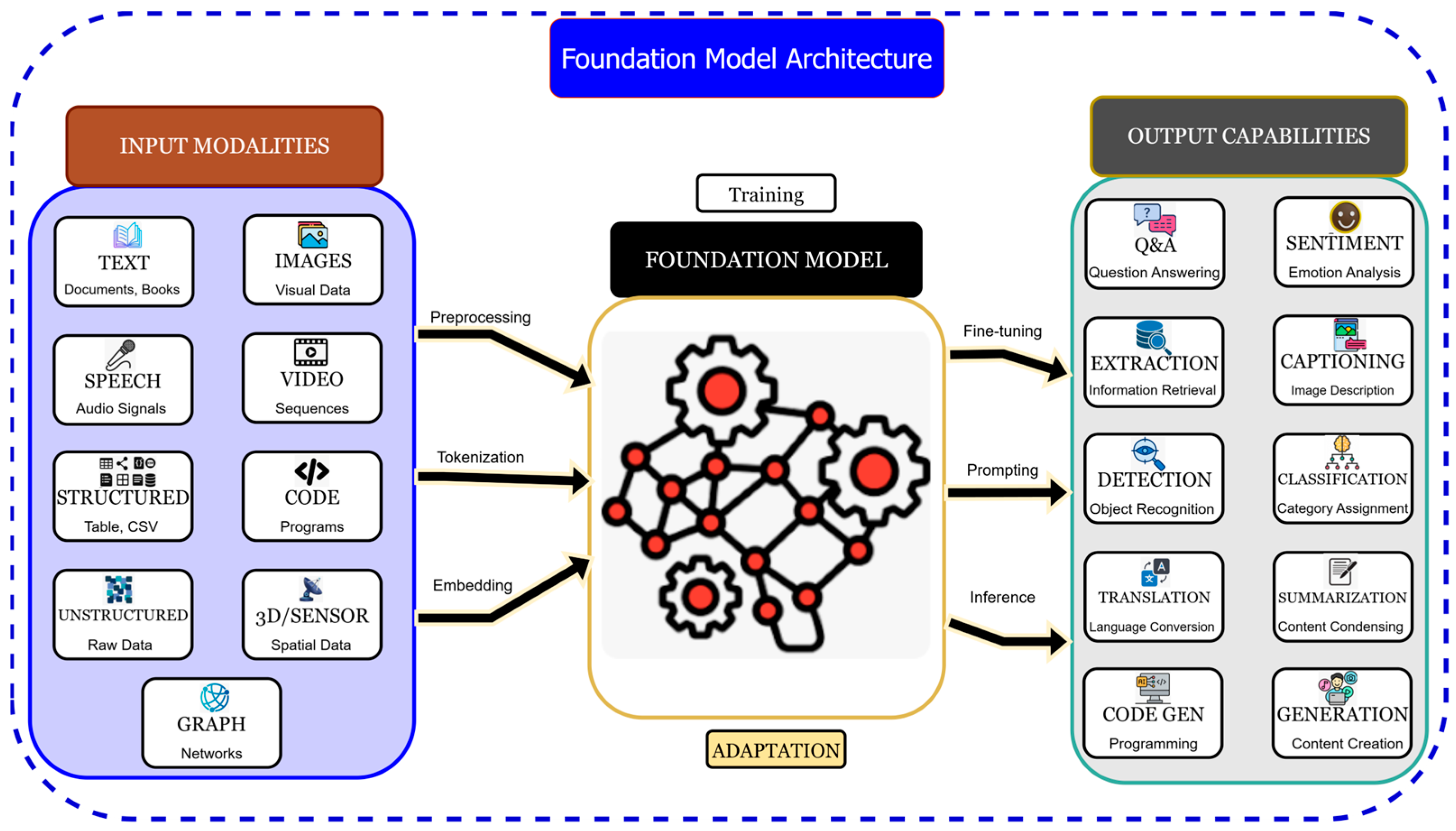
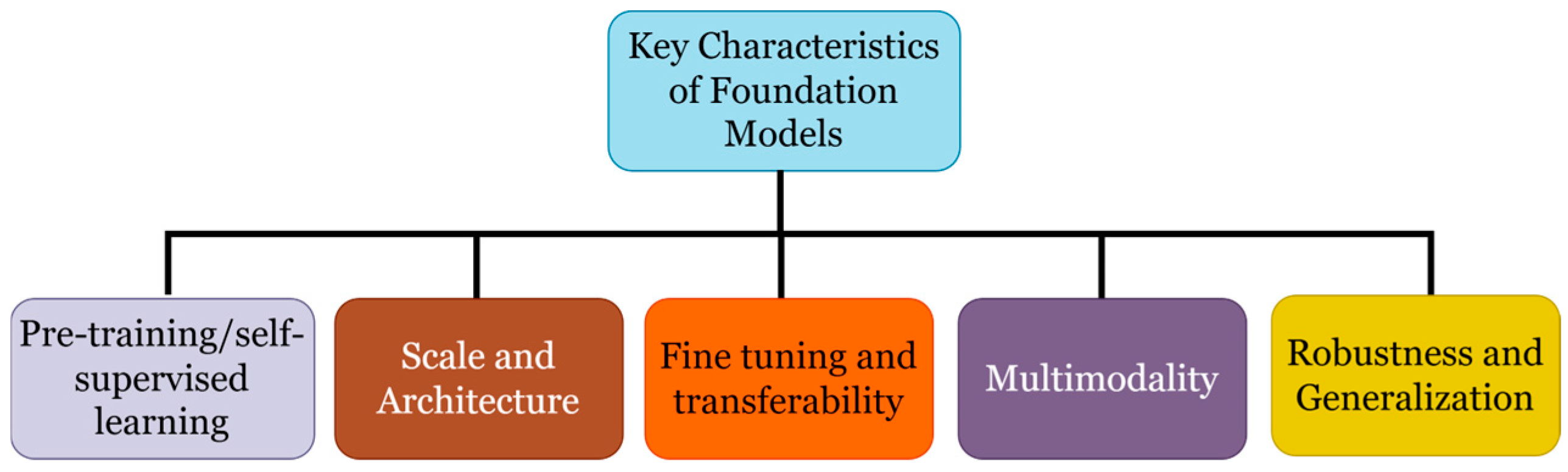
1.2. Characteristics of Foundation Models
1.2.1. Pre-Training Processes
- Extensive datasets: Using comprehensive datasets from a wide range of domains (i.e., books, websites, articles, images) to train the model, providing it with broad knowledge.
- Self-supervised learning: They mostly use self-supervised learning techniques to learn from large unlabeled datasets like predicting a missing word based on the preceding word in a sequence.
1.2.2. Scale and Architecture
- Parameters: A foundation model consists of a vast number of parameters, which allows it to incorporate insights derived from the massive data into its design [9].
- Adaptability: The model has the ability to adapt and adjust its input data and processing tasks based on the different and changing requirements [15].
- Ability to generalize: The model presents the ability to generalize, enabling it to perform well even when faced with new or unfamiliar data [15].
- Deep learning architecture: They use advanced deep learning frameworks, usually transformers, that are suitable for handling sequential data like text, etc. [16].
1.2.3. Fine-Tuning and Transferability
- Fine-tuning: Foundation models can be fine-tuned on smaller datasets by adjusting their weights to achieve optimal performance, after pretraining, like sentiment analysis or image classification. One kind of transfer learning is pretraining, which is used in the GPT-n series of LLMs [17].
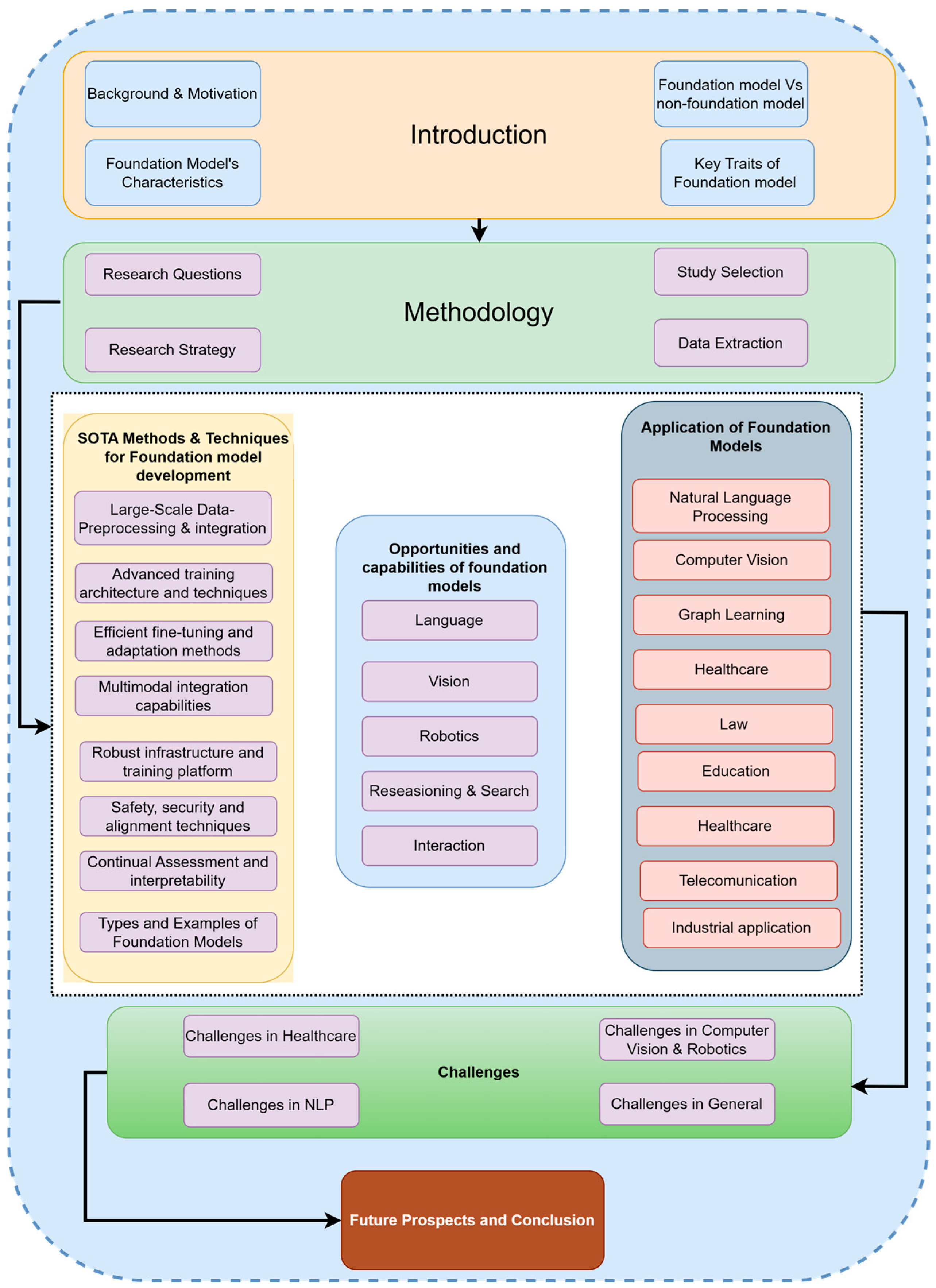
2. Methodology
2.1. Research Questions
2.2. Search Strategy
2.3. Study Selection
- Opportunities and capabilities of foundation models over traditional models
- Linguistics: Understanding language and generating text.
- Vision: Interpreting and processing visuals, i.e., images and videos.
- Robotics: Having the capability to impact the physical environment through robotic technology.
- Interaction: Communicating, collaborating, and interacting with humans.
- Reasoning: Capable of reasoning and searching, which allows them to find solutions and gather data.
2.4. Difference Between Foundation and Non-Foundation Models
3. State-of-the-Art Methods and Techniques for the Development of the Foundation Model
3.1. Large-Scale Data Preprocessing and Integration
3.2. Advanced Training Architecture and Techniques
- Advanced techniques for learning representations by comparing and contrasting similar and dissimilar samples: This technique is used to enhance the capability of the model to distinguish between similar and dissimilar instances, which is essential for applications like text embeddings and object identification [54].
- Masked language modeling: Masked language modeling (MLM), which is commonly used in models like BERT, involves randomly masking parts of the input and then training the model to predict the missing pieces. These are basically complex methods for predicting the masked input data segments towards improved model robustness and interpretations, which aid the model in achieving a thorough understanding of dependencies and data structures [55].
3.3. Efficient Fine-Tuning and Adaptation Methods
3.4. Multimodal Integration Capabilities
- Unified Representation Spaces: By projecting the different modalities to a common space, models like CLIP and GPT-4 create unified representation spaces to process and align different data types. These multimodal models are able to extract and relate information coming from diverse sources and jointly analyze it, like images and text, for applications in image captioning or video–text alignment. This enables foundation models to apply knowledge from one modality to another effectively [9,60].
- Modality-Specific Attention: The attention mechanisms are adapted to serve various types of data in an integrated model so that the system can analyze and highlight information according to the peculiarities of each modality, such as temporal attention for videos or visual attention for images, to capture modality-specific information more accurately [61,62].
- Cross-Modal Alignment: Techniques aligning representations across modalities ensure that, for instance, the word “dog” in the text is aligned to a picture of a dog. Such alignment becomes indispensable in tasks like image-text retrieval and multimodal translation. In the coming section, we will discuss the applications of foundation models across various domains in detail [63,64].
3.5. Robust Infrastructure and Training Platform
3.6. Safety, Security, and Alignment Techniques
3.7. Continual Assessment and Interpretability
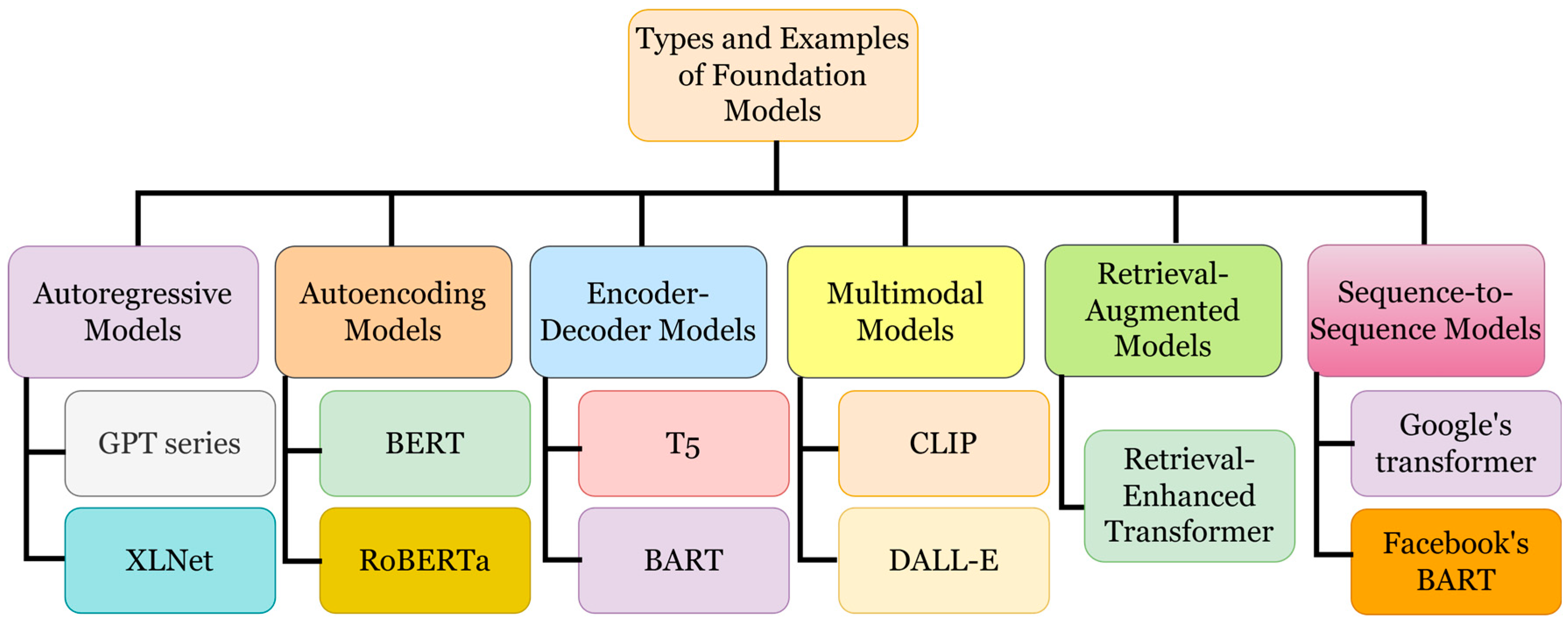
3.8. Types and Examples of Foundation Models
- Autoregressive Models
- 2.
- Autoencoding Models
- 3.
- Encoder–Decoder Models
- 4.
- Multimodal Models
- 5.
- Retrieval-Augmented Models
- 6.
- Sequence-to-Sequence Models
3.9. Examples of Foundation Models
- Text-to-image models are used to understand and generate images based on text prompts. They can be fine-tuned to better suit human interests or to carry out some specific tasks; for example, DALL.E [70].
- A lot of tasks fall between the spectrum of either generative or non-generative, and the majority of the foundation models can be fined-tuned or adapted to function as either.
- Open AI has developed a versatile chatbot named ChatGPT, which reached an estimate of more than 100 million daily active users.
- Another foundation model, Midjourney, is deployed to generate millions of images from text prompts per day. As more and more foundation models are being integrated into the products, their access to broad audiences is also increasing. A number of famous companies are preparing to introduce products like ChatGPT; for instance, Meta’s LLaMa, Jasper AI, Microsoft’s Bing Chat, etc. Table 7 summarizes some examples of foundation models and their applications across various domains.
4. Application of Foundation Models
4.1. Natural Language Processing
- Text Generation: FMs like GPT-3 and ChatGPT have been used to generate coherent, contextually relevant text; hence, they enrich applications in content creation and conversation agents [12].
- Text Classification: They are exceptionally good at categorizing text data, which is highly important in sentiment analysis and information retrieval [97].
- Masked Language Modeling: This is the popularly used pretraining task in NLP, where many models, like BERT and SpanBERT, are trained based on the objective of predicting randomly masked words in an input sequence. It helps the model to learn contextual representation, which is very important for most tasks like sentiment analysis, question answering, and named entity recognition [98,99].
- Denoising AutoEncoder (DAE): Models such as BART [100] make use of DAE tasks, which involve adding noise to input text and then making the model learn to reconstruct the original, clean text. These help in effectively carrying out tasks that involve text generation, such as summarization or paraphrasing, since this enhances the model’s robustness against incomplete or noisy data.
- Replaced Token Detection (RTD): ELECTRA comes up with RTD as a discriminative task, where it learns whether a token has been replaced by another. This in turn helps in gaining insight into deep language understanding and proves handy for sentence classification and language inference tasks [101,102].
- Next Sentence Prediction: BERT is used for NSP tasks to predict whether two sentences are connected logically. This enhances a model’s ability in sentence coherence tasks such as document classification and natural language inference.
- Sentence Order Prediction: ALBERT is used where the model has to predict the correct order of sentences. The pretraining based on SOP enhances the discourse structure understanding capability of the model and thus benefits long-form question answering and summarization tasks [103].
4.2. Advancing Computer Vision
- Medical Imaging: FMs can be applied for medical image analysis to support the doctor in diagnosing different diseases. They can also generate realistic images from textual descriptions and other images.
- Object detection and tracking: FMs make it possible to locate and identify objects in images or a video frame and label them appropriately, which is useful for various tasks. For example, in security systems, they are used for object identification and detection in surveillance footage. Vision transformer embeddings from the foundation models have been applied to single object tracking and have outperformed the classical models, such as ResNet-50, with exceptional results as indicated [106].
- Visual Place Recognition: According to a study by [107], foundation models, especially DINOv2, demonstrate striking advantages in the visual place recognition task and have even reached state-of-the-art status under challenging conditions, including occlusion and seasonal changes. Self-attention features promote re-ranking towards improved location prediction accuracies for geotagged images.
- Histopathology: Foundation models have been benchmarked as feature extractors and for generalizability in tasks like slide-level and patch-level classification within computational pathology, where it has been shown that low-resource fine-tuning achieves and sometimes outperforms the state of the art on image classification tasks [108].
- Enhanced localization: The FM-Loc approach uses CLIP for object detection and GPT-3 for semantic labeling, creating a very robust image descriptor invariant to changes in scene geometry and camera viewpoints. It has proven to be effective for several indoor scenes without extensive training or fine-tuning, thus demonstrating that FMs are adaptable [109].
- Creative design: Models learn to predict missing parts of images, aiding object detection and image segmentation, and also designing new products of artwork. They are also used for creating realistic special effects in movies and videos.
4.3. Graph Learning
- Graph Learning with LLMs: There will be some interesting applications in the sense that LLMs can generate high-quality textual features of graph entities and edges, which enhance graphs to be used in graph learning tasks, or they might encode knowledge that can enhance graph data toward a better understanding and analysis of complex relationships [110,111].
- Graph Foundation Models Development: GFMs are designed to generalize across a wide range of graph data, addressing challenges in zero-shot learning settings. In particular, these models have used unified graph tokenizers and scalable graph transformers to capture node dependencies effectively [112].
- Graph Classification: FMs are also employed for graph learning tasks, which provides evidence of their adaptability across different data modalities [113].
4.4. Transforming Healthcare
- Pathology: Applications of FMs in pathology come in the form of disease diagnosis, diagnosis of rare cancers, prediction of patient survival prognosis, biomarker expression predictions, and immunohistochemistry expression intensity scoring, which indeed proves the applications to be versatile with high accuracy in the health care domain [114].
- Mental Health: They are applied to electronic medical records for the prediction of diseases and personalized treatment. Large language models support therapy and monitoring of a patient, and pharmacogenetics deals with precision medicine—all for enhanced mental health care through integrated data sources [115].
- Improved Patient Interface: Applications that directly face the patient can facilitate health literacy and engagement for the patients by responding to questions, explaining clinical facts, communicating on population health, and much more, including emergency precautions like COVID-19. These types of models will improve the health care service and health literacy of patients, acting as a trustable and reliable source [119,120].
- Better Efficiency in Public Health: The fact that the foundation model contributes to faster diagnosis and prioritization of treatments during pandemics translates to utilizing resources at the right time to manage or prevent further spread. This is well-documented in the works of [121].
- Accelerated Drug Discovery: These models identify drug targets, design molecules, and optimize protocols far more quickly and inexpensively than what was ever achieved before in this field [122,123]. An IBM foundation model, CogMol (Controlled Generation Molecules), has recently produced a series of novel COVID-19 antivirals by using a common architecture known as variational autoencoder.
4.5. Law
- Public law: FMs could support clients and attorneys in civil law matters by reviewing contracts, patent searching, and legal document translation [128,129]. Models can also identify, at low cost, the relevant legal issues from client descriptions, which is an area where legal accessibility is gaining momentum [130].
- Criminal Justice Assistance: FMs can help public defenders handling caseloads in criminal justice become more efficient, reducing erroneous procedures. This may also include eliminating bias through standardization of the processes in charging decisions and identification of discriminatory language use in police records [131].
- Improvement of Public Law: Foundation models can improve the quality of services and efficiency delivered from governments, supporting everything from the process of public comments to assisting patent examiners. For example, in regulatory review, foundation models may also improve NLP applications and Freedom of Information Act requests [132].
4.6. Education
- AI for Instruction: These models have the potential to personalize instruction with regard to content adaptation and pedagogical techniques. Such sources can include training resources like question-and-answer forums such as StackOverflow, or even Wikipedia, to train AI in tutor-like activities, while public data on lecture videos or textbooks could inform models in their effective communication with students [137,138].
4.7. Telecommunication
4.8. Industrial Applications
4.9. Geophysical Research
4.10. Earth Observation and Geospatial AI
4.11. Revolutionizing Robotics
- Task-Specific Policies: The Diffusion for Policy Parameters (DPP) approach enables the creation of modular, task-specific policies, enhancing interpretability and user interaction [161].
- Object-Centric Representations: The POCR framework combines “what” and “where” information from pretrained models, improving performance in robotic manipulation tasks [162].
5. Challenges
5.1. Healthcare
- Dataset Limitations: Most medical datasets are imbalanced among different imaging modalities, such as PET and DSA, and among pathologies. The rarity of some diseases or high cost of imaging makes the situation worse, limiting generalization to wider clinical applications [167,168,169,170]. In addition to imbalance, recent research has found that apparently random or heuristic sampling strategies apply when collecting and preprocessing data to overcome the imbalance issue. However, such strategies still struggle with biasness [171].
5.2. Natural Language Processing (NLP)
- Privacy Exposure: Large models may leak any personally identifiable information retained from training texts unwittingly [183].
- Apparent Fluency Risks: While the produced output usually appears fluent and coherently smooth, it can embed incorrect or biased information while deceiving users [184].
- Maliciousness: Foundational models give rise to extremist content generation and misinformation in critical realms like political propaganda or false news [182].
5.3. Computer Vision
- Evaluation and Benchmarking: Vision-language models are difficult to evaluate due to their reliance on external models (e.g., GPT-4) for judging tasks, which often overlook visual-specific nuances [185].
- Hallucination: Models sometimes generate irrelevant or incorrect outputs by over-relying on text input while ignoring visual data [186].
- Bias and Fairness: Training data biases can lead to skewed results, such as models misclassifying images or perpetuating stereotypes [187].
- High Compute Requirements: Large vision models have high resource requirements, rendering real-time applications such as segmentation infeasible [186].
5.4. Robotics
- Computational Constraints: Foundation models need substantial amounts of computation, which renders them difficult to deploy on robots with limited hardware, especially for real-time tasks [190].
- Modality Integration: Combining multiple data types like 3D point clouds and text is difficult due to the lack of aligned datasets and the need for intermediate data conversions, which may cause information loss [191].
- Uncertainty Quantification: Robotics requires reliable uncertainty estimates for safety-critical tasks, but models often struggle with uncalibrated or incomplete estimates [192].
5.5. General
- Environmental Impact: Most of the training and usage of foundation models have enormous energy requirements, leading to massive carbon emissions.
- Scalability and Cost: With financial scaling coming at a high cost for large models, there are greater disincentives for resource-poor researchers and damping of innovation.
- Interpretability: Foundation models’ “black box” decisions cannot be comprehended or trusted for accountability.
- Dual-Use Risks: These models can be misused to create harmful content, such as extremist propaganda or deepfake materials [182].
5.6. Ethical Implications
5.7. Environmental and Societal Considerations
6. Future Prospects
7. Conclusions
Author Contributions
Funding
Data Availability Statement
Conflicts of Interest
References
- Zhang, H.; Lin, Y.; Cao, S.; Cheng, J.-H.; Zeng, X.-A. Artificial Intelligence Boosting Multi-dimensional Information Fusion: Data Collection, Processing and Modeling for Food Quality and Safety Assessment. Trends Food Sci. Technol. 2025, 163, 105138. [Google Scholar] [CrossRef]
- Rane, N.L.; Paramesha, M.; Choudhary, S.P.; Rane, J. Artificial intelligence, machine learning, and deep learning for advanced business strategies: A review. Partn. Univ. Int. Innov. J. 2024, 2, 147–171. [Google Scholar] [CrossRef]
- Plested, J.; Gedeon, T. Deep transfer learning for image classification: A survey. arXiv 2022, arXiv:2205.09904. [Google Scholar] [CrossRef]
- Rani, V.; Nabi, S.T.; Kumar, M.; Mittal, A.; Kumar, K. Self-supervised learning: A succinct review. Arch. Comput. Methods Eng. 2023, 30, 2761–2775. [Google Scholar] [CrossRef] [PubMed]
- Gui, J.; Chen, T.; Zhang, J.; Cao, Q.; Sun, Z.; Luo, H.; Tao, D. A survey on self-supervised learning: Algorithms, applications, and future trends. IEEE Trans. Pattern Anal. Mach. Intell. 2024, 46, 9052–9071. [Google Scholar] [CrossRef] [PubMed]
- Khan, A.; Rauf, Z.; Sohail, A.; Khan, A.R.; Asif, H.; Asif, A.; Farooq, U. A survey of the vision transformers and their CNN-transformer based variants. Artif. Intell. Rev. 2023, 56, 2917–2970. [Google Scholar] [CrossRef]
- Khan, S.; Naseer, M.; Hayat, M.; Zamir, S.W.; Khan, F.S.; Shah, M. Transformers in vision: A survey. ACM Comput. Surv. 2022, 54, 1–41. [Google Scholar] [CrossRef]
- Amjoud, A.B.; Amrouch, M. Object detection using deep learning, CNNs and vision transformers: A review. IEEE Access 2023, 11, 35479–35516. [Google Scholar] [CrossRef]
- Awais, M.; Naseer, M.; Khan, S.; Anwer, R.M.; Cholakkal, H.; Shah, M.; Yang, M.-H.; Khan, F.S. Foundation models defining a new era in vision: A survey and outlook. IEEE Trans. Pattern Anal. Mach. Intell. 2025, 47, 2245–2264. [Google Scholar] [CrossRef]
- Zheng, H.; Shen, L.; Tang, A.; Luo, Y.; Hu, H.; Du, B.; Wen, Y.; Tao, D. Learning from models beyond fine-tuning. Nat. Mach. Intell. 2025, 7, 6–17. [Google Scholar] [CrossRef]
- Bommasani, R. On the opportunities and risks of foundation models. arXiv 2021, arXiv:2108.07258. [Google Scholar] [CrossRef]
- Zhou, C.; Li, Q.; Li, C.; Yu, J.; Liu, Y.; Wang, G.; Zhang, K.; Ji, C.; Yan, Q.; He, L. A comprehensive survey on pretrained foundation models: A history from BERT to ChatGPT. Int. J. Mach. Learn. Cybern. 2025, 16, 9851–9915. [Google Scholar] [CrossRef]
- Chen, H.; Chen, H.; Zhao, Z.; Han, K.; Zhu, G.; Zhao, Y.; Du, Y.; Xu, W.; Shi, Q. An overview of domain-specific foundation model: Key technologies, applications and challenges. arXiv 2024, arXiv:2409.04267. [Google Scholar] [CrossRef]
- Schrepel, T.; Potts, J. Measuring the openness of AI foundation models: Competition and policy implications. Inf. Commun. Technol. Law 2025, 34, 279–304. [Google Scholar] [CrossRef]
- Huang, J.; Xu, Y.; Wang, Q.; Wang, Q.C.; Liang, X.; Wang, F.; Zhang, Z.; Wei, W.; Zhang, B.; Huang, L. Foundation models and intelligent decision-making: Progress, challenges, and perspectives. Innovation 2025, 6, 100948. [Google Scholar] [CrossRef]
- Mowbray, T. A Survey of Deep Learning Architectures in Modern Machine Learning Systems: From CNNs to Transformers. J. Comput. Technol. Softw. 2025, 4, 8. [Google Scholar]
- Church, K.W.; Chen, Z.; Ma, Y. Emerging trends: A gentle introduction to fine-tuning. Nat. Lang. Eng. 2021, 27, 763–778. [Google Scholar] [CrossRef]
- Bian, Y.; Li, J.; Ye, C.; Jia, X.; Yang, Q. Artificial intelligence in medical imaging: From task-specific models to large-scale foundation models. Chin. Med. J. 2025, 138, 651–663. [Google Scholar] [CrossRef]
- Neidlinger, P.; El Nahhas, O.S.; Muti, H.S.; Lenz, T.; Hoffmeister, M.; Brenner, H.; van Treeck, M.; Langer, R.; Dislich, B.; Behrens, H.M. Benchmarking foundation models as feature extractors for weakly supervised computational pathology. Nat. Biomed. Eng. 2025, 1–11. [Google Scholar] [CrossRef]
- Khurana, D.; Koli, A.; Khatter, K.; Singh, S. Natural language processing: State of the art, current trends and challenges. Multimed. Tools Appl. 2023, 82, 3713–3744. [Google Scholar] [CrossRef]
- Wolf, T.; Debut, L.; Sanh, V.; Chaumond, J.; Delangue, C.; Moi, A.; Cistac, P.; Rault, T.; Louf, R.; Funtowicz, M. Transformers: State-of-the-art natural language processing. In Proceedings of the 2020 Conference on Empirical Methods in Natural Language Processing, Punta Cana, Dominican Republic, 16–20 November 2020; pp. 38–45. [Google Scholar]
- D’Antonoli, T.A.; Bluethgen, C.; Cuocolo, R.; Klontzas, M.E.; Ponsiglione, A.; Kocak, B. Foundation models for radiology: Fundamentals, applications, opportunities, challenges, risks, and prospects. Diagn. Interv. Radiol. 2025. [Google Scholar] [CrossRef]
- Shin, H.-C.; Roth, H.R.; Gao, M.; Lu, L.; Xu, Z.; Nogues, I.; Yao, J.; Mollura, D.; Summers, R.M. Deep convolutional neural networks for computer-aided detection: CNN architectures, dataset characteristics and transfer learning. IEEE Trans. Med. Imaging 2016, 35, 1285–1298. [Google Scholar] [CrossRef] [PubMed]
- Bai, Y.; Ying, J.; Cao, Y.; Lv, X.; He, Y.; Wang, X.; Yu, J.; Zeng, K.; Xiao, Y.; Lyu, H. Benchmarking foundation models with language-model-as-an-examiner. Adv. Neural Inf. Process. Syst. 2023, 36, 78142–78167. [Google Scholar]
- Mahbod, A.; Saeidi, N.; Hatamikia, S.; Woitek, R. Evaluating pre-trained convolutional neural networks and foundation models as feature extractors for content-based medical image retrieval. Eng. Appl. Artif. Intell. 2025, 150, 110571. [Google Scholar] [CrossRef]
- Sieber, J.; Alonso, C.A.; Didier, A.; Zeilinger, M.N.; Orvieto, A. Understanding the differences in foundation models: Attention, state space models, and recurrent neural networks. Adv. Neural Inf. Process. Syst. 2024, 37, 134534–134566. [Google Scholar]
- Noor, M.H.M.; Ige, A.O. A survey on state-of-the-art deep learning applications and challenges. arXiv 2024, arXiv:2403.17561. [Google Scholar]
- Duderstadt, B.; Helm, H.S.; Priebe, C.E. Comparing Foundation Models using Data Kernels. arXiv 2023, arXiv:2305.05126. [Google Scholar]
- Clark, P.; Etzioni, O.; Khot, T.; Khashabi, D.; Mishra, B.; Richardson, K.; Sabharwal, A.; Schoenick, C.; Tafjord, O.; Tandon, N. From ‘f’ to ‘a’ on the NY Regents science exams: An overview of the Aristo project. AI Mag. 2020, 41, 39–53. [Google Scholar]
- Paris, C.L.; Swartout, W.R.; Mann, W.C. Natural Language Generation in Artificial Intelligence and Computational Linguistics; Springer Science Business Media: New York, NY, USA, 2013. [Google Scholar]
- Dou, Y.; Forbes, M.; Koncel-Kedziorski, R.; Smith, N.A.; Choi, Y. Is GPT-3 text indistinguishable from human text? Scarecrow: A framework for scrutinizing machine text. arXiv 2021, arXiv:2107.01294. [Google Scholar]
- Baevski, A.; Zhou, Y.; Mohamed, A.; Auli, M. wav2vec 2.0: A framework for self-supervised learning of speech representations. Adv. Neural Inf. Process. Syst. 2020, 33, 12449–12460. [Google Scholar]
- Gogoulou, E. Multilingual Language Models: Studies of Pre-Training Approaches and Hallucination Detection; KTH Royal Institute of Technology: Stockholm, Sweden, 2024. [Google Scholar]
- Liu, J.; Fu, B. Responsible Multilingual Large Language Models: A Survey of Development, Applications, and Societal Impact. arXiv 2024, arXiv:2410.17532. [Google Scholar] [CrossRef]
- FitzGerald, J.; Hench, C.; Peris, C.; Mackie, S.; Rottmann, K.; Sanchez, A.; Nash, A.; Urbach, L.; Kakarala, V.; Singh, R. MASSIVE: A 1M-example multilingual natural language understanding dataset with 51 typologically-diverse languages. arXiv 2022, arXiv:2204.08582. [Google Scholar]
- Lepikhin, D.; Lee, H.; Xu, Y.; Chen, D.; Firat, O.; Huang, Y.; Krikun, M.; Shazeer, N.; Chen, Z. GShard: Scaling giant models with conditional computation and automatic sharding. arXiv 2020, arXiv:2006.16668. [Google Scholar] [CrossRef]
- Dupoux, E. Cognitive science in the era of artificial intelligence: A roadmap for reverse-engineering the infant language-learner. Cognition 2018, 173, 43–59. [Google Scholar] [CrossRef]
- Hsu, W.-N.; Bolte, B.; Tsai, Y.-H.H.; Lakhotia, K.; Salakhutdinov, R.; Mohamed, A. Hubert: Self-supervised speech representation learning by masked prediction of hidden units. IEEE/ACM Trans. Audio Speech Lang. Process. 2021, 29, 3451–3460. [Google Scholar] [CrossRef]
- Chowdhery, A.; Narang, S.; Devlin, J.; Bosma, M.; Mishra, G.; Roberts, A.; Barham, P.; Chung, H.W.; Sutton, C.; Gehrmann, S. PaLM: Scaling language modeling with pathways. J. Mach. Learn. Res. 2023, 24, 11324–11436. [Google Scholar]
- Huang, R.S.; Lu, K.J.Q.; Meaney, C.; Kemppainen, J.; Punnett, A.; Leung, F.-H. Assessment of resident and AI chatbot performance on the University of Toronto family medicine residency progress test: Comparative study. JMIR Med. Educ. 2023, 9, e50514. [Google Scholar] [CrossRef]
- Moon, J.H.; Lee, H.; Shin, W.; Kim, Y.-H.; Choi, E. Multi-modal understanding and generation for medical images and text via vision-language pre-training. IEEE J. Biomed. Health Inform. 2022, 26, 6070–6080. [Google Scholar] [CrossRef]
- Huang, S.-C.; Shen, L.; Lungren, M.P.; Yeung, S. GLORIA: A multimodal global-local representation learning framework for label-efficient medical image recognition. In Proceedings of the 2021 IEEE/CVF International Conference on Computer Vision (ICCV), Montreal, QC, Canada, 10–17 October 2021; pp. 3942–3951. [Google Scholar]
- Touvron, H.; Martin, L.; Stone, K.; Albert, P.; Almahairi, A.; Babaei, Y.; Bashlykov, N.; Batra, S.; Bhargava, P.; Bhosale, S. LLaMA 2: Open foundation and fine-tuned chat models. arXiv 2023, arXiv:2307.09288. [Google Scholar] [CrossRef]
- Bai, Y.; Geng, X.; Mangalam, K.; Bar, A.; Yuille, A.L.; Darrell, T.; Malik, J.; Efros, A.A. Sequential modeling enables scalable learning for large vision models. In Proceedings of the 2024 IEEE/CVF Conference on Computer Vision and Pattern Recognition (CVPR), Seattle, WA, USA, 17–21 June 2024; pp. 22861–22872. [Google Scholar]
- Oquab, M.; Darcet, T.; Moutakanni, T.; Vo, H.; Szafraniec, M.; Khalidov, V.; Fernandez, P.; Haziza, D.; Massa, F.; El-Nouby, A. DINOv2: Learning robust visual features without supervision. arXiv 2023, arXiv:2304.07193. [Google Scholar]
- Min, B.; Ross, H.; Sulem, E.; Veyseh, A.P.B.; Nguyen, T.H.; Sainz, O.; Agirre, E.; Heintz, I.; Roth, D. Recent advances in natural language processing via large pre-trained language models: A survey. ACM Comput. Surv. 2023, 56, 1–40. [Google Scholar] [CrossRef]
- Chopra, S.; Ahmad, H.; Goel, D.; Szabo, C. ChatNVD: Advancing cybersecurity vulnerability assessment with large language models. arXiv 2024, arXiv:2412.04756. [Google Scholar] [CrossRef]
- Shrestha, Y.R.; He, V.F. Integrating multimodal data and machine learning for entrepreneurship research. Strateg. Entrep. J. 2025, 1–38. [Google Scholar] [CrossRef]
- Maniparambil, M.; Vorster, C.; Molloy, D.; Murphy, N.; McGuinness, K.; O’Connor, N.E. Enhancing CLIP with GPT-4: Harnessing visual descriptions as prompts. In Proceedings of the 2023 IEEE/CVF International Conference on Computer Vision (ICCV), Paris, France, 4–6 October 2023; pp. 262–271. [Google Scholar]
- Ye, C.; Chen, W.; Hu, B.; Zhang, L.; Zhang, Y.; Mao, Z. Improving Video Summarization by Exploring the Coherence Between Corresponding Captions. IEEE Trans. Image Process. 2025, 34, 5369–5384. [Google Scholar] [CrossRef] [PubMed]
- Kumar, Y.; Marchena, J.; Awlla, A.H.; Li, J.J.; Abdalla, H.B. The AI-powered evolution of big data. Appl. Sci. 2024, 14, 10176. [Google Scholar] [CrossRef]
- Bevilacqua, M.; Oketch, K.; Qin, R.; Stamey, W.; Zhang, X.; Gan, Y.; Yang, K.; Abbasi, A. When automated assessment meets automated content generation: Examining text quality in the era of gpts. ACM Trans. Inf. Syst. 2025, 43, 1–36. [Google Scholar] [CrossRef]
- Jakubik, J.; Roy, S.; Phillips, C.; Fraccaro, P.; Godwin, D.; Zadrozny, B.; Szwarcman, D.; Gomes, C.; Nyirjesy, G.; Edwards, B. Foundation models for generalist geospatial artificial intelligence. arXiv 2023, arXiv:2310.18660. [Google Scholar] [CrossRef]
- Xu, L.; Xie, H.; Li, Z.; Wang, F.L.; Wang, W.; Li, Q. Contrastive learning models for sentence representations. ACM Trans. Intell. Syst. Technol. 2023, 14, 1–34. [Google Scholar] [CrossRef]
- Li, S.; Zhang, L.; Wang, Z.; Wu, D.; Wu, L.; Liu, Z.; Xia, J.; Tan, C.; Liu, Y.; Sun, B. Masked modeling for self-supervised representation learning on vision and beyond. arXiv 2023, arXiv:2401.00897. [Google Scholar]
- Paaß, G.; Giesselbach, S. Foundation Models for Natural Language Processing: Pre-Trained Language Models Integrating Media; Springer Nature: Cham, Switzerland, 2023. [Google Scholar]
- Han, Z.; Gao, C.; Liu, J.; Zhang, J.; Zhang, S.Q. Parameter-efficient fine-tuning for large models: A comprehensive survey. arXiv 2024, arXiv:2403.14608. [Google Scholar]
- Hu, E.J.; Shen, Y.; Wallis, P.; Allen-Zhu, Z.; Li, Y.; Wang, S.; Wang, L.; Chen, W. Lora: Low-rank adaptation of large language models. ICLR 2022, 1, 3. [Google Scholar]
- Marvin, G.; Hellen, N.; Jjingo, D.; Nakatumba-Nabende, J. Prompt engineering in large language models. In Proceedings of the ICDICI 2023, Tirunelveli, India, 27–28 June 2023; pp. 387–402. [Google Scholar]
- Wang, J.; Jiang, H.; Liu, Y.; Ma, C.; Zhang, X.; Pan, Y.; Liu, M.; Gu, P.; Xia, S.; Li, W. A comprehensive review of multimodal large language models: Performance and challenges across different tasks. arXiv 2024, arXiv:2408.01319. [Google Scholar] [CrossRef]
- Peng, Y.; Qi, J.; Yuan, Y. Modality-specific cross-modal similarity measurement with recurrent attention network. IEEE Trans. Image Process. 2018, 27, 5585–5599. [Google Scholar] [CrossRef]
- Niu, Z.; Zhong, G.; Yu, H. A review on the attention mechanism of deep learning. Neurocomputing 2021, 452, 48–62. [Google Scholar] [CrossRef]
- Xu, F.; Leiva, L.A. Multimodal Representation Alignment for Cross-modal Information Retrieval. arXiv 2025, arXiv:2506.08774. [Google Scholar] [CrossRef]
- Li, Z.; Zhang, L.; Zhang, K.; Zhang, Y.; Mao, Z. Improving image-text matching with bidirectional consistency of cross-modal alignment. IEEE Trans. Circuits Syst. Video Technol. 2024, 34, 6590–6607. [Google Scholar] [CrossRef]
- Patel, D.; Raut, G.; Cheetirala, S.N.; Nadkarni, G.N.; Freeman, R.; Glicksberg, B.S.; Klang, E.; Timsina, P. Cloud platforms for developing generative AI solutions: A scoping review of tools and services. arXiv 2024, arXiv:2412.06044. [Google Scholar] [CrossRef]
- Zhou, J.; Chen, Y.; Hong, Z.; Chen, W.; Yu, Y.; Zhang, T.; Wang, H.; Zhang, C.; Zheng, Z. Training and serving system of foundation models: A comprehensive survey. IEEE Open J. Comput. Soc. 2024, 5, 107–119. [Google Scholar] [CrossRef]
- Rachakatla, S.K.; Ravichandran, P.; Kumar, N. Scalable Machine Learning Workflows in Data Warehousing: Automating Model Training and Deployment with AI. Aust. J. AI Data Sci. 2022, 2, 262–286. [Google Scholar]
- Annepaka, Y.; Pakray, P. Large language models: A survey of their development, capabilities, and applications. Knowl. Inf. Syst. 2025, 67, 2967–3022. [Google Scholar] [CrossRef]
- Minaee, S.; Mikolov, T.; Nikzad, N.; Chenaghlu, M.; Socher, R.; Amatriain, X.; Gao, J. Large language models: A survey. arXiv 2024, arXiv:2402.06196. [Google Scholar] [PubMed]
- Lai, Z.; Zhu, X.; Dai, J.; Qiao, Y.; Wang, W. Mini-dalle3: Interactive text to image by prompting large language models. arXiv 2023, arXiv:2310.07653. [Google Scholar] [CrossRef]
- Narapareddy, V.S.R. Generative AI and Foundation Models. Univ. Libr. Innov. Res. Stud. 2025, 2, 262–271. [Google Scholar] [CrossRef]
- Chen, P.-Y.; Liu, S. Introduction to Foundation Models; Springer Nature: Cham, Switzerland, 2025. [Google Scholar]
- de Queiroz Hermida, P.C.; de Santos, E.M. Exploring the performance of generative models in detecting aggressive content in memes. AI Soc. 2025, 40, 4545–4560. [Google Scholar] [CrossRef]
- Wang, J.; Chen, D.; Wu, Z.; Luo, C.; Zhou, L.; Zhao, Y.; Xie, Y.; Liu, C.; Jiang, Y.-G.; Yuan, L. Omnivl: One foundation model for image-language and video-language tasks. Adv. Neural Inf. Process. Syst. 2022, 35, 5696–5710. [Google Scholar]
- Molina, A.; Thoppilan, R.; De Freitas, D.; Hall, J.; Shazeer, N.; Kulshreshtha, A.; Cheng, H.T.; Jin, A.; Bos, T.; Baker, L.; et al. LaMDA: Language Models for Dialog Applications. arXiv 2022, arXiv:2201.08239. [Google Scholar] [CrossRef]
- Gao, K.; He, S.; He, Z.; Lin, J.; Pei, Q.; Shao, J.; Zhang, W. Examining user-friendly and open-sourced large gpt models: A survey on language, multimodal, and scientific gpt models. arXiv 2023, arXiv:2308.14149. [Google Scholar]
- Achiam, J.; Adler, S.; Agarwal, S.; Ahmad, L.; Akkaya, I.; Aleman, F.L.; Almeida, D.; Altenschmidt, J.; Altman, S.; Anadkat, S. Gpt-4 technical report. arXiv 2023, arXiv:2303.08774. [Google Scholar] [CrossRef]
- Chen, M. Evaluating large language models trained on code. arXiv 2021, arXiv:2107.03374. [Google Scholar] [CrossRef]
- Borsos, Z.; Marinier, R.; Vincent, D.; Kharitonov, E.; Pietquin, O.; Sharifi, M.; Roblek, D.; Teboul, O.; Grangier, D.; Tagliasacchi, M. Audiolm: A language modeling approach to audio generation. IEEE/ACM Trans. Audio Speech Lang. Process. 2023, 31, 2523–2533. [Google Scholar] [CrossRef]
- Workshop, B.; Scao, T.L.; Fan, A.; Akiki, C.; Pavlick, E.; Ilić, S.; Hesslow, D.; Castagné, R.; Luccioni, A.S.; Yvon, F.; et al. Bloom: A 176b-parameter open-access multilingual language model. arXiv 2022, arXiv:2211.05100. [Google Scholar]
- Grattafiori, A.; Dubey, A.; Jauhri, A.; Pandey, A.; Kadian, A.; Al-Dahle, A.; Letman, A.; Mathur, A.; Schelten, A.; Vaughan, A. The llama 3 herd of models. arXiv 2024, arXiv:2407.21783. [Google Scholar] [CrossRef]
- Marcus, G.; Davis, E.; Aaronson, S. A very preliminary analysis of DALL-E 2. arXiv 2022, arXiv:2204.13807. [Google Scholar] [CrossRef]
- Devlin, J.; Chang, M.-W.; Lee, K.; Toutanova, K. Bert: Pre-training of deep bidirectional transformers for language understanding. In Proceedings of the 2019 Conference of the North American Chapter of the Association for Computational Linguistics: Human Language Technologies, Minneapolis, MN, USA, 2–7 June 2019; pp. 4171–4186. [Google Scholar]
- Marchisio, K.; Dash, S.; Chen, H.; Aumiller, D.; Üstün, A.; Hooker, S.; Ruder, S. How does quantization affect multilingual LLMs? arXiv 2024, arXiv:2407.03211. [Google Scholar] [CrossRef]
- Esser, P.; Kulal, S.; Blattmann, A.; Entezari, R.; Müller, J.; Saini, H.; Levi, Y.; Lorenz, D.; Sauer, A.; Boesel, F. Scaling rectified flow transformers for high-resolution image synthesis. In Proceedings of the ICML 2024, Vienna, Austria, 21–27 July 2024. [Google Scholar]
- Reed, S.; Zolna, K.; Parisotto, E.; Colmenarejo, S.G.; Novikov, A.; Barth-Maron, G.; Gimenez, M.; Sulsky, Y.; Kay, J.; Springenberg, J.T. A generalist agent. arXiv 2022, arXiv:2205.06175. [Google Scholar] [CrossRef]
- Driess, D.; Xia, F.; Sajjadi, M.S.; Lynch, C.; Chowdhery, A.; Wahid, A.; Tompson, J.; Vuong, Q.; Yu, T.; Huang, W. Palm-e: An embodied multimodal language model. In Proceedings of the ICML 2023, Honolulu, HI, USA, 23–29 July 2023. [Google Scholar]
- Mazzia, V.; Angarano, S.; Salvetti, F.; Angelini, F.; Chiaberge, M. Action transformer: A self-attention model for short-time pose-based human action recognition. Pattern Recognit. 2022, 124, 108487. [Google Scholar] [CrossRef]
- Oppenlaender, J. The creativity of text-to-image generation. In Proceedings of the 25th International Academic Mindtrek Conference, Tampere, Finland, 16–18 November 2022; pp. 192–202. [Google Scholar]
- Yu, Y.; Chung, S.; Lee, B.-K.; Ro, Y.M. Spark: Multi-vision sensor perception and reasoning benchmark for large-scale vision-language models. arXiv 2024, arXiv:2408.12114. [Google Scholar]
- Hoffmann, J.; Borgeaud, S.; Mensch, A.; Buchatskaya, E.; Cai, T.; Rutherford, E.; de Las Casas, D.; Hendricks, L.A.; Welbl, J.; Clark, A. Training compute-optimal large language models. arXiv 2022, arXiv:2203.15556. [Google Scholar] [CrossRef]
- Radford, A.; Kim, J.W.; Hallacy, C.; Ramesh, A.; Goh, G.; Agarwal, S.; Sastry, G.; Askell, A.; Mishkin, P.; Clark, J. Learning transferable visual models from natural language supervision. In Proceedings of the 38th International Conference on Machine Learning, Online, 18–24 July 2021; pp. 8748–8763. [Google Scholar]
- Myers, D.; Mohawesh, R.; Chellaboina, V.I.; Sathvik, A.L.; Venkatesh, P.; Ho, Y.-H.; Henshaw, H.; Alhawawreh, M.; Berdik, D.; Jararweh, Y. Foundation and large language models: Fundamentals, challenges, opportunities, and social impacts. Clust. Comput. 2024, 27, 1–26. [Google Scholar] [CrossRef]
- Comrie, B. Language Universals and Linguistic Typology: Syntax and Morphology; University Chicago Press: Chicago, IL, USA, 1989. [Google Scholar]
- Androutsopoulos, I.; Malakasiotis, P. A survey of paraphrasing and textual entailment methods. J. Artif. Intell. Res. 2010, 38, 135–187. [Google Scholar] [CrossRef]
- Sarzynska-Wawer, J.; Wawer, A.; Pawlak, A.; Szymanowska, J.; Stefaniak, I.; Jarkiewicz, M.; Okruszek, L. Detecting formal thought disorder by deep contextualized word representations. Psychiatry Res. 2021, 304, 114135. [Google Scholar] [CrossRef] [PubMed]
- Allam, H.; Makubvure, L.; Gyamfi, B.; Graham, K.N.; Akinwolere, K. Text classification: How machine learning is revolutionizing text categorization. Information 2025, 16, 130. [Google Scholar] [CrossRef]
- Clavié, B.; Cooper, N.; Warner, B. It’s all in the [MASK]: Simple instruction-tuning enables BERT-like masked language models as generative classifiers. Nat. Lang. Process. J. 2025, 11, 100150. [Google Scholar] [CrossRef]
- Najeeb, R.F.; Dhannoon, B.N.; Alkhalidi, F.Q. Topic modeling based BERT SBERT transformer pretrained language modeling: A survey (2019–2023). AIP Conf. Proc. 2025, 3169, 030020. [Google Scholar]
- Lewis, M.; Liu, Y.; Goyal, N.; Ghazvininejad, M.; Mohamed, A.; Levy, O.; Stoyanov, V.; Zettlemoyer, L. BART: Denoising sequence-to-sequence pre-training for natural language generation, translation, and comprehension. arXiv 2019, arXiv:1910.13461. [Google Scholar]
- Clark, K.; Luong, M.-T.; Le, Q.V.; Manning, C.D. Electra: Pre-training text encoders as discriminators rather than generators. arXiv 2020, arXiv:2003.10555. [Google Scholar]
- Holm, H. Bidirectional Encoder Representations from Transformers (Bert) for Question Answering in the Telecom Domain: Adapting a Bert-Like Language Model to the Telecom Domain Using the Electra Pre-Training Approach. Master’s Thesis, KTH Royal Institute of Technology, Stockholm, Sweden, 2021. [Google Scholar]
- Lan, Z.; Chen, M.; Goodman, S.; Gimpel, K.; Sharma, P.; Soricut, R. Albert: A lite bert for self-supervised learning of language representations. arXiv 2019, arXiv:1909.11942. [Google Scholar]
- Russakovsky, O.; Deng, J.; Su, H.; Krause, J.; Satheesh, S.; Ma, S.; Huang, Z.; Karpathy, A.; Khosla, A.; Bernstein, M. Imagenet large scale visual recognition challenge. Int. J. Comput. Vis. 2015, 115, 211–252. [Google Scholar] [CrossRef]
- Zong, Y.; Mac Aodha, O.; Hospedales, T.M. Self-supervised multimodal learning: A survey. IEEE Trans. Pattern Anal. Mach. Intell. 2024, 47, 5299–5318. [Google Scholar] [CrossRef]
- Kenneweg, T.; Kenneweg, P.; Hammer, B. Foundation Model Vision Transformers are Great Tracking Backbones. In Proceedings of the 2024 International Conference on Artificial Intelligence, Computer, Data Sciences and Applications (ACDSA), Victoria, Seychelles, 1–2 February 2024; pp. 1–6. [Google Scholar]
- Tzachor, I.; Lerner, B.; Levy, M.; Green, M.; Shalev, T.B.; Habib, G.; Samuel, D.; Zailer, N.K.; Shimshi, O.; Darshan, N. Effovpr: Effective foundation model utilization for visual place recognition. arXiv 2024, arXiv:2405.18065. [Google Scholar] [CrossRef]
- Roth, B.; Koch, V.; Wagner, S.J.; Schnabel, J.A.; Marr, C.; Peng, T. Low-resource finetuning of foundation models beats state-of-the-art in histopathology. In Proceedings of the 2024 IEEE International Symposium on Biomedical Imaging (ISBI), Athens, Greece, 27–30 May 2024; pp. 1–5. [Google Scholar]
- Mirjalili, R.; Krawez, M.; Burgard, W. FM-LOC: Using foundation models for improved vision-based localization. In Proceedings of the 2023 IEEE/RSJ International Conference on Intelligent Robots and Systems (IROS), Detroit, MI, USA, 1–5 October 2023; pp. 1381–1387. [Google Scholar]
- Ren, X.; Tang, J.; Yin, D.; Chawla, N.; Huang, C. A survey of large language models for graphs. In Proceedings of the 30th ACM SIGKDD Conference on Knowledge Discovery and Data Mining, Barcelona, Spain, 25–29 August 2024; pp. 6616–6626. [Google Scholar]
- Jin, B.; Liu, G.; Han, C.; Jiang, M.; Ji, H.; Han, J. Large language models on graphs: A comprehensive survey. IEEE Trans. Knowl. Data Eng. 2024, 36, 8622–8642. [Google Scholar] [CrossRef]
- Shi, C.; Yang, C.; Fang, Y.; Sun, L.; Yu, P.S. Lecture-style Tutorial: Towards Graph Foundation Models. In Proceedings of the ACM Web Conference 2024, Singapore, 13–17 May 2024; pp. 1264–1267. [Google Scholar]
- Ektefaie, Y.; Dasoulas, G.; Noori, A.; Farhat, M.; Zitnik, M. Multimodal learning with graphs. Nat. Mach. Intell. 2023, 5, 340–350. [Google Scholar] [CrossRef] [PubMed]
- Ochi, M.; Komura, D.; Ishikawa, S. Pathology foundation models. JMA J. 2025, 8, 121–130. [Google Scholar] [CrossRef]
- Tan, X.; Li, Z.; Suo, X.; Li, W.; Bi, L.; Yao, F. Integrated visual analysis of multi-source data for comprehensive assessment of adolescent physical and mental health. Vis. Comput. 2025, 41, 11103–11115. [Google Scholar] [CrossRef]
- Kocher, R.P. Reducing administrative waste in the US health care system. JAMA 2021, 325, 427–428. [Google Scholar] [CrossRef] [PubMed]
- Shrank, W.H.; Rogstad, T.L.; Parekh, N. Waste in the US health care system: Estimated costs and potential for savings. JAMA 2019, 322, 1501–1509. [Google Scholar] [CrossRef]
- Shah, N.A.; Jue, J.; Mackey, T.K. Surgical data recording technology: A solution to address medical errors? Ann. Surg. 2020, 271, 431–433. [Google Scholar] [CrossRef]
- Demner-Fushman, D.; Mrabet, Y.; Ben Abacha, A. Consumer health information and question answering: Helping consumers find answers to their health-related information needs. J. Am. Med. Inform. Assoc. 2020, 27, 194–201. [Google Scholar] [CrossRef]
- Kreps, S.E.; Kriner, D.L. Model uncertainty, political contestation, and public trust in science: Evidence from the COVID-19 pandemic. Sci. Adv. 2020, 6, eabd4563. [Google Scholar] [CrossRef]
- Lalmuanawma, S.; Hussain, J.; Chhakchhuak, L. Applications of machine learning and artificial intelligence for Covid-19 (SARS-CoV-2) pandemic: A review. Chaos Solitons Fractals 2020, 139, 110059. [Google Scholar] [CrossRef]
- Kadurin, A.; Nikolenko, S.; Khrabrov, K.; Aliper, A.; Zhavoronkov, A. druGAN: An advanced generative adversarial autoencoder model for de novo generation of new molecules with desired molecular properties in silico. Mol. Pharm. 2017, 14, 3098–3104. [Google Scholar] [CrossRef]
- Wouters, O.J.; McKee, M.; Luyten, J. Estimated research and development investment needed to bring a new medicine to market, 2009–2018. JAMA 2020, 323, 844–853. [Google Scholar] [CrossRef]
- Rajkomar, A.; Oren, E.; Chen, K.; Dai, A.M.; Hajaj, N.; Hardt, M.; Liu, P.J.; Liu, X.; Marcus, J.; Sun, M. Scalable and accurate deep learning with electronic health records. npj Digit. Med. 2018, 1, 18. [Google Scholar] [CrossRef] [PubMed]
- Roberts, A.; Raffel, C.; Shazeer, N. How much knowledge can you pack into the parameters of a language model? arXiv 2020, arXiv:2002.08910. [Google Scholar] [CrossRef]
- Ali, Z.; Zibert, J.R.; Thomsen, S.F. Virtual clinical trials: Perspectives in dermatology. Dermatology 2020, 236, 375–382. [Google Scholar] [CrossRef] [PubMed]
- Harrer, S.; Shah, P.; Antony, B.; Hu, J. Artificial intelligence for clinical trial design. Trends Pharmacol. Sci. 2019, 40, 577–591. [Google Scholar] [CrossRef]
- Betts, K.D.; Jaep, K.R. The dawn of fully automated contract drafting: Machine learning breathes new life into a decades-old promise. Duke L. Tech. Rev. 2016, 15, 216. [Google Scholar]
- Hendrycks, D.; Burns, C.; Chen, A.; Ball, S. Cuad: An expert-annotated NLP dataset for legal contract review. arXiv 2021, arXiv:2103.06268. [Google Scholar] [CrossRef]
- Rhode, D.L. Access to Justice; Oxford University Press: Oxford, UK, 2004. [Google Scholar]
- Voigt, R.; Camp, N.P.; Prabhakaran, V.; Hamilton, W.L.; Hetey, R.C.; Griffiths, C.M.; Jurgens, D.; Jurafsky, D.; Eberhardt, J.L. Language from police body camera footage shows racial disparities in officer respect. Proc. Natl. Acad. Sci. USA 2017, 114, 6521–6526. [Google Scholar] [CrossRef]
- Engstrom, D.F.; Ho, D.E.; Sharkey, C.M.; Cuéllar, M.-F. Government by algorithm: Artificial intelligence in federal administrative agencies. In NYU School of Law, Public Law Research Paper; NYU-Law-PUB: New York, NY, USA, 2020; pp. 20–54. [Google Scholar]
- Dixon, L.; Li, J.; Sorensen, J.; Thain, N.; Vasserman, L. Measuring and mitigating unintended bias in text classification. In Proceedings of the 2018 AAAI/ACM Conference on AI, Ethics, and Society, New Orleans, LA, USA, 2–3 February 2018; pp. 67–73. [Google Scholar]
- Bolukbasi, T.; Chang, K.-W.; Zou, J.Y.; Saligrama, V.; Kalai, A.T. Man is to computer programmer as woman is to homemaker? Debiasing word embeddings. Adv. Neural Inf. Process. Syst. 2016, 29, 1–9. [Google Scholar]
- Shen, J.T.; Yamashita, M.; Prihar, E.; Heffernan, N.; Wu, X.; Graff, B.; Lee, D. MathBERT: A pre-trained language model for general NLP tasks in mathematics education. arXiv 2021, arXiv:2106.07340. [Google Scholar]
- Wu, M.; Goodman, N.; Piech, C.; Finn, C. ProtoTransformer: A meta-learning approach to providing student feedback. arXiv 2021, arXiv:2107.14035. [Google Scholar]
- McKenzie, J. Pedagogy does matter. Educ. Technol. J. 2003, 13, 1–6. [Google Scholar]
- Truax, M.L. The impact of teacher language and growth mindset feedback on writing motivation. Lit. Res. Instr. 2018, 57, 135–157. [Google Scholar] [CrossRef]
- Zanouda, T.; Masoudi, M.; Gebre, F.G.; Dohler, M. Telecom Foundation Models: Applications, Challenges, and Future Trends. arXiv 2024, arXiv:2408.03964. [Google Scholar]
- Wang, Y.; Yang, C.; Lan, S.; Fei, W.; Wang, L.; Huang, G.Q.; Zhu, L. Towards industrial foundation models: Framework, key issues and potential applications. In Proceedings of the 2024 27th International Conference on Computer Supported Cooperative Work in Design (CSCWD), Tianjin, China, 8–10 May 2024; pp. 1–6. [Google Scholar]
- Liu, Q.; Ma, J. Foundation Models for Geophysics: Review and Perspective. arXiv 2024, arXiv:2406.03163. [Google Scholar] [CrossRef]
- Dionelis, N.; Fibaek, C.; Camilleri, L.; Luyts, A.; Bosmans, J.; Saux, B.L. Evaluating and benchmarking foundation models for earth observation and geospatial AI. arXiv 2024, arXiv:2406.18295. [Google Scholar] [CrossRef]
- Xiao, X.; Liu, J.; Wang, Z.; Zhou, Y.; Qi, Y.; Jiang, S.; He, B.; Cheng, Q. Robot learning in the era of foundation models: A survey. Neurocomputing 2025, 638, 129963. [Google Scholar] [CrossRef]
- Andrychowicz, M.; Wolski, F.; Ray, A.; Schneider, J.; Fong, R.; Welinder, P.; McGrew, B.; Tobin, J.; Pieter Abbeel, O.; Zaremba, W. Hindsight experience replay. Adv. Neural Inf. Process. Syst. 2017, 30, 1–11. [Google Scholar]
- Nair, A.V.; Pong, V.; Dalal, M.; Bahl, S.; Lin, S.; Levine, S. Visual reinforcement learning with imagined goals. Adv. Neural Inf. Process. Syst. 2018, 31, 1–10. [Google Scholar]
- Squire, S.; Tellex, S.; Arumugam, D.; Yang, L. Grounding English commands to reward functions. In Proceedings of the Robotics: Science and Systems 2015, Rome, Italy, 13–17 July 2015. [Google Scholar]
- Karamcheti, S.; Williams, E.C.; Arumugam, D.; Rhee, M.; Gopalan, N.; Wong, L.L.; Tellex, S. A tale of two DRAGGNs: A hybrid approach for interpreting action-oriented and goal-oriented instructions. arXiv 2017, arXiv:1707.08668. [Google Scholar][Green Version]
- Misra, D.; Langford, J.; Artzi, Y. Mapping instructions and visual observations to actions with reinforcement learning. arXiv 2017, arXiv:1704.08795. [Google Scholar] [CrossRef]
- Deng, J.; Dong, W.; Socher, R.; Li, L.-J.; Li, K.; Fei-Fei, L. ImageNet: A large-scale hierarchical image database. In Proceedings of the 2009 IEEE Conference on Computer Vision and Pattern Recognition, Miami, FL, USA, 20–25 June 2009; pp. 248–255. [Google Scholar]
- Gao, L.; Biderman, S.; Black, S.; Golding, L.; Hoppe, T.; Foster, C.; Phang, J.; He, H.; Thite, A.; Nabeshima, N. The Pile: An 800 GB dataset of diverse text for language modeling. arXiv 2020, arXiv:2101.00027. [Google Scholar]
- Chen, A.S.; Nair, S.; Finn, C. Learning generalizable robotic reward functions from “in-the-wild” human videos. arXiv 2021, arXiv:2103.16817. [Google Scholar]
- Kaelbling, L.P. Learning to achieve goals. In Proceedings of the 13th Occurrence of the Conference, Chambéry, France, 28 August–3 September 1993; pp. 1094–1098. [Google Scholar]
- Finn, C.; Abbeel, P.; Levine, S. Model-agnostic meta-learning for fast adaptation of deep networks. In Proceedings of the 34th International Conference on Machine Learning, Sydney, Australia, 6–11 August 2017; pp. 1126–1135. [Google Scholar]
- Schaul, T.; Horgan, D.; Gregor, K.; Silver, D. Universal value function approximators. In Proceedings of the 32nd International Conference on Machine Learning, Lille, France, 6–11 July 2015; pp. 1312–1320. [Google Scholar]
- Gupta, A.; Murali, D.P.; Gandhi, D.P.; Pinto, L. Robot learning in homes: Improving generalization and reducing dataset bias. Adv. Neural Inf. Process. Syst. 2018, 31, 1–11. [Google Scholar]
- Eysenbach, B.; Gu, S.; Ibarz, J.; Levine, S. Leave no trace: Learning to reset for safe and autonomous reinforcement learning. arXiv 2017, arXiv:1711.06782. [Google Scholar] [CrossRef]
- Sadeghi, F.; Levine, S. Cad2rl: Real single-image flight without a single real image. arXiv 2016, arXiv:1611.04201. [Google Scholar]
- Akkaya, I.; Andrychowicz, M.; Chociej, M.; Litwin, M.; McGrew, B.; Petron, A.; Paino, A.; Plappert, M.; Powell, G.; Ribas, R. Solving rubik’s cube with a robot hand. arXiv 2019, arXiv:1910.07113. [Google Scholar]
- Naderi, H.; Shojaei, A.; Huang, L. Foundation Models for Autonomous Robots in Unstructured Environments. arXiv 2024, arXiv:2407.14296. [Google Scholar] [CrossRef]
- Firoozi, R.; Tucker, J.; Tian, S.; Majumdar, A.; Sun, J.; Liu, W.; Zhu, Y.; Song, S.; Kapoor, A.; Hausman, K. Foundation models in robotics: Applications, challenges, and the future. Int. J. Robot. Res. 2025, 44, 701–739. [Google Scholar] [CrossRef]
- Sheidlower, I.; Aronson, R.; Short, E.S. Towards Interpretable Foundation Models of Robot Behavior: A Task Specific Policy Generation Approach. arXiv 2024, arXiv:2407.08065. [Google Scholar] [CrossRef]
- Shi, J.; Qian, J.; Ma, Y.J.; Jayaraman, D. Composing pre-trained object-centric representations for robotics from “what” and “where” foundation models. In Proceedings of the 2024 IEEE International Conference on Robotics and Automation (ICRA), Yokohama, Japan, 13–17 May 2024; pp. 15424–15432. [Google Scholar]
- Larson, D.B.; Magnus, D.C.; Lungren, M.P.; Shah, N.H.; Langlotz, C.P. Ethics of using and sharing clinical imaging data for artificial intelligence: A proposed framework. Radiology 2020, 295, 675–682. [Google Scholar] [CrossRef] [PubMed]
- Salerno, S.; Laghi, A.; Cantone, M.-C.; Sartori, P.; Pinto, A.; Frija, G. Overdiagnosis and overimaging: An ethical issue for radiological protection. Radiol. Med. 2019, 124, 714–720. [Google Scholar] [CrossRef] [PubMed]
- Gabriel, O.T. Data Privacy and Ethical Issues in Collecting Health Care Data Using Artificial Intelligence Among Health Workers. Master’s Thesis, University of Ibadan, Ibadan, Niger, 2023. [Google Scholar]
- He, Y.; Huang, F.; Jiang, X.; Nie, Y.; Wang, M.; Wang, J.; Chen, H. Foundation model for advancing healthcare: Challenges, opportunities and future directions. IEEE Rev. Biomed. Eng. 2024, 18, 172–191. [Google Scholar] [CrossRef]
- Abhisheka, B.; Biswas, S.K.; Purkayastha, B.; Das, D.; Escargueil, A. Recent trend in medical imaging modalities and their applications in disease diagnosis: A review. Multimed. Tools Appl. 2024, 83, 43035–43070. [Google Scholar] [CrossRef]
- Haendel, M.; Vasilevsky, N.; Unni, D.; Bologa, C.; Harris, N.; Rehm, H.; Hamosh, A.; Baynam, G.; Groza, T.; McMurry, J. How many rare diseases are there? Nat. Rev. Drug Discov. 2020, 19, 77–78. [Google Scholar] [CrossRef]
- Wang, S.; Li, C.; Wang, R.; Liu, Z.; Wang, M.; Tan, H.; Wu, Y.; Liu, X.; Sun, H.; Yang, R. Annotation-efficient deep learning for automatic medical image segmentation. Nat. Commun. 2021, 12, 5915. [Google Scholar] [CrossRef]
- Zhang, S.; Metaxas, D. On the challenges and perspectives of foundation models for medical image analysis. Med. Image Anal. 2024, 91, 102996. [Google Scholar] [CrossRef]
- Shang, Y. Subgraph robustness of complex networks under attacks. IEEE Trans. Syst. Man Cybern. Syst. 2017, 49, 821–832. [Google Scholar] [CrossRef]
- Guan, H.; Liu, M. Domain adaptation for medical image analysis: A survey. IEEE Trans. Biomed. Eng. 2021, 69, 1173–1185. [Google Scholar] [CrossRef]
- Liu, Z.; He, K. A decade’s battle on dataset bias: Are we there yet? arXiv 2024, arXiv:2403.08632. [Google Scholar]
- Cassidy, A.; Duffy, S.W.; Myles, J.P.; Liloglou, T.; Field, J.K. Lung cancer risk prediction: A tool for early detection. Int. J. Cancer 2007, 120, 1–6. [Google Scholar] [CrossRef] [PubMed]
- Gama, J.; Žliobaite, I.; Bifet, A.; Pechenizkiy, M.; Bouchachia, A. A survey on concept drift adaptation. ACM Comput. Surv. 2014, 46, 1–37. [Google Scholar] [CrossRef]
- Aljabri, M.; AlAmir, M.; AlGhamdi, M.; Abdel-Mottaleb, M.; Collado-Mesa, F. Towards a better understanding of annotation tools for medical imaging: A survey. Multimed. Tools Appl. 2022, 81, 25877–25911. [Google Scholar] [CrossRef] [PubMed]
- Tajbakhsh, N.; Roth, H.; Terzopoulos, D.; Liang, J. Guest editorial annotation-efficient deep learning: The holy grail of medical imaging. IEEE Trans. Med. Imaging 2021, 40, 2526–2533. [Google Scholar] [CrossRef]
- Willemink, M.J.; Koszek, W.A.; Hardell, C.; Wu, J.; Fleischmann, D.; Harvey, H.; Folio, L.R.; Summers, R.M.; Rubin, D.L.; Lungren, M.P. Preparing medical imaging data for machine learning. Radiology 2020, 295, 4–15. [Google Scholar] [CrossRef]
- Wang, X.; Gu, R.; Chen, Z.; Li, Y.; Ji, X.; Ke, G.; Wen, H. Uni-RNA: Universal pre-trained models revolutionize RNA research. bioRxiv 2023. [Google Scholar] [CrossRef]
- Li, Q.; Hu, Z.; Wang, Y.; Li, L.; Fan, Y.; King, I.; Jia, G.; Wang, S.; Song, L.; Li, Y. Progress and opportunities of foundation models in bioinformatics. Brief. Bioinform. 2024, 25, bbae548. [Google Scholar]
- Wei, J.; Wang, X.; Schuurmans, D.; Bosma, M.; Xia, F.; Chi, E.; Le, Q.V.; Zhou, D. Chain-of-thought prompting elicits reasoning in large language models. Adv. Neural Inf. Process. Syst. 2022, 35, 24824–24837. [Google Scholar]
- Alsentzer, E.; Murphy, J.R.; Boag, W.; Weng, W.-H.; Jin, D.; Naumann, T.; McDermott, M. Publicly available clinical BERT embeddings. arXiv 2019, arXiv:1904.03323. [Google Scholar] [CrossRef]
- Fei, N.; Lu, Z.; Gao, Y.; Yang, G.; Huo, Y.; Wen, J.; Lu, H.; Song, R.; Gao, X.; Xiang, T. Towards artificial general intelligence via a multimodal foundation model. Nat. Commun. 2022, 13, 3094. [Google Scholar] [CrossRef]
- Li, Q.; Yang, X.; Wang, H.; Wang, Q.; Liu, L.; Wang, J.; Zhang, Y.; Chu, M.; Hu, S.; Chen, Y. From beginner to expert: Modeling medical knowledge into general LLMs. arXiv 2023, arXiv:2312.01040. [Google Scholar]
- Zhou, Z.; Ji, Y.; Li, W.; Dutta, P.; Davuluri, R.; Liu, H. DNABERT-2: Efficient foundation model and benchmark for multi-species genome. arXiv 2023, arXiv:2306.15006. [Google Scholar]
- Chen, R.J.; Ding, T.; Lu, M.Y.; Williamson, D.F.; Jaume, G.; Song, A.H.; Chen, B.; Zhang, A.; Shao, D.; Shaban, M. Towards a general-purpose foundation model for computational pathology. Nat. Med. 2024, 30, 850–862. [Google Scholar] [CrossRef] [PubMed]
- Yan, B.; Pei, M. Clinical-BERT: Vision-language pre-training for radiograph diagnosis and reports generation. In Proceedings of the 36th AAAI Conference on Artificial Intelligence, Online, 22 February–1 March 2022; pp. 2982–2990. [Google Scholar]
- Nwoye, C.I.; Padoy, N. Data splits and metrics for method benchmarking on surgical action triplet datasets. arXiv 2022, arXiv:2204.05235. [Google Scholar]
- Zhou, H.-Y.; Lu, C.; Chen, C.; Yang, S.; Yu, Y. A unified visual information preservation framework for self-supervised pre-training in medical image analysis. IEEE Trans. Pattern Anal. Mach. Intell. 2023, 45, 8020–8035. [Google Scholar] [CrossRef]
- Lin, J.; Tang, J.; Tang, H.; Yang, S.; Chen, W.-M.; Wang, W.-C.; Xiao, G.; Dang, X.; Gan, C.; Han, S. AWQ: Activation-aware weight quantization for on-device LLM compression and acceleration. Proc. Mach. Learn. Syst. 2024, 6, 87–100. [Google Scholar] [CrossRef]
- Zeng, A.; Attarian, M.; Ichter, B.; Choromanski, K.; Wong, A.; Welker, S.; Tombari, F.; Purohit, A.; Ryoo, M.; Sindhwani, V. Socratic models: Composing zero-shot multimodal reasoning with language. arXiv 2022, arXiv:2204.00598. [Google Scholar] [CrossRef]
- Sun, J.; Jiang, Y.; Qiu, J.; Nobel, P.; Kochenderfer, M.J.; Schwager, M. Conformal prediction for uncertainty-aware planning with diffusion dynamics model. Adv. Neural Inf. Process. Syst. 2023, 36, 80324–80337. [Google Scholar]
- Kusano, K.D.; Beatty, K.; Schnelle, S.; Favaro, F.; Crary, C.; Victor, T. Collision avoidance testing of the Waymo automated driving system. arXiv 2022, arXiv:2212.08148. [Google Scholar] [CrossRef]
- Webb, N.; Smith, D.; Ludwick, C.; Victor, T.; Hommes, Q.; Favaro, F.; Ivanov, G.; Daniel, T. Waymo’s safety methodologies and safety readiness determinations. arXiv 2020, arXiv:2011.00054. [Google Scholar]
- Shah, D.; Sridhar, A.; Dashora, N.; Stachowicz, K.; Black, K.; Hirose, N.; Levine, S. ViNT: A foundation model for visual navigation. arXiv 2023, arXiv:2306.14846. [Google Scholar] [CrossRef]
- Yu, T.; Xiao, T.; Stone, A.; Tompson, J.; Brohan, A.; Wang, S.; Singh, J.; Tan, C.; Peralta, J.; Ichter, B. Scaling robot learning with semantically imagined experience. arXiv 2023, arXiv:2302.11550. [Google Scholar] [CrossRef]
- Luo, R.; Zhao, S.; Kuck, J.; Ivanovic, B.; Savarese, S.; Schmerling, E.; Pavone, M. Sample-efficient safety assurances using conformal prediction. Int. J. Robot. Res. 2024, 43, 1409–1424. [Google Scholar] [CrossRef]
- Farid, A.; Snyder, D.; Ren, A.Z.; Majumdar, A. Failure prediction with statistical guarantees for vision-based robot control. arXiv 2022, arXiv:2202.05894. [Google Scholar]
- Strubell, E.; Ganesh, A.; McCallum, A. Energy and policy considerations for deep learning in NLP. In Proceedings of the 57th Annual Meeting of the Association for Computational Linguistics, Florence, Italy, 28 July–2 August 2019; pp. 3645–3650. [Google Scholar]
- Ali, H.; Qadir, J.; Alam, T.; Househ, M.; Shah, Z. Revolutionizing healthcare with foundation AI models. In Healthcare Transformation with Informatics and Artificial Intelligence; IOS Press: Amsterdam, The Netherlands, 2023; pp. 469–470. [Google Scholar]
- Hussain, A.; Ali, S.; Farwa, U.E.; Mozumder, M.A.I.; Kim, H.-C. Foundation Models: From Current Developments, Challenges, and Risks to Future Opportunities. In Proceedings of the 2025 27th International Conference on Advanced Communications Technology (ICACT), Pyeong Chang, Republic of Korea, 16–19 February 2025; pp. 51–58. [Google Scholar]
- Song, P.; Ojo, A.; Curry, E. Towards trustworthy foundation models: A survey. SSRN 2024. [Google Scholar] [CrossRef]
- Anwar, U.; Saparov, A.; Rando, J.; Paleka, D.; Turpin, M.; Hase, P.; Lubana, E.S.; Jenner, E.; Casper, S.; Sourbut, O. Foundational challenges in assuring alignment and safety of large language models. arXiv 2024, arXiv:2404.09932. [Google Scholar] [CrossRef]





| Population | Intervention | Comparison | Outcomes | Context |
|---|---|---|---|---|
| Foundation models, general-purpose foundation models, large foundation models, multi-modal models, transformer-based models. | Trends in foundation models, training techniques, fine-tuning methods, pretraining datasets, model architecture, evaluation metrics. | Investigate various foundation models | Performance metrics, application success, scalability, ethical considerations. | Studies in AI research, industry applications, academia, and various datasets. |
| Code | Research Questions | Motivations |
|---|---|---|
| RQ1 | What are the opportunities, capabilities, and potentials of foundation models? | To explore and identify the potential, advantages, and capabilities of foundation models. |
| RQ2 | What are the state-of-the-art technologies, techniques, and methods used for devel-oping foundation models? | To discover the best approaches for developing foundation models that demonstrate encouraging performance. |
| RQ3 | What are the applications and use cases of foundation models? | To examine the areas where foundation models are being applied. |
| RQ4 | What are the challenges, limitations, and obstacles in developing foundation models? | To explore the challenges and limitations associated with building foundation models. |
| RQ5 | What are the recent trends and future perspectives of foundation models? | To investigate the current trends and emerging applications of foundation models. |
| Features | Foundation Models | Non-Foundation Models |
|---|---|---|
| Reliance on labeled data | Low reliance during pretraining; down-stream fine-tuning typically requires labeled data [11] | High reliance on labeled data for both training and fine-tuning [22,23] |
| Training data | Massive, diverse, multi-domain datasets [15] | Medium to small, task-specific datasets |
| Model size | Very large (billions of parameters) [24] | Smaller (thousands to millions of parameters) [25] |
| Architecture | Dominantly transformer-based [26] | Varied (e.g., CNNs, RNNs, small transformers) [23] |
| Training method | Highly parallelizable large-scale pretraining [24] | Standard sequential or batch-based training [23] |
| Expressiveness | Highly expressive and capable of capturing broad patterns | More limited expressiveness, domain/task-specific |
| Scalability | Highly scalable due to architecture and training framework [15] | Less scalable; training costs rise sharply with model size [27] |
| Complexity | High computational and architectural complexity [26] | Lower overall complexity [25] |
| Embedding generation | Learns universal embeddings during pretraining [28] | Embedding generation depends on model type |
| Adaptability | Strong cross-task generalization and transfer learning [28] | Primarily specialized for a single downstream task [23] |
| Characteristic | Traditional NLP Models | Foundation Models |
|---|---|---|
| Model Type | Task-specific models are used to perform each sub-task like token segmentation and syntactic parsing. | A single foundation model is fine-tuned to perform multiple tasks such as sentiment classification, translation, and summarization. |
| Architecture | Pipeline with separate task-specific models for each unique task, such as tokenization or coreference resolution. | One model fine-tuned with small datasets for each individual task. |
| Performance | Moderate performance: Traditional NLP question-answering models achieved accuracy of 73.1% for answering open-ended science questions [29]. | Higher performance: A fine-tuned foundation model achieved 91.6% accuracy for the same exam in the following year [29]. |
| Language Generation | Considered very difficult and achievable only through linguistic subtasks [30]. | Achieved by models like GPT-3, which predict the next word in a sequence [31]. |
| Speech Recognition | Separate models were needed for speech-related tasks such as ASR (Automatic Speech Recognition). | Foundation models like wav2vec 2.0 are trained on large speech audio datasets and then fine-tuned for ASR tasks [32]. |
| Impact on NLP | Narrow scope, focusing on individual sub-tasks. | Broad scope, enabling multiple related tasks within a unified frame-work. |
| Leveraging Linguistic Diversity | Limited support for non-English languages, dialects, and linguistic variations. | Can handle multiple languages using models like XLM-R, mT5, and mBERT to enable cross-lingual flow from high- to low-resource languages [33,34,35]. |
| Multilingual Model Adaptation | Task-specific models struggle with cross-lingual adaptation. | Foundation models like GShard handle large-scale multilingual tasks, significantly improving low-resource languages [36]. |
| Real-world Language Understanding | Traditional models lack human-like contextual understanding. | RoBERTa incorporates real-world context into language learning, mimicking human-level under-standing [37]. |
| Feature | Traditional Supervised Model | Foundation Models |
|---|---|---|
| Architecture | Primarily convolutional neural networks (CNNs). | Vision transformers (ViTs), multimodal architectures (CLIP, DALL-E). |
| Annotation Depen- dence | Requires large, annotated datasets, which limit scalability and diversity. | Reduced annotation requirement by leveraging large unlabeled data in the pretraining phase. |
| Scalability | Hard to adapt to new tasks without labeled data. | Can be adapted to large data and models. |
| Flexibility | Only limited to visual tasks. | Multimodal: text, images, and other modalities. |
| Generalization | Limited task generalization. | Generalization across various tasks, supports transfer learning. |
| Core Tasks | Image classification, object detection, and segmentation. | Traditional tasks plus image generation, multimodal reasoning, visual question answering, and others. |
| Performance | State-of-the-art performance for specific tasks. | Medium to state-of-the-art performance for various tasks with little fine-tuning, including unseen tasks. |
| Representation Learning | Needs fully supervised or hand-crafted feature learning. | Uses self-supervised or contrastive learning to acquire high-level feature representation. |
| Efficiency | Demands a large amount of labeled data and processing power. | Self-supervision and transfer learning make data utilization more efficient but computationally expensive. |
| Application | Suitable for specific applications like security and autonomous driving. | Image synthesis (DALL-E), common-sense reasoning, and medical imaging. |
| Objective | Dataset | Data Type | Contribution | Model Used | Reference |
|---|---|---|---|---|---|
| Auto Speech Recognition | Libri-Light, LibriSpeech, TIMIT | Voice data | Improved speech representations | Encoder–Decoder | [38] |
| Large-Scale Language Understanding | Mixture of 780B Text, English NLP, BIG-bench Reasoning, Code, etc. | Mixed data | Scaling Few-Shot Performance, multilingual and code understanding | Unsupervised | [39] |
| Chatbots (ChatGPT 3.5, 4) evaluation against Family Medicine residents | MCQs | Multiple-choice questions (MCQs) | GPT-4 performed the best | ChatGPT (3.5 and 4) | [40] |
| Vision-Language Tasks | VQA-RAD, MIMIC-CXR, Open-I | Multimodal (image–text) | Multi-modal understanding of text–image pairs | ResNet-50, BERT | [41] |
| Classification, Segmentation, Image-Text Retrieval | SIIM Pneu- mothorax, CheXpert, RSNA Pneu-monia | Image–text | Improved performance | ResNet, Bio-ClinicalBERT | [42] |
| Text Generation | Common Crawl, C4, Github, Wikipedia, Books, ArXiv, StackEx-change, TruthfulQA, ToxiGen | Text data | Efficient, high-performance open model | Self-Supervised, RLHF | [43] |
| Surface Normal Estimation, Depth Estimation, Semantic Segmentation, Edge Detection | UVD-v1, Kinetics-700, ImageNet | Image/Video | Unified, multi-task visual learner | Self-Supervised | [44] |
| Self-Supervised Universal Visual Representation | LVD-142M, ImageNet-1K, ImageNet-A, ADE-20K | Image data | Scalable state-of-the-art vision encoder | Vision Trans- former (ViT) trained with self- supervision | [45] |
| Foundation Model | Company/Develop | Domain Category | Specific Domains | Key Features and Applications |
|---|---|---|---|---|
| LaMDA [75] | Multi-domain NLP | Conversation, General Knowledge | Experimental AI chat service, natural dialog, conversational capabilities | |
| GPT-3.5 [76] | OpenAI | Multi-domain NLP | Conversation, Text Generation, Analysis | Human-like conversations, general- purpose dialogue |
| GPT-4 [77] | OpenAI | Multi-domain NLP | Text Generation, Visual Understanding, Coding, Analysis | Powers multiple AI assistants, enhanced coding capabilities, DataLab user support |
| Codex [78] | OpenAI | Specialized NLP | Code Generation, Development Tools | Real-time code suggestions, function completion, programming assistance |
| AudioLM [79] | Audio Generation | Music Creation, Audio Processing | Text-to-music generation, music composition | |
| BLOOM [80] | Hugging Face | Multilingual NLP | Multilingual Processing, Code Generation, Multiple NLP Tasks | 46 language support, 13 programming languages, direct model access |
| LLaMA [81] | Meta | Research NLP | AI Research, Model Development | Research advancement, foundation model development |
| DALL-E 2 [82] | OpenAI | Computer Vision | Image Generation, Art Creation, Design | Text-to-image generation, realistic art Creation |
| BERT [83] | NLP | Text Analysis, Document Processing, Question Answering | Bidirectional model, 3.3B token training, biomedical applications | |
| Cohere [84] | Cohere | Specialized NLP | Text Generation, Enterprise Solutions | Specialized tasks, enterprise solutions |
| Stable Diffusion [85] | Stability AI | Computer Vision | Image Generation, Art Creation | Resource efficient, consumer hardware Compatible |
| Gato [86] | Google Deep- Mind | Multimodal AI | Robotics, Gaming, Vision | Multimodal system, robotics integration, multiple task capabilities |
| PaLM-E [87] | Robotics and Vision- Language | Robot Control, Visual Understanding | Cross-domain integration, knowledge transfer | |
| Action Transformer (ACT-1) [88] | Adept | Human–Computer Interaction | Web Navigation, Tool Us- age | Browser automation, digital tool interaction |
| Midjourney [89] | Midjourney | Computer Vision | Image Generation, Art Creation | Advanced image generation, photorealistic output |
| Spark [90] | Meta | Computer Vision | Image Filtering, Social Media, Image Augmentation | Instagram filter generation, image style Augmentation |
| Chinchilla [91] | DeepMind | Multi-domain NLP | Text Generation | Content creation |
| PaLM [39] | Multi-domain NLP | Text Generation | Content creation | |
| CLIP [92] | OpenAI | Computer Vision and NLP | Image and Text Classification | Image tagging, cross-modal understanding |
Disclaimer/Publisher’s Note: The statements, opinions and data contained in all publications are solely those of the individual author(s) and contributor(s) and not of MDPI and/or the editor(s). MDPI and/or the editor(s) disclaim responsibility for any injury to people or property resulting from any ideas, methods, instructions or products referred to in the content. |
© 2026 by the authors. Published by MDPI on behalf of the International Institute of Knowledge Innovation and Invention. Licensee MDPI, Basel, Switzerland. This article is an open access article distributed under the terms and conditions of the Creative Commons Attribution (CC BY) license.
Share and Cite
Hussain, A.; Farwa, U.E.; Ali, S.; Kim, H.-C. The Rise of Foundation Models: Opportunities, Technology, Applications, Challenges, Recent Trends, and Future Directions. Appl. Syst. Innov. 2026, 9, 35. https://doi.org/10.3390/asi9020035
Hussain A, Farwa UE, Ali S, Kim H-C. The Rise of Foundation Models: Opportunities, Technology, Applications, Challenges, Recent Trends, and Future Directions. Applied System Innovation. 2026; 9(2):35. https://doi.org/10.3390/asi9020035
Chicago/Turabian StyleHussain, Ali, Umm E. Farwa, Sikandar Ali, and Hee-Cheol Kim. 2026. "The Rise of Foundation Models: Opportunities, Technology, Applications, Challenges, Recent Trends, and Future Directions" Applied System Innovation 9, no. 2: 35. https://doi.org/10.3390/asi9020035
APA StyleHussain, A., Farwa, U. E., Ali, S., & Kim, H.-C. (2026). The Rise of Foundation Models: Opportunities, Technology, Applications, Challenges, Recent Trends, and Future Directions. Applied System Innovation, 9(2), 35. https://doi.org/10.3390/asi9020035