

First Evidence of Lanternfishes from the Last Interglacial (MIS 5e) of Santa Maria Island (Azores Archipelago: NE Atlantic Ocean): Paleoecology and Paleobiodiversity
 , and
, and
Abstract
1. Introduction
2. Materials and Methods
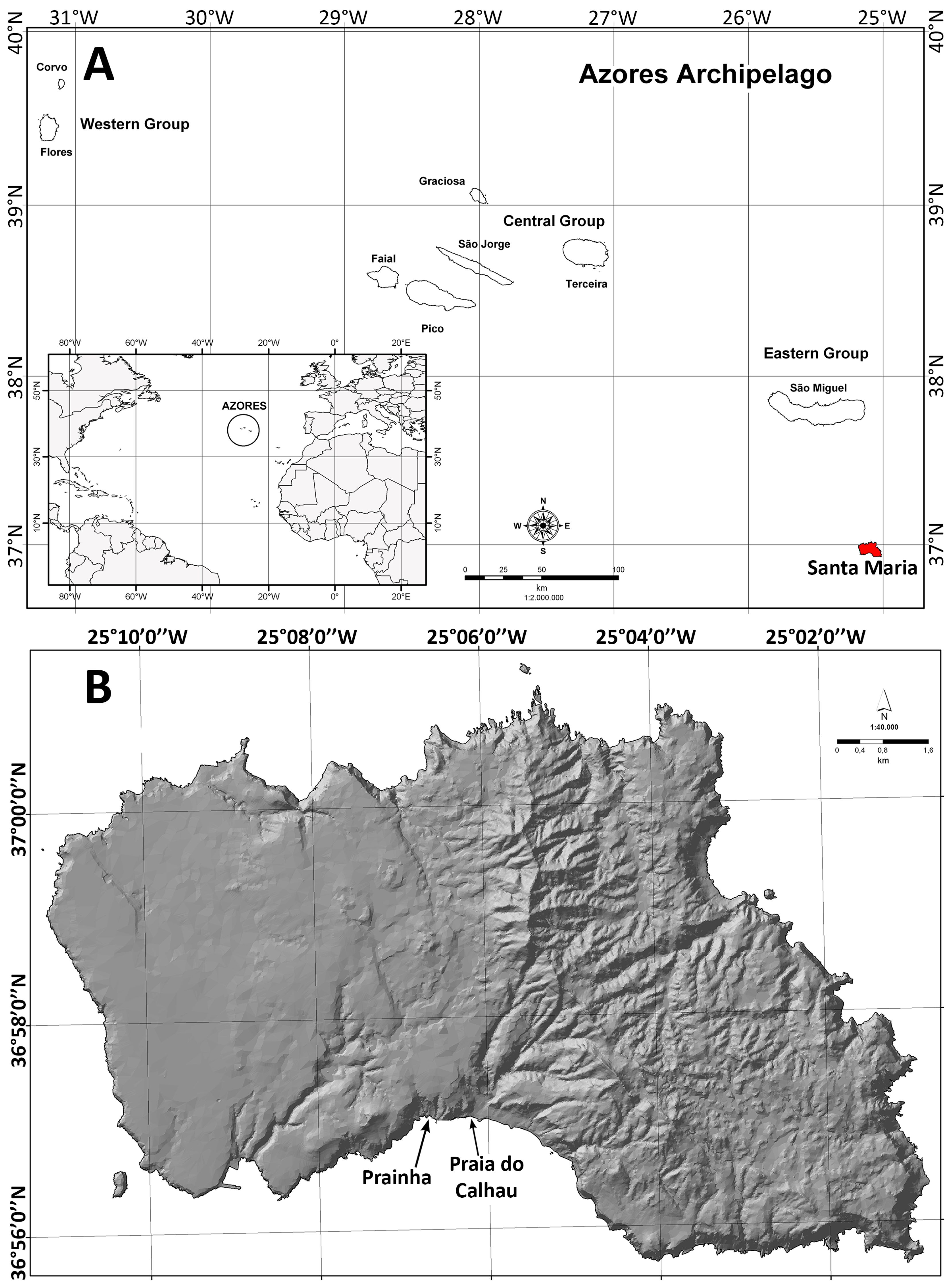
Stratigraphical and Sedimentological Characterization
3. Results
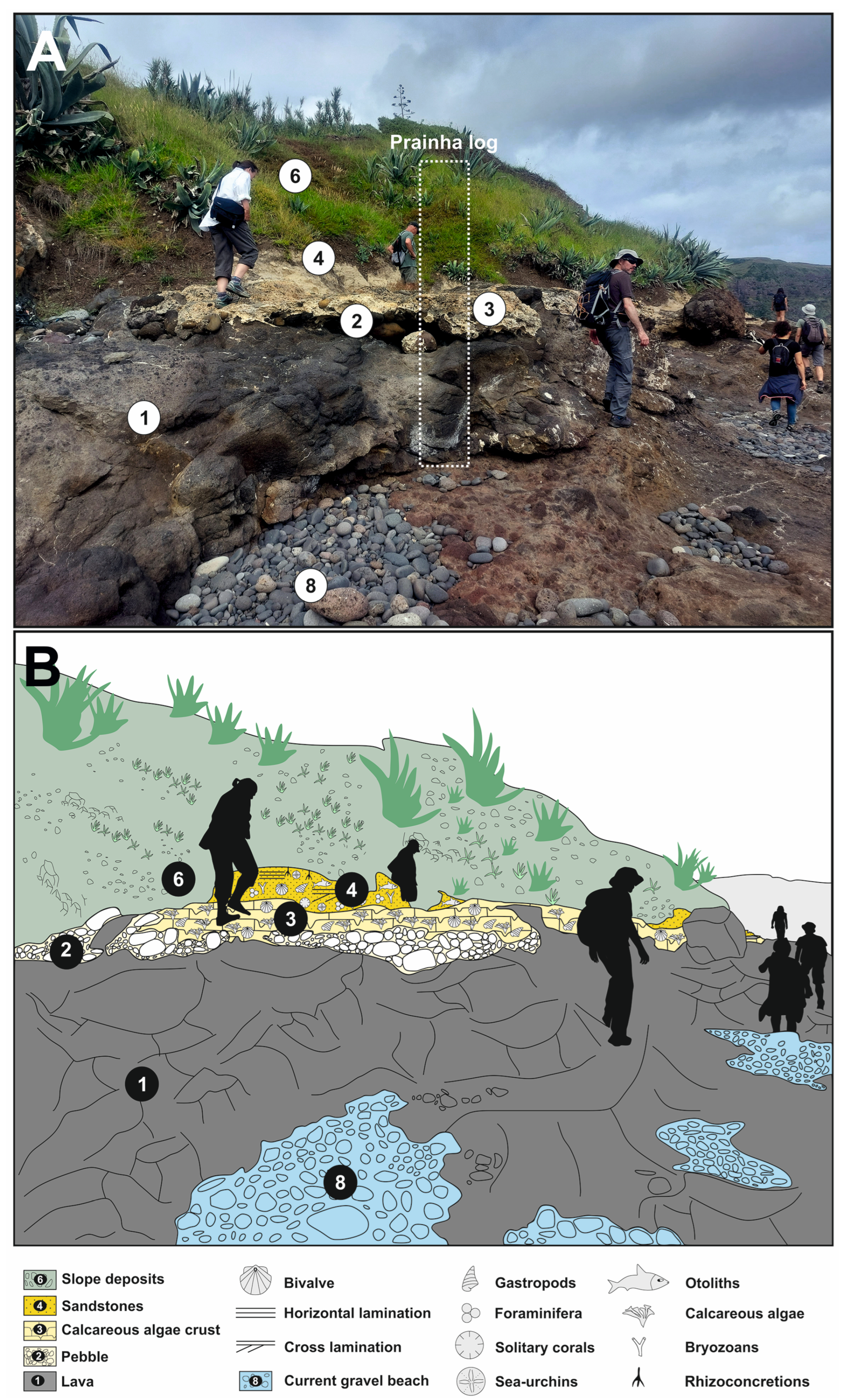
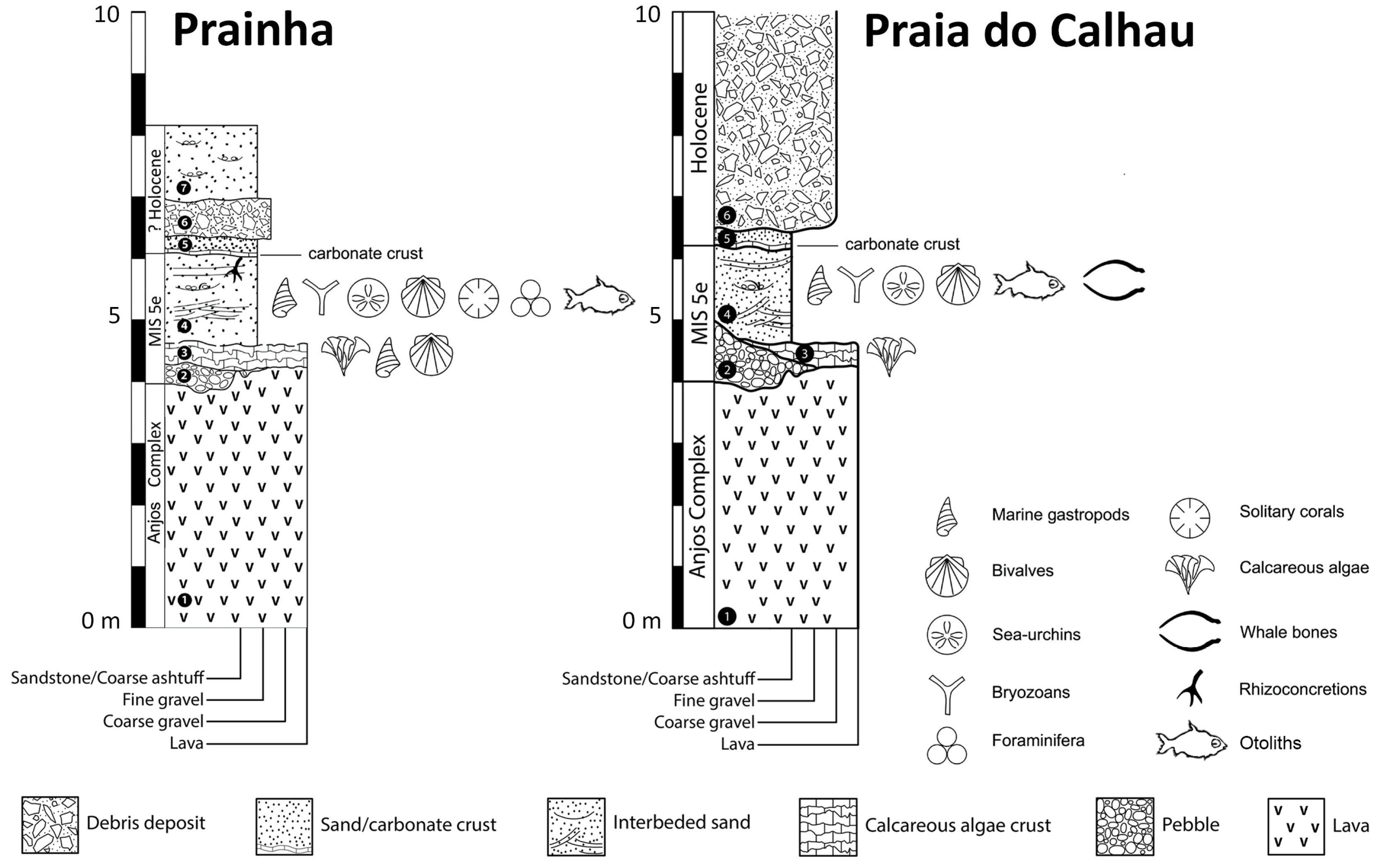
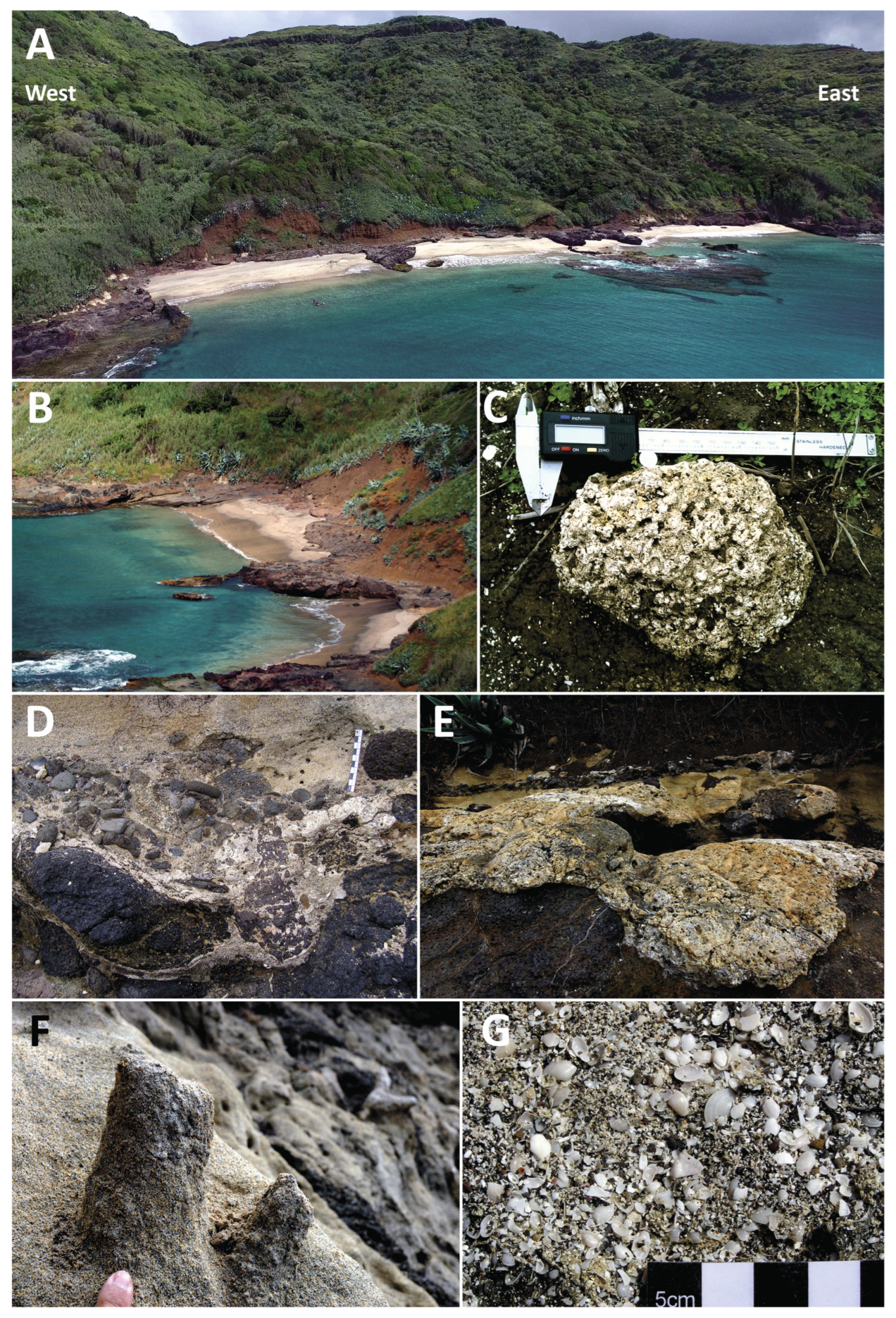
Stratigraphical and Sedimentological Characterization
4. Discussion
4.1. The Paleobiodiversity of the MIS 5e Deposits at Santa Maria Island
4.2. Paleoecology and the Lanternfish Fossil Record
5. Conclusions
Author Contributions
Funding
Data Availability Statement
Acknowledgments
Conflicts of Interest
Abbreviations
| DBUA-F | Fossil collection of the Department of Biology, University of the Azores |
References
- Darwin, C.R. On the geology of the Falkland Islands. Q. J. Geol. Soc. Lond. 1846, 2, 267–274. [Google Scholar] [CrossRef]
- Costa, J.T. On the organic law of change: Alfred Russel Wallace and the book that should have been. Evolve 2013, 7, 30–33. [Google Scholar]
- Ávila, S.P.; Azevedo, J.M.N.; Gonçalves, J.M.; Fontes, J.; Cardigos, F. Checklist of the shallow-water marine molluscs of the Azores: 1—Pico, Faial, Flores and Corvo islands. Açoreana 1998, 8, 487–523. [Google Scholar]
- Ávila, S.P.; Azevedo, J.M.N.; Gonçalves, J.M.; Fontes, J.; Cardigos, F. Checklist of the shallow-water marine molluscs of the Azores: 2—São Miguel island. Açoreana 2000, 9, 139–173. [Google Scholar]
- Arechavaleta Rodríguez, M.S.; Zurita, N.; García, A. Lista de especies silvestres de Canarias. Hongos, plantas y animales terrestres. Gob. Canar. 2010, 2009, 579. [Google Scholar]
- Cordeiro, R.; Borges, J.P.; Martins, A.M.F.; Ávila, S.P. Checklist of the littoral gastropods (Mollusca: Gastropoda) from the Archipelago of the Azores (NE Atlantic). Biodivers. J. 2015, 6, 855–900. [Google Scholar]
- Madeira, P.; Kroh, A.; Cordeiro, R.; Martins, A.M.F.; Ávila, S.P. The echinoderm fauna of the Azores (NE Atlantic Ocean). Zootaxa 2019, 4639, 1–231. [Google Scholar] [CrossRef] [PubMed]
- Rebelo, A.C.; Johnson, M.E.; Rasser, M.W.; Silva, L.; Melo, C.S.; Ávila, S.P. Global biodiversity and biogeography of rhodolith-forming species. Front. Biogeogr. 2021, 13, e50646. [Google Scholar] [CrossRef]
- Arrhenius, O. Species and area. J. Ecol. 1921, 9, 95–99. [Google Scholar] [CrossRef]
- Ricklefs, R.E.; Cox, G.W. Taxon cycles in the west Indian avifauna. Am. Nat. 1972, 106, 195–219. [Google Scholar] [CrossRef]
- Diamond, J.M. Assembly of species communities. In Ecology and Evolution of Communities; Cody, M.L., Diamond, J.M., Eds.; Harvard University Press: Cambridge, MA, USA, 1975; pp. 342–444. [Google Scholar]
- Gillespie, R. Community assembly through adaptive radiation in Hawaiian spiders. Science 2004, 303, 356–359. [Google Scholar] [CrossRef] [PubMed]
- Bunnefeld, N.; Phillimore, A.B. Island, archipelago and taxon effects: Mixed models as a means of dealing with the imperfect design of nature’s experiments. Ecography 2012, 35, 15–22. [Google Scholar] [CrossRef]
- Franzén, M.; Schweiger, O.; Betzholtz, P.-E. Species–area relationships are controlled by species traits. PLoS ONE 2012, 7, e37359. [Google Scholar] [CrossRef] [PubMed]
- Aguilée, R.; Claessen, D.; Lambert, A. Adaptive radiation driven by the interplay of eco–evolutionary and landscape dynamics. Evolution 2013, 67, 1291–1306. [Google Scholar] [CrossRef]
- Cunha, R.L.; Lima, F.P.; Tenorio, M.J.; Ramos, A.A.; Castilho, R.; Williams, S.T. Evolution at a different pace: Distinctive phylogenetic patterns of cone snails from two ancient oceanic archipelagos. Syst. Biol. 2014, 63, 971–987. [Google Scholar] [CrossRef]
- Ávila, S.P.; Cordeiro, R.; Madeira, P.; Silva, L.; Medeiros, A.; Rebelo, A.C.; Melo, C.; Neto, A.I.; Haroun, R.; Monteiro, A.; et al. Global change impacts on large-scale biogeographic patterns of marine organisms on Atlantic oceanic islands. Mar. Pollut. Bull. 2018, 126, 101–112. [Google Scholar] [CrossRef]
- Macarthur, R.H.; Wilson, E.O. An equilibrium theory of insular zoogeography. Evolution 1963, 17, 373–387. [Google Scholar] [CrossRef]
- Macarthur, R.H.; Wilson, E.O. The Theory of Island Biogeography; Princeton University Press: Princeton, NJ, USA, 1967. [Google Scholar]
- Whittaker, R.J.; Triantis, K.A.; Ladle, R.J. A general dynamic theory of oceanic Island biogeography. J. Biogeogr. 2008, 35, 977–994. [Google Scholar] [CrossRef]
- Whittaker, R.J.; Triantis, K.A.; Ladle, R.J. A general dynamic theory of oceanic island biogeography: Extending the MacArthur–Wilson theory to accommodate the rise and fall of volcanic islands. In The Theory of Island Biogeography Revisited; Losos, J.B., Ricklefs, R.E., Eds.; Princeton University Press: Princeton, NJ, USA, 2010; pp. 88–115. [Google Scholar]
- Fernández-Palácios, J.M.; Ridjsdiijk, K.F.; Norder, S.J.; Otto, R.; De Nascimento, L.; Fernández–Lugo, S.; Tjørve, E.; Whittaker, R.J. Towards a glacial–sensitive model of Island biogeography. Glob. Ecol. Biogeogr. 2016, 25, 817–830. [Google Scholar] [CrossRef]
- Hachich, N.F.; Bonsall, M.B.; Arraut, E.M.; Barneche, D.R.; Lewinsohn, T.M.; Floeter, S.R. Island biogeography: Patterns of marine shallow-water organisms in the Atlantic Ocean. J. Biogeogr. 2015, 45, 1871–1882. [Google Scholar] [CrossRef]
- Hachich, N.F.; Bonsall, M.B.; Arraut, E.M.; Barneche, D.R.; Lewinsohn, T.M.; Floeter, S.R. Marine island biogeography. Response to comment on ‘Island biogeography: Patterns of marine shallow-water organisms’. J. Biogeogr. 2016, 43, 2517–2519. [Google Scholar] [CrossRef]
- Hachich, N.F.; Ferrari, D.S.; Quimbayo, J.P.; Pinheiro, H.T.; Floeter, S.R. Island biogeography of marine shallow-water organisms. Encycl. World’s Biomes 2020, 1, 61–75. [Google Scholar]
- Ávila, S.P.; Cordeiro, R.; Haroun, R.; Wirtz, P. Comment on ‘Island biogeography: Patterns of marine shallow-water organisms’ by Hachich et al., Journal of Biogeography (2025). J. Biogeogr. 2016, 43, 2515–2516. [Google Scholar] [CrossRef][Green Version]
- Ávila, S.P.; Melo, C.; Sá, N.; Quartau, R.; Rijsdijk, K.; Ramalho, R.S.; Berning, B.; Cordeiro, R.; Sá, N.C.; De Pimentel, A.; et al. Towards a “Sea-Level Sensitive” dynamic model: Impact of island ontogeny and glacio-eustasy on global patterns of marine island biogeography. Biol. Rev. 2019, 94, 1116–1142. [Google Scholar] [CrossRef]
- Ávila, S.P.; Santos, A.M.; Melo, C.S.; Porteiro, J.M.; Medeiros, A.M.; Baptista, L.; Pimentel, A.; Madeira, P.; Rebelo, A.C.; Hipólito, A.; et al. Extending the Sea-Level Sensitive dynamic model of marine island biogeography to include fusion-fission islands. Front. Biogeogr. 2025, 18, e141200. [Google Scholar] [CrossRef]
- Pinheiro, H.T.; Bernardi, G.; Simon, T.; Joyeux, J.-C.; Macieira, R.M.; Gasparini, J.L.; Rocha, C.; Rocha, L.A. Island biogeography of marine organisms. Nature 2017, 82, 82–86. [Google Scholar] [CrossRef]
- Baptista, L.; Santos, A.M.; Cabezas, M.P.; Cordeiro, R.; Melo, C.; Ávila, S.P. Intertidal or subtidal/circalittoral species: Who appeared first? A phylogenetic approach to the evolution of non-planktotrophic species in Atlantic Archipelagos. Mar. Biol. 2019, 166, 88. [Google Scholar] [CrossRef]
- Ávila, S.P.; Cachão, M.; Ramalho, R.S.; Botelho, A.Z.; Madeira, P.; Rebelo, A.C.; Cordeiro, R.; Melo, C.; Hipólito, A.; Ventura, M.A.; et al. The palaeontological heritage of Santa Maria Island (Azores: NE Atlantic): A re-evaluation of geosites in GeoPark Azores and their use in geotourism. Geoheritage 2016, 8, 155–171. [Google Scholar] [CrossRef]
- Raposo, V.B.; Melo, C.S.; Silva, L.; Ventura, M.A.; Câmara, R.; Pombo, J.; Johnson, M.E.; Ávila, S.P. Comparing methods of evaluation of geosites: The fossiliferous outcrops of Santa Maria Island (Azores: NE Atlantic) as a case-study for sustainable Island tourism. Sustainability 2018, 10, 3596. [Google Scholar] [CrossRef]
- Zbyszewsky, G.; Ferreira, O.d.V. La faune marine des basses plages quaternaires de Praia et Prainha dans l’ile de Santa Maria (Açores). Comun. Dos Serviços Geológicos Port. 1961, 45, 467–478. [Google Scholar]
- Meco, J. Los Strombus Neogenos y Cuaternarios del Atlantico Euroafricano (Taxonomia, Biostratigrafia y Paleoecologia). In Paleontologia de Canarias; Tomo, I., Ed.; Cabildo Insular de Gran Canaria: Las Palmas de Gran Canaria, Spain, 1977; p. 142. [Google Scholar]
- García-Talavera, F.; Kardas, S.J.; Richards, H.G. Quaternary marine mollusks from Tenerife, Canary Islands. Nautilus 1978, 92, 97–102. [Google Scholar]
- Gerber, J.; Hemmen, J.; Groh, K. Eine pleistoz¨ane marineMolluskenfauna von Porto Santo (Madeira–Archipel). Mitteilungen Der Dtsch. Malakozool. Ges. 1989, 44–45, 19–30. [Google Scholar]
- Callapez, P.; Soares, A.F. Late Quaternary marine mollusks from Santa Maria (Azores); paleoecologic and paleobiogeographic considerations. Ciências Terra (UNL) 2000, 14, 313–322. [Google Scholar]
- Ávila, S.P.; Rebelo, A.C.; Medeiros, A.; Melo, C.; Gomes, C.; Bagaço, L.; Madeira, P.; Borges, P.A.; Monteiro, P.; Cordeiro, R.; et al. Os Fósseis de Santa Maria (Açores). 1. A Jazida da Prainha; OVGA—Observatório Vulcanológico e Geotérmico dos Açores: Lagoa, Portugal, 2010; p. 103. ISBN 978-989-8164-09-04. [Google Scholar]
- Ávila, S.P.; Ramalho, R.S.; Da Silva, C.M.; Johnson, M.E.; Uchman, A.; Berning, B.; Quartau, R.; Madeira, P.; Melo, C.S.; Rebelo, A.C.; et al. Os Fósseis de Santa Maria (Açores). 2. Pedra-Que-Pica: Uma História com 5 Milhões de Anos; OVGA—Observatório Vulcanológico e Geotérmico dos Açores: Lagoa, Portugal, 2022; p. 160. ISBN 978-989-8164-25-4. [Google Scholar]
- Ávila, S.P.; Ramalho, R.S.; Da Silva, C.M.; Uchman, A.; Berning, B.; Johnson, M.E.; Melo, C.S.; Madeira, P.; Rebelo, A.C.; Câmara, R.; et al. Os Fósseis de Santa Maria (Açores). 3. O Trilho Marítimo da Rota dos Fósseis; OVGA—Observatório Vulcanológico e Geotérmico dos Açores: Lagoa, Portugal, 2023; p. 120. ISBN 978-989-8164-27-8. [Google Scholar]
- Ávila, S.P.; Landau, B.; Ávila, G.C.; Hipólito, A.; Uchman, A.; Johnson, M.E.; Madeira, P. A call to address the taxonomic gap in the Pleistocene of Santa Maria Island (Azores Archipelago). Acta Geol. Pol. 2025, 75, e40. [Google Scholar] [CrossRef]
- Madeira, P.; Kroh, A.; Martins, A.M.F.; Ávila, S.P. The marine fossils from Santa Maria Island (Azores, Portugal): An historical overview. Açoreana 2007, Suplemento 5, 59–73. [Google Scholar]
- Madeira, P.; Kroh, A.; Cordeiro, R.; Meireles, R.; Ávila, S.P. The fossil echinoids of Santa Maria Island, Azores (Northern Atlantic Ocean). Acta Geol. Pol. 2011, 61, 243–264. [Google Scholar]
- Sacchetti, C.; Landau, B.; Ávila, S.P. The Lower Pliocene marine gastropods of Santa Maria Island, Azores: Taxonomy and palaeobiogeographic implications. Zootaxa 2023, 5295, 1–150. [Google Scholar] [CrossRef]
- Estevens, M.; Ávila, S.P. Fossil whales from the Azores. Açoreana 2007, Suplemento 5, 140–161. [Google Scholar]
- Ávila, S.P.; Cordeiro, R.; Rodrigues, A.R.; Rebelo, A.C.; Melo, C.; Madeira, P.; Pyenson, N.D. Fossil Mysticeti from the Pleistocene of Santa Maria Island, Azores (NE Atlantic Ocean), and the prevalence of fossil cetaceans on oceanic islands. Palaeontol. Electron. 2015, 18.2.27A. Available online: https://palaeo-electronica.org/content/2015/1225-oceanic-island-fossil-cetacean (accessed on 17 December 2025).
- Uchman, A.; Torres, P.; Johnson, M.E.; Berning, B.; Ramalho, R.S.; Rebelo, A.C.; Melo, C.S.; Baptista, L.; Madeira, P.; Cordeiro, R.; et al. Feeding traces of recent ray fish and occurrences of the trace fossil Piscichnus waitemata from the Pliocene of Santa Maria Island, Azores (Northeast Atlantic). Palaios 2018, 33, 361–375. [Google Scholar] [CrossRef]
- Aguilera, O.A.; Ramos, M.I.F.; Paes, E.T.; Costa, S.A.R.F.; Sánchez-Villagra, M.R. The Neogene tropical America fish assemblage and the paleobiogeography of the Caribbean region. Swiss J. Palaeontol. 2011, 130, 217–240. [Google Scholar] [CrossRef]
- Roberts, A.; Rucinski, M.; Kera, B.P.; Hammer, Ø.; Engelschiøn, V.S.; Scharling, T.H.; Larsen, R.B.; Hurum, J.H. Earliest oceanic tetrapod ecosystem reveals rapid complexification of Triassic marine communities. Science 2025, 390, 722–727. [Google Scholar] [CrossRef] [PubMed]
- Argyriou, T.; Alexopoulos, A.; Carrillo-Briceño, J.D.; Cavin, L. A fossil assemblage from the mid–late Maastrichtian of Gavdos Island, Greece, provides insights into the pre-extinction pelagic ichthyofaunas of the Tethys. PLoS ONE 2022, 17, e0265780. [Google Scholar] [CrossRef]
- Purdy, R.W.; Donovan, S.K.; Pickerill, R.K.; Dixon, H.L. Fish teeth from the Pleistocene of Jamaica. J. Vertebr. Paleontol. 1996, 16, 165–167. [Google Scholar] [CrossRef]
- Stringer, G.L. Otolitos-based fishes from the Bowden Shell Bed (Pliocene) of Jamaica: Systematic and Palaeoecology. Contrib. Tert. Quat. Geol. 1998, 35, 147–160. [Google Scholar]
- Underwood, C.J.; Mitchell, S.F. Sharks, bony fishes and endodental borings from the Miocene Montpelier Formation (White Limestone Group) of Jamaica. Cainozoic Res. 2004, 3, 157–165. [Google Scholar]
- Iturralde-Vinent, M.; Case, G.R. First report of the fossil fish, Diodon (family Diodontidae) from the Miocene of Cuba. RevSoc. Mex. Paleontol. 1998, 8, 123–126. [Google Scholar]
- Días-Franco, S.; Rojas-Consuegra, R. Dientes fósiles de Sphyraena (Perciformes: Sphyraenidae) en el Terciario de Cuba occidental. Solenodon 2009, 8, 124–129. [Google Scholar]
- Nolf, D.; Stringer, G.L. Neogene paleontology in the northern Dominican Republic: Otoliths of teleostean fishes. Bull. Am. Paleontol. 1992, 102, 41–81. [Google Scholar]
- Schwarzhans, W. A Comparative Morphological Treatise of Recent and Fossil Otoliths of the Order Pleuronectiformes. Piscium Catalogus, Otolithi Piscium; Verlag Dr. Friedrich Pfeil: Munich, Germany, 1997. [Google Scholar]
- Ávila, S.P.; Azevedo, J.M.N.; Madeira, P.; Cordeiro, R.; Melo, C.S.; Baptista, L.; Torres, P.; Johnson, M.E.; Vullo, R. Pliocene and late Pleistocene actinopterygian fishes from Santa Maria Island, Azores (NE Atlantic Ocean): Palaeoecological and palaeobiogeographical implications. Geol. Mag. 2020, 157, 1526–1542. [Google Scholar] [CrossRef]
- Ávila, S.P.; Melo, C.; Berning, B.; Cordeiro, R.; Landau, B.; da Silva, C.M. Persististrombus coronatus (Mollusca: Strombidae) in the early Pliocene of Santa Maria Island (Azores: NE Atlantic): Palaeoecology, palaeoclimatology and palaeobiogeographic implications on the NE Atlantic Molluscan Biogeographical Provinces. Palaeogeogr. Palaeoclimatol. Palaeoecol. 2016, 441, 912–923. [Google Scholar] [CrossRef]
- Ávila, S.P. Processos e Padrões de Dispersão e Colonização nos Rissoidae (Mollusca: Gastropoda) dos Açores. Ph.D. Thesis, Universidade dos Açores, Ponta Delgada, Portugal, 2005. pp. x+329. [Google Scholar]
- Ávila, S.P.; Da Silva, C.M.; Schiebel, R.; Cecca, F.; Backeljau, T.; Martins, A.M.F. How did they get here? The biogeography of the marine molluscs of the Azores. Bull. Geol. Soc. Fr. 2009, 180, 295–307. [Google Scholar] [CrossRef]
- Ávila, S.P.; Melo, C.; Silva, L.; Ramalho, R.; Quartau, R.; Hipólito, A.; Cordeiro, R.; Rebelo, A.C.; Madeira, P.; Rovere, A.; et al. A review of the MIS 5e highstand deposits from Santa Maria Island (Azores, NE Atlantic): Palaeobiodiversity, palaeoecology and palaeobiogeography. Quat. Sci. Rev. 2015, 114, 126–148. [Google Scholar] [CrossRef]
- Ávila, S.P.; Ramalho, R.; Habermann, J.; Titschack, J. The marine fossil record at Santa Maria Island (Azores). In Volcanoes of the Azores; Kueppers, U., Beier, C., Eds.; Revealing the Geological Secrets of the Central Northern Atlantic Islands; Active Volcanoes of the World; Springer: Berlin/Heidelberg, Germany, 2018; pp. 155–196. [Google Scholar] [CrossRef]
- WoRMS Database. Available online: https://www.marinespecies.org/aphia.php?p=taxdetails&id=125498 (accessed on 3 December 2025).
- Near, T.J.; Thacker, C.E. Phylogenetic classification of living and fossil ray-finned fishes (Actinopterygii). Bull. Peabody Mus. Nat. Hist. 2024, 65, 3–302. [Google Scholar] [CrossRef]
- Rebelo, A.C.; Rasser, M.W.; Ramalho, R.S.; Johnson, M.E.; Melo, C.S.; Uchman, A.; Quartau, R.; Berning, B.; Neto, A.I.; Mendes, A.R.; et al. Pleistocene coralline algal build-ups on a mid-ocean rocky shore—Insights into the MIS 5e record of the Azores. Palaeobiogeography Palaeoclimatol. Palaeoecol. 2021, 579, 110598. [Google Scholar] [CrossRef]
- Carroll, R.L. Vertebrate Paleontology and Evolution; W. H. Freeman and Company: New York, NY, USA, 1988. [Google Scholar]
- Riede, K. Global Register of Migratory Species—From Global to Regional Scales; Final Report of the R&D-Projekt 808 05 081; Federal Agency for Nature Conservation: Bonn, Germany, 2004; p. 329. [Google Scholar]
- Hulley, P.A. Myctophidae. In Check-List of the Fishes of the Eastern Tropical Atlantic (CLOFETA); Quero, J.C., Hureau, J.C., Karrer, C., Post, A., Saldanha, L., Eds.; JNICT: Lisbon, Portugal; SEI: Paris, France; UNESCO: Paris, France, 1990; Volume 1, pp. 398–467. [Google Scholar]
- Mytilineou, C.; Politou, C.-Y.; Papaconstantinou, C.; Kavadas, S.; D’Onghia, G.; Sion, L. Deep-water fish fauna in the Eastern Ionian Sea. Belg. J. Zool. 2005, 135, 229–233. [Google Scholar]
- Porteiro, F.; Sutton, T.; Byrkjedal, I.; Orlov, A.; Heino, M.; Menezes, G.; Bergstad, O.A. Fishes of the Northern Mid-Atlantic Ridge collected during the MAR-ECO cruise in June-July 2004: An annotated checklist. Arquipélago Life Mar. Sci. 2017, Supplement 10, 1–126. [Google Scholar]
- Gaudant, J.; Delrieau, B.; Dermitzakis, M.D.; Symeonidis, N.K. Découverte d’une ichthyofaune marine dans les diatomites du Pliocène supérieur (Plaisancien) des environs d’Héraklion (Crète centrale, Grèce). Comptes Rendus Acad. Seances Paris 1994, 319, 589–596. [Google Scholar]
- Marcopoulou-Diacantoni, A.; Kagiouzis, G. Otoliths from the lower Pliocene of the section Prassies (Rethymnon, NW-Crete), Systematics—Paleoecology. Bull. Geol. Soc. Greece 2001, 34, 577–584. [Google Scholar] [CrossRef][Green Version]
- Tsaparas, N.; Marcopoulou-Diacantoni, A. Tortonian Scleractinian Corals from the island of Gavdos (South Greece). Rev. Paléobiologie 2005, 24, 629–637. [Google Scholar]
- Agiadi, K.; Triantaphyllou, M.; Girone, A.; Karakitsios, V.; Dermitzakis, M. Paleobathymetric interpretation of the fish otoliths from the lower—Middle quaternary deposits of Kephallonia and Zakynthos islands (Ionian Sea, Western Greece). Riv. Ital. Paleontol. Stratigr. 2010, 116, 63–78. [Google Scholar]
- Agiadi, K.; Girone, A.; Koskeridou, E.; Moissette, P.; Cornee, J.J.; Quillevere, F. Pleistocene marine fish invasions and paleoenvironmental reconstructions in the eastern Mediterranean. Quat. Sci. Rev. 2018, 196, 80–99. [Google Scholar] [CrossRef]
- Chevalier, J.P. Recherches sur les Madreporaires et les formations recifales Miocenes de la Mediterranee occidentale [Miocene corals and reefs from the western Mediterranean]. Mem. Soc. Geol. Fr. 1961, 93, 1–562. [Google Scholar]
- Marasti, R. La fauna tortoniana del T. Stirone (limite Parmense-Piacentino). Boll. Della Soc. Paleontol. Ital. 1973, 12, 76–120. [Google Scholar]
- Landini, W.; Sorbini, L. Données récentes sur Les téléostéens du Miocène et du Pliocéne d’Italie. Geobios 1992, 14, 151–157. [Google Scholar] [CrossRef]
- Girone, A.; Nolf, D.; Cappetta, H. Pleistocene fish otoliths from the Mediterranean Basin: A synthesis. Geobios 2006, 39, 651–671. [Google Scholar] [CrossRef]
- Lin, C.-H.; Girone, A.; Nolf, D. Tortonian fish otoliths from turbiditic deposits in Northern Italy: Taxonomic and stratigraphic significance. Geobios 2015, 48, 249–261. [Google Scholar] [CrossRef]
- Lin, C.-H.; Brzobohaty, R.; Nolf, D.; Girone, A. Tortonian teleost otoliths from northern Italy: Taxonomic synthesis and stratigraphic significance. Eur. J. Taxon. 2017, 322, 1–44. [Google Scholar] [CrossRef]
- Porteiro, F.M.; Giacomello, E.; Carmo, V.; Graça, G.; Cascão, I.; Morais, A.; Vieira, A.R.; Caetano, M.; Menezes, G. Mesopelagic fishes around the Condor seamount. In CONDOR Observatory for Long-Term Study and Monitoring of Azorean Seamount Ecosystems; Giacomello, E., Menezes, G., Eds.; Arquivos do DOP, Série Estudos; Final Project Report; University of the Azores: Ponta Delgada, Portugal, 2011; Volume 1, pp. 25–31. [Google Scholar]
- Nolf, D.; Martinell, J. Otoliths de Téléostéens du Pliocène des environs de Figueiras (Catalogne). Geol. Palaeontol. 1980, 14, 209–234. [Google Scholar]
- Nolf, D.; Cappetta, H. Otoliths de poisons pliocènes du Sud-Est de la France. Bull. L’Institut R. Sci. Nat. Belg. Sci. Terre 1989, 58, 209–271. [Google Scholar]
- Coad, B.W.; Reist, J.D. Annotated list of the Arctic marine fishes of Canada. Can. Manuscr. Rep. Fish. Aquat. Sci. 2004, 2674, 1–112. [Google Scholar]
- Badouvas, N.; Somarakis, S.; Tsagarakis, K. Length-weight relations of 16 mesopelagic fishes (Actinopterygii: Myctophiformes and Stomiiformes) from the eastern Mediterranean Sea. Acta Ichthyol. Piscat. 2022, 52, 279–283. [Google Scholar] [CrossRef]
- Hulley, P.A. Myctophidae. In Fishes of the North-Eastern Atlantic and the Mediterranean; Whitehead, P.J.P., Bauchot, M.-L., Hureau, J.-C., Nielsen, J., Tortonese, E., Eds.; UNESCO: Paris, France, 1984; Volume 1, pp. 429–483. [Google Scholar]
- Ávila, S.P.; Arruda, S.; Silva, L.; Martins, G.M.; Hipólito, A.; Quartau, R.; Ramalho, R.S.; Madeira, P.; Baptista, L.; Rebelo, A.C.; et al. Comparing the Last Interglacial (MIS 5e) with the present interglacial period (MIS 1) using a multidimensional functional diversity analysis: The marine molluscs from Santa Maria Island (Azores Archipelago, central Atlantic) as a case-study. J. Quat. Sci. 2025, 43, 333–360. [Google Scholar] [CrossRef]
- Moreno, S.; Doukani, M.A.; Hipólito, A.; Madeira, P.; Pérez, S.P.; Ávila, G.C.; Silva, L.; Martins, G.M.; Ávila, S.P. Paleobiodiversity and paleoecology insights from a new MIS 5e highstand deposit on Santa Maria Island (Azores Archipelago, Portugal). Quaternary 2025, 8, 53. [Google Scholar] [CrossRef]
- Gjøsaeter, J.; Kawaguchi, K. A Review of the World Resources of Mesopelagic Fish; FAO Fisheries Technical Paper; FAO: Rome, Italy, 1980; Volume 193, pp. 123–134. [Google Scholar]
- Zanchin, V.R.; Temperoni, B.; Acha, E.M.; Buratti, C.C.; Alemany, D. Lanternfish (Myctophidae) distribution and diversity patterns in the Southwestern Atlantic Ocean. Deep Sea Res. Part I Oceanogr. Res. Pap. 2025, 222, 104518. [Google Scholar] [CrossRef]
- Schwarzhans, W.; Ohe, F.; Tsuchiya, Y.; Ujihara, A. Lanternfish otoliths (Myctophidae, Teleostei) from the Miocene of Japan. Zitteliana 2022, 96, 103–134. [Google Scholar] [CrossRef]
- Schwarzhans, W.; Carnevale, G. The rise to dominance of lanternfishes (Teleostei: Myctophidae) in the oceanic ecosystems: A paleontological perspective. Paleobiology 2021, 47, 446–463. [Google Scholar] [CrossRef]
- Prihartato, P.K.; Irigoien, X.; Genton, M.G.; Kaartvedt, S. Global effects of moon phase on nocturnal acoustic scattering layers. Mar. Ecol. Prog. Ser. 2016, 544, 65–75. [Google Scholar] [CrossRef]
- Davison, P.C.; Checkley, D.M.; Koslow, J.A.; Barlow, J. Carbon export mediated by mesopelagic fishes in the northeast Pacific Ocean. Prog. Oceanogr. 2013, 116, 14–30. [Google Scholar] [CrossRef]
- Ávila, S.P.; Johnson, M.E.; Rebelo, A.C.; Baptista, L.; Melo, C.S. Comparison of modern and Pleistocene (MIS 5e) coastal boulder deposits from Santa Maria Island (Azores Archipelago, NE Atlantic Ocean). J. Mar. Sci. Eng. 2020, 8, 386. [Google Scholar] [CrossRef]
- Hearty, P.J.; Tormey, B.R. Sea-level change and superstorms; geologic evidence from the last interglacial (MIS 5e) in the Bahamas and Bermuda offers ominous prospects for a warming Earth. Mar. Geol. 2017, 390, 347–365. [Google Scholar] [CrossRef]
- Hearty, P.J.; Tormey, B.R. Listen to the whisper of the rocks, telling their ancient story. Proc. Natl. Acad. Sci. USA 2018, 115, E2902–E2903. [Google Scholar] [CrossRef]
- Rovere, A.; Casella, E.; Harris, D.L.; Lorscheid, T.; Nandasena, N.A.K.; Dyer, B.; Sandstrom, M.R.; Stocchi, P.; D’andrea, W.J.; Raymo, M.E. Reply to Hearty and Tormey: Use the scientific method to test geologic hypotheses, because rocks do not whisper. Proc. Natl. Acad. Sci. USA 2018, 115, E2904–E2905. [Google Scholar] [CrossRef]
- Rusu, L.; Guedes Soares, C. Wave energy assessments in the Azores Islands. Renew. Energy 2012, 45, 183–196. [Google Scholar] [CrossRef]
- Zhao, Z.; Mitchell, N.C.; Quartau, R.; Moreira, S.; Rusu, L.; Melo, C.S.; Ávila, S.P.; Das, D.; Afonso, P.; Pombo, J.; et al. Wave-influenced deposition of carbonate-rich sediment on the insular shelf of Santa Maria Island, Azores. Sedimentology 2022, 69, 1547–1572. [Google Scholar] [CrossRef]
- Duguy, R.; Wisdorff, D. Strandings of Cetacea and meteorological data on the Atlantic coast (from the Loire Estuary to Gironde). Int. Counc. Exploit. Sea 1988, 3, 1–6. [Google Scholar]
- Gonçalves, J.M.; Barreiros, J.P.; Azevedo, J.M.N.; Norberto, R. Cetaceans stranded in the Azores during 1992–96. Arquipélago Life Mar. Sci. 1996, 14A, 57–65. [Google Scholar]
- López, A.; Barreiro, A.; Benavente, P. Varamientos de cetáceos en las costas occidentales del sur de Europa. Quercus 1996, 135, 34–37. [Google Scholar]
- Geraci, J.R.; Loundsbury, V.J. Marine Mammals Ashore: A Field Guide for Strandings, 2nd ed.; E. John Smitz & Sons: Sparks, MD, USA, 2005; ISBN 0-9774609-0-8. [Google Scholar]
- Battaglia, P.; Malara, D.; Ammendolia, G.; Romeo, T.; Andaloro, F. Relationships between otolith size and fish length in some mesopelagic teleosts (Myctophidae, Paralepididae, Phosichthyidae and Stomiidae). J. Fish Biol. 2015, 87, 774–782. [Google Scholar] [CrossRef]
- Mazzarelli, G. Gli animali abissali e le correnti sottomarine dello Stretto di Messina. Riv. Mens. Pesca Idrobiol. 1909, 11, 177–218. [Google Scholar]
- Di Carlo, B.S.; Costanzo, G.; Fresi, E.; Guglielmo, L.; Ianora, A. Feeding ecology and stranding mechanisms in two lanternfishes, Hygophum benoiti and Myctophum punctatum. Mar. Ecol. Prog. Ser. 1982, 9, 13–24. [Google Scholar] [CrossRef]
- Battaglia, P.; Ammendolia, G.; Cavallaro, M.; Consoli, P.; Esposito, V.; Malara, D.; Rao, I.; Romeo, T.; Andaloro, F. Influence of lunar phases, winds and seasonality on the stranding of mesopelagic fish in the Strait of Messina (Central Mediterranean Sea). Mar. Ecol. 2017, 38, e12459. [Google Scholar] [CrossRef]
- Gaudant, J.; Courme-Rault, M.-D.; Fornaciari, E.; Fourtanier, E. The Upper Miocene fossil fish locality of Pecetto di Valenza (Piedmont, Italy): A multidisciplinary approach. Boll. Della Soc. Paleontol. Ital. 2010, 49, 203–225. [Google Scholar]


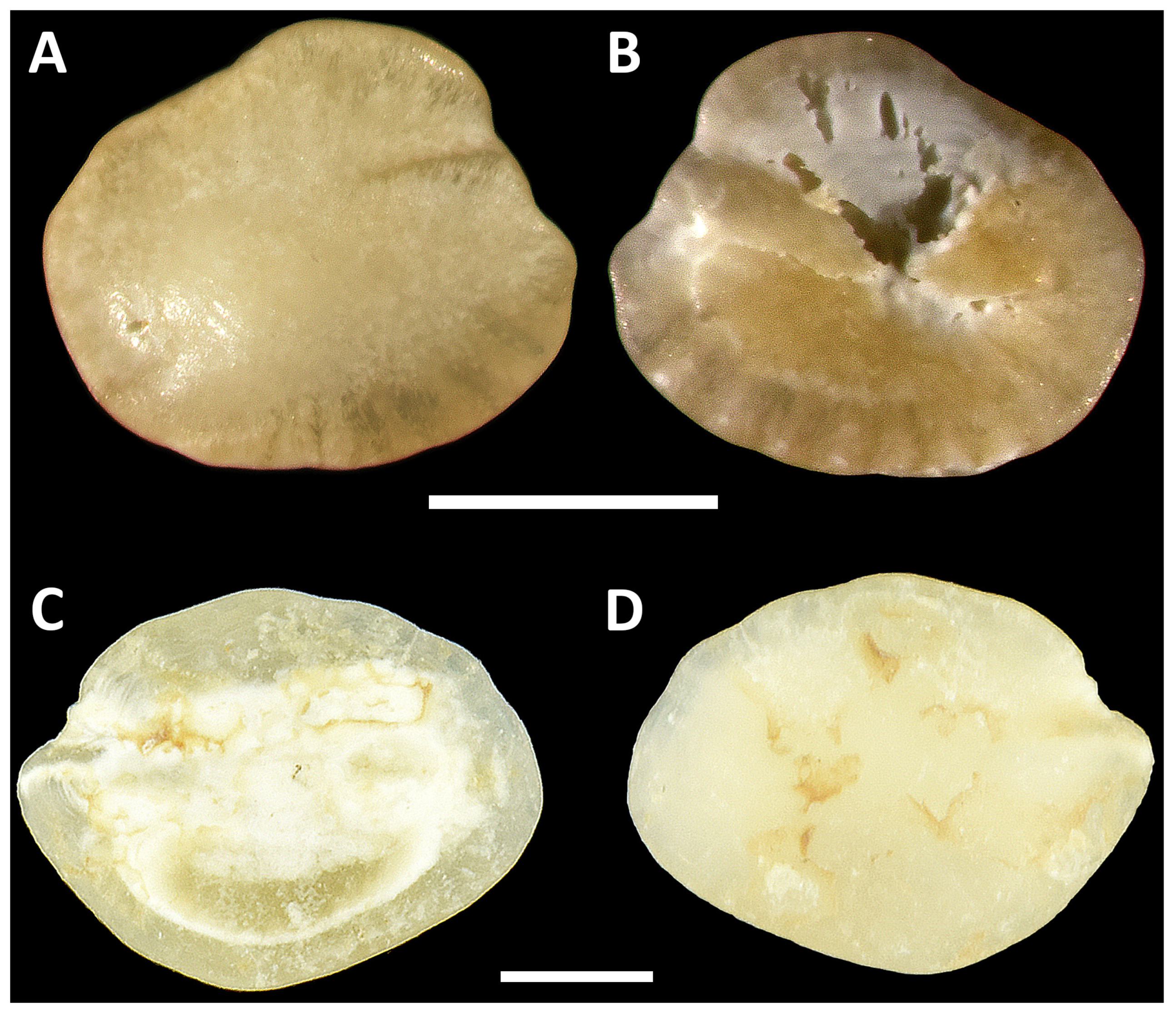
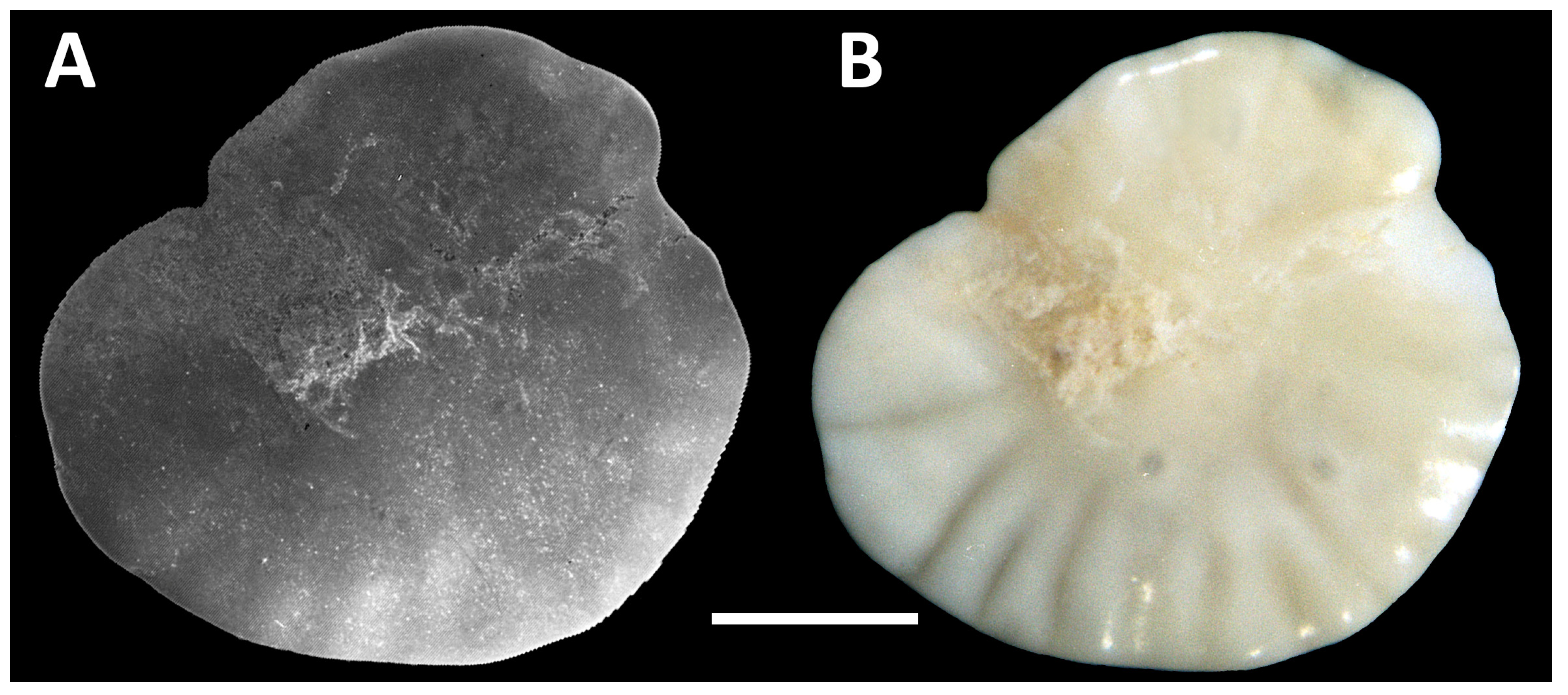

| Marine Group | PCt | PCr | PCe | Pqp | Pra | PCa | Lag | VVe | Total Number of Species |
|---|---|---|---|---|---|---|---|---|---|
| Coralline algae forming rhodoliths | 4 | 4 | 4 | 4 | |||||
| Cnidaria Anthozoa | 1 | 1 | |||||||
| Echinodermata | 4 | 2 | 3 | 2 | 4 | ||||
| Mollusca Gastropoda | 2 | 1 | 80 | 47 | 100 | 65 | 48 | 62 | 130 |
| Pelagic Mollusca Gastropoda (Heteropoda + Pteropoda) | 4 | 4 | |||||||
| Mollusca Bivalvia | 15 | 6 | 20 | 16 | 3 | 8 | 28 | ||
| Crustacea Decapoda | 4 | 5 | 7 | ||||||
| Coastal fishes | 1 | 1 | |||||||
| Myctophidae (mesopelagic lanternfishes) | 2 | 2 | |||||||
| Cetaceans | 0 | 1 | 1 | ||||||
| Total number of species | 2 | 1 | 99 | 54 | 134 | 88 | 58 | 78 | 182 |
| Marine Group | MIS 5e Species | Recent Species | Ratio (%) MIS 5e/MIS 1 |
|---|---|---|---|
| Coralline algae forming rhodoliths | 4 | 4 | 100.0 |
| Cnidaria Anthozoa | 1 | 31 | 3.2 |
| Echinodermata | 4 | 64 | 6.3 |
| Mollusca Gastropoda | 130 | 230 | 56.5 |
| Mollusca Bivalvia | 28 | 143 | 19.6 |
| Crustacea Decapoda | 7 | 63 | 11.1 |
| Myctophidae (lanternfishes) | 2 | 44 | 4.5 |
| Coastal fishes | 1 | 165 | 0.6 |
| Cetaceans | 1 | 28 ǂ | 3.6 |
| Total number of species | 178 | 772 | 23.1 |
Disclaimer/Publisher’s Note: The statements, opinions and data contained in all publications are solely those of the individual author(s) and contributor(s) and not of MDPI and/or the editor(s). MDPI and/or the editor(s) disclaim responsibility for any injury to people or property resulting from any ideas, methods, instructions or products referred to in the content. |
© 2026 by the authors. Licensee MDPI, Basel, Switzerland. This article is an open access article distributed under the terms and conditions of the Creative Commons Attribution (CC BY) license.
Share and Cite
Ávila, S.P.; Madeira, P.; Doukani, M.A.; Hipólito, A.; Ávila, G.C.; Marques, S.; Vullo, R.; Schwarzhans, W. First Evidence of Lanternfishes from the Last Interglacial (MIS 5e) of Santa Maria Island (Azores Archipelago: NE Atlantic Ocean): Paleoecology and Paleobiodiversity. Quaternary 2026, 9, 31. https://doi.org/10.3390/quat9020031
Ávila SP, Madeira P, Doukani MA, Hipólito A, Ávila GC, Marques S, Vullo R, Schwarzhans W. First Evidence of Lanternfishes from the Last Interglacial (MIS 5e) of Santa Maria Island (Azores Archipelago: NE Atlantic Ocean): Paleoecology and Paleobiodiversity. Quaternary. 2026; 9(2):31. https://doi.org/10.3390/quat9020031
Chicago/Turabian StyleÁvila, Sérgio P., Patrícia Madeira, Mohamed Amine Doukani, Ana Hipólito, Gonçalo Castela Ávila, Sandra Marques, Romain Vullo, and Werner Schwarzhans. 2026. "First Evidence of Lanternfishes from the Last Interglacial (MIS 5e) of Santa Maria Island (Azores Archipelago: NE Atlantic Ocean): Paleoecology and Paleobiodiversity" Quaternary 9, no. 2: 31. https://doi.org/10.3390/quat9020031
APA StyleÁvila, S. P., Madeira, P., Doukani, M. A., Hipólito, A., Ávila, G. C., Marques, S., Vullo, R., & Schwarzhans, W. (2026). First Evidence of Lanternfishes from the Last Interglacial (MIS 5e) of Santa Maria Island (Azores Archipelago: NE Atlantic Ocean): Paleoecology and Paleobiodiversity. Quaternary, 9(2), 31. https://doi.org/10.3390/quat9020031