
Phytoliths and Pollen from a Desert Wetland Through the Last Glacial–Interglacial Cycle in Azraq, Jordan
 , , , , and
Abstract
1. Introduction
2. Study Area
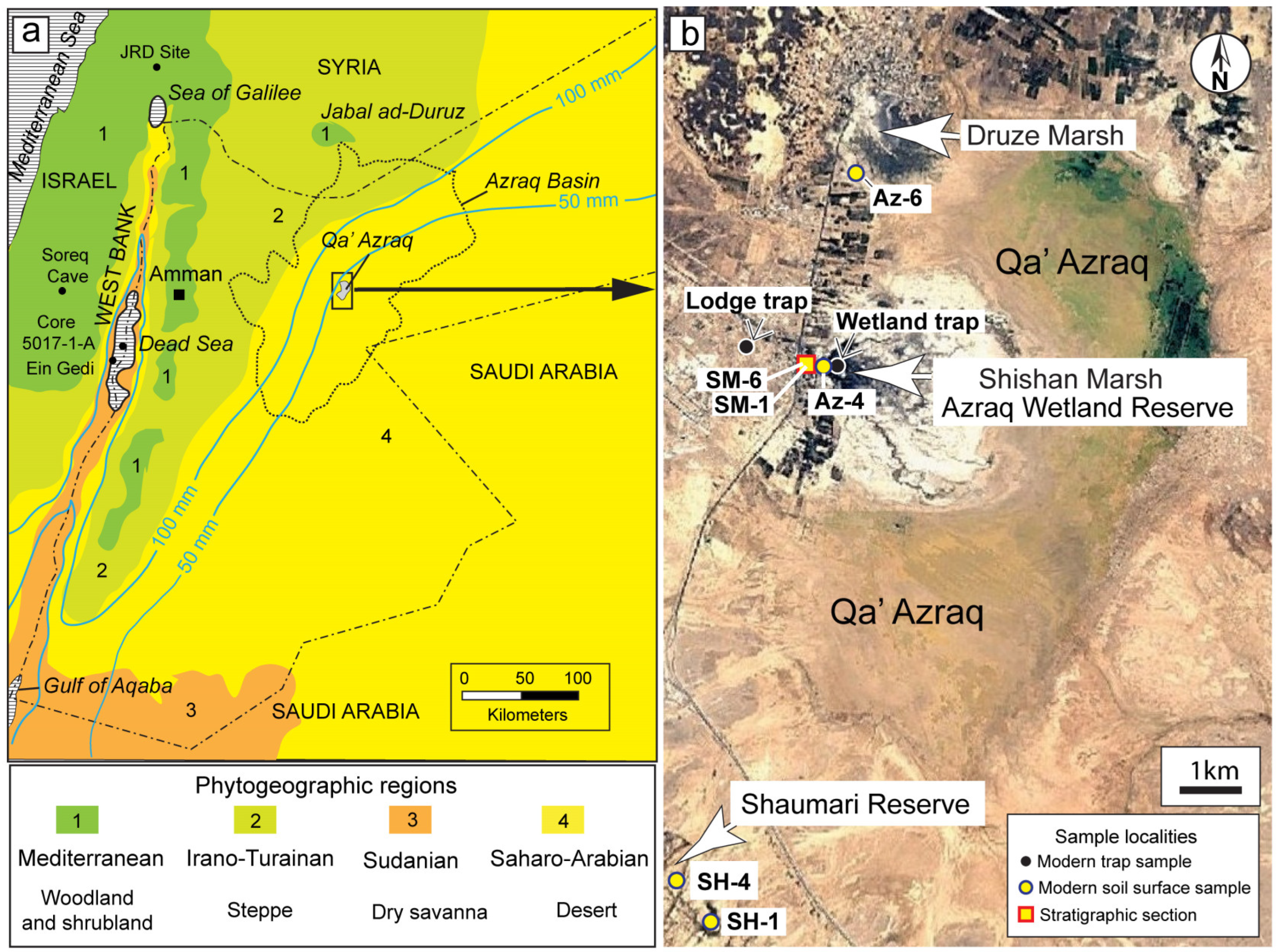
2.1. Environmental and Archaeological Context
2.2. Vegetation and Phytolith-Producing Plants
3. Materials and Methods
3.1. Sampling
3.2. Processing and Analysis
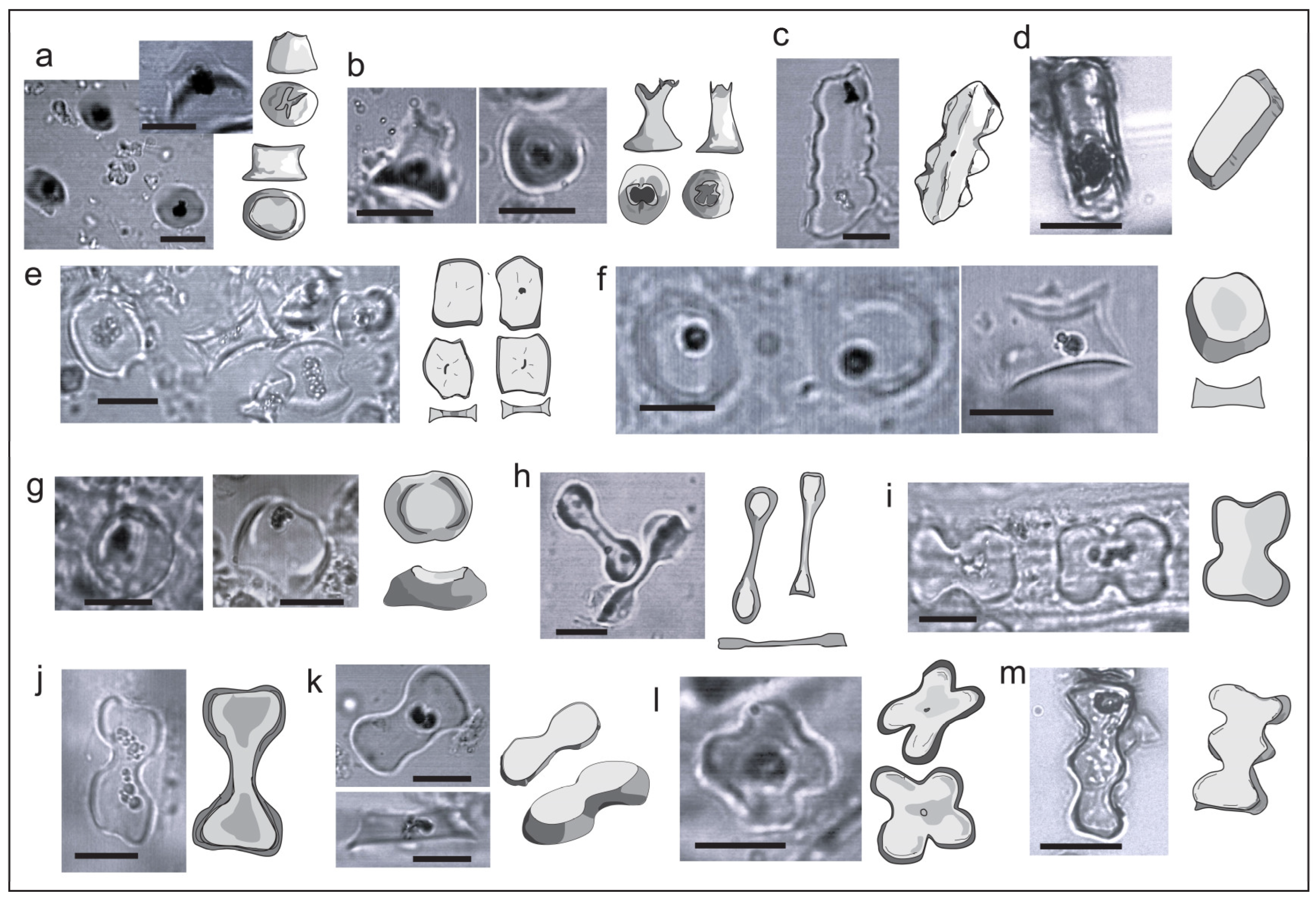
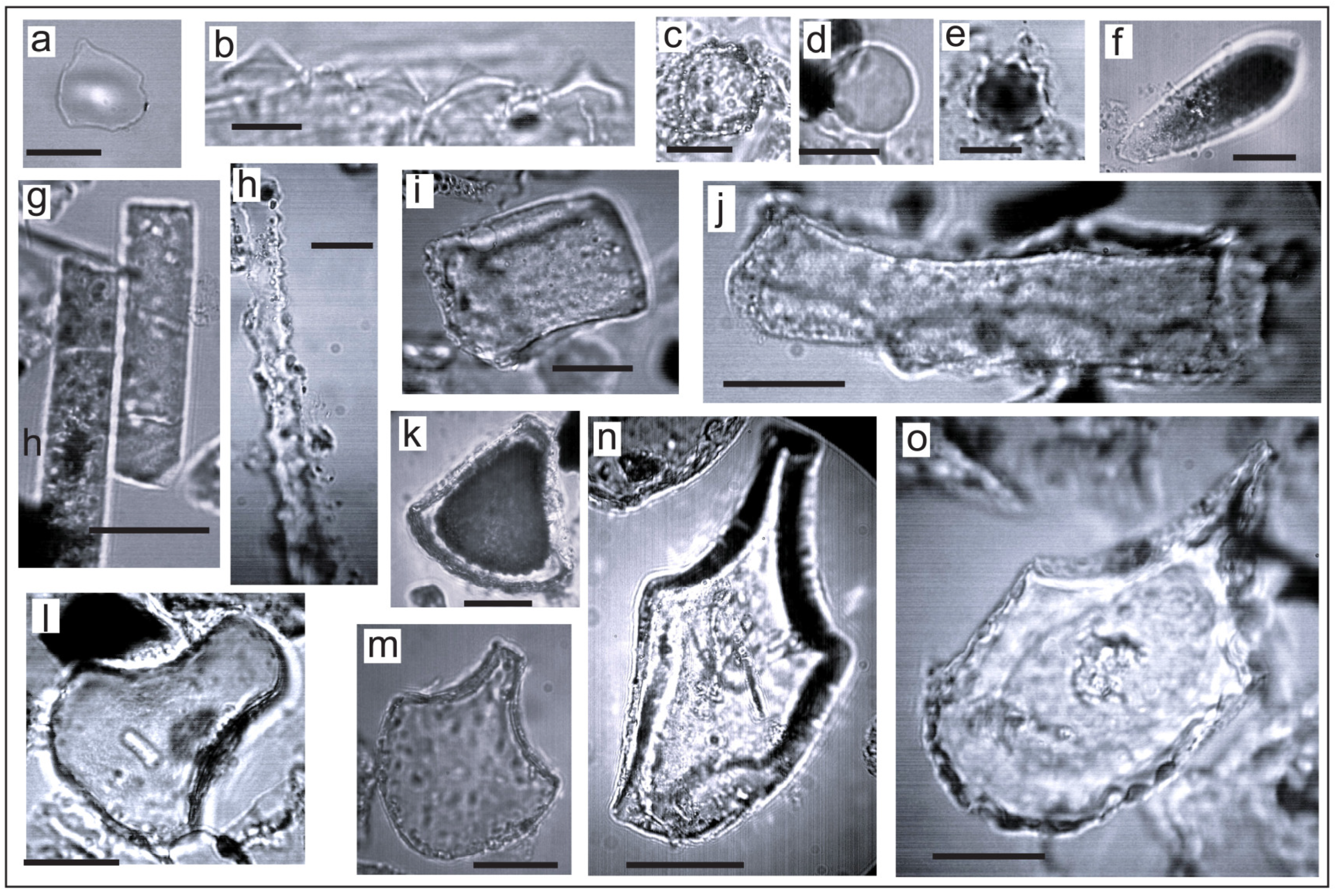
3.3. Phytolith Classification
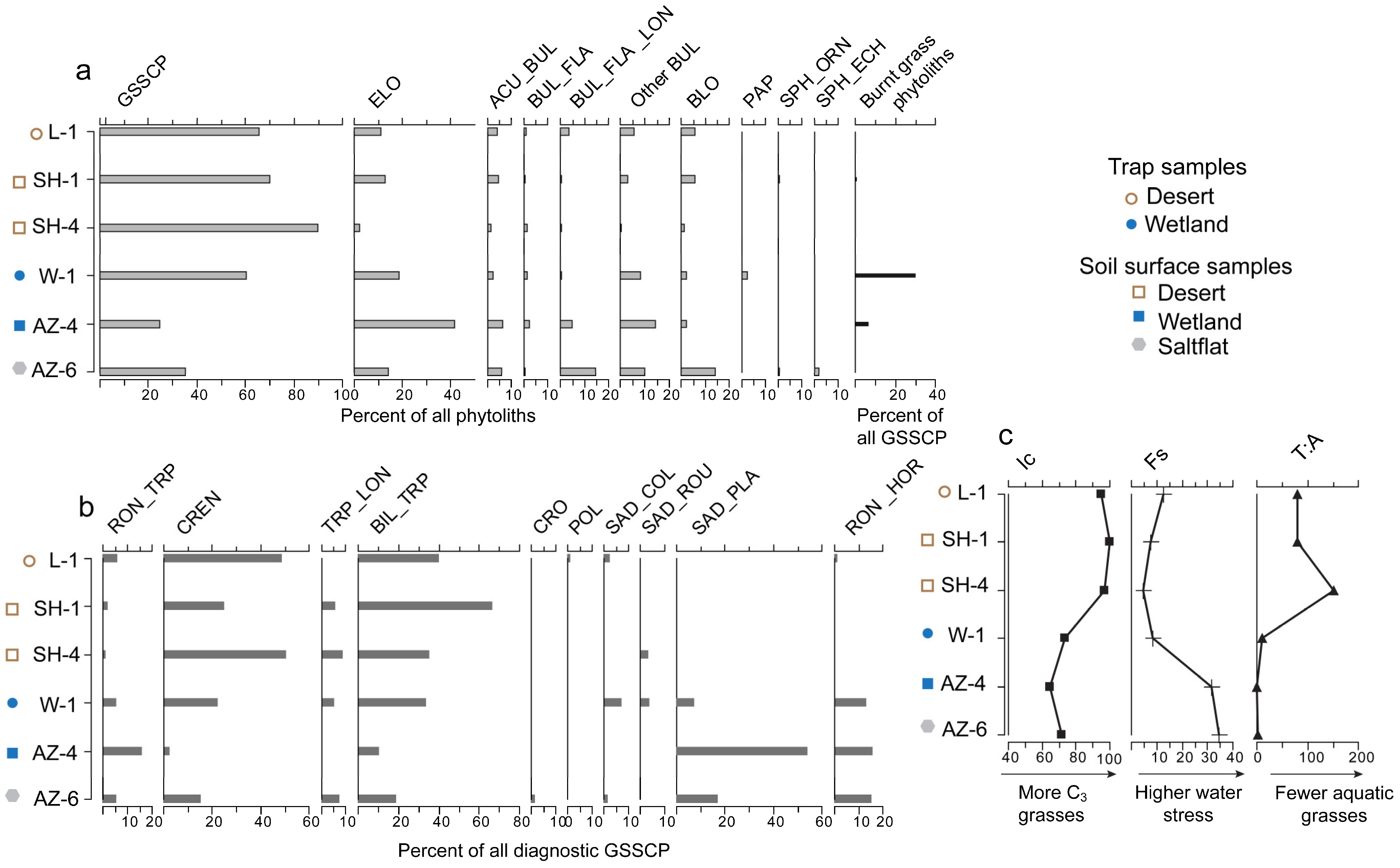
3.4. Phytolith Indices and Measurements
3.5. Radiocarbon Dating
4. Results
4.1. Modern Phytolith Data
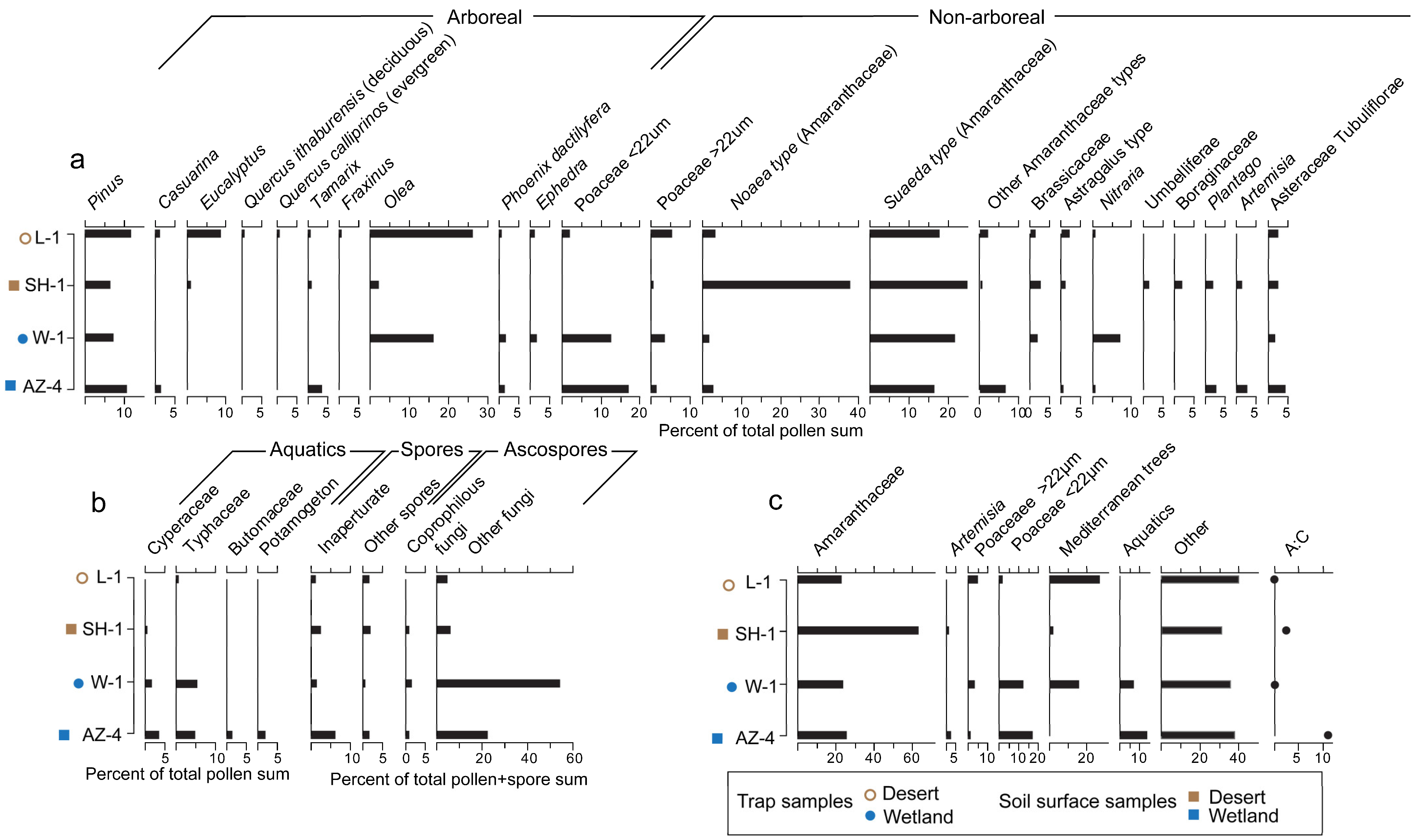
4.2. Modern Pollen Data
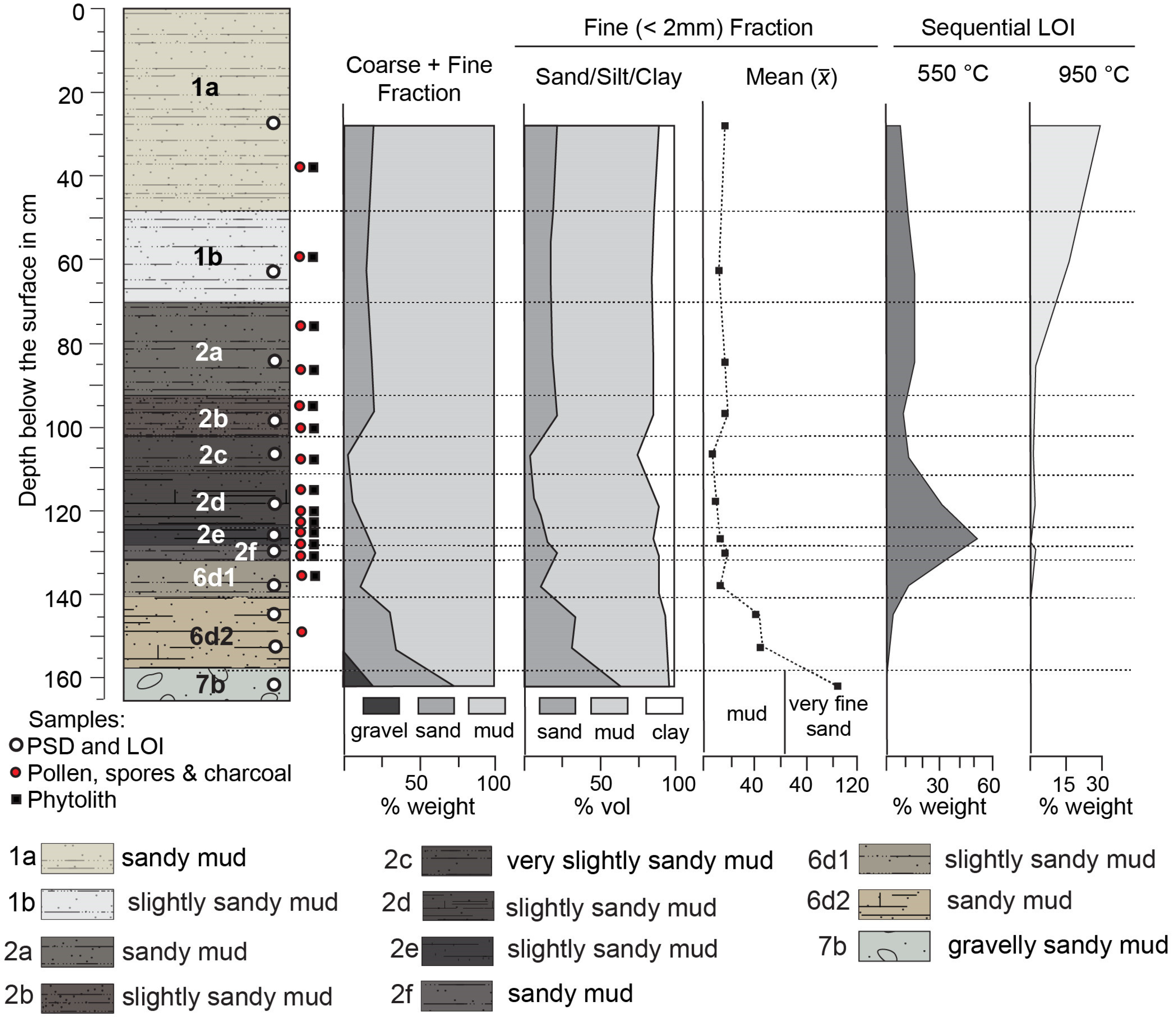
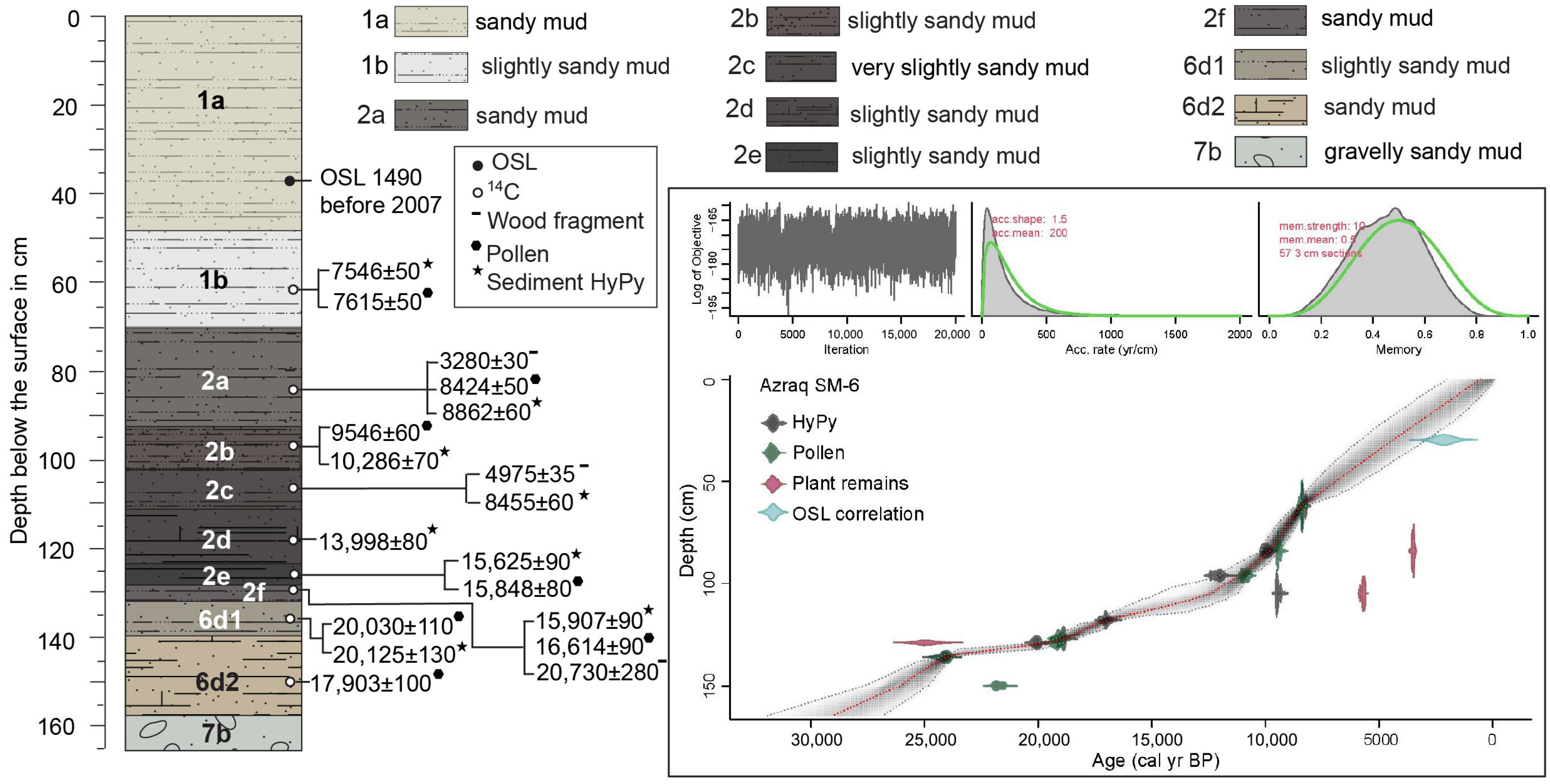
4.3. Stratigraphy and Chronology
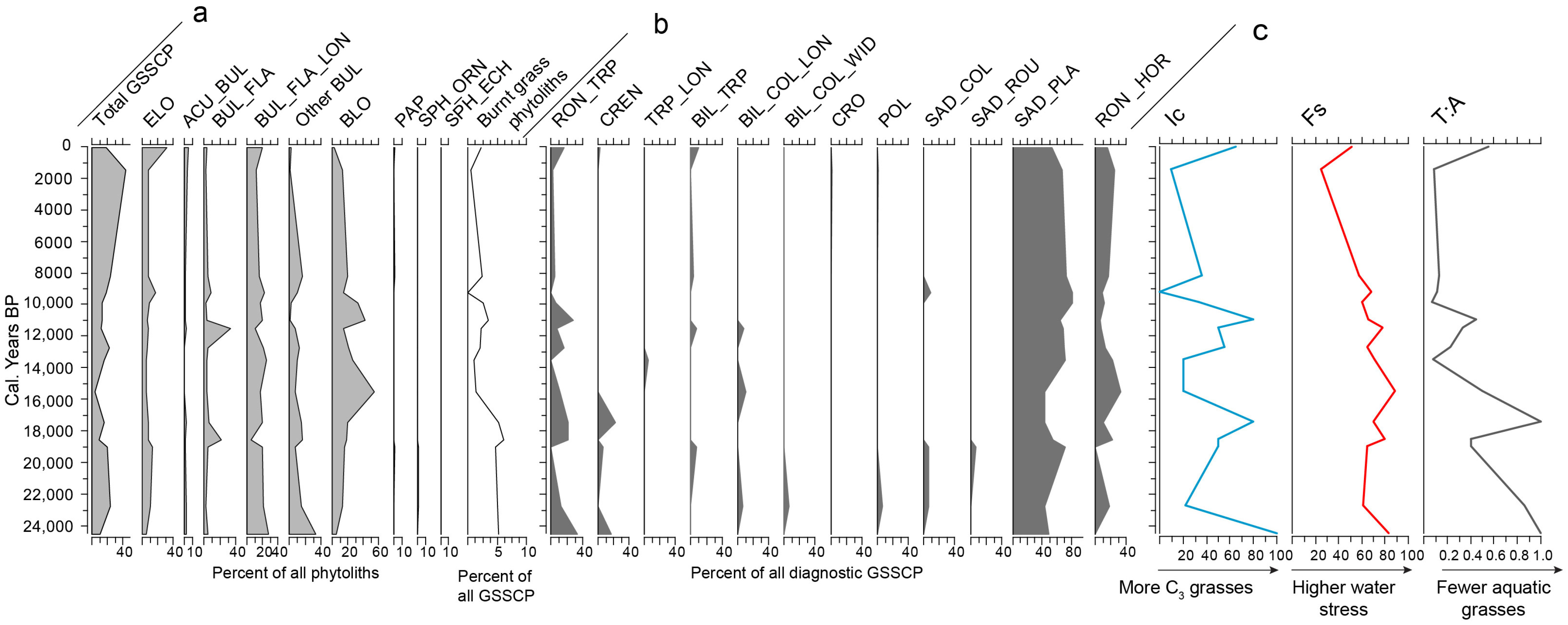
4.4. Phytoliths in Section SM-6
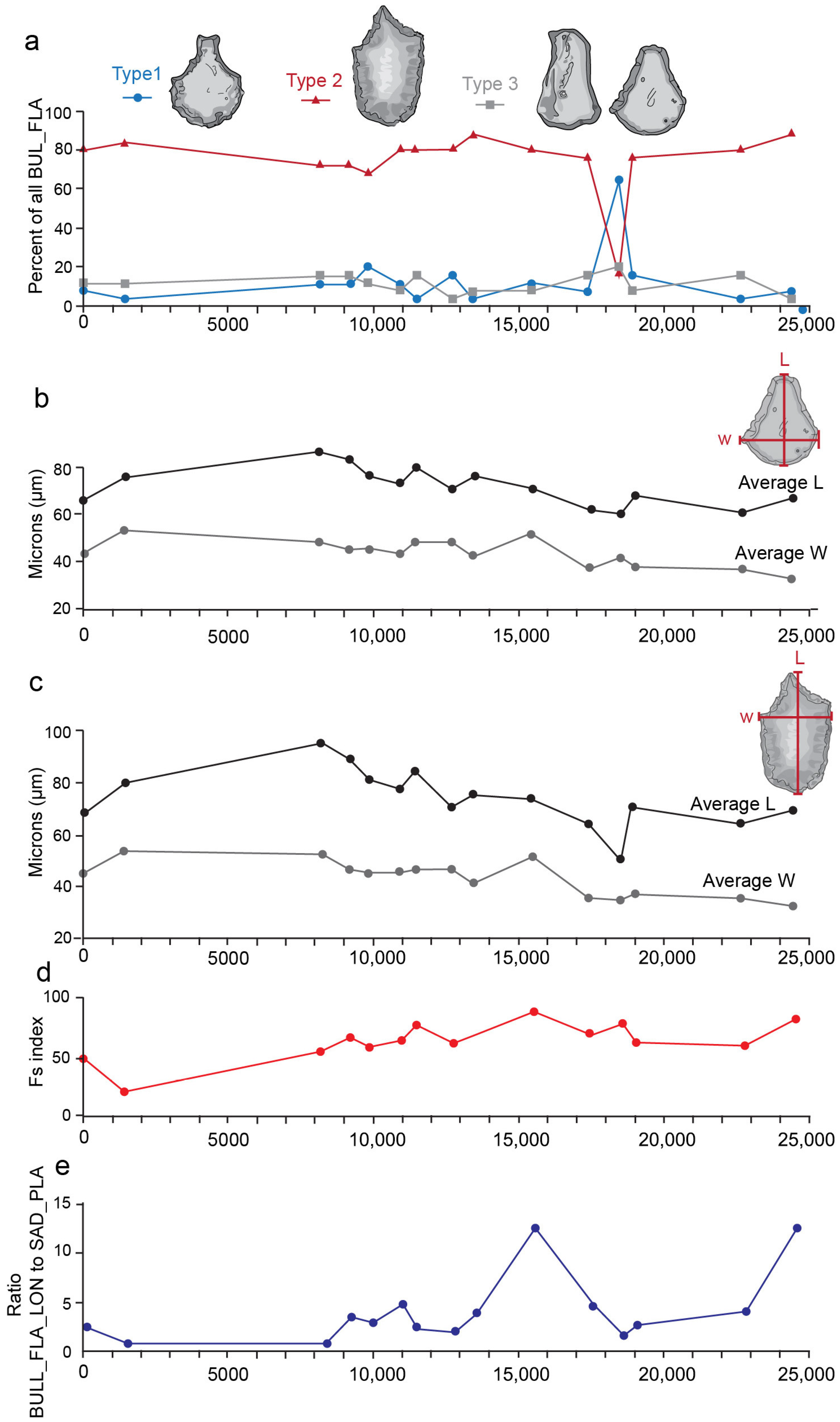
4.5. Bulliform Size and Types
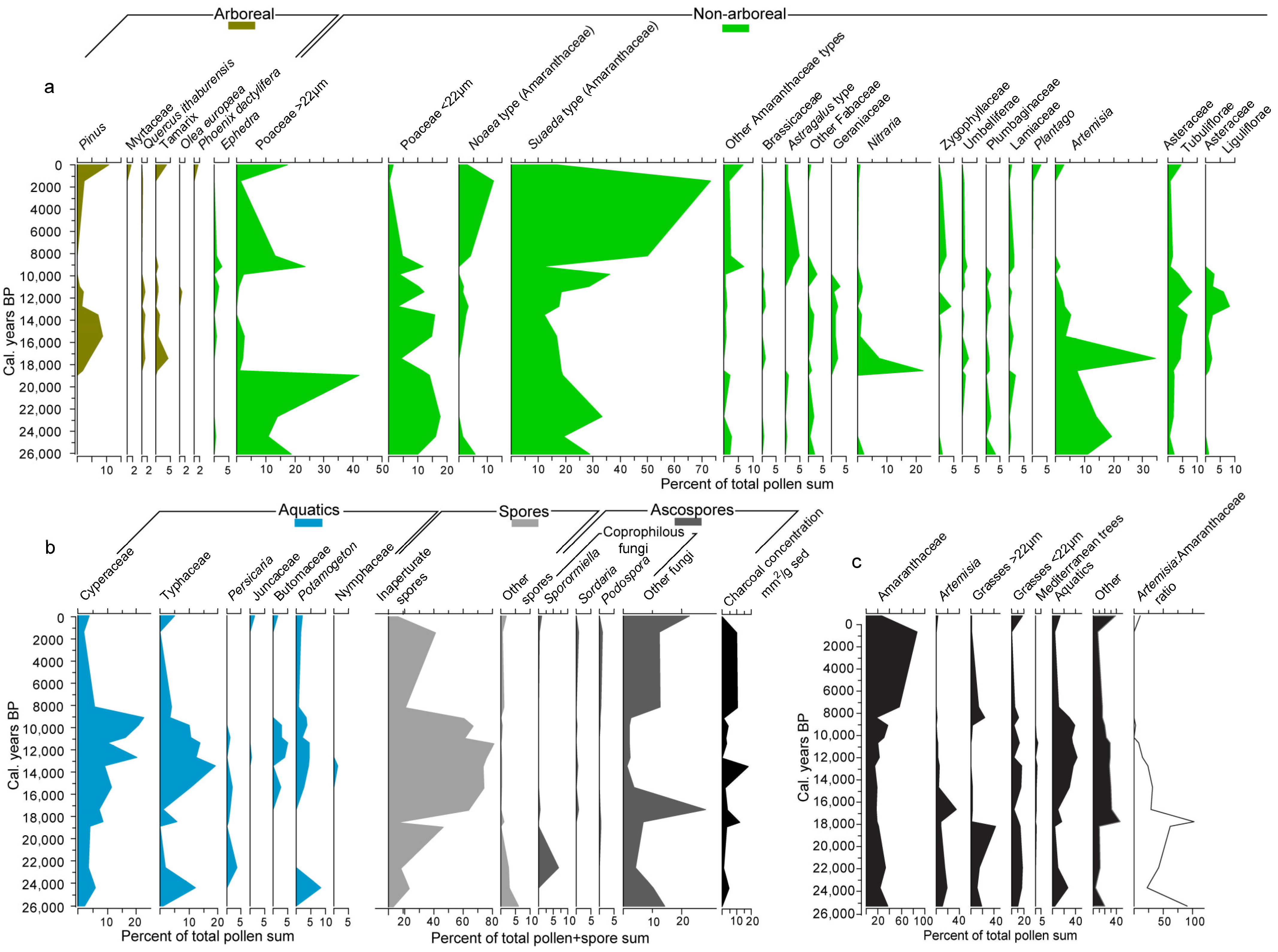
4.6. Pollen and Spores in Section SM-6
5. Discussion
5.1. Comparison Between Phytolith and Pollen Records
5.2. The Water Stress Index (Fs) and Bulliform Phytoliths
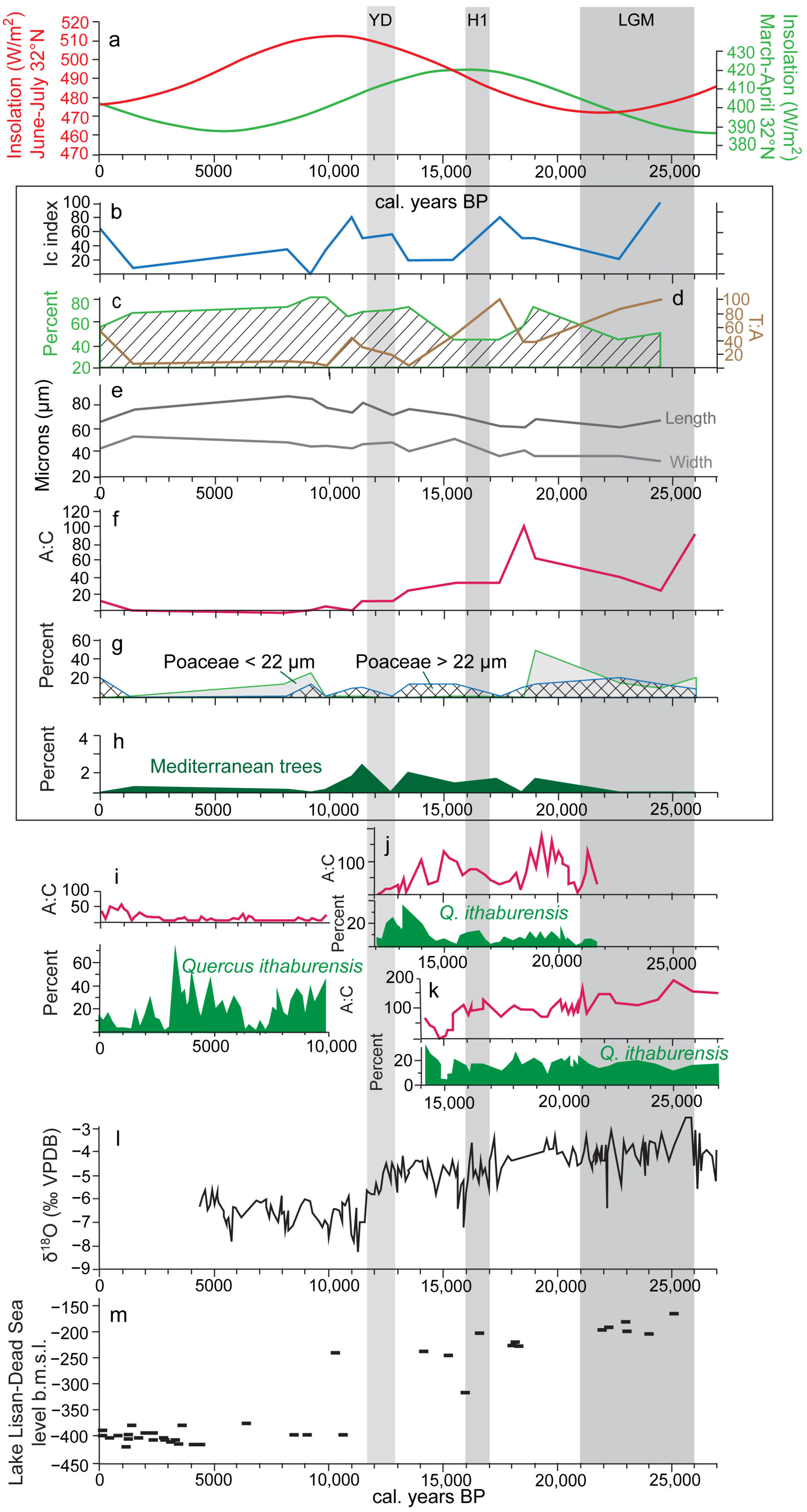
5.3. Local Vegetation and Climate in a Regional Context
5.3.1. Comparison with Regional Records
5.3.2. The LGM: c. 26 ka to c. 18 ka
5.3.3. Deglaciation Period: 18 ka to 11 ka
5.3.4. The Holocene
6. Conclusions
Supplementary Materials
Author Contributions
Funding
Data Availability Statement
Acknowledgments
Conflicts of Interest
Abbreviations
| LGM | Last Glacial Maximum |
| GAOA | Greater Azraq Oasis Area |
| AMAPP | Azraq Marshes Archaeological and Paleoecological Project |
| GSSCP | Grass silica short cell phytoliths |
| OSL | Optically stimulated luminescence |
| RSCN | Royal Society for the Conservation of Nature |
| T:A | Terrestrial-to-aquatic grass ratio |
| A:C | Artemisia-to-Amaranthaceae pollen ratio |
| Fs | Water stress index |
| Ic | Phytolith climatic index |
| Iph | Phytolith aridity index |
Appendix A
Appendix A.1. Phytolith Processing
Appendix A.2. Pollen Processing
Appendix A.3. Radiocarbon Dating
References
- Maher, L.A.; Richter, T.; Stock, J.T. The pre-Natufian Epipaleolithic: Long-term behavioral trends in the Levant. Evol. Anthropol. 2012, 21, 69–81. [Google Scholar] [CrossRef] [Scilit]
- Maher, L.A.; White, A.J.; Brown, J.; De Peña, F.; Ames, C.J. From wetlands to deserts: The role of water in the prehistoric occupation of eastern Jordan. In Palaeolandscapes in Archaeology; Carson, M.T., Ed.; Routledge: London, UK, 2021; pp. 82–129. [Google Scholar]
- Ramsey, M.N.; Rosen, A.M. Wedded to wetlands: Exploring Late Pleistocene plant-use in the Eastern Levant. Quat. Int. 2016, 396, 5–19. [Google Scholar] [CrossRef] [Scilit]
- Gasse, F.; Vidal, L.; Develle, A.-L.; Van Campo, E. Hydrological variability in the Northern Levant: A 250 ka multi-proxy record from the Yammoûneh (Lebanon) sedimentary sequence. Clim. Past. 2011, 7, 1261–1284. [Google Scholar] [CrossRef] [Scilit]
- Schiebel, V. Vegetation and Climate History of the Southern Levant During the Last 30,000 Years Based on Palynological Investigation. Doctoral dissertation, Universitäts-und Landesbibliothek Bonn, Münster, Germany, 2013. [Google Scholar]
- Torfstein, A.; Goldstein, S.L.; Stein, M.; Enzel, Y. Impacts of abrupt climate changes in the Levant from Last Glacial Dead Sea levels. Quat. Sci. Rev. 2013, 69, 117723. [Google Scholar] [CrossRef] [Scilit]
- Schiebel, V.; Litt, T. Holocene vegetation history of the southern Levant based on a pollen record from Lake Kinneret (Sea of Galilee), Israel. Veg. Hist. Archaeobot. 2018, 27, 577–590. [Google Scholar] [CrossRef] [Scilit]
- Miebach, A.; Stolzenberger, S.; Wacker, L.; Hense, A.; Litt, T. A new Dead Sea pollen record reveals the last glacial paleoenvironment of the southern Levant. Quat. Sci. Rev. 2019, 214, 98–116. [Google Scholar] [CrossRef] [Scilit]
- Bar-Matthews, M.; Keinan, J.; Ayalon, A. Hydro-climate research of the late Quaternary of the Eastern Mediterranean-Levant region based on speleothems research–A review. Quat. Sci. Rev. 2019, 221, 105872. [Google Scholar] [CrossRef] [Scilit]
- Langgut, D.; Cheddadi, R.; Sharon, G. Climate and environmental reconstruction of the Epipaleolithic Mediterranean Levant (22.0–11.9 ka cal. BP). Quat. Sci. Rev 2021, 270, 107170. [Google Scholar] [CrossRef] [Scilit]
- Cordova, C.E.; Ames, C.J.H. Quaternary sediments and soils of Jordan: Palaeoclimatic and geoarchaeological implications. In Quaternary of the Levant; Enzel, Y., Bar-Yosef, O., Eds.; Cambridge University Press: Cambridge, UK, 2017; pp. 531–538. [Google Scholar]
- Ramsey, M.N. Ecological-cultural inheritance in the wetlands: The non-linear transition to plant food production in the southern Levant. Veg. Hist. Archaeobot. 2023, 32, 435–452. [Google Scholar] [CrossRef] [Scilit]
- Al-Eisawi, D. Vegetation of Jordan; UNESCO-Cairo Office: Cairo, Egypt, 1996. [Google Scholar]
- Cordova, C.E. Millennial Landscape Change in Jordan: Geoarchaeology and Cultural Ecology; University of Arizona Press: Tucson, AZ, USA, 2007. [Google Scholar]
- Jones, M.D.; Richter, T. Paleoclimatic and archeological implications of Pleistocene and Holocene environments in Azraq, Jordan. Quat. Res. 2011, 76, 363–372. [Google Scholar] [CrossRef] [Scilit]
- Jones, M.D.; Maher, L.A.; Macdonald, D.A.; Ryan, C.; Rambeau, C.; Black, S.; Richter, T. The environmental setting of Epipalaeolithic aggregation site Kharaneh IV. Quat. Int. 2016, 396, 95–104. [Google Scholar] [CrossRef] [Scilit]
- Ames, C.J.; Cordova, C.E.; Boyd, K.; Schmidt, C.; Degering, D.; Kalbe, J.; Jones, B.G.; Dosseto, A.; Pokines, J.T.; Alsouliman, A.; et al. Middle to Late Quaternary palaeolandscapes of the central Azraq Basin, Jordan: Deciphering discontinuous records of human-environment dynamics at the arid margin of the Levant. Quat. Int. 2022, 635, 31–52. [Google Scholar] [CrossRef] [Scilit]
- Kelso, G.K.; Rollefson, G.O. Two late Quaternary pollen profiles form Ain El-Assad, Azraq, Jordan. In The Hammer on the Rock. British Archaeological Reports International Series; Copeland, L., Hours, F., Eds.; British Archaeological Reports: Oxford, UK, 1989; Volume 540, pp. 259–275. [Google Scholar]
- Woolfenden, W.B.; Ababneh, L. Late Holocene vegetation in the Azraq Wetland Reserve, Jordan. Quat. Int. 2011, 76, 345–351. [Google Scholar] [CrossRef] [Scilit]
- Ramsey, M.N.; Jones, M.; Richter, T.; Rosen, A.M. Modifying the marsh: Evaluating Early Epipaleolithic hunter-gatherer impacts in the Azraq wetland, Jordan. Holocene 2016, 25, 1553–1564. [Google Scholar] [CrossRef] [Scilit]
- Boyd, K.C.; Ames, C.J.; Cordova, C.E. The Middle to Late Pleistocene transition in the Azraq Oasis, Jordan: A phytolith-based reconstruction of wetland palaeoecology. Palaeogeogr. Palaeoclimatol. Palaeoecol. 2022, 595, 110967. [Google Scholar] [CrossRef] [Scilit]
- Ames, C.J.; Nowell, A.; Cordova, C.E.; Pokines, J.T.; Bisson, M.S. Paleoenvironmental change and settlement dynamics in the Druze Marsh: Results of recent excavation at an open-air Paleolithic site. Quat. Int. 2014, 331, 60–73. [Google Scholar] [CrossRef] [Scilit]
- Nowell, A.; Walker, C.; Cordova, C.E.; Ames, C.J.; Pokines, J.T.; Stueber, D.; DeWitt, R.; Al-Souliman, A.S.A. Middle Pleistocene subsistence in the Azraq Oasis, Jordan: Protein residue and other proxies. J. Archaeol. Sci. 2016, 73, 36–44. [Google Scholar] [CrossRef] [Scilit]
- Pokines, J.T.; Lister, A.M.; Ames, C.J.; Nowell, A.; Cordova, C.E. Faunal remains from recent excavations at Shishan Marsh 1 (SM1), a Late Lower Paleolithic open-air site in the Azraq Basin, Jordan. Quat. Res. 2019, 91, 768–791. [Google Scholar] [CrossRef] [Scilit]
- Goldsmith, Y.; Polissar, P.J.; Ayalon, A.; Bar-Matthews, M.; DeMenocal, P.B.; Broecker, W.S. The modern and Last Glacial Maximum hydrological cycles of the Eastern Mediterranean and the Levant from a water isotope perspective. Earth Planet. Sci. Lett. 2017, 457, 302–312. [Google Scholar] [CrossRef] [Scilit]
- Richter, T.; Maher, L.; Stock, J.; Allcock, S.; Jones, M.; Martin, L.; Thorne, B. New light on Final Pleistocene settlement diversity in the Azraq Basin (Jordan): Recent excavations at ‘Ayn Qasiyya. Paléorient 2009, 35, 49–68. [Google Scholar] [CrossRef] [Scilit]
- Nelson, B. Azraq: Desert Oasis; Allen Lane: London, UK, 1973. [Google Scholar]
- El-Naqa, A. Study of Saltwater Intrusion in the Upper Aquifer in Azraq Basin; International Union for the Conservation of Nature (IUCN): Gland, Switzerland; The University of Jordan: Amman, Jordan, 2010. [Google Scholar]
- Bender, F. Geology of Jordan; Borntraeger: Berlin, Germany, 1974. [Google Scholar]
- Ibrahim, K. The Regional Geology of Al-Azraq Area. Bulletin of the Geological Map Division; Natural Resources Authority: Amman, Jordan, 1966; Volume 36. [Google Scholar]
- Copeland, L.; Hours, F. (Eds.) The Hammer on the Rock; British Archaeological Reports International Series; British Archaeological Reports: Oxford, UK, 1989; Volume 540. [Google Scholar]
- Rollefson, G.O. Return to ’Ain el-Assad (Lion Spring), 1996: Azraq Acheulian Occupation in situ. In The Archaeology of Jordan and Beyond: Essays in Honor of James A. Sauer; Stager, S.E., Greene, J.A., Coogan, M.D., Eds.; Eisenbrauns: Winona Lake, IN, USA, 2000; pp. 418–428. [Google Scholar]
- Rollefson, G.O.; Schnurrenberger, D.; Quintero, L.A.; Watson, R.P.; Low, R. ’Ain Soda and ’Ain Qasiya: New Late Pleistocene and Early Holocene Sites in the Azraq Shishan Area, Eastern Jordan. In The Prehistory of Jordan: Perspectives from 1997; Gebel, H.G.K., Kafafi, Z., Rollefson, G.O., Eds.; Ex-Oriente: Berlin, Germany, 1997; pp. 25–34. [Google Scholar]
- Cordova, C.E.; Rollefson, G.O.; Kalchgruber, R.; Wilke, P.J.; Quintero, L. Natural and cultural stratigraphy of ’Ayn as-Sawda, al-Azraq wetland reserve: 2007 excavation report and discussion of finds. Annu. Dep. Antiq. Jordan Hashemite Kingd. Jordan 2008, 52, 417–425. [Google Scholar]
- Garrard, A.N.; Betts, A.; Byrd, B.; Hunt, C.; Colledge, S.; Copeland, L.; Montague, R.; West, B. Summary of palaeoenvironmental and prehistoric investigations in the Azraq Basin. In The Prehistory of Jordan: The State of Research in 1986; Garrard, A.N., Gebel, H.G., Eds.; British Archaeological Reports International Series; British Archaeological Reports: Oxford, UK, 1988; Volume 396, pp. 311–337. [Google Scholar]
- Copeland, L. Environment, chronology and lower-Middle paleolithic occupations of the Azraq basin, Jordan. Paléorient 1988, 14, 66–75. [Google Scholar] [CrossRef] [Scilit]
- Twiss, P.C. Predicted World Distribution of C3 and C4 Grass Phytoliths. In Phytolith Systematics: Emerging Issues; Rapp, G., Mulholland, S.C., Eds.; Advances in Archaeological and Museum Science; Springer: Boston, MA, USA, 1992; pp. 113–128. [Google Scholar] [CrossRef] [Scilit]
- Zohary, M. Geobotanical Foundations of the Middle East; Gustav Fischer: Stuttgart, Germany, 1973. [Google Scholar]
- Bonnefille, R.; Riollet, G. Pollens des Savanes d’Afrique Orientale; Éditions du Centre National de la Recherche Scientifique: Paris, France, 1980. [Google Scholar]
- Wang, Y.; Wang, W.; Liu, L.; Jiang, Y.; Niu, Z.; Ma, Y.; He, J.; Mensing, S.A. Reliability of the Artemisia/Chenopodiaceae pollen ratio in differentiating vegetation and reflecting moisture in arid and semi-arid China. Holocene 2020, 30, 858–864. [Google Scholar] [CrossRef] [Scilit]
- Bottema, S.; Barkoudah, Y. Modern pollen precipitation in Syria and Lebanon and its relation to vegetation. Pollen Spores 1979, 21, 427–480. [Google Scholar]
- El-Moslimany, A.P. Ecological significance of common nonarboreal pollen: Examples from drylands of the Middle East. Rev. Palaeobot. Palynol. 1990, 64, 343–350. [Google Scholar] [CrossRef] [Scilit]
- Neumann, K.; Strömberg, C.A.; Ball, T.; Albert, R.M.; Vrydaghs, L.; Cummings, L.S. International Code for Phytolith Nomenclature (ICPN) 2.0. Ann. Bot. 2019, 124, 189–199. [Google Scholar] [CrossRef] [Scilit]
- Chen, I.; Li, K.T.; Tsang, C.H. Silicified bulliform cells of Poaceae: Morphological characteristics that distinguish subfamilies. Bot. Stud. 2020, 61, 103996. [Google Scholar] [CrossRef] [Scilit]
- Biswas, O.; Ghosh, R.; Paruya, D.K.; Mukherjee, B.; Thapa, K.K.; Bera, S. Can grass phytoliths and indices be relied on during vegetation and climate interpretations in the eastern Himalayas? Studies from Darjeeling and Arunachal Pradesh, India. Quat. Sci. Rev. 2016, 134, 114–132. [Google Scholar] [CrossRef] [Scilit]
- Bremond, L.; Alexandre, A.; Peyron, O.; Guiot, J. Grass water stress estimated from phytoliths in West Africa. J. Biogeogr. 2005, 32, 311–327. [Google Scholar] [CrossRef] [Scilit]
- Cadd, H.; Sherborne-Higgins, B.; Becerra-Valdivia, L.; Tibby, J.; Barr, C.; Forbes, M.; Cohen, T.J.; Tyler, J.; Vandergoes, M.; Francke, A.; et al. The application of pollen radiocarbon dating and bayesian age-depth modeling for developing robust geochronological frameworks of wetland archives. Radiocarbon 2022, 64, 213–235. [Google Scholar] [CrossRef] [Scilit]
- Turney, C.; Becerra-Valdivia, L.; Sookdeo, A.; Thomas, Z.A.; Palmer, J.; Haines, H.A.; Cadd, H.; Wacker, L.; Baker, A.; Andersen, M.S.; et al. Radiocarbon protocols and first intercomparison results from the Chronos 14Carbon-Cycle facility, University of New South Wales, Sydney, Australia. Radiocarbon 2021, 63, 1003–1023. [Google Scholar] [CrossRef] [Scilit]
- Orr, T.J.; Wurster, C.M.; Levchenko, V.; Ascough, P.L.; Bird, M.I. Improved pretreatment method for the isolation and decontamination of pyrogenic carbon for radiocarbon dating using hydrogen pyrolysis. Quat. Geochronol. 2021, 61, 101124. [Google Scholar] [CrossRef] [Scilit]
- Blaauw, M.; Christen, J.A. Flexible paleoclimate age-depth models using an autoregressive gamma process. Bayesian Anal. 2011, 6, 457–474. [Google Scholar] [CrossRef] [Scilit]
- Hogg, A.; Heaton, T.; Hua, Q.; Palmer, J.; Turney, C.; Southon, J.; Bayliss, A.; Blackwell, P.; Boswijk, G.; Bronk Ramsey, C.; et al. SHCal20 Southern Hemisphere calibration, 0–55,000 years cal BP. Radiocarbon 2020, 62, 759–778. [Google Scholar] [CrossRef] [Scilit]
- Abu-Azizeh, L.; Bonnéric, J.; Couturaud, B.; Stavy, A. First Results of the Excavations at the Umayyad and Early Abbasid Reservoir-Enclosure of ‘Ayn Sawdā (Azraq Oasis, Jordan). J. Islam. Archaeol. 2023, 10, 101–133. [Google Scholar] [CrossRef] [Scilit]
- Laskar, J.; Robutel, P.; Joutel, F.; Gastineau, M.; Correia, A.C.; Levrard, B. A long-term numerical solution for the insolation quantities of the Earth. Astron. Astropys. 2004, 428, 261–285. [Google Scholar] [CrossRef] [Scilit]
- Litt, T.; Ohlwein, C.; Neumann, F.H.; Hense, A.; Stein, M. Holocene climate variability in the Levant from the Dead Sea pollen record. Quat. Sci. Rev. 2012, 49, 95–105. [Google Scholar] [CrossRef] [Scilit]
- Orland, I.J.; Bar-Matthews, M.; Ayalon, A.; Matthews, A.; Kozdon, R.; Ushikubo, T.; Valley, J.W. Seasonal resolution of Eastern Mediterranean climate change since 34 ka from a Soreq Cave speleothem. Geochim. Cosmochim. Acta 2012, 89, 240–255. [Google Scholar] [CrossRef] [Scilit]
- Guillerm, E.; Gardien, V.; Waldmann, N.D.; Brall, N.S.; Ariztegui, D.; Schwab, M.J.; Neugebauer, I.; Lach, A.; Caupin, F. Dead Sea Lake Level for the Last 237 Ka, Data Compilation; Dataset Publication Series; PANGAEA; Data Publisher for Earth & Environmental Science: Bremerhaven, Germany, 2024. [Google Scholar] [CrossRef]
- Cabanes, D.; Burjachs, F.; Expósito, I.; Rodríguez, A.; Allué, E.; Euba, I.; Vergés, J.M. Formation processes through archaeobotanical remains: The case of the Bronze Age levels in El Mirador cave, Sierra de Atapuerca, Spain. Quat. Int. 2009, 193, 160–173. [Google Scholar] [CrossRef] [Scilit]
- Strömberg, C.A.E.; Dunn, R.E.; Crifò, C.; Harris, E.B. Phytoliths in Paleoecology: Analytical Considerations, current use, and Future Directions. In Methods in Paleoecology: Reconstructing Cenozoic Terrestrial Environments and Ecological Communities. Vertebrate Paleobiology and Paleoanthropology; Croft, D.A., Su, D.F., Simpson, S.W., Eds.; Springer International Publishing: Cham, Switzerland, 2018; pp. 235–287. [Google Scholar] [CrossRef] [Scilit]
- Liu, H.; Gu, Y.; Yu, Z.; Huang, C.; Ge, J.; Huang, X.; Xie, S.; Zheng, M.; Zhang, Z.; Cheng, S. Holocene peatland water regulation response to ~1000-year solar cycle indicated by phytoliths in central China. J. Hydrol. 2020, 589, 125169. [Google Scholar] [CrossRef] [Scilit]
- Piperno, D.R. Phytoliths: A Comprehensive Guide for Archaeologists and Paleoecologists; Altamira: Lanham, ML, USA, 2006. [Google Scholar]
- D’Agostini, F.; Ruiz-Pérez, J.; Madella, M.; Vadez, V.; Kholova, J.; Lancelotti, C. Phytoliths as indicators of plant water availability: The case of millets cultivation in the Indus Valley civilization. Rev. Palaeobot. Palynol. 2023, 309, 104783. [Google Scholar] [CrossRef] [Scilit]
- Liu, L.; Jie, D.; Liu, H.; Gao, G.; Gao, Z.; Li, D.; Li, N.; Guo, J.; Qiao, Z. Assessing the importance of environmental factors to phytoliths of Phragmites communis in north-eastern China. Ecol. Indic. 2016, 69, 500–507. [Google Scholar] [CrossRef] [Scilit]
- Liu, H.; Liu, K.; Wei, F.; Wang, Y.; Liu, M. Artemisia pollen-indicated steppe distribution in southern China during the Last Glacial Maximum. J. Palaeogeogr. 2013, 2, 297–305. [Google Scholar] [CrossRef]



| Subfamily | Tribe | Name | Photosynthetic Pathway | Habitat |
|---|---|---|---|---|
| Pooideae | Poeae | Lolium rigidum Gaudin | C3 | Terrestrial |
| Phalaris minor Retz. | C3 | Terrestrial | ||
| Poa bulbosa L. Poa sinaica Steudel | C3 | Terrestrial | ||
| Polypogon monspeliensis (L.) Desf. | C3 | Terrestrial | ||
| Rostraria berythea (Boiss. & Blanche) Holub | C3 | Terrestrial | ||
| Triticeae | Hordeum glaucum Steudel Hordeum spontaneum C. Koch Taeniatherum crinitum (Schreber) Nevski | C3 | Terrestrial | |
| Stipeae | Stipa arabica Trin. & Rupr. Stipa hohenackeriana Trin. & Rupr. Stipa capensis Thunb. | C3 | Terrestrial | |
| Panicoidae | Andropogoneae | Imperata cylindrica (L.) Raeusch. | C4 | Subaquatic |
| Paniceae | Setaria verticillata (L.) P. Beauv | C4 | Terrestrial, disturbance | |
| Chloridoideae | Cynodonteae | Aeluropus littoralis (Gouan) Parl | C4 | Halophytic |
| Cynodon dactylon (L.) Pers. | C4 | Terrestrial, disturbance | ||
| Aristidoideae | None | Stipagrostis lanata (Forskal) De Winter Stipagrostis Nees. There are nine species in Jordan | C4 | Terrestrial Terrestrial |
| Arundinoideae | None | Phragmites australis (Cav.) Trin. ex. Steud. | C3 | Aquatic |
| Arundo donax L. | C3 | Aquatic, invasive, usually in disturbed places | ||
| Danthonioideae | Danthonieae | Schismus arabicus Nees var. minus (Roemer & Schul) Boiss. Schismus barbatus (L.) Thell. | C3 | Terrestrial |
| Morphotype and Code | Subtype | Code | Figure | Taxonomic Association |
|---|---|---|---|---|
| Rondel (RON) | Rondel trapezoid | RON_TRP | Figure 2a | Several subfamilies, mostly Pooideae |
| Rondel horned | RON_HOR | Figure 2b | Several subfamilies | |
| Crenate (CRE) | CRE | Figure 2c | Pooideae and Schismus (subfamily Danthonioideae) | |
| Trapezoid | Trapezoid long | TRP_LON | Figure 2d | |
| Saddle (SAD) | Saddle collapsed | SAD_COL | Figure 2e | Chloridoideae |
| Saddle round | SAD_ROU | Figure 2f | Stipagrostis spp. (subfamily Aristidoideae) | |
| Saddle plateaued | SAD_PLA | Figure 2g | Phragmites australis (subfamily Arundinoideae) | |
| Bilobate (BIL) | Bilobate long narrow | BIL_LON_NAR | Figure 2h | Aristida spp. (subfamily Aristidoideae) |
| Bilobate collapsed wide | BIL_COL_WID | Figure 2i | Panicoideae | |
| Bilobate collapsed long | BIL_COL_LON | Figure 2j | Panicoideae | |
| Bilobate trapezoid | BIL_TRP | Figure 2k | Stipeae tribe (subfamily Pooideae) | |
| Cross (CRO) | CRO | Figure 2l | Panicoideae | |
| Polylobate | POL | Figure 2m | Panicoideae, Aristidoideae, and some Stipeae |
| Morphotype and Code | Subtype | Code | Figure | Taxonomic Association |
|---|---|---|---|---|
| Papillate | PAP | Figure 3a,b | Cyperaceae | |
| Spheroid | Spheroid ornate | SPH_ORN | Figure 3c | Woody plants |
| Spheroid psilate | SPH_ORN | Figure 3d | Several dicots, including woody plants | |
| Spheroid echinate | SPH_ECH | Figure 3e | Palms (Arecaceae) Phoenix dactylifera | |
| Acutus | Acutus bulbosus | ACU_BUL | Figure 3f | Poaceae and Cyperaceae |
| Elongate | ELO | Figure 3g,h | Poaceae and Cyperaceae | |
| Blocky | Blocky tabular | BLO_TAB | Figure 3i,j | Poaceae and Cyperaceae |
| Bulliform | Bulliform flabellate | BUL_FLA | Figure 3k–m | Poaceae |
| Bulliform flabellate long | BUL_FLA_LON | Figure 3n,o | Poaceae, particularly Phragmites australis |
| Indices | Calculation | Source |
|---|---|---|
| Ic * Climatic index | × 100 | [37,45] |
| Fs Water stress index (%) | × 100 | [46] |
| T:A Terrestrial to aquatic grass ratio | This study |
| Sample | Avg L | Avg W | Type 1 | Type 2 | Type 3 | Total N |
|---|---|---|---|---|---|---|
| SH4 | 55.28 | 38.24 | 1 | 8 | 16 | 25 |
| Az-4 | 58.64 | 39.96 | 3 | 17 | 5 | 25 |
| Az-6 | 58.92 | 39.68 | 2 | 19 | 4 | 25 |
| Lab ID | Depth cm | Layer | Material Dated | C14 Age | Error |
|---|---|---|---|---|---|
| UNSW-1229 | 62 | 1b | Sediment HyPy * | 7546 | 50 |
| UNSW-1237 | 62 | 1b | Pollen concentrate | 7615 | 50 |
| UNSW-1230 | 84 | 2a | Sediment HyPy | 8862 | 60 |
| UNSW-1238 | 84 | 2a | Pollen concentrate | 8424 | 50 |
| CAMS-169738 | 84 | 2a | Plant fragment | 3280 | 30 |
| UNSW-1231 | 96 | 2b | Sediment HyPy | 10,286 | 70 |
| UNSW-1239 | 96 | 2b | Pollen concentrate | 9546 | 60 |
| UNSW-1232 | 105 | 2c | Sediment HyPy | 8455 | 60 |
| CAMS-169739 | 105 | 2c | Plant fragment | 4975 | 35 |
| UNSW-1233 | 118 | 2d | Sediment HyPy | 13,998 | 80 |
| UNSW-1234 | 127 | 2e | Sediment HyPy | 15,625 | 90 |
| UNSW-1240 | 127 | 2e | Pollen concentrate | 15,848 | 80 |
| UNSW-1235 | 129 | 2f | Sediment HyPy | 16,614 | 90 |
| UNSW-1241 | 129 | 2f | Pollen concentrate | 15,907 | 90 |
| CAMS-169740 | 129 | 2f | Plant fragment | 20,730 | 280 |
| UNSW-1236 | 136 | 621 | Sediment HyPy | 20,125 | 130 |
| UNSW-1242 | 136 | 621 | Pollen concentrate | 20,030 | 110 |
| UNSW-1243 | 150 | 6d2 | Pollen concentrate | 17,903 | 100 |
| All Types | Type 2 Only | |||||
|---|---|---|---|---|---|---|
| Cal yr BP | Avg L | Avg W | N | Avg L | Avg W | N |
| 0 | 65.68 | 44.32 | 25 | 68.9 | 44.9 | 20 |
| 1433 | 76 | 53.68 | 25 | 79.9 | 53.85 | 21 |
| 8174 | 86.52 | 49.12 | 25 | 94.74 | 52.42 | 18 |
| 9183 | 84.25 | 45.66 | 25 | 89.66 | 46.83 | 18 |
| 9860 | 76.96 | 46.12 | 25 | 81.53 | 45.58 | 17 |
| 10,933 | 73.32 | 44.2 | 25 | 78.2 | 44.85 | 20 |
| 11,465 | 80.72 | 47.4 | 25 | 84.7 | 46.65 | 20 |
| 12,711 | 71.16 | 48.76 | 25 | 71.25 | 46.1 | 20 |
| 13,474 | 75.52 | 41.72 | 25 | 75.91 | 41.26 | 22 |
| 15,462 | 70.92 | 51.88 | 25 | 74.35 | 51.75 | 20 |
| 17,427 | 62.04 | 37.36 | 25 | 64.68 | 35.68 | 19 |
| 18,500 | 61.12 | 42.08 | 25 | 50 | 35 | 4 |
| 18,967 | 66.96 | 37.68 | 25 | 71.11 | 36.77 | 19 |
| 22,689 | 61.16 | 37.08 | 25 | 64.35 | 35.55 | 20 |
| 24,467 | 67.08 | 33.12 | 25 | 69.18 | 32.72 | 22 |
Disclaimer/Publisher’s Note: The statements, opinions and data contained in all publications are solely those of the individual author(s) and contributor(s) and not of MDPI and/or the editor(s). MDPI and/or the editor(s) disclaim responsibility for any injury to people or property resulting from any ideas, methods, instructions or products referred to in the content. |
© 2026 by the authors. Licensee MDPI, Basel, Switzerland. This article is an open access article distributed under the terms and conditions of the Creative Commons Attribution (CC BY) license.
Share and Cite
Cordova, C.E.; Ames, C.J.H.; Boyd, K.C.; Cadd, H.R.; Bird, M.; Alsouliman, A.S.; Nowell, A.; Pokines, J.T. Phytoliths and Pollen from a Desert Wetland Through the Last Glacial–Interglacial Cycle in Azraq, Jordan. Quaternary 2026, 9, 18. https://doi.org/10.3390/quat9010018
Cordova CE, Ames CJH, Boyd KC, Cadd HR, Bird M, Alsouliman AS, Nowell A, Pokines JT. Phytoliths and Pollen from a Desert Wetland Through the Last Glacial–Interglacial Cycle in Azraq, Jordan. Quaternary. 2026; 9(1):18. https://doi.org/10.3390/quat9010018
Chicago/Turabian StyleCordova, Carlos E., Christopher J. H. Ames, Kelsey C. Boyd, Haidee R. Cadd, Michael Bird, Amer S. Alsouliman, April Nowell, and James T. Pokines. 2026. "Phytoliths and Pollen from a Desert Wetland Through the Last Glacial–Interglacial Cycle in Azraq, Jordan" Quaternary 9, no. 1: 18. https://doi.org/10.3390/quat9010018
APA StyleCordova, C. E., Ames, C. J. H., Boyd, K. C., Cadd, H. R., Bird, M., Alsouliman, A. S., Nowell, A., & Pokines, J. T. (2026). Phytoliths and Pollen from a Desert Wetland Through the Last Glacial–Interglacial Cycle in Azraq, Jordan. Quaternary, 9(1), 18. https://doi.org/10.3390/quat9010018