


The Late Quaternary Aeolian Deposits in the Subtropical Bose–Bubing Basins, Southern China

 , and
, and 
Abstract
1. Introduction
2. Geological Setting and Sampling
2.1. Geological Setting
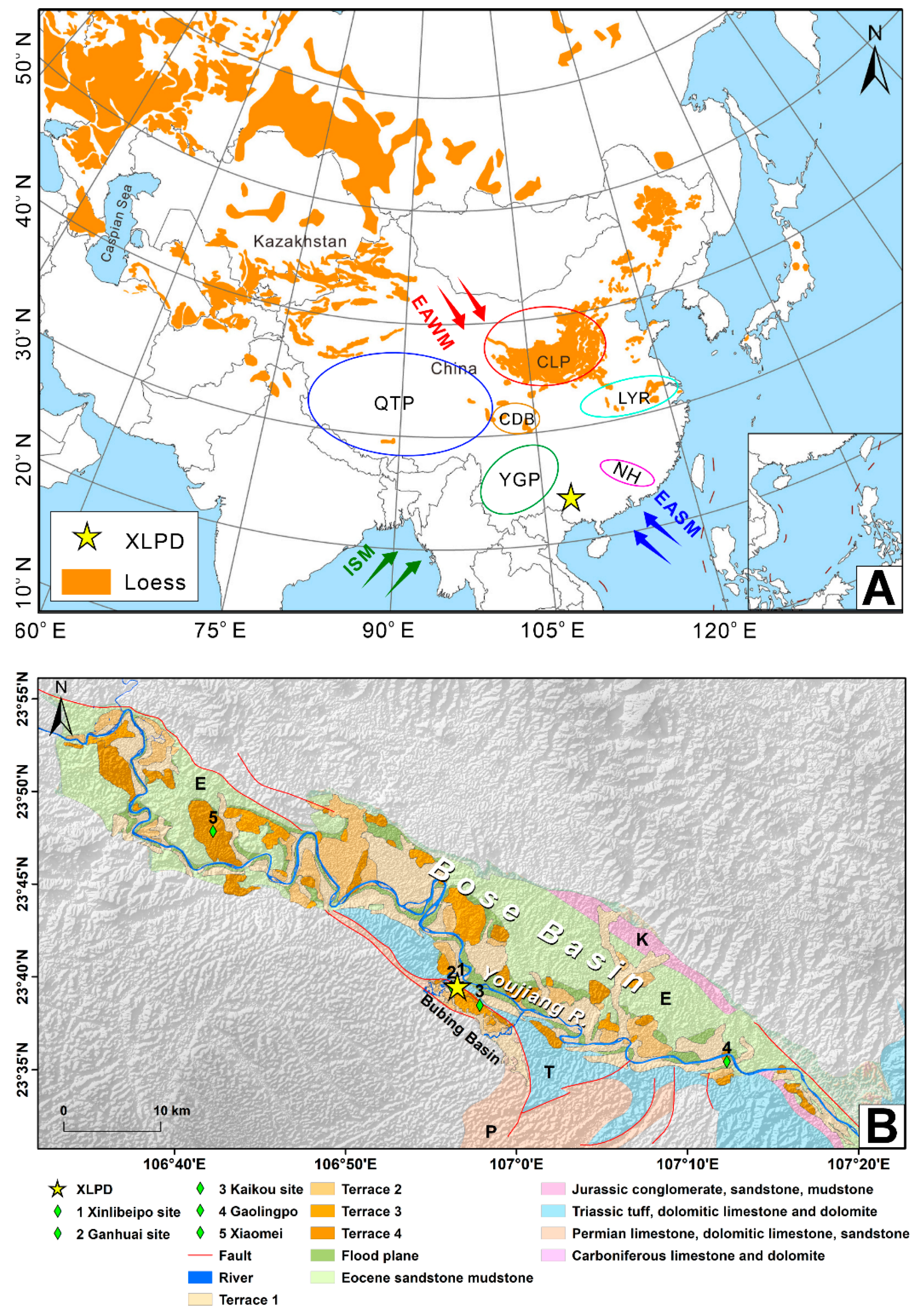
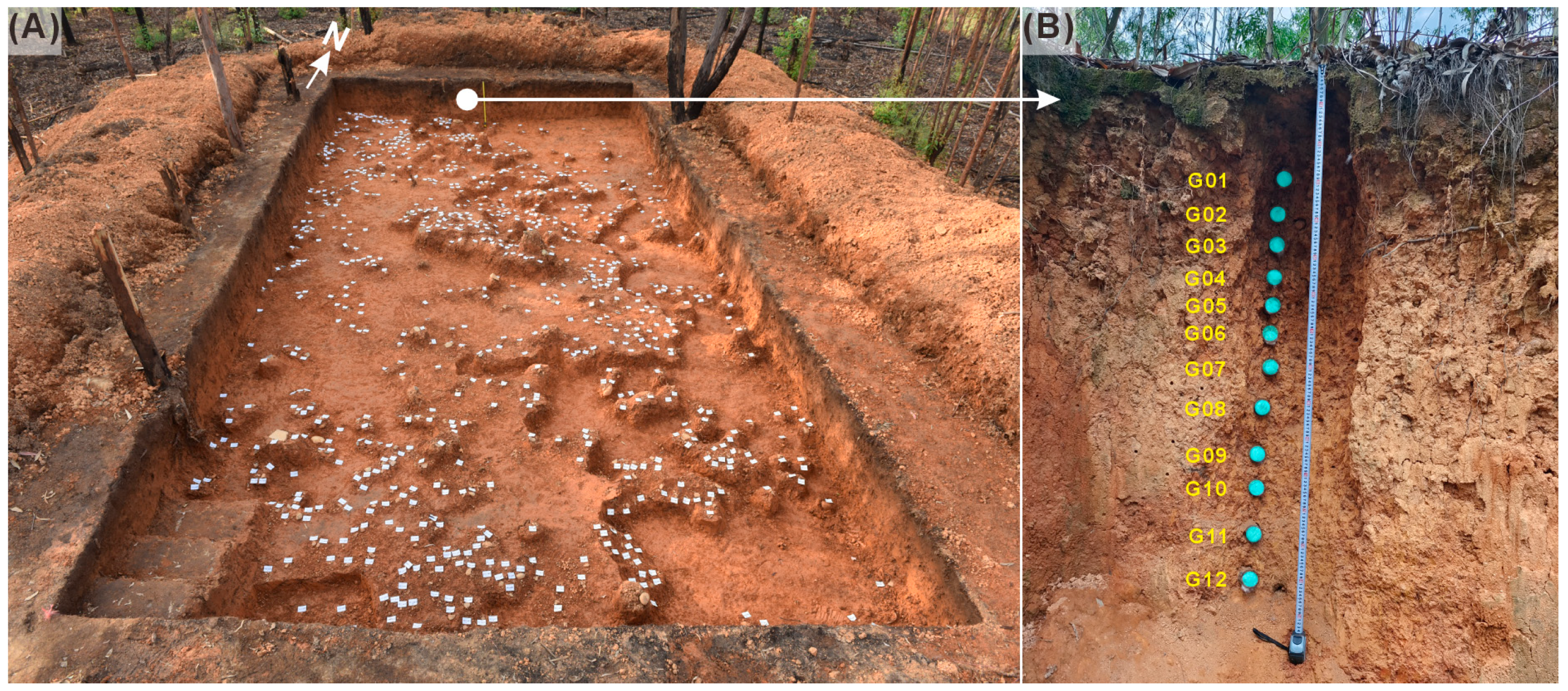
2.2. Sampling
3. Materials and Methods
3.1. Optically Stimulated Luminescence (OSL) Dating
3.2. Grain-Size Analysis
3.3. Major and Trace Element Geochemistry
4. Results
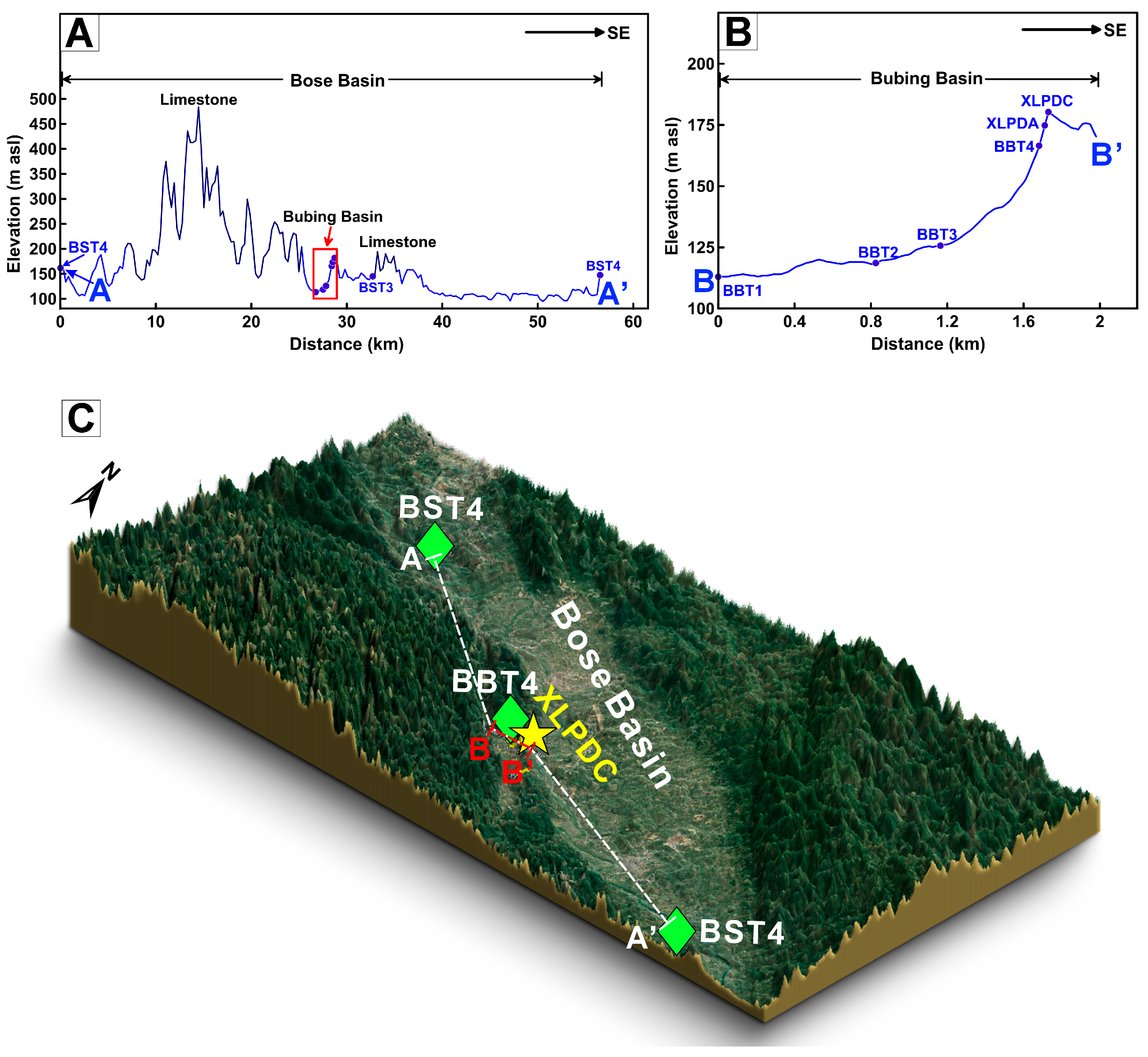
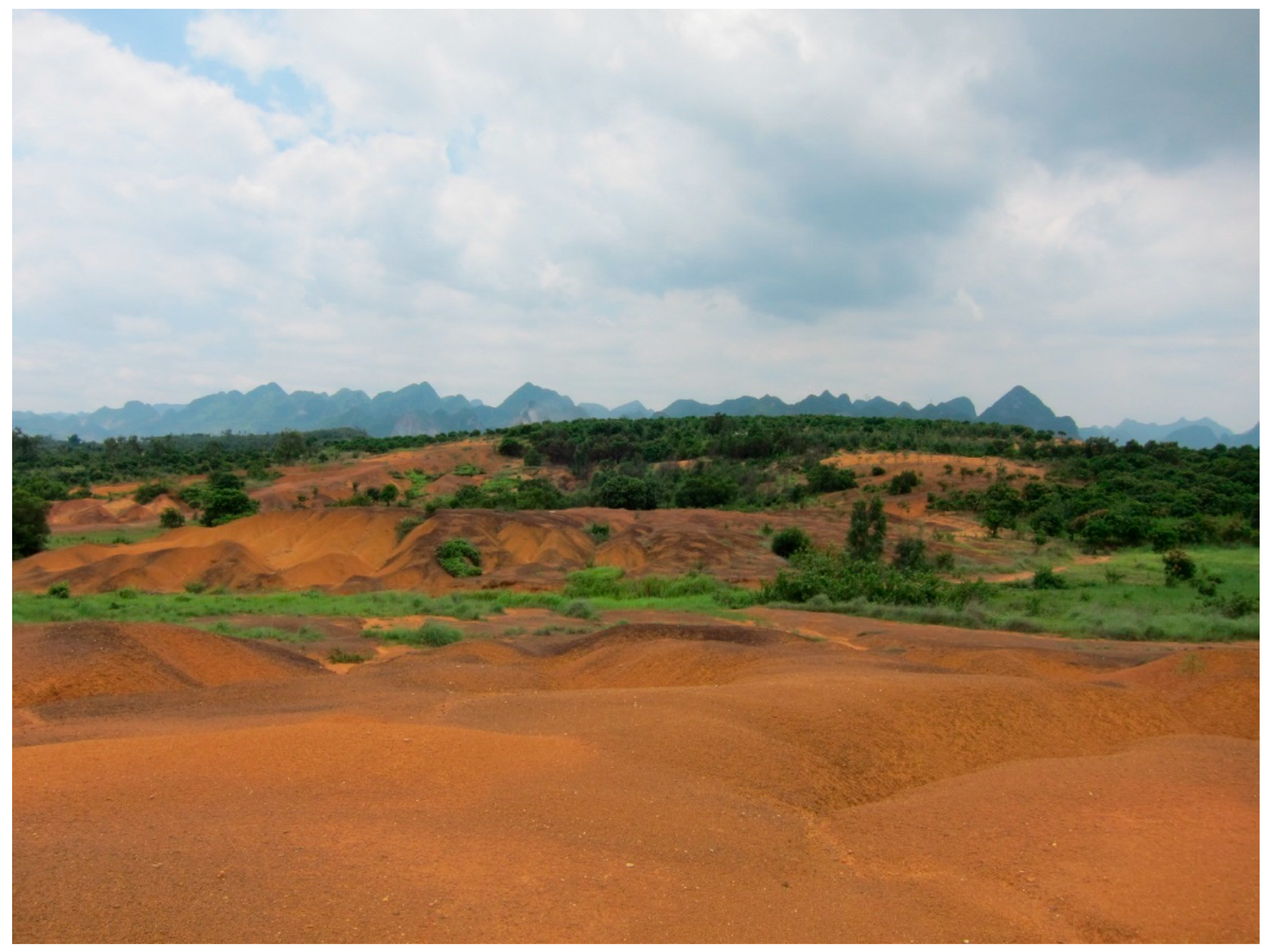
4.1. Field Description of Terraces in the Bose–Bubing Basins and the Section XLPD
4.2. Chronology of the XLPD Section
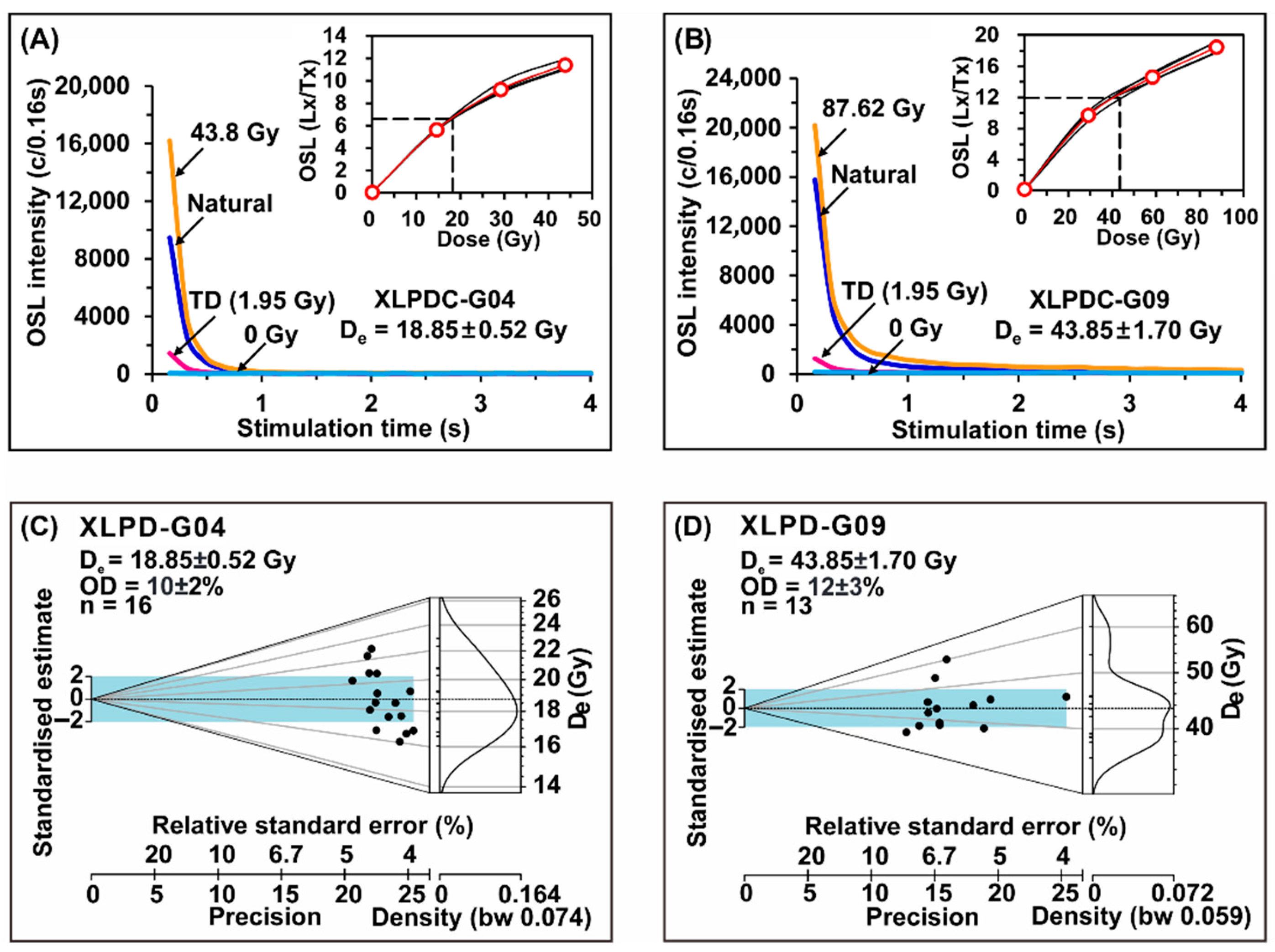

| Sample ID | Depth (m) | Aliquot Numbers | Dose Rate (Gy/ka) | Moisture (%) | U (ppm) | Th (ppm) | K (%) | Overdispersion (%) | De (Gy) | Age (ka) |
|---|---|---|---|---|---|---|---|---|---|---|
| XLPD-G01 | 0.18 | 6 a + 12 b | 1.77 ± 0.07 | 25 ± 5 | 2.51 ± 0.13 | 11.20 ± 0.56 | 0.61 ± 0.06 | 13 ± 3 | 4.83 ± 0.16 | 2.73 ± 0.14 |
| XLPD-G02 | 0.32 | 4 a + 10 b | 1.97 ± 0.08 | 25 ± 5 | 2.79 ± 0.14 | 12.50 ± 0.63 | 0.73 ± 0.07 | 13 ± 3 | 9.04 ± 0.33 | 4.60 ± 0.25 |
| XLPD-G03 | 0.42 | 4 a + 12 b | 2.01 ± 0.09 | 25 ± 5 | 2.78 ± 0.14 | 12.40 ± 0.62 | 0.81 ± 0.08 | 11 ± 2 | 11.46 ± 0.35 | 5.70 ± 0.30 |
| XLPD-G04 | 0.52 | 4 a + 10 b | 2.08 ± 0.09 | 25 ± 5 | 2.90 ± 0.15 | 12.50 ± 0.63 | 0.87 ± 0.09 | 10 ± 2 | 18.85 ± 0.52 | 9.08 ± 0.47 |
| XLPD-G05 | 0.60 | 4 a + 12 b | 2.08 ± 0.09 | 25 ± 5 | 2.85 ± 0.14 | 12.90 ± 0.65 | 0.86 ± 0.09 | 14 ± 3 | 18.64 ± 0.74 | 8.98 ± 0.53 |
| XLPD-G06 | 0.73 | 4 a + 10 b | 2.22 ± 0.10 | 25 ± 5 | 3.00 ± 0.15 | 14.00 ± 0.70 | 0.95 ± 0.10 | 13 ± 3 | 27.73 ± 0.98 | 12.47 ± 0.71 |
| XLPD-G07 | 0.83 | 4 a + 10 b | 2.22 ± 0.10 | 25 ± 5 | 3.05 ± 0.15 | 13.60 ± 0.68 | 0.97 ± 0.10 | 7 ± 2 | 34.13 ± 0.77 | 15.36 ± 0.77 |
| XLPD-G08 | 0.96 | 4 a + 11 b | 2.24 ± 0.10 | 25 ± 5 | 2.99 ± 0.15 | 13.80 ± 0.69 | 1.00 ± 0.10 | 18 ± 4 | 32.14 ± 1.55 | 14.33 ± 0.94 |
| XLPD-G09 | 1.10 | 4 a + 9 b | 2.19 ± 0.10 | 25 ± 5 | 2.88 ± 0.14 | 13.00 ± 0.65 | 1.02 ± 0.10 | 12 ± 3 | 43.85 ± 1.70 | 20.01 ± 1.19 |
| XLPD-G10 | 1.20 | 4 a + 9 b | 1.80 ± 0.08 | 25 ± 5 | 2.75 ± 0.14 | 10.90 ± 0.55 | 0.70 ± 0.07 | 15 ± 3 | 45.61 ± 1.94 | 25.29 ± 1.52 |
| XLPD-G11 | 1.35 | 4 a + 9 b | 1.91 ± 0.08 | 25 ± 5 | 2.70 ± 0.14 | 11.30 ± 0.57 | 0.83 ± 0.08 | 13 ± 3 | 78.29 ± 1.35 | 40.90 ± 1.92 |
| XLPD-G12 | 1.50 | 8 a + 21 b | 2.17 ± 0.10 | 25 ± 5 | 3.00 ± 0.15 | 13.20 ± 0.66 | 0.96 ± 0.10 | 16 ± 2 | 71.19 ± 2.23 | 32.82 ± 1.80 |
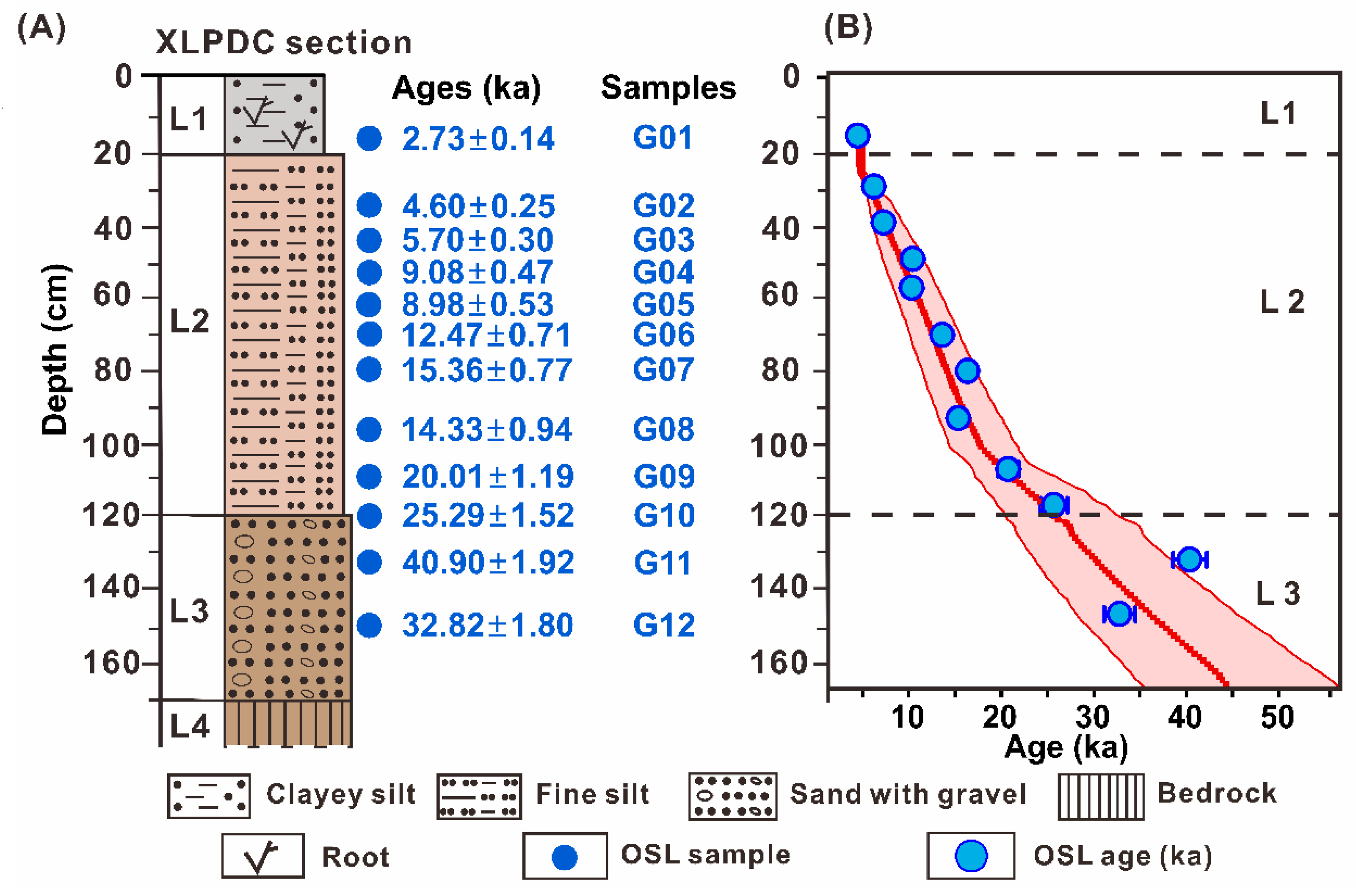
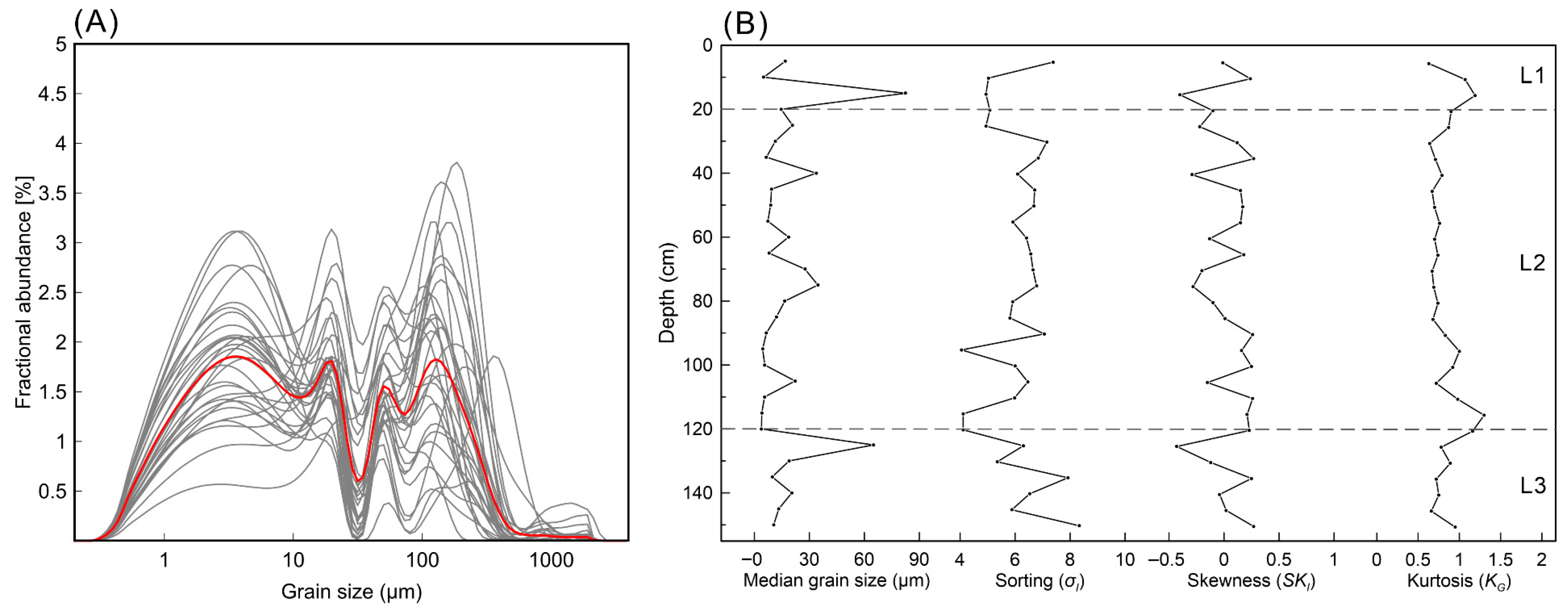
4.3. Grain-Size Results
4.4. Geochemistry Results
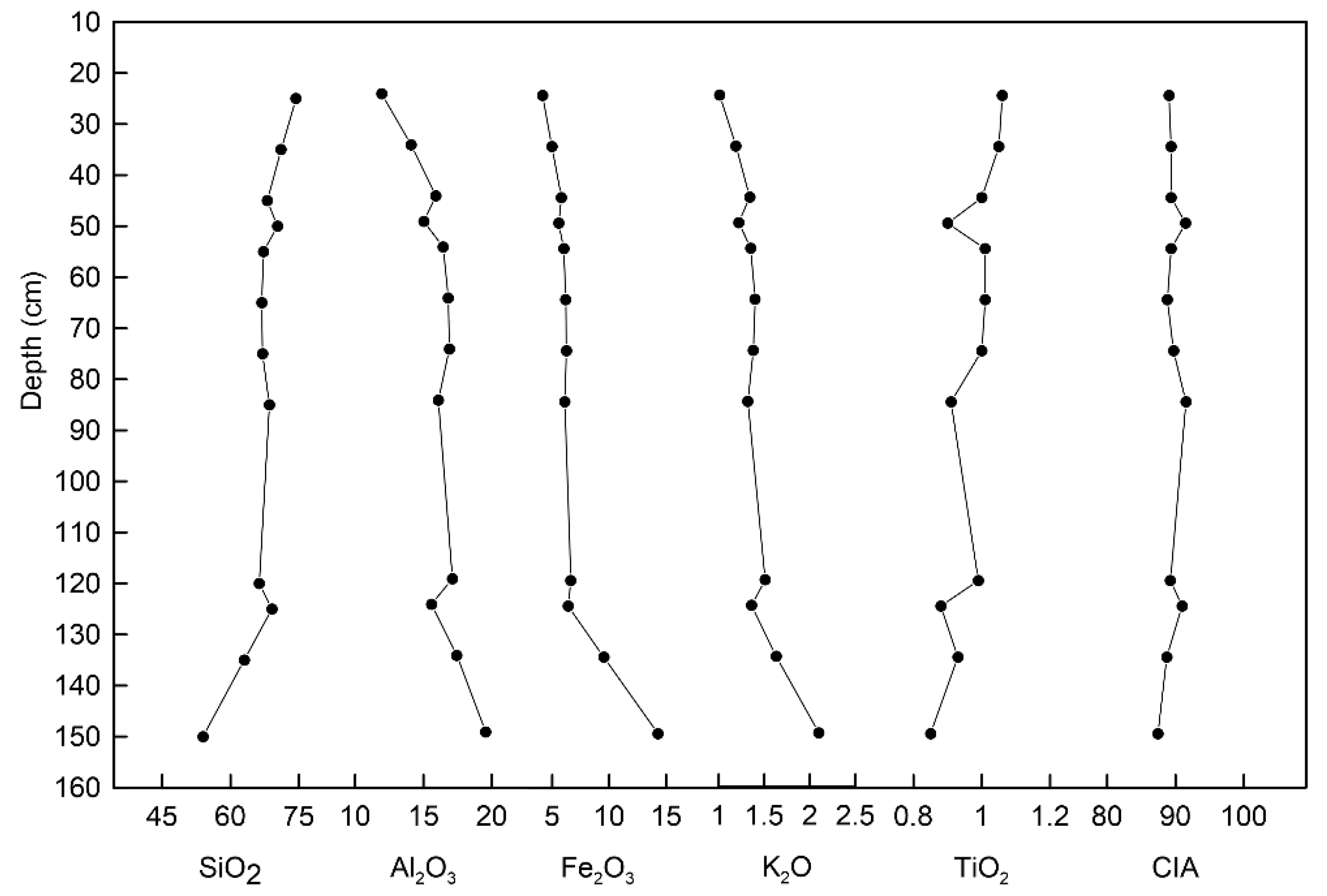
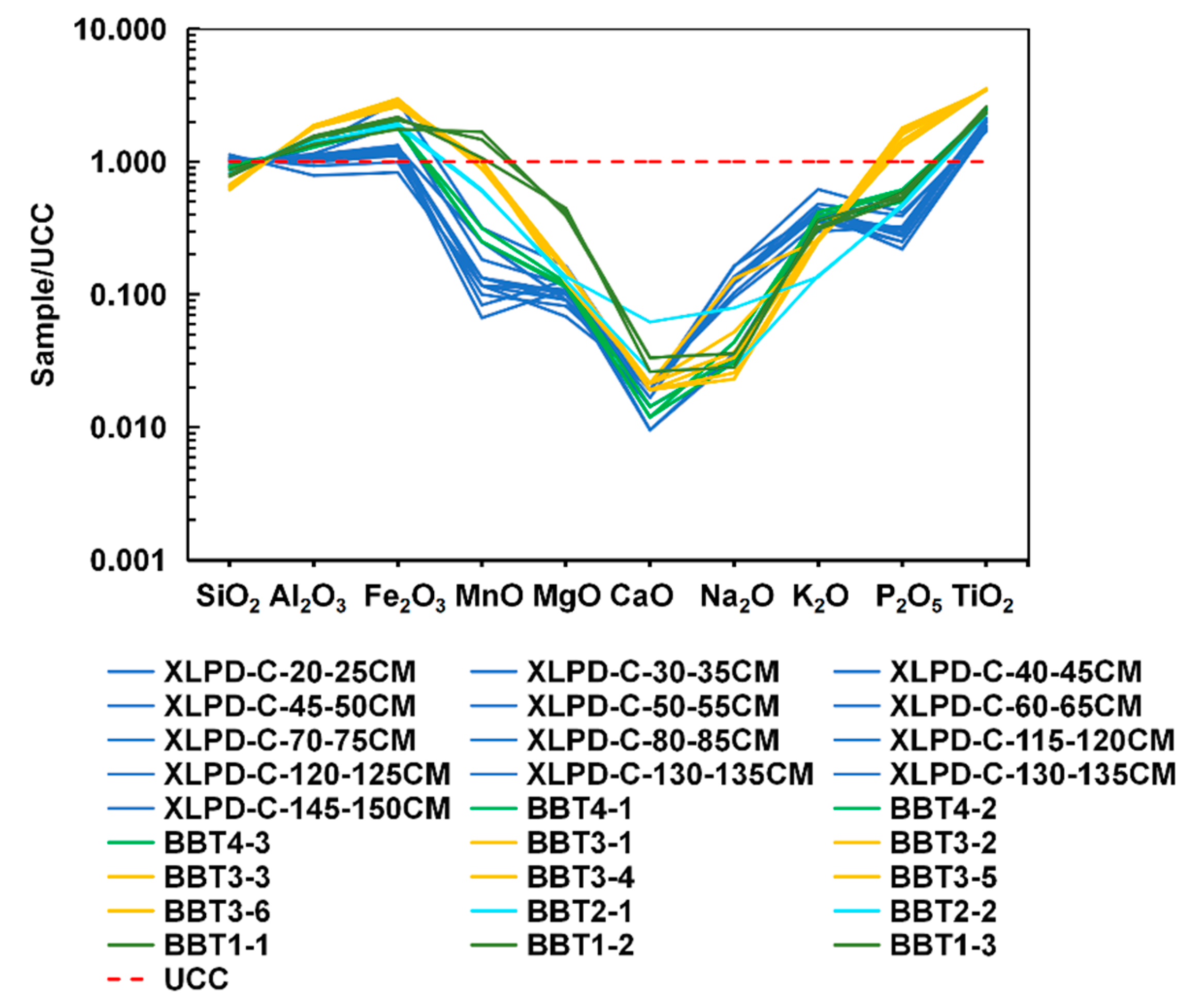
4.4.1. Major Element Geochemistry
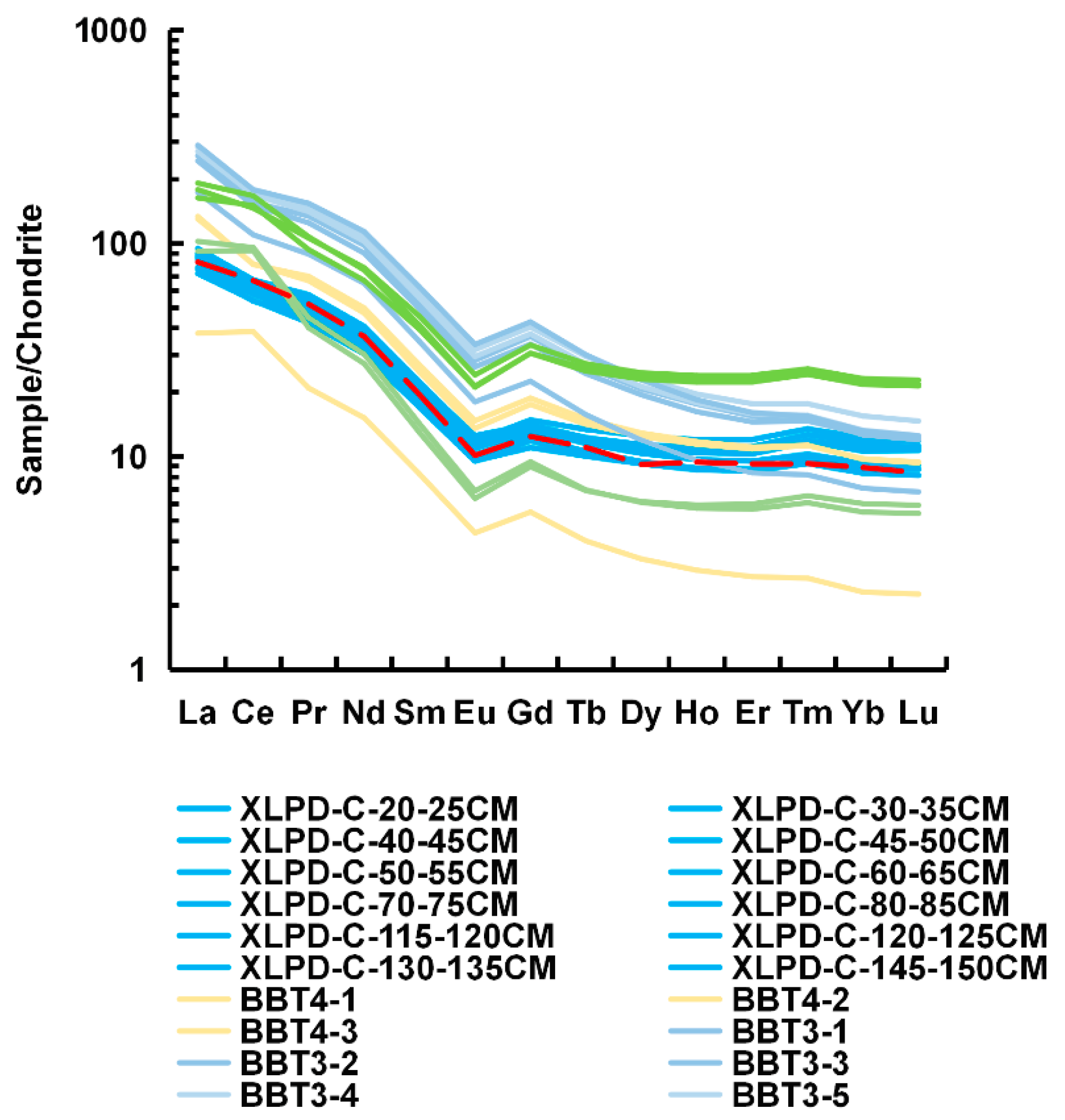
4.4.2. Trace Element Geochemistry
5. Discussion
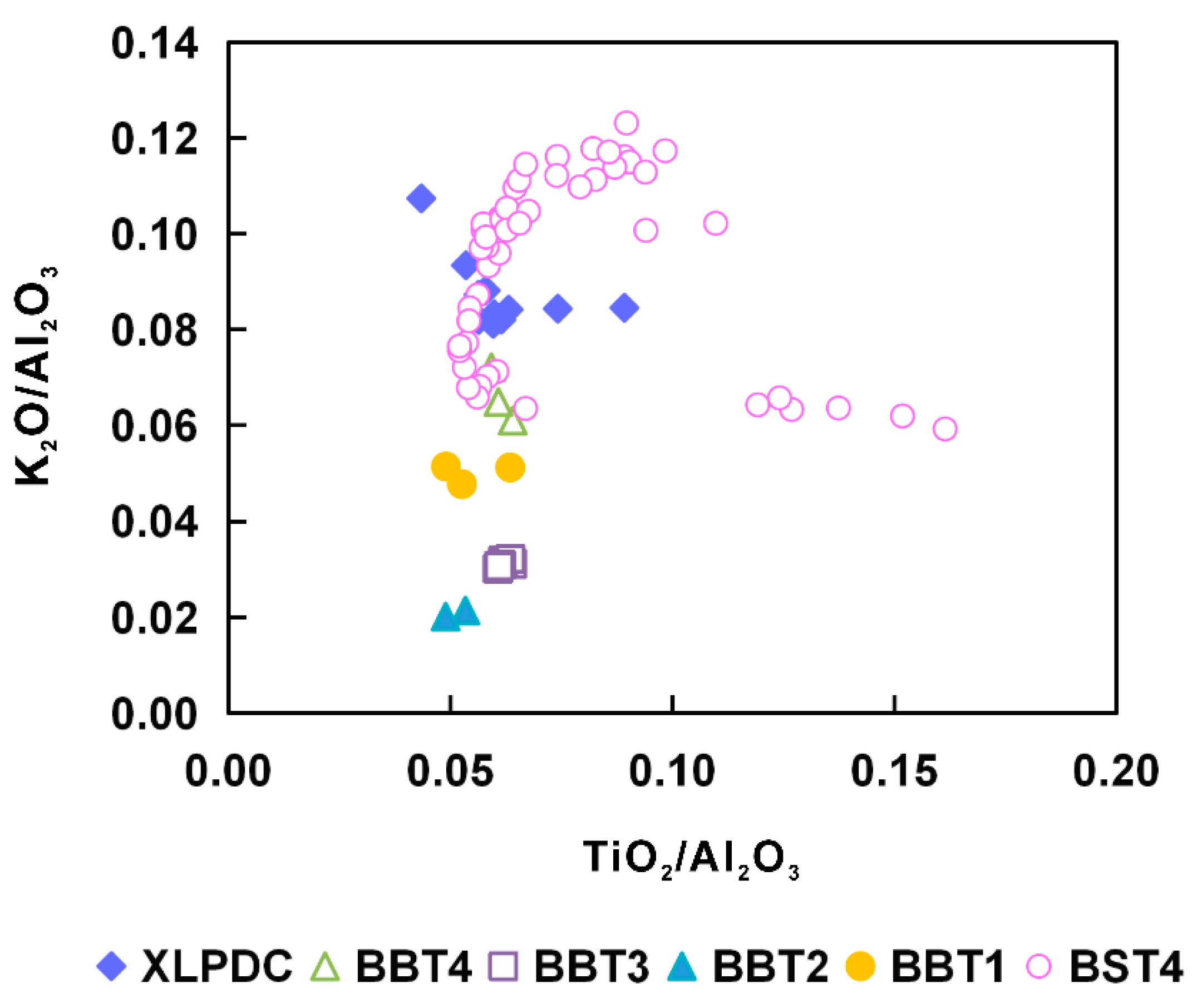
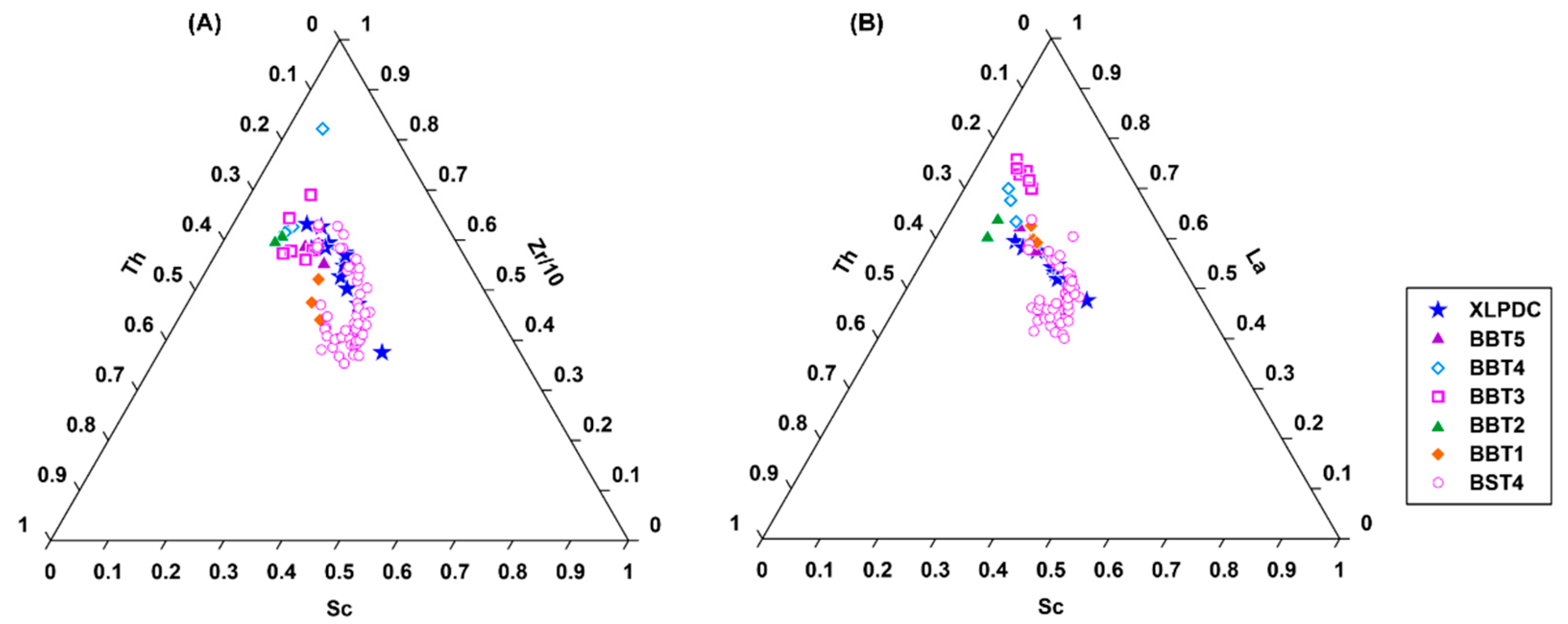
5.1. Geochemical Evidence for Provenance of XLPD Sediments
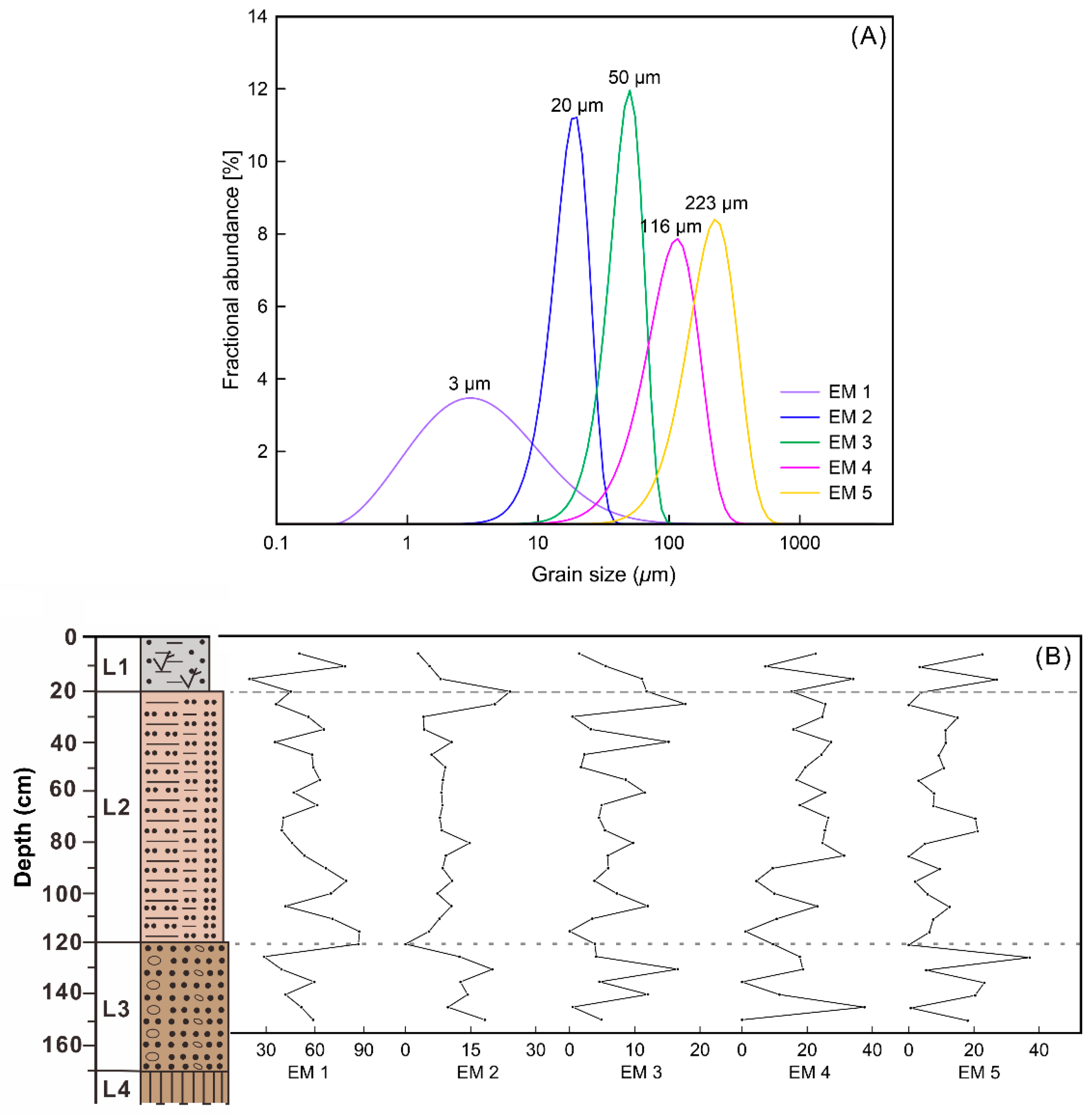
5.2. Evidence for Sedimentary Characteristics Provided by End-Member Modeling
6. Conclusions
Supplementary Materials
Author Contributions
Funding
Data Availability Statement
Conflicts of Interest
References
- Li, Y.; He, S.; Peng, J.; Xu, Q.; Aydin, A.; Xu, Y. Loess geology and surface processes: An introductory note. J. Asian Earth Sci. 2020, 200, 104477. [Google Scholar] [CrossRef]
- Liu, T. Loess and Environment; Beijing Science Press: Beijing, China, 1985. [Google Scholar]
- Prins, M.A.; Vriend, M. Glacial and interglacial eolian dust dispersal patterns across the Chinese Loess Plateau inferred from decomposed loess grain-size records. Geochem. Geophys. Geosyst. 2007, 8, 1–17. [Google Scholar] [CrossRef]
- Stevens, T.; Palk, C.; Carter, A.; Lu, H.; Clift, P.D. Assessing the provenance of loess and desert sediments in northern China using U-Pb dating and morphology of detrital zircons. GSA Bull. 2010, 122, 1331–1344. [Google Scholar] [CrossRef]
- Qin, X.; Cai, B.; Liu, T. Loess record of the aerodynamic environment in the east Asia monsoon area since 60,000 years before present. J. Geophys. Res. Solid Earth 2005, 110, 1–16. [Google Scholar] [CrossRef]
- Wang, Y.; Yang, S.; Ding, Z. Provenance and paleoclimatic implications of loess deposits in Shandong Province, eastern China. Quat. Res. 2021, 103, 88–98. [Google Scholar] [CrossRef]
- Zhang, W.; Dong, C.; Ye, L.; Ma, H.; Yu, L. Magnetic properties of coastal loess on the Midao islands, northern China: Implications for provenance and weathering intensity. Palaeogeogr. Palaeoclimatol. Palaeoecol. 2012, 333–334, 160–167. [Google Scholar] [CrossRef]
- Lü, T.; Sun, J.; Feathers, J.K.; Sun, D.; Cui, C.; Shen, X. OSL dating of coastal sand dunes in southeastern China provides new insights into the relationship between aeolian activity and eustatic sea-level fluctuations. Palaeogeogr. Palaeoclimatol. Palaeoecol. 2022, 600, 111082. [Google Scholar] [CrossRef]
- Hao, Q.; Guo, Z.; Qiao, Y.; Xu, B.; Oldfield, F. Geochemical evidence for the provenance of middle Pleistocene loess deposits in southern China. Quat. Sci. Rev. 2010, 29, 3317–3326. [Google Scholar] [CrossRef]
- Qiao, Y.; Guo, Z.; Hao, Q.; Wu, W.; Jiang, W.; Yuan, B.; Zhang, Z.; Wei, J.; Zhao, H. Loess-soil sequences in southern Anhui Province: Magnetostratigraphy and paleoclimatic significance. Chin. Sci. Bull. 2003, 48, 2088–2093. [Google Scholar] [CrossRef]
- Yang, S.Y.; Li, C.X.; Yang, D.Y.; Li, X.S. Chemical weathering of the loess deposits in the lower Changjiang Valley, China, and paleoclimatic implications. Quat. Int. 2004, 117, 27–34. [Google Scholar] [CrossRef]
- Qiao, Y.; Zhao, Z.; Li, Z.; Wang, Y.; Fu, J.; Wang, S.; Li, C.; Yao, H.; Jiang, F. Aeolian origin of the red earth formation in the Chengdu Plain. Quat. Sci. 2007, 27, 286–294, (Chinese with English abstract). [Google Scholar]
- Xiong, S.; Sun, D.; Ding, Z. Aeolian origin of the red earth in southeast China. J. Quat. Sci. Publ. Quat. Res. Assoc. 2002, 17, 181–191. [Google Scholar] [CrossRef]
- Hong, H.; Wang, C.; Zeng, K.; Gu, Y.; Wu, Y.; Yin, K.; Li, Z. Geochemical constraints on provenance of the mid-Pleistocene red earth sediments in subtropical China. Sediment. Geol. 2013, 290, 97–108. [Google Scholar] [CrossRef]
- Yang, D.; Han, H.; Zhou, L. Mid to late Pleistocene eolian deposits in Xuancheng, Anhui. Mar. Geol. Quat. Geol. 1991, 11, 97–104, (Chinese with English abstract). [Google Scholar]
- Sun, Y.; Yan, Y.; Nie, J.; Li, G.; Shi, Z.; Qiang, X.; Chang, H.; An, Z. Source-to-sink fluctuations of Asian aeolian deposits since the late Oligocene. Earth Sci. Rev. 2020, 200, 102963. [Google Scholar] [CrossRef]
- Iriondo, M.H.; Kröhling, D. Non-classical types of loess. Sediment. Geol. 2007, 202, 352–368. [Google Scholar] [CrossRef]
- Yuan, B.; Hou, Y.; Wang, W.; Rick, P.; Guo, Z.; Huang, W. On the morphological evolution of the bose basin, a lower paleolithic locality in South china. Acta Anthropol. Sin. 1999, 18, 215–224, (Chinese with English abstract). [Google Scholar]
- Xia, Y.; Chen, X.; Lu, H.; Xie, G.; Yi, S.W.; Yang, F.; Chen, Y.; Rao, Z. Optically stimulated luminescence dating and its significance of the newly discovered Paleolithic sites in the Bose Basin, Guangxi Zhuang Autonomous Region, South China. Quat. Sci. 2025, 45, 1–14, (Chinese with English abstract). [Google Scholar]
- Wang, W. Recently discovered Paleolithic sites in the Bubing Basin, South China. Acta Anthropol. Sin. 2014, 33, 270–284, (Chinese with English abstract). [Google Scholar]
- Hou, Y.; Potts, R.; Yuan, B.; Guo, Z.; Deino, A.; Wang, W.; Clark, J.; Xie, G.; Huang, W. Mid-Pleistocene Acheulean-like Stone Technology of the Bose Basin, South China. Science 2000, 287, 1622–1626. [Google Scholar] [CrossRef]
- Shen, X.; Hong, H.; Huang, S.; Algeo, T.J.; Huang, Q.; Bae, C.J.; Yin, K.; Wang, C.; Fang, Q.; Liu, C. Terrestrial paleoclimate changes recorded by Pleistocene red earth deposits at the Gaolingpo Paleolithic site, Bose Basin, South China. Palaeogeogr. Palaeoclimatol. Palaeoecol. 2023, 614, 111438. [Google Scholar] [CrossRef]
- Yuan, B.; Xia, Z.; Li, B.; Qiao, Y.; Gu, Z.; Zhang, J.; Xu, B.; Huang, W.; Zeng, R. Chronostratigraphy and stratigraphic division of red soil in southern china. Quat. Sci. 2008, 28, 1–13, (Chinese with English abstract). [Google Scholar]
- Wang, W.; Bae, C.J.; Huang, S.; Huang, X.; Tian, F.; Mo, J.; Huang, Z.; Huang, C.; Xie, S.; Li, D. Middle Pleistocene bifaces from Fengshudao (Bose Basin, Guangxi, China). J. Hum. Evol. 2014, 69, 110–122. [Google Scholar] [CrossRef] [PubMed]
- Huang, W.; Leng, J.; Yuan, X.; Xie, G. Advanced opinions on the stratigraphy and chronology of Baise stone industry. Acta Anthropol. Sin. 1990, 9, 105–112, (Chinese with English abstract). [Google Scholar]
- Lu, H.; Wang, X.; Wang, Y.; Zhang, X.; Yi, S.; Wang, X.; Stevens, T.; Kurbanov, R.; Marković, S.B. Chinese loess and the Asian monsoon: What we know and what remains unknown. Quat. Int. 2022, 620, 85–97. [Google Scholar] [CrossRef]
- Lai, Z. Chronology and the upper dating limit for loess samples from Luochuan section in the Chinese Loess Plateau using quartz OSL SAR protocol. J. Asian Earth Sci. 2010, 37, 176–185. [Google Scholar] [CrossRef]
- Lai, Z.-P.; Brückner, H.; Zöller, L.; Fülling, A. Existence of a common growth curve for silt-sized quartz OSL of loess from different continents. Radiat. Meas. 2007, 42, 1432–1440. [Google Scholar] [CrossRef]
- Aitken, M.J. Introduction to Optical Dating: The Dating of Quaternary Sediments by the Use of Photon-Stimulated Luminescence; Clarendon Press: Oxford, UK, 1998. [Google Scholar]
- Lai, Z.; Brückner, H. Effects of Feldspar Contamination on Equivalent dose and the Shape of Growth Curve for OSL of Silt-Sized Quartz Extracted from Chinese Loess. Geochronometria 2008, 30, 49–53. [Google Scholar] [CrossRef]
- Bøtter-Jensen, L.; Duller, G.; Murray, A.; Banerjee, D. Blue light emitting diodes for optical stimulation of quartz in retrospective dosimetry and dating. Radiat. Prot. Dosim. 1999, 84, 335–340. [Google Scholar] [CrossRef]
- Murray, A.S.; Wintle, A.G. Luminescence dating of quartz using an improved single-aliquot regenerative-dose protocol. Radiat. Meas. 2000, 32, 57–73. [Google Scholar] [CrossRef]
- Roberts, H.; Duller, G.A. Standardised growth curves for optical dating of sediment using multiple-grain aliquots. Radiat. Meas. 2004, 38, 241–252. [Google Scholar] [CrossRef]
- Lai, Z. Testing the use of an OSL standardised growth curve (SGC) for De determination on quartz from the Chinese Loess Plateau. Radiat. Meas. 2006, 41, 9–16. [Google Scholar] [CrossRef]
- Lai, Z.; Ou, X. Basic procedures of optically stimulated luminescence (OSL) dating. Prog. Geogr. 2013, 32, 683–693, (In Chinese with English abstract). [Google Scholar]
- Prescott, J.R.; Hutton, J.T. Cosmic ray contributions to dose rates for luminescence and ESR dating: Large depths and long-term time variations. Radiat. Meas. 1994, 23, 497–500. [Google Scholar] [CrossRef]
- Wallinga, J.; Cunningham, A.C. Luminescence dating, uncertainties and age range. In Encyclopedia of Scientific Dating Methods; Springer: Dordrecht, The Netherlands, 2015; pp. 440–445. [Google Scholar]
- Durcan, J.A.; King, G.E.; Duller, G.A. DRAC: Dose Rate and Age Calculator for trapped charge dating. Quat. Geochronol. 2015, 28, 54–61. [Google Scholar] [CrossRef]
- Folk, R.; Ward, W. Brazos River Bar: A Study in the Significance of Grain Size Parameters. J. Sediment. Petrol. 1957, 27, 3–26. [Google Scholar] [CrossRef]
- Udden, J.A. Mechanical composition of clastic sediments. Bull. Geol. Soc. Am. 1914, 25, 655–744. [Google Scholar] [CrossRef]
- Wentworth, C.K. A scale of grade and class terms for clastic sediments. J. Geol. 1922, 30, 377–392. [Google Scholar] [CrossRef]
- Paterson, G.A.; Heslop, D. New methods for unmixing sediment grain size data. Geochem. Geophys. Geosyst. 2015, 16, 4494–4506. [Google Scholar] [CrossRef]
- Eggins, S.M.; Woodhead, J.D.; Kinsley, L.P.J.; Mortimer, G.E.; Sylvester, P.; McCulloch, M.T.; Hergt, J.M.; Handler, M.R. A simple method for the precise determination of ≥40 trace elements in geological samples by ICPMS using enriched isotope internal standardisation. Chem. Geol. 1997, 134, 311–326. [Google Scholar] [CrossRef]
- Kamber, B.S.; Greig, A.; Schoenberg, R.; Collerson, K.D. A refined solution to Earth’s hidden niobium: Implications for evolution of continental crust and mode of core formation. Precambrian Res. 2003, 126, 289–308. [Google Scholar] [CrossRef]
- Blaauw, M.; Christen, J.A. Flexible paleoclimate age-depth models using an autoregressive gamma process. Bayesian Anal. 2011, 6, 457–474, 418. [Google Scholar] [CrossRef]
- Liao, W.; Tian, C.; Liang, H.; Yao, Y.; Li, J.; Yan, Y.; Huang, S.; Bae, C.J.; Wang, W. Provenance geochemical detection of soil deposits from archaeological limestone caves in the Bubing Basin, tropical China. Quat. Int. 2024, 714, 109580. [Google Scholar] [CrossRef]
- Taylor, S.R.; McLennan, S.M. The Continental Crust: Its Composition and Evolution; Blackwell Scientific Publications: Oxford, UK, 1985. [Google Scholar]
- Sheldon, N.D.; Tabor, N.J. Quantitative paleoenvironmental and paleoclimatic reconstruction using paleosols. Earth Sci. Rev. 2009, 95, 1–52. [Google Scholar] [CrossRef]
- Cox, R.; Lowe, D.R.; Cullers, R. The influence of sediment recycling and basement composition on evolution of mudrock chemistry in the southwestern United States. Geochim. Cosmochim. Acta 1995, 59, 2919–2940. [Google Scholar] [CrossRef]
- McLennan, S.M. Weathering and Global Denudation. J. Geol. 1993, 101, 295–303. [Google Scholar] [CrossRef]
- Bhatia, M.R.; Crook, K.A.W. Trace element characteristics of graywackes and tectonic setting discrimination of sedimentary basins. Contrib. Mineral. Petrol. 1986, 92, 181–193. [Google Scholar] [CrossRef]
- Kasanzu, C.; Maboko, M.A.H.; Manya, S. Geochemistry of fine-grained clastic sedimentary rocks of the Neoproterozoic Ikorongo Group, NE Tanzania: Implications for provenance and source rock weathering. Precambrian Res. 2008, 164, 201–213. [Google Scholar] [CrossRef]
- Muhs, D.R.; Budahn, J.R.; Johnson, D.L.; Reheis, M.; Beann, J.; Skipp, G.; Fisher, E.; Jones, J.A. Geochemical evidence for airborne dust additions to soils in Channel Islands National Park, California. GSA Bull. 2008, 120, 106–126. [Google Scholar] [CrossRef]
- Dietze, E.; Maussion, F.; Ahlborn, M.; Diekmann, B.; Hartmann, K.; Henkel, K.; Kasper, T.; Lockot, G.; Opitz, S.; Haberzettl, T. Sediment transport processes across the Tibetan Plateau inferred from robust grain-size end members in lake sediments. Clim. Past 2014, 10, 91–106. [Google Scholar] [CrossRef]
- Vandenberghe, J.; Sun, Y.; Wang, X.; Abels, H.A.; Liu, X. Grain-size characterization of reworked fine-grained aeolian deposits. Earth-Sci. Rev. 2018, 177, 43–52. [Google Scholar] [CrossRef]
- Vandenberghe, J. Grain size of fine-grained windblown sediment: A powerful proxy for process identification. Earth-Sci. Rev. 2013, 121, 18–30. [Google Scholar] [CrossRef]
- Du, Y. OSL Dating of the Quaternary Red Clay Distributed in the Reaches of the Yangtze River and Paleoclimatic Changes since the Last Interglacial Period in Mid-Subtropical Southeast China. Ph.D. Thesis, Shanghai University, Shanghai, China, 2013. [Google Scholar]
- Sun, D.; Bloemendal, J.; Rea, D.K.; An, Z.; Vandenberghe, J.; Lu, H.; Su, R.; Liu, T. Bimodal grain-size distribution of Chinese loess, and its palaeoclimatic implications. CATENA 2004, 55, 325–340. [Google Scholar] [CrossRef]
- Wang, Y.; Mai, B.; He, L. Analysis of the causes of a rare floating dust weather in Guangxi in March 2021. J. Meteorol. Res. Appl. 2023, 44, 96–101, (Chinese with English abstract). [Google Scholar]
- Tsoar, H.; Pye, K. Dust transport and the question of desert loess formation. Sedimentology 1987, 34, 139–153. [Google Scholar] [CrossRef]
- Prins, M.A.; Vriend, M.; Nugteren, G.; Vandenberghe, J.; Lu, H.; Zheng, H.; Weltje, G.J. Late Quaternary aeolian dust input variability on the Chinese Loess Plateau: Inferences from unmixing of loess grain-size records. Quat. Sci. Rev. 2007, 26, 230–242. [Google Scholar] [CrossRef]
- Vandenberghe, J.; Yang, X.; Wang, X.; Wang, S.; Lu, H. Diverse floodplain deposits of reworked loess in a monsoon climate (Hanzhong Basin, central China). Quat. Res. 2021, 103, 4–20. [Google Scholar] [CrossRef]
- Song, X.; Zhu, T.; Mo, J.; Bae, C.J.; Wang, W. In situ (splash-form) tektites from the Middle Pleistocene laterite deposits in Bose Basin, South China. Quat. Sci. Rev. 2025, 366, 109500. [Google Scholar] [CrossRef]
- Wang, X.; Ma, J.; Yi, S.; Vandenberghe, J.; Dai, Y.; Lu, H. Interaction of fluvial and eolian sedimentation processes, and response to climate change since the last glacial in a semiarid environment along the Yellow River. Quat. Res. 2019, 91, 570–583. [Google Scholar] [CrossRef]
Disclaimer/Publisher’s Note: The statements, opinions and data contained in all publications are solely those of the individual author(s) and contributor(s) and not of MDPI and/or the editor(s). MDPI and/or the editor(s) disclaim responsibility for any injury to people or property resulting from any ideas, methods, instructions or products referred to in the content. |
© 2025 by the authors. Licensee MDPI, Basel, Switzerland. This article is an open access article distributed under the terms and conditions of the Creative Commons Attribution (CC BY) license (https://creativecommons.org/licenses/by/4.0/).
Share and Cite
Zhong, J.; Lai, P.; Liao, W.; Lai, Z.; Bae, C.J.; Wang, W.; Vandenberghe, J. The Late Quaternary Aeolian Deposits in the Subtropical Bose–Bubing Basins, Southern China. Quaternary 2025, 8, 70. https://doi.org/10.3390/quat8040070
Zhong J, Lai P, Liao W, Lai Z, Bae CJ, Wang W, Vandenberghe J. The Late Quaternary Aeolian Deposits in the Subtropical Bose–Bubing Basins, Southern China. Quaternary. 2025; 8(4):70. https://doi.org/10.3390/quat8040070
Chicago/Turabian StyleZhong, Jiemei, Ping Lai, Wei Liao, Zhongping Lai, Christopher J. Bae, Wei Wang, and Jef Vandenberghe. 2025. "The Late Quaternary Aeolian Deposits in the Subtropical Bose–Bubing Basins, Southern China" Quaternary 8, no. 4: 70. https://doi.org/10.3390/quat8040070
APA StyleZhong, J., Lai, P., Liao, W., Lai, Z., Bae, C. J., Wang, W., & Vandenberghe, J. (2025). The Late Quaternary Aeolian Deposits in the Subtropical Bose–Bubing Basins, Southern China. Quaternary, 8(4), 70. https://doi.org/10.3390/quat8040070

