
Urological Manifestations of Stevens–Johnson Syndrome/Toxic Epidermal Necrolysis and Their Management: A Scoping Review
 , , and
Abstract
1. Introduction
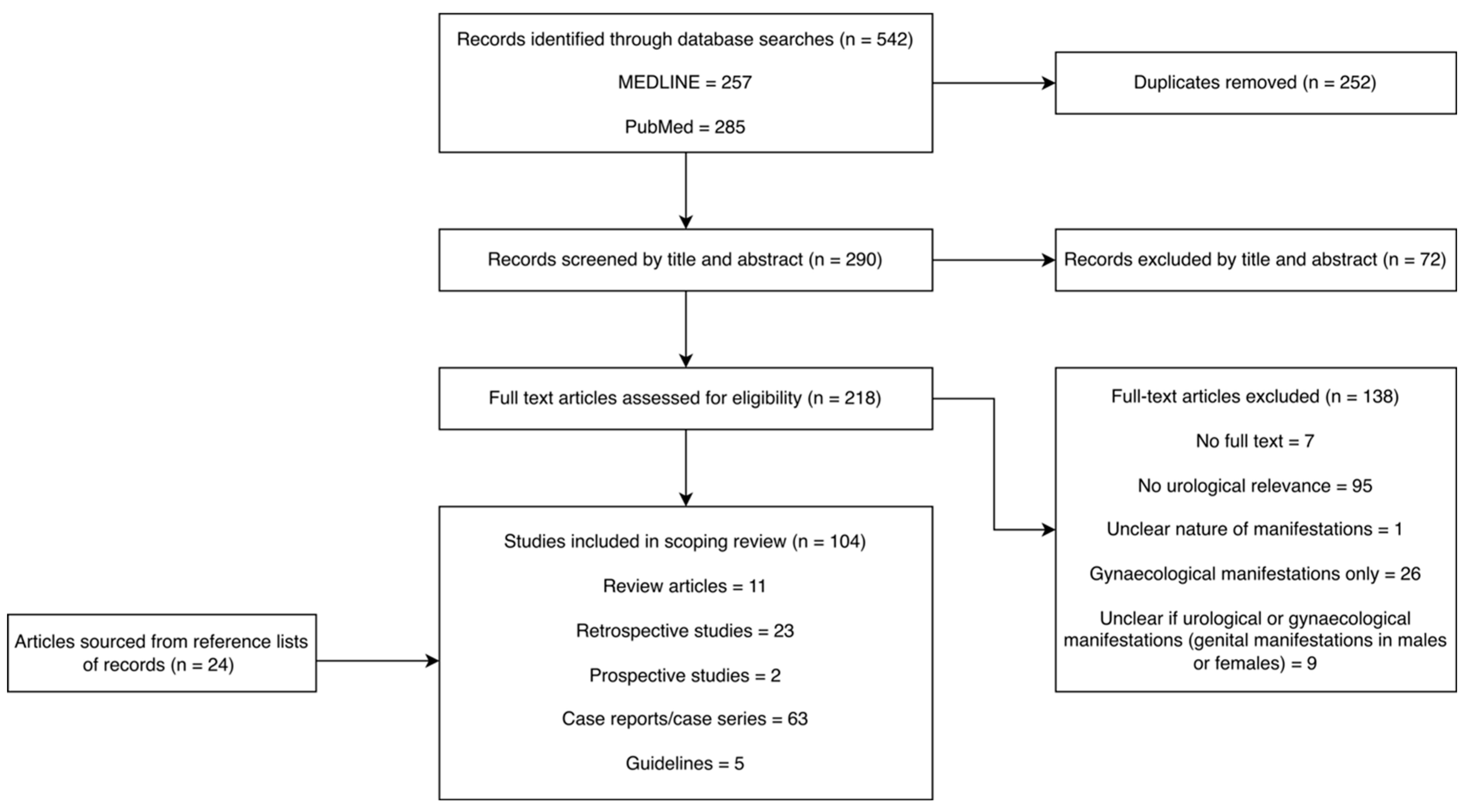
2. Methods
3. Results
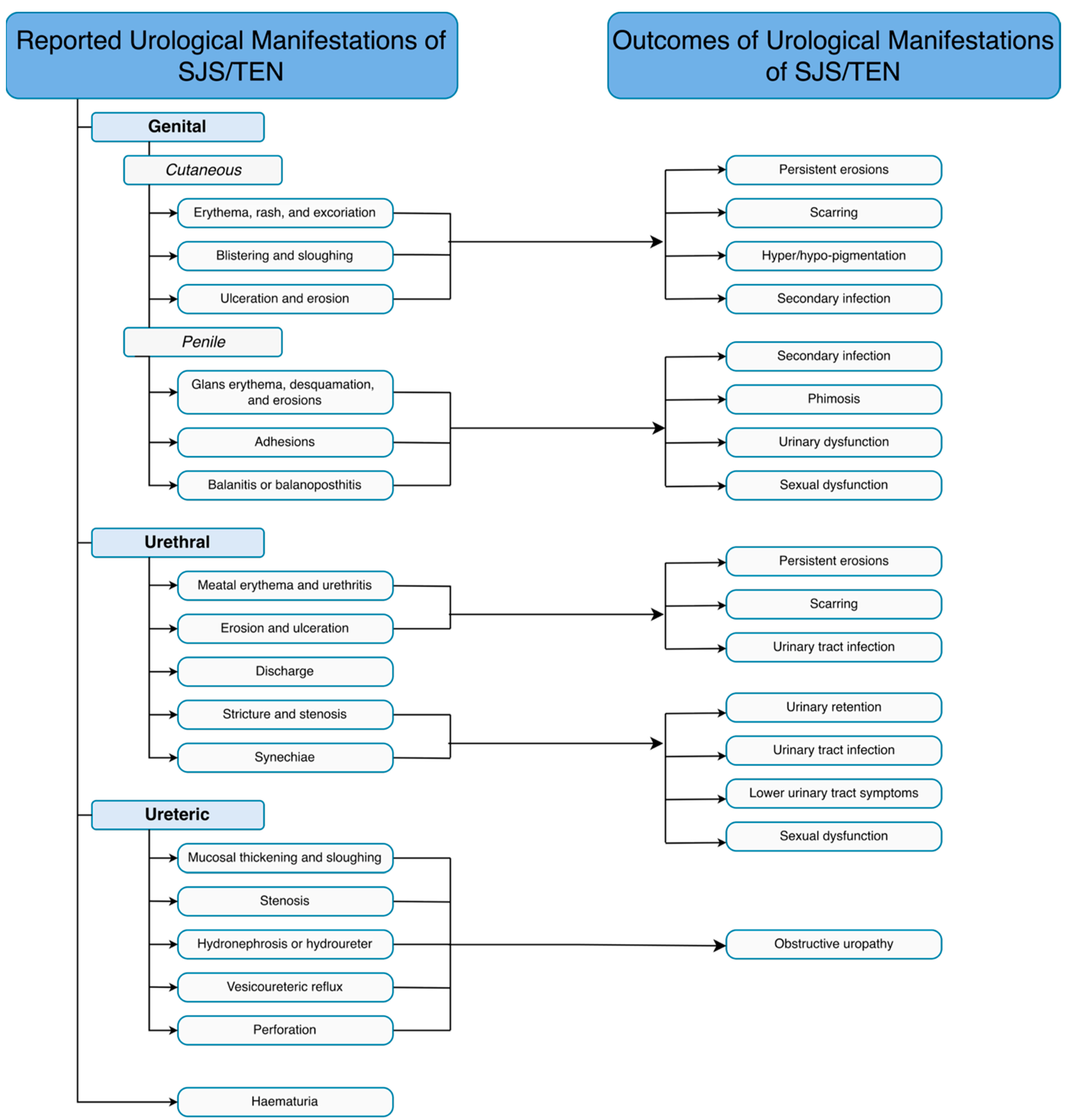
3.1. Outcomes of Urological Manifestations of SJS/TEN
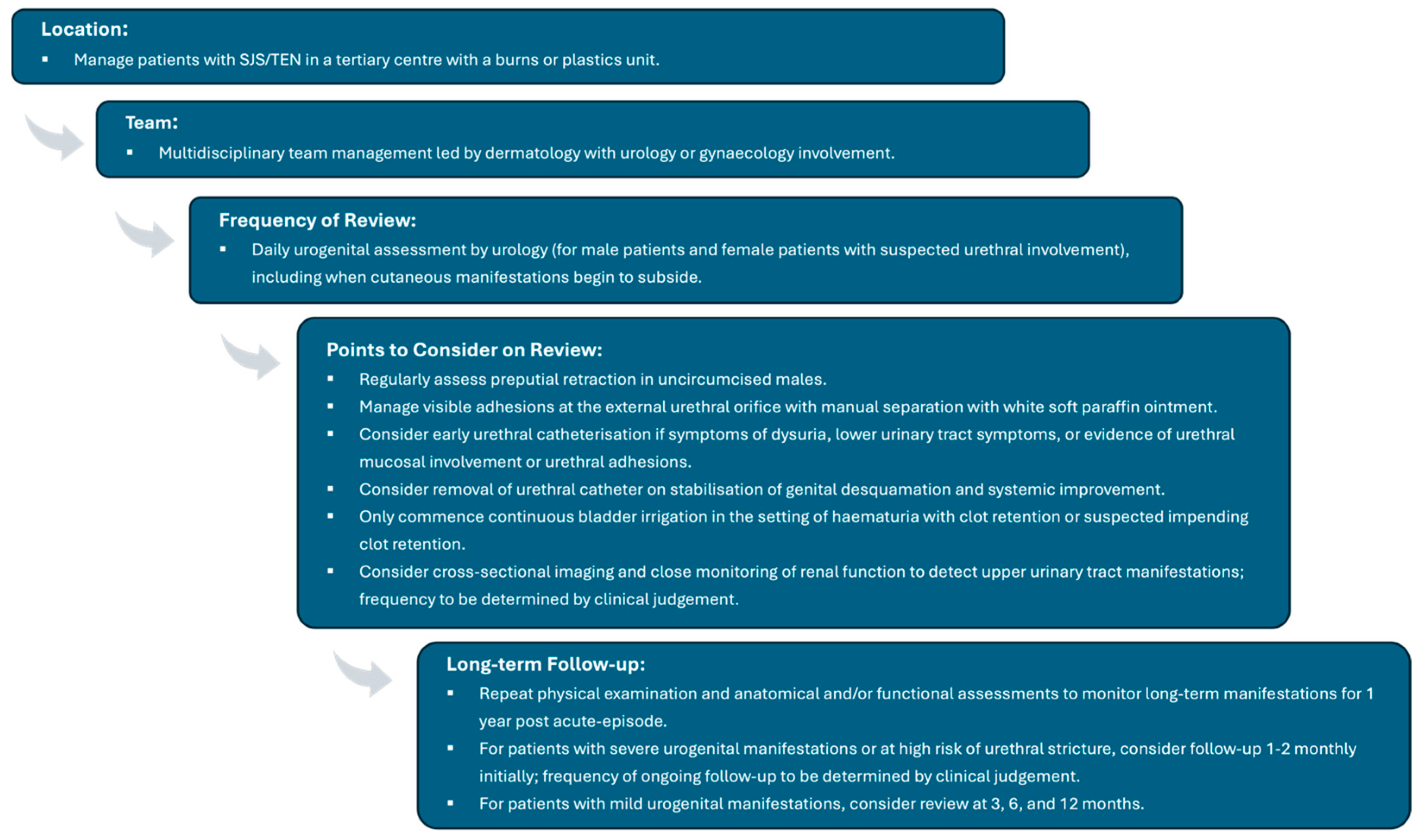
3.2. Management and Prevention of Urological Manifestations of SJS/TEN
3.3. Genital Cutaneous Lesions
3.4. Urogenital Adhesions
3.5. Urethral Strictures
3.6. Other Urological Manifestations
3.7. Long-Term Follow-Up
4. Discussion/Recommendations
Strengths and Limitations
5. Conclusions
Supplementary Materials
Author Contributions
Funding
Institutional Review Board Statement
Informed Consent Statement
Data Availability Statement
Conflicts of Interest
References
- Lissia, M.; Mulas, P.; Bulla, A.; Rubino, C. Toxic epidermal necrolysis (Lyell’s disease). Burns 2010, 36, 152–163. [Google Scholar] [CrossRef]
- Schwartz, R.A.; McDonough, P.H.; Lee, B.W. Toxic epidermal necrolysis: Part I. Introduction, history, classification, clinical features, systemic manifestations, etiology, and immunopathogenesis. J. Am. Acad. Dermatol. 2013, 69, 173.e1–173.e13. [Google Scholar] [CrossRef]
- Bastuji-Garin, S.; Rzany, B.; Stern, R.S.; Shear, N.H.; Naldi, L.; Roujeau, J.-C. Clinical classification of cases of toxic epidermal necrolysis, Stevens-Johnson syndrome, and erythema multiforme. Arch. Dermatol. 1993, 129, 92–96. [Google Scholar] [CrossRef]
- Schwartz, R.A.; McDonough, P.H.; Lee, B.W. Toxic epidermal necrolysis: Part II. Prognosis, sequelae, diagnosis, differential diagnosis, prevention, and treatment. J. Am. Acad. Dermatol. 2013, 69, 187.e1–187.e16. [Google Scholar] [CrossRef]
- Dalli, R.L.; Kumar, R.; Kennedy, P.; Maitz, P.; Lee, S.; Johnson, R. Toxic epidermal necrolysis/Stevens–Johnson syndrome: Current trends in management. ANZ J. Surg. 2007, 77, 671–676. [Google Scholar] [CrossRef] [PubMed]
- O’Brien, K.F.; Bradley, S.E.; Mitchell, C.M.; Cardis, M.A.; Mauskar, M.M.; Pasieka, H.B. Vulvovaginal manifestations in Stevens-Johnson syndrome and toxic epidermal necrolysis: Prevention and treatment. J. Am. Acad. Dermatol. 2021, 85, 523–528. [Google Scholar] [CrossRef] [PubMed]
- Tasker, F.; Smith, S.P.; Mustapa, M.F.M.; de Berker, D.A.R. British Association of Dermatologists national clinical audit on the management of Stevens–Johnson syndrome/toxic epidermal necrolysis in adults. Clin. Exp. Dermatol. 2024, 49, 810–816. [Google Scholar] [CrossRef] [PubMed]
- Seminario-Vidal, L.; Kroshinsky, D.; Malachowski, S.J.; Sun, J.; Markova, A.; Beachkofsky, T.M.; Kaffenberger, B.H.; Ergen, E.N.; Mauskar, M.; Bridges, A.; et al. Society of Dermatology Hospitalists supportive care guidelines for the management of Stevens-Johnson syndrome/toxic epidermal necrolysis in adults. J. Am. Acad. Dermatol. 2020, 82, 1553–1567. [Google Scholar] [CrossRef] [PubMed]
- Tricco, A.C.; Lillie, E.; Zarin, W.; O’Brien, K.K.; Colquhoun, H.; Levac, D.; Moher, D.; Peters, M.D.J.; Horsley, T.; Weeks, L.; et al. PRISMA Extension for Scoping Reviews (PRISMA-ScR): Checklist and Explanation. Ann. Intern. Med. 2018, 169, 467–473. [Google Scholar] [CrossRef]
- Gulanikar, A.; Abrol, A.; Sagar, S. Study of genital manifestations of Stevens Johnson syndrome/Toxic epidermal necrolysis. Indian J. Sex. Transm. Dis. AIDS 2022, 43, 39–42. [Google Scholar] [CrossRef] [PubMed]
- Sauteur, P.M.M.; Goetschel, P.; Lautenschlager, S. Mycoplasma pneumoniae and mucositis—Part of the Stevens-Johnson syndrome spectrum. J. Der Dtsch. Dermatol. Ges. 2012, 10, 740–745. [Google Scholar] [CrossRef]
- Charlton, O.A.; Harris, V.; Phan, K.; Mewton, E.; Jackson, C.; Cooper, A. Toxic epidermal necrolysis and Stevens–Johnson syndrome: A comprehensive review. Adv. Wound Care 2020, 9, 426–439. [Google Scholar] [CrossRef] [PubMed]
- Chhipa, S.A.; Masood, S.; Salarzai, Y.; Khan, Q.A.; Ahmad, K.; Sajid, S. Ocular manifestation, complications and aetiological factors in Stevens-Johnson syndrome/toxic epidermal necrolysis. J. Pak. Med. Assoc. 2015, 65, 62–64. [Google Scholar]
- Revuz, J.; Penso, D.; Roujeau, J.-C.; Guillaume, J.-C.; Payne, C.R.; Wechsler, J.; Touraine, R. Toxic epidermal necrolysis. Clinical findings and prognosis factors in 87 patients. Arch. Dermatol. 1987, 123, 1160–1165. [Google Scholar] [CrossRef] [PubMed]
- Chatproedprai, S.; Wutticharoenwong, V.; Tempark, T.; Wananukul, S. Clinical features and treatment outcomes among children with Stevens-Johnson syndrome and toxic epidermal necrolysis: A 20-year study in a tertiary referral hospital. Dermatol. Res. Pract. 2018, 2018, 1–9. [Google Scholar] [CrossRef]
- Sevketoglu, E.; Hatipoglu, S.; Akman, M.; Bicer, S. Toxic Epidermal necrolysis in a child after carbamazepine dosage increment. Pediatr. Emerg. Care 2009, 25, 93–95. [Google Scholar] [CrossRef]
- Saitoh, A.; Ohya, T.; Yoshida, S.; Hosoya, R.; Nishimura, K. A case report of Stevens-Johnson syndrome with Mycoplasma pneumoniae infection. Pediatr. Int. 1995, 37, 113–115. [Google Scholar] [CrossRef]
- Canter, N.; Smith, L. Incomplete Stevens-Johnson syndrome caused by sulfonamide antimicrobial exposure. Clin. Pract. Cases Emerg. Med. 2019, 3, 240–242. [Google Scholar] [CrossRef]
- Abuhammad, A.; Ayyad, M.; Albandak, M.; Natsheh, M.; Attawna, S.I.Y. Levofloxacin-induced fuchs syndrome: A rare atypical Stevens–Johnson syndrome variant with a comprehensive literature review. Case Rep. Med. 2025, 2025, 9944674. [Google Scholar] [CrossRef]
- Mermershtain, W.; Cohen, A.; Lazarev, I.; Grunwald, M.; Ariad, S. Toxic epidermal necrolysis associated with gemcitabine therapy in a patient with metastatic transitional cell carcinoma of the bladder. J. Chemother. 2003, 15, 510–511. [Google Scholar] [CrossRef]
- Bannaga, A.; Rahama, O.; Barlow, G. Nevirapine-induced Stevens-Johnson syndrome following HIV postexposure prophylaxis. BMJ Case Rep. 2013, 2013, bcr2013009453. [Google Scholar] [CrossRef]
- Sendi, P.; Graber, P.; Lepère, F.; Schiller, P.; Zimmerli, W. Mycoplasma pneumoniae infection complicated by severe mucocutaneous lesions. Lancet Infect. Dis. 2008, 8, 268. [Google Scholar] [CrossRef]
- Viscuse, P.V.; Marques-Piubelli, M.L.; Heberton, M.M.; Parra, E.R.; Shah, A.Y.; Siefker-Radtke, A.; Gao, J.; Goswami, S.; Ivan, D.; Curry, J.L.; et al. Case report: Enfortumab vedotin for metastatic urothelial carcinoma: A case series on the clinical and histopathologic spectrum of adverse cutaneous reactions from fatal Stevens-Johnson syndrome/toxic epidermal necrolysis to dermal hypersensitivity reaction. Front. Oncol. 2021, 11, 621591. [Google Scholar] [CrossRef]
- Karthikeyan, K.; Sameera, K.V.; Shaji, S.; Swetha, M.A.C.; Madhu, C.S. Capecitabine induced Steven–Johnson syndrome: A rare case report. J. Oncol. Pharm. Pract. 2021, 28, 250–254. [Google Scholar] [CrossRef]
- Cocca, S.; Viviano, M. Stevens-Johnson syndrome and abuse of anabolic steroids. J. Korean Assoc. Oral Maxillofac. Surg. 2017, 43, 57–60. [Google Scholar] [CrossRef] [PubMed]
- Buganu, A.; Atta, M.; Solomon, M.; Banerjee, P.R.; Ganti, L. Stevens Johnson syndrome initiated by an adverse reaction to trimethoprim-sulfamethoxazole. Cureus 2020, 12, e10023. [Google Scholar] [CrossRef] [PubMed]
- Alves, D.D.; Lourenço, N.; Franco, D.; Calmeiro, E.; Silva, R. Toxic epidermal necrolyisis and sepsis. Eur. J. Case Rep. Intern. Med. 2016, 3, 000502. [Google Scholar] [CrossRef] [PubMed]
- Grafanaki, K.; Lygeros, S.; Vryzaki, E.M.; Georgiou, S. Rare vardenafil-associated Stevens-Johnson syndrome: Toxic epidermal necrolysis. BMJ Case Rep. 2022, 15, e249013. [Google Scholar] [CrossRef]
- Maciejewska, J.; Jankowski, M.; Zegarska, B.; Czajkowski, R. Stevens-Johnson syndrome/toxic epidermal necrolysis presumably induced by norfloxacin. Adv. Dermatol. Allergol. 2014, 3, 194–196. [Google Scholar] [CrossRef]
- Taqi, S.A.; Zaki, S.A.; Nilofer, A.R.; Sami, L.B. Trimethoprim-sulfamethoxazole-induced Stevens Johnson syndrome in an HIV-infected patient. Indian J. Pharmacol. 2012, 44, 533–535. [Google Scholar] [CrossRef]
- Barman, K.D.; Verma, K.K.; Agrawal, S.; Agarwalla, A.; Rijal, A. Stevens-Johnson Syndrome with idiopathic thrombocytopenic purpura treated with dexamethasone pulse therapy. J. Dermatol. 2003, 30, 54–58. [Google Scholar] [CrossRef]
- Carrera, D.; Ulloa, J.G. Iodinated contrast-induced Stevens-Johnson syndrome: A report of a rare complication for a common imaging agent. J. Vasc. Surg. Cases Innov. Tech. 2022, 8, 455–457. [Google Scholar] [CrossRef] [PubMed]
- Case, R.A.; Patel, V.; Mejia-Otero, C.; Siroy, A.E.; Patel, D.C. Anti-MDA-5 dermatomyositis with development of drug-mediated necrolytic skin lesions. J. Investig. Med. High Impact Case Rep. 2020, 8, 2324709620940496. [Google Scholar] [CrossRef] [PubMed]
- Honma, M.; Tobisawa, S.; Iinuma, S.; Shibuya, T.; Komatsu, S.; Takahashi, I.; Ishida-Yamamoto, A.; Iizuka, H. Toxic epidermal necrolysis with prominent facial pustules: A case with reactivation of human herpesvirus 7. Dermatology 2010, 221, 306–308. [Google Scholar] [CrossRef]
- Ikeda, M.; Fujita, T.; Amoh, Y.; Mii, S.; Matsumoto, K.; Iwamura, M. Stevens-Johnson syndrome induced by sorafenib for metastatic renal cell carcinoma. Urol. Int. 2013, 91, 482–483. [Google Scholar] [CrossRef]
- Kong, J.; Cuevas-Castillo, F.; Nassar, M.; Lei, C.M.; Idrees, Z.; Fix, W.C.; Halverstam, C.; Mir, A.; Elbendary, A.; Mathew, A. Bullous drug eruption after second dose of mRNA-1273 (Moderna) COVID-19 vaccine: Case report. J. Infect. Public Health 2021, 14, 1392–1394. [Google Scholar] [CrossRef]
- Mazumdar, G.; Shome, K. Stevens-Johnson syndrome following use of metronidazole in a dental patient. Indian J. Pharmacol. 2014, 46, 121–122. [Google Scholar] [CrossRef] [PubMed]
- Mohammadzadeh, I.; Khaledi, M.; Rezaei, N. Stevens-Johnson syndrome: Report on a case with a strange complaint of allergy to bus. Acta. Clin. Croat. 2013, 52, 391–394. [Google Scholar]
- Sood, M.; O Oyibo, S.; Rajkanna, J. A case of toxic epidermal necrolysis caused by the use of trimethoprim alone. Cureus 2021, 13, e14783. [Google Scholar] [CrossRef]
- Umebayashi, Y.; Enomoto, H.; Ogasawara, M. Drug eruption due to peplomycin: An unusual form of Stevens-Johnson syndrome with pustules. J. Dermatol. 2004, 31, 802–805. [Google Scholar] [CrossRef]
- Wang, Y.-S.; Tay, Y.-K.; Kwok, C. Toxic epidermal necrolysis caused by alfuzosin, an α1-adrenoceptor antagonist. Arch. Dermatol. 2006, 142, 927–947. [Google Scholar] [CrossRef]
- Marlowe, E.; Palmer, R.; Rahrig, A.L.; Dinora, D.; Harrison, J.; Skiles, J.; Rahim, M.Q. Case report: Toxic epidermal necrolysis as a unique presentation of acute graft versus host disease in a pediatric patient. Front. Immunol. 2025, 15, 1452245. [Google Scholar] [CrossRef]
- Kwong, E.Y.L.; Kuok, M.C.I.; Lam, K.F.; Chan, W.K.Y. Case report: Multi-targeted therapy in the treatment of severe toxic epidermal necrolysis. Front. Pediatr. 2024, 12, 1460579. [Google Scholar] [CrossRef]
- Li, N.; Li, J. Coronavirus-disease-2019-associated Stevens–Johnsons syndrome in a 15-year-old boy: A case report and review of the literature. J. Med. Case Rep. 2024, 18, 493. [Google Scholar] [CrossRef]
- Samar, A.; Sahana, G.; Deepak, P.; Nagaral, J.V.; Saranyaa, M. Drug-induced Stevens–Johnson syndrome in post traumatic facial injury. Indian J. Pharmacol. 2024, 56, 58–60. [Google Scholar] [CrossRef]
- Heuer, R.; Paulmann, M.; Annecke, T.; Behr, B.; Boch, K.; Boos, A.M.; Brockow, K.; French, L.E.; Gille, J.; Gundlach, V.; et al. S3 guideline: Diagnosis and treatment of epidermal necrolysis (Stevens-Johnson syndrome and toxic epidermal necrolysis)—Part 1: Diagnosis, initial management, and immunomodulating systemic therapy. J. Der Dtsch. Dermatol. Ges. 2024, 22, 1448–1466. [Google Scholar] [CrossRef] [PubMed]
- Walicka, M.; Majsterek, M.; Rakowska, A.; Słowińska, M.; Sicińska, J.; Góralska, B.; Ptasińska, M.; Rudnicka, L.; Marcinowska-Suchowierska, E. Mycoplasma pneumoniae-induced pneumonia with Stevens-Johnson syndrome of acute atypical course. Pol. Arch. Intern. Med. 2008, 118, 449–453. [Google Scholar] [CrossRef]
- Lipozencic, J.; Milavec-Puretic, V.; Kotrulja, L.; Tomicic, H.; Buzina, D.Š. Toxic epidermal necrolysis due to cotrimoxazole. J. Eur. Acad. Dermatol. Venereol. 2002, 16, 182–183. [Google Scholar] [CrossRef] [PubMed]
- Creamer, D.; Walsh, S.A.; Dziewulski, P.; Exton, L.S.; Lee, H.Y.; Dart, J.K.G.; Setterfield, J.; Bunker, C.B.; Ardern-Jones, M.R.; Watson, K.M.T.; et al. U.K. guidelines for the management of Stevens–Johnson syndrome/toxic epidermal necrolysis in adults 2016. Br. J. Dermatol. 2016, 174, 1194–1227. [Google Scholar] [CrossRef] [PubMed]
- Rajaratnam, R.; Mann, C.; Balasubramaniam, P.; Marsden, J.R.; Taibjee, S.M.; Shah, F.; Lim, R.; Papini, R.; Moiemen, N.; Lewis, H. Toxic epidermal necrolysis: Retrospective analysis of 21 consecutive cases managed at a tertiary centre. Clin. Exp. Dermatol. 2010, 35, 853–862. [Google Scholar] [CrossRef]
- Buenrostro-Rubio, I.; Silva-Villaseñor, J.A.; Hatami-Blechner, A.W.; Salazar-Del Valle, J.J.; Vázquez-Cárdenas, N.A.; Bustamante-Montes, L.P.; González-Alvarez, R. Allopurinol-induced toxic epidermal necrolysis. Drug Saf.-Case Rep. 2019, 6, 8. [Google Scholar] [CrossRef]
- Mehta, H.; Mete, U.K.; Gupta, P.; Ranjan, K.R.; Saikia, U.N.; Mahajan, R. Toxic epidermal necrolysis-like presentation of toxic erythema of chemotherapy. Clin. Exp. Dermatol. 2022, 47, 1201–1203. [Google Scholar] [CrossRef]
- Stătescu, L.; Constantin, M.; Morariu, H.S.; Solovăstru, L.G. Toxic epidermal necrolysis—A case report. J. Crit. Care Med. 2017, 3, 29–33. [Google Scholar] [CrossRef]
- Bouziri, A.; Khaldi, A.; Hamdi, A.; Borgi, A.; Ghorbel, S.; Kharfi, M.; Hadj, S.B.; Menif, K.; Ben Jaballah, N. Toxic epidermal necrolysis complicated by small bowel intussusception: A case report. J. Pediatr. Surg. 2011, 46, e9–e11. [Google Scholar] [CrossRef]
- Yachoui, R.; Kolasinski, S.L.; Feinstein, D.E. Mycoplasma pneumoniae with atypical stevens-Johnson syndrome: A diagnostic challenge. Case Rep. Infect. Dis. 2013, 2013, 457161. [Google Scholar] [CrossRef] [PubMed]
- Gallegos, J.A.O.; Amar, S. Stevens-Johnson syndrome/toxic epidermal necrolysis overlap caused by enzalutamide in patient with metastatic prostate cancer. BMJ Case Rep. 2021, 14, e242319. [Google Scholar] [CrossRef]
- Lyon, D.R.; Akinboboye, O.; Jain, P.V.; Jha, P. A Case of drug-induced Stevens-Johnson syndrome. Wis. Med. J. 2022, 121, E63–E65. [Google Scholar] [PubMed]
- Endo, Y.; Oka, A.; Uehara, A.; Toki, S.; Motegi, S.; Ishikawa, O.; Miyazawa, Y.; Suzuki, K. Fatal case of toxic epidermal necrolysis due to apalutamide used as a novel prostate cancer drug. J. Dermatol. 2020, 47, E359–E360. [Google Scholar] [CrossRef] [PubMed]
- Kawai, T.; Hama, N.; Nakamura, R.; Yamaguchi, S.; Suzuki, K.; Komeyama, T.; Yokoyama, A.; Abe, R. A fatal case of enfortumab vedotin-caused cutaneous adverse reaction mimicking toxic epidermal necrolysis with myelosuppression: Distinct clinical and histopathological features. J. Dermatol. 2025, 1–3. [Google Scholar] [CrossRef]
- Van Batavia, J.P.; Chu, D.I.; Long, C.J.; Jen, M.; Canning, D.A.; Weiss, D.A. Genitourinary involvement and management in children with Stevens–Johnson syndrome and toxic epidermal necrolysis. J. Pediatr. Urol. 2017, 13, 490.e1–490.e7. [Google Scholar] [CrossRef]
- Paulmann, M.; Heuer, R.; Annecke, T.; Behr, B.; Boch, K.; Boos, A.M.; Brockow, K.; French, L.E.; Gille, J.; Gundlach, V.; et al. S3 guideline: Diagnosis and treatment of epidermal necrolysis (Stevens-Johnson syndrome and toxic epidermal necrolysis)—Part 2: Supportive therapy of EN in the acute and post-acute stages. J. der Dtsch. Dermatol. Ges. 2024, 22, 1576–1593. [Google Scholar] [CrossRef]
- Lee, H.; Walsh, S.; Creamer, D. Long-term complications of Stevens-Johnson syndrome/toxic epidermal necrolysis (SJS/TEN): The spectrum of chronic problems in patients who survive an episode of SJS/TEN necessitates multidisciplinary follow-up. Br. J. Dermatol. 2017, 177, 924–935. [Google Scholar] [CrossRef]
- Wang, Q.; Cao, H.; Zhang, X.; Wu, H.; Tang, Z. Case report: Apalutamide-induced severe lethal cutaneous adverse effects in China. Front. Immunol. 2024, 14, 1291564. [Google Scholar] [CrossRef] [PubMed]
- Kuang, H.; Huang, D.; Hu, C.; Gong, L.; Yu, Z.; Zhu, X.; Lan, H.; Huang, G. Stevens–Johnson syndrome induced by sintilimab: A case report and literature review. Front. Oncol. 2025, 15, 1568316. [Google Scholar] [CrossRef]
- Bang, D.; Shah, T.; Thakker, D.; Shah, Y.; Raval, A.D. Drug-induced Stevens–Johnson syndrome: Case series from tertiary care centre in Gujarat. Pharmacoepidemiol. Drug Saf. 2012, 21, 384–395. [Google Scholar] [CrossRef] [PubMed]
- Ingen-Housz-Oro, S.; Schmidt, V.; Ameri, M.M.; Abe, R.; Brassard, A.; Mostaghimi, A.; Paller, A.S.; Romano, A.; Didona, B.; Kaffenberger, B.H.; et al. Post-acute phase and sequelae management of epidermal necrolysis: An international, multidisciplinary DELPHI-based consensus. Orphanet J. Rare Dis. 2023, 18, 33. [Google Scholar] [CrossRef] [PubMed]
- Medeiros, M.P.; Carvalho, C.H.C.; Santi, C.G.; Avancini, J. Stevens-Johnson syndrome and toxic epidermal necrolysis—retrospective review of cases in a high complexity hospital in Brazil. Int. J. Dermatol. 2020, 59, 191–196. [Google Scholar] [CrossRef]
- Boyraz, G.; Basaran, D.; Salman, M.C.; Ozgul, N.; Yuce, K. Vaginal reconstruction for vaginal obliteration secondary to stevens Johnson syndrome: A case report and review of literature. Oman Med. J. 2017, 32, 436–439. [Google Scholar] [CrossRef]
- Yang, M.-S.; Lee, J.Y.; Kim, J.; Kim, G.-W.; Kim, B.-K.; Kim, J.-Y.; Park, H.-W.; Cho, S.-H.; Min, K.-U.; Kang, H.-R. Incidence of Stevens-Johnson syndrome and toxic epidermal necrolysis: A nationwide population-based study using National Health Insurance Database in Korea. PLoS ONE 2016, 11, e0165933. [Google Scholar] [CrossRef]
- Blum, L.; Chosidow, O.; Rostoker, G.; Philippon, C.; Revuz, J.; Roujeau, J.-C. Renal involvement in toxic epidermal necrolysis. J. Am. Acad. Dermatol. 1996, 34, 1088–1090. [Google Scholar] [CrossRef]
- Hu, L.; Lu, X.; Xia, J.; Hou, M. A case of Stevens–Johnson syndrome with gross hematuria. Int. J. Women’s Dermatol. 2016, 2, 65–66. [Google Scholar] [CrossRef]
- Baccaro, L.M.; Sakharpe, A.; Miller, A.; Amani, H. The first reported case of ureteral perforation in a patient with severe toxic epidermal necrolysis syndrome. J. Burn. Care Res. 2014, 35, e265–e268. [Google Scholar] [CrossRef]
- Wang, C.; Huang, Y. Case Report: Hydronephrosis and nephrogenic adenoma secondary to Stevens-Johnson syndrome. Front. Pharmacol. 2025, 16, 1624432. [Google Scholar] [CrossRef]
- Bruce-Hickman, D.; Jiang, X.; Thia, J.J.-P.; Kansal, A. Stevens-Johnson syndrome complicated by obstructive uropathy, pneumothorax, and pneumomediastinum: A case report and literature review. Burn. Trauma 2019, 7, 14. [Google Scholar] [CrossRef]
- Niemeijer, I.C.; van Praag, M.C.G.; van Gemund, N. Relevance and consequences of erythema multiforme, Stevens-Johnson syndrome and toxic epidermal necrolysis in gynecology. Arch. Gynecol. Obstet. 2009, 280, 851–854. [Google Scholar] [CrossRef] [PubMed]
- Gleghorn, K.L.; Voigt, C.; Kelly, B. Toxic epidermal necrolysis and Stevens-Johnson syndrome/toxic epidermal necrolysis overlap in pediatric patients with a focus on newer antiepileptic drugs: A 25-year retrospective study at a single tertiary care center. Pediatr. Dermatol. 2021, 38, 812–818. [Google Scholar] [CrossRef]
- Donta-Bakoyianni, K.; Mitsea, A.G.; Deodoropoulou-Papadimitriou, K. Stevens-Johnson syndrome: Case presentation. J. Clin. Pediatr. Dent. 2002, 27, 71–76. [Google Scholar] [PubMed]
- Kumar, H.; Kumar, A.; Kumar, S. Severe cutaneous adverse reaction to piperacillin-tazobactam: A case of Stevens-Johnson syndrome. Cureus 2023, 15, e42839. [Google Scholar] [CrossRef] [PubMed]
- Baroni, A.; Ruocco, E. Lyell’s syndrome. Skinmed 2005, 4, 221–225. [Google Scholar] [CrossRef]
- Sanmarkan, A.D.; Sori, T.; Thappa, D.M.; Jaisankar, T.J. Retrospective analysis of Stevens-Johnson syndrome and toxic epidermal necrolysis over a period of 10 years. Indian J. Dermatol. 2011, 56, 25–29. [Google Scholar] [CrossRef] [PubMed]
- Weisz, L.M.C.; Escuredo, I.M.; Soto, J.B.A.; Gutiérrez, J.J.G. Toxic epidermal necrolysis (TEN): Acute complications and long-term sequelae management in a multidisciplinary follow-up. J. Plast. Reconstr. Aesthet. Surg. 2020, 73, 319–327. [Google Scholar] [CrossRef]
- Letko, E.; Papaliodis, D.N.; Papaliodis, G.N.; Daoud, Y.J.; Ahmed, A.R.; Foster, C.S. Stevens-Johnson syndrome and toxic epidermal necrolysis: A review of the literature. Ann. Allergy, Asthma Immunol. 2005, 94, 419–436. [Google Scholar] [CrossRef]
- Heimbach, D.M.; Engrav, L.H.; Marvin, J.A.; Harnar, T.J.; Grube, B.J. Toxic epidermal necrolysis. A step forward in treatment. JAMA 1987, 257, 2171–2175. [Google Scholar] [CrossRef] [PubMed]
- Belver, M.T.; Michavila, A.; Bobolea, I.; Feito, M.; Bellón, T.; Quirce, S. Severe delayed skin reactions related to drugs in the paediatric age group: A review of the subject by way of three cases (Stevens–Johnson syndrome, toxic epidermal necrolysis and DRESS). Allergol. et Immunopathol. 2016, 44, 83–95. [Google Scholar] [CrossRef] [PubMed]
- Okan, G.; Yaylaci, S.; Peker, O.; Kaymakoglu, S.; Saruc, M. Vanishing bile duct and Stevens-Johnson syndrome associated with ciprofloxacin treated with tacrolimus. World J. Gastroenterol. 2008, 14, 4697–4700. [Google Scholar] [CrossRef]
- Shahraki, T.; Hassanpour, K.; Arabi, A.; Ansari, I.; Sadoughi, M.-M. Corona virus disease 2019-associated Stevens-Johnson syndrome: A case report. BMC Ophthalmol. 2021, 21, 274. [Google Scholar] [CrossRef]
- Hasbini, J.; Safawi, N.; Berjaoui, C.; Rajab, M.; Naous, A. Mycoplasma pneumonia complicated by Stevens-Johnson syndrome: A case report. Respir. Med. Case Rep. 2024, 51, 102081. [Google Scholar] [CrossRef] [PubMed]
- Desai, M.R.; Jaiswal, H.; Rathod, M.M.; Vijayvargi, S. Ofloxacin, paracetamol and cefixime induced Stevens-Johnson syndrome—Toxic epidermal necrolysis in an adult female patient: A case report. J. Pharm. Health Care Sci. 2025, 11, 98. [Google Scholar] [CrossRef]
- Peters, W.; Zaidi, J.; Douglas, L. Toxic epidermal necrolysis: A burn-centre challenge. CMAJ. 1991, 144, 1477–1480. [Google Scholar]
- Patel, T.K.; Barvaliya, M.J.; Sharma, D.; Tripathi, C. A systematic review of the drug-induced Stevens-Johnson syndrome and toxic epidermal necrolysis in Indian population. Indian J. Dermatol. Venereol. Leprol. 2013, 79, 389–398. [Google Scholar] [CrossRef]
- Sharma, V.; Sethuraman, G.; Minz, A. Stevens Johnson syndrome, toxic epidermal necrolysis and SJS-TEN overlap: A retrospective study of causative drugs and clinical outcome. Indian J. Dermatol. Venereol. Leprol. 2008, 74, 238–240. [Google Scholar] [CrossRef]
- Lipový, B.; Holoubek, J.; Hanslianová, M.; Cvanová, M.; Klein, L.; Grossová, I.; Zajíček, R.; Bukovčan, P.; Koller, J.; Baran, M.; et al. Toxic epidermal necrolysis data from the CELESTE multinational registry. Part I: Epidemiology and general microbiological characteristics. Burns 2018, 44, 1551–1560. [Google Scholar] [CrossRef]
- Engelhardt, S.L.; Schurr, M.J.; Helgerson, R.B. Toxic epidermal necrolysis: An analysis of referral patterns and steroid usage. J. Burn Care Rehab. 1997, 18, 520–524. [Google Scholar] [CrossRef]
- Stewart, T.J.; Chan, C.-W.J.; Shah, H.; Frew, J. Infectious complications of Stevens-Johnson syndrome and toxic epidermal necrolysis: A systematic review and meta-analysis. Int. J. Dermatol. 2025, 64, 830–848. [Google Scholar] [CrossRef] [PubMed]
- Dore, J.; Salisbury, R.E. Morbidity and mortality of mucocutaneous diseases in the pediatric population at a tertiary care center. J. Burn. Care Res. 2007, 28, 865–870. [Google Scholar] [CrossRef]
- de Jesus, L.E.; Dekermacher, S.; Manhães, C.R.; Faria, L.M.; Barros, M.L. Acquired labial sinechiae and hydrocolpos secondary to Stevens-Johnson syndrome. Urology 2012, 80, 919–921. [Google Scholar] [CrossRef]
- Olteanu, C.; Shear, N.H.; Burnett, M.; Hashimoto, R.; Jeschke, M.G.; Ziv, M.; Dodiuk-Gad, R.P. Retrospective study of patients with SJS/TEN treated at a tertiary burn unit in Canada: Overview of 17 years of treatment. J. Cutan. Med. Surg. 2021, 25, 271–280. [Google Scholar] [CrossRef]
- Saeed, H.; Mantagos, I.S.; Chodosh, J. Complications of Stevens–Johnson syndrome beyond the eye and skin. Burns 2016, 42, 20–27. [Google Scholar] [CrossRef]
- Holm, S.; Thurfjell, V.; Lara-Valencia, P.; Huss, F. Purpura fulminans, TEN, and disseminated herpes simplex: An unexpected combination. Clin. Case Rep. 2022, 10, e05784. [Google Scholar] [CrossRef] [PubMed]
- Wang, L.; Mei, X.-L. Retrospective Analysis of Stevens-Johnson syndrome and toxic epidermal necrolysis in 88 Chinese patients. Chin. Med. J. 2017, 130, 1062–1068. [Google Scholar] [CrossRef] [PubMed]
- Yamane, Y.; Matsukura, S.; Watanabe, Y.; Yamaguchi, Y.; Nakamura, K.; Kambara, T.; Ikezawa, Z.; Aihara, M. Retrospective analysis of Stevens–Johnson syndrome and toxic epidermal necrolysis in 87 Japanese patients—Treatment and outcome. Allergol. Int. 2016, 65, 74–81. [Google Scholar] [CrossRef]
- Shanbhag, S.S.; Chodosh, J.; Fathy, C.; Goverman, J.; Mitchell, C.; Saeed, H.N. Multidisciplinary care in Stevens-Johnson syndrome. Ther. Adv. Chronic Dis. 2020, 11, 2040622319894469. [Google Scholar] [CrossRef]
- Theva, D.P.; Li, L.; Ng, L. Urologic presentation of Stevens-Johnson syndrome: A case report. Int. J. Exp. Clin. Res. 2017, 130. [Google Scholar] [CrossRef]
- Estrella-Alonso, A.; Aramburu, J.A.; González-Ruiz, M.Y.; Cachafeiro, L.; Sánchez, M.S.; Lorente, J.A. Toxic epidermal necrolysis: A paradigm of critical illness. Rev. Bras. De Ter. Intensiv. 2017, 29, 499–508. [Google Scholar] [CrossRef] [PubMed]
- Lerma, V.; Macías, M.; Toro, R.; Moscoso, A.; Alonso, Y.; Hernández, O.; de Abajo, F. Care in patients with epidermal necrolysis in burn units. A nursing perspective. Burns 2018, 44, 1962–1972. [Google Scholar] [CrossRef]
- Magone, M.T.; Maiberger, M.; Clayton, J.; Pasieka, H. Vulvovaginal and ocular involvement and treatment in female patients with Stevens–Johnson syndrome and toxic epidermal necrolysis: A review. Int. J. Women’s Dermatol. 2021, 7, 520–528. [Google Scholar] [CrossRef]
- Petukhova, T.A.; Maverakis, E.; Ho, B.; Sharon, V.R. Urogynecologic complications in Stevens-Johnson syndrome and toxic epidermal necrolysis: Presentation of a case and recommendations for management. JAAD Case Rep. 2016, 2, 202–205. [Google Scholar] [CrossRef] [PubMed][Green Version]
- SBI Practice Guidelines Committee; Advisory Subcommittee; Steering Subcommittee. ISBI practice guidelines for burn care, Part 2. Burns 2018, 44, 1617–1706. [Google Scholar] [CrossRef]


Disclaimer/Publisher’s Note: The statements, opinions and data contained in all publications are solely those of the individual author(s) and contributor(s) and not of MDPI and/or the editor(s). MDPI and/or the editor(s) disclaim responsibility for any injury to people or property resulting from any ideas, methods, instructions or products referred to in the content. |
© 2026 by the authors. Published by MDPI on behalf of the Société Internationale d’Urologie. Licensee MDPI, Basel, Switzerland. This article is an open access article distributed under the terms and conditions of the Creative Commons Attribution (CC BY) license.
Share and Cite
Williams, Z.; Kim, P.; Canagasingham, A.D.; Kovacic, J.; Shepherd, A.; Dhar, A.; Chung, A.S.J. Urological Manifestations of Stevens–Johnson Syndrome/Toxic Epidermal Necrolysis and Their Management: A Scoping Review. Soc. Int. Urol. J. 2026, 7, 19. https://doi.org/10.3390/siuj7010019
Williams Z, Kim P, Canagasingham AD, Kovacic J, Shepherd A, Dhar A, Chung ASJ. Urological Manifestations of Stevens–Johnson Syndrome/Toxic Epidermal Necrolysis and Their Management: A Scoping Review. Société Internationale d’Urologie Journal. 2026; 7(1):19. https://doi.org/10.3390/siuj7010019
Chicago/Turabian StyleWilliams, Zoe, Paul Kim, Ashan David Canagasingham, James Kovacic, Andrew Shepherd, Ankur Dhar, and Amanda Shu Jun Chung. 2026. "Urological Manifestations of Stevens–Johnson Syndrome/Toxic Epidermal Necrolysis and Their Management: A Scoping Review" Société Internationale d’Urologie Journal 7, no. 1: 19. https://doi.org/10.3390/siuj7010019
APA StyleWilliams, Z., Kim, P., Canagasingham, A. D., Kovacic, J., Shepherd, A., Dhar, A., & Chung, A. S. J. (2026). Urological Manifestations of Stevens–Johnson Syndrome/Toxic Epidermal Necrolysis and Their Management: A Scoping Review. Société Internationale d’Urologie Journal, 7(1), 19. https://doi.org/10.3390/siuj7010019