1. Introduction
Bladder cancer is the eleventh most common cancer in the UK with non-muscle invasive bladder cancer (NMIBC) representing 75–80% of new bladder cancer diagnoses [
1,
2]. There is a wide variety of Urology practice across the National Health Service (NHS) making the bladder cancer pathway a recent target for national improvement [
3]. Outlined recently in the UK Get It Right First Time (GIRFT) programme ‘Decarbonisation of the Bladder Cancer Pathway’ [
4,
5], Transurethral Laser Ablation (TULA) has emerged as both a diagnostic and a treatment tool with a reduced environmental impact. It is particularly useful for small or recurrent bladder cancer and is increasingly used for en bloc resections of appropriate tumours. TULA has already been implemented in many units in England and has shown promise in improving the delivery of bladder cancer services. However, many smaller units are still yet to adopt it with an unclear cost-effectiveness.
The current gold standard for evaluation and management of all NMIBC remains Transurethral Resection of a Bladder Tumour (TURBT) [
6,
7]. Limitations of this practice are evident, by subjecting even those with low-risk cancer to repeated general anaesthetic (GA) and a greater perioperative morbidity [
8]. The complication rate is around 6% and can include bladder perforation, persistent haematuria, and incomplete sampling, which may necessitate further operations and inpatient admission [
9]. Recurrence rates following TURBT for NMIBC vary widely depending on tumour risk stratification, with 5-year recurrence rates approaching 70–80% in selected high-risk cohorts [
10]. High numbers of TURBTs and frequent, long-term monitoring contribute to bladder cancer having the highest lifetime cost of all cancers [
11,
12].
TULA is a less invasive procedure that has been well tolerated under local anaesthetic (LA) with a low complication risk. It uses a dual diode laser with wavelengths of 980 nm, which is highly absorbed in haemoglobin for coagulation, and 1470 nm, which is absorbed in water and is ideal for cutting tissue. It also offers a blend of these wavelengths according to surgeon preference. Long term follow-up of TULA cases has shown 5-year recurrence-free survival rates of 31.8% and 29% for intermediate- and high-risk NMIBC, respectively, equivocal to TURBT. However, it shows a high level of progression-free survival of 86.8% and 93.1%, respectively [
13].
In this study, the stepwise introduction of TULA over a two-year period is assessed. The impact of introducing a dedicated TULA service in a secondary care unit is presented here, focusing on safe delivery of the service, with improved cancer waiting times (CWTs) and overall cost-effectiveness. This may demonstrate to Trusts who have not yet adopted it the practicality of establishing the service.
2. Materials and Methods
As per UK Health Research Authority guidelines, this study qualified as a service evaluation of a single-institution bladder cancer service. Informed consent for data analysis was waived by the local Ethics Committee. The study was conducted in accordance with the principles of the Helsinki Declaration.
A retrospective analysis of all bladder biopsies with TULA was performed in our secondary care bladder cancer unit. The study consisted of two audit cycles, with the first phase occurring from August 2023, when TULA was introduced to the unit, to November 2024. Following review of the service and presentation at the local governance meeting, the second cycle continued until September 2025. Patient records stored in the electronic hospital databases ‘Careflow’ and ‘Clinical Information Portal (CIP)’ were screened with a 4 week to 1 year follow-up.
The data on patients’ previous bladder cancer history, type of anaesthetic, intraoperative findings, histology results, and complications were collected. Accepted complications excluded social admissions, defined as overnight stays required for non-clinical reasons, such as lack of a responsible adult at home following GA/intravenous (IV) sedation, in accordance with the local discharge policy. Patients were identified for targeted bladder biopsy following a check flexible cystoscopy and a multidisciplinary team (MDT) discussion.
2.1. Bladder Cancer Surgery Planning Meetings
As introduced locally in July 2024, all patients on the bladder cancer pathway in our unit are discussed on a fortnightly basis with consultant support. Participants included the Consultant Urologist, the Cancer Patient Pathway Navigator, the Waiting List Coordinator, the Bladder Cancer Specialist Nurse, and the Specialty Doctor leading the haematuria pathway. The meeting identifies delays from various aspects of the bladder cancer pathway. This includes those who are awaiting high-risk anaesthetic clinic appointments and who, if suitable, could be re-allocated to TULA without the need for general anaesthetic. Cases appropriate for TULA were carefully selected. These included small, visually accessible lesions, that are typically recurrent and are low-grade in appearance on cystoscopic assessment. Large, multifocal, or suspicious tumours of high-risk diseases, including muscle invasive bladder cancer (MIBC), were usually managed with conventional TURBT. New bladder tumours, even if small, were also listed for TURBT unless the patient was unfit for GA. The Waiting List Coordinator can allocate dates for the appropriately selected bladder cancer surgical procedures in this meeting.
2.2. Setting for TULA Procedure
All the procedures included in this study were performed in a theatre setting with an anaesthetist present, regardless of whether the procedure was undertaken under LA, IV sedation, or GA. Transition to a fully outpatient TULA service represents a future phase of service development and was not implemented during the study period.
2.3. Biopsy
All bladder biopsies with TULA were gathered by expert Urologists using a reusable flexible cystoscope (Karl Storz® Endoscopy UK Ltd., Slough, Berkshire, UK). The LEONARDO® Mini Dual Laser System (Promed Ltd., Cambridgeshire, Cambridge, UK) was used for TULA alongside the following equipment from the same company: single-use Biopsy forceps for ‘cold cup’ biopsies and 400 µm flat tip laser fibre (3 m length) with a power output of 4 watts at 1470 nm for further ablation and haemostasis. All biopsies were graded by a uropathologist and reviewed in a weekly bladder cancer MDT setting.
2.4. Costs
Financial analysis was conducted locally, with a retrospective audit of the actual expenses of the procedures: TURBT with a Complete Case (CC) score of 2–4 (code M421), GBP 2481; TULA in theatre setting (accounting for additional staff) (M423), GBP 2043; and diagnostic flexible cystoscopy (M459), GBP 802. Unit costs of the equipment described in this study were provided by Promed Ltd.; the 400 µm flat tip laser fibre was GBP 160 per item and the TULA single-use biopsy forceps were GBP 30 per item.
3. Results
3.1. Study Population and Procedure Outcomes
Over the full 25-month study period, TULA was used for 95 patients in our secondary care unit. Of the procedures, 61 were performed during the first phase from August 2023 to November 2024. A further 34 procedures were performed up to September 2025. The median age was 71.2 years. A total of 57 (60%) patients were of an American Society of Anaesthesiologists (ASA) grade of III or higher and 48 (51%) had a previous history of biopsy/TURBT (
Table 1).
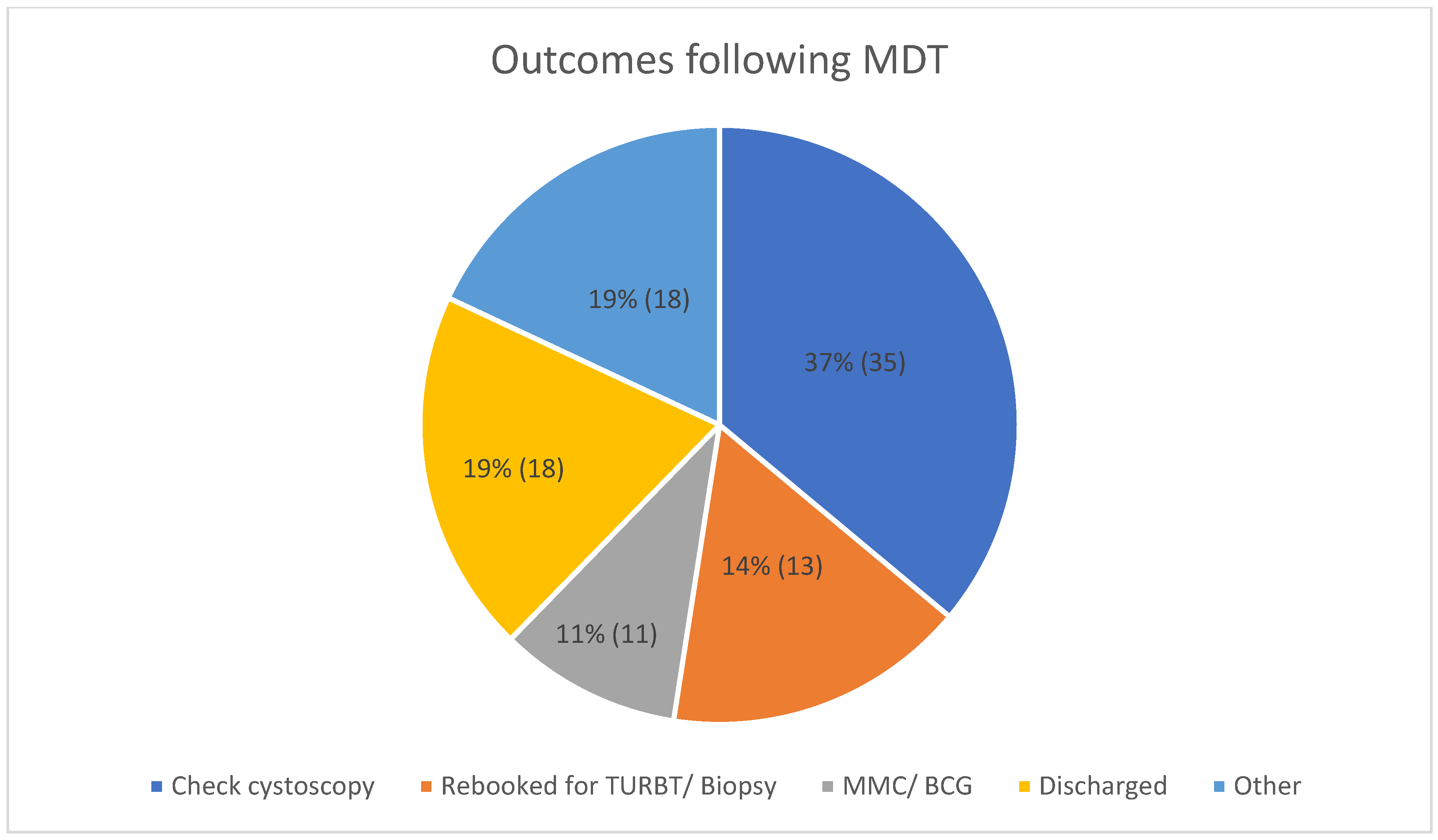
Of the initial 61 patients, 47 (77.1%) had LA + IV sedation administered by an anaesthetist; 8 (13.1%) had GA; 5 (8.2%) had LA alone and 1 (1.6%) had spinal anaesthetic (SA). In this cohort, 16 (26.2%) cases were found to have incomplete sampling, defined as absence of detrusor muscle within the biopsy specimen. Of these, following MDT discussion, 5 (8.2%) were rebooked for TURBT; 1 (1.6%) was rebooked for repeat TULA; 9 (14.8%) continued with check cystoscopies and 1 (1.6%) was discharged. Tumours on the anterior bladder wall and those seen only on J-manouvre proved the most difficult to sample, all with incomplete sampling (four tumours total).
In the second phase of the study, out of 34 patients, 17 (50%) had LA + IV sedation and 17 (50%) had LA alone. A total of 16 (47%) were found to have incomplete sampling and of these, 3 (8.8%) were rebooked for TURBT; 10 (29.4%) continued with check cystoscopy and 3 (8.8%) were discharged.
None of the cases were considered to have missed a significant finding. Three (3.2%) cases later required repeat biopsies following check flexible cystoscopy, These findings may represent tumour recurrence rather than missed lesions, although formal oncological outcome analysis was not the aim of this study. One (1.1%) case had a complication with ongoing bleeding, requiring catheterisation and subsequent washout under GA. This patient had not stopped their anticoagulation medication. There were no other cases reporting complications. Post-MDT outcomes are shown in
Figure 1, with the additional cases rebooked for TURBT for completion of resection. There were two deaths in the follow-up period, both were inpatients under the medical team and died of non-bladder cancer-related causes.
Between July and November 2024, with the addition of the bladder cancer surgery planning meetings (BSPMs), 24 patients were identified for TULA, out of the total of 108 patients discussed in BSPMs. Of these, 7 (29%) were originally booked for TURBT and were waiting for a long period for pre-operative assessment clearance.
3.2. Costing Analysis
Following the local average procedure pricing methodology, considering the total number of TULA procedures in the study period and assuming they were all performed in an outpatient setting, the cost estimates represent an average cost per patient of GBP 992 and an approximate saving of GBP 99,845 for the Trust (
Table 2).
4. Discussion
This study demonstrates the clinical and cost-effective integration of TULA into a bladder cancer service. Coupled with bladder cancer surgery planning meetings, TULA enabled a significant reduction in cancer waiting time, especially for those awaiting high-risk general anaesthetic pre-operative assessment (POA) clearance. It also reduced unnecessary TURBT procedures, which supports a reduction in local Trust spending. The study was designed as a service evaluation assessing the feasibility, safety, and cost-effectiveness of TULA within an established bladder cancer pathway, rather than an assessment of long-term oncological outcomes.
Bladder cancer is a common cancer in Europe, including in the UK, with around 10,500 new cases every year. Incidence rates are highest in the elderly population with 56% of bladder cancer cases in the UK occurring in those aged 75 and over [
14,
15]. This has a significant financial impact, with 3-year estimates of bladder cancer costs in the UK at GBP 66.14 million [
16]. TULA represents a diagnostic and treatment pathway that reduces morbidity, obtains biopsies effectively and is cost-effective. As a result, over 100 TULA services have now been established in the UK with around 10,000 procedures estimated to be performed annually [
17]. A great deal of research has supported this implementation and international urological associations including the European Association of Urology (EAU) have endorsed the use of TULA. TULA has additional uses for ureteric or renal pelvi-calyceal tumour biopsy, but these have been excluded from this study as they would not be used in an outpatient setting. TULA remains an adjunct to the bladder cancer pathway with TURBT still remaining the gold standard. However, in scenarios such as suspected metastatic or muscle-invasive bladder cancer, where obtaining histopathological evidence to determine appropriate radical/oncological treatment with standard TURBT is delayed, TULA may also be sufficient to progress the bladder cancer pathway. Future uses of TULA may develop, for example, the newly available 200 µm laser fibre will allow better access to difficult areas in the bladder and upper tract. It may also become feasible to treat high-risk NMIBC with TULA when blue-light flexible cystoscopy becomes available.
This study demonstrates a clear cost saving that could be achieved by moving the TULA service to an outpatient setting, with an approximate 60% cost reduction compared to a day-case TURBT. The local costs of major and intermediate endoscopic bladder procedures and flexible cystoscopy differ from the national averages suggested by NHS England (GBP 2002, GBP 841, and GBP 257, respectively). This may be attributed to differences in medical staffing and the use of consumables. Additional equipment costs associated with the service include the base pricing of the LEONARDO® Mini dual laser system at around GBP 11,500 with the stand and a cost of GBP 1100 for laser eye protection at GBP 245 per unit. Any facility offering TULA as an outpatient procedure needs to ensure laser safety protocols are followed.
TULA procedures are generally well tolerated with better patient-reported outcomes compared to TURBT [
18]. This includes a lower perception of pain, shorter duration of haematuria, and fewer instances of acute urinary retention. This study demonstrates this with the majority of procedures (90.5%) being performed under LA with or without IV sedation, provided by an anaesthetist. There was a significant improvement between the two phases of the study with more patients in the second phase having LA alone. This represents the learning curve of a new procedure with improved confidence over time and the progression towards forming an outpatient service.
The low complication rate in this study is in-line with similar published standards [
13,
19,
20]. This supports its role as a less invasive treatment option. The overall rates of detrusor muscle sampling with TULA in this study was 66.3%, even though the flexible cold-cup biopsy forceps used through the flexible cystoscope are relatively small when compared to the rigid cold-cup biopsy forceps used through a rigid cystoscope. The TULA muscle sampling rate approaches the British Association of Urological Surgeons’ set standard for TURBT at 70% and suggests TULA can achieve similar resection depths with room for improvement. Lack of muscle in the specimen did not mandate a significant number of repeat procedures, with the majority of patients continuing with check flexible cystoscopy. Variation in sampling may further demonstrate differences of surgeon experience, as more surgeons began learning the procedure in the second phase. Patients were appropriately selected for the procedure with the majority being of an older age cohort and an ASA III or above. Furthermore, no cases were converted intra-operatively to TURBT, for example, for large tumours. Rarely were tumours treated with an en bloc resection, but as this is being increasingly used nationally; further assessment of its safety in the TULA setting is necessary.
Although there was one patient (1.1%) with a bleeding complication that required re-admission and bladder washout, generally TULA procedures can be performed safely in patients on anticoagulants and antiplatelet agents without stopping them or requiring a peri-operative bridging plan, based on evidence from multiple UK NHS trusts and the UK’s GIRFT programme (4).
Following the introduction of the bladder cancer surgery planning meetings in July 2024, a total of 108 patients were discussed during the initial implementation period up to November 2024. Within this cohort, 24 patients were directed to TULA rather than TURBT after a multidisciplinary review. However, this snapshot analysis reflects an early implementation phase of the pathway and does not span the full duration of either audit cycle in the present study. As such, these data are presented for contextual service insight only and were not included in the primary analysis.
This retrospective analysis of clinical outcomes over 2 years is not without limitations. The results describe economic benefits in a single secondary care unit. It is acknowledged that these results might not exactly replicate the exact procedure costs in different healthcare Trusts or systems. Furthermore, cost estimates assume that all the TULA procedures could be performed in an outpatient setting. However, as with flexible cystoscopy procedures, there is variability of patient tolerance to the procedure and IV sedation may still be needed in some cases. The follow-up period ranged from 4 weeks to 1 year. As a result, not all patients had undergone a flexible check cystoscopy at the time of analysis, and so we cannot yet comment on long-term oncological outcomes. The proportion of all bladder cancer cases directed to TULA over time was not specifically analysed and this represents an area for future service evaluation.
5. Conclusions
Our results further support the role of TULA as a safe and cost-effective adjunct within a secondary care bladder cancer pathway with low complication rates and appropriate sampling. The next step will involve using TULA in a fully outpatient setting under LA. This will help further reduce the cancer waiting times, create additional GA theatre slots for other more deserving surgical procedures, and represent a significant cost saving. We believe the pathway described is reproducible in similar healthcare settings. Our experience may guide other units, especially those facing long surgical wait times or servicing elderly, comorbid populations, in developing their own outpatient bladder cancer laser treatment services. However, longer term follow-up will be required to assess oncological outcomes as outpatient TULA services continue to evolve.
Author Contributions
Conceptualization, S.K.P. and S.A.; methodology, S.K.P. and A.K.-S.; data curation, A.K.-S.; writing—original draft preparation, A.K.-S.; writing—review and editing, S.K.P., S.H. and A.K.-S.; supervision, S.K.P.; project administration. All authors have read and agreed to the published version of the manuscript.
Funding
This research received no external funding.
Institutional Review Board Statement
The research team have advised that this retrospective audit was approved and deemed by clinical governance as not requiring research approvals. As the audit was primarily a service evaluation with no patient identifying information, they do not issue ethics committee approval statements.
Informed Consent Statement
Informed consent for data analysis was waived by the local Ethics Committee.
Data Availability Statement
The data presented in this study are available on request from the corresponding author, S.K.P. The data is not publicly available to protect patient privacy.
Acknowledgments
The authors wish to express their gratitude to Sachin Agrawal, Urologist at Ashford and St. Peter’s Hospitals NHS Foundation Trust for providing expertise on TULA and to Steven Verdin at Promed Ltd. for assistance in equipment acquisition.
Conflicts of Interest
The authors declare no conflicts of interest.
References
- Cancer Research UK. Bladder Cancer Statistics. Available online: https://www.cancerresearchuk.org/health-professional/cancer-statistics/statistics-by-cancer-type/bladder-cancer#BladderCS0 (accessed on 19 October 2025).
- Grabe-Heyne, K.; Henne, C.; Mariappan, P.; Geiges, G.; Pöhlmann, J.; Pollock, R.F. Intermediate and high-risk non-muscle-invasive bladder cancer: An overview of epidemiology, burden, and unmet needs. Front. Oncol. 2023, 13, 1170124. [Google Scholar] [CrossRef] [PubMed]
- Harrison, S. GIRFT Programme National Specialty Report; NHS: Leeds, UK, 2018. [Google Scholar]
- John, J.; McGrath, J. GIRFT Greener Pathways: A Practical Guide to Decarbonising the Bladder Cancer Care Pathway; NHS: Leeds, UK, 2024. [Google Scholar]
- John, J.B.; Collins, M.; Eames, S.; O’Flynn, K.; Briggs, T.W.R.; Gray, W.K.; McGrath, J.S. The carbon footprint of the perioperative transurethral resection of bladder tumour pathway. BJU Int. 2025, 135, 78–87. [Google Scholar] [CrossRef] [PubMed]
- Babjuk, M.; Burger, M.; Capoun, O.; Cohen, D.; Compérat, E.M.; Dominguez Escrig, J.L.; Gontero, P.; Liedberg, F.; Masson-Lecomte, A.; Mostafid; et al. European Association of Urology Guidelines on Non–muscle-invasive Bladder Cancer (Ta, T1, and Carcinoma in Situ). Eur. Urol. 2022, 81, 75–94. [Google Scholar] [CrossRef] [PubMed]
- Leiblich, A.; Bryant, R.J.; Crew, J. The management of non-muscle-invasive bladder cancer: A comparison of European and UK guidelines. J. Clin. Urol. 2018, 11, 144–148. [Google Scholar] [CrossRef]
- Kim, L.H.C.; Patel, M.I. Transurethral resection of bladder tumour (TURBT). Transl. Androl. Urol. 2020, 9, 3056–3072. [Google Scholar] [CrossRef] [PubMed]
- Nieder, A.M.; Meinbach, D.S.; Kim, S.S.; Soloway, M.S. Transurethral bladder tumor resection: Intraoperative and postoperative complications in a residency setting. J. Urol. 2005, 174, 2307–2309. [Google Scholar] [CrossRef] [PubMed]
- Sylvester, R.J.; van der Meijden, A.P.; Oosterlinck, W.; Witjes, J.A.; Bouffioux, C.; Denis, L.; Newling, D.W.; Kurth, K. Predicting recurrence and progression in individual patients with stage Ta T1 bladder cancer using EORTC risk tables: A combined analysis of 2596 patients from seven EORTC trials. Eur. Urol. 2006, 49, 466–477. [Google Scholar] [CrossRef] [PubMed]
- Sievert, K.D.; Amend, B.; Nagele, U.; Schilling, D.; Bedke, J.; Horstmann, M.; Hennenlotter, J.; Kruck, S.; Stenzl, A. Economic aspects of bladder cancer: What are the benefits and costs? World J. Urol. 2009, 27, 295–300. [Google Scholar] [CrossRef] [PubMed]
- Sanchez, A.; Agarwal, N. Quantifying the Costs of Care Among Patients with High-Risk Non–Muscle-Invasive Bladder Cancer Treated in the Veterans Health Administration. JAMA Netw. Open. 2021, 4, e213816. [Google Scholar] [CrossRef] [PubMed]
- Ng, C.P.Y.; Light, A.; Eleftheriou, C.; Hug, O.; Richardson, E.; Gill-Taylor, T.; Shamsuddin, A.; Abboudi, H.; Agrawal, S. Long-term outcome of transurethral laser ablation for recurrent non-muscle invasive bladder cancer: An EORTC risk-matched study. BJUI Compass 2025, 6, e70052. [Google Scholar] [CrossRef] [PubMed]
- Cancer Research UK. Bladder Cancer Incidence Statistics. Available online: https://www.cancerresearchuk.org/health-professional/cancer-statistics/statistics-by-cancer-type/bladder-cancer/incidence (accessed on 19 October 2025).
- Bray, F.; Laversanne, M.; Sung, H.; Ferlay, J.; Siegel, R.L.; Soerjomataram, I.; Jemal, A. Global cancer statistics 2022: GLOBOCAN estimates of incidence and mortality worldwide for 36 cancers in 185 countries. CA Cancer J. Clin. 2024, 74, 229–263. [Google Scholar] [CrossRef] [PubMed]
- Cox, E.; Saramago, P.; Kelly, J.; Porta, N.; Hall, E.; Tan, W.S.; Sculpher, M.; Soares, M. Effects of Bladder Cancer on UK Healthcare Costs and Patient Health-Related Quality of Life: Evidence from the BOXIT Trial. Clin. Genitourin. Cancer 2020, 18, e418–e442. [Google Scholar] [CrossRef] [PubMed]
- Agrawal, S. GIRFT Urology: Transurethral Laser Ablation for Bladder Cancer Pathway Guide; NHS: Leeds, UK, 2025. [Google Scholar]
- Deacon, N.N.; Nielsen, N.K.; Jensen, J.B. Patient-Reported Outcomes after Laser Ablation for Bladder Tumours Compared to Transurethral Resection—A Prospective Study. Cancers 2024, 16, 1630. [Google Scholar] [CrossRef] [PubMed]
- Khalil, I.A.; Younes, N.; Badawi, A.; Al Rumaihi, K. Efficacy and safety of office-based diode laser ablation for recurrent low-grade non-muscle-invasive bladder cancer under local anaesthesia: A pilot study. Arab. J. Urol. 2024, 23, 70–74. [Google Scholar] [CrossRef] [PubMed]
- Bai, Y.; Liu, L.; Yuan, H.; Li, J.; Tang, Y.; Pu, C.; Han, P. Safety and efficacy of transurethral laser therapy for bladder cancer: A systematic review and meta-analysis. World J. Surg. Oncol. 2014, 12, 301. [Google Scholar] [CrossRef] [PubMed]
| Disclaimer/Publisher’s Note: The statements, opinions and data contained in all publications are solely those of the individual author(s) and contributor(s) and not of MDPI and/or the editor(s). MDPI and/or the editor(s) disclaim responsibility for any injury to people or property resulting from any ideas, methods, instructions or products referred to in the content. |
© 2026 by the authors. Published by MDPI on behalf of the Société Internationale d’Urologie. Licensee MDPI, Basel, Switzerland. This article is an open access article distributed under the terms and conditions of the Creative Commons Attribution (CC BY) license.