1. Introduction
Dysuria, defined as painful or difficult urination, is a common symptom across various patient populations, frequently resulting from urinary tract infections (UTIs), urologic malignancies, and inflammatory disorders. Its associated pain can significantly impair quality of life, underscoring the need for effective management strategies. Recently, medical cannabis (MC) has emerged as a potential alternative for pain control due to its antinociceptive and anti-inflammatory effects [
1]. However, concerns persist regarding its long-term safety, particularly its possible role in precipitating substance use disorders (SUD).
Several epidemiologic studies have found that cannabis use, whether recreational or medicinal, may elevate the risk of developing SUD. In a longitudinal analysis of general population data, cannabis use increased odds of future SUD diagnoses, including a more than ninefold risk for cannabis-use disorder (CUD) and significant associations with alcohol and other drug use disorders [
2]. Among patients with chronic pain initiating cannabis use, a substantial proportion meet criteria for CUD within a year, with concurrent psychiatric symptoms frequently observed [
3]. These data underscore cannabis’s potential to alter neurobiological reward circuits, increasing vulnerability to misuse [
4].
Although preclinical findings indicate cannabinoids may ameliorate symptoms in bladder dysfunction models, clinical evidence for their benefit in non-neurogenic lower urinary tract symptoms (LUTS) or dysuria remains inconclusive [
5,
6,
7]. Despite this, MC is increasingly prescribed for urinary symptoms without robust investigation into whether its use contributes to later SUD. This gap is critical, as individuals with dysuria may have overlapping risk factors such as pain syndromes, mental health issues, and polypharmacy that could elevate addiction risk.
From a conceptual standpoint, dysuria-related pain and discomfort may increase vulnerability to substance exposure through symptom-driven analgesic seeking, while cannabis-related modulation of reward pathways may further predispose susceptible individuals to subsequent substance use disorders [
3]. This biopsychosocial framework provides a rationale for examining downstream SUD risk following therapeutic cannabis exposure in a urologic population.
To address this, we conducted a large retrospective cohort study using a federated electronic health records network to assess whether MC exposure following dysuria diagnosis is associated with increased risk of developing SUD, including cannabis, opioid, or cocaine use disorders. Dysuria was selected as the index condition because it is a common, symptom-driven indication for analgesic prescribing and represents a clinically heterogeneous population without baseline substance pathology. Using propensity score matching (PSM), we hypothesized MC use would be independently associated with higher incidence and earlier onset of SUD compared to matched controls.
2. Methods
A retrospective cohort design was performed, utilizing data from the TriNetX Research Network, a federated global health research platform aggregating de-identified electronic health records (EHRs) from more than 120 million patients across academic medical centers, integrated delivery networks, and community healthcare systems. The TriNetX platform provides access to longitudinal clinical data including demographic characteristics, diagnoses, procedures, medication exposures, and laboratory results. All data analyses were conducted within the TriNetX Analytics environment, which ensures compliance with Health Insurance Portability and Accountability Act (HIPAA) privacy regulations and qualifies for exemption from Institutional Review Board (IRB) oversight due to the de-identified nature of the data.
Adult patients aged 18 years and older were identified between 1 January 2003, and 29 February 2024, based on a recorded diagnosis of dysuria, defined by the International Classification of Diseases, Tenth Revision, Clinical Modification (ICD-10-CM) code R30.0. The date of the first recorded dysuria diagnosis was defined as the index date for cohort entry. Two mutually exclusive cohorts were defined for analysis: the general dysuria (GD) cohort included patients with a diagnosis of dysuria who had no recorded cannabis-related diagnostic codes at any point during the observation period and the second dysuria cohort, referred to as the MC cohort, included patients with a cannabis-related diagnosis, identified by ICD-10-CM codes F12.0 through F12.9, within 90 days following the initial dysuria diagnosis. Patients with any prior diagnosis of SUD preceding the index date were excluded to ensure the capture of incident cases of SUD following medical cannabis exposure.
The primary outcome was new onset of SUD within 12 months of index dysuria diagnosis, defined by ICD-10-CM codes for abuse or dependence of cannabis (F12.1, F12.2), opioids (F11.1, F11.2), or cocaine (F14.1, F14.2). The secondary outcome was time to SUD onset, measured from index date to first SUD diagnosis and assessed over up to 5 years, allowing detection of early divergence in SUD incidence. An aggregated SUD outcome was selected to capture overall substance-related harm following cannabis exposure, reduce outcome sparsity inherent to EHR-based diagnoses, and reflect real-world clinical patterns in which polysubstance use and diagnostic overlap are common.
Baseline demographic variables included age, sex, and race/ethnicity. Where available, clinical covariates such as psychiatric comorbidities, chronic pain history, and prior urinary tract infections were evaluated. To mitigate confounding and reduce selection bias, 1:1 PSM was performed between MC and GD cohorts using greedy nearest-neighbor algorithm with caliper of 0.1 pooled standard deviations. Matching was based on age, sex, and race/ethnicity. PSM was performed prior to exclusion of patients with pre-existing SUD, and differential exclusion rates subsequently resulted in loss of exact 1:1 balance in the final analytic cohorts. Additional clinical variables were intentionally not included in PSM to avoid overmatching on potential mediators of cannabis exposure and to preserve cohort size within a federated database environment. Balance was assessed using standardized mean differences (SMD), with values < 0.1 considered acceptable.
Descriptive statistics summarized baseline characteristics. Means and standard deviations were reported for continuous variables; categorical variables as counts and percentages. Between-group comparisons used two-sample t-tests for continuous variables and chi-square tests for categorical variables. Association between cannabis use and subsequent SUD was evaluated using logistic regression to estimate odds ratios (ORs) and risk ratios with 95% confidence intervals (CIs). Kaplan–Meier (KM) survival curves visualized time-to-event data, and log-rank tests compared survival distributions between cohorts. For 12-month analyses, patients were required to have at least 12 months of follow-up or were right-censored at last encounter. Patients were censored at the time of last recorded clinical activity.
3. Results
A total of 4,443,235 adult patients diagnosed with dysuria were identified during the initial extraction. Of these, 102,841 patients had documented cannabis use following their dysuria diagnosis and were assigned to the MC cohort (medical cannabis). The remaining 4,340,394 patients who did not use cannabis formed the GD cohort. After applying 1:1 PSM based on age, sex, and race/ethnicity, both cohorts included 102,559 patients, forming two demographically comparable populations.
Following matching, the mean age at index was 37.2 ± 16.3 years in both groups. The female proportion was identical across cohorts (64.55% in each). Racial composition was similarly balanced, with White patients comprising 57.99%, Black or African American patients 28.58%, and male patients representing 32.84% of each cohort. SMDs for all demographic covariates were <0.0001 after matching, confirming considerable balance. These characteristics are detailed in
Table 1.
The mean follow-up duration was 924.3 days (standard deviation [SD]: 664.9) in the MC cohort and 1074.5 days (SD: 719.6) in the GD cohort. Median follow-up durations were 842 and 1181 days, respectively, with interquartile ranges of 1362 and 1481 days. The baseline clinical diagnoses, including urinary tract infection, vaginitis, cystitis, and relevant urological and systemic comorbidities were also analyzed. Some variables showed persistent significance after matching (e.g., urinary tract infection: 35.1% MC vs. 15.75% GD, SMD = 0.4562; sedative use: 61.3% MC vs. 27.3% GD, SMD = 0.727). These residual imbalances highlight clinically relevant differences in symptom burden and medication exposure between cohorts and were therefore retained to contextualize downstream SUD risk rather than eliminated through overmatching. These findings are summarized in
Table 2.
Following PSM, patients with a prior SUD diagnosis were excluded, resulting in a final analytic sample of 60,544 in the MC group and 98,715 in the GD group. During follow-up, 6736 patients (11.13%) in the MC cohort developed a new SUD diagnosis, compared to 2250 patients (2.28%) in the GD cohort. The resulting SUD risk difference was −8.85% (95% CI: −9.11 to −8.58; p < 0.0001). The relative risk was 0.205 (95% CI: 0.196–0.215), and the OR was 0.186 (95% CI: 0.177–0.196). These estimates reflect new SUD diagnoses occurring within 12 months of the index diagnosis.
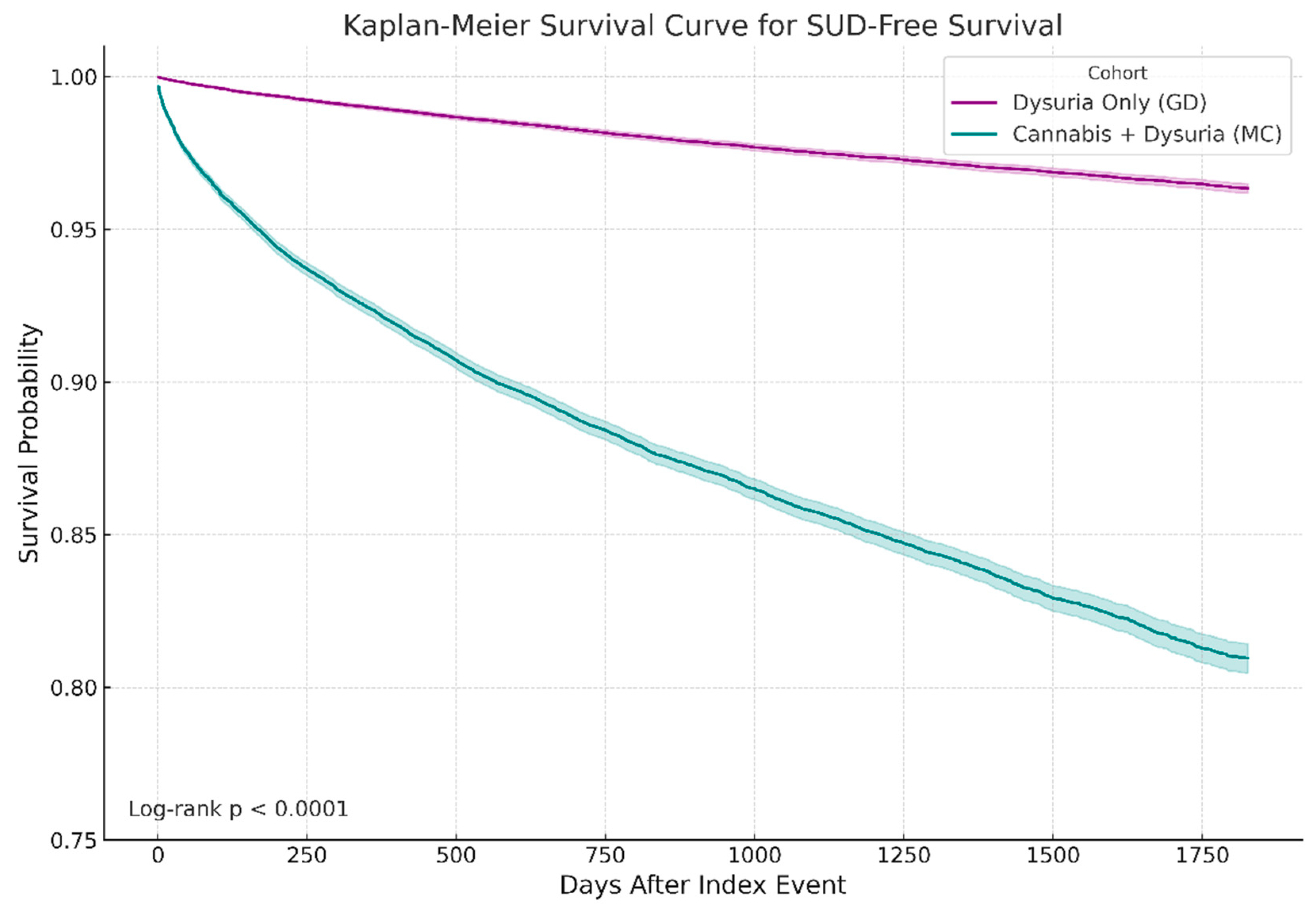
KM survival analysis over a 5-year period demonstrated significantly lower SUD-free survival in the MC cohort relative to the GD cohort. By the end of follow-up, the probability of remaining free of SUD was 80.96% in the MC group and 96.35% in the GD group. The log-rank test confirmed a significant difference between cohorts (χ
2 = 7093.6,
p < 0.0001). The corresponding hazards ratio (HR) for incident SUD was 0.163 (95% CI: 0.155–0.171), corresponding to a sixfold increase in hazard over the full 5-year observation period. The KM curves showed early separation and persistent divergence throughout the study period, reinforcing the magnitude and durability of this association (
Figure 1).
4. Discussion
This study demonstrates that MC use following a dysuria diagnosis is associated with a substantially higher risk of developing SUD, with a nearly fivefold increase in a 12-month incidence and a faster progression to SUD over long-term follow-up. These findings add to growing concerns regarding the safety profile of MC, particularly in populations whose cannabis exposure occurs in a therapeutic rather than recreational context.
The accelerated progression to SUD in the MC cohort suggests that MC use may act as a potential risk factor for earlier dependency or misuse. This aligns with existing evidence demonstrating a temporal link between cannabis use and the development of SUD [
7,
8,
9]. The 8.85% absolute increase in 12-month SUD incidence seen in our study is particularly notable within a urologic context, where symptom-driven analgesic prescribing may unintentionally introduce patients to substances with misuse potential. Prior work in urology, such as the study by Grutman et al., has shown similar concerns, postoperative opioid prescriptions led to significantly increased risks of persistent opioid use, with relative risks ranging from 2.18 to 17.0 depending on procedure type [
10]. Our findings extend this concern to MC, indicating that even non-opioid therapeutic agents may carry measurable addiction risks when used for urologic symptoms. Furthermore, the dose–response relationship described by Connor et al. [
7] underscores the importance of exposure patterns, suggesting that repeated or sustained MC use after dysuria may heighten vulnerability to SUD.
Urinary tract infections and sedative use were significantly more common in the MC cohort, suggesting a population with greater underlying symptom burden and medical complexity. Prior studies have shown that such factors including recurrent urologic symptoms, higher healthcare utilization, and exposure to psychoactive medications are associated with increased vulnerability to substance-related outcomes [
2,
11]. The substantially higher sedative use in the MC group is particularly notable, as sedative exposure is a recognized risk factor for future misuse and often reflects underlying psychological or pain-related distress. Together, these baseline characteristics may contribute to a “stacked risk” profile that helps explain the higher and earlier SUD incidence observed among MC users in our study.
Early initiation and prolonged use of MC have been associated with heightened addiction risk, reinforcing the importance of exposure timing in shaping patient outcomes [
12]. While MC may provide symptom relief for dysuria, our findings highlight the need for careful risk assessment prior to prescribing, particularly among individuals with a history of substance misuse or psychiatric comorbidities [
2,
11]. Ongoing clinical monitoring, including routine screening for early SUD symptoms may facilitate timely intervention and reduce the likelihood of adverse outcomes [
13]. Patient education should also be a core component of MC counseling, emphasizing adherence to prescribed dosing and caution against non-medical use [
14].
Given the elevated SUD risk observed in this study, clinicians should balance the potential benefits of MC against safer alternatives for dysuria management, including non-addictive analgesics and non-pharmacological interventions [
14,
15]. These findings also highlight the need for further research to clarify optimal dosing strategies, the appropriate duration of therapy, and patient-specific characteristics that influence vulnerability to dependency [
8,
16]. Because standardized dosing guidelines for MC remain limited, patients often self-titrate to achieve symptom relief, a pattern that may inadvertently increase exposure and associated risk. Investigating formulations with lower abuse potential, varying tetrahydrocannabinol (THC)-to-cannabidiol (CBD) ratios, and personalized therapeutic approaches may help optimize outcomes while minimizing the risk of SUD [
17,
18].
To our knowledge, no prior study has examined the relationship between medical cannabis use and subsequent SUD specifically in dysuria patients, making this analysis a unique and clinically impactful contribution to the urologic literature. This study adds meaningfully to the existing research and clinical practice literature. While prior studies have characterized cannabis-related harms in general or chronic pain populations, evidence in urologic settings has been limited. Our findings address this gap by demonstrating that MC exposure in a urologic symptom population, where cannabis is increasingly considered as an analgesic option, carries measurable risk for new-onset and earlier-onset SUD. This contribution is clinically important as urologists increasingly encounter patient interest in MC for symptom management and require evidence-based guidance to inform prescribing practices.
The strengths of this study include its large, diverse sample size and the use of propensity score matching, which reduced demographic confounding and enhanced internal validity. By leveraging a federated electronic health records platform, this study provides real-world estimates that are immediately applicable to clinical decision-making in urology. However, the retrospective design precludes causal inference, and unmeasured factors, such as socioeconomic status, symptom severity, cannabis formulation, and frequency of use may influence outcomes. Although some clinical variables remained imbalanced after matching, these factors may represent downstream consequences or correlates of cannabis exposure rather than true baseline confounders. Diagnostic coding variability across institutions may also affect exposure classification. Differences in follow-up duration between cohorts may introduce survival bias, although early and persistent curve separation supports the robustness of the observed association.
Accordingly, findings should be interpreted as associative rather than causal. Future prospective studies are needed to better define risk trajectories and identify which dysuria patients are most vulnerable to developing SUD after MC exposure.
5. Conclusions
While MC represents a promising therapeutic option for managing dysuria, its potential to increase the risk of SUD necessitates cautious application in clinical practice. This study provides a critical foundation for future research and policy development aimed at balancing the therapeutic advantages of MC with the imperative to safeguard public health.
Author Contributions
M.A.M.H.: Conceptualization, investigation, data curation, writing—original draft, writing—review and editing. L.E.B.: Conceptualization, Investigation, Writing—original draft, writing—review and editing. M.S.: Conceptualization, investigation, writing—original draft, writing—review and editing. G.M.G.: Conceptualization, investigation, writing—original draft, writing—review and editing. All authors have read and agreed to the published version of the manuscript.
Funding
This research received no external funding.
Institutional Review Board Statement
This study did not involve human participants and did not require ethics committee approval. All data analyses were conducted within the TriNetX Analytics environment, which ensures compliance with Health Insurance Portability and Accountability Act (HIPAA) privacy regulations and qualifies for exemption from Institutional Review Board (IRB) oversight due to the de-identified nature of the data.
Informed Consent Statement
This is a retrospective study using previously available data. No informed consent was required.
Data Availability Statement
The data that support the findings of this study were accessed through the TriNetX Research Network. Due to data use agreements and privacy regulations, individual-level data are not publicly available. Aggregated data generated and analyzed during the study are included in this published article. Researchers with authorized access to TriNetX may request access to the underlying data through the platform.
Conflicts of Interest
The authors declare no conflicts of interest related to the content of this manuscript. No funding was received for the conduct of this study or preparation of this manuscript. All authors contributed substantially to the conception, design, analysis, and writing of this work, and approved the final version of the manuscript.
References
- Sznitman, S.R.; Rosenberg, D.; Vulfsons, S.; Meiri, D.; Greene, T. Medical Cannabis Use and Pain: An Experience Sampling Study. Front. Psychiatry 2021, 12, 728283. [Google Scholar] [CrossRef] [PubMed]
- Blanco, C.; Hasin, D.S.; Wall, M.M.; Flórez-Salamanca, L.; Hoertel, N.; Wang, S.; Kerridge, B.T.; Olfson, M. Cannabis Use and Risk of Psychiatric Disorders: Prospective Evidence From a US National Longitudinal Study. JAMA Psychiatry 2016, 73, 388–395. [Google Scholar] [CrossRef] [PubMed]
- Mun, C.J.; Timmons, P.M.; Perez, I.I.; Meier, M.H.; Wegener, S.T.; Campbell, C.M.; Aaron, R.V. Risk of Cannabis Use Disorder in Chronic Pain: Longitudinal Links to Pain Outcomes. J. Addict. Med. 2025, 19, 545–551. [Google Scholar] [CrossRef] [PubMed]
- Lupica, C.R.; Hoffman, A.F. Cannabinoid disruption of learning mechanisms involved in reward processing. Learn. Mem. 2018, 25, 435–445. [Google Scholar] [CrossRef] [PubMed]
- Christie, S.; Brookes, S.; Zagorodnyuk, V. Endocannabinoids in Bladder Sensory Mechanisms in Health and Diseases. Front. Pharmacol. 2021, 12, 708989. [Google Scholar] [CrossRef] [PubMed]
- Andersson, K.E. Emerging drugs for the treatment of bladder storage dysfunction. Expert Opin. Emerg. Drugs 2022, 27, 277–287. [Google Scholar] [CrossRef] [PubMed]
- Connor, J.P.; Stjepanović, D.; Le Foll, B.; Hoch, E.; Budney, A.J.; Hall, W.D. Cannabis use and cannabis use disorder. Nat. Rev. Dis. Primers 2021, 7, 16. [Google Scholar] [CrossRef] [PubMed] [PubMed Central]
- Choi, N.G.; Moore, J.; Choi, B.Y. Cannabis use disorder and substance use treatment among U.S. adults. J. Subst. Use Addict. Treat. 2024, 167, 209486. [Google Scholar] [CrossRef] [PubMed]
- Galimberti, M.; Levey, D.F.; Deak, J.D.; Zhou, H.; Stein, M.B.; Gelernter, J. Genetic influences and causal pathways shared between cannabis use disorder and other substance use traits. Mol. Psychiatry 2024, 29, 2905–2910. [Google Scholar] [CrossRef] [PubMed]
- Grutman, A.J.; Stewart, C.; Able, C.; Agrawal, P.; Galansky, L.; Gabrielson, A.; Haney, N.; Kohn, T.P.; Crigger, C.B. Postoperative Opioid Prescribing in Adolescents and Young Adults After Urologic Procedures Is Associated With New Persistent Opioid Use Disorder: A Large Claims Database Analysis. Urology 2023, 182, 211–217. [Google Scholar] [CrossRef] [PubMed]
- Vasilenko, S.A.; Evans-Polce, R.J.; Lanza, S.T. Age trends in rates of substance use disorders across ages 18–90: Differences by gender and race/ethnicity. Drug Alcohol Depend. 2017, 180, 260–264. [Google Scholar] [CrossRef] [PubMed]
- Fergusson, D.M.; Boden, J.M.; Horwood, L.J. The developmental antecedents of illicit drug use: Evidence from a 25-year longitudinal study. Drug Alcohol Depend. 2008, 96, 165–177. [Google Scholar] [CrossRef] [PubMed]
- Woodward, D.; Wilens, T.E.; Glantz, M.; Rao, V.; Burke, C.; Yule, A.M. A systematic review of substance use screening in outpatient behavioral health settings. Addict. Sci. Clin. Pract. 2023, 18, 18. [Google Scholar] [CrossRef] [PubMed] [PubMed Central]
- Bushnell, M.C.; Frangos, E.; Madian, N. Non-pharmacological Treatment of Pain: Grand Challenge and Future Opportunities. Front. Pain Res. 2021, 2, 696783. [Google Scholar] [CrossRef] [PubMed] [PubMed Central]
- Dey, S.; Sanders, A.E.; Martinez, S.; Kopitnik, N.L.; Vrooman, B.M. Alternatives to Opioids for Managing Pain. In StatPearls [Internet]; StatPearls Publishing: Treasure Island, FL, USA, 2024. Available online: https://www.ncbi.nlm.nih.gov/books/NBK574543/ (accessed on 11 January 2026).
- Hasin, D.S.; Kerridge, B.T.; Saha, T.D.; Huang, B.; Pickering, R.; Smith, S.M.; Jung, J.; Zhang, H.; Grant, B.F. Prevalence and correlates of DSM-5 cannabis use disorder, 2012-2013: Findings from the National Epidemiologic Survey on Alcohol and Related Conditions–III. Am. J. Psychiatry 2016, 173, 588–599. [Google Scholar] [CrossRef] [PubMed]
- Schlag, A.K.; Hindocha, C.; Zafar, R.; Nutt, D.J.; Curran, H.V. Cannabis based medicines and cannabis dependence: A critical review of issues and evidence. J. Psychopharmacol. 2021, 35, 773–785. [Google Scholar] [CrossRef] [PubMed] [PubMed Central]
- Hossain, M.K.; Chae, H.J. Medical cannabis: From research breakthroughs to shifting public perceptions and ensuring safe use. Integr. Med. Res. 2024, 13, 101094. [Google Scholar] [CrossRef] [PubMed] [PubMed Central]
| Disclaimer/Publisher’s Note: The statements, opinions and data contained in all publications are solely those of the individual author(s) and contributor(s) and not of MDPI and/or the editor(s). MDPI and/or the editor(s) disclaim responsibility for any injury to people or property resulting from any ideas, methods, instructions or products referred to in the content. |
© 2026 by the authors. Published by MDPI on behalf of the Société Internationale d’Urologie. Licensee MDPI, Basel, Switzerland. This article is an open access article distributed under the terms and conditions of the Creative Commons Attribution (CC BY) license.