
Cystic Fibrosis Mortality Trends 1999–2024—A CDC Wonder Study


Highlights
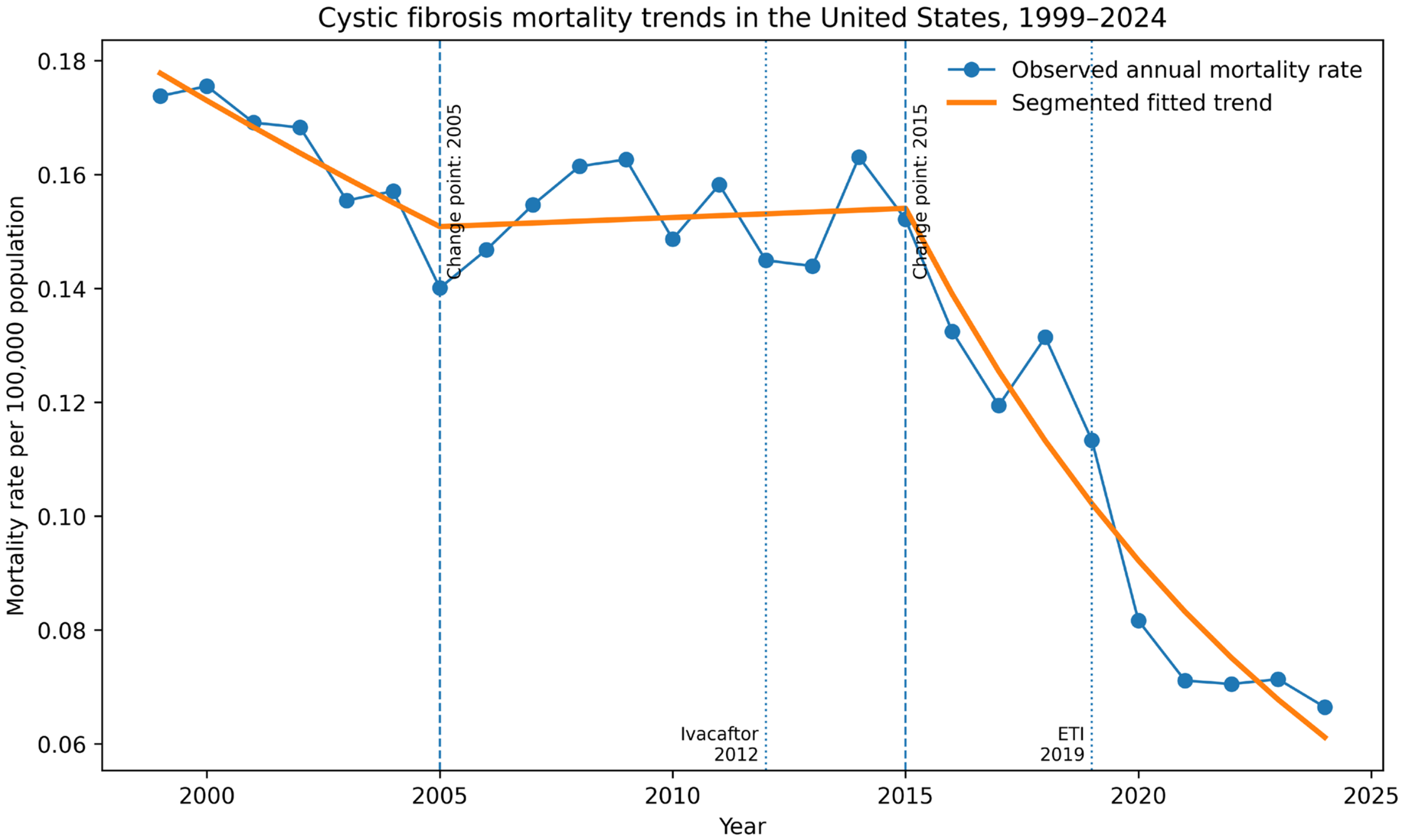
- CF mortality declined by more than half over 26 years, with the age-adjusted mortality rate falling from 0.17 to 0.07 per 100,000 (1999–2024). The steepest reduction coincided temporally with elexacaftor/tezacaftor/ivacaftor availability, though causation cannot be established from ecological data.
- The female-to-male death count ratio shifted from 1.05 to 0.97 across therapeutic periods; however, age-adjusted mortality rates were identical between sexes within each period, and this observation should be considered hypothesis-generating rather than evidence of differential benefit.
- Despite absolute mortality declines in every U.S. Census Region, the South’s share of deaths grew from 37.2% to 41.6%. Several factors may contribute to this pattern, including differences in modulator-eligible genotype prevalence, socioeconomic barriers, and insurance-related limitations, though the current data cannot determine their relative contributions.
- Annual deaths stabilized at approximately 235 per year from 2021 through to 2024, a novel observation that may reflect the approximately 10% of CF patients ineligible for current modulators, irreversible organ damage in older patients, and evolving death certificate coding practices.
Abstract
1. Introduction
2. Materials and Methods
2.1. Study Design and Data Sources
2.2. Case Identification
2.3. Population Denominators
2.4. Rate Calculations
2.5. Stratification and Subgroup Analyses
2.6. Outcome Definitions
2.7. Crude Mortality Rate: Deaths per 100,000 Population, Unadjusted for Age
2.8. Stratification of Therapeutic Periods
- Pre-modulator period (1999–2011): The period preceding the approval of any CFTR modulator therapy, serving as the baseline comparator.
- Early CFTR modulator period (2012–2018): Beginning with the approval of ivacaftor (January 2012, targeting gating mutations in approximately 4–5% of patients), encompassing the approval of lumacaftor/ivacaftor (July 2015, extending eligibility to F508del homozygotes, approximately 25% of patients), and ending with the approval of tezacaftor/ivacaftor (February 2018).
- Elexacaftor/tezacaftor/ivacaftor period (2019–2024): Beginning with the approval of elexacaftor/tezacaftor/ivacaftor (Trikafta) in October 2019, which extended modulator eligibility to patients with at least one F508del allele (approximately 90% of the CF population). Although the drug was approved in late 2019, the full calendar year of 2019 was included in this period to capture the transitional period and because partial-year effects were expected.
2.9. Statistical Approach
3. Results
3.1. Sex Variation
3.2. Regional Variation
3.3. Temporal Trend Analysis
3.4. Interrupted Time-Series Sensitivity Analysis
4. Discussion
Author Contributions
Funding
Institutional Review Board Statement
Informed Consent Statement
Data Availability Statement
Acknowledgments
Conflicts of Interest
References
- Cystic Fibrosis Foundation. Patient Registry Annual Data Report; Cystic Fibrosis Foundation: Bethesda, MD, USA, 2022. [Google Scholar]
- Burgel, P.R.; Burnet, E.; Regard, L.; Martin, C. The Changing Epidemiology of Cystic Fibrosis: The Implications for Adult Care. Chest 2023, 163, 89–99. [Google Scholar] [CrossRef] [Scilit] [PubMed]
- Ong, T.; Ramsey, B.W. Cystic Fibrosis: A Review. JAMA 2023, 329, 1859–1871. [Google Scholar] [CrossRef] [Scilit] [PubMed]
- Singh, H.; Jani, C.; Marshall, D.C.; Franco, R.; Bhatt, P.; Podder, S.; Shalhoub, J.; Kurman, J.S.; Nanchal, R.; Uluer, A.Z.; et al. Cystic Fibrosis-Related Mortality in the United States from 1999 to 2020: An Observational Analysis of Time Trends and Disparities. Sci. Rep. 2023, 13, 15030. [Google Scholar] [CrossRef] [Scilit] [PubMed]
- Abraha, H.E.; Thoma, M.; Boghossian, N.S. Mortality Rate Trends for Sickle Cell Disease and Cystic Fibrosis in the US. JAMA Pediatr. 2025, 179, 1229–1231. [Google Scholar] [CrossRef] [Scilit] [PubMed]
- Middleton, P.G.; Mall, M.A.; Dřevínek, P.; Lands, L.C.; McKone, E.F.; Polineni, D.; Ramsey, B.W.; Taylor-Cousar, J.L.; Tullis, E.; Vermeulen, F.; et al. Elexacaftor-Tezacaftor-Ivacaftor for Cystic Fibrosis with a Single Phe508del Allele. N. Engl. J. Med. 2019, 381, 1809–1819. [Google Scholar] [CrossRef] [Scilit] [PubMed]
- Daines, C.L.; Tullis, E.; Costa, S.; Linnemann, R.W.; Mall, M.A.; McKone, E.F.; Polineni, D.; Quon, B.S.; Ringshausen, F.C.; Rowe, S.M.; et al. Long-Term Safety and Efficacy of Elexacaftor/Tezacaftor/Ivacaftor in People with Cystic Fibrosis and at Least One F508del Allele: 144-Week Interim Results from a 192-Week Open-Label Extension Study. Eur. Respir. J. 2023, 62, 2202029. [Google Scholar] [CrossRef] [Scilit] [PubMed]
- Wainwright, C.E.; Elborn, J.S.; Ramsey, B.W.; Marigowda, G.; Huang, X.; Cipolli, M.; Colombo, C.; Davies, J.C.; De Boeck, K.; Flume, P.A.; et al. Lumacaftor–Ivacaftor in Patients with Cystic Fibrosis Homozygous for Phe508del CFTR. N. Engl. J. Med. 2015, 373, 220–231. [Google Scholar] [CrossRef] [Scilit] [PubMed]
- Kurgansky, K.E.; Collaco, J.M.; Ng, D.K.; Lesko, C.R. Effectiveness of Cystic Fibrosis Transmembrane Conductance Regulator Modulator Therapy on Risk of Death for Individuals with Cystic Fibrosis. Chest 2026. Epub ahead of printing. [Google Scholar] [CrossRef] [Scilit] [PubMed]
- Bower, J.K.; Volkova, N.; Ahluwalia, N.; Sahota, G.; Xuan, F.; Chin, A.; Weinstock, T.G.; Ostrenga, J.; Elbert, A. Real-World Safety and Effectiveness of Elexacaftor/Tezacaftor/Ivacaftor in People with Cystic Fibrosis: Interim Results of a Long-Term Registry-Based Study. J. Cyst. Fibros. 2023, 22, 730–737. [Google Scholar] [CrossRef] [Scilit] [PubMed]
- Harness-Brumley, C.L.; Elliott, A.C.; Rosenbluth, D.B.; Raghavan, D.; Jain, R. Gender Differences in Outcomes of Patients with Cystic Fibrosis. J. Women’s Health 2014, 23, 1012–1020. [Google Scholar] [CrossRef] [Scilit] [PubMed]
- Sweezey, N.B.; Ratjen, F. The Cystic Fibrosis Gender Gap: Potential Roles of Estrogen. Pediatr. Pulmonol. 2014, 49, 309–317. [Google Scholar] [PubMed]
- Wang, A.; Lee, M.; Keller, A.; Jian, S.; Lowe, K.; Finklea, J.D.; Jain, R. Sex Differences in Outcomes of People with Cystic Fibrosis Treated with Elexacaftor/Tezacaftor/Ivacaftor. J. Cyst. Fibros. 2024, 23, 91–98. [Google Scholar] [CrossRef] [Scilit] [PubMed]
- Hincapie-Castillo, J.M.; Goodin, A. Using Joinpoint Regression for Drug Utilization Research: Tutorial and Case Study of Prescription Opioid Use in the United States. Pharmacoepidemiol. Drug Saf. 2023, 32, 509–516. [Google Scholar] [CrossRef] [Scilit] [PubMed]
- Bernal, J.L.; Cummins, S.; Gasparrini, A. Interrupted Time Series Regression for the Evaluation of Public Health Interventions: A Tutorial. Int. J. Epidemiol. 2017, 46, 348–355. [Google Scholar] [CrossRef] [Scilit] [PubMed]
- Ramsey, B.W.; Davies, J.; McElvaney, N.G.; Tullis, E.; Bell, S.C.; Dřevínek, P.; Griese, M.; McKone, E.F.; Wainwright, C.E.; Konstan, M.W.; et al. A CFTR Potentiator in Patients with Cystic Fibrosis and the G551D Mutation. N. Engl. J. Med. 2011, 365, 1663–1672. [Google Scholar] [CrossRef] [Scilit] [PubMed]
- Skilton, M.; Krishan, A.; Patel, S.; Sinha, I.P.; Southern, K.W. Potentiators (Specific Therapies for Class III and IV Mutations) for Cystic Fibrosis. Cochrane Database Syst. Rev. 2019, 1, CD009841. [Google Scholar] [CrossRef] [Scilit] [PubMed]
- Deeks, E.D. Ivacaftor: A Review of Its Use in Patients with Cystic Fibrosis. Drugs 2013, 73, 1595–1604. [Google Scholar] [CrossRef] [Scilit] [PubMed]
- McKone, E.F.; Borowitz, D.; Drevinek, P.; Griese, M.; Konstan, M.W.; Wainwright, C.; Ratjen, F.; Sermet-Gaudelus, I.; Plant, B.; Munck, A.; et al. Long-Term Safety and Efficacy of Ivacaftor in Patients with Cystic Fibrosis Who Have the Gly551Asp-CFTR Mutation: A Phase 3, Open-Label Extension Study (PERSIST). Lancet Respir. Med. 2014, 2, 902–910. [Google Scholar] [CrossRef] [Scilit] [PubMed]
- Guimbellot, J.S.; Baines, A.; Paynter, A.; Heltshe, S.L.; VanDalfsen, J.; Jain, M.; Rowe, S.M.; Sagel, S.D. Long-Term Clinical Effectiveness of Ivacaftor in People with the G551D CFTR Mutation. J. Cyst. Fibros. 2021, 20, 213–219. [Google Scholar] [CrossRef] [Scilit] [PubMed]
- Merlo, C.A.; Thorat, T.; DerSarkissian, M.; McGarry, L.J.; Nguyen, C.; Gu, Y.M.; Healy, J.; Rubin, J.L.; Brookhart, M.A. Long-Term Impact of Ivacaftor on Mortality Rate and Health Outcomes in People with Cystic Fibrosis. Thorax 2024, 79, 131–138. [Google Scholar] [CrossRef] [Scilit] [PubMed]
- Taylor-Cousar, J.L.; Munck, A.; McKone, E.F.; Van Der Ent, C.K.; Moeller, A.; Simard, C.; Wang, L.T.; Ingenito, E.P.; McKee, C.; Lu, Y.; et al. Tezacaftor-Ivacaftor in Patients with Cystic Fibrosis Homozygous for Phe508del. N. Engl. J. Med. 2017, 377, 2013–2023. [Google Scholar] [CrossRef] [Scilit] [PubMed]
- Rowe, S.M.; Daines, C.; Ringshausen, F.C.; Kerem, E.; Wilson, J.; Tullis, E.; Nair, N.; Simard, C.; Han, L.; Ingenito, E.P.; et al. Tezacaftor-Ivacaftor in Residual-Function Heterozygotes with Cystic Fibrosis. N. Engl. J. Med. 2017, 377, 2024–2035. [Google Scholar] [CrossRef] [Scilit] [PubMed]
- Heijerman, H.G.M.; McKone, E.F.; Downey, D.G.; Van Braeckel, E.; Rowe, S.M.; Tullis, E.; Mall, M.A.; Welter, J.J.; Ramsey, B.W.; McKee, C.M. Efficacy and Safety of the Elexacaftor Plus Tezacaftor Plus Ivacaftor Combination Regimen in People with Cystic Fibrosis Homozygous for the F508del Mutation: A Double-Blind, Randomised, Phase 3 Trial. Lancet 2019, 394, 1940–1948. [Google Scholar] [CrossRef] [Scilit] [PubMed]
- Sutharsan, S.; McKone, E.F.; Downey, D.G.; Duckers, J.; MacGregor, G.; Tullis, E.; Van Braeckel, E.; Wainwright, C.E.; Watson, D.; Ahluwalia, N.; et al. Efficacy and Safety of Elexacaftor Plus Tezacaftor Plus Ivacaftor Versus Tezacaftor Plus Ivacaftor in People with Cystic Fibrosis Homozygous for F508del-CFTR: A 24-Week, Multicentre, Randomised, Double-Blind, Active-Controlled, Phase 3b Trial. Lancet Respir. Med. 2022, 10, 267–277. [Google Scholar] [CrossRef] [Scilit] [PubMed]
- Taylor-Cousar, J.L.; Robinson, P.D.; Shteinberg, M.; Downey, D.G. CFTR Modulator Therapy: Transforming the Landscape of Clinical Care in Cystic Fibrosis. Lancet 2023, 401, 1764–1780. [Google Scholar]
- Naehrlich, L.; Orenti, A.; Dunlevy, F.; Kasmi, I.; Harutyunyan, S.; Pfleger, A.; Keegan, S.; Daneau, G.; Petrova, G.; Tješić-Drinković, D.; et al. Incidence of SARS-CoV-2 in People with Cystic Fibrosis in Europe Between February and June 2020. J. Cyst. Fibros. 2021, 20, 566–577. [Google Scholar] [CrossRef] [Scilit] [PubMed]
- Bain, R.; Cosgriff, R.; Zampoli, M.; Elbert, A.; Burgel, P.-R.; Carr, S.B.; Castaños, C.; Colombo, C.; Corvol, H.; Faro, A.; et al. Clinical Characteristics of SARS-CoV-2 Infection in Children with Cystic Fibrosis: An International Observational Study. J. Cyst. Fibros. 2021, 20, 25–30. [Google Scholar] [CrossRef] [Scilit] [PubMed]
- McGarry, M.E.; McColley, S.A. Cystic Fibrosis Patients of Minority Race and Ethnicity Less Likely Eligible for CFTR Modulators Based on CFTR Genotype. Pediatr. Pulmonol. 2021, 56, 1496–1503. [Google Scholar] [CrossRef] [Scilit] [PubMed]
- Keating, C.; Yonker, L.M.; Vermeulen, F.; Prais, D.; Linnemann, R.W.; Trimble, A.; Kotsimbos, T.; Mermis, J.; Braun, A.T.; O’Carroll, M.; et al. Vanzacaftor-Tezacaftor-Deutivacaftor Versus Elexacaftor-Tezacaftor-Ivacaftor in Individuals with Cystic Fibrosis Aged 12 Years and Older: Results from Two Randomised, Active-Controlled, Phase 3 SKYLINE Trials. Lancet Respir. Med. 2025, 13, 256–271. [Google Scholar] [CrossRef] [Scilit] [PubMed]
- Dhôte, T.; Grenet, D.; Reynaud-Gaubert, M.; Chatron, E.; Renaud-Picard, B.; Tissot, A.; Macey, J.; Murris-Espin, M.; Bunel, V.; Sermet-Gaudelus, I.; et al. The Impact of Progressive Expansion of Elexacaftor-Tezacaftor-Ivacaftor Availability on Lung Transplant for Cystic Fibrosis in France. J. Cyst. Fibros. 2026; in press. [CrossRef] [Scilit] [PubMed]
- Montemayor, K.; Jain, R. Cystic Fibrosis: Highly Effective Targeted Therapeutics and the Impact on Sex and Racial Disparities. Med. Clin. N. Am. 2022, 106, 1023–1038. [Google Scholar] [CrossRef] [Scilit]
- MacKenzie, T.; Gifford, A.H.; Sabadosa, K.A.; Quinton, H.B.; Knapp, E.A.; Goss, C.H.; Marshall, B.C. Longevity of Patients with Cystic Fibrosis in 2000 to 2010 and Beyond: Survival Analysis of the Cystic Fibrosis Foundation Patient Registry. Ann. Intern. Med. 2014, 161, 233–241. [Google Scholar] [CrossRef] [Scilit] [PubMed]
- Stephenson, A.L.; Tom, M.; Berthiaume, Y.; Singer, L.G.; Aaron, S.D.; Whitmore, G.; Stanojevic, S. A Contemporary Survival Analysis of Individuals with Cystic Fibrosis: A Cohort Study. Eur. Respir. J. 2015, 45, 670–679. [Google Scholar] [PubMed]
- Nick, J.A.; Chacon, C.S.; Brayshaw, S.J.; Jones, M.C.; Barboa, C.M.; Clair, C.G.S.; Young, R.L.; Nichols, D.P.; Janssen, J.S.; Huitt, G.A.; et al. Effects of Gender and Age at Diagnosis on Disease Progression in Long-Term Survivors of Cystic Fibrosis. Am. J. Respir. Crit. Care Med. 2010, 182, 614–626. [Google Scholar] [CrossRef] [Scilit] [PubMed]
- Kopp, B.T.; Nicholson, L.; Paul, G.; Tobias, J.; Ramanathan, C.; Hayes, D., Jr. Geographic Variations in Cystic Fibrosis: An Analysis of the U.S. CF Foundation Registry. Pediatr. Pulmonol. 2015, 50, 895–904. [Google Scholar] [CrossRef] [Scilit]


| Year | Deaths | Population | Crude Rate | Age-Adjusted Rate | 95% CI |
|---|---|---|---|---|---|
| 1999 | 485 | 279,040,168 | 0.17 | 0.17 | 0.15–0.19 |
| 2000 | 494 | 281,421,906 | 0.18 | 0.17 | 0.15–0.19 |
| 2001 | 482 | 284,968,955 | 0.17 | 0.17 | 0.15–0.18 |
| 2002 | 484 | 287,625,193 | 0.17 | 0.17 | 0.15–0.18 |
| 2003 | 451 | 290,107,933 | 0.16 | 0.16 | 0.14–0.17 |
| 2004 | 460 | 292,805,298 | 0.16 | 0.16 | 0.14–0.17 |
| 2005 | 414 | 295,516,599 | 0.14 | 0.14 | 0.13–0.16 |
| 2006 | 438 | 298,379,912 | 0.15 | 0.15 | 0.13–0.16 |
| 2007 | 466 | 301,231,207 | 0.15 | 0.15 | 0.14–0.17 |
| 2008 | 491 | 304,093,966 | 0.16 | 0.16 | 0.15–0.18 |
| 2009 | 499 | 306,771,529 | 0.16 | 0.16 | 0.15–0.18 |
| 2010 | 459 | 308,745,538 | 0.15 | 0.15 | 0.14–0.16 |
| 2011 | 493 | 311,591,917 | 0.16 | 0.16 | 0.15–0.17 |
| 2012 | 455 | 313,914,040 | 0.14 | 0.15 | 0.13–0.16 |
| 2013 | 455 | 316,128,839 | 0.14 | 0.15 | 0.13–0.16 |
| 2014 | 520 | 318,857,056 | 0.16 | 0.16 | 0.15–0.18 |
| 2015 | 489 | 321,418,820 | 0.15 | 0.15 | 0.14–0.17 |
| 2016 | 428 | 323,127,513 | 0.13 | 0.13 | 0.12–0.15 |
| 2017 | 389 | 325,719,178 | 0.12 | 0.12 | 0.11–0.13 |
| 2018 | 430 | 327,167,434 | 0.13 | 0.13 | 0.12–0.15 |
| 2019 | 372 | 328,239,523 | 0.11 | 0.11 | 0.10–0.13 |
| 2020 | 269 | 329,484,123 | 0.08 | 0.08 | 0.07–0.09 |
| 2021 | 236 | 331,893,745 | 0.07 | 0.07 | 0.06–0.08 |
| 2022 | 235 | 333,287,557 | 0.07 | 0.07 | 0.06–0.08 |
| 2023 | 239 | 334,914,895 | 0.07 | 0.07 | 0.06–0.08 |
| 2024 | 226 | 340,110,988 | 0.07 | 0.07 | 0.06–0.08 |
| Period | Years | Total Deaths | Mean Annual Deaths | Mean Age-Adjusted Rate | Rate Range |
|---|---|---|---|---|---|
| (1999–2011) | 1999–2011 | 6216 | 478 | 0.158 per 100,000 | 0.14–0.17 |
| (2012–2018) | 2012–2018 | 3166 | 452 | 0.142 per 100,000 | 0.12–0.16 |
| (2019–2024) | 2019–2024 | 1577 | 263 | 0.078 per 100,000 | 0.07–0.11 |
| Therapeutic Period | Female Deaths, n | Female Mortality Rate per 100,000 (95% CI) | Male Deaths, n | Male Mortality Rate per 100,000 (95% CI) | Female-to-Male MRR (95% CI) | p-Value |
|---|---|---|---|---|---|---|
| Pre-modulator (1999–2011) | 3078 | 0.158 (0.152–0.164) | 3015 | 0.160 (0.155–0.166) | 0.990 (0.941–1.041) | 0.691 |
| Early modulator (2012–2018) | 1867 | 0.140 (0.134–0.147) | 1862 | 0.143 (0.137–0.150) | 0.981 (0.915–1.052) | 0.587 |
| ETI period (2019–2024) | 519 | 0.064 (0.058–0.069) | 518 | 0.067 (0.062–0.073) | 0.947 (0.858–1.045) | 0.281 |
| Period | Region | Mortality Rate/100k | MRR vs. Northeast | 95% CI | p |
|---|---|---|---|---|---|
| Pre-modulator | Northeast | 0.164 | Reference | – | – |
| Pre-modulator | Midwest | 0.176 | 1.076 | 0.996–1.161 | 0.063 |
| Pre-modulator | South | 0.162 | 0.991 | 0.923–1.063 | 0.797 |
| Pre-modulator | West | 0.135 | 0.822 | 0.758–0.892 | <0.001 |
| Early modulator | Northeast | 0.137 | Reference | – | – |
| Early modulator | Midwest | 0.146 | 1.066 | 0.952–1.193 | 0.268 |
| Early modulator | South | 0.15 | 1.093 | 0.988–1.209 | 0.084 |
| Early modulator | West | 0.126 | 0.917 | 0.819–1.028 | 0.136 |
| ETI period | Northeast | 0.077 | Reference | – | – |
| ETI period | Midwest | 0.072 | 0.943 | 0.798–1.113 | 0.487 |
| ETI period | South | 0.085 | 1.111 | 0.963–1.283 | 0.15 |
| ETI period | West | 0.076 | 0.999 | 0.852–1.171 | 0.988 |
| Time Period | APC, % per Year | 95% CI | p-Value |
|---|---|---|---|
| 1999–2005 | −2.7%/year | −4.01% to −1.37% | 0.004 |
| 2006–2015 | 0.21%/year | −0.47% to +0.90% | 0.66 |
| 2016–2024 | −9.76%/year | −10.66% to −8.84% | <0.001 |
Disclaimer/Publisher’s Note: The statements, opinions and data contained in all publications are solely those of the individual author(s) and contributor(s) and not of MDPI and/or the editor(s). MDPI and/or the editor(s) disclaim responsibility for any injury to people or property resulting from any ideas, methods, instructions or products referred to in the content. |
© 2026 by the authors. Published by MDPI on behalf of the Polish Respiratory Society. Licensee MDPI, Basel, Switzerland. This article is an open access article distributed under the terms and conditions of the Creative Commons Attribution (CC BY) license.
Share and Cite
Grover, P.; Jain, R.; Kaur, G.; Ranjan, N.; Singh, B. Cystic Fibrosis Mortality Trends 1999–2024—A CDC Wonder Study. Adv. Respir. Med. 2026, 94, 47. https://doi.org/10.3390/arm94040047
Grover P, Jain R, Kaur G, Ranjan N, Singh B. Cystic Fibrosis Mortality Trends 1999–2024—A CDC Wonder Study. Advances in Respiratory Medicine. 2026; 94(4):47. https://doi.org/10.3390/arm94040047
Chicago/Turabian StyleGrover, Palak, Rahul Jain, Gurleen Kaur, Niroshan Ranjan, and Bipneet Singh. 2026. "Cystic Fibrosis Mortality Trends 1999–2024—A CDC Wonder Study" Advances in Respiratory Medicine 94, no. 4: 47. https://doi.org/10.3390/arm94040047
APA StyleGrover, P., Jain, R., Kaur, G., Ranjan, N., & Singh, B. (2026). Cystic Fibrosis Mortality Trends 1999–2024—A CDC Wonder Study. Advances in Respiratory Medicine, 94(4), 47. https://doi.org/10.3390/arm94040047