1. Introduction
Asthma and chronic obstructive pulmonary disease (COPD), collectively referred to as obstructive airway diseases (OADs), remain one of the major public health concerns in India, contributing substantially to morbidity, healthcare utilization, and economic burden [
1,
2,
3]. Acute exacerbations of OADs are the key drivers of disease progression, often requiring hospitalization. Optimizing the use of bronchodilators during these episodes is critical to improve clinical outcomes and reduce healthcare burden. Short-acting bronchodilators, including short-acting β2-agonists (SABAs) and short-acting muscarinic antagonists (SAMAs), form the cornerstone of initial management of acute exacerbations due to their rapid onset of action. However, their short duration of action necessitates frequent administration. This increases nursing workload and overall treatment burden. Repeated high-dose use may also predispose patients to systemic adverse effects such as tremors, hypokalemia, and arrhythmias [
4,
5,
6,
7,
8,
9].
In contrast, long-acting muscarinic antagonists (LAMAs) provide sustained bronchodilation lasting 12–14 h by selectively inhibiting M3 receptors in airway smooth muscles. Current international guidelines [
10] recommend the use of short-acting bronchodilators for immediate symptom relief, followed by escalation to long-acting agents as maintenance therapy after initial stabilization.
Glycopyrronium, a LAMA, possesses a relatively rapid onset of bronchodilatory action in addition to prolonged duration, making it potentially suitable for earlier introduction even in acute care settings. It is highly selective for the M3 subtype, resulting in effective bronchodilation with a reduced propensity for cardiovascular adverse effects [
11].
From a practical standpoint, the use of nebulized LAMA therapy in the inpatient setting may offer advantages such as reduced dosing frequency, improved bronchodilator coverage over 24 h, and potential reduction in reliance on frequent SABA/SAMA administration. However, in real-world settings, the optimal timing of LAMA initiation during hospitalization and its potential role earlier in the treatment continuum remain less clearly defined.
Despite these potential advantages, the absence of structured hospital protocols for initiating nebulized LAMA therapy during acute exacerbations has led to variability in clinical practice across institutions. Therefore, this expert opinion paper aimed to assess current utilization patterns, clinical experiences, and expert perspectives on nebulized glycopyrronium in hospitalized patients with AEOAD across the inpatient continuum, including emergency care, ward management, discharge, and post-discharge settings.
2. Methodology
From April 2025 to July 2025, 13 virtual advisory meetings (focus group discussions, FGDs) were conducted with 220 panellists, primarily practicing pulmonologists, representing northern, southern, western, eastern, and central regions of India, to explore utilization patterns, clinical perspectives, and real-world experiences with nebulized glycopyrronium in patients hospitalized for acute exacerbations of obstructive airway disease (AEOAD).
Panellists were invited by email. Inclusion criteria required practicing pulmonologists with ≥10 years’ clinical experience who actively managed hospitalized AEOAD patients. Participants represented a range of practice settings across Tier I–II cities, including Mumbai, Delhi, Bengaluru, Chandigarh, Patna, Lucknow, Kolkata, Jaipur, Hyderabad, Chennai, Ernakulam, Ahmedabad, and Pune.
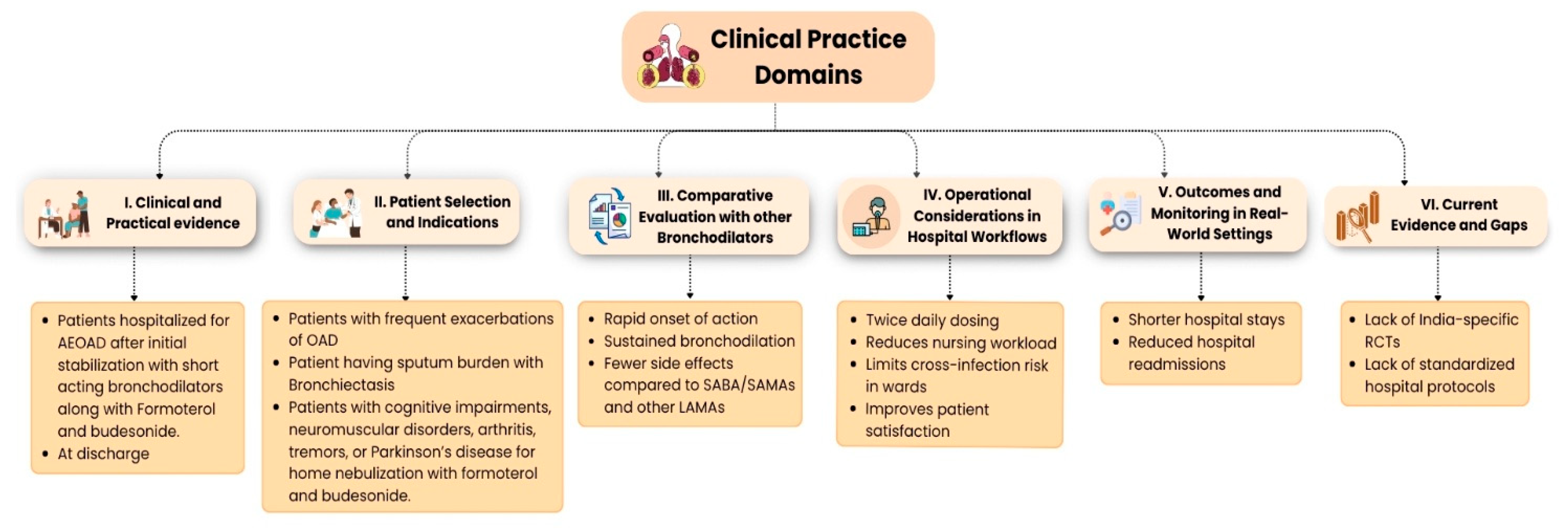
Discussions were structured around six clinical practice domains:
Clinical practice and experience;
Patient profile;
Comparative evaluation with other bronchodilators;
Operational feasibility;
Outcomes and monitoring in real-world settings;
Current evidence and knowledge gaps.
A panel of five subject matter experts (each with >20 years’ experience managing hospitalized AEOAD patients) reviewed the literature and developed 11 discussion items grouped into the six domains. The experts validated the questionnaire items for clarity and relevance to assess prescribing practices and integration of nebulized glycopyrronium into hospital care pathways (see
Figure 1). The clinical practice domains and corresponding discussion statements are presented in
Table 1.
A comprehensive literature search of PubMed and MEDLINE (January 1990–August 2025) was performed using terms including “nebulized glycopyrronium,” “glycopyrrolate,” “long-acting muscarinic antagonist,” “COPD exacerbation,” “asthma exacerbation,” “hospitalized patients,” and “bronchodilation.” The review was supplemented by the Global Initiative for Chronic Obstructive Lung Disease (GOLD) 2026 guidelines and landmark trials such as the GOLDEN studies.
As the project collected expert opinion rather than primary patient data, institutional ethics committee approval was deemed unnecessary in accordance with the Indian Council of Medical Research National Ethical Guidelines for Biomedical and Health Research Involving Human Participants (2017).
Insights from the 13 advisory meetings (no of KOLs and which specialties) were collected through guided discussions rather than formal voting or live polling. All sessions were digitally recorded; recordings were transcribed and reviewed in detail. Each transcript was listened to at least twice by two independent reviewers to ensure transcription accuracy and reviewer familiarity with the data. Final expert perspectives were categorized into recurrent and variable insights:
Recurrent Expert Insights: An insight was classified as recurrent when ≥75% of experts across ≥10 of the 13 meetings shared similar perspectives on a discussion point. Although derived from open discussion rather than formal scoring, the 75% threshold aligns with commonly used consensus methodologies [
12,
13].
Variable Expert Insights: An insight was classified as variable when <75% of experts in <10 of the 13 meetings expressed differing perspectives on a discussion point, reflecting diversity in clinical experience, regional practice patterns, or patient profiles [
14,
15].
3. Results
The expert panel discussions featured balanced participation from the North, South, East, West, and Central regions of India, covering Tier I–II cities. This diversity reflects real-world practice and the potential benefits of nebulized glycopyrronium in hospitalized patients with AEOAD.
Table 2 provides a comprehensive overview of expert perspectives on the early use of nebulized glycopyrronium in hospitalized patients with AEOAD, including the clinical rationale, patient selection criteria, and other operational and therapeutic factors.
The potential advantages of initiating early nebulized glycopyrronium include rapid bronchodilation, which may reduce the severity of AEOAD and support a smooth transition to maintenance therapy (
Table 3).
4. Discussion
This nationwide expert panel captured Indian pulmonologists’ perspectives on nebulized glycopyrronium in hospitalized AEOAD, providing context-specific insights that complement global evidence. The discussions identified clinical, operational, and patient-related factors influencing prescribing practices and highlighted key evidence gaps and the need for locally relevant protocols. Panel perspectives across six domains were compared with existing literature to inform future research and guideline development.
4.1. Clinical and Practical Experience
Most panelists perceived that for initial stabilization in patients admitted due to acute exacerbations, SABA/SAMA is preferred, followed by the use of nebulized glycopyrronium along with formoterol and budesonide once the patient stabilizes. This approach aligns with the GOLD 2026 guidelines for management of COPD recommendations, which emphasize the use of short-acting bronchodilators for immediate symptom relief during exacerbations and long-acting bronchodilators for maintenance therapy once the patient is stabilized [
11].
A physician survey by Bhojwani et al. mirrored these findings: most clinicians preferred nebulized SABA + SAMA in the ER/ICU, and after stabilization, 44% favored nebulized glycopyrronium-based open triple therapy (with formoterol and budesonide) while 26% preferred glycopyrronium-based triple therapy via pMDI/DPI [
14].
Regarding the use of short-acting bronchodilators, it was opined by the pulmonologist that repeated use of short-acting bronchodilators (SABA/SAMA) was sometimes associated with hypokalemia and tachycardia, which was concerning because cardiac-related complications, including atrial fibrillation, remain the leading cause of mortality in COPD patients [
15].
Similar results were found in a systematic review done by Kopsaftis et al., which suggested that no additional benefits were observed while using higher doses of short-acting β2-agonists, but there was a small increase in adverse events for participants using higher doses of β2-agonists used in patients [
9]. In contrast, the panelists highlighted that nebulized glycopyrronium demonstrated reduced cardiovascular adverse effects when used for patients hospitalized for acute exacerbations. This attribute of glycopyrronium is due to its high selectivity for M3 receptors, ensuring effective airway relaxation while minimizing interaction with M2 receptors, thereby reducing cardiovascular risks [
11].
Nebulized glycopyrronium provides effective bronchodilation with a more favourable cardiovascular safety profile than repeated high-dose short-acting bronchodilators, making it a safer option for hospitalized patients.
4.2. Patient Profile
It was widely opined that nebulized glycopyrronium was widely used in patients with frequent exacerbations of OAD, hospitalized for AEOAD, and with asthma-COPD overlap syndrome (ACOS). Similar results were observed in the drug utilization study conducted by Korukonda et al., which concluded that glycopyrronium, when added to LABA/ICS and used for incremental bronchodilation, showed significant improvement in FEV1 in patients with severe COPD and ACOS [
16]. And in a study conducted by Panigrahi et al. and Patel et al., which reported that in India, glycopyrronium along with formoterol and budesonide containing triple nebulization was the preferred treatment for hospitalized patients with AEOAD, and it leads to clinically significant improvements in FEV
1 without evident side effects [
17,
18].
The sustained bronchodilation further contributes to improved airflow, decreased hyperinflation, and enhanced patient comfort, which was also observed in the study conducted by Nardini et al. [
19]. It was also opined that patients who were already on glycopyrronium prior to hospitalization should continue the same for better symptom control, especially those with bronchiectasis or high sputum burden, as LAMAs help reduce mucus plugging and improve airway clearance.
In regard to ventilated patients, nebulized glycopyrronium has been reported to reduce secretions; similar findings were found in a study by Priya et al. that showed glycopyrronium reduces airway secretions and improves ventilator compliance, aiding in weaning and reducing ICU burden [
20].
For home nebulization in patients with obstructive airway disease, the pulmonologists had a collective opinion that nebulized glycopyrronium along with formoterol and budesonide is preferable for patients with cognitive impairments, neuromuscular disorders, arthritis, tremors, or Parkinson’s disease, as these individuals often struggle with handheld inhalers. This insight is supported by expert consensus conducted by Talwar et al., which highlights the operational and clinical benefits of nebulized long-acting bronchodilators in patients with physical or cognitive limitations [
21]. These findings highlight that nebulization with glycopyrronium offers both clinical and practical advantages, supporting its broader role in improving AEOAD care in inpatient, outpatient, and home settings after discharge from the hospital.
4.3. Comparative Evaluation
The study conducted in critically ill mechanically ventilated patients of chronic obstructive pulmonary disease by Priya et al. reported that glycopyrronium nebulization resulted in fewer respiratory secretions, a longer duration of action (10–12 h) compared to salbutamol/ipratropium combinations, which typically last only 4–6 h, and is also characterized by reduced airway resistance and no adverse effects, such as hypertension, tachycardia, or dehydration, compared to salbutamol and ipratropium [
20].
These findings further validate the panel perceptions in the current study, suggesting that nebulized glycopyrronium not only provides a rapid onset of action and more sustained bronchodilation but also demonstrates a better safety profile compared with other SABAs/SAMAs and LAMAs.
4.4. Operational Considerations
Unlike short-acting bronchodilators that require dosing every 4–6 h, glycopyrronium can be administered twice daily. This reduction in administration frequency decreases the time nurses spend on medication preparation, delivery, and cleaning of nebulizer equipment [
22].
Reduced nebulization frequency also contributes to improved patient satisfaction and adherence. Patients often report greater improvement with health-related quality of life (HRQoL) scores when treatment schedules are simplified. Similar improvement in HRQoL scores was also observed in GOLDEN studies [
23].
Finally, decreasing the frequency of nebulization leads to better infection control in shared ward environments. Frequent nebulization can increase aerosol generation, potentially leading to droplet and airborne transmission of pathogens. By minimizing nebulization frequency, glycopyrronium indirectly lowers cumulative exposure risk for healthcare workers and other patients [
24].
4.5. Outcomes and Monitoring
The panelists had a collective opinion that switching to nebulized therapy with glycopyrronium in patients hospitalized for acute exacerbations may reduce hospital stays, use of rescue inhalers, readmissions, corticosteroid use, and ICU transfers, while also improving QoL. Similar results were seen in a study published by Khanna et al., which showed that when nebulized glycopyrronium was used, there was decreased reliance on SABA rescue inhalers, and the average ICU stay and ward stay of subjects was also shorter [
25] compared to when salbutamol and ipratropium were used [
26,
27].
4.6. Evidence Required
Although the SABA/SAMA combination is traditionally preferred for AEOAD, early initiation with glycopyrronium/formoterol/budesonide triple nebulization is recommended by the panelists in the treatment of acute exacerbations of OAD. The panelists agreed that while clinical impressions are promising, India-specific randomized clinical trials (RCTs) and registries are necessary to validate the efficacy, cost-effectiveness, and optimal dosing strategies of nebulized glycopyrronium.
4.6.1. Additional Considerations
In neurology ICUs, nebulized glycopyrronium improves ventilator compliance and reduces suctioning frequency. Its use has also been extended beyond pulmonology, with cardiologists and general physicians adopting it for high-burden cases. As nebulized glycopyrronium is non-invasive and free of central adverse effects, it does not cross the blood–brain barrier, unlike other anticholinergics. One case report demonstrated its effectiveness in reducing drooling, providing symptomatic relief without significant adverse effects [
28].
Two cases of posterior drooling treatment were reported (an 82-year-old male stroke patient and a 1-year-old female with cerebral palsy), and salivary aspiration and the effect of nebulized glycopyrronium were identified using radionuclide sialograms. Treatment with nebulized glycopyrronium was well tolerated, with reduced posterior drooling, improved airway safety, and reduced aspiration risk [
29].
4.6.2. Potential Implications for Indian Practice
Given the variability in hospital infrastructure, prescription patterns, and patient profiles across India, understanding the role of nebulized glycopyrronium is key to its rational use in clinical practice. The proposed conceptual framework (
Figure 2) was developed from an expert perspective. By providing consistent bronchodilation regardless of patient effort, nebulized glycopyrronium delivers a reliable dose during AEOAD care, facilitating rapid stabilization and supporting timely discharge. This framework may guide the real-world practices of Indian pulmonologists and intensivists, thereby improving AEOAD care (
Figure 2).
4.6.3. Strengths and Limitations
The first nationwide expert opinion was captured through the perspectives of 220 pulmonologists at 13 structured meetings covering diverse regions and practice settings. Structured domains (clinical practice, patient selection, comparative evaluation, operational issues, outcomes, and evidence gaps) ensured comprehensive thematic analysis. The expert-validated discussion framework improved the consistency and credibility of these insights. However, this has some limitations. It represents expert perspectives rather than randomized clinical trial data, limiting its generalizability. Another limitation was the absence of a direct comparison group and quantitative outcome measures, and the findings were based solely on the panelists’ perceptions and clinical experiences. A key limitation is the absence of cost-effectiveness data; in resource-constrained settings such as India, cost and availability are important determinants of adoption, and no formal economic evaluation was performed. To support our findings, we recommend conducting a multicenter study to optimize the use of nebulized glycopyrronium in hospitalized patients with AEOAD in India. Longitudinal studies should be performed to evaluate the efficacy of nebulized glycopyrronium, focusing on its impact on hospital stay and readmission compared with SABA/SAMAs and other LAMA regimens. It is also crucial to evaluate nebulized glycopyrronium dosing strategies in both inpatient and outpatient settings and to conduct cost-effectiveness studies comparing them with SABA/SAMAs and other LAMA regimens.
5. Conclusions
This expert consensus highlights the potential of nebulized glycopyrronium in addressing critical gaps in the management of patients hospitalized with AEOAD in India. The panelists agreed that early initiation provides sustained bronchodilation, reduces reliance on short-acting agents, and offers operational benefits, such as a lower nursing workload and smoother discharge transitions. However, these expert perspectives, rather than formal recommendations, should be interpreted with caution.
Author Contributions
Conceptualization, A.K., P.W. and A.K.S.; methodology, A.K., P.W. and A.K.S; validation, J.M. and S.B.; formal analysis, J.M. and S.B.; investigation, J.M. and R.; resources, S.B. and S.P.; data curation, J.M. and S.B.; writing—original draft preparation, J.M., S.B. and S.P.; writing—review and editing, J.M., S.B., S.P. and H.B.; visualization, S.B. and S.P.; supervision, S.B. and S.P.; project administration, S.B., S.P. and H.B.; funding acquisition, S.B., S.P. and H.B. All authors have read and agreed to the published version of the manuscript.
Funding
The APC was funded by Glenmark Pharmaceuticals Ltd.
Data Availability Statement
The data presented in this study are available on request from the corresponding author due to privacy and confidentiality restrictions associated with expert opinion discussions.
Acknowledgments
The authors acknowledge all participating pulmonologists for their valuable insights and contributions to the advisory meetings. The authors have reviewed and edited the output and take full responsibility for the content of this publication.
Conflicts of Interest
Authors Jinay Mehta, Rithik, Sagar Bhagat, Saiprasad Patil and Hanmant Barkate were employed by the Glenmark Pharmaceuticals, Ltd. The remaining authors declare that the research was conducted in the absence of any commercial or financial relationships that could be construed as a potential conflict of interest. The authors declare that this study received funding from the Glenmark Pharmaceuticals Ltd. The funder was not involved in the study design, collection, analysis, interpretation of data, the writing of this article, or the decision to submit it for publication.
References
- Agrawal, A.; Singh, S.K.; Prabhudesai, P.P. The Prevalence of Obstructive Airway Disease by Spirometric Indices in Nonsmoker Patients with Catheter-Diagnosed Coronary Artery Disease. Indian J. Respir. Care 2019, 8, 46–50. [Google Scholar] [CrossRef] [PubMed]
- World Health Organisation. Noncommunicable Diseases, Rehabilitation and Disability. Chronic Respiratory Diseases Programme. Available online: https://www.who.int/teams/noncommunicable-diseases/ncds-management/chronic-respiratory-diseases-programme (accessed on 19 August 2025).
- World Health Organisation. Chronic Obstructive Pulmonary Disease (COPD). Available online: https://www.who.int/news-room/fact-sheets/detail/chronic-obstructive-pulmonary-disease-(copd) (accessed on 25 December 2020).
- Dasari, P.; Raman, D.; Unnikrishnan, D.; Britto, C. To Study the Burden of COPD among the Patients Admitted in Critical Care Units from Partner Hospitals under Smart-ICU Network Across India. Indian J. Crit. Care Med. 2024, 28, S438–S440. [Google Scholar] [CrossRef]
- Exceptional Surveillance of Chronic Obstructive Pulmonary Disease in Over 16s: Diagnosis and Management (NICE Guideline NG115); National Institute for Health and Care Excellence (NICE): London, UK, 2020.
- Elsey, L.; Allen, D. Management of acute exacerbations of airways disease: Advice for the non-respiratory physician. Clin. Med. 2021, 21, e567–e570. [Google Scholar] [CrossRef] [PubMed]
- Janson, C.; Wiklund, F.; Telg, G.; Stratelis, G.; Sandelowsky, H. High use of short-acting β2-agonists in COPD is associated with an increased risk of exacerbations and mortality. ERJ Open Res. 2023, 9, 00722-2022. [Google Scholar] [CrossRef] [PubMed]
- Tsao, C.; Chan, S.; Lee, M.; Hsieh, T.Y.J.; Phipatanakul, W.; Ruran, H.B.; Ma, K.S. Adverse Outcomes Associated with Short-Acting Beta-Agonist Overuse in Asthma: A Systematic Review and Meta-Analysis. Allergy 2025, 80, 1629–1646. [Google Scholar] [CrossRef] [PubMed]
- Kopsaftis, Z.A.; Sulaiman, N.S.; Mountain, O.D.; Carson-Chahhoud, K.V.; Phillips, P.A.; Smith, B.J. Short-acting bronchodilators for the management of acute exacerbations of chronic obstructive pulmonary disease in the hospital setting: Systematic review. Syst. Rev. 2018, 7, 213. [Google Scholar] [CrossRef] [PubMed]
- Venkatesan, P. GOLD COPD report: 2026 update. Lancet Respir. Med. 2025. [Google Scholar] [CrossRef] [PubMed]
- Ulrik, C. Once-daily glycopyrronium bromide, a long-acting muscarinic antagonist, for chronic obstructive pulmonary disease: A systematic review of clinical benefit. Int. J. Chronic Obstr. Pulm. Dis. 2012, 7, 673–678. [Google Scholar] [CrossRef] [PubMed]
- Morisset, J.; Johannson, K.A.; Jones, K.D.; Wolters, P.J.; Collard, H.R.; Walsh, S.L.F.; Ley, B.; Collaborators, T.H.D. Identification of Diagnostic Criteria for Chronic Hypersensitivity Pneumonitis. An International Modified Delphi Survey. Am. J. Respir. Crit. Care Med. 2018, 197, 1036–1044. [Google Scholar] [CrossRef] [PubMed]
- Schifano, J.; Niederberger, M. How Delphi studies in the health sciences find consensus: A scoping review. Syst. Rev. 2025, 14, 14. [Google Scholar] [CrossRef]
- Bhojwani, D.; Rithik; Bhagat, S.; Patil, S.; Barkate, H. Evaluating the role of nebulized glycopyrronium in hospitalized patients with exacerbations of obstructive airway disease: Transitioning from hospital care to discharge. Lung India 2025, 42, 8. [Google Scholar]
- Berg, M.E.v.D.; Stricker, B.H.; Brusselle, G.G.; Lahousse, L. Chronic obstructive pulmonary disease and sudden cardiac death: A systematic review. Trends Cardiovasc. Med. 2016, 26, 606–613. [Google Scholar] [CrossRef] [PubMed]
- Korukonda, K.; Prabhudesai, P.; Parthasarathi, B.; Singh, B.; Katiyar, S. Clinical Assessment of Glycopyrronium in COPD phenotypes and ACOS: Prospective, case control, observational study. Eur. Respir. J. 2019, 54, PA2478. [Google Scholar] [CrossRef]
- Panigrahi, N.; Panchal, S.; Patil, S.; Barkate, H.V. Glycopyrronium-Based Triple (ics/laba/lama) Nebulization in Patients Hospitalized with Acute Exacerbating Obstructive Airway Disease: Drug Utilization Study in India. Chest 2021, 160, A1835. [Google Scholar]
- Patel, K.; Parikh, U.; Gupta, A.; Patil, S.; Bhagat, S.; Barkate, H. Nebulized broncodilator utilization in hospitalized obstructive airway disease patients: An indian multicentre drug utilization study. Chest 2022, 161, A361. [Google Scholar] [CrossRef]
- Nardini, S.; Camiciottoli, G.; Locicero, S.; Maselli, R.; Pasqua, F.; Passalacqua, G.; Pela, R.; Pesci, A.; Sebastiani, A.; Vatrella, A. COPD: Maximization of bronchodilation. Multidiscip. Respir. Med. 2014, 9, 50. [Google Scholar] [CrossRef] [PubMed]
- Kumar, S.; Kumar, V.; Nath, S.S.; Priya, P. Comparison of Nebulized Glycopyrronium with a Combination of Salbutamol and Ipratropium on Ventilatory Parameters in Critically Ill Mechanically Ventilated Patients of Chronic Obstructive Pulmonary Disease: An Observational Study. Indian J. Crit. Care Med. 2024, 28, 963–969. [Google Scholar] [CrossRef] [PubMed]
- Talwar, D.; Bendre, S. Health-Related Effects of Home Nebulization With Glycopyrronium on Difficult-to-Treat Asthma: Post-Hoc Analyses of an Observational Study. Interact. J. Med. Res. 2020, 9, e17863. [Google Scholar] [CrossRef] [PubMed]
- Tashkin, D.P.; Niu, X.; Sharma, S.; Sanjar, S. Impact of baseline clinical features on outcomes of nebulized glycopyrrolate therapy in COPD. npj Prim. Care Respir. Med. 2021, 31, 43. [Google Scholar] [CrossRef] [PubMed]
- Ferguson, G.T.; Kerwin, E.M.; Donohue, J.F.; Ganapathy, V.; Tosiello, R.L.; Bollu, V.K.; Rajagopalan, K. Health-Related Quality of Life Improvements in Moderate to Very Severe Chronic Obstructive Pulmonary Disease Patients on Nebulized Glycopyrrolate: Evidence from the GOLDEN Studies. Chronic Obstr. Pulm. Dis. J. COPD Found. 2018, 5, 193–207. [Google Scholar] [CrossRef] [PubMed]
- Biney, I.N.; Ari, A.; Barjaktarevic, I.Z.; Carlin, B.; Christiani, D.C.; Cochran, L.; Drummond, M.B.; Johnson, K.; Kealing, D.; Kuehl, P.J.; et al. Guidance on Mitigating the Risk of Transmitting Respiratory Infections During Nebulization by the COPD Foundation Nebulizer Consortium. Chest 2024, 165, 653–668. [Google Scholar] [CrossRef] [PubMed]
- Khanna, A.; Tandon, A.; Narasimhan, R.L. A Study on the Use of Nebulized Glycopyrronium in Hospitalized Patients With Exacerbations of Obstructive Airway Disease. Cureus 2026, 18, e104894. [Google Scholar] [CrossRef] [PubMed]
- Hasan, M.A.; Sheherin, S.; Sardar, M.A.H.; Habib, M.A.; Ahamed, F. Compari-son of Bronchodilator Response of Nebulized Salbutamol with Nebulized Salbutamol and Ipratropium Bromide in Patients with Acute Exacerbation of Advanced COPD. J. Teach. Assoc. 2022, 34, 56–63. [Google Scholar] [CrossRef]
- Thomas, V.; Gefen, E.; Gopalan, G.; Mares, R.; McDonald, R.; Ming, S.W.Y.; Price, D.B. Ipratropium/Salbutamol Comparator Versus Originator for Chronic Obstructive Pulmonary Disease Exacerbations: USA Observational Cohort Study Using the Clinformatics™ Health Claims Database. Pulm. Ther. 2017, 3, 187–205. [Google Scholar] [CrossRef]
- Strutt, R.; Fachpm; Fardell, B.; Chye, R. Ffpmanzca Nebulized Glycopyrrolate for Drooling in a Motor Neuron Patient. J. Pain Symptom Manag. 2002, 23, 2–3. [Google Scholar] [CrossRef] [PubMed]
- Lee, Z.-I.; Yu, K.J.; Lee, D.H.; Hong, S.K.; Woo, S.B.; Kim, J.M.; Park, D. The Effect of Nebulized Glycopyrrolate on Posterior Drooling in Patients with Brain Injury: Two Cases of Different Brain Lesions. Am. J. Phys. Med. Rehabil. 2017, 96, e155–e158. [Google Scholar] [CrossRef] [PubMed]
| Disclaimer/Publisher’s Note: The statements, opinions and data contained in all publications are solely those of the individual author(s) and contributor(s) and not of MDPI and/or the editor(s). MDPI and/or the editor(s) disclaim responsibility for any injury to people or property resulting from any ideas, methods, instructions or products referred to in the content. |
© 2026 by the authors. Published by MDPI on behalf of the Polish Respiratory Society. Licensee MDPI, Basel, Switzerland. This article is an open access article distributed under the terms and conditions of the Creative Commons Attribution (CC BY) license.




 ,
,