

Advances in Therapeutic Options for Pulmonary and Sleep Disorders in Mucopolysaccharidosis (MPS) Patients: A Narrative Review


Highlights
- The use of enzyme replacement therapy (ERT) and hematopoietic stem cell transplantation (HSCT) have fundamentally altered the disease course by mitigating systemic glycosaminoglycan (GAG) buildup, with emerging gene therapies showing significant promise for respiratory optimization.
- MPS patients have a relatively high prevalence of sleep disordered breathing and face significantly higher risk during surgeries due to macroglossia, airway obstruction, cervical spine instability, and restrictive lung disease.
- ERT and HSCT are far more effective before irreversible tissue damage occurs, the inclusion of MPS in newborn screening programs and early detection are strongly recommended.
- Optimal management requires highly collaborative care among pulmonologists, otolaryngologists, and sleep specialists to mitigate peri-operative risks and deploy positive airway pressure devices when needed.
Abstract
1. Introduction
2. Methods
2.1. Search Strategy
2.2. Relevant Section
- Physiology of pulmonary and sleep complications in MPS
- Tracheal collapse and airway obstruction
- Sleep disordered breathing (SDB)
- Restrictive lung disease

2.3. Disease-Targeting Therapies
2.4. Surgical Interventions
2.5. Supportive Therapies
- Insomnia
- Importance of a multidisciplinary approach—The MPS Team
3. Limitations
4. Gaps and Future Directions
5. Conclusions
Funding
Institutional Review Board Statement
Informed Consent Statement
Data Availability Statement
Conflicts of Interest
Abbreviations
| MPS | mucopolysaccharidosis |
| GAG | Glycosaminoglycans |
| ERT | enzyme replacement therapy |
| HSCT | hematopoietic stem cell therapy |
| OSA | obstructive sleep apnea |
| CPAP | continuous positive airway pressure |
| PAP | positive airway pressure |
| FEV1 | forced vital capacity in first second |
| FVC | forced vital capacity |
| 6 MWT | 6-min walk test |
| BMT | bone marrow transplant |
| AT | adenotonsillectomy |
| LSD | lysosomal storage disease |
| AHI | apnea hypopnea index |
| SDB | sleep disordered breathing |
References
- Muenzer, J. Overview of the mucopolysaccharidoses. Rheumatology 2011, 50, v4–v12. [Google Scholar] [CrossRef] [PubMed]
- Kubaski, F.; de Oliveira Poswar, F.; Michelin-Tirelli, K.; Matte, U.D.S.; Horovitz, D.D.; Barth, A.L.; Baldo, G.; Vairo, F.; Giugliani, R. Mucopolysaccharidosis Type I. Diagnostics 2020, 10, 161. [Google Scholar] [CrossRef] [PubMed]
- Beck, M. Mucopolysaccharidosis Type II (Hunter Syndrome): Clinical picture and treatment. Curr. Pharm. Biotechnol. 2011, 12, 861–866. [Google Scholar] [CrossRef] [PubMed]
- Sjøgren, P.; Pedersen, T.; Steinmetz, H. Mucopolysaccharidoses and anaesthetic risks. Acta Anaesthesiol. Scand. 1987, 31, 214–218. [Google Scholar] [CrossRef] [PubMed]
- Shih, S.L.; Lee, Y.J.; Lin, S.P.; Sheu, C.Y.; Blickman, J.G. Airway changes in children with mucopolysaccharidoses. Acta Radiol. 2002, 43, 40–43. [Google Scholar] [CrossRef]
- John, A.; Fagondes, S.; Schwartz, I.; Azevedo, A.C.; Barrios, P.; Dalcin, P.; Menna-Barreto, S.; Giugliani, R. Sleep abnormalities in untreated patients with mucopolysaccharidosis type VI. Am. J. Med. Genet. A 2011, 155A, 1546–1551. [Google Scholar] [CrossRef] [PubMed]
- Muhlebach, M.S.; Wooten, W.; Muenzer, J. Respiratory manifestations in mucopolysaccharidoses. Paediatr. Respir. Rev. 2011, 12, 133–138. [Google Scholar] [CrossRef] [PubMed]
- Rutten, M.; Ciet, P.; van den Biggelaar, R.; Oussoren, E.; Langendonk, J.G.; van der Ploeg, A.T.; Langeveld, M. Severe tracheal and bronchial collapse in adults with type II mucopolysaccharidosis. Orphanet J. Rare Dis. 2016, 11, 50. [Google Scholar] [CrossRef] [PubMed]
- Gadepalli, C.; Stepien, K.M.; Sharma, R.; Jovanovic, A.; Tol, G.; Bentley, A. Airway Abnormalities in Adult Mucopolysaccharidosis and Development of Salford Mucopolysaccharidosis Airway Score. J. Clin. Med. 2021, 10, 3275. [Google Scholar] [CrossRef] [PubMed]
- Lee, C.L.; Lee, K.S.; Chuang, C.K.; Su, C.H.; Chiu, H.C.; Tu, R.Y.; Lo, Y.T.; Chang, Y.H.; Lin, H.Y.; Lin, S.P. Otorhinolaryngological Management in Taiwanese Patients with Mucopolysaccharidoses. Int. J. Med. Sci. 2021, 18, 3373–3379. [Google Scholar] [CrossRef] [PubMed]
- Lee, Y.H.; Su, C.H.; Lin, C.Y.; Lin, H.Y.; Lin, S.P.; Chuang, C.K.; Lee, K.S. Endoscopic and Image Analysis of the Airway in Patients with Mucopolysaccharidosis Type IVA. J. Pers. Med. 2023, 13, 494. [Google Scholar] [CrossRef] [PubMed]
- Ufuk, F. Tracheobronchial Involvement of Mucopolysaccharidosis Type VI. Pediatr. Pulmonol. 2025, 60, e71007. [Google Scholar] [CrossRef] [PubMed]
- Dodsworth, C.; Burton, B.K. Increased incidence of neonatal respiratory distress in infants with mucopolysaccharidosis type II (MPS II, Hunter syndrome). Mol. Genet. Metab. 2014, 111, 203–204. [Google Scholar] [CrossRef] [PubMed]
- Rapoport, D.M.; Mitchell, J.J. Pathophysiology, evaluation, and management of sleep disorders in the mucopolysaccharidoses. Mol. Genet. Metab. 2017, 122S, 49–54. [Google Scholar] [CrossRef] [PubMed]
- Asir, N.; Al-Naimi, A.R. Polysomnographic Analysis of Sleep-Disordered Breathing In Children With Mucopolysaccharidoses in Qatar: A Retrospective Study. Cureus 2025, 17, e79773. [Google Scholar] [CrossRef] [PubMed]
- Berger, K.I.; Fagondes, S.C.; Giugliani, R.; Hardy, K.A.; Lee, K.S.; McArdle, C.; Scarpa, M.; Tobin, M.J.; Ward, S.A.; Rapoport, D.M. Respiratory and sleep disorders in mucopolysaccharidosis. J. Inherit. Metab. Dis. 2013, 36, 201–210. [Google Scholar] [CrossRef]
- Wooten, W.I.; Muenzer, J.; Vaughn, B.V.; Muhlebach, M.S. Relationship of sleep to pulmonary function in mucopolysaccharidosis II. J. Pediatr. 2013, 162, 1210–1215. [Google Scholar] [CrossRef] [PubMed]
- Pal, A.R.; Langereis, E.J.; Saif, M.A.; Mercer, J.; Church, H.J.; Tylee, K.L.; Wynn, R.F.; Wijburg, F.A.; Jones, S.A.; Bruce, I.A.; et al. Sleep disordered breathing in mucopolysaccharidosis I: A multivariate analysis of patient, therapeutic and metabolic correlators modifying long term clinical outcome. Orphanet J. Rare Dis. 2015, 10, 42. [Google Scholar] [CrossRef] [PubMed][Green Version]
- Kasapkara, Ç.S.; Tümer, L.; Aslan, A.T.; Hasanoğlu, A.; Ezgü, F.S.; Küçükçongar, A.; Tunca, Z.; Köktürk, O. Home sleep study characteristics in patients with mucopolysaccharidosis. Sleep Breath. 2014, 18, 143–149. [Google Scholar] [CrossRef] [PubMed]
- Ademhan Tural, D.; Emiralioglu, N.; Dogru, D.; Ozsezen, B.; Ipek, O.F.; Sunman, B.; Nayir Buyuksahin, H.; Guzelkas, I.; Ciki, K.; Kilic, K.; et al. Evaluation of sleep-disordered breathing and its relationship with respiratory parameters in children with mucopolysaccharidosis Type IVA and VI. Am. J. Med. Genet. A 2021, 185, 2306–2314. [Google Scholar] [CrossRef] [PubMed]
- Murray, J.F. Pulmonary disability in the Hurler syndrome (lipochondrodystrophy): A study of two cases. N. Engl. J. Med. 1959, 261, 378–382. [Google Scholar] [CrossRef] [PubMed]
- Mitchell, J.; Berger, K.I.; Borgo, A.; Braunlin, E.A.; Burton, B.K.; Ghotme, K.A.; Kircher, S.G.; Molter, D.; Orchard, P.J.; Palmer, J.; et al. Unique medical issues in adult patients with mucopolysaccharidoses. Eur. J. Intern. Med. 2016, 34, 2–10. [Google Scholar] [CrossRef] [PubMed]
- Giugliani, R.; Federhen, A.; Muñoz Rojas, M.V.; Vieira, T.A.; Artigalás, O.; Pinto, L.L.; Azevedo, A.C.; Acosta, A.X.; Bomfim, C.; Lourenço, C.M.; et al. Enzyme replacement therapy for mucopolysaccharidoses I, II and VI: Recommendations from a group of Brazilian F experts. Rev. Assoc. Med. Bras. 2010, 56, 271–277. [Google Scholar] [CrossRef] [PubMed][Green Version]
- Harmatz, P.R.; Lampe, C.; Parini, R.; Sharma, R.; Teles, E.L.; Johnson, J.; Sivam, D.; Sisic, Z. Enzyme replacement therapy outcomes across the disease spectrum: Findings from the mucopolysaccharidosis VI Clinical Surveillance Program. J. Inherit. Metab. Dis. 2019, 42, 519–526. [Google Scholar] [CrossRef] [PubMed]
- Muenzer, J. Early initiation of enzyme replacement therapy for the mucopolysaccharidoses. Mol. Genet. Metab. 2014, 111, 63–72. [Google Scholar] [CrossRef] [PubMed]
- Politei, J.; Schenone, A.; Blanco, M.; Szlago, M. Mucopolysaccharidosis type VI: Clinical aspects, diagnosis and treatment with enzyme replacement therapy. Arch. Argent. Pediatr. 2014, 112, 258–262. [Google Scholar] [CrossRef] [PubMed]
- Brunelli, M.J.; Atallah, Á.; da Silva, E.M. Enzyme replacement therapy with galsulfase for mucopolysaccharidosis type VI. Cochrane Database Syst. Rev. 2016, 3, CD009806. [Google Scholar] [CrossRef] [PubMed]
- Wraith, J.E. The first 5 years of clinical experience with laronidase enzyme replacement therapy for mucopolysaccharidosis I. Expert. Opin. Pharmacother. 2005, 6, 489–506. [Google Scholar] [CrossRef] [PubMed]
- Nan, H.; Park, C.; Maeng, S. Mucopolysaccharidoses I and II: Brief Review of Therapeutic Options and Supportive/Palliative Therapies. BioMed Res. Int. 2020, 2020, 2408402. [Google Scholar] [CrossRef] [PubMed]
- Lee, C.L.; Chuang, C.K.; Chiu, H.C.; Tu, R.Y.; Lo, Y.T.; Chang, Y.H.; Lin, S.P.; Lin, H.Y. Clinical Utility of Elosulfase Alfa in the Treatment of Morquio A Syndrome. Drug Des. Devel Ther. 2022, 16, 143–154. [Google Scholar] [CrossRef] [PubMed]
- Parini, R.; Rigoldi, M.; Tedesco, L.; Boffi, L.; Brambilla, A.; Bertoletti, S.; Boncimino, A.; Del Longo, A.; De Lorenzo, P.; Gaini, R.; et al. Enzymatic replacement therapy for Hunter disease: Up to 9 years experience with 17 patients. Mol. Genet. Metab. Rep. 2015, 3, 65–74. [Google Scholar] [CrossRef] [PubMed]
- Horovitz, D.D.; Magalhães, T.S.; Acosta, A.; Ribeiro, E.M.; Giuliani, L.R.; Palhares, D.B.; Kim, C.A.; de Paula, A.C.; Kerstenestzy, M.; Pianovski, M.A.; et al. Enzyme replacement therapy with galsulfase in 34 children younger than five years of age with MPS VI. Mol. Genet. Metab. 2013, 109, 62–69. [Google Scholar] [CrossRef] [PubMed]
- Tomanin, R.; Zanetti, A.; D’Avanzo, F.; Rampazzo, A.; Gasparotto, N.; Parini, R.; Pascarella, A.; Concolino, D.; Procopio, E.; Fiumara, A.; et al. Clinical efficacy of enzyme replacement therapy in paediatric Hunter patients, an independent study of 3.5 years. Orphanet J. Rare Dis. 2014, 9, 129. [Google Scholar] [CrossRef] [PubMed]
- Broomfield, A.; Sims, J.; Mercer, J.; Hensman, P.; Ghosh, A.; Tylee, K.; Stepien, K.M.; Oldham, A.; Prathivadi Bhayankaram, N.; Wynn, R.; et al. The evolution of pulmonary function in childhood onset Mucopolysaccharidosis type I. Mol. Genet. Metab. 2021, 132, 94–99. [Google Scholar] [CrossRef] [PubMed]
- Bernardo Figueirêdo, B.; Reinaux, C.; Oliveira, T.G.; Cavalcanti, G.; Fernandes, J.; Dornelas DEAndrade, A. Respiratory muscular strength in children with mucopolysacaridosis: Comparison with predictive equations. Minerva Pediatr. 2024, 76, 507–516. [Google Scholar] [CrossRef] [PubMed]
- Rochester, D.F.; Arora, N.S. Respiratory muscle failure. Med. Clin. N. Am. 1983, 67, 573–597. [Google Scholar] [CrossRef] [PubMed]
- Beck, M.; Muenzer, J.; Scarpa, M. Evaluation of disease severity in mucopolysaccharidoses. J. Pediatr. Rehabil. Med. 2010, 3, 39–46. [Google Scholar] [CrossRef] [PubMed]
- Mitchell, J.J.; Burton, B.K.; Bober, M.B.; Campeau, P.M.; Cohen, S.; Dosenovic, S.; Ellaway, C.; Bhattacharya, K.; Guffon, N.; Hinds, D.; et al. Findings from the Morquio A Registry Study (MARS) after 6 years: Long-term outcomes of MPS IVA patients treated with elosulfase alfa. Mol. Genet. Metab. 2022, 137, 164–172. [Google Scholar] [CrossRef] [PubMed]
- Hendriksz, C.J.; Berger, K.I.; Parini, R.; AlSayed, M.D.; Raiman, J.; Giugliani, R.; Mitchell, J.J.; Burton, B.K.; Guelbert, N.; Stewart, F.; et al. Impact of long-term elosulfase alfa treatment on respiratory function in patients with Morquio A syndrome. J. Inherit. Metab. Dis. 2016, 39, 839–847. [Google Scholar] [CrossRef] [PubMed]
- Clarke, L.A.; Wraith, J.E.; Beck, M.; Kolodny, E.H.; Pastores, G.M.; Muenzer, J.; Rapoport, D.M.; Berger, K.I.; Sidman, M.; Kakkis, E.D.; et al. Long-term efficacy and safety of laronidase in the treatment of mucopolysaccharidosis I. Pediatrics 2009, 123, 229–240. [Google Scholar] [CrossRef] [PubMed]
- Adam, M.P.; Feldman, J.; Mirzaa, G.M.; Pagon, R.A.; Wallace, S.E.; Amemiya, A. GeneReviews; University of Washington: Seattle, WA, USA, 1993. [Google Scholar]
- Burrow, T.A.; Leslie, N.D. Review of the use of idursulfase in the treatment of mucopolysaccharidosis II. Biologics 2008, 2, 311–320. [Google Scholar] [PubMed]
- Allen, J.L. Treatment of respiratory system (not just lung!) abnormalities in Mucopolysaccharidosis I. J. Pediatr. 2004, 144, 561–562. [Google Scholar] [CrossRef]
- Kılıç, M.; Dursun, A.; Coşkun, T.; Tokatlı, A.; Özgül, R.K.; Yücel-Yılmaz, D.; Karaca, M.; Doğru, D.; Alehan, D.; Kadayıfçılar, S.; et al. Genotypic-phenotypic features and enzyme replacement therapy outcome in patients with mucopolysaccharidosis VI from Turkey. Am. J. Med. Genet. A 2017, 173, 2954–2967. [Google Scholar] [CrossRef] [PubMed]
- Muenzer, J.; Wraith, J.E.; Beck, M.; Giugliani, R.; Harmatz, P.; Eng, C.M.; Vellodi, A.; Martin, R.; Ramaswami, U.; Gucsavas-Calikoglu, M.; et al. A phase II/III clinical study of enzyme replacement therapy with idursulfase in mucopolysaccharidosis II (Hunter syndrome). Genet. Med. 2006, 8, 465–473. [Google Scholar] [CrossRef] [PubMed]
- Wraith, J.E.; Clarke, L.A.; Beck, M. Enzyme replacement therapy for mucopolysaccharidosis I: A randomized, double-blinded, placebo-controlled, multinational study of recombinant human alpha-L-iduronidase (laronidase). J. Pediatr. 2004, 144, 581–588. [Google Scholar] [CrossRef]
- Burton, B.K.; Harmatz, P.R.; Horvathova, V.; Lail, A.; Lampe, C.; Parini, R.; Sharma, R.; Teles, E.L. Long-term enzyme replacement therapy: Findings from the mucopolysaccharidosis VI clinical surveillance program after 15 years follow-up. Mol. Genet. Metab. 2025, 145, 109135. [Google Scholar] [CrossRef] [PubMed]
- Lampe, C.; Bosserhoff, A.K.; Burton, B.K.; Giugliani, R.; de Souza, C.F.; Bittar, C.; Muschol, N.; Olson, R.; Mendelsohn, N.J. Long-term experience with enzyme replacement therapy (ERT) in MPS II patients with a severe phenotype: An international case series. J. Inherit. Metab. Dis. 2014, 37, 823–829. [Google Scholar] [CrossRef] [PubMed]
- Tomatsu, S.; Alméciga-Díaz, C.J.; Montaño, A.M.; Yabe, H.; Tanaka, A.; Dung, V.C.; Giugliani, R.; Kubaski, F.; Mason, R.W.; Yasuda, E.; et al. Therapies for the bone in mucopolysaccharidoses. Mol. Genet. Metab. 2015, 114, 94–109. [Google Scholar] [CrossRef] [PubMed]
- Tomatsu, S.; Mackenzie, W.G.; Theroux, M.C.; Mason, R.W.; Thacker, M.M.; Shaffer, T.H.; Montaño, A.M.; Rowan, D.; Sly, W.; Alméciga-Díaz, C.; et al. Current and emerging treatments and surgical interventions for Morquio A syndrome: A review. Res. Rep. Endocr. Disord. 2012, 2012, 65–77. [Google Scholar] [CrossRef] [PubMed]
- Concolino, D.; Deodato, F.; Parini, R. Enzyme replacement therapy: Efficacy and limitations. Ital. J. Pediatr. 2018, 44, 120. [Google Scholar] [CrossRef] [PubMed]
- Chen, H.H.; Sawamoto, K.; Mason, R.W.; Kobayashi, H.; Yamaguchi, S.; Suzuki, Y.; Orii, K.; Orii, T.; Tomatsu, S. Enzyme replacement therapy for mucopolysaccharidoses; past, present, and future. J. Hum. Genet. 2019, 64, 1153–1171. [Google Scholar] [CrossRef] [PubMed]
- Rowan, D.J.; Tomatsu, S.; Grubb, J.H.; Haupt, B.; Montaño, A.M.; Oikawa, H.; Sosa, A.C.; Chen, A.; Sly, W.S. Long circulating enzyme replacement therapy rescues bone pathology in mucopolysaccharidosis VII murine model. Mol. Genet. Metab. 2012, 107, 161–172. [Google Scholar] [CrossRef] [PubMed]
- Okuyama, T.; Eto, Y.; Sakai, N.; Nakamura, K.; Yamamoto, T.; Yamaoka, M.; Ikeda, T.; So, S.; Tanizawa, K.; Sonoda, H.; et al. A Phase 2/3 Trial of Pabinafusp Alfa, IDS Fused with Anti-Human Transferrin Receptor Antibody, Targeting Neurodegeneration in MPS-II. Mol. Ther. 2021, 29, 671–679. [Google Scholar] [CrossRef] [PubMed]
- Clarke, L.A.; Harmatz, P.; Fong, E.W. Implementing evidence-driven individualized treatment plans within Morquio A Syndrome. Mol. Genet. Metab. 2016, 117, 217. [Google Scholar] [CrossRef] [PubMed]
- Kirkpatrick, K.; Ellwood, J.; Walker, R.W. Mucopolysaccharidosis type I (Hurler syndrome) and anesthesia: The impact of bone marrow transplantation, enzyme replacement therapy, and fiberoptic intubation on airway management. Pediatr. Anesth. 2012, 22, 745–751. [Google Scholar] [CrossRef] [PubMed]
- Rodgers, N.J.; Kaizer, A.M.; Miller, W.P.; Rudser, K.D.; Orchard, P.J.; Braunlin, E.A. Mortality after hematopoietic stem cell transplantation for severe mucopolysaccharidosis type I: The 30-year University of Minnesota experience. J. Inherit. Metab. Dis. 2017, 40, 271–280. [Google Scholar] [CrossRef] [PubMed]
- Selvanathan, A.; Ellaway, C.; Wilson, C.; Owens, P.; Shaw, P.J.; Bhattacharya, K. Effectiveness of Early Hematopoietic Stem Cell Transplantation in Preventing Neurocognitive Decline in Mucopolysaccharidosis Type II: A Case Series. JIMD Rep. 2018, 41, 81–89. [Google Scholar] [CrossRef] [PubMed]
- Chen, J.; Jiang, H.; Dong, L. [Treatment of 2 children with mucopolysaccharidosis by allogeneic hematopoietic stem cell transplantation]. Zhonghua Yi Xue Yi Chuan Xue Za Zhi 2008, 25, 675–677. [Google Scholar] [PubMed]
- Orchard, P.J.; Gupta, A.O.; Eisengart, J.B.; Polgreen, L.E.; Pollard, L.M.; Braunlin, E.; Pasquali, M.; Lund, T.C. Hematopoietic stem cell transplant for Hurler syndrome: Does using bone marrow or umbilical cord blood make a difference? Blood Adv. 2022, 6, 6023–6027. [Google Scholar] [CrossRef] [PubMed]
- Boelens, J.J.; Aldenhoven, M.; Purtill, D.; Ruggeri, A.; Defor, T.; Wynn, R.; Wraith, E.; Cavazzana-Calvo, M.; Rovelli, A.; Fischer, A.; et al. Outcomes of transplantation using various hematopoietic cell sources in children with Hurler syndrome after myeloablative conditioning. Blood 2013, 121, 3981–3987. [Google Scholar] [CrossRef] [PubMed]
- Santamaria, F.; Montella, S.; Mirra, V.; De Stefano, S.; Andria, G.; Parenti, G. Respiratory manifestations in patients with inherited metabolic diseases. Eur. Respir. Rev. 2013, 22, 437–453. [Google Scholar] [CrossRef] [PubMed]
- Frawley, G.; Fuenzalida, D.; Donath, S.; Yaplito-Lee, J.; Peters, H. A retrospective audit of anesthetic techniques and complications in children with mucopolysaccharidoses. Pediatr. Anesth. 2012, 22, 737–744. [Google Scholar] [CrossRef] [PubMed]
- Peters, C.; Steward, C.G.; on Behalf of the NMDP, IBMTR, and the Working Party on Inborn Errors of the EBMT. Hematopoietic cell transplantation for inherited metabolic diseases: An overview of outcomes and practice guidelines. Bone Marrow Transplant. 2003, 31, 229–239. [Google Scholar] [CrossRef] [PubMed]
- Walker, R.; Belani, K.G.; Braunlin, E.A.; Bruce, I.A.; Hack, H.; Harmatz, P.R.; Jones, S.; Rowe, R.; Solanki, G.A.; Valdemarsson, B. Anaesthesia and airway management in mucopolysaccharidosis. J. Inherit. Metab. Dis. 2013, 36, 211–219. [Google Scholar] [CrossRef] [PubMed]
- Yabe, H.; Tanaka, A.; Chinen, Y.; Kato, S.; Sawamoto, K.; Yasuda, E.; Shintaku, H.; Suzuki, Y.; Orii, T.; Tomatsu, S. Hematopoietic stem cell transplantation for Morquio A syndrome. Mol. Genet. Metab. 2016, 117, 84–94. [Google Scholar] [CrossRef] [PubMed]
- Theroux, M.C.; Nerker, T.; Ditro, C.; Mackenzie, W.G. Anesthetic care and perioperative complications of children with Morquio syndrome. Pediatr. Anesth. 2012, 22, 901–907. [Google Scholar] [CrossRef] [PubMed]
- Bhatia, S. Long-term health impacts of hematopoietic stem cell transplantation inform recommendations for follow-up. Expert Rev. Hematol. 2011, 4, 437–452; quiz 453-4. [Google Scholar] [CrossRef] [PubMed]
- Tichelli, A.; Rovó, A. Fertility issues following hematopoietic stem cell transplantation. Expert Rev. Hematol. 2013, 6, 375–388. [Google Scholar] [CrossRef] [PubMed]
- Taylor, M.; Khan, S.; Stapleton, M.; Wang, J.; Chen, J.; Wynn, R.; Yabe, H.; Chinen, Y.; Boelens, J.J.; Mason, R.; et al. Hematopoietic Stem Cell Transplantation for Mucopolysaccharidoses: Past, Present, and Future. Biol. Blood Marrow Transplant. 2019, 25, e226–e246. [Google Scholar] [CrossRef] [PubMed]
- Tulebayeva, A.; Sharipova, M.; Boranbayeva, R. Respiratory Dysfunction in Children and Adolescents with Mucopolysaccharidosis Types I, II, IVA, and VI. Diagnostics 2020, 10, 63. [Google Scholar] [CrossRef] [PubMed]
- Hampe, C.S.; Wesley, J.; Lund, T.C.; Orchard, P.J.; Polgreen, L.E.; Eisengart, J.B.; McLoon, L.K.; Cureoglu, S.; Schachern, P.; McIvor, R.S. Mucopolysaccharidosis Type I: Current Treatments, Limitations, and Prospects for Improvement. Biomolecules 2021, 11, 189. [Google Scholar] [CrossRef] [PubMed]
- Hampe, C.S.; Eisengart, J.B.; Lund, T.C.; Orchard, P.J.; Swietlicka, M.; Wesley, J.; McIvor, R.S. Mucopolysaccharidosis Type I: A Review of the Natural History and Molecular Pathology. Cells 2020, 9, 1838. [Google Scholar] [CrossRef] [PubMed]
- Ghosh, A.; Miller, W.; Orchard, P.J.; Jones, S.A.; Mercer, J.; Church, H.J.; Tylee, K.; Lund, T.; Bigger, B.W.; Tolar, J.; et al. Enzyme replacement therapy prior to haematopoietic stem cell transplantation in Mucopolysaccharidosis Type I: 10 year combined experience of 2 centres. Mol. Genet. Metab. 2016, 117, 373–377. [Google Scholar] [CrossRef] [PubMed]
- Sillence, D.; Waters, K.; Donaldson, S.; Shaw, P.J.; Ellaway, C. Combined Enzyme Replacement Therapy and Hematopoietic Stem Cell Transplantation in Mucopolysacharidosis Type VI. JIMD Rep. 2012, 2, 103–106. [Google Scholar] [CrossRef] [PubMed]
- Kubaski, F.; Yabe, H.; Suzuki, Y.; Seto, T.; Hamazaki, T.; Mason, R.W.; Xie, L.; Onsten, T.G.H.; Leistner-Segal, S.; Giugliani, R.; et al. Hematopoietic Stem Cell Transplantation for Patients with Mucopolysaccharidosis II. Biol. Blood Marrow Transplant. 2017, 23, 1795–1803. [Google Scholar] [CrossRef] [PubMed]
- Mendelsohn, N.J.; Harmatz, P.; Bodamer, O.; Burton, B.K.; Giugliani, R.; Jones, S.A.; Lampe, C.; Malm, G.; Steiner, R.D.; Parini, R.; et al. Importance of surgical history in diagnosing mucopolysaccharidosis type II (Hunter syndrome): Data from the Hunter Outcome Survey. Genet. Med. 2010, 12, 816–822. [Google Scholar] [CrossRef] [PubMed]
- Keilmann, A.; Läßig, A.K.; Pollak-Hainz, A.; Mann, W.J.; Beck, M.; Hainz, M. Adenoids of patients with mucopolysaccharidoses demonstrate typical alterations. Int. J. Pediatr. Otorhinolaryngol. 2015, 79, 115–118. [Google Scholar] [CrossRef] [PubMed]
- Gönüldaş, B.; Yılmaz, T.; Sivri, H.S.; Güçer, K.Ş.; Kılınç, K.; Genç, G.A.; Kılıç, M.; Coşkun, T. Mucopolysaccharidosis: Otolaryngologic findings, obstructive sleep apnea and accumulation of glucosaminoglycans in lymphatic tissue of the upper airway. Int. J. Pediatr. Otorhinolaryngol. 2014, 78, 944–949. [Google Scholar] [CrossRef] [PubMed]
- Galluzzi, F.; Garavello, W. Tracheostomy in children with mucopolysaccharidosis: A systematic review. Int. J. Pediatr. Otorhinolaryngol. 2024, 187, 112167. [Google Scholar] [CrossRef] [PubMed]
- Bianchi, P.M.; Gaini, R.; Vitale, S. ENT and mucopolysaccharidoses. Ital. J. Pediatr. 2018, 44, 127. [Google Scholar] [CrossRef] [PubMed]
- Northover, H.; Cowie, R.A.; Wraith, J.E. Mucopolysaccharidosis type IVA (Morquio syndrome): A clinical review. J. Inherit. Metab. Dis. 1996, 19, 357–365. [Google Scholar] [CrossRef] [PubMed]
- Pizarro, C.; Davies, R.R.; Theroux, M.; Spurrier, E.A.; Averill, L.W.; Tomatsu, S. Surgical Reconstruction for Severe Tracheal Obstruction in Morquio A Syndrome. Ann. Thorac. Surg. 2016, 102, e329–e331. [Google Scholar] [CrossRef] [PubMed]
- Hack, H.; Chapman, I.; Finucane, K.; Barber, C. Anaesthesia and orphan disease: Tracheal reconstruction in two children with Morquio disease. Eur. J. Anaesthesiol. 2020, 37, 132–137. [Google Scholar] [CrossRef] [PubMed]
- Kenth, J.J.; Thompson, G.; Fullwood, C.; Wilkinson, S.; Jones, S.; Bruce, I.A. The characterisation of pulmonary function in patients with mucopolysaccharidoses IVA: A longitudinal analysis. Mol. Genet. Metab. Rep. 2019, 20, 100487. [Google Scholar] [CrossRef] [PubMed]
- Karl, R.; Carola, S.; Regina, E.; Thomas, N.; Huber, R.M. Tracheobronchial stents in mucopolysaccharidosis. Int. J. Pediatr. Otorhinolaryngol. 2016, 83, 187–192. [Google Scholar] [CrossRef] [PubMed]
- Lao, H.C.; Lin, Y.C.; Liang, M.L.; Yang, Y.W.; Huang, Y.H.; Chan, Y.L.; Hsu, Y.W.; Lin, S.P.; Chuang, C.K.; Cheng, J.K.; et al. The Anesthetic Strategy for Patients with Mucopolysaccharidoses: A Retrospective Cohort Study. J. Pers. Med. 2022, 12, 1343. [Google Scholar] [CrossRef] [PubMed]
- Machado, A.; Rodrigues, D.; Ferreira, A.; Dias, J.; Santos, P. Anaesthetic Management in Mucopolysaccharidoses Patients: Clinical Experience in a Tertiary Hospital. Cureus 2022, 14, e27474. [Google Scholar] [CrossRef] [PubMed]
- Belani, K.G.; Krivit, W.; Carpenter, B.L.; Braunlin, E.; Buckley, J.J.; Liao, J.C.; Floyd, T.; Leonard, A.S.; Summers, C.G.; Levine, S. Children with mucopolysaccharidosis: Perioperative care, morbidity, mortality, and new findings. J. Pediatr. Surg. 1993, 28, 403–410. [Google Scholar] [CrossRef] [PubMed]
- Moretto, A.; Bosatra, M.G.; Marchesini, L.; Tesoro, S. Anesthesiological risks in mucopolysaccharidoses. Ital. J. Pediatr. 2018, 44, 116. [Google Scholar] [CrossRef] [PubMed]
- Tong, B.K.; Cistulli, P.A.; Ledger, S.; Chan, A.S.L. A novel three-dimensional-printed customized nasal mask for improving CPAP adherence and satisfaction for the treatment of obstructive sleep apnea. J. Clin. Sleep Med. 2025, 21, 9–16. [Google Scholar] [CrossRef] [PubMed]
- Fraser, J.; Wraith, J.E.; Delatycki, M.B. Sleep disturbance in mucopolysaccharidosis type III (Sanfilippo syndrome): A survey of managing clinicians. Clin. Genet. 2002, 62, 418–421. [Google Scholar] [CrossRef] [PubMed]
- Fraser, J.; Gason, A.A.; Wraith, J.E.; Delatycki, M.B. Sleep disturbance in Sanfilippo syndrome: A parental questionnaire study. Arch. Dis. Child. 2005, 90, 1239–1242. [Google Scholar] [CrossRef] [PubMed]
- Guerrero, J.M.; Pozo, D.; Diaz-Rodriguez, J.L.; Martinez-Cruz, F.; Vela-Campos, F. Impairment of the melatonin rhythm in children with Sanfilippo syndrome. J. Pineal Res. 2006, 40, 192–193. [Google Scholar] [CrossRef] [PubMed]
- Escolar, M.L.; Jones, S.A.; Shapiro, E.G.; Horovitz, D.D.G.; Lampe, C.; Amartino, H. Practical management of behavioral problems in mucopolysaccharidoses disorders. Mol. Genet. Metab. 2017, 122S, 35–40. [Google Scholar] [CrossRef] [PubMed]
- Stepien, K.M.; Bentley, A.; Chen, C.; Dhemech, M.W.; Gee, E.; Orton, P.; Pringle, C.; Rajan, J.; Saxena, A.; Tol, G.; et al. Non-cardiac Manifestations in Adult Patients with Mucopolysaccharidosis. Front. Cardiovasc. Med. 2022, 9, 839391. [Google Scholar] [CrossRef] [PubMed]
- Ramos, B.C.F.; Aranda, C.S.; Cardona, R.S.B.; Martins, A.M.; Solé, D.; Clemens, S.A.C.; Clemens, R. Vaccination strategies for people living with inborn errors of metabolism in Brazil. J. Pediatr. (Rio. J.) 2023, 99, S70–S80. [Google Scholar] [CrossRef] [PubMed]
- Gnasso, R.; Corrado, B.; Iommazzo, I.; Migliore, F.; Magliulo, G.; Giardulli, B.; Ruosi, C. Assessment, pharmacological therapy and rehabilitation management of musculoskeletal pain in children with mucopolysaccharidoses: A scoping review. Orphanet J. Rare Dis. 2022, 17, 255. [Google Scholar] [CrossRef] [PubMed]
- Nelson, J.; Thomas, P.S. Clinical findings in 12 patients with MPS IV A (Morquio’s disease). Further evidence for heterogeneity. Part III: Odontoid dysplasia. Clin. Genet. 1988, 33, 126–130. [Google Scholar] [CrossRef] [PubMed]
- Pantel, T.; Lindschau, M.; Luebke, A.M.; Kunkel, P.; Dreimann, M.; Muschol, N.; Eicker, S.O. Spinal cord compression in patients with mucopolysaccharidosis. Eur. Spine J. 2022, 31, 1693–1699. [Google Scholar] [CrossRef] [PubMed]
- Akyol, M.U.; Alden, T.D.; Amartino, H.; Ashworth, J.; Belani, K.; Berger, K.I.; Borgo, A.; Braunlin, E.; Eto, Y.; Gold, J.I.; et al. Recommendations for the management of MPS VI: Systematic evidence- and consensus-based guidance. Orphanet J. Rare Dis. 2019, 14, 118. [Google Scholar] [CrossRef] [PubMed]
- Solano, V.M.; Mandujano, C.Y.C.; Avila-Rejon, C.A.; Espin, V.H.; Montaño, H.P.Q. Disease burden, management patterns and multidisciplinary clinical approaches for patients with MPS IVA and VI in selected Latin American Countries. Mol. Genet. Metab. Rep. 2021, 28, 100769. [Google Scholar] [CrossRef] [PubMed]

| MPS Type | Syndrome Name | Enzyme Deficiency | OMIM |
|---|---|---|---|
| 1 (H, HS, S) | Hurler, Hurler-Scheie, Scheie | Dermatan sulphate, Heparan sulphate | 607014, 607015, 607016 |
| II | Hunter | Dermatan sulphate, Heparan sulphate | 309900 |
| III (A, B, C, D) | Sanfilippo | Heparan sulphate | 252900, 252920, 252930, 252940 |
| IVa | Morquio | Keratan Sulphate, Chondroitin sulphate | 253000 |
| VI | Maroteaux-Lamy | Dermatan sulphate, Chondroitin sulphate | 253200 |
| II | Sly | Dermatan sulphate, Heparan sulphate, Chondroitin sulphate | 253220 |
| IX | Natowicz | Hyaluronidase | 601492 |
| X | MPS10 | Mutation in gene ARSK | 619698 |
| S Plus Syndrome | MPSPS | Mutation in the VPS33A gene | 617303 |
| Pulmonary Manifestation | Description | MPS Types Involved | Management Strategies |
|---|---|---|---|
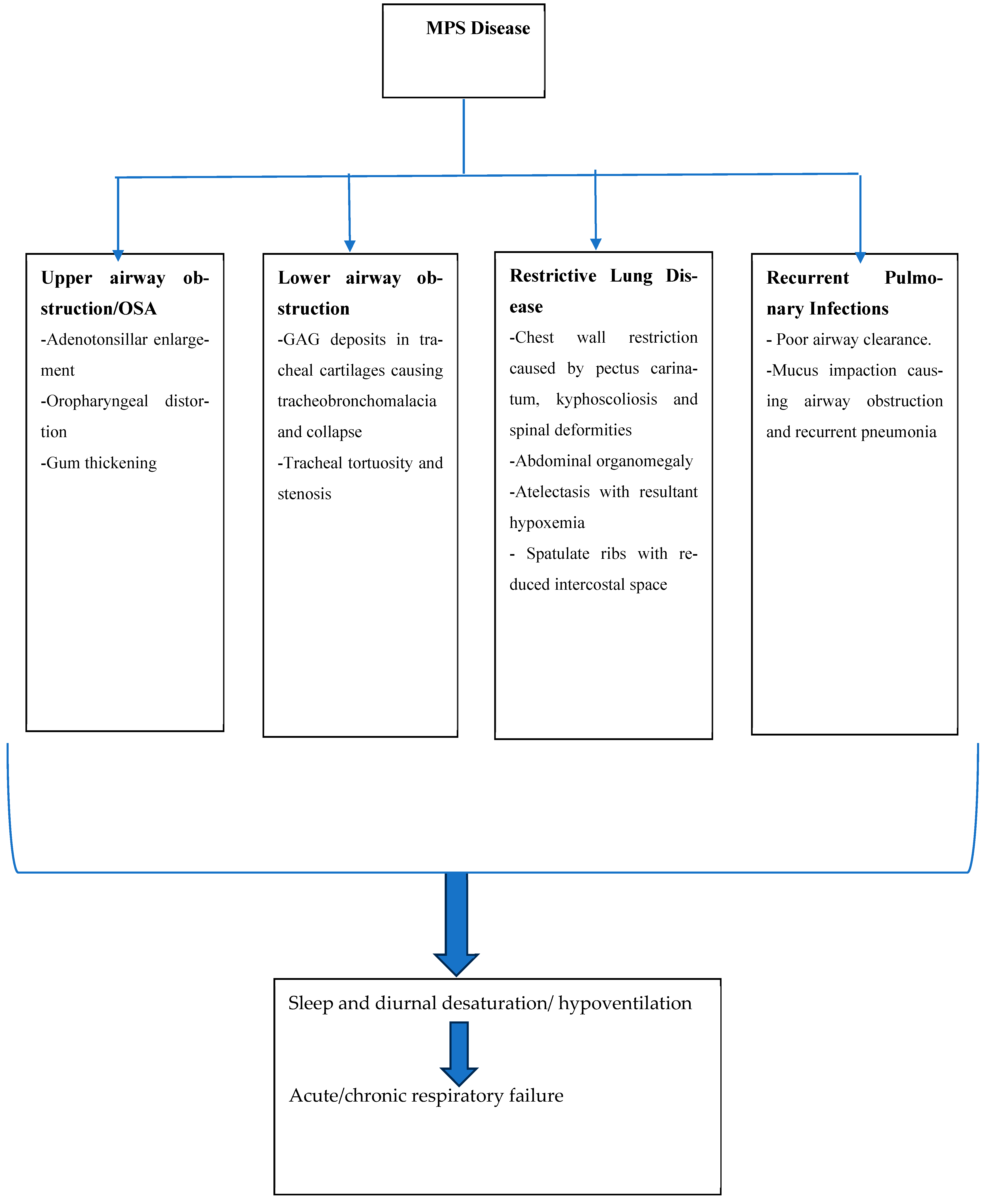
| Upper airway obstruction | Adenotonsillar enlargement, oropharyngeal distortion, leading to sleep disordered breathing. Abnormal teeth protrusion, mouth opening, high Mallampati class affects airway. | MPS I, II, IVA, VI, VII Minimal involvement in MPS III | Adenotonsillectomy, nasal steroid (more effective in young patients), tracheostomy (in recalcitrant cases), ERT, HSCT |
| Lower Airway Obstruction | GAG accumulation in tracheal cartilages causing collapse and tracheobronchomalacia. Tracheal stenosis and tortuosity MPS IVA has a peculiarity for severely narrowed airways due to tracheobronchial distortion. | MPS I, 11, IVA Minimal involvement in MPS III and other subtypes of MPS IV | PAP therapy particularly at night, use of tracheal and bronchial stents in very selected patients, inhaled steroids (airway inflammation), ERT/HSCT (less effective compared to upper airway obstruction), tracheostomy (for severe cases) |
| Restrictive Lung Disease | Chest wall restriction caused by pectus carinatum, broad spatulate ribs, reduced intercostal space, kyphoscoliosis and spinal deformities. Reduced lung volumes due to abdominal organomegaly. Atelectasis with resultant hypoxemia | MPS IV, VI Minimal involvement in MPS III | Spinal and chest wall surgeries (if applicable), ERT, HSCT (less effective for chest wall disorders compared to upper airway obstruction). |
| Sleep Disordered Breathing | Obstructive sleep apnea (OSA) and sleep hypoxemia/hypoventilation | MPS I, II | Weight loss, adenotonsillectomy, CPAP or Bilevel PAP devices, supplemental oxygen (may worsen hypoventilation), ERT, HSCT. Tracheostomy (in severe cases) |
| Recurrent Pulmonary Infection | Poor airway clearance causing upper respiratory infections, bronchitis and pneumonia. Reduced immunity. | All MPS types | Appropriately recommended vaccinations, use of mucolytics and cough assistance devices and maneuvers. |
| MPS Team Member | Role in MPS Management |
|---|---|
| Pulmonologist | Provide respiratory care to MPS patients which may include positive airway pressure devices, airway clearance and cough assist devices, prescription of medications to address airway inflammation and help with secretion mobilization. Assessment and monitoring of lung function. |
| Otolaryngologist | Addressing complicated airway obstruction, performing adenotonsillectomy for sleep disordered breathing, airway planning prior to surgical interventions, management of recurrent otitis media and hearing issues |
| Anesthesiologist | Pre- and Peri-operative airway assessment plans and management |
| Neurologist | Evaluation and management of neurological complications, including and nerve impingement affecting overall mobility and functionality |
| Orthopedic/Spinal Surgeon | Management of skeletal deformities, chest wall and restrictive thoracic disorders, addressing spinal cord compression to improve functionality |
| Clinical Geneticist | Diagnosis of MPS type, understanding disease progression and implications for treatment |
| Cardiologist | Optimizing cardiac health to prevent complications particularly during vulnerable periods such as during anesthesia for surgical interventions |
Disclaimer/Publisher’s Note: The statements, opinions and data contained in all publications are solely those of the individual author(s) and contributor(s) and not of MDPI and/or the editor(s). MDPI and/or the editor(s) disclaim responsibility for any injury to people or property resulting from any ideas, methods, instructions or products referred to in the content. |
© 2026 by the author. Published by MDPI on behalf of the Polish Respiratory Society. Licensee MDPI, Basel, Switzerland. This article is an open access article distributed under the terms and conditions of the Creative Commons Attribution (CC BY) license.
Share and Cite
Akpa, B. Advances in Therapeutic Options for Pulmonary and Sleep Disorders in Mucopolysaccharidosis (MPS) Patients: A Narrative Review. Adv. Respir. Med. 2026, 94, 41. https://doi.org/10.3390/arm94030041
Akpa B. Advances in Therapeutic Options for Pulmonary and Sleep Disorders in Mucopolysaccharidosis (MPS) Patients: A Narrative Review. Advances in Respiratory Medicine. 2026; 94(3):41. https://doi.org/10.3390/arm94030041
Chicago/Turabian StyleAkpa, Bimaje. 2026. "Advances in Therapeutic Options for Pulmonary and Sleep Disorders in Mucopolysaccharidosis (MPS) Patients: A Narrative Review" Advances in Respiratory Medicine 94, no. 3: 41. https://doi.org/10.3390/arm94030041
APA StyleAkpa, B. (2026). Advances in Therapeutic Options for Pulmonary and Sleep Disorders in Mucopolysaccharidosis (MPS) Patients: A Narrative Review. Advances in Respiratory Medicine, 94(3), 41. https://doi.org/10.3390/arm94030041