
Validation of SpO2/FiO2 as a Non-Invasive Surrogate of PaO2/FiO2 in Mechanically Ventilated COVID-19 Patients at High Altitude

 , , ,
, , ,
Highlights
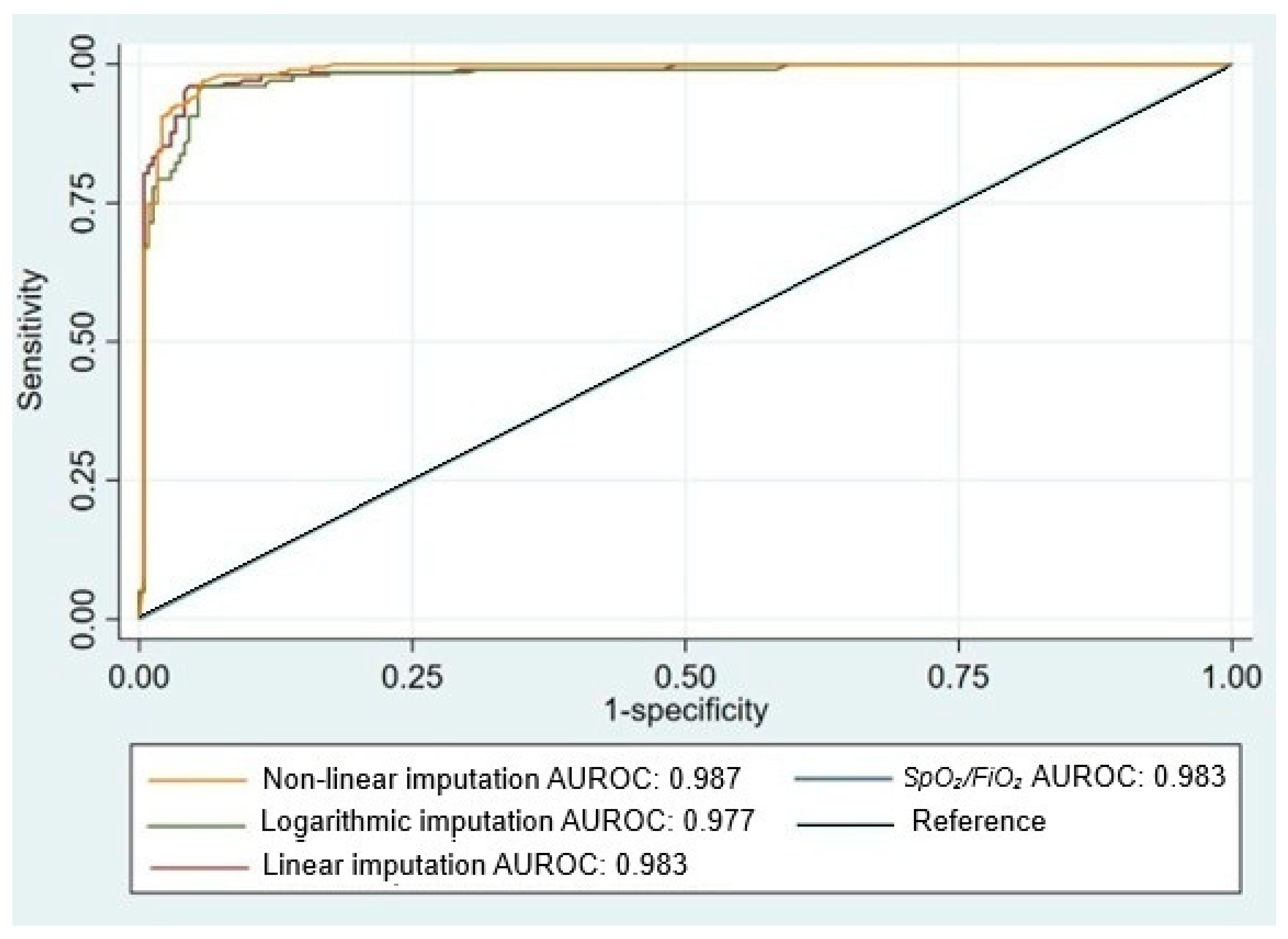
- An SpO2/FiO2 (S/F) ratio threshold of ≥206 is an excellent predictor for identifying non-severe hypoxemia (defined as a PaO2/FiO2 ≥ 150), showing a diagnostic performance with an AUC of 0.983.
- The S/F ratio maintains its high diagnostic accuracy across various complex clinical conditions, including hypercapnia (PCO2 > 35 mmHg), high PEEP (>10 cmH2O), anemia, and hyperbilirubinemia.
- The S/F ratio serves as a valid, non-invasive alternative to the invasive PaO2/FiO2 ratio, allowing for the classification of respiratory distress without the need for frequent and painful arterial blood gas sampling.
- This metric is particularly beneficial for resource-limited settings and high-altitude locations where access to arterial gas analysis may be restricted, enabling faster and more cost-effective clinical decision-making.
Abstract
1. Introduction
2. Methods
2.1. Study Design and Setting
2.2. Participants
2.3. Variables and Data Sources
2.4. Statistical Analysis
3. Results
4. Discussion
Limitations
5. Conclusions
Author Contributions
Funding
Institutional Review Board Statement
Informed Consent Statement
Data Availability Statement
Acknowledgments
Conflicts of Interest
References
- Ashbaugh, D.G.; Bigelow, D.B.; Petty, T.L.; Levine, B.E. Acute respiratory distress in adults. Lancet 1967, 2, 319–323. [Google Scholar] [CrossRef] [PubMed]
- Sweeney, R.M.; McAuley, D.F. Acute respiratory distress syndrome. Lancet 2016, 388, 2416–2430. [Google Scholar] [CrossRef] [PubMed]
- Bellani, G.; Laffey, J.G.; Pham, T.; Fan, E.; Brochard, L.; Esteban, A.; Gattinoni, L.; Van Haren, F.; Larsson, A.; McAuley, D.F.; et al. Epidemiology, Patterns of Care, and Mortality for Patients with Acute Respiratory Distress Syndrome in Intensive Care Units in 50 Countries. JAMA 2019, 315, 788–800. [Google Scholar] [CrossRef] [PubMed]
- Rubenfeld, G.D.; Caldwell, E.; Peabody, E.; Weaver, J.; Martin, D.P.; Neff, M.; Stern, E.J.; Hudson, L.D. Incidence and Outcomes of Acute Lung Injury. N. Engl. J. Med. 2004, 353, 1685–1693. [Google Scholar] [CrossRef]
- Vincent, J.L.; Moreno, R.; Takala, J.; Willatts, S.; De Mendonça, A.; Bruining, H.; Reinhart, C.K.; Suter, P.; Thijs, L.G. The SOFA (Sepsis-related Organ Failure Assessment) score to describe organ dysfunction/failure. On behalf of the Working Group on Sepsis-Related Problems of the European Society of Intensive Care Medicine. Intensive Care Med. 1996, 24, 707–710. [Google Scholar] [CrossRef]
- ARDSDefinition Task Force; Ranieri, V.M.; Rubenfeld, G.D.; Thompson, B.T.; Ferguson, N.D.; Caldwell, E.; Fan, E.; Camporota, L.; Slutsky, A.S. Acute respiratory distress syndrome: The Berlin Definition. JAMA 2012, 307, 2526–2533. [Google Scholar] [CrossRef]
- Riviello, E.D.; Kiviri, W.; Twagirumugabe, T.; Mueller, A.; Banner-Goodspeed, V.M.; Officer, L.; Novack, V.; Mutumwinka, M.; Talmor, D.S.; Fowler, R.A. Hospital Incidence and Outcomes of the Acute Respiratory Distress Syndrome Using the Kigali Modification of the Berlin Definition. Am. J. Respir. Crit. Care Med. 2016, 193, 52–59. [Google Scholar] [CrossRef]
- Matthay, M.A.; Arabi, Y.; Arroliga, A.C.; Bernard, G.; Bersten, A.D.; Brochard, L.J.; Calfee, C.S.; Combes, A.; Daniel, B.M.; Ferguson, N.D.; et al. A New Global Definition of Acute Respiratory Distress Syndrome. Am. J. Respir. Crit. Care Med. 2024, 209, 37–47. [Google Scholar] [CrossRef]
- Chen, W.; Janz, D.R.; Shaver, C.M.; Bernard, G.R.; Bastarache, J.A.; Ware, L.B. Clinical Characteristics and Outcomes Are Similar in ARDS Diagnosed by Oxygen Saturation/Fio2 Ratio Compared with Pao2/Fio2 Ratio. Chest 2015, 148, 1477–1483. [Google Scholar] [CrossRef]
- Brown, S.M.; Grissom, C.K.; Moss, M.; Rice, T.W.; Schoenfeld, D.; Hou, P.C.; Thompson, B.T.; Brower, R.G.; NIH/NHLBI PETAL Network Collaborators. Nonlinear Imputation of Pao2/Fio2 from Spo2/Fio2 Among Patients With Acute Respiratory Distress Syndrome. Chest 2016, 150, 307–313. [Google Scholar] [CrossRef]
- Zhang, G.; Burla, M.J.; Caesar, B.B.; Falank, C.R.; Kyros, P.; Zucco, V.C.; Strumilowska, A.; Cullinane, D.C.; Sheppard, F.R. Emergency Department SpO2/FiO2 Ratios Correlate with Mechanical Ventilation and Intensive Care Unit Requirements in COVID-19 Patients. West. J. Emerg. Med. 2024, 25, 325–331. [Google Scholar] [CrossRef]
- Bickler, P.E.; Feiner, J.R.; Severinghaus, J.W. Effects of skin pigmentation on pulse oximeter accuracy at low saturation. Anesthesiology 2005, 102, 715–719. [Google Scholar] [CrossRef]
- James, A.; Petit, M.; Biancale, F.; Bougle, A.; Degos, V.; Monsel, A.; Vieillard-Baron, A.; Constantin, J.M. Agreement between pulse oximetry and arterial oxygen saturation measurement in critical care patients during COVID-19: A cross-sectional study. J. Clin. Monit. Comput. 2023, 37, 977–984. [Google Scholar] [CrossRef]
- Ortiz, G.; Bastidas, A.; Garay-Fernández, M.; Lara, A.; Benavides, M.; Rocha, E.; Buitrago, A.; Díaz, G.; Ordóñez, J.; Reyes, L.F. Correlation and validity of imputed PaO2/FiO2 and SpO2/FiO2 in patients with invasive mechanical ventilation at 2600 m above sea level. Med. Intensiv. Engl. Ed. 2022, 46, 501–507. [Google Scholar] [CrossRef]
- Lu, X.; Jiang, L.; Chen, T.; Wang, Y.; Zhang, B.; Hong, Y.; Wang, J.; Yan, F. Continuously available ratio of SpO2/FiO2 serves as a noninvasive prognostic marker for intensive care patients with COVID-19. Respir. Res. 2020, 21, 194. [Google Scholar] [CrossRef] [PubMed]
- von Elm, E.; Altman, D.G.; Egger, M.; Pocock, S.J.; Gøtzsche, P.C.; Vandenbroucke, J.P. STROBE Initiative. The Strengthening the Reporting of Observational Studies in Epidemiology (STROBE) statement: Guidelines for reporting observational studies. PLoS Med. 2007, 4, e296. [Google Scholar] [CrossRef] [PubMed]
- StataCorp. Stata: Statistical Software, Release 17; StataCorp LLC: College Station, TX, USA, 2021.
- Hosmer, D.; Lemeshow, S. Applied Logistic Regression; John Wiley & Sons, Inc.: New York, NY, USA, 2000; p. 162. [Google Scholar]
- Kumle, L.; Võ, M.L.; Draschkow, D. Estimating power in (generalized) linear mixed models: An open introduction and tutorial in R. Behav. Res. Methods 2021, 53, 2528–2543. [Google Scholar] [CrossRef] [PubMed]
- Bonaventura, A.; Mumoli, N.; Mazzone, A.; Colombo, A.; Evangelista, I.; Cerutti, S.; Brivio, L.; Vecchié, A.; Bonomi, A.; Para, O.; et al. Correlation of SpO2/FiO2 and PaO2/FiO2 in patients with symptomatic COVID-19: An observational, retrospective study. Intern. Emerg. Med. 2022, 17, 1769–1775. [Google Scholar] [CrossRef]
- Ruangsomboon, O.; Jirathanavichai, S.; Phanprasert, N.; Puchongmart, C.; Boonmee, P.; Thirawattanasoot, N.; Dorongthom, T.; Monsomboon, A.; Praphruetkit, N. Ratio of Oxygen Saturation to Inspired Oxygen, ROX Index, Modified ROX Index to Predict High Flow Cannula Success in COVID-19 Patients: Multicenter Validation Study. West. J. Emerg. Med. 2023, 24, 511–521. [Google Scholar] [CrossRef]
- West, J.B. Physiological effects of chronic hypoxia. N. Engl. J. Med. 2017, 376, 1965–1971. [Google Scholar] [CrossRef]
- Aguirre-Franco, C.; Thirion-Romero, I.; Gochicoa-Rangel, L.; Cherrez-Ojeda, I.; Noriega-Aguirre, L.; Arbo Oze de Morvil, G.A.; González Toledo, S.; Rincon-Alvarez, E.; Torre-Bouscoulet, L.; Delgado Viteri, C.M.; et al. Evaluation of the performance of the reference equations for single-breath diffusing capacity of the lung for carbon monoxide (DLCOsb) in Latin American populations at different altitudes: A multicentre study. Pulmonology 2026, 32, 2638013. [Google Scholar] [CrossRef] [PubMed]
- Hegewald, M.J.; Tw, D.; Weaver, L.K.; Jensen, R.L. Effect of barometric pressure on single-breath carbon monoxide diffusing capacity. Respir. Physiol. Neurobiol. 2023, 308, 103997. [Google Scholar] [CrossRef] [PubMed]
- Zhou, H.; Bian, M.; Huang, X.; Deji, Y. Analysis of clinical features of AECOPD at different altitudes and GOLD stages in high-altitude regions. BMJ Open Respir. Res. 2026, 13, e003876. [Google Scholar] [CrossRef]
- Merola, R.; Battaglini, D.; Schultz, M.J.; Rocco, P.R.M. Physiology-guided personalized mechanical ventilation to prevent ventilator-induced lung injury. Front. Med. 2026, 13, 1764151. [Google Scholar] [CrossRef]
- Merola, R.; Vargas, M.; Battaglini, D. Ventilator-Induced Lung Injury: The Unseen Challenge in Acute Respiratory Distress Syndrome Management. J. Clin. Med. 2025, 14, 3910. [Google Scholar] [CrossRef] [PubMed]
- Chiumello, D.; Coppola, S.; Silva, P.L.; Lais, G.; Rocco, P.R.M.; Piquilloud, L. Bedside ventilatory settings guided by respiratory mechanics in acute respiratory distress syndrome. Ann. Intensive Care 2025, 15, 189. [Google Scholar] [CrossRef]



| Total, n (%) | 473 (100) |
|---|---|
| Age, years, mean (SD) | 62.37 (14.05) |
| Male sex, n (%) | 318 (67.23) |
| Systolic blood pressure, mmHg, mean (SD) | 123.49 (23.67) |
| Diastolic blood pressure, mmHg, mean (SD) | 72.15 (14.49) |
| Heart rate, beats/min, mean (SD) | 96.14 (18.97) |
| Respiratory rate, breaths/min, mean (SD) | 23.19 (7.29) |
| Temperature, °C, mean (SD) | 36.57 (1.23) |
| Tidal volume, mL, mean (SD) | 441.64 (64.20) |
| PEEP, cmH2O, mean (SD) | 11.40 (2.45) |
| Plateau pressure, cmH2O, mean (SD) | 23.05 (5.49) |
| Peak pressure, cmH2O, mean (SD) | 28.64 (6.32) |
| Driving pressure, cmH2O, mean (SD) | 10.79 (5.09) |
| Dynamic compliance, mL/cmH2O, mean (SD) | 29.19 (15.13) |
| Static compliance, mL/cmH2O, mean (SD) | 43.59 (31.35) |
| Inspiratory airway resistance, cmH2O/L/s, mean (SD) | 13.99 (6.16) |
| Leukocytes, ×109/L, mean (SD) | 11,418.95 (12,036.43) |
| Hemoglobin, g/dL, mean (SD) | 14.34 (2.32) |
| Hematocrit, %, mean (SD) | 42.94 (6.56) |
| Platelets, ×109/L, mean (SD) | 238,066.31 (96,186.23) |
| Total bilirubin, mg/dL, mean (SD) | 0.88 (1.17) |
| Creatinine, mg/dL, mean (SD) | 1.49 (2.08) |
| Sodium, mmol/L, mean (SD) | 137.03 (5.40) |
| Potassium, mmol/L, mean (SD) | 4.42 (0.87) |
| D-dimer, ng/mL, mean (SD) | 2276.07 (4907.27) |
| Troponin, ng/mL, mean (SD) | 66.46 (262.33) |
| Lactate dehydrogenase, U/L, mean (SD) | 589.48 (663.18) |
| SOFA score, m (SD) | 5.22 (2.73) |
| NEWS score, m (SD) | 7.46 (3.15) |
| Use of vasopressors, n (%) | 369 (78.01) |
| Arterial blood gas parameters of patients 24 h after IMV in the ICU | |
| FiO2, fraction, mean (SD) | 57.34 (32.21) |
| pH, mean (SD) | 7.38 (0.11) |
| PaCO2, mmHg, mean (SD) | 37.71 (13.00) |
| PaO2, mmHg, mean (SD) | 67.19 (23.48) |
| HCO3−, mmol/L, mean (SD) | 21.71 (4.93) |
| SaO2, %, mean (SD) | 88.53 (10.47) |
| SpO2/FiO2 ratio, mean (SD) | 224.66 (139.65) |
| PaO2/FiO2 ratio, mean (SD) | 168.45 (114.91) |
| Severe Hypoxemia n = 255 (53.91) | No severe Hypoxemia n = 218 (46.09) | p Value | |
|---|---|---|---|
| Age, years, mean (SD) | 64.04 (13.68) | 60.40 (14.24) | 0.004 * |
| Male sex, n (%) | 168 (65.88) | 150 (68.81) | 0.499 |
| Systolic blood pressure, mmHg, mean (SD) | 122.35 (22.76) | 124.82 (24.68) | 0.272 |
| Diastolic blood pressure, mmHg, mean (SD) | 71.35 (14.00) | 73.08 (15.02) | 0.210 |
| Heart rate, beats/min, mean (SD) | 94.69 (17.94) | 97.76 (19.97) | 0.085 |
| Respiratory rate, breaths/min, mean (SD) | 23.74 (7.93) | 22.55 (6.46) | 0.085 |
| Temperature, °C, mean (SD) | 36.56 (1.49) | 36.59 (0.84) | 0.801 |
| Tidal volume, mL, mean (SD) | 439.67 (57.99) | 446.60 (77.92) | 0.430 |
| PEEP, cmH2O, mean (SD) | 11.39 (2.48) | 11.44 (2.39) | 0.848 |
| Plateau pressure, cmH2O, mean (SD) | 23.45 (5.29) | 21.86 (6.05) | 0.243 |
| Peak pressure, cmH2O, mean (SD) | 28.73 (6.59) | 28.36 (5.58) | 0.814 |
| Driving pressure, cmH2O, mean (SD) | 11.09 (4.93) | 9.86 (5.69) | 0.435 |
| Dynamic compliance, mL/cmH2O, mean (SD) | 28.59 (15.85) | 31.53 (12.16) | 0.505 |
| Static compliance, mL/cmH2O, mean (SD) | 44.47 (35.41) | 40.89 (12.98) | 0.676 |
| Inspiratory airway resistance, cmH2O/L/s, mean (SD) | 14.97 (6.40) | 11.40 (4.79) | 0.101 |
| Leukocytes, ×109/L, mean (SD) | 11,052.27 (5077.75) | 11,852.14 (16,911.55) | 0.474 |
| Hemoglobin, g/dL, mean (SD) | 14.19 (2.09) | 14.51 (2.57) | 0.133 |
| Hematocrit, %, mean (SD) | 42.36 (5.86) | 43.62 (7.27) | 0.038 * |
| Platelets, ×109/L, mean (SD) | 244,784.60 (96,123.68) | 230,017.00 (9567.77) | 0.099 |
| Total bilirubin, mg/dL, mean (SD) | 0.80 (0.71) | 0.99 (1.54) | 0.119 |
| Creatinine, mg/dL, mean (SD) | 1.52 (2.41) | 1.44 (1.60) | 0.692 |
| Sodium, mmol/L, mean (SD) | 136.78 (5.12) | 137.36 (5.74) | 0.274 |
| Potassium, mmol/L, mean (SD) | 4.39 (0.90) | 4.51 (0.76) | 0.618 |
| D-dimer, ng/mL, mean (SD) | 1980.78 (4883.27) | 2605.56 (4925.87) | 0.203 |
| Troponin, ng/mL, mean (SD) | 53.58 (116.73) | 80.94 (361.83) | 0.303 |
| Lactate dehydrogenase, U/L, mean (SD) | 640.73 (857.21) | 533.73 (339.25) | 0.105 |
| SOFA score, m (SD) | 5.43 (2.76) | 4.98 (2.68) | 0.122 |
| NEWS score, m (SD) | 7.93 (3.09) | 6.95 (3.14) | 0.002 * |
| Use of vasopressors, n (%) | 197 (77.25) | 172 (78.90) | 0.667 |
| Arterial blood gas parameters of patients 24 h after IMV in the ICU | |||
| FiO2, fraction, mean (SD) | 82.50 (20.42) | 27.90 (12.43) | 0.001 * |
| pH, mean (SD) | 7.36 (0.11) | 7.39 (0.10) | 0.002 * |
| PaCO2, mmHg, mean (SD) | 40.75 (13.01) | 34.18 (12.10) | 0.001 * |
| PaO2, mmHg, mean (SD) | 64.12 (19.27) | 70.77 (27.21) | 0.002 * |
| HCO3−, mmol/L, mean (SD) | 22.45 (4.38) | 20.85 (5.38) | 0.001 * |
| SaO2, %, mean (SD) | 87.76 (11.14) | 89.44 (9.57) | 0.090 |
| SpO2/FiO2 ratio, mean (SD) | 115.01 (43.52) | 355.37 (95.03) | 0.001 * |
| PaO2/FiO2 ratio, mean (SD) | 82.15 (27.61) | 269.40 (94.02) | 0.001 * |
| Variable | AUC (IC 95%) | Sensitivity (%) | Specificity (%) | LR (+) | LR (−) | Correctly Classified (%) |
|---|---|---|---|---|---|---|
| SpO2/FiO2 ≥ 206 a | 0.983 (0.97–0.99) | 90.64 | 96.69 | 27.42 | 0.09 | 93.93 |
| SpO2/FiO2 ≥ 206 (PEEP > 10) | 0.982 (0.97–0.99) | 78.79 | 97.70 | 34.28 | 0.22 | 92.50 |
| SpO2/FiO2 ≥ 206 b | 0.951 (0.90–0.99) | 91.67 | 92.73 | 12.60 | 0.09 | 92.23 |
| SpO2/FiO2 ≥ 206 Hemoglobin < 10 g/dL | 0.906 (0.72–1.00) | 100.00 | 75.00 | 4.00 | 0.01 | 90.00 |
| SpO2/FiO2 ≥ 206 PaCO2 > 35 mmHg | 0.976 (0.95–0.99) | 74.67 | 99.38 | 120.96 | 0.25 | 91.56 |
Disclaimer/Publisher’s Note: The statements, opinions and data contained in all publications are solely those of the individual author(s) and contributor(s) and not of MDPI and/or the editor(s). MDPI and/or the editor(s) disclaim responsibility for any injury to people or property resulting from any ideas, methods, instructions or products referred to in the content. |
© 2026 by the authors. Published by MDPI on behalf of the Polish Respiratory Society. Licensee MDPI, Basel, Switzerland. This article is an open access article distributed under the terms and conditions of the Creative Commons Attribution (CC BY) license.
Share and Cite
Ortiz-Ruiz, G.; Garay-Fernández, M.; Tuta-Quintero, E.; Bastidas, A.; Lara, A.; Márquez, A.M.; Aponte, C.; Guevara, J.; Guezguan, J.A. Validation of SpO2/FiO2 as a Non-Invasive Surrogate of PaO2/FiO2 in Mechanically Ventilated COVID-19 Patients at High Altitude. Adv. Respir. Med. 2026, 94, 28. https://doi.org/10.3390/arm94030028
Ortiz-Ruiz G, Garay-Fernández M, Tuta-Quintero E, Bastidas A, Lara A, Márquez AM, Aponte C, Guevara J, Guezguan JA. Validation of SpO2/FiO2 as a Non-Invasive Surrogate of PaO2/FiO2 in Mechanically Ventilated COVID-19 Patients at High Altitude. Advances in Respiratory Medicine. 2026; 94(3):28. https://doi.org/10.3390/arm94030028
Chicago/Turabian StyleOrtiz-Ruiz, Guillermo, Manuel Garay-Fernández, Eduardo Tuta-Quintero, Alirio Bastidas, Antonio Lara, Arlen Mauricio Márquez, Carolina Aponte, Jairo Guevara, and Jonathan A. Guezguan. 2026. "Validation of SpO2/FiO2 as a Non-Invasive Surrogate of PaO2/FiO2 in Mechanically Ventilated COVID-19 Patients at High Altitude" Advances in Respiratory Medicine 94, no. 3: 28. https://doi.org/10.3390/arm94030028
APA StyleOrtiz-Ruiz, G., Garay-Fernández, M., Tuta-Quintero, E., Bastidas, A., Lara, A., Márquez, A. M., Aponte, C., Guevara, J., & Guezguan, J. A. (2026). Validation of SpO2/FiO2 as a Non-Invasive Surrogate of PaO2/FiO2 in Mechanically Ventilated COVID-19 Patients at High Altitude. Advances in Respiratory Medicine, 94(3), 28. https://doi.org/10.3390/arm94030028