Systematic Review

Effects of Exercise-Based Pulmonary Rehabilitation in Patients with Long COVID: A Systematic Review and Meta-Analysis


by
Janne Marques Silveira
1,2,
Ana Paula Midori Nakaishi
3,
Marcos Gontijo da Silva
4,
Daniele Oliveira dos Santos
1 and
Ada Clarice Gastaldi
1,*
1
Graduate Program in Rehabilitation and Functional Performance, Ribeirão Preto Medical School (FMRP-USP), University of São Paulo—USP, Ribeirão Preto 14049-900, São Paulo, Brazil
2
Medicine (Undergraduate Program), University of Gurupi (UNIRG), Gurupi 77403-080, Tocantins, Brazil
3
Physiotherapy Course, Ribeirão Preto Medical School (FMRP-USP), University of São Paulo—USP, Ribeirão Preto 14049-900, São Paulo, Brazil
4
Graduate Program in Biotechnology, Federal University of Tocantins, Gurupi 77402-970, Tocantins, Brazil
*
Author to whom correspondence should be addressed.
Adv. Respir. Med. 2026, 94(2), 25; https://doi.org/10.3390/arm94020025
Submission received: 20 February 2026 / Revised: 26 March 2026 / Accepted: 7 April 2026 / Published: 10 April 2026

Highlights

What are the main findings?
  • In-person pulmonary rehabilitation significantly improves functional exercise capacity in Long COVID, with a clinically meaningful + 53.7 m increase in 6MWT.
  • Functional gains were consistent across randomized and observational studies, accompanied by improvements in dyspnea and quality of life, independent of spirometric changes.
What are the implications of the main findings?
  • Supervised exercise-based pulmonary rehabilitation is associated with improvements in functional recovery in Long COVID.
  • Benefits were observed across different study designs, supporting the role of supervised rehabilitation in the multidisciplinary management of Long COVID.

Abstract

Background/Objective: A substantial proportion of infected individuals develop persistent symptoms after the acute phase of COVID-19, regardless of initial disease severity. Long COVID (LC) remains a public health challenge characterized by impaired functional exercise capacity (FEC) and quality of life (QoL). We systematically synthesized evidence on the effects of in-person outpatient pulmonary rehabilitation (OPR) with individualized and supervised exercise in adults with LC. Methods: Following PROSPERO (CRD42023389365), this study reviewed randomized controlled trials (RCTs) and observational cohort studies (OCSs) published between November 2019 and January 2026 in MEDLINE/PubMed, Web of Science, PEDro, and EMBASE. Results: Fifteen studies (n = 803) were included. OPR improved FEC (6MWT; MD: 53.72 m, 95% CI 43.69–63.75) and 30″SST (MD: 4.68, 95% CI 3.59–5.77) and reduced exertional dyspnea. RCTs showed benefits in physical (MD: 8.04, 95% CI 3.02–13.05) and mental QoL (MD: 6.60, 95% CI 2.01–11.18) and dyspnea impact, with inconsistent PF findings. Fatigue showed a trend toward improvement but was measured using heterogeneous patient-reported tools in RCTs and OCSs. Conclusions: Supervised PR improves FEC, QoL, and dyspnea in individuals with LC. In patients with fatigue/PEM, systematic assessment and continuous symptom monitoring are essential. High-quality controlled studies are needed to strengthen evidence and clinical guide.

1. Introduction

Long COVID (LC) is considered a significant post-pandemic health problem that manifests itself regardless of the severity of COVID-19 [1,2]. It is characterized by long-lasting, heterogeneous, and multisystemic symptoms. Prevalence estimates remain high, ranging from 36% [3], 45% [4] to 57% [5]. Moreover, longitudinal data indicate persistence and even increase over time, from 35% at the 12-month to 46% at the 12- to 24-month follow-up after the acute phase of COVID-19 [3].
The clinical and functional implications of LC [6] reduce physical performance and exercise tolerance [7,8]. Such limitations are related to a greater sensation of dyspnea at rest, which worsens during exercise, negatively impacting activities of daily living (ADL) [9] and QoL [10]. In addition, they compromise productivity and work capacity, overburdening health systems worldwide [11].
The course of spontaneous recovery from COVID-19 varies, with improvement most likely occurring within 6 months. However, a substantial proportion of people tend not to recover fully and require specific interventions aimed at functional improvement and symptom management [12].
Classically, PR is a well-established strategy in the management of a variety of chronic respiratory diseases [13]. Patients with LC may benefit from physical therapy programs that utilize various exercise modalities combined with in-person, remote, or hybrid therapeutic interventions. However, because these programs involve multimodal interventions, the specific effects of exercise alone have not been clearly established, particularly given the clinical heterogeneity of LC and the potential risk of adverse events [14].
In this context, given that the effects of protocols focused primarily on physical exercise for patients with LC have not yet been clearly established in the literature [15], it is necessary to evaluate the effects of exercise-based physical therapy. This modality was chosen because it is a strategy that does not require complex infrastructure or sophisticated technologies and is easy to implement at different levels of healthcare [16].
Given this, this systematic review aimed to identify the best evidence from the literature on the impact of in-person and supervised outpatient pulmonary rehabilitation, with physical exercise as the main strategy, on functional exercise capacity, pulmonary function, and dyspnea in patients with LC.

2. Materials and Methods

2.1. Register

This review adhered to the PRISMA (Preferred Reporting Items for Systematic Review and Meta-Analyses) guidelines [17] and was registered for access in the International Prospective Registry of Systematic Reviews (PROSPERO) under protocol number n° CRD42023389365 for access. This study was partially funded by the Coordination for the Improvement of Higher Education Personnel—Brazil (CAPES) and no conflicts of interest affected this review.

2.2. Eligibility Criteria

Randomized clinical trial (RCTs) and observational cohort studies (OCS) were included.

2.3. Participants

Participants were adults aged 18 years and older diagnosed with LC, which is defined as persistent symptoms continuing from 12 weeks after SARS-CoV-2 infection [1], regardless of the clinical form of COVID-19 in the acute phase.

2.4. Intervention

Outpatient pulmonary rehabilitation (OPR) lasts at least 4 weeks, with supervised physical training as a unique and essential component. Interventions in RCTs were compared to any control.

2.5. Outcomes

Primary outcomes included FEC as assessed by the 6-Minute Walk Test (6MWT) or Sit-to-Stand Test (SST) and QoL. Secondary outcomes included PF assessed by spirometry, dyspnea at rest measured by the modified Medical Research Council (mMRC) scale, and dyspnea during exercise assessed by the adapted Borg Scale.

2.6. Exclusion Criteria

Studies not available in English, editorials, letters, congress and conference abstracts, case reports and series, preprints, pilot studies and studies describing protocols, and those not meeting the eligibility criteria were excluded.

2.7. Search, Selection and Data Extraction Process

Searches used MeSH terms (Medical Subject Headings) and were customized for each database, Pubmed, Web of Science, Physiotherapy Evidence Database (PEDro) and EMBASE via Elsevier, for studies published between November 2019 and January 2026.
The concepts “COVID-19” AND “Rehabilitation” OR “Exercise Therapy” AND “Walk Test” OR “Sit and Stand Test” OR “Quality of life” OR “Respiratory Function Tests” OR “Dyspnea” were used in the search. The concept map and search strategy can be viewed in Supplementary Materials S1 and S2.
Deduplication was performed using Rayyan® software [18]. Two reviewers (JMS and APMN) independently conducted selection, data extraction and risk of bias analysis with discrepancies resolved by a third reviewer (DOS). Authors were contacted for unavailable data in included studies. Most of our requests were successful.
A standardized form was used with the following information on the articles included: year of publication, authors, type of study, title, characteristics of the participants (age and clinical classification of COVID-19 in the acute phase), number of participants before and after the intervention, intervention details (duration, parameters and follow-up period) and primary and secondary outcomes (accessed in the Eligibility Criteria/Outcomes subsection). When multiple assessments occurred during follow-up, data from the end of the intervention protocol were included. For RCTs, we also collected data from the control group for comparison with the intervention group with OPR.

2.8. Assessing the Risk of Bias

The National Heart, Lung and Blood Institute (NHLBI) [19] criteria specific to RCTs and OCSs were used. For the RCTs, criteria and questions were: randomization (1), allocation (2, 3), blinding (4, 5), characteristics of the groups at baseline (6), dropout (7, 8), adherence (9), deviation from the planned intervention (10), validity of the outcome measures (11), power of the test for sample calculation (12), prespecified outcome (13), intention-to-treat analysis (14). Responses were categorical: “yes”, “no” and “not reported”. For OCSs, criteria and questions were: clarity research question and objective (1), population recruitment and standardization (2,3), uniform group eligibility criteria (4), sample size justification (5), exposure assessment prior to outcome measurement (6), adequate time to observe effects (7), various exposure levels (8), definition of exposure measure/independent variable measures (9), repeated exposure assessment (10), outcome measures (11), blinding of outcome assessors (12), follow-up rate (13), statistical analysis (14). Responses were categorical: “yes”, “no” and “not reported”. The overall risk was categorized according to the number of “yes” responses: 1–8 (high risk), 9–12 (unclear risk), and 13–14 (low risk), in accordance with similar systematic review [20].
The response synthesis/global bias classification for each study indicated low, unclear and high risk of bias, respectively. Disagreements between independent reviewers were resolved by a third reviewer.
The graphical tool Canva was used to generate individual and global risk of bias figures for the included studies. Methodological quality of this systematic review was assessed using the Measurement Tool to Assess Systematic Reviews 2 (AMSTAR 2).

2.9. Synthesis and Analysis

Data originally reported as median and interquartile range were converted to mean and standard deviation for the meta-analyses, according to statistical methods described in the literature [21]. When presented in figures, data were extracted using WebPlotDigitizer [22]. If meta-analysis was not possible, a descriptive synthesis was carried out.
Quantitative analyses of continuous variables were grouped as mean difference (MD) with 95% confidence interval (95% CI) at pre- and post-intervention. The meta-analyses were conducted separately according to study design, with independent analyses of observational studies (OCSs) and randomized clinical trials (RCTs), with the aim of reducing methodological heterogeneity and increasing the robustness of the estimates. Interventions in RCTs were compared to the control group.
In the meta-analyses, the results were expressed as MD 95% CI for the outcomes of FEC assessed by the 6MWT and 30″SST, 5 dimensions of QoL (EQ 5D) were assessed using the visual analog scale (EQ/VAS), and dyspnea was assessed by the Borg scale and in the OCS. In the RCTs, meta-analyses were performed on QoL assessed by the Short Form12 (SF-12), physical (QoL/PD) and mental (Qol/MD) domains, pulmonary function parameters (FVC, FEV1, FEV1/FVC) were measured in accordance with the recommendations of the American Thoracic Society/European Respiratory Society (ATS/ERS), using reference equations from the Global Lung Function Initiative (GLI) [23], and dyspnea was assessed by the mMRC.
A value of 30.5 m was used as the minimally significant clinical difference (MSCD) in the 6MWT [24].
Statistical analysis was performed using R software, version 4.3.1, for Windows 10, meta package version 6.5.0. [25]. In the absence or presence of reduced heterogeneity (I2 < 10% and p > 0.05), the fixed-effect model was applied using the Mantel–Haenszel method; for greater heterogeneity (I2 > 10% and p < 0.05), the random effects model was applied using the DerSimonian–Laird method [26]. I2 values near 25%, 50% and 75% or more indicated low, moderate and high heterogeneity, respectively [26,27]. In the presence of high heterogeneity, sensitivity analysis was carried out by excluding studies.

2.10. Certainty of Evidence

The Grading of Recommendations Assessment, Development, and Evaluation (GRADE) approach was used to assess the certainty of evidence for each outcome. Certainty was considered high for RCTs, which can be downgraded, and low for OCSs, which can be downgraded or upgraded [28].
The certainty of evidence rating for both RCTs and OCSs includes five items that may downgrade the evidence: risk of bias, inconsistency, indirect evidence, imprecision and publication bias [29]. In addition, OCSs include three items that may upgrade the evidence: large treatment effects, dose–response gradient and confounders against treatment.
The level of certainty is high when the results present a low risk of bias, consistency, directness, and precision, suggesting minimal impact from further studies; moderate when new studies are likely to change the effect estimate; low when new studies could significantly affect the estimate; and very low when uncertainty surrounds the effect estimate [30,31].

3. Results

Study Selection
The search strategy retrieved 5136 studies, removed 2227 duplicates, and screened 2909 titles and abstracts. Following this stage, 206 studies were read in full, and the reasons for exclusion (n = 191) are presented in the PRISMA flowchart. Fifteen studies were finally included (Figure 1). The RCTs included 329 [32,33,34,35,36,37] and the OCSs included 474 [38,39,40,41,42,43,44,45,46] for a total of 803 participants.

3.1. Characteristics of the Studies

The characteristics of the included studies can be found in Supplementary Material S3. The results on the effects of the OPR are shown in Table 1 and Table 2. The list of excluded studies is available in Supplementary Material S4.
Of the fifteen included studies, six were RCTs [32,33,34,35,36,37] and nine were OCSs [38,39,40,41,42,43,44,45,46]. All the patients with LC who had persistent symptoms (>3 months after the acute phase) participated in the in-person OPR program with physical exercise as an essential component.
The duration of the protocols was 3 [36], 4 [41,46], 6 [35,38,42,43,44], 7 [40], 8 [33,34,39] 10 [32,37] and 16 [45] weeks in the included studies. The number of weekly sessions varied from 2 [32,37,38,39,40,45], 3 [33,34,35,43,44,46], 5 [36,42] to 6 [41].
FEC was assessed in nine studies with 6MWT [35,36,39,41,42,43,44,45,46], four with 30″SST [39,43,44,45], one with a 1-min Sit-to-Stand Test (1′SST) [42] and one with a five-repetition Sit-to-Stand Test (5 × SST) [33]. QoL was assessed with SF-12 (physical and mental domains) in three studies [33,34,41] and with EQ-5D-5L in four studies [32,37,38,40]. PF was assessed in three studies [33,35,36]. Dyspnea was assessed with mMRC in six studies [33,34,35,43,44,46]. Three studies assessed dyspnea using the Borg scale [35,43,44], and one study assessed dyspnea using the Dyspnea-12 (D-12) [32].
Post-intervention QoL did not improve in two RCTs, one evaluated by EQ 5D (EQ Index and EQ/VAS) [32] and the other in the physical and mental domains of SF-12 [34]. Two OCSs showed no improvement in this same outcome by EQ/VAS [38] and in the mental domain of SF-36 [46]. PF and its variables (FVC, FEV1, and FEV1/FVC) did not change after the intervention in two RCTs [33,35], with significant improvement reported in only one RCT [36]. As for dyspnea, two RCTs did not show improvement in this outcome in the intervention group when assessed by mMRC [33] D-12 [32].

3.2. Risk of Bias

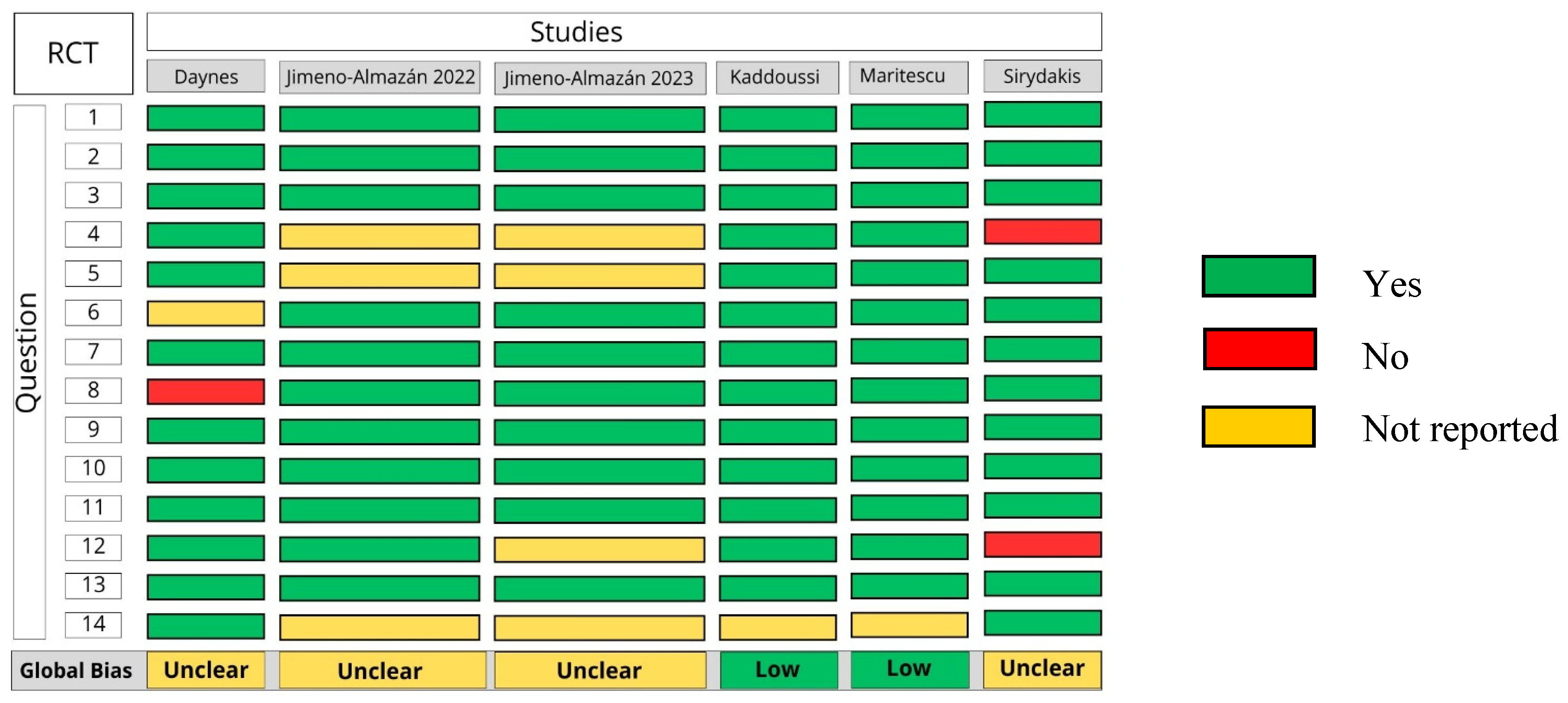
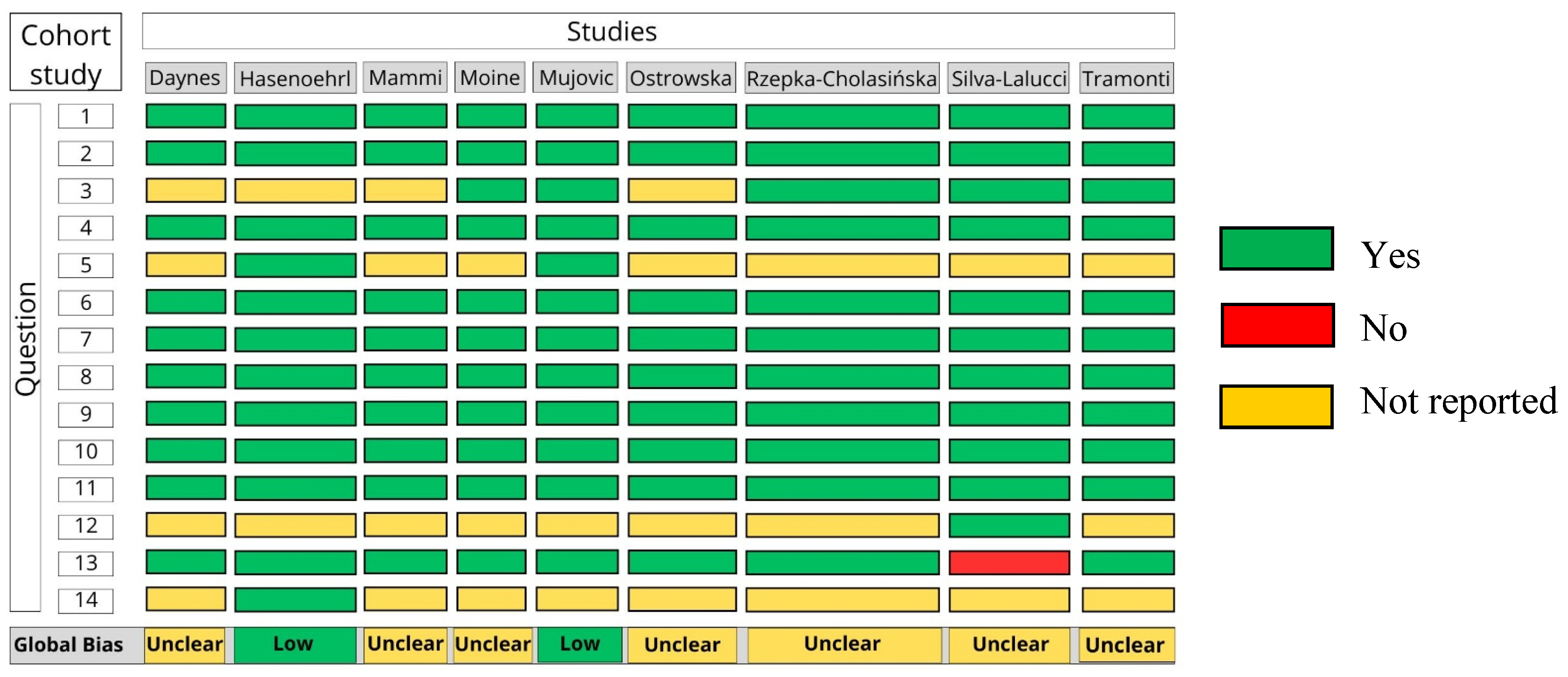
Regarding the overall risk of bias among the included RCTs, four [32,33,34,37] presented an unclear risk of bias, and two [35,36] presented a low risk, related to the absence of blinding of evaluators, incomplete description of losses, lack of prior sample calculation, and no intention-to-treat (ITT) analysis (Figure 2). In the OCSs, seven studies presented an uncertain risk [38,40,41,43,44,45,46] and two presented a low risk [40,42], predominantly associated with the absence of adequate control of confounding factors and the absence of adjusted analyses (Figure 3).
Criteria assessed and question number:
Randomization: 1
Allocation: 2, 3
Blinding: 4, 5
Group characteristics at baseline: 6
Dropout: 7, 8
Adherence: 9
Deviation from planned intervention: 10
Validity of outcome measures: 11
Power of the test for sample calculation: 12
Prespecified outcomes: 13
Intention-to-treat analysis: 14
Figure 3. Risk of bias using the specific National Heart, Lung and Blood Institute (NHLBI) for observational cohort studies [38,39,40,41,42,43,44,45,46].
Arm 94 00025 g003
Criteria assessed and question number:
Research question and goal defined: 1
Study population: 2, 3
Recruitment of groups from the same population with uniform eligibility criteria: 4
Sample size justification: 5
Exposure assessed prior to outcome measurement: 6
Sufficient time frame to see an effect: 7
Different levels of the exposure of interest: 8
Definition of exposure measures/independent variable: 9
Repeated evaluation of exposure measures: 10
Outcome measures: 11
Blinding of outcome assessors: 12
Follow-up rate: 13
Statistical analysis: 14

3.3. Publication Bias

The funnel plot was constructed for exploratory analysis of publication bias in the meta-analysis of the FEC (6MWT) outcome.

3.4. Effectiveness of OPR on FCE, QoL, PF, and Dyspnea

In the quantitative syntheses evaluating FEC outcomes (6MWT and 30″SST), the original pre- or post-intervention data stratified by COVID-19 severity in two of the included OCS [39,45] were pooled using a weighted mean.
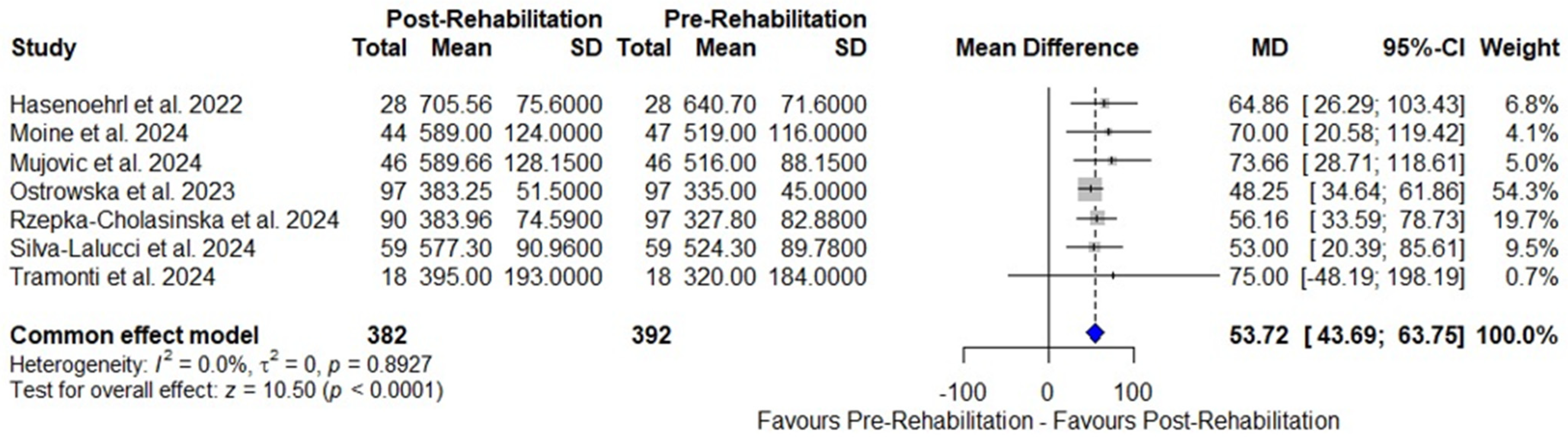
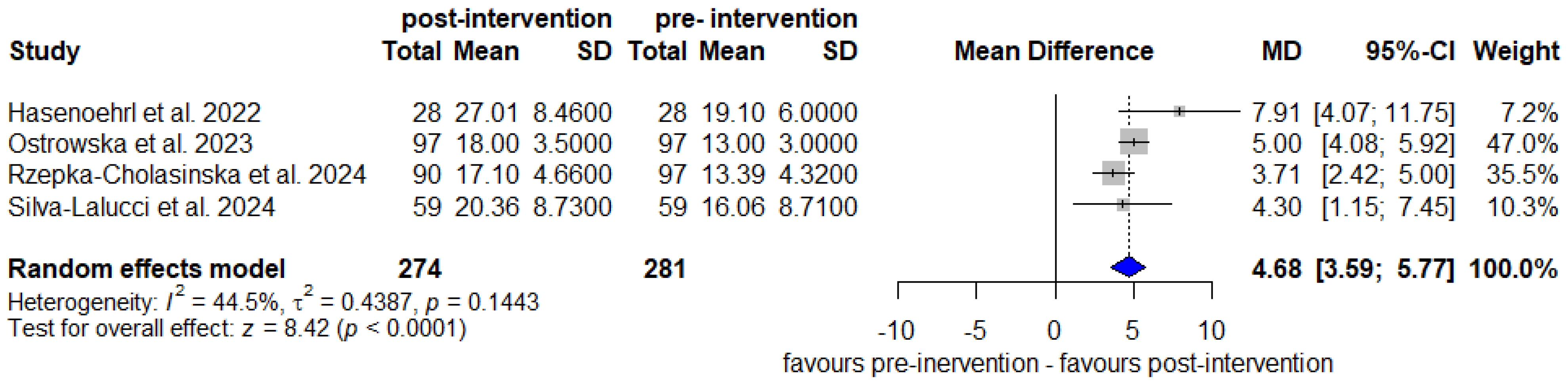
Meta-analysis of seven OCSs [39,41,42,43,44,45,46] demonstrated an improvement in FEC during exercise using the 6MWT (MD: 53.72 m, 95% CI 43.69–63.75, I2 = 0%, p = 0.89) (Figure 4). Another meta-analysis with four OCSs [39,43,44,45] also demonstrated an improvement assessed by the 30″SST (MD: 4.68 repetitions, 95% CI 3.59–5.77, I2 = 44.5%, p = 0.14) (Figure 5), both with very low certainty of evidence. The sensitivity analysis of the 30″SST by removing one study [39] that included patients under the age of 50 from the other three studies [43,44,45] that included patients over the age of 50 identified a reduction in heterogeneity to 22.3% (MD: 4.45, 95% CI 3.40–5.49, I2 = 22.3%, p = 0.27) (Supplementary Material S5). In two individual studies, one RCT [33] and one OCS [42] showed a significant improvement in FEC by the 5 × SST and 1′SST tests, respectively.
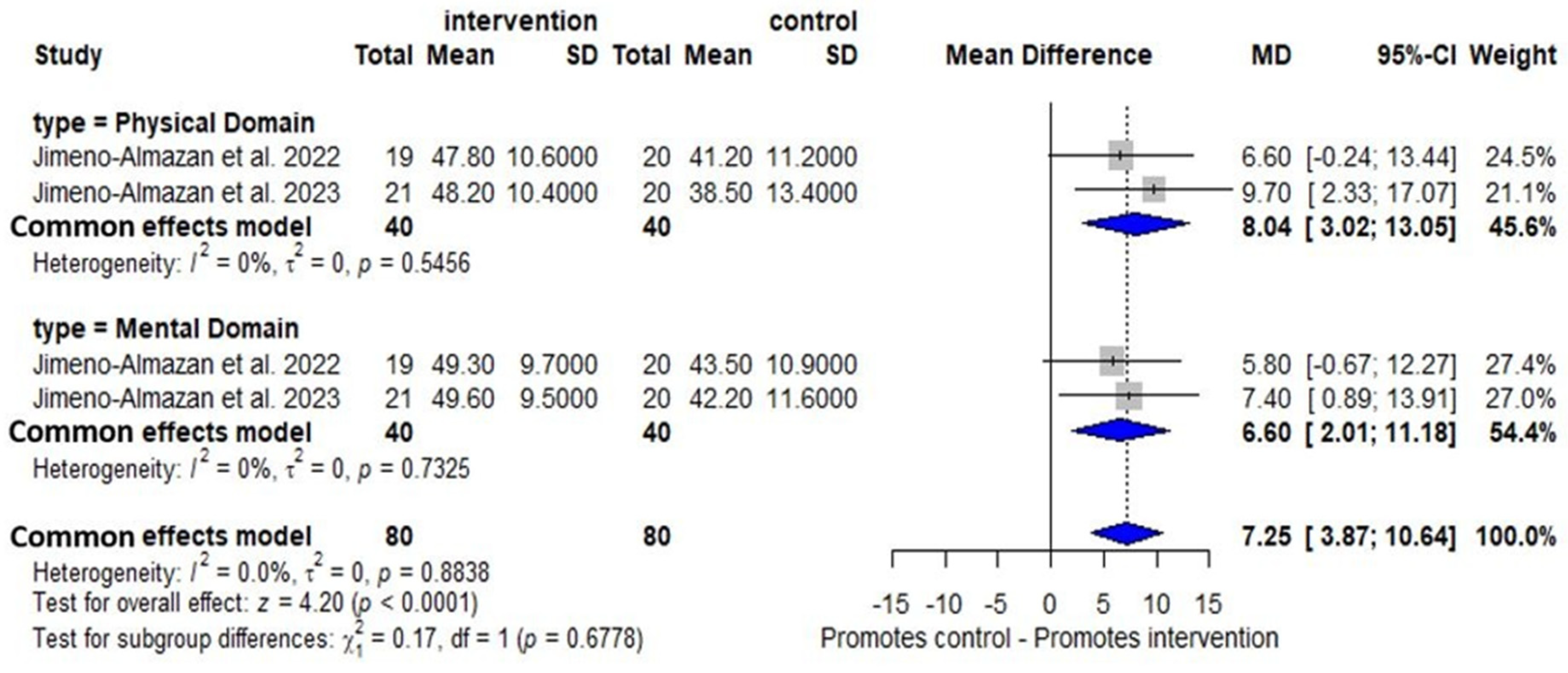
Two RCTs [33,34] demonstrated improved QoL after intervention in the physical (MD: 8.04, 95% CI 3.02–13.05, I2 = 0%, p = 0.54) and mental (MD: 6.60, 95% CI 2.01–11.18, I2 = 0%, p = 0.73) domains compared with the control group, both with low certainty of evidence (Figure 6). Two OCSs [38,40] showed an improvement in QoL EQ/VAS (MD: 14.16, 95% CI 3.23–25.09, I2 = 70%, p = 0.07) with low certainty evidence (Supplementary Material S6). There was also a significant improvement in this outcome using the EQ/VAS after the intervention with physical exercise in one RCT [37] and in one OCS [46] in the physical domain of the SF-36.
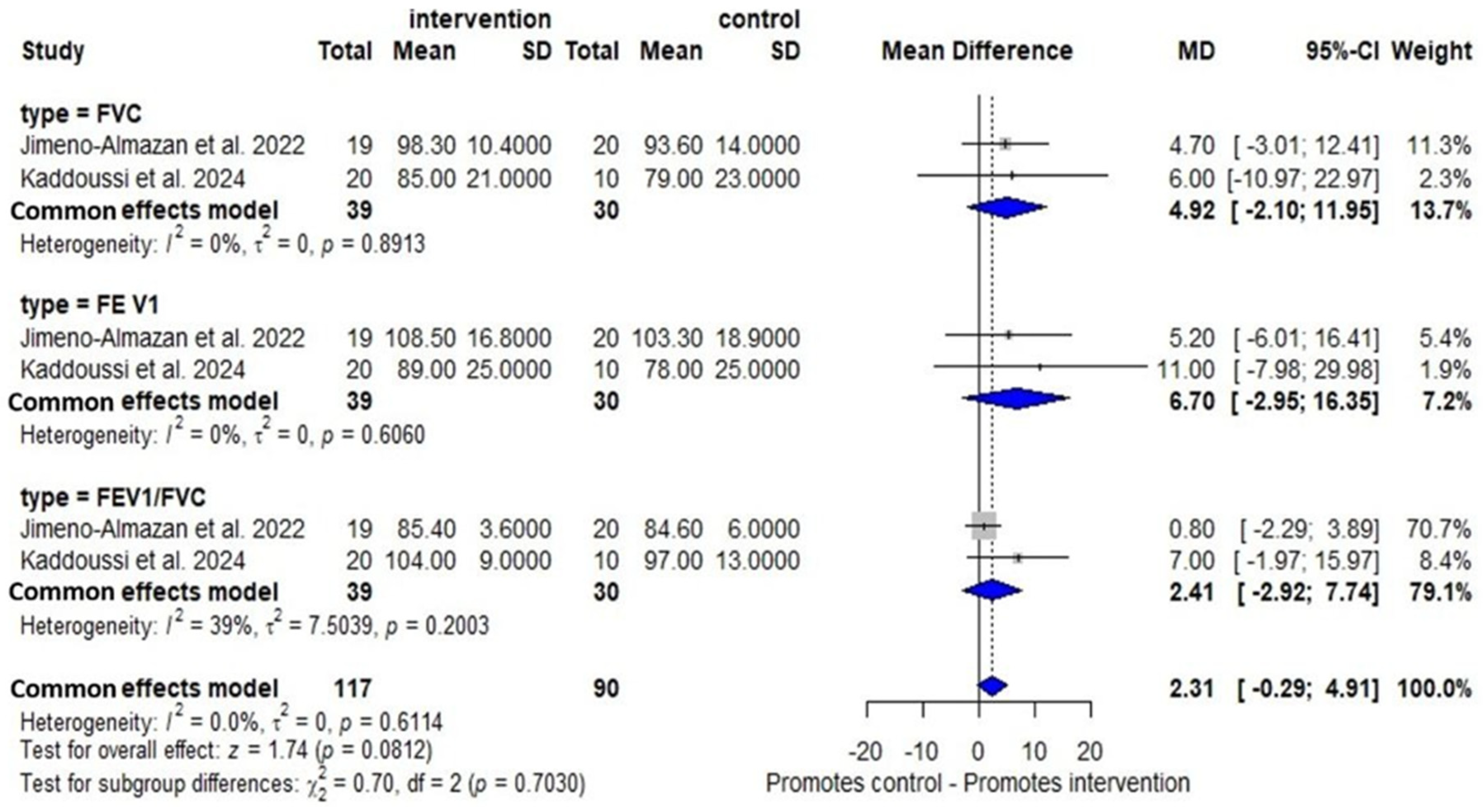
Two RCTs [33,35] showed that there were no changes in the variables of the PF in FVC (MD: 4.92; 95% CI −2.10–11.95, I2 = 0%, p = 0.89), in FEV1 (MD: 6.70; 95% CI −2.95–16.35, I2 = 0%, p = 0.60) and in FEV1/FVC (MD: 2.41, 95% CI −2.92–7.74, I2 = 39%, p = 0.20) post-intervention compared with the control group (Figure 7). The certainty of the evidence was low for all three PF parameters assessed.
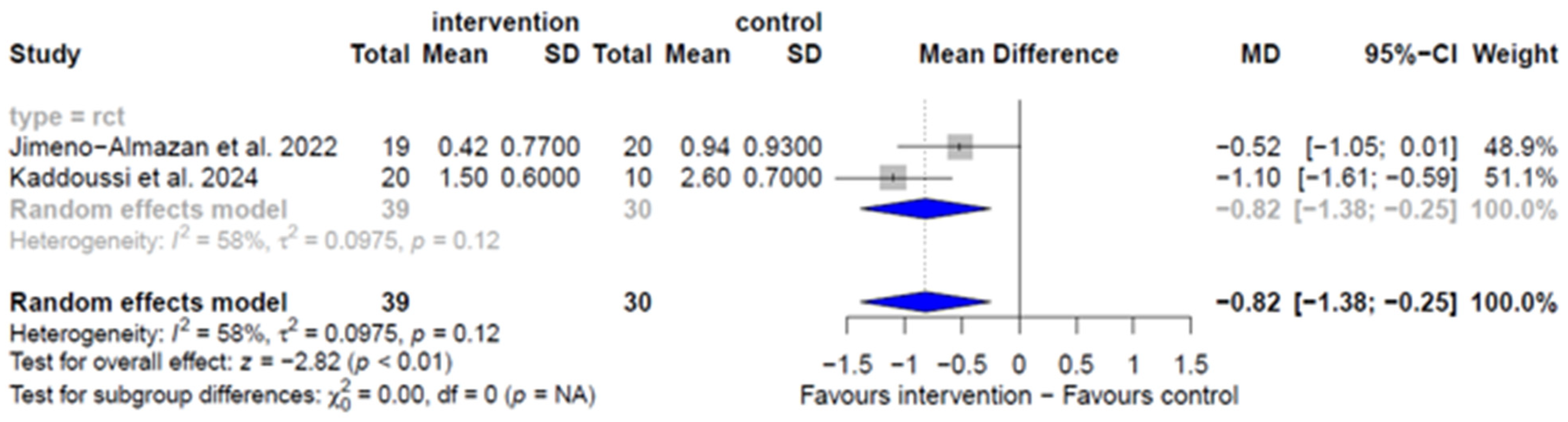
Meta-analysis of the two RCTs [33,35] showed a reduction in dyspnea assessed by the mMRC in the impact of dyspnea on ADLs (MD: −0.82, 95% CI −1.38–−0.25, I2 = 58%, p = 0.12) (Figure 8) in post- intervention compared with the control group with very low certainty of evidence. Another meta-analysis with two OCSs [43,44] showed a reduction in exertional dyspnea assessed by the Borg scale (MD: −1.14, 95% CI −1.51–−0.77, I2 = 46%, p = 0.18) after the intervention with very low certainty of evidence (Supplementary Material S7). Individual studies showed a significant reduction in dyspnea assessed by the mMRC [34,43,44,46] and Borg scale [35].
The certainty of the evidence for all outcomes is available in Supplementary Material S8.
The funnel plot assessing publication bias in the meta-analysis of FEC using the 6MWT is available in Supplementary Material S9. The observed asymmetry (p = 0.01) should be interpreted with caution given the small number of studies included in the meta-analysis (n < 10).

4. Discussion

Exercise-based pulmonary rehabilitation promoted improvements in FEC, QoL, and reductions in dyspnea related to ADL and exertion, without consistent evidence of improvement in PF. Several pulmonary and extra-pulmonary factors limit exercise capacity in patients with LC, contributing to an increased perception of dyspnea. This symptom may be present at rest but typically worsens during physical effort, leading to functional limitation and impaired QoL [10,47,48].
In the included studies, the duration of PR protocols ranged from 3 to 16 weeks. Evidence from chronic respiratory disease suggests that longer protocols, ranging from 8 to 12 weeks, were associated with greater potential gains [49]. Protocols with durations lasting 8 [33,34,39] and 16 weeks [45] in the present review are consistent with this perspective. Nevertheless, the benefits of PR were also identified in shorter protocols lasting three [36], four [41,46], six [35,38,42,43,44] and seven [40] weeks.
Regarding FEC, OCS meta-analyses demonstrated significant post-intervention improvement. The meta-analysis of seven studies [39,41,42,43,44,45,46] demonstrated a mean increase of 53.72 m in 6MWT, exceeding the 30.5 m MSCD, which was adopted from other chronic lung diseases [24] given the absence of a defined value for LC. The absence of heterogeneity (I2 = 0) should be interpreted with caution, as the small number of included studies (n = 7) reduces the statistical power to detect true heterogeneity. Additionally, clinical differences related to the severity of COVID-19 in the acute phase and participant characteristics, as well as relevant methodological differences regarding the varying durations of the intervention protocols, should be considered. In three of the included studies [43,44,46], patients performed below 350 m, indicative of a worse prognosis in chronic lung diseases [50,51,52]. Moreover, previous evidence indicates [53] that patients with LC, even with preserved PF, performed below the 50th percentile of reference values for healthy individuals in the 6MWT. Another study [54] showed that patients with LC after a mild clinical case of COVID-19 walked less than 80% of what was predicted. Given the similarity of clinical manifestations between LC and other chronic lung diseases.
Taken together, these findings reinforce the clinical relevance of the observed gains. The meta-analysis of the 30″SST [39,43,44,45] demonstrated a mean increase of 4.68 repetitions post-intervention. Moderate inconsistency (I2 = 44.5%) was reduced to low (I2 = 22.3%) after excluding one study [39] whose participants were younger than 50 years, differing from those in the other included studies (>50 years), suggesting that age may influence performance in submaximal functional tests, reinforcing the need to individualize exercise prescription in PR programs [55].
Studies not eligible for the meta-analyses due to presenting methodological designs different from those included [35,36] or for using different instruments to assess the same outcome, such as the 5 × SST [33] and the 1′SST [42], demonstrated improvement after the intervention.
With respect to QoL, the RCTs’ meta-analysis [33,34] demonstrated an improvement in both physical (I2 = 0%) and mental domains (I2 = 0%) of the SF-12 in the intervention group. The lack of heterogeneity observed in both domains, although it suggests a high degree of clinical homogeneity (age, clinical profile, and disease severity) and methodological homogeneity (8-week protocol), should be interpreted with caution, given that only two studies were included; low statistical power may mask variability and overestimate the consistency of the findings. As the OPR program included in this review had physical exercise as an essential component, despite any structured psychotherapeutic intervention, it was also possible to observe the positive impact on the mental domain, which suggests that there is a potential indirect psychological benefit associated with physical training. A previous systematic review [56] reported that in-person protocols seem to be superior to remote protocols for improving the mental component in patients with LC. On the other hand, one OCS [46] that used the SF-36 identified improvement only in the physical domain, suggesting that the mental domain may exhibit different sensitivity depending on the instrument used, particularly when exercise-based intervention is not associated with a structured psychological intervention.
With respect to quality of life, the meta-analysis of two OCSs [38,40] demonstrated improvement in QoL as measured by the EQ/VAS, with a mean increase of 14.16 points. The substantial inconsistency (I2 = 70%) observed may be attributed to differences in the age of participants, intervention duration, exercise modality, and training volume across the studies. In contrast, a recent study [32] did not find improvement in QoL assessed by the EQI or EQ/VAS post-intervention compared with the control group. The authors attributed this finding to the heterogeneous symptoms of LC and to a possible ceiling effect reached by some participants.
The meta-analysis of two RCTs [33,35] did not demonstrate the effects of the intervention on PF (I2 = 0). A possible explanation is that patients presented baseline spirometric values within the normal range, thereby limiting the potential to detect measurable improvement. Although recent evidence [16] associated exercise with reduced airway inflammation, its effects on PF in patients with post-COVID-19 pulmonary sequelae remain inconclusive [57], and the evidence is still limited [16]. Despite differences in clinical characteristics, participant age, and protocol duration, the small number of studies (n = 2) limits the statistical power to detect true heterogeneity.
Regarding dyspnea, the meta-analysis with two RCTs [33,35] demonstrated that exercise-based rehabilitation reduces the impact of severe dyspnea (mMRC ≥ 2) on ADLs. Moderated inconsistency (I2 = 58%) may be attributed to differences among the studies regarding the severity of COVID-19 in the acute phase (mild vs. mild to severe), age (<50 vs. >50 years), and study duration (8 vs. 6 weeks). An additional RCT [34] not included in the meta-analysis reported similar findings, demonstrating a significant reduction in the proportion of patients with severe dyspnea (mMRC ≥ 2). In contrast, one RCT [32] did not identify a significant improvement in dyspnea in the intervention group when assessed using the D-12 instrument. This tool captures the affective dimension of dyspnea, which may have been less responsive to an exercise-based intervention without a structured psychological approach. One OCS [41] identified a significant reduction in dyspnea as measured by the mMRC.
With respect to the dyspnea post-intervention, reduction was assessed by the Borg scale and was observed in the meta-analysis of two OCSs [43,44] (I2 = 46%). Although the studies were similar in terms of duration (6 weeks) and age (≥60 years), the differences are likely due to the clinical characteristics of the participants, including patients with severe COVID-19 in only one study [43], as well as the limited number of studies (n = 2). One RCT [35] also demonstrated a significant reduction in exertional dyspnea in the intervention group compared with the control group.

4.1. Long COVID and Fatigue

Fatigue was not originally included in the PICO framework, although it emerged as a relevant outcome in this review. Among the more than 200 symptoms described in LC [58], fatigue is the most frequently reported and one of the most disabling symptoms [59].
Current recommendations emphasize the use of appropriate instruments to define fatigue, assess its functional impact, and guide clinical management [60,61]. In the included studies, fatigue was assessed by different subjective self-reporting instruments [32,33,34,38,39,41,42,43,44], and reduction following exercise-based rehabilitation was reported in two RCTs [33,34] and in six OCSs [38,39,41,42,43,44]. Two additional studies [37,40] showed a reduction in fatigue after intervention based only on patient reports, without standardized measurement instruments.
Most scales used measured the intensity of fatigue and its functional impact but did not apply the diagnostic criteria. Only two of the included studies [32,33] used the DePaul Symptom Questionnaire (DSQ) [62], which is an instrument for screening and diagnostic confirmation of chronic fatigue syndrome (CFS). In addition to assessing the frequency and intensity of fatigue, it evaluates criteria related to post-exertional malaise (PEM), considered a central feature of this symptom [63] and an adverse event related to exercise. One of the studies used the DSQ to screen for fatigue [33], whereas another [32] applied it to identify clinical improvements in this symptom after intervention compared to the control group. Three studies [32,37,41] reported adverse events. In two of them [32,37], these were unrelated to fatigue, and only one study [41] identified a case of PEM.
The assessment of fatigue relied on a predominantly heterogeneous and subjective self-reporting instrument, which preludes quantitative synthesis and limits the interpretation of the results. However, findings regarding fatigue should be interpreted with caution, as their assessment in the included studies was based on heterogeneous self-reporting instruments measuring perceived functional outcomes, without the systematic application of formal diagnostic criteria for chronic fatigue syndrome/post-exertional malaise (CFS/PEM). This limitation compromises adequate clinical stratification and hinders the identification of the subgroup with fatigue associated with PEM, a condition that requires specific therapeutic approaches.

4.2. Clinical Implications

The pulmonary rehabilitation (PR) protocol, which is primarily exercise-based, is well tolerated by patients and leads to clinically significant improvements in exercise capacity (EC), quality of life (QoL), and a reduction in dyspnea, underscoring the importance of exercise in structured PR protocols for the management of Long COVID [64]. Interventions based primarily on exercise should be considered a central component and integrated into the care of patients with LC. However, their implementation requires rigorous clinical stratification, individualized prescribing, and continuous monitoring, combined with professional training. In the context of public policy, exercise as the primary strategy in physical rehabilitation represents a low-cost approach with minimal infrastructure and technology requirements [16], thereby expanding the population’s access to pulmonary rehabilitation.
The in-person, supervised, and individualized delivery model of pulmonary rehabilitation (PR) is strategic, as it allows rigorous clinical monitoring of exercise responses, precise adjustment of intensity, and personalized prescription, which is particularly important for patients at risk of symptom exacerbation, such as those in the fatigue/post-exertional malaise (PEM) subgroup. On the other hand, alternative models, including remote strategies, may impose barriers related to the environment and the availability of technological resources [65], in addition to increasing the risk of PEM worsening due to the lack of in-person monitoring, which may compromise adherence to PR.
Regarding fatigue, particularly in the fatigue/PEM subgroup, although rehabilitation is indicated, interventions should be adapted and individualized to ensure greater patient safety, optimize functional outcomes, and prevent symptom exacerbation. Additionally, the findings suggest the need to standardize the assessment of patients with Long COVID using specific and validated instruments, combined with continuous and routine monitoring to minimize the risk of adverse events, thereby enhancing the safety of interventions.

4.3. Strengths and Limitations

The search strategy was updated to January 2026, ensuring the inclusion of the most recent evidence. Restricting inclusion to individuals ≥3 months after the acute phase of COVID-19 enhanced clinical homogeneity and alignment with current definitions of LC. Additionally, the interventions included traditional, in-person, and individualized PR programs, based on established models for chronic lung diseases, supporting feasibility and external validity. The delivery model reinforces clinical safety in the face of potential adverse events, while allowing individualized adjustments to address the heterogeneity of LC manifestations, particularly PEM.
It was not possible to determine the influence of the severity of COVID-19 in the acute phase on the effects of PR. Although the protocols were in-person and individualized, applied to patients with LC (≥3 months) after the acute phase, most studies did not consider the clinical diagnosis of fatigue and did not monitor exercise-related adverse events. These findings are consistent with previous Cochrane reviews [66,67] which report the potential benefits of PR but highlight low certainty of evidence and insufficient consideration of fatigue and PEM management.
The included studies exhibited methodological limitations, with a high or unclear risk of bias, mainly due to the absence of sample size calculation, small sample sizes, limited control of confounding variables, and lack of blinding, as well as the limited inclusion of RCTs. The risk of bias assessment using NHLBI instruments favors internal comparability among the studies included in this review. However, other tools such as RoB 2 and ROBINS-I could have been used, as they provide a more detailed framework for assessing bias domains aligned with outcomes.
The certainty of the evidence for the outcomes of interest was rated as low or very low, reinforcing the need for caution in interpreting the findings, generalizing the results, and drawing definitive conclusions.
Future trials should adopt higher methodological standards, incorporate structured diagnostic tools for CFS/PEM, and systematically report adverse events to enhance the safety and interpretability of exercise-based PR in this subgroup. Additionally, given the higher prevalence and functional impact of LC among middle-aged adults and women, future research should prioritize stratified analyses to improve clinical applicability [68,69]. As future perspectives, more robust studies with better methodological quality that incorporate the systematic diagnosis of CFS/PEM are needed to ensure greater safety in PR focused on exercise for this subgroup of patients.

4.4. Contributions

This systematic review synthesizes evidence on exercise-based pulmonary rehabilitation for Long COVID, providing a better understanding of the specific effects of this intervention in a context often characterized by multimodal approaches. The results demonstrate improvements in exercise capacity, quality of life, and dyspnea, while also highlighting significant gaps, such as the absence of consistent effects on lung function and limitations in the assessment of fatigue, particularly due to the lack of formal diagnostic criteria for post-exertional malaise (PEM). From a clinical perspective, the findings reinforce the importance of supervised protocols, with individualized prescriptions and continuous monitoring, particularly to reduce the risk of symptom exacerbation in patients with fatigue/PEM. Furthermore, they highlight exercise as a safe, low-cost strategy requiring minimal infrastructure, favoring its broad applicability across different levels of healthcare. Finally, this study guides future research regarding the need for greater methodological rigor, standardization of protocols and outcomes, as well as the systematization of assessment and continuous monitoring, especially in subgroups at higher risk of post-exercise exacerbation.

5. Conclusions

In-person, supervised PR with structured exercise improves exercise capacity, QoL, and dyspnea in individuals with LC. In patients with fatigue/PEM, systematic assessment and continuous symptom monitoring are essential to prevent the risk of symptomatic exacerbation and ensure the safety of interventions. Future high-quality trials incorporating standardized diagnostic criteria and adverse-event reporting are needed to optimize patient selection and intervention safety.

Supplementary Materials

The following supporting information can be downloaded at: https://drive.google.com/drive/folders/1_1xbbHjZ0t6i0E_U4nUCje55EunGVb2i?usp=sharing, accessed on 6 April 2026. S1: Concept map; S2: Search strategy conducted; S3: Characteristics of the included studies; S4: List of excluded studies; Meta-analysis S5: Sensitivity analysis with SST30″; Meta-analysis S6: Effectiveness of OPR on QoL EQ 5D/VAS; Meta-analysis S7: Effectiveness of OPR on dyspnea by Borg; S8: Grade/certainty of evidence; S9: Funnel plot.

Author Contributions

Conceptualization, J.M.S., A.C.G., D.O.d.S. and M.G.d.S.; methodology, J.M.S., A.C.G., D.O.d.S. and M.G.d.S.; software, M.G.d.S.; validation, J.M.S., A.C.G., D.O.d.S., A.P.M.N. and M.G.d.S.; formal analysis, M.G.d.S.; investigation, J.M.S., D.O.d.S. and A.P.M.N.; resources, A.C.G.; data curation, J.M.S., A.C.G., D.O.d.S. and A.P.M.N.; writing—original draft preparation, J.M.S. and D.O.d.S.; writing—review and editing, J.M.S., A.C.G., D.O.d.S., A.P.M.N., and M.G.d.S.; visualization, A.C.G. and D.O.d.S.; supervision, A.C.G. and D.O.d.S.; project administration, A.C.G.; funding acquisition, A.C.G. All authors have read and agreed to the published version of the manuscript.

Funding

This research supported by the São Paulo Research Foundation (FAPESP) (Grant NO. 2022/07841-0), the Foundation for Teaching, Research and Assistance Support of the Hospital das Clínicas, Ribeirão Preto Medical School, University of São Paulo (FAEPA–FMRP-USP), and by the Coordenação de Aperfeiçoamento de Pessoal de Nível Superior (CAPES)—Brazil, Finance Cod 001 (Funding NO. 88887.836963/2023-0).

Informed Consent Statement

Not applicable.

Data Availability Statement

The original contributions presented in this study are included in the article/Supplementary Material. Further inquiries can be directed to the corresponding author.

Acknowledgments

The authors acknowledge the Respiratory Assessment Laboratory (LAR), Department of Health Sciences, Ribeirão Preto School of Medicine, University of São Paulo (FMRP-USP), and the University of Gurupi (UnirG) for their institutional support.

Conflicts of Interest

The authors declare no conflicts of interest.

Abbreviations

The following abbreviations are used in this manuscript:
LC Long COVID
QoLQuality of Life
PRPulmonary Rehabilitation
OPROutpatient Pulmonary Rehabilitation
FECFunctional Exercise Capacity
PFPulmonary Function
RCTsRandomized Clinical Trials
OCSObservational Cohort Studies
PEDroPhysiotherapy Evidence Database
NHLBINational Heart, Lung, and Blood Institute
MDMean
CI Confidence Interval
I2Heterogeneity
6MWTSix-Minute Walk Test
SSTSit-to-Stand Test
30″SST30-Second Sit-to-Stand Test
1′SST1 min Sit-to-Stand Test
5 × SST5-repetition Sit-to-Stand Test
mMRCmodified Medical Research Council
D-12Dyspnea 12
ATS/ERS American Thoracic Society/European Respiratory Society
GLIGlobal Lung Functional Initiative
FVCForced Vital Capacity
FEV1Forced Expiratory Volume in One Second
ADLActivities of Daily Living
CAPESCoordination for the Improvement of Higher Education Personnel
MeSHMedical Subject Headings
AMSTAR Measurement Tool to Assess Systematic Reviews 2
EQ 5D 5L EuroQoL 5 dimensions, 5 level
EQ/VASEuroQoL/Visual Analog Scale
EQIEuroQoL/Index
SF-12Short Form 12
SF-36Short Form 36
QoL/PDPhysical Domain of SF-12
Qol/MDMental Domain of SF-12
MSCDMinimally Significant Clinical Difference
GRADEGrading of Recommendations Assessment, Development, and Evaluation
IGIntervention Group
CG Control Croup
WHOWorld Health Organization
IQRInterquartile Range
ITTIntention-to-Treat
mMeters
50th50th percentile
DSQDePaul Symptom Questionnaire
CFSChronic Fatigue Syndrome
PEMPost-Exertional Malaise

References

  1. Soriano, J.B.; Murthy, S.; Marshall, J.C.; Relan, P.; Diaz, J.V. A clinical case definition of post-COVID-19 condition by a Delphi consensus. Lancet Infect. Dis. 2022, 22, e102–e107. [Google Scholar] [CrossRef] [Scilit] [PubMed]
  2. Thaweethai, T.; Jolley, S.E.; Karlson, E.W.; Levitan, E.B.; Levy, B.; McComsey, G.A.; McCorkell, L.; Nadkarni, G.N.; Parthasarathy, S.; Singh, U.; et al. Development of a Definition of Postacute Sequelae of SARS-CoV-2 Infection. JAMA 2023, 329, 1934–1946. [Google Scholar] [CrossRef] [Scilit] [PubMed]
  3. Hou, Y.; Gu, T.; Ni, Z.; Shi, X.; Ranney, M.L.; Mukherjee, B. Global Prevalence of Long COVID, Its Subtypes, and Risk Factors: An Updated Systematic Review and Meta-analysis. Open Forum Infect. Dis. 2025, 12, ofaf533. [Google Scholar] [CrossRef] [Scilit]
  4. O’Mahoney, L.L.; Routen, A.; Gillies, C.; Ekezie, W.; Welford, A.; Zhang, A.; Karamchandani, U.; Simms-Williams, N.; Cassambai, S.; Ardavani, A.; et al. The prevalence and long-term health effects of Long COVID among hospitalised and non-hospitalised populations: A systematic review and meta-analysis. EClinicalMedicine 2023, 14, 101762. [Google Scholar] [CrossRef] [Scilit]
  5. Di Gennaro, F.; Belati, A.; Tulone, O.; Diella, L.; Fiore Bavaro, D.; Bonica, R.; Genna, V.; Smith, L.; Trott, M.; Bruyere, O.; et al. Incidence of long COVID-19 in people with previous SARS-CoV-2 infection: A systematic review and meta-analysis of 120,970 patients. Intern. Emerg. Med. 2023, 18, 1573–1581. [Google Scholar] [CrossRef] [Scilit]
  6. Al-Aly, Z.; Davis, H.; McCorkell, L.; Soares, L.; Wulf-Hanson, S.; Iwasaki, A.; Topol, E.J. Long COVID science, research and policy. Nat. Med. 2024, 30, 2148–2164. [Google Scholar] [CrossRef] [Scilit]
  7. Singh, I.; Joseph, P.; Heerdt, P.M.; Cullinan, M.; Lutchmansingh, D.D.; Gulati, M.; Possick, J.D.; Systrom, D.M.; Waxman, A.B. Persistent Exertional Intolerance After COVID-19: Insights from Invasive Cardiopulmonary Exercise Testing. Chest 2022, 161, 54–63. [Google Scholar] [CrossRef] [Scilit]
  8. Sahin, M.E.; Satar, S.; Ergün, P. Predictors of reduced incremental shuttle walk test performance in patients with long post-COVID-19. J. Bras. Pneumol. 2023, 49, e20220438. [Google Scholar] [CrossRef] [Scilit]
  9. Sheehy, L.M. Considerations for Postacute Rehabilitation for Survivors of COVID-19. JMIR Public Health Surveill. 2020, 6, e19462. [Google Scholar] [CrossRef] [Scilit] [PubMed]
  10. Magdy, D.; Metwally, A.; Tawab, D.; Hassan, S.; Makboul, M.; Farghaly, S. Long-term COVID-19 effects on pulmonary function, exercise capacity, and health status. Ann. Thorac. Med. 2022, 17, 28–36. [Google Scholar] [CrossRef] [Scilit]
  11. Bartsch, S.M.; Chin, K.L.; Strych, U.; John, D.C.; Shah, T.D.; Bottazzi, M.E.; O’Shea, K.J.; Robertson, M.; Weatherwax, C.; Heneghan, J.; et al. The Current and Future Burden of Long COVID in the United States. J. Infect. Dis. 2025, 231, 1581–1590. [Google Scholar] [CrossRef] [Scilit]
  12. Hastie, C.E.; Lowe, D.J.; McAuley, A.; Mills, N.L.; Winter, A.J.; Black, C.; Scott, J.T.; O’Donnell, C.A.; Blane, D.N.; Browne, S.; et al. Natural history of long-COVID in a nationwide, population cohort study. Nat. Commun. 2023, 14, 3504. [Google Scholar] [CrossRef] [Scilit] [PubMed]
  13. Gloeckl, R.; Leitl, D.; Jarosch, I.; Schneeberger, T.; Nell, C.; Stenzel, N.; Vogelmeier, C.F.; Kenn, K.; Koczulla, A.R. Benefits of pulmonary rehabilitation in COVID-19: A prospective observational cohort study. ERJ Open Res. 2021, 7, 00108. [Google Scholar] [CrossRef] [Scilit]
  14. Pouliopoulou, D.V.; Macdermid, J.C.; Saunders, E.; Peters, S.; Brunton, L.; Miller, E.; Quinn, K.L.; Pereira, T.V.; Bobos, P. Rehabilitation interventions for physical capacity and quality of life in adults with post-COVID-19 condition: A systematic review and meta-analysis. JAMA Netw. Open 2023, 6, e2333838. [Google Scholar] [CrossRef] [Scilit] [PubMed]
  15. Tarazona, V.; Kirouchena, D.; Clerc, P.; Pinsard-Laventure, F.; Bourrion, B. Quality of life in COVID-19 outpatients: A long-term follow-up study. J. Clin. Med. 2022, 11, 6478. [Google Scholar] [CrossRef] [Scilit]
  16. Asai, K. Impact of physical activity on respiratory disease: Current status and therapeutic implications. Respir. Investig. 2025, 63, 1187–1193. [Google Scholar] [CrossRef] [Scilit]
  17. Page, M.J.; McKenzie, J.E.; Bossuyt, P.M.; Boutron, I.; Hoffmann, T.C.; Mulrow, C.D.; Shamseer, L.; Tetzlaff, J.M.; Akl, E.A.; Brennan, S.E. The PRISMA 2020 statement: An updated guideline for reporting systematic reviews. BMJ 2021, 372, 71. [Google Scholar] [CrossRef] [Scilit]
  18. Ouzzani, M.; Hammady, H.; Fedorowicz, Z.; Elmagarmid, A. Rayyan—A web and mobile app for systematic reviews. Syst. Rev. 2016, 5, 210. [Google Scholar] [CrossRef] [Scilit]
  19. NHLBI. Study Quality Assessment Tools. 2021. Available online: https://www.nhlbi.nih.gov/health-topics/study-quality-assessment-tools (accessed on 11 February 2026).
  20. Silva, M.A.X.; Santos, M.M.A.; Araújo, A.B.; Galvão, C.R.C.; Barros, M.M.M.; Oliveira e Silva, A.C.; Souza, M.M.M.; Barroso, B.I.L. Risk factors for healthcare professionals’ mental health during the COVID-19 pandemic: A systematic review. Cien. Saude Colet. 2023, 28, 3033–3044. [Google Scholar] [CrossRef] [Scilit]
  21. Wan, X.; Wang, W.; Liu, J.; Tong, T. Estimating the sample mean and standard deviation from the sample size, median, range and/or interquartile range. BMC Med. Res. Methodol. 2014, 14, 135. [Google Scholar] [CrossRef] [Scilit] [PubMed]
  22. Rohatgi, A. WebPlotDigitizer Version 5.0. 2024. Available online: https://automeris.io/WebPlotDigitizer/ (accessed on 25 January 2026).
  23. Graham, B.L.; Steenbruggen, I.; Miller, M.R.; Barjaktarevic, I.Z.; Cooper, B.G.; Hall, G.L.; Hallstrand, T.S.; Kaminsky, D.A.; McCarthy, K.; McCormack, M.C.; et al. Standardization of Spirometry 2019 Update. An Official American Thoracic Society and European Respiratory Society Technical Statement. Am. J. Respir. Crit. Care Med. 2019, 200, e70–e88. [Google Scholar] [CrossRef] [Scilit]
  24. Bohannon, R.W.; Crouch, R. Minimal clinically important difference for change in 6-minute walk test distance of adults with pathology: A systematic review. J. Eval. Clin. Pract. 2017, 23, 377–381. [Google Scholar] [CrossRef] [Scilit]
  25. R Core Team. R: The R Project for Statistical Computing. Version 3.5.0 (“Joy in Playing”). 2023. Available online: https://www.R-project.org (accessed on 12 February 2026).
  26. Higgins, J.P.; Thompson, S.G. Quantifying heterogeneity in a meta-analysis. Stat. Med. 2002, 21, 1539–1558. [Google Scholar] [CrossRef] [Scilit]
  27. Higgins, J.P.; Thompson, S.G.; Deeks, J.J.; Altman, D.G. Measuring inconsistency in meta-analyses. BMJ 2003, 327, 557–560. [Google Scholar] [CrossRef] [Scilit]
  28. Cuello-Garcia, C.A.; Morgan, R.L.; Brozek, J.; Santesso, N.; Verbeek, J.; Thayer, K.; Guyatt, G.; Schünemann, H.J. A scoping review and survey provides the rationale, perceptions, and preferences for the integration of randomized and nonrandomized studies in evidence syntheses and GRADE assessments. J. Clin. Epidemiol. 2018, 98, 33–40. [Google Scholar] [CrossRef] [Scilit] [PubMed]
  29. Schünemann, H.J.; Brennan, S.; Akl, E.A.; Hultcrantz, M.; Alonso-Coello, P.; Xia, J.; Davoli, M.; Rojas, M.X.; Meerpohl, J.J.; Flottorp, S.; et al. The development methods of official GRADE articles and requirements for claiming the use of GRADE: A statement by the GRADE guidance group. J. Clin. Epidemiol. 2023, 159, 79–84. [Google Scholar] [CrossRef] [Scilit] [PubMed]
  30. Higgins, J.P.T.; Thomas, J.; Chandler, J.; Cumpston, M.; Li, T.; Page, M.J. (Eds.) Cochrane Handbook for Systematic Reviews of Interventions, 6.5th ed.; Cochrane: London, UK, 2024; Available online: www.cochrane.org/handbook (accessed on 2 January 2026).
  31. Atkins, D.; Best, D.; Briss, P.A.; Eccles, M.; Falck-Ytter, Y.; Flottorp, S.; Guyatt, G.H.; Harbour, R.T.; Haugh, M.C.; Henry, D.; et al. GRADE Working Group. Grading quality of evidence and strength of recommendations. BMJ 2004, 328, 1490–1494. [Google Scholar]
  32. Daynes, E.; Evans, R.A.; Greening, N.J.; Bishop, N.C.; Yates, T.; Lozano-Rojas, D.; Ntotsis, K.; Richardson, M.; Baldwin, M.M.; Hamrouni, M.; et al. Post-Hospitalisation COVID-19 Rehabilitation (PHOSP-R): A randomised controlled trial of exercise-based rehabilitation. Eur. Respir. J. 2025, 65, 2402152. [Google Scholar] [CrossRef] [Scilit]
  33. Jimeno-Almazán, A.; Franco-López, F.; Buendía-Romero, Á.; Martinez-Cava, A.; Sánchez-Agar, J.A.; Sáncez-Alcaraz Matínez, B.J.; Courel-Ibáñez, J.; Pallares, J.G. Rehabilitation for post-COVID-19 condition through a supervised exercise intervention: A randomized controlled trial. Scand. J. Med. Sci. Sports 2022, 32, 1791–1801. [Google Scholar] [CrossRef] [Scilit] [PubMed]
  34. Jimeno-Almazán, A.; Buendía-Romero, Á.; Martínez-Cava, A.; Franco-López, F.; Sánchez-Alcaraz, B.J.; Courel-Ibáñez, J.; Pallarés, J.G. Effects of a concurrent training, respiratory muscle exercise, and self-management recommendations on recovery from post-COVID-19 conditions: The RECOVE trial. J. Appl. Physiol. 2023, 134, 95–104. [Google Scholar] [CrossRef] [Scilit]
  35. Kaddoussi, R.; Rejeb, H.; Kalai, A.; Zaara, E.; Rouetbi, N.; Salah Frih, Z.B.; Zmijewski, P.; Ben Saad, H. Effects of a cardiopulmonary rehabilitation programme on submaximal exercise in Tunisian patients with long-COVID-19: A randomized clinical trial. Biol. Sport. 2024, 41, 197–217. [Google Scholar] [CrossRef] [Scilit]
  36. Maritescu, A.; Crisan, A.F.; Pescaru, C.C.; Stoicescu, E.R.; Oancea, C.; Iacob, D. Effectiveness of Combined Pulmonary Rehabilitation and Progressive Muscle Relaxation in Treating Long-Term COVID-19 Symptoms: A Randomized Controlled Trial. J. Clin. Med. 2024, 13, 6237. [Google Scholar] [CrossRef] [Scilit]
  37. Sirydakis, M.E.M.; Danielevicz, A.; Melo, P.U.G.; Bregalda, J.; Constantini, M.I.; Palliciari, G.; Sampaio, S.K.; Rech, C.R.; Maurici, R.; Gerade, A.M.; et al. Improving quality of life, sleep and mental health through multicomponent training versus Brazilian recommendations of physical activity in post-COVID-19 patients: CORE-study—A randomized controlled trial. Ment. Health Phys. Act. 2024, 27, 100615. [Google Scholar] [CrossRef] [Scilit]
  38. Daynes, E.; Gerlis, C.; Chaplin, E.; Gardiner, N.; Singh, S.J. Early experiences of rehabilitation for individuals post-COVID to improve fatigue, breathlessness exercise capacity and cognition: A cohort study. Chronic Respir. Dis. 2021, 18, 14799731211015691. [Google Scholar] [CrossRef] [Scilit]
  39. Hasenoehrl, T.; Palma, S.; Huber, D.F.X.; Kasti, S.; Steiner, M.; Jordakieva, G.; Crebenna, R. Post-COVID: Effects of physical exercise on functional status and work ability in health care personnel. Disabil. Rehabil. 2022, 45, 2872–2878. [Google Scholar] [CrossRef] [Scilit] [PubMed]
  40. Mammi, P.; Ranza, E.; Rampello, A.; Ravanetti, D.; Moretti, S.; Gobbi, E.; Rodà, F.; Brianti, R. Post-COVID-19 ongoing symptoms and health-related quality of life: Does rehabilitation matter? preliminary evidence. Am. J. Phys. Med. Rehabil. 2023, 102, 241–244. [Google Scholar] [CrossRef] [Scilit]
  41. Moine, E.; Molinier, V.; Castanyer, A.; Calvat, A.; Coste, G.; Vernet, A.; Faugé, A.; Magrina, P.; Aliaga-Parera, J.L.; Oliver, N.; et al. Safety and Efficacy of Pulmonary Rehabilitation for Long COVID Patients Experiencing Long-Lasting Symptoms. Int. J. Environ. Res. Public Health 2024, 21, 242. [Google Scholar] [CrossRef] [Scilit] [PubMed]
  42. Mujovic, N.; Nikolic, D.; Markovic, F.; Stjepanovic, M.; Zekovic, M.; Ali, H.S.H.; Zivanovic, D.; Savic, M.; Laban, M. The Effects of Six Weeks Pulmonary Rehabilitation on Functional and Psychological Outcomes in Long-COVID Patients: Preliminary Results from Serbian Single Center Study. Medicina 2024, 60, 671. [Google Scholar] [CrossRef] [Scilit]
  43. Ostrowska, M.; Rzepka-Cholasińska, A.; Pietrzykowski, Ł.; Michalski, P.; Kosobucka-Ozdoba, A.; Jasiewicz, M.; Kasprzak, M.; Kryś, J.; Kubica, A. Effects of multidisciplinary rehabilitation program in patients with long COVID-19: Post-COVID-19 rehabilitation (PCR SIRIO 8) Study. J. Clin. Med. 2023, 12, 420. [Google Scholar] [CrossRef] [Scilit]
  44. Rzepka-Cholasińska, A.; Ratajczak, J.; Michalski, P.; Kasprzak, M.; Kosobucka-Ozdoba, A.; Pietrzykowski, Ł.; Grzelakowska, K.; Kubica, J.; Kryś, J.; Kubica, A. Gender-Related Effectiveness of Personalized Post-COVID-19 Rehabilitation. J. Clin. Med. 2024, 13, 938. [Google Scholar] [CrossRef] [Scilit] [PubMed]
  45. Silva-Lalucci, M.P.; Marques, D.C.; Ryal, J.J.; Marques, M.G.S.; Perli, V.A.S.; Sordi, A.F.; de Moraes, S.M.F.; Valdés-Badilla, P.; Andreato, L.V.; Branco, B.H.M.; et al. Impact of Multi-Professional Intervention on Health-Related Physical Fitness and Biomarkers in Overweight COVID-19 Survivors for 8 and 16 Weeks: A Non-Randomized Clinical Trial. Healthcare 2024, 12, 2034. [Google Scholar] [CrossRef] [Scilit]
  46. Tramonti, C.; Graziani, F.; Pasqualone, E.; Ricci, E.; Moncini, C.; Lombardi, B. Outpatient rehabilitation in post-acute COVID-19 patients: A combined progressive treatment protocol. Disabil. Rehabil. 2024, 46, 5879–5889. [Google Scholar] [CrossRef] [Scilit]
  47. Ribeiro Baptista, B.; d’Humières, T.; Schlemmer, F.; Bendib, I.; Justeau, G.; Al-Assaad, L.; Hachem, M.; Codiat, R.; Bardel, B.; Abou Chakra, L.; et al. Identification of factors impairing exercise capacity after severe COVID-19 pulmonary infection: A 3-month follow-up of prospective COVulnerability cohort. Respir. Res. 2022, 23, 68–76. [Google Scholar] [CrossRef] [Scilit]
  48. Clavario, P.; De Marzo, V.; Lotti, R.; Barbara, C.; Porcile, A.; Russo, C.; Beccaria, F.; Bonavia, M.; Bottaro, L.C.; Caltabellotta, M.; et al. Cardiopulmonary exercise testing in COVID-19 patients at 3 months follow-up. Int. J. Cardiol. 2021, 340, 113–118. [Google Scholar] [CrossRef] [Scilit] [PubMed]
  49. Spruit, M.A.; Singh, S.J.; Garvey, C.; ZuWallack, R.; Nici, L.; Rochester, C.; Hill, K.; Holland, A.E.; Lareau, S.C.; Man, W.D.; et al. ATS/ERS Task Force on Pulmonary Rehabilitation. An official American Thoracic Society/European Respiratory Society statement: Key concepts and advances in pulmonary rehabilitation. Am. J. Respir. Crit. Care Med. 2014, 189, 1570. [Google Scholar]
  50. Rasekaba, T.; Lee, A.L.; Naughton, M.T.; Williams, T.J.; Holland, A.E. The six-minute walk test: A useful metric for the cardiopulmonary patient. Intern. Med. J. 2009, 39, 495–501. [Google Scholar] [CrossRef] [Scilit] [PubMed]
  51. Camillo, C.A.; Langer, D.; Osadnik, C.R.; Pancini, L.; Demeyer, H.; Burtin, C.; Gosselink, R.; Decramer, M.; Janssens, W.; Troosters, T. Survival after pulmonary rehabilitation in patients with COPD: Impact of functional exercise capacity and its changes. Int. J. Chronic Obstr. Pulm. Dis. 2016, 11, 2671–2679. [Google Scholar] [CrossRef] [Scilit]
  52. Celli, B.; Tetzlaff, K.; Criner, G.; Polkey, M.I.; Sciurba, F.; Casaburi, R.; Tal-Singer, R.; Kawata, A.; Merrill, D.; Rennard, S. COPD Biomarker Qualification Consortium. The 6-Minute-Walk Distance Test as a Chronic Obstructive Pulmonary Disease Stratification Tool. Insights from the COPD Biomarker Qualification Consortium. Am. J. Respir. Crit. Care Med. 2016, 194, 1483–1493. [Google Scholar] [CrossRef] [Scilit] [PubMed]
  53. Salmam, I.; Dubé, M.O.; Zahouani, I.; Ramos, A.; Desmeules, F.; Best, K.L.; Roy, J.S. The impact of long COVID on physical and cardiorespiratory parameters: A systematic review. PLoS ONE 2025, 20, e0318707. [Google Scholar] [CrossRef] [Scilit]
  54. Yelin, D.; Levi, R.; Babu, C.; Moshe, R.; Shitenberg, D.; Atamna, A.; Tishler, O.; Babich, T.; Shapira-Lichter, I.; Abecasis, D. Assessment of Exercise Capacity of Individuals with Long COVID: A Cross-sectional Study. Isr. Med. Assoc. J. 2023, 25, 83–87. [Google Scholar]
  55. Torres-Castro, R.; Núñez-Cortés, R.; Larrateguy, S.; Alsina-Restoy, X.; Barberà, J.A.; Gimeno-Santos, E.; García, A.R.; Sibila, O.; Blanco, I. Assessment of Exercise Capacity in Post-COVID-19 Patients: How Is the Appropriate Test Chosen? Life 2023, 13, 621. [Google Scholar] [CrossRef] [Scilit] [PubMed]
  56. Martínez-Pozas, O.; Meléndez-Oliva, E.; Rolando, L.M.; Rico, J.A.Q.; Corbellini, C.; Sánchez Romero, E.A. The pulmonary rehabilitation effect on long COVID-19 syndrome: A systematic review and meta-analysis. Physiother. Res. Int. 2024, 29, e2077. [Google Scholar] [CrossRef] [Scilit]
  57. Fugazzaro, S.; Contri, A.; Esseroukh, O.; Kaleci, S.; Croci, S.; Massari, M.; Facciolongo, N.C.; Besutti, G.; Iori, M.; Salvarani, C. Rehabilitation Interventions for Post-Acute COVID-19 Syndrome: A Systematic Review. Int. J. Environ. Res. Public Health 2022, 19, 5185. [Google Scholar] [CrossRef] [Scilit]
  58. Davis, H.E.; McCorkell, L.; Vogel, J.M.; Topol, E.J. Long COVID: Major findings, mechanisms and recommendations. Nat. Rev. Microbiol. 2023, 21, 133–146. [Google Scholar] [CrossRef] [Scilit]
  59. Giussani, G.; Westenberg, E.; Garcia-Azorin, D.; Bianchi, E.; Yusof Khan, A.H.K.; Allegri, R.F.; Atalar, A.Ç.; Baykan, B.; Crivelli, L.; Fornari, A. Prevalence and Trajectories of Post-COVID-19 Neurological Manifestations: A Systematic Review and Meta-Analysis. Neuroepidemiology 2024, 58, 120–133. [Google Scholar] [CrossRef] [Scilit]
  60. Sandler, C.X.; Wyller, V.B.B.; Moss-Morris, R.; Buchwald, D.; Crawley, E.; Hautvast, J.; Katz, B.Z.; Knoop, H.; Little, P.; Taylor, R.; et al. Long COVID and Post-infective Fatigue Syndrome: A Review. Open Forum Infect. Dis. 2021, 8, 10. [Google Scholar] [CrossRef] [Scilit] [PubMed]
  61. Thomas, B.; Pattinson, R.; Edwards, D.; Dale, C.; Jenkins, B.; Lande, H.; Bundy, C.; Davies, J. Defining and measuring long COVID fatigue: A scoping review. BMJ Open. 2024, 14, e08853. [Google Scholar] [CrossRef] [Scilit]
  62. Sunnquist, M.; Lazarus, S.; Jason, L.A. The development of a short form of the DePaul Symptom Questionnaire. Rehabil. Psychol. 2019, 64, 453–462. [Google Scholar] [CrossRef] [Scilit] [PubMed]
  63. Faghy, M.A.; Duncan, R.; Hume, E.; Gough, L.; Roscoe, C.; Laddu, D.; Arena, R.; Asthon, R.E.M.; Dalton, C. Developing effective strategies to optimize physical activity and cardiorespiratory fitness in the long COVID population—The need for caution and objective assessment. Prog. Cardiovasc. Dis. 2024, 83, 62–70. [Google Scholar] [CrossRef] [Scilit]
  64. Jia, G.; Su, C.-H. Tailored Physical Activity Interventions for Long COVID: Current Approaches and Benefits—A Narrative Review. Healhcare 2024, 12, 1539. [Google Scholar] [CrossRef] [Scilit]
  65. Holland, A.E.; Cox, N.S.; Houchen-Wolloff, L.; Rochester, C.L.; Garvey, C.; ZuWallack, R.; Nici, L.; Limberg, T.; Lareau, S.C.; Yawn, B.P.; et al. Defining Modern Pulmonary Rehabilitation. An Official American Thoracic Society Workshop Report. Ann. Am. Thorac. Soc. 2021, 18, e12–e29. [Google Scholar] [CrossRef] [Scilit]
  66. Arienti, C.; Cordani, C.; Lazzarini, S.G.; Del Furia, M.J.; Negrini, S.; Kiekens, C. Fatigue, post-exertional malaise and orthostatic intolerance: A map of Cochrane evidence relevant to rehabilitation for people with post COVID-19 condition. Eur. J. Phys. Rehabil. Med. 2022, 58, 857–863. [Google Scholar] [CrossRef] [Scilit]
  67. Arienti, C.; Lazzarini, S.G.; Andrenelli, E.; Cordani, C.; Negrini, F.; Pollini, E.; Ceravolo, M.G. Rehabilitation and COVID-19: Systematic review by Cochrane Rehabilitation. Eur. J. Phys. Rehabil. Med. 2023, 59, 800–818. [Google Scholar] [CrossRef] [Scilit] [PubMed]
  68. Tsampasian, V.; Elghazaly, H.; Chattopadhyay, R.; Debski, M.; Naing, T.K.P.; Garg, P.; Clark, A.; Ntatsaki, E.; Vassiliou, V.S. Risk Factors Associated with Post-COVID-19 Condition: A Systematic Review and Meta-analysis. JAMA Intern. Med. 2023, 183, 566–580. [Google Scholar] [CrossRef] [Scilit] [PubMed]
  69. Gorenshtein, A.; Leibovitch, L.; Liba, T.; Stern, S.; Stern, Y. Gender Disparities in Neurological Symptoms of Long COVID: A Systematic Review and Meta-Analysis. Neuroepidemiology 2025, 59, 426–440. [Google Scholar] [CrossRef] [Scilit] [PubMed]
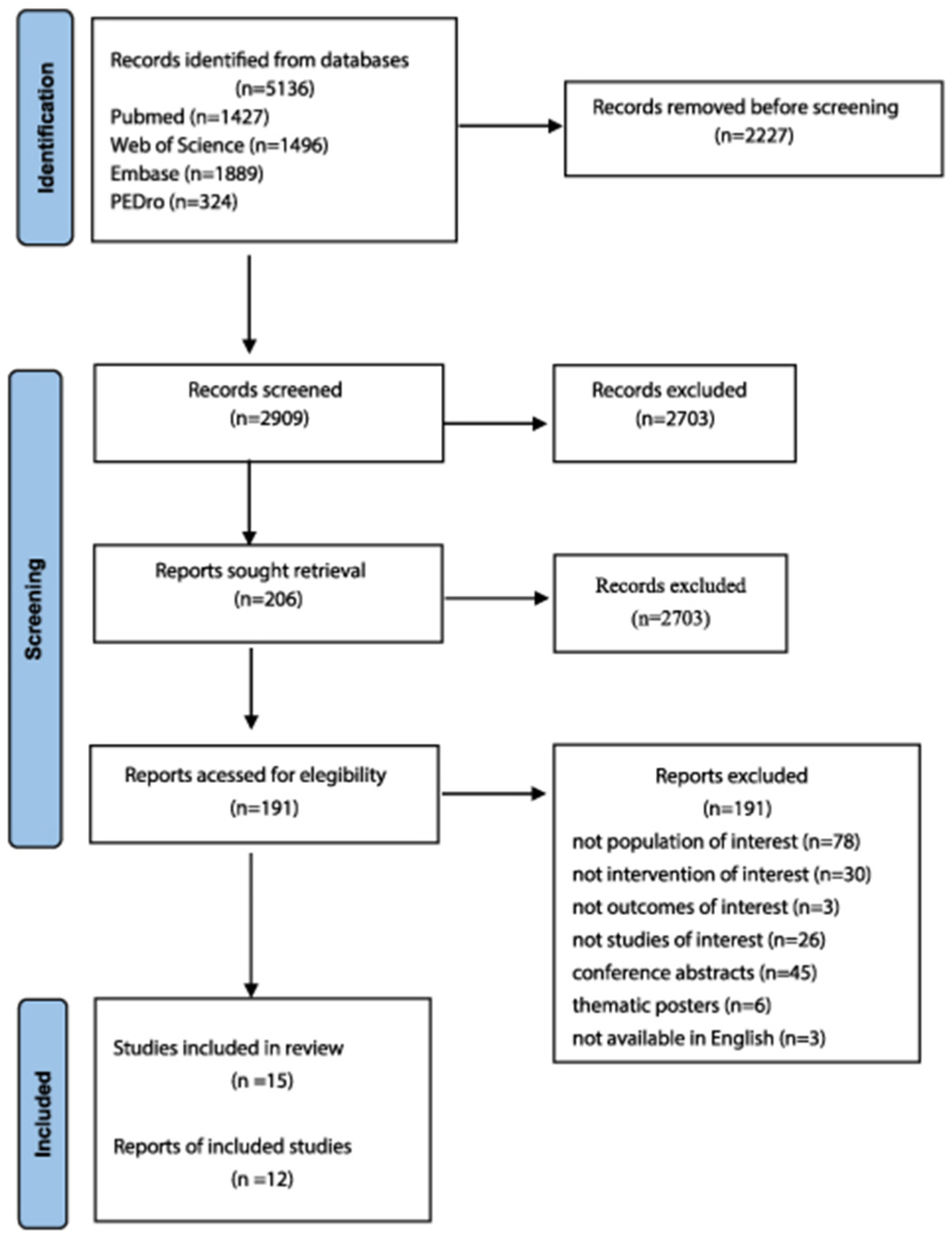
Figure 1. PRISMA flowchart.
Arm 94 00025 g001
Figure 2. Risk of bias using the specific National Heart, Lung and Blood Institute (NHLBI) for randomized clinical trials [32,33,34,35,36,37].
Arm 94 00025 g002
Figure 4. Benefit of OPR using the 6MWT (meters) in OCSs [39,41,42,43,44,45,46].
Arm 94 00025 g004
Figure 5. Benefit of OPR using the 30″SST (repetitions) in OCSs [39,43,44,45].
Arm 94 00025 g005
Figure 6. Benefit of OPR on QoL/physical and mental domains in RCTs [33,34].
Arm 94 00025 g006
Figure 7. Results of OPR on PF in RCTs [33,35].
Arm 94 00025 g007
Figure 8. Benefits of OPR for dyspnea by mMRC in RCTs [33,35].
Arm 94 00025 g008
Table 1. Outcomes of Randomized Clinical Trials (RCTs).
Author/YearDaynes et al./2025 [32]Jimeno-Almazán et al./2022 [33]Jimeno-Almazán et al./2023 [34]Kaddoussi et al./2024 [35]
Risk of biasUnclearUnclearUnclearLow
Participants IG (n = 56) vs. CG (n = 62)IG (n = 19) vs. CG (n = 20)IG (n = 21) vs. CG (n = 20)IG (n = 20) vs. CG (n = 10)
InterventionIG—OPR supervised, personalized, in-person (2×/week aerobic and resistance exercises), combined with 3 home-based sessions of strength and resistance and self-management strategies for 8 consecutive weeks.
CG—usual care.
IG—OPR supervised with multicomponent, personalized exercises, 3×/week (2× moderate intensity aerobic exercises and 1× light intensity continuous training) for 8 consecutive weeks.
CG—unsupervised, which followed the WHO guidelines for rehabilitation after COVID-19.
IG—OPR supervised with multicomponent, personalized exercises, 3×/week (2× moderate intensity aerobic exercises and 1× light intensity continuous training) for 8 consecutive weeks.
CG—unsupervised, which followed the WHO guidelines for rehabilitation after COVID-19.
IG—OPR supervised group OPR with aerobic and strength exercises, 3×/week for 6 consecutive weeks.
CG—maintenance of the usual level of sedentary physical activity.
Physical Performance (6MWT) (m) IG (pre × post) vs. GC (pre × post)
(349 ± 137 × 517 ± 115) vs. (414 ± 106 × 419 ± 78) (p = 0.01)
Physical Performance (5× SST) IG (pre × post) vs. GC (pre × post)
(6.6 ± 2.5 × 5.1 ± 1.2) vs. (8.3 ± 3.5 × 6.6 ± 1.5) (p = 0.009)
SF-12
QoL/PD
IG (pre × post) vs. CG (pre × post)
(35.7 ± 11.6 × 47.8 ± 10.6) vs. (37.2 ± 11.0 × 41.2 ± 11.2)
(p = 0.024)
IG (pre × post) vs. CG (pre × post)
(35.2 ± 11.6 × 48.2 ± 10.4) vs. (36.5 ± 11.7 × 38.5 ± 13.4)
(p < 0.001)
SF-12
QoL/MD
IG (pre × post) vs. CG (pre × post)
(46.1 ± 12.2 × 49.3 ± 9.7) vs. (39.6 ± 11.5 × 43.5 ± 10.9) (p = 0.444)
IG (pre × post) vs. CG (pre × post)
(46.3 ± 11.9 × 49.6 ± 9.5) vs. (39.5 ± 12.1 × 42.2 ± 11.6) (p > 0.05)
EQ 5D
QoL
IG (pre × post) vs. CG (pre × post)
in MD/IQR
VAS
[57.75 (52.44–63.05) × 62.40 (57.14–67.65)] vs. [60.84 (55.59–66.09) × [65.61(60.75–70.48)] (p > 0.05)
EQI
[0.58 (0.53–0.63) × 0.61 (0.56–0.66)] vs. [0.59 (0.52–0.66) × 0.64 (0.59–0.69)] (p > 0.05)
PF IG (pre × post) vs. CG (pre × post)
FVC (%)
(97.2 ± 13.7 × 98.3 ± 10.4) vs. (94.1 ± 13.8 × 93.6 ± 14.0) (p = 0.186)
FEV1 (%)
(110.7 ± 13.3 × 108.5 ± 16.8) vs. (102.4 ± 17.2 × 103.3 ± 18.9) (p = 0.100)
FEV1/FVC (%)
(87.3 ± 3.1 × 85.4 ± 3.6) vs. (83.6 ± 5.3 × 84.6 ± 6.0) (p = 0.093)
IG (pre × post) vs. CG (pre × post)
FVC (%)
(80 ± 21 × 85 ± 21) vs. (79 ± 21 × 79 ± 23) (p = 0.70)
FEV1 (%)
(82 ± 24 × 89 ± 25) vs. (78 ± 25 × 78 ± 25) (p = 0.65)
FEV1/FVC (%)
(102 ± 12 × 104 ± 9) vs. (97 ± 17 × 97 ± 13) (p = 0.92)
Author/YearMaritescu et al./2024 [36]Sirydakis et al./2024 [37]
Risk of biasLowUnclear
Participants IG (n = 30) vs. CG (n = 31)IG (n = 21) vs. CG (n = 19)
InterventionIG—OPR supervised, in-person 5×/weeks (progressive aerobic and resistance training, and breathing exercises for 3 consecutive weeks).
CG—OPR identical to that of IG, combined with 20 min of relaxation.
IG—OPR supervised with multicomponent 2×/week (aerobic and resistance exercises), with a total duration of 11 weeks, including 1 week for familiarization and 10 weeks of training.
CG—recommendations on physical activity and sedentary behavior.
Physical Performance (6MWT) (m)IG (pre × post) vs. CG (pre × post)
(332 ± 86.28 × 366 ± 81.97) vs. (347.25 ± 61.94 × 391.54 ± 56.81) (p < 0.001)
EQ 5D
QoL
IG (pre × post) vs. GC (pre × post)
[(10.70 ± 0.77 × 8.83 ± 0.82)] vs. [(10.11 ± 0.81 × 11 ± 1.11)] (p < 0.001)
PFIG (pre × post) vs. CG (pre × post)
in median/IQR
FVC (%)
[71.5 (67–81) × 76 (71–85)] vs. [72 (67–78) × 76 (69.25–83)] (p < 0.001)
FEV1 (%)
[78 (66–89) × 84.5 (73–94)] vs. [75 (64–86.75) × [79 (71.75–94.50)] (p < 0.001)
FEV1/FVC (%)
[84 (75–86) × 85.50 (76–88)] vs. [85 (76–88.75) × 85 (75–92.75)] (p = 0.001)
ConclusionImprovement in exercise performance, with or without relaxation as an additional intervention.Improvement in QoL in the IG compared to CG.
Abbreviations: IG—intervention group; CG—control group; OPR—outpatient pulmonary rehabilitation; WHO—World Health Organization; 6MWT—Six-Minute Walking Test; m—meters; 5 × SST—5-repetition Sit-to-Stand Test; vs.—versus; SF-12—Short Form-12; QoL/PD—quality of life; Qol/PD—QoL/physical domain; QoL/MD—quality of life/mental domain; QoL/EQ 5D—quality of life/EuroQol 5 dimensions; EQ/VAS—visual analog scale; EQI—EQ Index; PF—pulmonary function; FVC—forced vital capacity; FEV1—forced expiratory volume in one second; mMRC—modified Medical Research Council.
Table 2. Outcomes of Observational Cohort Studies (OCSs).
Author/YearDaynes et al./2021 [38]Hasenoehrl et al./2022 [39]Mammi et al./2023 [40]Moine et al./2024 [41]Mujovic et al./2024 [42]
Risk of bias UnclearLowUnclearUnclearLow
ParticipantsIG (n = 32)IG (n = 28)IG (n = 50)IG (n = 47)IG (n = 46)
InterventionOPR supervised aerobic exercise (walking/treadmill), upper and lower limb strength training, 2×/week for 6 consecutive weeks.OPR for subjects in both groups with resistance exercises, 2×/week for 8 consecutive weeks.OPR individualized with progression to endurance training consisted of 10 individual 45-min sessions with physiotherapists 2×/week for 7 consecutive weeks. An additional 10 to 15 sessions were added. OPR supervised with 6×/week (aerobic and strength exercises), for 4 consecutive weeks.OPR individualized 5×/week (aerobic exercise) for 45 min for 6 consecutive weeks.
Physical Performance (6MWT) (m) IG (pre × post)
640.70 ± 71.60 vs. 705.56 ± 75.60 (p < 0.001)
IG (pre × post) (n = 44)
519 ± 116 vs. 589 ± 124
(p < 0.001)
IG (pre × post)
506 ± 88.15 vs. 588 ± 128.15
(p < 0.001)
Physical Performance (30″SST) IG (pre × post)
19.10 ± 6.0 vs. 27.01 ± 8.46
(p < 0.001)
Physical
Performance
(1′SST)
IG (pre × post)
in MD and IQR
24 (18–27.5) vs. 25 (22–31.5)
(p < 0.01)
SF-12
QoL/PD
IG (pre × post) (n = 38)
33 ± 11 vs. 42 ± 9
(p < 0.001)
SF-12
QoL/MD
IG (pre × post) (n = 38)
40 ± 10 vs. 50 ± 8
(p < 0.001)
QoL (EQ 5D) IG (pre × post)
VAS
62 ± 18 vs. 70 ± 21
(p = 0.05)
IG (pre × post)
VAS
60.23 ± 17.42 vs. 79.44 ± 16.48 (p < 0.001)
EQI
0.65 ± 0.21 vs. 0.75 ± 0.20
(p < 0.001)
Dyspnea
(mMRC)
(n = 25)
1 (1–2) vs. 1 (1–1)
(p < 0.01)
ConclusionImproving the QoL.Improved exercise performance.Improving the QoL.Improved exercise performance, QoL/PD and QoL/MD.Improved exercise performance.
Author/YearOstrowska et al./2023 [43]Rzepka-Cholasińska et al./2024 [44]Silva-Lalucci et al./2024 [45]Tramonti et al./2024 [46]
Risk of bias UnclearUnclearUnclearUnclear
ParticipantsIG (n = 97)IG (n = 97)IG (n = 59)IG (n = 18)
InterventionOPR with aerobic and resistance exercises for 90 min each session, 3×/week for 6 consecutive weeks.OPR with aerobic, strength and interval exercises with load progression, 3×/week for 6 consecutive weeks. OPR with resistance and strength exercises, 2×/week for 16 consecutive weeks.OPR with aerobic exercise, 3×/week for 4 consecutive weeks.
Physical
Performance
(6MWT) (m)
IG (pre × post)
335 ± 45 vs. 383.25 ± 51.50
(p < 0.0001)
IG (pre × post)
327.80 ± 82.88 vs. 383.96 ± 74.59 (p < 0.0001)
IG (pre × post)
524.30 ± 89.78 vs. 577.30 ± 90.96 (p < 0.0001)
IG (pre × post)
320 ± 184 vs. 395 ± 193
(p < 0.001)
Physical
Performance
(30″SST)
IG (pre × post)
13.0 ± 3.0 vs. 18.0 ± 3.5
(p < 0.0001)
IG (pre × post)
13.39 ± 4.32 vs. 17.10 ± 4.66
(p < 0.0001)
IG (pre × post)
16.06 ± 8.71 vs. 20.36 ± 8.73
(p < 0.0001)
SF-36
QoL/PD
IG (pre × post) in %
57.5 [35] vs. 85 [19] (p = 0.001)
SF-36
QoL/MD
IG (pre × post) %
64 [21] vs. 68 [21] (p = 0.05)
Dyspnea (mMRC)IG (pre × post)
in median/IQR
2 (2–2) vs. 1 (0–2)
(p < 0.0001)
IG (pre × post)
2.21 ± 0.52 vs. 1.00 ± 0.89
(p < 0.0001)
IG (pre × post)
3.0 ± 1.0 vs. 1.0 ± 1.0
(p < 0.0001)
Dyspnea (Borg)IG (pre × post)
3.0 ± 1.0 vs. 2.0 ± 1.0
(p < 0.0001)
IG (pre × post)
3.65 ± 1.95 vs. 2.26 ± 1.44
(p < 0.0001)
ConclusionImproved exercise performance, reduced dyspnea.Improved exercise performance and reduced dyspnea.Improved exercise performance.Improved exercise performance, QoL and reduced dyspnea.
Abbreviations: IG—intervention group; OPR—outpatient pulmonary rehabilitation; vs.—versus; h—hours; 6MWT—Six-Minute Walking Test; m—meters; 30″SST—30 s Sit-to-Stand Test; 1′SST—1 min Sit-to-Stand Test; SF-12—Short Form-12; QoL—quality of life; Qol/PD—QoL/physical domain; QoL/MD—QoL/mental domain; EQ 5D—quality of life/EuroQol 5 dimensions; EQ/VAS—visual analog scale; EQI—EQ Index; MD—median; IQR—interquartile range; PF—pulmonary function; FEV1—forced expiratory volume in one second; FVC—forced vital capacity; mMRC—modified Medical Research Council.
Disclaimer/Publisher’s Note: The statements, opinions and data contained in all publications are solely those of the individual author(s) and contributor(s) and not of MDPI and/or the editor(s). MDPI and/or the editor(s) disclaim responsibility for any injury to people or property resulting from any ideas, methods, instructions or products referred to in the content.