

Glucagon-like Peptide-1 Receptor Agonist Therapy and Risk of Pulmonary and Systemic Infections in Diabetic Gastroparesis: A Propensity-Matched Cohort Study
 ,
,  , ,
, ,
Highlights
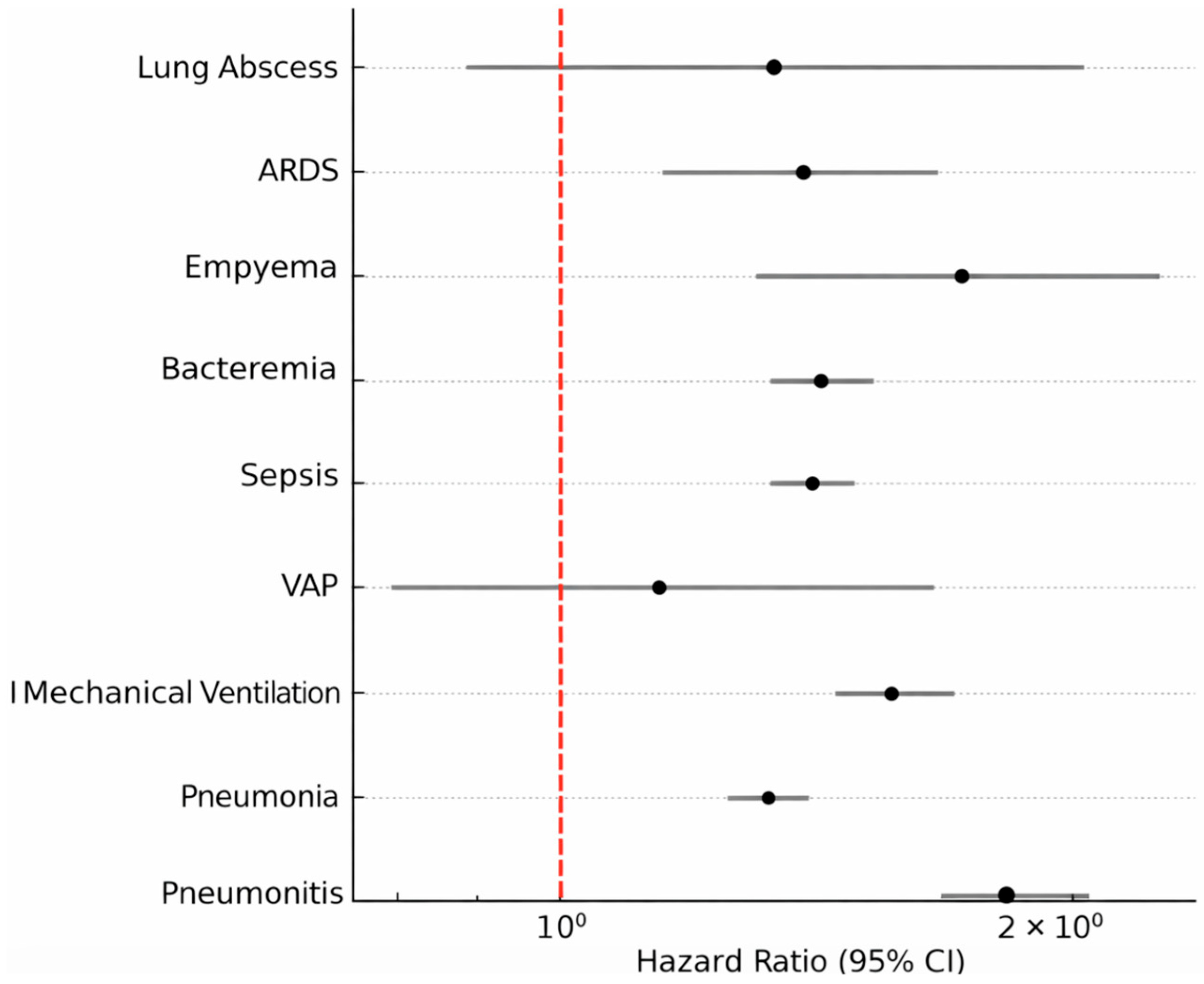
- GLP-1 receptor agonist therapy was associated with reduced risk of pulmonary and systemic infections in patients with diabetic gastroparesis.
- Non-GLP-1 users had significantly higher rates of pneumonitis, pneumonia, sepsis, and bacteremia.
- GLP-1 receptor agonists may be safer than previously assumed in patients with gastroparesis.
- Their anti-inflammatory and metabolic benefits may outweigh concerns about delayed gastric emptying.
Abstract
1. Introduction
Objective
2. Methods
2.1. Data Source and Study Design
2.2. Study Population and Cohort Definitions
- Cohort 1 (DM + Gastroparesis − GLP-1): Patients with Diabetes Mellitus and gastroparesis who had no record of GLP-1 RA exposure.
- Cohort 2 (DM + Gastroparesis + GLP-1): Patients with Diabetes Mellitus and gastroparesis with recorded GLP-1 RA use.
- Age ≥ 18 years at index date;
- Confirmed diagnosis of both DM and gastroparesis;
- Availability of complete demographic and clinical data;
- Minimum 6-month follow-up post-index.
2.3. Outcomes
- Pneumonia (J13–J18; 483);
- Pneumonitis (J69);
- Ventilator-associated pneumonia (VAP) (J95.851);
- Mechanical ventilation use (CPT 1015098);
- Sepsis (A40–A41);
- Empyema (J86);
- Lung abscess (J85);
- Acute respiratory distress syndrome (ARDS) (J80);
- Bacteremia (R78.81);
- Percutaneous endoscopic gastrostomy (PEG) or enteral feeding (SNOMED 229912004, 183028005).
2.4. Propensity Score Matching and Covariates
2.5. Statistical Analysis
2.6. Ethical Considerations
3. Results
3.1. Study Population and Cohort Characteristics
- Cohort 1 (Diabetes Mellitus + Gastroparesis − GLP-1): patients with diabetes and gastroparesis without GLP-1 receptor agonist use.
- Cohort 2 (Diabetes Mellitus + Gastroparesis + GLP-1): patients with diabetes and gastroparesis with GLP-1 receptor agonist exposure.
3.2. Overview of Outcomes
3.3. Pneumonitis and Pneumonia
3.4. Ventilator-Associated Outcomes
3.5. Sepsis and Bacteremia
3.6. Pulmonary Complications
3.7. PEG Tube and Nutritional Support
3.8. Summary of Comparative Outcomes
4. Discussion
4.1. Pathophysiological Interpretation
4.2. Pulmonary and Infectious Outcomes
4.3. Clinical Implications
4.4. Comparison with Prior Studies
4.5. Strengths and Limitations
4.6. Future Directions
4.7. Final Remarks
5. Conclusions
Supplementary Materials
Author Contributions
Funding
Institutional Review Board Statement
Informed Consent Statement
Data Availability Statement
Conflicts of Interest
References
- Petri, M.; Singh, I.; Baker, C.; Underkofler, C.; Rasouli, N. Diabetic gastroparesis: An overview of pathogenesis, clinical presentation and novel therapies, with a focus on ghrelin receptor agonists. J. Diabetes Complicat. 2021, 35, 107733. [Google Scholar] [CrossRef] [Scilit] [PubMed]
- Portincasa, P.; Bonfrate, L.; Wang, D.Q.; Fruhbeck, G.; Garruti, G.; Di Ciaula, A. Novel insights into the pathogenic impact of diabetes on the gastrointestinal tract. Eur. J. Clin. Investig. 2022, 52, e13846. [Google Scholar] [CrossRef] [Scilit]
- Li, L.; Wang, L.; Long, R.; Song, L.; Yue, R. Prevalence of gastroparesis in diabetic patients: A systematic review and meta-analysis. Sci. Rep. 2023, 13, 14015. [Google Scholar] [CrossRef] [Scilit]
- El Halabi, M.; Parkman, H.P. 2023 update on the clinical management of gastroparesis. Expert Rev. Gastroenterol. Hepatol. 2023, 17, 431–441. [Google Scholar] [CrossRef] [Scilit]
- Parkman, H.P.; Xin, Y.; Wilson, L.A.; Burton-Murray, H.; McCallum, R.W.; Sarosiek, I.; Moshiree, B.; Koch, K.L.; Bulat, R.S.; Grover, M.; et al. Characterization of Patients With Symptoms of Gastroparesis Having Frequent Emergency Department Visits and Hospitalizations. Clin. Gastroenterol. Hepatol. 2025, 23, 2023–2038. [Google Scholar] [CrossRef] [Scilit]
- Pavurala, R.B.; Stanich, P.P.; Krishna, S.G.; Guturu, P.; Hinton, A.; Conwell, D.L.; Balasubramanian, G. Predictors of Early Readmissions in Hospitalized Patients With Gastroparesis: A Nationwide Analysis. J. Neurogastroenterol. Motil. 2021, 27, 408–418. [Google Scholar] [CrossRef] [Scilit]
- Hsu, C.T.; Azzopardi, N.; Broad, J. Prevalence and disease burden of gastroparesis in Asia. J. Gastroenterol. Hepatol. 2024, 39, 649–657. [Google Scholar] [CrossRef] [Scilit] [PubMed]
- Farsi, Z.; Kamali, M.; Butler, S.; Zareiyan, A. The Effect of Semirecumbent and Right Lateral Positions on the Gastric Residual Volume of Mechanically Ventilated, Critically Ill Patients. J. Nurs. Res. 2020, 28, e108. [Google Scholar] [CrossRef] [Scilit]
- Chen, Y.H.; Zink, T.; Chen, Y.W.; Nin, D.Z.; Talmo, C.T.; Hollenbeck, B.L.; Grant, A.R.; Niu, R.; Chang, D.C.; Smith, E.L. Postoperative Aspiration Pneumonia Among Adults Using GLP-1 Receptor Agonists. JAMA Netw. Open 2025, 8, e250081. [Google Scholar] [CrossRef] [Scilit]
- Lindner, M.; Padar, M.; Mandul, M.; Christopher, K.B.; Reintam Blaser, A.; Gratz, H.C.; Elke, G.; Bachmann, K.F. Current practice of gastric residual volume measurements and related outcomes of critically ill patients: A secondary analysis of the intestinal-specific organ function assessment study. J. Parenter. Enter. Nutr. 2023, 47, 614–623. [Google Scholar] [CrossRef] [Scilit] [PubMed]
- Zhou, K.; Lansang, M.C. Diabetes Mellitus and Infection. In Endotext; Feingold, K.R., Ahmed, S.F., Anawalt, B., Blackman, M.R., Boyce, A., Chrousos, G., Corpas, E., Herder, W., Dhatariya, K., Dungan, K., et al., Eds.; MDText.com, Inc.: South Dartmouth, MA, USA, 2000. [Google Scholar]
- Ulambayar, B.; Ghanem, A.S.; Nagy, A.C. Effect of Anti-Diabetic Medication Use on Sepsis Risk in Type 2 Diabetes Mellitus: A Multivariate Analysis. Geriatrics 2025, 10, 108. [Google Scholar] [CrossRef] [Scilit]
- Gerstein, H.C.; Sattar, N.; Rosenstock, J.; Ramasundarahettige, C.; Pratley, R.; Lopes, R.D.; Lam, C.S.; Khurmi, N.S.; Heenan, L.; Del Prato, S.; et al. Cardiovascular and Renal Outcomes with Efpeglenatide in Type 2 Diabetes. N. Engl. J. Med. 2021, 385, 896–907. [Google Scholar] [CrossRef] [Scilit] [PubMed]
- Tang, H.; Lu, Y.; Zhang, B.; Zhou, T.; Zhang, D.; Chen, J.; Chen, Y.; Asch, D.A. Cardiovascular and kidney outcomes of GLP-1 receptor agonists in adults with obesity: A target trial emulation study. Diabetes Obes. Metab. 2025, 27, 6527–6536. [Google Scholar] [CrossRef] [Scilit]
- Wharton, S.; Davies, M.; Dicker, D.; Lingvay, I.; Mosenzon, O.; Rubino, D.M.; Pedersen, S.D. Managing the gastrointestinal side effects of GLP-1 receptor agonists in obesity: Recommendations for clinical practice. Postgrad. Med. 2022, 134, 14–19. [Google Scholar] [CrossRef] [Scilit] [PubMed]
- Shankar, A.; Sharma, A.; Vinas, A.; Chilton, R.J. GLP-1 receptor agonists and delayed gastric emptying: Implications for invasive cardiac interventions and surgery. Cardiovasc. Endocrinol. Metab. 2025, 14, e00321. [Google Scholar] [CrossRef] [Scilit] [PubMed]
- Ibe, T.; Borlaug, B.A. Glucagon-Like Peptide 1 Receptor Agonists and Cardiovascular Disease. Annu. Rev. Med. 2025, 77, 1–15. [Google Scholar] [CrossRef] [Scilit]
- Mehdi, S.F.; Pusapati, S.; Anwar, M.S.; Lohana, D.; Kumar, P.; Nandula, S.A.; Nawaz, F.K.; Tracey, K.; Yang, H.; LeRoith, D.; et al. Glucagon-like peptide-1: A multi-faceted anti-inflammatory agent. Front. Immunol. 2023, 14, 1148209. [Google Scholar] [CrossRef] [Scilit]
- Battistoni, A.; Piras, L.; Tartaglia, N.; Carrano, F.M.; De Vitis, C.; Barbato, E. Glucagon-like peptide-1 receptor agonists and the endothelium: Molecular and clinical insights into cardiovascular protection. Front. Med. 2025, 12, 1669685. [Google Scholar] [CrossRef] [Scilit]
- Leis, A.; Fradera, M.; Pena-Gomez, C.; Aguilera, P.; Hernandez, G.; Parralejo, A.; Ramírez-Anguita, J.-M.; Mayer, M.-A. Real World Data and Real World Evidence Using TriNetX: The TauliMar Clinical Research Network. Stud. Health Technol. Inform. 2025, 327, 759–760. [Google Scholar]
- Nassar, M.; Abosheaishaa, H.; Elfert, K.; Beran, A.; Ismail, A.; Mohamed, M.; Ali, R.; El-Sayed, A.; Ibrahim, S.; Abdel-Rahman, M. TriNetX and Real-World Evidence: A Critical Review of Its Strengths, Limitations, and Bias Considerations in Clinical Research. ASIDE Intern. Med. 2025, 1, 24–33. [Google Scholar] [CrossRef] [Scilit]
- Wilson, J.L.; Betensky, M.; Udassi, S.; Ellison, P.R.; Lilienthal, R.; Stahl, L.R.; Palchuk, M.B.; Zia, A.; Town, D.A.; Kimble, W.; et al. Leveraging a global, federated, real-world data network to optimize investigator-initiated pediatric clinical trials: The TriNetX Pediatric Collaboratory Network. JAMIA Open 2024, 7, ooae077. [Google Scholar] [CrossRef] [Scilit]
- Henney, A.E.; Riley, D.R.; Hydes, T.J.; Anson, M.; Ibarburu, G.H.; Frost, F.; Alam, U.; Cuthbertson, D.J. Comparative estimate of glucose-lowering therapies on risk of incident pneumonia and severe sepsis: An analysis of real-world cohort data. Thorax 2024, 80, 32–41. [Google Scholar] [CrossRef] [Scilit]
- Janic, M.; Skrgat, S.; Harlander, M.; Lunder, M.; Janez, A.; Pantea Stoian, A.; El-Tanani, M.; Maggio, V.; Rizzo, M. Potential Use of GLP-1 and GIP/GLP-1 Receptor Agonists for Respiratory Disorders: Where Are We at? Medicina 2024, 60, 2030. [Google Scholar] [CrossRef] [Scilit]
- See, X.Y.; Xanthavanij, N.; Lee, Y.C.; Ong, T.E.; Wang, T.H.; Ahmed, O.; Chang, Y.-C.; Peng, C.-Y.; Chi, K.-Y.; Chang, K.-Y.; et al. Pulmonary outcomes of incretin-based therapies in COPD patients receiving single-inhaler triple therapy. ERJ Open Res. 2025, 11, 00803-2024. [Google Scholar] [CrossRef] [Scilit]
- Pirera, E.; Di Raimondo, D.; D’Anna, L.; Tuttolomondo, A. Efficacy of SGLT2 Inhibitors, GLP-1 Receptor Agonists, DPP-4 Inhibitors, and Sulfonylureas on Moderate-to-Severe COPD Exacerbations Among Patients with Type 2 Diabetes: A Systematic Review and Network Meta-Analysis. Pharmaceuticals 2025, 18, 1337. [Google Scholar] [CrossRef] [Scilit]
- Zheng, Z.; Zong, Y.; Ma, Y.; Tian, Y.; Pang, Y.; Zhang, C.; Gao, J. Glucagon-like peptide-1 receptor: Mechanisms and advances in therapy. Signal Transduct. Target. Ther. 2024, 9, 234. [Google Scholar] [CrossRef] [Scilit]
- Skrobucha, A.; Pindlowski, P.; Krajewska, N.; Grabowski, M.; Jonik, S. Anti-inflammatory effects of glucagon-like peptide-1 (GLP-1) in coronary artery disease: A comprehensive review. Front. Cardiovasc. Med. 2024, 11, 1446468. [Google Scholar] [CrossRef] [Scilit] [PubMed]
- Alharbi, S.H. Anti-inflammatory role of glucagon-like peptide 1 receptor agonists and its clinical implications. Ther. Adv. Endocrinol. Metab. 2024, 15, 20420188231222367. [Google Scholar] [CrossRef] [Scilit] [PubMed]
- Park, B.; Bakbak, E.; Teoh, H.; Krishnaraj, A.; Dennis, F.; Quan, A.; Rotstein, O.D.; Butler, J.; Hess, D.A.; Verma, S. GLP-1 receptor agonists and atherosclerosis protection: The vascular endothelium takes center stage. Am. J. Physiol. Heart Circ. Physiol. 2024, 326, H1159–H1176. [Google Scholar] [CrossRef] [Scilit] [PubMed]
- Baer, B.; Putz, N.D.; Riedmann, K.; Gonski, S.; Lin, J.; Ware, L.B.; Toki, S.; Peebles, R.S.; Cahill, K.N.; Bastarache, J.A. Liraglutide pretreatment attenuates sepsis-induced acute lung injury. Am. J. Physiol. Lung Cell. Mol. Physiol. 2023, 325, L368–L384. [Google Scholar] [CrossRef] [Scilit]
- Tomy, N.; Shwartzman, B.; Frishman, W.H. The Potential of Using Glucagon-Like Peptide-1 Receptor Agonists in Sepsis. Cardiol. Rev. 2025. [Google Scholar] [CrossRef] [Scilit] [PubMed]
- Lu, Y.; Dai, H.; Tang, H.; Donahoo, W.T.; George, T.J.; Sun, R.C.; Brown, A.J.; Zhang, L.; Liu, S.; Zhao, D. Association of Glucagon-Like Peptide-1 Receptor Agonists with Cancer Risk in Older Adults With Type 2 Diabetes. Obesity 2025. [Google Scholar] [CrossRef] [Scilit]
- Goldstein, N.D.; Olivieri-Mui, B.; Burstyn, I. Are Aggregated Electronic Health Record Datasets Good for Research? J. Gen. Intern. Med. 2025, 40, 3743–3749. [Google Scholar] [CrossRef] [Scilit] [PubMed]
- Merola, D.; Campbell, U.; Lenis, D.; Schneeweiss, S.; Wang, S.; Madsen, A.; Carrigan, G.; Chia, V.; Ovbiosa, O.E.; Pinheiro, S.; et al. Calibrating Observational Health Record Data Against a Randomized Trial. JAMA Netw. Open 2024, 7, e2436535. [Google Scholar] [CrossRef] [Scilit] [PubMed]
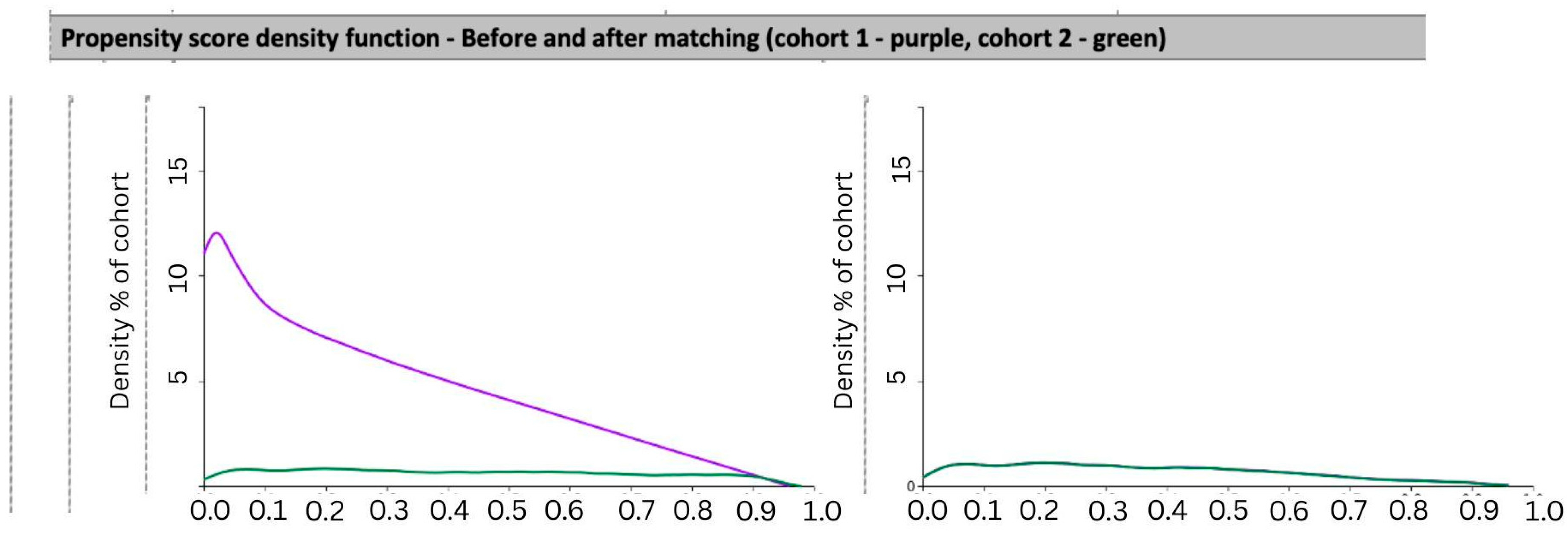


| Cohort 1 (N = 23,371) and Cohort 2 (N = 23,371) Characteristics After Propensity Score Matching | ||||||
|---|---|---|---|---|---|---|
| Demographics | ||||||
| Cohort | Mean ± SD | Patients | % of Cohort | p-Value | Std diff. | |
| 1 | Current Age | 61.2 ± 15.1 | 23,371 | 100% | <0.001 | 0.038 |
| 2 | 60.7 ± 12.7 | 23,371 | 100% | |||
| 1 | Age at Index | 57.0 ± 15.1 | 23,371 | 100% | <0.001 | 0.042 |
| 2 | 56.4 ± 12.5 | 23,371 | 100% | |||
| 1 | Male | 7166 | 30.70% | 0.880 | 0.001 | |
| 2 | 7151 | 30.60% | ||||
| 1 | Female | 16,198 | 69.30% | 0.960 | <0.001 | |
| 2 | 16,203 | 69.30% | ||||
| 1 | Black or African American | 4775 | 20.40% | 0.167 | 0.013 | |
| 2 | 4896 | 20.90% | ||||
| 1 | White | 15,270 | 65.30% | 0.573 | 0.005 | |
| 2 | 15,212 | 65.10% | ||||
| 1 | American Indian or Alaska Native | 156 | 0.70% | 0.351 | 0.009 | |
| 2 | 140 | 0.60% | ||||
| 1 | Unknown Race | 1188 | 5.10% | 0.769 | 0.003 | |
| 2 | 1202 | 5.10% | ||||
| 1 | Native Hawaiian or Other Pacific Islander | 188 | 0.80% | 0.368 | 0.008 | |
| 2 | 171 | 0.70% | ||||
| 1 | Unknown Ethnicity | 2324 | 9.90% | 0.170 | 0.013 | |
| 2 | 2236 | 9.60% | ||||
| 1 | Not Hispanic or Latino | 18,136 | 77.60% | 0.991 | <0.001 | |
| 2 | 18,135 | 77.60% | ||||
| 1 | Hispanic or Latino | 2911 | 12.50% | 0.216 | 0.011 | |
| 2 | 3000 | 12.80% | ||||
| 1 | Other Race | 1198 | 5.10% | 0.834 | 0.002 | |
| 2 | 1188 | 5.10% | ||||
| 1 | Asian | 596 | 2.60% | 0.312 | 0.009 | |
| 2 | 562 | 2.40% | ||||
| Diagnosis | ||||||
| 1 | Other chronic obstructive pulmonary disease | 4053 | 17.30% | 0.391 | 0.008 | |
| 2 | 3983 | 17.00% | ||||
| 1 | Chronic kidney disease (CKD) | 7397 | 31.70% | 0.277 | 0.01 | |
| 2 | 7288 | 31.20% | ||||
| 1 | Overweight and obesity | 14,306 | 61.20% | 0.001 | 0.031 | |
| 2 | 13,952 | 59.70% | ||||
| Medication | ||||||
| 1 | Insulin and analogues | 17,295 | 74.00% | 0.156 | 0.013 | |
| 2 | 17,160 | 73.40% | ||||
| 1 | Biguanides | 14,061 | 60.20% | 0.029 | 0.02 | |
| 2 | 13,830 | 59.20% | ||||
| 1 | Sulfonylureas | 6483 | 27.70% | 0.741 | 0.003 | |
| 2 | 6515 | 27.90% | ||||
| 1 | Alpha glucosidase inhibitors | 158 | 0.70% | 0.578 | 0.005 | |
| 2 | 168 | 0.70% | ||||
| 1 | Thiazolidinediones | 1882 | 8.10% | 0.588 | 0.005 | |
| 2 | 1914 | 8.20% | ||||
| 1 | Dipeptidyl peptidase 4 (DPP-4) inhibitors | 4139 | 17.70% | 0.039 | 0.019 | |
| 2 | 4311 | 18.40% | ||||
| 1 | Sodium–glucose co-transporter 2 (SGLT2) inhibitors | 3819 | 16.30% | <0.001 | 0.065 | |
| 2 | 4400 | 18.80% | ||||
| Outcome | Incidence (No GLP-1) | Incidence (GLP-1) | Risk Ratio (95% CI) | Hazard Ratio (95% CI) | p-Value | Absolute Risk Difference (ARD) | NNT/NNH |
|---|---|---|---|---|---|---|---|
| Pneumonitis | 3.60% | 2.50% | 1.43 (1.29–1.59) | 1.76 (1.58–1.95) | <0.001 | 1.10% | 91 |
| Pneumonia | 13.20% | 12.20% | 1.08 (1.03–1.13) | 1.34 (1.27–1.41) | <0.001 | 1.00% | 100 |
| Mechanical Ventilation | 4.40% | 3.30% | 1.33 (1.22–1.46) | 1.63 (1.49–1.79) | <0.001 | 1.10% | 91 |
| Ventilator-Associated Pneumonia | 0.18% | 0.20% | 0.94 (0.62–1.42) | 1.14 (0.75–1.73) | 0.750 | −0.02% | 5000 (NNH) |
| Sepsis | 12.80% | 11.10% | 1.16 (1.10–1.22) | 1.44 (1.37–1.52) | <0.001 | 1.70% | 59 |
| Bacteremia | 5.20% | 4.40% | 1.19 (1.10–1.29) | 1.46 (1.35–1.59) | <0.001 | 0.80% | 125 |
| Empyema | 0.40% | 0.30% | 1.49 (1.10–2.03) | 1.80 (1.32–2.45) | 0.011 | 0.10% | 1000 |
| ARDS | 0.80% | 0.70% | 1.16 (0.95–1.43) | 1.41 (1.15–1.74) | 0.001 | 0.10% | 1000 |
| Lung Abscess | 0.20% | 0.10% | 1.12 (0.70–1.78) | 1.36 (0.85–2.16) | 0.640 | 0.10% | 1000 |
| PEG/Nasal Tube Feeding | 0% | 0% | — | — | — | 0% | — |
Disclaimer/Publisher’s Note: The statements, opinions and data contained in all publications are solely those of the individual author(s) and contributor(s) and not of MDPI and/or the editor(s). MDPI and/or the editor(s) disclaim responsibility for any injury to people or property resulting from any ideas, methods, instructions or products referred to in the content. |
© 2026 by the authors. Published by MDPI on behalf of the Polish Respiratory Society. Licensee MDPI, Basel, Switzerland. This article is an open access article distributed under the terms and conditions of the Creative Commons Attribution (CC BY) license.
Share and Cite
Kazi, M.A.I.; Kamal, H.; Mufarrih, S.M.; Qureshi, I.; Singh, S.; Mazer, A. Glucagon-like Peptide-1 Receptor Agonist Therapy and Risk of Pulmonary and Systemic Infections in Diabetic Gastroparesis: A Propensity-Matched Cohort Study. Adv. Respir. Med. 2026, 94, 20. https://doi.org/10.3390/arm94020020
Kazi MAI, Kamal H, Mufarrih SM, Qureshi I, Singh S, Mazer A. Glucagon-like Peptide-1 Receptor Agonist Therapy and Risk of Pulmonary and Systemic Infections in Diabetic Gastroparesis: A Propensity-Matched Cohort Study. Advances in Respiratory Medicine. 2026; 94(2):20. https://doi.org/10.3390/arm94020020
Chicago/Turabian StyleKazi, Muhammad Ali Ibrahim, Hasan Kamal, Syed Musa Mufarrih, Imran Qureshi, Sanmeet Singh, and Adrien Mazer. 2026. "Glucagon-like Peptide-1 Receptor Agonist Therapy and Risk of Pulmonary and Systemic Infections in Diabetic Gastroparesis: A Propensity-Matched Cohort Study" Advances in Respiratory Medicine 94, no. 2: 20. https://doi.org/10.3390/arm94020020
APA StyleKazi, M. A. I., Kamal, H., Mufarrih, S. M., Qureshi, I., Singh, S., & Mazer, A. (2026). Glucagon-like Peptide-1 Receptor Agonist Therapy and Risk of Pulmonary and Systemic Infections in Diabetic Gastroparesis: A Propensity-Matched Cohort Study. Advances in Respiratory Medicine, 94(2), 20. https://doi.org/10.3390/arm94020020