1. Theorethical Background
1.1. Cultural psychology
Cultural psychology starts from the assumption that the human being gives meaning to what he encounters in the course of his life. Through this process of attribution of meaning, the human being does not just react or act on the basis of the surrounding environment, but builds the world with which he interacts and reacts. It differs from the rest of the psychology that prefers to look at the basic psychological functions (perception, attention), favoring the higher psychological functions that concern, instead, the voluntary construction of meanings. It is evident that this shift of attention (from something traditionally measurable such as behaviors, to something “less” measurable such as the processes of signification) involves the redefinition of the model, specific objectives and the privileged object of psychological discipline and function of the latter within the socio-cultural context.
1.2. The object of cultural psychology
Traditionally we believe that scientific knowledge is a stable and universal basis. If applied to psychological phenomena this definition is at least doubtful: how is it possible that the study of a transient, changing and subjective phenomenon can generate scientific knowledge? One of the solutions to this problem is, for example, to measure behavior. However, the problem arises again when the “observable part” of the behavior fails.
As mentioned, cultural psychology prefers higher psychological functions and, as we well know, at any time a social actor can consciously decide to act unexpectedly in a given situation. For this reason, “non-behavior” or the absence of behavior has the same value as “real” behavior. In other sciences (as in astrophysics) the absence of a phenomenon has the same value as the presence of the same phenomenon, both inserted in general development models.
For Valsiner, one of the problems of psychology was that of not being able to accept the “centrality of nothing, the lack” as part of something, of not being able to create its own model that was able to hold the elements together even when some of these were “missing”, largely because it imposed the inductive generalization model instead of the abductive one as a form of empirical evidence:
The inductive path of generalization of knowledge requires the creation of categories of phenomena in which each instance is treated as if it were an equivalent member of that class. (…) On the contrary, each person has their own unique story which is lost in such a generalization. (Valsiner 2015).
Peirce developed this topic in his conception of the logic of scientific discovery, extending the meaning of abduction and considering it “the first step of scientific reasoning” in which a hypothesis is established to explain some empirical phenomena. For Peirce the human being has three different ways of inferring knowledge:
-Deductive reasoning
All the balls from that basket are white. (Implication report)
These balls come from that basket. (Antecedent)
These balls are white. (Result)
Deduction is a process in which the premises and rules are known and a conclusion is sought (ranging from general to particular). It starts from a general rule (implication relation), applies it to a specific (antecedent) fact and derives a certain (consequent) result. The conclusion will make explicit information that is present only implicitly in the premises.
-Inductive reasoning
These balls are white. (Antecedent)
These balls come from that basket. (Result)
All the balls in that basket are white. (Implication report)
Induction is a process in which the premises and the conclusion are known and the rules are to be reconstructed (from the particular to the general). It starts from a specific case (the antecedent), connects it to another fact (the consequent), and draws from it a probable general rule (implication relation)
-The abductive reasoning These balls are white. (Result)
All the balls in that basket are white. (Implication report)
These balls come from that basket. (Antecedent)
Abduction is a process that is used when one knows the rules and the conclusion and wants to reconstruct the premises. It considers a specific fact (the consequent), connects it to a hypothetical rule (implication relationship) and derives an uncertain result, that is, a hypothetical conclusion (the antecedent).
About abduction, Peirce:
The form of inference, therefore, is this: the surprising fact, C, is observed; but if A were true, C would be a matter of course. Hence, there is reason to suspect that A is true.” (Peirce, Harvard Lecture on Pragmatism, 1902/1976)
The use of inductive generalization in psychology increases the risk that the variability of the phenomenon is replaced by the “notion of score” (Valsiner 2015) and that therefore the uniqueness of the phenomenon is lost. Why is it essential to protect the uniqueness of the phenomenon? As we have seen, the abductive reasoning aims to build the premises starting from the phenomenon through the connection of this to a hypothetical rule. Reducing the complexity of phenomena is one of the ways that psychology has used to respond to the needs of common sense, but this means losing the nature of the psychological phenomena that arise in the relationship between the world and the individual.
Negotiation is between the world and the individual (what Stern calls “the external infinity”, that is, the imagination and knowledge of the world “and” the internal infinity, that is, the feeling of a person with respect to himself) of signs through their use. Considering a phenomenon like the product of this negotiation through a process of signification allows us to define precisely this dynamic of assigning meaning as the object of the discipline. All phenomena are subordinated to this process of signification. The behavior is therefore not objective but subjective, through the meanings linked to it. (
Valsiner 2017). In this perspective, behavior is therefore the set of actions made significant by the human being.
1.3. The role of culture
For Valsiner people act through culture, inventing tools, signs and metasigns that organize the work done by other cultural tools. Culture is therefore located between (“in-between”) the person and the social world and leaves its marks both on the environment and on the deep layers of the human soul.
The path that led culture to have a decisive role in psychological theory passes through Parsons’ studies which in ’51 summarizes its fundamental characteristics: culture is transmitted (it is a social tradition), learned (not proper to the human being, not genetic) and shared. However, today these characteristics are no longer shared and have been replaced by others more suitable for the current model. Valsiner “overturns” the characteristics listed by Parsons: a culture that is transmitted, learned and shared is replaced by a co-constructed culture (through two-way communication processes, culture is co-built both between individuals of the same generation and between individuals of different generations), internalized/outsourced (messages are actively broken down and recomposed into new intrapsychic patterns and made available to other individuals), coordinated (the different social agents regulate the experience of their own vital worlds so that they can be mutually linked).
Culture is therefore constituted by the processes of construction and use that occur simultaneously in the intrapsychological and interpsychological fields. the subject builds significant relationships with the world first of all within his own subjective inner infinite while facing the environment perceived as meaningful in itself. (
Valsiner 2017)
The fundamental role that here relies on culture in the symbolic mediation process places culture in-between: it catalyses the activity of signification of the individual and at the same time provides the frame within which meanings interact.
1.4. Meaning as a cultural model
The studies on the processes of signification carried out over the years clearly outline how the dynamics of creating meaning is a fundamental element to keep in mind when approaching the discipline. Before going into the study of signification processes, however, it is necessary to make some premises.
According to Salvatore, the traditional epistemological conception defines meaning as an autonomous entity, pre-existing to its public/private representation. According to this definition, individuals therefore have a given content in their mind (a concept, an image, a representation) and by virtue of this they can express it. However, this definition has undergone a series of revisions over the past thirty years due both to the increase in interest for some authors such as Wittgenstein and Peirce, and to the linguistic and semiotic turn of psychology. These innovations led to a pragmatic and contextual conception of the dynamics of signification which played a role of primary importance in the development of different areas of psychology.
“How strange it would be if logic were to deal with an ideal language and not ours. What should that ideal language express? Certainly what we express in our usual language; but then logic can only deal with this. Or it can deal with something else, but how can I simply know what it can be? Logical analysis is the analysis of something we have, not something we don’t have. It will therefore be the analysis of propositions as they are”. (Wittgenstein, Philosophical observations, 2)
It is the assumption of ordinary language on the ground of logical analysis that gives rise to the important theory of “meaning as use”, which constitutes the core of Philosophical Observations. In them, Wittgenstein writes that “for a large class of cases even if not for all the cases in which we use them, the word meaning can be defined as follows: the meaning of a word is its use in language” (Wittgenstein, Philosophical observations, 2)
The importance of this theory is remarkable, and is linked to the principles that have proved extremely stimulating and fruitful. Wittgenstein downsizes the primacy of the structure or logical substance of language and the related logistical approach to it. He does not intend to affirm the “illogicality” of linguistic expressions, nor does he contest the existence of formal languages attributable to rigorous (formal) structures. His thesis is that there are types of linguistic communication which, far from being able or having to be evaluated primarily in the light of logical-formal criteria (objective and invariant), respond to needs, requirements and purposes to be analyzed in the light of criteria practical (not unique or universal). Secondly, Wittgenstein rehabilitates a somewhat pragmatic approach to linguistic reality: language is, for him, above all else, an interacting activity with the most disparate theoretical and practicalexistential components of human life and doing (which Wittgenstein also calls the “lifestyle”).
Understanding a linguistic expression therefore implies not so much the reference of it to certain pre-constituted essences or logical structures, but the understanding of the multiple factors (linguistic and extra-linguistic) cooperating in determining the meaning of this expression. From this point of view, tracing meaning back to use expresses the insertion of the linguistic phenomenon into a wider anthropological and socio-cultural context.
There is a psychology that designates meaning (and the dynamics of signification) as the fundamental object of the discipline.
“To consider a phenomenon as a process of signification means to conceive it as a dynamic of exchange of signs that allows distancing from the immediacy of experience. This semiotic vision offers itself as a general conceptual framework for modeling the set of phenomena generally associated with psychology”. (
Salvatore 2015)
The semiotic approach differs from the common sense vision of the meanings seen as static entities. A multitude of studies and developments of contemporary psychological thought that we can fit into the frame of socioconstructivism have highlighted the need to focus the analysis of psychological processes on the interpretative activity of individuals, a process within and by means of which the meaning it is co-constructed rather than merely applied. More precisely:
“Socio-constructivism has questioned the vision of meanings as fixed entities of the symbolic universe, opposing to it the idea according to which they do not pre-exist to the social and communicative exchange but are constructed and continuously redefined through and in function of this exchange” (
Salvatore 2015)
It is therefore essential to provide the fundamental characteristics of the Sensemaking to make it easier to identify the ways in which this acts:
Contextuality: as we have already said, sensemaking is not an individual process, closed within the mind of the individual. On the contrary, it is an intrinsically social process that unfolds within and through the communicative exchange. Semantic structures must therefore be conceived as historical products, symbolic artifacts that the culture of a given social group configures and makes available to its members.
Situativeness: symbolic models do not pre-exist to communication and action but are properties emerging from these processes.
Pragmaticity: any act of thought is not a neutral act. The way in which individuals give meaning to experience is a social act animated by some intentionality, it is a fundamental lever through which they safeguard and mutually promote their expectations, versions of the world, systems of interests. (
Salvatore 2015).
The absolute freedom of interpretation of the subject is therefore protected. Nonetheless, the recognition of the existence of the rest of the world is not questioned. Individuals do not “generate” the world, they make certain aspects pertinent, depending on how reality makes itself subject to be interpreted and experienced.
1.5. The performative value of the signification process
The process of signification is therefore not a particular or contingent process in communication/relationship but is understood here as a real object of analysis, the necessary prerequisite for it to be recognized as a theoretical object: an object that is therefore understood here as the whole of ways, connections and relationships that signs have over time. What has been said so far leads us to define the set of signs as a dynamic field of co-occurring elements that creates the conditions for its own reproduction. As we can see, this definition is similar to that developed by Maturana and Varela in the description of autopoietic systems: the meaning is therefore the general conformation, the scheme, which is created over time by the relationship between the elements and is therefore not only a specific component of the system.
The interpretative operation of the sign allows us to imagine a region of meaning that operates from a condition of interpretability, and it is in function of that area that therefore the sign is made pertinent. The relationship between the area of meaning and interpretation is not “upstream” of the interpretative act, but emerges precisely in the act, in the relationship between the signs within which the sign is inserted. The meaning is therefore performative, they establish the various areas that act as a condition of interpretability of the sign making them realities given.
In order to be “seen” and therefore subject to interpretation by the individual, the sign must necessarily be sensible: this means that there must be at least one “area of meaning” for which that sign has a meaning, an interpretative cast through the which sign can be recognized. It is worth now to deepen the concept of “area of sense” used so far: this is not declarative knowledge, it cannot be a direct object of experience, but it is a premise of sense activated contextually to the interpretative act of the sign that founds thought. To recall what was said in par. 1.2 is precisely this “absence”, the semiotic cast that in this context assumes crucial importance. The object susceptible to experience therefore becomes an object of investment even when this object assumes critical and negative characteristics, determining a further characteristic of the dynamics of meaning, that is, which persists in its functioning regardless of the content of the representation.
Another characteristic of the dynamics of signification is its generalization. Once a sign has been made relevant, this “describes” the totality of the field of experience that was activated when the dynamic of signification was established. Various researches related to different social objects (Carli & Salvatore, 2001; Guidi & Salvatore,2014; Manzo, Salvatore, Venuleo, Olive & Geusa, 2008; Mannarini, Ciavolino, Nitti & Salvatore, 2012; Pinto, Balestra, del Gottardo, Salvatore & Venuleo, 2008; Salvatore, Mannarini & Rubino 2004), have shown that the representation of specific objects is a function of the global image of the context conveyed by individuals. We can therefore infer that whenever a social practice calls for a generation of meaning, what we see is the totality of the field of experience active at the moment of the act of signification.
1.6. The affective component of the signification process
We find a psychodynamic component within the dynamics of signification in the field of affectivity: the meanings that substantiate the interpretation of the sign can be described as the product of a process of affective semiosis. The affects are basic forms of signification of the relationship with the world, definable as embodied general categories with hedonic value, within which the flow of experience is represented, divided and transformed into objects with relational quality (Carli and Paniccia, 1993). In the process of signification there is no pre-existing affective content which is then activated: the process consists rather of the continuous abductive construction of a particular area of meaning as a condition of interpretability of the experience.
1.7. The Re.Cri.Re Project
The Re.Cri.Re. Project aims to understand changes in social identity within the European community. It is designed to provide policy makers with a tool to plan intervention in different social contexts starting from the assumption that it is social identity that changes the impact and outcome that these interventions have on individuals.
As previously said, culture plays a fundamental role in the interpretation of social signs. The identification of different general, abstract, stable systems of meaning allows us to understand how individuals represent themselves and how they represent themselves in relation to the social environment: these systems of meaning are here called Symbolic Universes. Identifying the U.S. allows us to analyze which higher mental functions (see 1.1) are associated with the different symbolic universes and through which behavioral and communication forms are expressed in daily life and how the U.S. mediates the impact of political and social interventions in the social community.
As previously stated, the system of signification is semiopoietic and the development of the system is an endogenous process. To propose a system development means to favor a reorganization of the rules inside the system. Development cannot take place through the investment of resources capable of producing change since, in the world, development implies the production of resources. The abandonment of the regulatory approach of meanings does not mean that development is impossible: this implies the abandonment of meanings as “per se”. Consequently, the development of the system will be oriented towards the management of semiotic dynamics, continuously implemented through the various social contingencies. Making the U.S. the goal of strategic interventions means developing a methodological approach that combines hermeneutic research aimed at understanding the anthropological and psychological aspects of cultural dynamics with a computational approach aimed at providing abstract mathematical models of their latent structure. This approach provides policy makers with a vision of the cultural milieu that allows assessing the impact of U.S. on social identity, but also to organize interventions and what consequences to expect from their implementation in social areas.
If we identified the signs as points within a semiotic space, the shift from one sign to the other can be interpreted as a shift within this space (
Salvatore 2016). This implies that the dynamics of signification can be understood as a trajectory of signs within a semiotic space. Borrowing the notion of “field” from physics which affirms that a field is a system whose internal organizational dynamics exerts an effect on the elements that constitute it, we can see how the definition of culture in terms of the field is a way to make the more general theory of signification dynamics which identifies the position of the subject as dependent on the semiotic space. From what has been said, we can see the U.S. as attractors active within the semiotic field that make a certain semiotic trajectory more likely than another. From a phenomenological point of view we can identify the activity of an attractor as a co-occurrence of ideas, habits, feelings, behaviors that tend to associate with each other and that determine the experience that the individual has of himself, of others, of the world. The internal organization of a field, therefore the salience of the attractors that characterize it, can be represented in terms of lines of force. A line of force describes the effect that local dynamics exerts on its elements due to their position within the field. Hence, a semiotic line of force detects the direction and magnitude of the effects to which the dynamic of individual signification is subjected, due to its position within the cultural milieu, once the latter is interpreted in terms of the semiotic field. Consequently, the variability of the individual trajectories of the dynamics of signification within a semiotic field can be seen as the manifestation of the interactions of semiotic lines of force. This means that each attractor of the semiotic field (therefore each U.S.) can be interpreted as the effect emerging from the interaction of certain semiotic lines of force.
As stated in 1.4 a semiotic line of force can be understood as an embodied dimension, full of affectivity. This is because, as has been said so far, the semiotic line of force detects the field dynamics: it is the constitutive element of the U.S., which outlines their ability to function as semantic attractors. The semiotic lines of force are therefore the core of the process of forming experience, highlight the two complementary semiotic processes through which this process unfolds: the process of pertinentisation of a part of the world that makes the phenomenon the object of experience and the attribution of an emotional charge to the relevant dimension of experience. it is important to underline how the qualities attributed to the relevant experience are modeled here in terms of antinomic structures (Good/Bad, Strong/Weak, Active/Passive). In this way it is possible to explain the bivalent dimension within which the meanings are articulated. The latent dimensions of sense act as semiotic lines of force with an oppositional structure: the semiotic activation of a certain quality is simultaneously the semiotic neutralization of the opposite quality. This means that moment by moment a particular state of semiotic trajectories emerges from a background composed of all potentially possible alternatives. The meaning of something therefore is not only given by the relationship “in presence”, but also by the relations “in absence” between the signs (de Saussure 1916/1967;
Salvatore 2016; Salvatore, Tonti, Gennaro, 2017).
1.8. The Health Institution
For centuries, medicine has been a foregone institution of social control, a moral guardian of society with the power to discern between normality and deviance (
Illich 1976;
Foucault [1969] 1972;
Parsons 1951). The role of the patient was relegated to the passivity of a strong figure like the medical one; grateful and complacent with respect to taking charge of the indisputably benefactor, selfless and competent doctor (Porter 2011).
In the last decades the medical role has undergone a strong weakening of the institutional legitimacy it has enjoyed for centuries. Today the health system must face new forms of demand, characterized not only by the request for a more efficient treatment, but also in terms of improving personal performance and image. Furthermore, the easy accessibility of information on the web deludes people into believing that everyone can have a complete knowledge of themselves and this would allow them to manage their health not only without medical support, but also questioning the professionalism of the same (
Brownstein et al. 2009; Hudak et al. 2009;
Sommerhalder et al. 2009).
The erosion of the medical institution is visible from several aspects: An evident symptom of this is the increase in cases of burnout of doctors who are always subject to new requests and different stresses from the client/patient. Furthermore, it is expressed by the increase in the cost of medical insurance used to protect themselves from the legal consequences of the conflict with users. A third example is the increase in the number of incidents of violence and assault in hospitals and emergency rooms in the past few decades. For example, the estimated cost of violence and assault in new Hampshire exceeds £ 69 million per year (NHS Violence Towards NHS staff from the public, 2001).
On the one hand, these symptoms signal how patients developed agent conflict and on the other hand, they report that doctors are aware that the medical role has lost its institutional value which was previously mediated in form and content by the application. Through a modeling and methodological structure such as that which establishes the theoretical background of the Re.Cri.Re Project, we can interpret the results not at the content level but at a more abstract and general level which considers the content as the instantiation of the superordinate dynamics that organizes the culture in which the content is acted. This allows us to understand and analyze the erosion level of the medical institution: here the institution is seen as a system of meanings concerning a practice/social object that is deeply shared and homogeneous within the cultural milieu. The institution crystallizes a system of meanings that was initially developed by a certain social group in contingent circumstances and was reified/naturalized. It is so stable, invariant, indisputable and permanent, that it is experienced as a fact (
Berger and Luckmann 1966). As said, the way of representing and acting the social object/practice becomes monolithic, non-negotiable, a piece of reality, transformed into a canonical order and taken for granted (
Carli 1982;
Merleau-ponty [1954] 2010). This definition clarifies how the erosion of the institution itself manifests itself in the plurality of meanings in which the object/practice is represented and acted on, new representations emerge, each of which is an expression of the reinterpretation of the object/practice in the light of a certain domain of meaning or value system which is rooted in the cultural milieu. Since these representations reflect different anchoring processes (Moscovici 1976), each new representation has a content that can be more or less coherent with the system of meanings. For what has been said so far we can say that the cultural context of the medical role has an important effect on the perception of the same, in fact the symbolic power of the medical institution in the past was sufficient for the patient to be confident, receptive, assertive to the indications and requests of treatment and to assume that the indications could only be so, there was therefore no room for differences between individuals. Today, however, the medical institution in western society has experienced a fragmentation that also manifests itself with the loss of symbolic power and this also affects the vision of the health institution (Venezia, in press).
Therefore, the health demand was chosen as the object of analysis in light of the criticalities highlighted previously by processing the data with statistical tools in order to interpret the results through a semiotic approach that allows to investigate the latent dimensions of meaning that organize it.
1.9. The specific declination of Symbolic Universes
The purpose of this work is to highlight the relationship between the U.S. and their specific declination within some discussion groups on the topic of vaccinations. The choice of the theme is not accidental: although, as has been said so far, the relevance of each object of experience is the precipitate of some premises of meaning, a discussion on a “hot” topic such as that of vaccines, could favor the taking precise and defined positions within the focus group. The relationship between symbolic universes and specific object (health demand, vaccines) allows us to make explicit the links between the sense premises of individuals and how social phenomena are experienced, and to policymakers to point out targeted interventions with better expected outcomes.
2. Methods and research tools
2.1. V.O.C. Questionnaire
The tool used to identify the US is the VOC questionnaire (View of Context), a questionnaire consisting of 68 items that allows you to identify how individuals emotionally represent significant aspects of their lives and the world around them and how these representations are linked to their way of thinking and emotions. Through the statistical analysis (Multiple correspondence analysis, co-occurrence analysis, cluster analysis) five U.S. were identified:
Ordered Universe (O.U.)
Main features: sense of self-efficacy, perception of control over one’s life, agency, sharing, altruism, respect for the rules, trust in others, cultural pluralism, trust in the future and in others.
The world is governed by an intrinsic order that fuels trust in the future and aversion to any form of opportunism, careerism, and abuse of power. Trust in the world and in others induces people to abandon selfish interest in favor of collective interest: sharing, solidarity and commitment are some of the values that inspire life in society. In this context, people can actively contribute to common well-being and this effort contributes to giving meaning to life.
At the same time, solidarity, sharing, trust and respect for others represent an individual development tool. Justice and morals are constitutive elements of the intrinsic order that governs the world where everyone can find his place.
Interpersonal Bond (I.B)
Main features: moderate perception of selfefficacy and control over the future, moderate trust in people, moderately optimistic vision, moderate trust in institutions, moderate investment in the future, moderate orientation towards inter-ethnic dialogue, moderate conformism. Personal fulfillment, adaptability, sharing, emotions.
The interpersonal ties, and the feelings of love and friendship that they convey, are what gives meaning to people’s lives. They provide stability and protection and therefore justify the sacrifices that individuals make to keep them alive. In this perspective, conformism represents the most effective way to succeed in life in the face of a lack of openness towards diversity and a cautious optimism towards the future.
The relationship is what you should invest your time in: it conveys belonging and guarantees safety and development.
Caring Society (C.S)
Main features: trust in public institutions and organizations, positive view of the context, high perception of control, respect for the rules.
A full trust in society, its institutions and bodies, represents a secure basis that supports individual agency and the belief that the future holds only good things. Respect for the rules has priority over the needs and requirements of individuals who must be enslaved to the rules.
Trust in formal and social institutions ensures people well-being and nourishes hope for a better future. So what you need to do is respect the rules, express your needs and cultivate your passions.
Niche of belonging (N.B)
Main features: poor perception of control and interpersonal trust, pessimistic vision of the future and present, attribution to others or to the case of control over one’s life, distrust of institutions, focus on the present, poor multicultural orientation, importance of emotional ties for which you can commit transgressions, shared values, economic interests, alliances with the strongest.
A moderate pessimism towards the future and the awareness of living in an anomic context greatly reduce the perception of control over one’s life. Institutions and services are unreliable, especially law enforcement, the public administration and the health service. On the contrary, a more positive image characterizes institutions where there is more space for interpersonal relationships and social exchanges, such as school. The only way to “survive” and defend against external threats is by belonging to primary groups which constitute a solid foundation for identity.
Change can never be fully implemented. It is preferable to close oneself to novelties, not to adapt to them and maintain the status quo.
Other’s World (O.W)
Main features: negative vision of the world, deep distrust of the future, devaluation of the context, fatalism, personalistic conception of power, no perception of control over one’s life, following the current, little importance of feelings. Things are going badly and in the future they will be even worse. The world belongs to those who have power and use it unscrupulously. It is not possible to change things: people pursue selfish goals and do not count on each other. Institutions are not trustworthy, so what remains for people to do is to survive day after day, being on the side of the strongest, marrying their rules and point of view even at the cost of going against common morality. This is the only way to have a little control over your life. The lack of security, the instinct for survival, and fear make the world a violent place where corrupt power reigns in front of which one can not help but perceive a sense of helplessness and live day to day.
Following the administration of the questionnaire to the participants of the various focus groups, the symbolic universe was assigned to each participant, then reported in an Excel matrix and used as an illustrative variable in the interpretation of the results obtained from the analysis with T-Lab.
2.2. ACASM (Automatic analysis of co-occurrences for semantic mapping)
ACASM was recently developed (
Salvatore et al. 2012) to overcome the limitations of traditional automated text analysis methods. ACASM is a bottom-up text analysis procedure based on explicit and invariant coding rules and yet capable of taking into account the contextuality of the meaning (
Salvatore et al. 2012, p. 258).
ACASM aims to extrapolate thematic contents (for example semantic meanings) active in the text. Each thematic content is characterized by a cluster of words that tend to co-occur (that is, be associated with each other) in the text. Such sets of co-occurring words are identified by means of invariant rules but context-related through an ad-hoc software. ACASM belongs to the wider family of semantic analysis methods focused on the co-occurrence of lexical units (for example, ALCESTE, see Reinert, 1993; Latent Semantic Analysis [LSA], see Landauer & Dumais, 1997; Meaning Extraction method [MEM], see Chung & Pennebaker, 2008; see Wolf, Chung and Kordy). Compared to most of these methods, the main specificity of ACASM is that it adopts as a context unit a single sentence or a group of a few sentences (the context unit is the text segment within which the cooccurrences). This context unit is smaller than that used by most other methods. This unit of context is chosen in order to make semantic analysis sensitive to the contingencies of communication, that is, how words tend to be combined with each other at a given limited time. The contingency of communication is an important component of contextual meaning (
Salvatore 2015). An initial ACASM validity study (
Salvatore et al. 2012) was conducted in order to test the hypothesis that ACASM is functionally equivalent to a human bottom-up semantic analysis model based on common sense (
Garfinkel 1967;
Valsiner 2007). For this purpose, a validity criterion similar to that of the Turing test has been adopted, i.e., being able to consider ACASM as a valid semantic analysis method if and only if the analysis produced is indistinguishable from that produced by human interpreters (
Salvatore et al. 2012, p. 258). This criterion was adopted because in the case of bottom-up semantic analysis it is not possible to refer to an external, objective regulatory criterion on the basis of which the validity of the analysis can be assessed in absolute terms (
Salvatore et al. 2012, p 258). Thus, the performance of ACASM compared to a group of human interpreters (blind to the objectives of the study) were compared in relation to two specific semantic analysis tasks, namely the evaluation of the semantic similarity between different text units, and the bottom-up of a certain amount of these textual units, in clusters (ie thematic contents) based on their semantic meaning. The results showed that ACASM’s performance is indistinguishable from that performed by human interpreters regarding these two tasks, thus providing empirical evidence of the validity of the semantic analysis performed by ACASM. The aforementioned study showed that ACASM is able to perform two semantic analysis operations (i.e., evaluation of the semantic similarity of text units and their bottom-up classification based on thematic content) in an indistinguishable way from human interpreters, with the advantage of being more reliable and faster. ACASM is based on the theoretical and methodological framework illustrated in the first chapter: this implies the enhancement of abduction as a strategy for building knowledge in the field of psychosocial phenomena. The ACASM is based on the conception that meanings consist of a transition of signs: in the case of the text, the transition of the signs takes on forms of syntactic association i.e., co-occurrences between lexemes within the same contextual units (e.g., paragraph). The ACASM identifies the co-occurrences between lexemes by means of a multidimensional analysis procedure combining the correspondence analysis and cluster analysis applied to the corpus we treat. More specifically, the multidimensional procedure is applied to the data matrix thus composed: in line the segments into which the text is divided (e.g., paragraphs) and in column the lemmas. The cells indicate the presence or absence of the presence of the lemma in the segment. In general terms, the method allows to break down the entire lexical variability, that is the distribution of lemmas present in the text, in discrete units (factorial dimensions), corresponding to the behavior of one or more lemmas, or to a share of variability. Each factor identifies a structure of opposite subsets of cooccurrences of terms and can be represented geometrically as a spatial dimension—that is, an axis with two polarities. The words placed on the two different extreme polarities, can be considered most distant from each other. We conceptualize the dichotomous tension emerging between the two opposite patterns of words, in terms of an Active Symbolization Dimension within the emotional-cultural matrix expressed by the participants in the interview. In other words, the factors are interpreted as meaning structures, generative of the representational contents. Since factorial dimensions must be considered statistically independent of each other, the factors can be represented geometrically in terms of axes orthogonal to each other. This means that the combination of the n factors extracted from the analysis will produce a geometric space consisting of n descriptive dimensions, in good approximation, of the entire significance variability of the respondents. For this reason, we define this factorial space as a symbolic field.
The main analysis procedures applied to transcripts are described.
Indexing: The text, obtained from the complete transcription of the interviews, has been indexed to take into account the interviewee’s illustrative variables. Indexing has been applied to the full transcription of the text. Lexical Correspondence Analysis (LCA): LCA is a factorial analysis procedure that works on nominal data (Benzecri 1973). In general terms, the method allows to break down the entire lexical variability (i.e., the distribution of the lemmas present in the corpus) into discrete units, the factorial dimensions, corresponding to the behavior of one or more lemmas, or to a share of variability. Each factorial dimension identifies a structure of opposite subsets of co-occurrences of terms and is geometrically representable as a spatial dimension consisting of an axis with two polarities. The dichotomous tension between the two opposite patterns of words is interpreted as a sign of an active Symbolic Dimension within the emotional-cultural matrix expressed by the interviewees. The co-occurring words that characterize each factorial polarity concern aspects that do not have functional or semantic relationships; their aggregation, therefore, lends itself to be interpreted as the effect of a generalized meaning. Interpreting each dimension means understanding what common meaning emerges from the subset of terms that characterize a polarity and which from the subset of terms that characterize the other polarity, as well as understanding the second-order meaning that emerges from their aggregation.
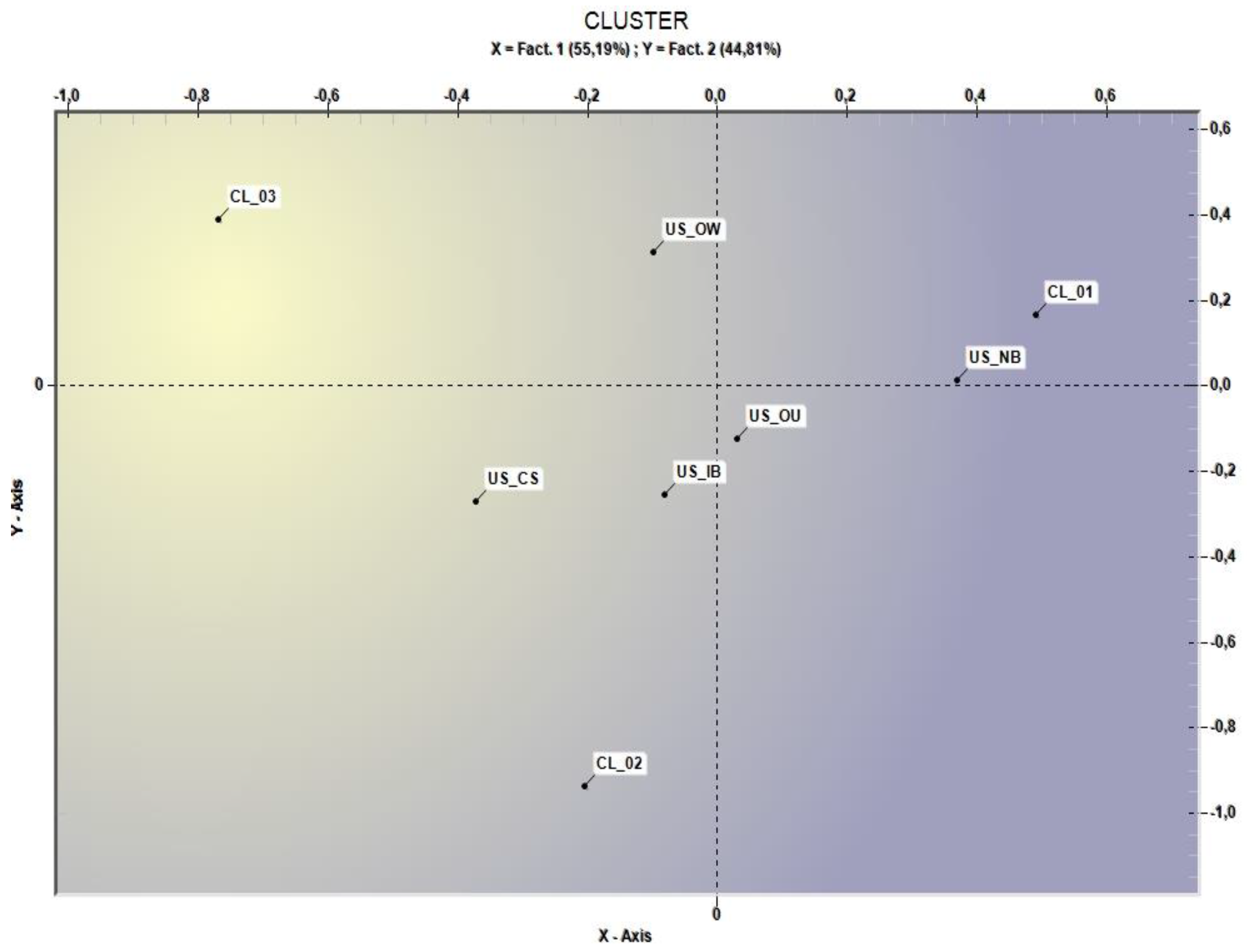
The LCA allows you to identify a very large number of factors, each of which explains a decreasing share of inertia. In the present study we interpret the first two factorial dimensions, which correspond to the most significant Symbolic Dimensions identified through the interview. As statistically independent of each other, the factors can be represented geometrically in terms of axes orthogonal to each other. Conventionally the first factor is represented by the horizontal axis, the second by the vertical axis (Figure 1). The two patterns of words making up each factor are defined by a label that identifies a specific symbolization mode opposite to another mode, identifying the other pattern.
Cluster Analysis (AC): The AC is an analysis procedure aimed at identifying groupings of context units that share a certain number of cooccurring words. In accordance with the methodology adopted, each grouping can be understood as the expression of a corresponding set of representational contents—or semantic nucleus (
Mossi and Salvatore 2011). Interpreting the clusters means identifying the thematic core shared by different representational contents conveyed by each group. We consider each semantic nucleus the expression of a specific positioning (
Harrè & Gillet 1994) within the common symbolic space defined by the Symbolic Dimensions, and therefore of a specific way of representing (of having an opinion, of connoting) the various objects of the experience on which the interviewees were invited to express themselves. From this point of view, analyzing the relationship between semantic nuclei and Symbolic Dimensions allows us to understand the socio-symbolic genesis of the representational contents expressed (Mossi and Salvatore 2012). The association between semantic nuclei and Symbolic Dimensions can be expressed in terms of a quantitative parameter that describes the level of inertia that a given discursive nucleus and a given symbolic dimension have in common: the higher the value of the parameter, the greater the significance of the Association. All analyzes were carried out with the support of a specific textual analysis software: T-LAB.
Here are three orders of results:
- -
the analysis of the symbolic field configuring the overall discursive dynamic in terms of the two main Symbolic Dimensions that characterize it;
- -
the analysis of semantic nuclei and their positioning within the symbolic field;
- -
the interpretation of the illustrative variables in light of the symbolic dimensions;
2.3. Focus Group
The Focus Group is a qualitative data collection technique based on the information that emerges from a group discussion on a topic to be investigated. “Focus” stands for “focused discussion”, that is, limited to a limited number of topics that are analyzed in depth (Stewart & Shamdasani 1990) while “group” identifies the source of information: it is not the individual but precisely, a group of individuals in interaction (Corrao 2000). The Focus Group therefore allows us to pay attention to meanings, processes and rules that emerge within the group, during the discussion on a specific topic. The organization of a focus group is divided into 5 phases: Planning, Selection and Recruitment, Group discussion, Data analysis, Return. In addition to the participants, two are the fundamental figures that make up the Focus Group: the Conductor and the Observer. The conductor clarifies the objectives of the meeting, explains the methods of participation, moderates the debate, facilitates interaction between the participants, makes sure that all participants, and not just some, express their point of view. The Observer, on the other hand, takes note of the non-verbal communication, actively participates in the data analysis and report preparation phase, welcomes the participants to whom he presents himself by describing his function, sits outside the group.
In order to activate and moderate the involvement of the participants, the Conductor has different types of questions at his disposal:
- -
The Opening Questions allow you to identify the elements in common between the participants (e.g., you are asked to introduce yourself, explain the reason for your presence, say something about yourself in relation to the topic of the meeting)
- -
The Introduction Questions allow you to introduce the subject of discussion and allow participants to reflect on personal experiences or express their point of view
- -
Transition Questions bring participants closer to the focus
- -
The Key Questions introduce the focal and most relevant aspects that are intended to be explored and deepened
- -
The final questions stimulate the participants to reflect on what has emerged and to identify the aspects discussed (e.g., we ask you to define the most important aspect that emerged during the discussion)
- -
The closing questions aim to stimulate participants to express their mood and personal opinion regarding the topic and experience.
The Conductor introduces himself, explains the purpose of the meeting, announces the possible presence for audio/video recording, illustrates the “rules” of participation and invites participants to introduce themselves. Subsequently, the conductor asks some introductory questions/stimuli urging the participants to discuss the topic under discussion in a general way. In our specific case ten different stimuli have been created, created through the recombination of previously determined sentences:
Over the past few months, the public debate on the issue of vaccinations has become increasingly heated.
For some, (3) it is the task of the institutions to take care of their citizens and prepare the conditions for their well-being.
The mandatory nature of vaccines is established precisely in this sense. Getting vaccinated is a duty that everyone is required to maintain safety and public health. It is a moral as well as a legal duty (1).
The debate on vaccines is causing confidence in institutions to falter. Instead, the relationship with close people is strengthened, with whom direct contact can be established (2). It is to those who know each other that one should seek advice (2).
It is the well-being of loved ones and one’s own that must be defended. Even violating the law can be justified if it serves to safeguard one’s family unit (4).
Institutions, pharmaceutical industries, lobbies of the powerful. What can the citizen do in the face of their overwhelming power? There is nothing we can do. Vaccines today, another thing tomorrow. All that remains is to live the day and rely on fate (5).
The underlined phrases are those that are recombined in the creation of the different stimuli. The numbers between parentheses refer to U.S. of 2.1.
The different stimuli were then made available randomly to the different participants before the start of the discussion. In a third phase, substantial in-depth questions are asked to collect information/data in relation to the purpose of the meeting. In a fourth phase, the conductor makes the return: summarizes the main contents of the discussion, offering participants the opportunity to clarify their point of view. Finally, participants are asked to make a conclusive consideration regarding the discussion.
The interventions of all participants were audio recorded and digitized in Excel folders in the form of a matrix to allow the analysis of the text with the T-Lab software (par 2.2).
2.4. Sampling
For the focus groups, 59 participants (33 women and 26 men) were selected through a sampling of convenience divided into 8 groups. At the end of the focus, the Voc questionnaire was administered. Illustrative variables used: Membership Focus (A1, A2, B1, B2, C1, C2, D1, D2), Participant Gender (SEX_D, SEX_U), Participant Age (AGE_GIO, AGE_ADU, AGE_ANZ), Participant Education (ED_BAS, ED_MED, ED_ALT), Participating Symbolic Universe (US_OU, US_CS, US_IB, US_NB, US_OW)
3. Results
3.1. T-Lab Analysis
Through the analysis of the corpus formed by the interventions of all the participants within the focus, we have identified three clusters. For each cluster, 20 characteristic words and a selection of elementary contexts in which these words are found will be reported below. A description of the results will be provided after each cluster.
The segments analyzed by T-Lab (Elementary contexts) are distributed as follows within the clusters:
CLUSTER 1: n=272 50.56%
CLUSTER 2: n=115 21.38%
CLUSTER 3: n=151 28.07%
Cluster 1 Interpretation:
Vaccination is seen as something that belongs to the family that is responsible for the decision, decision-making autonomy, the power to decide (Lemmi: we, children, family, take, children, decide, daughter, ours). The rule here has to do with decision-making power, who is responsible for making the decision to vaccinate or not vaccinate, the family’s decision with respect to a health act (Lemmi: mother, take, situation, decide).
Cluster 2 Interpretation:
The idea of the sanction occurs, (paying the fine otherwise they take away your parental authority), the regulatory constraint, therefore vaccination as a norm, the constraint (as opposed to cluster 1), something that society says to do (Lemmi: remove, pay, problem, fine).
Cluster 3 Interpretation:
The scientific/health aspect is predominant in the cluster (Lemmi: disease, flu, virus, vaccine, dying, studies, source).
3.2. Factor analysis
As previously said, the factor analysis allows us to identify the symbolic dimensions that form the semantic field and the positions of the semantic nuclei within it.
Description first dimension/first factor: From the comparative analysis of the two lists of terms and variables we can identify and name the two polarities that form the semantic dimension along which the semantic nuclei are positioned: in the negative pole of the first factor we find speaking, opinion, disease, dying, flu, viruses, history, vaccines, statistics, studies, information, scientific, while in the positive polarity we find thinking, vaccinating, we, school, children, deciding, our, case, child, situation, boy. Proceeding with the abductive construction of a scenario capable of keeping together the relationships between the internal elements at the same polarity and between the two polarities we can define the semantic dimension as a continuum that identifies vaccination as a local/systemic “fact”. In the negative pole we have a vision of vaccination as systemic, while in the positive pole vaccination has a local declination, which strictly concerns the sphere of action of the individual.
Description of second dimension/second factor: We use again a process of abductive construction of a scenario that can hold together the relationships between the lemmas within the same polarity and between the polarities: in this case the sense dimension regards the vision of the vaccination which has the characteristics of negotiability/institutional obligation. In the negative pole we find terms such as paying, effect, making a mistake, cause, problem, removing, institution, which we could refer to a scenario in which vaccination is seen as an obligation given by the institution to which it is not possible to escape, while in the positive pole we find terms like thinking, reading, speaking, vaccine, we, people, people, disease, flu, sick who can outline the vision of the vaccine as something that can be negotiated, “I do it because I need it”, it’s as if vaccination here had to do with the disease. Note that the lemmas present in the positive polarity of factor 2 are similar to those present in cluster 2 and it could not be otherwise, given the proximity between cluster 2 and the position of the US_CS within the semantic field. For the analysis, see the discussion of the results.

The graph shows the distribution that symbolic universes assume within the semiotic space. As can be seen, on the first factor there is an opposition between the (US_NB) and the Caring Society (US_CS)—the first associated with local polarity, the second with systemic polarity. Other’s World (US_OW) and Interpersonal Bond (US_IB) take antithetical positions on the second factorial axis—the first on the polarity of negotiability, the second on the polarity of the institutional obligation. The symbolic universe Ordered Universe (US_OU), on the other hand, contrary to what might have been expected, does not occupy a significant position within the semiotic space. The symbolic universes can be better understood by recalling their location on the factorial axes. The niche of belonging (US_NB) and caring society (US_CS), is consistent with the logic that organizes these symbolic universes: in the first case, since the investment in the primary network responds to the need to survive in an anomalous context, we are inevitably led to put corporal inviolability before the common good; in the second, the reliability attributed to the institutions would induce compliance with public health measures. On the other hand, the opposition between the other’s world (US_OW) and interpersonal bond (US_IB) on the second factor is also consistent with the logic with which these symbolic universes are associated: in the first case, the deep mistrust in the world, the sense of powerlessness and anomia and above all the idea that people do not count on each other and pursue selfish objectives, implies a representation of vaccination not in terms of an institutional prescription, but of a practice dictated by an individual choice; in the second, the centrality of relationships and above all the importance attributed to sharing, reciprocity and conformism, is reflected in the adherence to an institutional act, which as such represents a value in itself, which motivates the investment.
Finally, one last observation must be made regarding the ordered universe (US_OU). The immanent order which is presumed to be the basis of this symbolic universe, should be reflected in a systemic and institutional attitude towards vaccination; the fact that the ordered universe does not assume a specific positioning within the factorial space, therefore represents a fact that does not confirm our expectations.
3.3. Conclusions
The results obtained following the research proved to be in line with theoretical expectations: the positions of the US and clusters in the semantic field defined by the dimensions identified through the interpretation of the factors obtained from the textual analysis of the transcripts of the interventions within the focus groups proved compatible. We have seen how the use of ACASM and VOC motivated by the cultural background reported in CAP 1 leads to results that are psychologically relevant and usable by policy-makers for the implementation of targeted intervention strategies. Once the prerequisites of meaning that allow to experience a social phenomenon as such have been identified, it is essential to act through the subjectivity (and not despite the subjectivity) of the individuals who make up the population subject to the intervention to enhance their chances of success. In other words, the identification of the semantic field defined by the sense dimensions of the individuals who create it is a useful condition for identifying how, through culture, the actors configure a certain phenomenon.