Article

Working Memory Training Improves Cognitive and Clinical ADHD Symptoms in Children

by
Maha S. Alsaad
1,2,
Abeer F. Almarzouki
1,*,
Solafa H. Ghoneim
3,
Basma A. Al-Jabri
4,5 and
Samraa Suliman
6
1
Department of Clinical Physiology, Faculty of Medicine, King Abdualziz University, Jeddah 21589, Saudi Arabia
2
Ministry of Health, Najran 66255, Saudi Arabia
3
Department of Internal Medicine, King Faisal Specialist Hospital & Research Centre, Jeddah 23433, Saudi Arabia
4
Department of Pediatrics, Faculty of Medicine, King Abdulaziz University Hospital, Jeddah 21589, Saudi Arabia
5
Autism Center, Neuroscience Excellence Center, King Faisal Specialist Hospital and Research Center, Riyadh 12713, Saudi Arabia
6
Department of Psychiatry, Faculty of Medicine, King Abdulaziz University Hospital, Jeddah 21589, Saudi Arabia
*
Author to whom correspondence should be addressed.
Clin. Transl. Neurosci. 2025, 9(4), 55; https://doi.org/10.3390/ctn9040055 (registering DOI)
Submission received: 15 July 2025 / Revised: 3 November 2025 / Accepted: 11 November 2025 / Published: 2 December 2025
(This article belongs to the Special Issue Brain Health)

Abstract

Working memory training (WMT) has promising effects on cognitive and clinical outcomes in children with attention deficit hyperactivity disorder (ADHD). However, few studies have explored the effectiveness of such programs in developing countries with different populations and sociocultural backgrounds. This study aimed to pilot Cogmed WMT (CWMT) and examine its impact on clinical and cognitive outcomes in children diagnosed with ADHD in Saudi Arabia. We assessed 34 children with ADHD assigned to either a CWMT or standard-of-care group. Both groups were evaluated at baseline and five weeks for ADHD symptoms and cognitive function, including working memory (WM), sustained attention, and impulsivity. Compared with the baseline and the control group, the intervention group demonstrated improved parent ratings of ADHD clinical symptoms and cognitive function scores, including WM, sustained attention, and impulsivity. CWMT improved cognitive and clinical measures in our sample of Saudi children with ADHD and is a promising non-pharmacological therapy for treating children with ADHD in developing countries.

1. Introduction

Children diagnosed with ADHD demonstrate deficits in working memory (WM), the capacity to maintain and manipulate information over a short period [1], sustained attention, and motor response [2]. Deficits in these cognitive functions may account for core clinical symptoms in patients with ADHD [3]. WM deficits are detrimental to academic performance, social skills, and relationships, and may also contribute to the inattention and hyperactivity typical of ADHD [4]. Psychostimulant medications are prescribed as a first-line treatment for clinical symptoms in patients with ADHD [5], however, they have inconsistent effects on WM [6]. Non-pharmacological interventions, such as cognitive training, are also recommended for children and adolescents with ADHD [7].
Cogmed WMT (CWMT) comprises various adaptive WM tasks used to test and improve users’ memory storage capacity and manipulation abilities based on the multi-component WM model [5]. Several studies have documented improvements in overall ADHD symptoms, organizational behavior, and cognitive functions, including WM [5,8]. CWMT leads to significant cognitive gains in working memory [9], and a recent meta-analysis of CWMT studies consistently detected near-transfer effects or improvements in WM tasks structurally similar to the training task [10]. However, some studies found only short-term, limited effects on ADHD symptoms for non-training tasks [10,11]. A meta-analysis that examined the effectiveness of cognitive training for children with ADHD concluded that the training did not significantly impact children’s cognitive, behavioral, or academic abilities [12]. ADHD’s clinical symptoms are central to diagnosing ADHD [13], but cultural variation is high [14,15]. For example, parents in non-Western countries resist accepting an ADHD diagnosis and embracing pharmacological options for fear of side effects, drug dependency, and costs [16]; they prefer alternative interventions [16]. In Saudi Arabia, a study conducted by Al-Mohsin et al. (2020) reported growing concerns among mothers regarding the side effects of medication, which could potentially hinder compliance [17]. The authors also highlighted the role of clinicians in helping alleviate mothers’ fears and correcting any misconceptions that might affect ADHD management [17]. The majority of parents of children with ADHD prefer to avoid the use of medication for ADHD and have limited knowledge of and access to psychological interventions [18]. Similar concerns have been expressed by teachers [19].
Furthermore, Western countries have incorporated computerized WMT and other behavioral interventions and technologies into their treatment guidelines [20]; however, in non-Western countries, pharmacological treatment continues to be the first recommended line of treatment, despite the reluctance to use it [21]. Due to the sociocultural differences in presentation and treatment preferences between non-Western and Western countries, it is critical to evaluate non-pharmacological treatments for ADHD, including CWMT.
We previously conducted a separate feasibility study on an intervention for a group of children with ADHD but without a control group [22], which provided the practical basis for this study of CWMT for Saudi children with ADHD. In the current study, we investigated not only the clinical symptomology of ADHD (hyperactivity and inattention) but also deficits in WM, impulsivity, and sustained attention. Decreases in impulsivity or improvements in sustained attention, together with enhanced WM performance, are considered indicators of the positive effects of CWMT. Compared with children in a standard care group, we hypothesized that those in the intervention group would be able to successfully complete the CWMT and that the intervention group would demonstrate significant improvements in ADHD symptomology and cognitive performance.

2. Materials and Methods

2.1. Materials and Process

This study was conducted between November 2020 and May 2021 at a pediatric clinic in King Abdulaziz University Hospital (KAUH), Jeddah city, Saudi Arabia. Participant recruitment was carried out mainly through the referral of children diagnosed with ADHD by a pediatrician and a child psychiatric consultant as well as through electronic and personal invitations. Electronic advertisements were distributed through WhatsApp messages and emails. The participants who expressed interest were screened via phone according to the inclusion and exclusion criteria and invited to the clinic for a demonstration of the software used for the training. The inclusion criteria were selected based on previous work [23]: (a) an age of 7–15; (b) a previously confirmed diagnosis of ADHD by a healthcare professional based on the DSM-4 [13] diagnostic criteria and confirmed by the Vanderbilt ADHD Diagnostic Rating Scale (VADRS) [24]; and (c) home internet access. The exclusion criteria were severe sensory or intellectual disabilities.
The children who attended the clinic for the demonstration of Cogmed received information on it and were given the opportunity to attend a trial session in which any questions or concerns expressed by the parents were answered and any technical challenges that the parents may face when running the program at home were clarified. The researchers ensured that all children had active access to the internet. The contact details of the researchers were given, and parents were advised to contact them whenever they had any issues running the program at home. As mentioned in the Introduction, there is a low level of awareness among parents, teachers, and caregivers of children with ADHD about alternative, non-pharmacological interventions for ADHD; this may have contributed to difficulties in recruiting these patients [17,18,19]. Furthermore, since true randomization was not feasible in this study due to COVID-19 lockdown disruptions, the participants were allocated to either an intervention group or a standard treatment group using the order of sign-up; that is, interested patients were alternately assigned to the active (intervention) group or the standard treatment (control) group. Written informed consent was obtained from the parents of all the patients prior to the study. They were also provided with a verbal overview to confirm that all the details of the study were clear to them. All information about the research was provided, explaining that participation was voluntary and that all questions and concerns would be addressed. Participants were given the right to withdraw at any point during the study with no consequences.
Each study consisted of two visits: the baseline first visit and the follow-up visit at the clinic. At the first visit, the researcher obtained the medical history of each participant, as well as their demographic and socioeconomic information, assessment on the Vanderbilt Attention Deficit Hyperactivity Disorder Rating Scale (VADRS), and cognitive assessment on the CANTAB; a full demonstration of Cogmed was also conducted in a trial session. This visit lasted for about 50 min. The follow-up visit took place in the pediatric clinic after training on Cogmed, and it involved a post-training follow-up assessment on VADRS and a cognitive assessment on the Cambridge Neuropsychological Test Automated Battery (CANTAB). This visit took around 30 min for each participant.

2.2. Outcome Measures

  • The clinical outcomes were the Vanderbilt Attention Deficit Hyperactivity Disorder Rating Scale and Vanderbilt ADHD Parent Rating Scale scores.
  • The cognitive outcome was the CANTAB assessment (Cambridge Cognition, Cambridge, UK). The CANTAB is a widely used computer-based neuropsychological assessment for identifying cognitive deficits in children with ADHD [25]. It has also been previously explored in a Saudi Arabian child population [26]. The participants were assessed using three cognitive tests: the spatial WM (SWM) test for executive functions, the reaction time (RTI) test for impulsivity, and the rapid visual information processing (RVP) test for sustained attention. Impairments in the VWM and VSWM, in particular, are associated with inattentiveness and failure to filter out irrelevant stimuli [27]. Reaction times are typically faster in children with ADHD compared to those without; this reflects in difficulty in social interaction as they tend to interrupt or impulsively disrupt their surroundings [28]. Finally, the RVP test reflects decreased sustained attention ability among ADHD patients that is not easily reversed by simple coping techniques and remains the hallmark of the neurocognitive profile of the disease [29].
SWM was evaluated using the total errors made and a strategy score, with a lower strategy score indicating better executive function. The RTI was evaluated as the time taken to initiate a response, movement time (the time required to complete the response), and total errors. RVP was evaluated using the A prime (target sequence detection sensitivity), response latency (length of time between the delivery of a given stimulus and the reply to that stimulus), and probability of a hit (correct response). The average test duration was 20 min for each participant.

2.3. The Cogmed Intervention Program

The participants were asked to follow the standard CWMT protocol [23]. Cogmed comprises auditory–verbal and visual–spatial WM tasks involving the recall and processing of certain ord§ers of stimuli. Each session lasted 45 min on average, and sessions were held five days per week for five weeks. The difficulty level for each task was automatically adjusted to ensure that the participants worked consistently at the upper limit of their WM capacity. Adapting the task difficulty level to the users’ ability is considered essential for ensuring observable improvements in WM and ADHD symptoms. Positive reinforcement was provided via encouragement, verbal motivation, and objective feedback on training task performance during training [10]. The researcher contacted the parents weekly to provide feedback on the children’s training progress, answer questions or concerns, and resolve any technical difficulties.

2.4. Cogmed Parameters

The children’s compliance with the training was assessed based on the compliance index (total number of training sessions completed) and time spent on the training program. According to Klingberg et al. [8], a child was defined as compliant if they completed at least 80% of the training. The children’s performance and improvement throughout the training were assessed using the Cogmed, max, and improvement indices. The Cogmed Progress Indicator automatically computed the overall improvement index as a measure of the performance, improvement, and transfer on tasks performed by the children following the CWMT (i.e., WM tasks), their ability to follow instructions, and their mathematical skills. On training days 1, 2, 10, 15, 20, and 25, the children performed additional cognitive tasks, and feedback was recorded and provided to the children and their families. The start, max, and improvement indices were calculated for each task.

2.5. Statistical Analysis

All statistical analyses were completed using R version 4.1.1. The linear mixed modeling package lme4 was used to evaluate the effects of the intervention on cognitive task outcome measures [30], and post hoc testing was completed using the emmeans package. False discovery rate-adjusted p-values were presented to correct for multiple comparisons. We applied linear regression to assess the intervention’s impact on cognitive task performance using the main effects of time, group, and their interaction.

3. Results

3.1. Demographic, Socioeconomic, and Baseline Clinical Characteristics

A total of 48 participants completed the pre-intervention assessment, with 35 returning for the post-intervention assessment. Of these, 34 completed all cognitive testing (Table 1); the statistical analyses included only these 34 participants. The intervention group was significantly younger than the control group, and fewer members of this group attended special education. No other characteristics differed significantly.

3.2. Cogmed Indices

Participants in the intervention group had a start index (average score for the three best trials on the second and third days of training) of 60.6 (SD = 12.08) and a maximum index (average score for the three best trials during the two best days of comprehensive training) of 80.9 (SD = 20.8). This difference was statistically significant (t(19) = 5.29, p < 0.001). This indicates a difference of over 20 points across five weeks, the full designed course of CWMT, with an average of half an hour (30.3 min) per day of training (SD = 2.4).

3.3. ADHD Clinical Outcome Measures

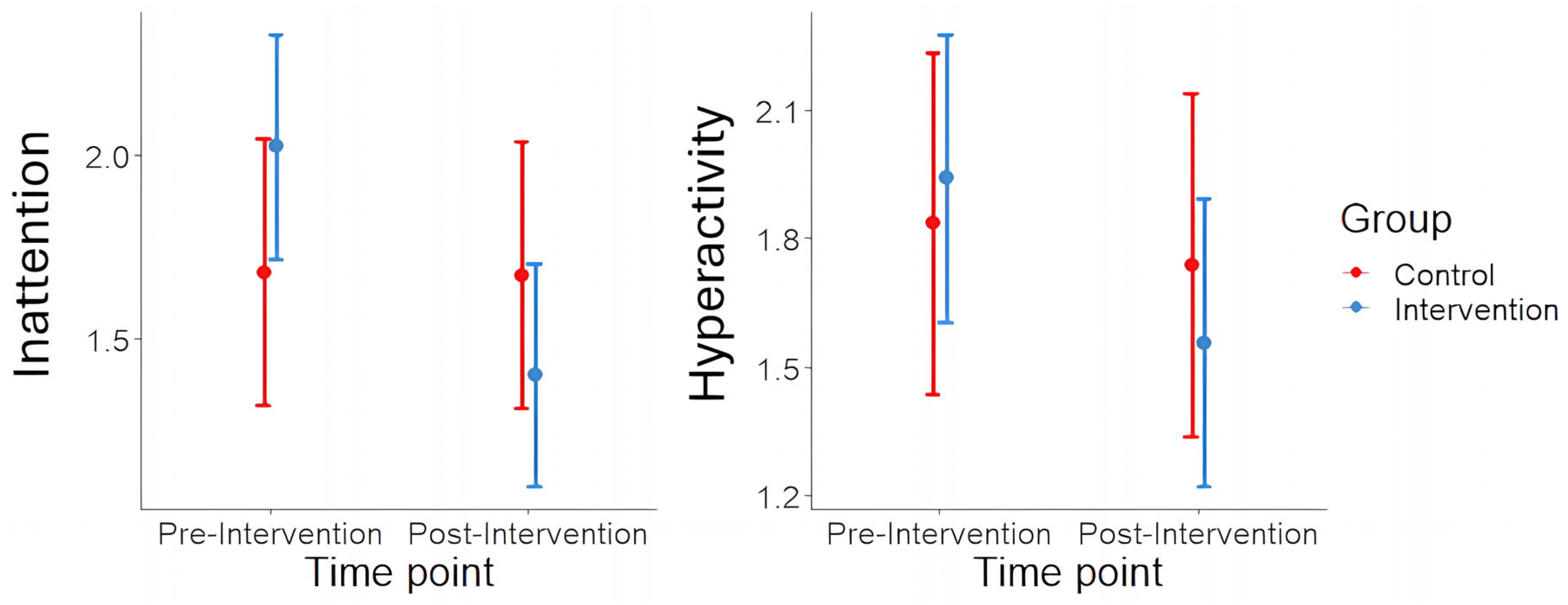
Table 2 and Figure 1 show the clinical outcomes for each group. The VADRS scores ranged from 0.51 to 2.21 and were significantly higher in the intervention group. Inattention scores were significantly lower post-intervention for the full sample (F(1,32) = 16.09, p < 0.001), alongside a significant interaction between group and time (F(1,32) = 15.29, p < 0.001); this demonstrated that the difference was larger and significant in the intervention group (t(32) = 6.17, p < 0.001) but was not significant in the control group (t(32) = 0.07, p = 0.948). Although the overall hyperactivity scores were lower post-intervention for the full sample (F(1,32) = 4.44, p = 0.043), the differences were comparable between the two groups (F(1,32) = 1.58, p = 0.217).
Overall, inattention scores showed a large post-intervention difference for the intervention group (Cohen’s d = 2.22) and a small difference for the control group (d = 0.22). This pattern was similar for the hyperactivity scores, with a moderate post-intervention difference for the intervention group (d = 0.45) and a small difference for the control group (d = 0.19).

3.4. Cognitive Outcome Measures

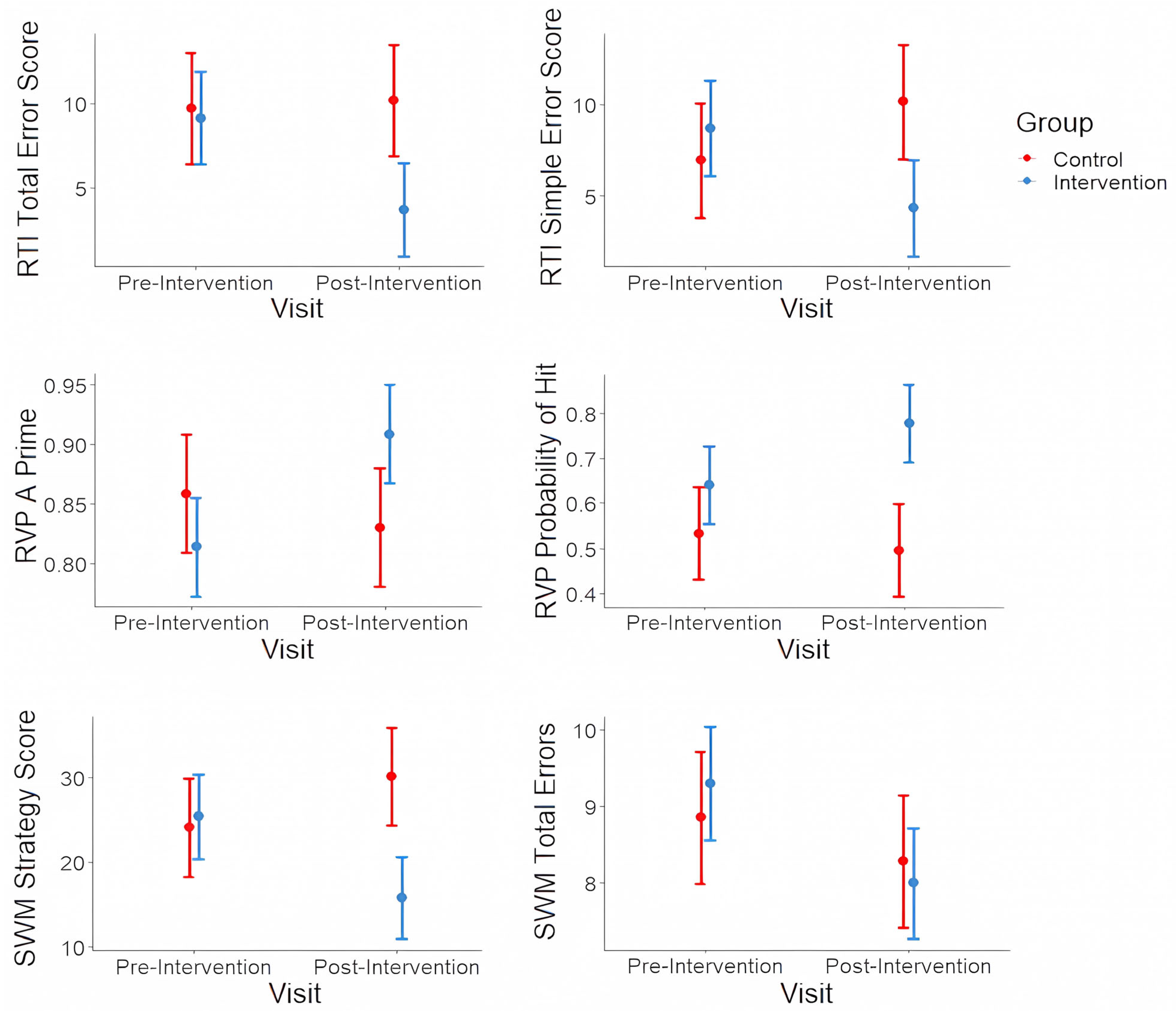
Cognitive functioning was assessed using the SWM strategy scores (for trials with six to eight boxes in the task) and total errors (for trials with four to eight boxes or all trials). Impulsivity was captured using the RTI movement time, reaction time, and error score (total and simple). Sustained attention was captured using the RVP measures: A prime, response latency, and hit probability (Table 3 and Figure 2).
Table 4 shows the post-intervention differences for each group in each task. Relative to the control group, post-intervention SWM errors were significantly fewer for the intervention group during the six-box and all-box trials. Post hoc testing showed that post-intervention errors were significantly fewer for the intervention group in all-box trials, but not for the control group. The same interaction was observed in the RTI error scores, with a significant difference for the intervention group but not the control group. Finally, this interaction was also significant for the RVP target sensitivity, which was significantly better post-intervention in the intervention group but not the control group. The other SWM, RTI, and RVP measures did not change significantly over time. All findings are detailed in Table 4.
For the cognitive measures that showed significant changes over time, effect sizes were more moderate than they were for changes in inattention scores; these measures included SWM total errors in all boxes (Cohen’s d = 1.04), SWM total errors in six boxes (d = 1.09), the RTI error score (d = 1.39), and RVP A prime (d = 1.12).

3.5. Associations of Clinical and Demographic Characteristics with ADHD Clinical Outcomes Following Intervention

Male participants had significantly higher VADRS and hyperactivity scores (all results outlined in Table 5). The ADHD subtype was significantly related to the VADRS, inattention, and hyperactivity scores, with the hyperactive subtype showing the highest hyperactivity scores and the combined subtype showing the highest VADRS and inattention scores. Children with oppositional defiant disorder (ODD) showed significantly higher VADRS scores than did those without. Finally, those that received medical care and those with learning disorders showed significantly higher hyperactivity scores.

3.6. Associations of Clinical and Demographic Characteristics with ADHD Cognitive Outcomes Following Intervention

Regarding the post-intervention cognitive task performance, children with learning disabilities (LDs) performed worse than those without LDs (Table 6). They made relatively more errors during the RTI task (based on simple error scores), had a lower target sensitivity (A prime) and a lower probability to hit during the RVP task, and made more errors during the SWM task (total errors for trials with six or eight boxes overall). Additionally, the children in special education programs made significantly fewer errors during the RTI task. Finally, the children that received clinical care made more errors during the SWM task (total errors for trials with four or eight boxes overall). Age was not significantly associated with cognitive performance despite a mean difference of 1.5 years between the groups.

3.7. Associations of ADHD Clinical Outcomes (Inattention and Hyperactivity) with Cognitive Outcomes: Spatial Working Memory (SWM), Reaction Time (RTI), and Rapid Visual Information Processing (RVP)

All outcome measures from each task were tested for association with the participants’ inattentiveness and hyperactivity scores while controlling for group (intervention vs. control) and time point (pre- vs. post-intervention) as covariates. FDR-adjusted p-values were calculated to control for multiple comparisons across measures within each task. Neither inattentiveness nor hyperactivity significantly affected the outcome measures in any of the three tasks.

3.8. Sensitivity and Power Analyses

The intervention group was significantly younger than the control group, by 1.5 years (Table 1), and so we tested whether this impacted changes over time in any scores. Age was not a significant predictor of either the inattention or hyperactivity score, and including age as a covariate did not impact the significance of the reported changes over time between the groups. The same was true for changes over time in cognitive scores.
Given the small sample size, we tested the robustness of the reported significant effects using a power analysis. The significant change in inattention scores for the intervention group (effect size d = 2.22) at a two-tailed significance threshold of α = 0.05 for a three-term linear regression model (group, time, and their interaction) indicated a power of 0.99. Cognitive changes over time showed smaller effect sizes (ranging from d = 0.104 to 1.39) and lower power (0.47 to 0.74) and would benefit from replication in a larger sample.

4. Discussion

Building on our previous work [22], this study aimed to examine the efficacy of CWMT for Saudi children with ADHD as a model for use in developing countries. The intervention group improved significantly more than the control group on the parent rating scale for ADHD clinical symptoms. Moreover, we found significant effects on WM, impulsivity, and sustained attention measures. These findings provide preliminary evidence of improvements in clinical and cognitive symptoms, although they must be confirmed in larger, randomized controlled trials.
We observed reductions in inattention and hyperactivity scores from parent ratings in both groups but more so in the CWMT group by the end of the training program, suggesting a potential CWMT treatment effect. This finding aligns with increasing evidence that CWMT significantly affects WM and attention [31,32]. Concerning hyperactivity, the intervention and control groups did not differ significantly in the group interaction regarding time; the small number of patients might explain the lack of significant improvement in hyperactivity.
The participants’ initial WMT scores indicated marked impairment of WM relative to normative training scores in adolescents aged 7–17 [6]. Regarding errors, only the intervention group showed significant improvement. Interestingly, Lui and Tannock (2007) [33] found that children’s SWM performance significantly predicted their parents’ ratings of their inattention. The present study supports this finding, with a significant decrease in inattention, based on the parents’ ratings, observed only in children who received the training. The RTI is another cognitive outcome measure that reflects impulsivity. Only the intervention group showed significant improvement regarding response errors, and improving response control could benefit children with ADHD [34].
The intervention group also significantly improved in detecting target sequences during the RVP task post-intervention, whereas the control group showed a non-significant decline. Slow processing speeds in individuals with ADHD are associated with poor WM and reading ability [35]. Basic functions, such as processing speed, are central to impaired cognitive functions in ADHD [35]. Therefore, improvements in processing speed, as observed in this study following the CWMT, can greatly ease the daily burden on individuals with ADHD. Interestingly, neither of the tasks mentioned above resembled CWMT tasks, suggesting an intriguing signal of potential generalization [31,36] that must be confirmed in larger, randomized controlled trials.
The specific mechanisms by which CWMT intervention is beneficial for improving inattention/hyperactivity symptoms in ADHD patients remain unknown. However, it has been postulated that cognitive-based training could improve the symptoms of ADHD by strengthening important neural connections, resulting in overall functional improvement [37,38]. These changes can be introduced through the adaptation of the brain to salient experiences that are dependent on the quality of perceptual processing [36]. The latter can be ensured by focusing on underlying brain processes rather than on the impaired higher-level functions. For a more in-depth discussion on the mechanism underlying the improvement of ADHD symptoms through working memory training, one can refer to Alsaad et al. 2021 [39].

4.1. Associations of Clinical and Demographic Characteristics with ADHD Clinical Outcomes

In this study, post-intervention, the male children, children with the combined subtype (inattention and hyperactivity), and children with ODD had the highest scores for the parent-rated severity of ADHD symptoms. Additionally, the children that received clinical medical care and those with LDs were rated significantly higher for hyperactivity. The control group was about 1.5 years older than the intervention group; however, age was not associated with performance before or after the CWMT. While this study did not assess long-term academic performance, given the feasibility of CWMT demonstrated here, future studies might analyze their findings for CWMT regarding academic performance in schools.

4.2. Associations of Clinical and Demographic Characteristics with Cognitive Outcomes

The children with LDs performed worse in terms of the WM tasks, impulsivity, and sustained attention than those without LDs. This finding aligns with previous research indicating that children with ADHD and LDs have worse EF impairments than patients with ADHD alone [40]. Therefore, children with comorbid LDs might require prolonged training to achieve significant improvements, while specific types of LDs could be important mediators of training effects [41]. The children in special education programs performed significantly better on the impulsivity measures. This finding supports the assumption that inclusive special education improves academic performance, social functioning, and behavioral outcomes [42]. CWMT might enhance special education’s beneficial effects on these domains in children with ADHD.
Finally, the children that received clinical medical care made more errors during the SWM task (total errors for trials with four or eight boxes overall). Although this finding was somewhat surprising, the medicated patients (n = 9) in this study represented a minority of the enrolled sample (n = 34). The impact of medications on the CWMT’s effectiveness might have also contributed to this observation. For example, a recent study on CWMT for children with the ADHD-C subtype and comorbidities receiving pharmacological treatment found that CWMT did not result in WM gains [43].

4.3. Associations of ADHD Clinical Outcomes with Cognitive Outcomes

Interestingly, the improvements in cognitive and clinical measures in this study were non- correlational, and there may be barriers to real-world implementation. The heterogeneity among ADHD patients regarding EF tasks suggests that ADHD and EF deficits, including those in WM, are behaviorally separable, thus supporting the hypothesis that they may be divisible at the neurobiological level [44]. A recent fMRI study tested the relationship between ADHD and WM deficits. The study examined adults with ADHD who had impaired or unimpaired SWM and compared them with healthy controls. The study showed that while being scanned, those with ADHD and impaired SWM performed worse on the n-back task than those with ADHD and unimpaired SWM and healthy controls.The participants with ADHD and impaired SWM showed hypoactivation in the inferior frontal junction, precuneus, lingual gyrus, and cerebellum as a function of WMC. By contrast, the participants with ADHD and unimpaired SWM and the healthy controls showed hyperactivation in the same regions of the brain [44]. These findings support the hypothesis that ADHD and EF impairment are dissociable both behaviorally and neurobiologically. The well-documented diversity of ADHD patients can account for the contradictory conclusions regarding WM performance and brain activation [44]. These findings vary according to the percentage of ADHD patients with impaired or unimpaired WM represented in any given sample. This remains a viable area for further investigation.
Other challenges to real-world implementation include differences in contextual factors, such as training aids and the training environment, which might influence CWMT. Children diagnosed with ADHD are also diverse in terms of their ADHD subtypes, comorbidities, and medications, which could moderate the training effects of CWMT. Future studies should consider all these factors to determine their effects on CWMT.

5. Limitations of This Study

Although this study provided preliminary evidence for CWMT’s effectiveness for children diagnosed with ADHD in developing countries, the results must be interpreted with caution due to the small and unbalanced sample and the age discrepancy between the two groups.
The grouping of participants based on their order of sign-up for the study introduced selection bias. The demographic and clinical characteristics were not allocated randomly to the two groups; hence, the validity of the results may have been impacted by factors that are not necessarily related to those produced by the intervention.
In addition, due to the lack of a double-blind design, the participants in both groups were aware of which group they were in, and expectancy effects could not be ruled out. This might have occurred if parents in the intervention group positively expected the training to improve their children’s symptoms and behaviors.
Additionally, practice effects remain a limitation [45]. Moreover, the differences observed between the groups, if due to the intervention, may not last beyond the end of treatment. The lack of a long-term follow-up in our study prevents confirmation of this possibility.

6. Conclusions

Considering that research on non-pharmacological interventions for ADHD patients in developing countries remains in its infancy, this study provides important insights into the effectiveness of cognitive-based interventions. Despite its limitations, the improvements in WM in our study resemble those in randomized, double-blind, placebo-controlled studies [11]. However, more studies are required to address and replicate the promising evidence of the benefits of computerized WMT programs, such as Cogmed. Randomized and blinded controlled trials are needed in the future to investigate the effects of CWMT in comparison and in addition to other interventions (including but not limited to pharmacological interventions and different types of cognitive training) and to examine the long-term effects of CWMT on cognitive and adaptive functioning. Future researchers may expand these insights by exploring the mechanisms by which CWMT improves ADHD symptoms and documenting potential benefits regarding grades or other real-world outcomes.

Author Contributions

M.S.A.: Conceptualization, Funding acquisition, Investigation, Methodology, Project administration, Resources, Validation, Visualization, Writing—review and editing; A.F.A.: Conceptualization, Formal analysis, Funding acquisition, Investigation, Methodology, Project administration, Resources, Supervision, Validation, Visualization, Writing—review and editing; S.H.G.: Investigation, Resources, Writing—review and editing; B.A.A.-J.: Investigation, Project administration, Resources, Supervision, Writing—review and editing; S.S.: Investigation, Project administration, Resources, Writing—review and editing. All authors have read and agreed to the published version of the manuscript.

Funding

This project was funded by the deanship of scientific Research (DSR) at King Abdualziz University, Jeddah, Saudi Arabia, under grant no. (IPP:1452-140-2025). The authors therefore acknowledge DSR with thanks for their technical and financial support.

Institutional Review Board Statement

Ethical approval was obtained from The Unit of Biomedical Ethics Research Committee at King Abdulaziz University Hospital (KAUH). The approval number was 388–19.

Informed Consent Statement

Written informed consent was obtained from all participants involved in this study.

Data Availability Statement

The original contributions presented in this study are included in the article material. Further inquiries can be directed to the corresponding author.

Conflicts of Interest

The authors declare no conflicts of interest.

References

  1. Coghill, D.R.; Seth, S.; Matthews, K. A comprehensive assessment of memory, delay aversion, timing, inhibition, decision making and variability in attention deficit hyperactivity disorder: Advancing beyond the three-pathway models. Psychol. Med. 2014, 44, 1989–2001. [Google Scholar] [CrossRef] [PubMed]
  2. Mueller, A.; Hong, D.S.; Shepard, S.; Moore, T. Linking ADHD to the neural circuitry of attention. Trends Cogn. Sci. 2017, 21, 474–488. [Google Scholar] [CrossRef] [PubMed]
  3. Song, Y. Chapter 8—Cognitive function in attention deficit hyperactivity disorder. In ADHD: New Directions in Diagnosis and Treatment; Jill, M.N., Ed.; IntechOpen: London, UK, 2015. [Google Scholar]
  4. Kofler, M.J.; Harmon, S.L.; Aduen, P.A.; Day, T.N.; Austin, K.E.; Spiegel, J.A.; Irwin, L.; Sarver, D.E. Neurocognitive and behavioral predictors of social problems in ADHD: A Bayesian framework. Neuropsychology 2018, 32, 344–355. [Google Scholar] [CrossRef] [PubMed]
  5. Veloso, A.; Vicente, S.G.; Filipe, M.G. Effectiveness of cognitive training for school-aged children and adolescents with attention deficit/hyperactivity disorder: A systematic review. Front. Psychol. 2020, 10, 2983. [Google Scholar] [CrossRef]
  6. Stevens, M.C.; Gaynor, A.; Bessette, K.L.; Pearlson, G.D. A preliminary study of the effects of working memory training on brain function. Brain Imaging Behav. 2016, 10, 387–407. [Google Scholar] [CrossRef]
  7. Feldman, M.E.; Charach, A.; Bélanger, S.A. ADHD in children and youth: Part 2-treatment. Paediatr. Child Health 2018, 23, 462–472. [Google Scholar] [CrossRef]
  8. Klingberg, T.; Fernell, E.; Olesen, P.J.; Johnson, M.; Gustafsson, P.; Dahlström, K.; Gillberg, C.G.; Forssberg, H.; Westerberg, H. Computerized training of working memory in children with ADHD-A randomized, controlled trial. J. Am. Acad. Child Adolesc. Psychiatry 2005, 44, 177–186. [Google Scholar] [CrossRef]
  9. Holmes, J.; Gathercole, S.E.; Place, M.; Dunning, D.L.; Hilton, K.A.; Elliott, J.G. Working memory deficits can be overcome: Impacts of training and medication on working memory in children with ADHD. Appl. Cogn. Psychol. 2009, 24, 827–836. [Google Scholar] [CrossRef]
  10. Aksayli, N.D.; Sala, G.; Gobet, F. The cognitive and academic benefits of Cogmed: A meta-analysis. Educ. Res. Rev. 2019, 27, 229–243. [Google Scholar] [CrossRef]
  11. Cortese, S.; Ferrin, M.; Brandeis, D.; Buitelaar, J.; Daley, D.; Dittmann, R.W.; Holtmann, M.; Santosh, P.; Stevenson, J.; Stringaris, A.; et al. Cognitive training for attention-deficit/hyperactivity disorder: Meta-analysis of clinical and neuropsychological outcomes from randomized controlled trials. J. Am. Acad. Child Adolesc. Psychiatry 2015, 54, 164–174. [Google Scholar] [CrossRef]
  12. Rapport, M.D.; Orban, S.A.; Kofler, M.J.; Friedman, L.M. Do programs designed to train working memory, other executive functions, and attention benefit children with ADHD? A meta-analytic review of cognitive, academic, and behavioral outcomes. Clin. Psychol. Rev. 2013, 33, 1237–1252. [Google Scholar] [CrossRef]
  13. American Psychiatric Association. Diagnostic and Statistical Manual of Mental Disorders; American Psychiatric Association: Washington, DC, USA, 1980. [Google Scholar]
  14. MacDonald, B.; Pennington, B.F.; Willcutt, E.G.; Dmitrieva, J.; Samuelsson, S.; Byrne, B.; Olson, R.K. Cross-country differences in parental reporting of symptoms of ADHD. J. Cross-Cult. Psychol. 2019, 50, 806–824. [Google Scholar] [CrossRef]
  15. Widding-Havneraas, T.; Markussen, S.; Elwert, F.; Lyhmann, I.; Bjelland, I.; Halmøy, A.; Chaulagain, A.; Ystrom, E.; Mykletun, A.; Zachrisson, H.D. Geographical variation in ADHD: Do diagnoses reflect symptom levels? Eur. Child Adolesc. Psychiatry 2023, 32, 1795–1803. [Google Scholar] [CrossRef]
  16. Smith, M. Hyperactive around the world? The history of ADHD in global perspective. Soc. Hist. Med. 2017, 30, 767–787. [Google Scholar] [CrossRef]
  17. Al-Mohsin, Z.J.; Al-Saffar, H.A.; Al-Shehri, S.Z.; Shafey, M.M. Saudi mothers’ perception of their children with attention-deficit hyperactivity disorder in Dammam, Al-Qatif, and Al-Khobar cities, Saudi Arabia. J. Fam. Community Med. 2020, 27, 46. [Google Scholar] [CrossRef] [PubMed]
  18. Alharbi, R. Attention Deficit Hyperactivity Disorder (ADHD) Discourses in Saudi Arabia. Master’s Thesis, University of Ottawa, Ottawa, ON, Canada, 2018. [Google Scholar]
  19. Munshi, A.M.A. Knowledge and misperceptions towards diagnosis and management of attention deficit hyperactivity disorder (ADHD) among primary school and kindergarten female teachers in Al-Rusaifah district, Makkah city, Saudi Arabia. Intern. J. Med. Sci. Public Health 2014, 3, 444–451. [Google Scholar] [CrossRef]
  20. National Institute for Health and Care Excellence. Attention Deficit Hyperactivity Disorder: Diagnosis and Management; National Institute for Health and Care Excellence: London, UK, 2018; Available online: https://www.nice.org.uk/guidance/ng87 (accessed on 1 June 2021).
  21. Bashiri, F.A.; Albatti, T.H.; Hamad, M.H.; Al-Joudi, H.F.; Daghash, H.F.; Al-Salehi, S.M.; Varnham, J.L.; Alhaidar, F.; Almodayfer, O.; Alhossein, A.; et al. Adapting evidence-based clinical practice guidelines for people with attention deficit hyperactivity disorder in Saudi Arabia: Process and outputs of a national initiative. Child Adolesc. Psychiatry Ment. Health 2021, 15, 6. [Google Scholar] [CrossRef] [PubMed]
  22. Almarzouki, A.F.; Bellato, A.; Al-Saad, M.S.; Al-Jabri, B. COGMED working memory training in children with Attention Deficit/Hyperactivity Disorder (ADHD): A feasibility study in Saudi Arabia. Appl. Neuropsychol. Child 2022, 12, 202–213. [Google Scholar] [CrossRef]
  23. Chacko, A.; Bedard, A.C.; Marks, D.J.; Feirsen, N.; Uderman, J.Z.; Chimiklis, A.; Rajwan, E.; Cornwell, M.; Anderson, L.; Zwilling, A.; et al. A randomized clinical trial of Cogmed Working Memory Training in school-age children with ADHD: A replication in a diverse sample using a control condition. J. Child Psychol. Psychiatry Allied Discip. 2014, 55, 247–255. [Google Scholar] [CrossRef]
  24. Wolraich, M.L.; Hagan, J.F., Jr.; Allan, C.; Chan, E.; Davison, D.; Earls, M.; Evans, S.W.; Flinn, S.K.; Froehlich, T.; Frost, J.; et al. Clinical practice guideline for the diagnosis, evaluation, and treatment of attention-deficit/hyperactivity disorder in children and adolescents. Pediatrics 2019, 144, e20192528. [Google Scholar] [CrossRef]
  25. Fried, R.; DiSalvo, M.; Kelberman, C.; Biederman, J. Can the CANTAB identify adults with attention-deficit/hyperactivity disorder? A controlled study. Appl. Neuropsychol. Adult 2021, 28, 318–327. [Google Scholar] [CrossRef] [PubMed]
  26. Bashir, S.; Al Backer, N.; Alharbi, K.A.; Alfahadi, A.; Habib, S.S. Assessment of the Cambridge Neuropsychological Test Automated Battery test in Saudi children with learning disabilities: A case-control study. In Proceedings of the 3rd International Conference on Educational Neuroscience, Abu Dhabi, United Arab Emirates, 11–12 March 2018; Available online: https://f1000research.com/articles/7-323/v1 (accessed on 1 June 2021).
  27. de Lima Ferreira, T.; Brites, C.; Azoni, C.A.S.; Ciasca, S.M. Evaluation of working memory in children with attention deficit/hyperactivity disorder. Psychology 2015, 6, 1581. [Google Scholar] [CrossRef]
  28. Korolczuk, I.; Burle, B.; Casini, L.; Gerc, K.; Lustyk, D.; Senderecka, M.; Coull, J.T. Leveraging time for better impulse control: Longer intervals help ADHD children inhibit impulsive responses. PLoS ONE 2025, 20, e0319621. [Google Scholar] [CrossRef] [PubMed]
  29. Somogyi, S.; Kilencz, T.; Szőcs, K.; Klein, I.; Balogh, L.; Molnár, R.; Bálint, S.; Pulay, A.J.; Nemoda, Z.; Baradits, M.; et al. Differential neurocognitive profiles in adult attention-deficit/hyperactivity disorder subtypes revealed by the Cambridge Neuropsychological Test Automated Battery. Eur. Arch. Psychiatry Clin. Neurosci. 2023, 274, 1741–1758. [Google Scholar] [CrossRef] [PubMed]
  30. Bates, D.; Maechler, M.; Bolker, B.; Walker, S.; Christensen, R.H.B.; Singmann, H.; Dai, B.; Scheipl, F.; Grothendieck, G.; Green, P.; et al. Package “lme4”: Linear Mixed-Effects Models Using S4 Classes R Package Version. 2011. Available online: https://cran.r-project.org/web/packages/lme4/lme4.pdf (accessed on 1 June 2021).
  31. Bigorra, A.; Garolera, M.; Guijarro, S.; Hervas, A. Impact of working memory training on hot executive functions (decision-making and theory of mind) in children with ADHD: A randomized controlled trial. Neuropsychiatry 2016, 6, 251–263. [Google Scholar] [CrossRef]
  32. Capodieci, A.; Re, A.M.; Fracca, A.; Borella, E.; Carretti, B. The efficacy of a training that combines activities on working memory and metacognition: Transfer and maintenance effects in children with ADHD and typical development. J. Clin. Exp. Neuropsychol. 2019, 41, 1074–1087. [Google Scholar] [CrossRef]
  33. Lui, M.; Tannock, R. Working memory and inattentive behaviour in a community sample of children. Behav. Brain Funct. 2007, 3, 12. [Google Scholar] [CrossRef]
  34. Waschbusch, D.A. A meta-analytic examination of comorbid hyperactive-impulsive-attention problems and conduct problems. Psychol. Bull. 2002, 128, 118–150. [Google Scholar] [CrossRef]
  35. Mohamed, S.M.H.; Butzbach, M.; Fuermaier, A.B.M.; Weisbrod, M.; Aschenbrenner, S.; Tucha, L.; Tucha, O. Basic and complex cognitive functions in Adult ADHD. PLoS ONE 2021, 16, e0256228. [Google Scholar] [CrossRef]
  36. Van der Donk, M.; Hiemstra-Beernink, A.-C.; Tjeenk-Kalff, A.; van der Leij, A.; Lindauer, R. Cognitive training for children with ADHD: A randomized controlled trial of cogmed working memory training and ‘paying attention in class’. Front. Psychol. 2015, 6, 1081. [Google Scholar] [CrossRef]
  37. Klingberg, T. Training and plasticity of working memory. Trends Cogn. Sci. 2010, 14, 317–324. [Google Scholar] [CrossRef]
  38. Vinogradov, S.; Fisher, M.; de Villers-Sidani, E. Cognitive Training for Impaired Neural Systems in Neuropsychiatric Illness. Neuropsychopharmacology 2012, 37, 43–76. [Google Scholar] [CrossRef] [PubMed]
  39. Al-Saad, M.S.H.; Al-Jabri, B.; Almarzouki, A.F. A Review of Working Memory Training in the Management of Attention Deficit Hyperactivity Disorder. Front. Behav. Neurosci. 2021, 15, 686873. [Google Scholar] [CrossRef] [PubMed] [PubMed Central]
  40. Huang, F.; Sun, L.; Qian, Y.; Liu, L.; Ma, Q.G.; Yang, L.; Cheng, J.; Cao, Q.J.; Su, Y.; Gao, Q.; et al. Cognitive function of children and adolescents with attention deficit hyperactivity disorder and learning difficulties: A developmental perspective. Chin. Med. J. 2016, 129, 1922–1928. [Google Scholar] [CrossRef] [PubMed]
  41. Overbeek, G.J.; van der Donk, M. Cognitive training for children with ADHD. Individual differences in training and transfer gains. Kind en Adolesc. 2016, 37, 256–257. [Google Scholar] [CrossRef]
  42. Kim, M.; King, M.D.; Jennings, J. ADHD remission, inclusive special education, and socioeconomic disparities. SSM—Popul. Health 2019, 8, 100420. [Google Scholar] [CrossRef]
  43. Dentz, A.; Guay, M.C.; Parent, V.; Romo, L. Working memory training for adults with ADHD. J. Atten. Disord. 2020, 24, 918–927. [Google Scholar] [CrossRef]
  44. Mattfeld, A.T.; Whitfield-Gabrieli, S.; Biederman, J.; Spencer, T.; Brown, A.; Fried, R.; Gabrieli, J.D. Dissociation of working memory impairments and attention-deficit/hyperactivity disorder in the brain. NeuroImage Clin. 2016, 10, 274–282. [Google Scholar] [CrossRef]
  45. Gau, S.S.F.; Shang, C.Y. Improvement of executive functions in boys with attention deficit hyperactivity disorder: An open-label follow-up study with once-daily atomoxetine. Int. J. Neuropsychopharmacol. 2010, 13, 243–256. [Google Scholar] [CrossRef]
Figure 1. Inattention and hyperactivity scores pre- and post-intervention for each group.
Ctn 09 00055 g001
Figure 2. Cognitive performance for each group (control vs. intervention) at baseline (pre-intervention) and 5 weeks post-intervention for outcomes on which significant cognitive performance differences were observed. RTI: reaction time; RVP: rapid visual information processing; SWM: spatial working memory.
Ctn 09 00055 g002
Table 1. Clinical and demographic characteristics of the study participants overall and by group, with significant differences between the groups denoted by asterisks (*, p < 0.05).
Full SampleControlInterventionGroup Difference
Pre-intervention Sample (No.)471433
Post-intervention Sample (No.)341420
Age (Mean, SD)9.1 (2.1)10.0 (2.0)8.5 (2.0)t(28) = 2.14, p = 0.041 *
Sex (No., %)
 Male21 (62%)8 (57%)15 (75%)χ2 = 1.19, p = 0.273
 Female13 (38%)6 (43%)5 (25%)
ADHD Subtype (No., %)
 Inattention9 (26%)5 (36%)4 (20%)χ2 = 3.26, p = 0.195
 Hyperactivity/Impulsivity9 (26%)5 (36%)4 (20%)
 Combined16 (47%)4 (29%)12 (60%)
Clinical Care (No., %)
 None14 (41%)8 (57%)8 (40%)χ2 = 3.78, p = 0.286
 Medical9 (26%)2 (14%)7 (35%)
 Behavioral10 (29%)6 (43%)4 (20%)
 Combined1 (3%)0 (0%)1 (5%)
Co-occurring Conditions (No., %)
 ODD10 (29%)1 (7%)9 (45%)χ2 = 7.43, p = 0.059
 CD4 (12%)1 (7%)3 (15%)
 Anxiety/Depression6 (18%)1 (7%)5 (25%)
 Learning Disabilities22 (65%)12 (86%)10 (50%)
Education (No., %)
 Regular Education23 (68%)13 (93%)10 (50%)χ2 = 6.91, p = 0.008 *
 Special Education11 (32%)1 (7%)10 (50%)
Parental Education (No., %)
 High School Diploma6 (18%)2 (14%)4 (20%)χ2 = 0.79, p = 0.671
 Bachelor’s Degree/Diploma24 (71%)11 (79%)13 (65%)
 Master’s Degree/PhD4 (12%)1 (7%)3 (15%)
Parental Occupation (No., %)
 Employed24 (71%)8 (57%)16 (80%)χ2 = 3.72, p = 0.155
 Unemployed9 (26%)6 (43%)3 (15%)
 Student1 (3%)0 (0%)1 (5%)
Note: ODD—oppositional defiant disorder; CD—conduct disorder.
Table 2. ADHD evaluation scores for the study participants overall and by group. The partial effects of the between-group differences at each time point are shown after controlling for the effect of time (pre-/post-intervention). Significance is denoted by an asterisk (*, p < 0.05).
Full SampleControlInterventionGroup Difference
VADRS (Mean, SD)1.1 (0.4)1.0 (0.4)1.3 (0.4)F(1,32) = 5.86, p = 0.021 *
Inattention (Mean, SD)
 Pre-intervention1.9 (0.7)1.7 (0.8)2.0 (0.5)F(1,32) = 2.29, p = 0.140
 Post-intervention1.5 (0.7)1.7 (0.9)1.4 (0.6)F(1,32) = 1.19, p = 0.284
Hyperactivity (Mean, SD)
 Pre-intervention1.9 (0.8)1.8 (0.9)1.9 (0.7)F(1,32) = 0.15, p = 0.698
 Post-intervention1.6 (0.7)1.7 (0.9)1.6 (0.6)F(1,32) = 0.52, p = 0.476
Note: VADRS—Vanderbilt Attention Deficit Hyperactivity Disorder Rating Scale.
Table 3. Cognitive task scores (means and standard deviations) before and after the intervention.
Pre-InterventionPost-Intervention
TaskMeasureControlInterventionControlIntervention
SWMStrategy score (six to eight boxes)8.9 (2.1)9.3 (1.3)8.3 (1.0)8.0 (1.8)
Total errors (all boxes)24.1 (10.9)25.4 (6.7)30.1 (12.9)15.8 (12.5)
Total errors (six boxes)6.9 (3.5)7.5 (2.6)10.4 (5.7)5.0 (4.0)
Total errors (eight boxes)15.1 (7.4)15.3 (4.5)17.2 (9.5)8.9 (7.8)
RTIMean movement time360.7 (136.4)424.6 (63.0)368.5 (331.2)378.5 (242.2)
Mean reaction time641.9 (184.4)729.8 (247.8)515.1 (186.3)593.1 (229.7)
Total error score (five choices)9.7 (6.1)9.2 (7.6)10.2 (4.4)3.7 (5.7)
Simple error score (all)6.9 (4.1)8.7 (7.3)10.1 (3.9)4.3 (6.5)
RVPA prime0.9 (0.1)0.8 (0.1)0.8 (0.1)0.9 (0.1)
Mean response latency536.3 (118.6)664.6 (178.6)515.1 (86.5)517.3 (244.7)
Probability of hit0.5 (0.2)0.6 (0.2)0.5 (0.1)0.8 (0.2)
Note: SWM—spatial working memory; RTI—reaction time; RVP—rapid visual information processing.
Table 4. Interactions between group and time (pre-/post-intervention) and, if significant, the pre-/post-intervention post hoc test within each group. Significance is denoted by an asterisk (*, p < 0.05).
TaskMeasureIntervention Effect
SWMStrategy score (six to eight boxes)Group-by-time interaction: F(1,32) = 1.27, p = 0.448
Total errors (all boxes)Group-by-time interaction: F(1,63) = 8.42, p = 0.039 *
Intervention group: t(63) = −2.75, p = 0.039 *
Control group: t(63) = 1.47, p = 0.337
Total errors (six boxes)Group-by-time interaction: F(1,63) = 9.38, p = 0.039 *
Intervention group: t(63) = −2.01, p = 0.125
Control group: t(63) = 2.31, p = 0.080
Total errors (eight boxes)Group-by-time interaction: F(1,63) = 5.37, p = 0.080
RTIMean movement timeGroup-by-time interaction: F(1,32) = 1.49, p = 0.231
Mean reaction timeGroup-by-time interaction: F(1,32) = 0.01, p = 0.911
Total error score (five choices)Group-by-time interaction: F(1,32) = 6.88, p = 0.078
Simple error score (all)Group-by-time interaction: F(1,32) = 14.96, p = 0.010 *
Intervention group: t(32) = −3.48, p = 0.010 *
Control group: t(32) = 2.13, p = 0.176
RVPA primeGroup-by-time interaction: F(1,32) = 9.71, p = 0.025 *
Intervention group: t(32) = 3.73, p = 0.019 *
Control group: t(32) = −0.94, p = 0.420
Mean response latencyGroup-by-time interaction: F(1,32) = 2.27, p = 0.225
Probability of hitGroup-by-time interaction: F(1,32) = 4.50, p = 0.100
Note: SWM—spatial working memory; RTI—reaction time; RVP—rapid visual information processing.
Table 5. Associations of clinical and demographic characteristics with ADHD clinical outcomes following the intervention (*, p < 0.05).
MeasureTermMeanSESignificance
VADRSSex F(1,19) = 12.02, p = 0.003 *
 Female1.260.17
 Male1.420.21
ADHD Subtype F(2,19) = 0.77, p = 0.001 *
 Combined1.480.14
 Hyperactive1.310.24
 Inattentive1.230.23
ODD F(1,19) = 8.31, p = 0.010 *
 No1.180.21
 Yes1.490.19
InattentionADHD Subtype F(2,19) = 5.94, p = 0.010 *
 Combined1.310.33
 Hyperactive0.380.56
 Inattentive1.200.53
HyperactivitySex F(1,19) = 6.15, p = 0.023 *
 Female0.900.29
 Male1.230.35
ADHD Subtype F(2,19) = 12.12, p < 0.001 *
 Combined1.420.24
 Hyperactive1.810.40
 Inattentive−0.040.38
Medical Clinical Care F(1,19) = 7.55, p = 0.013 *
 No0.850.24
 Yes1.270.37
Learning Disability F(1,19) = 17.26, p = 0.001 *
 No0.640.32
 Yes1.480.30
Note: VADRS—Vanderbilt Attention Deficit Hyperactivity Disorder Rating Scale; ODD—oppositional defiant disorder.
Table 6. Associations of clinical and demographic characteristics with cognitive outcomes by group post-intervention, with significance denoted by an asterisk (*, p < 0.05).
TaskMeasureTermMeanSESignificance
SWMTotal errorsMedical clinical care F(1, 20) = 9.96, p = 0.015 *
 No10.975.59
 Yes26.308.13
Learning disability F(1, 20) = 19.54, p < 0.001 *
 No7.087.20
 Yes30.186.71
Total errors (four boxes)Medical clinical care F(1, 20) = 8.73, p = 0.016 *
 No0.431.04
 Yes2.571.51
Total errors (six boxes)Learning disability F(1, 20) = 6.90, p = 0.032 *
 No2.853.35
 Yes9.563.11
Total errors (eight boxes)Medical clinical care F(1, 20) = 10.04, p = 0.015 *
 No6.203.45
 Yes15.645.01
Learning disability F(1, 20) = 23.00, p < 0.001 *
 No3.334.44
 Yes18.524.13
RTISimple error score (all)Learning disability F(1, 20) = 14.20, p = 0.006 *
 No3.802.91
 Yes12.212.71
Simple error score (all)Education type F(1, 20) = 8.57, p = 0.048 *
 Regular10.673.31
 Special5.352.35
RVPA primeLearning disability F(1, 20) = 9.51, p = 0.024 *
 No0.990.07
 Yes0.850.06
Probability of hitLearning disability F(1, 20) = 7.27, p = 0.028 *
 No0.830.15
 Yes0.560.14
Note: SWM—spatial working memory; RTI—reaction time; RVP—rapid visual information processing.
Disclaimer/Publisher’s Note: The statements, opinions and data contained in all publications are solely those of the individual author(s) and contributor(s) and not of MDPI and/or the editor(s). MDPI and/or the editor(s) disclaim responsibility for any injury to people or property resulting from any ideas, methods, instructions or products referred to in the content.