1. Introduction
Late-stage cancellation of elective surgery after patient admission is associated with inefficient operating room utilization, patient and family distress, prolonged fasting, and disruption of coordinated perioperative care [
1,
2,
3]. Many same-day cancellations are considered preventable and arise from incomplete preoperative assessment, documentation gaps, or failures in coordination rather than from unavoidable acute deterioration [
1,
2,
3,
4]. Structured checklist-based approaches have therefore been adopted across surgical practice to reduce omissions and improve team communication [
5,
6,
7,
8,
9,
10].
Functional neurosurgery is particularly vulnerable to preoperative process failure because these procedures depend on alignment between clinical selection, imaging review, anticoagulation management, infection screening, anesthesia clearance, hardware availability, and technical support [
11,
12,
13,
14,
15,
16,
17,
18,
19,
20,
21,
22,
23,
24,
25,
26]. Elective procedures such as deep brain stimulation (DBS), focused ultrasound (FUS), vagus nerve stimulation (VNS), intrathecal pump procedures, and neuromodulation for pain require coordinated preparation across surgeons, trainees, anesthesiologists, nurses, and device personnel. In this setting, late-stage cancellation may occur when a relevant issue is identified only after admission, including active infection, unresolved anticoagulant exposure, missing equipment, or systemic medical instability [
1,
2,
3,
12,
18,
19,
20,
21,
22].
Although checklist principles are well established in surgery, there is limited published literature describing a specialty-specific preoperative cognitive scaffold tailored to recurrent readiness failures in functional neurosurgery. Existing neurosurgical checklist literature supports the value of structured workflow in specialized operative environments, while DBS-specific and neuromodulation literature emphasize the importance of careful perioperative governance given the risks of infection, hemorrhage, device-related failure, and logistical complexity. We therefore developed the ABCDE framework as a five-domain structure for preoperative case review. The present study had two aims: first, to describe the framework and its implementation as a reproducible workflow model; and second, to evaluate its association with late-stage surgical cancellations after patient admission in a single-center before-and-after service evaluation.
2. Methods
2.1. Study Design and Setting
We conducted a retrospective single-center before-and-after study in the functional neurosurgery unit of Sheba Medical Center, a tertiary academic referral center. All consecutive functional neurosurgical procedures scheduled between 1 January 2020, and 31 December 2025, were reviewed. The ABCDE framework was introduced into unit workflow in 2023, allowing comparison between a pre-implementation period (2020–2022) and a post-implementation period (2023–2025).
2.2. Included Procedures
The study included procedures routinely performed within the functional neurosurgery service: DBS, VNS, FUS, intrathecal pump implantation and replacement, implantable pulse generator replacement, and pain procedures including spinal cord stimulation, peripheral nerve stimulation, and palliative neuromodulation interventions. These procedures were analyzed together because they share a preoperative pathway characterized by multidisciplinary planning, device dependence, and susceptibility to cancellation from missed clinical or logistical details.
2.3. Development of the ABCDE Framework
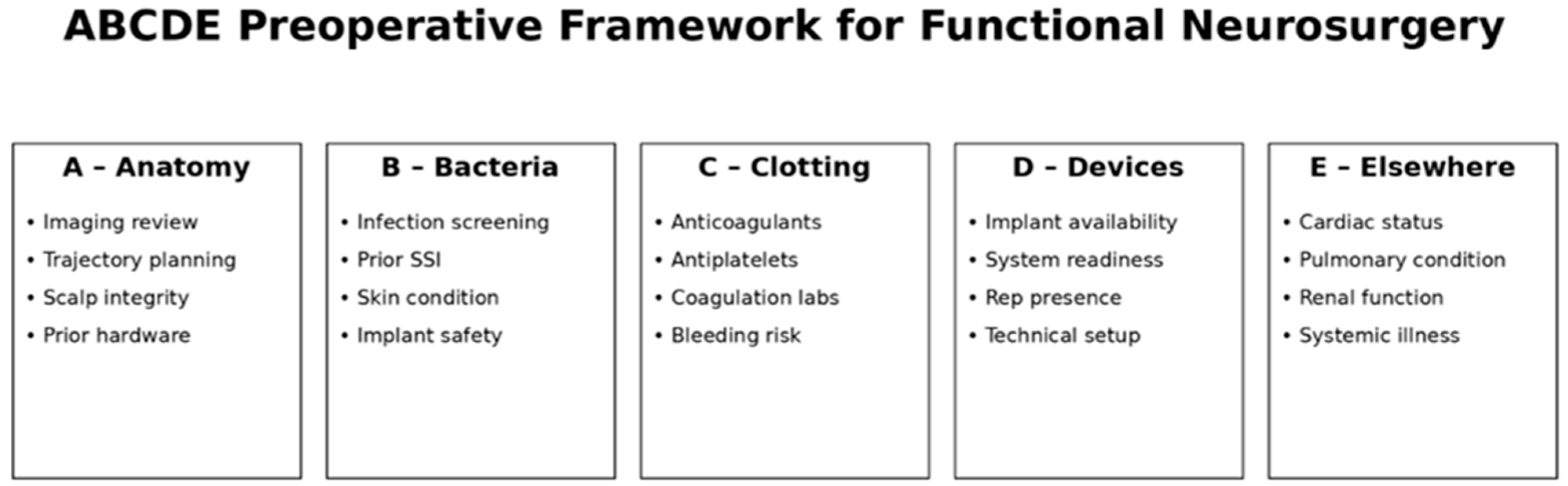
The ABCDE framework was developed locally within the functional neurosurgery unit to standardize preoperative review of recurrent procedure-readiness issues. The framework organizes case review into five domains: Anatomy, Bacteria, Clotting, Devices, and Elsewhere. Its content was based on unit-level functional neurosurgery practice and on established perioperative principles regarding infection prevention, anticoagulation management, surgical safety checklists, and neurosurgical workflow [
5,
6,
7,
8,
9,
10,
12,
20,
21,
22,
23,
24,
25,
26].
The five domains were defined as follows:
A—Anatomy: review of relevant imaging, target anatomy, operative side and trajectory when applicable, incision site considerations, prior cranial or implanted hardware, and anatomical factors relevant to the planned procedure.
B—Bacteria: assessment for active systemic infection, skin or scalp infection, wound issues, prior implant-related infection, or other infectious concerns relevant to incision or implantation.
C—Clotting: review of antiplatelet and anticoagulant exposure, known bleeding disorders, coagulation studies when indicated, and perioperative medication interruption or bridging plans.
D—Devices: confirmation that all required hardware, accessories, programming systems, imaging support, technical support, and industry or equipment personnel were available for the scheduled procedure.
E—Elsewhere: assessment of non-neurosurgical medical issues that could make the planned procedure unsafe on the scheduled day, including cardiopulmonary instability, acute systemic illness, or other active medical deterioration (
Figure 1).
2.4. Pre-Implementation Workflow
During the pre-implementation period, preoperative checks were performed according to routine unit practice. Cases were reviewed by the treating surgical team, anesthesia evaluation was obtained according to institutional practice, and coordination with nursing staff and device personnel was performed as needed. No formal domain-based checklist or standardized ABCDE documentation template was used during this period.
2.5. Post-Implementation Workflow
During the post-implementation period, the ABCDE framework functioned as a structured preoperative review and documentation template rather than as a mnemonic alone. Each elective functional neurosurgical case was intended to undergo ABCDE-based review by the assigned resident or fellow during preoperative list review, typically 24–72 h before the scheduled procedure, with repeat review on the day before surgery when clinically indicated. The review was discussed with the attending functional neurosurgeon as part of routine case preparation.
The framework was incorporated into the existing workflow without creating a separate administrative pathway. Residents and fellows used the five domains to verify imaging and anatomical considerations, infection status, antiplatelet or anticoagulant exposure, device and equipment readiness, and relevant systemic medical issues. Positive findings in any domain triggered targeted follow-up before the planned operative day, including repeat patient or family contact, medication reconciliation, laboratory review, wound or scalp assessment, anesthesiology reassessment, device representative coordination, or equipment confirmation as appropriate.
The framework was expected to be applied to all elective functional neurosurgical cases during the post-implementation period. However, formal case-level adherence auditing was not prospectively performed. Therefore, the present study evaluates unit-level implementation of the ABCDE workflow rather than individual-case checklist fidelity.
2.6. Cancellation Workflow and Outcome Definition
The primary endpoint was late-stage surgical cancellation, defined as cancellation of the planned procedure after hospital admission and initiation of same-day operative preparation. Cases postponed or rescheduled before admission were not counted as late-stage cancellations. For each cancellation, the primary reason was assigned on the basis of operative scheduling records and treating team documentation. When more than one contributing issue was present, the dominant immediate reason leading to cancellation was recorded.
The decision to cancel a case was made by the attending functional neurosurgeon, in consultation with the relevant perioperative stakeholders when needed, including anesthesiology, nursing staff, internal medicine consultants, or device personnel. The documented reason for cancellation was extracted from the operative scheduling system, medical record, and available unit-level cancellation logs.
2.7. Data Collection
For each calendar year, total scheduled case volume and total late-stage cancellations were recorded. For each canceled case, the following were extracted when available: procedure type, date, documented cancellation reason, timing of identification, and assignment to an ABCDE domain. Because the dataset was designed around the operational outcome of late-stage cancellation, detailed patient-level covariates were not consistently available for adjusted multivariable modeling across the full study period.
2.8. Cancellation Reason Coding and Completeness
Cancellation reasons were coded at two levels. First, when a source-level narrative was available, the immediate documented reason for cancellation was recorded, such as aspirin exposure, apixaban exposure, scalp infection, equipment unavailability, or acute cardiopulmonary instability. Second, each cancellation was assigned to the most relevant ABCDE domain. When more than one contributing factor was present, the dominant immediate reason leading to cancellation was used.
For some events, particularly during 2020 and 2023, detailed source-level narratives were not recoverable from the current retrospective dataset. These events were retained in the primary cancellation-rate analysis because the occurrence and timing of cancellation were verifiable. However, they were labeled as having incomplete source-level attribution. Domain-level interpretation was therefore considered descriptive and exploratory rather than definitive.
2.9. Implementation Resources
Implementation required a brief orientation of residents, fellows, and attending functional neurosurgeons to the five ABCDE domains and their intended use during routine preoperative review. The framework was incorporated into existing case preparation, handover, and preoperative list review processes. No additional equipment, personnel, or dedicated budget was required. The estimated added review time was approximately 5–10 min per case, depending on case complexity and whether follow-up actions were triggered.
2.10. Statistical Analysis
Cancellation rates were calculated as the proportion of scheduled procedures that were canceled after admission and initiation of operative preparation. The primary comparison was between the pre-implementation period (2020–2022) and the post-implementation period (2023–2025). For this comparison, a two-sided Fisher’s exact test was applied to a 2 × 2 contingency table comparing cancellation versus non-cancellation by implementation period. Specifically, the primary test compared 16 cancellations and 391 non-cancellations among 407 pre-implementation procedures with 5 cancellations and 455 non-cancellations among 460 post-implementation procedures. Fisher’s exact test was chosen because of the low number of cancellation events. Results are reported as counts, percentages, absolute risk difference, relative risk, and 95% confidence intervals.
Because 2020 coincided with pandemic-era health-system disruption, an additional sensitivity analysis compared 2021–2022 with 2023–2025 using the same approach. This analysis was considered supportive rather than definitive because exclusion of 2020 further reduced the number of events. No multivariable model was performed because the total number of cancellation events was small and patient-level covariates were not consistently available across the full study period. Statistical significance was defined as a two-sided p value < 0.05.
3. Results
3.1. Cohort
A total of 867 functional neurosurgical procedures were scheduled during the six-year study period. Annual case volume increased from 105 procedures in 2020 to 163 procedures in 2025. Across the full cohort, 21 late-stage cancellations occurred after admission and initiation of operative preparation.
3.2. Case Mix by Implementation Period
The cohort included a heterogeneous functional neurosurgical case mix, including DBS, FUS, VNS, intrathecal pump procedures, implantable pulse generator replacement, and pain-related neuromodulation procedures. Broad procedural categories by implementation period are summarized in
Table 1. The study was not powered to compare cancellation rates within individual procedure subgroups, and subgroup analyses were therefore considered descriptive only.
3.3. Implementation
The ABCDE framework was introduced into routine unit workflow in 2023. The framework was incorporated into the preexisting preoperative review pathway through structured case review and documentation by the treating team.
3.4. Case-Level Cancellation Causes
A case-level summary of all late-stage cancellations is provided in
Table 2. Source-level narrative attribution was complete for 11 of 21 cancellations and incomplete for 10 of 21 cancellations. Incomplete source-level attribution was present in 8 of 16 pre-implementation cancellations and 2 of 5 post-implementation cancellations. These cases were retained in the primary rate analysis because the occurrence and timing of cancellation were verifiable, but they were labeled as having incomplete source-level detail. Among cancellations with available source-level narratives, pre-implementation events included aspirin exposure, apixaban exposure, a missed hemophilia diagnosis, scalp surgical-site infection, equipment unavailability, technician unavailability, and systemic cardiopulmonary instability. Post-implementation events with available source-level narratives included aspirin administration despite the perioperative plan and occult coagulation abnormalities not detected on routine screening. No late-stage cancellation in the analyzed cohort was primarily attributed to an anatomy or imaging issue. Therefore, domain-level patterns should be interpreted as descriptive rather than as definitive evidence that any specific domain was responsible for the observed before-and-after difference.
Table 2 Distribution of cancellation causes. A case-level summary of all late-stage cancellations is presented in
Table 2. In the pre-implementation period, individually documented cancellations included aspirin exposure, apixaban exposure, a missed hemophilia diagnosis, scalp surgical-site infection, missing equipment, equipment technician unavailability, and systemic medical instability related to cardiac and pulmonary conditions. In the post-implementation period, individually documented cancellations included aspirin administration by family despite the perioperative plan and two occult coagulation abnormalities not detected on routine blood testing. The specific source-level narratives for eight cancellations in 2020 and two cancellations in 2023 were not recoverable from the current retrospective dataset. These events were retained for cancellation-rate analysis but treated cautiously in domain level.
Source-level narrative unavailable indicates that the cancellation event and timing were verifiable, but the detailed immediate reason was not recoverable from the current retrospective source files. These cases were included in the primary cancellation-rate analysis but were treated cautiously in domain-level interpretation.
3.5. Annual Cancellation Rates
In 2020, 8 of 105 scheduled procedures were canceled after admission (7.6%). In 2021, 2 of 149 scheduled procedures were canceled (1.3%). In 2022, 6 of 153 scheduled procedures were canceled (3.9%). After implementation of the ABCDE framework, 2 of 145 procedures were canceled in 2023 (1.4%), 1 of 152 in 2024 (0.7%), and 2 of 163 in 2025 (1.2%) (
Table 3).
Table 1 Annual procedural volume and late-stage cancellation rates in the functional neurosurgery unit between 2020 and 2025. Cancellation rate is defined as the proportion of scheduled procedures that were canceled after patient admission and entry into the operative preparation pathway.
3.6. Primary Before-and-After Analysis
In the pre-implementation period, 16 of 407 scheduled procedures were canceled after admission, yielding a late-stage cancellation rate of 3.9% (95% CI, 2.4% to 6.3%). In the post-implementation period, 5 of 460 scheduled procedures were canceled, yielding a rate of 1.1% (95% CI, 0.5% to 2.5%). The corresponding non-cancellation counts were 391 of 407 in the pre-implementation period and 455 of 460 in the post-implementation period. Thus, the primary Fisher’s exact test compared a 2 × 2 table of cancellation status by implementation period: 16 cancellations and 391 non-cancellations before implementation versus 5 cancellations and 455 non-cancellations after implementation. This corresponded to an absolute risk difference of −2.8 percentage points (95% CI, −5.2 to −0.8) and a relative risk of 0.28 (95% CI, 0.10 to 0.75). The difference was statistically significant using a two-sided Fisher’s exact test (
p = 0.0074) (
Table 4).
Table 4 Comparison of late-stage surgical cancellations before and after implementation of the ABCDE framework. Cancellation rates are presented as proportions of total scheduled procedures. Statistical comparison was performed using Fisher’s exact test due to low event counts.
3.7. Sensitivity Analysis Excluding 2020
Because 2020 coincided with pandemic-era disruption, a sensitivity analysis was performed excluding that year. In 2021–2022, 8 of 302 scheduled procedures were canceled after admission, compared with 5 of 460 procedures in 2023–2025. The corresponding non-cancellation counts were 294 and 455, respectively. Cancellation rates were 2.6% and 1.1%. The absolute risk difference was −1.6% (95% CI, −4.1 to 0.3), and the relative risk was 0.41 (95% CI, 0.14 to 1.24). The direction of effect remained similar to the primary analysis, but the difference was not statistically significant using a two-sided Fisher’s exact test (p = 0.1505).
4. Discussion
In this single-center before-and-after study, implementation of the ABCDE framework was associated with a lower rate of late-stage surgical cancellation after patient admission in a functional neurosurgery service. The primary analysis showed a statistically significant reduction in cancellation rates, while the sensitivity analysis excluding 2020 remained directionally similar but was not statistically significant. These findings suggest that structured preoperative review may improve reliability of perioperative preparation, but they should be interpreted cautiously because the study was observational, the number of events was small, and the study period overlapped with pandemic-era disruption, post-pandemic service stabilization, and possible secular changes in staffing, scheduling, and documentation.
The main practical contribution of the framework is standardization of preoperative review in a setting where procedure readiness depends on multiple parallel domains: imaging, infection status, anticoagulation management, device logistics, and systemic medical condition [
12,
13,
14,
15,
16,
17,
18,
19,
20,
21,
22,
23,
24,
25,
26,
27]. Late-stage cancellations in this cohort were concentrated in domains that are potentially detectable before admission, particularly clotting, infection, device readiness, and non-neurosurgical medical instability. This pattern is consistent with the broader literature on surgical cancellations, in which preventable failures often arise from incomplete assessment or coordination rather than from unexpected intraoperative events [
1,
2,
3].
The present results also align conceptually with literature supporting structured surgical safety processes. The ABCDE framework differs from intraoperative safety checklists in that it is applied earlier in the pathway, during preoperative readiness assessment. It is best understood as a specialty-specific workflow structure rather than as a substitute for the operating-room time-out, attending judgment, or multidisciplinary perioperative decision-making.
Although the framework was used by residents and fellows during case preparation, the present study did not include a formal educational evaluation. Therefore, any educational benefit should be considered plausible but unproven. Its main demonstrated contribution in this dataset is operational: providing a repeatable structure for reviewing common sources of late-stage cancellation, including medication exposure, infection, device readiness, and systemic medical instability.
Clotting-related problems remained the most frequent residual source of cancellation even after implementation. This finding is clinically plausible given the complexity of perioperative antiplatelet and anticoagulant management and the limitations of routine laboratory screening for some bleeding risks [
23,
24,
25]. It also suggests that future iterations of the framework may benefit from more explicit medication reconciliation steps, repeated patient and family counseling, and predefined escalation pathways for suspected bleeding disorders.
No late-stage cancellation in this cohort was primarily attributed to the Anatomy domain. This does not necessarily imply that anatomical review is unimportant in functional neurosurgery. Rather, it indicates that, within the present cancellation endpoint, anatomical or imaging concerns were either resolved earlier in the pathway, did not lead to post-admission cancellation, or were not captured as dominant cancellation reasons in the available dataset. Anatomy was retained in the framework because target verification, laterality, trajectory planning, prior hardware, incision considerations, and imaging adequacy are central to procedural readiness in DBS, lesioning, FUS, and neuromodulation procedures. The present study, however, cannot estimate the independent contribution of the Anatomy domain to the observed reduction in cancellations.
The study should be interpreted in light of its scope. The endpoint was intentionally operational: cancellation after admission and initiation of operative preparation. This endpoint is meaningful to patients, staff, and hospital workflow, and it is more directly related to preoperative capture than postoperative outcomes such as infection or hemorrhage. Although it is biologically plausible that improved preoperative governance could influence downstream complications, the present dataset was not designed to support that conclusion and should not be used to infer a direct effect on postoperative morbidity.
5. Limitations
This study has several limitations. First, it is a retrospective single-center before-and-after study, and causal inference is therefore limited. The observed reduction in cancellations may have been influenced by secular changes in staffing, scheduling practices, documentation quality, perioperative coordination, or post-pandemic service stabilization rather than by the ABCDE framework alone. Second, the primary comparison included 2020, a year affected by pandemic-era health-system disruption. Although the sensitivity analysis excluding 2020 showed a similar direction of effect, it did not reach statistical significance. This finding supports a cautious interpretation: the primary analysis is encouraging, but the data remain compatible with residual confounding and limited statistical power. Third, the total number of late-stage cancellations was small. Only 21 cancellation events occurred across 867 scheduled procedures, limiting the precision of effect estimates and preventing reliable procedure-specific or domain-specific subgroup analysis. Confidence intervals were therefore included to emphasize statistical uncertainty. Fourth, the cohort included heterogeneous functional neurosurgical procedures, including DBS, FUS, VNS, intrathecal pump procedures, implantable pulse generator replacement, and pain-related neuromodulation procedures. These procedures differ in complexity, device dependence, anesthesia requirements, and cancellation risk. Broad case-mix summaries were provided, but the study was not powered to determine whether the framework had differential effects across procedure types. Fifth, detailed source-level cancellation narratives were incomplete for 10 of 21 events. These events were retained in the primary rate analysis because the occurrence and timing of cancellation were verifiable, but domain-level interpretation is limited. The distribution of ABCDE domains should therefore be viewed as descriptive rather than definitive. Sixth, patient-level covariates were not consistently available across the full study period. The analysis could not adjust for revision status, anticoagulation burden, comorbidity, disease severity, anesthesia risk, procedure urgency, or evolving surgical practices. Finally, formal adherence to the ABCDE framework was not prospectively audited at the individual-case level. Future studies should incorporate prospective checklist completion tracking, procedure-specific denominators, patient-level covariates, and multicenter validation.
6. Conclusions
The ABCDE framework is a structured preoperative workflow model for functional neurosurgery organized around five domains: Anatomy, Bacteria, Clotting, Devices, and Elsewhere. In this single-center before-and-after study, its implementation was associated with fewer late-stage surgical cancellations after patient admission. Because the study was observational, included a small number of events, and overlapped with pandemic-era and post-pandemic workflow changes, the findings should be interpreted cautiously and not as proof of causality. The framework may offer a practical method for standardizing preoperative review in complex functional neurosurgical workflows. Prospective studies should evaluate adherence, educational value, procedure-specific performance, and portability across centers.
Author Contributions
Conceptualization, S.Z.S. and L.U.; methodology, S.Z.S., P.K., Z.R.C. and L.U.; data curation, S.Z.S., P.K., J.A. and O.C.; formal analysis, S.Z.S.; investigation, S.Z.S., P.K., J.A., O.C., Z.R.C. and L.U.; writing—original draft preparation, S.Z.S.; writing—review and editing, all authors; supervision, Z.R.C. and L.U. All authors have read and agreed to the published version of the manuscript.
Funding
This research received no external funding.
Institutional Review Board Statement
The study was conducted in accordance with the Declaration of Helsinki and approved by the Institutional Review Board/Ethics Committee of Sheba Medical Center protocol code SMC 8148-21 and date of approval 9 December 2025.
Informed Consent Statement
Patient consent was waived due to the retrospective observational design of the study, the use of routinely collected clinical and operational data, and the analysis of de-identified data with minimal risk to participants.
Data Availability Statement
The datasets generated and analyzed during the current study are not publicly available due to institutional privacy regulations and restrictions related to clinical operative records, but may be available from the corresponding author upon reasonable request and subject to institutional approval.
Conflicts of Interest
The authors declare no conflicts of interest.
References
- Schofield, W.N.; Sage, M.D.; Pascoe, E.M.; Lai, Y.Y.; Sindhusake, D.; Fearnside, M.R.; Klineberg, P.L. Cancellation of operations on the day of intended surgery at a major Australian referral hospital. Med. J. Aust. 2005, 182, 612–615. [Google Scholar] [CrossRef] [PubMed]
- Abate, S.M.; Limenih, M.A.; Abate, K.H. Global prevalence and determinants of preoperative surgical case cancellation: A systematic review and meta-analysis. Int. J. Surg. Open 2020, 26, 203–212. [Google Scholar] [CrossRef] [PubMed]
- Koushan, M.; Wood, L.C.; Greatbanks, R. Evaluating factors associated with the cancellation and delay of elective surgical procedures: A systematic review. Int. J. Qual. Health Care 2021, 33, mzab092. [Google Scholar] [CrossRef] [PubMed]
- Reason, J. Human error: Models and management. BMJ 2000, 320, 768–770. [Google Scholar] [CrossRef] [PubMed]
- World Health Organization. WHO Guidelines for Safe Surgery 2009: Safe Surgery Saves Lives; WHO: Geneva, Switzerland, 2009. [Google Scholar]
- Haynes, A.B.; Weiser, T.G.; Berry, W.R.; Lipsitz, S.R.; Breizat, A.-H.S.; Dellinger, E.P.; Herbosa, T.; Joseph, S.; Kibatala, P.L.; Lapitan, M.C.M.; et al. A surgical safety checklist to reduce morbidity and mortality in a global population. N. Engl. J. Med. 2009, 360, 491–499. [Google Scholar] [CrossRef] [PubMed]
- De Vries, E.N.; Prins, H.A.; Crolla, R.M.; Outer, A.J.D.; van Andel, G.; van Helden, S.H.; Schlack, W.S.; van Putten, M.A.; Gouma, D.J.; Dijkgraaf, M.G.; et al. Effect of a comprehensive surgical safety system on patient outcomes. N. Engl. J. Med. 2010, 363, 1928–1937. [Google Scholar] [CrossRef] [PubMed]
- Haugen, A.S.; Søfteland, E.; Almeland, S.K.; Sevdalis, N.; Vonen, B.; Eide, G.E.; Nortvedt, M.W.; Harthug, S. Effect of the World Health Organization checklist on patient outcomes: A stepped wedge cluster randomized trial. Ann. Surg. 2015, 261, 821–828. [Google Scholar] [CrossRef] [PubMed]
- Bergs, J.; Hellings, J.; Cleemput, I.; Zurel, Ö.; De Troyer, V.; Van Hiel, M.; Demeere, J.; Claeys, D.; Vandijck, D. Systematic review and meta-analysis of the effect of the World Health Organization surgical safety checklist on postoperative complications. Br. J. Surg. 2014, 101, 150–158. [Google Scholar] [CrossRef] [PubMed]
- Urbach, D.R.; Govindarajan, A.; Saskin, R.; Wilton, A.S.; Baxter, N.N. Introduction of surgical safety checklists in Ontario, Canada. N. Engl. J. Med. 2014, 370, 1029–1038. [Google Scholar] [CrossRef] [PubMed]
- von Elm, E.; Altman, D.G.; Egger, M.; Pocock, S.J.; Gøtzsche, P.C.; Vandenbroucke, J.P. The Strengthening the Reporting of Observational Studies in Epidemiology (STROBE) Statement: Guidelines for Reporting Observational Studies. Ann. Intern. Med. 2007, 147, 573–577. [Google Scholar] [CrossRef] [PubMed]
- Zuckerman, S.L.; Green, C.S.; Carr, K.R.; Dewan, M.C.; Morone, P.J.; Mocco, J. Neurosurgical checklists: A review. Neurosurg. Focus 2012, 33, E2. [Google Scholar] [CrossRef] [PubMed]
- Rasiah, N.P.; Maheshwary, R.; Kwon, C.-S.; Bloomstein, J.D.; Girgis, F. Complications of Deep Brain Stimulation for Parkinson Disease and Relationship between Micro-electrode tracks and hemorrhage: Systematic Review and Meta-Analysis. World Neurosurg. 2023, 171, e8–e23. [Google Scholar] [CrossRef] [PubMed]
- Kantzanou, M.N.; Zommorodi, S.; Edwards, J.; Murnion, B. Surgical site infections in DBS: Meta-analysis. Neuromodulation 2021, 24, 197–211. [Google Scholar] [CrossRef] [PubMed]
- Elias, W.J.; Lipsman, N.; Ondo, W.G.; Ghanouni, P.; Kim, Y.G.; Lee, W.; Schwartz, M.; Hynynen, K.; Lozano, A.M.; Shah, B.B.; et al. A Randomized Trial of Focused Ultrasound Thalamotomy for Essential Tremor. N. Engl. J. Med. 2016, 375, 730–739. [Google Scholar] [CrossRef] [PubMed]
- Morris, G.L., 3rd; Gloss, D.; Buchhalter, J.; Mack, K.J.; Nickels, K.; Harden, C. Evidence-based guideline update: Vagus nerve stimulation for the treatment of epilepsy. Neurology 2013, 81, 1453–1459. [Google Scholar] [CrossRef] [PubMed]
- Shanthanna, H.; Eldabe, S.; Provenzano, D.A.; Bouche, B.; Buchser, E.; Chadwick, R.; Doshi, T.L.; Duarte, R.; Hunt, C.; Huygen, F.J.P.M.; et al. Evidence-based consensus guidelines on patient selection and trial stimulation for spinal cord stimulation therapy for chronic non-cancer pain. Reg. Anesth. Pain Med. 2023, 48, 273–287. [Google Scholar] [CrossRef] [PubMed]
- Wang, X.; Li, N.; Li, J.; Kou, H.; Wang, J.; Jing, J.; Su, M.; Li, Y.; Qu, L.; Wang, X. Optimized Deep Brain Stimulation Surgery to Avoid Vascular Damage: A Single-Center Retrospective Analysis of Path Planning for Various Deep Targets by MRI Image Fusion. Brain Sci. 2022, 12, 967. [Google Scholar] [CrossRef] [PubMed]
- Karamon, K.S.; Sobstyl, M. Intracranial hemorrhage in deep brain stimulation: A meta-analysis of incidence, surgical approach, laterality, symptoms, and center experience. Neurosurg. Rev. 2026, 49, 224. [Google Scholar] [CrossRef] [PubMed]
- World Health Organization. Global Guidelines for the Prevention of Surgical Site Infection, 2nd ed.; WHO: Geneva, Switzerland, 2018. [Google Scholar]
- Berríos-Torres, S.I.; Umscheid, C.A.; Bratzler, D.W.; Leas, B.; Stone, E.C.; Kelz, R.R.; Reinke, C.E.; Morgan, S.; Solomkin, J.S.; Mazuski, J.E.; et al. Centers for Disease Control and Prevention Guideline for the Prevention of Surgical Site Infection, 2017. JAMA Surg. 2017, 152, 784–791. [Google Scholar] [CrossRef] [PubMed]
- Spindler, P.; Braun, F.; Truckenmüller, P.; Wasilewski, D.; Faust, K.; Schneider, G.-H.; Trampuz, A.; Conen, A.; Kühn, A.A.; Vajkoczy, P.; et al. Surgical Site Infections Associated with Implanted Pulse Generators for Deep Brain Stimulation: Meta-Analysis and Systematic Review. Neuromodulation 2023, 26, 280–291. [Google Scholar] [CrossRef] [PubMed]
- Douketis, J.D.; Spyropoulos, A.C.; Murad, M.H.; Arcelus, J.I.; Dager, W.E.; Dunn, A.S.; Fargo, R.A.; Levy, J.H.; Samama, C.M.; Shah, S.H.; et al. Perioperative Management of Antithrombotic Therapy. Chest 2022, 162, e207–e243. [Google Scholar] [CrossRef] [PubMed]
- Douketis, J.D.; Spyropoulos, A.C.; Kaatz, S.; Becker, R.C.; Caprini, J.A.; Dunn, A.S.; Garcia, D.A.; Jacobson, A.; Jaffer, A.K.; Kong, D.F.; et al. Perioperative Bridging Anticoagulation in Patients with Atrial Fibrillation. N. Engl. J. Med. 2015, 373, 823–833. [Google Scholar] [CrossRef] [PubMed]
- Douketis, J.D.; Spyropoulos, A.C.; Duncan, J.; Carrier, M.; Le Gal, G.; Tafur, A.J.; Vanassche, T.; Verhamme, P.; Shivakumar, S.; Gross, P.L.; et al. Perioperative Management of Patients with Atrial Fibrillation Receiving a Direct Oral Anticoagulant. JAMA Intern. Med. 2019, 179, 1469–1478. [Google Scholar] [CrossRef] [PubMed]
- Fleisher, L.A.; Fleischmann, K.E.; Auerbach, A.D.; Barnason, S.A.; Beckman, J.A.; Bozkurt, B.; Davila-Roman, V.G.; Gerhard-Herman, M.D.; Holly, T.A.; Kane, G.C.; et al. 2014 ACC/AHA Guideline on Perioperative Cardiovascular Evaluation and Management of Patients Undergoing Noncardiac Surgery. Circulation 2014, 130, e278–e333. [Google Scholar] [CrossRef] [PubMed]
- COVIDSurg Collaborative. Elective surgery cancellations due to the COVID-19 pandemic: Global predictive modelling to inform surgical recovery plans. Br. J. Surg. 2020, 107, 1440–1449. [Google Scholar] [CrossRef] [PubMed]
| Disclaimer/Publisher’s Note: The statements, opinions and data contained in all publications are solely those of the individual author(s) and contributor(s) and not of MDPI and/or the editor(s). MDPI and/or the editor(s) disclaim responsibility for any injury to people or property resulting from any ideas, methods, instructions or products referred to in the content. |
© 2026 by the authors. Published by MDPI on behalf of the Swiss Federation of Clinical Neuro-Societies. Licensee MDPI, Basel, Switzerland. This article is an open access article distributed under the terms and conditions of the Creative Commons Attribution (CC BY) license.



 ,
,