2.2. Formal Representation Framework for Hierarchical Digital Twins
The conceptual distinctions between ACDTs, PCDTs and SCDTs can be formalized using a mathematical framework that captures the relationships between physical systems and their digital representations.
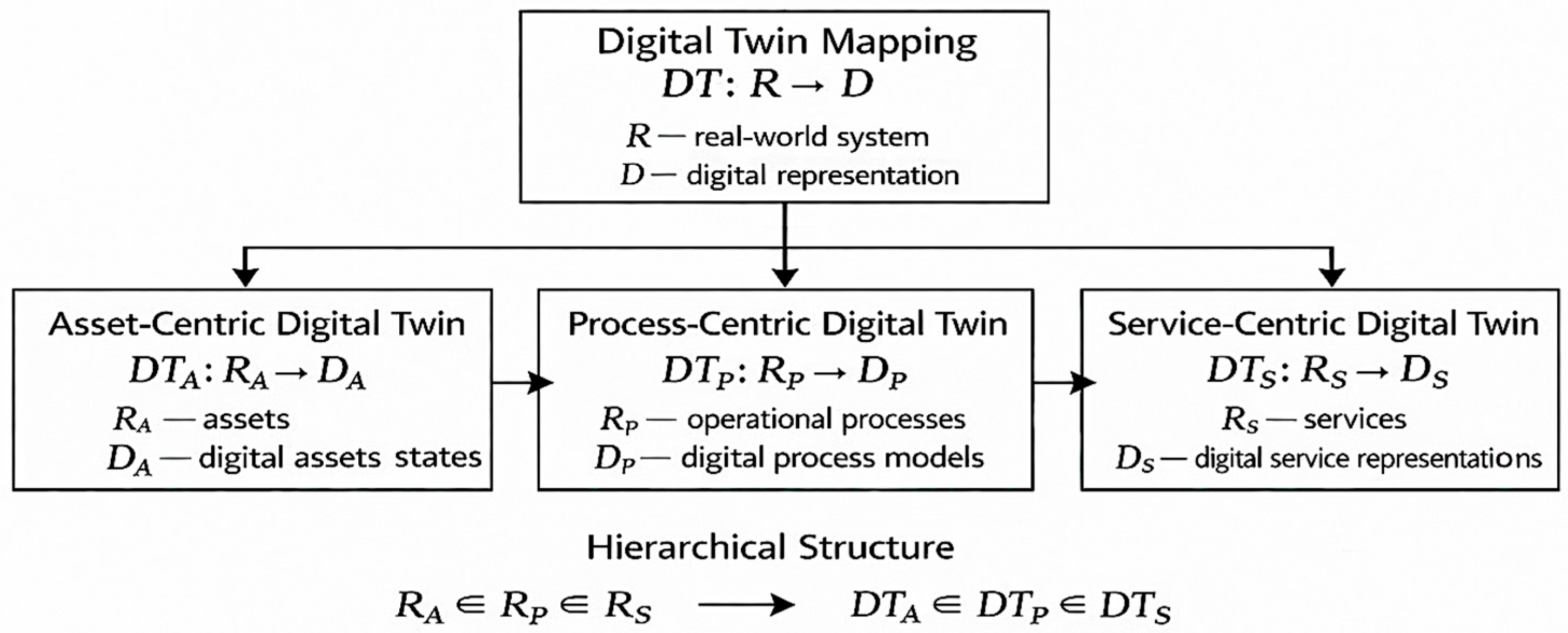
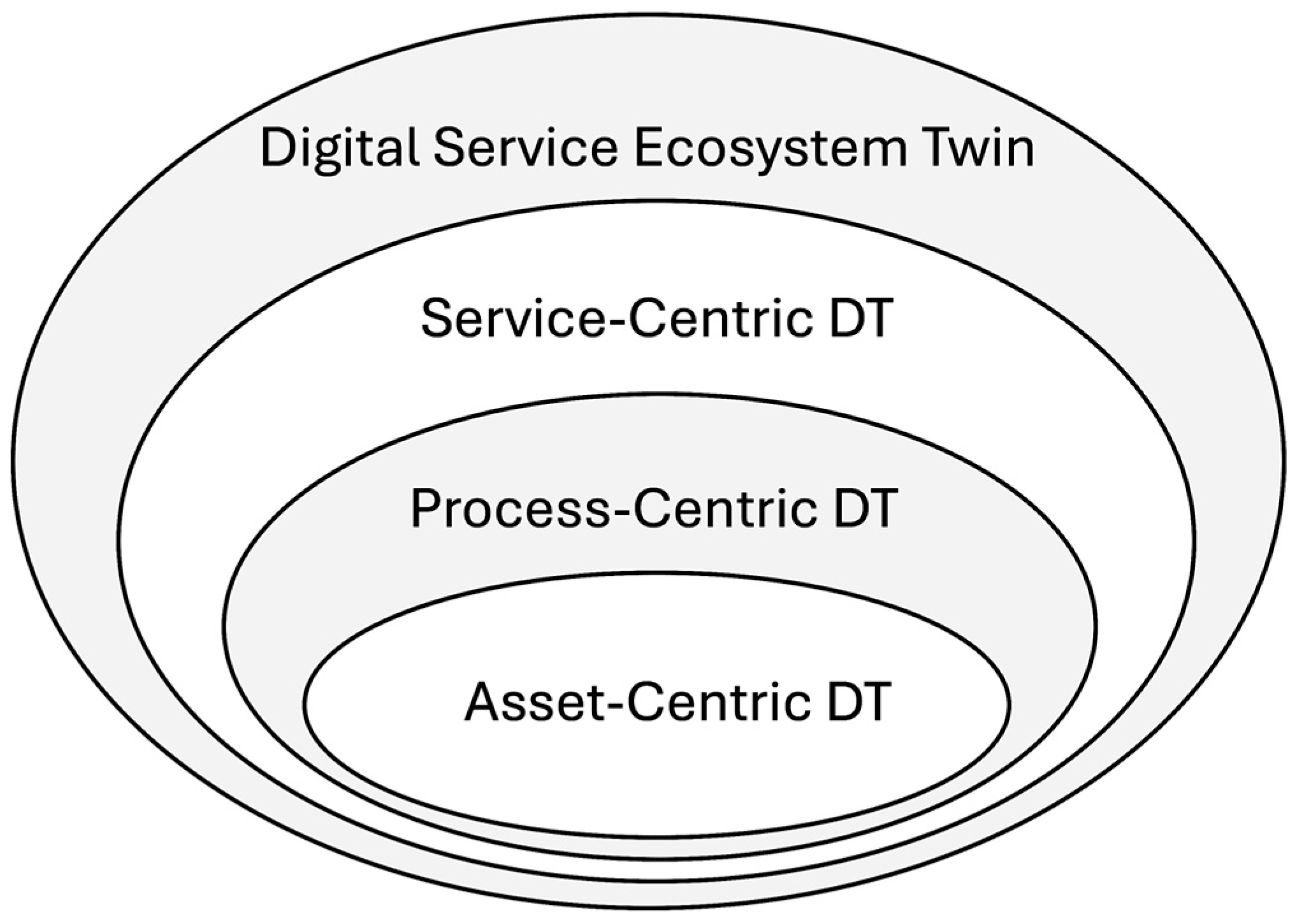
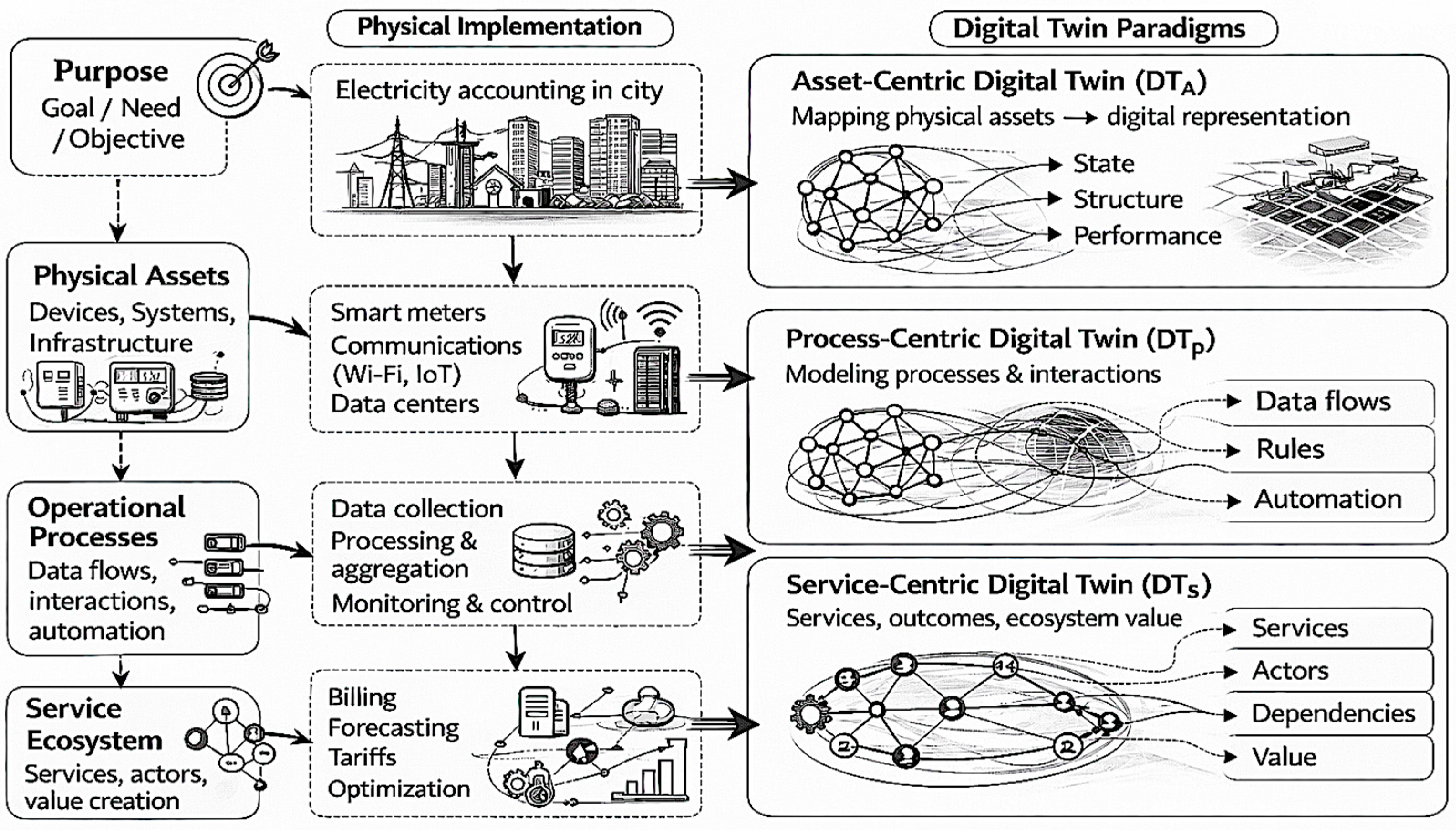
The mathematical interpretation of DT paradigms can be expressed through a hierarchy of mappings between elements of the physical system and their corresponding digital representations. The general structure of these mappings is illustrated in
Figure 2.
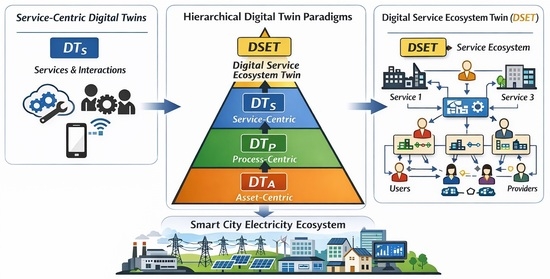
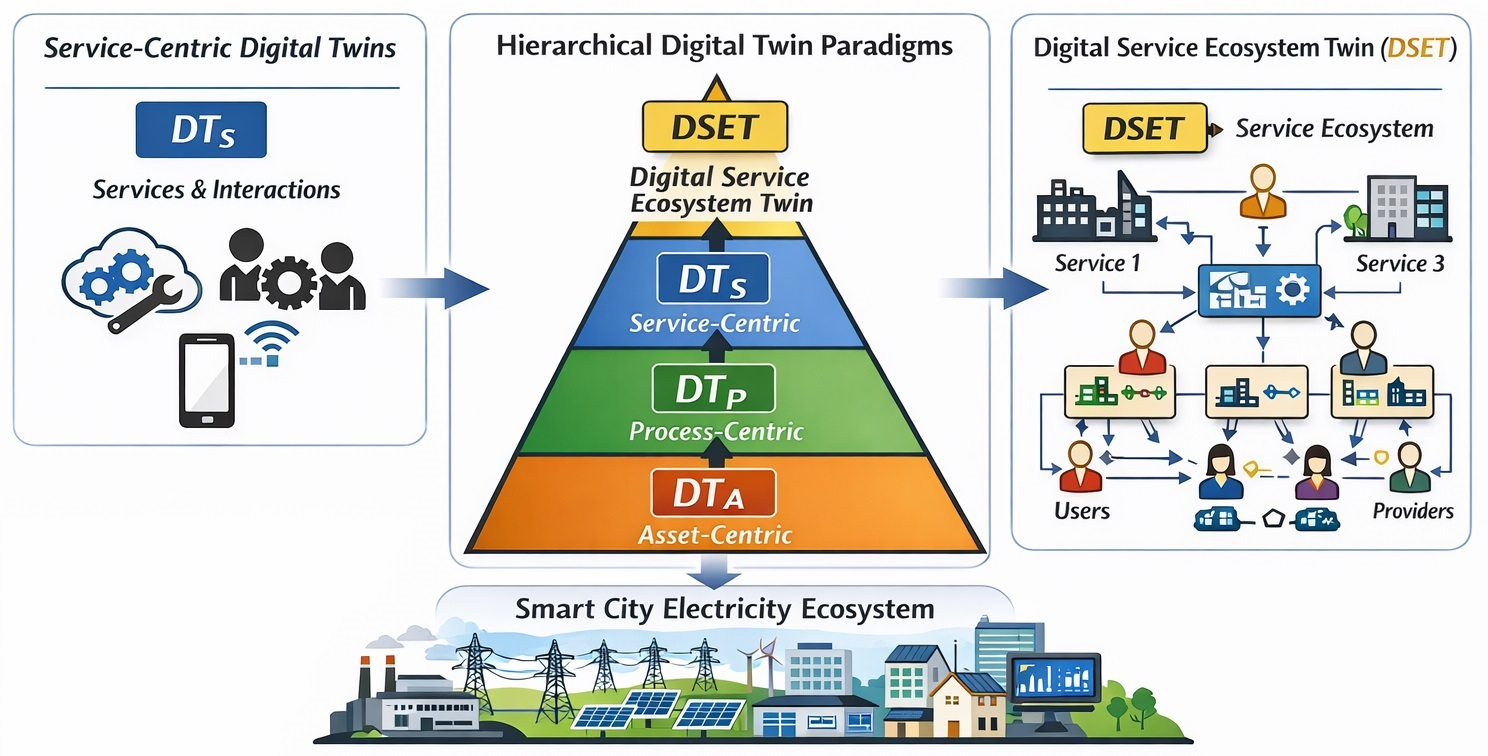
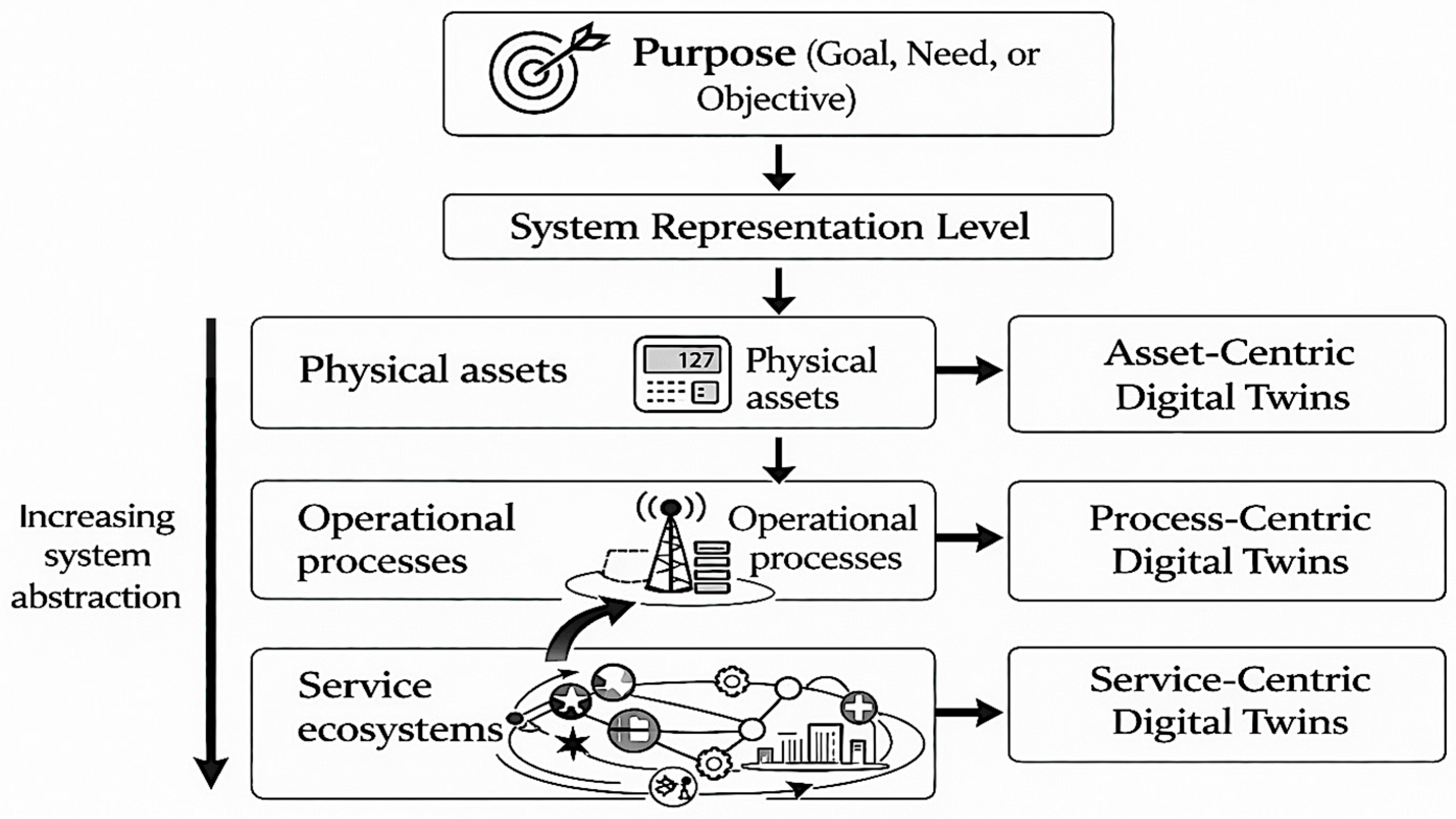
Three specialized mappings correspond to the three DT paradigms considered in this study: ACDTs, PCDTs and SCDTs. These mappings form a hierarchical structure that reflects the increasing abstraction level of system representation.
The purpose of the mathematical framework developed in this section is not merely to provide symbolic definitions of different DT paradigms, but to explain how these paradigms emerge as progressively higher levels of system representation. In this sense, the equations that follow should be interpreted as a formal description of hierarchical evolution: (1) the DT is represented in its most general form as a mapping between real-world entities and digital representations; (2) this general mapping is specialized to assets, then to operational processes formed by interacting assets, (3) to services and service ecosystems generated by coordinated processes. Accordingly, the mathematical role of the framework is to demonstrate that the evolution from asset-centric to process-centric and service-centric DTs is not terminological, but structural.
Let
denote the set of real-world referents represented by a digital twin and let
denote the corresponding set of digital representations. The general digital twin mapping is denoted by
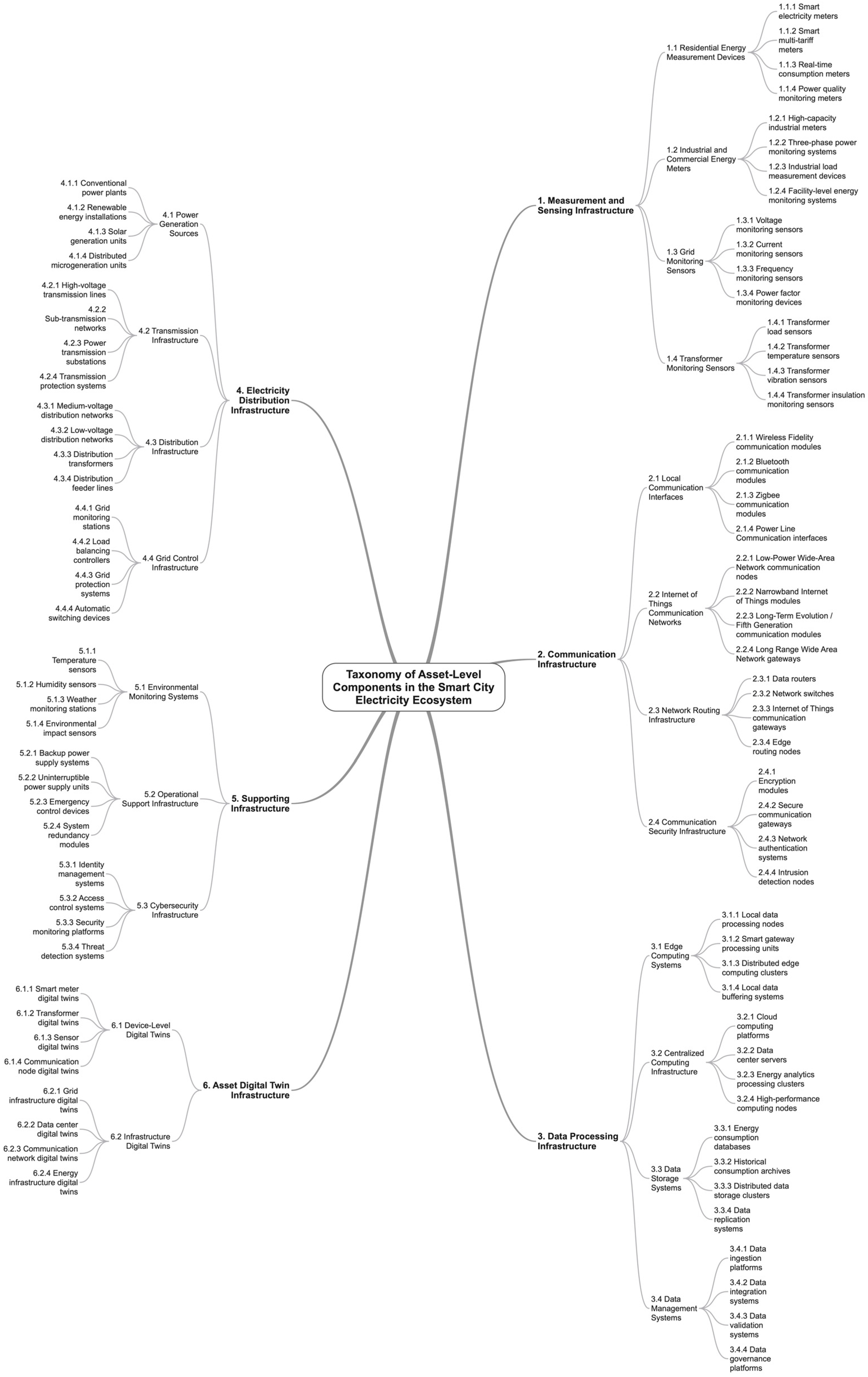
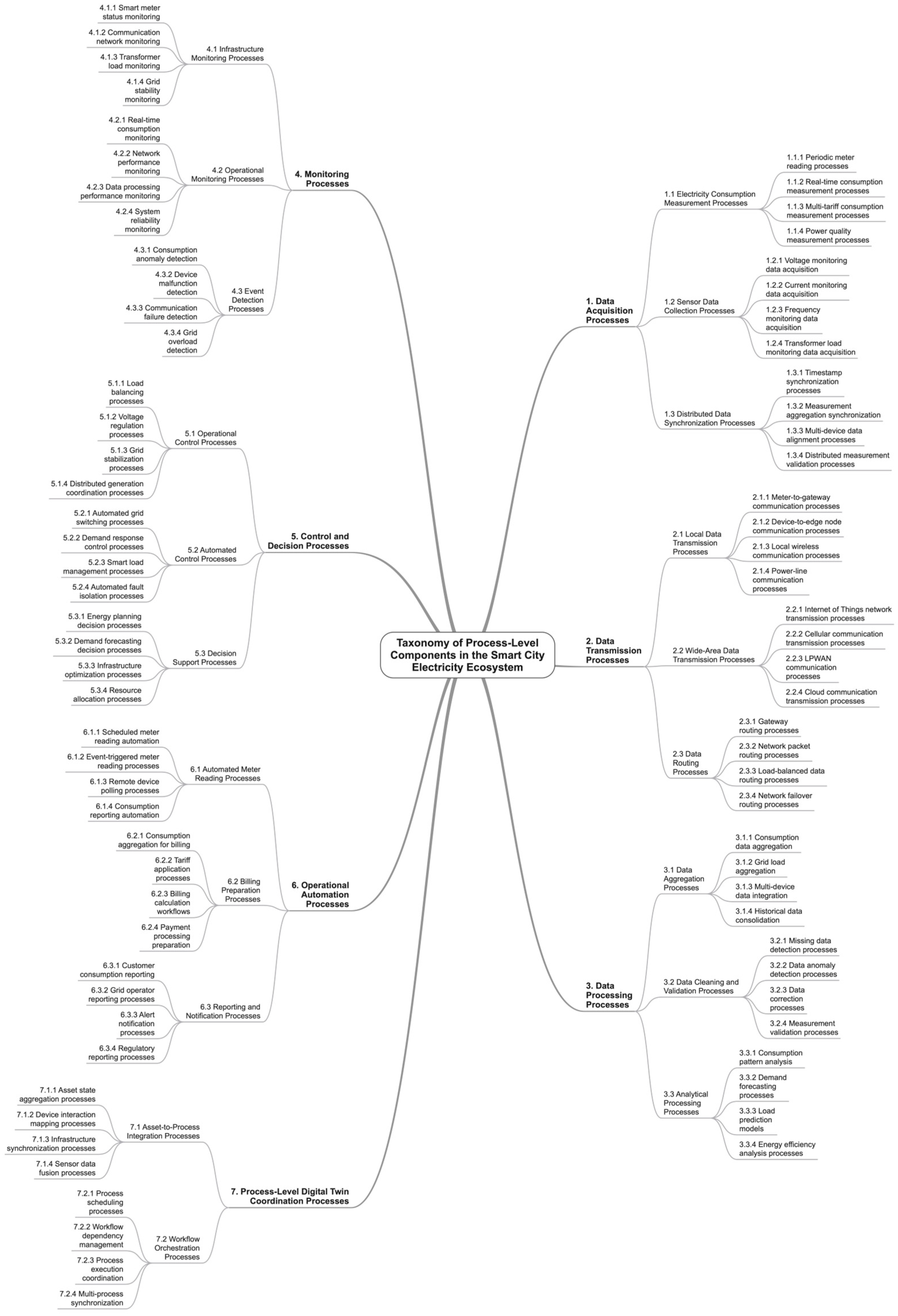
Within the hierarchical framework developed in this paper, four classes of referents are distinguished. The set of physical assets is denoted by , the set of operational processes by , the set of services by , and the service ecosystem by . The set of actors involved in service provision, coordination, regulation, or consumption is denoted by . Correspondingly, the digital representation spaces at the asset, process, service, and ecosystem levels are denoted by , , , and , respectively.
The specialized digital twin mappings are defined as follows:
Here, , , and denote the asset-centric, the process-centric, the service-centric and digital service ecosystem twin mapping, respectively. This notation is used consistently throughout the remainder of the paper.
The cross-layer relations among referents are represented by dependency sets. The asset-process dependency relation is denoted by
where
means that asset
participates in, supports, or enables process
.
The process-service dependency relation is denoted by
where
means that process
supports or enables service
. Service-level dependencies are denoted by
where
indicates that service
depends on, interacts with, or is influenced by service
. The set of actor-service relations may be denoted by
where
means that actor
provides, regulates, consumes, or otherwise participates in service
.
For a process
, let
denote the set of assets participating in process
. Similarly, for a service
, let
denote the set of processes enabling service
. These component sets are used to define cross-layer traceability between adjacent representational levels.
The paper uses the symbol
to denote layered embedding or representational dependency. Thus,
means that higher-level representations preserve traceable links to the lower-level representations from which they are composed. For adjacent levels, this relation is defined through projection operators. For example,
holds if there exists a projection
such that, for every process
,
Analogously,
holds if there exists a projection
such that, for every service
,
The ecosystem-level projection is defined in the same way for services composing the service ecosystem. These projections provide the formal basis for cross-layer traceability in the proposed hierarchy.
The framework relies on the following modeling assumptions.
Assumption 1. Asset observability. Each relevant asset has observable, measurable, or otherwise representable state variables that can be included in an asset-level digital representation .
Assumption 2. Process composition. Operational processes are composed of interactions among assets. Therefore, each process is associated with a non-empty set of participating assets .
Assumption 3. Service composition. Services are enabled by operational processes and delivered to or through actors. Therefore, each service is associated with a set of enabling processes and may be connected with one or more actors from .
Assumption 4. Service-level structural independence. Actor roles, service dependencies, and value-generation mechanisms are not, in general, fully determined by asset and process layers alone. Two systems may therefore have the same asset and process structures while differing at the service or ecosystem level.
Assumption 5. Faithfulness of service-level representation. The service-centric digital twin mapping is assumed to be faithful to relevant service-level differences. In other words, if two service configurations differ in actors, dependencies, or value-generation mechanisms that are relevant to the modeled ecosystem, their service-level digital representations should also differ.
Assumption 6. Cross-layer traceability. Higher-level representations preserve recoverable references to their lower-level components through projection operators. This assumption does not imply that higher-level representations are reducible to lower-level ones; it only requires that the lower-level components participating in a higher-level representation remain identifiable.
These assumptions define the modeling scope of the proposed formal framework. Definitions introduced below specify the digital twin mappings at each level, constructions explain how layered representations can be formed under the stated assumptions, and propositions describe conditional consequences of these assumptions. This separation is used to avoid treating modeling premises as independently derived mathematical results.
The relationships among DT paradigms can now be expressed through a limited number of conditional propositions, constructions, and traceability results.
Proposition 1. Conditional Non-Reducibility of Service-Centric Digital Twins.
Under Assumptions 4 and 5, a service-centric digital twin is not reconstructively reducible to asset-centric and process-centric digital twins alone. More precisely, say that
is reconstructively reducible to
and
if there exists a reconstruction operator
such that, for every admissible service configuration, the service-level representation can be recovered from the asset- and process-level representations alone
Under Assumption 4, actor roles, service dependencies, and value-generation mechanisms are not fully determined by the asset and process layers. Therefore, two service configurations may share the same asset set , the same process set , and the same asset–process structure, while differing in actors, service dependencies, or value-generation mechanisms. Under Assumption 5, is faithful to such service-level differences. Consequently, the corresponding service-level digital representations must differ, even though the asset- and process-level representations are identical.
If a reconstruction operator based only on and existed, it would return the same service-level representation for both configurations, because its inputs would be identical. This contradicts the faithfulness of . Therefore, under the stated assumptions, cannot be reconstructively reduced to a finite composition of and alone.
This proposition should be interpreted as a conditional modeling result. It does not claim that service-level irreducibility holds for all possible systems, but only that it follows when service-level actors, dependencies, and value structures are not fully determined by lower-level asset and process structures.
Construction 1. Layered Composition of Digital Twin Representations.
A layered digital twin representation can be constructed when the asset-, process-, service-, and ecosystem-level mappings are connected through explicit cross-layer dependency relations and projection operators.
Let
and
be the digital twin mappings at the four representational levels. The hierarchy is constructed by requiring the following layered embedding relations:
The first relation means that each process-level representation preserves traceable links to the asset-level representations participating in that process. Formally, for a process
,
where
is the set of assets participating in process
.
The second relation means that each service-level representation preserves traceable links to the process-level representations enabling that service. For a service
where
is the set of processes enabling service
.
The third relation means that the ecosystem-level representation preserves traceable links to the service-level representations composing the service ecosystem. If
denotes the set of services forming ecosystem
, then
Thus, the layered composition of digital twins is not modeled as set inclusion between mappings. It is modeled as a system of projection-based representational dependencies between adjacent levels
This construction provides the formal basis for cross-layer traceability in the proposed digital twin hierarchy.
Modeling Principle 1. Service-Oriented Representation Shift.
When the primary objective of system modeling, evaluation, or decision making is defined in terms of service outcomes, user value, actor coordination, or ecosystem performance, the appropriate digital twin representation shifts from asset-level or process-level modeling toward service-centric or ecosystem-level modeling.
This principle explains why service-centric digital twins are introduced as a separate representational level. Asset-centric digital twins are appropriate when the main modeling objective concerns the state, reliability, or performance of physical components. Process-centric digital twins are appropriate when the main objective concerns workflow coordination, operational efficiency, or process-level interactions. Service-centric digital twins become necessary when the main objective concerns service delivery, service dependencies, stakeholder value, or ecosystem-level outcomes.
This principle is not a theorem in the strict mathematical sense. It is a modeling rule that guides the choice of representational level according to the purpose of the digital twin.
Construction 2. Asset-Centric Digital Twin Representation.
Under Assumption 1, an asset-centric digital twin representation can be constructed for any system containing identifiable assets with observable or representable state variables.
Let be the set of physical assets in the system. For each asset , let denote its observed or estimated state at time . The asset-level digital representation may include this state together with structural parameters, configuration information, operational status, and performance indicators.
The asset-centric digital twin mapping is then defined as
where
Here, denotes the digital representation of asset . This construction establishes the foundational layer of the hierarchy, because asset-level representations provide the primary digital descriptions from which higher-level process and service representations can be composed.
Construction 3. Process-Centric Digital Twin Representation.
Under Assumption 2, a process-centric digital twin representation can be constructed when operational processes are formed by interactions among assets.
Let
denote the set of operational processes in the system. For each process
, the set of participating assets is defined by
A process-level representation must therefore include not only a description of the process itself, but also the asset-level representations participating in that process. The process-centric digital twin mapping is defined as
where
The representation
may include workflow logic, operational rules, data flows, control dependencies, performance indicators, and references to the asset-level digital representations
Thus, the process-centric digital twin is constructed over interactions among assets rather than over isolated physical components. This explains why
is layered above
, while still preserving traceable links to asset-level representations
Construction 4. Service-Centric Digital Twin Representation.
Under Assumptions 3–5, a service-centric digital twin representation can be constructed when operational processes enable services delivered to or through actors, and when service-level dependencies or value-generation mechanisms are relevant to system evaluation.
Let
denote the set of services and
the set of actors involved in service provision, regulation, coordination, or consumption. For each service
, the set of enabling processes is defined by
The service-centric digital twin mapping is defined as
where
The representation
may include service objectives, service status, service quality indicators, actor roles, dependency relations, value indicators, and references to the process-level digital representations
At the ecosystem level, services, actors, and service dependencies can be represented as
where
denotes service–service dependencies,
denotes actor–service relations, and
denotes the value-generation structure or ecosystem-level value function. The ecosystem-level digital twin mapping is then defined as
where
This construction establishes the service-centric and ecosystem-level layers of the proposed hierarchy:
The service-centric representation is therefore not treated as a simple aggregation of asset and process representations. It is constructed as a higher-level representation that preserves traceability to lower-level processes while also introducing actor relations, service dependencies, and value-generation mechanisms.
Theorem 1. Cross-Layer Traceability of the Hierarchical Digital Twin Representation.
Let
,
,
, and
be digital twin mappings satisfying the layered embedding relations
Assume that the corresponding projection operators exist
Then the hierarchical digital twin representation is cross-layer traceable. In particular, asset-level representations participating in an ecosystem-level representation can be recovered through the composition of projection operators.
Because the projection operators are set-valued, define their lifted composition as follows. For a set
Similarly, for a set
The composed projection from the ecosystem level to the asset level is therefore
For any ecosystem
, this gives
Thus, every asset-level representation participating in the asset–process–service chains of the ecosystem can be recovered from the ecosystem-level representation through successive projections.
Proof of Theorem 1.
By the definition of layered embedding, implies that the ecosystem-level representation preserves recoverable references to the service-level representations composing ecosystem . Therefore, applying to returns the set of service-level digital representations associated with that ecosystem.
Similarly, implies that each service-level representation preserves recoverable references to the process-level representations enabling the corresponding service. Applying to each recovered service-level representation returns the set of process-level representations associated with that service.
implies that each process-level representation preserves recoverable references to the asset-level representations participating in that process. Applying to each recovered process-level representation returns the corresponding asset-level representations.
Taking the union over all services and processes in the ecosystem gives the composed projection . Therefore, the ecosystem-level representation is cross-layer traceable to the asset level through the composition of adjacent projection operators. □
Theorem 1 does not claim that higher-level digital twins are reducible to lower-level ones. Rather, it establishes a weaker and more practically relevant property: higher-level representations can preserve traceable references to the lower-level representations from which they are composed. This traceability is essential for hierarchical digital twin architectures because it allows service-level outcomes and ecosystem-level knowledge to be interpreted in relation to the assets and processes that support them.