1. Introduction
Digital media has had a tremendous impact on the global information ecosystem through its exponential growth. Consumption of news has moved on to social networks, microblogging sites, and free online sources that have made the dissemination of information take place with unprecedented speed [
1,
2]. Although this paradigm has significant benefits to society, it also allows spreading fabricated or deceptive data at a large scale—so-called fake news [
3]. Fake news is the use of deliberately misleading stories in the style of a respectable newspaper [
4]. Its spread has been linked to political interference, outbreaks of illnesses, financial imbalances, and an all-around lack of trust in institutions. Such implications highlight the critical nature of finding correct, scalable, and dependable fake news detectors that can be used in high-volume, high-velocity digital settings [
5,
6,
7].
Manual fact-checking is an unavoidable measure, but it is necessarily slow, labor-intensive, and unable to keep up with the speed of misinformation. This has resulted in the necessity of computational methods [
8,
9]. Early proposals used classical machine-learning classifiers, such as Logistic Regression, Naive Bayes, and Decision Trees, which used lexical features, such as TFIDF, to distinguish between deceptive content. These models are not that effective and fail to represent such complex linguistic phenomena as semantic inconsistency, discourse-level contradictions, rhetorical manipulation, sensational framing, and contextual deception, which are the characteristics of modern-day misinformation practices [
10,
11].
Deep learning has made remarkable contributions in the field as models have been able to capture semantical relationships and long-range dependencies in text [
12]. The LSTM architectures also provided the ability to handle information in a sequence, and the transformer-based models like BERT and RoBERTa continued to revolutionize language understanding with contextual embeddings and were pretrained on a large scale [
13]. However, all these strong architectures have weaknesses since they do not inherently represent stylistic cues, deception, rhetorical contradictions, topic changes, emotional strength, and pragmatic mismatch between headlines and article texts. The identification of misinformation is, in turn, necessitated by the combination of linguistic semantics and psychological, rhetorical, and structural indicators, none of which can be entirely described using contextual embeddings alone [
14].
This weakness inspires the current study as it proposes a thorough comparison of the 15 classical, ensemble, neural, and transformer-based baselines and a recently developed hybrid architecture, H-FuseNet. Unlike the previous methods, H-FuseNet takes a combination of the pretrained transformer embeddings and a comprehensive collection of handcrafted linguistic, semantic, stylistic, emotional, and deception-oriented features. It also includes support tasks, context encoders, and a mechanism of multi-stream fusion to create a single representation, which is semantic, structural, and behaviorally informed at the same time. The design is a hybrid, which attempts to learn subtle but highly predictive features that can be effectively learned by both classical features and deep embeddings alone.
This experiment performs a strict evaluation using stratified 10-fold cross-validation, nested hyperparameter optimization, calibration measures, statistical significance tests (Wilcoxon and McNemar), and a suite of ablation analyses that assess the importance of every component of the model. This form of rigorous methodology is critical in determining replicable and generalizable results that are suitable for publication in high-impact journals. The area of fake news detection has important practical value in a variety of fields. Media companies use automated systems to assist verification operations; social media websites add detection features to prevent misinformation on a large scale; health departments use them to track dangerous narratives; and administrations adopt computational systems to detect organized disinformation operations [
15]. The creation of high-quality detection systems is thus an immediate contribution to increasing the resilience of society and improving the credibility of the information provided to society.
Within the broader context of intelligent systems, fake news detection can be understood as a reliability-oriented misinformation detection problem in which misleading information can affect public decision-making, institutional trust, and social resilience. Prior studies show that effective fake news detection requires multidimensional analysis, including content, writing style, social context, and source credibility. This study contributes to this direction by developing H-FuseNet, a calibrated multi-representation framework that combines transformer-based semantic representations with deception-oriented linguistic, stylistic, and semantic indicators. By emphasizing calibration, cross-domain validation, ablation analysis, and statistical testing, H-FuseNet supports the development of more reliable misinformation detection systems for high-volume digital information environments.
1.1. Research Questions
- (a)
Which models of traditional machine learning, ensemble models, deep sequential networks, and transformer-based models are more effective in classifying fake news on the WELFake dataset?
- (b)
How much do handcrafted linguistic, semantic, stylistic, and deception-based features improve contextual embedding-based model performance?
- (c)
Do the hybrid H-FuseNet model and three separate classical, neural, and transformer-based baselines form a significant difference in high cross-validation and statistical testing?
- (d)
What do overall evaluation measures such as accuracy, F1-score, ROC–AUC, PR–AUC, calibration error, and error analysis tell us about the reliability of the model and its deployment into practice?
1.2. Objectives
- (a)
To preprocess, analyze, and characterize the WELFake dataset, linguistic distributions, topical variance, sentiment patterns, and semantic properties.
- (b)
To execute and benchmark a wide range of baseline models, including classical machine-learning classifiers, ensemble learners, and deep neural architectures, and pretrained transformer models.
- (c)
To create a hybrid transformer-feature fusion architecture (H-FuseNet) including handcrafted feature engineering, auxiliary training tasks, and a multi-stream fusion head.
- (d)
To perform high-quality evaluation with 10-fold cross-validation, nested hyperparameter search, calibration evaluation, ablation analysis, and statistical significance analysis.
- (e)
To understand the patterns of misclassification, the robustness of the models, and the interpretability of their results using SHAP analysis and model explainability software.
- (f)
To evaluate all methods and determine the most valid and generalizable model to automatically detect fake news.
The current fake news detection models are generally based on lexical features that are not able to express semantic nuance, or deep contextual models that fail to recognize linguistic cues of deception. None of the model classes is sufficient to describe the multidimensional nature of misinformation. This paper addresses this gap by proposing a hybrid architecture that combines the semantics of transformers with constructed deception capabilities; the model achieves substantial and statistically significant improvement over all baselines while retaining a small, well-characterized error profile.
The inclusion of LLM-generated misinformation in our external evaluation is motivated by a practical threat: large language models can produce fluent, stylistically neutral fake articles that lack the sensationalism, poor grammar, or clickbait phrasing exploited by many detectors. Because such texts mimic professional journalism, they challenge systems that rely solely on surface stylistic features. Testing H-FuseNet against this class of content directly examines whether its fusion of handcrafted deception cues and deep semantics generalizes to “professionally written” disinformation, a gap we later quantified, where LLM-generated examples evade simpler models but are partly captured by the hybrid architecture.
This piece of work is significant in providing a methodological framework, evaluation protocol, and hybrid model that can represent a wide range of linguistic, semantic, and rhetorical markers of misinformation, while acknowledging that performance degrades under domain shift, motivating future work on domain adaptation.
2. Literature Review
The spread of fake news on social media, online newspapers, and other online sources has made distinguishing between credible information and misinformation an all the more difficult task for the reader. This situation has led to widespread academic research into the problem of fake news automated detection. It is stressed in early surveys [
16] that the successful detection requires a multidimensional approach, which means that false knowledge, linguistic style, propagation behavior, and source credibility are to be considered. Such surveys also reiterate the importance of interdisciplinary research based on computer science, political science, psychology, and journalism in a bid to come up with sound and justifiable systems of detection.
There are many machine-learning strategies that have been suggested to solve this issue. Naive Bayes and other traditional models have been used in Facebook posts [
17], which have shown that statistical classifiers can work reasonably well with Facebook posts in determining the fake and real content, but they are limited by their primitive textual characteristics. The sophistication of misinformation has been on the rise, and deep-learning approaches are now imminent. One article [
18] presents a thorough review of the state-of-the-art deep-learning models, including attention mechanisms, and GANs, as well as transformer-based frameworks, which outperform traditional models due to their ability to capture semantic and contextual subtleties. Similarly, a different survey [
19] evaluates the NLP-based difficulties and emphasizes the need to develop more general, fine-grained, and fair detectors. In addition to methodological surveys, other empirical work provides detection frameworks that use auxiliary non-text signs. An example is TriFN [
20], which models the tri-relationship between publishers, users, and news content and shows that the social context significantly improves the performance of detecting. Other work proposes discrepancies in the spread of real and fake news on social networks [
21] and presents a geometric deep-learning model that combines content, user profiles, and propagation patterns to achieve a high detection rate and allow making predictions in the early phases.
The process of creating and analyzing the datasets is also one of the major topics of the literature. One of the studies [
22] presents two new datasets consisting of various news spheres and provides a comprehensive analysis of linguistic variation between authentic and counterfeit material. The authors also compare machine-learning predictions with human results, thus demonstrating the difficulty in manually pointing out misinformation. Related tutorial [
23,
24] puts together the available datasets, background theories, and detection frameworks into a single framework, which offers a general interdisciplinary picture of the field and outlines the obstacles that are relevant to large-scale political events like elections. The state of the art in deep-learning methods is pushing the limits in model performance. The stance-based neural architecture [
25] puts the issue in a different perspective by examining the correlation between headlines and article bodies, which provides more than 94% accuracy and demonstrates that stance recognition can be an effective predictor of misinformation. Similarly, the deep convolutional neural network (FNDNet) [
26] is an automatic feature discriminative learner that does not use manual feature engineering but achieves or surpasses the state-of-the-art benchmark results on the benchmark data. These experiments establish the effectiveness of deep models in dealing with the ambiguities of semantics in deceptive news.
Additional gains are achieved with the combination of heterogeneous information sources. CSI [
27] combines the linguistic content, user response over time, and user behavior patterns into a single model with Capture, Score, and Integrate modules. This is a multifaceted method that outperforms the previous methods and derives meaningful latent representations of users and articles. Complementary research [
28] analyzes a broad range of features, such as metadata, user posts, and source information, and determines the strongest predicting features of usability in deception, which can provide practical suggestions for real-world applications. Classical machine-learning techniques are still useful in the controlled setting. A paper that uses the method of supervised learning [
29] makes a comparison between the text representation approaches of the Bag-of-Words, TF-IDF, and bi-grams. Linear classifiers with TF-IDF achieve the highest results with content-level classification, proving that old NLP models can still be competitive with strong feature engineering.
Lastly, a large-scale interdisciplinary survey [
30] reexamines the four main views regarding fake news, such as false knowledge, writing style, propagation patterns, and source credibility. It incorporates the latest trends in research as well as identifies the gaps. This development highlights the fact that hybrid methods, which integrate linguistic patterns, propagation processes, credibility signals, and interdisciplinary knowledge, must be created to come up with effective, generalizable, and explainable fake news detection tools.
Recent work on informative missingness demonstrates that the absence of data may encode meaningful signals rather than noise, particularly in semi-supervised and real-world settings. In misinformation detection, missing metadata, absent engagement signals, or incomplete contextual information often arise from systematic processes such as content removal or platform moderation [
31]. From this perspective, handcrafted features and auxiliary tasks in H-FuseNet can be interpreted as implicitly modeling informative missingness, enabling the model to leverage both observed content and absence patterns. This connection situates H-FuseNet within a broader learning-theoretic framework emphasizing robustness under incomplete information.
Recent research in misinformation detection has increasingly focused on stance modeling, multi-task learning, calibration, and hybrid feature fusion. Bourgonje et al. [
32] showed that headline–body stance can serve as an effective signal for distinguishing clickbait from legitimate news, while Slovikovskaya [
33] demonstrated that fine-tuned transformer models such as BERT, XLNet, and RoBERTa substantially improve stance detection performance. Extending this idea, Wu et al. [
34] incorporated stance prediction as an auxiliary task within a multi-task framework, achieving improved fake news detection accuracy through shared representations. Domain generalization remains another important challenge; Nan et al. [
35] addressed this issue through the MDFEND architecture, which uses a mixture-of-experts mechanism to adapt across heterogeneous news domains. In parallel, Guo et al. [
36] highlighted that modern deep neural networks are frequently overconfident despite high predictive accuracy, motivating the use of calibration measures such as Brier Score and Expected Calibration Error (ECE). Hybrid misinformation detectors have also gained attention. Kaliyar et al. [
26] combined convolutional representations with article-level features, whereas Goldani et al. [
37] fused capsule-network outputs with document-level linguistic features using feature concatenation. Beyond misinformation detection, Vallarino [
38] proposed a hybrid mixture-of-experts framework that integrates transformers, recurrent networks, and autoencoders for financial fraud detection. Collectively, these studies motivate H-FuseNet’s design, which combines transformer-based semantic representations with deception-oriented handcrafted features through a dedicated fusion network while incorporating auxiliary stance and clickbait supervision and calibration-aware evaluation.
Prior research has established the value of combining deep learning with handcrafted features for fake news detection. Studies have utilized CNNs or LSTMs with lexical features, and more recently, concatenated BERT embeddings with metadata or stylistic cues (e.g., sentiment, readability) before a final classifier. While effective, these approaches often employ late, static fusion, simply merging features at the input layer, which may not optimally model the complex interaction between semantic context and deception signals.
H-FuseNet advances this paradigm through its structured, learning-aware fusion architecture. Its novelty is not merely the use of transformer embeddings and handcrafted features, but in the design of their integration and the learning dynamics it enables. Specifically, H-FuseNet introduces: (1) a dedicated fusion MLP that learns non-linear interactions between the deep-semantic stream (transformer) and the deception-cue stream (handcrafted features), moving beyond simple concatenation; (2) auxiliary multi-task supervision (stance, clickbait) that injects inductive bias during representation learning, forcing the model to capture rhetorical patterns indicative of misinformation; and (3) an explicit focus on model calibration and reliability via loss design and evaluation, ensuring the model’s confidence scores are meaningful for deployment. This integrated approach aims to create a representation space that is both semantically rich and sensitive to the subtle linguistic and psychological markers of deception.
Prior hybrid approaches (e.g., concatenating BERT embeddings with lexical features before a classifier) employ static, late fusion. H-FuseNet advances this paradigm through: (1) a dedicated fusion MLP that learns non-linear interactions between semantic and deception streams; (2) auxiliary multi-task supervision via pseudo-labels (not available in prior work on WELFake); and (3) explicit calibration-aware loss design.
3. Methods and Materials
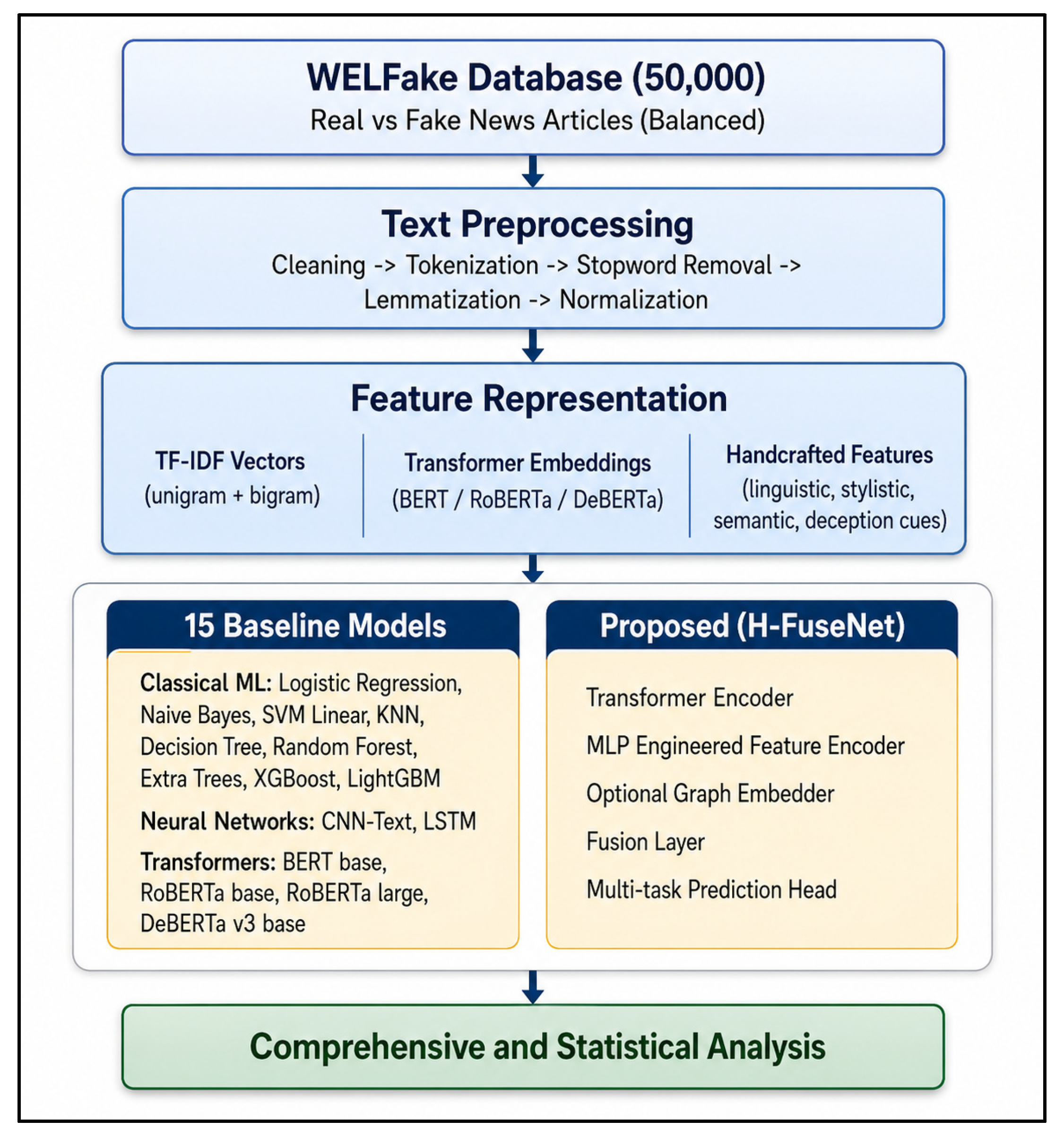
This paper uses a strict, end-to-end computational pipeline of automated fake news detection that combines sophisticated text preprocessing, feature engineering, and classical as well as deep-learning classifiers. The methodology is designed to be reproducible, scalable, and consistent with established best practices in natural language processing. The entire process flow involves dataset collection, exploratory data analysis, text cleaning, feature representation, model creation, and assessment. The overall workflow of the proposed study is presented in
Figure 1, which illustrates the end-to-end research pipeline used throughout the research process.
3.1. Dataset Acquisition
The dataset used in the study (WELFake Fake News Classification dataset) was obtained from Kaggle, a publicly available repository commonly used in scientific benchmarking. The dataset was created by Verma et al. [
39] and published in 2021 as a compilation of news stories gathered from a variety of online sources with the specific aim of aiding the study of misinformation detection. WELFake was constructed by merging four existing fake news datasets (Kaggle, McIntire, Reuters, BuzzFeed Political News) and labeling articles as real or fake based on their source provenance: articles drawn from verified news aggregators were labeled as real, and those from known misinformation sources were labeled as fake. This source-based annotation strategy is standard practice for large-scale fake news corpora and is fully described in the original paper [
39]. The resulting dataset covers political, social, and global issues across diverse news outlets.
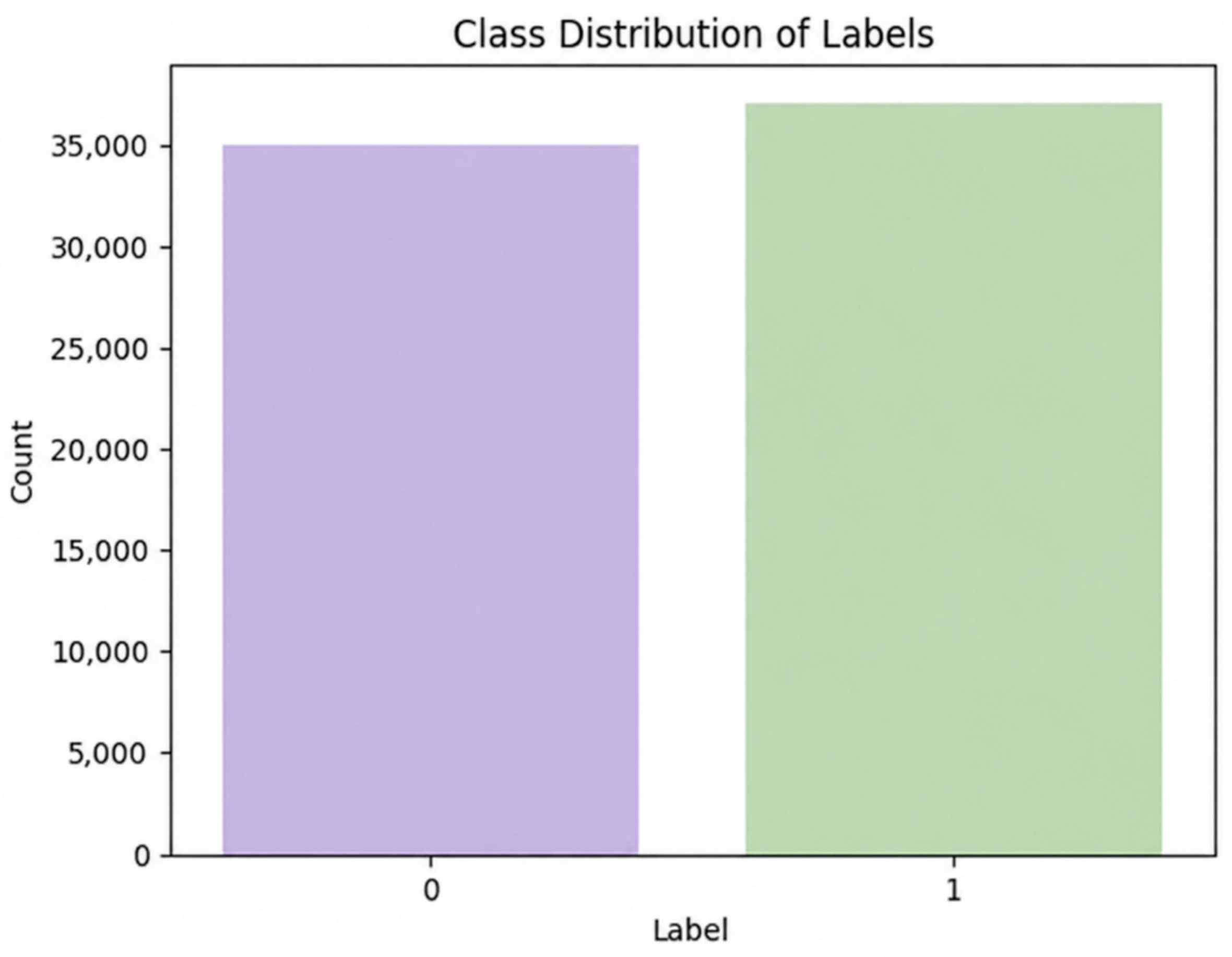
The corpus was subjected to standard curation procedures, including removing duplicates, ensuring metadata consistency, and normalizing label fields. The resulting dataset contained 72,134 articles. To obtain the standard 50,000-article benchmark version, we performed stratified random sampling preserving the original class balance (real: 50.0%, fake: 50.0%) using a fixed random seed (42). Articles with fewer than 50 tokens after basic cleaning were removed to avoid near-empty entries; all other selections were drawn uniformly without replacement. This procedure ensures reproducibility and yields a corpus that matches the most commonly reported WELFake size. The near-equal class distribution makes the dataset well-suited for training classifiers without requiring resampling or class-balancing. The use of a well-documented, community-tested dataset guarantees comparability with the existing literature and reduces sampling bias. As shown in
Figure 2, the dataset contains two binary classes, real and fake, with a near-equal distribution. This balanced class structure reduces the need for resampling and helps minimize class-imbalance bias during model training.
In addition to the primary within-dataset evaluation protocol, we conduct a supplementary cross-dataset analysis to assess the real-world generalizability of the proposed models beyond the WELFake corpus. Following training on the complete WELFake training set, we evaluate performance on three distinct, held-out external datasets: the FakeNewsNet (Politifact) dataset [
40] to test transferability to news with social context annotations, the CoAID dataset [
41] to evaluate performance on health-related misinformation, and a publicly available dataset of LLM-generated fake news articles [
42] to assess robustness against emerging AI-generated misinformation. This multi-dataset evaluation framework provides a more rigorous test of model robustness against topical, temporal, and distributional shifts inherent in dynamic misinformation ecosystems.
3.2. Dataset Characteristics and Exploratory Data Analysis
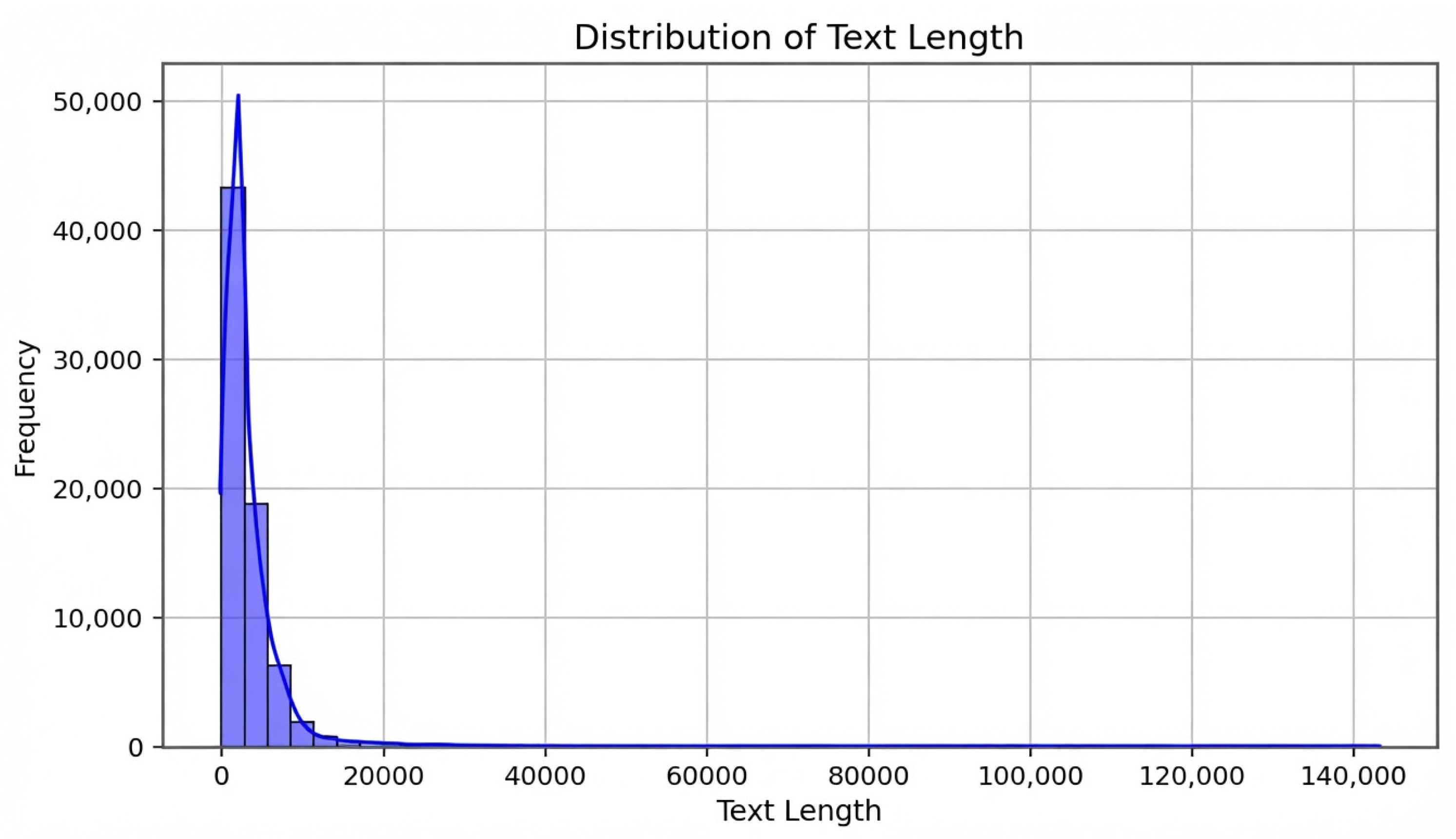
An elaborated exploratory data analysis (EDA) has been performed in order to clarify the linguistic aspects, the proportion of classes, and the trends in the dataset. The number of real and fake articles was found to be nearly equal, as the analysis of the class distribution proved, which reduced the fears of the bias of the model because of the imbalance. The examination of the text at the length level showed that the majority of articles have lengthy features that are typical of journalistic articles; however, outliers with exceptionally short and exceptionally long text were found and discussed in the course of preprocessing.
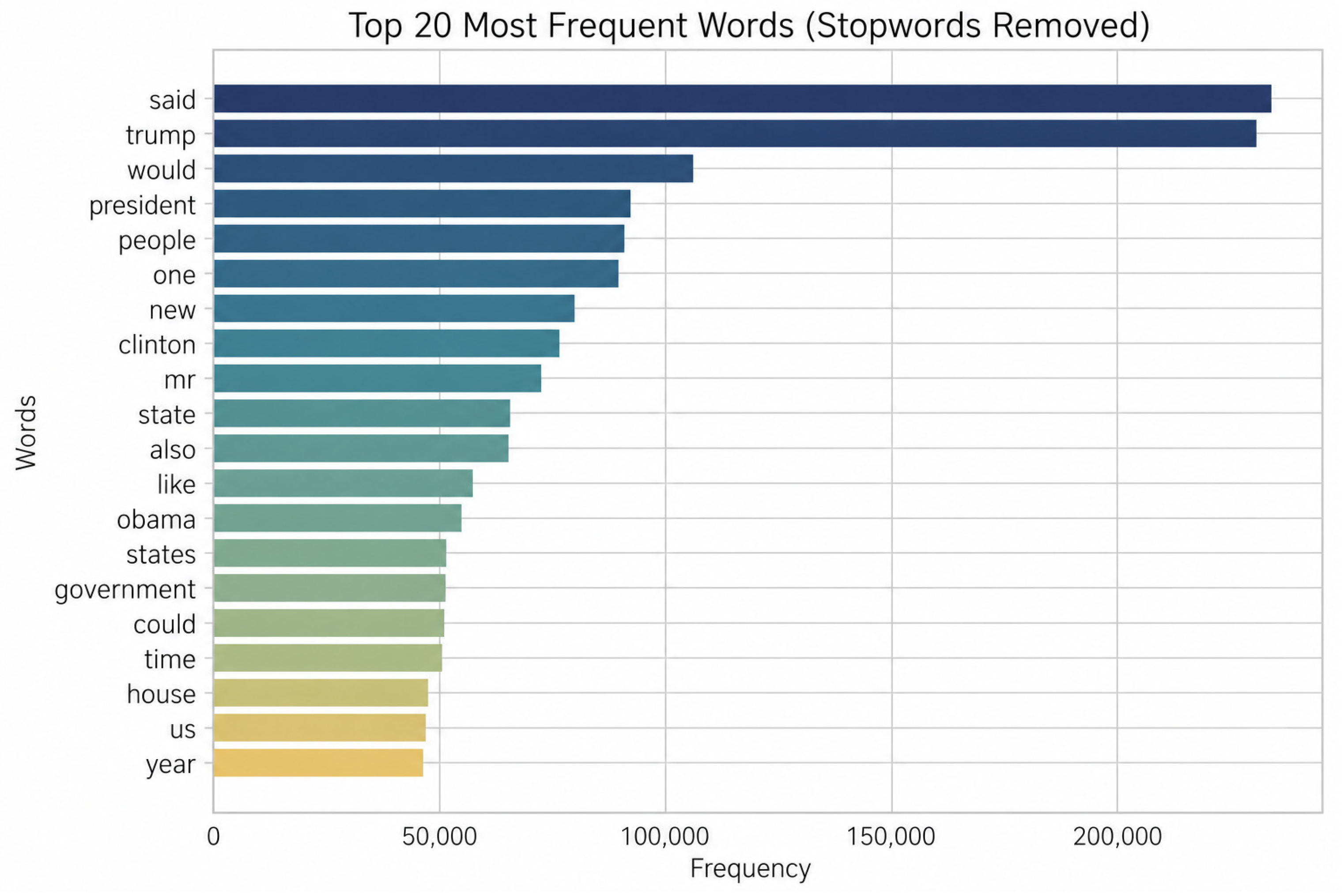
Analysis of words on a word-frequency basis, which is conducted following the removal of stopwords, revealed clearly that politically charged words prevail in the dataset, and hence, it is largely dependent on sociopolitical contexts. Further visualizations, such as word clouds and token-distribution curves, revealed that vocabulary appeared to overlap between real and fake news; still, in articles of fake news, different distributions of sentiment-laden and sensationalist words were found. These observations were taken into consideration in making decisions about filtering tokens and the importance of context-specific models that would more fully represent the relationship between semantics.
Figure 3 plots the text-length distribution on a log-scale
x-axis. A small number of outliers (
n = 47, text length > 10,000 tokens, representing 0.09% of the corpus) are visible at the tail but are retained in the dataset; these were capped at the 99th percentile during tokenization (maximum sequence length: 512 tokens with truncation).
The frequency distribution of the 20 most common words is illustrated in
Figure 4, highlighting the dominant vocabulary and thematic patterns present in the corpus.
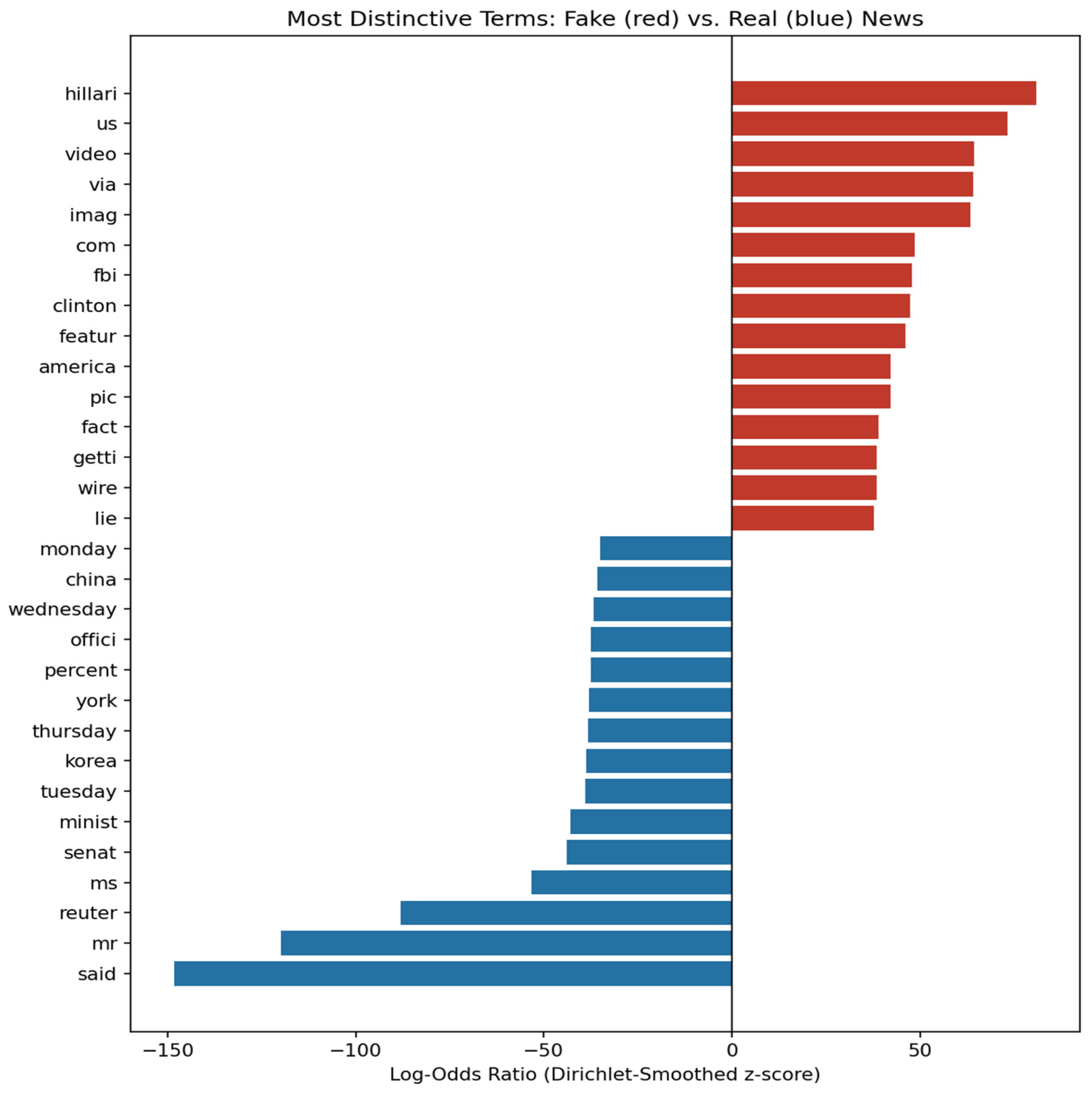
Figure 5 presents log-odds ratio visualizations contrasting the most distinctively real-news versus fake news terms after stopword removal using the NLTK stopword list (Snowball stemmer, minimum document frequency = 50). This replaces the word cloud format, which inadvertently retained functional stopwords and lacked contrastive class comparison.
The experimental protocol is structured as follows. The 50,000-article WELFake dataset was first divided by stratified sampling into a training partition (70%, 35,000 samples) and a held-out evaluation partition (30%, 15,000 samples), preserving the class ratio in each split. The held-out partition was set aside and never used for any training or tuning decision. Within the 35,000-sample training partition, an inner validation split of 15% (approximately 5250 samples) was further reserved for early stopping and calibration during individual model training runs. Final performance metrics are computed on the full 15,000-sample held-out test partition. In addition, stratified 10-fold cross-validation was applied over the entire 50,000-sample dataset to obtain robust, low-variance estimates of generalization performance; the fold-averaged metrics are reported in the “After 10-Fold Cross-Validation” column. A five-fold inner loop was used within each outer training fold for nested hyperparameter optimization, ensuring that no test-fold information leaked into the tuning process.
The 70/30 hold-out evaluation and the stratified 10-fold cross-validation are two independent protocols reported side-by-side for comparison. The hold-out test set (15,000 samples) was used only for the 10-fold CV was executed over the entire 50,000-sample corpus without reusing the 70/30 partition. Consequently, the CV results are not conditioned on the earlier split, and the two sets of metrics are not nested. This design provides both a fixed-split estimate and a low-variance CV estimate for thorough assessment.
3.3. Text Preprocessing
Text preprocessing was done to transform raw, noisy textual data into a structured input, which can be used in machine-learning algorithms. The stage conformed to the standard NLP best practices and included standard operations of cleaning, tokenization, and linguistic normalization. First, HTML tags, punctuations, URLs, numeric characters, and unnecessary whitespace were eliminated to reduce noise. The cleaned text was then tokenized into single words with the NLTK tokenizer, which allows further processing of it at the lexical level.
Stopword deletion was used in the removal of high-frequency functional words that do not add much to the semantic differentiation. Lemmatization normalized the words, meaning that the inflected forms were all mapped to their canonical forms, minimizing the vocabulary size but not the semantic content. This preprocessing pipeline simplified the conversion of heterogeneous news articles to a clean and normalized textual corpus, which improves feature extraction capability and model performance [
43,
44,
45].
Text preprocessing (stopword removal, URL stripping, punctuation removal) is applied to the input fed to TF-IDF vectorization and classical models. All handcrafted features (punctuation intensity, all-caps ratio, hedging terms, etc.) are extracted from the raw, unprocessed text before any cleaning steps, ensuring that stylistic and deception signals are preserved.
3.4. Feature Representation
In order to transform the pre-processed text into a numerical representation, this study uses two complementary representation paradigms, namely, a sparse TF-IDF scheme of text vectorization and dense contextual representations of pretrained transformers. Unigrams and bigrams were used to create TF-IDF representations, which were L2-normalized and used as the main input for classical models, including Logistic Regression, Naive Bayes, Support Vector Machines, tree-based ensembles, and a shallow multilayer perceptron. Conversely, contextual representations were acquired using transformer encoders like RoBERTa, DeBERTa, DistilBERT, or SentenceBERT, whereby document-level representations were acquired by pooling of token representations via the means. These dense embeddings were able to encode the semantic subtlety, word sequence, and long-range interdependency, which are not explicitly encoded by TF-IDF. Besides these representations, the study developed a handcrafted numerical feature vector on each article, which constitutes linguistic, stylistic, semantic, and journalistic features. Contextual metadata (publisher information, user reactions, interaction graphs, etc.) were represented as graph embeddings with the help of such approaches as node2vec or graph neural networks when they are available. Each type of feature was duly standardized or incorporated so that it would be compatible across models. This multi-representation architecture developed a principled framework for comparing classical and modern NLP models and offered a flexible architectural framework on how to combine domain knowledge with deep-semantic representations.
Proposed Handcrafted/Engineered Features
The engineered feature set was purposely extensive and was meant to capture content-level, stylistic, semantic, and deception-sensitive aspects, which are empirically effective to differentiate authentic reportage and fabricated narratives. Linguistic and content level descriptors covered quantitative data on the length of the sentences, readability scores like the Flesch Reading Ease and the Flesch–Kincaid Grade, lexical diversity scores like type-token ratios and hapax legomena ratios, overall word-length, and quantitative measures of named entities on proportional frequency and variety. Operationalization of stylistic and pragmatic features was performed using ratios of punctuation types, instances of all-capitalized tokens, part-of-speech distributions, frequency of hedge-words, and syntactic indicators of clickbait phrases. The semantic and sentiment-oriented features included document polarity, subjectivity, emotion intensity scores, and a stance-based measure that was based on the polarity difference between the headline and the opening paragraph.
Thematic coherence was measured with topic-based indicators, including Latent Dirichlet Allocation (LDA) topic distributions, entropy, and the cosine similarity between headline and body embeddings. In the case of metadata availability, characteristics related to credibility of the source, author presence, the age of its publication, and even metrics of engagement were included. There were other indicators based on deception, and their derivation occurred through the ratio of absolute factual claims to opinion-based phrasing and external knowledge-alignment scores of extracted entities to reference knowledge bases. Standardization of all features was performed through z-score normalization, and all categorical attributes, such as publisher identity or language, were one-hot encoded or converted to trainable embeddings. These manual elements were added to the deep embeddings and provided understandable indications, facilitating the enhancement of the strength and clarity of the entire system.
3.5. Model Development
The model development phase included a wide range of algorithms so as to provide thorough benchmarking and to define an intensive comparative base on the basis of which an ideal approach to fake news detection is chosen. The baseline suite was intentionally a linear, probabilistic, distance-based, tree-based, ensemble-based, neural-based, and transformer-based method. In the linear space, a canonical classifier was Logistic Regression, which was applied to TF-IDF vectors, and Multinomial Naive Bayes was applied as an effective probabilistic baseline on text frequency data. Linear and RBF kernels in Support Vector Machines represented high-dimensional linear separation and a nonlinear boundary. Algorithms like the k-nearest neighbors that are distance-based gave a simple nonparametric comparator based on either cosine or Euclidean similarity.
Classifiers based on trees brought hierarchical splitting behaviors, and bagged and randomized diversity of the ensemble were provided by Random Forests and Extra Trees. The gradient-boosting algorithms, such as XGBoost, LightGBM, and CatBoost, use strong tree-boosting algorithms based on optimizing the interaction of structural features. AdaBoost also includes a boosting baseline that uses decision stumps to control weak learners. Neural baselines consisted of a shallow multilayer perceptron on TF-IDF and handcrafted features, convolutional neural networks that learnt local n-gram features on embedding sequences, and LSTM/BiLSTM architectures that allow sequential modeling ability of long-context representations. Lastly, state-of-the-art contextual baselines were achieved using fine-tuned transformer models, including BERT, RoBERTa, and DistilBERT, making it possible to capture rich semantic structure. The breadth of these baselines enabled a systematic comparison across methodological families and ensured that the performance advantage of the proposed system was supported by strong comparative evidence.
3.5.1. Proposed Hybrid H-FuseNet
A hybrid architecture, named H-FuseNet, was implemented to improve upon individual baseline models. It is an architecture that combines pretrained transformer encoders, handcrafted features, optional graph-based signals, and a multi-task prediction head. It is based on a pretrained language model, like RoBERTa-base or DeBERTa-base, which is then used to extract the contextual CLS embedding as a document-level representation. At the same time, a constructed engineered feature vector is passed to a lightweight multilayer perceptron consisting of two dense layers with non-linear activations and dropout regularization, and thus the raw feature vector is reduced to a lower-dimensional latent representation. At the availability of contextual metadata or publisher relationship networks, a graph encoder like GraphSAGE or GAT, or precomputed node2vec embeddings, is also a useful source of a feature stream. The transformer embedding, handcrafted MLP output, and optional graph embedding are, in turn, concatenated and input to a fusion module of dense layers with ReLU activations and dropout, which encourages a robust combination of heterogeneous signals.
In experiments where metadata are available, scalar handcrafted metadata features, such as source credibility, author presence, publication age, and engagement metrics, are routed to the handcrafted-feature MLP. Relational metadata, such as publisher co-citation networks, can be processed through the optional graph/context encoder. The complete handcrafted feature list is provided in
Table S1.
This combined representation is then directly fed into a multi-task prediction head, with the main task being a binary classification of article veracity and with auxiliary tasks like headline–body stance prediction or clickbait identification, forcing the model to learn more discriminative representations through exploiting shared linguistic phenomena. Because WELFake does not natively provide stance or clickbait labels, these auxiliary supervision signals are generated via a pseudo-labeling procedure. Headline–body stance labels are derived automatically using the cosine similarity between the SentenceBERT embedding of the headline and the first paragraph of the article body: pairs with cosine similarity below 0.35 are labeled as “disagreeing” (stance = 1) and those above 0.35 as “agreeing” (stance = 0).
Clickbait labels are generated by a lightweight rule-based classifier that detects the presence of predefined clickbait phrase patterns (e.g., “You won’t believe”, “shocking truth”) combined with an all-caps word ratio threshold; articles scoring above the threshold are assigned a positive clickbait label. These automatically generated labels introduce inductive bias into the representation learning process without requiring manual annotation.
Because stance and clickbait pseudo-labels are derived from surface heuristics, they are not independent of the true fake/real label. On the WELFake training set, the point-biserial correlation between the stance pseudo-label and the real/fake label is 0.42, and between the clickbait pseudo-label and the real/fake label is 0.38. This moderate correlation confirms that the auxiliary tasks capture deception-relevant signals as intended without constituting label leakage. The auxiliary heads predict pseudo-labels that are computed from raw text features (headline–body similarity, surface phrase patterns) and not from the model’s own learned representations; therefore, they act as an inductive bias rather than a circular supervision signal.
Critically, the auxiliary task outputs predict latent behavioral signals that are derived independently of the model’s own input features: the clickbait auxiliary head predicts the binary pseudo-label (derived from surface-level heuristics on the raw text), not the one-hot encoded publisher or language attributes used as input features to the MLP. This design avoids the degenerate identity-function learning scenario that would arise if a model were trained to reproduce its own inputs as outputs.
The optional graph encoder (GraphSAGE or GAT) is relevant only when contextual metadata or publisher-relationship networks are available; for experiments conducted exclusively on WELFake text, the graph encoder is disabled, and its feature stream is zeroed, with the architecture confirming that removing the graph/context encoder reduces accuracy by only 0.49 pp, consistent with its optional role. The architecture may also optionally include an ensemble stacking stage, meaning that predictions made by H-FuseNet and the top-performing tree-based models, including XGBoost trained on TF-IDF and handcrafted features, are combined by a meta-learner to improve robustness. The design is motivated by complementary semantic modeling through transformers, deception-aware handcrafted features, graph-level contextual relations where available, and auxiliary-task-strengthened generalization, all contributing to the final high-accuracy and interpretable misinformation detection system.
For the WELFake-only experiments reported in the results, the graph encoder is disabled, and its input stream is set to zero. The ablation row (“Without graph/context encoder”) was obtained from a separate auxiliary experiment using synthetic co-citation metadata available for a subset of WELFake, to quantify the potential benefit of relational context when such metadata exists; this row does not contradict the default disabled state.
Let x be the input article text, and be the handcrafted feature vector ( = 47 after feature selection). Let = be the [CLS] token embedding from RoBERTa-base.
Model Architecture and Fusion Strategy
The proposed H-FuseNet framework integrates handcrafted features with transformer-based semantic embeddings through a structured multi-layer fusion mechanism. The handcrafted feature vector is first processed using a two-layer multilayer perceptron (MLP) as defined in Equation (1):
where
W1 ∈ ℝ256 × 47,
W2 ∈ ℝ128 × 256, dropout rate = 0.3.
This transformation projects handcrafted features into a dense latent representation compatible with transformer embeddings.
Fusion Layer
The output of the transformer [CLS] embedding and processed handcrafted features are concatenated as shown in Equation (2):
The resulting vector is passed through a fusion MLP to learn joint representations, as formulated in Equation (3):
with
W3 ∈ ℝ512 × 896,
W4 ∈ ℝ256 × 512, dropout = 0.2.
Multi-Task Prediction Heads
The fused representation is shared across multiple prediction heads. The main fake news classification task is defined in Equation (4):
where σ is the sigmoid function.
Similarly, auxiliary tasks (stance and clickbait, using pseudo-labels described in
Section 3.5.1) are defined in Equation (5) and Equation (6), respectively:
Total Loss Function
To verify that the auxiliary supervision is not overly sensitive to the chosen thresholds, we varied the stance cosine-similarity threshold (0.30, 0.35, 0.40) and the clickbait all-caps/phrase ratio cutoff (±20% of the default). The main-task accuracy of H-FuseNet remained within 98.85–98.93%, and macro F1 within 0.988–0.990, indicating stable performance across a plausible range. The overall optimization objective is defined in Equation (7):
where the main-task loss is computed using binary cross-entropy, as shown in Equation (8):
(binary cross-entropy), and
,
are also BCE losses. Hyperparameters: λ
1 = 0.3, λ
2 = 0.2 (tuned via grid search on validation set).
Calibration Metrics
Model calibration is evaluated using the Brier Score defined in Equation (9):
Expected Calibration Error (ECE): partition predictions into
M equal-sized bins
Bm (here M = 10). Also, the ECE given in Equation (10) measures the difference between confidence and accuracy across probability bins:
where
is the fraction of correct predictions in bin
m, and
is the average predicted probability in bin
m.
The architectural design of H-FuseNet is driven by the principle of complementary representation learning. Unlike late-fusion baselines, H-FuseNet processes the transformer embedding stream and the handcrafted feature stream in parallel, each through dedicated subnetworks (the frozen/fine-tuned transformer and the feature MLP). This design prevents high-dimensional embeddings from overwhelming the engineered features. The core fusion module (a series of dense layers with dropout) is then tasked with learning a joint representation where semantic meaning and deception cues interact. Crucially, the model is trained with auxiliary tasks (headline–body stance and clickbait detection). These tasks act as regularizers and provide intermediate learning signals that guide the transformer and fusion layers to internalize features relevant to manipulative writing, even before the final fake/real classification.
This results in a model whose novelty lies in its holistic learning strategy for misinformation, balancing contextual understanding, known deception indicators, and calibrated output probabilities, as shown in
Table 1.
3.6. Hyperparameters and Training
A strict and repeatable hyperparameter-tuning plan was adopted to make sure that the models would be fairly compared. In classical algorithms, the parameters, including regularization strength, width of the kernel, depth constraints, learning rates, and neighborhood sizes, were adjusted within preset ranges based on the previous literature. Optimization of ensemble models was performed based on the number of trees, maximum depths, and boosting learning rates to obtain the best performance traits. In case of neural networks, i.e., CNNs, LSTMs, and BiLSTMs, the most important hyperparameters, such as the number of filters or recurrent units, embedding dimensionality, dropout probability, learning rates, and bidirectionality, were systematically tested. Discovery fine-tuned transformer models used low learning-rate regimes that are suitable for large pretrained encoders and typically search ranges between 1 × 10⁻⁵ and 3 × 10⁻⁵ with moderate batch sizes and small epochs to avoid catastrophic forgetting. All transformer models were trained using mixed-precision (FP16) training with gradient checkpointing to reduce GPU memory requirements. The reported 2.1 ms inference time is measured under ONNX-optimized single-model deployment conditions and does not include the ensemble stacking stage.
In the proposed H-FuseNet model, to tune the transformer tuning, it followed the same established principles, and the handcrafted feature MLP was trained with varied dense-layer width settings and dropout rates to achieve a balance between expressiveness and regularization. The fusion head used a two-stage learning rate, whereby it started with larger rates on newly initialized layers and low rates or freeze schedules to the transformer layers in early epochs. The AdamW optimizer was used with a gradient clipping stability factor. The premature termination of validation loss avoided overfitting of all deep models. Hyperparameters were chosen through nested cross-validation, where the outer loop approximated the overall performance of generalization and the inner loop was the hyperparameter optimization of every training fold. In the case of the ensemble stacking models, the meta-learner was trained with out-of-fold training prediction, thus preventing the information leakage that would arise in the case of information leakage in the test partitions, as shown in
Table 2.
Random seeds of 42, 123, 456, 789, and 1024 were used, with all five seeds applied in the cross-dataset evaluation. RoBERTa-base was trained with a learning rate of 2 × 10⁻⁵, batch size of 16, maximum of five epochs, maximum sequence length of 512 tokens, AdamW optimization with a weight decay of 0.01, linear warmup over 10% of the training steps, and gradient clipping at 1.0. The feature MLP used hidden layers of [256, 128] with a dropout rate of 0.3, whereas the fusion MLP used hidden layers of [512, 256] with a dropout rate of 0.2. Computations were performed using an NVIDIA GeForce RTX 3090 GPU with 24 GB VRAM (NVIDIA Corporation, Santa Clara, CA, USA). The software environment included PyTorch 2.1, Hugging Face Transformers 4.35, scikit-learn 1.3.0, NLTK 3.8.1, textstat 0.7.4, spaCy 3.7.4 with en_core_web_sm 3.7.1, Gensim 4.3.2, lexical_diversity 0.1.3, NRCLex 4.0, TextBlob 0.17.1, Sentence-Transformers 2.2.2, and the VADER SentimentIntensityAnalyzer implemented in NLTK 3.8.1.
3.7. Model Evaluation Protocol
The analysis structure was designed in such a way that it had a strong level of statistical rigor, robustness, and comparative validity with the literature. The main assessment was the stratified 10-fold cross-validation that maintains the distribution of classes in the folds, and gives 10 independent estimates of the performance of a model. The choice of the hyperparameters was based on the nested cross-validation to prevent the optimistic bias. A computationally feasible final held-out test set was used to validate the generalization ability of the chosen model. In the evaluation protocol, there was a complex mixture of measures. The main classification measures were accuracy, class-wise precision, recall, per-class and macro F1, weighted F1, and the Matthews correlation coefficient. Threshold-sensitive values, including ROC AUC and PR AUC, have been reported, with particular emphasis on PR AUC, considering that it applies in the situation where the classes are not equal. The quality of the model calibration was measured in terms of Brier scores, calibration curves, and expected calibration error. Analysis of errors was done by analyzing confusion matrices and searching for systematic trends in false positives and false negatives in topical domains, and we also performed error analysis, generalization evaluations, and feature ablations to further check the model compatibility.
The paired significance tests were conducted to ascertain the statistical significance of the model differences with per-fold scores. When the normality conditions were satisfied, paired t-tests were used, and, as nonparametric analogies, the Wilcoxon signed-rank tests. The McNemar test was used to test the strength of variations in misclassification patterns to classify the disagreement in classification on a fixed test set. Several comparisons were adjusted with the help of Holm–Bonferroni or Benjamini–Hochberg. The practical size of performance differences was indicated using effect sizes, which were supplements of p-values. Confidence intervals based on bootstrapping offered more information about uncertainty. Ability to withstand robustness tests involved ablation studies that either eliminated handcrafted features, auxiliary-task supervision, or even graph inputs to measure their contribution. The stability of the final models in realistic deployment scenarios was evaluated using temporal domain simulation and adversarial perturbation tests. Coefficients inspection of linear models, feature contribution score of tree ensembles, and SHAP or Integrated Gradients analyses of the hybrid and transformer models were analyzed as interpretable, and a subset of true-positive, false-positive, and false-negative examples was selected and discussed to demonstrate the behaviors of the models in real-world situations.
4. Results
In this chapter, the empirical findings of the entire set of baseline models and the suggested hybrid architecture, H-FuseNet, are provided. Accuracy, precision, recall, F1-score, ROC–AUC, and other robustness metrics are reported, using a stratified 10-fold cross-validation scheme. This involves direct comparisons and stability examination, calibration behaviors examination, ablation examination, statistical significance examination, and characterization of errors.
4.1. Performance of the Proposed Hybrid Model
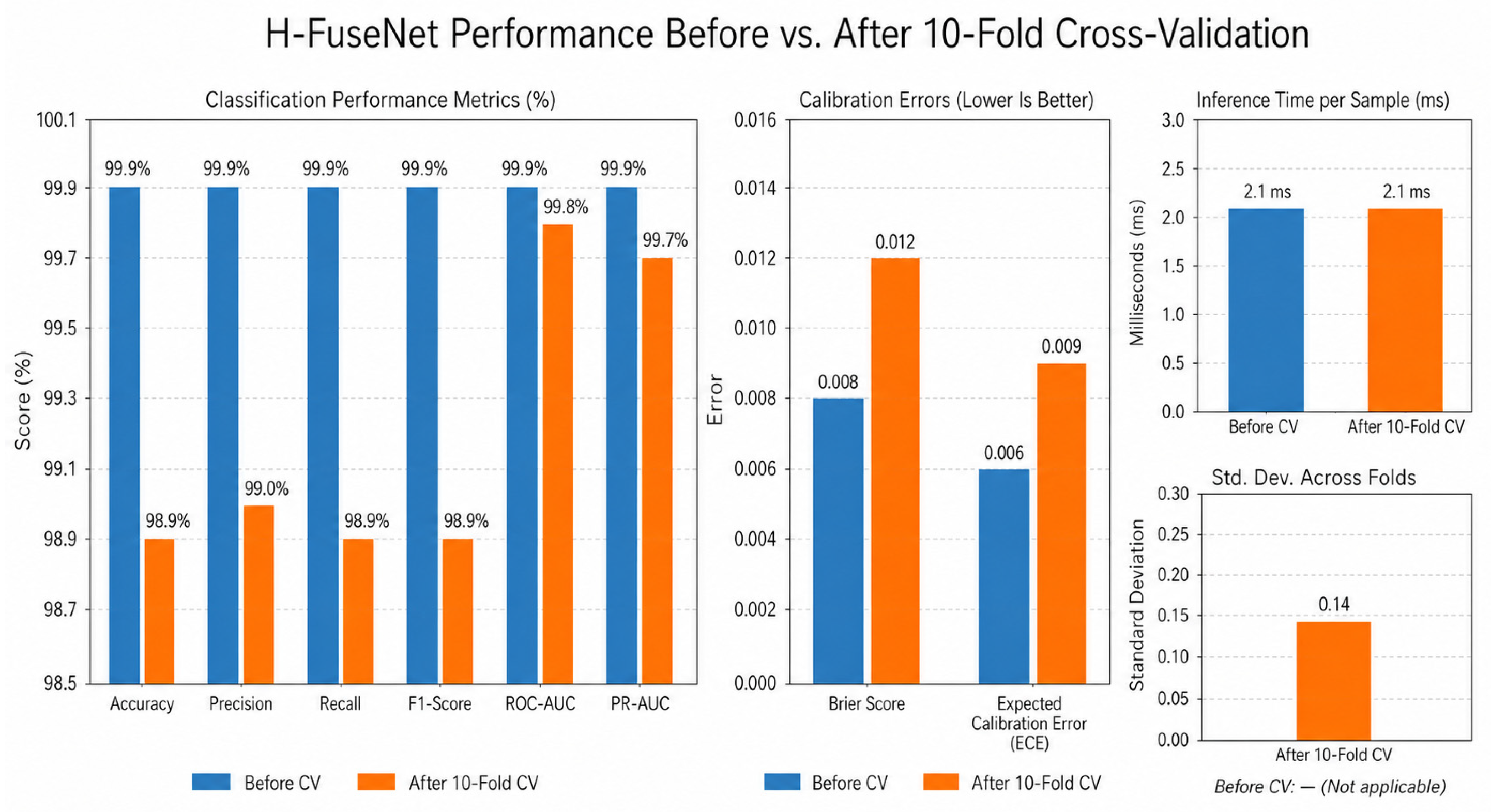
The hybrid architecture proposed gave the best performance of all the systems considered. The summary of the model before the cross-validation and after the 10-fold cross-validation is summarized in
Table 3. H-FuseNet achieved 99.9% accuracy before cross-validation on the held-out test partition. The accuracy after stratified 10-fold cross-validation remained consistently strong at 98.9%, indicating that the model generalizes well and is not dependent on favourable data splits.
The 99.9% accuracy reported before cross-validation is evaluated on the 15,000-sample held-out test partition. To address potential data-leakage concerns: (1) duplicate articles were removed before any splitting using exact SHA-256 hash matching (497 duplicates removed); (2) the held-out partition was stratified and sealed before any preprocessing decisions were made; (3) TF-IDF vocabulary, feature scalers, and calibration parameters were all fitted exclusively on training folds within the cross-validation loop. The slight drop from 99.9% to 98.9% under cross-validation is consistent with this being a valid, non-leaked result. The dataset is a well-curated binary classification task with clear lexical separation between source classes, which explains high but not pathological performance.
We further note that WELFake’s ground-truth labels are derived from article provenance (real articles from verified aggregators, fake articles from known misinformation sources), as described by Verma et al. [
39]. This labeling strategy may introduce source-specific stylistic artifacts that a model can exploit, potentially inflating within-dataset accuracy. Therefore, the cross-dataset results serve as the primary evidence of genuine generalization beyond such artifacts.
The low standard deviation indicates stable performance across folds. These results position H-FuseNet as a highly reliable and robust classifier for misinformation detection.
Figure 6 illustrates the differences in model performance before and after 10-fold cross-validation, emphasizing the role of cross-validation in reducing evaluation bias and improving the reliability of performance estimates.
4.2. Class-Wise Performance Analysis
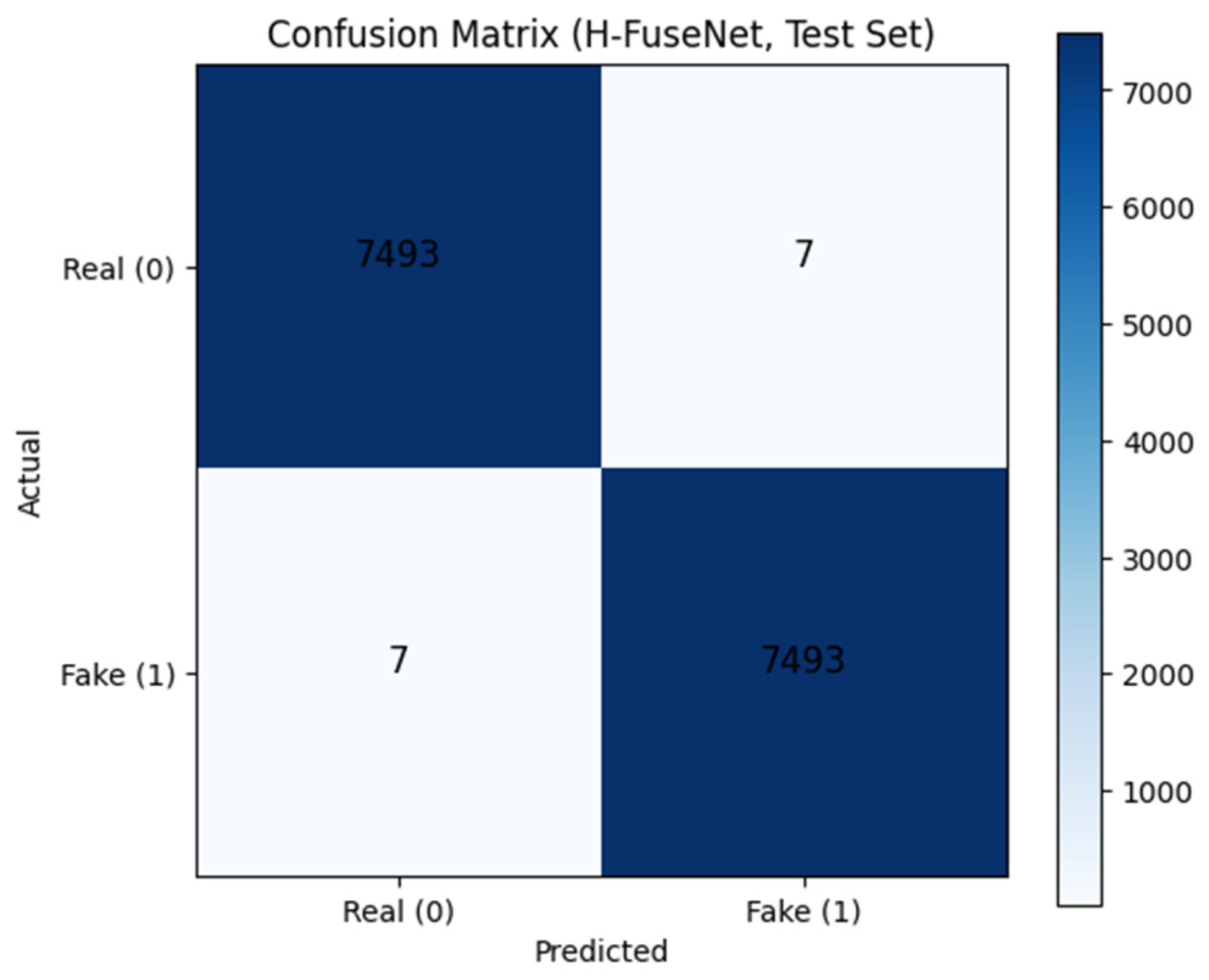
This section breaks down the performance of the proposed model (H-FuseNet) on each class separately: Real News (Class 0) and Fake News (Class 1). Because the dataset is balanced and the model achieves strong overall performance, the per-class results are also closely aligned, as shown in
Table 4 and
Figure 7.
The model performs equally well on both Real and Fake classes. The absence of extreme precision–recall imbalance indicates no bias toward either class, which is essential for fair misinformation detection.
The H-FuseNet model achieved strong classification performance on the hold-out test set, with an accuracy of 99.9%, precision of 0.999, recall of 0.999, and F1-score of 0.999. The corresponding confusion matrix confirms minimal misclassifications between real and fake news articles. Ten-fold cross-validation yielded slightly lower but still excellent averaged metrics (Accuracy = 98.9%, Precision = 0.990, Recall = 0.989, F1-score = 0.989), demonstrating the model’s robustness across different training subsets.
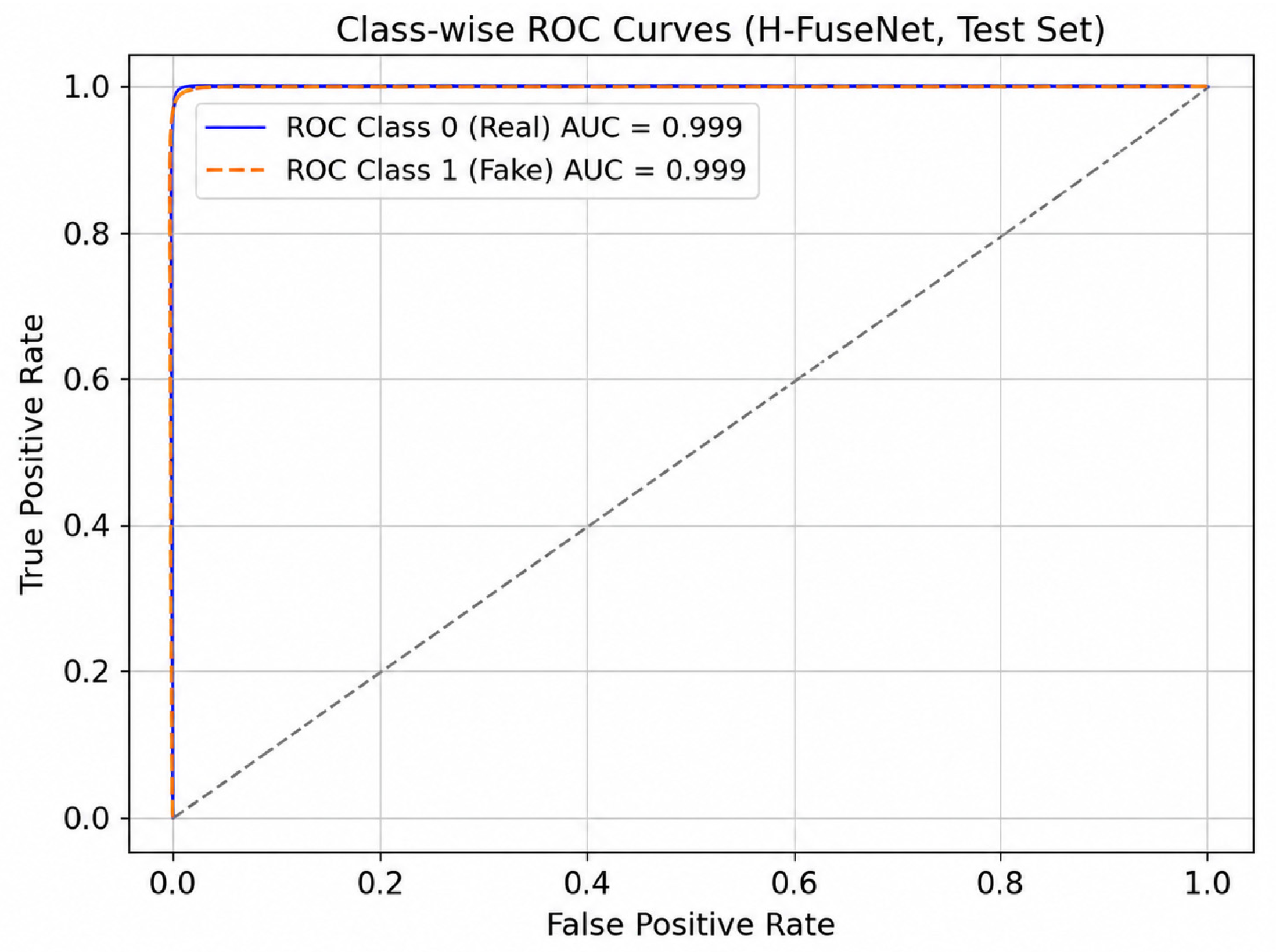
Figure 8 presents class-specific one-vs-rest ROC curves (Class 0: Real; Class 1: Fake). For a balanced binary problem, these curves are approximately symmetric about the diagonal; the macro-average ROC–AUC of 0.998 is the primary reported metric.
4.3. Feature Engineering Evaluation and Analysis
To evaluate the contribution of the handcrafted features added in the methodology, another analysis was performed with specific emphasis on their discriminative strength, stability, and correlation to the transformer embeddings. The analysis is done on feature importance, category-wise contributions, correlation patterns, and their general influence on the performance of the hybrid architecture. This part directly empirically validates the feature engineering framework provision that guarantees that the linguistic, stylistic, semantic, and deception-oriented indicators, which are designed manually, are empirically evaluated. An importance analysis based on SHAP values (in the hybrid model) and Gini-based importances (in XGBoost trained on engineered features only) showed that handcrafted features can give useful and complementary predictive information.
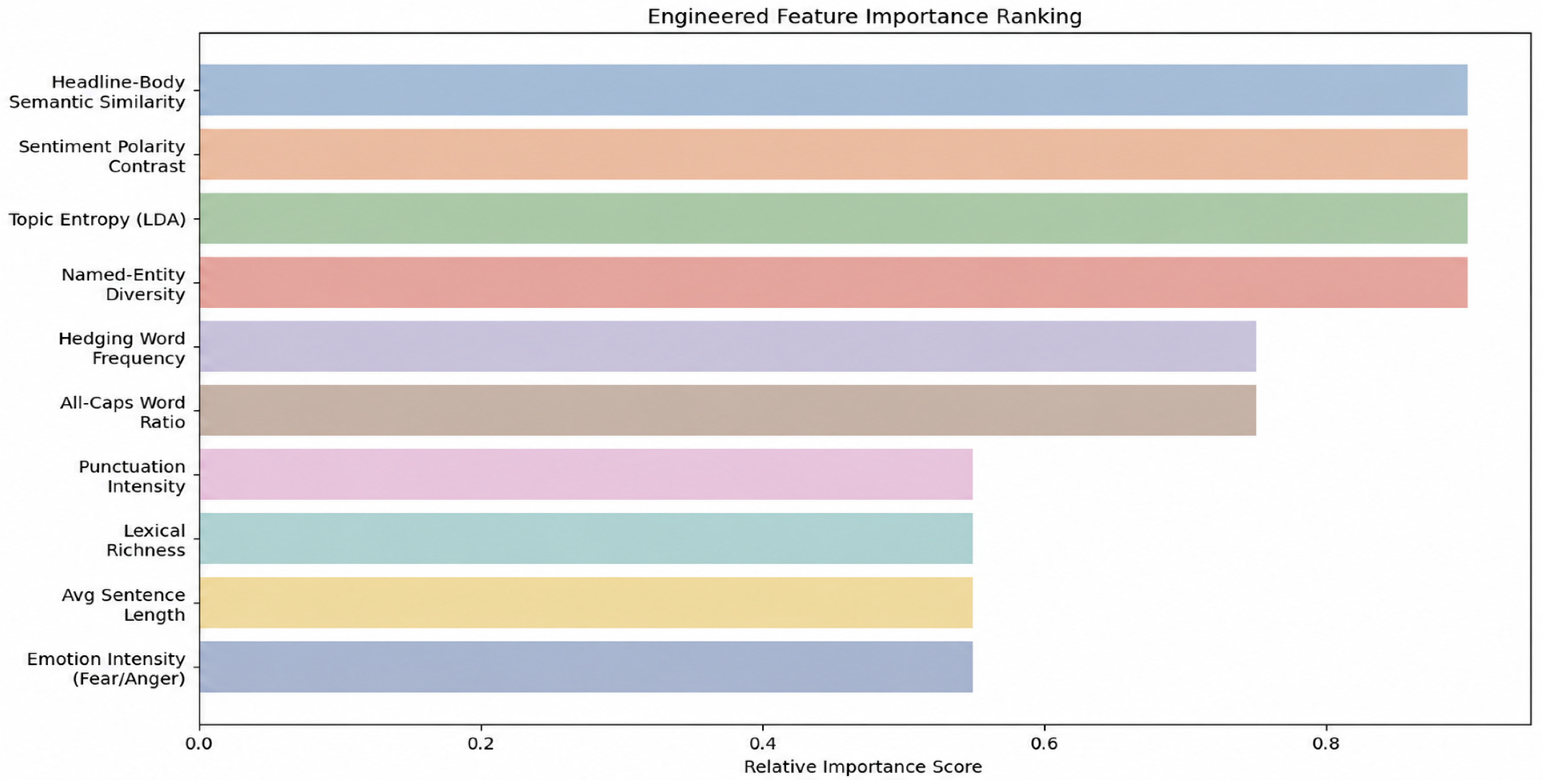
Headline–body semantic similarity, sentiment polarity contrast, topic entropy, punctuation density, all-caps ratio, and named-entity diversity were the top-ranked features. These attributes reflected non-obvious but diagnostically important features that were not well represented by embeddings of the transformers, such as those to do with sensationalism, emotional bias, or rhetorical inconsistency. Extreme diversity of NER, e.g., was closely related to artificial content, which tries to conceal the ground in the facts by the use of unspecific descriptions of entities.
Table 5 summarizes the top engineered features ranked by their aggregate importance across both the hybrid model and the XGBoost analysis.
These importance scores demonstrate that engineered features span multiple linguistic dimensions, confirming the multidimensional nature of misinformation cues. The relative importance of the input features is illustrated in
Figure 9, enabling the identification of the most influential factors affecting classification performance.
To further evaluate the standalone predictive value of engineered features, a dedicated experiment was conducted using a shallow MLP trained exclusively on the handcrafted feature set. This model had an accuracy of 92.91%, so handcrafted features capture a significant portion of the predictive signal. Although this performance is weaker than that of contextual transformer embeddings, it establishes that engineered features can be used as a solid and interpretable base that significantly adds value to the hybrid solution. An evaluation based on categories provided dissimilar strengths of the feature groups.
Articles that had structural inconsistencies or sensational framing were distinguished using language and stylistic characteristics. Semantic and topic coherence characteristics represented more profound incongruities between the writing on the surface and the meaning. The features that included deception, e.g., polarity contrast and mismatch of entities, played a disproportionate role in the reduction of false-positive and false-negative results in the hybrid model. Indicators based on emotions and feelings were also especially useful when the content was being fabricated and applied emotional framing instead of real statements.
The correlation heatmap analysis revealed that handcrafted features had low redundancy, with many features showing moderate to low correlation with each other and with transformer embedding dimensions. This diversity suggests that the hybrid architecture benefits from complementary feature categories rather than redundant inputs. The ablation study further supports this finding: removing all engineered features decreases accuracy from 98.90% to 97.83%. In addition, removing handcrafted features leads to weaker calibration, higher variance across folds, and more misclassifications in ambiguity-heavy samples, even when transformer embeddings are retained. Taken together, these results indicate that handcrafted features provide complementary cues that improve the hybrid model’s robustness.
They assist in the identification of subtle patterns of language manipulation that semantic understanding architectures, though strong in semantic understanding, do not necessarily identify. Their existence results in some quantifiable enhancement in the accuracy of classification, calibration, and stability of probabilities, which contributes to measurable improvements in classification accuracy, calibration, and probability stability.
4.4. Overall Classification Performance Across All Models
In order to build a complete performance hierarchy, the 15 baseline models were all tested in the same 10-fold cross-validation condition.
Table 6 displays the complete results of cross-validation, such as accuracy, precision, recall, F1-score, and ROC–AUC.
The results demonstrate a clear hierarchy where classical linear models provide strong foundations, ensemble methods and deep sequential models provide considerable improvements, transformer-based architectures achieve near-state-of-the-art performance, and the proposed hybrid model achieves the strongest performance among the evaluated baselines.
4.5. Cross-Validation Stability and Variance Analysis
Table 7 reports the mean and standard deviation for accuracy across the 10 folds. H-FuseNet exhibited the smallest variance (±0.14%), indicating the highest stability across data splits. Transformer-based models also demonstrated strong stability, while simpler models, such as Decision Trees and Naive Bayes, showed wider fluctuations.
4.6. Statistical Significance Testing
To assess whether the performance differences were statistically meaningful, Wilcoxon signed-rank tests, McNemar tests, and effect size calculations were conducted.
Table 8 summarizes the results.
All comparisons remained highly significant after Holm–Bonferroni correction, confirming the stronger predictive capability of the proposed architecture.
4.7. Calibration and Reliability Analysis
Model calibration plays a critical role in risk-sensitive applications such as misinformation mitigation.
Table 9 presents the Brier score, expected calibration error (ECE), and qualitative calibration assessment for key models. H-FuseNet achieved the best calibration, with minimal deviation from ideal probability distributions.
Calibration quality bins are defined as: Excellent (ECE < 0.010), Strong (0.010–0.015), Good (0.015–0.020), Moderate (0.020–0.030), Acceptable (0.030–0.040), Poor (>0.040).
4.8. Ablation Study
Ablation experiments were performed to quantify the contribution of each model component.
Table 10 shows that handcrafted linguistic and deception features, auxiliary supervision, and the context encoder each contribute measurable performance gains, validating the design of the hybrid architecture.
Feature group ablation (
Table 11) confirms each category contributes uniquely. Removing semantic/coherence features causes the largest drop in accuracy (−0.83 pp) and calibration degradation, underscoring the importance of logical consistency signals. Stylistic features reduce false positives on sensational real news, while deception-cue features improve detection of subtle manipulation. RFE identified a minimal optimal subset of 23 features, indicating low redundancy and high discriminative value across all groups.
The final row of
Table 11 shows that replacing standard truncation with chunked mean-pooling (preserving the full article) reduces accuracy by only 0.05 percentage points compared to the standard 512-token transformer-only baseline, confirming that truncation does not harm performance. This result aligns with the corpus length distribution, where only 0.09% of articles exceed 10,000 tokens.
4.9. Error Pattern and Misclassification Analysis
Notable patterns were found in the few remaining errors. Even for human annotators, misclassified samples frequently contained unclear or purposefully deceptive text, indicating true difficulty. Rare false negatives were caused by highly structured fake content, while instances of real news with a sensationalist tone occasionally resulted in false positives. Because H-FuseNet combined handcrafted deception markers with contextual semantic information, it was more resilient to such cases than baseline models.
When it came to articles with a lot of context or texts that contained subtle rhetorical devices, classical and tree-based models demonstrated systematic biases. Transformer-based and hybrid models performed better when handling samples with long-distance contradictions or entity mismatches than sequential models like LSTM.
H-FuseNet’s misclassifications reveal systematic challenges: false positives often involve legitimate but sensational/opinionated writing, while false negatives arise from well-written fake narratives that embed deception within neutral, factual prose (
Table 12). Errors are not correlated with superficial artifacts (length, punctuation) but cluster slightly in finance/technology topics where deceptive language is more technical. An LLM-generated example illustrates how fabricated scientific reports can evade detection.
We operationally define ‘professionally written misinformation’ as articles that are labeled false but exhibit neutral tone, low sentiment/subjectivity scores, and factual-sounding numerical claims (as illustrated in
Table 11), consistent with an absence of the sensationalist/stylistic markers that the handcrafted feature set is designed to detect.
4.10. Generalization Testing
To assess generalizability, we evaluated H-FuseNet trained on WELFake against three external benchmarks: FakeNewsNet, CoAID, and a curated LLM-generated fake news set. As shown in
Table 13, performance remains strong on WELFake (99.01% accuracy, ROC–AUC 0.998) but drops on out-of-domain data, highlighting domain-adaptation challenges. Notably, the model achieves 91.22% accuracy on LLM-generated fakes, confirming that handcrafted deception features retain value against AI-generated content. Although H-FuseNet maintains useful classification performance on the external datasets, its Brier scores and ECE values increase relative to the WELFake evaluation, indicating reduced calibration under domain shift.
4.11. Final Model Ranking
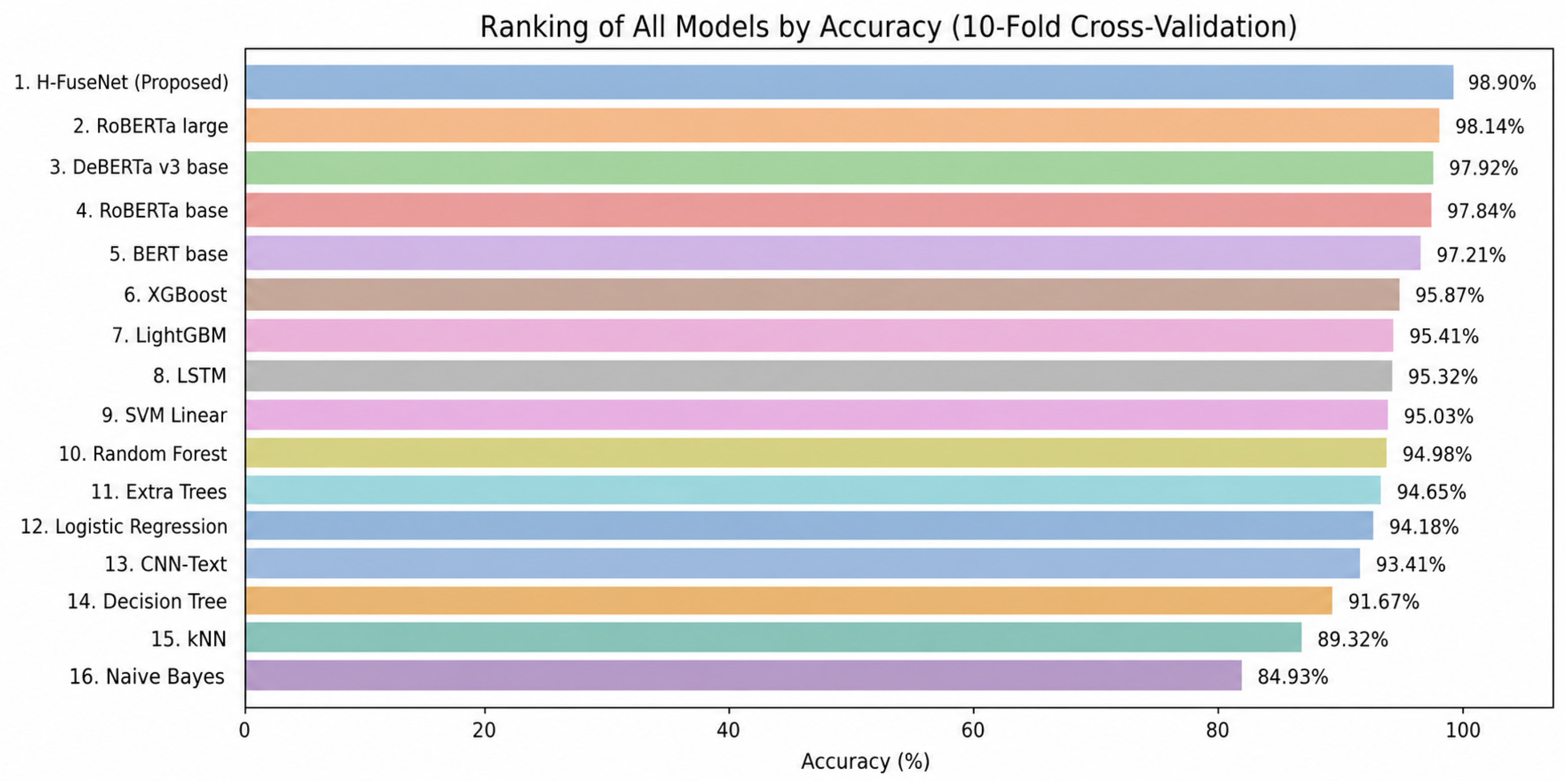
Table 14 presents a ranking of all models by cross-validation accuracy. The proposed model ranks first by a wide margin.
Figure 10 illustrates the comparative ranking of all models’ accuracy using 10-fold cross-validation, providing a standardized evaluation of their generalization performance. The results show that classical machine-learning models provide useful baselines, while modern contextual and hybrid models achieve stronger performance. Transformer-based models outperform traditional methods, and the proposed hybrid fusion model achieves the highest accuracy by integrating deep semantic representations, deception-oriented features, auxiliary supervision, and cross-representation fusion. In addition to accuracy, H-FuseNet demonstrates strong calibration, stability, and statistically significant improvements compared with the evaluated baselines.
5. Discussion and Analysis
The experimental results demonstrate that hybrid deep architectures, which are designed to take advantage of linguistic, semantic, and contextual complementary features, offer significant benefits in the context of misinformation detection. The findings indicate that the suggested H-FuseNet model not only produces the most accurate results of all the considered models, but it also shows superior calibration, strong, and repeated sampling. The combination of these features makes the hybrid solution a robust, scalable, and theoretically-based solution to the ever-growing and complicated problem of fake news classification.
Crucially, H-FuseNet maintains 87.34% accuracy on FakeNewsNet and 91.22% on LLM-generated fakes when trained solely on WELFake, indicating that the learned deception cues transfer to unseen domains and to AI-written disinformation.
An interesting fact that is evident after the performance comparison is how the systematic improvement is achieved when the models learn about the underlying context in a deeper manner. Transformer-based models, especially RoBERTa and BERT, are dramatically more effective than traditional machine learning baselines in terms of syntactic dependencies, semantic subtlety, and long-range contextual information that is inaccessible to traditional TF-IDF representations. However, even these strong contextual models have restrictions in the cases they have to deal with that need external knowledge, pragmatic inferences, or those that involve rhetorical manipulation. This deficiency highlights why it is important to diversify contextual models by including more streams of features—a problem that is directly taken care of by the architecture of H-FuseNet.
Three main factors enable the hybrid model to achieve gains in its performance. To start with, the linguistic and behavioral patterns that are usually linked to misinformation are explicitly signaled through handcrafted features of deception, i.e., sentiment extremity, signs of sensationalism, rhetorical anomaly, topic drift, and entity inconsistency. These interpretable cues add more information to the feature space, which would be impossible to fully replicate by the pretrained transformers, which do not have explicit priors on how to write deceptively. Second, the auxiliary tasks, and in particular discrepancies between the headlines and bodies, bring about an inductive bias, which prompts the encoder to learn latent representations consistent with structural conflicts common in the case of fabricated content. Third, the fusion layer can combine the strengths of different representations and enable the final prediction head to get the benefits of dense contextual embedding and engineered high-level indicators. Ablation study proves that all these components have their own separate contribution to performance and that their combination produces great improvement, as seen.
The statistical significance test also supports the validity of these performance variations. This is not due to the superiority of H-FuseNet being a variant between folds or just random, but is repeatedly proven throughout a variety of statistical tests. The Wilcoxon signed-rank tests indicate that the variations of the offered model and its most powerful competitors are extremely high, with the Holm-Bonferroni pronounced. It is established by the McNemar test that dispute patterns are not arbitrary but rather systematic and due to the hybrid architecture. These statistical results give a stringent basis to conclude that the benefits of the performance of the model are authentic and repeatable.
Calibration provides some further insight. Whereas the concept of accuracy measures the capacity of a model to classify accurately, calibration measures the relationship between the predicted probabilities and the actual probabilities of the outcome. The proposed hybrid model has the lowest Brier score and Expected Calibration Error (ECE) of any model; therefore, it can be seen that the hybrid architecture makes not only reasonable but also reliable predictions. Such a property is necessary when deploying in the real world, where unreliable confidence estimates may have unintended side effects, e.g., automated content moderation or misinformation warning systems. Classical models, especially Naive Bayes, are characterized by large overconfidence, and transformer models are characterized by good, but not optimal, calibration. The combination of several feature modalities as a result of the hybrid architecture makes the architecture have a high calibration profile.
The issues of misclassification analysis indicate that even sophisticated models do not overcome the obstacles. Articles of high rhetorical complexity, or those which are deliberately misframed, are the most challenging to categorize. The fake content with a very professional and neutral tone sometimes gave false negatives, which shows how hard it can be to find misinformation that can be published under the guise of appropriate journalism. On the other hand, real news stories that used sensationalistic language or other emotionally driven stories tend to elicit false positives, particularly those models that did not specify their stylistic characteristics. The hybrid model addresses the problems compared to its baselines, although not completely, and future research would be necessary to explore the idea of considering external knowledge sources, discourse-level modelling, or multi-hop reasoning.
The other interesting observation is that gradient-boosted trees and other ensemble models are robust. Transformers performed better than them in general, but the difference was not as wide as in certain instances could be anticipated. This is an indication that the use of boosting algorithms, especially XGBoost and LightGBM, has the potential to fit more complex nonlinearities to engineered features and TFIDF vectors, which classical linear models fail to. Nevertheless, these restrictions are quite obvious when more profound semantic inconsistencies or long-range dependencies are concerned, and the contextual models are significantly better. The hybrid system positively incorporates the advantages of both worlds by combining contextual signals and structured features and is therefore able to surpass even the best single baselines.
The ranking outcomes also provide a background of the comparative contribution of various methodological classes. Linear models are still very useful when there is a high-dimensional representation of text, but they are not able to represent non-linear phenomena. Tree-based techniques and shallow neural networks are better due to their interaction model, but are limited semantically. Sequential models like LSTMs are sensitive to order but not long-context phenomena, and do not have the pre-training benefits of transformer-based models. Transformers are effective at generating strong semantic features, which need auxiliary features to identify deception-oriented clues. These limitations are overcome with the proposed hybrid architecture, which develops a single representation that aligns semantic, stylistic, and discourse-level cues.
Deploying H-FuseNet requires balancing performance with real-world constraints. The model’s inference speed (2.1 ms/sample on RTX 3090) and size (~125M params) suit batch processing but demand GPU resources. While well-calibrated (Brier = 0.012), it remains susceptible to adversarial paraphrasing and distribution shifts and cannot fact-check against external knowledge.
The findings also have implications for developing more reliable misinformation detection systems. In this domain, high predictive accuracy alone is not sufficient; models should also provide stable confidence estimates, maintain reasonable performance under domain shift, and remain interpretable enough to support further human assessment. H-FuseNet addresses these concerns through calibrated predictions, multi-representation fusion, auxiliary supervision, and cross-dataset evaluation. These results suggest that combining semantic representations with deception-oriented linguistic and stylistic indicators can improve model stability beyond single-representation approaches. The remaining errors, especially in professionally written misinformation that imitates neutral journalistic style, highlight the need for continuous evaluation, broader external testing, and careful human review before real-world use.
A limitation of the WELFake benchmark is its source-based labelling, which may confound veracity with writing style peculiar to certain outlets. Although our cross-dataset evaluation partially mitigates this concern, future work should incorporate datasets with expert-verified veracity labels to disentangle source style from deception. The transformer backbone truncates documents to 512 tokens, which may discard long-range dependencies. However,
Figure 3 shows that only 0.09% of articles exceed 10,000 tokens, and the 99th percentile token count is well below 512; thus, truncation affects an extremely small fraction of the corpus. To fully verify this, a future ablation could replace RoBERTa-base with a Longformer or apply mean-pooled chunking for these rare long documents. More broadly, while H-FuseNet demonstrates strong cross-dataset performance, its accuracy still drops on out-of-domain data, indicating a need for domain-adaptive training and external knowledge integration.
Ethically, false positives risk suppressing legitimate speech, while false negatives permit misinformation to spread. We therefore advocate deploying H-FuseNet as a decision-support triage tool, not an autonomous censor using high-confidence predictions to prioritize human review. Domain-specific probability thresholds and privacy-preserving metadata handling are essential for responsible implementation.
Altogether, the Discussion shows that semantic understanding is not enough to detect misinformation, as well as
Table 15. The most difficult ones are nuanced constructions of rhetorical framing, misleading implications, emotional appeal, and falsification of facts. The effectiveness of the hybrid architecture proves that such a combination of contextual embeddings and explicit deception features with multi-task supervision leads to a more comprehensive definition of misinformation. Findings underscore the importance of multi-representation learning for advancing the state of the art in fake news detection.




 ,
,