Article

Effect of Notch Depth on Mode II Interlaminar Fracture Toughness of Rubber-Modified Bamboo–Coir Composites


1
Department of Civil Engineering, Jyothy Institute of Technology, Affiliated to Visvesvaraya Technological University, Belagavi 590018, India
2
Center for Incubation Innovation Research and Consultancy, Jyothy Institute of Technology, Bengaluru 560082, India
3
Faculty of Pharmaceutical Sciences, Chulalongkorn University, 254, Payathai Road, Bangkok 10330, Thailand
*
Author to whom correspondence should be addressed.
J. Compos. Sci. 2025, 9(12), 704; https://doi.org/10.3390/jcs9120704
Submission received: 13 November 2025 / Revised: 3 December 2025 / Accepted: 10 December 2025 / Published: 16 December 2025
(This article belongs to the Section Biocomposites)

Abstract

This study investigates the Mode II fracture behavior of bamboo–coir–rubber (BCR) hybrid composite panels developed as sustainable alternatives for wood-based panels used in structural applications. The composites were fabricated using alternating bamboo and coir layers within a polypropylene (PP) thermoplastic matrix, with styrene–butadiene rubber (SBR) incorporated as an additive at 0–30 wt.% to enhance interlaminar toughness. Commercial structural plywood was tested as the benchmark. Mode II interlaminar fracture toughness (GIIc) was evaluated using the ASTM D7905 End-Notched Flexure (ENF) test, supported by optical monitoring to study crack monitoring and Scanning Electron Microscopy (SEM) for microstructural interpretation. Results demonstrated a steady increase in GIIc from 1.26 kJ/m2 for unmodified laminates to a maximum of 1.98 kJ/m2 at 30% SBR, representing a 60% improvement over the baseline and nearly double the toughness of plywood (0.7–0.9 kJ/m2). The optimum performance was obtained at 20–25 wt.% SBR, where the laminated retained approximately 85–90% of their initial flexural modulus while exhibiting enhanced energy absorption. Increasing the initial notch ratio (a0/L) from 0.2 to 0.4 caused a reduction of 20% in GIIc and a twofold rise in compliance, highlighting the geometric sensitivity of shear fracture to the remaining ligament. Analysis of Variance (ANOVA) confirmed that the increase in GIIc for the 20–25% SBR laminates relative to plywood and the unmodified composite is significant at p < 0.05. SEM observations revealed rubber-particle cavitation, matrix shear yielding, and coir–fiber bridging as the dominant toughening mechanisms responsible for the transition from abrupt to stable delamination. The measured toughness levels (1.5–2.0 kJ/m2) position the BCR panels within the functional range required for reusable formwork, interior partitions, and transport flooring. The combination of renewable bamboo and coir with a thermoplastic PP matrix and rubber modification hence offers a formaldehyde-free alternative to conventional plywood for shear-dominated applications.

1. Introduction

Increasing global emphasis on sustainability and circular economy principles has driven the replacement of timber and petroleum-derived composites with natural fiber-reinforced materials. Natural-fiber-reinforced composites have gathered remarkable attention as sustainable alternatives to wood-based laminates in structural and semi-structural applications. Their low density, renewability, and biodegradability make them attractive for eco-efficient material systems [1]. Among the various natural reinforcements, bamboo and coir stand out mainly due to their complementary mechanical and morphological characteristics. Bamboo possesses high tensile and flexural strength, typically in the range of 400–600 MPa and 80–120 MPa, respectively, with a stiffness-to-weight ratio much superior to hardwoods and glass fiber composites [2,3]. In contrast, coir fibers, owing to their high lignin content (40–45%) and low cellulose content, exhibit exceptional ductility and resilience, allowing impact strength improvements up to 30–40% when incorporated into hybrid natural fiber laminates [4,5].
Despite these advantages, single-fiber composites often show anisotropic strength and limited crack resistance. Hybridization offers a rational means to overcome these limitations. Studies on bamboo–coir hybrid laminates by previous research works have demonstrated that coir acts as a crack-bridging and energy-dissipating phase, helping to delay the delamination propagation and enhance post-fracture toughness [6]. In one of the studies, it was reported that a 27% increase in flexural toughness and 35% increase in impact strength were observed when coir mats were introduced between bamboo layers in epoxy composites [7]. Another study observed that replacing 30% bamboo plies with coir mats reduced the brittleness and promoted stable crack growth under flexure and tensile loading [8].
Although bamboo-based laminates exhibit high stiffness and strength, their fracture response is mostly governed by weak or heterogeneous fiber matrix interfaces and strong anisotropy in crack propagation. Previous studies on bamboo and wood laminates have reported that interlaminar cracks tend to localize along resin-rich and poorly wetted regions, producing unstable delamination under shear-dominated loading and limited energy dissipation at the crack tip [9]. This behavior is particularly critical for structural panels where sliding-type (Mode II) cracking controls serviceability and durability. When a ductile phase and a secondary fiber system is introduced, the bamboo coir rubber architecture aims to mitigate the weakness, where rubber domains provide crack tip blunting and plastic deformation capacity, while coir fibers act as bridging elements that delay delamination and promote stable crack advance under Mode II loading [10].
Studies indicated that polypropylene (PP) fabric-based bamboo composites achieved a 15–20% higher tensile strength and 3% lower porosity when compared to powder matrices [11]. The thermoplastic nature of PP further facilitates recycling and thermal shaping, aligning with sustainable design principles [12]. In multiple previous studies, PP fabric was chosen as the thermoplastic matrix for its superior interfacial compatibility and processability as compared to powdered or pelletized PP. Utilization of PP in woven fabric form ensures uniform resin melting, enhanced fiber wetting, and minimized void content during hot press molding [7,13]. Rubber toughened matrices are known to enhance the matrix ductility and energy absorption through crack-tip blunting, cavitation and shear yielding mechanisms. In thermoplastic systems, rubber inclusions can increase both Mode I and Mode II fracture energy by 40–80% depending on dispersion and particle size [14,15]. Previous studies have also reported that Ethylene Propylene Diene Monomer (EPDM) modified polypropylene composite exhibited 63% improvement in Mode II fracture toughness (GIIC) due to delayed shear crack propagation [16]. However, similar toughening strategies have not been explored in bamboo–coir hybrid laminates, particularly under Mode II fracture, which governs the delamination and flexural performance. Mode II fracture toughness is a critical parameter that defines the resistance to sliding or in-plane shear cracking, which is often observed in bending, panel deflection or adhesive layer failures [17]. The End-Notched Flexure (ENF) test is one of the standards for evaluating Mode II fracture behavior in laminated composites as per ASTM D7905 [18]. Previous works on natural fiber composites indicate that GIIc values typically range between 0.4 and 1.2 kJ/m2, depending on fiber type, interface quality, and matrix ductility [19,20]. Inclusion of 10% by weight elastomeric modifier indicated an increased GIIc of sisal–PP composites from 0.52 to 0.88 kJ/m2 [21]. Furthermore, an increase in notch depth significantly reduced the shear toughness, thus indicating sensitivity to initial crack length and fiber bridging behavior [22].
While plywood remains a dominant material for formwork and moderate structural applications, its sustainability and durability limitations have motivated the search for viable natural fiber-based alternatives. Plywood production also depends extensively on hardwood timber, leading to significant deforestation and loss of forest carbon sinks [23]. The commonly used bonding adhesives include phenol formaldehyde and urea formaldehyde resins. These adhesives release volatile organic compounds (VOCs) that pose environmental and health concerns during manufacturing and service life [24]. Furthermore, in tropical and humid conditions, plywood panels are also prone to delamination, fungal attack, and moisture-induced degradation, which reduce their service life and increase maintenance costs. Moreover, the recycling or disposal of resin-bonded plywood is challenging due to the presence of thermoset binders that do not remelt or degrade easily [25].
Commercial plywood panels, which are widely used in load-bearing and structural applications, exhibited Mode II fracture energies between 0.8 and 1.1 kJ/m2 [26,27]. There is hence a need to develop a bio-hybrid composite with comparable Mode II fracture resistance and improved recyclability and moisture tolerance. This shall directly address both the environmental and functional drawbacks of traditional plywood, supporting the shift towards sustainable construction materials.
As summarized in Table 1, conventional plywood exhibits moderate stiffness and strength with limited ductility and recyclability, mainly due to thermoset adhesive bonds. In contrast, bamboo and coir–fiber-reinforced composites contribute higher stiffness and strength, while coir composites offer improved ductility and energy absorption. This synergistic behavior enables the design of hybrid laminates with tailored stiffness-toughness balance suitable for structural applications. Further, both bamboo and coir are renewable and biodegradable fibers compatible with thermoplastic matrices such as polypropylene, facilitating enhanced recyclability compared to conventional plywood.
The present study investigates the Mode II fracture behavior of bamboo–coir–rubber (BCR) hybrid composite panels fabricated using a polypropylene (PP) matrix. The focus is on quantifying the influence of notch depth and amount of rubber inclusion on the critical strain energy release rate (GIIc) and compliance behavior using the ASTM D7905 ENF test. Digital Image Correlation (DIC) is employed to monitor real-time crack propagation, and the results are benchmarked against structural plywood. The study hence provides a novel experimental framework for understanding the shear fracture mechanisms in thermoplastic bio-hybrid laminates, bridging the gap between renewable material design and fracture toughness.
Compared to conventional plywood bonded with phenol formaldehyde resin, the proposed BCR laminates offer multiple advantages. This includes the usage of a fully thermoplastic and recyclable PP matrix instead of non-recyclable thermoset adhesives, the absence of formaldehyde emissions, improved damage tolerance due to rubber-induced plasticity and coir fiber bridging, and nearly double the Mode II fracture toughness of structural plywood. Moreover, the bamboo coir architecture utilizes rapidly renewable, low-carbon fibers, thereby reducing the dependence on hardwood veneers.

2. Materials and Methods

2.1. Materials

The primary reinforcements used in this study were bamboo strips and coir mats, while PP served as the thermoplastic matrix. Bamboo strips (Dendrocalamus strictus) with an average density of 800 kg/m3 were procured from a local supplier in Bengaluru, Karnataka, India. The culms were slit into strips measuring 450 mm in length, 8 mm in width, and 2 mm in thickness. Coir mats, with a density of 1200 kg/m3, were sourced from coir manufacturing vendors in Bengaluru, Karnataka, India. They were cut into square sheets of 450 mm × 450 mm to match the bamboo strip length and ensure consistent layer coverage. Both fiber components were oven-dried at 60 °C for 24 h prior to layup to eliminate residual moisture and prevent vapor-induced porosity during hot pressing. The matrix material, PP, was employed in the form of nonwoven webs with a density of 900–920 kg/m3 and an average fiber diameter of 18–22 µm, supplied by Indian Oil Corporation, New Delhi, India.
The commercial plywood used as the benchmark consisted of seven veneers of Gurjan (Dipterocarpus spp.) bonded using phenol-formaldehyde (PF) adhesive in a cross-ply configuration [0/90] repeated throughout the thickness. The veneer thickness was approximately 1 mm each, resulting in an overall panel thickness of 10 mm. To investigate the influence of rubber modification on interlaminar fracture behavior, styrene butadiene rubber (SBR) granules with a particle size distribution in the range of approximately 1–4 mm were introduced between selected PP layers. The SBR granules of grade 1502 were procured from Laxness India Pvt. Ltd., Mumbai, India. The granules were manually dispersed to obtain a reasonably uniform distribution within the interlaminar regions before hot pressing. The use of dispersed rubber particles as a toughening phase in thermoplastic matrices is well established, with multiple studies showing that cavitation of rubber domains can trigger localized shear yielding and enhance energy dissipation during crack propagation [30].

2.2. Panel Fabrication

Hybrid bamboo–coir–rubber composite panels were fabricated by a hot compression molding process designed to achieve uniform impregnation of natural fibers within the thermoplastic matrix. Prior to assembly, the fiber and matrix components were carefully weighed to maintain a fiber-to-matrix ratio of 80:20 by weight, with an equal contribution of 50% bamboo and 50% coir within the total fiber content.
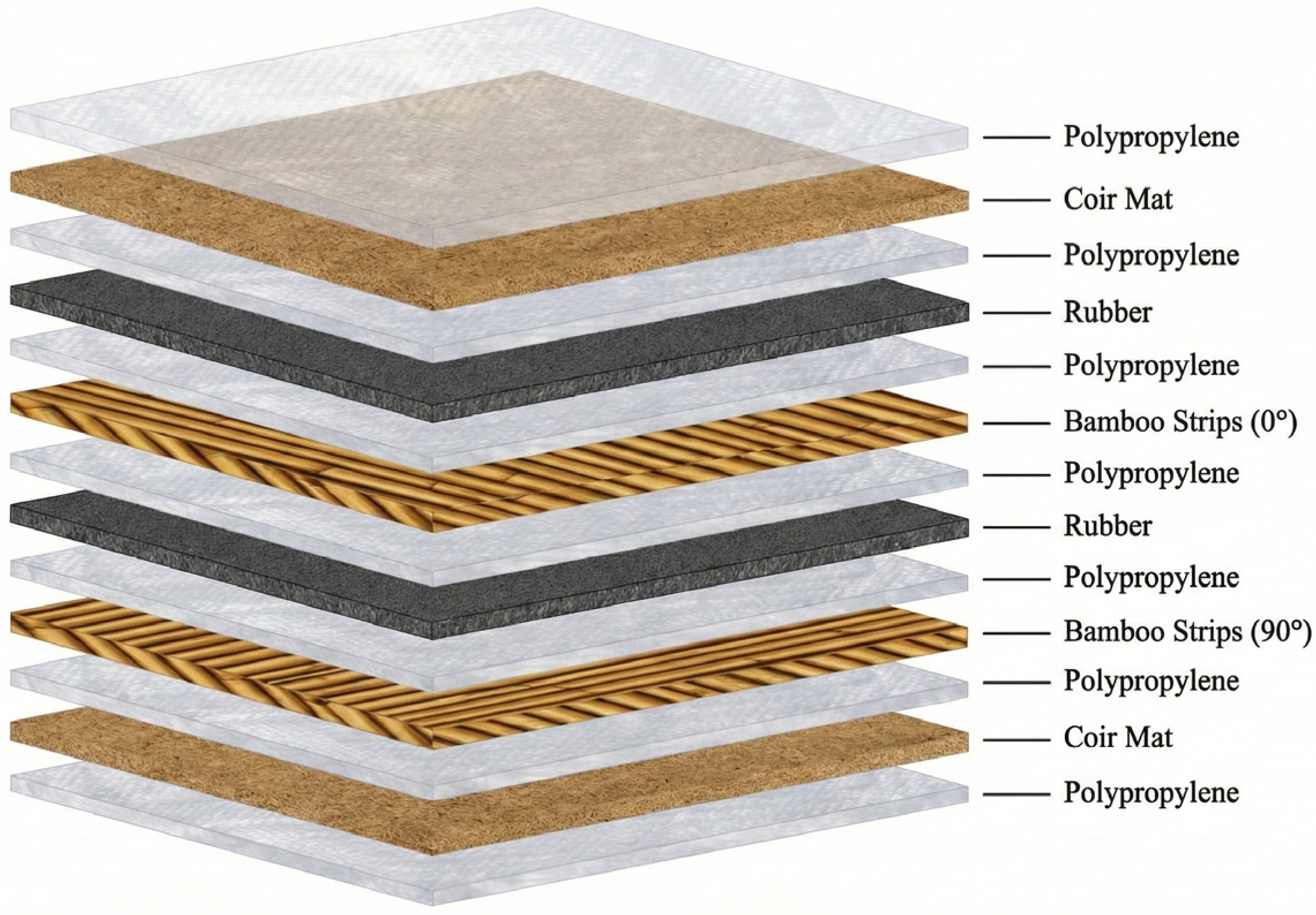
Each layup was arranged in a sandwich configuration in which alternating layers of bamboo strips and coir mats were interleaved with PP fabric layers acting as a thermoplastic matrix. The stacked assembly was placed between two aluminum foils to prevent adhesion and promote uniform heat transfer. Consolidation was formed in a custom-fabricated hydraulic compression mold designed by Om Shakti Hydraulics Pvt. Ltd, Bengaluru, India. at 180 °C and 2000 psi for 180 min, followed by cooling under pressure to avoid delamination.
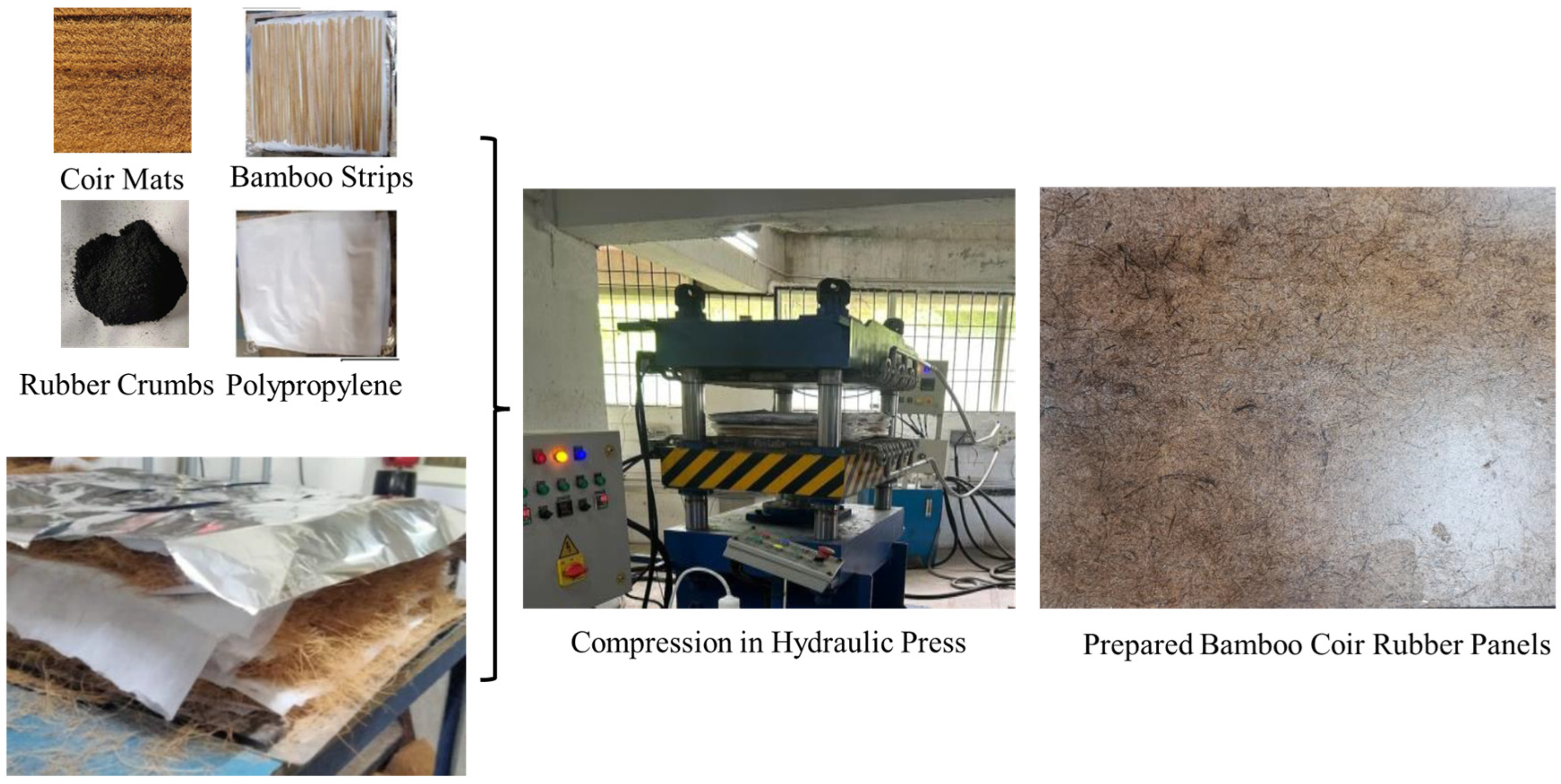
To investigate the influence of rubber modifications on the interlaminar fracture behavior, SBR was introduced between selected PP matrix layers at seven different levels, 0%, 5%, 10%, 15%, 20%, 25% and 30%, by additional weight of the total mix. While the 0% condition represented the unmodified baseline composite, 5–15% SBR levels were designed to assess the moderate rubber modification, and 20–30% SBR levels were used to examine the upper threshold. The composition of the hybrid laminates is summarized in Table 2. This progressive variation was considered to evaluate the balance between matrix ductility, interlaminar shear toughness, and stiffness retention, thus enabling the identification of the optimum rubber content for structural applications. The final consolidated panels measured 450 mm × 450 mm × 10 mm. All panels were conditioned at 25 ± 2 °C and 55 ± 5% RH for 24 h prior to testing. Figure 1 presents the illustrative representation of the layer arrangement of the laminates before the molding process. Figure 2 illustrates the overview of the fabrication stages of BCR panels, including the layer arrangement, molding, and final consolidation. The PP-SBR system forms a heterogeneous two-phase matrix consisting of a continuous PP phase with manually dispersed SBR particles. No chemical bonding occurs between PP and SBR.

2.3. Specimen Preparation and Notch Geometry

Mode II interlaminar fracture specimens were fabricated following the procedures outlined in ASTM D7905. The standard specifies the test method to determine the Mode II interlaminar fracture toughness of fiber-reinforced polymer matrix composites. Rectangular specimens with 100 mm × 20 mm × 10 mm dimensions were precisely cut from the consolidated hybrid panels using a diamond-tipped circular saw to ensure clean edges and minimal fiber pullout. Considering a total length (2L) of 100 mm and a half span (L) of 50 mm, a notch of length a0 was introduced at the midspan of each specimen to promote controlled crack propagation during testing. Three different notch-to-span ratios (a0/L) were considered, 0.2, 0.3, and 0.4. The span (L) is the total length of the sample between the supports and is fixed at 50 mm in this study. This variation was chosen to assess the crack propagation sensitivity with respect to initial crack size while maintaining consistent specimen geometry and also ensuring that the cracked region remains unsupported. The pre-cracks of the ENF specimen were introduced after cutting to the final dimensions. The notch was introduced precisely at the glue line between veneer layers 3 and 4 in the 7-ply configuration. An initial slit was machined at the midspan using a diamond-tipped circular saw of 0.3 mm thickness to obtain a straight notch. To minimize artificial blunting effects, the machined slit was sharpened by gently tapping a fresh razor blade into the notch root, extending the pre-crack by approximately 1–2 mm. All the notches were aligned along the mid-plane of the laminates and oriented normal to the span direction to promote sliding-dominated crack growth during ENF testing. After the introduction of the notch, all specimen edges were carefully polished with fine-grade sandpaper to prevent unintended crack initiation from edge defects. For comparison, structural plywood panels of identical dimensions were also prepared and tested under identical conditions. This benchmarking provided a baseline for evaluating the fracture performance of the hybridized bamboo coir PP panels relative to the conventional engineered wood products. Five samples of each combination were tested after 24 h of conditioning at ambient laboratory conditions. Table 3 lists the combinations of a0/L ratios and SBR contents of the test matrix.

2.4. End-Notched Flexure (ENF) Test Configuration

Mode II interlaminar fracture tests were performed using the ENF configurations, which is widely accepted for evaluating the shear-dominated fracture toughness of laminated composites. The ENF test is a reliable method for determining the critical strain energy release rate under pure shear loading [18,31].
The testing was carried out on a Universal Testing Machine (UTM) (Model: MTS Exceed E43, MTS Systems Corporation, Eden Prairie, MN 55344 USA) with a 10 kN capacity equipped with a high-precision load cell. The specimens were placed in a three-point bending arrangement with a total span (2L = 100 mm), giving a span–width ratio of L/W = 2.5. The cross-head displacement rate was maintained at 4 mm/min. During the loading conditions, the notched region was kept free of support over a length of a0 + Δa to facilitate stable slide mode crack propagation under an increasing shear load. The term Δa represents the incremental crack growth beyond the initial pre-crack (a0). Thus, the total cracked length during propagation is a0 + Δa. This unsupported configuration is critical because it prevents the cracked region from contacting the lower roller support, thereby eliminating any Mode I component at the crack tip. As a result, the crack can propagate in a pure shear (Mode II) manner along the midplane of the laminate, thus allowing for accurate evaluation of Mode II strain energy release rate (GII) and critical fracture toughness (GIIc). Figure 3 presents the schematic representation of ENF test specimen as per ASTM D7905.
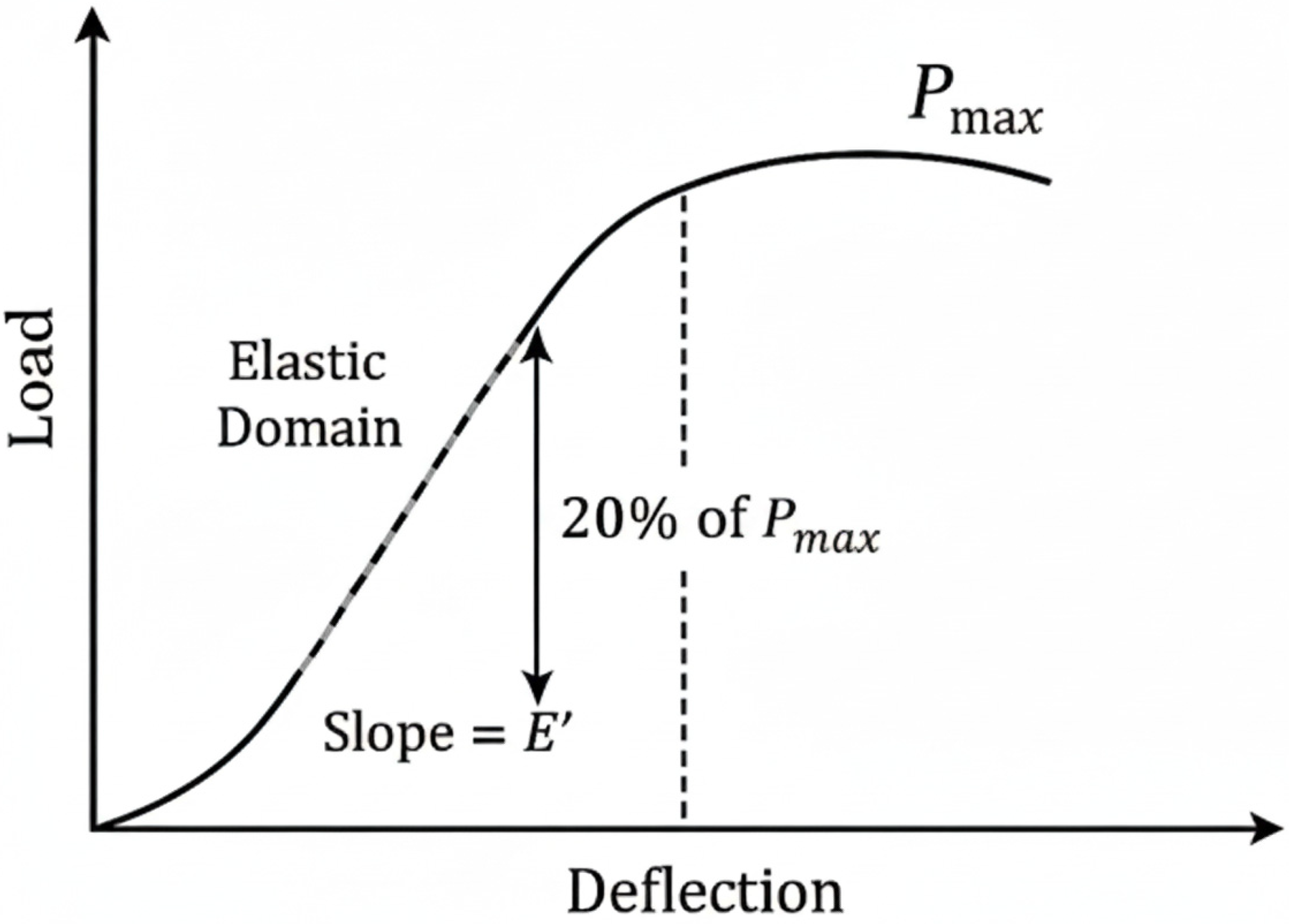
The load (P) and mid-span deflection (δ) were continuously recorded during the testing process. The compliance (C) of each specimen was determined as the ratio of displacement to load (C =   δ P ). Further, the mode II strain energy release rate (GII) was calculated based on linear elastic beam theory using Equation (1). Here, a is the total crack length ( a = a 0 + Δ a ) , b is the specimen width, L is half-span, and E′ is the effective flexural modulus. E′ is determined from the initial linear portion of the load–displacement curve. The modulus is obtained by fitting the initial slope of the P-δ curve before any visible crack growth, ensuring that the reading corresponds to the purely elastic region of the response.
G I I = 9 a 2 P 2 2 b L 3 E
Mode II fracture toughness GIIc represents the critical strain energy release rate required to initiate crack growth under pure shear. During the testing process, GII increases progressively with applied load and crack length until it reaches a critical value corresponding to the onset of crack propagation. Alternatively, GIIc can also be computed directly from compliance measurements using Equation (2) derived from beam theory differentiation. Here, d C d a represents the slope of the compliance–crack-length (C-a) curve obtained from the experiment.
G I I c = P 2 2 b d C d a
Figure 4 illustrates the procedure to determine the effective flexural modulus (E′) of the BCR laminates and plywood specimens during ENF testing. From the load deflection curve, the initial linear portion of the curve up to 20% of the peak load is where the specimen behaves purely elastically and no crack growth occurs. The slope of this elastic region represents the flexural stiffness of the uncracked ligament and is used to compute E′ following ASTM D7905.

2.5. Optical Image-Based Crack Tracking and Monitoring

Crack initiation and propagation during the ENF test were monitored using an optical image-based tracking method. The crack tip was monitored by analyzing high-resolution video frames captured during loading. Prior to testing, the specimen surface near the notch was slightly sprayed with a random speckle texture to enhance contrast for image processing. The loading sequence was recorded at 1080 p and 30 fps, and still frames were extracted at regular crack extension intervals of 0.5 mm. Using ImageJ 1.54r version, the crack tip position was identified through greyscale contrast gradients and tracked relative to a fixed reference line with a measurement resolution of ±0.05 mm. The incremental crack extension (Δa) obtained from ImageJ was synchronized with the corresponding load (P) and displacement (δ) values from the UTM to calculate the compliance C = δ P and the derivative d C d a for GIIc evaluation.

2.6. Microstructural Analysis

To investigate the fracture mechanisms and confirm the role of SBR in enhancing the mode II toughness, the fracture surfaces of the tested specimen were analyzed using a Scanning Electron Microscope (SEM) Model JEOL JSM-IT300, JEOL Ltd., Akishima, Tokyo, Japan, operating at an accelerating voltage of 10–15 kV. The samples were prepared by cutting small sections, approximately 5 mm × 5 mm from post-fracture delamination zones. The fracture surfaces were sputter-coated with a thin layer of gold–palladium alloy. The specimens were examined for SBR particle cavitation and shear yielding in the PP matrix, coir bridging and pullout marks, interfacial debonding between bamboo coir and matrix, and differences in fracture roughness between the brittle plywood and ductile rubber modified BCR composites.

3. Results and Discussion

3.1. Load–Displacement Behavior

The load displacement response of the bamboo–coir–rubber composite panels was evaluated under Mode II loading using the ENF test. The panels were prepared using varying SBR content (0–30%) and three initial notch ratios (a0/L = 0.2, 0.3 and 0.4). Plywood specimens were also tested under similar conditions as a benchmark. The peak load and corresponding midspan deflection for all the specimens are summarized in Table 4.
Table 4 summarizes the mean peak load, mid-span deflection and flexural modulus of BCR composites under Mode II loading for different SBR contents and notch ratios (a0/L), compared with plywood benchmarks. For a constant notch ratio, Pmax showed a systematic reduction of approximately 15–20% when the SBR content increased from 0% to 25%. The corresponding δmax decreased by 15–25%. This indicated a clear modulus–ductility trade-off. At a0/L = 0.2, the SBR 0% sample exhibited a load capacity of 165 N and deflection of 3.5 mm, whereas the 25% SBR laminate reached 140 N and 4.1 mm, representing a 15% decrease in load and a 17% increase in deformation. Further addition to 30% SBR reduced the load to 135 N with marginal gains in deflection up to 4.25 mm. This suggested a saturation of the toughening mechanism beyond this level.
Across all the SBR levels, increasing the notch ratio from 0.2 to 0.4 caused a 16–18% decrease in Pmax and 25–30% increase in δmax. This inverse relationship is consistent with the reduction in uncracked ligament length and shear transfer area, as reported in the Mode II fracture of laminated composites [32]. The increase in deflection with crack length suggests that longer pre-cracks promote controlled crack-propagation and delayed catastrophic failure, a behavior comparable to rubber-toughened epoxies [33] and natural fiber laminates [34].
At a0/L = 0.2, the unmodified laminate (SBR 0%) exhibited a load capacity of 165 N, a deflection of 3.5 mm, and a E′ = 590 MPa, whereas the 25% SBR composite recorded 140 N, 4.1 mm and E′ = 427 MPa. This represented a 15% decrease in strength and a 28% reduction in stiffness, accompanied by 17% higher deformation. Similar trends were reported for rubber-toughened natural fiber laminates, where the incorporation of 15–25 wt.% elastomeric modifiers has led to 20–35% reduction in flexural modulus but a 15–30% increase in strain to failure, reflecting enhanced energy absorption [33]. Further, the present modulus range is consistent with the 450–650 MPa reported for coir-polypropylene and bamboo–epoxy hybrids [28,32] and aligns with rubber-toughened epoxy laminates exhibiting a 30–40% reduction in flexural modulus upon elastomer addition [33]. Beyond 25% SBR, further reduction in modulus to 400 MPa (SBR 30%) indicated a saturation in the rubber-induced toughening effect, where matrix softening outweighs energy-dissipation benefits. This effect was reported in SBR- and CTBN-modified epoxy systems beyond 20 wt.% rubber content [16].
The plywood specimen recorded Pmax values of 154 N, 140 N, and 126 N for the three notches, respectively. Although the effective flexural modulus remained comparable to that of the unmodified hybrid at lower crack ratios, plywood exhibited 20–25% sharper post-peak drops, thereby characterizing brittle adhesive failure. In contrast, BCR laminates with 15–25% SBR displayed smoother post-peak responses sustaining 5–10% peak load beyond failure, confirming stable crack growth and improved damage tolerance. This improvement arises from rubber-particle cavitation and local shear yielding, which leads to blunting of the crack tip [33] along with fiber bridging and pullout of coir fibers at the interlaminar interface [35].
Thus, an optimum SBR content of 20–25% offers the best stiffness–ductility balance retaining 85–90% of the original load capacity while achieving 20–25% higher deflection and energy absorption. These levels are in line with other hybrid composite systems [32,34] and make the material suitable for structural panels and formwork-like applications requiring both strength retention and improved energy dissipation.

3.2. Crack Propagation and ImageJ-Based Analysis

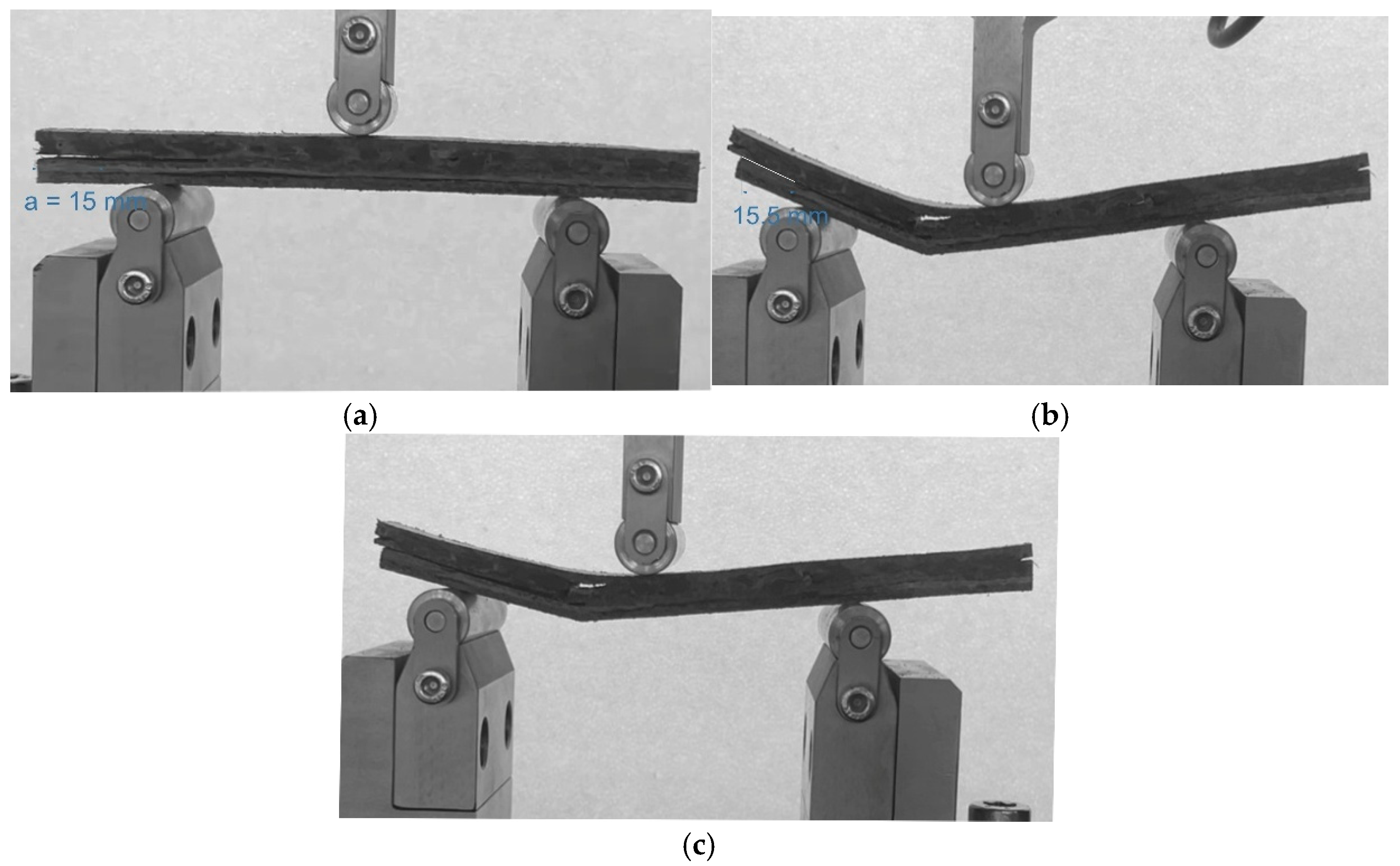
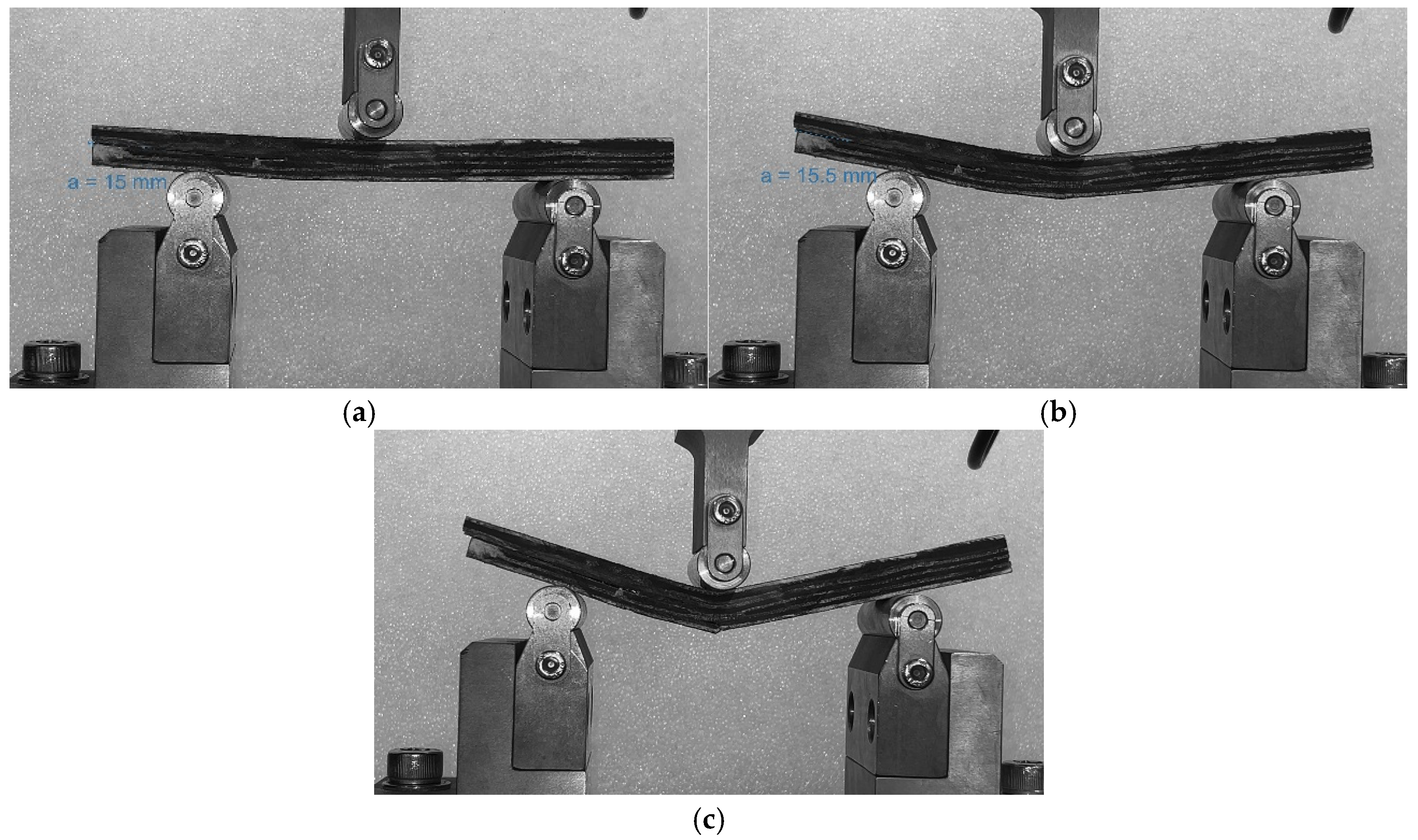
The evolution of crack growth (Δa) during Mode II loading was carefully monitored using high-resolution digital imaging. The gray-scale sequential images were analyzed using ImageJ to measure incremental crack extension with a precision of ±0.05 mm. At every 0.5 mm increase in crack length, corresponding P and δ were recorded. This allowed for direct evaluation of compliance (C) and subsequent computation of GII. Figure 5 and Figure 6 present the ImageJ analysis of a 0.3 a0/L ratio, 15% SBR, and a 0.3 a0/L ratio of plywood.
While Figure 5 and Figure 6 illustrate the ImageJ-based crack tracking procedure, analyzing the failure modes as a function of rubber concentration is also necessary. The failure behavior transitioned systematically with increasing SBR content. In 0% SBR laminates, failure was dominated by brittle interlaminar separation along the PP layer, with minimal plastic deformation and abrupt crack advancement. In 5–10% SBR laminates, the crack path remained primarily brittle, but local matrix tearing and limited coir pullout were observed, thereby indicating the beginning of plastic deformation. In 15–20% SBR laminates, a distinct shift to mixed-mode shear yielding occurred. Rubber cavitation, PP ligament stretching, and significant coir bridging were evident, thus producing more stable crack propagation. In 25–30% SBR laminates, failure was governed by extensive matrix shear deformation, with multiple shear bands around cavitated rubber particles and pronounced fiber pullout resulting in the highest Mode II energy absorption. A consolidated summary of Mode II fracture toughness values (mean ± Standard Deviation (SD)) for all SBR contents and initial crack ratios is presented in Table 5. Summarized GIIc value based on compliance data evaluated 0.5 mm increase in crack length and the corresponding deflection and load values is presented in Table S1.

3.2.1. Crack Initiation and Propagation

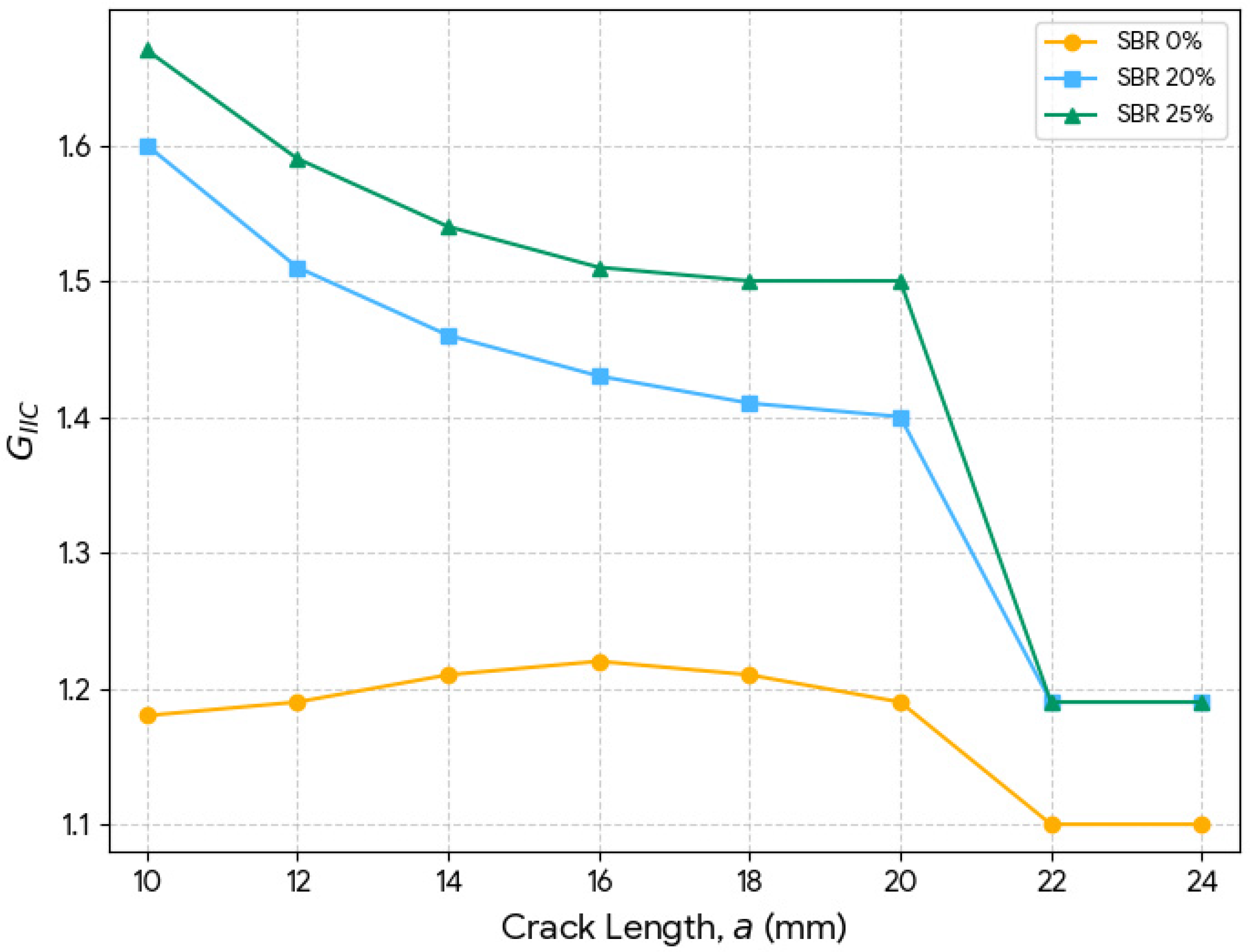
For all the configurations, the initial compliance (C0) increased progressively with crack length, followed by a nearly linear trend, typically based on beam-theory-based interlaminar shear tests [36]. At a0/L = 0.2, C rose from 0.0118 mm/N at a = 10 mm to 0.0136 mm/N at a = 11 mm for the unmodified laminate. This corresponded to a 15% increase over Δa = 1 mm. The slope dC/da increased further with SBR modification, reaching 0.0033 mm/N.mm at 30%, which is nearly double that of unmodified laminates (0.00175 mm/N.mm). This gradual rise in compliance indicated increased local shear deformation and enhanced strain accommodation within the rubberized matrix [37]. Figure 7 presents the variation in GIIc with crack length behavior for SBR 0%, 20% and 25% samples. It can be observed that GIIc-a profiles exhibited a distinct rise–plateau pattern. Here, GIIc peaked at 1.4–1.5 kJ/m2 for 20–25% SBR composites, compared to 1.19 kJ/m2 for SBR 0% before gradually stabilizing around 1.1–1.2 kJ/m2 at extended crack lengths. This plateau signifies the onset of steady state shear fracture, where the crack front advances at nearly constant resistance, coinciding with the reporting of studies on Mode II delamination of rubber-toughened fiber laminates [31,38].

3.2.2. Effect of SBR Modification

At each notch ratio, the slope dC/da and the magnitude of compliance increased with rising SBR percentages. This indicated enhanced interlaminar deformability. The unmodified laminates indicated the lowest compliance and most abrupt fracture, typical of a stiff but brittle interface. With 15–25% SBR, the compliance increased by approximately 35–50%. This corresponded to a greater capacity of shear deformation and energy dissipation before failure. The improvement is attributed to rubber-particle toughening, promoting the localized shear yielding and crack-tip blunting. This further delays catastrophic delamination. Comparable findings have been reported in the literature. Studies have reported that the inclusion of 20 wt.% carboxyl-terminated butadiene acrylonitrile (CTBM) in epoxy laminates enhanced Mode II fracture energy by 40–60% relative to neat resin [33]. Further, it was reported that an increase in GIIc from 0.85 kJ/m2 to 1.45 kJ/m2 (70% improvement) for carbon/epoxy composites toughened with 26–25% rubber modifier [39]. Earlier studies also demonstrated that moderate inclusion (10–25%) of rubber increased the interlaminar fracture resistance by 30–80% mainly through crack tip plasticization and shear band formation [14,40].
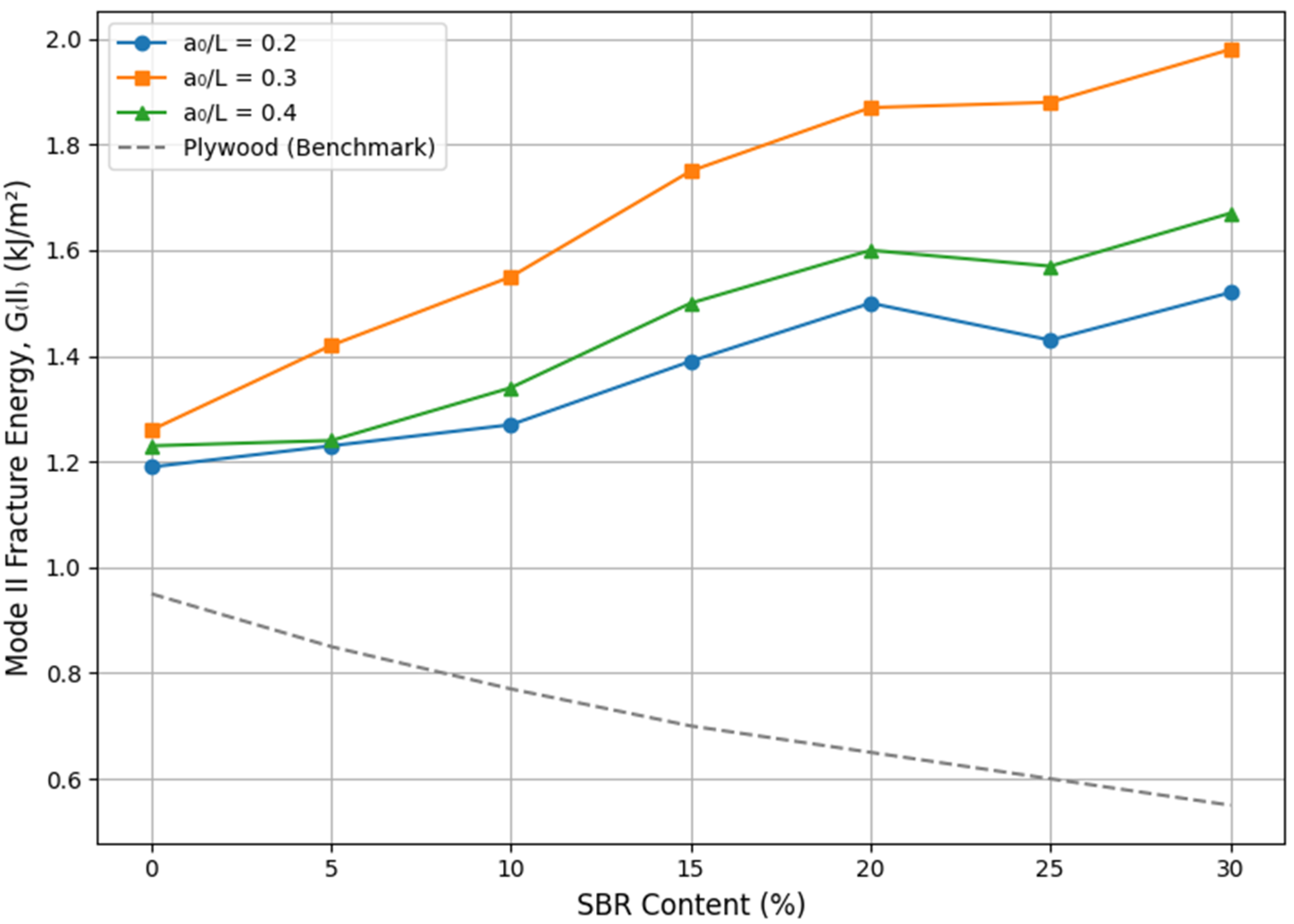
Excessive rubber content (30%) led to marginal softening. This indicated that the matrix ductility had reached its effective limit, and further addition could reduce the cohesive strength. This was consistent with prior studies, which reported that fracture energy gains plateaued or slightly declined beyond 25 wt.% rubber due to phase coalescence and reduced cohesive strength [41]. Figure 8 presents the variation in fracture energy for the three a0/L ratios with the SBR content, considering plywood as benchmark.

3.2.3. Influence of Initial Notch Ratio (a0/L)

As the initial crack ratio increased from 0.2 to 0.4, the overall compliance roughly doubled. Specifically, total compliance change across Δa = 1 mm was almost double for a0/L = 0.4 relative to a0/L = 0.2. This confirmed the geometric sensitivity of interlaminar stiffness to the remaining ligament. However, the corresponding GII decreased by about 20%. The longer initial crack reduced the uncracked ligament area, lowering the specimen stiffness and shear transfer capacity. However, these longer cracks also exhibited a more stable crack growth. This can be evidenced by gradual increases in compliance and a more extended post-peak load region, confirming a controlled sliding-type delamination. This behavior is consistent with earlier findings in laminated composites. Previous studies have reported a 15–25% reduction in GIIc as the normalized initial notch ratio increased from 0.25 to 0.4 in the glass/epoxy ENF specimen, attributed to a diminished elastic recovery and lower strain energy release rate [42]. Similarly, another study reported a nearly double increase in compliance with increasing a0/L for carbon/epoxy laminates in line with beam theory predictions [43].
The longer cracks in the present study also exhibited more stable crack growth, evidenced by a gradual increase in compliance and an extended post-peak load region. This controlled sliding type delamination is characteristic of stable Mode II propagation, as reported previously where delayed catastrophic shear fracture was indicated [33].
In addition to the reduction in the remaining ligament, the influence of the notch root radius is crucial for fracture initiation. Even with controlled sharpening, longer pre-cracks tend to accentuate the local stress concentration and reduce the extent of elastic energy that can be released before the crack advances, thereby lowering the effective GIIc. Consequently, the 20% reduction in GIIc measured between a0/L = 0.2 and 0.4 reflects the combined effect of decreased shear transfer area and more severe local stress state at the crack tip for longer initial notches.

3.2.4. Correlation Between C-A and GIIc

Using compliance data measured at each 0.5 mm increase, GII was computed based on the beam theory expression. For a0/L = 0.3, the unmodified laminate exhibited an initial GII of 1.26 kJ/m2, while the 25% SBR and 30% SBR laminates reached 1.88 kJ/m2 and 1.98 kJ/m2, respectively. Similar trends were also recorded for other notch ratios, with a range of 20–25% showing the best balance between stiffness and ductility [44]. Dispersed SBR domains act as stress concentrators that cavitate under shear, triggering localized plastic shear deformation zones in the surrounding PP matrix. This increases the energy required for crack propagation and blunts the crack tip, thereby delaying its advance. Furthermore, the ductile matrix surrounding the coir fibers allows for partial pullout and fiber bridging across the crack. This mechanism increases the fracture path length and the total energy dissipated per unit area [6]. Also, rubber inclusion reduces the matrix modulus slightly but enhances its ability to redistribute the stress around the crack tip. This transforms the single dominant shear plane into a network of smaller shear bands. This leads to smoother compliance increases and mitigates abrupt interfacial debonding [33]. The commercially available plywood relies on cured phenolic or urea formaldehyde resins. These provide strong but inelastic bonding between the veneers. Once the interfacial strength is exceeded, these adhesives fracture suddenly with minimal energy dissipation [26]. The plywood lacks mechanisms such as matrix yielding, fiber bridging, or crack tip plasticity, leading to the exhibition of unstable crack fracture propagation with limited shear deformation capacity.
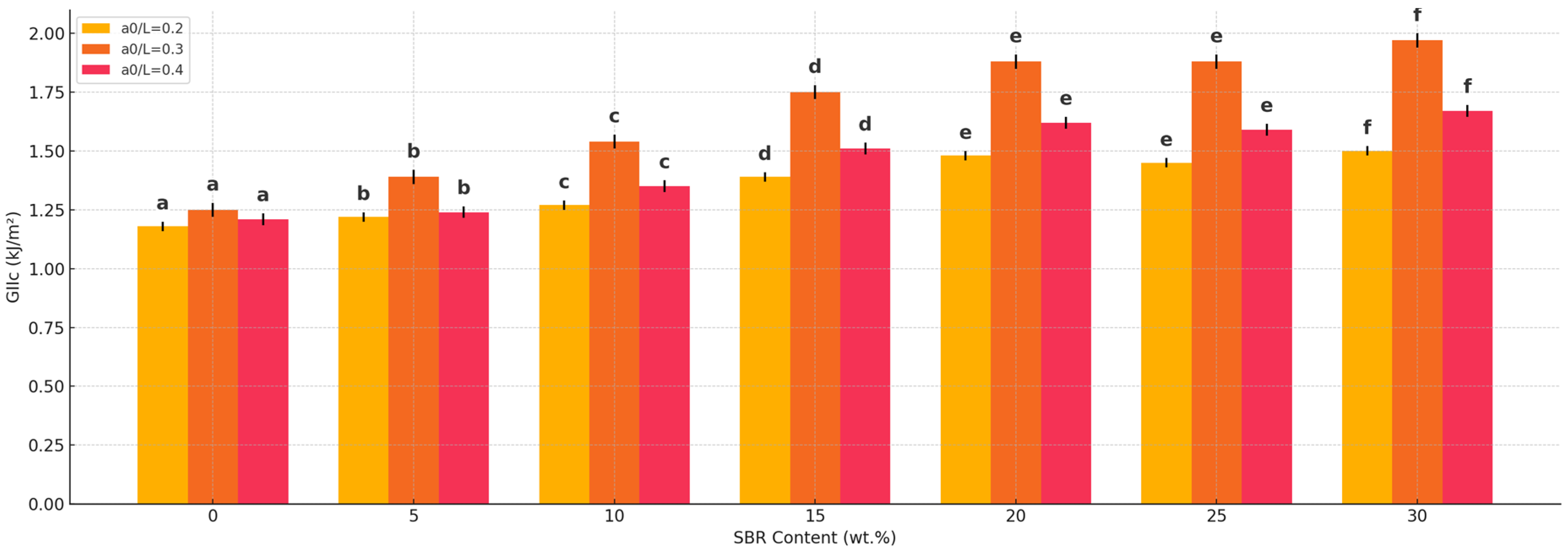
To assess the statistical significance of the observed improvements in fracture toughness, a one-way ANOVA was performed on the GIIc values for each a0/L ratio, considering SBR content as the main factor and including the plywood specimen as the reference group. For all three notch ratios, the F-statistics indicated a significant effect of SBR content on GIIc (p < 0.05). Post hoc comparisons (Tukey test) revealed that the 20–25 wt.% SBR laminates exhibited significantly higher GIIc than both the unmodified laminate and the plywood benchmark, whereas the difference between 25 and 30 wt.% SBR was not statistically significant. These results confirm that the increased Mode II toughness of the BCR laminates is not only practically meaningful but also statistically robust, with 20–25 wt.% SBR representing the optimal toughening range under the present conditions.
As indicated by the Tukey significance letters in Figure 9, the 20–25 wt.% SBR laminates consistently form separate statistical groups with higher GIIc values compared to both unmodified laminate and plywood, confirming optimal toughening range across all notch ratios.

3.3. Microstructural Analysis of the Fracture Surface

The significant increase in Mode II fracture energy and the transition to stable crack growth observed in the SBR-modified laminates can be attributed to a combination of microstructural toughening mechanisms activated at the interlaminar shear plane. The primary mechanism is rubber particle toughening, where SBR domains embedded in the PP matrix act as local stress concentrators that cavitate under high shear triaxiality, generating voids that promote extensive plastic shear deformation in the surrounding matrix. This cavitation-shear yielding sequence blunts the crack tip and converts a single dominant shear plane into a network of smaller, energy-dissipating shear bands in agreement with established models for rubber-toughened thermoplastics. At the same time, the hybrid reinforcement architecture allows coir fibers to bridge the crack and undergo progressive pullout, further increasing the fracture path length and the work required for delamination [45].
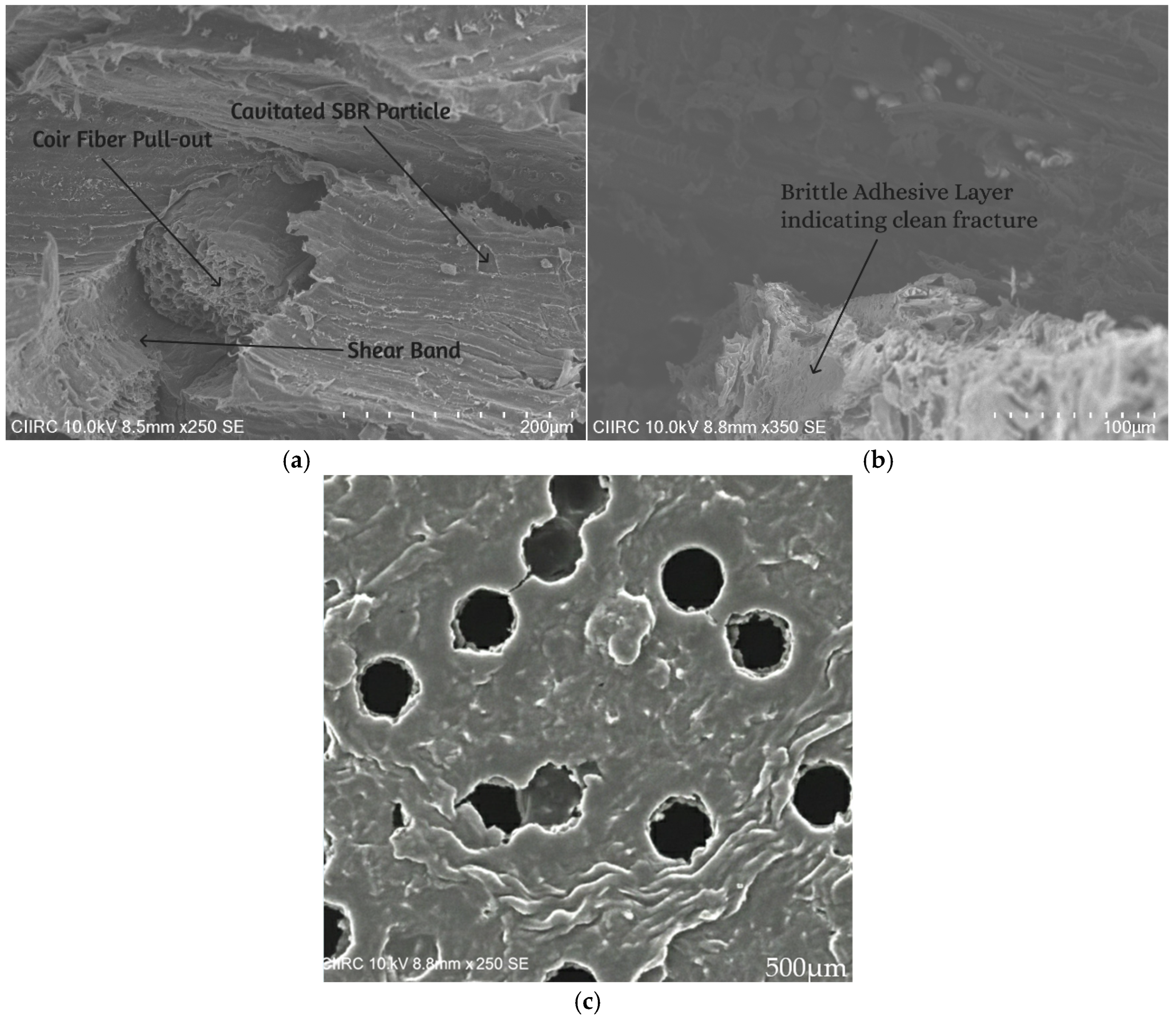
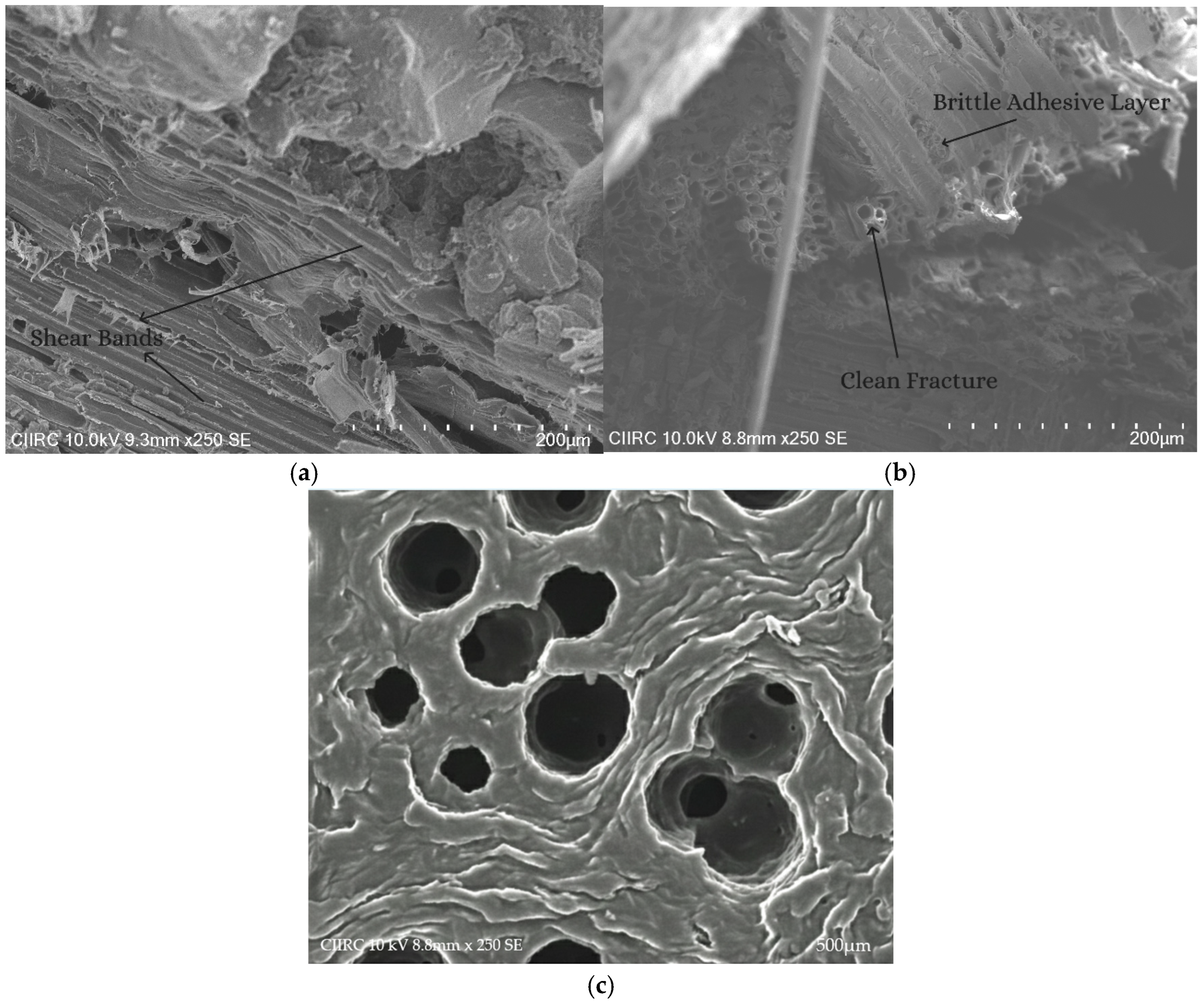
Higher-magnification SEM images (500–2000×) of the 20 wt.% and 25 wt.% SBR laminates revealed numerous cavitated rubber domains surrounded by plastically deformed matrix ligaments, together with coir fiber pullout and bridging across the fracture plane. Figure 10 presents the SEM image of 20% SBR and plywood at a0/L = 0.2, along with the magnified SBR cavitated particles observed during the analysis. The localized shear deformation can be effectively observed in this case. The inclusion of coir fibers plays a major role in energy dissipation, mainly through fiber bridging. Since coir is characterized by high lignin content, it exhibits exceptionally high ductility and resilience. When the crack initiates, the coir fibers span the crack plane and effectively bridge the delaminating surfaces. This bridging imposes closure forces on the crack, requiring additional work to overcome the fiber tension and friction during pullout. The ductile, SBR-modified PP matrix facilitates this mechanism by accommodating the partial pullout of coir fibers rather than brittle behavior. This hence contributes to post-peak load stability [46]. Figure 11 presents the SEM images of the fiber pullout zone in 25% SBR and the brittle phase in plywood at a0/L = 0.3 alongside the 500 µm image of a cavitated SBR particle observed during the analysis. PP and SBR form non-covalent interactions, where no chemical bonding is expected because both are non-polar thermoplastics. Toughening arises from mechanical anchoring, cavitation, and plastic shear deformation rather than chemical bonding.
The voids observed within the SBR granules are characteristic of rubber particle cavitation, which is known to activate extensive shear deformation in the surrounding matrix and form a plastic zone ahead of the crack tip. This mechanism is consistent with the classical rubber toughening mechanism models proposed for PP–rubber systems [30]. The elongated shear bands and plastically deformed ligaments surrounding the cavitated particles confirm that shear yielding contributes significantly to Mode II energy absorption. Similar cavitation-shear yielding sequences have been extensively documented in rubber-toughened thermoplastics and fiber-reinforced polymer blends [14,15,16]. In addition to rubber-induced plasticity, coir fiber bridging and fiber pullout, which increase the fracture path and resistance, were observed. Such hybrid mechanisms combining the ductile inclusions and fiber bridging have been reported to enhance delamination resistance in natural fiber composites and in Mode II interlaminar studies [13,17]. High crack resistance results from the combination of cavitating rubber particles that activate matrix shear yielding, ductile PP ligaments, and long coir fibers bridging the delamination front.

4. Practical Implications

The mode II fracture energies that were evaluated in this study (1.26–1.98 kJ/m2) increase with SBR content. This places the BCR panels in a mechanical performance band that has practical significance for structural and semi-structural applications. Values on the order of 0.7–1.1 kJ/m2 have been extensively used as engineering benchmarks for the delamination onset in laminated panels and have also been adopted in delamination propagation studies for static delamination [32]. Experimental and engineering investigations in fiber-reinforced laminates often use 1.0–1.2 kJ/m2 as a representative Mode II toughness for components expected to sustain shear-dominated loading, fatigue delamination, or repeated bending. Panels with GIIc at or above this band is considered more damage-tolerant under shear-driven delamination [26].
Unmodified BCR panels (GIIc = 1.26 kJ/m2) meet multiple engineering references for shear fracture resistance, while SBR-modified panels (GIIc = 1.98 kJ/m2) indicate a marked improvement that is consistent with the literature on rubber-toughened thermoplastics, where elastomeric inclusions increase the fracture energies substantially and enhance stable crack growth [47].
Literature comparisons support the practical claims made in this study, indicating that BCR panels with GIIC ≥ 1.2 kJ/m2 are suitable candidates to replace plywood in such applications as temporary/reusable formworks, interior partition panels, furniture panels, and transport flooring. They can be utilized as façade claddings and for any such purposes in which the panels are subjected to handling and vibrations [48]. The BCR panels in this study match or exceed the toughness targets of the established applications while offering the added benefits of a thermoplastic matrix that can be reprocessed under controlled conditions and the absence of formaldehyde-based adhesives commonly used in plywood.
The higher end of the measured Mode II fracture energy corresponds to the toughness level, which is practically required for laminated structural panels and bonded joints that undergo significant in-plane shear or repeated flexural stresses. The desirable GIIc values for load-bearing wood laminates and sandwich panels to resist delamination under cyclic loading or shear fatigue is 1 kJ/m2 [26]. Laminated Veneer Lumber (LVL) and phenolic-bonded plywood used in formwork and flooring systems operate within this toughness range, ensuring adequate safety margins against adhesive failure in variable environmental conditions. Furthermore, natural fiber/thermoplastic composites with GIIc between 1.5 and 2 kJ/m2 have been adopted in automotive door panels, setbacks, and load compartment liners where repeated shear and impact demand high interlaminar energy absorption [49].

5. Conclusions

The study aimed to investigate the Mode II fracture behavior of bamboo–coir–rubber hybrid composite panels fabricated using polypropylene thermoplastics matrix. The study examined the influence of rubber modification and notch depth on interlaminar shear toughness and crack propagation characteristics using standardized End-Notched Flexure (ENF) test and optical analysis.
  • The Mode II strain energy release rate of BCR panels increased considerably with the incorporation of SBR, achieving up to 1.98 kJ/m2 at 30% SBR content as compared to 1.26 kJ/m2 for the unmodified laminate (SBR 0%). This improvement was attributed to rubber-particle cavitation, matrix shear yielding, and coir–fiber bridging mechanisms that together promote progressive crack growth and delayed delamination. Optimal enhancement occurred at 20–25% SBR, balancing the ductility and stiffness while maintaining nearly 90% of the unmodified load-bearing capacity.
  • Increasing the crack ratio from 0.2 to 0.4 doubled the specimen compliance and reduced the GII values by approximately 20%. This confirmed the geometrical sensitivity of the interlaminar shear response. However, it must be noted that higher a0/L ratios yielded smoother post-peak transitions and more stable crack propagation, indicating the dominance of sliding-type delamination.
  • The commercial plywood exhibited brittle, unstable fracture with GII in the range of 0.7 to 0.9 kJ/m2. The inclusion of SBR resulted in 60–80% higher Mode II fracture energy, emphasizing superior energy absorption and damage tolerance of the hybrid laminates over traditional resin-bonded veneers.
  • SEM analysis confirmed the presence of cavitated SBR domains, plastic shear bands, and coir-pullout zones, validating the observed macroscopic increase in the fracture energy. The ductile failure morphology contrasted with the clean brittle adhesive separation seen in plywood. This underscored the constructive interaction between rubber-induced plasticity and natural fiber bridging.
  • The combination of bamboo and coir fibers with a PP matrix and SBR modification yields a fully thermoplastic laminate exhibiting toughness levels comparable to structural plywood.
While the present study provides a clear understanding of the monotonic Mode II fracture response, several limitations remain. Long-term durability under cyclic, moisture-assisted, or thermal aging conditions has yet to be addressed. Further, there is a need to evaluate the retention of mechanical performance after multiple recycling cycles of the PP matrix. Additionally, numerical modeling of delamination behavior is yet to be undertaken.
Future studies should therefore focus on (i) investigating the long term performance of BCR panels under cyclic and impact loading, (ii) quantifying the influence of moisture and thermal aging on Mode II fracture toughness, (iii) developing finite element models for delamination prediction in structural panel geometric, and (iv) assessing recycling and reprocessing routes for the thermoplastic laminate, including the retention of mechanical and fracture properties after multiple processing cycles. These efforts will support the translation of BCR composites into design guidelines and durability specifications for practical construction applications.

Supplementary Materials

The following supporting information can be downloaded at: https://www.mdpi.com/article/10.3390/jcs9120704/s1. Table S1: Summarised GIIc value based on compliance data evaluated 0.5 mm increase in crack length and the corresponding deflection and load values.

Author Contributions

Conceptualization, K.S.S. and N.R.; methodology, N.R. and K.S.S.; software, C.B.; validation, K.S.S., N.R. and C.B.; formal analysis, N.D.N. and C.B.; investigation, C.B., K.S.S. and N.D.N.; resources, C.B.; writing—original draft preparation, K.S.S.; writing—review and editing, C.B., K.S.S. and N.R.; visualization, K.S.S.; supervision, K.S.S. and N.R. All authors have read and agreed to the published version of the manuscript.

Funding

This research received no external funding.

Data Availability Statement

No new data were created in this study.

Acknowledgments

The authors thank Jyothy Institute of Technology and the Center for Incubation Innovation Research and Consultancy for their support in completing this work.

Conflicts of Interest

The authors declare no conflicts of interest.

References

  1. Mohammadabadi, M.; Yadama, V.; Dolan, J.D. Evaluation of Wood Composite Sandwich Panels as a Promising Renewable Building Material. Materials 2021, 14, 2083. [Google Scholar] [CrossRef] [PubMed]
  2. Xu, D.; He, S.; Leng, W.; Chen, Y.; Wu, Z. Replacing Plastic with Bamboo: A Review of the Properties and Green Applications of Bamboo-Fiber-Reinforced Polymer Composites. Polymers 2023, 15, 4276. [Google Scholar] [CrossRef]
  3. Oliveira, M.; Neves, V.; Banea, M.D. Mechanical and Thermal Characterization of Bamboo and Interlaminar Hybrid Bamboo/Synthetic Fibre-Reinforced Epoxy Composites. Materials 2024, 17, 1777. [Google Scholar] [CrossRef]
  4. Madueke, C.I.; Ekechukwu, O.M.; Kolawole, F.O. A Review on Coir Fibre, Coir Fibre Reinforced Polymer Composites and Their Current Applications. J. Renew. Mater. 2024, 12, 2017. [Google Scholar] [CrossRef]
  5. Sriseubsai, W.; Praemettha, A. Hybrid Natural Fiber Composites of Polylactic Acid Reinforced with Sisal and Coir Fibers. Polymers 2024, 17, 64. [Google Scholar] [CrossRef]
  6. Puttaswamygowda, P.H.; Sharma, S.; Ullal, A.K.; Shettar, M. Synergistic Enhancement of the Mechanical Properties of Epoxy-Based Coir Fiber Composites through Alkaline Treatment and Nanoclay Reinforcement. J. Compos. Sci. 2024, 8, 66. [Google Scholar] [CrossRef]
  7. Wasti, S.; Hubbard, A.M.; Clarkson, C.M.; Johnston, E.; Tekinalp, H.; Ozcan, S.; Vaidya, U. Long coir and glass fiber reinforced polypropylene hybrid composites prepared via wet-laid technique. Compos. Part C Open Access 2024, 14, 100445. [Google Scholar] [CrossRef]
  8. Adediran, A.A.; Akinwande, A.A.; Balogun, O.A.; Olasoju, O.S.; Adesina, O.S. Experimental evaluation of bamboo fiber/particulate coconut shell hybrid PVC composite. Sci. Rep. 2021, 11, 5465. [Google Scholar] [CrossRef]
  9. Tuswan, T.; Manik, P.; Samuel, S.; Suprihanto, A.; Sulardjaka, S.; Nugroho, S.; Pakpahan, B.F. Correlation between lamina directions and the mechanical characteristics of laminated bamboo composite for ship structure. Curved Layer. Struct. 2023, 10, 20220186. [Google Scholar] [CrossRef]
  10. Prabhudass, J.M.; Palanikumar, K.; Natarajan, E.; Markandan, K. Enhanced thermal stability, mechanical properties and structural integrity of MWCNT filled Bamboo/Kenaf hybrid polymer nanocomposites. Materials 2022, 15, 506. [Google Scholar] [CrossRef] [PubMed]
  11. Martijanti, M.; Sutarno, S.; Juwono, A.L. Polymer Composite Fabrication Reinforced with Bamboo Fiber for Particle Board Product Raw Material Application. Polymers 2021, 13, 4377. [Google Scholar] [CrossRef]
  12. Yousaf, A.; Al Rashid, A.; Polat, R.; Koç, M. Potential and challenges of recycled polymer plastics and natural waste materials for additive manufacturing. Sustain. Mater. Technol. 2024, 41, e01103. [Google Scholar] [CrossRef]
  13. Tran, T.M.N.; M.N., P.; Lee, D.W.; Song, J.I. Enhanced mechanical and thermal properties of green PP composites reinforced with bio-hybrid fibers and agro-waste fillers. Adv. Compos. Hybrid Mater. 2025, 8, 224. [Google Scholar] [CrossRef]
  14. He, D.; Cheng, X.; Wong, C.; Zeng, X.; Li, L.; Teng, C.; Du, G.; Zhang, C.; Ren, L.; Zeng, X.; et al. Insight into the fracture energy dissipation mechanism in elastomer composites via sacrificial bonds and fillers. Phys. Chem. Chem. Phys. 2024, 26, 4429–4436. [Google Scholar] [CrossRef]
  15. Bahrami, B.; Talebi, H.; Momeni, M.M.; Ayatollahi, M.R. Experimental and theoretical investigation of the influence of post-curing on mixed mode fracture properties of 3d-printed polymer samples. Sci. Rep. 2024, 14, 13216. [Google Scholar] [CrossRef]
  16. Costa, N.L.; Hiranobe, C.T.; Cardim, H.P.; Dognani, G.; Sanchez, J.C.; Carvalho, J.A.J.; Torres, G.B.; Paim, L.L.; Pinto, L.F.; Cardim, G.P.; et al. A Review of EPDM (Ethylene Propylene Diene Monomer) Rubber-Based Nanocomposites: Properties and Progress. Polymers 2024, 16, 1720. [Google Scholar] [CrossRef] [PubMed]
  17. Bhargavi, C.; Sreekeshava, K.S.; Prasad, B.K.R. Evolution of Studies on Fracture Behavior of Composite Laminates: A Scoping Review. Appl. Mech. 2025, 6, 63. [Google Scholar] [CrossRef]
  18. ASTM D7905/D7905M-14; Standard Test Method for Determination of the Mode II Interlaminar Fracture Toughness of Unidirectional Fiber-Reinforced Polymer Matrix Composites. ASTM International: West Conshohocken, PA, USA, 2014.
  19. Yu, B.; Li, Y.; Tu, H.; Zhang, Z. Experimental and numerical investigation into interlaminar toughening effect of chopped fiber-interleaved flax fiber reinforced composites. Acta Mech. Sin. 2024, 40, 423287. [Google Scholar] [CrossRef]
  20. Königsberger, M.; Senk, V.; Lukacevic, M.; Wimmer, M.; Füssl, J. Micromechanics stiffness upscaling of plant fiber-reinforced composites. Compos. Part B Eng. 2024, 281, 111571. [Google Scholar] [CrossRef]
  21. Qu, W.; Niu, B.; Lv, C.; Liu, J. A Review of Sisal Fiber-Reinforced Geopolymers: Preparation, Microstructure, and Mechanical Properties. Molecules 2024, 29, 2401. [Google Scholar] [CrossRef]
  22. Williams, A.; Hamerton, I.; Allegri, G. Environmental Effects of Moisture and Elevated Temperatures on the Mode I and Mode II Interlaminar Fracture Toughness of a Toughened Epoxy Carbon Fibre Reinforced Polymer. Polymers 2025, 17, 1503. [Google Scholar] [CrossRef]
  23. Dharek, M.S.; Vengala, J.; Sunagar, P.; Sreekeshava, K.S.; Kilabanur, P.; Thejaswi, P. Biocomposites and Their Applications in Civil Engineering—An Overview. In Smart Technologies for Energy, Environment and Sustainable Development; Kolhe, M.L., Jaju, S.B., Diagavane, P.M., Eds.; Springer Proceedings in Energy; Springer: Singapore, 2022; Volume 1. [Google Scholar] [CrossRef]
  24. Chen, Y.; Shen, J.; Wang, W.; Li, L.; Zheng, D.; Qi, F.; Wang, X.; Li, Q. Comparison of the properties of phenolic resin synthesized from different aldehydes and evaluation of the release and health risks of VOCs. Environ. Pollut. 2024, 344, 123419. [Google Scholar] [CrossRef]
  25. Krumins, J.A.; Vamza, I.; Dzalbs, A.; Blumberga, D. Particle Boards from Forest Residues and Bio-Based Adhesive. Buildings 2024, 14, 462. [Google Scholar] [CrossRef]
  26. Hadiji, H.; Serra, J.; Curti, R.; Gebrehiwot, D.; Castanié, B. Characterization of mode II delamination behaviour of poplar plywood and LVL. Theor. Appl. Fract. Mech. 2024, 131, 104354. [Google Scholar] [CrossRef]
  27. Wang, T.; Wang, Y.; Debertolis, M.; Crocetti, R.; Wålinder, M.; Blomqvist, L. Spreading angle analysis on the tensile capacities of birch plywood plates in adhesively bonded timber connections. Eng. Struct. 2024, 315, 118428. [Google Scholar] [CrossRef]
  28. Vengala, J.; Kilaru, D.; Varshini, V.H. Analysis of bamboo tensegrity structures. Mater. Today Proc. 2022, 65, 2060–2065. [Google Scholar] [CrossRef]
  29. Harries, K.A. Adoption of full-culm bamboo as a mainstream structural material. npj Mater. Sustain. 2025, 3, 1–8. [Google Scholar] [CrossRef]
  30. Zeidi, M.; Park, C.B.; Il Kim, C. Synergism effect between nanofibrillation and interface tuning on the stiffness-toughness balance of rubber-toughened polymer nanocomposites: A multiscale analysis. ACS Appl. Mater. Interfaces 2023, 15, 24948–24967. [Google Scholar] [CrossRef]
  31. Li, X.; Lubineau, G. Towards stable End Notched Flexure (ENF) tests. J. Mech. Phys. Solids 2024, 192, 05795. [Google Scholar] [CrossRef]
  32. Zheng, W.; Kassapoglou, C. Experimental tests and numerical simulation of delamination and fiber breakage in AP-PLY composite laminates. J. Reinf. Plast. Compos. 2024, 44, 1702–1714. [Google Scholar] [CrossRef]
  33. Ayyagari, S.; Al-Haik, M. Mitigating Crack Propagation in Hybrid Composites: An Experimental and Computational Study. J. Compos. Sci. 2024, 8, 122. [Google Scholar] [CrossRef]
  34. Romanowicz, M.; Grygorczuk, M. The effect of crack orientation on the mode I fracture resistance of pinewood. Int. J. Fract. 2024, 248, 27–48. [Google Scholar] [CrossRef]
  35. Arpitha, G.R.; Raghu, M.J.; Bharath, K.N.; Jain, N.; Verma, A. Mechanical and micro-structural characterization of biodegradable coir fiber–glass sheet–charcoal reinforced polymer composite: An experimental approach. Discov. Polym. 2024, 1, 7. [Google Scholar] [CrossRef]
  36. Carpinteri, A.; Accornero, F.; Rubino, A. Scale effects in the post-cracking behaviour of fibre-reinforced concrete beams. Int. J. Fract. 2022, 240, 1–16. [Google Scholar] [CrossRef]
  37. Vašina, M.; Pöschl, M.; Zádrapa, P. Influence of Rubber Composition on Mechanical Properties. Manuf. Technol. 2021, 21, 261–269. [Google Scholar] [CrossRef]
  38. Wang, C.; Vassilopoulos, A.P.; Keller, T. Numerical modeling of two-dimensional delamination growth in composite laminates with in-plane isotropy. Eng. Fract. Mech. 2021, 250, 107787. [Google Scholar] [CrossRef]
  39. Wang, Y.B.; Deng, X.L.; Cao, B.Y.; Feng, H.P.; Chen, J.; Li, P.D.; Ren, L.; Zhang, M.Y. Highly toughened PP/Rice husk charcoal composites modified Ethylene Propylene Diene Monomer (EPDM) with glycidyl methacrylate. J. Polym. Res. 2024, 31, 220. [Google Scholar] [CrossRef]
  40. Raimondi, L.; Bernardi, F. Advanced hybrid laminates: Elastomer integration for optimized mechanical properties. Int. J. Adv. Manuf. Technol. 2025, 136, 3177–3195. [Google Scholar] [CrossRef]
  41. Mohamed, S.; Elemam, H.; Seleem, M.H.; Sallam, H.E.D.M. Effect of fiber addition on strength and toughness of rubberized concretes. Sci. Rep. 2024, 14, 4346. [Google Scholar] [CrossRef]
  42. Dinç, Z.S.; Öz, Y.; Potluri, P.; Sampson, W.W.; Eren, H.A. Influence of thermoplastic fibre-epoxy adhesion on the interlaminar fracture toughness of interleaved polymer composites. Compos. Part A Appl. Sci. Manuf. 2024, 189, 108619. [Google Scholar] [CrossRef]
  43. Fikry, M.J.M.; Arai, Y.; Inoue, R.; Vinogradov, V.; Tan, K.T.; Ogihara, S. Damage Behavior in Unidirectional CFRP Laminates with Ply Discontinuity. Appl. Compos. Mater. 2025, 32, 1481–1499. [Google Scholar] [CrossRef]
  44. Bahmani, M.; Nosraty, H.; Mirdehghan, S.A.; Varkiani, S.M.H. Investigating the Interlaminar Fracture Toughness of Glass Fiber/Epoxy Composites Modified by Polypropylene Spunbond Nonwoven Fabric Interlayers. Fibers Polym. 2024, 25, 1061–1073. [Google Scholar] [CrossRef]
  45. Shen, F.; Sparrer, Y.; Rao, J.; Könemann, M.; Münstermann, S.; Lian, J. A forming limit framework accounting for various failure mechanisms: Localization, ductile and cleavage fracture. Int. J. Plast. 2024, 175, 103921. [Google Scholar] [CrossRef]
  46. Musale, A.; Hunashyal, A.M.; Patil, A.Y.; Kumar, R.; Ahamad, T.; Kalam, M.A.; Patel, M. Study on Nanomaterials Coated Natural Coir Fibers as Crack Arrestor in Cement Composite. Adv. Civ. Eng. 2024, 2024, 6686655. [Google Scholar] [CrossRef]
  47. Namrata, B.; Pai, Y.; Nair, V.G.; Hegde, N.T.; Pai, D.G. Analysis of aging effects on the mechanical and vibration properties of quasi-isotropic basalt fiber-reinforced polymer composites. Sci. Rep. 2024, 14, 26730. [Google Scholar] [CrossRef]
  48. Wdowiak-Postulak, A.; Świt, G.; Dziedzic-Jagocka, I. Application of Composite Bars in Wooden, Full-Scale, Innovative Engineering Products—Experimental and Numerical Study. Materials 2024, 17, 730. [Google Scholar] [CrossRef]
  49. Mohammed, M.; Oleiwi, J.K.; Mohammed, A.M.; Jawad, A.J.M.; Osman, A.F.; Adam, T.; Betar, B.O.; Gopinath, S.C.B. A Review on the Advancement of Renewable Natural Fiber Hybrid Composites: Prospects, Challenges, and Industrial Applications. J. Renew. Mater. 2024, 12, 1237–1290. [Google Scholar] [CrossRef]
Figure 1. Illustrative representation of the arrangement of layers of the laminates.
Jcs 09 00704 g001
Figure 2. Overview of the BCR laminate fabrication process.
Jcs 09 00704 g002
Figure 3. Representation of the ENF test configuration and geometry as per ASTM D7905.
Jcs 09 00704 g003
Figure 4. Schematic representation of extracting the effective flexural modulus E′.
Jcs 09 00704 g004
Figure 5. ImageJ analysis of SBR 15% a0/L = 0.3 specimen. (a) SBR 15% a0/L = 0.3 at Δa = 0 mm, a = 15 mm. (b) SBR 15% a0/L = 0.3 at Δa = 0.5 mm, a = 15.5 mm. (c) SBR 15% a0/L = 0.3 at failure, delamination, and slippage from support observed.
Jcs 09 00704 g005
Figure 6. ImageJ analysis of Plywood sample with a0/L = 0.3. (a) Plywood a0/L = 0.3 at Δa = 0 mm, a = 15 mm. (b) Plywood a0/L = 0.3 at Δa = 0.5 mm, a = 15.5 mm. (c) Plywood a0/L = 0.3 at failure; brittle failure with excessive delamination observed.
Jcs 09 00704 g006
Figure 7. Graphical representation of GIIc (kJ/m2) vs. a for SBR 0%, 20%, and 25%, indicating plateau formation, signifying the onset of steady state shear fracture.
Jcs 09 00704 g007
Figure 8. Graphical representation of variation in fracture energy for the three a0/L ratios with the SBR content, considering plywood as the benchmark.
Jcs 09 00704 g008
Figure 9. Mean ± SD of Mode II fracture toughness (GIIc) for BCR laminates at different SBR contents (0–30 wt.%) and initial notch ratios (a0/L = 0.2, 0.3, 0.4). Error bars indicate standard deviation. Different letters above the bars represent statistically distinct groups according to Tukey’s HSD test (p < 0.05).
Jcs 09 00704 g009
Figure 10. SEM images of (a) 20 wt.% SBR and (b) plywood samples (b) at a0/L = 0.2. (c) Cavitated SBR particles in 20 wt.% SBR laminates.
Jcs 09 00704 g010
Figure 11. SEM images of (a) 25% SBR and (b) plywood samples at a0/L = 0.3. (c) Cavitated SBR particles in 25 wt.% SBR laminates.
Jcs 09 00704 g011
Table 1. Comparative reference properties of conventional plywood and natural-fiber-based composites derived from bamboo and coir, highlighting the variations in mechanical performance and recyclability potential.
MaterialPropertyTypical Range/ValueReference
Conventional PlywoodDensity550–800 kg m−3[26,27]
Modulus of Elasticity (E)6.9–13.1 GPa
Modulus of Rupture (MOR)20.7–48.3 MPa
Tensile Strength27.6–34.5 MPa
Coir Fiber CompositeDensity1000–1250 kg m−3[4,7]
E2–5 GPa
MOR25–60 MPa
Tensile Strength20–50 MPa
Bamboo Mat CompositeDensity850–1100 kg m−3[28,29]
E8–18 Gpa
MOR25–60 MPa
Tensile Strength40–90 MPa
Table 2. Composition of Hybrid Laminates.
SpecimenSBR-0 wt.%SBR-5 wt.%SBR-10 wt.%SBR-15 wt.%SBR-20 wt.%SBR-25 wt.%SBR-30 wt.%
% Weight of Fiber80 (50% bamboo and 50% coir)
% Weight of PP20
% Weight of SBR051015202530
Table 3. Combinations of a0/L ratios and SBR content used in this study.
SpecimenSBR-0 wt.%SBR-5 wt.%SBR-10 wt.%SBR-15 wt.%SBR-20 wt.%SBR-25 wt.%SBR-30 wt.%
a0/L0.20.30.40.20.30.40.20.30.40.20.30.40.20.30.40.20.30.40.20.30.4
a0
(mm)
101520101520101520101520101520101520101520
Table 4. Mean peak load (Pmax), mid-span deflection (δmax) and flexural modulus (E′) for bamboo–coir–rubber (BCR) composites with varying SBR contents and initial notch ratios (a0/L), compared with plywood benchmark specimens.
a0/L0.20.30.4
SampleMean Peak Load (N)
Pmax
Mean Midspan Deflection (mm)
δmax
Mean Flexural Modulus (MPa)
E′
Mean Peak Load (N)
Pmax
Mean Midspan Deflection (mm)
δmax
Mean Flexural Modulus (MPa)
E′
Mean Peak Load (N)
Pmax
Mean Midspan Deflection (mm)
δmax
Mean Flexural Modulus (MPa)
E′
SBR 0%165 ± 2.13.50 ± 0.12589.3 ± 21.6150 ± 2.04.00 ± 0.14468.8 ± 17.6135 ± 1.84.50 ± 0.15375.0 ± 13.5
SBR 5%160 ± 1.93.60 ± 0.14555.6 ± 22.6145 ± 1.74.10 ± 0.12442.1 ± 13.9131 ± 1.94.65 ± 0.16352.2 ± 13.1
SBR 10%155 ± 2.03.72 ± 0.15520.8 ± 22.1141 ± 2.14.25 ± 0.13414.7 ± 14.1127 ± 2.04.80 ± 0.14330.7 ± 11.0
SBR 15%150 ± 1.83.85 ± 0.13487.0 ± 17.5136 ± 1.94.38 ± 0.15388.1 ± 14.4123 ± 1.84.95 ± 0.15310.6 ± 10.5
SBR 20%145 ± 2.23.98 ± 0.12455.4 ± 15.4132 ± 2.04.50 ± 0.14366.7 ± 12.7119 ± 2.15.10 ± 0.14291.7 ± 9.5
SBR 25%140 ± 2.14.10 ± 0.14426.8 ± 15.9127 ± 1.84.65 ± 0.13341.4 ± 10.7115 ± 2.05.25 ± 0.15273.8 ± 9.2
SBR 30%135 ± 2.04.25 ± 0.16397.1 ± 16.1123 ± 2.04.80 ± 0.16320.3 ± 11.9111 ± 1.95.40 ± 0.16256.9 ± 8.8
Plywood154 ± 2.33.80 ± 0.13506.6 ± 18.9140 ± 2.24.20 ± 0.14416.7 ± 15.4126 ± 2.14.85 ± 0.15324.7 ± 11.4
Table 5. Summary of Mode II fracture toughness (GIIc) for BCR laminates and plywood at different initial crack ratios. Values are reported as Mean ± SD (kJ/m2).
GIIc(kJ/m2)
SBR Contenta0/L = 0.2a0/L = 0.3a0/L = 0.4
0%1.0411 ± 0.14521.1064 ± 0.15331.0687 ± 0.1509
5%1.0887 ± 0.11401.2441 ± 0.17361.0773 ± 0.1513
10%1.1170 ± 0.11801.3503 ± 0.19001.1576 ± 0.1744
15%1.2198 ± 0.12761.5267 ± 0.21291.2871 ± 0.1980
20%1.3127 ± 0.18201.6365 ± 0.22771.3863 ± 0.2075
25%1.2521 ± 0.16721.6445 ± 0.22951.3582 ± 0.2056
30%1.3278 ± 0.18191.7292 ± 0.24161.4301 ± 0.2241
Plywood0.8210 ± 0.12630.7402 ± 0.10330.6601 ± 0.1109
Disclaimer/Publisher’s Note: The statements, opinions and data contained in all publications are solely those of the individual author(s) and contributor(s) and not of MDPI and/or the editor(s). MDPI and/or the editor(s) disclaim responsibility for any injury to people or property resulting from any ideas, methods, instructions or products referred to in the content.