
Article

Experimental and Analytical Evaluation of GFRP-Reinforced Concrete Bridge Barriers at the Deck–Wall Interface

1
Civil Engineering Department, Toronto Metropolitan University, Toronto, ON M5B 2K3, Canada
2
Faculty of Engineering, Pharos University, Alexandria 21648, Egypt
3
Faculty of Engineering, Tanta University, Tanta 31527, Egypt
*
Author to whom correspondence should be addressed.
J. Compos. Sci. 2025, 9(11), 600; https://doi.org/10.3390/jcs9110600
Submission received: 4 September 2025 / Revised: 9 October 2025 / Accepted: 14 October 2025 / Published: 2 November 2025

Abstract

This study investigates the structural performance of TL-5 concrete bridge barriers reinforced with glass fiber-reinforced polymer (GFRP) bars at the critical deck–wall interface. Five full-scale barrier models were subjected to static load testing until failure. The wall reinforcement included four barriers with high- and standard-modulus GFRP bars using headed-end, bent, and hooked anchorage, and one with conventional steel reinforcement. The objective was to assess the load-bearing capacity, failure modes, and deformation behavior of GFRP-reinforced barriers with respect to the Canadian Highway Bridge Design Code (CHBDC) requirements. Results revealed that all GFRP-reinforced models achieved ultimate flexural capacities surpassing CHBDC design limits, with diagonal tension cracking at the corner joint emerging as the predominant failure mode. A set of new equations was developed to predict diagonal tension failure and determine minimum reinforcement ratios to mitigate such failure. Comparisons with experimental findings validated the proposed analytical approach. Among the configurations tested, barriers with headed-end high-modulus GFRP bars offered the most cost-effective and structurally sound solution. These findings support the incorporation of GFRP bars in bridge barrier design and establish a framework for future code development regarding GFRP-reinforced barrier systems.

1. Introduction

The corrosion of steel reinforcement due to environmental influences significantly contributes to the degradation of bridge barriers. Utilizing glass fiber-reinforced polymer (GFRP) bars for reinforcing bridge construction presents an effective solution because of their corrosion resistance, which leads to a lower environmental impact. GFRP bars can act as a substitute for conventional steel reinforcement in bridge structures, especially when subjected to severe environmental conditions [1,2,3,4]. In winter, the application of de-icing salt poses a considerable threat to the exposed elements of bridges. It is believed that steel-reinforced barrier walls are negatively impacted by such environmental factors, resulting in the development of cracks on the barrier surface that permit salt solutions to penetrate the barrier wall. Once these solutions reach the reinforcing steel bars, they trigger corrosion, which ultimately reduces the overall strength of the barrier. This decrease in strength may jeopardize the structural integrity of the barrier during vehicle collisions, potentially leading to barrier failure [5,6,7]. Figure 1 depicts a photograph of a deteriorated barrier wall that has experienced corrosion of the steel-reinforcing bars.
Numerous studies examining the environmental behavior of GFRP bars have demonstrated that these bars exhibit exceptional resistance to corrosion in comparison to steel bars, underscoring their superior durability relative to steel [8,9,10,11,12,13,14]. Additionally, research on the mechanical properties of GFRP bars has shown significantly higher tensile strength compared to the yielding point of steel bars [15,16,17]. Thus, the incorporation of GFRP bars in bridge construction is increasing, supported by extensive research conducted by the Ministry of Transportation of Ontario (MTO) and GFRP manufacturers to assess the practical application of current products [18,19,20,21,22,23,24].
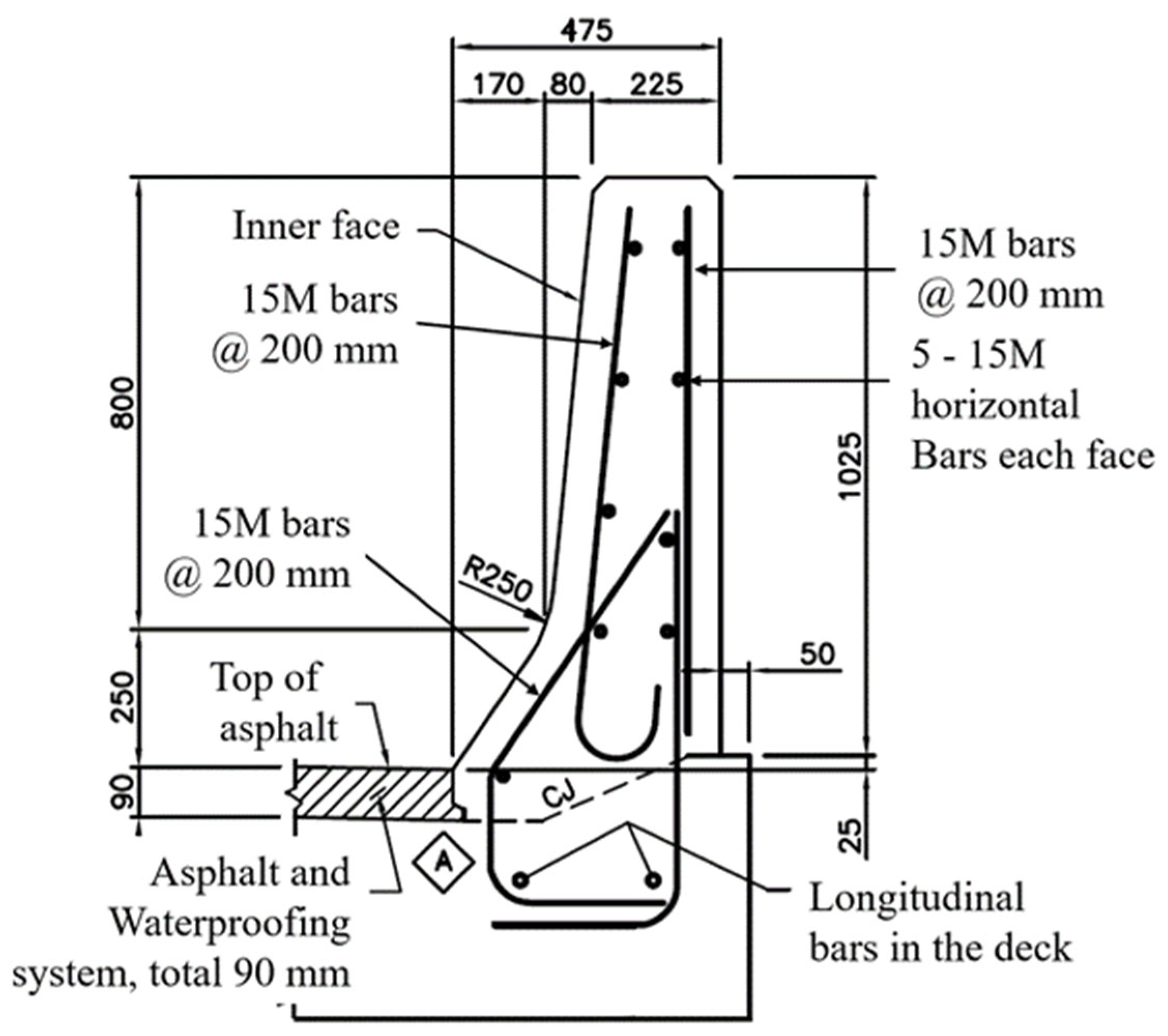
Due to the cantilever action of barrier walls under vehicle impact load, high tensile strength GFRP bars may be a suitable alternative to the conventional steel reinforcement when used in the barrier wall. As such, it was decided to revise the available standard TL-5 barrier detailing with steel reinforcement in the standard drawing of the Ontario Ministry of Transportation, shown in Figure 2, and develop a new barrier detailing with GFRP bars as reinforcement. As the design procedure for GFRP barrier walls is not yet established, an equivalent area of reinforcement with some modification in bar arrangement has been made.
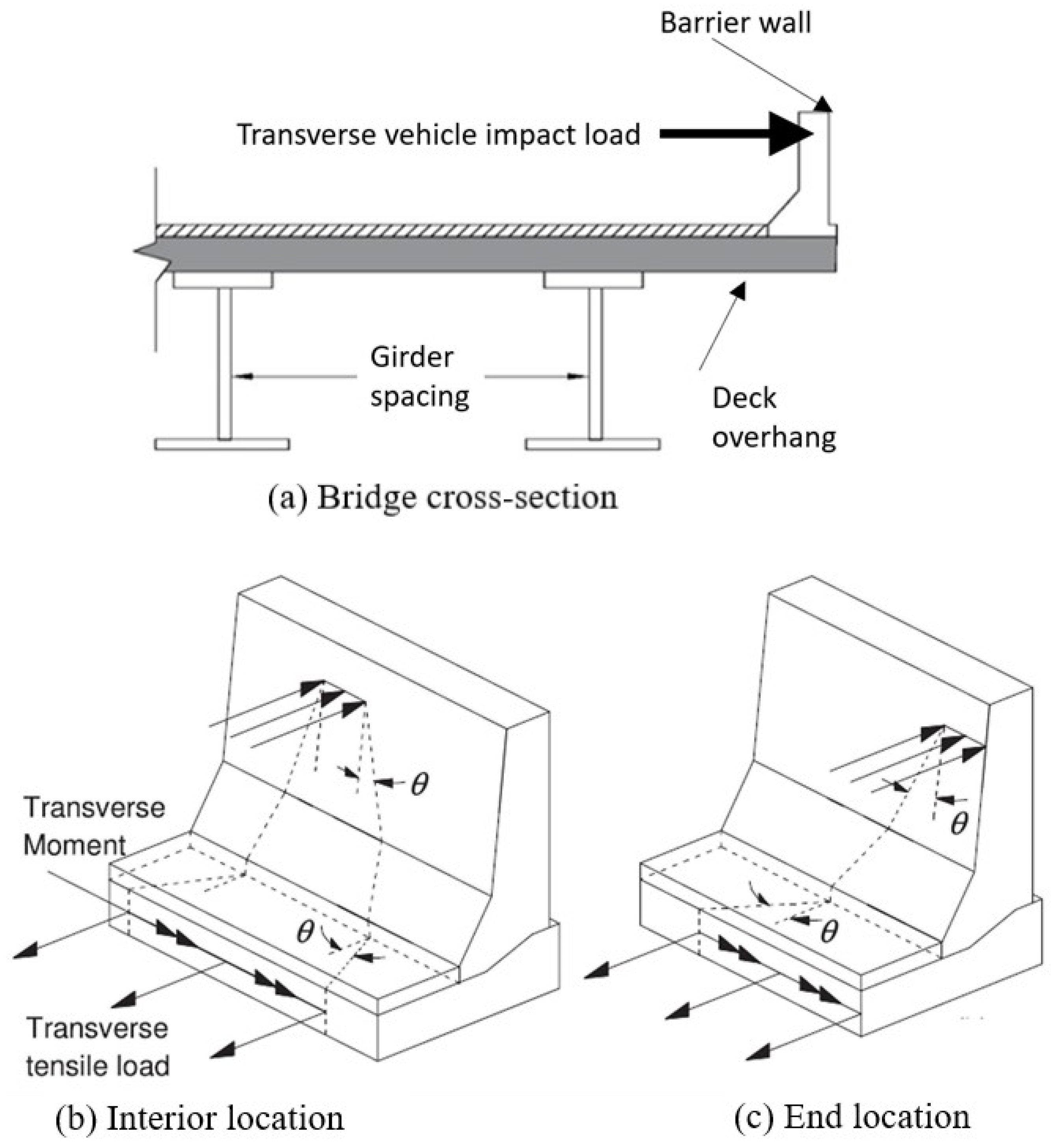
The design traffic loads and geometric requirements for bridge concrete barrier walls and deck overhangs are based on the Canadian Highway Bridge Design Code [25] and AASHTO-LRFD bridge design specification [26]. This is in addition to the AASHTO guide for selecting, locating, and designing traffic barriers [27] and the AASHTO guide specification for bridge railings [28]. The preliminary configuration of the TL-5 precast bridge barrier was developed in accordance with the CHBDC requirements [25] for static loading at the connection between the deck slab and the barrier wall [29]. According to CHBDC provisions, longitudinal and vertical loads of 210, 70, and 90 kN, respectively, must be considered over a defined segment of the barrier. For TL-5 barriers, the code specifies that the transverse load is to be distributed along a 2400 mm length. To determine the factored design loads, a live load factor of 1.7 is applied to the nominal loads specified earlier. As the transverse load governs the critical capacity of the barrier system, the longitudinal and vertical components were excluded from the design considerations for both the reinforcement of the barrier wall and its anchorage to the deck slab. In accordance with CHBDC, the prescribed live load factor is 1.7. Consequently, the resulting design transverse load acting over a 2400 mm barrier length is 357 kN, which was used in sizing the vertical and horizontal reinforcement within the barrier wall. Figure 3 presents how the transverse impact loading is applied at the barrier interior and end locations and how this load is transferred through the barrier wall and the deck overhang through the differential angles.
According to the AASHTO-LRFD bridge design specifications [26], the ultimate flexural strength of steel-reinforced barrier walls subjected to vehicle impact is determined using yield-line theory. This approach assumes that the failure mechanism is confined to the barrier wall and does not propagate into the deck slab, thereby requiring the slab to possess sufficient stiffness and strength to restrain failure within the wall. The method also presumes that an adequate longitudinal length of the barrier is available to develop the expected yield-line mechanism. However, because GFRP reinforcement exhibits linear elastic behavior until rupture, the conventional AASHTO-LRFD yield-line equations are not applicable to GFRP-reinforced barriers. In such cases, both equilibrium and deformation compatibility must be satisfied through the use of appropriate analytical or numerical modeling. Given the absence of validated analytical procedures, the performance of GFRP-reinforced barrier systems must instead be verified through load testing of full-scale specimens or prototypes before being implemented in Canadian bridge applications.
It is worth noting that a TL-5 bridge barrier design utilizing GFRP ribbed bars was developed at Toronto Metropolitan University, resulting in the first, second, and third full-scale vehicle crash tests worldwide [20,21,30]. During these three full-scale tests, the TL-5 GFRP-reinforced concrete barriers maintained their connection to the deck overhang, with no detachment of the barrier wall observed. Deformation was primarily confined to the barrier wall itself. The GFRP reinforcement effectively transferred impact loads to the deck while preserving the integrity of the anchorage, confirming the adequacy of the selected anchorage configurations (headed-end and hooked bars). Under short-duration impacts from a 36-ton tractor-trailer traveling at 80 km/h and striking at a 15° angle, the barrier remained securely attached to the deck, preventing vehicle penetration or detachment hazards. It is worth noting that these crash tests led to the development of MTO Standard Drawing SS110-92, issued by the Ontario Ministry of Transportation in May 2011 [25]. The crash-tested barriers were subsequently subjected to increasing transverse static loads until collapse to determine their ultimate load-carrying capacity governed by punching shear failure [22,31,32]. Based on these static tests, a punching shear capacity equation was proposed for the design of GFRP-reinforced concrete barrier walls and later incorporated into the Canadian Highway Bridge Design Code [25].
Previous research has emphasized the vulnerability of concrete corners and joints under opening moments. Johansson [33] examined reinforcement detailing in concrete frame corners and reported that insufficient anchorage frequently caused premature diagonal cracking. Skettrup et al. [34] investigated stress concentrations at re-entrant corners in concrete frames and concluded that careful reinforcement detailing is required to resist diagonal tension stresses. Mayfield et al. [35] studied lightweight concrete corners and observed reduced stiffness and early crack formation. Although these studies focused on frame corners, their findings highlight the importance of proper anchorage detailing, which also governs the performance of barrier–deck overhang systems in the present study. Other researchers [36,37,38,39,40] analyzed reinforced concrete corner joints under opening moments but did not develop equations to predict joint capacity associated with diagonal tension cracking. Moreover, these studies considered opening moments that necessitated additional steel reinforcement.
In contrast, the barrier–deck overhang concrete examined in this study is subjected to a combination of bending moments and tensile forces from the deck overhang, as well as to combined bending moments and shear forces at the base of the barrier wall. This results in a distinct stress state and force equilibrium, which will be discussed later in the paper.
Several researchers have experimentally investigated various mechanical connection techniques between steel-reinforced barriers and deck overhangs [41,42,43,44]. Others have tested the capacity of steel-reinforced barrier–deck overhang corners, reporting failures due to flexural failure or diagonal tension cracking in the deck under the barrier wall [45,46,47,48]. A few studies have examined the connection capacity between GFRP-reinforced barriers and steel-reinforced deck overhangs or stiff bases, considering both pre-installed and post-installed GFRP bars [23,24,29,49,50]. These studies used GFRP bars with headed ends for pre-installed configurations and straight ends for post-installed ones. Observed failure modes included diagonal tension cracking at the barrier–deck overhang corner, shear failure within the barrier wall, and GFRP bar pullout at the deck anchorage. Additionally, several researchers have experimentally evaluated the pullout capacity of vertical GFRP bars embedded in the deck slab [4,51,52,53].
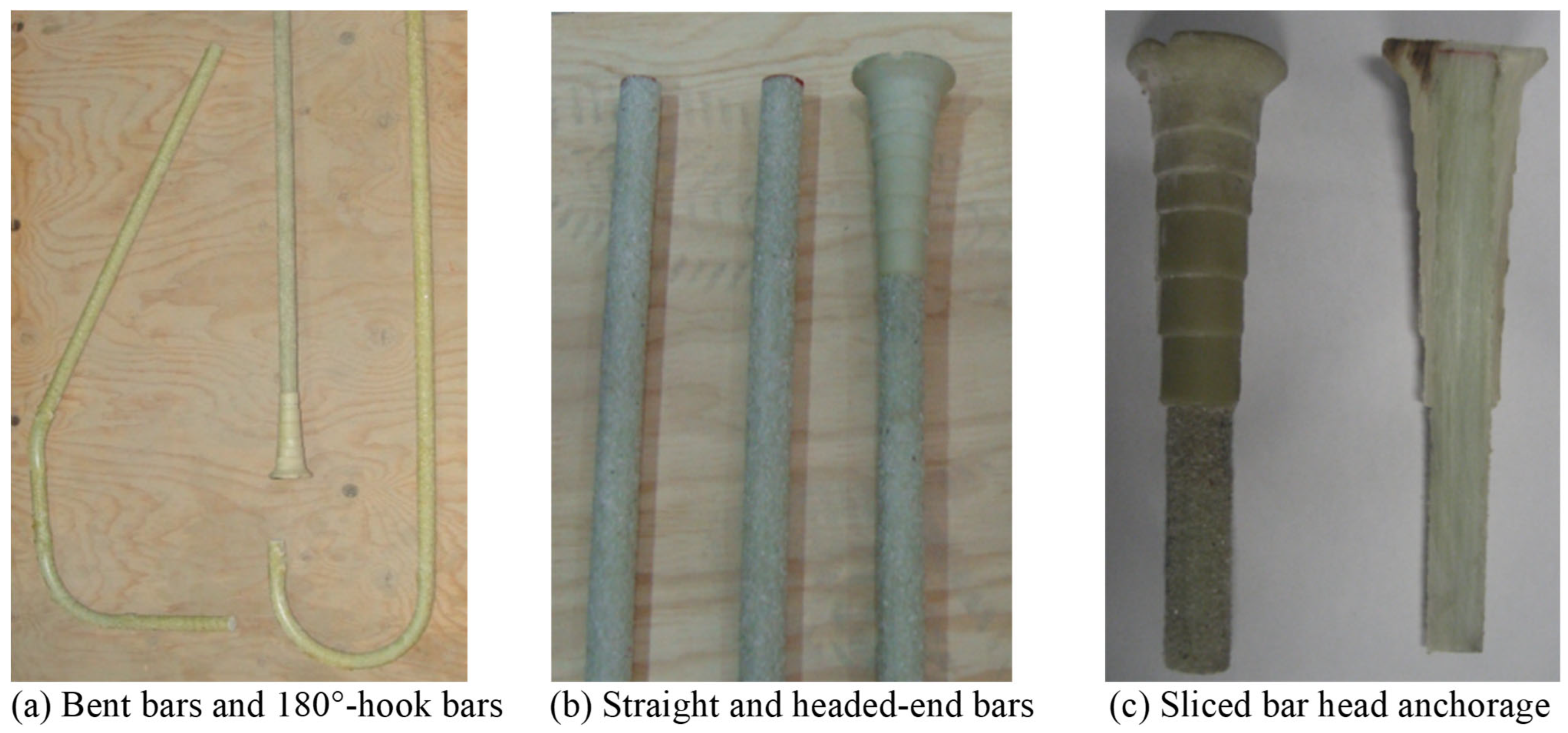
As no established design guidelines currently exist for GFRP-reinforced barriers, experimental testing to failure was undertaken to validate the proposed reinforcement details for ultimate strength. A total of five full-scale TL-5 barrier specimens of short length were fabricated and tested to collapse, assessing their load-carrying capacity and failure mechanisms. Four of these specimens incorporated GFRP reinforcement: two utilized high-modulus (HM) GFRP bars with headed-end anchorages, while the remaining two were reinforced with standard-modulus (SM) GFRP bars using bent and 180°-hook configurations, respectively. For comparison, a fifth specimen reinforced with conventional steel, in accordance with Ontario Ministry of Transportation (MTO) standard drawings, served as the reference model [25]. The experimental results—including crack development, deflection behavior, and ultimate capacity—were benchmarked against the design requirements of the Canadian Highway Bridge Design Code for barrier anchorage into deck slabs. Complementary analytical studies were also conducted to evaluate the structural adequacy of the proposed barrier systems.

2. Experimental Program

2.1. Test Specimens

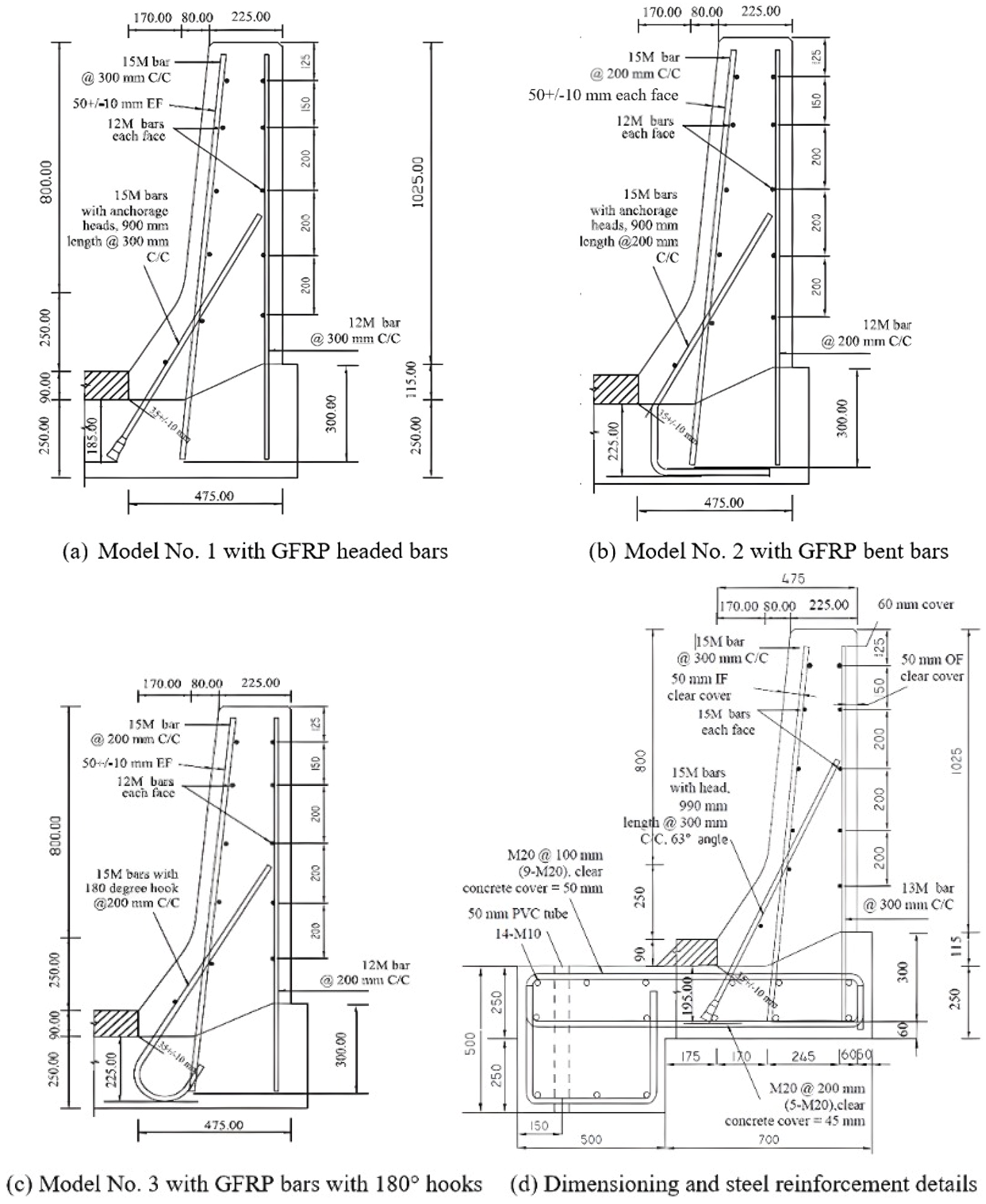
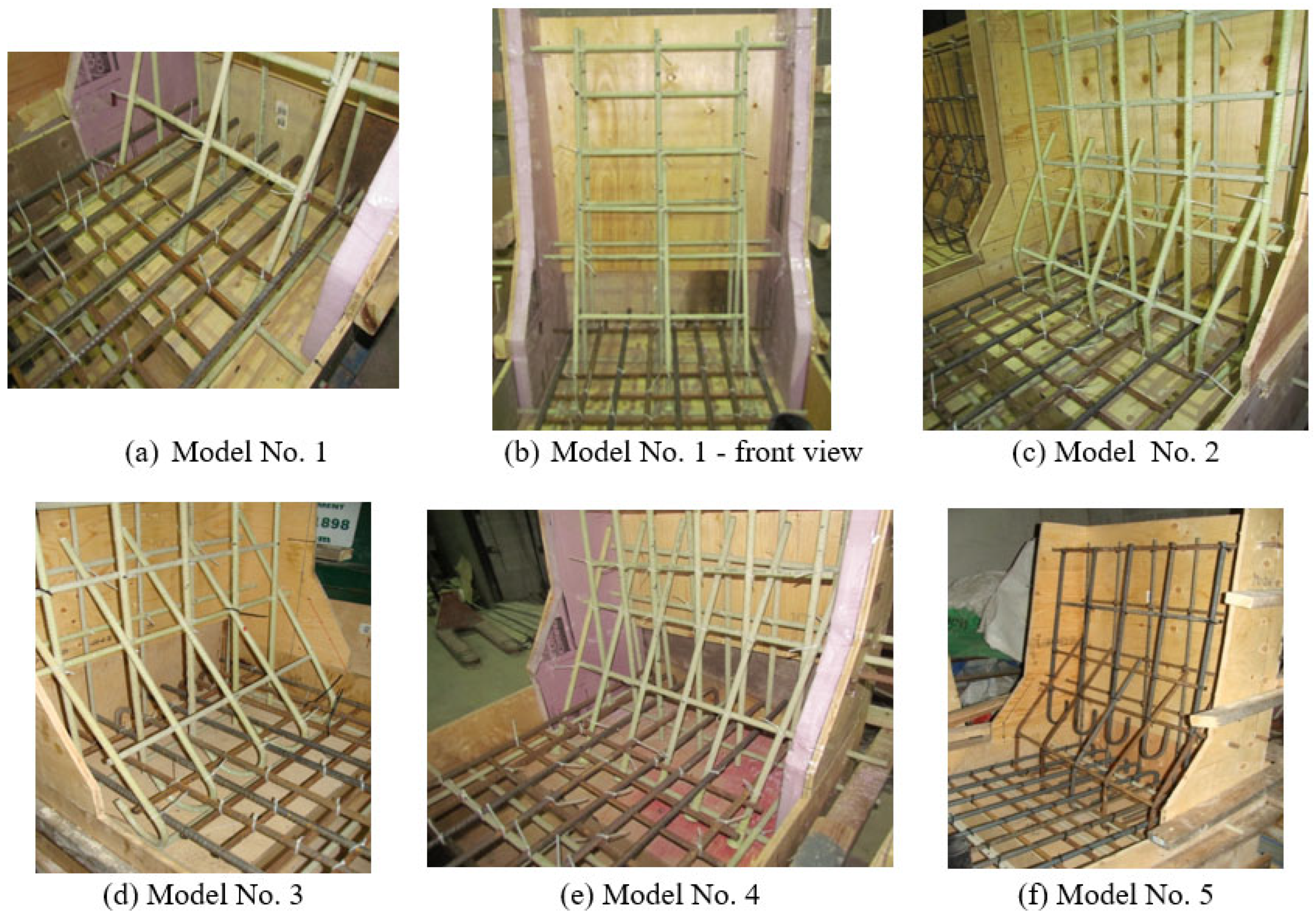
Five full-scale TL-5 barrier specimens were fabricated to evaluate the effect of reinforcement type and detailing on load resistance and failure mechanisms. The main geometric dimensions were identical for all specimens, as shown in Figure 4, while the reinforcement details varied, as summarized in Table 1 and comparatively illustrated in Figure 5. Models 1 to 4 used sand-coated glass fiber-reinforced polymer (GFRP) bars, while Model 5 served as the steel-reinforced reference in accordance with MTO standard drawings. Among the GFRP-reinforced barriers, two used high-modulus (HM) bars and two used standard-modulus (SM) bars, allowing for a direct comparison of bar stiffness, anchorage configuration, and bar spacing. Key distinctions among the five models are outlined below:
• Model 1 (HM-GFRP, Headed-End, 300 mm spacing):
Represented the baseline GFRP configuration with headed-end anchorage at the deck–barrier interface per the crash-tested GFRP barriers [20].
• Model 2 (SM-GFRP, Bent Bars, 200 mm spacing):
Incorporated bent bars instead of heads to assess the performance of mechanically anchored versus bent GFRP reinforcement.
• Model 3 (SM-GFRP, 180° Hooked Bars, 200 mm spacing):
Mirrored Model 2 in geometry but replaced bent bars with hooked ends to evaluate the anchorage efficiency of the hook configuration.
• Model 4 (HM-GFRP, Headed-End, 150 mm spacing):
Replicated Model 1 with denser vertical reinforcement to simulate reinforcement at barrier ends or construction joints.
• Model 5 (Steel Reinforced, 200 mm spacing):
Conventional steel detailing per MTO standards, used as a control for comparison.
All specimens were cast on the same day using a single concrete batch. Casting was performed in two stages: first, the deck slab, followed by the barrier wall. Mechanical vibration was applied uniformly during placement, and manual hammering was used around the wall–deck interface and tapered sections to ensure complete consolidation and minimize voids. The barrier walls were integrally connected to the projecting cantilever deck slabs, which allowed rotational movement at the barrier–deck interface. The cantilever deck slab was anchored to an end concrete block, which in turn was secured to the laboratory floor using a tie-down anchoring system.

2.2. Material Properties

In the current study, two types of GFRP bars were utilized, specifically: (i) high modulus GFRP bars (HM) and (ii) standard modulus GFRP bars (SM). The bar’s sand-coated surface profile, illustrated in Figure 6, guarantees an optimal bond between the bar and the surrounding concrete. Table 2 provides a summary of the bar’s mechanical properties used in this study [54]. It is important to note that the 180° hook or bent bars are produced using standard modulus material. Furthermore, it should be emphasized that the hook or bent bars cannot be reshaped on-site and must be manufactured by the producer. Due to the redirection of fibers during the bending process, the tensile strength of the hook and bent sections is significantly lower than that of the straight section. Consequently, in the design of structures using hook or bent bars, the quantity of GFRP bars needs to increase. The material properties of the headed section consist of a thermosetting polymeric substance that is applied to the straight bar end and cured at high temperatures. The polymeric mixture includes an alkali-resistant Vinyl Ester resin, exhibiting similar properties to those found in the straight bars. The outer diameter of the head reaches a maximum of 2.5 times the bar diameter, with a total head-end length of 100 mm. This design ensures optimal anchorage and minimizes potential transverse splitting in the area surrounding the head [4,51,52,53].
As for the reinforcing steel bars used to reinforce the deck slab for all models, as well as the wall of Model 5, two sizes of deformed steel bars of 15M and 20M were used. The 15M bar had a 16 mm diameter, while the 20M bar had a 19.5 mm diameter. Both sizes are typically made from high-tensile steel with a yield strength of 400 MPa and a tensile strength of 600 MPa.
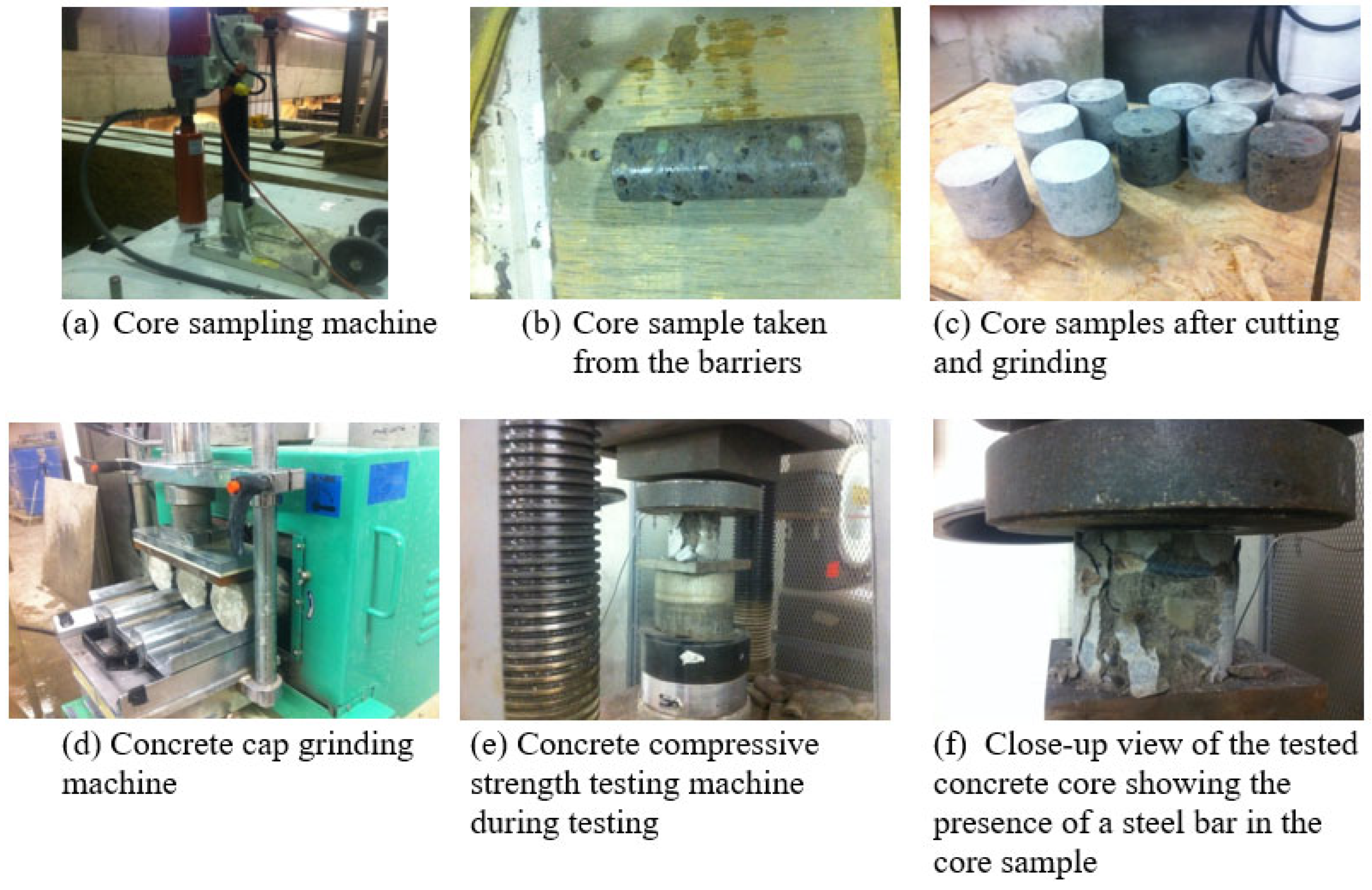
A 25 MPa ready-mix concrete was considered to cast all models. During concrete casting, the concrete was vibrated to remove entrapped air and prevent honeycombing on the sides and surface. Furthermore, 100 × 200 mm concrete cylinders were made from the same concrete batch as specimens, cast in separate molds but vibrated and cured under similar conditions as the specimens to verify that the achieved compressive strength matched the expected values. The concrete slabs were then watered twice a day for seven days and cured using plastic sheets to prevent evaporation of hydrated cement from the surface. However, to determine the in situ concrete strength more accurately, 25 core samples were extracted from the tested models after all experiments were completed, and their compressive strengths were measured. The equivalent concrete compressive strength of each sample was calculated according to [55]. Then, the characteristic strength, accounting for both the number of specimens tested and the deviation of individual strengths from the mean, was determined using Equation (1) as recommended in [34].
f c = 0.9 f ¯ e q 1 1.28 k c V 2 n + 0.0015 0.5  
where f ¯ e q = average core strength (30.38 MPa), V = coefficient of variation of core strengths (0.1881), n = number of cores tested (25), k c = coefficient of variation modification for concrete takes into account the number of tested cylinders, which equals 1.02 for 25 samples. Thus, the characteristic value of concrete was obtained as 25.4 MPa, with details of calculations shown in Table 3. Figure 7 illustrates a step-by-step procedure for determining concrete strength using a core sampling machine. It should be noted that the extraction of 25 cores was meant to obtain representative concrete strengths across all specimens after testing, thereby reducing scatter and ensuring an accurate evaluation of the as-built strength. This improved reliability for capacity-demand comparisons.

2.3. Test Setup and Instrumentation

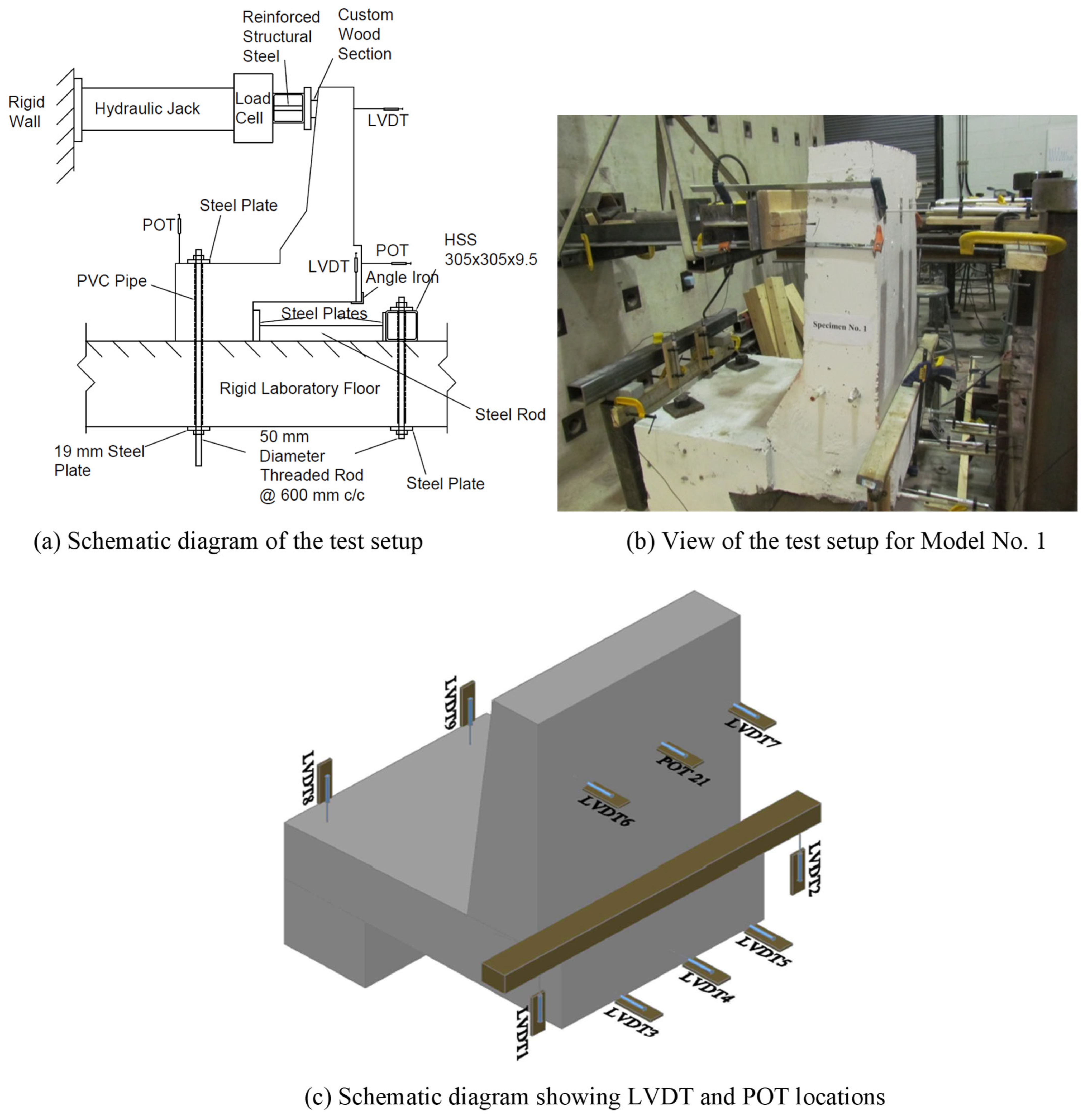
Figure 8 presents schematic representations of the test setup, including the locations of the LVDTs. Each barrier model was mounted on the strong floor of the structural laboratory and anchored using 50 mm diameter threaded rods at 600 mm intervals, which were tightened to control slab uplift during testing. A hydraulic jack applied horizontal loads to the barrier walls, while a universal flat load cell with a 900 kN capacity recorded the applied forces. Data from all sensors were collected using a SYSTEM 6000 data acquisition unit.
Testing of each barrier specimen was performed under progressively increasing monotonic loads until failure. The hydraulic jack applied loads in 10 kN increments, with each step held for several minutes to monitor crack initiation, propagation, and changes in barrier geometry as measured by the LVDTs. Failure was identified when sensor readings indicated continued deformation while no additional load could be applied. Figure 8c shows the LVDT placement: (i) on the top back face of the barrier wall aligned with the loading direction; (ii) at the bottom of the deck slab to track transverse movement; (iii) on the top back face of the deck slab to detect potential uplift; and (iv) on the back face of the barrier wall to measure vertical displacement.

3. Structural Demand of the TL-5 Barrier–Deck Overhang System

The design of a TL-5 traffic barrier supported on a bridge deck overhang requires accurate assessment of the transverse impact load effects on the barrier–deck system. In this study, the investigated configuration consists of a barrier mounted on a deck slab with an overhang length of 0.7 m, a total barrier length of 20 m, and a deck thickness of 250 mm, with barrier dimensioning as shown in Figure 2.
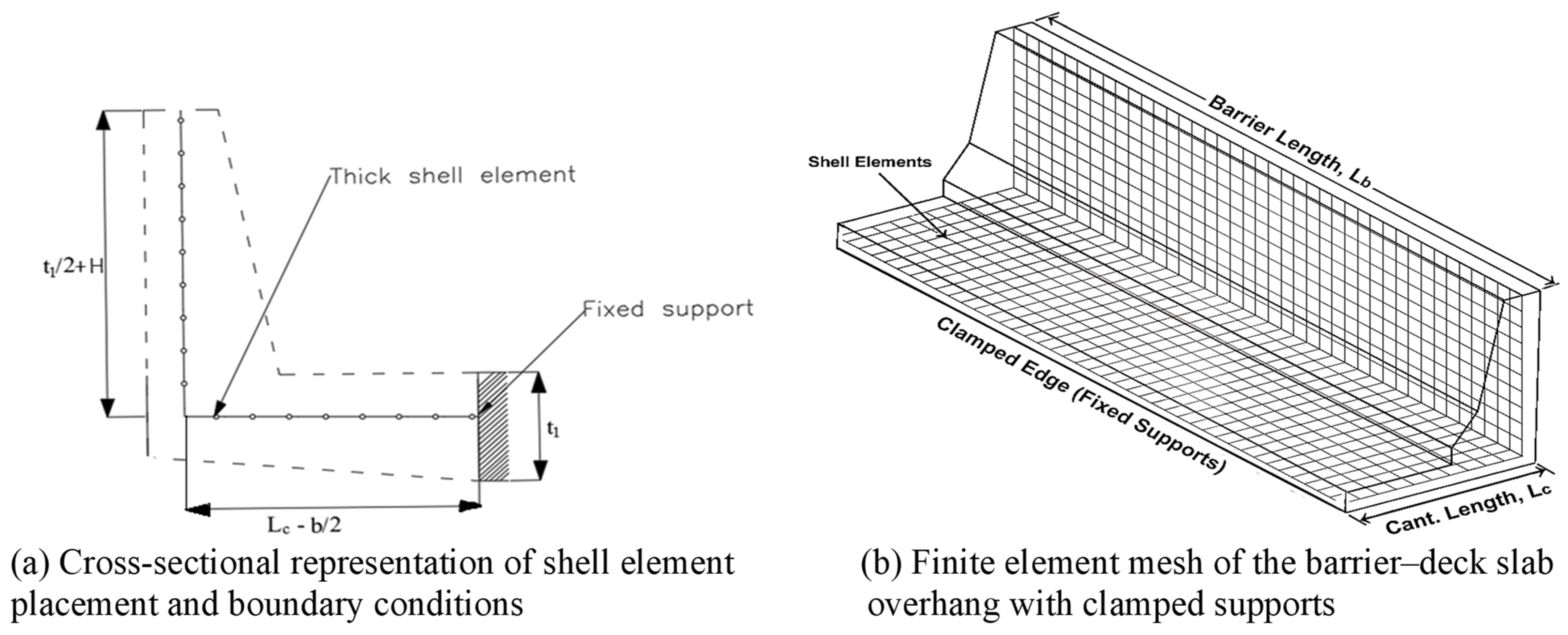
A three-dimensional finite element model, illustrated in Figure 9, was created to simulate the structural behavior of the barrier–deck system. Both the barrier and the deck slab were represented using thick shell elements, providing six degrees of freedom per node and effectively capturing the coupled bending and membrane actions at the deck–barrier interface. The boundary condition at the connection to the exterior girder was represented as fully fixed, preventing both translational and rotational degrees of freedom. The analysis was carried out in SAP2000 software (v21.2, Computers and Structures, Inc. (CSI), California, United States) [56], where the concrete materials for both barrier and deck were assumed to behave linearly elastic.
The applied vehicle impact demand followed the CHBDC TL-5 transverse loading case [25]. A concentrated transverse line load of 357 kN was distributed over a 2400 mm length along the barrier in the traffic direction. This load was applied at a 990 mm height measured from the deck slab’s overhang, consistent with the prescribed load application height for TL-5 barriers. To capture the variation in structural response along the barrier length, the load was positioned sequentially at multiple locations starting from the barrier end and shifting inward in 1200 mm increments until reaching the barrier mid-length.
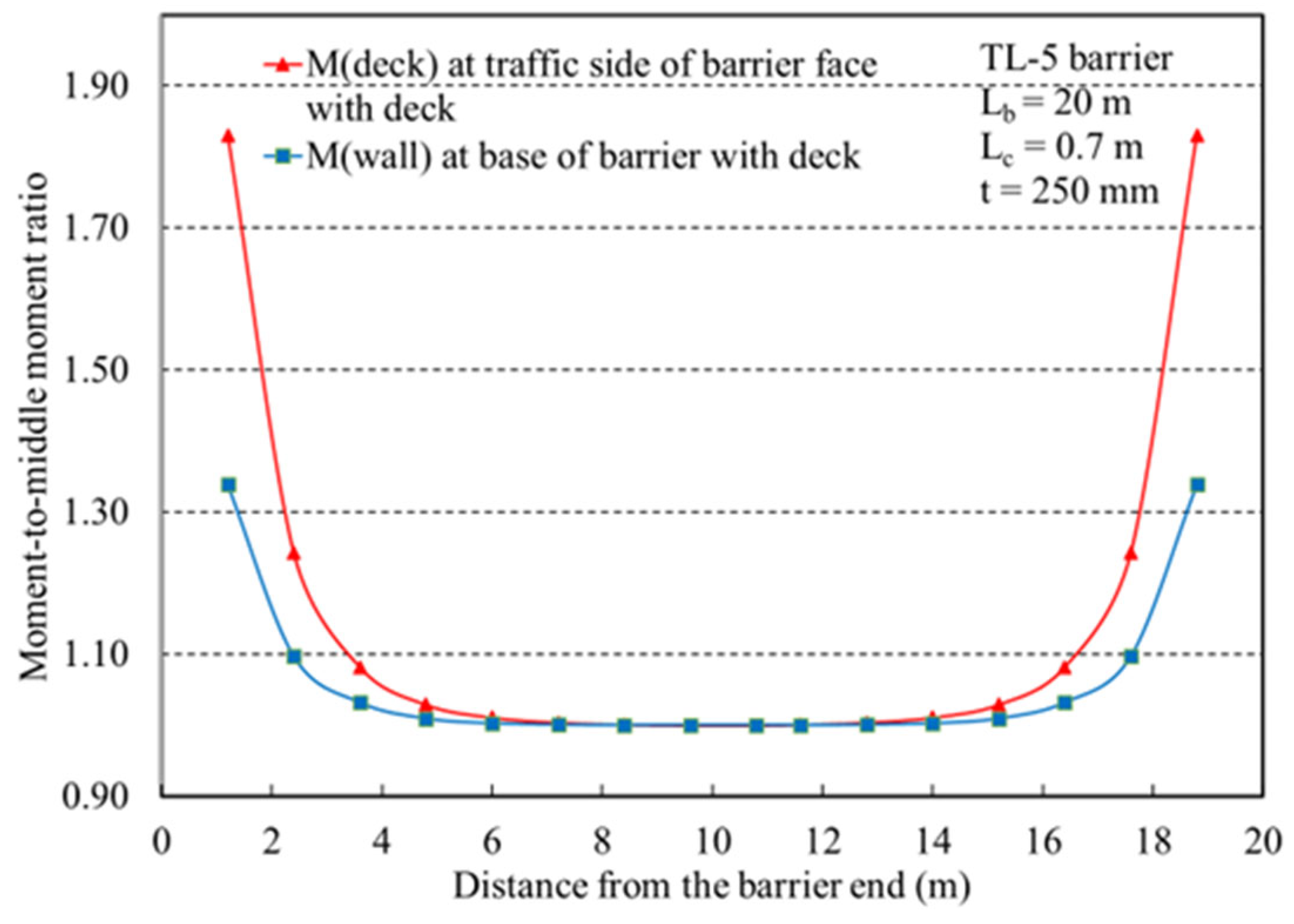
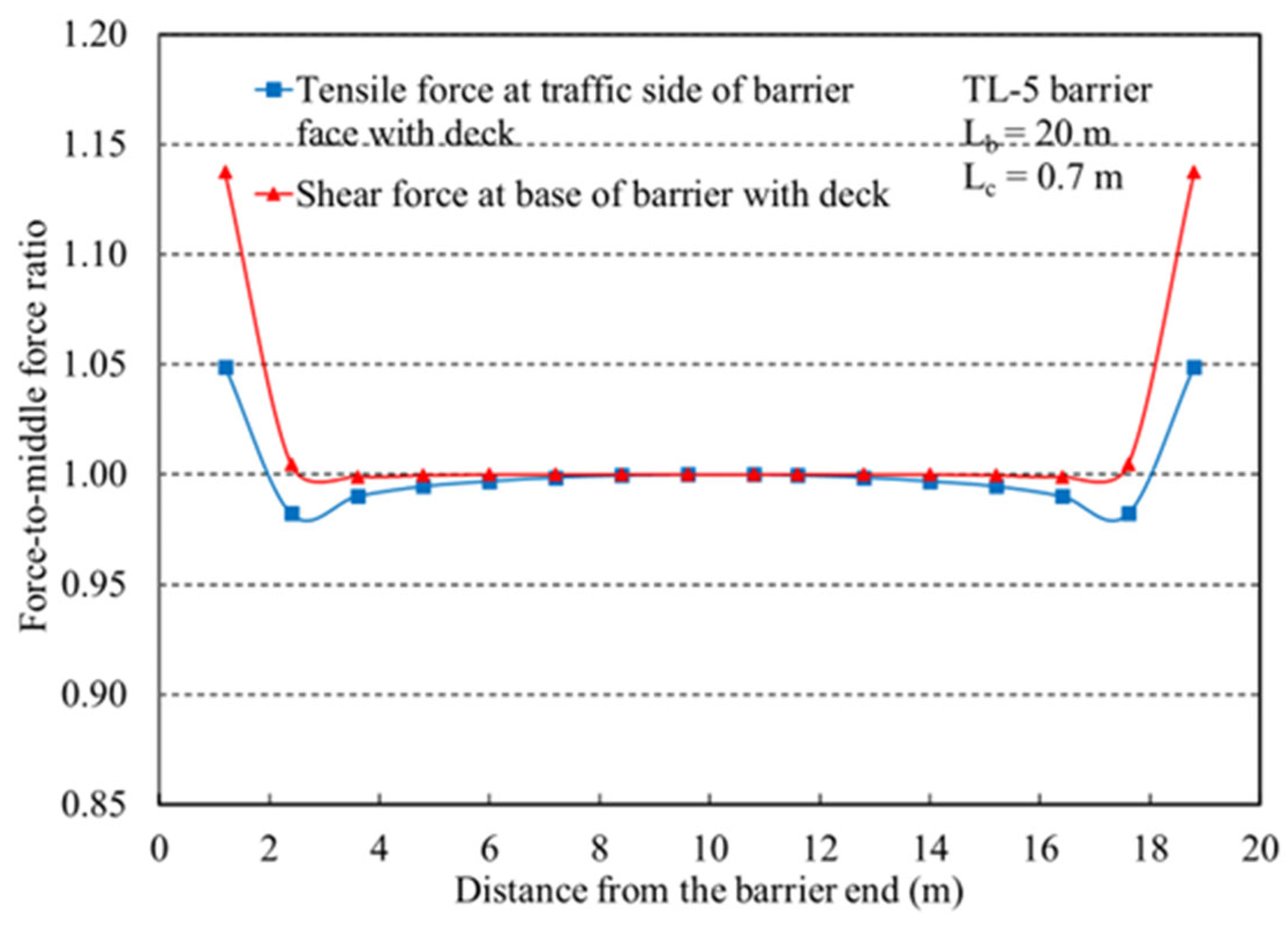
The analysis results are summarized in Figure 10 and Figure 11. Figure 10 illustrates the variation in the applied vertical moment at the barrier base with the deck and the transverse moment in the deck overhang at the inner edge of the barrier. Results were presented as the ratio of the applied moment at the barrier end to that at the barrier’s mid-length. It can be seen that the moment demand is greatest near the barrier end and gradually decreases towards the mid-length, where it stabilizes. A transition zone of approximately one loaded length (Lt) was identified, within which the moment demand drops sharply before reaching values comparable to those at the barrier mid-span. It can be observed that the applied moment at the barrier base changed from 78 to 104 kN·m/m when the load was applied at the barrier end compared to the barrier mid-length location (an increase of 34%). Also, the applied moment on the deck overhang increased from 57 kN·m/m at mid-length location to 103 kN·m/m at end location (83% increase).
Figure 11 presents the corresponding tensile force distribution in the deck overhang as well as the shear force at the barrier base barrier wall in the form of the ratio between the demand at the barrier end and its mid-length. Similar to the moment response, the tensile force increases significantly near the barrier end and diminishes toward the mid-length. However, the transitional length for tensile force variation was found to be shorter than that for bending moment, indicating higher sensitivity of tensile stresses to end loading conditions. The applied shear force at the barrier base changed from 133 to 150 kN/m when the load was applied at the barrier end compared to the barrier mid-length location (an increase of 14%). Also, the applied tensile force on the deck overhang increased from 150 kN/m at the mid-length location to 157 kN/m at the end location (5% increase). These findings confirm that the design demand for TL-5 barriers must account for the location of transverse impact loading, especially within the transition zone, to ensure conservative and safe structural performance. A quantitative comparison of the results further clarifies the influence of load position on the structural response. When the transverse load was applied near the barrier end rather than at the interior location, the moment at the bottom of the barrier wall increased by 34%, while the moment in the deck overhang at the inner face of the barrier increased by 83%. In contrast, the shear force at the barrier base increased only by 14%, and the tensile force in the deck at the inner face of the barrier increased by only 5%. These comparisons reveal that the influence of load location is far more significant on the flexural (moment) demand than on the shear or tensile responses. Practically, this means that even moderate variations in load position can substantially affect the required flexural reinforcement and the likelihood of diagonal tension cracking at barrier ends. Therefore, considering the most critical load position in design ensures that the reinforcement layout at barrier ends provides adequate strength and stiffness under realistic impact conditions.

4. Test Results and Discussion

4.1. Crack Patterns and Load-Carrying Capacity

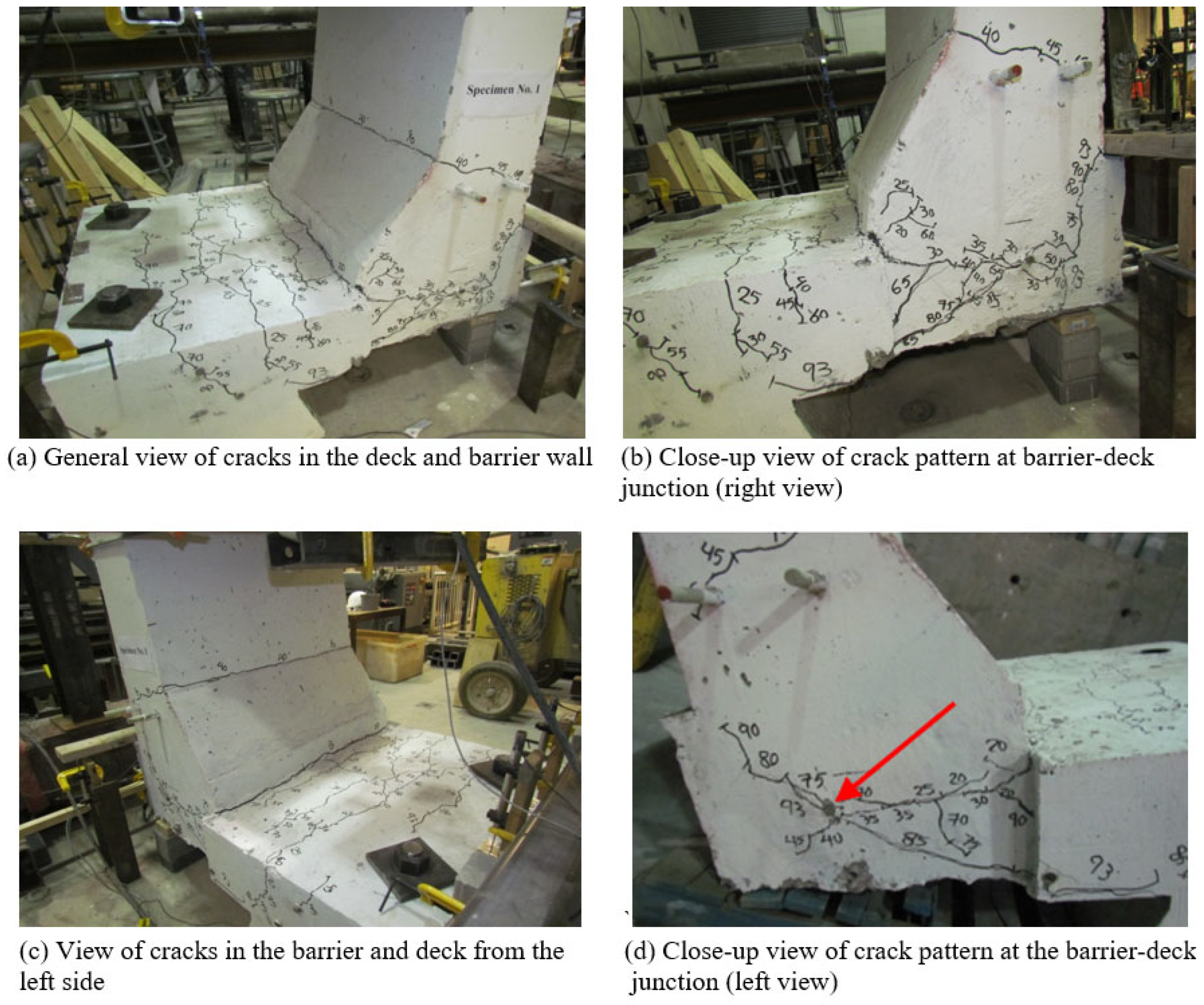
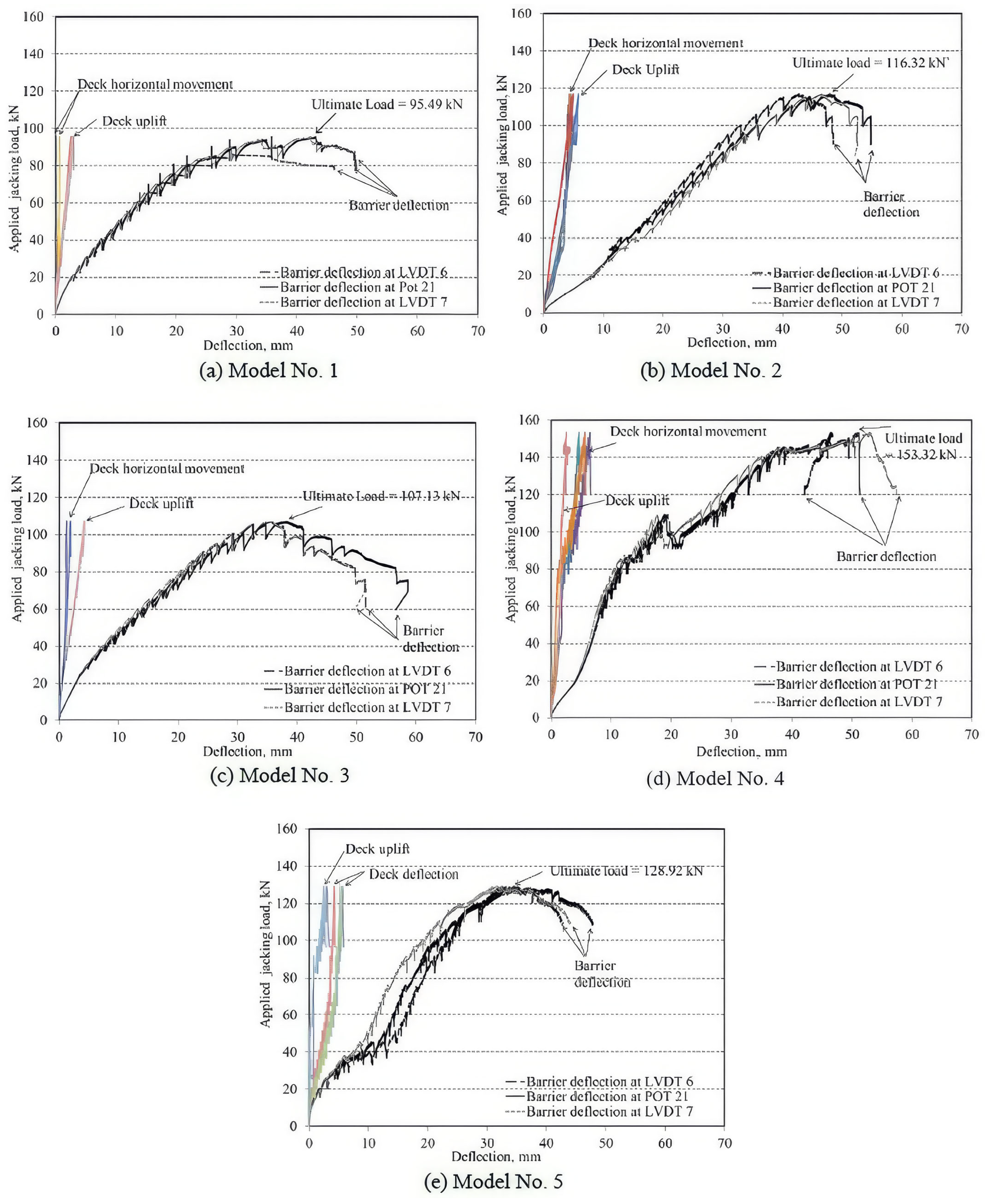
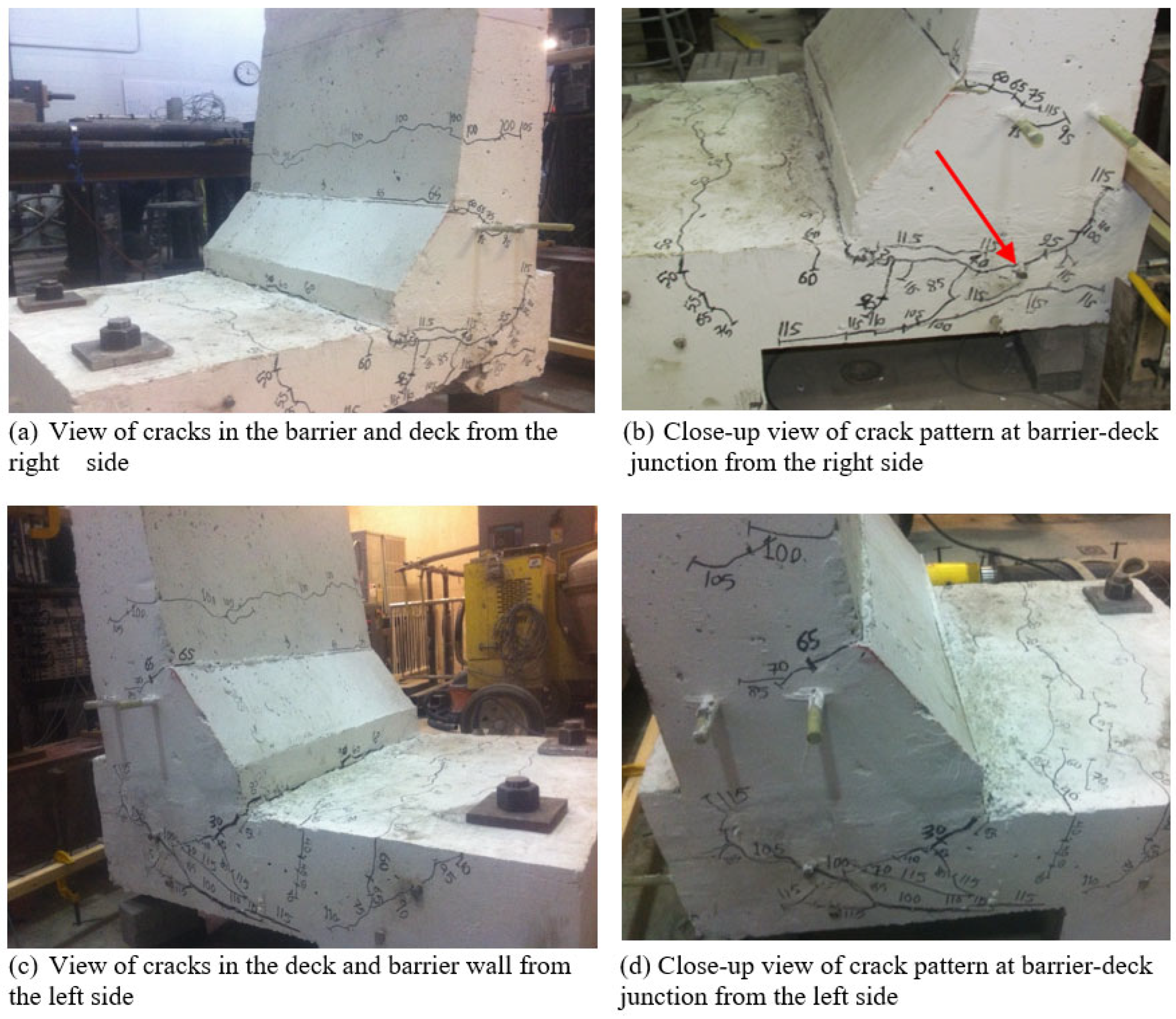
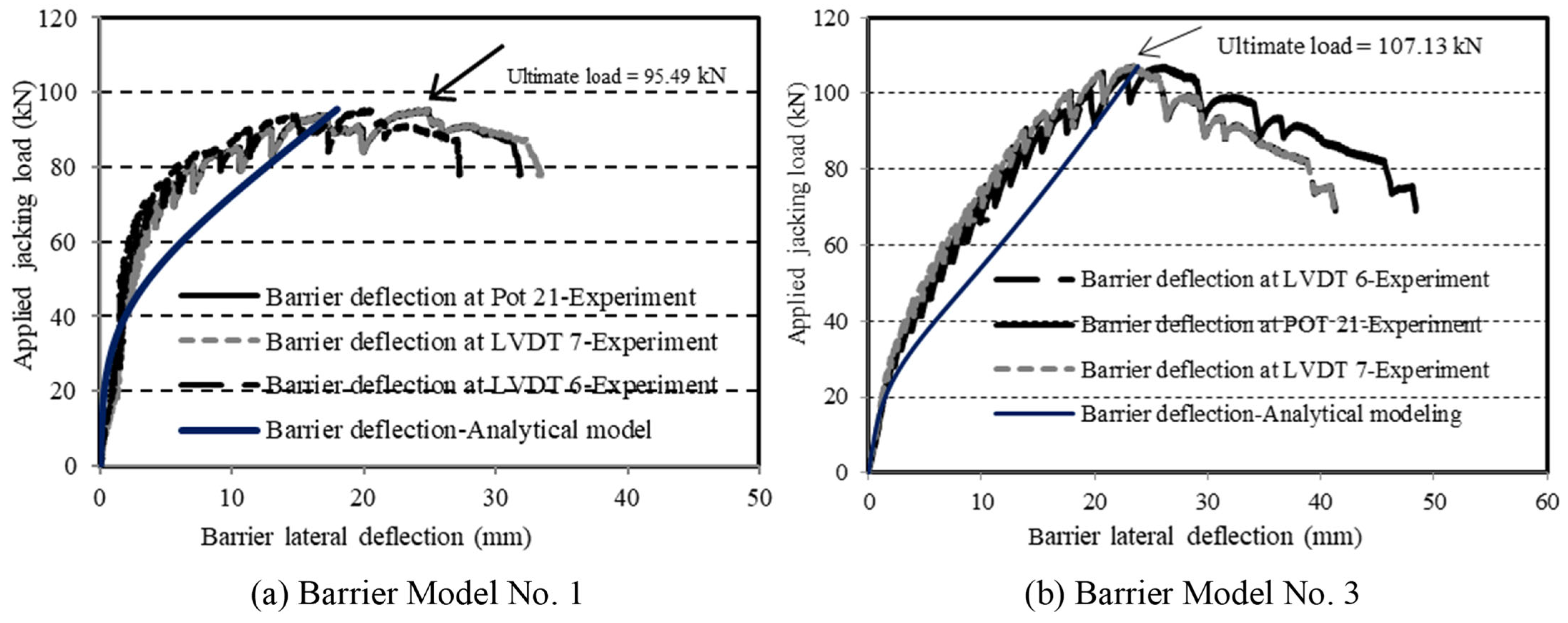
For barrier Model 1, which incorporated HM-GFRP bars with headed-end anchors, the barrier extended 900 mm along its longitudinal axis. The applied load was positioned 990 mm above the deck slab, in accordance with CHBDC guidelines for TL-5 barriers under static testing conditions. Load increments of 10 kN were used to monitor the onset of cracking in both the barrier wall and the deck slab. The first visible flexural crack appeared at the interface between the barrier wall and the deck slab at an applied load of approximately 20 kN. As the load increased, additional cracking developed at the corner where the deck met the slab, extending into the deck. Cracks in the deck slab became noticeable between 25 and 30 kN. At 40 kN, a flexural crack was observed at the junction between the upper and lower sections of the tapered wall. At this stage, cracks began propagating horizontally across the deck-to-barrier interface, alongside the previously observed slab cracks. Crack growth continued until the barrier reached its ultimate load of 95.49 kN. Various views of the crack patterns in barrier Model 1 are illustrated in Figure 12. The primary failure occurred at the corner of the deck-to-slab junction, resulting in diagonal tension cracking. The ultimate moment resisted per meter of barrier wall was calculated as 95.49 kN × 0.99 m/0.90 m, resulting in 105.0 kN·m/m, exceeding the CHBDC factored design moment of 78 kN·m/m for interior barrier locations, as listed in Table 4. At failure, the barrier wall exhibited a net lateral deflection of 24.45 mm, while the deck slab showed an average horizontal displacement of 1.6 mm and an average uplift of 2.8 mm. The net lateral deflection of the barrier was determined by accounting for both the horizontal displacement and the proportional contribution of deck uplift. Figure 13a presents the load-deformation response for barrier Model 1.
In Barrier Model 2, standard modulus GFRP bent bars were installed vertically in front of the barrier wall with 200 mm spacing. The barrier extended 1000 mm along its longitudinal axis, and the load was applied at 990 mm above the deck slab, consistent with the setup for Model 1. Figure 14 illustrates various views of the crack patterns observed at failure. The first flexural crack appeared at the fixed end of the deck slab under a load of 40 kN. When the load increased to 50 kN, additional cracks developed in the deck slab, along with vertical cracks on both sides of the deck. At 60 kN, a horizontal flexural crack emerged at the deck-to-barrier junction. A similar crack formed at the interface between the upper and lower sections of the tapered wall at 65 kN, which deepened through the wall as the load increased. Between 70 and 100 kN, cracks propagated further into both the deck and barrier thicknesses. At 100 kN, a flexural crack appeared at the top tapered portion of the barrier wall. Continued loading caused further crack propagation into the deck thickness at the barrier–deck interface, ultimately leading to failure at 116.3 kN, primarily due to diagonal tension cracking at the barrier–deck corner. The maximum moment at failure at the deck-to-barrier junction was calculated as 115.1 kN·m/m, exceeding the CHBDC factored design moment of 78 kN·m/m for interior barrier locations, as listed in Table 4. At failure, the barrier wall showed a net lateral deflection of 31.3 mm, with deck horizontal displacement of 4.4 mm and deck uplift of 5.3 mm. The load–deflection response measured by LVDTs is presented in Figure 13b.
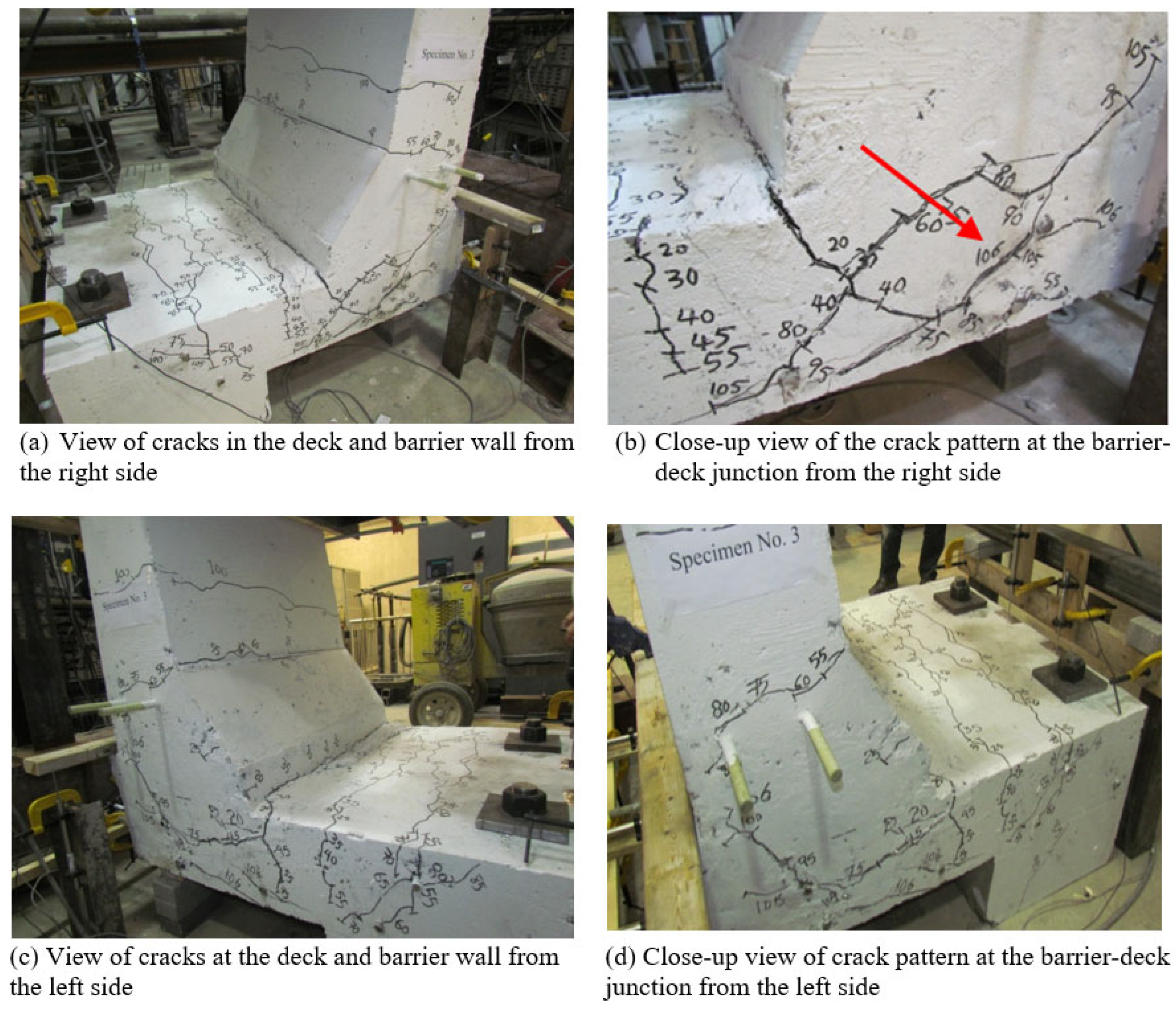
Barrier Model 3 was built using standard modulus GFRP bars with 180° hooks, spaced at 200 mm as vertical reinforcement along the front face of the barrier wall. The barrier measured 1000 mm in the longitudinal direction, and, as with Models 1 and 2, the load was applied 990 mm above the deck slab. Figure 15 presents various views of the crack patterns observed at failure. The first visible flexural crack appeared at the deck-barrier interface under a 30 kN load. At the same load, another flexural crack developed at the junction between the upper and lower tapered sections of the barrier wall, along with cracks in the deck slab.
As the load increased to 45 kN, cracks began propagating through the barrier–deck corner and into the slab thickness. Vertical cracks in the deck slab were observed when the load reached 50 to 70 kN. During this stage, cracking advanced at the corner junction of the barrier-to-deck and through the thickness of both the barrier wall and the deck slab. At 100 kN, a second flexural crack appeared in the top tapered portion of the barrier wall and extended significantly through the wall thickness. Multiple flexural cracks also formed on the top surface of the deck slab between 50 and 100 kN. The barrier ultimately failed at 107.13 kN at the barrier–deck corner due to diagonal tension cracking. The corresponding maximum moment at the junction was 106.1 kN·m/m, exceeding the CHBDC factored design moment of 78 kN·m/m for interior barrier locations. At failure, the barrier exhibited a net lateral deflection of 23.3 mm, accompanied by horizontal deck displacement of 1.6 mm and deck uplift of 4.2 mm. Figure 13c depicts the load–deflection response of both the barrier and deck slab under the applied load.
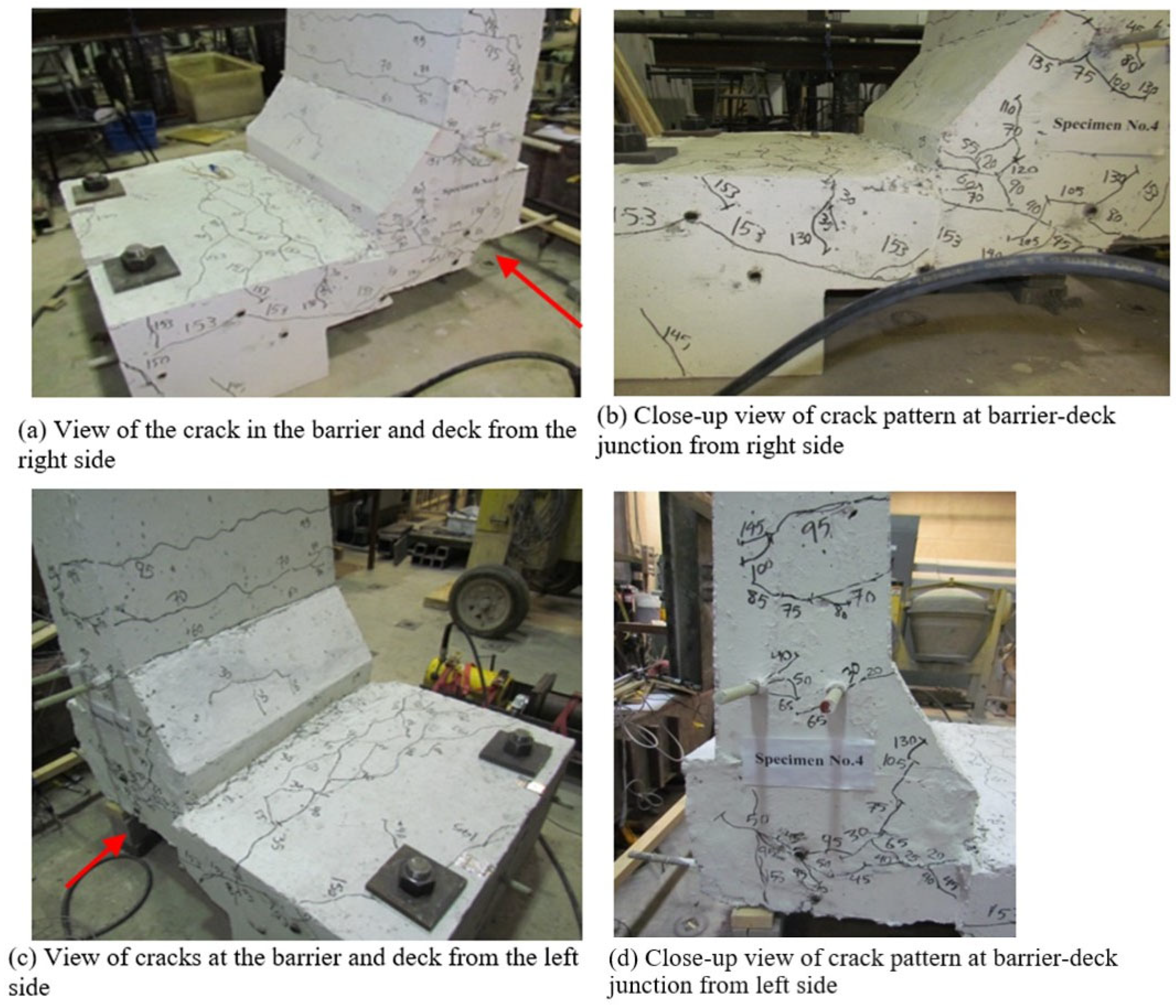
In Barrier Model 4, vertical high-modulus GFRP bars were installed along the front face of the barrier wall at 150 mm spacing. Consistent with the other models, the load was applied 990 mm above the deck slab. Figure 16 illustrates various views of the crack patterns observed at failure. The first visible flexural crack appeared at the barrier–deck interface under a 25 kN load. As the load increased, additional cracks developed in the deck slab due to the combined effects of flexural and tensile stresses. At 60 kN, a flexural crack was observed at the junction between the top and bottom tapered sections of the barrier wall. A similar crack formed above this junction at 70 kN and propagated extensively through the wall thickness. At the same load, cracks also extended through the barrier–deck corner. When the load reached 95 kN, a second flexural crack appeared in the top tapered portion of the barrier wall. The barrier ultimately failed at 153.3 kN, with failure occurring in the lower portion of the deck slab due to concrete splitting on the compression side beneath the barrier wall. The maximum moment at the barrier–deck junction was 168.6 kN·m/m, substantially exceeding the CHBDC factored design moment of 104 kN·m/m for barrier end locations, as reported in Table 4. At failure, the barrier exhibited a net lateral deflection of 43.2 mm, with an average horizontal displacement of 5.5 mm and deck uplift of 2.4 mm. The load–deflection response of Barrier Model 4 is shown in Figure 13d.
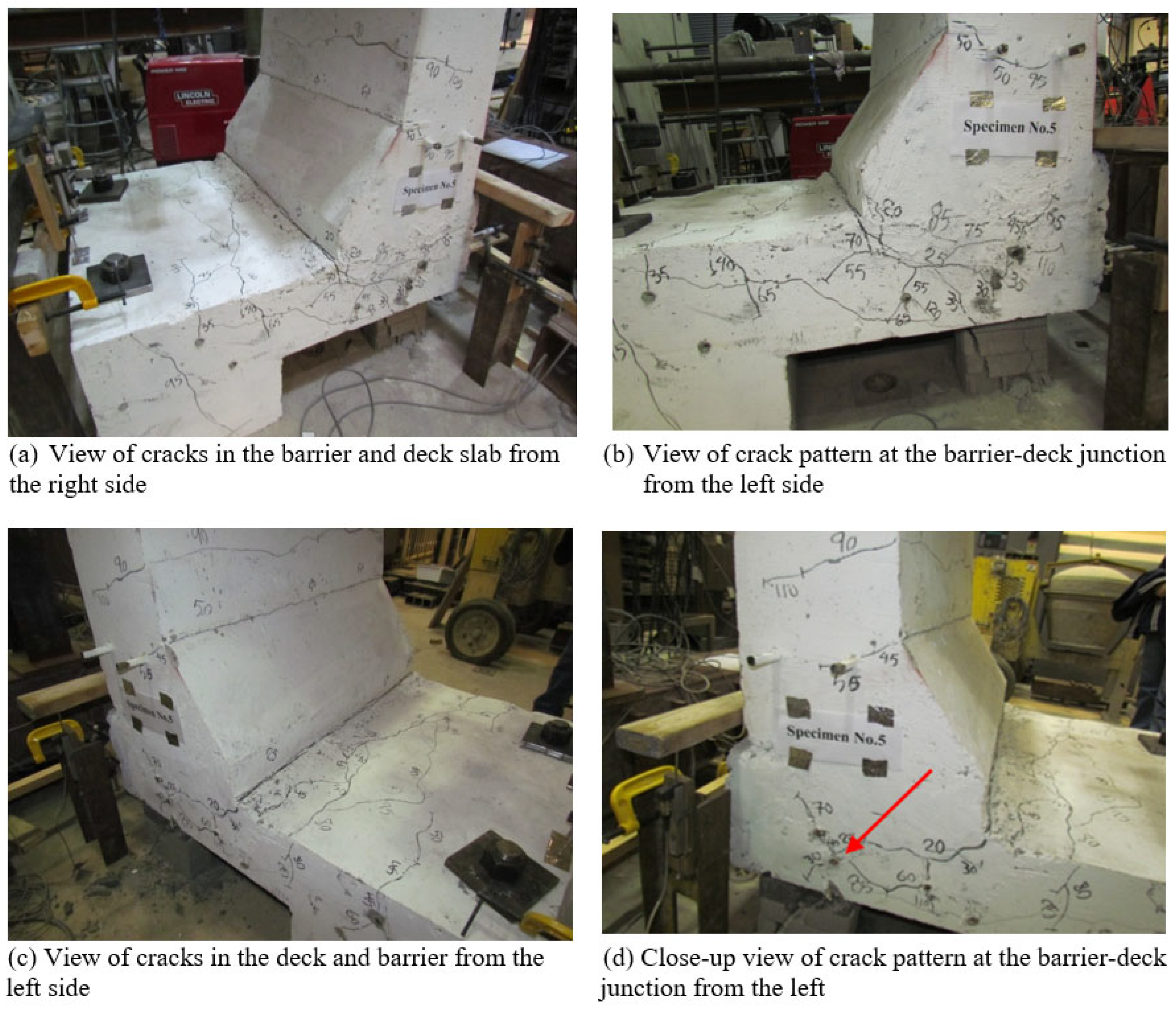
Barrier Model 5 was designed as a reference for comparing the performance of GFRP-reinforced barriers with that of a traditional steel-reinforced barrier. In this model, M15 steel bars were installed vertically along the front face of the barrier wall at 200 mm spacing. Consistent with the other barrier models, the load was applied 990 mm above the deck slab. Figure 17 shows the crack patterns observed at failure.
The first visible flexural crack appeared at the barrier–deck interface at a 20 kN load, extending down into the slab at the corner junction. As the load increased to 50 kN, additional flexural cracks developed throughout its thickness. At the same load, a flexural crack formed at the junction between the top and bottom tapered portions of the barrier wall, propagating through the wall thickness. At 85 kN, horizontal cracks appeared at the deck-barrier corner. When the load reached 105 kN, another flexural crack emerged in the top portion of the tapered wall and extended through its thickness, accompanied by additional cracks on the top surface of the deck slab. Further loading caused the cracks to widen, culminating in barrier failure at 128.92 kN at the deck-barrier corner under combined tension and flexure. The maximum moment at the barrier–deck junction was 127.3 kN·m/m, exceeding the CHBDC factored design moment of 78 kN·m/m for interior locations. At failure, the barrier wall exhibited a net lateral deflection of 17.8 mm, accompanied by a horizontal displacement of 5.0 mm in the deck slab and an uplift of 2.6 mm. Figure 13e presents the load–deflection response for Barrier Model 5.
The experimental results indicate that the proposed TL-5 barrier reinforcement details using GFRP bars with head anchorage, as well as GFRP bars with bent or 180° hooks, are effective and can be reliably implemented in bridge barrier walls to withstand the vehicle impact loads specified by the CHBDC at the barrier wall–deck slab connection. As shown in Table 4, a comparison of the experimental findings with the CHBDC design limits revealed a minimum 27% increase in barrier design strength. It could also be observed that barrier Models 1 and 3 showed relatively similar ultimate flexural strengths. Barrier Model 4, which was similar to Barrier Model 1, represented the case at the exterior location due to the reduced bar spacing to 150 mm. The experimental test results showed a 65% increase in the overall strength of the barrier model (Model 4) compared to the CHBDC limit at the exterior location. Thus, it can be concluded that Barrier Model 1 with HM-GFRP bars provided the most cost-effective barrier configuration due to the increased bar spacing of 300 mm, compared to Barrier Models 2 and 3 with a 200 mm bar spacing. The experimental results also demonstrated that the GFRP-reinforced barriers performed comparably to the steel-reinforced barrier in terms of strength at the barrier–deck junction. The ultimate flexural strength of the steel-reinforced barrier exceeded that of GFRP-reinforced Models 1, 2, and 3 by 20.4%, 10%, and 19%, respectively. Additionally, the maximum lateral deflection observed in the GFRP-reinforced barriers was greater than that of the steel-reinforced barrier, due to the lower modulus of elasticity of the GFRP bars. This higher deflection is beneficial, as it enhances the barrier’s capacity to absorb energy from vehicle impacts.
In summary, the five barrier configurations exhibited similar overall failure mechanisms, characterized by diagonal tension cracking at the corner of the barrier–deck junction, yet differed in terms of crack initiation and propagation, depending on the reinforcement type and detailing. All GFRP-reinforced barriers (Models 1–4) showed initial flexural cracking at the interface between the barrier wall and deck slab, followed by diagonal tension cracks extending into the deck. In contrast, the steel-reinforced barrier (Model 5) exhibited a more gradual crack propagation and narrower cracks prior to failure, due to the yielding capability of the steel bars. Among the GFRP specimens, those using headed-end HM-GFRP bars (Models 1 and 4) demonstrated more distributed cracking and smaller crack widths, indicating improved stress transfer and anchorage efficiency, while bent and hooked SM-GFRP bars (Models 2 and 3) developed fewer but wider cracks near the interface as a result of lower bond efficiency and reduced tensile strength in the bent regions. Model 4, with the closest bar spacing (150 mm), achieved the highest strength but experienced localized splitting in the deck slab, reflecting the influence of increased bar density at the barrier end. Overall, all GFRP-reinforced barriers failed in a controlled and non-brittle manner, and their failure patterns were consistent with flexure-dominated behavior governed by diagonal tension at the deck–wall junction.
It is important to note that although the anchorage types (headed-end, bent, or hooked) influenced the general distribution of cracks, the governing failure mechanism in all specimens was diagonal tension cracking at the barrier–deck corner, controlled primarily by the tensile capacity of the concrete rather than by bond failure of the reinforcement. No bar pullout or bond slip was observed before cracking, indicating that the bond stresses between the GFRP bars and surrounding concrete remained below their ultimate capacity throughout loading. Therefore, the relative effect of different anchorage configurations on bond or pullout resistance could not be directly evaluated in this study. Instead, the comparative observations of crack width and pattern reflect the overall stiffness and anchorage effectiveness of each configuration within the global structural response.

4.2. Cross-Sectional Analysis of Barrier Models

A conventional cross-sectional analysis, commonly used in beam design, was employed to determine the barrier’s ultimate flexural resistance (Mr) at the barrier-to-deck joint. The method was in accordance with ISIS manual 3 [57] for the design of FRP-reinforced beams. Material resistance factors of 0.5, 0.75, and 0.90 were considered for GFRP, concrete, and reinforcing steels, respectively, as per the CHBDC. The cross-sections of the wall at the base and deck at the connection joint were selected for the flexural strength calculation of the barrier models. As such, 475 mm corresponding to wall thickness and 250 mm corresponding to deck thickness at the barrier-to-deck joint was considered. The ultimate flexural capacities were determined over a 1000 mm barrier length and were found to be comparable with the experimental observations. In the calculation of the flexural capacity of the barrier wall models, the effect associated with the inclination of GFRP bars at the barrier-to-deck connection was considered. Additionally, the extended tension bars that were placed into the deck at the front face of the barrier walls were taken into account. It should be noted that in barrier Models 2 and 3 with GFRP-SM bars, the ultimate tensile strength of the bent portion of the GFRP bars was considered in the flexural strength calculation rather than tensile strength of straight portion, since the tensile strength of bent portion was found to be about 45% of straight portion as per manufacturer data sheet as listed in Table 2. Due to the reinforcement ratio provided in barrier Models 1 and 4, the flexural capacity of these barriers was determined on the basis of compression failure, while the flexural capacity of barrier Models 2 and 3 was determined based on tension failure mode. Table 4 summarizes the results of the cross-sectional analysis for calculating the flexural resistance of the barrier models, both in the wall and overhang, at the joint location (Mr.w and Mr.d). It can be observed from Table 4 that the ratio of the barrier wall’s resisting moment to the experimental moment in the wall (Mr,w/Mexp,w) was all greater than unity, indicating additional capacity of the wall system. In addition, the ratio of resisting moment in the overhang to the experimental moment in the deck (Mr,d/Mexp,d) was all greater than unity except for barrier Model 4, for which the value was 0.81. This indicated that the slab overhang strength was insufficient to carry the load; therefore, the slab portion failed. The finding was confirmed by experimental observations that the barrier Model 4 failed in the deck slab portion.
In reference to the calculations in Table 4, it is worth noting that the reinforcement detailing was primarily used to identify the bars contributing to the flexural strength calculations of the barrier wall and deck. Since all failures were governed by diagonal tension cracking in the concrete rather than by reinforcement pullout, the reinforcement layouts mainly influenced the stiffness and crack propagation behavior, while the calculated flexural capacities (Mr,w and Mr,d) reflected the theoretical participation of the effective bars in resisting flexure.

5. Investigation of Diagonal Tension Crack at the Barrier–Slab Overhang Joint

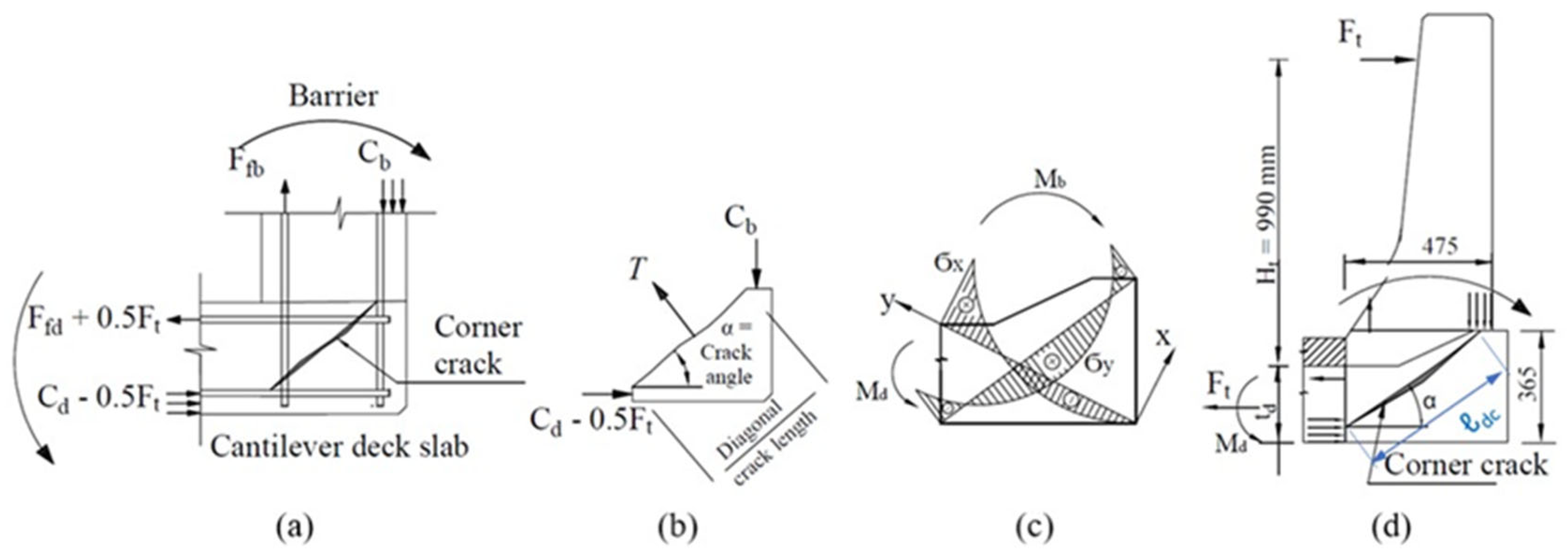
When a reinforced concrete joint develops cracks, it behaves as a composite system comprising both reinforcement and concrete, making its behavior more complex than that of a uniform material [58]. Failures at the joint may occur because of diagonal tension cracks. These cracks emerge when tensile stresses from external bending moments are not properly resisted by reinforcement, especially when the reinforcement detailing is insufficient. In Figure 18a, a diagonal tension crack is shown forming in the deck overhang beneath the barrier wall under the action of a transverse force, Ft. Figure 18b presents the free-body diagram of forces associated with this cracking mechanism. Figure 18c illustrates the stress distribution at the barrier–deck joint caused by the moments in both the wall and the deck slab. The bending stress, σx, indicates a concentration of tensile stress near the inner corner of the joint, suggesting that cracks can initiate there even under relatively small loads. Meanwhile, stresses acting perpendicular to σx, denoted as σy, create tension that contributes to diagonal cracking across the joint. If adequate reinforcement is not placed in these critical regions, such diagonal tension cracking can lead to sudden failure [58,59].
From Figure 18a, the applied transverse force Ft induces a moment at the centerline (mid-depth) of the deck overhang, Md. Balancing this with the internal resisting couple of the deck overhang gives:
Md = Ft × (Ht + 0.5td) = (Cd − 0.5Ft) × 0.9dd
Here, Ft is the vehicle transverse impact load, Ht is the height of the applied transverse load measured from the overhang’s top surface, Cd is the resultant compression on the inner face of the barrier, td is the slab overhang thickness, dd is the effective depth of the deck overhang, and the lever arm between the compression and tension resultants, taken as ~0.9dd.
Considering the forces acting parallel to the diagonal crack shown in Figure 18b, the relationship can be expressed by the following equation.
Cb × sinα = (Cd − 0.5Ft) × cosα
Here, α represents the angle of the diagonal tension crack, and Cb denotes the resultant compressive force in the barrier wall. To determine the diagonal crack angle between the forces Cb and (Cd − 0.5Ft), a conservative assumption is made that their points of action are located at approximately 0.8 times the barrier thickness at the barrier–deck interface and 0.8 times the deck slab thickness at the inner face of the barrier wall, respectively, as illustrated in Figure 18d. This formed triangle can be used to determine the diagonal tension crack length, dc, shown in Figure 18d.
Equation (3) can be expressed in the following rearranged form
C b = C d 0.5 F t     tan α
By examining the forces perpendicular to the diagonal crack shown in Figure 18b, the tensile force responsible for the diagonal crack, T, can be determined as follows:
T = Cb × cosα + (Cd − 0.5Ft) × sinα
Substituting Equation (4) into Equation (5) gives:
(Cd − 0.5Ft) = T × sinα
The modulus of rupture of concrete, fr, is determined using the following expression [37]:
f r = 0.6 λ f c
where λ is the concrete density factor and f c is the compressive strength of concrete.
The tensile capacity of a concrete section with width b at the diagonal crack can be calculated assuming a parabolic distribution of tensile stress along the crack length, dc.
T = 2 3 f r × b × d c
By substituting Equations (6) and (8) into Equation (2), the maximum moment at the centerline of the deck overhang on the inner face of the barrier wall can be expressed as follows:
Mb = 0.6 × fr. × b. × dd. × dc. × sinα
A concrete resistance factor, ϕc, can be incorporated into this equation for practical design applications. Equations (2) and (9) can then be used to evaluate the demand and capacity, respectively, allowing for the determination of the minimum deck slab overhang thickness required to prevent diagonal tension failure at the barrier–deck corner when the barrier is subjected to vehicle impact loads.
It should be noted that Equation (9) represents the moment resistance corresponding to diagonal tension cracking in the concrete, and therefore, the predicted failure load is governed mainly by the concrete’s tensile strength, geometry, and crack inclination, rather than by the specific anchorage configuration of the reinforcement. Experimental observations confirmed that all GFRP-reinforced specimens (Models 1–3) failed through diagonal tension cracking at the barrier–deck corner, without any evidence of bar pullout or bond failure. The measured ultimate loads for these models of 106.1 kN/m for headed-end HM-GFRP, 116.3 kN/m for bent SM-GFRP, and 107.2 kN/m for hooked SM-GFRP were very similar, indicating that anchorage detailing had minimal influence on the diagonal tension capacity. The anchorage type affected only the crack propagation and width, with headed-end bars showing more distributed cracking and bent or hooked bars showing more localized widening near the interface due to stress concentration around the curved regions. Hence, the failure load governed by Equation (9) is primarily concrete-controlled, with anchorage layout exerting only a secondary influence on local stress transfer.

5.1. Capacity Versus Demand for the Diagonal Tension Failure at Barrier–Overhang Corner

Equation (9) was applied to the tested specimens, Models No. 1, 2, and 3, with a 25.4 MPa concrete compressive strength. The deck overhang had a concrete cover of 58 mm to the tension reinforcement, and the effective depth, dd, was taken as 192 mm for a total overhang thickness of 250 mm. The section width was assumed to be 1000 mm. As depicted in Figure 18d, the angle of the diagonal crack formed between the compressive force at the barrier base and the resisting section at the inner face of the barrier was taken as 37.5°, while the diagonal crack length, dc, was determined to be 479 mm (i.e., 0.8 475 2 + 365 2 = 479 mm). It is worth mentioning that the measured crack angles were 41°, 43°, and 39° for Models No. 1, 2, and 3, respectively. For purposes of capacity prediction, however, the angle was standardized as described above, allowing the development of a unified equation that yields theoretical capacities equal to, or conservatively below, the experimental results.
Table 5 shows a comparison between the proposed prediction equation and the experimental findings for one-meter-wide barrier–deck overhang systems. In this comparison, Mr,predict represents the resisting moment at the deck overhang centerline due to diagonal tension failure as obtained from Equation (9). Mr,Exp is the experimentally determined ultimate moment at failure calculated using Equation (2), while FExp denotes the corresponding experimental failure load for each model.
For the evaluation using Equation (2), (Ht + 0.5td) was taken as 1.115 m (i.e., 0.99 + 0.25/2 = 1.115 m), leading to an experimental ultimate moment of 101.6 kN·m/m against diagonal tension failure at the barrier–deck corner. The ratios of experimental-to-theoretical moments were found to be 1.17, 1.28, and 1.06 for Models No. 1, 2, and 3, respectively.
These results confirm that the proposed prediction equation provides a reliable and conservative estimate of the diagonal tension capacity of barrier–deck overhang systems. The close alignment between theoretical and experimental values demonstrates that the equation can be confidently used as a design tool to ensure adequate safety margins while preventing sudden diagonal tension failure.

5.2. Minimum Reinforcement Ratio for Concrete Diagonal Tension Crack

Cracking moment in the deck overhang, Md,cr, depends on the concrete tensile strength. Since concrete is brittle under tensile loads, a diagonal tension crack has a brittle nature. If the corner joint is capable of taking linear-elastic deformation until failure, it is required that the GFRP tensile reinforcement reach its rupture stresses before the occurrence of the diagonal tension crack. This means that the tensile force in GFRP bars, Ff, at which a diagonal tension crack occurs, must satisfy the conditions that:
F f , w     ( A f   ×   f f u ) w
( F f , d + F diag . / 2 )     ( A f   ×   f f u ) d
where Ff,w is the tensile force in the GFRP bars in the wall on the onset of diagonal tension crack, and Ff,d is the tensile force in the GFRP bars in the overhang on the onset of diagonal tension crack. Af is the area of GFRP reinforcing bars in the wall or in the deck, and ffu is the ultimate tensile strength of GFRP bars. From resultant forces in the corner joint shown in Figure 18d and using the above equation for diagonal tension crack, it follows that:
√ (Ff, w2 + (Ff,d + Fdiag./2)2) = T = 2/3 × fr. × b. × Ldc
Substituting Equations (10) and (11) into Equation (12), the following equation is obtained:
(Af × ffu)2w + (Af × ffu)2d ≤ T2
The GFRP reinforcing bar area in the wall or in the deck can be written as a function of the minimum reinforcement ratio, provided that:
Af,w = ρf,w. × b. × dw
Af,d = ρf,d. × b. × dd
Also, by knowing that Cw = T. Cosα and Cd = T. sinα + Fdia./2 from Figure 18c and substituting Equations (11) and (15) into Equation (13), minimum reinforcement ratios in the wall and the deck can be determined so that the diagonal tension crack is prevented. This implies that when the following conditions are met, the barrier wall is expected to fail either through a flexural mechanism in the wall itself or through a combined tension–flexural mechanism in the deck.
ρf,w ≤ (T. Cos α − Fdia./2)/(b. × dw. × ffu)
ρf,d ≤ (T. Sin α − Fdia./2)/(b. × dd. × ffu)
Minimum reinforcement ratio in the wall section of barrier Model 1 was calculated using Equation (16) equal to 0.149%. As such, the maximum area of reinforcement required so that a diagonal tension crack is prevented was found to be 528 mm2. Cross-sectional analysis has been performed using this reinforcement ratio, yielding flexural moment resistance in the wall equal to 94.72 kN · m/m, which was found to be less than the moment in the deck due to a diagonal tension crack (106.1 kN·m/m). This indicated that the wall failed by the flexural mode of failure prior to the occurrence of diagonal tension crack failure.

6. Analytical Modeling of Deck–Wall Connection

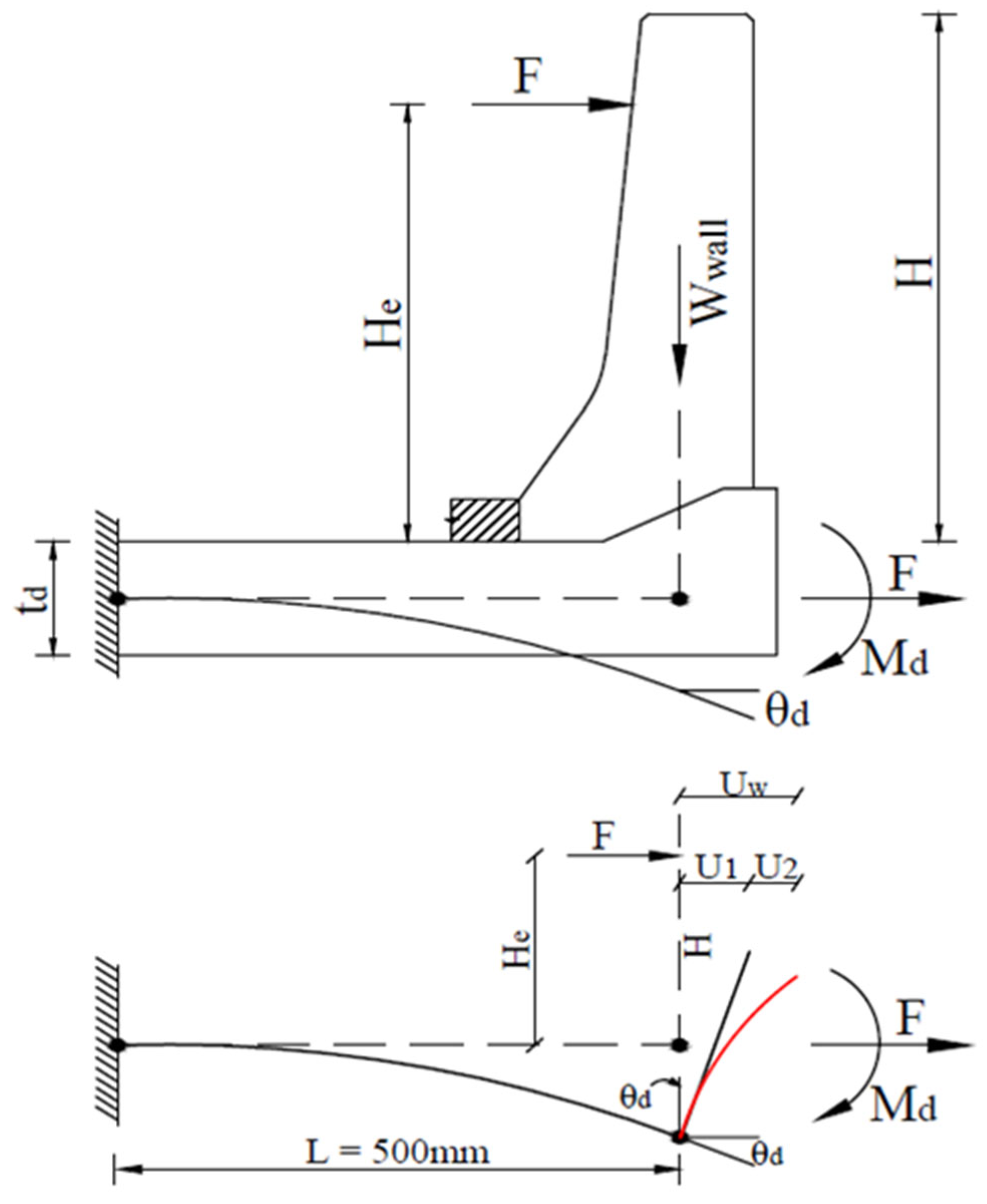
The analytical modeling was performed to evaluate the load–displacement response of the barrier walls under the applied load, F. The maximum deflection at the top of the wall, Uw, can be attributed to the rotation, θd, of the deck overhang due to the applied moment in the deck, Md, and barrier wall self-weight, W, per unit width as well as the displacement of the wall due to the applied transverse load, F, per unit width of the wall. Figure 19 shows the lateral deformation of the barrier wall under the applied transverse load and the deck slab rotation. Thus, the displacement function of the barrier wall can be written as:
Uw = U1 + U2 = H. × Sin θd + uw. × Cos θd
where the deck overhang rotation, θd, over the cantilever length, L, can be calculated as:
θd = L. × {F × (He + td/2) + W.L/2}/(Ec.Id)
where Ec is the modulus of elasticity of concrete, Id is the deck moment of inertia, He is the height of the applied load, F, over the slab overhang, and td is the thickness of the overhang. The transverse displacement in the wall, uw, due to the applied transverse load, F, can be determined as follows;
uw = (F. × He2). × (H − He/3)/(2Ec. × Iw)
On the basis of the assumption that the bending moment in the overhang, Md, exceeds the cracking moment, Mcr, and due to the nonlinear behavior of the overhang, the gross moment of inertia in the deck, Id, can be replaced by the effective moment of inertia, Ie,d. The following equations were adopted from [57,60] for deck slab reinforced with steel and GFRP bars, respectively:
Ie,d = Icr + (Ig − Icr). (Mcr/Md)3 ≤ Ig     (for reinforcing steel bars)
Ie,d = (It.Icr)/{Icr + [1 − 0.5 (Mcr/Md)2](It − Icr)}   (for GFRP bars)
where Ig is the gross moment of inertia of the deck section, Mcr is the cracking moment, It is the moment of inertia of an un-cracked section transformed to concrete, and Icr is the cracked moment of inertia that for rectangular sections is given by [60]:
Icr = {b. × (kd)3}/3 + ns/f.As/f.(d − kd)2
where b is the width of the cross-section in mm, d is the effective depth to the GFRP or steel layer in mm, ns/f is the modular ratio of steel or GFRP bars, As/f is the cross-sectional area of reinforcing steel or GFRP bars, and k is given by the following equation [60];
k = n s / f .   ρ s / f + { ( n s / f   .   ρ s / f ) 2 + 2   n s / f   .   ρ s / f }
In that, ρ s / f is the steel or GFRP reinforcement ratio. It is assumed that cracking in the deck slab occurs concurrently with cracking of the corner joint between the deck–wall junction, which was also observed in the experimental tests. In addition, the gross moment of inertia of the wall section, Iw, in Equation (20) was replaced by the cracked moment of inertia given by Equation (23). The load–displacement curves for barrier models 1 and 3 are plotted in Figure 20. The load–deflection response of the analytical model was performed incorporating the use of Equations (18)–(24). The strength and stiffness were accurately modeled and validated with experimental test results. It is worth mentioning that the discrepancy between the two graphs in Figure 20 can be attributed to the non-uniform geometrical shape of the barrier wall, which was approximated in the calculations by analytical modeling.

7. Conclusions

This study experimentally and analytically investigated the structural behavior of TL-5 GFRP-reinforced barriers at the critical barrier wall–deck overhang interface. Five full-scale barrier models, four reinforced with different GFRP anchorage configurations, and one with conventional steel bars, were tested to failure under static loading. The following key conclusions are drawn:
1. All GFRP-reinforced barriers exceeded the CHBDC factored design moment capacity, with measured strengths 27 to 65% higher than prescribed limits. This confirms that properly detailed GFRP reinforcement provides sufficient strength for TL-5 barrier–deck systems.
2. Diagonal tension cracking at the barrier–overhang corner joint consistently governed failure across most specimens. In one case (Model 4), with double the vertical GFRP bars at the front face representing the barrier end reinforcement, splitting failure occurred in the deck slab, highlighting the sensitivity of slab capacity to reinforcement detailing and bar spacing.
3. Barriers with headed-end HM-GFRP reinforcement demonstrated the most favorable balance of strength, ductility, and constructability, offering a cost-effective alternative to tighter bar spacing. Configurations using bent or hooked SM-GFRP bars reached comparable strength but required greater reinforcement density and showed higher crack propagation. The steel-reinforced barrier achieved only modestly higher strength than the best-performing GFRP designs, supporting GFRP as a viable replacement.
4. GFRP-reinforced barriers exhibited higher lateral deflections than their steel counterpart due to the lower modulus of GFRP. This added flexibility can be advantageous for energy dissipation during vehicle impact.
5. A new predictive model for diagonal tension cracking was developed and shown to conservatively estimate experimental failure loads. Minimum reinforcement ratios were also derived to prevent premature diagonal tension cracking, ensuring flexural rather than brittle failure.
6. The combined experimental and analytical results establish that GFRP bars, when appropriately detailed, can replace steel reinforcement in TL-5 barriers without compromising safety or strength. The proposed predictive equations and reinforcement ratio criteria provide a practical framework for integrating GFRP-reinforced barriers into future editions of the CHBDC and related bridge design standards.
Overall, this work demonstrates that GFRP reinforcement, particularly high-modulus bars with headed-end anchorage, offers a structurally sound and economically attractive alternative to steel in TL-5 bridge barriers. The validated analytical tools further support the broader adoption and codification of GFRP-reinforced barrier systems in highway bridge design.

Author Contributions

Conceptualization, K.S.; methodology, H.K.; validation, H.K.; formal analysis, H.K. and H.M.A.; investigation, H.K., K.S., H.M.A. and K.R.; data curation, H.K., K.S. and K.R.; writing—original draft preparation, H.K.; writing—review and editing, K.S., H.M.A. and K.R.; visualization, H.K.; project administration, H.K. and K.S. All authors have read and agreed to the published version of the manuscript.

Funding

This research received no external funding.

Data Availability Statement

The original contributions presented in this study are included in the article. Further inquiries can be directed to the corresponding author(s).

Acknowledgments

The authors gratefully acknowledge the financial support provided by the Natural Sciences and Engineering Research Council of Canada (NSERC), as well as Pultrall Inc. and V-Rod Canada Inc. The in-kind contribution of Pultrall Inc. through the supply of GFRP bars is also deeply appreciated.

Conflicts of Interest

The authors declare that they have no known competing financial interests or personal relationships that could have appeared to influence the work reported in this paper.

References

  1. El-Tawil, S.; Nanni, A. GFRP Reinforcement for Concrete Structures: Design and Performance. J. Compos. Constr. 2007, 11, 377–387. [Google Scholar]
  2. Nanni, A.; El-Tawil, S. Design and Performance of GFRP Reinforcement in Concrete Structures. ACI Struct. J. 2009, 106, 747–754. [Google Scholar]
  3. Almusallam, A.; Al-Gahtani, A. Assessment of Corrosion Damage to Concrete Bridge Barriers. Struct. Infrastruct. Eng. 2018, 14, 220–231. [Google Scholar]
  4. Rostami, M.; Sennah, K.; Azimi, H.; Afefy, H. Behavior and design of GFRP bar adhesive anchors under direct tension for deteriorated concrete bridge barrier replacement. Adv. Struct. Eng. 2025, 28, 13694332251334830. [Google Scholar] [CrossRef]
  5. Zhang, Y.; Li, X. Performance of GFRP and BFRP Reinforcements in Marine and De-Icing Salt Environments. Constr. Build. Mater. 2023, 352, 129031. [Google Scholar]
  6. Nguyen, T.T.; Nguyen, H.P. Assessment of Salt-Induced Corrosion in Bridge Barriers and Structural Health Monitoring Techniques. Struct. Control. Health Monit. 2024, 31, e2908. [Google Scholar]
  7. Patel, R.; Kumar, S. Innovative Use of GFRP Reinforcement for Bridge Barriers Exposed to Coastal and Salt-Spread Conditions. Mater. Today Commun. 2024, 34, 105447. [Google Scholar]
  8. Shah, S.P.; Sideris, P.J. Durability of GFRP Reinforcement in Concrete Structures. J. Compos. Constr. 2014, 18, 04014004. [Google Scholar]
  9. Liu, Y.; Wu, H.; Zhang, G. Environmental durability and corrosion resistance of GFRP bars in aggressive environments. J. Compos. Constr. 2021, 25, 04021008. [Google Scholar]
  10. Khan, M.R.; Zhang, Z. Corrosion Behavior of GFRP Reinforcement in Aggressive Environments. Constr. Build. Mater. 2018, 165, 468–477. [Google Scholar]
  11. Zhao, J.; Chen, J.; Wang, Y. Long-term durability of GFRP bars in chloride-rich environments. Constr. Build. Mater. 2022, 316, 125567. [Google Scholar]
  12. Singh, R.; Kumar, A. Comparative analysis of corrosion behavior of GFRP and steel rebars in marine environments. Mater. Today Proc. 2023, 81, 1234–1241. [Google Scholar]
  13. Ali, M.; Ahmed, S. Durability performance of GFRP reinforcement in harsh environmental conditions. Compos. Part B Eng. 2024, 238, 109935. [Google Scholar]
  14. Kim, D.; Lee, S.; Park, H. Innovations in GFRP reinforcement for sustainable construction: Environmental resistance and lifespan. Sustain. Mater. Technol. 2025, 30, e00567. [Google Scholar]
  15. Khan, M.I.; Aref, A.J. Mechanical Properties of GFRP Bars for Structural Applications: A Review. Compos. Struct. 2021, 280, 114950. [Google Scholar]
  16. Shah, S.M.; Yousuf, T. Advances in GFRP Reinforcement for Concrete Structures: Mechanical Properties and Structural Performance. Constr. Build. Mater. 2022, 345, 128394. [Google Scholar]
  17. Li, Y.; Zhang, H. Recent Progress in GFRP Reinforcement: Mechanical Performance and Structural Benefits. J. Compos. Constr. 2023, 27, 04023011. [Google Scholar]
  18. Ahmed, M.S.; Sennah, K.; Afefy, H.M. Structural Behavior of Full-Depth Deck Panels Having Developed Closure Strips Reinforced with GFRP Bars and Filled with UHPFRC. J. Comp. Sci. 2024, 8, 468. [Google Scholar]
  19. Ahmed, M.S.; Sennah, K.; Afefy, H.M. Fatigue and Ultimate Strength Evaluation of GFRP-Reinforced, Laterally Restrained, Full-Depth Precast Deck Panels with Developed UHPFRC Filled Transverse Closure Strips. Appl. Sci. 2024, 14, 19. [Google Scholar]
  20. Sennah, K.; Khederzadeh, H. Development of Cost-Effective PL-3 Concrete Bridge Barrier Reinforced with Sand-Coated GFRP Bars: Vehicle Crash Test. Can. J. Civ. Eng. 2014, 41, 357–367. [Google Scholar] [CrossRef]
  21. Sennah, K.; Hedjazi, S. Structural Qualification of a Developed GFRP-Reinforced PL-3 Concrete Bridge Barrier Using Vehicle Crash Testing. Int. J. Crashworthiness Taylor Fr. 2018, 24, 296–313. [Google Scholar] [CrossRef]
  22. Sennah, K.; Tropynina, E.; Ibrahim, Z.; Hedjazi, S. Structural Qualification of a Developed GFRP-Reinforced PL-3 Concrete Bridge Barrier Using Ultimate Load Testing. Int. J. Concr. Struct. Mater. 2018, 12, 63. [Google Scholar]
  23. Rostami, M.; Sennah, K.; Afefy, H.M. Ultimate capacity of barrier-deck anchorage in MTQ TL-5 barrier reinforced with headed-end, high-modulus, sand-coated GFRP bars. Can. J. Civ. Eng. 2018, 45, 263–275. [Google Scholar] [CrossRef]
  24. Dervishhasani, G.; Sennah, K.; Afefy, H.M.; Diab, A. Ultimate Capacity of a GFRP-Reinforced Concrete Bridge Barrier–Deck Anchorage Subjected to Transverse Loading. Appl. Sci. 2025, 15, 7771. [Google Scholar] [CrossRef]
  25. CAN/CSA-S6-25; Canadian Highway Bridge Design Code. Canadian Standards Association: Toronto, ON, Canada, 2025.
  26. AASHTO. AASHTO-LRFD Bridge Design Specifications, 3rd ed.; American Association of State Highway and Transportation Officials: Washington, DC, USA, 2020. [Google Scholar]
  27. AASHTO. AASHTO Guide for Selecting, Locating, and Designing Traffic Barriers; American Association of State Highway and Transportation Officials: Washington, DC, USA, 1977. [Google Scholar]
  28. AASHTO. AASHTO Guide Specifications for Bridge Railings; American Association of State Highway and Transportation Officials: Washington, DC, USA, 1989. [Google Scholar]
  29. Rostami, M.; Sennah, M.; Hedjazi, S. GFRP Bars Anchorage Resistance in a GFRP-Reinforced Concrete Bridge Barrier. Mater. J. 2019, 12, 2485. [Google Scholar] [CrossRef] [PubMed]
  30. Sennah, K.; Mostafa, A. Performance of a Developed TL-5 Concrete Bridge Barrier Reinforced with GFRP Hooked Bars: Vehicle Crash Testing. ASCE J. Bridge Eng. 2018, 23, 04017139. [Google Scholar] [CrossRef]
  31. Rostami, M.; Sennah, M.; Mostafa, A. Experimental Study on the Transverse Load Carrying Capacity of TL-5 Bridge Barrier Reinforced with Special Profile GFRP Bars. ASCE J. Compos. Constr. 2019, 23, 1–16. [Google Scholar] [CrossRef]
  32. Khederzadeh, H.; Sennah, K. Development of Cost-Effective PL-3 Concrete Bridge Barrier Reinforced with Sand-Coated GFRP Bars: Static Load Tests. Can. J. Civ. Eng. 2014, 41, 368–379. [Google Scholar] [CrossRef]
  33. Johansson, M. Reinforcement Detailing in Concrete Frame Corners. ACI Struct. J. 2001, 98, 105–115. [Google Scholar] [CrossRef] [PubMed]
  34. Skettrup, E.; Strabo, J.; Andersen, N.H.; Brondum-Nielsen, T. Concrete Frame Corners. ACI Struct. J. 1984, 91, 587–593. [Google Scholar]
  35. Mayfield, B.; Kong, F.K.; Bennison, A. Strength and Stiffness in Lightweight Concrete Corners. ACI Struct. J. 1972, 69, 420–427. [Google Scholar]
  36. Yamin, J.L. A Review of Reinforced Concrete Corner Joints Subjected to Opening Moments. Concr. Int. Am. Concr. Inst. 2024, 46, 63–67. [Google Scholar]
  37. Moretti, M.L.; Tassios, T.P.; Vintzileou, E. Behavior and Design of Corner Joints under Opening Bending Moment. ACI Struct. J. 2014, 111, 3–13. [Google Scholar] [CrossRef]
  38. Campana, S.; Ruiz, M.F.; Muttoni, A. Behaviour of nodal regions of reinforced concrete frames subjected to opening moments and proposals for their reinforcement. Eng. Struct. 2013, 51, 200–210. [Google Scholar] [CrossRef]
  39. Szczecina, M.; Winnicki, A. Rational Choice of Reinforcement of Reinforced Concrete Frame Corners Subjected to Opening Bending Moment. Materials 2021, 14, 3438. [Google Scholar] [CrossRef] [PubMed]
  40. Monserrat-López, A.; Faria, D.M.; Brantschen, F.; Ruiz, M.F. Performance of nodal regions of reinforced concrete frame corners subjected to opening bending moments. Eng. Struct. 2025, 322 Pt A, 119041. [Google Scholar] [CrossRef]
  41. Mitchell, G.; Tolnai, M.; Gokani, V.; Picón, R.; Yang, S.; Klingner, R.E.; Williamson, E.B. Design of Retrofit Vehicular Barriers Using Mechanical Anchors; Report No. FHWA/TX-07/0-4823-CT-1; Texas Department of Transportation: Austin, TX, USA, 2006. [Google Scholar]
  42. Cho, D.Y.; Jeong, H.S.; Choi, J.W. A Study of the Bolt Connection System for a Concrete Barrier of a Modular Bridge. Int. J. Eng. Technol. Innov. 2018, 8, 107–117. [Google Scholar]
  43. Zhao, H.; Xie, Z.; Yang, B.; Li, L.; Wang, R.; Chen, W. Impact resistance performance of precast reinforced concrete barriers with grouted sleeve and steel angle-to-plate connections. Eng. Struct. 2024, 316, 118533. [Google Scholar] [CrossRef]
  44. Patel, G.; Sennah, K.; Azimi, H.; Lam, C.; Kianoush, R. Development of Precast Concrete Barrier Wall System for Bridge Decks. J. Prestress. Concr. Inst. (PCI) Winter 2014, 2014, 83–102. [Google Scholar] [CrossRef]
  45. Trejo, D.; Aguiniga, F.; Buth, C.E.; James, R.W.; Keating, P.B. Pendulum Impact Tests on Bridge Deck Sections; Report No. FHWA-01/1520-1; Texas Department of Transportation: Austin, TX, USA, 2001. [Google Scholar]
  46. Scanlon, A.; McLure, R.M.; Spitzer, P.; Tessaro, T.; Aminmansour, A. Performance Characteristics of Case-in-Place Bridge Barrier; Report No. PA-89-018+87-21; Pennsylvania Department of Transportation: Harrisburg, PA, USA, 1990. [Google Scholar]
  47. Frosch, R.J.; Morel, A.J. Guardrails for Use on Historic Bridges: Volume 2—Bridge Deck Overhang Design; Joint Transportation Research Program, Publication No. FHWA/IN/JTRP-2016/34); Purdue University: West Lafayette, IN, USA, 2016. [Google Scholar] [CrossRef]
  48. Khodayari, A.; Mantawy, I.M.; Azizinamini, A. Experimental and Numerical Investigation of Prefabricated Concrete Barrier Systems Using Ultra-High-Performance Concrete. Transp. Res. Rec. 2023, 2677, 624–634. [Google Scholar] [CrossRef]
  49. Deitz, D.; Harik, I.; Gesund, H. GFRP Reinforced Concrete Bridges; Report No. KTC-00-9; Kentucky Transportation Center: Lexington, KY, USA, 2000. [Google Scholar]
  50. Rostami, M.; Sennah, K.; Afefy, H. Experimental capacity of TL-4 concrete barrier-deck connection using GFRP-bars with reduced-radius 180° hooks and adhesive GFRP anchors. Struct. Concr. 2025. [Google Scholar] [CrossRef]
  51. Lu, J.; Afefy, H.; Sennah, K.; Azimi, H.; Sayed-Ahmed, M. Bond Characteristics of Glass Fiber Reinforced Polymer Bars in High-Strength Concrete. J. Struct. Build. Proc. Inst. Civ. Eng. 2022, 175, 748–764. [Google Scholar] [CrossRef]
  52. Lu, J.; Afefy, H.; Azimi, H.; Sennah, K.; Sayed-Ahmed, M. Bond performance of sand-coated and ribbed-surface glass fiber reinforced polymer bars in high-performance concrete. J. Struct. 2021, 34, 10–19. [Google Scholar] [CrossRef]
  53. Islam, S.; Afefy, H.; Sennah, K.; Azimi, H. Bond characteristics of straight- and headed-end ribbed-surface GFRP bars embedded in high-strength concrete. J. Constr. Build. Mater. 2015, 83, 283–298. [Google Scholar] [CrossRef]
  54. Pultrall. GFRP Manufacturer Data Sheet; Pultrall Inc.: Thetford Mines, QC, Canada, 2011; Available online: https://pultrall.com/en/ (accessed on 1 June 2025).
  55. MacGregor, J.G. Reinforced Concrete, Mechanics and Design, 3rd ed.; Prentice Hall: Saddle River, NJ, USA, 1997; 939p. [Google Scholar]
  56. CSI. SAP2000 Software Integrated Finite Element Analysis and Design of Structures; Computers and Structures Inc.: Berkeley, CA, USA, 2020. [Google Scholar]
  57. ISIS. ISIS Canada Module 3—An Introduction to FRP Composites for Construction; Prepared by ISIS Canada; Department of Civil Engineering, Queen’s University: Kingston, ON, Canada, 2006; 36p. [Google Scholar]
  58. Nilsson, I.H.E.; Losberg, A. Reinforced concrete corners and joints subjected to bending moment. J. Struct. Div. 1976, 102, 1229–1254. [Google Scholar] [CrossRef]
  59. Matta, F.; Nanni, A. Connection of Concrete Railing Post and Bridge Deck with Internal FRP Reinforcement. ASCE J. Bridge Eng. 2009, 14, 66–76. [Google Scholar] [CrossRef]
  60. CSA-A23.3-24; Design of Concrete Structures. Canadian Standards Association: Mississauga, ON, Canada, 2024.
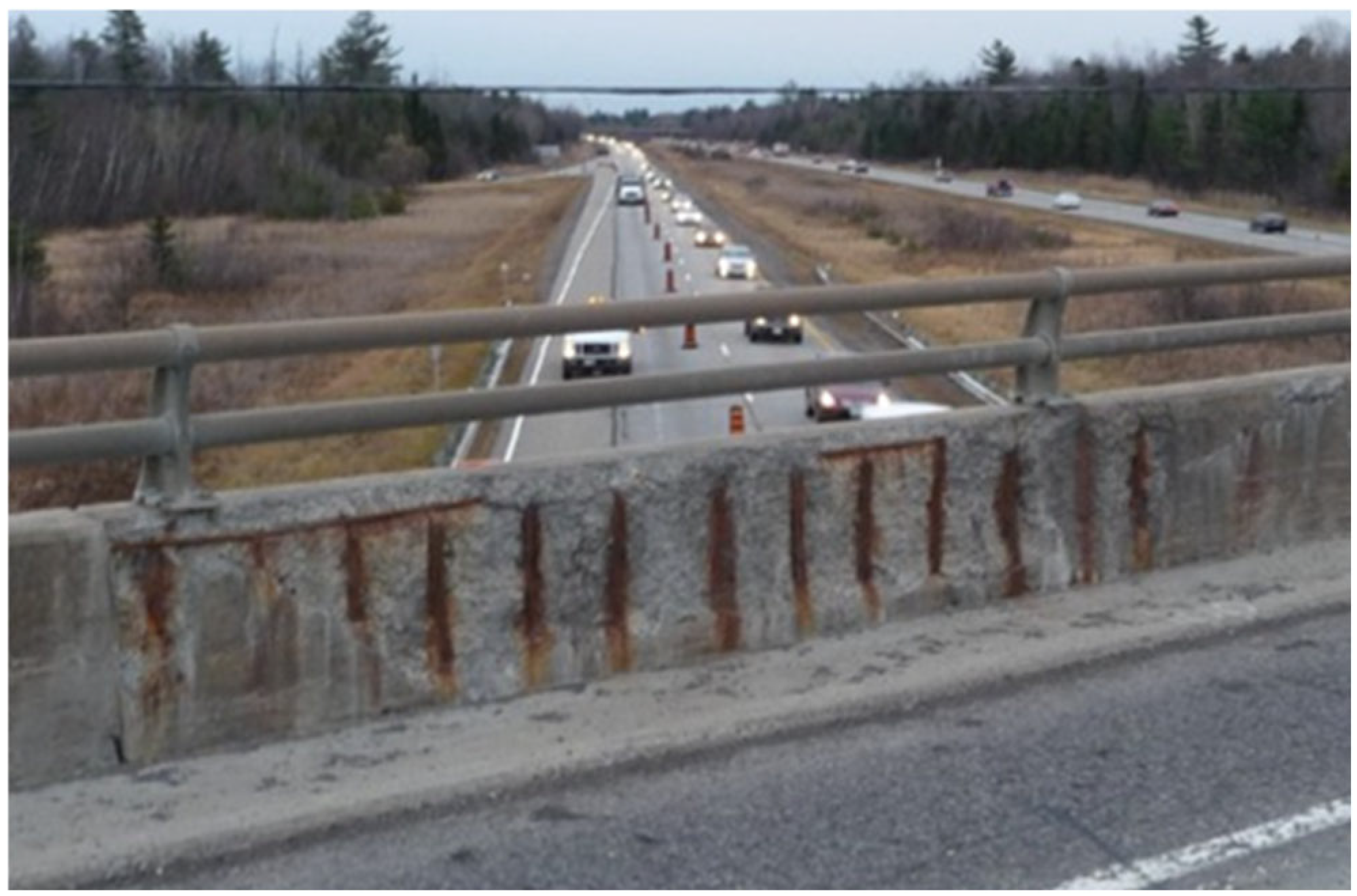
Figure 1. Steel bar corrosion and concrete spalling in a deteriorated barrier wall.
Jcs 09 00600 g001
Figure 2. Traditional TL-5 steel-reinforced barrier detailing with bent bars (Model No. 5).
Jcs 09 00600 g002
Figure 3. Distribution of transverse vehicle impact loads at the midsection and end of the barrier wall.
Jcs 09 00600 g003
Figure 4. Concrete dimensions and reinforcement of all GFRP-reinforced barrier models.
Jcs 09 00600 g004
Figure 5. Views of GFRP bars in barrier Models No. 1 to 4 and steel reinforcement in Model No. 5.
Jcs 09 00600 g005
Figure 6. Views of GFRP sand-coated HM and SM bars.
Jcs 09 00600 g006
Figure 7. Step-by-step procedure to obtain the concrete strength using a core sampling machine.
Jcs 09 00600 g007
Figure 8. Test setup and sensor locations for the barrier models.
Jcs 09 00600 g008
Figure 9. Structural idealization of the barrier–deck slab system using shell elements.
Jcs 09 00600 g009
Figure 10. Ratio of the barrier and deck overhang moment to the corresponding moment at the middle length of a TL-5 barrier wall mounted over a deck overhang of 0.7 m in length and barrier length of 20 m.
Jcs 09 00600 g010
Figure 11. Ratio of shear force at barrier base and tensile force on the deck overhang to the corresponding values at the middle length of a TL-5 barrier wall mounted over a deck overhang of 0.7 m in length and barrier length of 20 m.
Jcs 09 00600 g011
Figure 12. Views of the crack pattern in barrier Model No. 1 with HM-GFRP headed-end bars.
Jcs 09 00600 g012
Figure 13. Load–deflection curves for the tested models.
Jcs 09 00600 g013
Figure 14. Views of the crack pattern in barrier Model No. 2 with SM-GFRP bent bars.
Jcs 09 00600 g014
Figure 15. Views of the crack pattern in barrier Model No. 3 with SM-GFRP bars with 180° hook.
Jcs 09 00600 g015
Figure 16. Views of the crack pattern in barrier Model No. 4 with HM-GFRP bars.
Jcs 09 00600 g016
Figure 17. View of the crack pattern in barrier Model No. 5 with steel reinforcing bars.
Jcs 09 00600 g017
Figure 18. Representation of forces and stress conditions at the junction of the barrier wall and deck slab under diagonal tension failure: (a) acting internal forces; (b) corresponding free-body diagram; (c) distribution of tensile (positive) and compressive (negative) stresses along and across the diagonal crack; (d) measurement of diagonal crack length, Ftb is the developed tensile force at the deck and Ftb is the developed tensile force at the barrier wall.
Jcs 09 00600 g018
Figure 19. Analytical modeling of deck–wall response: barrier wall subjected to transverse load (top) and rotations of the deck and wall under the applied load (bottom).
Jcs 09 00600 g019
Figure 20. Comparison of load–deflection response of experiment and analytical modeling.
Jcs 09 00600 g020
Table 1. Barrier designations used in the current study for each model.
Model No.Description of Models
1Model No. 1 with HM-GFRP straight and headed-end bars at 300 mm spacing
2Model No. 2 with SM-GFRP-SM straight and bent bars at 200 mm spacing
3Model No. 3 with SM-GFRP straight and 180°-hook bars at 200 mm spacing
4Model No. 4 with HM-GFRP straight and headed-end bars at 150 mm spacing
5Model No. 5 with conventional steel reinforcement at 200 mm bar spacing
Table 2. GFRP bar mechanical properties [54].
Product TypeBar SizeGuaranteed Tensile Strength (MPa)Modulus of Elasticity (GPa)Strain at FailureCross-Sectional Area (mm2)
High modulus (HM)#4 (12M)1312 62.5 2.0%126.7
#5 (15M)1184 62.5 1.89%197.9
Standard modulus (SM)#4 (12M)94153.61.76%126.7
#5 (15M)93455.41.69%197.9
SM-Bent#5 (15M)473 (bent portion)501%197.9
1051 (straight portion)
SM-180° hook#5 (15M)473 (bent portion)501%197.9
1051 (straight portion)
Table 3. Concrete core sample detailing of the tested barrier walls.
Sample
No.
Ultimate
Load
(kN)
fcore
(MPa)
No. of
Bars Inside
Remarks
(Type of Bars)
Correction Factorsfeq
Fl/dFdiaFrFmcFd
1263.833.6-No bars0.87111.08131.5
2189.224.1-No bars0.87111.08122.6
3248.731.67-No bars0.87111.08129.7
4212.527.05-No bars0.87111.08125.4
5229.729.25-No bars0.87111.08127.4
6209.726.7-No bars0.87111.08125.0
7282.135.92-No bars0.87111.08133.7
8304.338.75-No bars0.87111.08136.4
9212.427.052Steel bars0.8711.131.08128.7
10180.923.41Steel bars0.8711.081.08123.7
11222.228.31Steel bars0.8711.081.08128.7
12186.523.751Steel bars0.8711.081.08124.1
13230.129.31Steel bars0.8711.081.08129.7
14212.427.051FRP bars0.8711.081.08127.4
15221.628.21FRP bars0.8711.081.08128.6
16208.226.511FRP bars0.8711.081.08126.9
17236.930.172FRP bars0.8711.131.08132.0
18240.330.62FRP bars0.8711.131.08132.4
19229.429.21FRP bars0.8711.081.08129.6
20303.338.632FRP bars0.8711.131.08141.0
21339.1443.182FRP bars0.8711.131.08145.8
22233.029.672FRP bars0.8711.131.08131.5
23218.227.791FRP bars0.8711.081.08128.2
24300.538.21FRP bars0.8711.081.08138.7
25231.729.51FRP bars0.8711.081.08129.9
feq = fcore.(Fl/d. Fdia. Fr. Fmc. Fd) = equivalent compressive strength of the tested core sample as influenced by strength correction factors; Fl/d = correction factor for length/diameter ratio; Fdia = correction factor for diameter of core; Fr = correction factor for the presence of reinforcement; Fmc = correction factor to account for the effect of moisture content; Fd = correction factor for the effect of the damage of the core surface during drilling; fcore = compressive strength of tested core sample.
Table 4. Summary of experimental findings of the tested barrier models.
Barrier ModelModel No. 1Model No. 2Model No. 3Model No. 4Model No. 5
Failure load, Fexp (kN/m)106.1116.3107.2170.3128.9
Height of load application, He (m)0.990.990.990.990.99
Experimental moment in the wall at the base Mexp,w = Fexp. He (kN·m/m)105.0115.1106.1168.6127.3
Experimental moment in the deck at the joint
Mexp,d = Fexp(He+0.5td), (kN·m/m)
118.3129.7119.5189.9143.7
Resistance moment in the wall at the base—cross-sectional analysis
Mr,w (kN·m/m)
243.6145.4145.4323.7150.8
Resistance moment in the deck at the joint—cross-sectional analysis Mr,d (kN·m/m)154154154154154
FEA design moments—Mdesign (kN·m/m)Interior
location
787878-78
Exterior location---104-
Capacity-to-demand ratio = Mexp,w/Mdesign1.351.481.361.621.63
Mr,w/Mexp,w2.321.261.371.921.18
Mr,d/Mexp,d1.301.191.290.811.02
Net lateral deflection of barrier wall (mm)24.531.323.343.217.8
Deck movement (mm)1.64.41.65.55.0
Deck uplift (mm)2.85.34.22.42.6
Table 5. Comparison between proposed analytical and experimental results by diagonal tension cracks.
Barrier Modelαexp.
(°)
αidealized
(°)
b
(mm)
db
(mm)
dc
(mm)
f′c
(MPa)
Mr,predict
(kN·m/m)
FExp.
(kN/m)
Mr,Exp.
(kN·m/m)
Mr,Exp/Mr,predit
Ratio
14137.5100019247925.4101.6106.1106.51.17
24337.5100019247925.4101.6116.3129.71.28
33937.5100019247925.4101.6107.2119.51.06
Mr,predict = resisting moment at the center line of deck overhang at the barrier–deck corner due to diagonal tension failure in concrete using prediction Equation (9), Mr,Exp. is the experimental ultimate moment that caused diagonal tension failure from Equation (2), FExp. is the experimental failure load of the tested models; αexp. and αidealized are the experimental and idealized angles of the diagonal crack formed between the compressive force at the barrier base and the resisting section at the inner face of the barrier, respectively
Disclaimer/Publisher’s Note: The statements, opinions and data contained in all publications are solely those of the individual author(s) and contributor(s) and not of MDPI and/or the editor(s). MDPI and/or the editor(s) disclaim responsibility for any injury to people or property resulting from any ideas, methods, instructions or products referred to in the content.