Article

Evaluation of Sasa kurilensis Biomass-Derived Hard Carbon as a Promising Anode Material for Sodium-Ion Batteries


by
Polina A. Marmaza
1,2,
Oleg O. Shichalin
1,2,3,*,
Zlata E. Priimak
1,2,
Alina I. Seroshtan
1,2,
Nikita P. Ivanov
1,2,
Grigory P. Lakienko
4,
Alexei S. Korenevskiy
4,
Sergey A. Syubaev
5,
Vitaly Yu. Mayorov
2,6,
Maria A. Ushkova
6,
Eduard A. Tokar
1,2,
Roman I. Korneikov
1,3,
Vadim V. Efremov
1,3,
Alexy V. Ognev
1,2,
Eugeniy K. Papynov
2 and
Ivan G. Tananaev
2,3
1
Electrochemical Sources for Renewable Energy Research Laboratory, Institute of Natural Sciences and Technosphere Safety, Sakhalin State University, Communist Ave. 33, Yuzhno-Sakhalinsk 693008, Russia
2
Institute of High Technologies and Advanced Materials, Far Eastern Federal University, 10 Ajax Bay, Russky Island, Vladivostok 690922, Russia
3
Kola Science Center, Tananaev Institute of Chemistry and Technology of Rare Elements and Mineral Raw Materials, Russian Academy of Sciences, Akademgorodok, 26a, Apatity 184209, Russia
4
Department of Chemistry, Lomonosov Moscow State University, Leninskie Gory 1, Moscow 119991, Russia
5
Institute of Automation and Control Processes, Far Eastern Branch Russian Academy of Science, 5 Radio Str., Vladivostok 690041, Russia
6
Far-Eastern Geological Institute, Far-Eastern Branch of the Russian Academy of Sciences, 159, Prospekt 100-Letiya, Vladivostok 690022, Russia
*
Author to whom correspondence should be addressed.
J. Compos. Sci. 2025, 9(12), 668; https://doi.org/10.3390/jcs9120668 (registering DOI)
Submission received: 9 September 2025 / Revised: 24 October 2025 / Accepted: 18 November 2025 / Published: 3 December 2025
(This article belongs to the Special Issue Composite Materials for Energy Management, Storage or Transportation)

Abstract

The depletion of global lithium reserves, coupled with the necessity for environmentally sustainable and economically accessible energy storage systems, has driven the development of sodium-ion batteries (SIBs) as a promising alternative to lithium-ion technologies. Among various anode materials for SIBs, hard carbon exhibits obvious advantages and significant commercial potential owing to its high energy density, low operating potential, and stable capacity retention during prolonged cycling. Biomass represents the most attractive source of non-graphitizable carbon from a practical standpoint, being readily available, renewable, and low-cost. However, the complex internal structure of biomass precursors creates significant challenges for precise control of microstructure and properties of the resulting hard carbon materials, requiring further research and optimization of synthesis methodologies. This work reports the synthesis of hard carbon from Sasa kurilensis via pyrolysis at 900 °C and investigates the effect of alkaline pretreatment on the structural and electrochemical characteristics of the anode material for SIBs. Sasa kurilensis is employed for the first time as a source for non-graphitizable carbon synthesis, whose unique natural vascular structure forms optimal hierarchical porosity for sodium-ion intercalation upon thermal treatment. The materials were characterized by X-ray diffraction, infrared and Raman spectroscopy, scanning electron microscopy, X-ray microtomography and low-temperature nitrogen adsorption–desorption. Electrochemical properties were evaluated by galvanostatic cycling in the potential range of 0.02–2 V at a current density of 25 mAhg−1 in half-cells with sodium metal counter electrodes. The unmodified sample demonstrated a discharge capacity of 160 mAhg−1 by the 6th cycle, with an initial capacity of 77 mAhg−1. The alkaline-treated material exhibited lower discharge capacity (114 mAhg−1) and initial Coulombic efficiency (40%) due to increased specific surface area, leading to excessive electrolyte decomposition.

1. Introduction

Lithium-ion batteries (LIBs) have long served as the cornerstone for powering portable electronics and electric vehicles owing to their high energy density and reliability. Nevertheless, their application in large-scale energy storage systems is limited by substantial costs arising from the increasing prices of raw material components (lithium, cobalt, and nickel), as well as associated logistical and environmental risks [1,2,3]. Solid-state lithium metal batteries exhibit high energy density and safety; however, their practical implementation is complicated by interfacial phenomena at the lithium–solid electrolyte interface, including high resistance, poor electrochemical and chemical compatibility, and mechanical instability caused by dendrite growth during repeated cycling [4].
Sodium-ion batteries (SIBs), operating on analogous electrochemical principles, are based on abundant and inexpensive sodium and demonstrate not only comparable cycling stability but also enhanced safety. Due to the low cost of raw materials, reduced geopolitical supply vulnerabilities, and the possibility of utilizing existing LIB manufacturing technologies, SIBs are rapidly gaining ground as a promising complement and, in certain cases, alternative to lithium-ion batteries [5].
The demand for environmentally sustainable and high-performance electrical energy storage systems continues to grow, driving the development of novel anode materials for sodium-ion batteries [6]. Anodes for SIBs perform a dual role: they serve as low-potential redox couples and accommodate sodium ions. They can be categorized into carbonaceous and non-carbonaceous systems. The non-carbonaceous category primarily comprises oxides, alloys, and transition metal oxides/sulfides of titanium, iron, and tin. Titanium oxides exhibit minimal structural deformation during cycling but suffer from inferior capacity; alloys provide low intercalation potentials; however, they are compromised by poor cyclability due to significant volumetric changes; metallic oxides/sulfides promise exceptional capacity, yet they are hindered by low electrical conductivity, agglomeration, and irreversible conversion reactions [7,8,9,10,11,12].
Among carbonaceous materials, non-graphitizable hard carbon (HC) occupies a leading position [13]. Like graphite anodes in lithium-ion batteries, it provides high specific capacity, low operating potential, and stability during numerous cycles owing to minimal volume changes. However, the utilization of graphite in SIBs is limited: its capacity does not exceed 35 mAhg−1 due to the inability of sodium ions to effectively intercalate into the interlayer spacing [14,15,16].
The simplest and most widespread method for HC production is pyrolysis of carbon-containing precursors in an inert atmosphere at 800–1500 °C, which ensures heteroatom removal and formation of an optimal number of closed pores. To improve HC characteristics, pretreatment is employed—carbonization in air or under hydrothermal conditions and washing with mineral acids and alkalis, which is particularly important for plant precursors [17,18].
The pyrolysis temperature and type of starting material directly influence the structural parameters of the material—surface area and interlayer spacing—which in turn affect the electrochemical properties: initial Coulombic efficiency and specific capacity (mAhg−1) of the material. Excessively large surface area accelerates side reactions and leads to excessive electrolyte decomposition and the formation of a passivating layer during the first cycle [19].
Natural polymers, resins, and biomass are employed as precursors for HC production. Glucose [20], polyacrylonitrile [21], phenol–formaldehyde resins [22], and lignocellulosic biomasses (nutshell [23], tea stems [24], bamboo [25], mango peel [26], and coconut waste [27,28,29]) have been investigated. However, inorganic impurities in biomass (silica, alkaline salts) affect the purity, interlayer spacing, and porosity, often deteriorating the specific capacity and cycling stability.
The utilization of renewable resources for biochar synthesis represents an important direction, encompassing economic, environmental, and technological advantages: wide availability, low cost, and the possibility of regional production.
Sasa kurilensis represents a particularly promising precursor for synthesizing anode materials for sodium-ion batteries. This perennial representative of bamboo grasses belonging to the Poaceae family is widely distributed in the northern regions of Japan, Korea, and Sakhalin Island, forming dense understory thickets in mixed and coniferous forests [30,31]. Due to its high growth rate and abundant biomass, Sasa kurilensis provides a stable source of raw materials without depleting forest resources [32]. The unique porous microstructure of its stems and leaves—resulting from natural accumulation of silicon and other minerals within cell walls—is suitable for forming complex hierarchical porous structures during pyrolysis [33].
In this study, alkaline pretreatment was applied to the plant-derived precursor with the primary aim of removing inorganic impurities such as silica, which are naturally present in lignocellulosic biomass. This treatment was also expected to increase the accessibility of the internal structure and promote pore formation during carbonization, thereby potentially enhancing the electrochemical performance of the resulting hard carbon. At the same time, since the presence of silicon species in the carbon matrix can contribute to higher capacity, this aspect deserves particular attention; therefore, our work also aims to elucidate how silica removal influences the structural and electrochemical properties of the final material. Herein, we propose a study aimed at obtaining non-graphitizable carbon based on Sasa kurilensis culms through biomass pyrolysis at 900 °C without and with preliminary alkaline treatment and at investigating their structural, physicochemical, and electrochemical characteristics.
The scientific novelty of this research lies in the first-time proposed utilization of Sasa kurilensis as a source for producing non-graphitizable carbon for use as an anode material for sodium-ion batteries. The unique natural vascular structure of this plant forms hierarchical porosity upon thermal treatment, which is optimal for sodium-ion intercalation. To achieve the stated objective, the influence of preliminary alkaline treatment of bamboo biomass on the microstructure, porosity, and electrochemical characteristics of the resulting anode material was investigated. The synthesized samples were characterized by X-ray diffraction analysis for determining structural composition, infrared and Raman spectroscopy for studying chemical structure, scanning electron microscopy for evaluating surface morphology, X-ray microtomography for investigating internal morphology and porous structure, and the low-temperature nitrogen adsorption–desorption method for analyzing textural characteristics. To evaluate the practical applicability of the obtained materials, two-electrode cells were assembled using a thin disk of metallic sodium as the counter electrode, and galvanostatic cycling was performed.

2. Materials and Methods

2.1. Materials Synthesis

For the synthesis of non-graphitizable carbon material, the raw material (culms of Sasa kurilensis) was pre-ground, washed with distilled water, and dried to constant mass at 105 °C. Pyrolysis was carried out in a “SAFTherm STG-50-12”, the manufacturer is most likely Jiangsu Saftherm Electric Appliance Co., Ltd., Qidong, China under an argon atmosphere. The sample was heated at a rate of 10 °C min−1 to 900 °C, then held at this temperature for 60 min. Upon completion of pyrolysis, the sample was cooled to room temperature under argon flow. The sample obtained by direct carbonization of untreated Sasa kurilensis culms at 900 °C without NaOH activation is denoted as B-900.
For the preparation of alkali-activated carbon material, the initial sample was treated with 1 M sodium hydroxide (NaOH) solution at 90 °C for one hour. After alkaline treatment, the material was filtered, washed with distilled water to neutral pH, and dried to constant mass. Subsequently, the obtained sample was subjected to pyrolysis following the above-described procedure: heated at a rate of 10 °C min−1 to 900 °C and held at this temperature for 60 min under argon atmosphere, then cooled to room temperature under an inert atmosphere. The sample obtained by direct carbonization of Sasa kurilensis culms at 900 °C with preliminary alkali treatment is denoted as B-NaOH-900.

2.2. Physicochemical Methods

Infrared spectra of samples were recorded using a The model appears to be the “Spectrum BX” FT-IR spectrometer, and “Perkin Elmexr” is a common misspelling of PerkinElmer. The company’s global headquarters is in Waltham, MA, USA. The mention of “KBr tablets” describes the sample preparation method, not the equipment’s origin.
The structural characterization of materials was performed using a Shimadzu XRD-7000S laboratory diffractometer (Shimadzu, Kyoto, Japan) with CuKα1-Kα2 radiation (40 kV, 30 mA, average wavelength λ = 1.5418 Å), Ni Kβ filter, scanning range of 5–60°, step size of 0.02°, and counting time of 0.6 s per point. In XRD analysis, the d002 interlayer spacing was determined using the Bragg Equation (1), while the crystallite sizes La and Lc are calculated based on the Scherrer Formulas (2) and (3) [34].
Bragg equation:
d 002 = λ 2 sin θ 002
Here, λ represents the wavelength of X-rays (0.154178 nm), and θ002 is half of the diffraction angle corresponding to the (002) peak.
Scherer equation:
L a = 1.84 λ B 100 cos θ 100
L c = 0.89 λ B 002 cos θ 002
Here, B100 and B002 represent the full width at half maximum (FWHM) of the (100) and (002) peaks, respectively, while 2θ100 and 2θ002 denote the corresponding diffraction angles for the (100) and (002) peaks.
The samples were characterized by transmission electron microscopy (TEM) using a JEOL JEM 2100 microscope (Tokyo, Japan) with an accelerating voltage of 200 kV and a resolution of 0.19 nm. The microscope is equipped with the analytical console Aztech X-Max 100 for energy dispersion analysis. The degree of disorder in non-graphitizable carbon was evaluated using Raman spectroscopy (combination scattering spectroscopy). Raman spectroscopy was carried out with an automated confocal micro-Raman setup (NTEGRA Spectra II, NT-MDT, Moscow, Russia) equipped with a grating-type spectrometer (M522, Solar Laser Systems, Minsk, Belarus) and a CCD camera (i-Dus, Andor Technologies, Belfast, UK). Raman scattering was excited by an unpolarized fiber-coupled CW laser radiation (633 nm pump wavelengths) focused onto the sample surface with a dry microscope objective (NA = 0.7; 100× Mitutoyo Apo, Kawasaki, Japan).
Differential thermal analysis and thermogravimetric analysis (DTA–TGA) were carried out using a Shimadzu DTG-60H thermogravimetric analyzer (Kyoto, Japan) in air, with a heating rate of 10 °C/min over the temperature range of 20–1000 °C in a platinum crucible.
The internal morphology and porous structure of the samples were characterized using X-ray microtomography on a SkyScan 1272 X-ray microtomograph (Bruker microCT, Kontich, Belgium). The tomographic acquisition was performed under the following conditions: X-ray source voltage of 50 kV and beam current of 200 μA. The samples were rotated from 0° to 180° with an angular step of 0.2°, providing a pixel size of 4 μm and image dimensions of 1224 × 820 pixels with an exposure time of 475 ms per projection.
Image reconstruction and processing were conducted using the proprietary Bruker microCT software suite: NRecon 1.7.1.0 for the conversion of shadow projection images into virtual cross-sectional slices, DataViewer 1.5.3.4 (64-bit) for cross-sectional visualization, and CTvox 3.3.0 r1403 (64-bit) for three-dimensional volumetric rendering and analysis. The reconstructed datasets enabled comprehensive three-dimensional characterization of the internal structure and porosity distribution within the samples.
Morphological characterization was conducted using a Carl Zeiss ULTRA 55 Plus scanning electron microscope (Carl Zeiss, Jena, Germany), with elemental composition determined by Electron Probe Microanalysis (EPMA) using an Oxford X-Max 80 detector (Oxford Instruments, Abingdon, UK).
Textural properties were evaluated through low-temperature nitrogen adsorption measurements on an Autosorb-iQ analyzer (Quantachrome, Boynton Beach, FL, USA), with specific surface area calculated by the BET method and pore size distribution modeled using DFT.

2.3. Electrochemical Measurements

For electrochemical characterization, two-electrode cells were assembled using metallic sodium as the counter electrode. The non-graphitizable carbon samples were mixed with sodium carboxymethyl cellulose (CMC) binder in a weight ratio of 9:1 and dispersed in deionized water to form a homogeneous slurry. This slurry was cast onto aluminum foil, which was subsequently calendared at 70 °C and punched into 15 mm diameter electrodes. Each electrode was weighed and then dried under vacuum at 100 °C for 12 h prior to transfer into an argon-filled glovebox.
Inside the glovebox, coin cells were assembled using 1 M NaPF6 dissolved in a 1:1 mixture of ethylene carbonate (EC) and diethyl carbonate (DEC) as the electrolyte and a glass fiber separator. Galvanostatic charge–discharge cycling and electrochemical impedance spectroscopy were performed on an eight-channel potentiostat/galvanostat (Electrochemical Instruments P-20X8, Chernogolovka, Russia) at a current density of 25 mAg−1 (corresponding to C/10 based on a theoretical capacity of 250 mAhg−1) and 250 mAg−1 (1C) over the voltage window of 0.02–2.0 V versus Na/Na+.

3. Results and Discussion

3.1. Characterization of Obtained Materials

The chemical composition of the samples was examined by FTIR spectroscopy (Figure 1a). For the carbon materials derived from Sasa kurilensis by pyrolysis at 900 °C, both with and without prior NaOH activation, the short-wavelength (high-frequency) region exhibits broad absorption bands at 3416 cm−1 and 3483 cm−1 and a weak band at 2930 cm−1, corresponding to O–H and C–H stretching vibrations, respectively. The O–H band appears at a lower wavenumber than the typical 3300 cm−1, reflecting strong hydrogen bonding of water molecules within the biomass structure. These hydroxyl groups may arise from both carbon-surface functionalities (phenolic and carboxyl groups) and silanol (Si–OH) moieties. Absorption bands at 1560 cm−1, 1564 cm−1, and 1714 cm−1 are attributed to C=C and C=O stretching modes, while the 1100–1000 cm−1 region corresponds to C–O stretching vibrations. The overall low intensity of bands associated with hydroxyl and carbonyl groups indicates a predominantly inert, weakly functionalized carbon surface.
In the untreated, directly pyrolyzed sample, three characteristic absorption bands at 482 cm−1, 790 cm−1, and 1091 cm−1, corresponding to the deformation and stretching vibrations of siloxane (Si–O–Si) linkages, unambiguously confirm the presence of silica within the char structure.
Following alkaline treatment, the intensity of all Si–O–Si deformation and stretching bands (482 cm−1, 790 cm−1, and 1091 cm−1) is markedly reduced, indicating dissolution and removal of SiO2 from the biocarbon framework. This process is accompanied by a decrease in the intensity of the C–O and C=O bands.
X-ray diffraction (XRD) was employed to assess the crystalline structure of the samples, and the resulting diffractograms are shown in Figure 1b. All hard carbon materials exhibit two characteristic diffraction peaks at ∼23–24° and ∼43–44°, which correspond to the (002) crystal plane of stacked graphene sheets and the (100) planes of sp2-hybridized hexagonal carbons [35]. The interlayer spacing d002 was calculated using Bragg’s law. For the as-pyrolyzed sample at 900 °C, d002 is 0.3796 nm, while for the NaOH-pretreated sample, it is 0.3794 nm—both significantly larger than that of ideal graphite [36], consistent with the expanded turbostratic structure typical of hard carbons. This increased interlayer distance provides additional space for Na+ intercalation, reduces diffusion resistance, and enhances reversible capacity in sodium-ion batteries.
Crystallite sizes were determined using a modified Scherrer equation that accounts for structural anisotropy [34]. In the as-pyrolyzed sample without NaOH pretreatment, the crystallite height (stacking height) along the c-axis (Lc) was approximately 1.64 nm, while the lateral crystallite size in the ab plane (La) was about 6.73 nm. Following alkaline pretreatment of the biomass, Lc decreased to 1.56 nm and La to 5.43 nm, indicating the formation of smaller planar domains within the graphitic layers and further demonstrating that chemical activation effectively modulates the microcrystalline structure.
The Raman spectra of the two samples—the pristine biochar obtained by direct pyrolysis at 900 °C and the NaOH-modified biochar subsequently pyrolyzed under identical conditions—are presented in Figure 1c. For each sample, three spectra were recorded at different optical densities to assess signal reproducibility and to evaluate the influence of laser power on the spectral features.
Graphitic materials in Raman spectra are characterized by two distinctive peaks: the D band observed at approximately 1320 cm−1 and the G band at 1570 cm−1. The relative intensity and shape of these peaks serve as indicators of structural defectiveness (turbostratic disorder) and the degree of ordering within graphene-like domains. In the pristine biochar, the intensity ratio ID/IG is close to unity (1.04), indicating a balanced distribution of ordered and defective regions within the carbon matrix. The moderate width of the D band reflects the presence of carbon vacancies and edge sites, while the G band corresponds to the in-plane vibrations of sp2-hybridized C–C bonds, consistent with the behavior of graphitic carbon materials.
Following NaOH treatment, a pronounced increase in the D-band intensity is observed, accompanied by a modest decrease in the G-band intensity. Consequently, the ID/IG ratio increases to 1.14, signifying the introduction of additional defect sites that facilitate Na+ adsorption and diffusion—a finding that corroborates the expansions in interlayer spacing and defect density inferred from XRD analysis.
The thermogram of the Sasa kurilensis-derived sample reveals three main stages of weight loss upon heating in air from 20 to 1000 °C. The first stage occurs in the range of 31.7–200.3 °C with a weight loss of 6.94% of the initial mass, mainly attributed to the removal of moisture and volatile components. The second and most intense stage takes place from 197.7 to 365.0 °C, showing a weight loss of 50.46%, which is associated with the thermal decomposition of cellulose and hemicellulose, the major polysaccharide constituents of the biomass. The third stage is observed between 362.4 and 589.1 °C, with a weight loss of 39.54%, corresponding to the degradation of lignin and other thermally stable organic residues. The total weight loss reaches 96.95%, indicating almost complete combustion of the organic components. The remaining inorganic residue (ash content, primarily silica and metal oxides) constitutes approximately 3% of the initial sample mass, which is typical for bamboo biomass and reflects the mineral composition naturally present in the plant material.
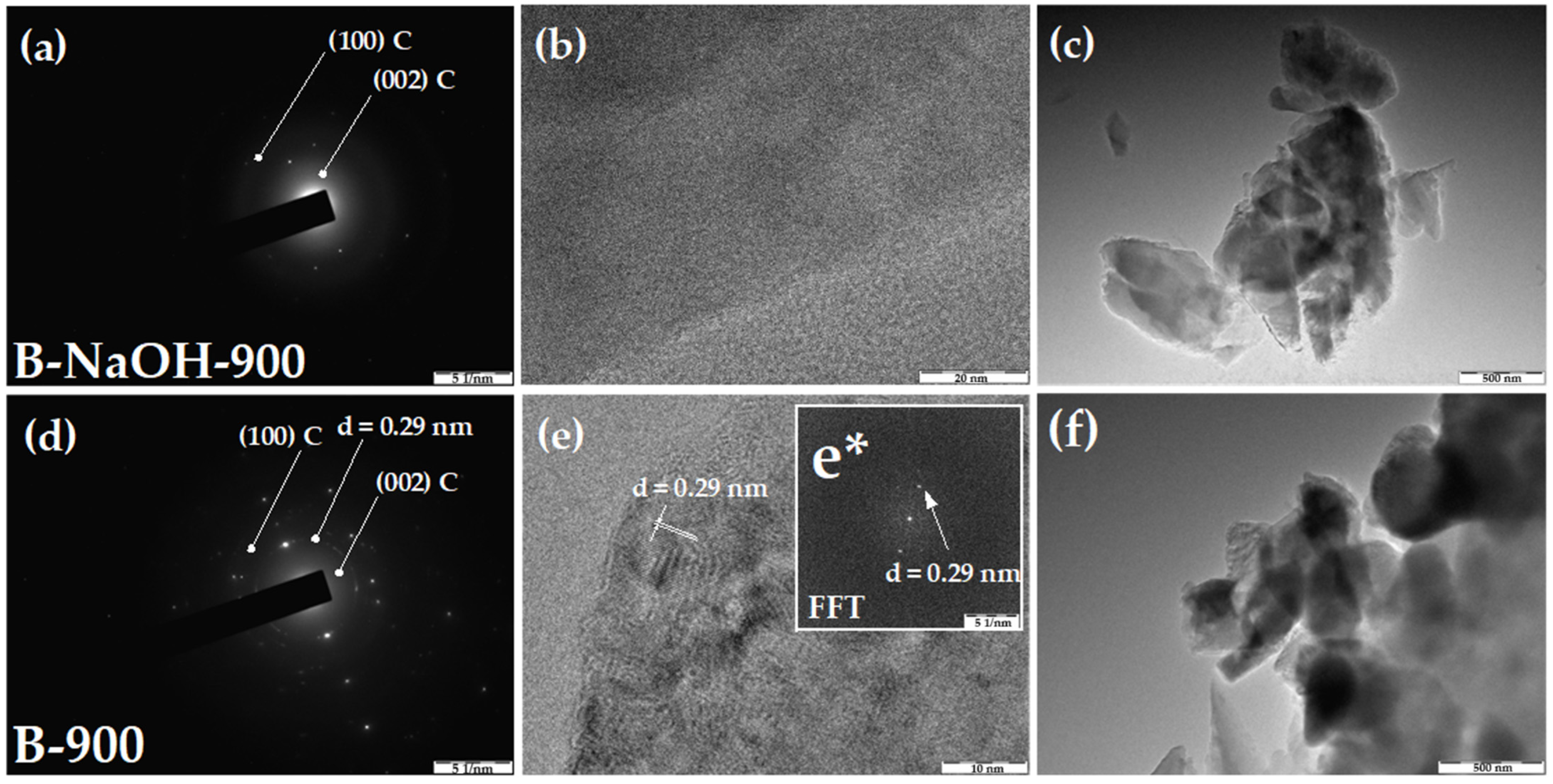
TEM images and SAED diffraction patterns of the pristine and alkali-treated bamboo biomass pyrolysis products are presented in Figure 2. Prior to NaOH treatment, the TEM images (Figure 2e,f) reveal a well-formed crystalline structure. The interplanar spacings calculated by direct processing of the TEM image, as well as from the corresponding FFT image (e*) are equal to 0.29 nm. The SAED pattern for the B-900 sample exhibits a diffraction ring with an interplanar spacing of 2.98 Å. After alkali treatment, the diffraction ring in SAED and the well-organized crystalline planes in TEM and FFT images disappear. Considering the interplanar spacing value of d = 0.29 nm, together with FTIR data indicating the presence of Si–O–Si bonds in the pristine sample, this suggests the formation of crystalline silicates (e.g., K2SiO3) dispersed within the carbon matrix of the pyrolyzed sample. Furthermore, diffuse rings are present in the SAED patterns for both B-900-NaOH and B-900 samples (Figure 2a,d), corresponding to interplanar spacings with Miller indices (002) and (100) in the hard carbon structure. Upon alkali treatment, complete removal of crystalline silicates occurs, as evidenced by the disappearance of the corresponding diffraction ring in SAED and the well-organized atomic planes in TEM. The absence of a uniform orientation of carbon layers (Figure 2b) indicates a turbostratic organization of the material [37,38,39].
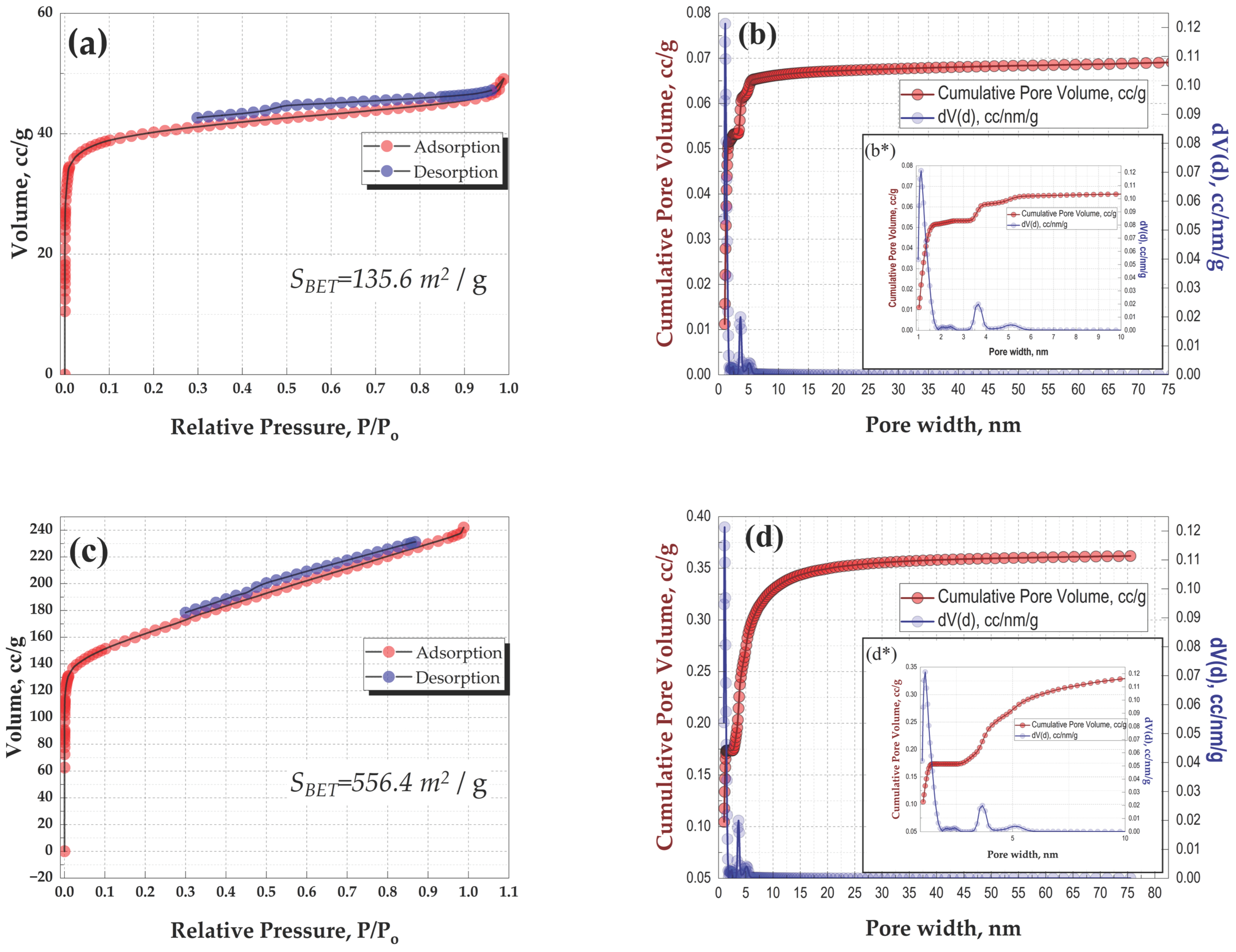
Figure 3 presents the low-temperature nitrogen adsorption–desorption isotherms and pore size distributions of the obtained samples, modeled using density functional theory.
For the pristine sample (Figure 3a), the low-temperature nitrogen adsorption–desorption isotherm corresponds to IUPAC Type I, indicative of a predominantly microporous material, with a narrow H4 hysteresis loop. The pronounced initial uptake at low relative pressures (P/P0 < 0.1) confirms a substantial micropore fraction, as further evidenced by density functional theory (DFT) pore size distribution analysis. The DFT results (Figure 3b) reveal a bimodal micropore distribution with predominant pore diameters of approximately 1–2 nm and 3–4 nm, demonstrating the development of a hierarchical microporous structure, which is more clearly visible in the Figure 3b*.
After alkaline pretreatment, the isotherm evolves into a mixed Type I/IV profile with a narrow H4 hysteresis loop (Figure 3c), in accordance with the IUPAC classification for microporous materials. The significant adsorption at low relative pressures again indicates a major contribution from micropores. DFT pore size distribution analysis (Figure 3d) confirms the continued predominance of micropores of approximately 1–2 nm and 3–4 nm, which is distinctly visible in the Figure 3d*. Concurrently, the Brunauer–Emmett–Teller (BET) specific surface area increases more than fourfold, reaching 556.4 m2g−1, underscoring the effectiveness of the alkaline activation in generating accessible microporosity.
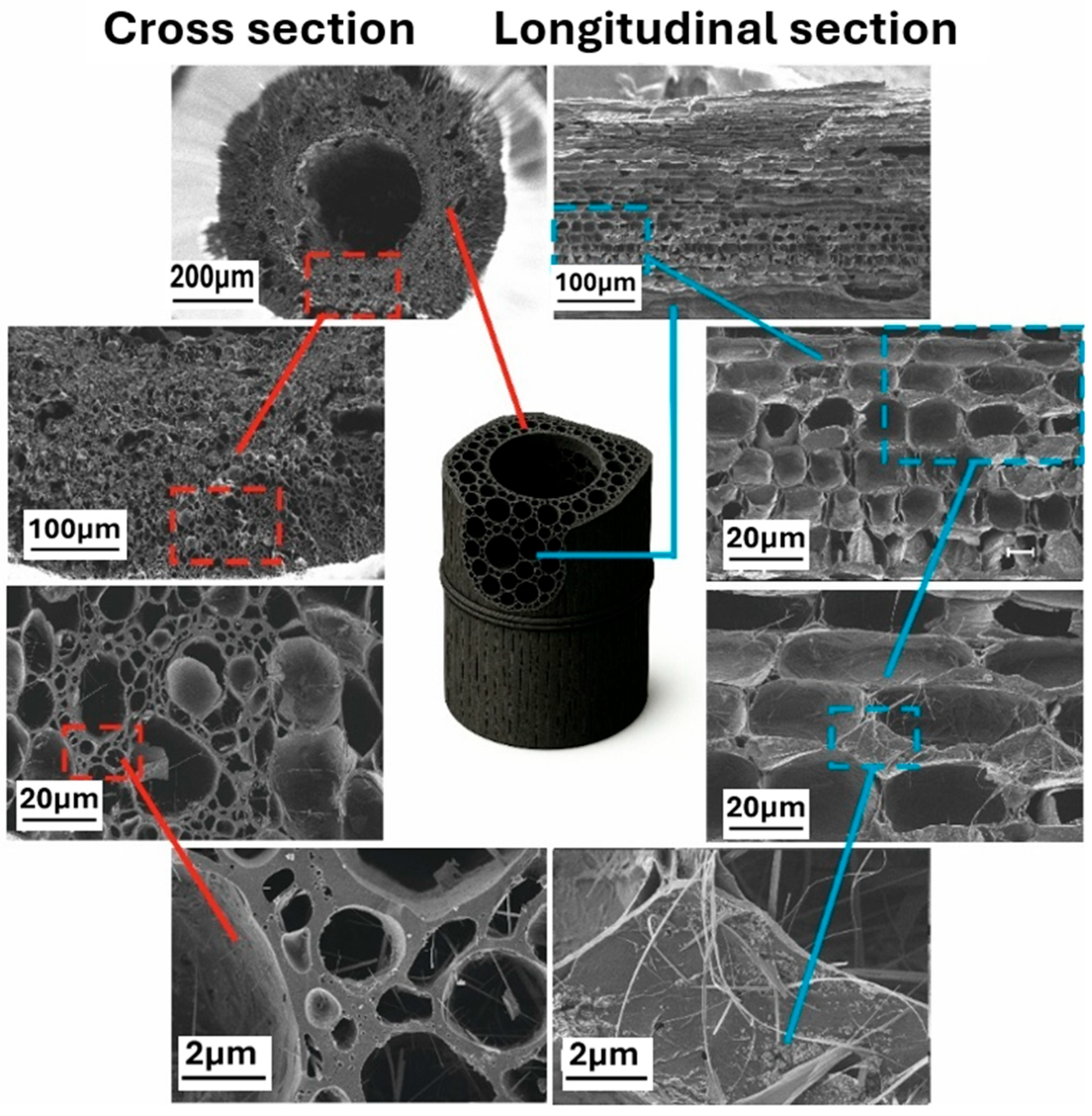
Through scanning electron microscopy and μCT, the morphology of the Sasa kurilensis culm.
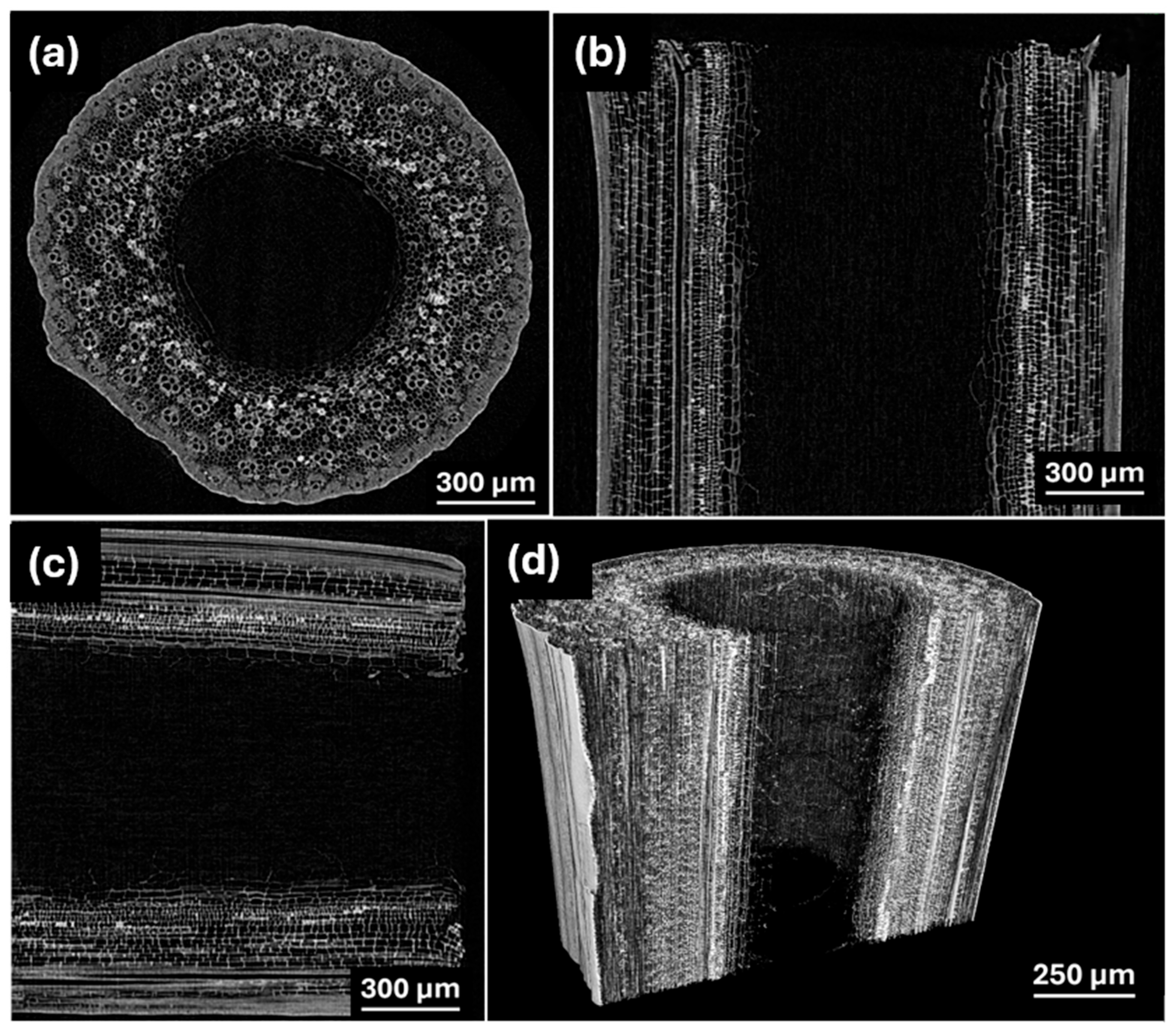
Microtomography (Figure 4) results reveal that the stem of Sasa kurilensis exhibits the typical anatomical structure of monocotyledonous plants: the outer surface is covered by an epidermis with a well-developed cuticle, beneath which lies a narrow sclerenchyma ring. Internal to the sclerenchyma layer is the primary parenchyma, with cells gradually increasing in size toward the stem center. Within this parenchyma, collateral closed vascular bundles are embedded, surrounded by sclerenchyma, most pronounced at the external and internal sides of the bundles. Sieve tube regions display characteristic features due to the presence of companion cells. In most stems, the parenchyma of the internodes partially breaks down, resulting in the formation of a large central cavity; this stem type is classified as a culm [40,41,42].
Parenchyma cells account for approximately 50–55% of the wall volume, predominantly elongated along the stem axis, while shorter cells form intercellular channels. X-ray tomography shows that the peripheral vascular–fibrous bundles form a spatially interconnected structure providing mechanical strength, whereas the central cavity remains hollow. Bright areas correspond to thickened cell walls rich in cellulose, hemicellulose, and lignin, and dark areas correspond to the central cavity and intercellular spaces [43,44]. Three-dimensional reconstruction indicates that vascular–fibrous bundles form an interconnected framework, while the central cavity remains unfilled.
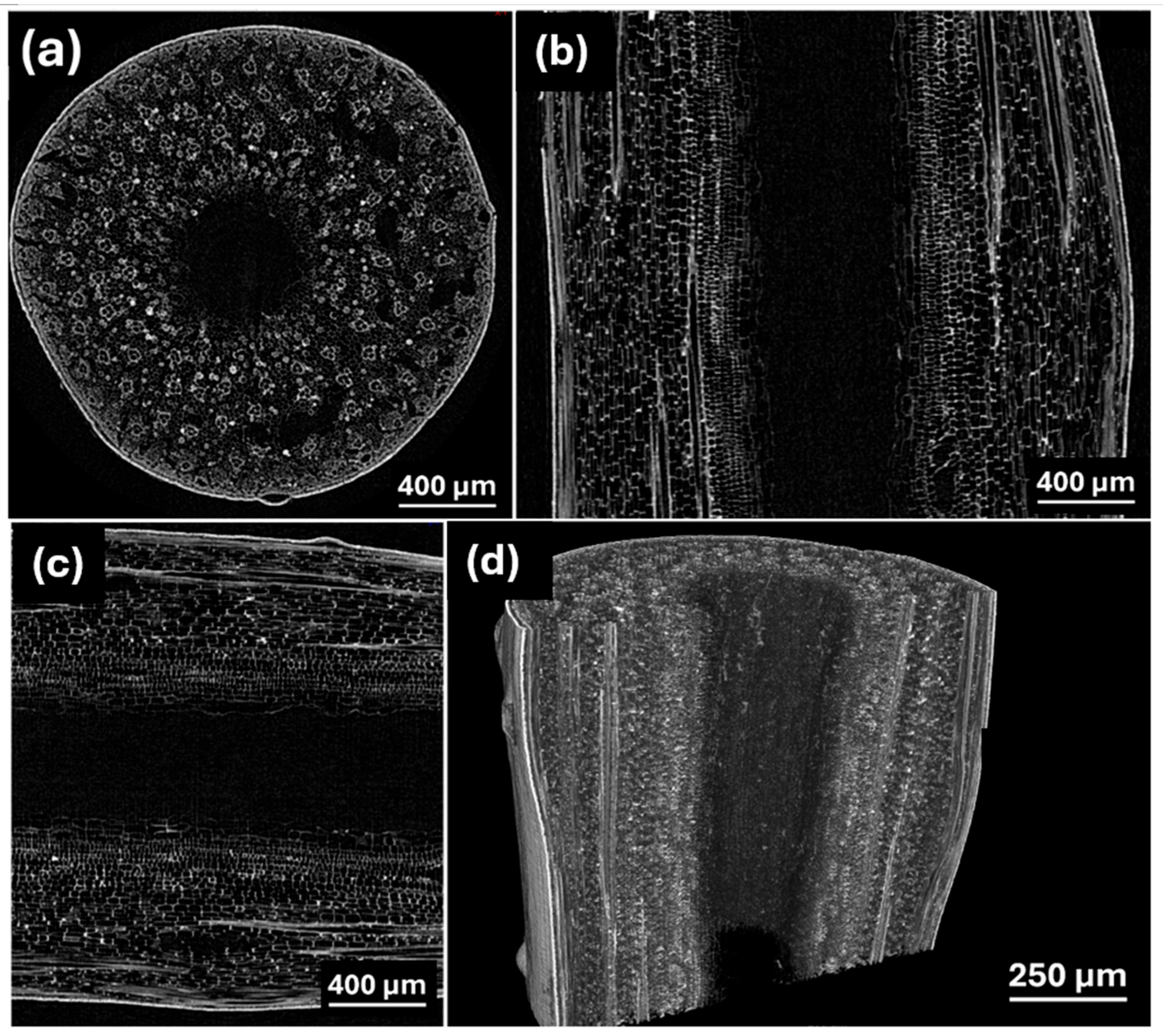
Pyrolysis of the stems at 900 °C in an inert argon atmosphere induces certain structural changes: the central cavity retains its size and shape, but the peripheral vascular–fibrous bundles become less distinct, with signal intensity decreasing by more than half compared to the native structure, indicating a reduction in X-ray density of the cell walls (Figure 5). Thick-walled fibers, previously highlighted as bright zones, now appear in medium-gray shades, reflecting degradation of the cellulose–lignin complex and formation of a porous carbon residue. Three-dimensional reconstruction after pyrolysis confirms an increase in pore volume.
In summary, microtomography demonstrates that Sasa kurilensis culms possess the typical monocotyledonous anatomy with tissue gradation that ensures mechanical strength. Pyrolysis at 900 °C preserves the primary stem architecture while inducing degradation of the cellulose–lignin complex and formation of a porous carbon matrix. These results indicate that the natural stem morphology provides an optimal framework for producing highly porous carbon with controlled structural characteristics and properties.
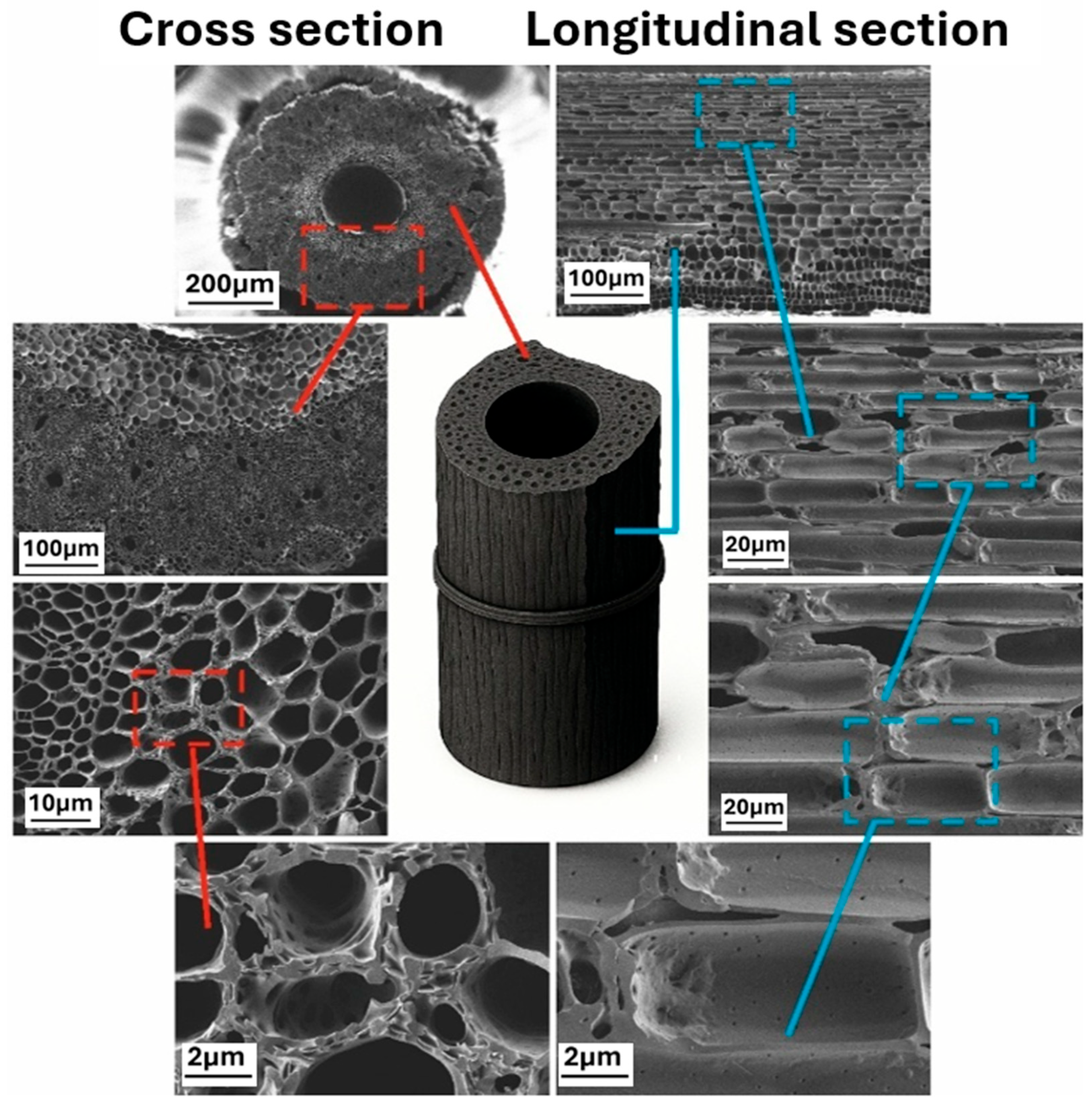
SEM images of the non-graphitizable derived from Sasa kurilensis biomass are shown in Figure 6 and Figure 7. Examination of the pristine hard carbon (Figure 6) reveals a complex, hierarchical architecture inherited from the Sasa kurilensis precursor. Bamboo parenchyma cells exhibit polyhedral morphology with uniformly distributed nanopores within the secondary cell walls. Comparative analysis demonstrates that across various bamboo species, the microstructure undergoes no significant alterations during carbonization at 600–1000 °C, with changes limited to wall thinning and pore expansion [40,41].
According to the research results, the wall thickness varies due to the uneven distribution of lignin and cellulose in the structural elements of bamboo. Closed micropores (<2 nm) are also evident; these are inaccessible to nitrogen during BET measurements yet readily permit Na+ diffusion, thereby contributing to sodium storage within the low-voltage plateau region. Longitudinal cross-section images (Figure 6) further highlight an anisotropic fibrous structure, comprising parallel channels of approximately 20 μm—consistent with the former xylem vessels of the biomass.
After alkaline pretreatment, the hard carbon retains its hierarchical microporosity (Figure 7), while pore walls acquire a finer, roughened texture owing to lignin and hemicellulose removal. The surfaces develop thin carbon filaments and fibrous fragments, indicative of partial matrix degradation.

3.2. Electrochemical Performance of the Investigated Materials

To investigate the electrochemical properties of the samples, galvanostatic cycling was performed in a two-electrode half-cell configuration with metallic sodium as the counter electrode. The primary electrochemical parameters evaluated were the specific capacity and the Coulombic efficiency of the samples during the first cycle.
The NaOH-activated sample exhibited the lowest initial Coulombic efficiency (40%) and the lowest first-cycle discharge capacity (114 mAhg−1), correlating with its highest specific surface area. The large surface area promotes excessive electrolyte decomposition and SEI-layer formation during the first cycle.
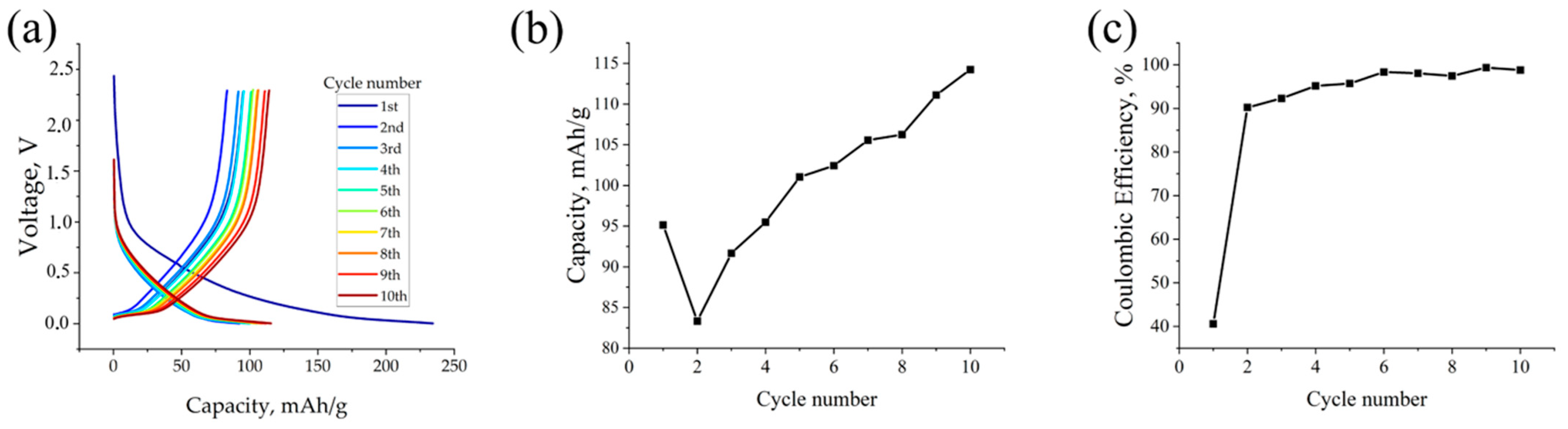
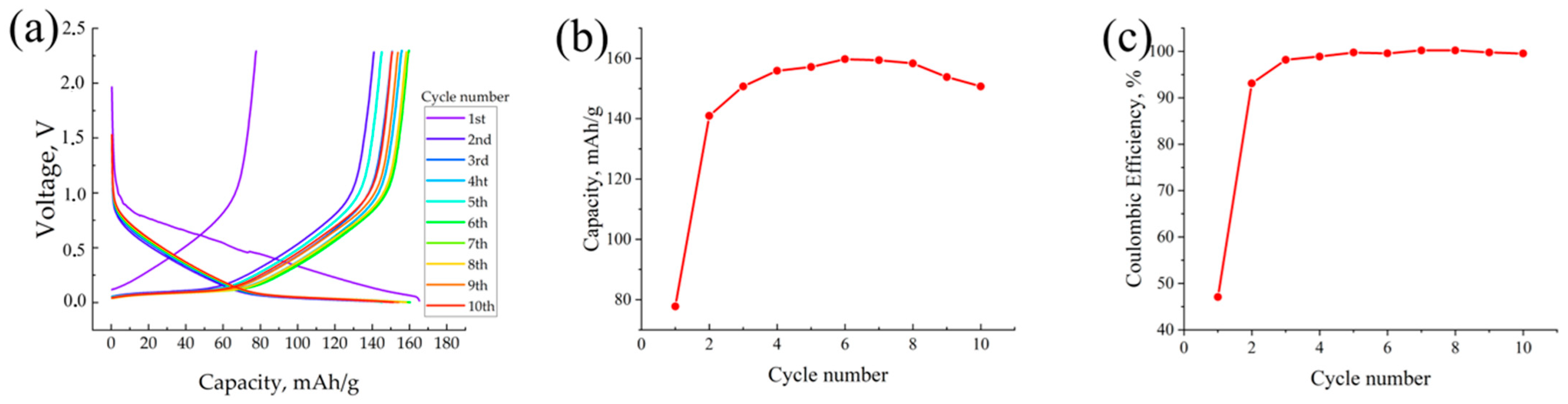
In contrast, B-900, with a lower specific surface area, showed an ICE of 47%; its initial charge capacity was 77 mAhg−1. For this untreated sample, the initial reversible capacity was higher and increased on subsequent cycling, reaching 160 mAhg−1 by the sixth cycle.
Both samples display low initial Coulombic efficiencies overall, attributable to sodium-ion migration into the carbon pores and irreversible trapping of Na+, which no longer participates in later cycles. Low-temperature N2 adsorption–desorption measurements confirm the correlation between surface area and capacity: a more developed pore structure enables greater Na+ intercalation, increasing both half-cell capacity and sodium loss during SEI formation on the high-porosity, defect-rich carbon surfaces. SEI formation on the hardcarbon anode occurs predominantly in the first cycle, as evidenced by the distinct shape of the first sodium intercalation profile. Subsequent cycles rapidly stabilize and exhibit high reversibility of Na+ accumulation. The NaOH treatment increases the surface area and generates new, high-energy, and often unstable surfaces and functional groups that, upon contact with the electrolyte, initiate irreversible decomposition reactions, leading to significant losses of active sodium ions and, consequently, a reduction in ICE. The alkali removes less ordered or amorphous regions of silica, exposing the edges of graphitic planes and creating defects. Oxygen-containing functional groups form at these defects and edges. The newly formed surfaces and functional groups exhibit high chemical and electrochemical activity. The new surfaces, especially within pores and at sharp edges, possess excessive surface energy, rendering them thermodynamically unstable and prone to reactions that lower this energy.
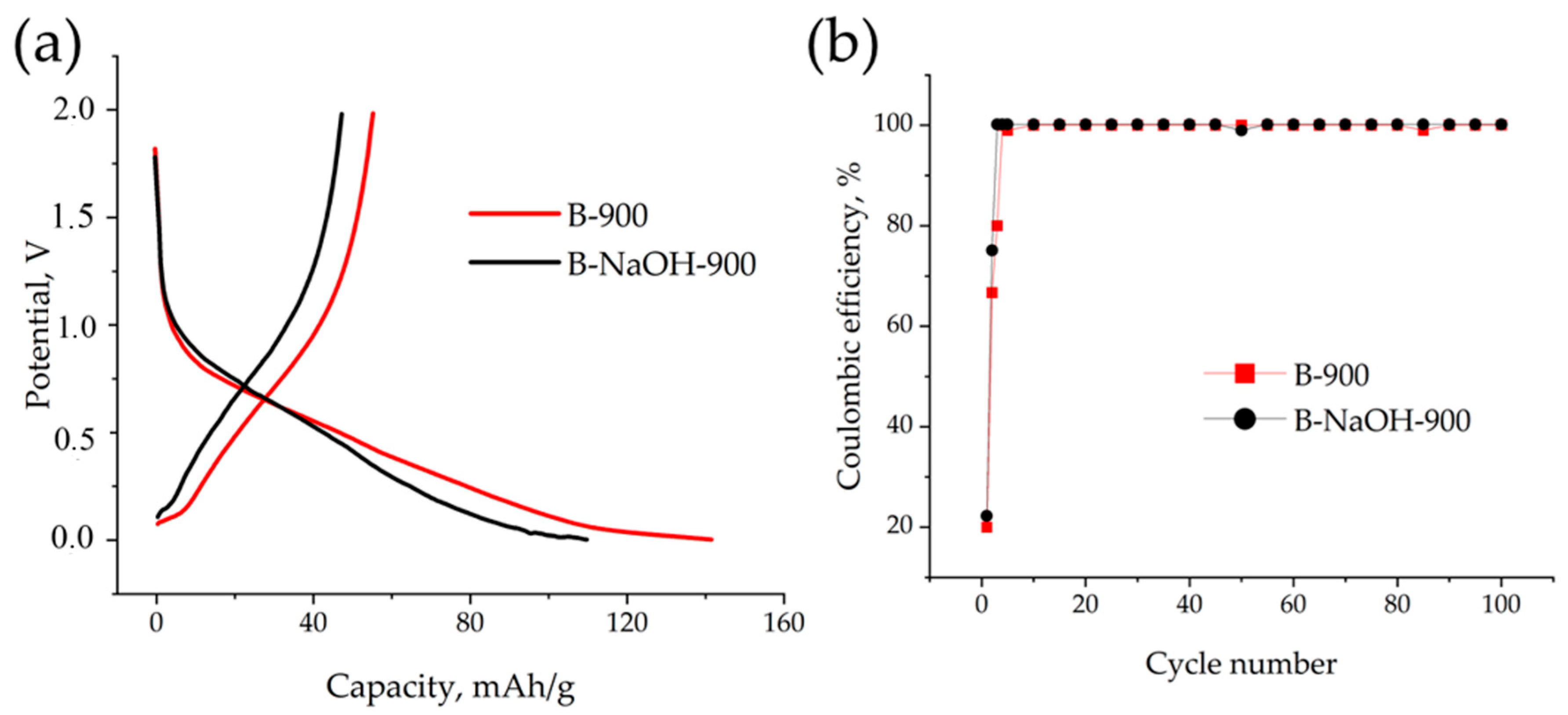
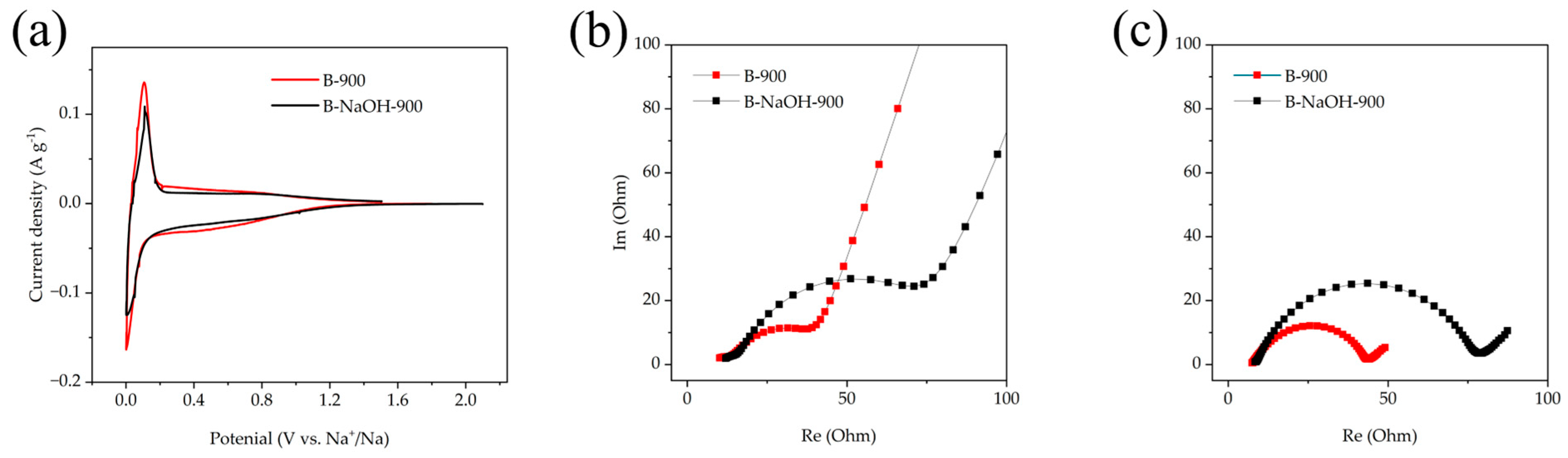
With a higher charge–discharge current (1C), it can be seen (Figure 8a) that the specific capacity decreased by 22 mAhg−1 for sample B-900 and 41 mAhg−1 for sample B-NaOH-900 compared to the data for C/10, respectively. This can be explained by ohmic losses, as well as kinetic constraints, which result in the formation of SEI and a further drop in capacitance. A graph of the Coulombic efficiency dependence on the number of charge–discharge cycles at 1C is shown (Figure 8b) for both samples. The Coulombic efficiency of the initial cycles also decreases by ~20% compared to the data obtained at C/10 (Figure 9c and Figure 10c). Impedance data were measured at the first cycle before charge (Figure 11b) and in the charged state (Figure 11c) in a half cell against metallic sodium. The shape of impedance spectra depends strongly on the cell potential applied, and EIS spectra consist of two partially overlapped and depressed semicircles. The first semicircle is attributed to the formation of SEI (it is very small in this case), and the second to charge transfer; then, Warburg diffusion is observed [45]. It can be concluded that the pristine sample has a smaller charge transfer resistance than the NaOH-treated one, which is consistent with the infrared spectroscopy data (Figure 1) on the presence and effect of silicon on the capacitance of the anode material [46,47].
It can be seen from the CV data (Figure 11a) from the first cycle that some irreversible processes occur at a potential between 1.2 and 0.3 V, which can be attributed to the process of SEI formation [48,49].
These results are of significant fundamental and practical interest. Successful adaptation of regional biomass feedstocks can reduce battery costs, increase material availability, and advance eco-friendly solutions for industrial energy. Systematic investigation and implementation of local botanical resources, such as Sasa kurilensis, enable the design of high-performance, competitive battery materials, thereby expanding the innovative potential of modern energy technologies.
A comparative analysis of the electrochemical performance of biomass-derived hard carbon anodes establishes a direct correlation between precursor type, pyrolysis conditions, and the resulting structural–textural features of the material [50,51,52]. As summarized in Table 1, increasing the pyrolysis temperature of bamboo from 900 to 1700 °C leads to a systematic reduction in the interlayer spacing d002 (from 0.392 to 0.370 nm) and specific surface area (from 519.6 to 3.7 m2g−1). These changes are accompanied by a steady increase in the initial Coulombic efficiency (from 68.2% to 87.6%) and a rise in reversible capacity, reaching a maximum of 348.5 mAhg−1 at 1300 °C [25].
Fruit waste-derived carbons, particularly those obtained from mango peels, exhibit an even stronger effect. The simultaneous expansion of interlayer spacing (0.38–0.48 nm) and the development of very high surface areas (up to 1079.9 m2g−1) enable capacities as high as 350 mAhg−1. However, the initial Coulombic efficiency remains relatively low (40–52%), indicating excessive SEI formation driven by the abundance of surface defects [26]. In contrast, coconut shell-derived carbons demonstrate a steady reduction in specific surface area with increasing pyrolysis temperature (from 15.6 to 8.3 m2g−1). This structural densification correlates with moderate specific capacities (119–221 mAhg−1) and significantly improved efficiencies (57–87%), highlighting the role of reduced surface reactivity in stabilizing the electrochemical response [27].
Coconut sheaths subjected to alkali and transition metal modification (K, Na, Zn) yield carbons with d002 values in the range of 0.367–0.394 nm and capacities of 141–162 mAhg−1, accompanied by initial efficiencies up to 72% [28]. Grain-derived precursors such as buckwheat demonstrate a broader capacity range (179–330 mAhg−1) depending on pyrolysis temperature and oxidative pretreatment, but their relatively low ICE (28–55%) confirms the necessity of reducing excessive surface area and structural defects to suppress irreversible sodium loss [50]. Tobacco stems and wood-derived carbons follow a similar trend: very small surface areas (<5 m2g−1) are consistently associated with high reversible capacities (274–330 mAhg−1) and ICE in the 65–80% range, supporting the view that sodium storage in these systems is dominated by interlayer insertion mechanisms [54,55].
Hybrid systems, such as composites derived from coffee residues and phenolic resins (CHC, SDP, SDCP), exhibit stable capacities up to 270.9 mAhg−1 with ICE around 66%, demonstrating the potential of combining organic precursors with engineered polymeric matrices to achieve synergistic structural benefits [57]. Potato starch-derived carbons are characterized by very high ICE (up to 90.6%) but moderate capacities (200–243 mAhg−1) [59], while peanut shell, coffee ground, and sugarcane bagasse carbons achieve capacities up to 203 mAhg−1 at the expense of lower ICE (28–54%) [60]. Paulownia xylem–derived carbons show promising results, with capacities up to 313 mAhg−1 at 1200–1400 °C and ICE above 80%, values that approach industrially relevant performance benchmarks [61]. Finally, Typha leaf-derived carbons display the most remarkable behavior: pyrolysis from 800 to 1300 °C increases capacity up to 285 mAhg−1 while maintaining ICE of 70–77%, confirming this precursor as one of the most promising candidates [62].
Taken together, these results underline a critical design principle: optimal electrochemical performance is achieved in hard carbons with interlayer spacings of 0.37–0.39 nm, specific surface areas between 30 and 200 m2g−1, and moderate defect concentrations. Increasing pyrolysis temperature generally reduces surface area, thereby limiting irreversible SEI formation during the first cycle and enhancing the initial Coulombic efficiency. Conversely, excessive surface development (>500 m2g−1) leads to uncontrolled electrolyte decomposition, sodium trapping, and low efficiencies.
The performance of Sasa kurilensis-derived hard carbons, reported here for the first time, aligns well with these general trends and occupies an intermediate position among known biomass precursors. For the B-900 sample (pyrolyzed at 900 °C without alkali activation), the interlayer spacing was 0.3796 nm with a moderate surface area of 135.6 m2 g−1, delivering a reversible capacity of 160 mAhg−1 at an ICE of 47%. Alkali activation (B-NaOH-900) substantially increased the surface area to 556.4 m2g−1 while maintaining a similar interlayer spacing (0.3794 nm). However, this modification resulted in reduced capacity (114 mAhg−1) and ICE (40%), consistent with the penalty observed in other high-surface-area carbons such as mango peel-derived materials [26].
When compared with coconut shell- and wood-derived carbons (119–221 and 224–323 mAhg−1, respectively [27,55]), Sasa kurilensis exhibits comparable performance, though its unique hierarchical vascular structure enables a moderately developed surface and sufficient capacity (mAhg−1) at a relatively low pyrolysis temperature (900 °C). This contrasts with carbons, which require 1300–1400 °C to achieve comparable performance. Thus, Sasa kurilensis emerges as a promising and energy-efficient precursor, capable of delivering acceptable electrochemical behavior under milder processing conditions.
It must be emphasized that in the present work we evaluated only the fundamental feasibility of employing Sasa kurilensis as a precursor for sodium-ion battery anodes, using a single pyrolysis temperature (900 °C) and one type of chemical activation (NaOH). Nevertheless, the results confirm the material’s suitability, thereby justifying comprehensive future investigations into the influence of processing temperature on textural properties, defect concentration, and interlayer spacing. Such systematic studies will provide a rational framework for better electrochemical behavior and unlock the full potential of this precursor.

4. Conclusions

In this study, the possibility of synthesizing non-graphitizable hard carbon from Sasa kurilensis culms via direct pyrolysis at 900 °C, with alkaline activation, was demonstrated for the first time. X-ray diffraction analysis revealed two reflections corresponding to the (002) and (100) planes of non-graphitizable carbon. For the untreated sample, d002 = 0.3796 nm, whereas for the sample pre-activated with alkali, d002 = 0.3794 nm, indicating a reduced interlayer spacing that facilitates Na+-ion intercalation. Raman spectroscopy showed an intensity ratio ID/IG of 1.04 for B-900 and 1.14 for B-NaOH-900, reflecting an increased fraction of amorphous regions, defects, and active sites, which was also confirmed by XRD analysis.
TEM-SAED analysis revealed that untreated carbon (B-900) contains crystalline silicates (d = 0.29 nm) within the matrix, which are completely removed by alkaline treatment. Both samples exhibit characteristic hard carbon diffraction rings for (002) and (100) planes with turbostratic organization. Alkali pretreatment effectively eliminates silicate phases while preserving the turbostratic hard carbon structure.
Thermogravimetric analysis of Sasa kurilensis revealed a characteristic three-stage decomposition pattern typical of lignocellulosic biomass. Initial moisture removal (6.94% loss, up to 200 °C) is followed by the primary thermal degradation of polysaccharides—cellulose and hemicellulose (50.46% loss, 198–365 °C)—and the subsequent decomposition of thermally stable lignin and associated compounds (39.54% loss, 362–589 °C). The nearly complete combustion of organic material (96.95% total loss) demonstrates effective carbonization potential, while the minimal residual ash content (~3%) confirms the typical mineral composition of bamboo biomass and indicates favorable conditions for hard carbon synthesis with controlled inorganic content.
Surface analysis by SEM and X-ray microtomography revealed that the vascular structure of the biomass was preserved after pyrolysis, with large macropores forming transport channels and micropores present in the cell walls. Alkaline activation resulted in thinning and increased roughness of the porous walls, as the pretreatment partially dissolved silica and broke ester bonds between polysaccharides, as confirmed by FTIR spectroscopy. This led to the development of a hierarchical porous structure, predominantly with micropores of 1–2 nm and 3–4 nm, and an increased specific surface area, as evidenced by nitrogen adsorption–desorption analysis: a fourfold increase in specific surface area (up to 556.4 m2/g) and a rise in total micropore volume from 0.07 to 0.36 cm3/g.
Electrochemical performance was evaluated by galvanostatic cycling in the potential range of 0.02–2 V versus Na/Na+ at a current density of 25 mAhg−1. The untreated hard carbon (B-900) achieved a capacity of approximately 160 mAhg−1 by the sixth cycle, starting from 77 mAhg−1 in the first cycle. Alkaline activation reduced the capacity to 114 mAhg−1 and the initial Coulombic efficiency to 40%. This effect is associated with the significant increase in specific surface area, which enlarges the SEI formation region and the volume of irreversible side reactions with the electrolyte, characteristic of highly porous structures. While alkaline modification enhanced the defect density of the carbon matrix, facilitating electrode processes, excessive surface development led to a marked decrease in Coulombic efficiency. Comparative analysis with other biomass-derived carbons showed that B-NaOH-900 exhibits intermediate performance: its specific capacity is lower than that of some activated precursors but exceeds that of certain unactivated samples from other plant sources.
The EIS and CV spectra of both samples clearly demonstrated that the original sample has a lower charge transfer resistance than the treated NaOH and also confirmed the formation of SEI in both samples, which is reflected in the cycling data.
In conclusion, the study demonstrates that non-graphitizable hard carbon derived from Sasa kurilensis biomass via pyrolysis at 900 °C possesses a combination of structural and electrochemical properties that make it a promising anode material for sodium-ion batteries. It is important to note that these results primarily demonstrate the feasibility of using this biomass for non-graphitizable carbon synthesis for anode applications. Future research will focus on elucidating structure–function relationships and systematically investigating the effect of treatment temperatures above 900 °C on the electrochemical performance of Sasa kurilensis-derived materials. Particular attention will be given to pretreatment methods to control specific surface area and detailed studies of sodium storage mechanisms within the hierarchical porous structure inherited from the natural vascular architecture of Sasa kurilensis.

Author Contributions

Conceptualization, O.O.S., A.V.O., E.K.P. and I.G.T.; Methodology, P.A.M., O.O.S., Z.E.P., A.I.S., M.A.U., R.I.K., V.V.E. and E.K.P.; Software, O.O.S. and G.P.L.; Validation, N.P.I., V.Y.M., M.A.U., E.A.T., R.I.K., V.V.E. and E.K.P.; Formal analysis, A.I.S., G.P.L., A.S.K., S.A.S., M.A.U. and R.I.K.; Investigation, P.A.M., O.O.S., Z.E.P., A.I.S., N.P.I., A.S.K., S.A.S., V.Y.M., M.A.U., E.A.T., R.I.K., V.V.E. and E.K.P.; Resources, O.O.S. and I.G.T.; Data curation, O.O.S., N.P.I., A.S.K., S.A.S., V.Y.M., E.A.T. and A.V.O.; Writing—original draft, P.A.M.; Writing—review & editing, O.O.S., Z.E.P. and I.G.T.; Visualization, P.A.M., R.I.K., V.V.E. and E.K.P.; Supervision, O.O.S. and A.V.O.; Project administration, O.O.S., A.V.O., E.K.P. and I.G.T.; Funding acquisition, O.O.S., E.A.T. and E.K.P. All authors have read and agreed to the published version of the manuscript.

Funding

Synthesis of HC materials and study of their electrochemical properties was carried out within the framework of the State assignment of Sakhalin State University No. FEFF-2024-0001. Studies of structural and functional properties were carried out within the framework of the State Assignment of the Ministry of Science and Higher Education of the Russian Federation, topic No. FZNS-2023-0003. The study was financially supported within the State Assignment of Sakhalin State University № FEFF-2024-0005. The equipment of the joint Center for collective use, the interdisciplinary center in the field of nanotechnology and new functional materials of the FEFU, was used in the work (Vladivostok, Russia).

Data Availability Statement

The experimental data that supports the findings of this study are available from the corresponding author upon reasonable request.

Conflicts of Interest

The authors declare no conflicts of interest.

References

  1. Tian, Y.; Zeng, G.; Rutt, A.; Shi, T.; Kim, H.; Wang, J.; Koettgen, J.; Sun, Y.; Ouyang, B.; Chen, T.; et al. Promises and Challenges of Next-Generation “Beyond Li-Ion” Batteries for Electric Vehicles and Grid Decarbonization. Chem. Rev. 2021, 121, 1623–1669. [Google Scholar] [CrossRef]
  2. Liu, Q.; Hu, Z.; Li, W.; Zou, C.; Jin, H.; Wang, S.; Chou, S.; Dou, S.-X. Sodium Transition Metal Oxides: The Preferred Cathode Choice for Future Sodium-Ion Batteries? Energy Environ. Sci. 2021, 14, 158–179. [Google Scholar] [CrossRef]
  3. Gao, Y.; Pan, Z.; Sun, J.; Liu, Z.; Wang, J. High-Energy Batteries: Beyond Lithium-Ion and Their Long Road to Commercialisation. Nano Micro Lett. 2022, 14, 94. [Google Scholar] [CrossRef]
  4. Liu, J.; Yuan, H.; Liu, H.; Zhao, C.; Lu, Y.; Cheng, X.; Huang, J.; Zhang, Q. Unlocking the Failure Mechanism of Solid State Lithium Metal Batteries. Adv. Energy Mater. 2022, 12, 2100748. [Google Scholar] [CrossRef]
  5. Yu, T.; Li, G.; Duan, Y.; Wu, Y.; Zhang, T.; Zhao, X.; Luo, M.; Liu, Y. The Research and Industrialization Progress and Prospects of Sodium Ion Battery. J. Alloys Compd. 2023, 958, 170486. [Google Scholar] [CrossRef]
  6. Qiao, S.; Zhou, Q.; Ma, M.; Liu, H.K.; Dou, S.X.; Chong, S. Advanced Anode Materials for Rechargeable Sodium-Ion Batteries. ACS Nano 2023, 17, 11220–11252. [Google Scholar] [CrossRef] [PubMed]
  7. Wu, X.; Lan, X.; Hu, R.; Yao, Y.; Yu, Y.; Zhu, M. Tin-Based Anode Materials for Stable Sodium Storage: Progress and Perspective. Adv. Mater. 2022, 34, 2106895. [Google Scholar] [CrossRef]
  8. Chen, T.; Ouyang, B.; Fan, X.; Zhou, W.; Liu, W.; Liu, K. Oxide Cathodes for Sodium-ion Batteries: Designs, Challenges, and Perspectives. Carbon Energy 2022, 4, 170–199. [Google Scholar] [CrossRef]
  9. Zhao, D.; Zhang, Z.; Ren, J.; Xu, Y.; Xu, X.; Zhou, J.; Gao, F.; Tang, H.; Liu, S.; Wang, Z.; et al. Fe2VO4 Nanoparticles on RGO as Anode Material for High-Rate and Durable Lithium and Sodium Ion Batteries. Chem. Eng. J. 2023, 451, 138882. [Google Scholar] [CrossRef]
  10. Yang, M.; Chang, X.; Wang, L.; Wang, X.; Gu, M.; Huang, H.; Tang, L.; Zhong, Y.; Xia, H. Interface Modulation of Metal Sulfide Anodes for Long-Cycle-Life Sodium-Ion Batteries. Adv. Mater. 2023, 35, e2208705. [Google Scholar] [CrossRef] [PubMed]
  11. Li, H.; He, Y.; Dai, Y.; Ren, Y.; Gao, T.; Zhou, G. Bimetallic SnS2/NiS2@S-RGO Nanocomposite with Hierarchical Flower-like Architecture for Superior High Rate and Ultra-Stable Half/Full Sodium-Ion Batteries. Chem. Eng. J. 2022, 427, 131784. [Google Scholar] [CrossRef]
  12. Yang, M.; Sun, Z.; Nie, P.; Yu, H.; Zhao, C.; Yu, M.; Luo, Z.; Geng, H.; Wu, X. SbPS4: A Novel Anode for High-Performance Sodium-Ion Batteries. Chin. Chem. Lett. 2022, 33, 470–474. [Google Scholar] [CrossRef]
  13. Wu, C.; Yang, Y.; Zhang, Y.; Xu, H.; Huang, W.; He, X.; Chen, Q.; Dong, H.; Li, L.; Wu, X.; et al. Industrial-Scale Hard Carbon Designed to Regulate Electrochemical Polarization for Fast Sodium Storage. Angew. Chem. Int. Ed. 2024, 63, e202406889. [Google Scholar] [CrossRef] [PubMed]
  14. Tang, Z.; Zhang, R.; Wang, H.; Zhou, S.; Pan, Z.; Huang, Y.; Sun, D.; Tang, Y.; Ji, X.; Amine, K.; et al. Revealing the Closed Pore Formation of Waste Wood-Derived Hard Carbon for Advanced Sodium-Ion Battery. Nat. Commun. 2023, 14, 6024. [Google Scholar] [CrossRef]
  15. Li, Y.; Vasileiadis, A.; Zhou, Q.; Lu, Y.; Meng, Q.; Li, Y.; Ombrini, P.; Zhao, J.; Chen, Z.; Niu, Y.; et al. Origin of Fast Charging in Hard Carbon Anodes. Nat. Energy 2024, 9, 134–142. [Google Scholar] [CrossRef]
  16. Feng, X.; Li, Y.; Li, Y.; Liu, M.; Zheng, L.; Gong, Y.; Zhang, R.; Wu, F.; Wu, C.; Bai, Y. Unlocking the Local Structure of Hard Carbon to Grasp Sodium-Ion Diffusion Behavior for Advanced Sodium-Ion Batteries. Energy Environ. Sci. 2024, 17, 1387–1396. [Google Scholar] [CrossRef]
  17. Xu, Z.; Wang, J.; Guo, Z.; Xie, F.; Liu, H.; Yadegari, H.; Tebyetekerwa, M.; Ryan, M.P.; Hu, Y.; Titirici, M. The Role of Hydrothermal Carbonization in Sustainable Sodium-Ion Battery Anodes. Adv. Energy Mater. 2022, 12, 2200208. [Google Scholar] [CrossRef]
  18. Zheng, Z.; Hu, S.; Yin, W.; Peng, J.; Wang, R.; Jin, J.; He, B.; Gong, Y.; Wang, H.; Fan, H.J. CO2-Etching Creates Abundant Closed Pores in Hard Carbon for High-Plateau-Capacity Sodium Storage. Adv. Energy Mater. 2024, 14, 2303064. [Google Scholar] [CrossRef]
  19. Jin, Y.; Le, P.M.L.; Gao, P.; Xu, Y.; Xiao, B.; Engelhard, M.H.; Cao, X.; Vo, T.D.; Hu, J.; Zhong, L.; et al. Low-Solvation Electrolytes for High-Voltage Sodium-Ion Batteries. Nat. Energy 2022, 7, 718–725. [Google Scholar] [CrossRef]
  20. Bobyleva, Z.V.; Drozhzhin, O.A.; Alekseeva, A.M.; Dosaev, K.A.; Peters, G.S.; Lakienko, G.P.; Perfilyeva, T.I.; Sobolev, N.A.; Maslakov, K.I.; Savilov, S.V.; et al. Caramelization as a Key Stage for the Preparation of Monolithic Hard Carbon with Advanced Performance in Sodium-Ion Batteries. ACS Appl. Energy Mater. 2023, 6, 181–190. [Google Scholar] [CrossRef]
  21. Rao, X.; Lou, Y.; Zhao, J.; Chen, J.; Qiu, Y.; Wu, T.; Zhong, S.; Wang, H.; Wu, L. Carbon Nanofibers Derived from Carbonization of Electrospinning Polyacrylonitrile (PAN) as High Performance Anode Material for Lithium Ion Batteries. J. Porous Mater. 2023, 30, 403–419. [Google Scholar] [CrossRef]
  22. Fan, C.; Zhang, R.; Luo, X.; Hu, Z.; Zhou, W.; Zhang, W.; Liu, J.; Liu, J. Epoxy Phenol Novolac Resin: A Novel Precursor to Construct High Performance Hard Carbon Anode toward Enhanced Sodium-Ion Batteries. Carbon 2023, 205, 353–364. [Google Scholar] [CrossRef]
  23. Alfattani, R.; Shah, M.A.; Siddiqui, M.I.H.; Ali, M.A.; Alnaser, I.A. Bio-Char Characterization Produced from Walnut Shell Biomass through Slow Pyrolysis: Sustainable for Soil Amendment and an Alternate Bio-Fuel. Energies 2021, 15, 1. [Google Scholar] [CrossRef]
  24. He, Q.; Chen, H.; Chen, X.; Zheng, J.; Que, L.; Yu, F.; Zhao, J.; Xie, Y.; Huang, M.; Lu, C.; et al. Tea-Derived Sustainable Materials. Adv. Funct. Mater. 2024, 34, 2310226. [Google Scholar] [CrossRef]
  25. Xu, T.; Qiu, X.; Zhang, X.; Xia, Y. Regulation of Surface Oxygen Functional Groups and Pore Structure of Bamboo-Derived Hard Carbon for Enhanced Sodium Storage Performance. Chem. Eng. J. 2023, 452, 139514. [Google Scholar] [CrossRef]
  26. Muruganantham, R.; Wang, F.-M.; Liu, W.-R. A Green Route N, S-Doped Hard Carbon Derived from Fruit-Peel Biomass Waste as an Anode Material for Rechargeable Sodium-Ion Storage Applications. Electrochim. Acta 2022, 424, 140573. [Google Scholar] [CrossRef]
  27. Cheng, Y.; Zhao, J.; Zhang, L.; Wan, J.; Yang, J.; Wang, H. The Effect of Thermal Treatment Temperature on the Crystal Structure and Electrochemical Performance of the Coconut Shell-Based Hard Carbon. Solid State Ion. 2023, 402, 116374. [Google Scholar] [CrossRef]
  28. Thenappan, M.; Rengapillai, S.; Marimuthu, S. Hard Carbon Reprising Porous Morphology Derived from Coconut Sheath for Sodium-Ion Battery. Energies 2022, 15, 8086. [Google Scholar] [CrossRef]
  29. Xiao, H.-M.; Zheng, H.; Yuan, P.; Luo, J.-H.; Shen, L.-L.; Tan, J.-F.; Luo, X.-Y.; Li, D.; Chen, Y. Structural Engineering of Hard Carbon through Spark Plasma Sintering for Enhanced Sodium-Ion Storage. Rare Met. 2024, 43, 4274–4285. [Google Scholar] [CrossRef]
  30. Itabashi, T.; Akada, S.; Ishida, K.; Ishibashi, S.; Ohno, M.; Matsui, K.; Watanabe, Y.; Nakashizuka, T.; Makita, A. Culm Dynamics of Dwarf Bamboo (Sasa kurilensis Makino & Shibata) in Relation to Forest Canopy Conditions in Beech Forests. Adv. Bamboo Sci. 2023, 2, 100013. [Google Scholar] [CrossRef]
  31. Okabe, S.; Takeuchi, K.; Takagi, K.; Shibata, M. Stimulatry Effect of the Water Extract of Bamboo Grass (Folin Solution) on Gastric Acid Secretion in Pylorus-Ligated Rats. Jpn. J. Pharmacol. 1975, 25, 608–609. [Google Scholar] [CrossRef]
  32. Xu, Q.-F.; Liang, C.-F.; Chen, J.-H.; Li, Y.-C.; Qin, H.; Fuhrmann, J.J. Rapid Bamboo Invasion (Expansion) and Its Effects on Biodiversity and Soil Processes +. Glob. Ecol. Conserv. 2020, 21, e00787. [Google Scholar] [CrossRef]
  33. Lux, A.; Luxová, M.; Abe, J.; Morita, S.; Inanaga, S. Silicification of Bamboo (Phyllostachys heterocycla Mitf.) Root and Leaf. Plant Soil 2003, 255, 85–91. [Google Scholar] [CrossRef]
  34. Shen, T.; Sun, Y.; He, Z.; Dai, G.; Ru, B.; Qiu, P.; Wang, S. Effect of Pore Structure Regulation in Coconut Shell-Derived Hard Carbon on Sodium Storage Capacity. Electrochim. Acta 2025, 538, 147046. [Google Scholar] [CrossRef]
  35. Chen, H.; Sun, N.; Zhu, Q.; Soomro, R.A.; Xu, B. Microcrystalline Hybridization Enhanced Coal-Based Carbon Anode for Advanced Sodium-Ion Batteries. Adv. Sci. 2022, 9, e2200023. [Google Scholar] [CrossRef]
  36. Huangfu, J.; Cao, H.; Xi, Y.; Li, Q.; Wang, H.; Wang, S.; Kong, F. Low-Temperature Pre-Oxidation and High-Temperature Activation Modulate Brewer’s Spent Grains-Based Hard Carbon Microcrystalline Structure to Enhance Sodium Storage Properties. Ind. Crops Prod. 2025, 233, 121413. [Google Scholar] [CrossRef]
  37. Yarramsetti, S.; Kalluri, S.; Ch, S.; Uv, V. Catalytic Graphitisation of Vigna Mungo (L) Hepper Biomass: A Renewable Graphite Source for High-Performance Energy Storage Applications. J. Energy Storage 2025, 134, 118211. [Google Scholar] [CrossRef]
  38. Hultman, L.; Cziga, Z. Ultramicroscopy Interpretation of Electron Diffraction Patterns from Amorphous and Fullerene-like Carbon Allotropes. Ultramicroscopy 2010, 110, 815–819. [Google Scholar] [CrossRef]
  39. Singh, J.; Zhu, Z.; Han, S.; Wang, N.; Tiwari, S.K. Advances in Hard Carbon: From Structural Complexity to Applications for next-Generation Technologies. J. Alloys Compd. 2025, 1042, 183755. [Google Scholar] [CrossRef]
  40. Chen, X.; Wang, X.; Shang, L.; Ma, X.; Fang, C.; Fei, B.; Liu, H.; Zhang, S. Three-Dimensional Structural Characterization and Mechanical Properties of Bamboo Parenchyma Tissue. Ind. Crops Prod. 2024, 208, 117833. [Google Scholar] [CrossRef]
  41. Palombini, F.L.; Kindlein, W.; de Oliveira, B.F.; de Araujo Mariath, J.E. Bionics and Design: 3D Microstructural Characterization and Numerical Analysis of Bamboo Based on X-Ray Microtomography. Mater. Charact. 2016, 120, 357–368. [Google Scholar] [CrossRef]
  42. Wang, F.; Shao, Z. Study on the Variation Law of Bamboo Fibers’ Tensile Properties and the Organization Structure on the Radial Direction of Bamboo Stem. Ind. Crops Prod. 2020, 152, 112521. [Google Scholar] [CrossRef]
  43. Chen, X.; Wang, X.; Gu, S.; Huang, A.; Cheng, H. Effects of Alkali Treatment on the Bending and Fracture Behavior of Biomaterial Bamboo. Polym. Test. 2025, 143, 108715. [Google Scholar] [CrossRef]
  44. Chen, X.; Wang, X.; Luo, X.; Chen, L.; Li, Y.; Xu, J.; Liu, Z.; Dai, C.; Miao, H.; Liu, H. Bamboo as a Naturally-Optimized Fiber-Reinforced Composite: Interfacial Mechanical Properties and Failure Mechanisms. Compos. Part B Eng. 2024, 279, 111458. [Google Scholar] [CrossRef]
  45. Väli, R.; Jänes, A.; Lust, E. Alkali-Metal Insertion Processes on Nanospheric Hard Carbon Electrodes: An Electrochemical Impedance Spectroscopy Study. J. Electrochem. Soc. 2017, 164, E3429–E3437. [Google Scholar] [CrossRef]
  46. Ali, M.; Hussain, H.; Ali, M.; Aman, S.; Yang, W.; Ali, Z.; Li, L.; Jiang, Y.; Yousaf, M. Regulating a NaF-Rich SEI Layer for Dendrite-Free Sodium Metal Batteries Using Trifunctional Halogenated Covalent Organic Framework Separators. Adv. Sci. 2025, 12, e03693. [Google Scholar] [CrossRef]
  47. Ali, M.; Chishti, A.N.; Ali, M.; Iqbal, S.; Aman, S.; Mahmood, A.; Liu, H.; Yousaf, M.; Jiang, Y. Recent Development in Sodium Metal Batteries: Challenges, Progress, and Perspective. Mater. Today 2025, 88, 730–751. [Google Scholar] [CrossRef]
  48. Ali, M.; Iqbal, S.; Chishti, A.N.; Ali, M.; Aman, S.; Hussain, H.; Jiang, Y.; Lin, X.; Yousaf, M. A Multifunctional Ex-Situ Artificial Hybrid Interphase Layer to Stabilize Sodium Metal Anode. Nano Energy 2024, 132, 110348. [Google Scholar] [CrossRef]
  49. Ali, M.; Iqbal, S.; Ali, M.; Aman, S.; Chishti, A.N.; Zhang, J.; Shen, Z.; Huang, H.; Yousaf, M.; Jiang, Y. Tailoring the NaI-Rich Solid Electrolyte Interphase for Enhanced Stability in Sodium Metal Batteries. J. Power Sources 2025, 640, 236733. [Google Scholar] [CrossRef]
  50. Pan, G.; Zhao, R.; Huang, Z.; Cui, C.; Wang, F.; Gu, Y.; Gao, Y.; Sun, Z.; Zhang, T. Vascular Tissue-Derived Hard Carbon with Ultra-High Rate Capability for Sodium-Ion Storage. Carbon 2024, 224, 118955. [Google Scholar] [CrossRef]
  51. Iqbal, S.; Chishti, A.N.; Ali, M.; Rehman, J.; Zaman, F.; Luo, T.; Ali, M.; Aman, S.; Hussain, H.; Huang, H.; et al. Introduction of a Multifunctional Percolated Framework into Na Metal for Highly Stable Sodium Metal Batteries. J. Mater. Chem. A 2025, 13, 14982–14994. [Google Scholar] [CrossRef]
  52. Aman, S.; Iqbal, S.; Chishti, A.N.; Ali, M.; Ali, M.; Hussain, H.; Huang, H.; Lin, Y.; Yousaf, M.; Jiang, Y. A Multifunctional Na2Se/Zn-Mn Skeleton Enables Processable and Highly Reversible Sodium Metal Anode. Small 2025, 21, 2407682. [Google Scholar] [CrossRef]
  53. Kydyrbayeva, U.; Baltash, Y.; Mukhan, O.; Nurpeissova, A.; Kim, S.-S.; Bakenov, Z.; Mukanova, A. The Buckwheat-Derived Hard Carbon as an Anode Material for Sodium-Ion Energy Storage System. J. Energy Storage 2024, 96, 112629. [Google Scholar] [CrossRef]
  54. Meng, W.; Gao, Y.; Zhu, K.; Cao, D. Preparation of Mesoporous Hard Carbon Anode Materials by Nitrogen Doping of Biomass to Enhance the Specific Capacity of Sodium Ion Adsorption. J. Electroanal. Chem. 2025, 991, 119190. [Google Scholar] [CrossRef]
  55. Saavedra Rios, C.d.M.; Simone, V.; Simonin, L.; Martinet, S.; Dupont, C. Biochars from Various Biomass Types as Precursors for Hard Carbon Anodes in Sodium-Ion Batteries. Biomass Bioenergy 2018, 117, 32–37. [Google Scholar] [CrossRef]
  56. Li, G.; Hua, Z.; Yang, J.; Hu, H.; Zheng, J.; Ma, X.; Lin, J.; Cao, S. Bamboo—A Potential Lignocellulosic Biomass for Preparation of Hard Carbon Anode Used in Sodium Ion Battery. Biomass Bioenergy 2025, 194, 107673. [Google Scholar] [CrossRef]
  57. Luo, X.; Bao, R.; Kong, X.; Liu, L.; Deng, Z.; Yi, J. Resin Derived Carbon Coating Enhances Closed Pore Architecture in Coffee Silver Skin Hard Carbon for Advanced Sodium Ion Storage. Colloids Surf. A Physicochem. Eng. Asp. 2025, 727, 138183. [Google Scholar] [CrossRef]
  58. Gao, T.; Zhou, Y.; Jiang, Y.; Xue, Z.; Ding, Y. Bamboo Waste Derived Hard Carbon as High Performance Anode for Sodium-Ion Batteries. Diam. Relat. Mater. 2024, 150, 111737. [Google Scholar] [CrossRef]
  59. Liu, X.; Liu, H.; Yuan, R.; Shang, L.; Liu, T.; Wang, W.; Miao, Y.; Chen, X.; Song, H. Potato-Starch-Based Hard Carbon Microspheres: Preparation and Application as an Anode Material for Sodium-Ion Batteries. Solid State Ion. 2024, 406, 116475. [Google Scholar] [CrossRef]
  60. Yan, B.; Han, C.; Dai, Y.; Li, M.; Wu, Z.; Gao, X. Biomass Derived Hard Carbon Materials for Sodium Ion Battery Anodes: Exploring the Influence of Carbon Source on Structure and Sodium Storage Performance. Fuel 2024, 371, 132141. [Google Scholar] [CrossRef]
  61. Xu, J.; Chen, B.; Hu, B.; Gu, Y.; Li, X.; Liu, Y.; Sha, D.; Zhang, J.; Huang, S. 3D Connected Porous Structure Hard Carbon Derived from Paulownia Xylem for High Rate Performance Sodium Ion Battery Anode. J. Energy Storage 2024, 81, 110306. [Google Scholar] [CrossRef]
  62. Iqbal, S.; Chishti, A.N.; Ali, M.; Ali, M.; Hao, Y.; Wu, X.; Huang, H.; Lu, W.; Gao, P.; Yousaf, M.; et al. Se-p Orbitals Induced “Strong d–d Orbitals Interaction” Enable High Reversibility of Se-Rich ZnSe/MnSe@C Electrode as Excellent Host for Sodium-Ion Storage. Small 2024, 20, e2308262. [Google Scholar] [CrossRef] [PubMed]
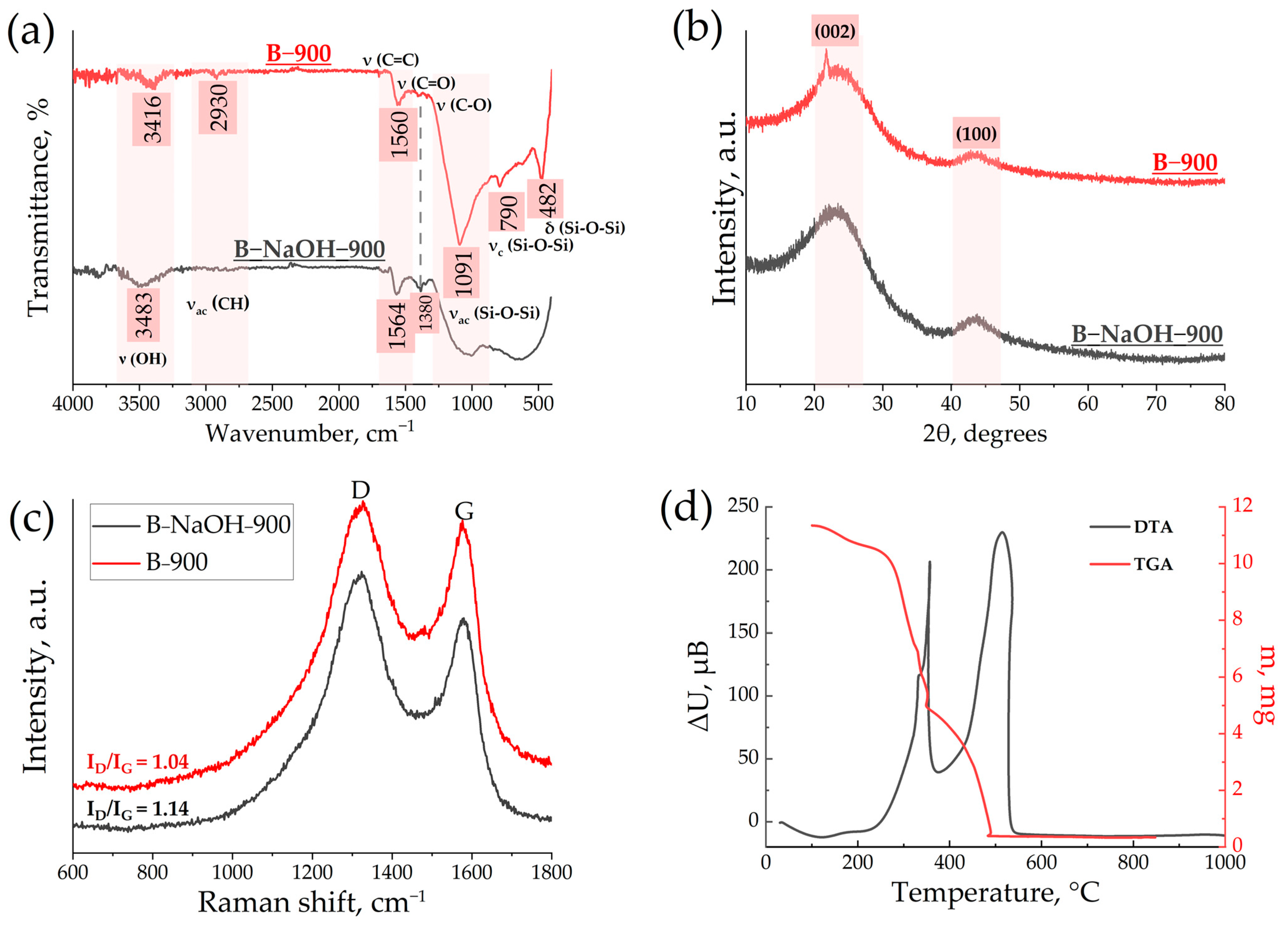
Figure 1. FTIR spectra (a), XRD patterns (b), and Raman spectra (c) of B-900 and B-NaOH-900; thermogram of raw bamboo (d).
Jcs 09 00668 g001
Figure 2. SAED patterns (a,d), TEM images (bf) and FFT image (e*) of B-NaOH-900 and B-900 samples.
Jcs 09 00668 g002
Figure 3. Low-temperature nitrogen adsorption–desorption isotherms and pore size distributions of carbon materials derived from Sasa kurilensis by pyrolysis at 900 °C (a,b) and following preliminary alkaline activation (c,d). The sections of the pore size distribution curves from 1 to 10 nm labeled as b* and d*.
Jcs 09 00668 g003
Figure 4. μCT scanning images of the Sasa kurilensis culm before pyrolysis obtained by X-ray microtomography: two-dimensional transverse sections in the X–Y (a), X–Z (b), and Z–Y (c) projections; three-dimensional reconstruction of the stem (d).
Jcs 09 00668 g004
Figure 5. μCT scanning images of the Sasa kurilensis culm after pyrolysis obtained by X-ray microtomography: two-dimensional cross-section slice in the X–Y plane (a), longitudinal slice in the X–Z plane (b), and longitudinal virtual slice in the Z–Y plane (c); three-dimensional reconstruction of the stem (d).
Jcs 09 00668 g005
Figure 6. Scanning electron microscopy images of the surface morphology of carbon materials derived from Sasa kurilensis by pyrolysis at 900 °C.
Jcs 09 00668 g006
Figure 7. Scanning electron microscopy images of the surface morphology of carbon materials derived from Sasa kurilensis biomass by pyrolysis at 900 °C following alkaline activation.
Jcs 09 00668 g007
Figure 8. Galvanostatic charge and discharge curves of the first cycle for both samples (a); coulombic efficiency at a current density of 250 mAg−1 (b).
Jcs 09 00668 g008
Figure 9. Galvanostatic charge and discharge curves for the B-900 sample (a); cycling performance of the cell with the studied anode material (b); coulombic efficiency at a current density of 25 mAg−1 (c).
Jcs 09 00668 g009
Figure 10. Galvanostatic charge and discharge curves for the B-NaOH-900 sample (a); cycling performance of the cell with the studied anode material (b); coulombic efficiency at a current density of 25 mAg−1 (c).
Jcs 09 00668 g010
Figure 11. Cyclic voltammetry of materials in a half cell against metallic sodium (a); impedance spectra measured before charge (b) and in charged state (c) in a half cell against metallic sodium.
Jcs 09 00668 g011
Table 1. Comparison of electrochemical performance of typical biomass-derived carbon anodes for SIBs.
PrecursorSampleTemperature (°C)d002, nmSBET, m2 g−1Capacity, mAhg−1ICE, %Ref.
BambooHC-900
HC-1100
HC-1300
HC-1500
HC-1700
900–17000.392
0.387
0.385
0.371
0.370
519.5972
35.6296
13.0375
3.7649
3.6883
237.5
266.1
348.5
310.0
314.5
68.2
72.7
84.1
85.6
87.6
[25]
Mango peelsMPC
NS-MPC
10000.38
0.48
1079.88
408.99
280
350
40.05
52.03
[26]
Coconut shellHC-1100
HC-1300
HC-1400
1000–15000.411
0.393
0.376
15.61
14.43
8.34
119.59
221.55
103.24
57.1
78.2
87.2
[27]
Coconut sheathK-CS
Na-CS
Zn-CS
9000.367
0.370
0.394
153.3
79.240
20.780
141.27
153.02
162.30
51.1
52.05
72
[28]
Buckwheat (Fagopyrum esculentum)HC600
HC800
HC1000
HC1400
HCox600
HCox800
HCox1000
HCox1400
600–14000.371
0.370
0.379
0.366
0.371
0.369
0.386
0.365
68.4242
4.7227
10.8565
12.1760
13.7254
1.1614
69.4572
9.3573
179.43
216.5
245.57
289.47
246.88
289.47
272.36
330.23
32.36
40.53
39.58
54.75
28.27
40.63
37.47
46.29
[53]
Tobacco stemsHC-1100
HC-1300
HC-1500
HC-N1300
1100–13000.360
0.400
0.350
0.410
1.44
3.24
3.96
7.13
293
296
287
330
71.9
66.6
68.5
67.9
[54]
Pine
Ash wood
Miscanthus
Wheat straw
Pine
Ash wood
Miscanthus
Wheat straw
14000.375
0.371
-
-
<3
<3
12
45
323.8
280
274
224
85
79
80
65
[55]
Bamboo (moso bamboo), hardwood (eucalyptus), softwood (scots pine) and straw (juncao)BC
HWC
SWC
SC
1200 + HCl treatment0.394 0.392 0.396 0.3934.85
28.33
21.02
11.33
344.3
309.2
303.5
273.2
60.6
59.8
62.6
57.0
[56]
Coffee silver skin (CHC), phenolic resin powder (SDP); coffee silver skin coating with phenolic resin (SDCP)CHC
SDP
SDCP
10000.378
0.398
0.389
141.83
2.34
2.67
203.42
255.35
270.89
60.50
65.46
65.89
[57]
Bamboo wasteHCB-1000
HCB-1200
HCB-1400
HCB-1600
1000–14000.397
0.387
0.382
0.378
61.14
35.02
10.78
10.48
136.4
267.1
328.4
296.9
39.1
61.5
67.8
66.7
[58]
Potato starch (PS)PC-800
PC-1000
PC-1200
PC-1400
PC-1500
800–15000.389
0.384
0.379
0.378
0.372
331.0
3.4
3.2
2.1
1.7
200.0
225.6
243.0
235.6
224.7
-
-
-
-
90.6
[59]
Peanut shells, coffee grounds, and sugarcane bagasseHC-P
HC-C
HC-S
1000 + HCl treatment0.373
0.368
0.355
35.46
57.79
87.26
203,6
187,9
112,1
53.84
50.46
28.02
[60]
Paulownia xylemHC-1000
HC-1100
HC-1200
HC-1300
HC-1400
1000–14000.379
0.375
0.374
0.372
0.368
270.8
-
28.3
-
18.6
239 at 0.5C
-
291.2 0.5C
-
313 0.5C
209 10C
76.8
77.9
81.8
82.6
85.9
[61]
Typha leavesVHC-800
VHC-900
VHC-1000
VHC-1100
VHC-1200
VHC-1300
800–13000.387
0.386
0.383
0.383
0.380
0.367
114.27
89.59
136.62
174.69
227.57
287.21
-
-
-
-
285.3
-
66.43
67.21
75.30
77.44
72.43
72.35
[62]
Sasa kurilensisB-900
B-NaOH-900
9000.3794
0.3796
135.6
556.4
160
114
47
40
This work
Disclaimer/Publisher’s Note: The statements, opinions and data contained in all publications are solely those of the individual author(s) and contributor(s) and not of MDPI and/or the editor(s). MDPI and/or the editor(s) disclaim responsibility for any injury to people or property resulting from any ideas, methods, instructions or products referred to in the content.