You are currently viewing a new version of our website. To view the old version click .
Journal of Composites Science
  • Article
  • Open Access

3 December 2025

Preparation and Characterization of Polyethylene-Based Composites with Iron-Manganese “Core-Shell” Nanoparticles


,
,

,
,
,
and
1
N. N. Semenov Federal Research Centre for Chemical Physics, Russian Academy of Sciences, 119334 Moscow, Russia
2
Research Institute of Physics, Southern Federal University, 344090 Rostov-on-Don, Russia
3
NTI Center “Digital Materials Science: New Materials and Substances”, Bauman Moscow State Technical University, 105005 Moscow, Russia
*
Author to whom correspondence should be addressed.
J. Compos. Sci.2025, 9(12), 666;https://doi.org/10.3390/jcs9120666 
(registering DOI)
This article belongs to the Special Issue Advanced Composite Materials: Design, Implementation and Characterization

Abstract

Composite materials based on low-density polyethylene (LDPE) embedded with iron-manganese nanoparticles with compositions Fe0.9Mn0.1 and Fe0.8Mn0.2 were prepared and investigated. The newly created composites were characterized using transmission electron microscopy (TEM), X-ray diffraction (XRD), X-ray absorption near-edge structure (XANES), extended X-ray absorption fine structure (EXAFS), and Mössbauer spectroscopy. The composition, electronic, and atomic structure of the nanoparticles were established. The study confirms that the nanoparticles possess a ‘core-shell’ structure, the nature of which depends on the manganese content. The nanoparticles of Fe0.8Mn0.2 in LDPE exhibit a three-layered structure: a metallic α-Fe core is coated with an intermediate oxidized layer structurally close to Fe2O3, while the outermost shell consists of manganese oxide (Mn2O3). In contrast, nanoparticles with lower Mn content Fe0.9Mn0.1 show a predominantly fully oxidized structure. This structural evolution is consistent with thermodynamic principles, where manganese, having a higher oxide formation enthalpy, migrates to the surface. The core–shell architecture is promising for applications requiring stable magnetic components or tailored catalytic interfaces within a polymer matrix.

1. Introduction

Composite materials with nanoscale fillers based on polymer matrices are widely employed in practice, as they allow for the easy creation of objects of various shapes. These materials have a variety of physical and chemical properties and, accordingly, are suitable for new fields of application. In the fabrication of composites from polymers and metal-containing nanoparticles, the polymer matrix serves a dual role. It not only inhibits nanoparticle growth but also mitigates the influence of the external environment, thereby preserving the properties of the nanoscale filler [1,2,3]. Among polymer matrices, polyethylene occupies a special position as one of the most widely produced polymers. Its application ranges from the use in the constructive parts of various devices to the creation of/participation in new functional composite materials [4].
Composite materials based on bimetallic nanoparticles of different compositions dispersed within polymer matrices are of great practical interest due to their potential use in detection devices, for hydrogen energy plant catalysts, materials for electromagnetic compatibility, and magnetic media for information recording [5,6,7,8]. The synthesis and study of bimetallic nanoparticles cause a lot of interest, and it has generated a significant number of research works [9,10,11,12,13,14,15,16,17]. In the framework of these publications, the syntheses of nanoparticles with the following compositions were described: Fe3O4/Au [9,10], ZnO/ZnMn2O4 [11,12], Ni/Co [13], Fe/Co [14], Cu/Ag [15], ZnO/CuO [16], Cr2O3/ZnO [17], and many others [18,19,20,21,22,23,24,25,26]. Polyethylene glycol [9], polyvinyl alcohol [13], polyacrylonitrile [14], and other stabilizers, including those of plant origin [15,17], were used to stabilize the nanoparticles.
One of the most popular directions in this field is the creation of nanoscale mixed oxides, including ferrite-like ones [27,28]. For example, a detailed study on the formation of nickel ferrite (NiFe2O4) nanoparticles in bulk low-density polyethylene (LDPE) was carried out in work [5]. This work demonstrated the possibility of creating magnetosoft magnetodielectric composite materials with a saturation magnitude comparable to that of volumetric nickel ferrite, and it showed the dependence of said magnitude on the concentration of nanoparticles.
Amiri et al. [29] considers the use of ferrite cobalt, nickel, copper, and zinc nanoparticles, as well as their combinations, as catalysts. An important advantage of such ferritic nanocatalysts is that they are not only environmentally friendly but can also be easily extracted from reaction systems and processed without significant loss of their catalytic activity.
The targeted delivery of drugs using the magnetic ferrite nanoparticles of cobalt, nickel, and zinc was discussed in detail in the review [30]. It is noted that the materials obtained have a number of improved properties, namely, excellent magnetic characteristics, high surface area, high chemical stability, and a good possibility of functionalization.
It has been repeatedly noted that, in the synthesis of bimetallic nanoparticles, depending on the experimental conditions, the metals involved in their formation can create nanoparticles with a complex structure of the «core-shell» type. For example, in paper [6], data on the synthesis and investigation of nanoparticles of FePt composition are presented, and in the paper [7], nanoparticles of Pt@Fe2O3 composition with the «core-shell» structure were obtained, where the atoms of the platinum form the nucleus of the nanoparticles, and the outer shell consists of iron compounds, mostly trivalent oxide, through changing the conditions of syntheses and applying the stabilization of nanoparticles in the volume of LDPE.
Yurkov et al. [8] demonstrated that polytetrafluoroethylene microgranules can also form nanoparticles with a «core-shell» structure, in which cobalt atoms form the nucleus of particles protected from oxidation by the surface layer of iron oxide.
The results from Yurkov et al. [7,8] have drawn our attention to the influence of thermodynamic processes during the formation of bimetallic nanoparticles with a «core-shell» structure. It is known that, in binary systems, those atoms come to the surface whose enthalpy of formation is greater [31,32,33]. In the bimetallic nanoparticles Pt@Fe2O3 [7], the heat of formation of Fe2O3 is 822.7 kJ/mol and PtOx is from 56.94 to 133.98 kJ/mol [34], so the iron atoms come to the surface. This fact results in the formation of nanoparticles with the «core-shell» structure with composition Pt@Fe2O3. Similar processes are observed for bimetallic nanoparticles Co@Fe2O3 [8], for which the formation heat of Fe2O3 is 822.7 kJ/mol and CoO 239.07 kJ/mol [34]; thus, in this case, the nucleus of the nanoparticle is formed by the cobalt atoms, and the oxidized iron atoms provide the surface layer.
In Koksharov et al. [35], nanoparticles of Fe1−xMnx (0.07 < x < 0.2) are investigated by electron magnetic resonance (EMR). It has been shown that EMR spectra are influenced by the temperature and concentration of manganese ions in the nanoparticles. It is assumed that nanoparticle phases with different magnetic properties exist, and that the relative content of these phases may depend on the concentration of manganese in the nanoparticles studied. To explain the detected effect, it was recommended to conduct complex studies of the phase composition, electronic, and atomic structure of the synthesized nanoparticles of Fe1−xMnx.
The aim of this work is a comprehensive study of the electronic and atomic structure of synthesized bimetallic Fe-Mn nanoparticles within an LDPE matrix. Furthermore, we seek to verify our hypothesis that the formation enthalpy of the constituent metal oxides is a key factor determining the final “core-shell” architecture of the nanoparticles. Having thoroughly considered the temperatures of Mn and Fe oxides formation—Mn3O4 (1387.6 kJ/mol), Mn2O3 (957.7 kJ/mol), MnO2 (521.5 kJ/mol), MnO (385.1 kJ/mol), Fe3O4 (1117.1 kJ/mol), Fe2O3 (822.7 kJ/mol), and FeO (265 kJ/mol)—and remembering the fact that manganese has a higher oxygen content as compared to iron, we propose a tentative structure for the newly synthesized particles: iron atoms will form the nucleus, and manganese atoms will travel to the surface and form an oxidized superficial “shell” layer.

2. Materials and Methods

2.1. Materials and Composite Preparation

Iron pentacarbonyl Fe(CO)5 and dimanganese decacarbonyl Mn2(CO)10 were employed as the initial metal-containing precursors for the synthesis of Fe0.9Mn0.1 (sample 1) and Fe0.8Mn0.2 (sample 2) nanoparticles embedded in low-density polyethylene (LDPE). The synthesis was carried out via thermal decomposition of a 10% hexane solution of the precursors in a molten LDPE–mineral oil mixture under an inert argon atmosphere at 290 °C with intensive mechanical stirring. The molar ratios of Fe(CO)5 and Mn2(CO)10 were precisely controlled to achieve the target stoichiometric compositions of Fe1−xMnx nanoparticles within the LDPE matrix. Decomposition byproducts and volatile solvent residues were continuously purged from the reaction vessel by a steady argon flow to prevent oxidation and ensure homogeneous nanoparticle nucleation. Following the reaction, the resulting composite was transferred to a Soxhlet extractor and washed with hexane to remove the residual mineral oil and unreacted precursors. After complete solvent extraction, the obtained powder was dried under vacuum at elevated temperature [36,37].

2.2. Experimental Methods

The size of the synthesized particles in LDPE was determined by transmission electron microscopy at an accelerating voltage of 80 keV on the microscope JEM-1011 (JEOL, Tokyo, Japan).
X-ray diffractograms of composites are obtained on the diffractometer DRON-3M (NPP «Bourevestnik», Saint-Petersburg, Russia), with a fixture for powder diffraction GP-13 and a sharp-focus X-ray tube Cu BSW21. We used CuKα12-radiation that was isolated from the total spectrum by means of a Ni filter. The diffractograms were recorded over a 2θ range from 5° to 60° with a pitch of 0.02° and exposure at the point of 10 s.
The X-ray Mn and Fe K− absorption edges of the studied samples were obtained in passage mode on the EXAFS spectrometer at the Siberian synchrotron center (Novosibirsk). The X-ray radiation was generated by an accumulative ring at the energies of the electron beam of 2 GeV and a medium current of 80 mA and was broken down into the spectrum of the double-crystal monochromator Si (111). The intensities of incident and sample-transmitted X-ray radiation were recorded by argon-filled ionization cameras. After the standard procedures for background separation, normalization to the K-edge magnitude, and separation of atomic absorption μ0 [38], Fourier transformation of the resulting EXAFS (χ)-spectra was performed in a wavelength range of k vectors from 2.3 to 13 Å−1 with a k3 weighting function. The threshold ionization energy E0 was chosen according to the maximum value of the K-edge first derivative and, subsequently, varied while adjusted. The parameters’ values of the local environment of the atoms Fe and Mn are determined by approximating the calculated EXAFS to the experimental one while varying the parameters of the corresponding coordination spheres (CS) with the help of IFFEFIT software (Version 1.2.11, Matthew Newville, Consortium for Advanced Radiation Sources, The University of Chicago, Chicago, IL, USA) [39]. The phase and amplitude scattering of photoelectric waves required for model specter phase building were calculated using FEFF7 software [40]. Structurally characterized metal oxides from the international ISCD structural database were taken as model compounds.
Mössbauer spectra are obtained at room temperature on a SM1104EM spectrometer (Analytical Instrument Engineering Division of SFU, Krasnoyarsk, Russia), applying standard 57Co γ-radiation source in the chromium matrix. The spectral model interpretation was performed using SpectRelax software (Version 2.8, M. E. Matsnev и V. S. Rusakov, Moscow State University, Moscow, Russia) [41]. The isomer shear was calculated relative to metallic Fe.

3. Results and Discussion

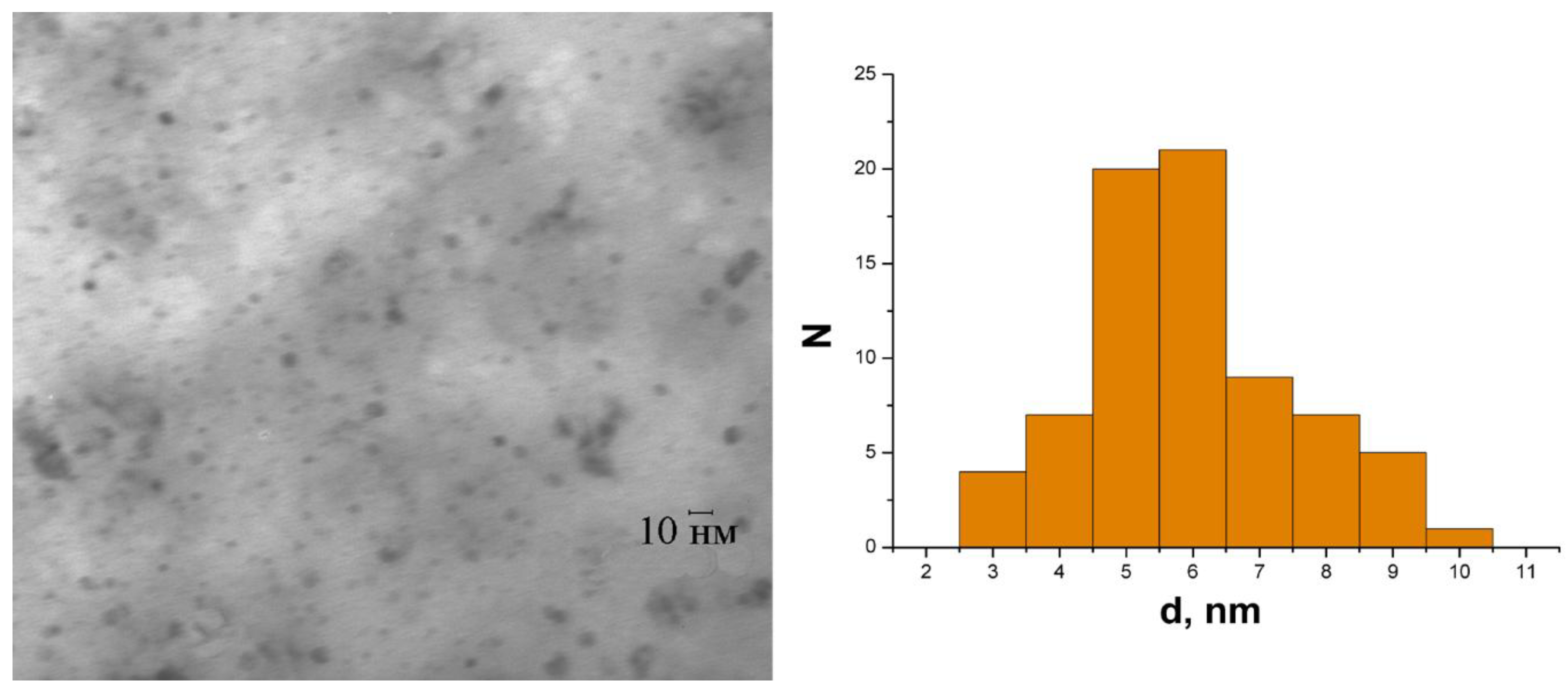
The morphology and size distribution of the synthesized Fe1−xMnx nanoparticles within the LDPE matrix were characterized using transmission electron microscopy (TEM). A representative TEM micrograph for sample 2 (Fe0.8Mn0.2) is presented in Figure 1, which is characteristic of both samples. The image reveals a homogeneous dispersion of quasi-spherical nanoparticles throughout the polymer matrix, with no evidence of large-scale agglomeration. This uniform distribution is attributed to the synthesis method in the polymer solution–melt, which effectively sterically stabilizes the nanoparticles and prevents their coalescence during formation.
Figure 1. Characteristic TEM image of Fe1−xMnx nanoparticles embedded in a polyethylene matrix, demonstrating their uniform dispersion and quasi-spherical morphology (left panel). The corresponding particle size distribution histogram, confirming an average particle size of 5–6 nm (right panel).
Statistical analysis of multiple such micrographs was performed to determine the particle size distribution, which is displayed in Figure 1. The histogram confirms a narrow size distribution for the nanoparticles. The measured particle diameters for both compositions, Fe0.9Mn0.1 and Fe0.8Mn0.2, fall within the range of 5 to 6 nm. The small and consistent particle size across both samples indicates that the variation in manganese content (from x = 0.1 to x = 0.2) does not significantly alter the nucleation and growth kinetics of the nanoparticles under the applied synthesis conditions. This well-defined nanoscale dimension is crucial for the subsequent structural analysis and is consistent with the high surface-to-volume ratio that promotes the core–shell formation driven by surface energy minimization.
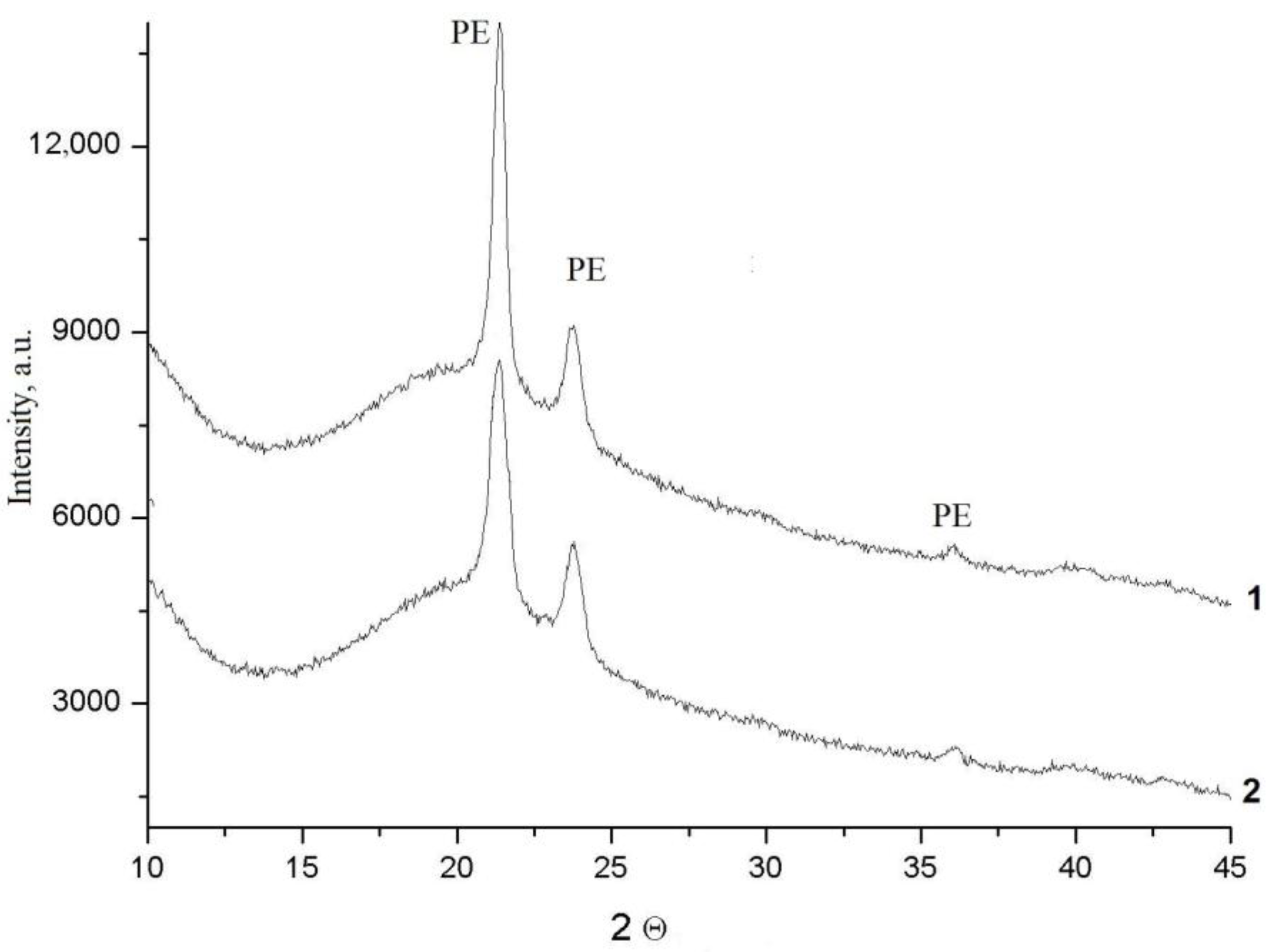
The diffractograms of samples 1 and 2 are shown in Figure 2. They exhibited only two intense reflections that are characteristic of LDPE and a weak peak above 36°, which can also be attributed to LDPE. Peaks that could be attributed to iron or manganese compounds are absent.
Figure 2. X-ray diffractograms of samples 1 (Fe0.9Mn0.1) and 2 (Fe0.8Mn0.2).
The absence of well-defined peaks corresponding to metal-containing phases in the diffractograms indicates the lack of distant atomic order in the iron- and manganese-containing phases of the investigated nanoparticles. Given this fact, further study of the iron and manganese phase structures that could be formed in the synthesized nanoparticles Fe0.9Mn0.1 and Fe0.8Mn0.2 was conducted by X-ray absorption spectroscopy.

3.1. Results of the Study of the Electron and Atomic State of Manganese Atoms in Composite Materials

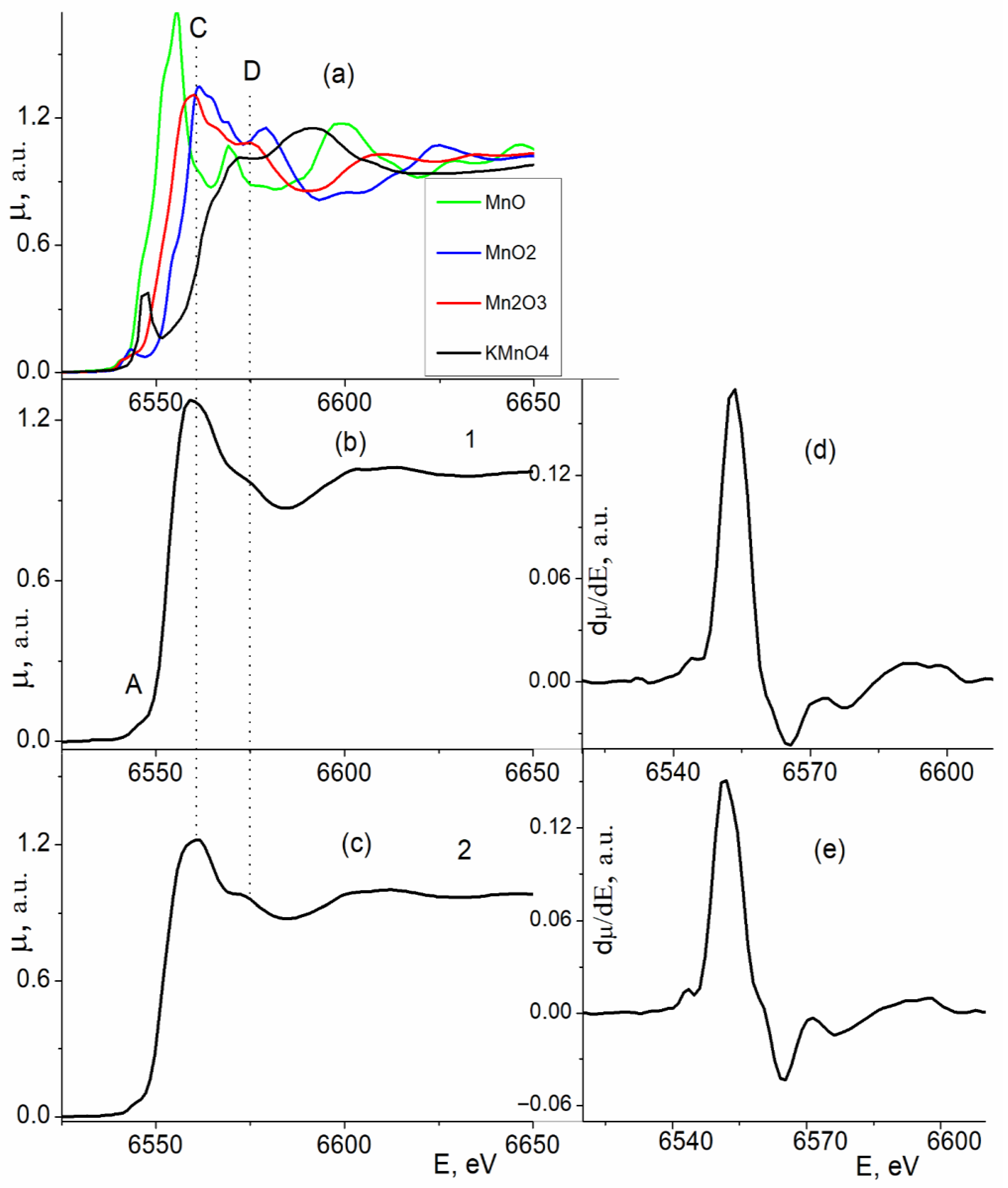
Figure 3a,c show the normalized XANES Mn K-edges for comparison samples: MnO, Mn2O3, MnO2, and KMnO4 (Figure 3a) and for examined samples 1 and 2 (Figure 3b and Figure 3c, respectively). The fine structure of XANES depends on the surrounding absorbing ion symmetry. As can be seen from Figure 3b,c, the pre-edge structure at the Mn K-edge (peak “A”) for the samples studied is practically absent, which indicates an almost symmetrical environment for manganese ions. The two main features on the XANES Mn K-edge spectra for both samples—the absorption maximums “C” and “D”—best coincide with the corresponding features of the XANES comparison sample Mn2O3. This result testifies that manganese ions in samples 1 and 2 have a geometry and atomic environment close to one of Mn2O3.
Figure 3. Normalized XANES Mn K-absorption edges: (a) Comparison samples MnO, Mn2O3, MnO2, and KMnO4; (b,c) samples 1 (Fe0.9Mn0.1) and 2 (Fe0.8Mn0.2), respectively; and (d,e) first derivatives dμ/dE for samples 1 and 2, respectively.
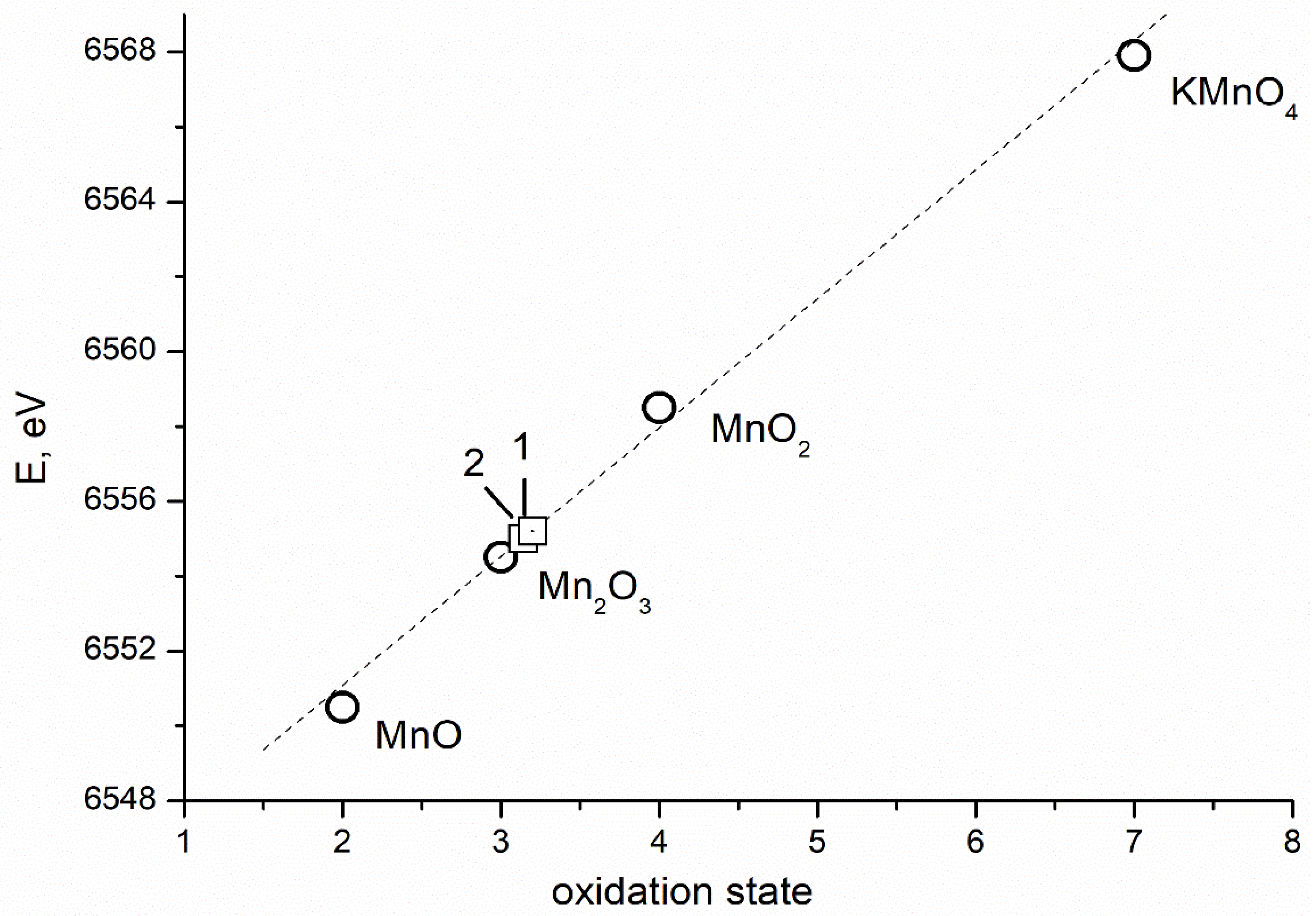
The energy position of the X-ray absorption edges depends on the charge of the absorbing ion by changing the degree of the electron levels shielding. As shown in Figure 3, when the manganese oxidation rate changes from +2 (MnO) to +7 (KMnO4), the Mn K-edge is shifted by about 14 eV, with this shift being almost linear depending on the degree of manganese ion oxidation (Figure 4).
Figure 4. Dependence of the energy position of Mn K-edge on the formal degree of oxidation for comparison samples MnO, Mn2O3, MnO2, and KMnO4. The energy positions of Mn K-edges of the studied samples 1 and 2 are plotted with squares (on the graph).
The energy positions of Mn K-edges in samples 1 and 2 were determined from the maxima of the first derivatives dμ/dE of these absorption edges (Figure 3d,e), which are marked with two squares. As visualized, the energy positions of Mn K-edges for samples 1 and 2 almost coincide with each other and with the energy position of the Mn K-edge of Mn2O3. This result allows us to conclude that the Mn ion in the researched nanoparticles Fe0.9Mn0.1 and Fe0.8Mn0.2 has an oxidation rate close to +3.
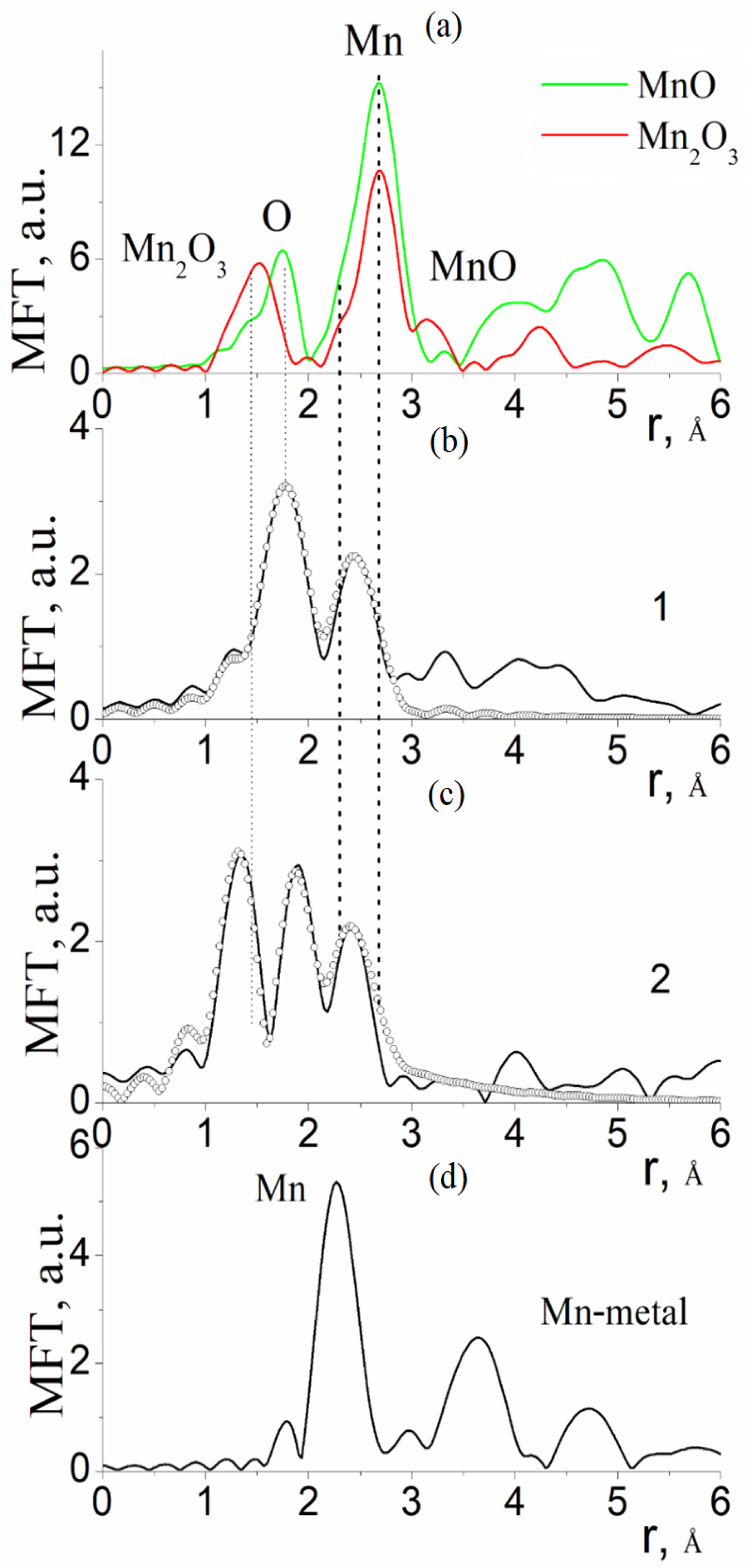
The quantitative characteristics of the local atomic environment of manganese ions in the Fe0.9Mn0.1 and Fe0.8Mn0.2 nanoparticles were determined through EXAFS analysis of the Mn K-edge absorption. The modulus of the Fourier transform (MFT) of the EXAFS spectra is presented in Figure 5, with reference samples of MnO, Mn2O3, and metallic Mn included for comparison.
Figure 5. EXAFS MFT of Mn K-edges: (a)—MnO, Mn2O3 comparison samples; (b)—sample 1 (Fe0.9Mn0.1), (c)—sample 2 (Fe0.8Mn0.2); and (d)—Mn–metal comparison sample. Solid line represents experiment; empty circles represent calculation.
The MFT spectra for both samples (Figure 5b,c) show a primary peak at low r (~1.5 Å, not corrected for phase shift), corresponding to the first coordination sphere of Mn–O bonds. The key difference between the samples is the presence of a second distinct peak in the spectrum of sample 2 (Fe0.8Mn0.2) at R ~ 2.4 Å. This peak is absent in sample 1 (Fe0.9Mn0.1). The position of this peak aligns well with the Mn–Mn distance in the reference Mn2O3 (Figure 5a), indicating a more ordered and crystalline-like local environment for manganese in sample 2. The presence of only one major peak beyond the Mn–O shell in sample 1 suggests a more disordered or highly defective structure, consistent with a fully oxidized nanoparticle where long-range order is diminished.
Notably, no peaks corresponding to metallic manganese were detected in the Mn K-edge EXAFS MFT of either composite, confirming the absence of a Mn metallic phase. The peak observed at r = 2.47 Å corresponds to Mn-Mn bonds in trivalent Mn2O3, which is consistent with the conclusions derived from the XANES analysis (Figure 3 and Figure 4).
The quantitative parameters of the local atomic environment of Mn ions, obtained by multi-shell EXAFS fitting, are summarized in Table 1. The coordination numbers (CN) for the nanoparticles are lower than those of the bulk crystalline references, which is consistent with their nanoscale dimensions and potential deviations in stoichiometry. Furthermore, an increase in manganese content leads to the appearance of multiple Mn-O distances in the first coordination shell, ranging from 1.90 to 2.43 Å (Table 1), reflecting a more complex local structure in the Fe0.8Mn0.2 nanoparticles.
Table 1. Structural data of the nearest atomic environment of Mn obtained by multi-sphere EXAFS fitting (CN—coordination numbers, R—interatomic distances, σ2—Debye–Waller factor, CS—coordination spheres, and Q—mismatch function).

3.2. Results of the Study of the Electron and Atomic State of Iron Atoms in Composite Materials

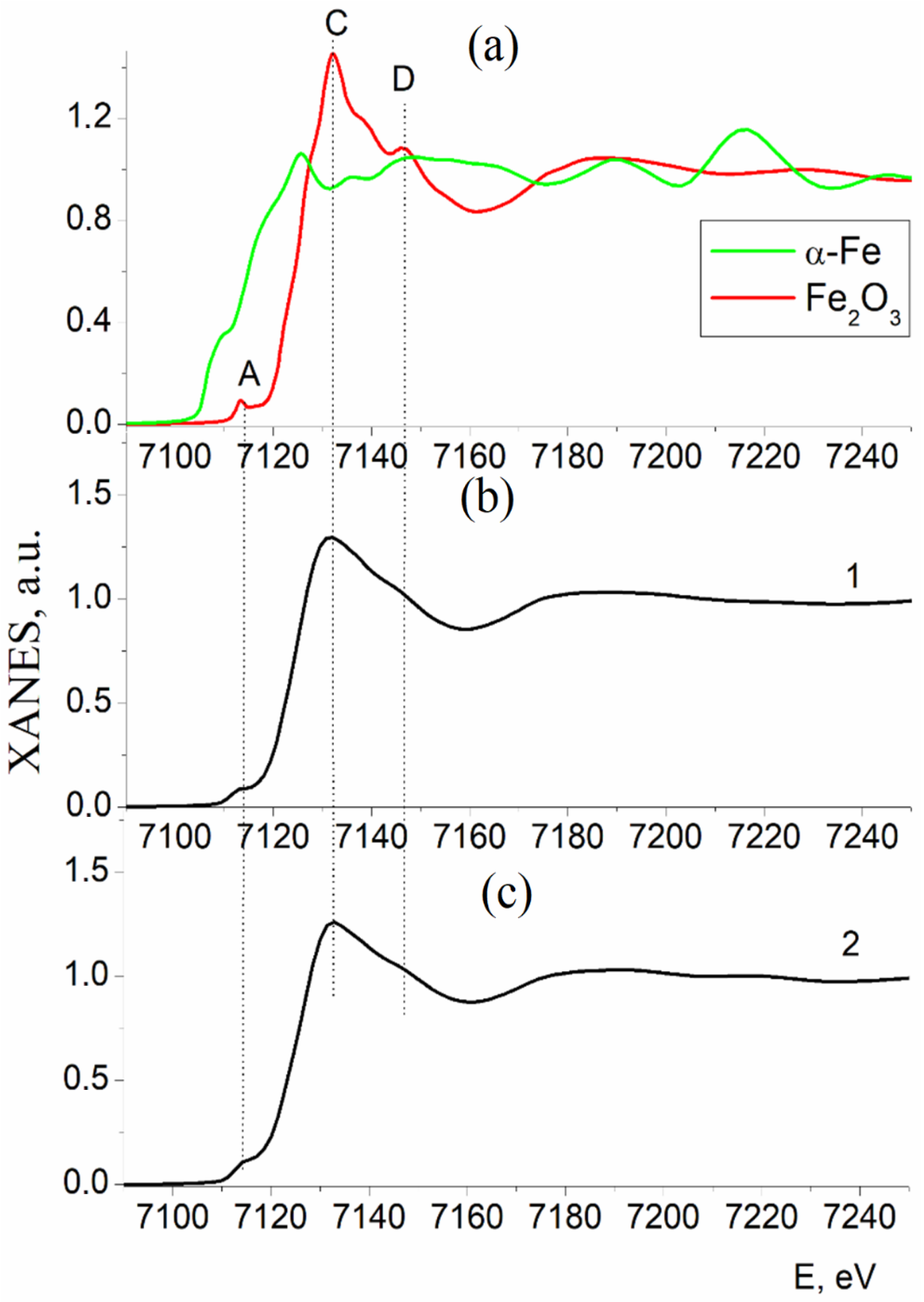
The normalized XANES Fe K-edge absorption spectra of the composites and reference samples (Fe2O3 and α-Fe) are presented in Figure 6.
Figure 6. Normalized XANES of Fe K-edges: (a)—for comparison samples Fe2O3, α-Fe; (b)—for sample 1 (Fe0.9Mn0.1); and (c)—for sample 2 (Fe0.8Mn0.2).
The energy positions of the pre-edge feature (peak “A”) and the main absorption maxima (“C” and “D”) in the Fe K-edge XANES spectra of both samples closely match those of the Fe2O3 reference. This indicates that the immediate coordination environment of the iron ions is characteristic of trivalent iron oxide.
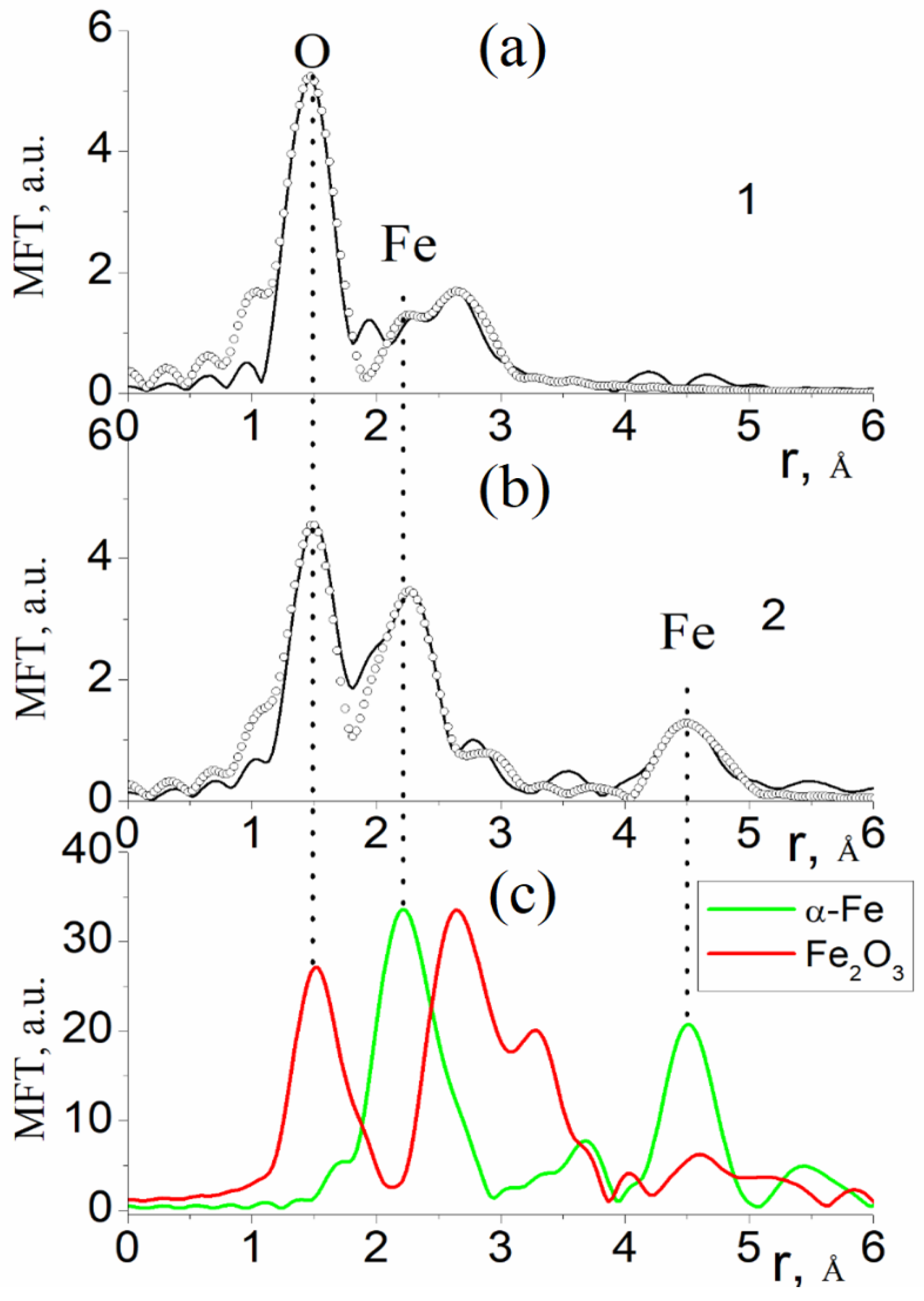
Quantitative analysis of the local atomic structure was performed via EXAFS spectroscopy. Figure 7 presents the modulus of the Fourier transform (MFT) of the Fe K-edge EXAFS spectra, and the corresponding fitting parameters are summarized in Table 2. The MFT spectra for both samples display a primary peak at r ≈ 1.45–1.46 Å, attributed to the first coordination sphere of Fe–O bonds, consistent with the Fe2O3 reference. A second peak at r ≈ 2.24 Å corresponds to the Fe–Fe distance in metallic α-Fe.
Figure 7. MFT EXAFS Fe K-edges: (a)—sample 1 (Fe0.9Mn0.1); (b)—sample 2 (Fe0.8Mn0.2); and (c)—comparison samples of Fe2O3, α-Fe. Solid line—experiment; empty circles—calculation.
Table 2. Structural data of the nearest atomic environment of Fe obtained by multi-sphere EXAFS fitting (CN—coordination numbers, R—interatomic distances, σ2—Debye–Waller factor, CS—coordination spheres, and Q—mismatch function).
Detailed fitting reveals critical structural differences. While the first coordination sphere in both samples exhibits Fe–O bonds with coordination numbers (CN) lower than in bulk Fe2O3, a stark contrast is observed in the metallic Fe–Fe coordination. The CN for the Fe–Fe metallic path in sample 1 (Fe0.9Mn0.1) is only 0.3, approximately four times lower than the value of 1.2 in sample 2 (Fe0.8Mn0.2). Furthermore, the Fe–Fe distances in the nanocomposites are elongated by 0.07–0.1 Å relative to bulk α-Fe, consistent with the finite-size effects in nanoparticles.
These quantitative EXAFS results provide direct structural evidence for the proposed concentration-dependent architectures. The negligible Fe–Fe metallic coordination in sample 1 confirms that these nanoparticles are nearly fully oxidized and lack a metallic core. In contrast, the significant metallic coordination in sample 2 unambiguously confirms the preservation of an α-Fe core. This finding strongly supports a three-layer core–shell model for sample 2, wherein a metallic iron core is encapsulated by an intermediate Fe2O3 layer and a surface Mn2O3 shell.
Thus, for samples 1 and 2 from the MFT EXAFS Fe K-edge research results, it has been determined that nanoparticles have a complex composition where iron atoms are mainly present as Fe2O3. However, it should be noted that the presence of α-Fe is also discovered in the nanoparticles’ composition. This result is original both for iron nanoparticles embedded in polymer matrices [37,42] and bimetallic nanoparticles within the LDPE matrices, such as Pt-Fe [7] or Co-Fe [8], where iron atoms formed a completely oxidized surface layer with a structure close to Fe2O3. For bimetallic nanoparticles in the Pt@Fe2O3 [7] or Co@Fe2O3 [8], it has been proven that nanoparticles with a «core-shell» structure are formed by iron atoms forming an oxide shell on their surface and thus preventing the oxidation of the atoms of platinum or cobalt that make the metal nucleus. In this work we investigated the bimetallic nanoparticles Mn-Fe of different compositions. Based on the results obtained, it can be assumed that both samples contain nanoparticles with a «core-shell» structure. In sample 1, nanoparticles have two components: Fe2O3 and Mn2O3; in sample 2, three components: α-Fe, Fe2O3, and Mn2O3.
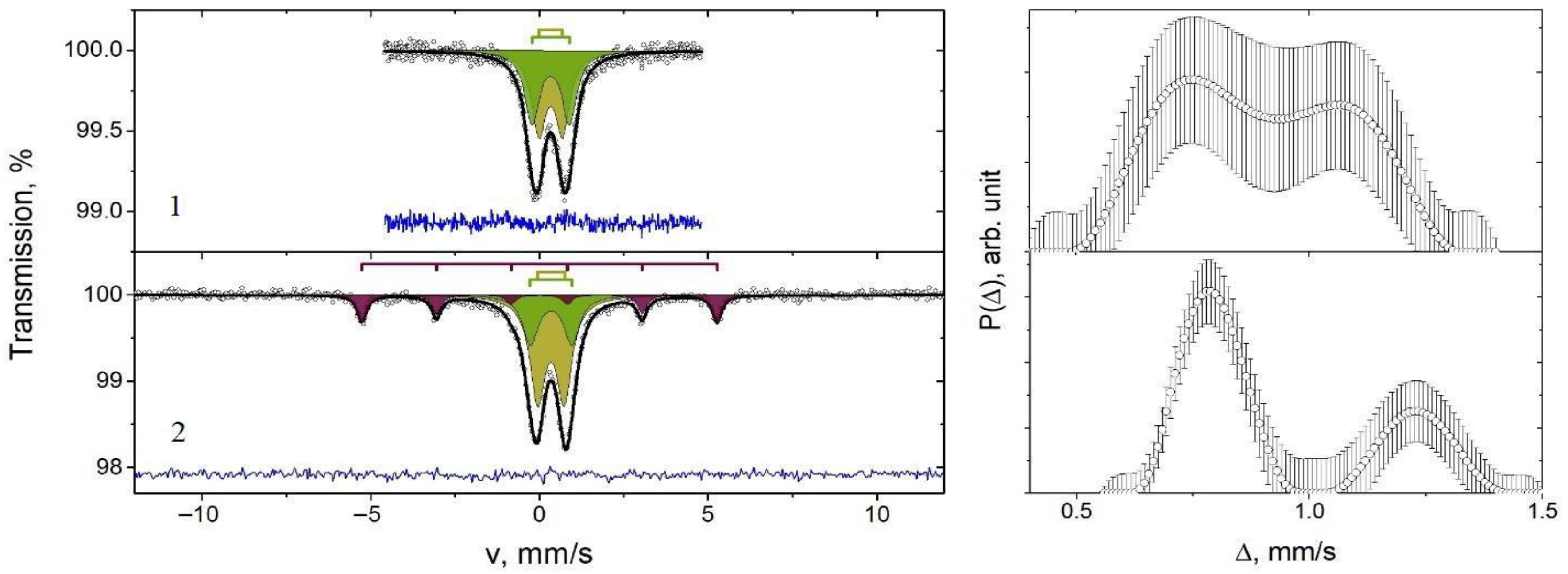
To determine the composition of the iron-containing phase in the samples, additional studies have been carried out by Mössbauer spectroscopy. The results of the Mössbauer spectroscopy studies provided information on the composition and dimension of iron-bearing phases. The Mössbauer spectra obtained at room temperature for samples 1 and 2 are shown in Figure 8, and their parameters are presented in Table 3.
Figure 8. Mössbauer spectra of samples 1 (Fe0.9Mn0.1) and 2 (Fe0.8Mn0.2). On the right, there are the distribution functions of P(Δ) for quadrupole splitting.
Table 3. Parameters of the Mössbauer spectra of samples 1 and 2.
Mössbauer’s spectrum of sample 1 (Fe0.9Mn0.1) is the sum of two doublets, and the spectrum of sample 2 (Fe0.8Mn0.2) is the superposition of the resonant lines of two types: two doublets and a sextet.
As can be seen from the data in Table 3, the results for sample 2 have parameters that correspond with great precision to the parameters of the α-Fe spectrum. The absence of such a parameter in the structure of the spectrum of sample 1 indicates an almost complete oxidation of iron, presumably due to the low concentration of manganese and the formation of a thinner surface protective layer from its oxide on the surface of the nanoparticles.
The observed room-temperature doublets for samples 1 and 2 of isomer shift δ = 0.34 mm/s correspond with high precision to the value of the isomer shift in trivalent iron for nanoparticles Fe2O3, embedded in LDPE [42,43]. The values of the quadrupole splitting Δ for D1 have a spread from 0.70 to 0.81 mm/s and for D2 from 1.11 to 1.23 mm/s. This parameter provides information about the asymmetry of the electric charge distribution around the iron nucleus. It is sensitive to the local chemical environment and crystal structure. These values of quadrupole splitting are typical for nanoparticles up to 10 nm in diameter. Moreover, the small difference in splits for D1 and D2 indicates the closeness of the nanoparticle sizes in the samples studied. The presence of a P(Δ) distribution (Figure 8) strongly suggests that the iron atoms in both samples do not have a single, unique environment. Instead, they experience a range of electric field gradients due to the random substitution of Fe atoms with Mn atoms.
With the values of isomeric shift and quadruple splitting we have already concluded that, in samples 1 and 2, the Fe2O3 phase is mainly present. The Fe2O3 phase content in Fe0.9Mn0.1 nanoparticles is found to be almost 100%, the Fe2O3 phase content in Fe0.8Mn0.2 nanoparticles is 83%, and the α-Fe phase content is 17% (see Table 3), which demonstrates the effect that manganese exerts on increase in the oxidation resistance of nanoscale iron. Similar approaches are used in metallurgy in the process of metal acidification [44,45,46].
The absence of the superfine magnetic field distribution function P(H) in the structure of the spectrum of sample 1 indicates the almost complete oxidation of iron in nanoparticles. This is probably due to the low concentration of manganese and the formation of a thin surface protective layer of its oxide, which does not prevent the atoms of iron from being completely oxidized. According to the structural data of the nearest atomic environment of Fe, obtained from EXAFS multi-sphere matching (Table 2), the CS of Fe-Fe in sample 1 is four times smaller than in sample 2. Therefore, if for nanoparticles in sample 2, according to Mössbauer spectroscopy results, the α-Fe phase content is about 17%, then for sample 1 it is less than 4%, according to EXAFS data. The determination of such a small α-Fe content in nanoparticles (concentration is less than 0.2 mass% in the sample) by Mössbauer spectroscopy is problematic and requires longer investigation, including some at negative temperatures.
Mössbauer spectroscopy results proved the presence of Fe2O3 in both types of samples. The α-Fe phase is present only in sample 2, which is nicely consistent with X-ray absorption spectroscopy data on the possible presence of at least two Fe-O and Fe-Fe CSs with characteristic distances for Fe2O3 and α-Fe in the nanoparticles.
Manganese atoms in nanoparticles exist in an oxidized state similar to Mn2O3. The presence of 17% α-Fe phase in Fe0.8Mn0.2 nanoparticles suggest that Fe-Mn nanoparticles have a three-layered structure. The nucleus of the particle consists of a metallic iron (α-Fe) followed by an iron oxide layer (Fe2O3) and then the surface layer of manganese oxide (Mn2O3).

4. Conclusions

A comprehensive study of LDPE-based composites containing Fe0.9Mn0.1 and Fe0.8Mn0.2 nanoparticles was conducted using X-ray diffraction, X-ray absorption spectroscopy, and Mössbauer spectroscopy. XRD results confirmed the X-ray amorphous nature of the nanoparticles, showing only the polyethylene phase.
The key finding reveals a concentration-dependent structure. Fe0.8Mn0.2 nanoparticles form a three-layered core–shell architecture with a metallic α-Fe core, an intermediate Fe2O3 layer, and an outer Mn2O3 shell. In contrast, Fe0.9Mn0.1 nanoparticles are almost fully oxidized to Fe2O3 and Mn2O3, lacking a metallic core. This validates the thermodynamic principle where manganese, with its higher oxide formation enthalpy (Mn2O3: 957.7 kJ/mol vs. Fe2O3: 822.7 kJ/mol), migrates to the surface. A sufficient Mn concentration is crucial to form a protective shell that prevents the complete oxidation of the iron core.
Beyond structural insights, this work demonstrates direct functional implications. The oxidation-resistant α-Fe core in Fe0.8Mn0.2 nanoparticles is promising for stable magnetic applications such as detection devices and data storage. Simultaneously, the surface Mn2O3 layer provides an optimized interface for catalytic uses in fuel cells or environmental catalysis. Moreover, nanoparticles can act as nucleating agents, potentially modifying the crystallization behavior and thus affecting the mechanical strength and thermal stability of the composite. The inorganic fillers could also enhance the barrier properties against gases and solvents. While a detailed investigation of these matrix-level effects was beyond the scope of this structural study, the successful integration and structural characterization of these functional nanoparticles provide a foundation for future research into tailoring the macroscopic properties of polyethylene-based composites.

Author Contributions

Conceptualization, G.Y.Y. and A.V.K.; methodology, G.Y.Y.; validation, A.V.K.; formal analysis, V.G.V.; investigation, V.G.V., A.V.M. and S.P.K.; resources, V.I.S.; data curation, G.Y.Y.; writing—original draft preparation, G.Y.Y. and A.V.M.; writing—review and editing, G.Y.Y. and A.V.M.; visualization, V.G.V. and V.E.K.; supervision, G.Y.Y.; project administration, G.Y.Y.; funding acquisition, A.V.K., A.V.M. and V.G.V. All authors have read and agreed to the published version of the manuscript.

Funding

The work was carried out within the framework of the State assignments of the Federal Research Center of Chemical Physics of the Russian Academy of Sciences (125012200641-2) and the Southern Federal University (FENW-2023-0014).

Data Availability Statement

The raw data supporting the conclusions of this article will be made available by the authors on request.

Acknowledgments

This work was carried out within the framework of the program of state support for the centers of the National Technology Initiative (NTI) basis on educational institutions of higher education and scientific organizations (NTI Center “Digital Materials Science: New Materials and Substances” Bauman Moscow State Technical University).

Conflicts of Interest

The authors declare that they have no conflicts of interest.

References

  1. Evgin, T.; Turgut, A.; Hamaoui, G.; Špitalský, Z.; Horny, N.; Altay, L.; Chirtoc, M.; Omastová, M. Size Effect of Hybrid Carbon Nanofillers on the Synergetic Enhancement of the Properties of HDPE-Based Nanocomposites. Nanotechnology 2021, 32, 315704. [Google Scholar] [CrossRef] [PubMed]
  2. Anto, T.; Rejeesh, C.R. Synthesis and Characterization of Recycled HDPE Polymer Composite Reinforced with Nano-Alumina Particles. Mater. Today Proc. 2023, 72, 3177–3182. [Google Scholar] [CrossRef]
  3. Makowiec, M.E.; Gionta, G.L.; Bhargava, S.; Ozisik, R.; Blanchet, T.A. Wear Resistance Effects of Alumina and Carbon Nanoscale Fillers in PFA, FEP, and HDPE Polymers. Wear 2022, 502–503, 204376. [Google Scholar] [CrossRef]
  4. Demirors, M. The History of Polyethylene. In 100+ Years of Plastics. Leo Baekeland and Beyond; ACS Symposium Series; American Chemical Society: Washington, DC, USA, 2011; Volume 1080, pp. 115–145. ISBN 978-0-8412-2677-7. [Google Scholar]
  5. Yurkov, G.Y.; Kozinkin, A.V.; Kubrin, S.P.; Zhukov, A.M.; Podsukhina, S.S.; Vlasenko, V.G.; Fionov, A.S.; Kolesov, V.V.; Zvyagintsev, D.A.; Vyatkina, M.A.; et al. Nanocomposites Based on Polyethylene and Nickel Ferrite: Preparation, Characterization, and Properties. Polymers 2023, 15, 3988. [Google Scholar] [CrossRef]
  6. Tanase, M.; Nuhfer, N.T.; Laughlin, D.E.; Klemmer, T.J.; Liu, C.; Shukla, N.; Wu, X.; Weller, D. Crystallographic Ordering Studies of FePt Nanoparticles by HREM. J. Magn. Magn. Mater. 2003, 266, 215–226. [Google Scholar] [CrossRef]
  7. Yurkov, G.Y.; Biryukova, M.I.; Koksharov, Y.A.; Pankratov, D.A.; Kozinkin, A.V.; Vlasenko, V.G.; Ovchenkov, E.A.; Chursova, L.V.; Bouznik, V.M. Synthesis and structure of composite materials based on low density polyethylene and Pt@Fe2O3 nanoparticles. Perspekt. Mater. 2013, 6, 51–62. (In Russian) [Google Scholar]
  8. Yurkov, G.Y.; Kozinkin, A.V.; Shvachko, O.V.; Kubrin, S.P.; Ovchenkov, E.A.; Korobov, M.S.; Kirillov, V.E.; Osipkov, A.S.; Makeev, M.O.; Ryzhenko, D.S.; et al. One-Step Synthesis of Composite Materials Based on Polytetrafluoroethylene Microgranules and Co@Fe2O3-FeF2 Nanoparticles. J. Appl. Polym. Sci. 2022, 139, e52890. [Google Scholar] [CrossRef]
  9. Baskakov, A.O.; Solov’eva, A.Y.; Ioni, Y.V.; Starchikov, S.S.; Lyubutin, I.S.; Khodos, I.I.; Avilov, A.S.; Gubin, S.P. Magnetic and Interface Properties of the Core-Shell Fe3O4/Au Nanocomposites. Appl. Surf. Sci. 2017, 422, 638–644. [Google Scholar] [CrossRef]
  10. Sokolov, A.E.; Ivanova, O.S.; Fedorov, A.S.; Kovaleva, E.A.; Vysotin, M.A.; Lin, C.-R.; Ovchinnikov, S.G. Why the Magnetite–Gold Core–Shell Nanoparticles Are Not Quite Good and How to Improve Them. Phys. Solid State 2021, 63, 1536–1540. [Google Scholar] [CrossRef]
  11. Konicki, W.; Sibera, D.; Narkiewicz, U. Adsorption of Acid Red 88 Anionic Dye from Aqueous Solution onto ZnO/ZnMn2O4 Nanocomposite: Equilibrium, Kinetics, and Thermodynamics. Pol. J. Environ. Stud. 2017, 26, 2585–2593. [Google Scholar] [CrossRef]
  12. Radovanović, L.; Radovanović, Ž.; Simović, B.; Vasić, M.V.; Balanč, B.; Dapčević, A.; Dramićanin, M.; Rogan, J. Structure and Properties of ZnO/ZnMn2O4 Composite Obtained by Thermal Decomposition of Terephthalate Precursor. J. Serbian Chem. Soc. 2023, 88, 313–325. [Google Scholar] [CrossRef]
  13. Muratov, D.G.; Kozhitov, L.V.; Kazaryan, T.M.; Vasil’ev, A.A.; Popkova, A.V.; Korovin, E.Y. Synthesis and Electromagnetic Properties of FeCoNi/C Nanocomposites Based on Polyvinyl Alcohol. Russ. Microelectron. 2021, 50, 657–664. [Google Scholar] [CrossRef]
  14. Muratov, D.G.; Kozhitov, L.V.; Yakushko, E.V.; Vasilev, A.A.; Popkova, A.V.; Tarala, V.A.; Korovin, E.Y. Synthesis, Structure and Electromagnetic Properties of FeCoAl/C Nanocomposites. Mod. Electron. Mater. 2021, 7, 99–108. [Google Scholar] [CrossRef]
  15. Sayed, M.A.; El-Rahman, T.M.A.A.; Abdelsalam, H.K.; El-Souad, S.M.S.A.; Shady, R.M.; Amen, R.A.; Zaki, M.A.; Mohsen, M.; Desouky, S.; Saeed, S.; et al. Biosynthesis of Silver, Copper, and Their Bi-Metallic Combination of Nanocomposites by Staphylococcus Aureus: Their Antimicrobial, Anticancer Activity, and Cytotoxicity Effect. Indian J. Microbiol. 2024, 64, 1721–1737. [Google Scholar] [CrossRef]
  16. Shinde, R.S.; Khairnar, S.D.; Patil, M.R.; Adole, V.A.; Koli, P.B.; Deshmane, V.V.; Halwar, D.K.; Shinde, R.A.; Pawar, T.B.; Jagdale, B.S.; et al. Synthesis and Characterization of ZnO/CuO Nanocomposites as an Effective Photocatalyst and Gas Sensor for Environmental Remediation. J. Inorg. Organomet. Polym. Mater. 2022, 32, 1045–1066. [Google Scholar] [CrossRef]
  17. Zelekew, O.A.; Fufa, P.A.; Sabir, F.K.; Duma, A.D. Water Hyacinth Plant Extract Mediated Green Synthesis of Cr2O3/ZnO Composite Photocatalyst for the Degradation of Organic Dye. Heliyon 2021, 7, e07652. [Google Scholar] [CrossRef]
  18. Angotzi, M.S.; Mameli, V.; Cara, C.; Peddis, D.; Xin, H.L.; Sangregorio, C.; Laura Mercuri, M.; Cannas, C. On the Synthesis of Bi-Magnetic Manganese Ferrite-Based Core–Shell Nanoparticles. Nanoscale Adv. 2021, 3, 1612–1623. [Google Scholar] [CrossRef]
  19. Chen, J.; He, F.; Zhang, H.; Zhang, X.; Zhang, G.; Yuan, G. Novel Core–Shell Structured Mn–Fe/MnO2 Magnetic Nanoparticles for Enhanced Pb(II) Removal from Aqueous Solution. Ind. Eng. Chem. Res. 2014, 53, 18481–18488. [Google Scholar] [CrossRef]
  20. García-Soriano, D.; Milán-Rois, P.; Lafuente-Gómez, N.; Navío, C.; Gutiérrez, L.; Cussó, L.; Desco, M.; Calle, D.; Somoza, Á.; Salas, G. Iron Oxide-Manganese Oxide Nanoparticles with Tunable Morphology and Switchable MRI Contrast Mode Triggered by Intracellular Conditions. J. Colloid Interface Sci. 2022, 613, 447–460. [Google Scholar] [CrossRef]
  21. Ullrich, A.; Rahman, M.M.; Longo, P.; Horn, S. Synthesis and High-Resolution Structural and Chemical Analysis of Iron-Manganese-Oxide Core-Shell Nanocubes. Sci. Rep. 2019, 9, 19264. [Google Scholar] [CrossRef]
  22. Rybaltovskij, A.A.; Zavorotnyj, Y.S.; Epifanov, E.O.; Shubny, A.; Yusupov, V.I.; Minaev, N.G.; Hmelenin, D.N. Two Approaches to the Laser-induced Formation of Au/Ag Bimetallic Nanoparticles in Supercritical Carbon Dioxide. Nanomaterials 2021, 11, 1553. [Google Scholar] [CrossRef]
  23. Borisov, R.V.; Belousov, O.V.; Zhizhaev, A.M.; Lihackij, M.N.; Belousova, N.V. Synthesis of Bimetallic Nanoparticles Pd-Au and Pt-Au on Carbon Nanotubes in an Autoclave. Russ. Chem. Bull. 2021, 70, 1474–1482. [Google Scholar] [CrossRef]
  24. Pervikov, A.V.; Lozhkomoev, A.S.; Bakina, O.V.; Lerner, M.I. Formation of Structural-Phase States in Ag–Cu Bimetallic Nanoparticles Produced By Electrical Explosion of Wires. Russ. Phys. J. 2021, 63, 1557–1561. [Google Scholar] [CrossRef]
  25. Batsalova, T.; Vasil’kov, A.; Moten, D.; Voronova, A.; Teneva, I.; Naumkin, A.; Dzhambazov, B. Bimetallic Gold–Iron Oxide Nanoparticles as Carriers of Methotrexate: Perspective Tools for Biomedical Applications. Appl. Sci. 2023, 13, 12894. [Google Scholar] [CrossRef]
  26. Pietrzak, M.; Ivanova, P. Bimetallic and Multimetallic Nanoparticles as Nanozymes. Sens. Actuators B Chem. 2021, 336, 129736. [Google Scholar] [CrossRef]
  27. Manohar, A.; Vijayakanth, V.; Vattikuti, S.V.P.; Kim, K.H. A Mini-Review on AFe2O4 (A = Zn, Mg, Mn, Co, Cu, and Ni) Nanoparticles: Photocatalytic, Magnetic Hyperthermia and Cytotoxicity Study. Mater. Chem. Phys. 2022, 286, 126117. [Google Scholar] [CrossRef]
  28. Kefeni, K.K.; Msagati, T.A.M.; Mamba, B.B. Ferrite Nanoparticles: Synthesis, Characterization and Applications in Electronic Device. Mater. Sci. Eng. B 2017, 215, 37–55. [Google Scholar] [CrossRef]
  29. Amiri, M.; Eskandari, K.; Salavati-Niasari, M. Magnetically Retrievable Ferrite Nanoparticles in the Catalysis Application. Adv. Colloid Interface Sci. 2019, 271, 101982. [Google Scholar] [CrossRef]
  30. Amiri, M.; Salavati-Niasari, M.; Akbari, A. Magnetic Nanocarriers: Evolution of Spinel Ferrites for Medical Applications. Adv. Colloid Interface Sci. 2019, 265, 29–44. [Google Scholar] [CrossRef]
  31. Kozakov, A.T.; Kolesnikov, V.I.; Sidashov, A.V.; Guglev, K.A. Study of the Segregation Phenomena on the Surface of Binary Alloys and Steels in Oxygen Environment. Bull. Russ. Acad. Sci. Phys. 2009, 73, 690–693. [Google Scholar] [CrossRef]
  32. Kozakov, A.T.; Kolesnikov, V.I.; Sidashov, A.V.; Nikol’skii, A.V. Peculiarities of Segregation Phenomena at the Surface of PdxV1−x alloys in an Oxygen Medium. J. Surf. Investig. 2007, 1, 443–449. [Google Scholar] [CrossRef]
  33. Sidashov, A.V.; Kozakov, A.T.; Yares’ko, S.I.; Manturov, D.S.; Marunevich, O.V. Effect of Nd: YAG Pulsed Laser Radiation on Oxidation and Segregation Processes in the Surface Layers of T8 High Speed Tool Steel: Tribological Consequences. Appl. Surf. Sci. 2021, 564, 150434. [Google Scholar] [CrossRef]
  34. Samsonov, G.V. The Oxide Handbook; Springer Science & Business Media: New York, NY, USA, 2013; ISBN 978-1-4615-9597-7. [Google Scholar]
  35. Koksharov, Y.A.; Yurkov, G.Y.; Baranov, D.A.; Malakho, A.P.; Polyakov, S.N.; Gubin, S.P. Electron Magnetic Resonance Spectra of Fe1−xMnx Amorphous Nanoparticles. Phys. Solid State 2006, 48, 940–947. [Google Scholar] [CrossRef]
  36. Gubin, S.P.; Yurkov, G.Y.; Kosobudsky, I.D. Nanomaterials Based on Metal-Containing Nanoparticles in Polyethylene and Other Carbon-Chain Polymers. Int. J. Mater. Prod. Technol. 2005, 23, 2–25. [Google Scholar] [CrossRef]
  37. Zhukov, A.M.; Solodilov, V.I.; Tretyakov, I.V.; Burakova, E.A.; Yurkov, G.Y. The Effect of the Structure of Iron-Containing Nanoparticles on the Functional Properties of Composite Materials Based on High-Density Polyethylene. Russ. J. Phys. Chem. B 2022, 16, 926–932. [Google Scholar] [CrossRef]
  38. Bunker, G. Introduction to XAFS: A Practical Guide to X-Ray Absorption Fine Structure Spectroscopy; Cambridge University Press: Cambridge, UK, 2010. [Google Scholar]
  39. Newville, M. EXAFS Analysis Using FEFF and FEFFIT. J. Synchrotron Radiat. 2001, 8, 96–100. [Google Scholar] [CrossRef]
  40. Zabinsky, S.I.; Rehr, J.J.; Ankudinov, A.; Albers, R.C.; Eller, M.J. Multiple-Scattering Calculations of x-Ray-Absorption Spectra. Phys. Rev. B 1995, 52, 2995–3009. [Google Scholar] [CrossRef]
  41. Matsnev, M.E.; Rusakov, V.S. SpectrRelax: An Application for Mössbauer Spectra Modeling and Fitting. AIP Conf. Proc. 2012, 1489, 178–185. [Google Scholar] [CrossRef]
  42. Yurkov, G.Y.; Fionov, A.S.; Kozinkin, A.V.; Koksharov, Y.A.; Ovtchenkov, Y.A.; Pankratov, D.A.; Popkov, O.V.; Vlasenko, V.G.; Kozinkin, Y.A.; Biryukova, M.I.; et al. Synthesis and Physicochemical Properties of Composites for Electromagnetic Shielding Applications: A Polymeric Matrix Impregnated with Iron- or Cobalt-Containing Nanoparticles. J. Nanophotonics 2012, 6, 061717. [Google Scholar] [CrossRef]
  43. Yurkov, G.Y.; Gubin, S.P.; Pankratov, D.A.; Koksharov, Y.A.; Kozinkin, A.V.; Spichkin, Y.I.; Nedoseikina, T.I.; Pirog, I.V.; Vlasenko, V.G. Iron(III) Oxide Nanoparticles in a Polyethylene Matrix. Inorg. Mater. 2002, 38, 137–145. [Google Scholar] [CrossRef]
  44. Song, T.; Wang, Z.; Bao, Y.; Gu, C.; Zhang, Z. Effect of Silicon–Manganese Deoxidation on Oxygen Content and Inclusions in Molten Steel. Processes 2024, 12, 767. [Google Scholar] [CrossRef]
  45. Jackson, P.R.S.; Wallwork, G.R. High Temperature Oxidation of Iron-Manganese-Aluminum Based Alloys. Oxid. Met. 1984, 21, 135–170. [Google Scholar] [CrossRef]
  46. Craddock, P.T. The Many and Various Roles of Manganese in Iron and Steel Production. Mater. Sci. Forum 2020, 983, 57–63. [Google Scholar] [CrossRef]
Disclaimer/Publisher’s Note: The statements, opinions and data contained in all publications are solely those of the individual author(s) and contributor(s) and not of MDPI and/or the editor(s). MDPI and/or the editor(s) disclaim responsibility for any injury to people or property resulting from any ideas, methods, instructions or products referred to in the content.

Article Metrics

Citations

Article Access Statistics

Article metric data becomes available approximately 24 hours after publication online.