Article

Electronic Structure Modulation in Sulfur-Doped g-C3N4 Quantum Dots for Enhanced NO2 Sensing

by
Kriengkri Timsorn
1,
Yaowapa Saengpayab
2,3 and
Chatchawal Wongchoosuk
4,*
1
Division of Physics, Faculty of Science and Technology, Phetchabun Rajabhat University, Phetchabun 67000, Thailand
2
Applied Physics Program, Faculty of Science and Technology, Valaya Alongkorn Rajabhat University Under the Royal Patronage, Pathum Thani 13180, Thailand
3
Mechatronics and Electric Vehicle Engineering Program, Faculty of Industrial Technology, Valaya Alongkorn Rajabhat University Under the Royal Patronage, Pathum Thani 13180, Thailand
4
Department of Physics, Faculty of Science, Kasetsart University, Chatuchak, Bangkok 10900, Thailand
*
Author to whom correspondence should be addressed.
J. Compos. Sci. 2026, 10(7), 370; https://doi.org/10.3390/jcs10070370
Submission received: 12 June 2026 / Revised: 3 July 2026 / Accepted: 7 July 2026 / Published: 11 July 2026

Abstract

This study explores the adsorption behavior of NO2, NO, and N2O gas molecules on pristine and sulfur-doped g-C3N4 quantum dots using the self-consistent charge density functional tight-binding (SCC-DFTB) method. Sulfur doping at the energetically favorable N-ring site significantly alters the electronic structure, reducing the band gap from 3.58 eV to 1.37 eV and increasing the density of states near the Fermi level. Adsorption analysis reveals that pristine g-C3N4 exhibits weak physisorption toward all gases, whereas S/g-C3N4 demonstrates a transition from physisorption to strong chemisorption, especially for NO2, with adsorption energies as high as −3.543 eV. This strong interaction is associated with significant charge transfer and pronounced band gap narrowing to as low as 0.46 eV. Density of states analysis confirms the formation of hybridized electronic states near the Fermi level, which facilitates enhanced charge transfer and conductivity modulation. Among the studied gases, NO2 shows the most significant electronic response, while NO exhibits moderate interaction and N2O remains weakly adsorbed with negligible electronic perturbation. These findings indicate that sulfur doping plays a critical role in inducing electronic structure modulation and enables highly sensitive and selective NO2 detection in g-C3N4 quantum dots.

1. Introduction

Air pollution caused by nitrogen oxide gases remains a major environmental and public health issue worldwide. Among these pollutants, nitrogen dioxide (NO2), nitric oxide (NO), and nitrous oxide (N2O) are particularly important because of their interconnected roles in atmospheric chemistry. NO2 and NO are key contributors to photochemical smog, acid rain, and respiratory illnesses, while N2O is a powerful greenhouse gas with a long atmospheric lifespan and significant global warming potential [1,2,3]. Ongoing emissions from industrial processes, vehicle exhaust, and agriculture have led to rising levels of these gases, emphasizing the need for effective detection and control strategies. Effective monitoring of these gases is crucial for air quality management, environmental regulation, and early warning systems. Gas sensors offer several advantages, including real-time response, portability, low power consumption, and easy integration into compact platforms, making them highly suitable for on-site and continuous environmental monitoring [4,5,6]. However, sensor performance is strongly dependent on the sensing materials, particularly their surface reactivity, electronic sensitivity, and selectivity toward target gas molecules [7,8]. Therefore, the development of advanced sensing materials with tunable electronic properties remains an active area of research.
Graphitic carbon nitride (g-C3N4) has attracted significant attention as a functional material for environmental and sensing applications due to its metal-free composition, chemical stability, and tunable electronic structure [9,10,11,12,13]. As a two-dimensional conjugated polymer composed of carbon and nitrogen atoms, g-C3N4 exhibits low cost, ease of synthesis, and tunable surface chemistry, making it suitable for a wide range of applications, including photocatalysis, optoelectronics, and sensing of gaseous pollutants [9,14,15,16,17,18]. Recently, research interest has grown in zero-dimensional g-C3N4 quantum dots (g-C3N4 QDs), which exhibit significant quantum confinement effects, larger surface-to-volume ratios, and improved electronic sensitivity compared to their bulk materials [18,19,20,21]. For gas-sensing applications, these characteristics significantly enhance gas–surface interactions and amplify electronic responses upon adsorption [22]. Furthermore, heteroatom doping has emerged as an effective strategy to further improve the sensing characteristics of g-C3N4 [20]. In particular, sulfur doping has been shown to modify the electronic structure of g-C3N4 by introducing defect states, redistributing charge density, and narrowing the band gap [23]. Although sulfur-doped g-C3N4 has been studied in photocatalysis [23,24,25], systematic theoretical investigations of sulfur-doped g-C3N4 quantum dots for detecting gaseous pollutants remain limited.
From a theoretical perspective, density functional theory (DFT) calculations offer valuable insights into the interactions between molecules and surfaces. These calculations enable the evaluation of important descriptors such as adsorption energy, molecular orbitals, variations in the band gap, and the density of states (DOS) [26,27,28,29,30]. These factors are closely related to the mechanisms behind gas-sensing responses. Density functional tight-binding (DFTB) is a semi-empirical approximation to DFT that expands the total energy around a reference electron density, thereby significantly reducing computational cost while retaining key electronic structure information [31,32,33]. In particular, the self-consistent charge formulation (SCC) incorporates charge redistribution effects, enabling more reliable descriptions of polar and adsorbed systems compared to non-self-consistent schemes [32]. Owing to its efficiency, the self-consistent charge density functional tight-binding (SCC-DFTB) is typically 2–3 orders of magnitude faster than conventional DFT methods, allowing simulations of large-scale systems while maintaining reasonable accuracy for geometries, adsorption energies, and electronic structures [34,35]. Benchmark studies have confirmed that SCC-DFTB can reproduce optimized structures, adsorption trends, charge transfer behavior, and electronic properties such as HOMO-LUMO gaps and DOS in good agreement with full DFT calculations, when appropriate parameter sets are used, for molecular adsorption and low-dimensional materials [33,36,37,38,39].
In this study, we investigate the adsorption behavior of NO2, NO, and N2O on sulfur-doped g-C3N4 quantum dots using SCC-DFTB. We examine multiple adsorption sites and molecular orientations to identify the most stable configurations. We systematically analyze key parameters related to sensing, including adsorption energy, charge transfer, HOMO-LUMO energy levels, band gap variations, and DOS. The results provide crucial insights into how sulfur doping affects gas–surface interactions, offering theoretical guidance for designing high-performance g-C3N4 quantum dot-based gas-sensing materials.

2. Computational Methods

All calculations and optimizations in this study were performed using the SCC-DFTB method, as implemented in the DFTB+ 24.1 computational package. This approach facilitates the efficient modeling of large quantum mechanical systems. Models of both pristine and sulfur-doped g-C3N4 quantum dots (g-C3N4 and S/g-C3N4) were constructed based on a 3 × 3 triazine unit cell, resulting in finite clusters with hydrogen-saturated edge atoms to eliminate any dangling bonds. The 3ob-3-1 Slater–Koster parameter set was used to describe the electronic interactions between atoms, which is suitable for systems containing C, N, O, H, and S atoms [40]. To determine the most stable site for sulfur doping, two doping positions were analyzed: one in which the sulfur atom replaced a ring nitrogen atom (N-ring, site 1 in Figure 1a) and another where it substituted a bridge nitrogen atom (N-bridge). The thermodynamic stability of each doping configuration was evaluated by calculating its formation energy. The formation energy (Eform) [23,25] is defined as follows:
Eform = E(S/g-C3N4) − E(g-C3N4) − µ(S) − µ(N)
where E(S/g-C3N4) and E(g-C3N4) represent the total energies of sulfur-doped and pristine g-C3N4 quantum dot systems, respectively. µ(S) and µ(N) denote the chemical potentials of single sulfur and nitrogen atoms, respectively. It is important to note that µ(S) or µ(N) is the energy per nitrogen or sulfur atom in its reference phase (N2 gas is the reference phase for the nitrogen atom). The structure with the lowest formation energy was chosen for further adsorption studies. From this analysis, the calculated Eform values for the N-ring and N-bridge doping sites were −2.75 eV and −0.81 eV, respectively. This result indicates that the N-ring doping site is more stable than the N-bridge doping site, which is consistent with theoretical and experimental studies [23,41]. Thus, the N-ring doping site was used as the representative sulfur-doped g-C3N4 quantum dot model in this work.
Nitrogen oxide gases, including NO2, NO, and N2O, were investigated to study their adsorption behaviors on g-C3N4 and S/g-C3N4 quantum dots. They were separately optimized in their isolated states before adsorption calculations. For gas adsorption studies, each gas molecule was initially positioned above the quantum dot surfaces at three different active sites (sites 1, 2, and 3, as shown in Figure 1) at various distances. At site 1, the gas molecules were positioned above either the nitrogen atom (in the g-C3N4 structure) or the sulfur atom (in the S/g-C3N4 structure). The molecules were oriented in three ways relative to the nitrogen or sulfur atom: vertically, tilted at 45 degrees, or parallel. At sites 2 (the hollow site) and 3 (the interstitial site), the gas molecules were oriented either vertically or parallel to the structure. All adsorption systems were fully optimized using the same convergence criteria as for the isolated structures. The most stable adsorption configuration between the structures and the gas molecules was identified based on the adsorption energies. The adsorption energy (Ed) was calculated according to:
E d = E t o t ( s t r u c t u r e + g a s   m o l e c u l e ) E t o t ( s t r u c t u r e ) E t o t ( g a s   m o l e c u l e )
where Etot (structure + gas molecule) is the total energy of the gas molecules adsorbed on g-C3N4 or S/g-C3N4 quantum dot systems. Etot (structure) and Etot (gas molecule) are the total energies of the isolated g-C3N4 or S/g-C3N4 quantum dot systems, and the isolated gas molecules, respectively. Negative adsorption energy values indicate energetically favorable adsorption.
To investigate charge transfer between gas molecules and quantum dots, the net charge transfer is defined as the difference in charge of the gas molecules before and after adsorption [38,42]. This approach facilitates a quantitative assessment of electron donation or acceptance during the adsorption process. The net charge transfer (Q) was determined using Equation (3):
Q = Q (structure + gas molecule) − Q (gas molecule)
where Q (structure + gas molecule) and Q (gas molecule) are the charges of gas molecules adsorbed on the quantum dot structures and the isolated gas molecules, respectively. The sign of the charge transfer provides direct insight into the donor–acceptor behavior of the adsorbed species: a positive value of Q (Q > 0) indicates electron transfer from the gas molecules to the quantum dots, corresponding to donor behavior of the gas molecules. Conversely, a negative value (Q < 0) signifies electron transfer from the quantum dots to the gas molecules, indicating acceptor behavior [43]. In addition, the electronic properties of the systems were further examined, including the highest occupied molecular orbital (HOMO), lowest unoccupied molecular orbital (LUMO), DOS, and the corresponding band gap variations induced by sulfur doping and gas adsorption. The energy gap (Eg) was calculated using
E g = E L U M O E H O M O
where ELUMO and EHOMO are the energy levels of LUMO and HOMO orbitals, respectively.

3. Results and Discussion

3.1. Optimized Structures and Electronic Properties of g-C3N4 and S/g-C3N4 Quantum Dots

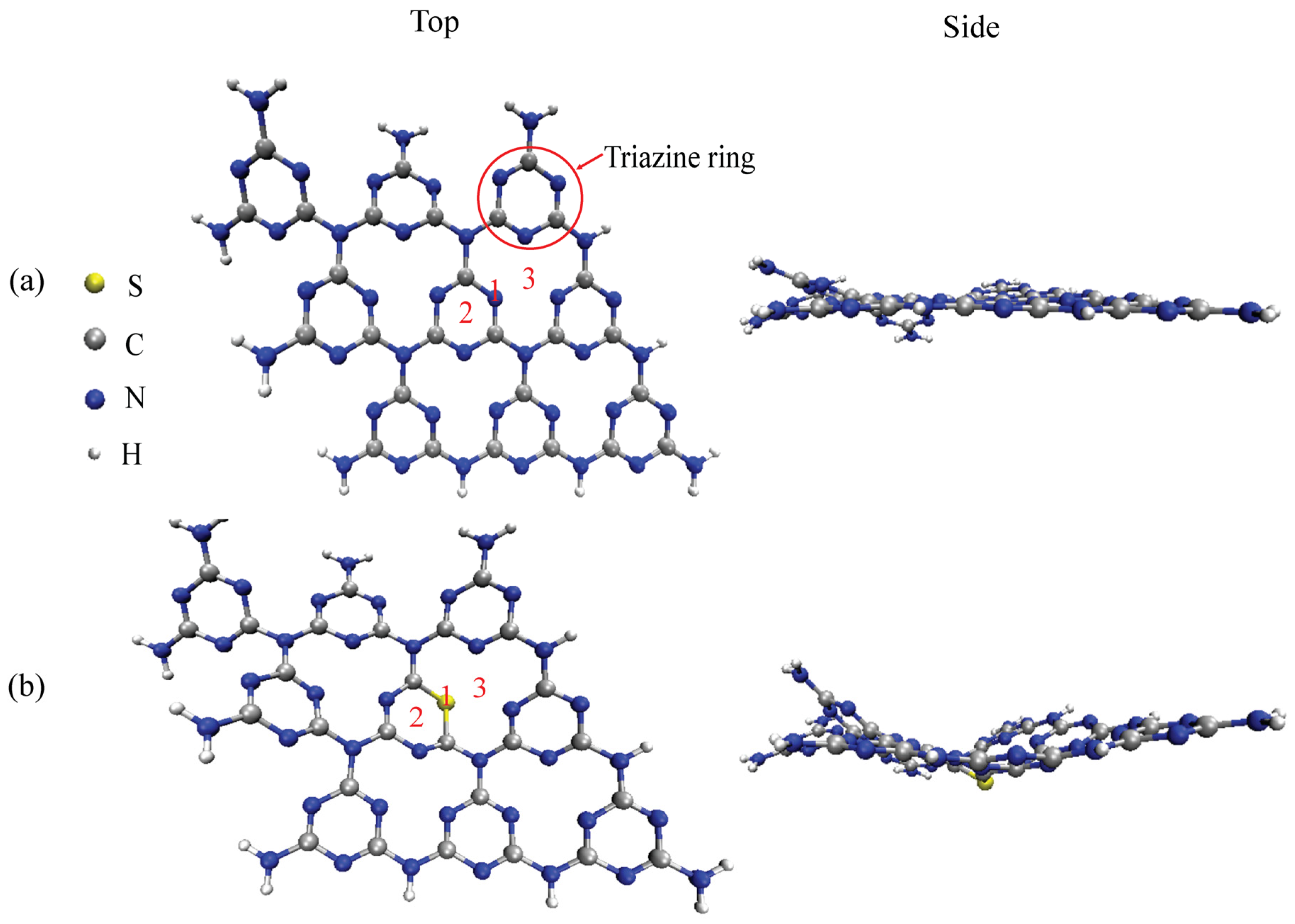
The optimized geometries of g-C3N4 and S/g-C3N4 quantum dots (top and side views) constructed from 3 × 3 triazine unit cells (87 atoms) using the SCC-DFTB method are presented in Figure 1. As shown in Figure 1a, the pristine g-C3N4 quantum dot exhibits a nearly planar framework composed of periodically connected triazine rings, indicating that the conjugated C-N network remains structurally stable after geometry optimization. The calculated diagonal diameter of the pristine structure was approximately 19.46 Å, confirming the nanoscale size expected for the selected model [18]. After the substitution of a nitrogen atom in the triazine ring by a sulfur atom (yellow) at site 1, a local distortion was observed around the doping site, as shown in Figure 1b. The diagonal diameter of the S/g-C3N4 quantum dot slightly decreased to 19.37 Å, indicating that sulfur doping induces small structural contraction without significantly altering the global size of the quantum dot. Such distortions are commonly observed in heteroatom-doped g-C3N4 because the dopant atoms modify local bonding geometry and conjugation within the triazine network [44,45].
For the pristine g-C3N4 quantum dot, the C-N bond lengths within the triazine rings were calculated to be 1.30–1.42 Å, which agrees well with reported theoretical and experimental ranges (1.33–1.48 Å) for sp2-hybridized C-N bonds in g-C3N4 frameworks, confirming the reliability of the optimized model [46]. In the case of the S/g-C3N4 quantum dot, the local bonding environment changed significantly. The C-S bond lengths were observed to increase to between 1.69–1.81 Å, which is considerably longer than the original C-N bonds. This difference is attributed to sulfur’s larger atomic radius and lower electronegativity compared to nitrogen. This size mismatch weakens the local conjugated bonding network and leads to noticeable out-of-plane deformation in the doped structure, as shown in the side-view geometry in Figure 1b. Similar geometric perturbations and lattice distortions have been reported in theoretical studies of S-doped g-C3N4, where the incorporation of sulfur affects bond lengths, local coordination, and the electronic distribution within the heptazine units [23]. The slight decrease in the overall diameter of the quantum dots (from 19.46 to 19.37 Å) with local distortion suggests that sulfur doping mainly affects the local structural environment. However, these localized geometric changes are expected to influence electronic properties, adsorption behavior, and surface reactivity, which are critical for gas-sensing applications. Furthermore, structural deformation can create active sites and modify charge redistribution within the π-conjugated network [47].
The electronic parameters for g-C3N4 and S/g-C3N4 quantum dots, calculated using SCC-DFTB, are summarized in Table 1. The pristine g-C3N4 quantum dot has a HOMO energy of −4.74 eV and a LUMO energy of −1.16 eV, resulting in a band gap of 3.58 eV. After sulfur doping, the HOMO level shifts significantly upward to −2.54 eV, while the LUMO level remains nearly unchanged at −1.17 eV. As a result, the calculated band gap decreases dramatically to 1.37 eV.
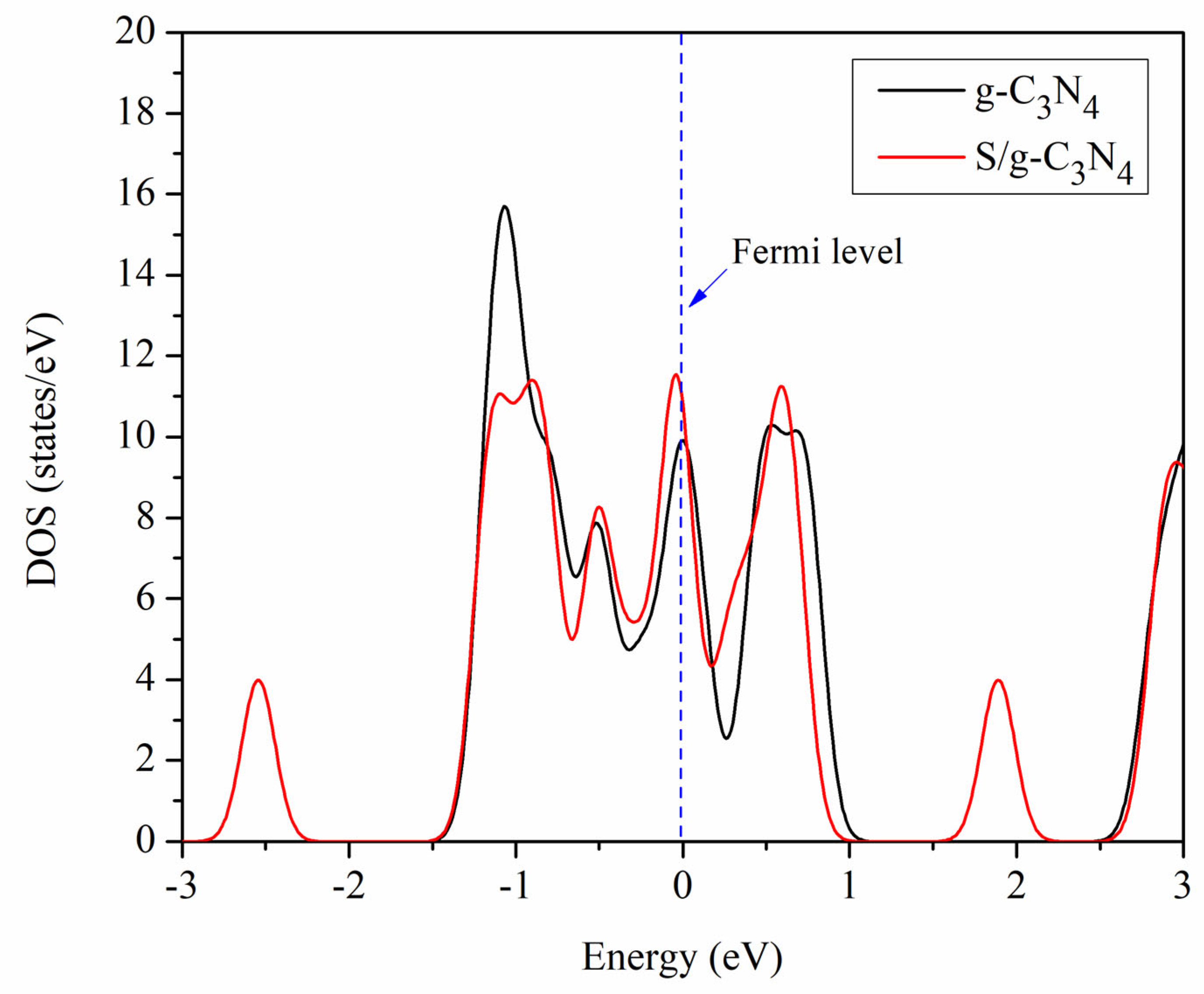
This significant reduction in the band gap indicates that sulfur doping substantially modifies the electronic structure of the g-C3N4 quantum dot, which is consistent with previous studies [48,49]. The decrease in the energy gap primarily arises from the upward shift of the HOMO level, rather than alterations to the LUMO level, which implies a strong influence of sulfur doping on the valence band. In addition, the Fermi level of the pristine g-C3N4 quantum dot is located at −2.95 eV, within the band gap, indicating the typical semiconducting behavior of carbon nitride materials. After sulfur doping, the Fermi level shifts upward to −2.54 eV, aligning with the HOMO level. This shift suggests enhanced electronic activity and improved charge carrier mobility. Moreover, the upward movement of the Fermi level indicates that sulfur doping introduces new electronic states and increases the electrical conductivity of the material [23]. Figure 2 illustrates the DOS of pristine g-C3N4 and S/g-C3N4 quantum dots, highlighting the pronounced modification of the electronic structure upon sulfur doping. The pristine g-C3N4 quantum dot exhibits a clear band gap region between the valence and conduction bands, consistent with its relatively wide band gap (3.58 eV) and typical semiconducting behavior. The low DOS intensity near the Fermi level indicates limited intrinsic electrical conductivity. In contrast, the DOS of S/g-C3N4 displays a substantial redistribution of electronic states, particularly in the vicinity of the Fermi level. The higher DOS intensity observed near the Fermi level indicates a significant increase in the number of electronic states compared to the pristine g-C3N4. This enhancement arises from the introduction of impurity or defect states associated with sulfur incorporation into the carbon nitride framework, which results in pronounced DOS peaks in this energy region. It should be noted that the DOS spectra were aligned with respect to the Fermi level (EF = 0 eV) and broadened for visualization purposes. Therefore, the apparent separation between occupied and unoccupied states in the DOS plots does not directly represent the HOMO-LUMO gap values listed in Table 1. The HOMO-LUMO gaps were obtained from the calculated molecular orbital energies. In contrast, the DOS analysis was used primarily to illustrate the redistribution of electronic states and the sulfur-induced defect states near the Fermi level. Previous first-principles studies have confirmed that sulfur doping in g-C3N4 introduces defect states within the band gap and significantly reduces the band gap energy [50]. As a result, electron excitation from the valence band becomes more favorable, leading to enhanced charge carrier mobility and improved electrical conductivity. Furthermore, the increased DOS provides more accessible pathways for charge transfer [51] during interactions with gas molecules, which is a critical factor governing sensor performance. Therefore, the DOS analysis confirms that sulfur doping effectively tailors the electronic structure of g-C3N4 quantum dots, making them more responsive to external perturbations such as gas adsorption and thus more suitable for high-performance gas-sensing applications.

3.2. Adsorption of NO2, N2O, and NO on g-C3N4 Quantum Dots

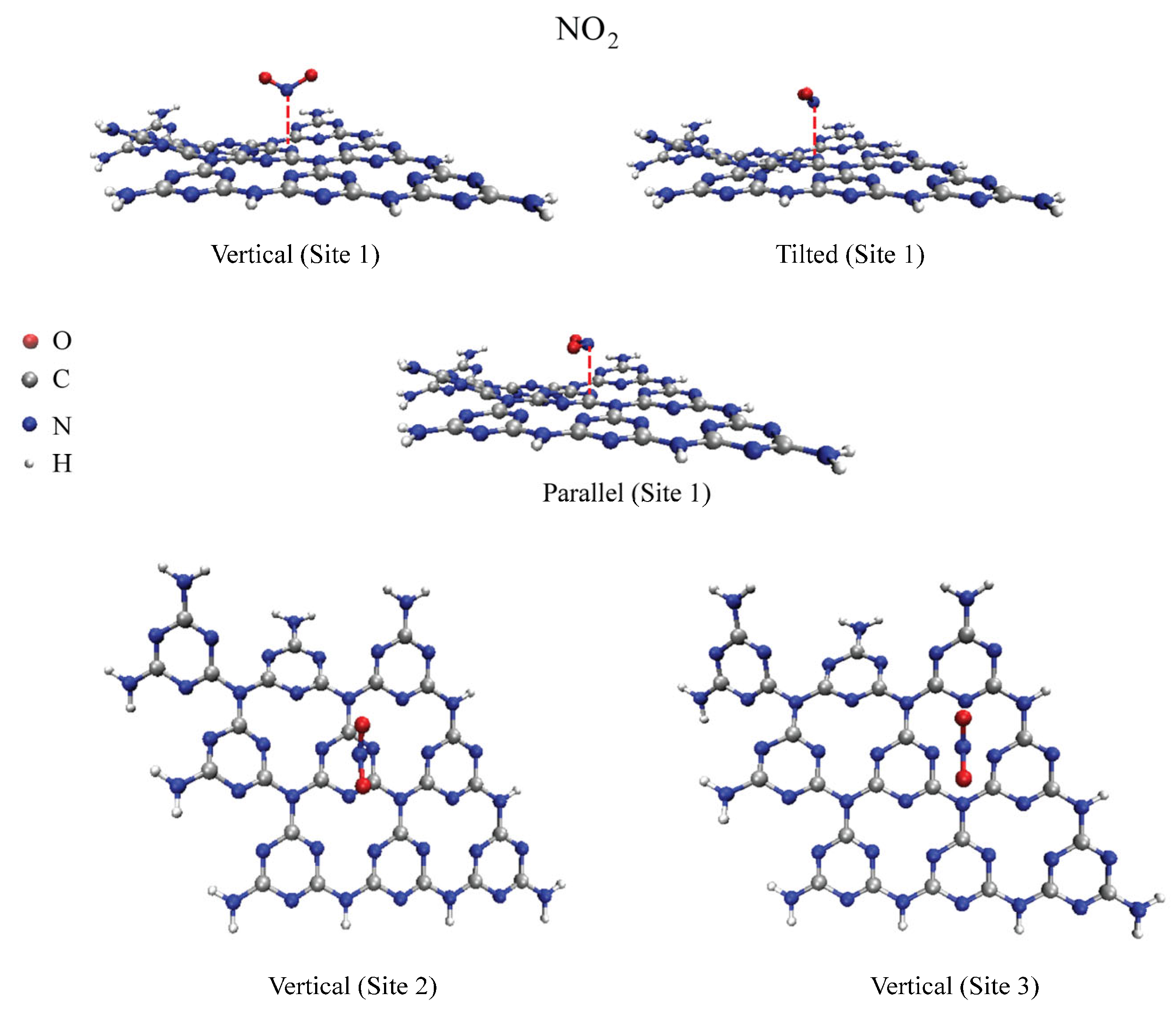
The adsorption behaviors of NO2, NO, and N2O molecules on pristine g-C3N4 quantum dots were systematically investigated. The key adsorption parameters are summarized in Table 2, which includes the adsorption energy (Ead), charge transfer (Q), adsorption distance, and electronic structure changes. Some adsorption configurations for NO2 are illustrated in Figure 3, while those for NO and N2O can be found in the Supplementary Information. Overall, the calculated adsorption energies for all gas molecules range from −0.002 to −0.279 eV, indicating weak gas–surface interactions driven by physisorption mechanisms. Similar physisorption behavior has been reported for small molecules on pristine g-C3N4 and related systems [52]. Among the investigated gases, NO2 exhibited the strongest interaction with the pristine g-C3N4 quantum dot. As shown in Table 2, the most stable configuration corresponds to NO2 adsorbed at the hollow site (site 2) in a parallel orientation, with an adsorption energy of −0.279 eV. The stronger interaction of NO2 can be attributed to its strong oxidizing nature, which facilitates electron acceptance from materials. The calculated negative charge transfer (−0.048 to −0.058 e) confirms that NO2 acts as an electron acceptor [53]. The corresponding band gap values decreased from 3.58 eV (without gases) to approximately 2.22–2.32 eV, suggesting moderate perturbation of the electronic structure.
In the case of NO adsorption, weaker interactions were observed, with adsorption energies reaching a maximum of −0.136 eV. The most stable configuration occurred at the hollow site with a parallel orientation, which is similar to that of NO2 adsorption. The small magnitude of charge transfer (less than −0.067 e) suggests weak electronic coupling between NO molecular orbitals and the π-conjugated system of g-C3N4. Consequently, moderate changes in the energy gaps were typically found within the range of 1.97–2.68 eV, indicating the limited sensitivity of the electronic structure to NO adsorption.
In contrast, N2O exhibited minimal interaction with the pristine g-C3N4 quantum dot. The adsorption energies ranged from −0.052 to −0.142 eV. Also, the band gaps were almost unchanged. These results indicate a weak physisorption interaction. Similar weak adsorption behavior of N2O has been reported on carbon-based materials [54,55]. This weak interaction is attributed to the intrinsic molecular properties of N2O, which is a linear triatomic molecule with a small dipole moment, resulting in low polarity and weak electrostatic interaction with the surface [56,57]. Based on the adsorption energies and charge transfer characteristics, NO2 showed the strongest adsorption, followed by NO, while N2O exhibited the weakest adsorption.

3.3. Adsorption of NO2, N2O, and NO on S/g-C3N4 Quantum Dots

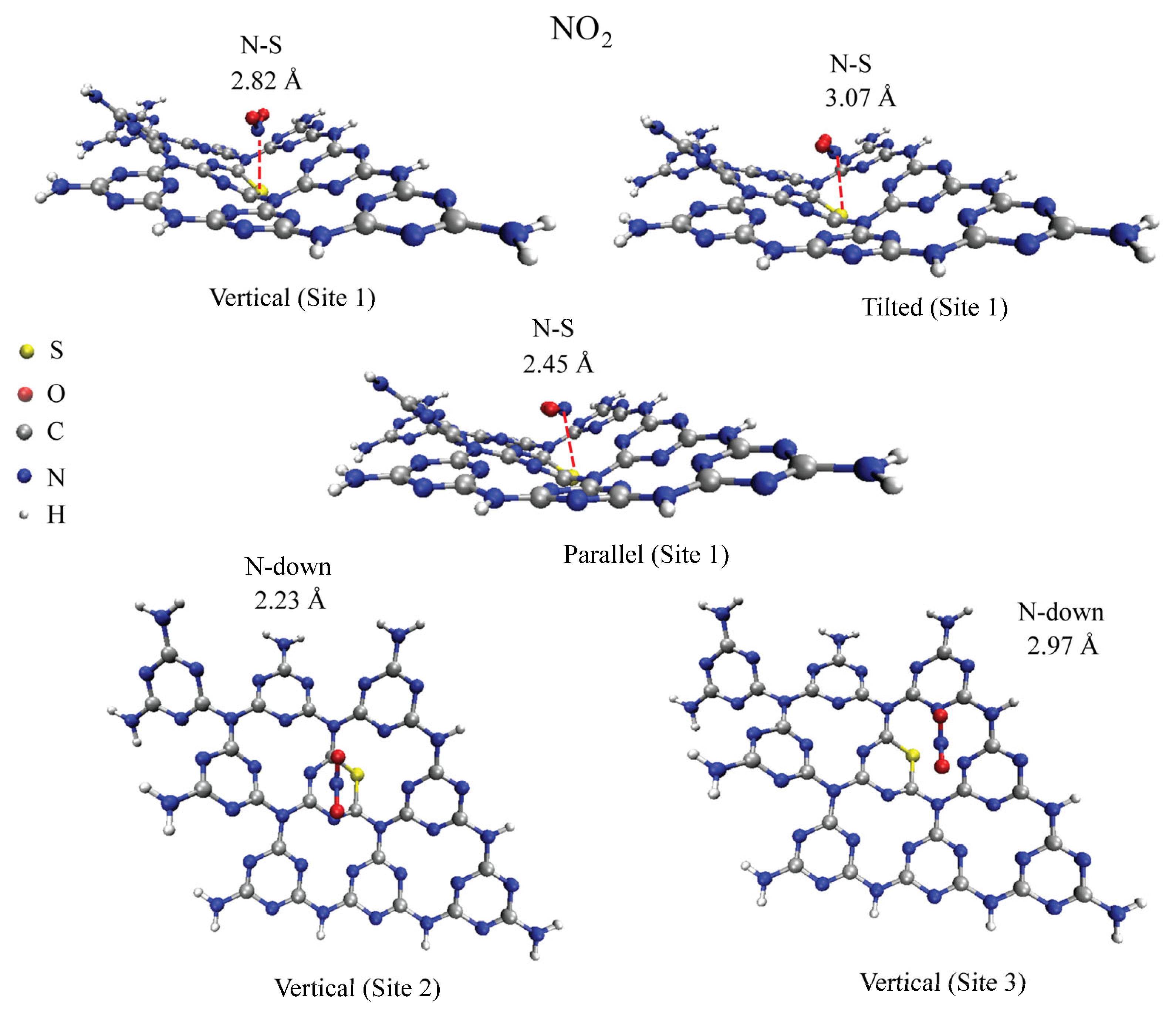
Table 3 summarizes the calculated adsorption parameters for NO2, NO, and N2O molecules on S/g-C3N4 quantum dots. Some representative adsorption configurations for NO2 on S/g-C3N4 quantum dots are shown in Figure 4, while those for NO and N2O are provided in the Supplementary Information. Compared to the pristine system, sulfur doping significantly enhances gas–surface interactions, particularly for NO2 and NO molecules. This improvement arises from the introduction of defect states caused by sulfur, charge redistribution, and increased electronic activity [58] near the Fermi level, as discussed in Section 3.1. As a result, the adsorption energies cover a wider range from weak physisorption to strong chemisorption [59,60,61], depending on the gas species and the adsorption configuration. NO2 exhibited exceptionally strong interaction with the S/g-C3N4 quantum dots. As shown in Table 3, the adsorption energies reach as high as −3.543 eV for the O-S vertical configuration at site 1 and −3.538 eV at the hollow site with N down to S, indicating clear chemisorption behavior. These values are more than an order of magnitude higher than those observed in the pristine system, confirming the critical role of sulfur doping in activating the surface. The strong interaction is further supported by significant charge transfer values (up to −0.285 e), indicating substantial electron transfer from the S/g-C3N4 surface to the NO2 molecule. This behavior confirms that NO2 acts as a strong electron acceptor, facilitated by its high electron affinity and open-shell electronic configuration. In addition, trends in the adsorption distances are significantly reduced compared to the pristine structures, suggesting the formation of strong chemical bonds between the gas molecule and the doped surface. The strong adsorption of NO2 induces significant alterations in the electronic structure. The energy gap decreased dramatically, reaching as low as 0.46 eV in the parallel configuration at site 1. This substantial narrowing of the band gap suggests a marked enhancement in electrical conductivity, which is particularly beneficial for gas-sensing applications. The pronounced modulation of electronic properties indicates that S/g-C3N4 quantum dots exhibit a high sensitivity for NO2 detection. It should be noted that we also performed DFT calculations at the CAM-B3LYP/6-311+G(d,p) level using the same adsorption geometry to evaluate the reliability of the SCC-DFTB results. For adsorption configurations with SCC-DFTB adsorption energies greater than approximately −3 eV, the corresponding DFT calculations yield adsorption energies of only about −1.9 eV. Therefore, the SCC-DFTB method tends to overestimate the adsorption strength in quantitative terms. Nevertheless, the adsorption energies calculated using SCC-DFTB are suitable for qualitative comparison and for identifying the relative adsorption trends among different configurations.
For NO adsorption, moderate-to-strong interactions were observed on the S/g-C3N4 surface. The adsorption energies ranged from −0.547 to −1.447 eV, indicating a transition from strong physisorption to weak chemisorption depending on the adsorption configuration. The most stable configurations involve adsorption at site 1 (sulfur site). The charge transfer values are mostly negative, indicating that NO also behaves predominantly as an electron acceptor, although the magnitude of charge transfer is smaller compared to NO2. The calculated band gaps were reduced to approximately 0.52–1.53 eV. These results demonstrated that NO adsorption still induces a significant electronic perturbation in the S/g-C3N4 quantum dots, suggesting that the quantum dot structure can detect NO with moderate sensitivity.
In the case of N2O adsorption, it exhibited weak adsorption on the S/g-C3N4 quantum dots. The band gaps are very low, with negligible charge transfer (Q = 0 e) across all configurations, as shown in Table 3. These results revealed that the electronic structure of the S/g-C3N4 quantum dots remains almost unchanged after N2O adsorption, with band gap values (~1.35–1.40 eV) similar to those of the isolated doped system (see Table 1).
The comparison between pristine and sulfur-doped systems clearly demonstrates that sulfur doping plays a crucial role in enhancing the adsorption strength and electronic sensitivity of g-C3N4 quantum dots. Remarkably, the dramatic enhancement in NO2 adsorption and the associated electronic response indicate that S/g-C3N4 quantum dots are highly sensitive to NO2 detection. While NO exhibits moderate interaction, N2O shows negligible interaction.

3.4. Total Density of State (DOS)

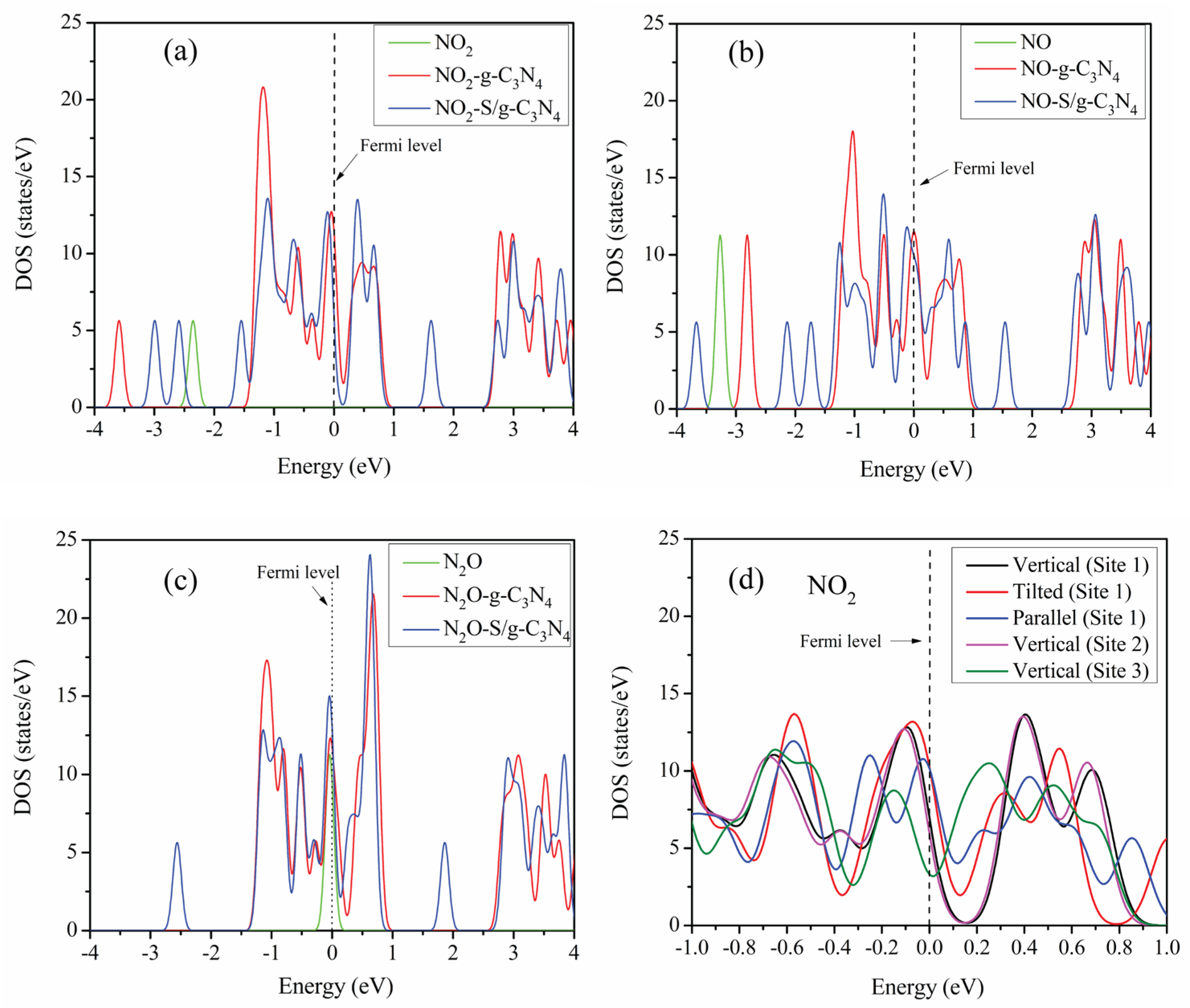
Figure 5 presents the calculated DOS for the most favorable adsorption sites of NO2, NO, and N2O on both pristine g-C3N4 and S/g-C3N4 quantum dots, providing deeper insight into the electronic interactions underlying the sensing behavior. The Fermi level is set to 0 eV. Figure 5a shows the DOS profiles of NO2 adsorption on these quantum dots. For the pristine system, the DOS intensity near the Fermi level increases slightly (~12.5 states/eV) compared to the isolated g-C3N4 system (~10 states/eV), as shown in Figure 2. This behavior is consistent with the weak physisorption interaction discussed in Section 3.2, where NO2 induces minimal charge redistribution and low adsorption energies. In contrast, a pronounced modification of the DOS intensity is observed for the S/g-C3N4 system. There is a significant increase in DOS intensity, with new peaks appearing near the Fermi level at approximately −0.4 eV and 0.4 eV. The appearance of these new peaks is attributed to strong orbital hybridization between the NO2 molecular orbitals and sulfur-induced defect states. This hybridization facilitates greater electron transfer from the structure to the NO2 molecule, corresponding to the large negative charge transfer values and higher adsorption energies reported in Table 3.
Figure 5b illustrates the DOS for NO adsorption. The DOS modification is moderate compared to NO2. The pristine system shows slight perturbations in the electronic states, with minimal change in DOS intensity near the Fermi level, indicating relatively weak physisorption. In comparison, the S/g-C3N4 system exhibits an increase in the DOS intensity near the Fermi level, although less than in the NO2 case. This indicates partial hybridization between NO molecular orbitals and the defect states introduced by sulfur doping. This result reveals that NO adsorption can lead to measurable changes in conductivity, implying moderate sensing sensitivity. For N2O adsorption, as shown in Figure 5c, the DOS curves show negligible differences before and after adsorption. No significant new states appear near the Fermi level in either the pristine g-C3N4 or S/g-C3N4 quantum dots. Moreover, the charge transfer is zero, and the band gap remains nearly unaffected. This result confirms that N2O interacts very weakly with both surfaces, consistent with the low adsorption energies. To investigate the influence of adsorption configurations and adsorption sites on the electronic properties, the DOS of NO2 adsorbed on the S/g-C3N4 quantum dot at the most favorable sites with different orientations was analyzed. As shown in Figure 5d, the results show that adsorption at the S-doped site (site 1; vertical, tilted, and parallel configurations) and at site 2 (hollow site with N-down vertical orientation) exhibit significant electronic modulation near the Fermi level. For adsorption at site 3 (interstitial, parallel), the DOS shows lower intensity than at sites 1 and 2. The differences in DOS features across configurations highlight that both the adsorption configuration and the site significantly influence the interaction strength. The S-doped site acts as the primary active center for NO2 adsorption. A more detailed understanding of the orbital contributions from sulfur atoms and adsorbed gas molecules could be obtained through projected density of states (PDOS) analysis. Although PDOS calculations were beyond the scope of the present work, the combined evidence from adsorption energies, charge transfer, HOMO-LUMO gaps, and DOS modifications consistently supports the role of sulfur-induced electronic states in enhancing NO2-sensing performance.

3.5. Variation in Energy Gap

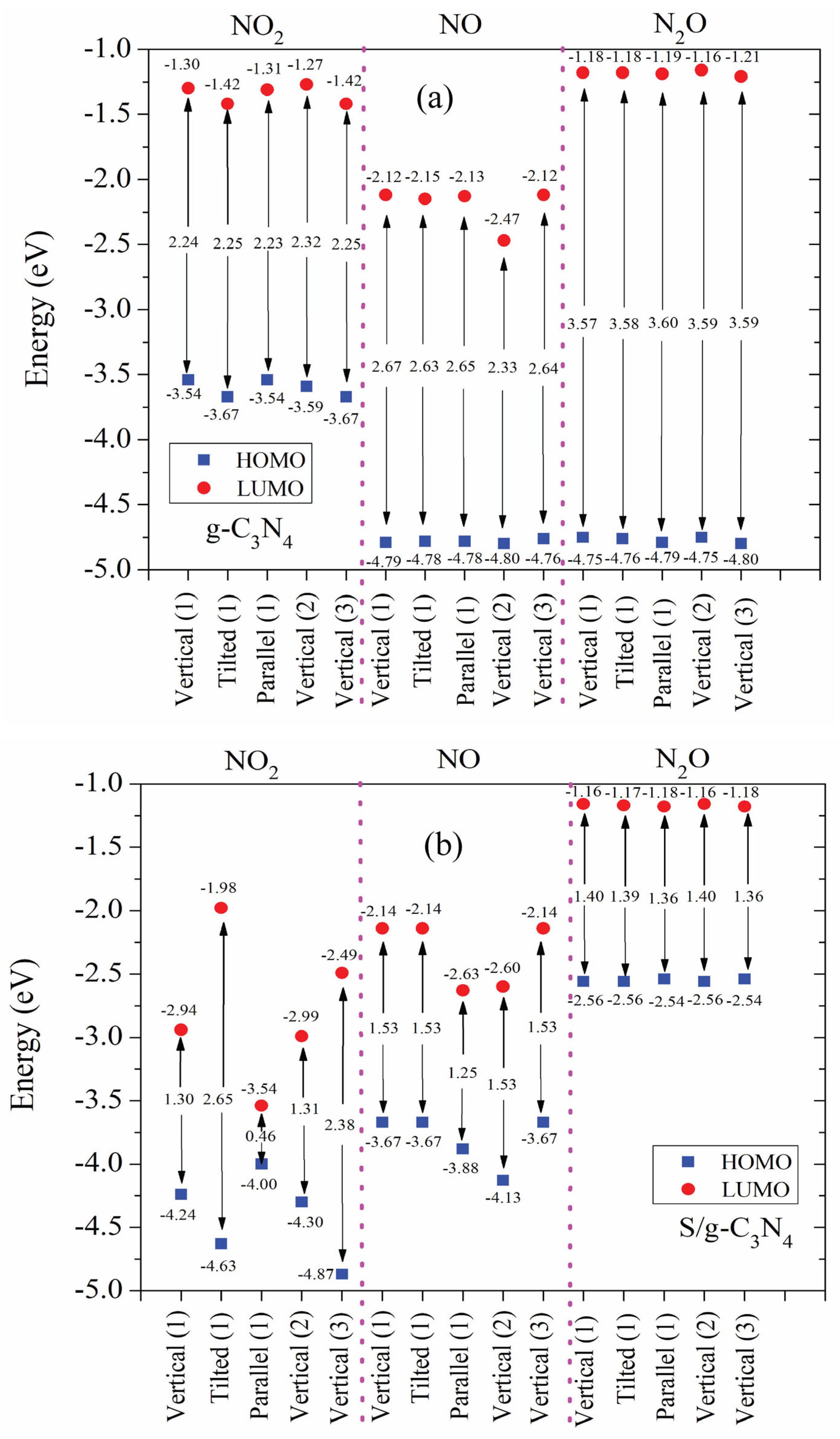
The variation in the HOMO-LUMO energy gap upon gas adsorption provides important insight into the sensing performance of both pristine g-C3N4 and S/g-C3N4 quantum dots. This variation directly correlates with changes in electrical conductivity. The calculated energy gap variations for the adsorption of NO2, NO, and N2O are summarized in Table 2 and Table 3, and their graphical representations of the most favorable adsorption site are displayed in Figure 6. For the pristine g-C3N4 quantum dot (Figure 6a), the adsorption of gas molecules induces only moderate changes in the energy gap. As shown in Table 2, the band gap decreases from 3.58 eV (isolated system) to approximately 2.22–2.32 eV for NO2 adsorption, depending on the configuration. This reduction is primarily due to the weak electronic interaction between the molecular orbitals of NO2 and the π-conjugated framework of g-C3N4 [62]. For NO adsorption, the energy gap varies within the range of ~1.97–2.68 eV, reflecting some orbital hybridization and limited charge transfer. N2O adsorption results in negligible variation in the energy gap (~3.57–3.60 eV). These small variations in energy gap indicate that the intrinsic electronic structure of pristine g-C3N4 remains largely preserved upon gas adsorption. The absence of significant mid-gap states or strong orbital coupling prevents substantial modification of the charge carrier concentration. As a result, changes in conductivity are limited, leading to poor sensing performance. This behavior is characteristic of physisorption-dominated systems, where van der Waals interactions do not significantly alter the electronic band structure [63].
As shown in Figure 6b, the S/g-C3N4 quantum dot exhibits pronounced energy gap modulation upon gas adsorption, particularly for NO2 and NO molecules. As outlined in Table 3, the band gap of the isolated S/g-C3N4 system (1.37 eV) significantly decreases upon the adsorption of NO2, dropping to as low as 0.46 eV depending on the specific adsorption configuration. This dramatic narrowing of the band gap is a direct consequence of strong chemisorption, significant charge transfer, and the formation of hybridized electronic states between NO2 and the sulfur-doped surface. Sulfur doping introduces localized electronic states within the band gap region, which serve as active sites for interaction with gas molecules. When NO2 is adsorbed, these defect states strongly interact with the molecular orbitals of NO2, resulting in the formation of new electronic states near the Fermi level. This interaction effectively reduces the energy separation between the HOMO and LUMO levels, resulting in band gap narrowing. For NO adsorption, a moderate reduction in the energy gap is observed, with energy gap values ranging from ~0.52 to 1.54 eV. Although NO also interacts with the sulfur-doped surface through charge transfer and orbital overlap, the hybridization is weaker than that of NO2. As a result, the induced electronic states are less pronounced, leading to a smaller degree of band gap modulation. Nevertheless, the observed reduction in energy gap is still sufficient to produce a measurable change in conductivity, indicating moderate sensing capability.
In contrast, the adsorption of N2O on S/g-C3N4 leads to negligible changes in the energy gap, with the energy gap remaining nearly constant at around 1.35–1.40 eV. This behavior indicates a lack of significant electronic interaction between N2O and the doped surface, as confirmed by zero charge transfer and minimal changes in the DOS, consistent with N2O adsorption on the pristine system. Overall, the modulation of the energy gap follows the trend NO2 > NO > N2O. This trend aligns with the analysis of adsorption energy, charge transfer, and DOS presented in previous sections. The results clearly indicate that sulfur doping plays a crucial role in enhancing the electronic response of g-C3N4 quantum dots. As a result, the variation in the energy gap serves as a key indicator for assessing and predicting the gas-sensing performance of these systems.

4. Conclusions

In this work, the adsorption mechanisms of NO2, NO, and N2O on pristine and sulfur-doped g-C3N4 quantum dots were systematically investigated using SCC-DFTB calculations. The results revealed that sulfur doping significantly influences the electronic structure and enhances the sensing performance of g-C3N4 quantum dots. While pristine g-C3N4 displayed weak physisorption with minimal electronic perturbation, the introduction of sulfur doping created defect states and substantially increased electronic activity near the Fermi level, resulting in a transition from physisorption to chemisorption. NO2 exhibited particularly strong chemisorption on sulfur-doped g-C3N4, characterized by high adsorption energies, significant charge transfer, pronounced DOS modification, and substantial band gap narrowing. In comparison, NO showed a moderate interaction with a detectable electronic response, while N2O remained weakly adsorbed and had little impact on the electronic structure. The sensing performance follows the trend NO2 > NO > N2O, consistent with adsorption energy, charge transfer, and electronic structure analyses. These findings suggest that sulfur doping facilitates significant modulation of the electronic structure, greatly enhancing the sensitivity and selectivity of g-C3N4 quantum dots for NO2 detection. Although the strong chemisorption of NO2 on S/g-C3N4 quantum dots is advantageous for sensitivity, excessively strong adsorption may increase the recovery time due to slower desorption kinetics. In practical applications, external stimuli such as thermal treatment, UV illumination, or electrical bias may be required to facilitate desorption and restore the sensor surface. Therefore, the trade-off between sensitivity and recoverability should be carefully considered when designing sulfur-doped g-C3N4 quantum dot-based gas sensors. This research offers valuable theoretical insights for the development of high-performance gas-sensing materials based on defect-engineered carbon nitride nanostructures.

Supplementary Materials

The following supporting information can be downloaded at: https://www.mdpi.com/article/10.3390/jcs10070370/s1, Figure S1: Different orientations and adsorption sites of N2O adsorbed on the pristine g-C3N4 quantum dots; Figure S2: Different orientations and adsorption sites of NO adsorbed on the pristine g-C3N4 quantum dots; Figure S3: Different orientations and adsorption sites of N2O adsorbed on the S/g-C3N4 quantum dots; Figure S4: Different orientations and adsorption sites of NO adsorbed on the S/g-C3N4 quantum dots.

Author Contributions

Conceptualization, K.T.; simulation, K.T.; methodology, K.T.; data analysis, K.T., Y.S. and C.W.; writing—original draft preparation, K.T.; visualization, K.T. and Y.S.; validation, K.T. and C.W.; writing—review and editing, C.W.; supervision, C.W.; funding acquisition, K.T. and C.W. All authors have read and agreed to the published version of the manuscript.

Funding

This research was funded by the Thailand Science Research and Innovation (TSRI), Fundamental Fund (FF2568), under Research and Development Institute Phetchabun Rajabhat University (RDI PCRU), grant number 207965. C.W. acknowledges Kasetsart University Research and Development Institute (KURDI, FF(KU)55.69) for supporting this work.

Data Availability Statement

The original data presented in the study are included in the article; further inquiries can be directed to the corresponding author.

Acknowledgments

K.T. would like to thank Division of Physics, Faculty of Science and Technology, Phetchabun Rajabhat University, and Laboratory for Multiscale Innovative Technologies (LMIT), Faculty of Science, Kasetsart University for computer servers. We also sincerely thank Anurak Udomvech from Research Laboratory for Intelligent Materials Design, Discovery, and Developments (RLIMD3), Faculty of Science and Digital Innovation, Thaksin University, for his assistance in performing the DFT calculations used to benchmark the SCC-DFTB results. A. Udomvech would also like to gratefully acknowledge the NSTDA Supercomputer Center (ThaiSC) for providing LANTA computing resources for this work.

Conflicts of Interest

The authors declare no conflicts of interest.

References

  1. Alves, L.; Holz, L.I.V.; Fernandes, C.; Ribeirinha, P.; Mendes, D.; Fagg, D.P.; Mendes, A. A comprehensive review of NOx and N2O mitigation from industrial streams. Renew. Sustain. Energy Rev. 2022, 155, 111916. [Google Scholar] [CrossRef]
  2. Skalska, K.; Miller, J.S.; Ledakowicz, S. Trends in NOx abatement: A review. Sci. Total Environ. 2010, 408, 3976–3989. [Google Scholar] [CrossRef] [PubMed]
  3. Lasek, J.A.; Lajnert, R. On the issues of NOx as greenhouse gases: An ongoing discussion. Appl. Sci. 2022, 12, 10429. [Google Scholar] [CrossRef]
  4. Tyagi, S.; Chaudhary, M.; Ambedkar, A.K.; Sharma, K.; Gautam, Y.K.; Singh, B.P. Metal oxide nanomaterials-based sensors for monitoring environmental NO2 and its impact on the plant ecosystem: A review. Sens. Diagn. 2022, 1, 106. [Google Scholar] [CrossRef]
  5. Zong, B.; Wu, S.; Yang, Y.; Li, Q.; Tao, T.; Mao, S. Smart gas sensors: Recent developments and future prospective. Nano-Micro Lett. 2025, 17, 54. [Google Scholar]
  6. Jung, J.K.; Lee, J.H.; Kim, Y.W.; Chung, N.K. Development of portable gas sensing system for measuring gas emission concentration and diffusivity using commercial manometric sensors in gas exposed polymer: Application to pure gases, H2, He, N2, O2 and Ar. Sens. Actuators B Chem. 2024, 418, 136240. [Google Scholar] [CrossRef]
  7. Qian, L.; Rahmati, F.; Li, F.; Zhang, T.; Wang, T.; Zhang, H.; Yan, S.; Zheng, Y. Recent advances in 2D MXene-based heterostructures for gas sensing: Mechanisms and applications in environmental and biomedical fields. Nanoscale 2025, 17, 8975. [Google Scholar] [CrossRef] [PubMed]
  8. Kumar, R.; Liu, X.; Zhang, J.; Kumar, M. Room-temperature gas sensors under photoactivation: From metal oxides to 2D materials. Nano-Micro Lett. 2020, 12, 164. [Google Scholar] [CrossRef]
  9. Idris, A.O.; Oseghe, E.O.; Msagati, T.A.M.; Kuvarega, A.T.; Feleni, U.; Mamba, B. Graphitic carbon nitride: A highly electroactive nanomaterials for environmental and clinical sensing. Sensors 2020, 20, 5743. [Google Scholar] [CrossRef] [PubMed]
  10. Qamar, M.A.; Javed, M.; Shahid, S.; Shariq, M.; Fadhali, M.M.; Ali, S.K.; Khan, M.S. Synthesis and applications of graphitic carbon nitride (g-C3N4) based membranes for wastewater treatment: A critical review. Heliyon 2023, 9, e12685. [Google Scholar] [CrossRef] [PubMed]
  11. Zhao, G.Q.; Zou, J.; Hu, J.; Long, X.; Jiao, F.P. A critical review on graphitic carbon nitride (g-C3N4)-based composites for environmental remediation. Sep. Purif. Technol. 2021, 279, 119769. [Google Scholar] [CrossRef]
  12. Dong, Y.; Wang, Q.; Wu, H.; Chen, Y.; Lu, C.H.; Chi, Y.; Yang, H.H. Graphitic carbon nitride materials: Sensing, imaging and therapy. Small 2016, 12, 5376–5393. [Google Scholar] [CrossRef] [PubMed]
  13. Ismael, M. A review on graphitic carbon nitride (g-C3N4)-based nanocomposites: Synthesis, categories, and their application in photocatalysis. J. Alloys Compd. 2020, 846, 156446. [Google Scholar] [CrossRef]
  14. Wang, Q.; Li, Y.; Huang, F.; Song, S.; Ai, G.; Xin, X.; Zhao, B.; Zheng, Y.; Zhang, Z. Recent advances in g-C3N4-based materials and their application in energy and environmental sustainability. Molecules 2023, 28, 432. [Google Scholar] [CrossRef] [PubMed]
  15. Bhati, V.S.; Takhar, V.; Raliya, R.; Kumar, M.; Banerjee, R. Recent advances in g-C3N4-based gas sensors for the detection of toxic and flammable gases: A review. Nano Express 2022, 3, 014003. [Google Scholar] [CrossRef]
  16. Liu, X.; Ma, R.; Zhuang, L.; Hu, B.; Chen, J.; Liu, X.; Wang, X. Recent development of doped g-C3N4 photocatalysts for the degradation of organic pollutants. Crit. Rev. Environ. Sci. Technol. 2021, 51, 751–790. [Google Scholar]
  17. Dong, G.; Zhang, Y.; Pan, Q.; Qiu, J. A fantastic graphitic carbon nitride (g-C3N4) material: Electronic structure, photocatalytic and photoelectronic properties. J. Photochem. Photobiol. C Photochem. Rev. 2014, 20, 33–50. [Google Scholar] [CrossRef]
  18. Majdoub, M.; Sengottuvelu, D.; Nouranian, S.; Al-Ostaz, A. Graphitic carbon nitride quantum dots (g-C3N4 QDs): From chemistry to applications. ChemSusChem 2024, 17, e202301462. [Google Scholar] [CrossRef] [PubMed]
  19. Wang, T.; Nie, C.; Ao, Z.; Wang, S.; An, T. Recent progress in g-C3N4 quantum dots: Synthesis, properties and applications in photocatalytic degradation of organic pollutants. J. Mater. Chem. A 2020, 8, 485. [Google Scholar] [CrossRef]
  20. Pasupuleti, K.S.; Ghosh, S.; Jayababu, N.; Kang, C.J.; Cho, H.D.; Kim, S.G.; Kim, M.D. Boron-doped g-C3N4 quantum dots based highly sensitive surface acoustic wave NO2 sensor with faster gas kinetics under UV light illumination. Sens. Actuators B Chem. 2023, 378, 133140. [Google Scholar] [CrossRef]
  21. Qureshi, S.; Asif, M.; Sajid, H.; Gilani, M.A.; Ayub, K.; Arshad, M.; Mahmood, T. Electrochemical sensing of heptazine graphitic C3N4 quantum dot for chemical warfare agents: A quantum chemical approach. Mater. Sci. Semicond. Process. 2022, 148, 106753. [Google Scholar] [CrossRef]
  22. Kumar, U.; Deng, Z.Y.; Yadav, B.C.; Lee, M.W.; Wu, C.H. Advances in 0D quantum dots and hybrid nanoarchitectures for high-performance gas sensing devices. Nanotechnology 2025, 36, 182001. [Google Scholar] [CrossRef]
  23. Wang, Y.; Tian, Y.; Yan, L.; Su, Z. DFT study on sulfur-doped g-C3N4 nanosheets as a photocatalyst for CO2 reduction reaction. J. Phys. Chem. C 2018, 122, 7712–7719. [Google Scholar] [CrossRef]
  24. You, R.; Dou, H.; Chen, L.; Zheng, S.; Zhang, Y. Graphitic carbon nitride with S and O codoping for enhanced visible light photocatalytic performance. RSC Adv. 2017, 7, 15842. [Google Scholar] [CrossRef]
  25. Lu, S.; Li, C.; Li, H.H.; Zhao, Y.F.; Gong, Y.Y.; Niu, L.Y.; Liu, X.J.; Wang, T. The effects of nonmetal dopants on the electronic, optical and chemical performances of monolayer g-C3N4 by first-principles study. Appl. Surf. Sci. 2017, 392, 966–974. [Google Scholar] [CrossRef]
  26. Diao, Z.; Cui, Z.; Zhang, S. A GaN/HfZrCO2 heterojunction with excellent photoresponse and superior hydrogen evolution reaction performance. Phys. Chem. Chem. Phys. 2026, 28, 8541–8555. [Google Scholar] [CrossRef] [PubMed]
  27. Kim, M.; Yoon, A.; Jung, J.C.; Jung, W. Application of DFT to MOS gas sensors: A review of sensing mechanisms. Sens. Actuators A Phys. 2026, 398, 117364. [Google Scholar] [CrossRef]
  28. Weng, K.; Peng, J.; Shi, Z.; Arramel, A.; Li, N. Highly NH3 sensitive and selective Ti3C2O2-based gas sensors: A density functional theory-NEGF study. ACS Omega 2023, 8, 4261–4269. [Google Scholar] [CrossRef] [PubMed]
  29. Abbasi, A. DFT study of the electronic properties and gas sensing characteristics of the novel Ag2O modified BP/BSe van der Waals heterostructures. Sci. Rep. 2025, 15, 17662. [Google Scholar] [CrossRef] [PubMed]
  30. Huang, C.S.; Murat, A.; Babar, V.; Montes, E.; Schwingenschlögl, U. Adsorption of the gas molecules NH3, NO, NO2, and CO on borophene. J. Phys. Chem. C 2018, 122, 14665–14670. [Google Scholar] [CrossRef]
  31. Porezag, D.; Frauenheim, T.; Köhler, T.; Seifert, G.; Kaschner, R. Construction of tight-binding-like potentials on the basis of density-functional theory: Application to carbon. Phys. Rev. B 1995, 51, 12947. [Google Scholar] [CrossRef]
  32. Elstner, M.; Porezag, D.; Jungnickel, G.; Elsner, J.; Haugk, M.; Frauenheim, T.; Suhai, S.; Seifert, G. Self-consistent-charge density-functional tight-binding method for simulation of complex materials properties. Phys. Rev. B 1998, 58, 7260. [Google Scholar] [CrossRef]
  33. Gahrouei, M.M.; Vlastos, N.; D’Souza, R.; Odogwu, E.C.; de Sousa Oliveira, L. Benchmark investigation of SCC-DFTB against standard and hybrid DFT to model electronic properties in two-dimensional MOFs for thermoelectric applications. J. Chem. Theory Comput. 2024, 20, 3976–3992. [Google Scholar] [CrossRef]
  34. Gruden, M.; Andjelković, L.; Jissy, A.K.; Stepanović, S.; Zlatar, M.; Cui, Q.; Elstner, M. Benchmarking density-functional tight-binding models for barrier heights and reaction energetics of organic molecules. J. Comput. Chem. 2017, 38, 2171–2185. [Google Scholar] [CrossRef] [PubMed]
  35. Lee, K.H.; Schnupf, U.; Sumpter, B.G.; Irle, S. Performance of density-functional tight-binding in comparison to ab initio and first-principles methods for isomer geometries and energies of glucose epimers in vacuo and solution. ACS Omega 2018, 3, 16899–16915. [Google Scholar] [CrossRef] [PubMed]
  36. Trani, F.; Barone, V. Silicon nanocrystal functionalization: Analytic fitting of DFTB parameters. J. Chem. Theory Comput. 2011, 7, 713–719. [Google Scholar] [CrossRef] [PubMed]
  37. Selli, D.; Fazio, G.; Di Valentin, C. Modelling realistic TiO2 nanospheres: A benchmark study of SCC-DFTB against hybrid DFT. J. Chem. Phys. 2017, 147, 164701. [Google Scholar] [CrossRef] [PubMed]
  38. Timsorn, K.; Wongchoosuk, C. Nitrogen-doped borophene quantum dots: A novel sensing material for the detection of hazardous environmental gases. J. Compos. Sci. 2024, 8, 397. [Google Scholar] [CrossRef]
  39. Zhang, Y.; Chen, J.; Li, Y.; Zhao, C.; Chen, Y. Application of a new self-consistent-charge density-functional tight-binding (SCC-DFTB) parameter set for simulating the adsorption of flotation reagents on the surface of typical lead minerals. Miner. Eng. 2024, 209, 108631. [Google Scholar] [CrossRef]
  40. Gaus, M.; Lu, X.; Elstner, M.; Cui, Q. Parameterization of DFTB3/3OB for sulfur and phosphorus for chemical and biological applications. J. Chem. Theory Comput. 2014, 10, 1518–1537. [Google Scholar] [CrossRef] [PubMed]
  41. Liu, G.; Niu, P.; Sun, C.; Smith, S.C.; Chen, Z.; Lu, G.Q.; Cheng, H.M. Unique electronic structure induced high photoreactivity of sulfur-doped graphitic C3N4. J. Am. Chem. Soc. 2010, 132, 11642–11648. [Google Scholar] [CrossRef] [PubMed]
  42. Wang, R.; Zhu, R.; Zhang, D. Adsorption of formaldehyde molecule on the pristine and silicon-doped boron nitride nanotubes. Chem. Phys. Lett. 2008, 467, 131–135. [Google Scholar] [CrossRef]
  43. Asif, M.; Kosar, N.; Sajid, H.; Qureshi, S.; Gilani, M.A.; Ayub, K.; Arshad, M.; Imran, M.; Hamid, M.H.S.A.; Bayach, I.; et al. Exploring the sensing potential of g-C3N4 versus Li/g-C3N4 nanoflakes toward hazardous organic volatiles: A DET simulation study. ACS Omega 2024, 9, 3541–3553. [Google Scholar] [PubMed]
  44. Sun, L.; Li, Y.; Feng, W. Gas-phase fluorination of g-C3N4 for enhanced photocatalytic hydrogen evolution. Nanomaterials 2022, 12, 37. [Google Scholar] [PubMed]
  45. Mohammad, A.; Chandra, P.; Khan, M.E.; Choi, C.H.; Yoon, T. Sulfur-doped graphitic carbon nitride: Tailored nanostructures for photocatalytic, sensing, and energy storage applications. Adv. Colloid Interface Sci. 2023, 322, 103048. [Google Scholar] [CrossRef] [PubMed]
  46. Li, Y.; Du, H. Engineering graphitic carbon nitride for next-generation photodetectors: A mini review. RSC Adv. 2023, 13, 25968. [Google Scholar] [CrossRef] [PubMed]
  47. Li, Y.; He, Z.; Liu, L.; Jiang, Y.; Ong, W.J.; Duan, Y.; Ho, W.; Dong, F. Inside-and-out modification of graphitic carbon nitride (g-C3N4) photocatalysts via defect engineering for energy and environmental science. Nano Energy 2023, 105, 108032. [Google Scholar] [CrossRef]
  48. Dong, L.; Chu, H.; Xu, S.; Li, Y.; Zhao, S.; Li, D. Band structure tuning of g-C3N4 via sulfur doping for broadband near-infrared ultrafast photonic applications. Nanophotonics 2022, 11, 139–151. [Google Scholar] [PubMed]
  49. Lin, Y.R.; Dizon, G.V.C.; Yamada, K.; Liu, C.Y.; Venault, A.; Lin, H.Y.; Yoshida, M.; Hu, C. Sulfur-doped g-C3N4 nanosheets for photocatalysis: Z-scheme water splitting and decreased biofouling. J. Colloid Interface Sci. 2020, 567, 202–212. [Google Scholar] [CrossRef] [PubMed]
  50. Li, J.; Li, Z.; Tan, J.; Meng, Y.; Lu, Y.; Zhang, T. First-principles study of S-doped point defects with different charge states in monolayer g-C3N4. Appl. Surf. Sci. 2021, 554, 149601. [Google Scholar] [CrossRef]
  51. Cui, J.; Yu, F.; Zhang, J.; Tang, X.; Liu, Y. Doping mechanism of S, O co-doped in nitrogen vacancy defect rich g-C3N4 nanosheet photocatalyst. Opt. Mater. 2023, 139, 113777. [Google Scholar] [CrossRef]
  52. Zhu, B.; Zhang, L.; Xu, D.; Cheng, B.; Yu, J. Adsorption investigation of CO2 on g-C3N4 surface by DFT calculation. J. CO2 Util. 2017, 21, 327–335. [Google Scholar] [CrossRef]
  53. Zhang, Y.; Chen, X.; Fang, D.; Yan, H.; Wang, D.; Wang, X.; Li, J.; Zhai, Y.; Chu, X.; Wang, D.; et al. Adsorption behavior of NO and NO2 on two-dimensional As, Sb, and Bi materials: First-principles insights. Materials 2024, 17, 1024. [Google Scholar] [CrossRef] [PubMed]
  54. Liu, Z.; Cheng, X.R.; Yang, Y.M.; Jia, H.Z.; Bai, B.Q.; Zhao, L. DFT study of N2O adsorption onto the surface of M-decorated graphene oxide (M = Mg, Cu or Ag). Materials 2019, 12, 2611. [Google Scholar] [CrossRef] [PubMed]
  55. Hua, H.; Ni, Y. The adsorption behaviors of N2O on penta-graphene and Ni-doped penta-graphene. RSC Adv. 2022, 12, 23937. [Google Scholar] [CrossRef] [PubMed]
  56. Moussounda Mba, G.M.; N’dollo, M.; Boungou, C.C.; Moussounda, P.S.; Dintzer, T. Coverage-dependent adsorption of nitrous oxide (N2O) on perfect and defective Cu(001) surfaces: A DFT investigation with and without van der Waals forces. Comput. Theor. Chem. 2021, 1205, 113428. [Google Scholar] [CrossRef]
  57. Mogi, K.; Komine, T.; Hirao, K. A theoretical study on the dipole moment of N2O and the weakly bound complexes formed by N2O. J. Chem. Phys. 1991, 95, 8999–9008. [Google Scholar] [CrossRef]
  58. Wu, P.; Wang, Y.; Liu, Y. Recent advances in heteroatom-doped porous carbon for adsorption of gaseous pollutants. Chem. Eng. J. 2024, 491, 152142. [Google Scholar] [CrossRef]
  59. Wang, Q.; Xu, S.; Gu, Y.; Zhang, X.; Wu, X. First-principles study of small gas molecule adsorption on SnC monolayer. Vacuum 2026, 249, 115260. [Google Scholar] [CrossRef]
  60. Girish, C.R. Determination of thermodynamic parameters in adsorption studies: A review. Chem. Pap. 2025, 79, 5687–5706. [Google Scholar] [CrossRef]
  61. Zhu, Z.; Yang, Q.; Zhang, M.; Ye, J. Study on the adsorption behavior and electronic and gas-sensing properties of SF6 decomposition products on Co-and Ni-modified g-C3N4 monolayer films. Phys. Chem. Chem. Phys. 2025, 27, 11941–11954. [Google Scholar] [CrossRef] [PubMed]
  62. Xia, P.; Cheng, B.; Jiang, J.; Tang, H. Localized π-conjugated structure and EPR investigation of g-C3N4 photocatalyst. Appl. Surf. Sci. 2019, 487, 335–342. [Google Scholar] [CrossRef]
  63. Bai, K.; Cui, Z.; Li, E.; Ding, Y.; Zheng, J.; Liu, C.; Zheng, Y. Electronic and optical characteristics of GaS/g-C3N4 van der Waals heterostructures: Effects of biaxial strain and vertical electric field. Vacuum 2020, 180, 109562. [Google Scholar] [CrossRef]
Figure 1. Top and side views of the optimized geometries: (a) g-C3N4 and (b) S/g-C3N4 quantum dots.
Jcs 10 00370 g001
Figure 2. DOS plot for the g-C3N4 and S/g-C3N4 quantum dots.
Jcs 10 00370 g002
Figure 3. Different orientations and adsorption sites of NO2 adsorbed on the pristine g-C3N4 quantum dots. Orientations and adsorption sites for N2O and NO can be found in Figures S1 and S2 of the Supplementary File.
Jcs 10 00370 g003
Figure 4. Different orientations and adsorption sites of NO2 adsorbed on the S/g-C3N4 quantum dots. Orientations and adsorption sites for N2O and NO can be found in Figures S3 and S4 of the Supplementary File.
Jcs 10 00370 g004
Figure 5. Calculated DOS of (a) NO2, (b) NO, (c) N2O adsorbed on the g-C3N4 and S/g-C3N4 quantum dots, and (d) NO2 adsorbed on the S/g-C3N4 quantum dots with different adsorption sites and orientations. The Fermi level is set to zero, indicated by dashed vertical lines.
Jcs 10 00370 g005
Figure 6. Graphical representation of variation in HOMO-LUMO for NO2, NO, and N2O adsorption on (a) g-C3N4 and (b) S/g-C3N4 quantum dots with different orientations and adsorption sites.
Jcs 10 00370 g006
Table 1. Calculated electronic parameters of the quantum dots using SCC-DFTB.
Quantum DotEHOMO (eV)ELUMO (eV)EF (eV)Eg (eV)
g-C3N4−4.74−1.16−2.953.58
S/g-C3N4−2.54−1.17−2.541.37
Table 2. Calculated adsorption parameters for each gas adsorbed on the g-C3N4 quantum dots.
SystemSiteOrientationAdsorption SiteDistance (Å)Ead (eV)Q (e)EHOMO (eV)ELUMO (eV)Eg (eV)
NO2-g-C3N41VerticalO-N3.19−0.194−0.05219−3.53−1.312.22
VerticalN-N2.21−0.194−0.05139−3.54−1.302.24
Tilted (45°)N-N2.53−0.252−0.05775−3.67−1.422.25
ParallelN-N3.40−0.194−0.05158−3.54−1.312.23
2VerticalO down 3.00−0.197−0.0494−3.57−1.272.30
VerticalN down 3.00−0.197−0.04817−3.58−1.292.29
ParallelParallel2.80−0.279−0.04908−3.59−1.272.32
3VerticalO down 3.17−0.194−0.05096−3.54−1.302.24
VerticalN down 2.90−0.247−0.05599−3.67−1.422.25
ParallelParallel3.38−0.194−0.05075−3.54−1.312.23
N2O-g-C3N41VerticalO-N3.24−0.065−0.00065−4.75−1.183.57
VerticalN-N3.00−0.063−0.00065−4.75−1.183.57
Tilted (45°)O-N2.76−0.063−0.00066−4.76−1.183.58
Tilted (45°)N-N2.82−0.061−0.00060−4.75−1.163.59
ParallelParallel3.53−0.061−0.00063−4.79−1.193.60
2VerticalO down 3.36−0.058−0.00064−4.75−1.163.59
VerticalN down3.13−0.052−0.00061−4.75−1.163.59
ParallelParallel3.20−0.056−0.00038−4.77−1.173.60
3VerticalO down 3.00−0.1370.00000−4.80−1.213.59
VerticalN down 2.54−0.1370.00045−4.80−1.213.59
ParallelParallel2.98−0.1420.00000−4.80−1.213.59
NO-g-C3N41VerticalO-N3.50−0.0030.00016−4.75−2.662.09
VerticalN-N3.06−0.057−0.05226−4.79−2.122.67
Tilted (45°)O-N2.44−0.051−0.02576−4.76−2.272.49
Tilted (45°)N-N2.27−0.082−0.06739−4.78−2.152.63
ParallelParallel2.31−0.077−0.06569−4.78−2.132.65
2VerticalO down 3.11−0.0020.00000−4.75−2.781.97
VerticalN down 3.05−0.052−0.03505−4.77−2.212.56
ParallelParallel3.15−0.136−0.02707−4.80−2.472.33
3VerticalO down 3.00−0.0980.00000−4.78−2.811.97
VerticalN down 2.72−0.069−0.05917−4.78−2.102.68
ParallelParallel2.88−0.072−0.06323−4.76−2.122.64
Table 3. Calculated adsorption parameters for each gas adsorbed on the S/g-C3N4 quantum dots.
SystemSiteOrientationAdsorption SiteDistance (Å)Ead (eV)Q (e)EHOMO (eV)ELUMO (eV)Eg (eV)
NO2-S/g-C3N41VerticalO-S2.05−3.543−0.20681−4.24−2.941.30
VerticalN-S2.82−1.898−0.09412−4.63−1.982.65
Tilted (45°)N-S3.07−1.898−0.09453−4.63−1.982.65
Parallel N-S2.45−3.116−0.18439−4.00−3.540.46
2Vertical O down 1.89−2.360−0.23110−4.32−3.640.68
VerticalN down 2.23−3.538−0.21074−4.30−2.991.31
ParallelParallel2.15−3.537−0.20943−4.30−2.991.31
3Vertical O down 2.80−1.483−0.28497−4.74−1.902.84
VerticalN down 2.97−1.896−0.09494−4.63−1.982.65
ParallelParallel3.11−3.409−0.20142−4.87−2.492.38
N2O-S/g-C3N41VerticalO-S3.28−0.054−0.00052−2.56−1.161.40
VerticalN-S2.95−0.052−0.00035−2.54−1.181.36
Tilted (45°)O-S2.87−0.050−0.00052−2.53−1.181.35
Tilted (45°)N-S2.74−0.052−0.00037−2.56−1.171.39
Parallel Parallel3.34−0.050−0.00052−2.54−1.181.36
2Vertical O down 3.24−0.054−0.00049−2.56−1.161.40
VerticalN down3.05−0.052−0.00041−2.54−1.181.36
ParallelParallel3.11−0.050−0.00025−2.56−1.171.39
3Vertical O down 2.92−0.050−0.00050−2.54−1.181.36
VerticalN down 2.44−0.052−0.00037−2.54−1.181.36
ParallelParallel2.77−0.050−0.00052−2.53−1.181.35
NO-S/g-C3N41VerticalO-S2.25−0.547−0.00361−3.21−2.540.67
VerticalN-S2.73−1.447−0.03625−3.67−2.141.53
Tilted (45°)O-S2.30−1.328−0.02187−3.65−2.231.42
Tilted (45°)N-S2.18−1.447−0.03615−3.67−2.141.53
Parallel Parallel2.23−1.3570.006858−3.88−2.631.25
2Vertical O down 2.16−0.576−0.02701−3.06−2.540.52
VerticalN down 2.48−1.351−0.00615−4.13−2.601.53
ParallelParallel2.85−1.2290.01062−3.88−2.671.21
3Vertical O down 2.51−0.844−0.70086−4.27−2.162.11
VerticalN down 2.84−1.447−0.03613−3.67−2.141.53
ParallelParallel3.13−1.446−0.03417−3.67−2.131.54
Disclaimer/Publisher’s Note: The statements, opinions and data contained in all publications are solely those of the individual author(s) and contributor(s) and not of MDPI and/or the editor(s). MDPI and/or the editor(s) disclaim responsibility for any injury to people or property resulting from any ideas, methods, instructions or products referred to in the content.