

Assessing Environmental Impact, Structural Integrity, and Circular Economy of Sustainable Concrete Made with Recycled Aggregates and SCM Composites: Systematic Literature Review



Abstract
1. Introduction
2. Methodology
- i.
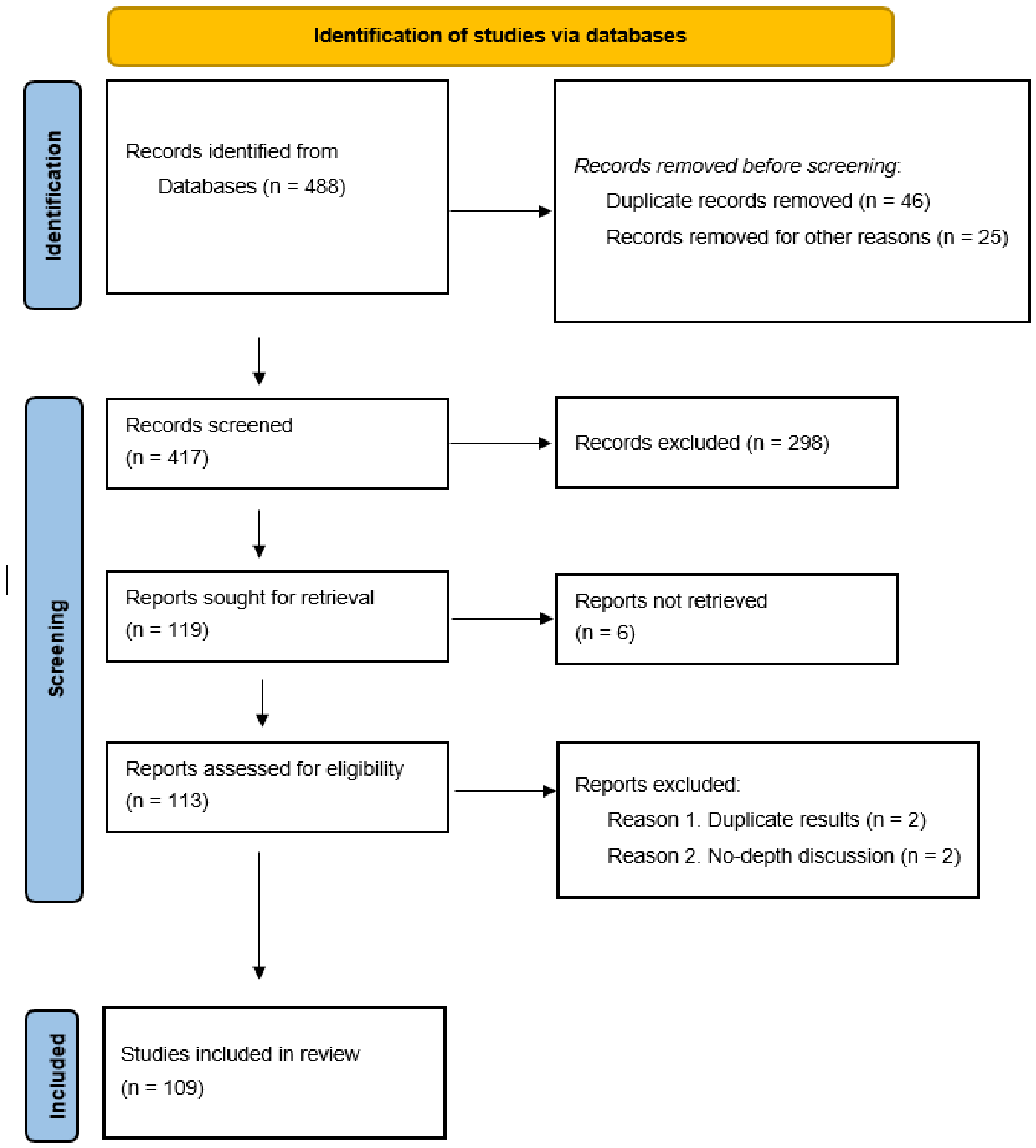
- Identification: Systematic searches across major databases, including Scopus, Web of Science, Google Scholar, and ASTM International, were conducted to identify pertinent literature. The primary sources consulted, taken together, offer substantial coverage of published research in engineering and materials science. Broad keywords such as recycled aggregates, SCMs, sustainable concrete, and the circular economy in sustainable concrete were included in the search strategy. To refine the results and ensure relevance, more specific terms were subsequently applied, including the carbon footprint of the cement industry, river sand mining, silica fume, flyash, recycled fine dust, recycled aggregate concrete, SCM-based concrete, and the circular economy of sustainable concrete.
- ii.
- Screening: A selection approach was developed to identify research addressing SCMs and RAs. At this stage of screening, articles that primarily focused on themes beyond the defined scope were excluded. This resulted in the removal of 294 studies from further consideration, ensuring that the studies included in the review were methodologically sound and of high overall quality. A thorough quality assessment was carried out. The studies screened at this stage included very significant peer-reviewed experimental research papers, comprehensive literature reviews, officially published conference articles, and authentic online reports.
- iii.
- Included: The final corpus of 102 documents was selected for analysis and discussion for this SLR study. The key significant criteria for the selected documents are publication types, language, scope, and publication period. The quality articles matched the key findings of the current review articles in English, and the most recent search results were selected for the final analysis and discussion to generate new research ideas for future directions.
3. CO2 Emissions and the Natural Sand Crisis
3.1. CO2 Emissions
3.2. Natural River Sand Extraction
4. Engineering Parameters of Sustainable Concrete
4.1. Relative Compressive Strength
4.2. Relative Tensile Strength
4.3. Durability Parameters of Sustainable Concrete
- i.
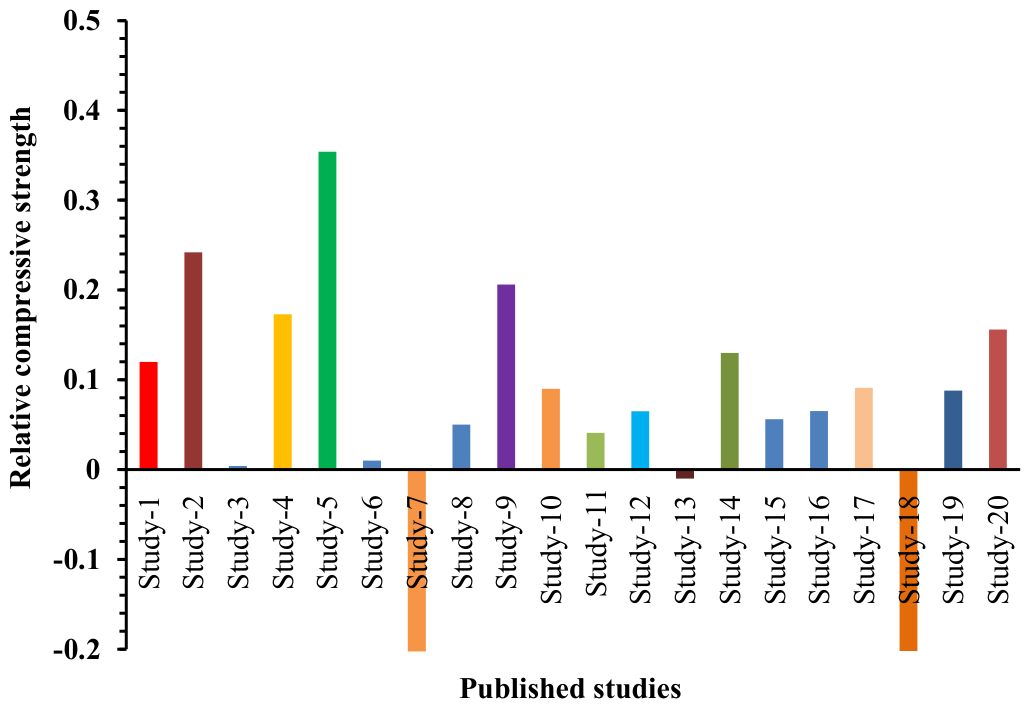
- One point is clear from the analysis of all selected studies: all studies evaluated the compressive strength of sustainable concrete. Hence, it is clear that compressive strength is the most essential parameter of the concrete; the other parameters are only valid when compressive strength passes the design strength criterion (fc′).
- ii.
- The second point is that most studies evaluated the strength characteristics more than the durability.
- iii.
- It has been observed that the combined use of SCMs replaced a significant amount of OPC in the new design mix sustainable concrete. However, each study showed different performances; hence, optimization is necessary before use in the concrete industry.
- iv.
- The recycled aggregates, coarse and fine, can also be replaced by natural aggregates. However, recycled aggregate had higher water absorption. Hence, a proper design mix is important for the durability of newly sustainable design mix concrete.
- v.
- For sustainable concrete, studies are inconsistent across all parameters that can affect industrial concrete performance over time. Hence, even if the sustainable concrete meets the strength requirements, proper durability tests must be conducted on each new batch before it is recommended for industrial use.
5. Cost–Benefit Evaluation of Sustainable Concrete
5.1. 1 m3 Sustainable Concrete Cost Analysis
5.2. Cost–Benefit Analysis of Sustainable Concrete
6. Prospect
- Long-Term Durability and Life Cycle Assessment (LCA): While short-term performance data is plentiful, more comprehensive studies are needed on the long-term strength and durability analysis of concrete incorporating high volumes of both RAs and SCMs, particularly under aggressive environmental conditions (e.g., marine environments, acid resistance, corrosion resistance, and freeze–thaw cycle testing). Future research should focus on conducting comprehensive life cycle assessments (LCAs) of sustainable concrete incorporating RAs and SCMs.
- Optimization of Recycled Sand Utilization: To continuously improve recycled sand quality in sustainable concrete, water absorption is the key physical property. New studies should focus on developing scalable, affordable pre-treatment methods. The full replacement of natural sand with developed sand from waste materials and vacant desert sand in new concrete designs requires investigating cutting-edge techniques to fulfill the industry requirements. That will allow the industry to accept the new concrete practically for end users.
- Combined Studies on Multiple SCMs with Recycled Aggregates: Most current research focuses on specific SCMs or RAs separately. Future studies should examine the combined effects of multiple SCMs, including SF, fly ash, ground granulated blast furnace slag, recycled fine dust, and natural pozzolans, as well as RAs. Such studies would enable the identification of optimal mix ratios that balance mechanical performance, durability, environmental benefits, and overall cost-effectiveness. The final combined ratio of SCMs and RAs, which will report the best combination across all aspects, should be available for practical application at the industrial level.
- Economic Modeling and Supply Chain Analysis: To evaluate the cost–benefit trade-offs of establishing regional solid waste processing facilities and the related supply chain logistics for SCMs and RAs, thorough economic feasibility studies are required. To support well-informed investment decisions throughout the sustainable concrete value chain, evaluations should produce transparent financial information.
7. Conclusions
- Mitigation of carbon footprint: The study confirmed that the primary source of carbon emissions is the calcination process during cement production. It has also been observed that studies have successfully found that SCMs overcome this issue. Most experimental studies found that silica fume with recycled aggregates is the most effective SCM for concrete performance in terms of strength and durability. However, the correct percentage is a matter of debate; different studies have reported different values, and none have confirmed a single value.
- Excessive Aggregate Extraction: The physical, chemical, and biological degradation of the river system is increasing to meet global demand for high-quality river sand utilized as a fine aggregate in the construction industry, resulting in a severe crisis. Recent studies have shown that recycled sand alone is not a good option for replacing higher percentages, as it does not improve the strength and durability of sustainable concrete. However, the combined use of recycled sand with other sands, such as desert and manufactured sands, could be the right option to replace a greater volume without affecting any strength or durability parameters.
- Sustainable Concrete Performance: SCMs, silica fume, and flyash improved strength and durability. In the case of combined use of silica fume = 10% and flyash = 15%, a combination of up to 25% was the best recommendation. Regarding recycled aggregates, such as coarse and fine aggregates, reported challenges include maintaining strength and durability at higher percentages. Most studies showed higher water absorption in RAs, which affected durability parameters. The pre-treatment method was suggested in published studies to maintain the water–cement ratio in the design mix concrete.
- Economic and Policy Implications: The transition to sustainable concrete is supported by the growing market for SCMs and the need to manage construction and demolition waste. Most studies did not report cost–benefit analyses of sustainable concrete. This review study reported that the cost–benefit analysis yielded the highest benefit when SCMs were combined with RAs.
Funding
Data Availability Statement
Acknowledgments
Conflicts of Interest
References
- Steinthorsdottir, M.; Coxall, H.; De Boer, A.; Huber, M.; Barbolini, N.; Bradshaw, C.; Burls, N.; Feakins, S.; Gasson, E.; Henderiks, J. The Miocene: The future of the past. Paleoceanogr. Paleoclimatol. 2021, 36, e2020PA004037. [Google Scholar] [CrossRef]
- Isson, T.T.; Planavsky, N.J.; Coogan, L.; Stewart, E.; Ague, J.; Bolton, E.; Zhang, S.; McKenzie, N.; Kump, L. Evolution of the global carbon cycle and climate regulation on earth. Glob. Biogeochem. Cycles 2020, 34, e2018GB006061. [Google Scholar] [CrossRef]
- Martin, K.R.; Nickoloff, A.; Moffat, L.; Weaver, A.J.; Eby, M. Assessing the effectiveness of ocean alkalinity enhancement on carbon sequestration and ocean acidification. Facets 2025, 10, 1–8. [Google Scholar]
- Kopperi, H.; Mukhrjee, T.; Kumari, P.; Javvadi, Y.; Mohan, S.V.; Swaminathan, S. India’s Cement Industry: Meeting the Challenge of Emissions Abatement with Sustainable Growth. ChemRxiv 2025. [Google Scholar] [CrossRef]
- Greco-Coppi, M.; Hofmann, C.; Ströhle, J.; Walter, D.; Epple, B. Efficient CO2 capture from lime production by an indirectly heated carbonate looping process. Int. J. Greenh. Gas Control 2021, 112, 103430. [Google Scholar] [CrossRef]
- Shan, Y.; Liu, Z.; Guan, D. CO2 emissions from China’s lime industry. Appl. Energy 2016, 166, 245–252. [Google Scholar] [CrossRef]
- Oriaku, E.; Abuh, M.; Udeh, U.O.; Ani, H. Mineral Processing: Production of Calcium Oxide from Nkalagu Limestone, Effect of Particle Size and Temperature. Caritas Int. J. Mech. Eng. Sci. 2025, 1, 1. [Google Scholar]
- Pitchaiah, P.S. Impacts of sand mining on environment—A Review. SSRG Int. J. Geoinform. Geol. Sci. 2017, 4, 1–5. [Google Scholar]
- IMR. Sand Market Size, Share & Global Industry Analysis 2032. Report ID 17320. 2024. Available online: https://introspectivemarketresearch.com/reports/sand-market/ (accessed on 15 June 2026).
- Garg, Y.; Faiz, M.; Gupta, M. Sand and Sustainability: A Review Paper. In Proceedings of 2024 10th International Conference on Advanced Computing and Communication Systems (ICACCS); IEEE: New York, NY, USA, 2024; pp. 1652–1656. [Google Scholar]
- Rentier, E.; Cammeraat, L. The environmental impacts of river sand mining. Sci. Total Environ. 2022, 838, 155877. [Google Scholar] [CrossRef] [PubMed]
- Cao, Z.; Chu, C.; Liu, J.; Su, X.; Zhong, X.; Behrens, P. Closing the global sand circularity gap needs a systems approach. One Earth 2025, 8, 101199. [Google Scholar] [CrossRef]
- Pandey, S.; Kumar, G.; Kumari, N.; Pandey, R. Assessment of causes and impacts of sand mining on river ecosystem. In Hydrogeochemistry of Aquatic Ecosystems; John Wiley & Sons Ltd.: Chichester, UK, 2023; pp. 357–379. [Google Scholar]
- Gopal, B.; Chauhan, M. River Sand and Gravel Mining: Striking a Balance between Ecology and Economy. Int. J. Ecol. Environ. Sci. 2025, 51, 171–179. [Google Scholar] [CrossRef]
- Bakta, S.; Ombella, J.; Kilonzo, C. Legal Gaps and Contradictions in Environmental Preservation in Small-Scale Sand Mining in Tanzania: Brewing Climate Change? J. Contemp. Afr. Leg. Stud. 2025, 2, 32–44. [Google Scholar] [CrossRef]
- NGT. Cases Related to Sand Mining. 2021. Available online: https://www.iasgyan.in/daily-current-affairs/sand-mining (accessed on 15 June 2026).
- Hernandez, M. The Messy Business of Sand Mining Explained. 2021. Available online: https://www.reuters.com/graphics/GLOBAL-ENVIRONMENT/SAND/ygdpzekyavw/ (accessed on 15 June 2026).
- Rangel-Buitrago, N.; Neal, W.; Pilkey, O.; Longo, N. The global impact of sand mining on beaches and dunes. Ocean Coast. Manag. 2023, 235, 106492. [Google Scholar] [CrossRef]
- Ashraf, M.A.; Maah, M.J.; Yusoff, I.; Wajid, A.; Mahmood, K. Sand mining effects, causes and concerns: A case study from Bestari Jaya, Selangor, Peninsular Malaysia. Sci. Res. Essays 2011, 6, 1216–1231. [Google Scholar]
- Adil, G.; Kevern, J.T.; Mann, D. Influence of silica fume on mechanical and durability of pervious concrete. Constr. Build. Mater. 2020, 247, 118453. [Google Scholar] [CrossRef]
- Azizi, M.; Samimi, K. Effect of silica fume on Self-compacting Earth Concrete: Compressive strength, durability and microstructural studies. Constr. Build. Mater. 2025, 472, 140815. [Google Scholar] [CrossRef]
- Aldred, J.M.; Holland, T.C.; Morgan, D.R.; Roy, D.M.; Bury, M.A.; Hooton, R.D.; Olek, J.; Scali, M.J.; Detwiler, R.J.; Jaber, T.M. Guide for the Use of Silica Fume in Concrete; ACI–American Concrete Institute–Committee: Farmington Hills, MI, USA, 2006; Volume 234. [Google Scholar]
- Bravo, M.; De Brito, J.; Pontes, J.; Evangelista, L. Mechanical performance of concrete made with aggregates from construction and demolition waste recycling plants. J. Clean. Prod. 2015, 99, 59–74. [Google Scholar] [CrossRef]
- Abed, M.; Nemes, R.; Tayeh, B.A. Properties of self-compacting high-strength concrete containing multiple use of recycled aggregate. J. King Saud Univ. Eng. Sci. 2020, 32, 108–114. [Google Scholar]
- Zheng, C.; Lou, C.; Du, G.; Li, X.; Liu, Z.; Li, L. Mechanical properties of recycled concrete with demolished waste concrete aggregate and clay brick aggregate. Results Phys. 2018, 9, 1317–1322. [Google Scholar] [CrossRef]
- Jagadeesh, P. Assessment of usage of manufactured sand and recycled aggregate as sustainable concrete: A review. Mater. Today Proc. 2022, 64, 1029–1034. [Google Scholar] [CrossRef]
- Zhang, K.; Xiao, J.; Hou, Y.; Zhang, Q. Experimental study on carbonation behavior of seawater sea sand recycled aggregate concrete. Adv. Struct. Eng. 2022, 25, 927–938. [Google Scholar] [CrossRef]
- Pereira, P.; Evangelista, L.; De Brito, J. The effect of superplasticisers on the workability and compressive strength of concrete made with fine recycled concrete aggregates. Constr. Build. Mater. 2012, 28, 722–729. [Google Scholar] [CrossRef]
- Wu, E.; Ma, X.; Fang, C.; Li, N.; Jia, L.; Jiang, P.; Wang, W. Strength performance and microscopic mechanism of cement mortar incorporating fine recycled concrete aggregate and natural sand. J. Build. Eng. 2025, 100, 111767. [Google Scholar] [CrossRef]
- Aslani, F.; Ma, G.; Wan, D.L.Y.; Muselin, G. Development of high-performance self-compacting concrete using waste recycled concrete aggregates and rubber granules. J. Clean. Prod. 2018, 182, 553–566. [Google Scholar]
- Sunhare, P.; Ananda Babu, K.; Sharma, R. Experimental Study on Use of Dismantled Aggregate as Natural Coarse Aggregate. J. Civ. Constr. Eng. 2020, 6, 27–35. [Google Scholar]
- Carro-López, D.; González-Fonteboa, B.; Martínez-Abella, F.; González-Taboada, I.; de Brito, J.; Varela-Puga, F. Proportioning, microstructure and fresh properties of self-compacting concrete with recycled sand. Procedia Eng. 2017, 171, 645–657. [Google Scholar] [CrossRef]
- Fernández-Ledesma, E.; Jiménez, J.; Ayuso, J.; Corinaldesi, V.; Iglesias-Godino, F. A proposal for the maximum use of recycled concrete sand in masonry mortar design. Mater. Constr. 2016, 66, 321. [Google Scholar] [CrossRef]
- Liang, G.; She, A.; Yao, W. Sustainable use of recycled sand in alkali-activated cement and Portland cement mortars: A comparative study with natural sand. Sustain. Mater. Technol. 2025, 43, e01290. [Google Scholar] [CrossRef]
- Yang, Y.; Chen, B.; Su, Y.; Chen, Q.; Li, Z.; Guo, W.; Wang, H. Concrete mix design for completely recycled fine aggregate by modified packing density method. Materials 2020, 13, 3535. [Google Scholar] [CrossRef] [PubMed]
- Hamada, H.M.; Abed, F.; Al-Sadoon, Z.A.; Elnassar, Z.; Hassan, A. The use of treated desert sand in sustainable concrete: A mechanical and microstructure study. J. Build. Eng. 2023, 79, 107843. [Google Scholar] [CrossRef]
- Akhtar, M.N.; Albatayneh, O.; Bani-Hani, K.A.; Malkawi, A.I.H. Performance of modified desert sand concrete: An experimental case study. Case Stud. Constr. Mater. 2024, 21, e03465. [Google Scholar] [CrossRef]
- Akhtar, M.N.; Bani-Hani, K.A.; Malkawi, D.A.H.; Albatayneh, O. Suitability of sustainable sand for concrete manufacturing-A complete review of recycled and desert sand substitution. Results Eng. 2024, 23, 102478. [Google Scholar]
- Ji, Y.; Qasem, M.G.S.; Xu, T.; Mohammed, A.O.Y. Mechanical properties investigation on recycled rubber desert sand concrete. J. CO2 Util. 2024, 88, 102939. [Google Scholar] [CrossRef]
- Jin, B.H.; Song, J.X.; Liu, H.F. Engineering characteristics of concrete made of desert sand from Maowusu Sandy Land. Appl. Mech. Mater. 2012, 174, 604–607. [Google Scholar]
- Zhang, G.; Song, J.; Yang, J.; Liu, X. Performance of mortar and concrete made with a fine aggregate of desert sand. Build. Environ. 2006, 41, 1478–1481. [Google Scholar] [CrossRef]
- Hou, M.; Li, Z.; Li, V.C. Green and durable engineered cementitious composites (GD-ECC) with recycled PE fiber, desert sand, and carbonation curing: Mixture design, durability performance, and life-cycle analysis. Constr. Build. Mater. 2024, 414, 134984. [Google Scholar]
- El-Mir, A.; El-Hassan, H.; El-Dieb, A.; Alsallamin, A. Development and optimization of geopolymers made with desert dune sand and blast furnace slag. Sustainability 2022, 14, 7845. [Google Scholar] [CrossRef]
- Chen, Q.; Liu, H.; Han, L.; Wang, Y. Comparative studies of dynamic mechanical properties of desert sand concrete and ordinary concrete. Shock Vib. 2022, 2022, 8680750. [Google Scholar] [CrossRef]
- Akhtar, M.N.; Jameel, M.; Ibrahim, Z.; Bunnori, N.M.; Bani-Hani, K.A. Development of sustainable modified sand concrete: An experimental study. Ain Shams Eng. J. 2024, 15, 102331. [Google Scholar]
- Damdelen, Ö.; Mosaberpanah, M.A.; Olabimtan, S.B.; Anthony, M.D.; Oluwole, B.O. Binary effect of silica fume and waste glass powder as a cement replacement for a sustainable concrete. Discov. Concr. Cem. 2025, 1, 28. [Google Scholar] [CrossRef]
- Mostofinejad, D.; Nasrollahi, M.; Bahmani, H.; Zajshoor, Z.; Sadeghi, M. Enhancing concrete strength and durability of normal and high-strength concrete: Exploring combined effects of optimized silica fume and slag. Iran. J. Sci. Technol. Trans. Civ. Eng. 2025, 49, 2309–2328. [Google Scholar]
- Ali, T.; Qureshi, M.Z.; Inam, I.; Kahla, N.B.; Ahmed, H.; Ajwad, A.; Adnan, M. Sustainable concrete production through the integration of waste foundry sand, fly ash, silica fume and metakaolin. Sci. Rep. 2025, 15, 27512. [Google Scholar] [CrossRef] [PubMed]
- IEA. Technology Roadmap Low-Carbon Transition in the Cement Industry; WBCSD: Geneva, Switzerland; IEA: Paris, France, 2018. [Google Scholar]
- Roser, M.; Ritchie, H.; Ortiz-Ospina, E.; Rodés-Guirao, L. World population growth. Our World Data 2013, 412, 543. [Google Scholar] [CrossRef]
- Rihner, M.; Hafez, H.; Walkley, B.; Purnell, P.; Drewniok, M. Thousand cuts: A realistic route to decarbonisation the UK cement and concrete sector by 2050. Sustain. Prod. Consum. 2025, 58, 319–333. [Google Scholar] [CrossRef]
- Akhtar, M.N.; Bani-Hani, K.A.; Akhtar, J.; Khan, R.A.; Nejem, J.K.; Zaidi, K. Flyash-based bricks: An environmental savior—A critical review. J. Mater. Cycles Waste Manag. 2022, 24, 1663–1678. [Google Scholar]
- Khalil, E.; AbouZeid, M. A global assessment tool for cement plants improvement measures for the reduction of CO2 emissions. Results Eng. 2025, 26, 104767. [Google Scholar] [CrossRef]
- Andrew, R. Global CO2 emissions from cement production, 1928–2018. Earth Syst. Sci. Data 2019, 11, 1675–1710. [Google Scholar] [CrossRef]
- Environment, U.; Scrivener, K.L.; John, V.M.; Gartner, E.M. Eco-efficient cements: Potential economically viable solutions for a low-CO2 cement-based materials industry. Cem. Concr. Res. 2018, 114, 2–26. [Google Scholar]
- Lehne, J.; Preston, F. Making concrete change: Innovation in low-carbon cement and concrete. Chatham House Rep. 13 June 2018. Available online: https://www.chathamhouse.org/about-us/our-departments-and-programmes/environment-and-society-centre/innovation-low-carbon-cement (accessed on 15 June 2026).
- García-Gusano, D.; Herrera, I.; Garraín, D.; Lechón, Y.; Cabal, H. Life cycle assessment of the Spanish cement industry: Implementation of environmental-friendly solutions. Clean Technol. Environ. Policy 2015, 17, 59–73. [Google Scholar]
- Taylor, M.; Tam, C.; Gielen, D. Energy efficiency and CO2 emissions from the global cement industry. Korea 2006, 50, 61–67. [Google Scholar]
- Williams, K.C.; Partheeban, P. An experimental and numerical approach in strength prediction of reclaimed rubber concrete. Adv. Concr. Constr. 2018, 6, 87. [Google Scholar]
- Akhtar, M.N.; Jameel, M.; Ibrahim, Z.; Bunnori, N.M. Incorporation of recycled aggregates and silica fume in concrete: An environmental savior-a systematic review. J. Mater. Res. Technol. 2022, 20, 4525–4544. [Google Scholar] [CrossRef]
- Xu, K.; Yang, J.; He, H.; Wei, J.; Zhu, Y. Influences of Additives on the Rheological Properties of Cement Composites: A Review of Material Impacts. Materials 2025, 18, 1753. [Google Scholar] [CrossRef] [PubMed]
- Azare, A.A.; Ibrahim, M.H.B.W.; Alshalif, A.F.; Jaya, R.P.; Nindyawati, N. Mechanical and Microstructural Characteristics of High-Strength Self-Compacting Concrete (HSSCC) with Optimal Silica Fume and Fly Ash Cement Replacement. Int. J. Sustain. Constr. Eng. Technol. 2024, 15, 81–99. [Google Scholar]
- Tripathi, I.M.; Mahto, S.S.; Bhagat, C.; Modi, A.; Jain, V.; Mohapatra, P.K. A Review of River Sand Mining: Methods, Impacts, and Implications. Next Res. 2025, 2, 100149. [Google Scholar] [CrossRef]
- Singh, P.; Chauhan, S.S.; Mishra, A. Ecological impacts of sand mining on the riverbanks of sangam. In Ecosystem Dynamics of Prayagraj; M/S Academic Publishers & Distributors: Lucknow, India, 2025. [Google Scholar]
- Bhatawdekar, R.M.; Singh, T.N.; Tonnizam Mohamad, E.; Armaghani, D.J.; Binti Abang Hasbollah, D.Z. River sand mining vis a vis manufactured sand for sustainability. In Proceedings of the International Conference on Innovations for Sustainable and Responsible Mining: ISRM 2020; Springer: New York, NY, USA, 2021; pp. 143–169; Volume 1. [Google Scholar]
- Kim, T.T.; Nga, T.N.Q.; Huy, N.D.Q.; Phung, N.K.; Hoai, H.C.; Bay, N.T. The impact of sand mining on the bed morphology of the Tien River, Mekong Delta, Vietnam. Environ. Earth Sci. 2025, 84, 84. [Google Scholar] [CrossRef]
- Dukeyev, B. Shifting Sands: Uncovering the Struggle for World War II Memory in Kazakhstan. Probl. Post-Communism 2025, 73, 152–165. [Google Scholar] [CrossRef]
- Pant, R.R.; Varol, M.; Phuyal, S.; Bhattarai, S.; Awasthi, M.P.; Thakur, T.K.; Bohara, R.; Basnet, N.; Sitaula, S.; Afandi, G.E. How sand mining is shaping the Trishuli river in the Himalayas of South Asia. Earth Syst. Environ. 2025, 10, 185–201. [Google Scholar] [CrossRef]
- He, X.; Xiao, J.; Yang, M.; Gao, J.; Wang, C. Component Distinction and Content Optimization of Fine Powder in Crushed Sand for High-Fluidity Concrete. J. Mater. Civ. Eng. 2025, 37, 04025447. [Google Scholar] [CrossRef]
- Rousseau, J.-F.; Lauzon, A.; Marschke, M. Can green concrete help address the sand and aggregate crisis? A scoping literature review. J. Environ. Plan. Manag. 2025, 68, 1788–1806. [Google Scholar]
- Team, I. Waste Management and Waste-to-Energy. Available online: https://static1.squarespace.com/static/66d875be45741e71e207c640/t/696fb387c39bc02fd1be7aaf/1768928135176/ecswg_g20technicalpapers_october2025.pdf (accessed on 15 June 2026).
- Sakthibala, R.; Vasanthi, P.; Hariharasudhan, C.; Partheeban, P. A critical review on recycling and reuse of construction and demolition waste materials. Clean. Waste Syst. 2025, 12, 100375. [Google Scholar] [CrossRef]
- Bhuyan, A.; Bordoloi, T.; Debnath, R.; Ikbal, A.M.A.; Debnath, B.; Singh, W.S. Assessing AQI of air pollution crisis 2024 in Delhi: Its health risks and nationwide impact. Discov. Atmos. 2025, 3, 13. [Google Scholar] [CrossRef]
- Wu, J.; Ye, X.; Cui, H. Recycled Materials in Construction: Trends, Status, and Future of Research. Sustainability 2025, 17, 2636. [Google Scholar] [CrossRef]
- White, S. Climate change in global environmental history. In A Companion to Global Environmental History; Blackwell Publishing Ltd.: Oxford, UK, 2025; pp. 361–374. [Google Scholar]
- Bonifazi, G.; Chiara, G.; Roberta, P.; Silvia, S. Current trends and challenges in construction and demolition waste recycling. Curr. Opin. Green Sustain. Chem. 2025, 53, 101032. [Google Scholar] [CrossRef]
- MacKenzie, T. The Sand Agenda: Transnational Sand Extraction, Social Injustice, and the Urgent Need for Global Governance. Mich. J. Political Sci. 2025, 1001, 94. [Google Scholar]
- Lian, L.; Huang, J.; Chen, S.; Du, S.; Zhang, L.; Yang, J. A Comprehensive Review of Dust Events: Characteristics, Climate Feedbacks, and Public Health Risks. Curr. Pollut. Rep. 2025, 11, 18. [Google Scholar] [CrossRef]
- Fatiha, A.; Karim, E.; Mhamed, A.; Abed, F. Enhancing performance of recycled aggregate concrete with supplementary cementitious materials. Clean. Mater. 2025, 15, 100298. [Google Scholar] [CrossRef]
- Akhtar, M.N. Feasibility of Modified Sand Made by Using Desert and Recycled Sand in Structural Concrete: An Experimental Research. Int. J. Concr. Struct. Mater. 2026, 20, 46. [Google Scholar] [CrossRef]
- Mohammed, T.U.; Rony, M.A.; Zunaied Bin Harun, M.; Uddin, N.; Saha, D.; Rahman, M.N.; Mahmood, A.H. Alternative Fine Aggregates to Natural River Sand for Manufactured Concrete Ensuring Circular Economy. Constr. Mater. 2024, 4, 640–654. [Google Scholar] [CrossRef]
- Mundra, S.; Sindhi, P.; Chandwani, V.; Nagar, R.; Agrawal, V. Crushed rock sand–An economical and ecological alternative to natural sand to optimize concrete mix. Perspect. Sci. 2016, 8, 345–347. [Google Scholar] [CrossRef]
- Ismail, A.Y.; Al-Luhybi, A.S.; Mohammad, K.I. Prediction of compressive strength of concrete incorporating fine recycled aggregate using regression analysis. Alger. J. Eng. Technol. 2024, 9, 114–126. [Google Scholar]
- Sada, B.; Amartey, Y.; Bako, S. An investigation into the use of groundnut shell as fine aggregate replacement. Niger. J. Technol. 2013, 32, 54–60. [Google Scholar]
- Cherif, R.; Bousleh, A.; El Euch Khay, S. Sustainable sand concrete incorporating fine recycled aggregates for structural applications. Eng. Res. Express 2026, 8, 015101. [Google Scholar] [CrossRef]
- Ngayakamo, B.H.; Ikotun, B.D. Utilization of quartz quarry dust as a sustainable partial sand replacement in cement mortar. Sci. Rep. 2026, 16, 7031. [Google Scholar] [CrossRef] [PubMed]
- Saurav, S.; Sinha, S. Performance Assessment of Stabilised Fine Sand Incorporating Crushed Bricks for Sustainable Pavement Layers. Road Mater. Pavement Des. 2026, 1–29. [Google Scholar] [CrossRef]
- Chen, Y.; Liu, Q.-F.; Xiong, Q.X.; Tan, K.; Zhu, W.; Shen, W. Artificial intelligence-guided design of manufactured sand concrete with targeted performance. Eng. Appl. Artif. Intell. 2026, 165, 113424. [Google Scholar] [CrossRef]
- Nejem, J.K.; Akhtar, M.N.; Almasri, A.H.; Rais, M.S. Assessment of Sustainable Structural Concrete Made by Composite Waste for the Concrete Industry: An Experimental Study. J. Compos. Sci. 2025, 9, 279. [Google Scholar] [CrossRef]
- Shmlls, M.; Abed, M.A.; Horvath, T.; Bozsaky, D. Sustainability framework of recycled aggregate concrete produced with supplementary cementitious materials. Ain Shams Eng. J. 2023, 14, 102036. [Google Scholar] [CrossRef]
- Nelson, K.; Horizon Research Publishing. Recycled aggregate concrete made with silica fume: Experimental investigation. Civ. Eng. Archit. 2020, 8, 1136–1143. [Google Scholar] [CrossRef]
- Corominas, A.; Etxeberria, M. Experimental analysis of properties of high performance recycled aggregate concrete. Constr. Build. Mater. 2014, 52, 227–235. [Google Scholar] [CrossRef]
- Gholampour, A.; Zheng, J.; Ozbakkaloglu, T. Development of waste-based concretes containing foundry sand, recycled fine aggregate, ground granulated blast furnace slag and fly ash. Constr. Build. Mater. 2021, 267, 121004. [Google Scholar] [CrossRef]
- Mohan, A.; Mini, K. Strength and durability studies of SCC incorporating silica fume and ultra fine GGBS. Constr. Build. Mater. 2018, 171, 919–928. [Google Scholar] [CrossRef]
- Akhtar, M.N.; Bani-Hani, K.A.; Akhtar, J.N. High-Temperature and Acid Resistance of Concrete with Recycled, Desert Sand, and Crumb Rubber Blends. Materials 2025, 18, 4410. [Google Scholar] [CrossRef] [PubMed]
- Bhardwaj, B.; Kumar, P. Waste foundry sand in concrete: A review. Constr. Build. Mater. 2017, 156, 661–674. [Google Scholar] [CrossRef]
- Alla, S.; Jayaram, M.; Asadi, S. An experimental investigation for replacements of river sand and cement with Robosand, fly-ash and silica fume in concrete to evaluate the influence in durability properties. Mater. Today Proc. 2021, 43, 954–961. [Google Scholar] [CrossRef]
- Memon, F.A.; Nuruddin, M.F.; Shafiq, N. Effect of silica fume on the fresh and hardened properties of fly ash-based self-compacting geopolymer concrete. Int. J. Miner. Metall. Mater. 2013, 20, 205–213. [Google Scholar]
- Tabsh, S.W.; Abdelfatah, A.S. Influence of recycled concrete aggregates on strength properties of concrete. Constr. Build. Mater. 2009, 23, 1163–1167. [Google Scholar] [CrossRef]
- Barbhuiya, S.; Qureshi, M. Effects of silica fume on the strength and durability properties of concrete. Age 2016, 3, 28. [Google Scholar]
- Sasanipour, H.; Aslani, F.; Taherinezhad, J. Effect of silica fume on durability of self-compacting concrete made with waste recycled concrete aggregates. Constr. Build. Mater. 2019, 227, 116598. [Google Scholar] [CrossRef]
- Farhan, N.; Rakibul, H.; Habibur Rahman, S.; Jawad, A.; Noor Md Sadiqul, H.; Shuvo Dip, D.; Hamidul, I.; Ashraful, I.; Robiul, A.; Arifur, R. Effect of silica fume on the microstructural and mechanical properties of concrete made with 100% recycled aggregates. Rev. Constr. 2024, 23, 413–435. [Google Scholar] [CrossRef]
- Yunchao, T.; Zheng, C.; Wanhui, F.; Yumei, N.; Cong, L.; Jieming, C. Combined effects of nano-silica and silica fume on the mechanical behavior of recycled aggregate concrete. Nanotechnol. Rev. 2021, 10, 819–838. [Google Scholar] [CrossRef]
- Ayub, T.; Mahmood, W.; Khan, A.-U.-R. Durability performance of SCC and SCGC containing recycled concrete aggregates: A comparative study. Sustainability 2021, 13, 8621. [Google Scholar] [CrossRef]
- Yehia, S.; Helal, K.; Abusharkh, A.; Zaher, A.; Istaitiyeh, H. Strength and durability evaluation of recycled aggregate concrete. Int. J. Concr. Struct. Mater. 2015, 9, 219–239. [Google Scholar] [CrossRef]
- Alharthai, M.; Onyelowe, K.C.; Ali, T.; Qureshi, M.Z.; Rezzoug, A.; Deifalla, A.; Alharthi, K. Enhancing concrete strength and durability through incorporation of rice husk ash and high recycled aggregate. Case Stud. Constr. Mater. 2025, 22, e04152. [Google Scholar] [CrossRef]
- ASTM C293-08; Standard Test Method for Flexuralstrength of Concrete (Using Simple Beam with Center-Point Loading). ASTM International: West Conshohocken, PA, USA, 2016.
- ASTM C496/C496M-17; Standard Test Method for Splitting Tensile Strength of Cylindrical Concrete Specimens. ASTM International: West Conshohocken, PA, USA, 2004; pp. 469–490.
- IEA. Cement. 2020. Available online: https://www.iea.org/energy-system/industry/cement (accessed on 15 June 2026).





| Source of Emission | Process Description | Approximate Contribution to Total CO2 Emissions (%) | Chemical Equation Example |
|---|---|---|---|
| Coal Combustion | Burning of coal as kiln fuel for clinker production | 30–40% | C + O2 → CO2 |
| Calcination (Decomposition) | Thermal decomposition of CaCO3 to form CaO and CO2 | 60–70% | CaCO3 → CaO + CO2 |
| Total CO2 Emissions | Combined emissions from fuel and calcination | ~100% | — |
| Published Studies | Relative Values of the Tested Parameters of Sustainable Concrete | |||||||||
|---|---|---|---|---|---|---|---|---|---|---|
| Compressive Strength | Splitting Tensile Strength | Flexural Strength | Modulus of Elasticity | Shrinkage of Concrete | Water Absorption | Acid Attack | Sample Cracking Pattern | Resistance Against High Temperatures | Rapid Chloride Penetration Test | |
| Study 1 [79] | +0.12 | +0.196 | +0.45 | - | +0.44 | +0.28 | - | - | - | - |
| Study 2 [89] | +0.242 | - | +0.558 | +0.055 | - | +0.118 | +0.30 | - | - | - |
| Study 3 [90] | +0.004 | +0.051 | +0.129 | - | - | - | - | - | - | - |
| Study 4 [45] | +0.173 | +0.037 | - | - | - | - | - | +0.60 | - | - |
| Study 5 [91] | +0.354 | +0.176 | +0.130 | - | - | - | - | - | - | - |
| Study 6 [92] | +0.010 | −0.006 | +0.051 | −0.121 | - | −0.05 | - | - | - | - |
| Study 7 [93] | −0.208 | −0.0737 | −0.199 | −0.025 | - | −0.023 | - | - | - | - |
| Study 8 [94] | +0.05 | +0.116 | - | - | +0.02 | - | −0.11 | - | - | - |
| Study 9 [95] | +0.206 | - | - | - | - | - | +0.164 | - | +0.147 | - |
| Study 10 [96] | +0.090 | +0.026 | - | +0.068 | −0.50 | - | - | - | - | |
| Study 11 [97] | +0.041 | +0.010 | +0.023 | - | - | - | −0.018 | - | - | - |
| Study 12 [98] | +0.065 | +0.113 | +0.115 | - | - | - | - | - | - | - |
| Study 13 [99] | −0.010 | −0.25 | - | - | - | - | - | - | - | - |
| Study 14 [100] | +0.13 | +0.04 | - | - | - | +0.17 | - | - | - | +0.90 |
| Study 15 [101] | +0.056 | - | - | - | +0.18 | - | - | - | −0.026 | |
| Study 16 [102] | +0.065 | +0.234 | - | - | - | - | - | +0.58 | - | - |
| Study 17 [103] | +0.091 | +0.165 | - | - | - | - | - | +0.25 | - | - |
| Study 18 [104] | −0.202 | −0.09 | - | - | - | −0.06 | - | - | - | - |
| Study 19 [105] | +0.088 | +0.042 | - | +0.043 | - | - | - | - | - | −0.133 |
| Study 20 [106] | +0.156 | +0.213 | - | - | - | +0.032 | −0.311 | - | - | - |
| Published Studies | Binding Materials | Fine Aggregate | Coarse Aggregate | Admixture | Cost of 1 m3 of Concrete ($) | |||||
|---|---|---|---|---|---|---|---|---|---|---|
| OPC | FA | SF | Natural Sand | Recycled Sand | Desert Sand | Natural Aggregate | Recycled Aggregate | |||
| Cost of materials in $/kg | 0.07 | 0.08 | 0.26 | 0.025 | 0.008 | 0.006 | 0.020 | 0.009 | 0.40 | |
| Conventional concrete cost | 32.61 | - | - | 22.46 | - | - | 21.35 | - | 1.2 | 77.62 |
| Study 1 [79] (10% SF + 100 RCA) | 27.09 | - | 11.18 | 18.75 | - | - | - | 8.86 | 2.2 | 68.08 |
| Study 2 [89] (15% FA + 10% SF + 50% RS) | 24.41 | 5.58 | 12.09 | 8.62 | 2.76 | - | 20 | - | 2.4 | 75.86 |
| Study 3 [90] (20% FA + 12% SF + 70% RCA) | 16.15 | 5.76 | 10.18 | 22.12 | - | - | 6.28 | 7.56 | 2.1 | 70.15 |
| Study 4 [45] (12.5% SF + 50% RS) | 26.6 | - | 14.6 | - | 2.8 | 2.1 | 20.6 | - | 4.5 | 71.20 |
| Study 5 [91] (15% SF + 100% RCA) | 21.12 | - | 13.78 | 18.25 | - | - | 8.25 | 9.31 | - | 70.71 |
| Parameters | Weightage Factor | Study 1 [79] (10% SF + 100 RCA) | Study 2 [89] (15%FA + 10% SF + 50% RS) | Study 3 [90] (20% FA + 12% SF + 30% RCA) | Study 4 [45] (12.5% SF + 50% RS) | Study 5 [91] (15% SF + 100% RCA) | |||||
|---|---|---|---|---|---|---|---|---|---|---|---|
| Increase | Increase Multiplied by the Weightage Factor | Increase | Increase Multiplied by the Weightage Factor | Increase | Increase Multiplied by the Weightage Factor | Increase | Increase Multiplied by the Weightage Factor | Increase | Increase Multiplied by the Weightage Factor | ||
| Compressive strength | 0.40 | 0.12 | 0.048 | 0.242 | 0.097 | 0.004 | 0.002 | 0.173 | 0.069 | 0.354 | 0.142 |
| Splitting tensile strength | 0.10 | 0.196 | 0.019 | - | - | 0.051 | 0.005 | 0.037 | 0.004 | 0.176 | 0.017 |
| Flexural strength | 0.10 | 0.45 | 0.045 | 0.558 | 0.056 | 0.129 | 0.013 | - | 0.130 | 0.013 | |
| Modulus of elasticity | 0.10 | - | - | 0.055 | 0.005 | - | - | - | - | - | - |
| Sample cracking pattern | 0.10 | - | - | - | - | - | - | 0.60 | 0.06 | - | - |
| Water absorption | 0.10 | 0.28 | 0.028 | 0.118 | 0.011 | - | - | - | - | - | - |
| Sulfuric acid attack | 0.10 | 0.30 | 0.03 | - | - | - | - | - | - | ||
| Shrinkage of concrete | 0.10 | 0.44 | 0.044 | - | - | - | - | - | - | - | - |
| Benefit with a weightage factor | 2 | Study | |||||||||
| Conventional concrete cost (CCC) ($) | 77.62 | 77.62 | 77.62 | 77.62 | 77.62 | ||||||
| Non-conventional concrete cost (N-CCC) ($) | 68.08 | 75.86 | 70.15 | 71.20 | 70.71 | ||||||
| 20.97 | 20.36 | 2.30 | 14.49 | 18.88 | |||||||
Disclaimer/Publisher’s Note: The statements, opinions and data contained in all publications are solely those of the individual author(s) and contributor(s) and not of MDPI and/or the editor(s). MDPI and/or the editor(s) disclaim responsibility for any injury to people or property resulting from any ideas, methods, instructions or products referred to in the content. |
© 2026 by the authors. Licensee MDPI, Basel, Switzerland. This article is an open access article distributed under the terms and conditions of the Creative Commons Attribution (CC BY) license.
Share and Cite
Akhtar, M.N.; Qudah, A.; Bani-Hani, K.A. Assessing Environmental Impact, Structural Integrity, and Circular Economy of Sustainable Concrete Made with Recycled Aggregates and SCM Composites: Systematic Literature Review. J. Compos. Sci. 2026, 10, 335. https://doi.org/10.3390/jcs10070335
Akhtar MN, Qudah A, Bani-Hani KA. Assessing Environmental Impact, Structural Integrity, and Circular Economy of Sustainable Concrete Made with Recycled Aggregates and SCM Composites: Systematic Literature Review. Journal of Composites Science. 2026; 10(7):335. https://doi.org/10.3390/jcs10070335
Chicago/Turabian StyleAkhtar, Mohammad Nadeem, Abdalla Qudah, and Khaldoon A. Bani-Hani. 2026. "Assessing Environmental Impact, Structural Integrity, and Circular Economy of Sustainable Concrete Made with Recycled Aggregates and SCM Composites: Systematic Literature Review" Journal of Composites Science 10, no. 7: 335. https://doi.org/10.3390/jcs10070335
APA StyleAkhtar, M. N., Qudah, A., & Bani-Hani, K. A. (2026). Assessing Environmental Impact, Structural Integrity, and Circular Economy of Sustainable Concrete Made with Recycled Aggregates and SCM Composites: Systematic Literature Review. Journal of Composites Science, 10(7), 335. https://doi.org/10.3390/jcs10070335