Review

Research Progress on Metal–Organic Framework Composites for Greenhouse Gas Adsorption and Separation

1
Faculty of Chemical Engineering, Kunming University of Science and Technology, Kunming 650500, China
2
National Engineering Research Center of Flame Retardant Materials, School of Materials Science & Engineering, Beijing Institute of Technology, Beijing 100081, China
*
Authors to whom correspondence should be addressed.
J. Compos. Sci. 2026, 10(6), 324; https://doi.org/10.3390/jcs10060324
Submission received: 7 May 2026 / Revised: 15 June 2026 / Accepted: 15 June 2026 / Published: 18 June 2026
(This article belongs to the Section Composites Applications)

Abstract

The excessive emission of greenhouse gases (CO2, CH4, SF6, and CF4.) is a primary driver of global climate change, making the development of efficient adsorption and separation technologies critically important for achieving carbon reduction goals. Metal–organic frameworks (MOFs) have attracted considerable attention in this field due to their crystalline porous structures, ultrahigh surface areas, and tunable pore architectures. However, pristine MOFs face significant bottlenecks including poor water stability, high bed pressure drops caused by their powdered form, and limited mass transfer, which severely hinder their industrial application. The integration of MOFs with functional materials such as carbon materials, polymers, metal oxides, and porous SiO2 offers a synergistic strategy to overcome these limitations. Carbon materials provide hydrophobic barriers and mesoporous transport channels, polymers enhance processability and mechanical strength, metal oxides introduce basic sites for enhanced chemisorption, and MOF-on-MOF heterostructures enable atomic-level interfacial integration and pore synergy. This review systematically summarizes recent advances in MOF composites for the separation of CO2, CH4, and fluorinated greenhouse gases (SF6, CF4.), with an emphasis on design strategies, structure–performance relationships, and synergistic mechanisms across different composite types. Finally, the current challenges including scalable synthesis, long-term stability, and separation performance under realistic conditions are discussed, and future directions toward rational design and functional synergy for industrial carbon capture and fluorinated gas emission reduction are envisioned.

1. Introduction

According to the IPCC Sixth Assessment Report, the excessive emission of greenhouse gases has become a critical factor driving global warming and disrupting ecological balance. A commonly used metric for evaluating the greenhouse effect is the global warming potential (GWP), which comprehensively reflects both the heat-trapping ability of a gas and its atmospheric lifetime [1]. The Kyoto Protocol and subsequent international conventions have identified carbon dioxide (CO2), methane (CH4), nitrous oxide (N2O), and fluorinated gases (SF6, CF4) as the primary greenhouse gases requiring control. Among these, CO2, CH4, and N2O are the primary drivers of climate change [2]. CO2, as the reference gas with a GWP of 1, mainly originates from fossil fuel combustion and industrial processes [3,4]; CH4 has a GWP approximately 28 times that of CO2 and is primarily emitted from natural gas extraction and agricultural livestock [1,5]; N2O has a GWP approximately 265 times that of CO2 and also poses the dual hazard of depleting the stratospheric ozone layer [6]. SF6, CF4, and C3F8 are typical electronic specialty gases widely used in semiconductor manufacturing, electrical equipment insulation, and refrigeration systems [7]. Although these fluorinated gases play an irreplaceable role in industrial technologies, their environmental impact is severe. For example, SF6 has a GWP approximately 23,500 times that of CO2 and an atmospheric lifetime of up to 3200 years, while CF4 has a GWP of 6630 times that of CO2 and an atmospheric lifetime of up to 50,000 years [8,9]. Once released, these gases cause long-term and irreversible damage to the Earth’s radiative balance [1].
Currently, the separation and recovery technologies for greenhouse gases such as CO2, CH4, N2O, and fluorinated gases (e.g., SF6, CF4, C3F8) mainly include cryogenic distillation, membrane separation, and adsorption separation [10,11]. Among them, cryogenic distillation can achieve high-purity products but suffers from extremely high energy consumption and poor economic efficiency when treating low-concentration greenhouse gases [11]. Membrane separation is operationally simple but limited by the separation selectivity and stability of membrane materials [12]. In contrast, adsorption separation is considered one of the most promising technologies for greenhouse gas recovery due to its mild operating conditions, low energy consumption, and environmental friendliness [13]. The core of adsorption separation technology lies in the design and development of high-performance adsorbents. Although traditional porous materials such as activated carbon and zeolite molecular sieves have been widely used in the field of gas separation, their single pore structures and poorly tunable surface chemical properties limit their adsorption capacity and selectivity for greenhouse gases [14,15,16]. Therefore, the development of novel high-efficiency adsorbents has become the key to advancing greenhouse gas recovery technologies.
Metal–organic frameworks (MOFs) are a class of crystalline porous materials formed by the self-assembly of inorganic metal nodes (metal ions or metal clusters) and organic linkers through coordination bonds [17,18,19]. This unique “molecular building block” structure endows MOFs with exceptional designability in terms of pore size, pore shape, and chemical environment on pore surfaces, all of which can be precisely tuned by selecting different metal nodes and organic linkers. Their pore sizes typically range from 0.3 to 10 nm [20,21]. Benefiting from their highly ordered pore architectures, MOFs exhibit extremely high specific surface areas, 7000 m2/g. In addition, MOFs also possess features such as high porosity, structural diversity, and the ability to introduce functional sites through post-synthetic modification [22,23].
However, pristine MOF materials still face several bottlenecks in practical applications. First, insufficient water stability is one of the key issues limiting their application. The coordination bond nature of MOFs makes them sensitive to moisture. Water molecules not only compete with target gases (e.g., CO2) for open metal sites (OMS) but can also directly attack metal–linker bonds, leading to framework hydrolysis and structural collapse [24,25,26]. Second, engineering problems arising from the powdered form cannot be ignored. MOFs synthesized by conventional solvothermal methods are typically nano- or micrometer-sized powders. When used directly in fixed-bed adsorption columns, they can cause excessively high bed pressure drops, severe dust pollution, and pipeline clogging, greatly increasing the difficulty of industrial application [27,28]. Third, the mass transfer performance of MOFs is also limited. Pristine MOF materials are predominantly microporous, which is unfavorable for the rapid diffusion of large molecules or mixed gases [29]. Moreover, the pores of some MOFs tend to collapse upon removal of guest molecules, further compromising their adsorption performance [30,31,32]. Meanwhile, the long-term stability of MOF materials under harsh conditions such as acidic, alkaline, and high-temperature environments still requires improvement [33].
Faced with the bottlenecks of pristine MOF materials in terms of stability, processability, and mass transfer performance, researchers have gradually recognized that the inherent properties of a single MOF can hardly simultaneously meet the multiple requirements of practical applications for adsorbents [34,35]. Against this background, the strategy of compositing MOFs with functional materials has emerged, aiming to overcome the performance limitations of single-component materials through synergistic effects among multiple components [36]. MOF composites refer to novel materials formed by combining MOFs, either as the host or guest, with one or more functional materials (such as carbon materials, polymers, metal oxides, porous silica, or other MOFs) through physical mixing, in situ growth, or chemical bonding [37]. Their synthesis strategies are diverse, mainly including one-pot synthesis, surfactant-assisted synthesis, precipitation, in situ synthesis, template synthesis, and stepwise synthesis [38]. Through such compositing, significant synergistic enhancement effects can be achieved, resulting in overall performance that is fundamentally different from that of individual components [36]. Therefore, the synergistic combination of MOFs and functional components endows the composites with unique structural advantages and functional diversity, rendering them promising for a wide range of applications including gas adsorption and separation, catalysis, energy storage, and sensing [39,40].
In recent years, researchers worldwide have published a series of important reviews on MOF composites in the field of gas adsorption and separation. Regarding the research themes, existing publications exhibit the following characteristic: most reviews focus on CO2 as a single gas system, while systematic summaries on CH4 purification and the separation of fluorinated greenhouse gases (SF6, CF4.) remain relatively scarce. Against this background, this review focuses on the research progress and synergistic mechanisms of MOF composites in greenhouse gas adsorption and separation, and discusses the prospects and challenges for their industrial applications (Table 1).

2. Types and Design Strategies of MOF Composites

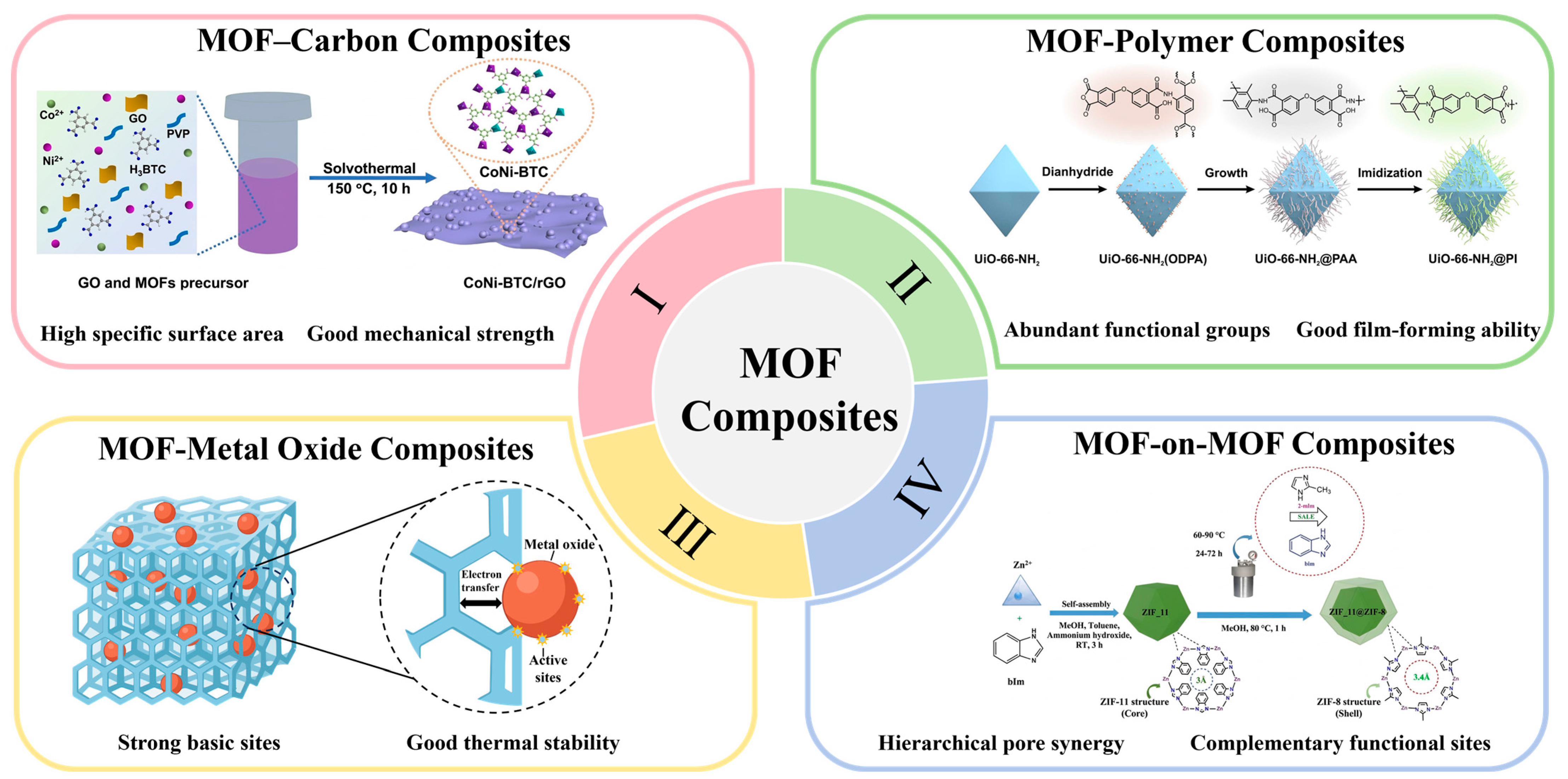
Based on the nature of the functional component, MOF composites can be broadly classified into four representative categories: carbon-based materials (graphene, carbon nanotubes, biochar, porous carbon), polymers (cellulose, chitosan, PVDF, Pebax), metal oxides (MgO, CaO, ZnO), and MOF-on-MOF heterostructures (core–shell, yolk–shell) (Figure 1). Other types, such as MOF/porous SiO2 and MOF/ionic liquid (IL) composites, are briefly discussed in Section 2.5, but the four categories above represent the most widely studied and developed classes. Their design strategies focus on achieving synergistic effects to overcome the limitations of pristine MOFs, including poor water stability, low processability, and mass transfer bottlenecks. Key strategies include interface engineering to enhance component compatibility, hierarchical pore construction to improve diffusion, and surface functionalization to introduce additional adsorption sites. These approaches collectively enable the rational design of MOF composites with enhanced performance for greenhouse gas adsorption and separation.
This review primarily focuses on MOF composites as adsorbents for greenhouse gas capture. Membrane separation and shaping strategies (e.g., pelletization, granulation, packed columns) are briefly discussed only where they directly support or relate to the adsorption performance of MOF composites. A detailed discussion of membrane-based separation or industrial shaping processes is beyond the scope of this review. For readers unfamiliar with the nomenclature of metal–organic frameworks, Table 2 lists the acronyms, full names, metal ions, and organic linkers of the MOFs discussed in this review.

2.1. MOF–Carbon Composites

Carbon-based composites are an important class of functional materials formed by combining MOFs with carbon materials such as graphene/graphene oxide (GO), carbon nanotubes (CNTs), porous carbon (PC), activated carbon (AC), and biochar. Carbon materials like graphene and CNTs possess high specific surface areas, providing additional adsorption sites for MOFs. Meanwhile, the oxygen-containing functional groups on their surfaces can act as nucleation sites, guiding the in situ growth of MOF crystals. Furthermore, the introduction of carbon materials can construct mesoporous or macroporous channels between MOF particles and at the MOF–carbon interfaces, forming a hierarchical pore system featuring synergistic microporous, mesoporous, and macroporous structures. This significantly alleviates the mass transfer limitations of pristine MOFs caused by their predominantly microporous nature [44]. In terms of stability, graphene and CNTs exhibit excellent mechanical properties and can serve as structural scaffolds, providing stable mechanical support for MOFs and effectively suppressing structural collapse and volume expansion during cycling [45,46]. Meanwhile, the hydrophobic surfaces of carbon materials can build protective barriers for MOFs, resisting water molecule attack and preventing MOF hydrolysis, thereby significantly enhancing the chemical stability of the composites under humid conditions [47,48].

2.1.1. Synthesis Strategies

MOF–carbon composites are typically prepared by in situ growth of MOF crystals on carbon substrates or by physical mixing of pre-synthesized MOFs with carbon materials. The oxygen-containing functional groups (carboxyl, hydroxyl, epoxy) on graphene oxide, carbon nanotubes, and activated carbon can coordinate with metal ions, acting as nucleation sites that guide the heterogeneous crystallization of MOFs. For example, HKUST-1 is grown on acid-treated multi-walled carbon nanotubes by dispersing the nanotubes in the MOF precursor solution under solvothermal conditions [49]. Graphene oxide sheets are mixed with MOF precursors, where zinc or copper ions bind to the oxygen groups, leading to a sandwich-like alternation of GO layers and MOF crystals [50]. Biochar-based composites are synthesized by oxygen-limited pyrolysis of agricultural wastes followed by in situ MOF growth, where the biochar surface provides abundant functional groups for anchoring MOF nanoparticles [51,52].

2.1.2. Graphene-Based Composites

Graphene is a two-dimensional carbon material possessing high electrical and thermal conductivity, an extremely high theoretical specific surface area, excellent mechanical strength and flexibility, good chemical stability, and unique optical properties [53,54]. Graphene oxide (GO) can be obtained by oxidizing graphite with strong oxidizing agents, and further reduction yields reduced graphene oxide (rGO) [55]. The sheet structures of GO and rGO are rich in reactive oxygen-containing functional groups such as hydroxyl (-OH), carboxyl (-COOH), and epoxy (C-OC) groups. These hydrophilic groups not only facilitate their dispersion in aqueous media but also provide an ideal platform for the in situ growth and stable anchoring of MOFs [56,57].
In the construction of MOF-based composite adsorbents, graphene and its derivatives play multiple roles. First, the oxygen-containing functional groups on the surfaces of GO and rGO can serve as additional adsorption sites, enhancing the affinity for polar greenhouse gases such as CO2 through hydrogen bonding or electrostatic interactions, thereby creating synergistic effects with the pore adsorption of MOFs [58]. Second, graphene sheets can effectively prevent the agglomeration of MOF particles, while MOF particles can also prevent the restacking of graphene sheets [46]. This enables the construction of mesoporous channels between MOF particles and at the MOF–graphene interfaces, forming a hierarchical pore system featuring synergistic microporous and mesoporous structures, which alleviates the mass transfer limitations of pristine MOFs caused by their predominantly microporous nature [45]. Furthermore, the hydrophobic nature of graphene can build protective barriers for MOFs, suppressing the competitive adsorption of water molecules from flue gas. This is particularly relevant for practical applications such as CO2 capture from wet flue gas in coal-fired power plants.
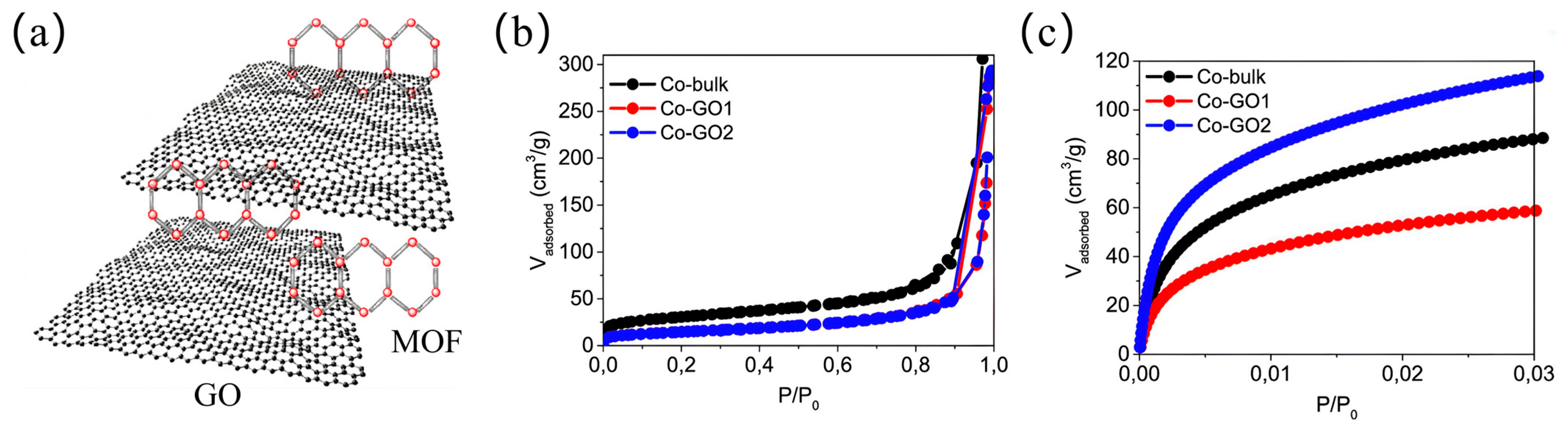
To date, the modification of various MOFs with graphene oxide has demonstrated excellent greenhouse gas adsorption performance. For example, MOF-5@GO exhibits excellent physical CO2 adsorption performance at 25 °C and 1 bar. The SEM image shows that 3Li-MOF-5@GO retains a cubic morphology similar to that of MOF-5, with a reduced crystal size due to Li+ doping. After doping with 3% Li+, its specific surface area increases by 52.53%, and the CO2 adsorption capacity reaches 98.32 cm3/g. This is attributed to the Li+ doping strengthening the Zn-O coordination bonds and amplifying the electrostatic interaction with the quadrupole moment of CO2 [50]. In another study, Cirujano et al. [58] developed a Co-MOF-74@GO2 composite via a green aqueous room-temperature synthesis using non-graphitized carbon nanofiber-derived GO (GO2) (Figure 2a). Among the materials tested, Co-MOF-74@GO2 achieved the highest CO2 uptake of approximately 116.5 cm3/g (5.2 mmol/g) at 0 °C and 1 bar, significantly outperforming the corresponding Zn- and Ni-based analogues. The superior performance is attributed to the smaller crystallite size of Co-MOF-74, which provides more surface-exposed active sites, and the higher density of oxygen-containing functional groups on GO2, which enhances interfacial interactions with the MOF and creates additional CO2 binding sites (Figure 2b,c). Collectively, these studies indicate that graphene-based MOF composites hold great promise for greenhouse gas adsorption and separation applications, including CO2 capture and CH4 purification [59].

2.1.3. Carbon Nanotube-Based Composites

Carbon nanotubes (CNTs) possess a unique one-dimensional tubular structure, good mechanical strength, and excellent thermal stability. The nanoscale pore spaces within CNTs can generate significant confinement effects, which greatly influence gas adsorption behavior [60]. MOF-CNT composites exhibit significant synergistic effects by combining the high porosity and structural diversity of MOFs with the superior mechanical, electronic, and thermal properties of CNTs. The introduction of CNTs can enhance the structural stability of MOFs by dispersing electrostatic charges or providing internal confined spaces. The formation of ultramicropores at the MOF-CNT interfaces, together with the improved structural integrity of MOFs, contributes to enhanced storage capacities for gases such as hydrogen, carbon dioxide, and methane. Meanwhile, this synergy can optimize the adsorption selectivity of the composites toward specific gas mixtures (e.g., CO2/N2). Furthermore, the specific surface area and total pore volume of MOFs are often increased upon compositing with CNTs.
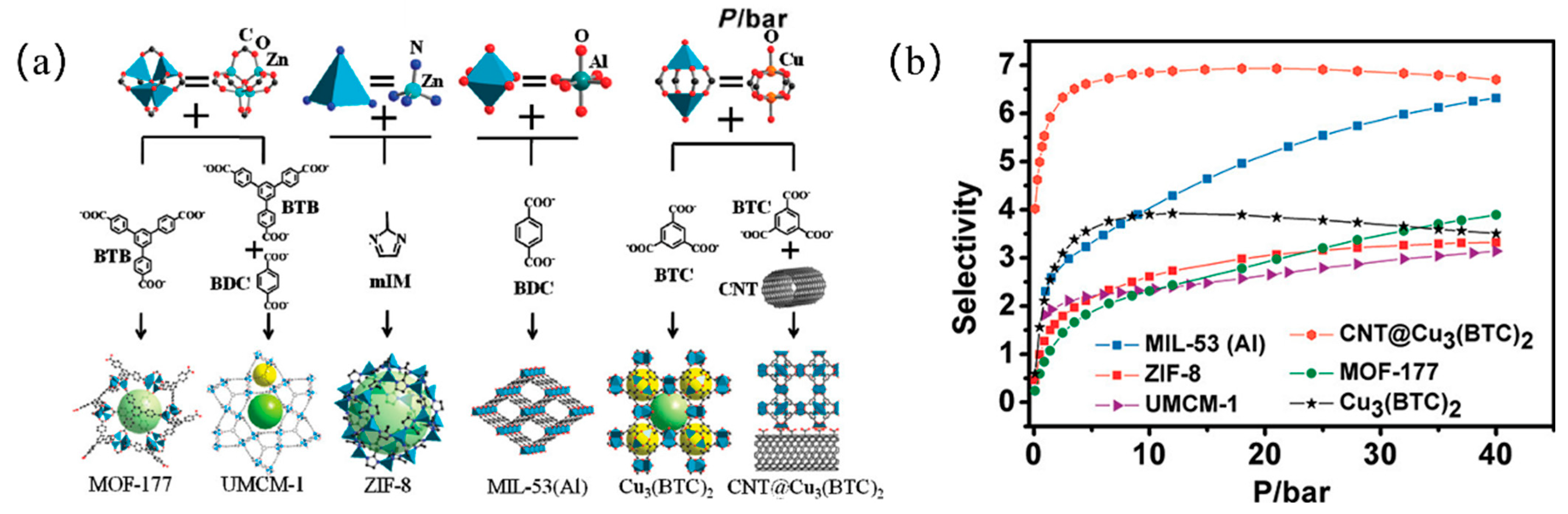
HKUST-1 (chemical formula [Cu3(BTC)2], BTC = 1,3,5-benzenetricarboxylate) is an important MOF material that has attracted considerable attention due to its open copper metal sites, high thermal stability, and excellent adsorption properties [61]. To further enhance its adsorption and separation performance, Xiang et al. [49,62] introduced carboxylated multi-walled carbon nanotubes into HKUST-1. For example, upon introducing CNTs into HKUST-1, the pore volume of the composite increased from 0.73 to 0.87 cm3/g. At 18 bar and 298 K, and the CO2 and CH4 uptake increased from 295 to 595 mg/g and from 72 to 120 mg/g, respectively [49]. In another study, using ideal adsorbed solution theory (IAST) based on the dual-site Langmuir–Freundlich equation, Xiang et al. [62] evaluated the CO2/CH4 separation potential of CNT@HKUST-1 and several representative MOFs, including MOF-177, UMCM-1, ZIF-8, MIL-53(Al), and HKUST-1 (Figure 3a). For an equimolar CO2/CH4 mixture at pressures ranging from 1 to 20 bar, CNT@HKUST-1 exhibited the highest selectivity among the tested materials, with values ranging from 5.5 to 7.0 (Figure 3b). Collectively, these studies demonstrate that CNT-based MOF composites hold great promise for greenhouse gas adsorption and separation applications, including CO2 capture, CH4 purification, and acid gas removal.

2.1.4. Porous Carbon-Based Composites

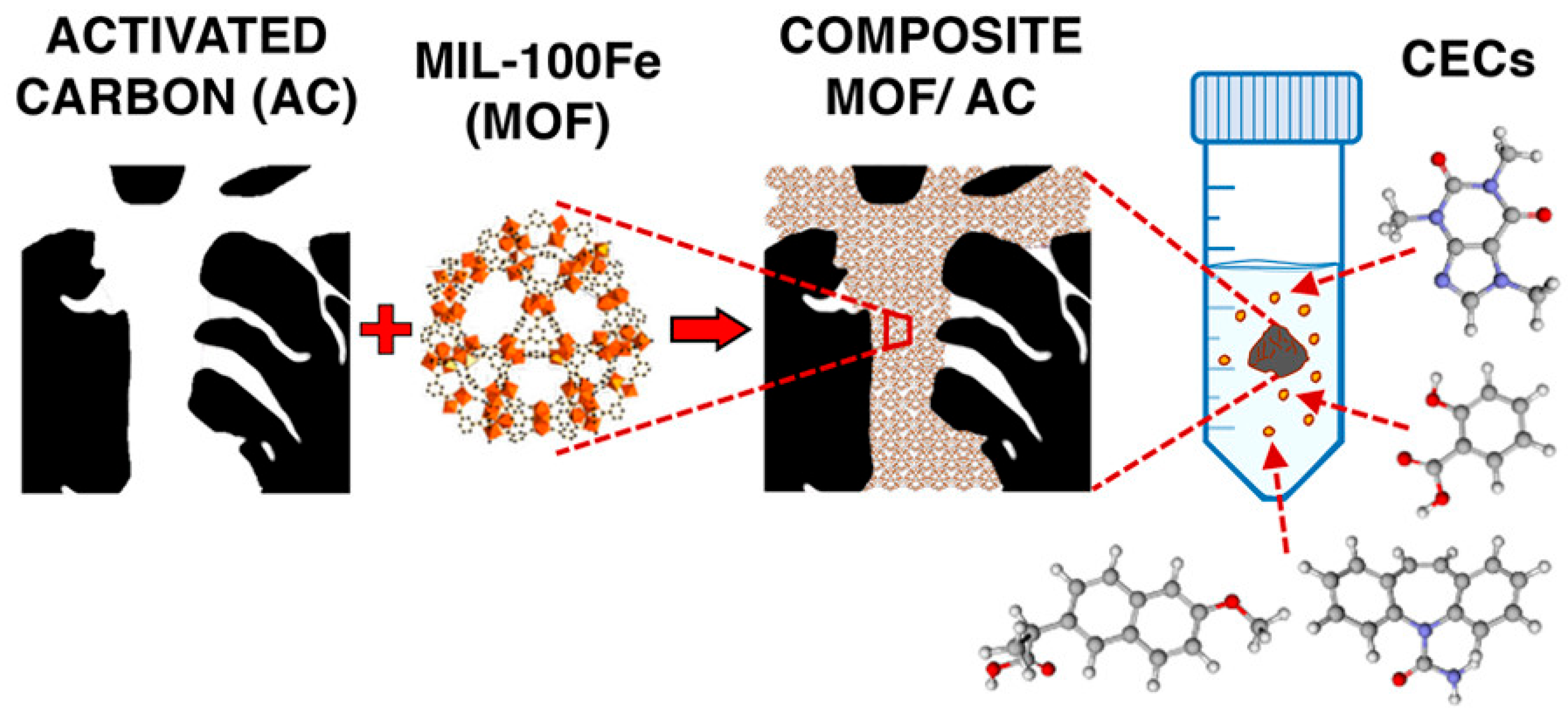
Porous carbon materials are considered one of the most promising candidates for gas-related applications owing to their low cost, high thermal and chemical stability, high adsorption capacity, and fast regeneration capability. Recent studies have demonstrated that incorporating microporous particles into the meso-/macroporous networks of carbon materials to create hierarchical porous systems can optimize structural features and enhance adsorption performance (Figure 4). For example, HKUST-1@ACM composites were prepared by in situ synthesis of HKUST-1 within a porous carbon monolith. The composite retained the monolithic shape and exhibited a unique hybrid structure combining features of both ACM and HKUST-1. Its volumetric CO2 uptake reached approximately 24 cm3/g at 1 bar and 25 °C, which is comparable to that of pristine ACM. In terms of CO2/CH4 separation, the composite showed superior selectivity compared to pristine ACM. IAST calculations revealed that for an equimolar CO2/CH4 mixture, the selectivity factor of HKUST-1@ACM was approximately 5.5 at 1 bar, while that of pristine ACM was only 3.5 [63].

2.1.5. Biochar-Based Composites

Biochar is a porous carbon material prepared from agricultural wastes (such as straw, nut shells, wood chips, and leaves) through oxygen-limited pyrolysis. It possesses three inherent advantages. First, its raw materials are widely available and low in cost, aligning with the principles of circular economy. Second, it features abundant surface functional groups (e.g., hydroxyl, carboxyl, and carbonyl groups), which facilitate its functional modification. Third, its porous structure can be tuned over a wide range of scales, forming hierarchical pore networks with coexisting micropores and mesopores [65,66].
Upon compositing biochar with metal–organic frameworks (MOFs), significant synergistic effects arise between the two components. Unlike synthetic carbon materials such as graphene and carbon nanotubes, biochar possesses unique structural and chemical advantages stemming from its natural biomass source and oxygen-limited pyrolysis preparation process. On one hand, the three-dimensional carbon skeleton of biochar and its naturally abundant oxygen-containing functional groups provide a low-cost, high-activity growth substrate for MOFs. These functional groups can coordinate with the metal nodes of MOFs, which not only inhibits the agglomeration of MOF nanoparticles but also significantly enhances the structural stability of the composite [51,52]. On the other hand, the inherent mesopores of biochar interconnect with the micropores of MOFs, forming a hierarchical pore network featuring coexisting micropores and mesopores. In this architecture, the mesoporous channels serve as fast diffusion pathways for gas molecules, while the micropores provide high-density adsorption sites. Together, they overcome the mass transfer bottleneck of pristine MOFs caused by their predominantly microporous nature, thereby substantially increasing the saturated adsorption capacity [67]. Most critically, active site synergy is achieved. The metal nodes (e.g., Zr-O clusters, Cu2+, Fe3+) and organic linkers (e.g., -COOH, -NH2) provided by MOFs, together with the oxygen-containing functional groups (e.g., -OH, C=O) contributed by biochar, create a coexistence of multiple types of active sites within the composite [68]. This endows the material with multiple adsorption mechanisms for greenhouse gases. For instance, acidic CO2 can be captured by the basic functional groups on the biochar surface through acid–base interactions, coordinated with the metal nodes of MOFs, and simultaneously form hydrogen-bonding networks with functional groups. This multi-mechanism synergy enables the composite to exhibit significantly superior adsorption performance in complex gas environments compared to single-component materials.
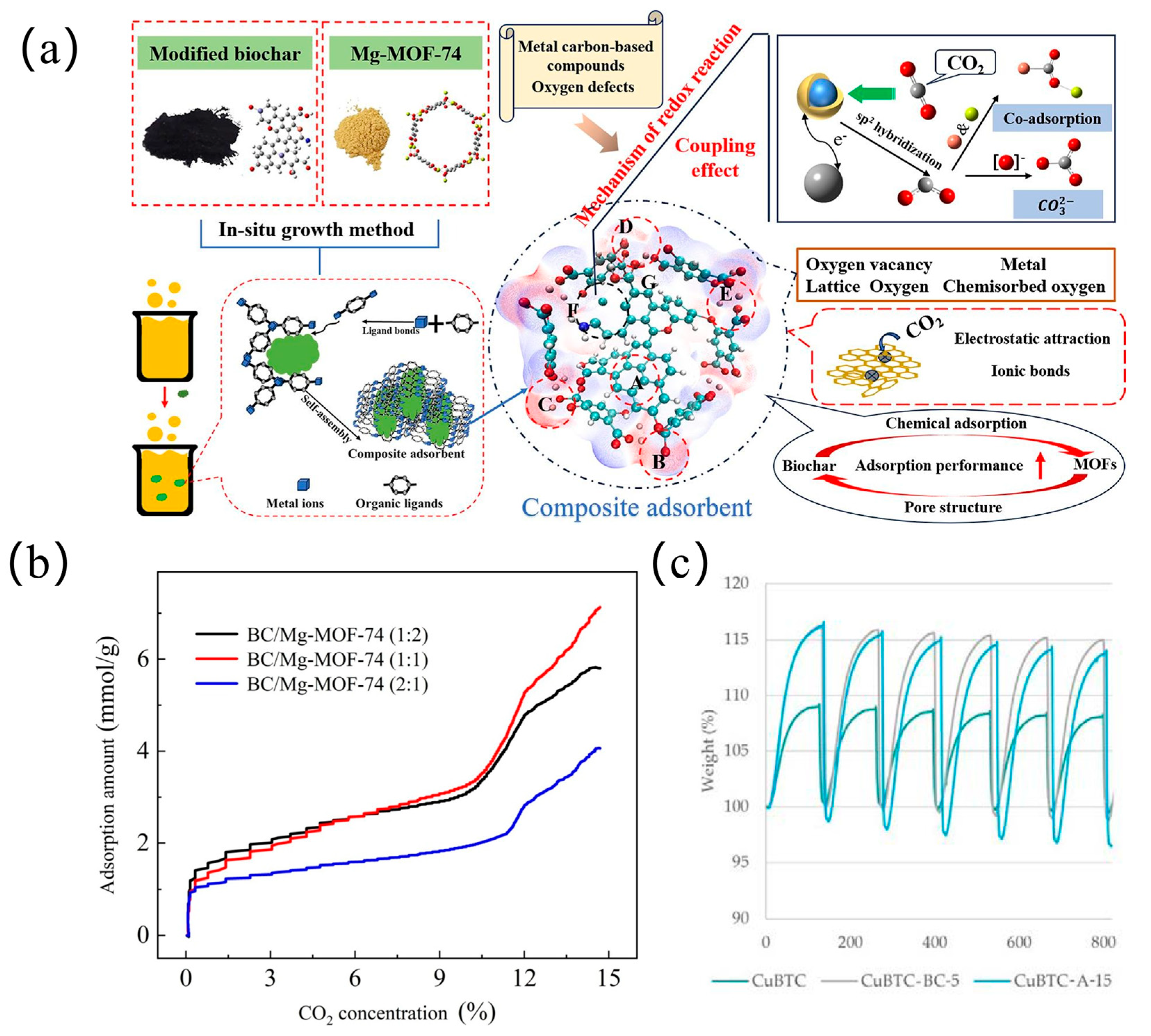
In terms of adsorption capacity, Wang et al. synthesized three BC/Mg-MOF-74 composites with different mass ratios (Figure 5a). Under a 15% CO2 atmosphere at 100 °C, BC/Mg-MOF-74 (1:1) exhibited the optimal CO2 adsorption performance, achieving an uptake of 6.86 mmol/g (Figure 5b) [69]. This excellent performance is mainly attributed to the synergistic effect between biochar and Mg-MOF-74: the two components are composited via an in situ growth method, forming multiple adsorption sites rich in oxygen vacancies, lattice oxygen, and chemisorbed oxygen. CO2 forms ionic bonds with metal ions through electrostatic attraction, while simultaneously undergoing chemisorption with oxygen-containing functional groups, ultimately generating carbonate species (Figure 5a). In terms of stability, the Cu-BTC/biochar composite retained approximately 92% of its adsorption capacity after five cycles, demonstrating better regeneration performance compared to pristine Cu-BTC (Figure 5c) [70]. Compared with other carbon-based MOF composites such as those using carbon nanotubes or graphene, MOF–biochar composites significantly reduce raw material costs and preparation barriers while maintaining good adsorption performance, making them more amenable to large-scale production and industrial application. Therefore, these materials hold great promise for greenhouse gas adsorption and separation applications, including CO2 capture from industrial flue gas, natural gas purification, biogas upgrading, and air purification in enclosed spaces [68].

2.2. MOF–Polymer Composites

2.2.1. Synthesis Strategies

Polymer composites are an important class of functional materials formed by combining MOFs with polymers such as cellulose, chitosan, and polyvinylidene fluoride (PVDF) through physical blending, in situ growth, or chemical crosslinking [71,72]. Among commonly used polymer matrices, cellulose and its derivatives (e.g., nanocellulose, carboxymethyl cellulose) have become promising MOF support substrates [73,74] due to their abundant availability, non-toxicity, renewability, excellent hydrophilicity, flexibility, high strength, and low cost [71,75]. Chitosan has attracted considerable attention for its abundant amino functional groups. Polyvinylidene fluoride (PVDF), polyimide, polyvinyl alcohol (PVA), and polyurethane (PU) are widely used in the construction of MOF composites owing to their good film-forming ability and mechanical properties [76].
The composite forms of MOFs and polymers are diverse, mainly including MOF gels (hydrogels and aerogels), MOF/polymer membranes (mixed matrix membranes, MMMs), and polymer@MOF core–shell structures. Two main synthetic routes are used to prepare these composites: (i) confined polymerization of monomers inside MOF channels, and (ii) coating of MOF crystals with a polymer shell. For confined polymerization, vinyl monomers (e.g., styrene, methyl methacrylate) are infiltrated into the MOF pores, followed by radical polymerization initiated by heat or UV light, yielding polymer chains with narrow molecular weight distribution and unusual conformations [77]. For core–shell structures, pre-synthesized MOF particles are dispersed in a monomer solution, and polymerization is triggered to form a protective polymer layer (e.g., PN@MOF-5 via in situ polymerization of polynaphthalene) [78]. Alternatively, Pickering emulsions stabilized by MOF nanoparticles can be used to fabricate MOF–polymer composite microcapsules, where the polymer membrane forms at the oil–water interface [79].

2.2.2. Structural Features and Synergistic Mechanisms

The design of such composites aims to address engineering issues associated with pristine MOF powders, including poor processability and insufficient mechanical strength, while also introducing additional adsorption sites through the functional groups of polymers to enhance greenhouse gas adsorption performance [72,80,81,82]. The synergistic effects between polymers and MOFs are primarily manifested in the following aspects. First, polymers can significantly improve the processability of MOFs, resolving engineering problems such as high bed pressure drops and dust pollution caused by pristine MOF powders in fixed-bed reactors. Studies have shown that incorporating 30 wt% UiO-66 nanoparticles into a polyurethane (PU) matrix yields composites with optimal mechanical properties, with both tensile strength and elastic modulus substantially enhanced [83]. The composite hydrogel formed by polyvinyl alcohol (PVA) and UiO-66 exhibits higher structural stability than the pure polymer [71]. Second, the functional groups on polymer surfaces can serve as additional adsorption sites, enhancing the affinity for CO2 [84]. Cellulose surfaces are rich in hydroxyl (-OH) groups, and functionalization can further enhance specific CO2 adsorption [67]. Chitosan contains amino (-NH2) groups, which can form reversible chemisorption interactions with CO2, significantly increasing CO2 adsorption capacity and selectivity [85]. Third, the introduction of polymers is not a simple mixing process. Instead, it constructs a hierarchical pore system featuring synergistic microporous, mesoporous, and macroporous structures, substantially optimizing gas mass transfer efficiency [86]. For example, Zhu et al. [77] prepared a MOF/cellulose composite aerogel with a three-dimensional porous structure by mixing MOF crystals, surface-functionalized nanocellulose crystals (CNCs), and carboxymethyl cellulose (CMC) to form a suspension, followed by sol–gel reaction and freeze-drying. This material exhibits excellent mass transfer performance in gas adsorption and separation applications.
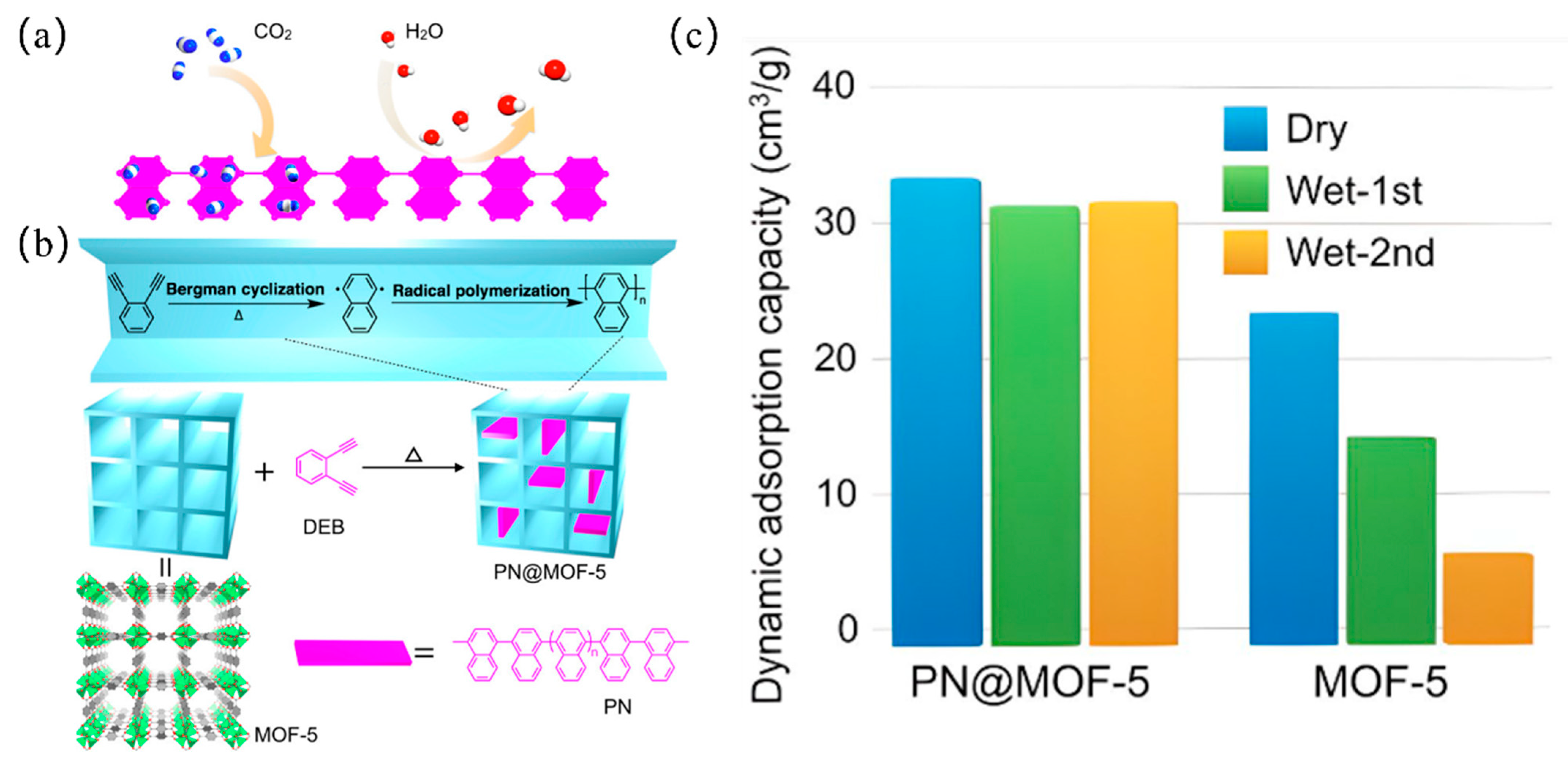
Finally, the hydrophobic nature of polymers can build protective barriers for MOFs, suppressing competitive adsorption of water molecules from flue gas. Many polymers, such as PVDF and polyimide, possess good hydrophobicity. When used as a shell or matrix to encapsulate MOFs, their hydrophobic surfaces can effectively block the contact between water molecules and the active sites of MOFs, preventing framework hydrolysis and collapse under humid conditions [87]. Studies have shown that encapsulating MOFs in hydrophobic polymer matrices significantly reduces the water uptake of the composites and greatly enhances their adsorption stability and recyclability in water-containing systems such as wet flue gas CO2 capture. For example, the PN@MOF-5 composite, formed by in situ polymerization of polynaphthalene within the channels of MOF-5 (Figure 6a), retains over 90% of its dynamic CO2 adsorption capacity under humid conditions (Figure 6b,c) [78]. This is mainly attributed to the hydrophobic nature of polynaphthalene (water contact angle increases from 0° to 135°) and its pore-partitioning effect, which effectively prevents water molecules from attacking the MOF and suppresses competitive adsorption. In another example, Choe et al. [79] coated diamine-grafted Mg2(dobpdc) with a hydrophobic poly(divinylbenzene) (PDVB) layer to prepare een-MOF/PDVB-5 composites. After exposure to 90% relative humidity for 7 days, the CO2 adsorption capacity of the composite remained almost unchanged (from 9.79 to 10.15 wt%), while that of the uncoated een-MOF drastically decreased from 18.9 to 7.1 wt%. After 90 humid CO2 adsorption–desorption cycles, een-MOF/PDVB-5 retained approximately 96.5% of its initial capacity (decreasing from 9.79 to 9.45 wt%), whereas een-MOF retained only about 41%. These results demonstrate that the hydrophobic PDVB layer effectively protects the diamine-grafted MOF from water vapor attack, significantly enhancing its long-term stability and recyclability under high-humidity conditions. Collectively, these studies demonstrate that hydrophobic polymer coating is an effective strategy for enhancing the long-term stability of MOF materials under humid operating conditions.

2.3. MOF–Metal Oxide Composites

2.3.1. Synthesis Strategies

Metal oxide composites are an important class of functional materials formed by combining MOFs with metal oxides such as MgO, CaO, and ZnO through in situ growth, physical mixing, or chemical bonding [88,89,90]. Integrating metal oxides into MOF matrices has proven to be a particularly effective strategy. Metal oxides possess unique surface unsaturated sites and redox activity, while MOFs offer ultrahigh specific surface areas, ordered microporous structures, and abundant coordination sites. The synergistic integration of these two components endows metal oxide@MOF (MO@MOF) composites with enhanced stability, improved charge transfer characteristics, and greater accessibility of active sites.
Two common approaches are used. The first is the in situ generation of metal oxide nanoparticles inside MOF cavities. Volatile metal–organic precursors (e.g., ZnEt2, Ti(O-iPr)4) are introduced into MOF-5 or ZIF-8 via gas-phase infiltration (CVD), followed by oxidative annealing to form nanosized ZnO or TiO2 particles [88]. Alternatively, metal nitrates (e.g., Co(NO3)2) confined in MOF pores are decomposed at low temperatures (≈200 °C) to produce highly dispersed Co3O4 NPs [91]. The second approach is the encapsulation of pre-synthesized metal oxide nanoparticles by growing MOF shells around them. For example, Fe3O4 nanoparticles modified with polyvinylpyrrolidone (PVP) are used as seeds for the growth of ZIF-8 or HKUST-1, yielding core–shell Fe3O4@MOF composites [92].

2.3.2. Structural Features and Synergistic Mechanisms

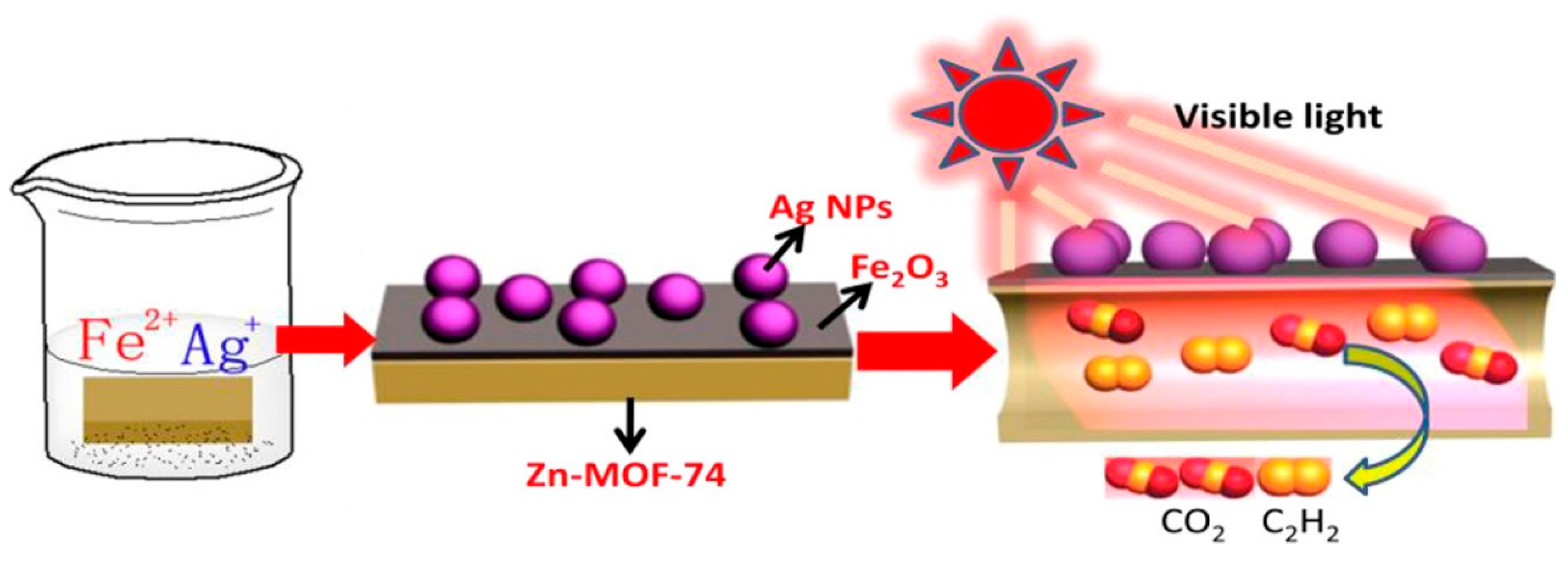
Commonly used metal oxides mainly include alkaline earth metal oxides (e.g., MgO, CaO), transition metal oxides (e.g., ZnO, Fe3O4), and composite metal oxides (e.g., NiCo2O4). Among these, MgO and CaO have attracted considerable attention due to their strong basic sites. They can form stable carbonates with CO2, enabling efficient chemisorption. Studies have shown that compositing MgO with ZIF-8 significantly enhances the affinity of the composite for CO2, maintaining high adsorption capacity even under low partial pressure conditions [93]. Second, metal oxides possess good mechanical strength and thermal stability, allowing them to serve as structural scaffolds that provide mechanical support for MOFs and effectively suppress structural collapse during processing and cycling. For example, an Mg-doped CaO adsorbent derived from a calcium-based metal–organic framework (Ca-MOF) precursor exhibited a capacity decay of only 0.7 mmol/g after 30 CO2 adsorption–desorption cycles, demonstrating significantly enhanced cycling stability [91]. In addition to these conventional roles, metal oxides can also act as bifunctional components. For example, Wu et al. [94] developed a Ag NPs@Fe2O3@MOF composite via a modified coprecipitation method (Figure 7). The Ag nanoparticles provide preferential adsorption of C2H2 over CO2 through π-complexation, while under visible light irradiation, they generate a plasmon-driven photothermal effect that leads to distinct release behaviors for the two gases. As a result, the C2H2/CO2 selectivity of the composite under visible light reached 4.73 at 293 K and 100 kPa, approximately twice that of pristine MOF-74. Furthermore, magnetic oxides (e.g., Fe3O4) allow low-energy regeneration via magnetically induced swing adsorption (MISA), where alternating magnetic fields generate localized heat for rapid desorption [92]. This further expands the applicability of MOF–metal oxide composites in energy-efficient carbon capture processes.
Various methods are available for preparing MO@MOF composites, including hydrothermal/solvothermal methods, sonochemical methods, mechanochemical methods, and microwave-assisted methods. Among these, the in situ growth of MOFs on metal oxide surfaces under high-temperature and high-pressure conditions by introducing metal oxide precursors into the precursor solution is a common strategy for constructing core–shell structures. Kim et al. [95] employed a hydrothermal oxidation-assisted MOF construction strategy to successfully prepare an Al@MIL-53 core–shell microstructure on an Al substrate by controlling the metal surface oxidation–dissolution process and MOF crystallization kinetics, and verified the generalizability of this method on Cu and Zn substrates. Ben Neon et al. [96] further revealed the competitive mechanism between MOF growth and alumina crystal plane rearrangement during the oxide–MOF transformation process, identifying pH variation as a key factor influencing MOF crystal morphology and distribution. Romero-Guerrero et al. [97] achieved in situ growth of ZIF-8 crystals on TiO2 micropillar films using a layer-by-layer immersion method. DFT calculations confirmed that the formation of covalent bonds between Zn2+ and the TiO2 surface is a critical step for nucleation. Collectively, these studies provide important theoretical guidance and experimental foundations for the design and preparation of MOF–metal oxide composites.

2.4. MOF-on-MOF Composites

MOF materials possess high specific surface areas, tunable pore sizes, and functionalizable pore environments, making them ideal adsorbents for gas separation. Nevertheless, the structural and functional limitations of single MOFs have become increasingly evident with ongoing research. Compositing two or more MOFs with different functionalities yields composites with superior performance. MOF-on-MOF composites combine the structural advantages of different MOFs: abundant metal centers and ligand diversity endow them with high specific surface areas and hierarchical pore structures, which balance the high selectivity of micropores with the fast mass transfer of mesopores/macropores, thus overcoming the selectivity–capacity trade-off of single MOFs [98,99,100].

2.4.1. Synthesis Strategies

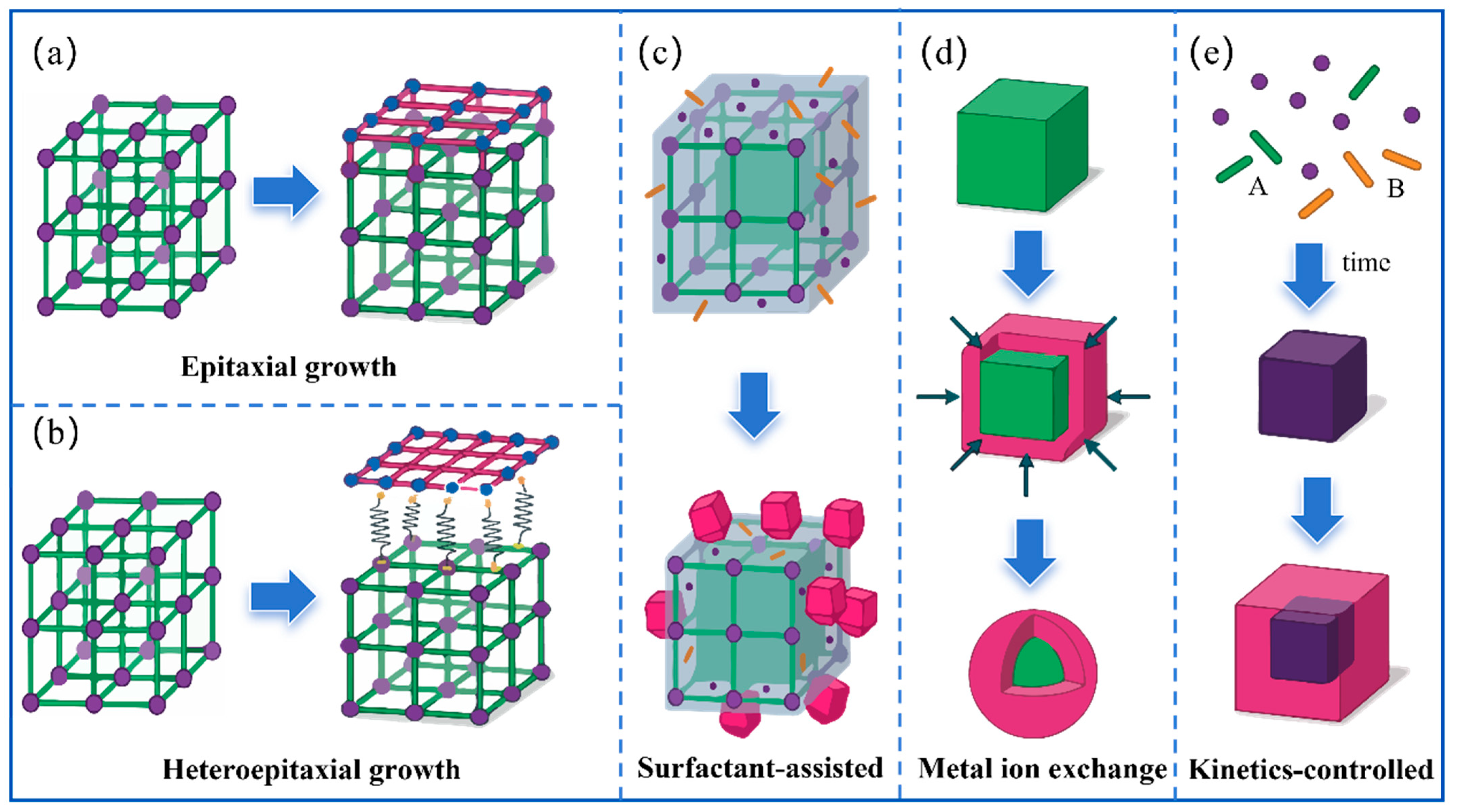
The design core of MOF-on-MOF composites lies in achieving controllable spatial assembly of different MOF units. Based on existing research, the synthesis strategies can be mainly summarized into the following categories (Figure 8a–e).
To achieve controllable spatial assembly of different MOF units, epitaxial growth (Figure 8a) is the most straightforward strategy. This strategy requires that the host MOF and guest MOF have similar lattice parameters on specific crystal planes, thereby inducing oriented nucleation and growth of the guest MOF on the host surface. Furukawa’s team first reported this strategy in 2009. They selected [Cu2(ndc)2(dabco)]n and [Zn2(ndc)2(dabco)]n, which share the same tetragonal topology and similar lattice parameters. By mixing a Zn-based precursor with pre-synthesized Cu-based MOF crystals, they successfully prepared core–shell single crystals. This work demonstrated for the first time that MOFs with different metal centers can be controllably composited via epitaxial growth [101].
To overcome the strict lattice matching requirement of conventional epitaxial growth, researchers have further developed the heteroepitaxial growth strategy (Figure 8b). This strategy takes advantage of the low elastic constant of MOF materials and the healing effect of special functional groups in ligands on interfacial vacancies, allowing oriented growth between host and guest MOFs even with a lattice mismatch as high as 26%. This greatly expands the range of combinable MOF types. For example, the Wöll team successfully achieved MOF-on-MOF heteroepitaxial growth with a lattice mismatch as high as 20%, and through theoretical calculations revealed that the mechanism lies in the low elastic constant of MOFs and the ligand healing of interfacial vacancies [102].
Different from epitaxial and heteroepitaxial growth, surfactant-assisted growth (Figure 8c) does not strictly require lattice matching, offering broader applicability. Surfactants such as PVP can enhance the interfacial affinity between the host and guest MOFs, mediating the adsorption of guest metal ions onto the host surface and inducing heterogeneous nucleation and growth. For example, Kitagawa’s team constructed an NH2-UiO-66@NH2-MIL-125 core–satellite structure using a PVP-assisted strategy. Control experiments showed that without PVP, the two MOFs nucleated independently and failed to form a composite structure, confirming the critical role of the surfactant in mediating heterogeneous nucleation [100].
In addition to the above two strategies, ligand/metal ion exchange (Figure 8d) provides an alternative approach by exploiting the diffusion and exchange capacity of ligands or metal ions within the MOF to construct heterostructures layer by layer from the outside in. By controlling kinetic parameters such as reaction time and concentration, the shell thickness and component distribution can be precisely tuned, enabling the preparation of complex structures such as core–shell and yolk–shell architectures. For instance, Li’s team used a ZIF-67@ZIF-8 core–shell structure as a precursor. Leveraging the lower stability of ZIF-67 compared to ZIF-8, they selectively converted the core in a Co2+/methanol solution, successfully preparing a yolk–shell structure [103]. Zhang’s team, through ion exchange between Fe-MIL-88B and Co2+, constructed a Fe-MIL-88B@Co-MIL-88B bimetallic core–shell structure. By controlling the exchange time, they achieved continuous tuning of the shell thickness [104].
Furthermore, nucleation kinetics-guided growth (Figure 8e) offers a distinct advantage by exploiting differences in nucleation rates among different MOFs to achieve controllable construction of core–shell structures in a one-pot reaction system. This strategy eliminates the need for pre-synthesizing the host MOF, simplifies the synthesis process, and is suitable for large-scale preparation. Zhou et al. reacted two ligands, TCPP and BPDC, with Zr4+. Owing to its stronger coordination ability and faster nucleation, TCPP preferentially formed a PCN-222 core. Subsequently, BPDC underwent heterogeneous growth on the core surface to form a Zr-BPDC shell, successfully yielding a PCN-222@Zr-BPDC core–shell structure. This composite combines the mesoporosity of the core with the microporosity of the shell, demonstrating excellent performance in size-selective catalysis. Based on the same strategy, the team also constructed a PCN-134@Zr-BTB system, validating the generalizability of this method [104].

2.4.2. Structural Features and Synergistic Mechanisms

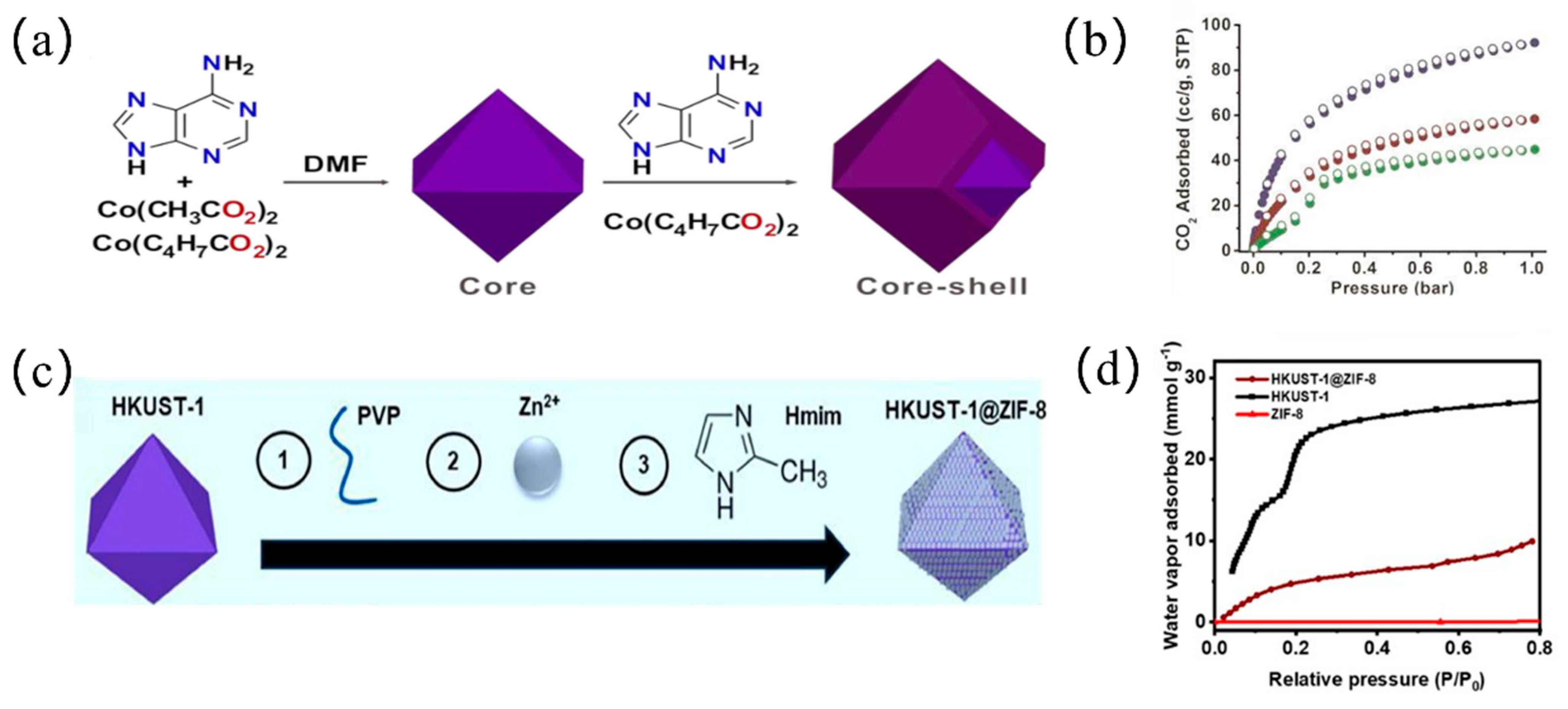
MOF-on-MOF composites integrate two or more MOFs with different structures and functionalities at the atomic scale, forming novel heterostructures with unique structural features and synergistic effects. These composites exhibit significant advantages over single MOFs in terms of hierarchical pore synergy, complementary functional sites, and external protection effects. Li et al. [105]. successfully achieved the epitaxial growth of Bio-MOF-11/14@Bio-MOF-14 core–shell structures by modulating the lattice parameters of the core via mixed acetate/valerate ligands to match those of the shell (Figure 9a). In terms of adsorption capacity, compositing a highly porous core with a shell possessing specific gas affinity enables synergistic enhancement. As demonstrated in Figure 9b, the CO2 uptake of this core–shell structure is approximately 30% higher than that of the pure shell material (bio-MOF-14).
For selective separation, the pore size of the shell MOF can precisely regulate the entry of gas molecules, enabling a molecular sieving effect. Klomklang et al. [106] synthesized ZIF-67@ZIF-8 core–shell structures using a seed-mediated growth strategy. The small-pore ZIF-8 shell selectively restricts N2 entry while allowing higher CO2 permeation, resulting in significantly higher CO2 adsorption capacity of the core–shell structure compared to monometallic ZIF-8. Additionally, lattice mismatch at the core–shell interface can create unique nanoconfined spaces, providing extra molecular sieving channels and further optimizing separation performance.
Figure 9. (a) Synthetic scheme for the preparation of the Bio-MOF-11/14@Bio-MOF-14 core–shell crystal. (b) CO2 adsorption isotherms at 273 K (core, navy; core–shell, dark red; bio-MOF-14, green). Filled and empty circles represent adsorption and desorption points, respectively. (c) Schematic illustration of the synthesis of HKUST-1@ZIF-8 core–shell structures, where the numbers in circles indicate the order of reagent addition. (d) Water vapor adsorption isotherms at 298 K for HKUST-1@ZIF-8 core–shell adsorbent, compared with those of pure HKUST-1 and pure ZIF-8 [105,107].
Jcs 10 00324 g009
Regarding stability, coating a hydrophobic or highly stable MOF shell (e.g., ZIF-8, Bio-MOF-14) can effectively protect the moisture-sensitive core from water vapor attack. Gebremariam et al. [107] successfully achieved uniform coating of hydrophobic ZIF-8 nanoparticles on the surface of hydrophilic HKUST-1 using a PVP-assisted in situ growth combined with a secondary growth strategy, forming the HKUST-1@ZIF-8 core–shell structure (Figure 9c). As shown in Figure 9d, the water vapor adsorption capacity of this core–shell structure is reduced by approximately 70% compared to pristine HKUST-1. Collectively, these synergistic mechanisms endow MOF-on-MOF composites with comprehensive advantages in adsorption capacity, selectivity, stability, and mass transfer efficiency, positioning them as ideal platforms for high-performance greenhouse gas adsorption and separation materials [108].

2.5. Other Types of MOF Composites

In addition to carbon-based, polymer, metal oxide, and MOF-on-MOF composites, researchers have also explored the compositing of MOFs with other functional materials such as porous SiO2, ionic liquids, and aerogels. These materials each possess unique characteristics in terms of pore structure regulation, surface chemical modification, and macroscopic shaping, offering diverse solutions for greenhouse gas adsorption and separation.

2.5.1. MOFs/Porous SiO2 Composites

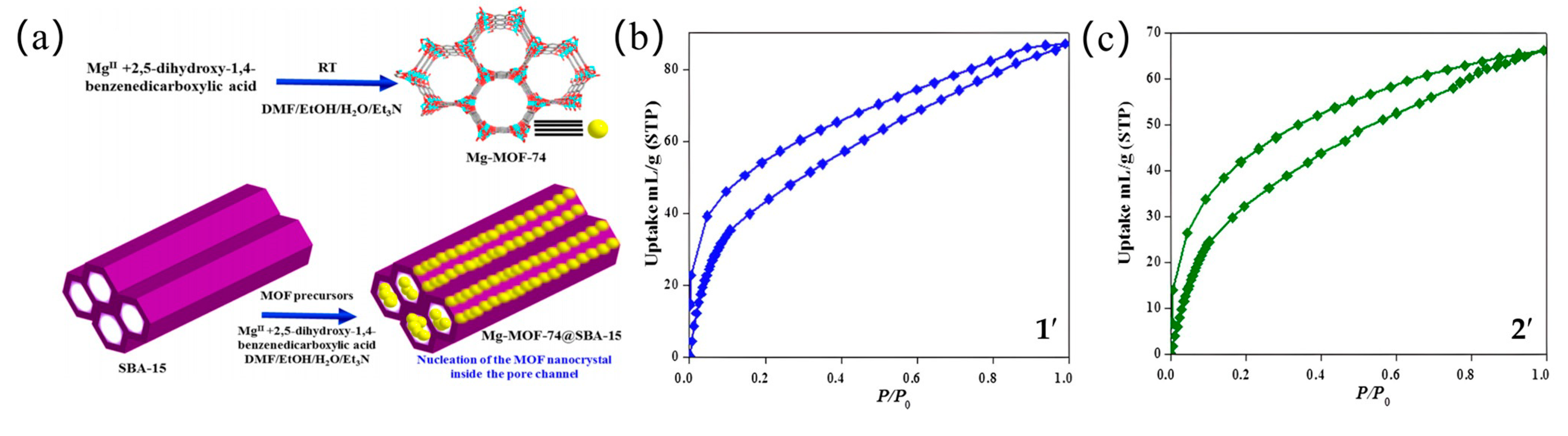
Porous SiO2 materials (such as mesoporous SBA-15 and MCM-41) feature well-defined pore structures, high specific surface areas, excellent hydrothermal stability, and easily functionalizable surfaces [109,110,111]. Compositing MOFs with porous SiO2 can significantly enhance the hydrothermal stability and mechanical strength of the composites while retaining the high adsorption capacity of MOFs. Furthermore, the silanol groups on the SiO2 surface can form covalent bonds with the metal nodes or organic linkers of MOFs, enhancing interfacial adhesion and inhibiting the agglomeration of MOF particles [112]. In the context of SBA-15-based composite systems, numerous studies have demonstrated that this support can effectively enhance the CO2 separation performance of MOFs. The Cu-BTC@SBA-15 composite exhibits significantly enhanced selectivity in CO2/CH4 and CO2/N2 separation, with a CO2/CH4 selectivity 39% higher than that of pristine Cu-BTC. [113] Through amine functionalization, the MIL-101(Cr)/SBA-15/PEI-25 composite achieves a CO2 adsorption capacity of 3.2 mmol/g, which is 146% higher than that of pristine MIL-101(Cr), and can be regenerated at a low temperature of 65 °C [114]. Furthermore, the Mg-MOF-74@SBA-15 composite, fabricated by confining Mg-MOF-74 nanocrystals within the mesopores of SBA-15 (Figure 10a), exhibits significant CO2 adsorption at 293 K and 1 bar. The composite with 75 wt% MOF loading shows a CO2 uptake of ~88 mL/g, which is only 45% lower than that of pristine Mg-MOF-74, while the 50 wt.% loading sample shows a 77% decrease (Figure 10b,c) [115].
In the context of MCM-41-based composite systems, the MCM-41/Cu(BDC) composite exhibits a 73% increase in specific surface area compared to pristine MCM-41, a 15% increase in CO2/CH4 selectivity at 4 bar, and only a 1% loss in adsorption capacity after three cycles [116]. Similarly, the MIL-101(Cr)@MCM-41 composite utilizes the confinement effect of MCM-41 to regulate the crystal growth of MOFs, resulting in reduced MOF particle size and increased specific surface area. At 298 K and 1 bar, its CO2 uptake is 79% higher than that of pristine MIL-101(Cr) [117]. Collectively, these studies demonstrate that MOFs/porous SiO2 composites hold great promise for CO2 capture and gas separation membrane applications.

2.5.2. MOF/Ionic Liquid Composites

Ionic liquids (ILs) are low-temperature molten salts composed of organic cations and organic or inorganic anions, featuring low vapor pressure, high thermal stability, strong interionic interactions, and excellent CO2 solubility [118]. Incorporating ILs into MOF pores combines the high specific surface area of MOFs with the specific affinity of ILs, enabling synergistic CO2 adsorption. Functional groups such as amine groups and imidazolium cations in ILs can interact with CO2 through acid–base interactions or form carbamates, significantly enhancing the CO2 adsorption capacity and selectivity of the composites under low partial pressure conditions [119,120]. Studies have shown that loading the ionic liquid 1-butyl-3-methylimidazolium tetrafluoroborate ([BMIM][BF4]) into ZIF-8 significantly improves the CO2 adsorption performance of the composite. At 0.1 bar and an IL loading of 20 wt%, the CO2 uptake increases by approximately 9% compared to pristine ZIF-8. Meanwhile, at a loading of 28 wt%, the CO2/N2 selectivity doubles compared to pristine ZIF-8 [121]. The presence of ILs can also modify the surface properties of MOFs, enhancing their affinity for polar molecules. Furthermore, IL-loaded MOF composites exhibit excellent performance in CO2/CH4 separation, which is attributed to the strong interactions between ILs and CO2 as well as the size sieving effect of MOF pores. In recent years, the combination of functionalized ILs (e.g., amino-containing ILs) with MOFs has further enhanced chemisorption capacity, offering new routes for low-concentration CO2 capture and industrial flue gas treatment.

3. MOF Composites for Different Gas Systems

3.1. CO2 Capture

CO2 is the primary greenhouse gas driving global climate change, accounting for more than 70% of total anthropogenic greenhouse gas emissions. CO2 capture technologies can be classified into four categories based on their integration position in energy systems: post-combustion capture, pre-combustion capture, oxy-fuel combustion, and direct air capture (DAC) [122].
MOF/carbon composites have been widely applied in CO2 capture. For pre-combustion capture, which operates under high pressure and requires good thermal stability, Liu et al. [123] found through computational simulations that the internal pores of carbon nanotubes exhibit higher adsorption energy for CO2 than for N2. Consequently, the MOF-177/carbon nanotube composite achieved an approximately 5-fold increase in CO2/N2 selectivity at a CO2 partial pressure of 0.01 MPa. For oxy-fuel combustion, where flue gas CO2 concentration exceeds 90% and high moisture resistance is required, Zeng et al. prepared a UiO-66-F4@rGO composite with a water contact angle of 169.3°, demonstrating excellent superhydrophobic properties [47].
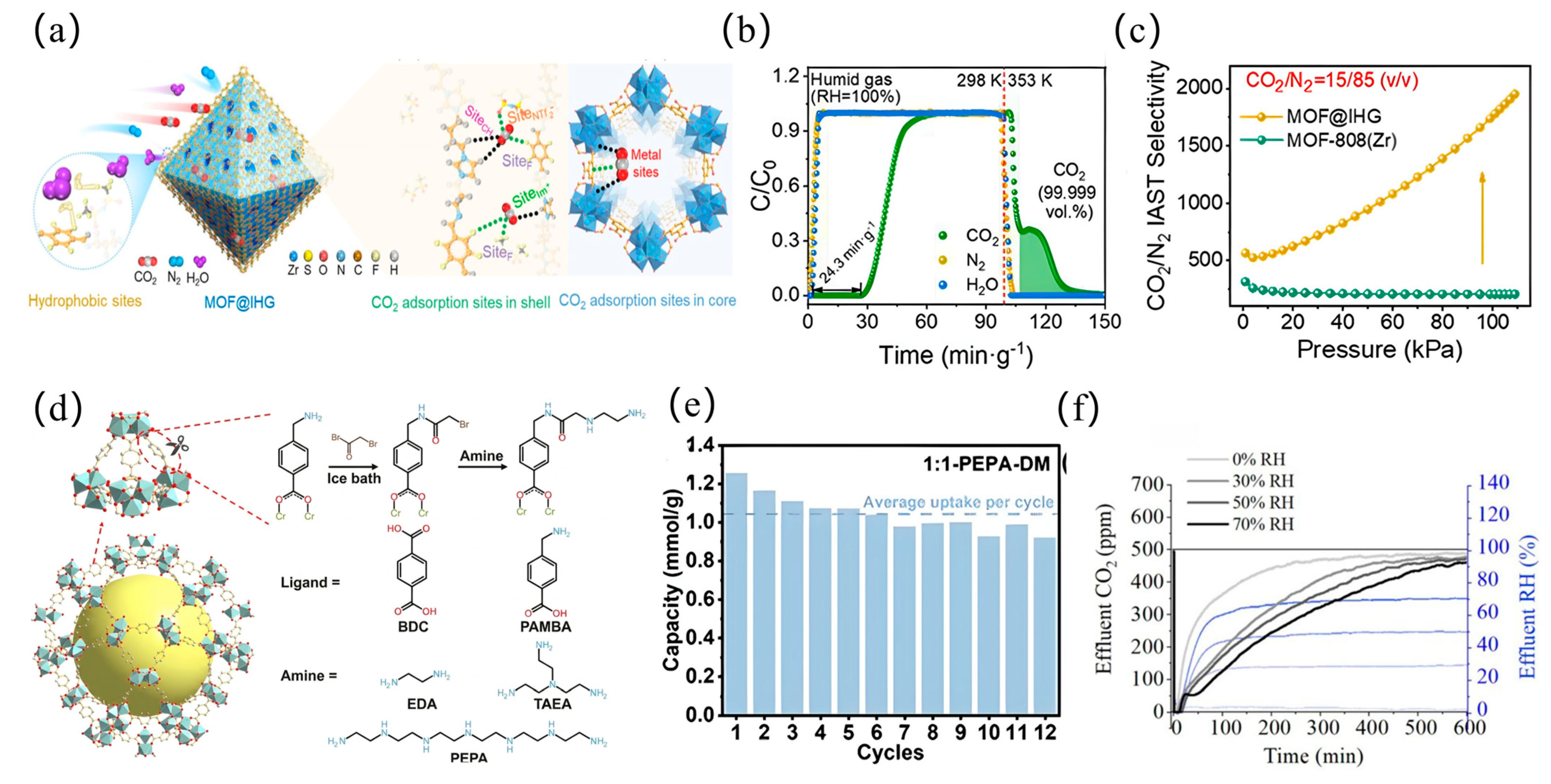
MOF/polymer composites have shown great promise for post-combustion CO2 capture, which targets flue gas with low CO2 partial pressure (10–15%), high N2 content, and water vapor. A recent breakthrough in the ionic hydrophobic gating (IHG) strategy offers a new approach for CO2 capture from humid flue gas. Sun et al. [124] assembled a hydrophobic ionic liquid and fluorinated terephthalaldehyde on the MOF surface to construct a bifunctional shell. This shell simultaneously forms a H2O permeation barrier and provides CO2-selective transport channels (Figure 11c). Under saturated humidity (RH = 100%) flue gas, this material directly captured dry CO2 with a purity of 99.999% (Figure 11a), achieving a CO2/N2 selectivity as high as 1780 at 298 K and 1 bar (Figure 11b). For direct air capture (DAC), which removes CO2 from ambient air (~400 ppm), amine-functionalized polymer composites achieve efficient capture through chemisorption. Yan et al. [125] covalently grafted polyethylenepolyamine (PEPA) onto a defective chromium-based MOF (Figure 11d). The resulting PEPA-DM composite exhibited a CO2 adsorption capacity of 1.26 mmol/g under ambient air conditions, with a regeneration energy consumption of only 75.1 kJ/mol (Figure 11e). Ionic liquid functionalization offers a new approach for low-energy regeneration. Zeeshan et al. [126] loaded functionalized ionic liquids into MOFs. The resulting IL/MOF composite achieved a CO2 uptake of 0.5 mmol/g at 500 ppm CO2 under varying relative humidity conditions (Figure 11f) and could be rapidly regenerated within 2–4 min using microwave dielectric heating, which delivers energy directly to the ionic liquid domains.
MOF/metal oxide composites offer advantages in high-temperature stability and cyclic performance. Zhao et al. [91] prepared an Mg-doped CaO adsorbent using a calcium-based MOF as a precursor. The optimal sample, Ca5Mg3, exhibited a capacity decay of only 0.7 mmol/g after 30 CO2 adsorption–desorption cycles, with MgO serving as an inert high-temperature stabilizer that significantly enhanced the sintering resistance and cycling stability of the adsorbent. For oxy-fuel combustion, magnetic MOF composites such as Fe3O4@HKUST-1 can be aligned under an external magnetic field to optimize membrane performance. This material achieves a CO2 uptake of 5 mmol/g at 273 K and 1 bar, with a CO2/N2 selectivity of 22.
MOF-on-MOF composites also contribute to CO2 separation. Hou et al. [127] constructed a ZIF-8@NH2-MIL-125 heterostructure featuring a “small pore–large pore–small pore” architecture, enabling a “select–diffuse–select” separation mechanism. When incorporated into a Pebax matrix to prepare mixed matrix membranes, the material achieved an ideal CO2/N2 selectivity of 103.2 at 308 K and 4 atm, representing a 102% increase compared to pristine Pebax membranes (51.0).
In summary, the integration of MOFs with various functional materials has emerged as a versatile strategy for CO2 capture, offering unique advantages in enhancing adsorption capacity, selectivity, and regenerability. As summarized in Table 3, rational composite design including MOF/carbon hybrids, MOF/polymer composites, MOF/metal oxide systems, and MOF-on-MOF architectures significantly improves CO2 capture performance through synergistic effects at the interface between components. MOF/carbon composites achieve enhanced CO2 uptake by creating additional micropores at the MOF–carbon interface, while carbon/MOF hybrids exhibit substantially improved CO2/N2 selectivity through surface functionality modulation. MOF/polymer composites, particularly those functionalized with amine-rich polymers such as TEPA and PEI, achieve high CO2 uptake under ambient conditions by combining the high surface area of MOFs with the strong chemical affinity of amines for CO2. MOF/metal oxide composites leverage the strong chemical reactivity of metal oxides (e.g., CaO, MgO, Fe3O4) for enhanced CO2 chemisorption, while also enabling magnetic separation and low-energy regeneration. Furthermore, MOF-on-MOF core–shell architectures achieve high CO2/N2 selectivity through precise pore engineering and tailored interface design (e.g., ZIF-8@NH2-MIL-125). These composite design strategies collectively provide a versatile platform for developing high-performance adsorbents tailored to specific CO2 capture scenarios, including post-combustion flue gas, pre-combustion syngas, and direct air capture.
However, several challenges remain. The trade-off between CO2 uptake and selectivity persists, as materials with high surface area often exhibit reduced selectivity due to non-specific adsorption. Interfacial compatibility between MOFs and functional components requires further optimization to avoid pore blockage and ensure uniform dispersion. The long-term stability of these composites under realistic operating conditions, including humidity, trace impurities (e.g., SOx, NOx), and cyclic adsorption–desorption, demands systematic evaluation. Moreover, the energy consumption for regeneration remains a key concern, particularly for amine-functionalized composites where strong chemisorption necessitates high-temperature desorption. Building on the composite design strategies discussed above, future research should focus on developing novel MOF-based composites that combine high CO2 uptake with excellent selectivity, low regeneration energy, and long-term cycling stability, while advancing scalable processing and real-world validation under practical conditions.

3.2. CH4 Capture

Methane (CH4) is not only an important clean energy gas but also the second largest greenhouse gas after CO2, with a global warming potential (GWP) approximately 25 times that of CO2. The main sources of CH4 include natural gas, coalbed methane, and biogas. Among these, natural gas purification primarily involves CH4/CO2 separation, while coalbed methane/biogas upgrading mainly involves CH4/N2 separation. Both separation systems face challenges arising from similar molecular sizes and physical properties. For example, the kinetic diameters of CO2 and CH4 are 3.30 Å and 3.80 Å, respectively, while those of N2 and CH4 are 3.64 Å and 3.80 Å, respectively. Furthermore, CH4 is a non-polar molecule, making it difficult to capture selectively through polar interactions. Therefore, developing MOF composites with both high selectivity and high adsorption capacity has become a research priority in this field.
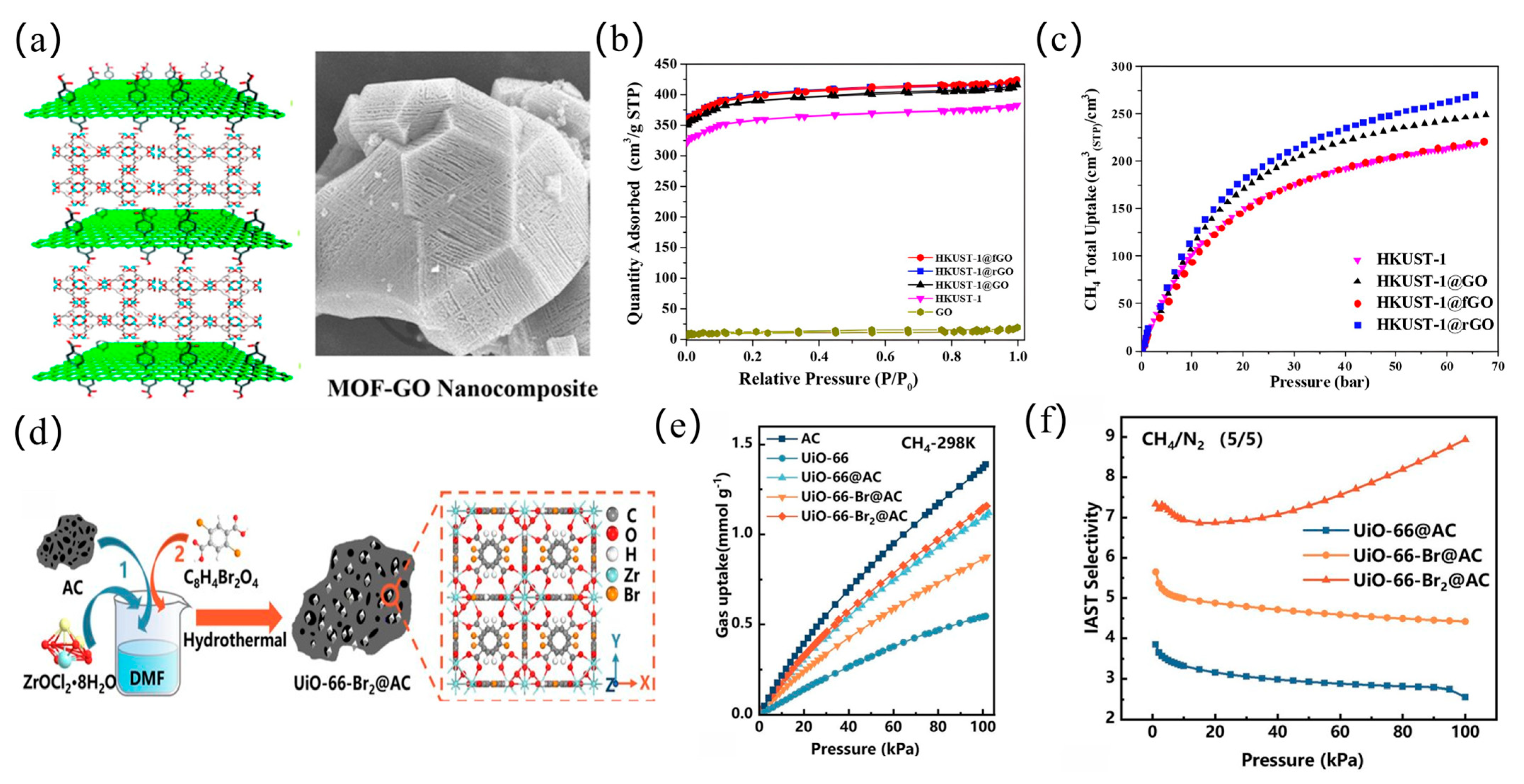
MOF/carbon composites have been widely explored for CH4 capture due to their enhanced porosity and improved gas uptake. Zheng et al. doped activated carbon into MIL-101 via an in situ hydrothermal method, tuning the pore structure to develop more micropores. The resulting DFAC-MIL-101 composite exhibited a CH4 uptake of 11.5 mmol/g at 6 MPa and 30 °C, with a CH4/N2 selectivity exceeding 4.0 at 1.5 MPa [170]. In terms of high-pressure CH4 storage, HKUST-1@rGO achieved a CH4 deliverable capacity of 193 cm3/cm3 at 298 K and 5.8–65 bar, representing a 30% improvement over pristine HKUST-1, attributed to the formation of additional micropores at the MOF–carbon interface (Figure 12a,c) [171]. Similarly, Cui et al. developed a bromine-functionalized UiO-66-Br2@AC composite (Figure 12d), also a MOF–carbon material, achieving a CH4/N2 IAST selectivity of 8.94 at 298 K and a CH4 uptake of 1.16 mmol·g−1 (Figure 12e,f), with excellent breakthrough performance under dilute CH4 conditions [172]. Additionally, Li et al., combining GCMC simulations with experiments, identified Ni-MOF-74 as a promising candidate, and the resulting 5 wt% GO/Ni-MOF-74 composite achieved an IAST selectivity of 25.94, far exceeding that of pristine Ni-MOF-74 (15.23) [173].
MOF/polymer composites offer advantages in shaping and practical handling for CH4 storage applications. Dou et al. developed a phase conversion method to fabricate PC-HKUST-1 nanofibers by decorating HKUST-1 on polyacrylonitrile (PAN) nanofibers. The resulting MOF/polymer nanofiber composite achieved a high MOF loading of 52 wt% and a CH4 uptake of 86 cm3/g (3.84 mmol/g) at 298 K and 35 bar, demonstrating that polymer nanofiber matrices can effectively structure MOFs into mechanically robust and flexible adsorbent forms without sacrificing gas storage performance [174].
Figure 12. (a) Schematic illustration of the synthesis of MOF-GO nanocomposites. (b) N2 physisorption isotherms of pristine HKUST-1 and MOF-GO nanocomposites at 77 K. (c) Volumetric CH4 adsorption isotherms of pristine HKUST-1 and MOF-GO nanocomposites at 25 °C. (d) Schematic of the synthesis of UiO-66-Br2@AC. (The numbers “1” and “2” indicate the sequential order of addition during the synthesis process.) (e) The CH4 adsorption isotherms at (a) 298 K, (c) 273 K. (f) IAST selectivity of CH4/N2 (5: 5, v/v) [171,175].
Jcs 10 00324 g012
In summary, the integration of MOFs with carbon-based materials, polymers, zeolites, and silica has emerged as a powerful strategy for CH4 capture and separation. As summarized in Table 4, rational composite design including MOF/carbon hybrids, MOF/polymer composites, zeolite/MOF composites, and MOF/silica systems significantly improves CH4 uptake and selectivity through synergistic effects. MOF/carbon composites achieve enhanced deliverable capacity by creating additional micropores at the MOF–carbon interface. MOF/polymer nanofibers enable high MOF loadings while maintaining excellent CH4 uptake. Zeolite/MOF and MOF/silica composites have also demonstrated improved selectivity through subunit incorporation and pore engineering, respectively. These strategies collectively provide a versatile platform for developing high-performance adsorbents for CH4/N2, CH4/CO2, and high-pressure CH4 storage.
However, several challenges remain. The trade-off between gravimetric and volumetric CH4 uptake persists, as high-surface-area materials often suffer from low packing density. Interfacial compatibility between MOFs and carbon/zeolite matrices requires further optimization to avoid pore blockage and ensure uniform dispersion. The long-term stability of these composites under realistic operating conditions, including humidity, trace impurities, and cyclic adsorption–desorption, demands systematic evaluation. Moreover, the scalable and cost-effective production of high-performance MOF composites remains a significant hurdle for industrial deployment. Building on the composite design strategies discussed above, future research should focus on developing novel MOF-based composites that combine high CH4 uptake with excellent selectivity and mechanical stability, while advancing shaping technologies and real-world validation under practical conditions.

3.3. Separation of Fluorinated Greenhouse Gases

In recent years, metal–organic frameworks (MOFs) and MOF-based composites have shown broad application prospects in gas adsorption and separation. Benefiting from their tailorable pore structures and tunable surface chemistry, these materials have also attracted growing attention for the capture of fluorinated greenhouse gases. However, compared with mature systems for CO2, CH4, and light hydrocarbons, studies on CF4, NF3, and SF6 separation remain relatively limited. In this field, the research on MOF composites has mainly focused on MOF/polymer composites, while other composite types such as MOF/carbon and MOF/metal oxide have been less explored.
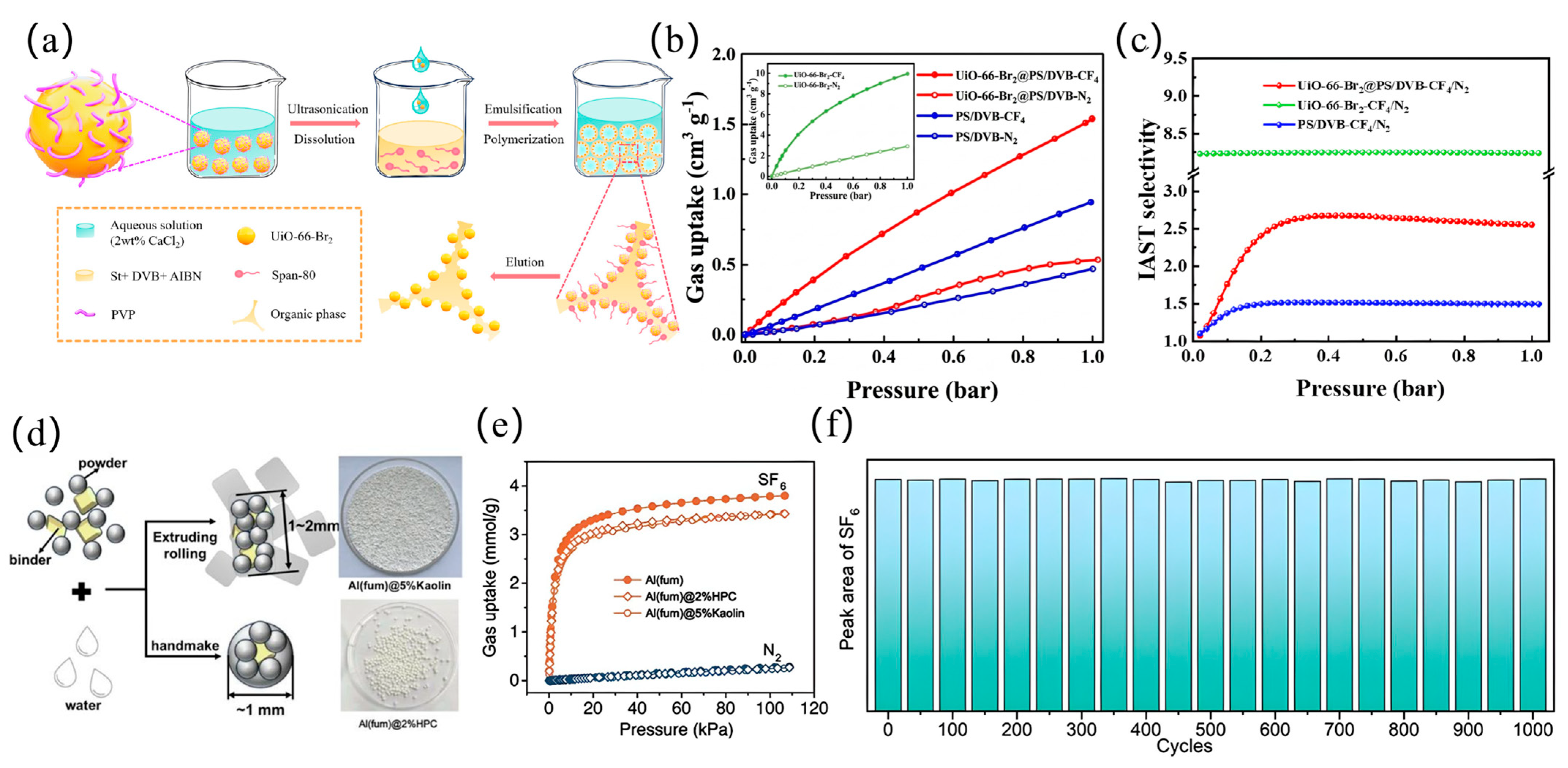
For CF4/N2 separation, various porous materials have been explored, but each suffers from certain limitations. Pure carbon materials (e.g., PNN) show moderate CF4 uptake (4.89 mmol/g) but lack selectivity. Pure MOFs (e.g., SIFSIX-2-Cu) offer better selectivity (~5) but face challenges in shaping and practical handling [183]. To address these issues, Miao et al. [184] constructed a hierarchical porous UiO-66-Br2@PS/DVB packed column via a high internal phase emulsion strategy (Figure 13a). Compared to the pristine PS/DVB polymer, the composite showed enhanced CF4 uptake (1.54 vs. 0.94 cm3/g) and improved CF4/N2 selectivity (2.67 vs. 1.51) at 298 K and 1 bar (Figure 13b,c). Further improving the selectivity, the same group later designed a core–shell PSD@HKUST-1-AcOH composite, which achieved a CF4 uptake of 5.28 cm3/g and a CF4/N2 selectivity of approximately 27 at 298 K and 1 bar. These examples demonstrate that compositing MOFs with polymer matrices can simultaneously improve separation performance and processability, providing a promising direction for fluorinated gas capture.
For SF6/N2 separation, pure MOF powders often suffer from high mass transfer resistance and poor processability, limiting their practical application. To address these issues, Li et al. [185] composited Al(fum) with hydroxypropyl cellulose (HPC) and kaolin, preparing Al(fum)@2%HPC and Al(fum)@5%Kaolin shaped pellets via wet granulation (Figure 13d). These composites not only retained the excellent SF6/N2 selectivity (>2 × 10⁴) and dynamic adsorption capacity (~2.7 mmol/g) of pristine Al(fum) powder but also significantly reduced bed pressure drops (Figure 13e). After 1000 adsorption–desorption cycles, the composites maintained stable performance (Figure 13f). Combined with a two-stage temperature-vacuum swing adsorption (VTSA) process, the SF6 recovery rate reached 99.91%, with an energy consumption of only 18.7% of that of cryogenic distillation [185]. Further improving the selectivity–kinetics trade-off, Miao et al. [186] who prepared a core–shell PSD@HKUST-1-AcOH composite by growing HKUST-1 on mesoporous poly(styrene-divinylbenzene) spheres. By introducing acetic acid to create additional defects, the optimized material achieved an SF6/N2 IAST selectivity of 924 at 298 K and 1 bar, markedly higher than that of pristine HKUST-1, while also reducing material cost by approximately 25%. The hierarchical architecture, consisting of a microporous HKUST-1 shell and a mesoporous PSD core, was proposed to facilitate gas diffusion, reduce mass-transfer resistance, and mitigate the trade-off between selectivity and adsorption kinetics that is often encountered in purely microporous adsorbents. These examples demonstrate that shaping strategies and hierarchical architecture design can effectively address the practical challenges of MOF-based adsorbents for SF6 capture.
In summary, the integration of MOFs with polymer matrices has emerged as a promising strategy for fluorinated gas separation, offering unique advantages in balancing selectivity, processability, and engineering applicability. As summarized in Table 5, rational composite design including hierarchical porous structures, core–shell architectures, and shaped pellets significantly enhances separation performance through improved pore engineering, interfacial interactions, and defect modulation. Hierarchical porous structures facilitate fast gas diffusion while maintaining high selectivity. Core–shell architectures effectively mitigate the trade-off between selectivity and adsorption kinetics. Shaped pellets address critical engineering issues such as high bed pressure drops and dust pollution, while preserving excellent gas uptake and selectivity over extended cycling. Defect engineering creates additional unsaturated metal sites that strengthen host–guest interactions with fluorinated gases, substantially boosting selectivity. These strategies collectively provide a versatile framework for designing high-performance adsorbents for fluorinated gas separation.
However, several challenges remain. High-selectivity, high-capacity adsorbents for CF4 and NF3 are still scarce, and the efficient separation of more challenging gas pairs (e.g., C2F6/CF4, C3F6/C3F8) remains a major hurdle. Interfacial compatibility and structural homogeneity between MOFs and polymer matrices require further optimization to avoid non-selective defects. Moreover, the trade-off between selectivity and adsorption kinetics persists, necessitating continued refinement of shell thickness and pore architecture. The long-term stability of polymer matrices under realistic conditions (e.g., humidity, trace impurities) also demands systematic evaluation, and the complex composition of multi-component composites poses challenges for cost-effective large-scale production. Building on the composite design strategies discussed above, future research should therefore focus on developing novel MOF-based composites that combine strong affinity with precise molecular sieving capabilities, while advancing scalable processing and real-world validation. Maintaining the synergistic stability of MOF/polymer composites over extended cycling and under industrial conditions remains a significant challenge that warrants further investigation.

3.4. Structure–Property Relationships of MOF Composites for Gas Adsorption

The adsorption and separation performance of MOF composites is governed by the interplay of several structural parameters, including functional groups, organic linkers, central metal ions, and the molecular properties of the target gases. A deeper comparison of these factors reveals clear structure–property trends.
Polar functional groups (e.g., -NH2, -Br, -OH) can significantly enhance the affinity of MOF composites for polar or polarizable gas molecules. For example, amino-functionalized UiO-66-NH2@GO composites exhibit improved CO2 capture via acid–base interactions between -NH2 and CO2, leading to reversible chemisorption and higher selectivity over N2 [78,188]. Moreover, bromine substitution in UiO-66-Br2@AC increases surface polarity, which strengthens CH4 adsorption while sterically hindering N2 diffusion, resulting in a CH4/N2 selectivity of 8.94 [172]. In contrast, hydrophobic polymer coatings (e.g., polynaphthalene on MOF-5) do not directly participate in gas binding but create a water barrier, preserving CO2 uptake under humid conditions.
The organic linker—its length, rigidity, and functionalization—determines pore size and shape, which affect molecular sieving. For instance, in ZIF-8-based composites such as ZIF-8@ZIF-67/GO and 15C5@ZIF-7/PI, the short 2-methylimidazole linker creates a narrow aperture (~0.34 nm) that effectively excludes N2 (kinetic diameter 3.64 Å) while allowing CO2 (3.30 Å) to pass, contributing to high CO2/N2 selectivity [43,189,190]. In addition, in MOF-74-based composites such as BC/Mg-MOF-74 and CNT@Ni-MOF-74/PZ, the DOBDC linker with two -OH groups provides open metal sites after activation, enabling strong coordination with CO2 [69,151]. Furthermore, extending the linker length in isoreticular MOFs generally increases pore volume but may reduce selectivity due to less confined diffusion pathways.
The molecular structure of the target gas—kinetic diameter, polarizability, and quadrupole moment—directly influences which composites perform best. For instance, CO2 (3.30 Å, high quadrupole moment) is effectively captured by composites with open metal sites (BC/Mg-MOF-74) or amine groups (UiO-66-NH2@GO) [78,188]. Likewise, CH4 (3.80 Å, non-polar) relies more on van der Waals interactions and surface polarity; thus, brominated composites such as UiO-66-Br2@AC enhance its uptake [172]. In contrast, N2 (3.64 Å, low polarizability) is often excluded by molecular sieving in ZIF-8-based composites (ZIF-8@ZIF-67/GO, 15C5@ZIF-7/PI) or steric hindrance in brominated composites [43,190]. For larger fluorinated gases like SF6 (5.50 Å) and CF4 (4.70 Å), composites with hierarchical pores (PSD@HKUST-1) or defect sites (PSD@HKUST-1-AcOH) provide sufficient space and strong interactions (F···H hydrogen bonds), achieving ultrahigh selectivities [186].
In summary, the best performance for a given gas is achieved by matching the composite’s functional groups, metal ions, and pore architecture to the gas’s molecular properties. For CO2 capture, open metal sites or basic functional groups on a high-surface-area support are most effective. For CH4/N2 separation, increasing surface polarity while maintaining microporosity enhances CH4 affinity over N2. For fluorinated gases, a combination of large enough pores to accommodate the bulky molecules and specific interaction sites (e.g., -OH defects, crown ether cavities) is key. This analysis underscores that rational design of MOF composites requires simultaneous optimization of multiple structural parameters.

4. Challenges and Perspectives

Despite the significant progress and superior performance of MOF composites for greenhouse gas adsorption and separation, translating fundamental research into industrial applications still faces numerous challenges. This section summarizes the key bottlenecks and outlines future perspectives.

4.1. Summary

Metal–organic frameworks (MOFs) are promising for greenhouse gas capture due to their high surface area and tunable pores, but pristine MOFs suffer from poor water stability, high bed pressure drops, limited mass transfer, and low mechanical strength. To overcome these bottlenecks, integrating MOFs with functional materials such as carbon, polymers, metal oxides, or other MOFs has proven effective. This review systematically summarizes four representative composite types, emphasizing design strategies and synergistic mechanisms. The synergistic effects operate across multiple scales: MOF–carbon composites introduce hydrophobic barriers and hierarchical porosity; MOF–polymer composites enable shaping and provide protective coatings; MOF–metal oxide composites combine physical adsorption with chemisorption and offer low-energy regeneration pathways; MOF-on-MOF heterostructures achieve atomic-level interfacial integration, balancing selectivity and permeability. These multiscale synergies position MOF composites as versatile platforms for greenhouse gas adsorption and separation, with tunability enabling applications from CO2 capture and CH4 purification to fluorinated gas recovery.

4.2. Challenges

Despite notable progress, several critical challenges impede the industrial deployment of MOF composites for greenhouse gas separation. These challenges can be grouped into five closely related aspects, namely mechanism understanding, performance evaluation, material preparation, functional innovation, and application expansion, which also define the priorities discussed in the following Perspectives section. Mechanistic understanding remains limited. The interfacial interactions between MOFs and functional components such as carbon materials, polymers, and metal oxides are central to the properties of the resulting composites, yet the microscopic origin of the observed synergistic effects is still poorly resolved. Fundamental questions persist regarding whether chemical bonds are formed at the interface, how the local electronic structure is reorganized, and how pore connectivity and mass-transfer pathways are modified. These issues still lack systematic experimental evidence and robust theoretical interpretation.
Performance evaluation is often disconnected from practical operating conditions. Most studies are still performed using pure gases or binary mixtures under idealized laboratory conditions, whereas real flue gas and industrial exhaust streams typically contain multiple impurities, including water vapor, SO2, NOx, and O2. Water can compete with target molecules for adsorption sites and even induce framework hydrolysis, while acidic species may accelerate structural degradation. Under low-concentration conditions, such as direct air capture of CO2 or trace recovery of SF6/CF4, equilibrium uptake alone is insufficient to predict process performance. Long-term working capacity, cyclic stability, and tolerance toward impurities therefore remain inadequately assessed.
Material preparation continues to be constrained by cost and scalability. Many synthetic routes depend on energy-intensive solvothermal processes, costly organic ligands, and high-purity metal salts, while the incorporation of additives such as graphene or carbon nanotubes further increases the economic burden. Scaling production from gram-scale synthesis to kilogram-scale manufacture remains challenging in terms of reproducibility, yield, and structural integrity. In addition, converting powdered composites into pellets, monoliths, or membranes often requires binders or mechanical processing, both of which can compromise porosity and separation performance.
Functional innovation has not yet advanced far beyond conventional adsorption enhancement. Much of the current work remains focused on maximizing adsorption capacity or equilibrium selectivity, whereas the concurrent optimization of selectivity, diffusion kinetics, moisture resistance, mechanical robustness, and regenerability has received far less attention. Low-energy regeneration strategies, including magnetic swing adsorption, microwave-assisted regeneration, and photothermal swing adsorption, have shown promise at the laboratory scale, but they have not yet matured into broadly applicable composite design concepts.
Application expansion is still at an early stage. Reported studies are largely limited to batch experiments or small fixed-bed demonstrations, with comparatively little attention paid to continuous operation, process integration, pilot-scale validation, or techno-economic assessment. More demanding scenarios, such as the separation of complex fluorinated gas mixtures or the treatment of streams containing corrosive impurities, also remain underexplored. Consequently, a substantial gap persists between laboratory demonstrations and practical deployment.

4.3. Perspectives

To address the above challenges, future research should be advanced in the same five aspects identified above: mechanism understanding, performance evaluation, material preparation, functional innovation, and application expansion. These five priorities are derived directly from the main bottlenecks currently limiting the practical deployment of MOF composites, and organizing the discussion in this way helps clarify the pathway from material design to real application. A clearer mechanistic picture will depend on the integration of multiscale characterization with theory and simulation. In situ and operando techniques, including synchrotron diffraction, infrared spectroscopy, XPS, and electron microscopy, when combined with DFT calculations, GCMC simulations, and molecular dynamics, can provide direct insight into interfacial bonding, charge redistribution, adsorption-site evolution, transport pathways, and degradation processes. Such knowledge is essential for moving MOF composite design beyond empirical optimization toward predictive, mechanism-guided engineering.
Equally important is the establishment of standardized, application-relevant evaluation protocols. Benchmark conditions covering temperature, pressure, gas composition, humidity, impurity level, and flow rate should be defined so that different materials can be compared on a meaningful basis. Beyond equilibrium uptake and ideal selectivity, future studies should routinely report breakthrough behavior, working capacity, regeneration energy, cyclic stability, mechanical strength, and cost-related indicators. Particular emphasis should be placed on multicomponent, humid, and low-concentration gas streams that more faithfully represent real operating environments.
On the synthesis side, greener and more scalable manufacturing strategies are urgently needed. Water-based, room-temperature, solvent-minimized, and continuous-flow routes offer promising pathways to lower energy consumption while improving reproducibility. Economic viability may be further enhanced through the use of earth-abundant metal nodes and biomass-derived carbons in place of more expensive components. At the same time, shaping strategies for pellets, monoliths, and membranes must be refined to preserve pore accessibility and separation performance while delivering the mechanical strength required for industrial operation.
Future functional design should emphasize multifunctional integration rather than the improvement of a single metric. In addition to high adsorption capacity, next-generation MOF composites should combine strong and selective host–guest interactions with rapid mass transfer, moisture tolerance, structural stability, and low-energy regenerability. Regeneration strategies driven by magnetic fields, microwaves, or photothermal effects merit deeper investigation because of their potential to reduce the energy penalty associated with conventional temperature-swing processes. Dual-functional composites that couple greenhouse gas capture with catalytic conversion may also open new avenues for increasing overall process value.
Finally, broader application development will depend on tighter coupling between materials and process engineering. More systematic work is needed on continuous adsorption systems, hybrid separation processes, long-term pilot demonstrations, and techno-economic analysis. Beyond conventional CO2 capture, future efforts should also address more challenging targets, including trace SF6/CF4 recovery, mixed fluorinated gas separations, and the treatment of impurity-laden streams. Defining the operating windows and performance boundaries of MOF composites in these scenarios will be critical for identifying where they can deliver genuine practical advantages. Overall, the path forward for MOF composites lies not in isolated improvements to individual properties, but in the coordinated advancement of interfacial science, realistic performance assessment, scalable manufacturing, multifunctional design, and process-level deployment. Only by aligning materials innovation with engineering implementation can these systems be translated from promising laboratory materials into viable technologies for greenhouse gas separation.

Funding

This work is supported by the National Natural Science Foundation of China (Grant Nos. 22375023, 22278198, 22068016) and the Applied Basic Research Program (grant no. 202501CF070138) of Yunnan Province.

Data Availability Statement

No new data were created or analyzed in this study.

Conflicts of Interest

The authors declare no conflict of interest.

References

  1. Intergovernmental Panel On Climate Change (IPCC). Climate Change 2021—The Physical Science Basis: Working Group I Contribution to the Sixth Assessment Report of the Intergovernmental Panel on Climate Change, 1st ed.; Cambridge University Press: Cambridge, UK, 2023. [Google Scholar] [CrossRef] [Scilit]
  2. Breidenich, C.; Magraw, D.; Rowley, A.; Rubin, J.W. The kyoto protocol to the united nations framework convention on climate change. Am. J. Int. Law 1998, 92, 315–331. [Google Scholar] [CrossRef] [Scilit]
  3. Yurak, V.V.; Fedorov, S.A. Review of natural and anthropogenic emissions of carbon dioxide into the earth’s atmosphere. Int. J. Environ. Sci. Technol. 2025, 22, 2719–2736. [Google Scholar] [CrossRef] [Scilit]
  4. Balacéanu, J.C.; Bertrand, A.; Lacour, J.J. The greenhouse effect and its connection with the use of fossil fuels: The concept of CO2 emission intensity. Energy Explor. Exploit. 1989, 7, 337–347. [Google Scholar] [CrossRef] [Scilit]
  5. Nature Climate Change. Methane possible. Nat. Clim. Change 2023, 13, 1. [Google Scholar] [CrossRef] [Scilit]
  6. Pauleta, S.R.; Carepo, M.S.P.; Moura, I. Source and reduction of nitrous oxide. Coord. Chem. Rev. 2019, 387, 436–449. [Google Scholar] [CrossRef] [Scilit]
  7. Wanigarathna, D.K.J.A.; Gao, J.; Liu, B. Metal organic frameworks for adsorption-based separation of fluorocompounds: A review. Mater. Adv. 2020, 1, 310–320. [Google Scholar] [CrossRef] [Scilit]
  8. Zheng, M.; Xue, W.; Yan, T.; Jiang, Z.; Fang, Z.; Huang, H.; Zhong, C. Fluorinated MOF-based hexafluoropropylene nanotrap for highly efficient purification of octafluoropropane electronic specialty gas. Angew. Chem. 2024, 136, e202401770. [Google Scholar] [CrossRef] [Scilit]
  9. Say, D.; Manning, A.J.; Western, L.M.; Young, D.; Wisher, A.; Rigby, M.; Reimann, S.; Vollmer, M.K.; Maione, M.; Arduini, J.; et al. Global trends and european emissions of tetrafluoromethane (CF4), hexafluoroethane (C2F6) and octafluoropropane (C3F8). Atmos. Chem. Phys. 2021, 21, 2149–2164. [Google Scholar] [CrossRef] [Scilit]
  10. Godin, J.; Liu, W.; Ren, S.; Xu, C.C. Advances in recovery and utilization of carbon dioxide: A brief review. J. Environ. Chem. Eng. 2021, 9, 105644. [Google Scholar] [CrossRef] [Scilit]
  11. Sholl, D.S.; Lively, R.P. Seven chemical separations to change the world. Nature 2016, 532, 435–437. [Google Scholar] [CrossRef] [Scilit] [PubMed]
  12. Castel, C.; Favre, E. Membrane separations and energy efficiency. J. Membr. Sci. 2018, 548, 345–357. [Google Scholar] [CrossRef] [Scilit]
  13. Li, J.-R.; Kuppler, R.J.; Zhou, H.-C. Selective gas adsorption and separation in metal–organic frameworks. Chem. Soc. Rev. 2009, 38, 1477–1504. [Google Scholar] [CrossRef] [Scilit] [PubMed]
  14. Reddy, M.S.B.; Ponnamma, D.; Sadasivuni, K.K.; Kumar, B.; Abdullah, A.M. Carbon dioxide adsorption based on porous materials. RSC Adv. 2021, 11, 12658–12681. [Google Scholar] [CrossRef] [Scilit] [PubMed]
  15. Zhao, Y.-L.; Zhang, X.; Li, M.-Z.; Li, J.-R. Non-CO2 greenhouse gas separation using advanced porous materials. Chem. Soc. Rev. 2024, 53, 2056–2098. [Google Scholar] [CrossRef] [Scilit] [PubMed]
  16. Zhang, X.; Li, W.; Lu, A. Designed porous carbon materials for efficient CO2 adsorption and separation. New Carbon Mater. 2015, 30, 481–501. [Google Scholar] [CrossRef] [Scilit]
  17. Long, J.R.; Yaghi, O.M. The pervasive chemistry of metal–organic frameworks. Chem. Soc. Rev. 2009, 38, 1213–1214. [Google Scholar] [CrossRef] [Scilit] [PubMed]
  18. Zhou, H.-C.; Long, J.R.; Yaghi, O.M. Introduction to metal–organic frameworks. Chem. Rev. 2012, 112, 673–674. [Google Scholar] [CrossRef] [Scilit] [PubMed]
  19. Zhou, H.-C.; Kitagawa, S. Metal–organic frameworks (MOFs). Chem. Soc. Rev. 2014, 43, 5415–5418. [Google Scholar] [CrossRef] [Scilit] [PubMed]
  20. Cui, Y.; Li, B.; He, H.; Zhou, W.; Chen, B.; Qian, G. Metal–organic frameworks as platforms for functional materials. Acc. Chem. Res. 2016, 49, 483–493. [Google Scholar] [CrossRef] [Scilit] [PubMed]
  21. Howarth, A.J.; Liu, Y.; Li, P.; Li, Z.; Wang, T.C.; Hupp, J.T.; Farha, O.K. Chemical, thermal and mechanical stabilities of metal–organic frameworks. Nat. Rev. Mater. 2016, 1, 15018. [Google Scholar] [CrossRef] [Scilit]
  22. Raptopoulou, C.P. Metal-organic frameworks: Synthetic methods and potential applications. Materials 2021, 14, 310. [Google Scholar] [CrossRef] [Scilit] [PubMed]
  23. Jiao, L.; Seow, J.Y.R.; Skinner, W.S.; Wang, Z.U.; Jiang, H.-L. Metal–organic frameworks: Structures and functional applications. Mater. Today 2019, 27, 43–68. [Google Scholar] [CrossRef] [Scilit]
  24. Keshavarz, F. Dual impact of water on stability of metal–organic frameworks. Phys. Chem. Chem. Phys. 2026, 28, 6089–6098. [Google Scholar] [CrossRef] [Scilit] [PubMed]
  25. Tan, K.; Ullah, S.; Pandey, H.; Cedeño-Morales, E.M.; Wang, H.; Wang, K.; Zhou, H.-C.; Li, J.; Thonhauser, T. Competitive adsorption of NH3 and H2O in metal–organic framework materials: MOF-74. Chem. Mater. 2022, 34, 7906–7915. [Google Scholar] [CrossRef] [Scilit]
  26. Severino, M.I.; Al Mohtar, A.; Vieira Soares, C.; Freitas, C.; Sadovnik, N.; Nandi, S.; Mouchaham, G.; Pimenta, V.; Nouar, F.; Daturi, M.; et al. MOFs with open metal(III) sites for the environmental capture of polar volatile organic compounds. Angew. Chem. Int. Ed. 2023, 62, e202211583. [Google Scholar] [CrossRef] [Scilit]
  27. Yeskendir, B.; Dacquin, J.-P.; Lorgouilloux, Y.; Courtois, C.; Royer, S.; Dhainaut, J. From metal–organic framework powders to shaped solids: Recent developments and challenges. Mater. Adv. 2021, 2, 7139–7186. [Google Scholar] [CrossRef] [Scilit]
  28. Anand, B.; Kim, K.-H.; Sonwani, R.K.; Szulejko, J.E.; Heynderickx, P.M. Removal of gaseous benzene by a fixed-bed system packed with a highly porous metal-organic framework (MOF-199) coated glass beads. Environ. Res. 2022, 208, 112655. [Google Scholar] [CrossRef] [Scilit] [PubMed]
  29. Nicks, J.; Mudure, C.; James, J.; McDougall, A.; Hughes, W.O.H.; Spencer, J.; Düren, T.; Burrows, A.D. Particle size effects on vapour uptake and release dynamics in metal–organic frameworks. Chem. Commun. 2025, 61, 7490–7493. [Google Scholar] [CrossRef] [Scilit] [PubMed]
  30. Lang, F.; Zhang, L.; Li, Y.; Xi, X.; Pang, J.; Zheng, W.; Zhou, H.; Bu, X. Retrieving the stability and practical performance of activation-unstable mesoporous Zr(IV)-MOF for highly efficient self-calibrating acidity sensing. Angew. Chem. Int. Ed. 2025, 64, e202422517. [Google Scholar] [CrossRef] [Scilit] [PubMed]
  31. Maity, K.; Bon, V.; Kaskel, S. Toward controlled partial desolvation of guest-responsive metal–organic frameworks for precise porosity control. Chem. Mater. 2023, 35, 4192–4200. [Google Scholar] [CrossRef] [Scilit]
  32. Suh, M.P.; Cheon, Y.E. Recent advances in the dynamics of single crystal to single crystal transformations in metal–organic open frameworks. Aust. J. Chem. 2006, 59, 605–612. [Google Scholar] [CrossRef] [Scilit]
  33. Moumen, E.; Assen, A.H.; Adil, K.; Belmabkhout, Y. Versatility vs. stability. Are the assets of metal–organic frameworks deployable in aqueous acidic and basic media? Coord. Chem. Rev. 2021, 443, 214020. [Google Scholar] [CrossRef] [Scilit]
  34. Nayak, A.; Goyal, S.; Bhushan, B.; Negi, P. Metal organic framework composites for removal of organic pollutants: Focus on advanced features, gaps and prospects. Environ. Eng. Res. 2025, 31, 88–131. [Google Scholar] [CrossRef] [Scilit]
  35. Begum, M.; Wang, F.; Saboor, A.; Khan, A.; Lv, G.; Oussama, L.; Shen, J.; Bai, J. A critical review on the modification and application of MOF-808 frameworks. Sep. Purif. Technol. 2025, 368, 133046. [Google Scholar] [CrossRef] [Scilit]
  36. Xue, Y.; Zheng, S.; Xue, H.; Pang, H. Metal–organic framework composites and their electrochemical applications. J. Mater. Chem. A 2019, 7, 7301–7327. [Google Scholar] [CrossRef] [Scilit]
  37. Zhu, Q.-L.; Xu, Q. Metal–organic framework composites. Chem. Soc. Rev. 2014, 43, 5468–5512. [Google Scholar] [CrossRef] [Scilit] [PubMed]
  38. Shen, Z.; Peng, Y.; Li, X.; Li, N.; Xu, H.; Li, W.; Guo, X.; Pang, H. Design principle and synthetic strategy for metal-organic framework composites. Compos. Commun. 2024, 48, 101933. [Google Scholar] [CrossRef] [Scilit]
  39. Xu, K.; Zhang, S.; Zhuang, X.; Zhang, G.; Tang, Y.; Pang, H. Recent progress of MOF-functionalized nanocomposites: From structure to properties. Adv. Colloid Interface Sci. 2024, 323, 103050. [Google Scholar] [CrossRef] [Scilit] [PubMed]
  40. Mourdikoudis, S.; Dutta, S.; Kamal, S.; Gómez-Graña, S.; Pastoriza-Santos, I.; Wuttke, S.; Polavarapu, L. State-of-the-art, insights, and perspectives for MOFs-nanocomposites and MOF-derived (nano)materials. Adv. Mater. 2025, 37, 2415399. [Google Scholar] [CrossRef] [Scilit] [PubMed]
  41. Xu, X.; Ran, F.; Fan, Z.; Cheng, Z.; Lv, T.; Shao, L.; Liu, Y. Bimetallic metal–organic framework-derived pomegranate-like nanoclusters coupled with CoNi-doped graphene for strong wideband microwave absorption. ACS Appl. Mater. Interfaces 2020, 12, 17870–17880. [Google Scholar] [CrossRef] [Scilit] [PubMed]
  42. Wang, H.; He, S.; Qin, X.; Li, C.; Li, T. Interfacial engineering in metal–organic framework-based mixed matrix membranes using covalently grafted polyimide brushes. J. Am. Chem. Soc. 2018, 140, 17203–17210. [Google Scholar] [CrossRef] [Scilit] [PubMed]
  43. Hosseini, S.R.; Omidkhah, M.; Mehri Lighvan, Z.; Norouzbahari, S.; Ghadimi, A. Synthesis, characterization, and gas adsorption performance of an efficient hierarchical ZIF-11@ZIF-8 core–shell metal–organic framework (MOF). Sep. Purif. Technol. 2023, 307, 122679. [Google Scholar] [CrossRef] [Scilit]
  44. Jayaramulu, K.; Mukherjee, S.; Morales, D.M.; Dubal, D.P.; Nanjundan, A.K.; Schneemann, A.; Masa, J.; Kment, S.; Schuhmann, W.; Otyepka, M.; et al. Graphene-based metal–organic framework hybrids for applications in catalysis, environmental, and energy technologies. Chem. Rev. 2022, 122, 17241–17338. [Google Scholar] [CrossRef] [Scilit] [PubMed]
  45. Dassouki, K.; Dasgupta, S.; Dumas, E.; Steunou, N. Interfacing metal organic frameworks with polymers or carbon-based materials: From simple to hierarchical porous and nanostructured composites. Chem. Sci. 2023, 14, 12898–12925. [Google Scholar] [CrossRef] [Scilit] [PubMed]
  46. Zhang, X.; Zhang, S.; Tang, Y.; Huang, X.; Pang, H. Recent advances and challenges of metal–organic framework/graphene-based composites. Compos. Part B Eng. 2022, 230, 109532. [Google Scholar] [CrossRef] [Scilit]
  47. Zhan, Y.; He, S.; Hu, J.; Zhao, S.; Zeng, G.; Zhou, M.; Zhang, G.; Sengupta, A. Robust super-hydrophobic/super-oleophilic sandwich-like UIO-66-F4@rGO composites for efficient and multitasking oil/water separation applications. J. Hazard. Mater. 2020, 388, 121752. [Google Scholar] [CrossRef] [Scilit] [PubMed]
  48. Jayaramulu, K.; Datta, K.K.R.; Rösler, C.; Petr, M.; Otyepka, M.; Zboril, R.; Fischer, R.A. Biomimetic superhydrophobic/superoleophilic highly fluorinated graphene oxide and ZIF-8 composites for oil–water separation. Angew. Chem. Int. Ed. 2016, 55, 1178–1182. [Google Scholar] [CrossRef] [Scilit]
  49. Xiang, Z.; Hu, Z.; Cao, D.; Yang, W.; Lu, J.; Han, B.; Wang, W. Metal–organic frameworks with incorporated carbon nanotubes: Improving carbon dioxide and methane storage capacities by lithium doping. Angew. Chem. Int. Ed. 2011, 50, 491–494. [Google Scholar] [CrossRef] [Scilit] [PubMed]
  50. Wang, S.; Chen, X.; Xia, W. Preparation of alkali metal-doped MOF-5@GO composites and study on absorption properties. ChemistrySelect 2025, 10, e05986. [Google Scholar] [CrossRef] [Scilit]
  51. Zhang, J.; Shao, J.; Zhang, X.; Rao, G.; Krivoshapkin, P.; Krivoshapkina, E.; Yang, H.; Zhang, S.; Chen, H. Broccoli-shaped cu-BTC/biochar composite with enhanced water stability for toluene adsorption: Influence of humid air aging. Fuel 2023, 335, 127013. [Google Scholar] [CrossRef] [Scilit]
  52. Navarathna, C.M.; Dewage, N.B.; Karunanayake, A.G.; Farmer, E.L.; Perez, F.; Hassan, E.B.; Mlsna, T.E.; Pittman, C.U., Jr. Rhodamine B adsorptive removal and photocatalytic degradation on MIL-53-Fe MOF/magnetic magnetite/biochar composites. J. Inorg. Organomet. Polym. Mater. 2020, 30, 214–229. [Google Scholar]
  53. Li, M.; Guo, Q.; Chen, L.; Li, L.; Hou, H.; Zhao, Y. Microstructure and properties of graphene nanoplatelets reinforced AZ91D matrix composites prepared by electromagnetic stirring casting. J. Mater. Res. Technol. 2022, 21, 4138–4150. [Google Scholar] [CrossRef] [Scilit]
  54. Liu, Y.; Ma, Y.; Yang, J.; Zhang, S.; Wu, N.; Wang, P.; Wang, L. Overcoming chemical stability challenges of nanoporous graphene separation membranes in harsh environments. Chem. Eng. J. 2025, 508, 160721. [Google Scholar] [CrossRef] [Scilit]
  55. Farooq, N.; Luque, R.; Hessien, M.M.; Qureshi, A.M.; Sahiba, F.; Nazir, M.A.; Ur Rehman, A. A comparative study of cerium- and ytterbium-based GO/g-C3N4/Fe2O3 composites for electrochemical and photocatalytic applications. Appl. Sci. 2021, 11, 9000. [Google Scholar] [CrossRef] [Scilit]
  56. Wei, K.; Zhou, J.; Qu, G.; Pan, K.; Qin, J.; Lv, J.; Liang, Y. Bifunctional colloid based on anchoring reactions in-situ modified electrodes: For electrochemical sensing and HER. Microchem. J. 2024, 202, 110791. [Google Scholar] [CrossRef] [Scilit]
  57. Yang, L.; Zou, M.; Wu, S.; Xu, W.; Wu, H.; Cao, A. Graphene oxide glue-electrode for fabrication of vertical, elastic, conductive columns. ACS Nano 2017, 11, 2944–2951. [Google Scholar] [CrossRef] [Scilit] [PubMed]
  58. Cirujano, F.G.; Martín, N.; López-Maya, E.; G Álvarez, M.; Sánchez-Montero, M.J.; García-Verdugo, E.; Merchán, M.D.; Velázquez, M.M. Tuning CO2 capture and conversion with metal–organic frameworks crystallized in aqueous graphene oxide suspensions. ACS Appl. Mater. Interfaces 2025, 17, 15357–15371. [Google Scholar] [CrossRef] [Scilit] [PubMed]
  59. Bi, X.; Hou, Y.; Pan, Y.; Huo, S.; Shi, C.; He, J.; Yang, R. Metal–organic frameworks meet two-dimensional materials in polymer matrices for flame retardant and sensor applications. Small Sci. 2025, 5, 2400611. [Google Scholar] [CrossRef] [Scilit]
  60. Berson, S.; de Bettignies, R.; Bailly, S.; Guillerez, S.; Jousselme, B. Elaboration of P3HT/CNT/PCBM composites for organic photovoltaic cells. Adv. Funct. Mater. 2007, 17, 3363–3370. [Google Scholar] [CrossRef] [Scilit]
  61. Chui, S.S.-Y.; Lo, S.M.-F.; Charmant, J.P.H.; Orpen, A.G.; Williams, I.D. A chemically functionalizable nanoporous material [Cu3(TMA)2(H2O)3]n. Science 1999, 283, 1148–1150. [Google Scholar] [CrossRef] [Scilit] [PubMed]
  62. Xiang, Z.; Peng, X.; Cheng, X.; Li, X.; Cao, D. CNT@Cu3(BTC)2 and metal–organic frameworks for separation of CO2/CH4 mixture. J. Phys. Chem. C 2011, 115, 19864–19871. [Google Scholar] [CrossRef] [Scilit]
  63. Fernández-Catalá, J.; Casco, M.E.; Martínez-Escandell, M.; Rodríguez-Reinoso, F.; Silvestre-Albero, J. HKUST-1@ACM hybrids for adsorption applications: A systematic study of the synthesis conditions. Microporous Mesoporous Mater. 2017, 237, 74–81. [Google Scholar] [CrossRef] [Scilit]
  64. Muñoz-Senmache, J.C.; Kim, S.; Arrieta-Pérez, R.R.; Park, C.M.; Yoon, Y.; Hernández-Maldonado, A.J. Activated carbon–metal organic framework composite for the adsorption of contaminants of emerging concern from water. ACS Appl. Nano Mater. 2020, 3, 2928–2940. [Google Scholar] [CrossRef] [Scilit]
  65. Ma, X.; Li, Y.; Du, Y.; Chen, S.; Bai, Y.; Li, L.; Qi, C.; Wu, P.; Zhang, S. In-situ synthesis of ZIF-8 on magnetic pineapple leaf biochar as an efficient and reusable adsorbent for methylene blue removal from wastewater. Environ. Sci. Pollut. Res. 2024, 31, 24113–24128. [Google Scholar] [CrossRef] [Scilit] [PubMed]
  66. Aboughaly, M.; Babaei-Ghazvini, A.; Dhar, P.; Patel, R.; Acharya, B. Enhancing the potential of polymer composites using biochar as a filler: A review. Polymers 2023, 15, 3981. [Google Scholar] [CrossRef] [Scilit] [PubMed]
  67. Xiao, J.; Zhang, Y.; Zhang, T.C.; Wang, Y.; Yuan, S. Cu3BTC2 MOF-impregnated boron-doped biochar derived from orange peels for enhanced NH3 capture. Appl. Surf. Sci. 2023, 635, 157735. [Google Scholar] [CrossRef] [Scilit]
  68. Vaz, R.C.A.; Lopez, M.A.R.; Ferreira, G.M.D. Unlocking the potential of MOF-biochar composites: Advanced functional materials for adsorption, catalysis, and energy storage. Mater. Today Chem. 2024, 42, 102383. [Google Scholar] [CrossRef] [Scilit]
  69. Wang, C.; Jia, L.; Qin, S.; He, L.; Wu, Y.; Liu, Q.; Jin, Y. Study on the decarbonization mechanism of composite adsorbent by mg-MOF-74-based modified biochar. Fuel 2024, 357, 129959. [Google Scholar] [CrossRef] [Scilit]
  70. Ansone-Bertina, L.; Ozols, V.; Arbidans, L.; Dobkevica, L.; Sarsuns, K.; Vanags, E.; Klavins, M. Metal–organic frameworks (MOFs) containing adsorbents for carbon capture. Energies 2022, 15, 3473. [Google Scholar] [CrossRef] [Scilit]
  71. Verma, P.; Bannon, M.S.; Kuenen, M.K.; Raj, S.; Dhakal, A.; Stone, K.; Nichols, A.W.; Machan, C.W.; Colón, Y.J.; Letteri, R.A.; et al. Expanding the design space of polymer–metal organic framework (MOF) gels by understanding polymer–MOF interactions. Chem. Mater. 2024, 36, 9356–9369. [Google Scholar] [CrossRef] [Scilit] [PubMed]
  72. Sivamanjari, S.M.; Jesitha, K.; Sreekala, M.S.; Thomas, S. Nanocellulose—Metal-organic framework (MOF) composites for efficient carbon dioxide capture and sequestration: A review. Int. J. Biol. Macromol. 2025, 315, 144583. [Google Scholar] [CrossRef] [Scilit] [PubMed]
  73. Duyar, C.; Kayan, A. Synthesis of aluminum-based MOF and cellulose-modified al-MOF for enhanced adsorption of congo red dye. Inorganics 2025, 14, 6. [Google Scholar] [CrossRef] [Scilit]
  74. Demirci, G.V.; Baig, M.T.; Kayan, A. UiO-66 MOF/Zr-di-terephthalate/cellulose hybrid composite synthesized via sol-gel approach for the efficient removal of methylene blue dye. Int. J. Biol. Macromol. 2024, 283, 137950. [Google Scholar] [CrossRef] [Scilit] [PubMed]
  75. Ahmad, S.; Omar, M.F.; Mahdi, E.M.; Halim, K.A.A.; Abd Rahim, S.Z.; Md Akil, H.; Nosbi, N.; Yudasari, N.; Hassan, M.H.; Md Saleh, S.S.; et al. Molecular interactions between polyurethane and UiO-66 in polymer-MOF nanocomposites: Microstructural and mechanical effects. Arch. Metall. Mater. 2025, 70, 199–209. [Google Scholar] [CrossRef] [Scilit]
  76. Chen, C.; Zhu, H.; Li, B.; Zhu, S. Structuring metal–organic framework materials into hierarchically porous composites through one-pot fabrication strategy. Chem.—Eur. J. 2020, 26, 3358–3363. [Google Scholar] [CrossRef] [Scilit] [PubMed]
  77. Zhu, H.; Yang, X.; Cranston, E.D.; Zhu, S. Flexible and porous nanocellulose aerogels with high loadings of metal–organic-framework particles for separations applications. Adv. Mater. 2016, 28, 7652–7657. [Google Scholar] [CrossRef] [Scilit] [PubMed]
  78. Ding, N.; Li, H.; Feng, X.; Wang, Q.; Wang, S.; Ma, L.; Zhou, J.; Wang, B. Partitioning MOF-5 into confined and hydrophobic compartments for carbon capture under humid conditions. J. Am. Chem. Soc. 2016, 138, 10100–10103. [Google Scholar] [CrossRef] [Scilit] [PubMed]
  79. Choe, J.H.; Kim, H.; Shin, D.Y.; Kim, N.; Cheon, G.; Yun, H.; Youn, J.; Lee, J.-H.; Hong, C.S. Postsynthetic in situ polymerization of a diamine-appended MOF for humidity-tolerant CO2 capture. Chem. Eng. J. 2025, 526, 170939. [Google Scholar] [CrossRef] [Scilit]
  80. Wang, D.; Li, T. Toward MOF@polymer core–shell particles: Design principles and potential applications. Acc. Chem. Res. 2023, 56, 462–474. [Google Scholar] [CrossRef] [Scilit] [PubMed]
  81. Anan, S.; Sada, K.; Kokado, K. Durable metal-organic frameworks by covalent hybridization with polyurethane and polyallophanate. Asian J. Org. Chem. 2025, 14, e202400642. [Google Scholar] [CrossRef] [Scilit]
  82. Ma, R.; Hou, Y.; Zhang, W.; Pan, Y.-T.; Huo, S.; Shi, C. MOF-based nanocomposites in polymer matrix: Progress and prospects. Adv. Compos. Hybrid Mater. 2025, 8, 351. [Google Scholar] [CrossRef] [Scilit]
  83. Freitas, C.; Severino, M.I.; Mohtar, A.A.; Kolmykov, O.; Pimenta, V.; Nouar, F.; Serre, C.; Pinto, M. Metal–organic frameworks polyurethane composite foams for the capture of volatile organic compounds. ACS Mater. Lett. 2024, 6, 174–181. [Google Scholar] [CrossRef] [Scilit]
  84. Ozcan, A.; Fan, D.; Datta, S.J.; Diaz-Marquez, A.; Semino, R.; Cheng, Y.; Joarder, B.; Eddaoudi, M.; Maurin, G. Tuning MOF/polymer interfacial pore geometry in mixed matrix membrane for upgrading CO2 separation performance. Sci. Adv. 2024, 10, eadk5846. [Google Scholar] [CrossRef] [Scilit] [PubMed]
  85. Ming, H.; Jiang, H.; Zheng, R.; Wu, M.; Li, H.; Li, Z.; Zhang, X.; Yuan, Z.; Wang, Z. Polyethylene polyamine-modified chitosan aerogels: Enhanced CO2 adsorbents with lamellar porous structures. Polymers 2025, 17, 414. [Google Scholar] [CrossRef] [Scilit] [PubMed]
  86. Shirasaki, K.; Zhao, Y.; Chen, N.C.-R.; Liu, X.; Asakura, Y.; Wu, K.C.-W.; Yamauchi, Y. Gradient mesoporosity in hierarchical ZIF-8 by temperature-modulated soft-templating. Chem. Sci. 2025, 16, 22742–22747. [Google Scholar] [CrossRef] [Scilit] [PubMed]
  87. Bindra, A.K.; Wang, D.; Zhao, Y. Metal–organic frameworks meet polymers: From synthesis strategies to healthcare applications. Adv. Mater. 2023, 35, 2300700. [Google Scholar] [CrossRef] [Scilit] [PubMed]
  88. Cai, J.; Liang, Q.; Tang, Y.; Yang, J.; Fang, M.; Yao, S. CO2 capture properties of a multi-metals CaMgZr-MOF derived CaO-based sorbents with highly dispersed doped metal atoms and DFT study. Fuel 2024, 374, 132466. [Google Scholar] [CrossRef] [Scilit]
  89. Duojie, Z.; Chen, K.; Chen, J.; Zeng, Q.; Bai, J.; Li, T.; Ma, C.; Zhang, M. Tailoring morphology of MgO with mg-MOF for the enhanced adsorption of congo red. ACS Omega 2024, 9, 41676–41686. [Google Scholar] [CrossRef] [Scilit] [PubMed]
  90. Xiang, Y.; Liu, Z.; Cheng, Z. Diatomite supported highly-dispersed ZnO/Zn-co-embedded ZIF-8 derived porous carbon composites for adsorption desulfurization. J. Hazard. Mater. 2024, 471, 134399. [Google Scholar] [CrossRef] [Scilit] [PubMed]
  91. Xu, Z.; Jiang, T.; Zhang, J.; Lou, S.N.; Wang, S. A novel self-reactivated and stable MOF-derived mg-doped CaO sorbent for high-temperature CO2 capture. Sep. Purif. Technol. 2025, 359, 130827. [Google Scholar] [CrossRef] [Scilit]
  92. Kong, Q.; Zhang, H.; Wang, P.; Lan, Y.; Ma, W.; Shi, X. NiCo bimetallic and the corresponding monometallic organic frameworks loaded CMC aerogels for adsorbing Cu2+: Adsorption behavior and mechanism. Int. J. Biol. Macromol. 2023, 244, 125169. [Google Scholar] [CrossRef] [Scilit] [PubMed]
  93. Chang, C.-W.; Kao, Y.-H.; Shen, P.-H.; Kang, P.-C.; Wang, C.-Y. Nanoconfinement of metal oxide MgO and ZnO in zeolitic imidazolate framework ZIF-8 for CO2 adsorption and regeneration. J. Hazard. Mater. 2020, 400, 122974. [Google Scholar] [CrossRef] [Scilit] [PubMed]
  94. Wu, H.Q.; Yan, C.S.; Luo, F.; Krishna, R. Beyond crystal engineering: Significant enhancement of C2H2/CO2 separation by constructing composite material. Inorg. Chem. 2018, 57, 3679–3682. [Google Scholar] [CrossRef] [Scilit] [PubMed]
  95. Kim, J.; Lee, S.; Kim, J.; Lee, D. Metal–organic frameworks derived from zero-valent metal substrates: Mechanisms of formation and modulation of properties. Adv. Funct. Mater. 2019, 29, 1808466. [Google Scholar] [CrossRef] [Scilit]
  96. Ben Neon, L.; Bechelany, M.; Drobek, M.; Petit, E.; Julbe, A. The race of time during oxide-to-MOF conversion: Competition between MOF(Al) growth and alumina facets rearrangement. Materialia 2025, 39, 102327. [Google Scholar] [CrossRef] [Scilit]
  97. Romero-Guerrero, J.J.; Moscoso, F.G.; Hamad, S.; Moreno, G.P.; Rico, V.; Quero, Á.B.; Lopes-Costa, T.; Pedrosa, J.M. In situ growing of ZIF-8 crystals into TiO2 micro columnar films. Mater. 2025, 6, 100406. [Google Scholar] [CrossRef] [Scilit]
  98. Liu, C.; Wang, J.; Wan, J.; Yu, C. MOF-on-MOF hybrids: Synthesis and applications. Coord. Chem. Rev. 2021, 432, 213743. [Google Scholar] [CrossRef] [Scilit]
  99. Chai, L.; Pan, J.; Hu, Y.; Qian, J.; Hong, M. Rational design and growth of MOF-on-MOF heterostructures. Small 2021, 17, 2100607. [Google Scholar] [CrossRef] [Scilit] [PubMed]
  100. Gu, Y.; Wu, Y.; Li, L.; Chen, W.; Li, F.; Kitagawa, S. Controllable modular growth of hierarchical MOF-on-MOF architectures. Angew. Chem. Int. Ed. 2017, 56, 15658–15662. [Google Scholar] [CrossRef] [Scilit] [PubMed]
  101. Furukawa, S.; Hirai, K.; Nakagawa, K.; Takashima, Y.; Matsuda, R.; Tsuruoka, T.; Kondo, M.; Haruki, R.; Tanaka, D.; Sakamoto, H.; et al. Heterogeneously hybridized porous coordination polymer crystals: Fabrication of heterometallic core–shell single crystals with an in-plane rotational epitaxial relationship. Angew. Chem. Int. Ed. 2009, 48, 1766–1770. [Google Scholar] [CrossRef] [Scilit] [PubMed]
  102. Wang, Z.; Liu, J.; Lukose, B.; Gu, Z.; Weidler, P.G.; Gliemann, H.; Heine, T.; Wöll, C. Nanoporous designer solids with huge lattice constant gradients: Multiheteroepitaxy of metal–organic frameworks. Nano Lett. 2014, 14, 1526–1529. [Google Scholar] [CrossRef] [Scilit] [PubMed]
  103. Yang, J.; Zhang, F.; Lu, H.; Hong, X.; Jiang, H.; Wu, Y.; Li, Y. Hollow zn/co ZIF particles derived from core–shell ZIF-67@ZIF-8 as selective catalyst for the semi-hydrogenation of acetylene. Angew. Chem. 2015, 127, 11039–11043. [Google Scholar] [CrossRef] [Scilit]
  104. Liu, C.; Wang, J.; Wan, J.; Cheng, Y.; Huang, R.; Zhang, C.; Hu, W.; Wei, G.; Yu, C. Amorphous metal–organic framework-dominated nanocomposites with both compositional and structural heterogeneity for oxygen evolution. Angew. Chem. Int. Ed. 2020, 59, 3630–3637. [Google Scholar] [CrossRef] [Scilit] [PubMed]
  105. Li, T.; Sullivan, J.E.; Rosi, N.L. Design and preparation of a core–shell metal–organic framework for selective CO2 capture. J. Am. Chem. Soc. 2013, 135, 9984–9987. [Google Scholar] [CrossRef] [Scilit] [PubMed]
  106. Klomkliang, N.; Threerattanakulpron, N.; Kumsi, J.; Serafin, J.; Chaemchuen, S. Synthesis of core–shell zeolitic imidazolate frameworks for enhanced CO2 capture and separation over N2: A GCMC simulation and experimental study. Sep. Purif. Technol. 2025, 375, 133799. [Google Scholar] [CrossRef] [Scilit]
  107. Gebremariam, S.K.; Varghese, A.M.; Kuppireddy, S.; Al Wahedi, Y.; AlHajaj, A.; Karanikolos, G.N.; Dumée, L.F. MOF@MOF core-shell hybrid adsorbents with controlled water vapor affinity towards enhanced and steady CO2 capture in moist conditions. Carbon Capture Sci. Technol. 2025, 14, 100356. [Google Scholar] [CrossRef] [Scilit]
  108. Pan, Y.-T.; Li, T.; Cao, J.; Wang, D.-Y.; Yang, R. Advances in reticular materials for flame retardant polymers. Int. Mater. Rev. 2025, 70, 551–575. [Google Scholar] [CrossRef] [Scilit]
  109. Chen, C.; Li, B.; Zhou, L.; Xia, Z.; Feng, N.; Ding, J.; Wang, L.; Wan, H.; Guan, G. Synthesis of hierarchically structured hybrid materials by controlled self-assembly of metal–organic framework with mesoporous silica for CO2 adsorption. ACS Appl. Mater. Interfaces 2017, 9, 23060–23071. [Google Scholar] [CrossRef] [Scilit] [PubMed]
  110. Ge, L.; Feng, Y.; Xue, Y.; Dai, Y.; Wang, R.; Ge, T. Mesoporous silica-guided synthesis of metal–organic framework with enhanced water adsorption capacity for smart indoor humidity regulation. Small Struct. 2023, 4, 2300055. [Google Scholar] [CrossRef] [Scilit]
  111. Chen, G.; Liu, G.; Pan, Y.; Liu, G.; Gu, X.; Jin, W.; Xu, N. Zeolites and metal–organic frameworks for gas separation: The possibility of translating adsorbents into membranes. Chem. Soc. Rev. 2023, 52, 4586–4602. [Google Scholar] [CrossRef] [Scilit] [PubMed]
  112. Li, Z.; Yu, B.; Wang, Y.; Yan, B.; Liu, J.; Liu, Y.; Wang, R.; Rao, P.; Liu, Y. Reliable strategy for the covalent bonding of MOFs to SiC membranes for ultrastable noble metal capture in harsh environments. ACS Appl. Mater. Interfaces 2025, 17, 52981–52992. [Google Scholar] [CrossRef] [Scilit] [PubMed]
  113. Dalakoti, S.; Singh, N.; Sharma, A.; Singh, A.; Sachdeva, M.; Divekar, S.; Arya, A.; Murali, R.S.; Dasgupta, S. Cu-trimesate and mesoporous silica composite as adsorbent showing enhanced CO2/CH4 and CO2/N2 selectivity for biogas and flue gas separation. Microporous Mesoporous Mater. 2025, 381, 113354. [Google Scholar] [CrossRef] [Scilit]
  114. Mukherjee, D.; Hassan, S.; Shajahan, J.; Prokofjevs, A.; Kuila, D. Synergistic enhancement of CO2 capture via amine decorated hierarchical MIL-101(Cr)/SBA-15 composites. Mater. Chem. Phys. 2024, 322, 129533. [Google Scholar] [CrossRef] [Scilit]
  115. Chakraborty, A.; Maji, T.K. Mg-MOF-74@SBA-15 hybrids: Synthesis, characterization, and adsorption properties. APL Mater. 2014, 2, 124107. [Google Scholar] [CrossRef] [Scilit]
  116. Tari, N.E.; Tadjarodi, A.; Tamnanloo, J.; Fatemi, S. One pot microwave synthesis of MCM-41/cu based MOF composite with improved CO2 adsorption and selectivity. Microporous Mesoporous Mater. 2016, 231, 154–162. [Google Scholar] [CrossRef] [Scilit]
  117. Chen, C.; Feng, N.; Guo, Q.; Li, Z.; Li, X.; Ding, J.; Wang, L.; Wan, H.; Guan, G. Template-directed fabrication of MIL-101(Cr)/mesoporous silica composite: Layer-packed structure and enhanced performance for CO2 capture. J. Colloid Interface Sci. 2018, 513, 891–902. [Google Scholar] [CrossRef] [Scilit] [PubMed]
  118. Dalakoti, S.; Jha, A.; Singh, N.; Arya, A.; Murali, R.S.; Dasgupta, S. Facile synthesis of mixed matrix membranes embedded with MOF-incorporated mesoporous silica composite fillers for gas separation. J. Polym. Sci. 2025, 63, 4138–4152. [Google Scholar] [CrossRef] [Scilit]
  119. Lu, J.-L.; Yan, T.; Pan, W.-G.; Wang, L.-W. Absorption of CO2 by amino acid-functionalized ionic liquids: Mechanisms, properties, and outlook. J. Energy Chem. 2025, 104, 594–608. [Google Scholar] [CrossRef] [Scilit]
  120. Rezaeian, M.; Izadyar, M.; Nakhaei Pour, A. Carbon dioxide absorption by the imidazolium–amino acid ionic liquids, kinetics, and mechanism approach. J. Phys. Chem. A 2018, 122, 5721–5729. [Google Scholar] [CrossRef] [Scilit] [PubMed]
  121. Koyuturk, B.; Altintas, C.; Kinik, F.P.; Keskin, S.; Uzun, A. Improving gas separation performance of ZIF-8 by [BMIM][BF4] incorporation: Interactions and their consequences on performance. J. Phys. Chem. C 2017, 121, 10370–10381. [Google Scholar] [CrossRef] [Scilit]
  122. Shyam, A.; Ahmed, K.R.A.; Kumar, J.P.N.; Iniyan, S.; Goic, R. Path of carbon dioxide capture technologies: An overview. Sustain. 2025, 6, 100118. [Google Scholar] [CrossRef] [Scilit]
  123. Liu, W.; Zeng, Z.; Liu, Q.; Ma, L.; Jing, D. Metal-organic framework encapsulating carbon nanotubes for trace CO2 separation. Chin. J. Chem. Eng. 2025, 77, 714–725. [Google Scholar]
  124. Sun, D.; Chen, S.; He, M.; Xu, H.; Sun, Y.; Shi, L.; Zeng, H.; Yi, Q. Ionic hydrophobic gates on metal–organic frameworks enable high-purity CO2 separation from humid flue gas. J. Am. Chem. Soc. 2025, 147, 24370–24381. [Google Scholar] [CrossRef] [Scilit] [PubMed]
  125. Yan, W.; Hou, J.; Yan, T.; Liu, Z.; Kang, P. Amine-functionalized defective MOFs for direct air capture by postsynthetic modification. ACS Appl. Mater. Interfaces 2025, 17, 26631–26638. [Google Scholar] [CrossRef] [Scilit] [PubMed]
  126. Zeeshan, M.; Klemm, A.; Damron, J.T.; Unocic, K.A.; Kidder, M.K.; Gurkan, B. Ionic liquid functionalizes the metal organic framework for microwave-assisted direct air capture of CO2. ACS Mater. Lett. 2024, 6, 3854–3861. [Google Scholar] [CrossRef] [Scilit]
  127. Hou, W.; Cheng, J.; Liu, N.; Yang, C.; Chen, Y.; Zhang, H.; Ye, B.; Zhou, J. Selection-diffusion-selection mechanisms in ordered hierarchically-porous MOF-on-MOF: ZIF-8 @NH2-MIL-125 for efficient CO2 separation. J. Environ. Chem. Eng. 2022, 10, 108029. [Google Scholar] [CrossRef] [Scilit]
  128. Chen, Y.; Lv, D.; Wu, J.; Xiao, J.; Xi, H.; Xia, Q.; Li, Z. A new MOF-505@GO composite with high selectivity for CO2/CH4 and CO2/N2 separation. Chem. Eng. J. 2017, 308, 1065–1072. [Google Scholar] [CrossRef] [Scilit]
  129. Wang, J.; Cui, S.; Li, Z.; Wen, S.; Ning, P.; Lu, S.; Lu, P.; Huang, L.; Wang, Q. Comprehensive investigation of dynamic CO2 capture performance using mg/DOBDC as precursor to fabricate a composite of metallic organic framework and graphene oxide. Chem. Eng. J. 2021, 415, 128859. [Google Scholar] [CrossRef] [Scilit]
  130. Li, W.; Chuah, C.Y.; Yang, Y.; Bae, T.-H. Nanocomposites formed by in situ growth of NiDOBDC nanoparticles on graphene oxide sheets for enhanced CO2 and H2 storage. Microporous Mesoporous Mater. 2018, 265, 35–42. [Google Scholar] [CrossRef] [Scilit]
  131. Ghanbari, T.; Fazly Abdul Patah, M.; Hoong Wong, Y.; Abnisa, F.; Daud, W.M.A.W. Probing the capability of the MOF-74(Ni)@GrO composite for CO2 adsorption and CO2/N2 separation: A combination of experimental and molecular dynamic simulation studies. Fuel 2024, 372, 131837. [Google Scholar] [CrossRef] [Scilit]
  132. Sedighi, M.; Azarhoosh, M.J.; Alamgholiloo, H.; Pesyan, N.N. Engineering CALF-20/graphene oxide nanocomposites for enhancing CO2/N2 capture performance. Process Saf. Environ. Prot. 2024, 190, 1481–1493. [Google Scholar] [CrossRef] [Scilit]
  133. Cao, Y.; Zhao, Y.; Lv, Z.; Song, F.; Zhong, Q. Preparation and enhanced CO2 adsorption capacity of UiO-66/graphene oxide composites. J. Ind. Eng. Chem. 2015, 27, 102–107. [Google Scholar] [CrossRef] [Scilit]
  134. Qiu, Z.; Zhou, M.; Wang, K.; Fan, D.; Wen, C.; Zhu, Z.; Wang, Y.; Zhong, L. Synthesis, characterization, and CO2 adsorption performance of UiO-66-(OH)2/GO composite. Process Saf. Environ. Prot. 2024, 182, 939–947. [Google Scholar] [CrossRef] [Scilit]
  135. Bian, Z.; Xu, J.; Zhang, S.; Zhu, X.; Liu, H.; Hu, J. Interfacial growth of metal organic framework/graphite oxide composites through pickering emulsion and their CO2 capture performance in the presence of humidity. Langmuir 2015, 31, 7410–7417. [Google Scholar] [CrossRef] [Scilit] [PubMed]
  136. Shang, S.; Tao, Z.; Yang, C.; Hanif, A.; Li, L.; Tsang, D.C.W.; Gu, Q.; Shang, J. Facile synthesis of CuBTC and its graphene oxide composites as efficient adsorbents for CO2 capture. Chem. Eng. J. 2020, 393, 124666. [Google Scholar] [CrossRef] [Scilit]
  137. Ning, H.; Yang, Z.; Yin, Z.; Wang, D.; Meng, Z.; Wang, C.; Zhang, Y.; Chen, Z. A novel strategy to enhance the performance of CO2 adsorption separation: Grafting hyper-cross-linked polyimide onto composites of UiO-66-NH2 and GO. ACS Appl. Mater. Interfaces 2021, 13, 17781–17790. [Google Scholar] [CrossRef] [Scilit] [PubMed]
  138. Rosado, A.; Borrás, A.; Fraile, J.; Navarro, J.A.R.; Suárez-García, F.; Stylianou, K.C.; López-Periago, A.M.; Planas, J.G.; Domingo, C.; Yazdi, A. HKUST-1 metal–organic framework nanoparticle/graphene oxide nanocomposite aerogels for CO2 and CH4 adsorption and separation. ACS Appl. Nano Mater. 2021, 4, 12712–12725. [Google Scholar] [CrossRef] [Scilit]
  139. Kamal, K.; Grekov, D.I.; Shariff, A.M.; Bustam, M.A.; Pré, P. Improving textural properties of magnesium-based metal-organic framework for gas adsorption by carbon doping. Microporous Mesoporous Mater. 2021, 323, 111246. [Google Scholar] [CrossRef] [Scilit]
  140. Ullah, S.; Shariff, A.M.; Bustam, M.A.; Elkhalifah, A.E.I.; Gonfa, G.; Kareem, F.A.A. The role of multiwall carbon nanotubes in Cu-BTC metal-organic frameworks for CO2 adsorption. J. Chin. Chem. Soc. 2016, 63, 1022–1032. [Google Scholar] [CrossRef] [Scilit]
  141. Soleimanpour, A.; Farsi, M.; Keshavarz, P.; Zeinali, S. Modification of activated carbon by MIL-53(Al) MOF to develop a composite framework adsorbent for CO2 capturing. Environ. Sci. Pollut. Res. 2021, 28, 37929–37939. [Google Scholar] [CrossRef] [Scilit] [PubMed]
  142. Adhikari, A.K.; Lin, K.-S. Improving CO2 adsorption capacities and CO2/N2 separation efficiencies of MOF-74(Ni, Co) by doping palladium-containing activated carbon. Chem. Eng. J. 2016, 284, 1348–1360. [Google Scholar] [CrossRef] [Scilit]
  143. Zeng, G.; Yu, Z.; Du, M.; Ai, N.; Chen, W.; Gu, Z.; Chen, B. Enhanced CO2 adsorption on activated carbon-modified HKUST-1 composites. ChemistrySelect 2018, 3, 11601–11605. [Google Scholar] [CrossRef] [Scilit]
  144. Li, L.; Zhou, Z.; Yang, Y.; Liu, T.; Wan, C. Enhanced capacity in cellulose aerogel for carbon dioxide capture through modified by metal–organic framework. Int. J. Biol. Macromol. 2025, 303, 140423. [Google Scholar] [CrossRef] [Scilit] [PubMed]
  145. Rehman, A.; Jahan, Z.; Sher, F.; Noor, T.; Khan Niazi, M.B.; Akram, M.A.; Sher, E.K. Cellulose acetate based sustainable nanostructured membranes for environmental remediation. Chemosphere 2022, 307, 135736. [Google Scholar] [CrossRef] [Scilit] [PubMed]
  146. Zhao, H.; Bahamon, D.; Khaleel, M.; Vega, L.F. Insights into the performance of hybrid graphene oxide/MOFs for CO2 capture at process conditions by molecular simulations. Chem. Eng. J. 2022, 449, 137884. [Google Scholar] [CrossRef] [Scilit]
  147. Xu, F.; Yu, Y.; Yan, J.; Xia, Q.; Wang, H.; Li, J.; Li, Z. Ultrafast room temperature synthesis of GrO@HKUST-1 composites with high CO2 adsorption capacity and CO2/N2 adsorption selectivity. Chem. Eng. J. 2016, 303, 231–237. [Google Scholar] [CrossRef] [Scilit]
  148. Qasem, N.A.A.; Qadir, N.U.; Ben-Mansour, R.; Said, S.A.M. Synthesis, characterization, and CO2 breakthrough adsorption of a novel MWCNT/MIL-101(Cr) composite. J. CO2 Util. 2017, 22, 238–249. [Google Scholar] [CrossRef] [Scilit]
  149. Cortés-Súarez, J.; Celis-Arias, V.; Beltrán, H.I.; Tejeda-Cruz, A.; Ibarra, I.A.; Romero-Ibarra, J.E.; Sánchez-González, E.; Loera-Serna, S. Synthesis and characterization of an SWCNT@HKUST-1 composite: Enhancing the CO2 adsorption properties of HKUST-1. ACS Omega 2019, 4, 5275–5282. [Google Scholar] [CrossRef] [Scilit] [PubMed]
  150. Eshraghi, F.; Anbia, M.; Salehi, S. Dative post synthetic methods on SBUs of MWCNT@MOFs hybrid composite and its effect on CO2 uptake properties. J. Environ. Chem. Eng. 2017, 5, 4516–4523. [Google Scholar] [CrossRef] [Scilit]
  151. Zaidi, S.T.H.; Ahmad, A.; Ismail, M.; Nordin, N.A.H.M.; Bustam, M.A.; Usman, M.; Asubonteng, D.; ul Hasnain, S.M.W. Enhanced CO2 adsorption and selectivity in CNT and piperazine modified Ni-MOF-74 nanocomposites. Solid State Sci. 2025, 161, 107855. [Google Scholar] [CrossRef] [Scilit]
  152. Salehi, S.; Anbia, M. High CO2 adsorption capacity and CO2/CH4 selectivity by nanocomposites of MOF-199. Energy Fuels 2017, 31, 5376–5384. [Google Scholar] [CrossRef] [Scilit]
  153. Ji, Y.; Liu, X.; Li, H.; Jiao, X.; Yu, X.; Zhang, Y. Hydrophobic ZIF-8 covered active carbon for CO2 capture from humid gas. J. Ind. Eng. Chem. 2023, 121, 331–337. [Google Scholar] [CrossRef] [Scilit]
  154. Zhang, X.; Zheng, Q.; He, H. Multicomponent adsorptive separation of CO2, CH4, N2, and H2 over M-MOF-74 and AX-21@M-MOF-74 composite adsorbents. Microporous Mesoporous Mater. 2022, 336, 111899. [Google Scholar] [CrossRef] [Scilit]
  155. Gaikwad, S.; Han, S. Shaping metal-organic framework (MOF) with activated carbon and silica powder materials for CO2 capture. J. Environ. Chem. Eng. 2023, 11, 109593. [Google Scholar] [CrossRef] [Scilit]
  156. Zhen, H.-G.; Zhao, Z.-P.; Mao, H.; Li, T.; Li, J.-H.; Hou, T.-S. In-situ HKUST-1 growth into inner pores of activated carbon granule for CO2 efficient capture. IOP Conf. Ser. Earth Environ. Sci. 2019, 330, 032107. [Google Scholar] [CrossRef] [Scilit]
  157. Vrtovec, N.; Jurjevec, S.; Zabukovec Logar, N.; Mazaj, M.; Kovačič, S. Metal oxide-derived MOF-74 polymer composites through pickering emulsion-templating: Interfacial recrystallization, hierarchical architectures, and CO2 capture performances. ACS Appl. Mater. Interfaces 2023, 15, 18354–18361. [Google Scholar] [CrossRef] [Scilit] [PubMed]
  158. Gaikwad, S.; Kim, Y.; Gaikwad, R.; Han, S. Enhanced CO2 capture capacity of amine-functionalized MOF-177 metal organic framework. J. Environ. Chem. Eng. 2021, 9, 105523. [Google Scholar] [CrossRef] [Scilit]
  159. Tanjaoui, Y.; Dahani, S.; Bouchriti, N.; El Hariri, O. The problematics of parasites in fishery products. In Proceedings of the 7th International Conference on Materials & Environmental Science (ICMES-2024), Saidia, Morocco, 7–9 June 2024. [Google Scholar]
  160. Sharafinia, S.; Ardestani, N.S.; Rashidi, A.; Abbasy, F.; Eskandari Sabzi, P. CO2/N2 selectivity with high efficiency using new flexible coordinate organic polymer-based core–shell. RSC Adv. 2025, 15, 29284–29299. [Google Scholar] [CrossRef] [Scilit] [PubMed]
  161. Otter, D.; Ernst, S.-J.; Krätz, L.; Bart, H.-J. Kinetic separation of CO2/CH4 mixtures with ni-MOF-74@Al2O3 core–shell composites. SN Appl. Sci. 2020, 2, 1071. [Google Scholar] [CrossRef] [Scilit]
  162. Thomas, M.; Nair, B.N.; Anilkumar, G.M.; Mohamed, A.P.; Warrier, K.G.K.; Hareesh, U.S. Processing of thermally stable 3D hierarchical ZIF-8@ZnO structures and their CO2 adsorption studies. J. Environ. Chem. Eng. 2016, 4, 1442–1450. [Google Scholar] [CrossRef] [Scilit]
  163. Wang, B.; Zeng, J.; He, H. Enhanced CO2 adsorption and selectivity over N2 and CH4 in UiO-67 modified by loading CuO NPs through solvent exchange. CrystEngComm 2024, 26, 1328–1338. [Google Scholar] [CrossRef] [Scilit]
  164. Li, H.; Sadiq, M.M.; Suzuki, K.; Ricco, R.; Doblin, C.; Hill, A.J.; Lim, S.; Falcaro, P.; Hill, M.R. Magnetic metal–organic frameworks for efficient carbon dioxide capture and remote trigger release. Adv. Mater. 2016, 28, 1839–1844. [Google Scholar] [CrossRef] [Scilit] [PubMed]
  165. Wang, J.; Jin, L.; Wen, S.; Ma, C.; Ning, P.; Zhang, Y. Progress of MOFs/solid material composite adsorbent for efficient CO2 adsorption and separation. Coord. Chem. Rev. 2026, 549, 217334. [Google Scholar] [CrossRef] [Scilit]
  166. Bellusci, M.; Albino, M.; Masi, A.; Peddis, D.; Innocenti, C.; Varsano, F. High porosity-magnetic composite materials for magnetic induction swing adsorption (MISA): Improvement of performance properties. Mater. Chem. Phys. 2024, 311, 128525. [Google Scholar] [CrossRef] [Scilit]
  167. Norouzbahari, S.; Mehri Lighvan, Z.; Ghadimi, A.; Sadatnia, B. ZIF-8@zn-MOF-74 core–shell metal–organic framework (MOF) with open metal sites: Synthesis, characterization, and gas adsorption performance. Fuel 2023, 339, 127463. [Google Scholar] [CrossRef] [Scilit]
  168. He, Y.; Sun, M.; Zhao, Q.; Shang, J.; Tian, Y.; Xiao, P.; Gu, Q.; Li, L.; Webley, P.A. Effective gas separation performance enhancement obtained by constructing polymorphous core–shell metal–organic frameworks. ACS Appl. Mater. Interfaces 2019, 11, 30234–30239. [Google Scholar] [CrossRef] [Scilit] [PubMed]
  169. Than-ardna, B.; Hiranphinyophat, S.; Matsumoto, M.; Meeyoo, V.; Kitiyanan, B. Synthesized structure of mg-MOF-74 decorated on ZIF-8 as solid adsorbent for CO2 capture. Resour. Chem. Mater. 2025, 4, 100116. [Google Scholar] [CrossRef] [Scilit]
  170. Zheng, Y.; Li, Q.; Yu, G.; Jiang, B.; Ren, B.; Wang, S. Characteristics of in situ synthesized activated carbon and metal-organic framework composites for CH4/N2 gas mixture separation. Greenh. Gases Sci. Technol. 2023, 13, 67–80. [Google Scholar] [CrossRef] [Scilit]
  171. Al-Naddaf, Q.; Al-Mansour, M.; Thakkar, H.; Rezaei, F. MOF-GO hybrid nanocomposite adsorbents for methane storage. Ind. Eng. Chem. Res. 2018, 57, 17470–17479. [Google Scholar] [CrossRef] [Scilit]
  172. Cui, Z.; Li, Y.; Zeng, G.; Yan, X.; Yuan, J.; Gao, S.; Yue, Q.; Yang, G. Hierarchical porosity and tailored surface functionality synergism enabling high-selectivity and capacity CH4/N2 separation for coalbed methane purification. Chem. Eng. Sci. 2026, 321, 122890. [Google Scholar] [CrossRef] [Scilit]
  173. Li, S.; Zheng, Q. Developments of composite adsorbents by incorporation of MOFs for separation of methane: By GCMC simulations and experiments. Adsorption 2025, 31, 89. [Google Scholar] [CrossRef] [Scilit]
  174. Dou, Y.; Grande, C.; Kaiser, A.; Zhang, W. Highly structured metal-organic framework nanofibers for methane storage. Sci. China Mater. 2021, 64, 1742–1750. [Google Scholar] [CrossRef] [Scilit]
  175. Wu, Y.; Yuan, D.; He, D.; Xing, J.; Zeng, S.; Xu, S.; Xu, Y.; Liu, Z. Decorated traditional zeolites with subunits of metal–organic frameworks for CH4/N2 separation. Angew. Chem. Int. Ed. 2019, 58, 10241–10244. [Google Scholar] [CrossRef] [Scilit] [PubMed]
  176. Zhou, X.; Huang, W.; Liu, J.; Wang, H.; Li, Z. Quenched breathing effect, enhanced CO2 uptake and improved CO2/CH4 selectivity of MIL-53(Cr)/graphene oxide composites. Chem. Eng. Sci. 2017, 167, 98–104. [Google Scholar] [CrossRef] [Scilit]
  177. Mozafari, M.; Rahimpour, A.; Abedini, R. Exploiting the effects of zirconium-based metal organic framework decorated carbon nanofibers to improve CO2/CH4 separation performance of thin film nanocomposite membranes. J. Ind. Eng. Chem. 2020, 85, 102–110. [Google Scholar] [CrossRef] [Scilit]
  178. Kayal, S.; Chakraborty, A. Activated carbon (type Maxsorb-III) and MIL-101(Cr) metal organic framework based composite adsorbent for higher CH4 storage and CO2 capture. Chem. Eng. J. 2018, 334, 780–788. [Google Scholar] [CrossRef] [Scilit]
  179. Al-Naddaf, Q.; Rownaghi, A.A.; Rezaei, F. Multicomponent adsorptive separation of CO2, CO, CH4, N2, and H2 over core-shell zeolite-5A@MOF-74 composite adsorbents. Chem. Eng. J. 2020, 384, 123251. [Google Scholar] [CrossRef] [Scilit]
  180. Liu, H.; Ding, W.; Lei, S.; Tian, X.; Zhou, F. Selective adsorption of CH4/N2 on ni-based MOF/SBA-15 composite materials. Nanomaterials 2019, 9, 149. [Google Scholar] [CrossRef] [Scilit] [PubMed]
  181. Wang, H.; Zong, Z.; Zhou, Y.; Yin, C.; Lei, Y.; Wang, R.; Deng, Y.; Wu, T. Enhanced CH4/N2 separation efficiency of UiO-66-Br2 through hybridization with mesoporous silica. Molecules 2024, 29, 2750. [Google Scholar] [CrossRef] [Scilit] [PubMed]
  182. Essid, M.; Missaoui, N.; Alnakhli, Z.H.; Khari, H.; Barhoumi, H.; Alomari, K.B.; Dziejarski, B.; Kishibayev, K.; Serafin, J. One-step synthesis of mesoporous ZnO@ZIF-8 composites for CO2, CH4, N2 adsorption and separation with potential application for industrial biogas. J. Alloys Compd. 2025, 1032, 181123. [Google Scholar] [CrossRef] [Scilit]
  183. Skarmoutsos, I.; Koukaras, E.N.; Klontzas, E. CF4 capture and separation of CF4–SF6 and CF4–N2 fluid mixtures using selected carbon nanoporous materials and metal–organic frameworks: A computational study. ACS Omega 2022, 7, 6691–6699. [Google Scholar] [CrossRef] [Scilit] [PubMed]
  184. Miao, X.; Sui, J.; Weng, S.; Zhang, J.; Zhao, H.; Wei, Y.; Shi, J.; Zhao, Y.; Cai, J.; Xiao, L.; et al. Construction of hierarchical porous UiO-66-Br2 @PS/DVB-packed columns by high internal phase emulsion strategy for enhanced separation of CF4/N2 and SF6/N2. ACS Appl. Mater. Interfaces 2024, 16, 24083–24093. [Google Scholar] [CrossRef] [Scilit] [PubMed]
  185. Li, J.; Chen, Y.; Ke, T.; Jin, Y.; Fan, R.; Xu, G.; Yang, L.; Zhang, Z.; Bao, Z.; Ren, Q.; et al. Efficient continuous SF6/N2 separation using low-cost and robust metal-organic frameworks composites. Nat. Commun. 2025, 16, 632. [Google Scholar] [CrossRef] [Scilit] [PubMed]
  186. Miao, X.; Chen, F.; Weng, S.; Xie, Z.; Xu, W.; Wen, J.; Cai, J.; Li, Z.; Hou, L. Core-shell engineering of PSD@HKUST-1 with hierarchical channels for accelerated SF6/N2 separation. Angew. Chem. Int. Ed. 2026, 65, e6909416. [Google Scholar] [CrossRef] [Scilit]
  187. Han, Z.-Y.; Bai, X.; Li, R.; Chen, Q.; Li, J.-R. A circular life-cycle paradigm for bio-derived dual-ligand cu-MOFs: From scalable manufacturing to greenhouse gas mitigation. Green Chem. 2026, 28, 3745–3754. [Google Scholar] [CrossRef] [Scilit]
  188. Kazemi, A.; Moghadaskhou, F.; Pordsari, M.A.; Manteghi, F.; Tadjarodi, A.; Ghaemi, A. Enhanced CO2 capture potential of UiO-66-NH2 synthesized by sonochemical method: Experimental findings and performance evaluation. Sci. Rep. 2023, 13, 19891. [Google Scholar] [CrossRef] [Scilit] [PubMed]
  189. Liu, N.; Cheng, J.; Hou, W.; Yang, X.; Zhou, J. Unsaturated Zn–N2–O active sites derived from hydroxyl in graphene oxide and zinc atoms in core shell ZIF-8@ZIF-67 nanocomposites enhanced CO2 adsorption capacity. Microporous Mesoporous Mater. 2021, 312, 110786. [Google Scholar] [CrossRef] [Scilit]
  190. Li, Z.; Li, T.; Zheng, W.; Li, X.; Zhu, J.; Yu, M.; Jiang, X.; Wu, X.; He, G.; Zhang, J. Mixed matrix membrane based N2/CF4 separation intensified by “window-cage dual sieving” strategy. J. Membr. Sci. 2025, 717, 123657. [Google Scholar] [CrossRef] [Scilit]
Figure 1. Types of MOF composites [41,42,43]. Arrows indicate the synthesis routes and structural relationships between components.
Jcs 10 00324 g001
Figure 2. (a) Schematic illustration of the synergistic mechanism in MOF/GO composites for enhanced CO2 capture and conversion. (b) N2 adsorption–desorption isotherm of Co-MOF-74@GO2 composite at 77 K. (c) CO2 adsorption isotherm of Co-MOF-74@GO2 composite at 0 °C. Note that the decimal format in the original figure uses commas (e.g., “0,1”) as decimal separators, consistent with the source publication [58].
Jcs 10 00324 g002
Figure 3. (a) Schematic representation of the MOF assembly process. Second building units (top) are connected with organic linkers (middle) to form different MOFs (button); arrows indicate the assembly pathways. BTB = 1,3,5tris(4-carboxyphenyl)benzene; BDC = terephthalic acid; 2-methylimidazole = mIM; BTC = benzene-1,3,5-tricarboxylic; CNT = carbon nanotubes. (b) IAST-predicted selectivities of CO2 over CH4 in MOF-177, UMCM-1, ZIF-8, MIL-53 (Al), Cu3(BTC)2, and CNT@Cu3(BTC)2 for equimolar mixtures of CO2 and CH4 at 298 K [62].
Jcs 10 00324 g003
Figure 4. Schematic illustration of the synthesis strategy for MOF/AC composites. (Left): Porous activated carbon (AC) with an amorphous structure. (Middle): Crystalline metal–organic framework (MOF), exemplified by MIL-100(Fe). (Right): The resulting MOF/AC composite. The arrows indicate the assembly direction [64].
Jcs 10 00324 g004
Figure 5. (a) Schematic illustration of the synthesis and CO2 adsorption mechanism of BC/Mg-MOF-74 composites. Arrows indicate the synthesis steps and the direction of CO2 adsorption. (b) Isothermal adsorption line of BC/Mg-MOF-74 [69]. (c) CO2 adsorption–desorption cycles of CuBTC and its composites containing aerosil (CuBTC-A-15) and biochar (CuBTC-BC-5) [70].
Jcs 10 00324 g005
Figure 6. (a) Illustration of competitive adsorption of CO2 against H2O at the surface and edge of PN. Arrows indicate the adsorption sites: CO2 on the surface and H2O at the edge of PN. (b) Polymerization of DEB in MOFs. (c) Dynamic CO2 adsorption capacities of MOF-5 and PN@MOF-5 under dry conditions (blue) and humid conditions at RH = 65% (green/yellow) [78,79].
Jcs 10 00324 g006
Figure 7. Schematic of the modified coprecipitation synthesis of Ag NPs@Fe2O3@MOF and its plasmon-driven photothermal enhancement of C2H2/CO2 separation Arrows indicate the sequence of synthesis steps and the direction of gas flow/light irradiation [94].
Jcs 10 00324 g007
Figure 8. Illustration of synthetic strategies of MOF-on-MOF hybrids, including (a) epitaxial growth, (b) heteroepitaxial growth, (c) surfactant assistant growth, (d) ligand (I)/metal ion (II) exchange and (e) nucleation kinetics-guided growth. Different colors represent different MOF components (host and guest). In panels (ac), arrows indicate the growth direction; in panel (d), the inward arrows indicate the diffusion and exchange of metal ions from the outer surface; in panel (e), “A” and “B” represent different ligands or metal sources. The arrow at the bottom indicates the progression of time.
Jcs 10 00324 g008
Figure 10. (a) Formation of Mg-MOF-74 nanocrystal at RT. The 3D framework along crystallographic c direction has been shown. Color code: Mg: cyan; C: grey; O: red. The yellow sphere corresponds to Mg-MOF-74 in nano phase. (b,c) CO2 adsorption isotherms at 293 K of the Mg-MOF-74@SBA-15 (1′) and Mg-MOF-74@SBA-15 (2′) [115].
Jcs 10 00324 g010
Figure 11. (a) Dynamic breakthrough curves of MOF@IHG in humid flue gas (CO2/N2 = 15/85, v/v, RH = 100%) at 298 K. (b) CO2/N2 (15/85, v/v) IAST selectivity of MOF-808(Zr) and MOF@IHG at 298 K calculated by the dual-site Langmuir–Freundlich (DSLF) equation. (c) Schematic illustration of the proposed separation mechanism of CO2, N2, and H2O in MOF@IHG, highlighting the selective transport of CO2 through the hydrophobic IHG shell and into the MOF core. (d) Two-Step Postsynthetic Modification Method Used To Graft Amines to the Defective MOFs. (The red arrow indicates a zoomed-in MOF region where modification occurs, and the dashed box highlights the final amine-functionalized product.) (e) Cyclic CO2 adsorption performance of 1:1-PEPA-DM over 12 consecutive cycles under ambient air conditions. (f) CO2 breakthrough curves of [IL]35/ZIF-8 (batch 1) under 500 ppm of CO2 in N2 at 30 °C with 0, 30, 50 and 70% RH (Different colored lines represent different RH levels) [124,125,126].
Jcs 10 00324 g011
Figure 13. (a) Schematic illustration depicting the preparation process and the mechanism of fabricating the hierarchical skeleton of UiO-66-Br2@PS/DVB. (b) Single-component adsorption isotherm of UiO-66-Br2, PS/DVB, and UiO-66-Br2@PS/DVB at 298 K and 0.0–1.0 bar, (c) IAST-predicted CF4/N2 (10/90) selectivity on UiO-66-Br2, PS/DVB, and UiO-66-Br2@PS/DVB at 298 K. (d) The process of shaping Al(fum) powder with Kaolin or HPC binder. (e) Single-component isotherms of SF6 and N2 on Al(fum), Al(fum)@2%HPC, and Al(fum)@5%Kaolin at 298 K, respectively. (f) The adsorption–desorption cycles of the Al(fum)@2%HPC column by 1000 times pulse injection at 373 K [184,185].
Jcs 10 00324 g013
Table 1. Comparison of this review with recent review articles on MOF composites for gas adsorption and separation.
FeatureThis ReviewOther Reviews
MOF composites for CO2 captureMany
MOF composites for CH4 purificationFew
MOF composites for fluorinated gases (SF6, CF4)Very few
Systematic summary across multiple greenhouse gasesRare
Table 2. Nomenclature of metal–organic frameworks (MOFs) discussed in this review.
MOF AcronymFull NameMetal ClusterOrganic Linker
ZIF-7Zeolitic Imidazolate Framework-7Zn2+Benzimidazole
ZIF-8Zeolitic Imidazolate Framework-8Zn2+2-Methylimidazole
ZIF-67Zeolitic Imidazolate Framework-67Co2+2-Methylimidazole
HKUST-1Hong Kong University of Science and Technology-1Cu2+1,3,5-Benzenetricarboxylate (BTC)
UiO-66Universitetet i Oslo-66Zr4+1,4-Benzenedicarboxylate (BDC)
UiO-66-NH2Amino-functionalized UiO-66Zr4+2-Amino-1,4-benzenedicarboxylate
UiO-66-Br2Bromo-functionalized UiO-66Zr4+2,5-Dibromo-1,4-benzenedicarboxylate
MIL-101(Cr)Matériaux de l’Institut Lavoisier-101Cr3+1,4-Benzenedicarboxylate (BDC)
MIL-53(Al)Matériaux de l’Institut Lavoisier-53Al3+1,4-Benzenedicarboxylate (BDC)
MOF-5Metal–Organic Framework-5Zn2+1,4-Benzenedicarboxylate (BDC)
MOF-74(Ni)Metal–Organic Framework-74Ni2+2,5-Dihydroxy-1,4-benzenedicarboxylate
MOF-177Metal–Organic Framework-177Zn2+1,3,5-Benzenetribenzoate (BTB)
Bio-MOF-14Biological Metal–Organic Framework-14Zn2+9,10-Anthracenedicarboxylate (ADC)
Table 3. Summary of MOF composites for CO2 capture.
CompositeTypeTarget GasUptakeSelectivityTest ConditionsRef.
MOF-5@GO (3% Li doping)MOF/carbonCO2/N24.39 mmol/g-298 K, 1 bar[50]
MOF-505@5GOMOF/carbonCO2/N23.94 mmol/g37.2298 K, 0.1 MPa[128]
Mg/DODBC MOF@GOMOF/carbonCO2/N28.60 mmol/g20.8298 K, 1 bar[129]
Ni/DODBC/GOMOF/carbonCO2/N210.50 mmol/g20.8298 K, 20 bar[130]
MOF-74(Ni)@GrOMOF/carbonCO2/N25.76 mmol/g44298 K, 1 bar[131]
CALF-20/GO-20MOF/carbonCO2/N23.65 mmol/g277298 K, 1 bar[132]
UiO-66/GO-5MOF/carbonCO2/N23.37 mmol/g277298 K, 1 bar[133]
UiO-66(OH)2/GOMOF/carbonCO2/N24.34 mmol/g277298 K, 1 bar[134]
Cu3(BTC)2/GO-1MOF/carbonCO2/N23.13 mmol/g20.8298 K, 1 bar[135]
CuBTC@1%GOMOF/carbonCO2/N28.90 mmol/g186273 K, 1 bar[136]
PI-UiO/GOMOF/carbonCO2/N28.24 mmol/g64.7298 K, 30 bar[137]
HKUST-1@GOMOF/carbonCO2/N26.00 mmol/g44273 K, 1 bar[138]
Mg-MOF-74@GOMOF/carbonCO2/N25.64 mmol/g185.64298 K, 1 bar[139]
Cu-BTC/MWCNTsMOF/carbonCO2/N21.63 mmol/g181.63297 K, 1 bar[140]
CuBTC-BC-5 wt%MOF/carbonCO2/N23.70 mmol/g67.461 bar[71]
30%MIL-53(Al)/ACMOF/carbonCO2/N21.86 mmol/g3.75298 K, 1 bar[141]
MOF-74(Ni)-Pd(AC)MOF/carbonCO2/N212.24 mmol/g12.4298 K, 32 bar[142]
MOF-74(Co)-Pd(AC)MOF/carbonCO2/N211.42 mmol/g12.4298 K, 32 bar[142]
HKUST-1@AC/2%MOF/carbonCO2/N25.50 mmol/g51.6298 K, 1 bar[143]
HKUST-1@ACMMOF/carbonCO2/CH42.30 mmol/g5.5293 K, 1 bar[63]
een–MOF/PDVB-5MOF/carbonCO2/N22.22 mmol/g-298 K, 150 mbar[79]
MOF-CNFsMOF/carbonCO2/N22.76 mmol/g66298 K, 1 bar[144]
Cu-MOF-GOMOF/carbonCO2/N21.79 mmol/g-15 bar[145]
39 wt% GO/UTSACarbon/MOFCO2/N23.26 mmol/g183.26298 K, 1 bar[146]
2GrO@HKUST-1Carbon/MOFCO2/N29.02 mmol/g186273 K, 1 bar[147]
2 wt% MWCNT/MIL-101(Cr)Carbon/MOFCO2/N25.88 mmol/g185.88298 K, 1 bar[148]
2 wt% SWCNT@HKUST-1Carbon/MOFCO2/N28.23 mmol/g188.23196 K, 1 bar[149]
5 wt% SWCNT@HKUST-1Carbon/MOFCO2/N23.75 mmol/g183.75298 K, 1 bar[149]
CNT@MIL-100-EnCarbon/MOFCO2/CH44.70 mmol/g5.4298 K, 1 bar[150]
CNT@Cu3(BTC)2-EnCarbon/MOFCO2/CH46.10 mmol/g5.4298 K, 1 bar[150]
CNT@Ni-MOF-74/PZCarbon/MOFCO2/CH44.30 mmol/g6.2298 K, 1 bar[151]
CNT@MOF-199/30PZCarbon/MOFCO2/N21.79 mmol/g3.75305 K, 1.09 bar[152]
AC@ZIF-8Carbon/MOFCO2/N22.24 mmol/g14.6298 K, 32 bar[153]
AX-Mg-MOF-74(15%)Carbon/MOFCO2/N235.50 mmol/g51.6300 K, 10 bar[154]
AC/UTSA-16(Co)30%Carbon/MOFCO2/N23.35 mmol/g67.46298 K, 1 bar[155]
6 vol% AC/HKUST-1Carbon/MOFCO2/N26.38 mmol/g67.4615% CO2, 85% N2[156]
BC/Mg-MOF-74(1:1)Carbon/MOFCO2/N25.83 mmol/g67.461 bar[69]
RC-MIL-101(Cr)Carbon/MOFCO2/CH425.79 mmol/g-298 K, 35 bar[117]
PN@MOF-5Carbon/MOFCO2/N23.53 mmol/g212273 K, 1 bar[78]
Mg-MOF-74@PDCPDMOF/PolymerCO29.3 mmol/g-298 K, 1 bar[157]
Co-MOF-74@PDCPDMOF/PolymerCO26.8 mmol/g-298 K, 1 bar[157]
Zn-MOF-74@PDCPDMOF/PolymerCO25.8 mmol/g-298 K, 1 bar[157]
20% TEPA@MOF-177Polymer/MOFCO2/N22.8 mmol/g-298 K, 1 bar[158]
10% PEI@MOF-177Polymer/MOFCO2/N22.3 mmol/g-298 K, 1 bar[158]
20% DETA@MOF-177Polymer/MOFCO2/N22.8 mmol/g-298 K, 1 bar[158]
CS@MOF-74(Co)Polymer/MOFCO2/N23.1 mmol/g-298 K, 1 bar[159]
COP@ZIF-8 (20%)Polymer/MOFCO2/N23.425 mmol/g207.81 bar, 300.15 K[160]
Ni-MOF-74@Al2O3MOF/oxideCO210.26 mmol/g-303.15 K, 5 bar[161]
MOF-74(Zn)/Fe2O3/AgMOF/oxideCO24.11 mmol/g-293 K, 1 bar[94]
ZIF@ZnO95MOF/oxideCO20.34 mmol/g-298 K, 1 bar[162]
CaO-MOxide/MOFCO214.1 mmol/g-650 °C[91]
CuO@UiO-67Oxide/MOFCO2/N22.76 mmol/g54.3298 K, 1 bar[163]
Fe3O4/Mg-MOF-74Oxide/MOFCO210.00 mmol/g-273 K, 1 bar[164]
MgFe2O4/UiO-66Oxide/MOFCO20.35 mmol/g-300 K, 0.15 bar[165]
Fe3O4@HKUST-1Oxide/MOFCO2/N25 mmol/g22273 K, 1 bar[166]
ZIF-11@ZIF-8MOF/MOFCO2/N28.21 mmol/g40.23298 K, 3.45 bar[43]
ZIF-8@Zn-MOF-74MOF/MOFCO2/N23.27 mmol/g11.5308 K, 4 bar[167]
MOF-S@MOF-CMOF/MOFCO2/N22.30 mmol/g32.7273 K, 1 bar[168]
ZIF-8@NH2-MIL-125MOF/MOFCO2/N21.90 mmol/g40298 K, 1 bar[127]
HKUST-1@ZIF-8MOF/MOFCO2/N22.9 mmol/g41.4298 K, 1 bar[107]
ZIF-8/Mg-MOF-74 (1:1)MOF/MOFCO24.09 mmol/g-30 °C, 12% CO2[169]
Table 4. Summary of MOF composites for CH4 capture.
CompositeTypeTarget GasUptakeSelectivityTest ConditionsRef.
MOF-505@5GOMOF/CarbonCH40.85 mmol/g-298 K, 1 bar[128]
HKUST-1@ACMMOF/carbonCH4/CO22.30 mmol/g5.5293 K, 1 bar[63]
HKUST-1@rGO (10 wt%)MOF/CarbonCH4270 cm3(STP)/cm3-298 K, 65 bar[171]
HKUST-1@GO (10 wt%)MOF/CarbonCH4247 cm3(STP)/cm3-298 K, 65 bar[171]
HKUST-1@fGO (10 wt%)MOF/CarbonCH4220 cm3(STP)/cm3-298 K, 65 bar[171]
10GrO@MIL-53(Cr)Carbon/MOFCH4/CO20.80 mmol/g48298 K, 5 bar[176]
CNF/UiO-66-NH2Carbon/MOFCH4/CO2-3.81298 K, 4 bar[177]
Maxsorb-III/MIL-101Carbon/MOFCH43.87 mmol/g-300 K, 10 bar[178]
DFAC-MIL-101Carbon/MOFCH4/N210.79 mmol/g2.5–4.530 °C, 6 MPa[170]
NMAC-MIL-101Carbon/MOFCH4/N28.87 mmol/g2–430 °C, 6 MPa[170]
CNT@Ni-MOF-74/PZCarbon/MOFCH4/CO24.30 mmol/g6.2298 K, 1 bar[151]
RC-MIL-101(Cr)Carbon/MOFCH4/CO225.79 mmol/g-298 K, 35 bar[117]
5GO/Ni-MOF-74Carbon/MOFCH4/CO2-25.940.1 MPa, 298 K[173]
Zeo-A@MOF-74-1Zeolite/MOFCH47.7 mmol/g-298 K, 20 bar[179]
ZnY-pIMZeolite/MOFCH4/N2-7.56298 K, 1 bar[175]
ZnZSM-5-pIMZeolite/MOFCH4/N2-8.44298 K, 1 bar[175]
Ni-MOF/SBA-15MOF/SiO2CH4/N2-11.1298 K, 1 bar[180]
UiO-66-Br2/SBA-15MOF/SiO2CH4/N2Enhanced CH420.06-[181]
PC-HKUST-1 NFsMOF/PolymerCH43.84 mmol/g-298 K, 35 bar[174]
ZnO@ZIF-8Oxide/MOFCH4/N20.95 mmol/g3.63298 K, 1 bar[182]
Table 5. Summary of MOF composites for fluorinated gas capture.
CompositeTypeTarget GasUptakeSelectivityTest ConditionsRef.
UiO-66-Br2@PS/DVBMOF/PolymerCF4/N21.54 cm3/g2.67298 K, 1 bar[184]
Al(fum)@2%HPCMOF/PolymerSF6/N2~3.7 mmol/g>2 × 104298 K, 1 bar[185]
Al(fum)@5%KaolinMOF/PolymerSF6/N2~3.7 mmol/g>2 × 104298 K, 1 bar[185]
BUT-321/HEC pelletsMOF/PolymerSF6/N22.72 mmol/g133.4298 K, 1 bar[187]
PSD@HKUST-1-AcOHPolymer/MOFCF4/N25.28 cm3/g27298 K, 1 bar[186]
PSD@HKUST-1-20Polymer/MOFSF6/N211.98 cm3/g191298 K, 1 bar[186]
PSD@HKUST-1-AcOHPolymer/MOFSF6/N229.39 cm3/g924298 K, 1 bar[186]
Disclaimer/Publisher’s Note: The statements, opinions and data contained in all publications are solely those of the individual author(s) and contributor(s) and not of MDPI and/or the editor(s). MDPI and/or the editor(s) disclaim responsibility for any injury to people or property resulting from any ideas, methods, instructions or products referred to in the content.