1. Introduction
The global transition toward sustainable materials and circular bioeconomy systems has intensified research into renewable alternatives to petroleum-based plastics, particularly in food packaging applications. Conventional plastic packaging provides excellent mechanical strength and barrier resistance, but creates persistent environmental concerns due to fossil dependence and poor end-of-life degradability. As a result, biodegradable polymers such as polylactic acid (PLA), starch, chitosan, gelatin, and polyvinyl alcohol (PVA) have gained increasing attention as greener packaging matrices.
Despite these advantages, many biopolymers suffer from relatively low stiffness, weak moisture resistance, limited thermal stability, and poor oxygen barrier performance under humid conditions. Composite engineering offers an effective strategy to overcome these limitations by incorporating functional fillers into a continuous polymer matrix. Through appropriate filler selection, morphology control, and interfacial design, composite films can achieve synergistic improvements in mechanical, thermal, optical, and barrier properties beyond those of neat polymers.
Among various reinforcement materials, carbonaceous fillers have attracted increasing attention due to their multifunctional properties, including barrier enhancement, ultraviolet shielding, thermal resistance, and adsorption capability. Conventional carbon fillers such as carbon black, graphene derivatives, activated carbon, and carbon nanotubes have demonstrated strong reinforcement potential in polymer composites. More recently, biomass-derived carbons produced from agricultural residues have emerged as sustainable alternatives with lower environmental impact and a renewable origin.
Among emerging sustainable fillers, biomass-derived carbon materials produced from agricultural residues have attracted growing interest. Palm kernel shell (PKS) and coconut shell (CS) are abundant lignocellulosic agricultural by-products widely available in Southeast Asia and other tropical regions. Owing to their high lignin content, fixed-carbon yield, and low ash content, these residues are highly suitable precursors for activated carbon, porous biochar, and graphitic carbon materials generated through thermochemical conversion routes such as pyrolysis, activation, and graphitization [
1,
2].
When incorporated into biodegradable polymer matrices, these precursors may provide multiple reinforcement mechanisms. Their rigid particulate structure can improve stiffness and tensile strength through stress transfer, while layered or porous morphologies may reduce gas permeability by generating tortuous diffusion pathways. In addition, the intrinsic black color and electronic structure of carbon materials contribute to ultraviolet shielding and thermal stabilization. However, the hydrophobic nature of many carbon fillers also creates challenges related to agglomeration, poor dispersion, and weak interfacial bonding with hydrophilic biopolymers [
3,
4].
Although extensive literature exists on carbon-filled biopolymer composites and sustainable packaging materials, comparatively fewer reviews have specifically focused on PKS- and CS-derived carbon fillers in biodegradable coating-film systems for food packaging applications. Particular emphasis is placed on filler characteristics, matrix compatibility, barrier and mechanical performance, surface modification strategies, and future commercialization challenges.
This review critically evaluates the use of PKS- and CS-derived carbon fillers in biodegradable composite coating films for food packaging applications, with emphasis on thermochemical conversion routes, filler structure, interfacial compatibility, barrier performance, active packaging functionality, and commercialization challenges.
2. Lignocellulosic Precursors: PKS and CS
PKS and CS have emerged as premier lignocellulosic precursors for carbonized materials, valued for their high fixed carbon content and dense structural integrity. PKS is a byproduct of the palm oil milling process, characterized by its high lignin content and low hemicellulose, which makes it exceptionally favorable for the synthesis of high-energy biochar and activated carbon. Similarly, CS is prized for its extreme hardness and microporous nature, allowing for the production of carbonized materials with superior mechanical strength and minimal ash content. As of 2026, both precursors are increasingly preferred over coal-based alternatives due to their renewable origin and the specific pore architectures they develop during the carbonization process.
The availability and volume of PKS and CS are intrinsically linked to the global agricultural output of Southeast Asia, with Indonesia and Malaysia maintaining their status as the dominant producers [
5,
6]. PKS production remains massive; Indonesia alone is estimated to generate approximately 12 million tonnes of PKS annually as a byproduct of its 52 million metric ton crude palm oil (CPO) output [
7]. This abundance has catalyzed a robust secondary market, with the global valuation for industrial-grade PKS reaching approximately
$975.36 million in 2026 [
8].
While PKS supply is relatively consistent due to the year-round nature of palm oil milling, CS are notably more susceptible to seasonal fluctuations and climatic variations. Regional droughts or localized La Niña events, which have resurfaced in early 2026, frequently disrupt the collection and primary processing of coconut-based materials [
9]. Despite these challenges, CS remains an abundant waste product of the desiccated coconut and oil industries, particularly in Indonesia, which leads global production at 17.1 million tons of raw coconut [
10].
The global market for CS-derived carbon products is experiencing a period of significant expansion. The activated carbon segment is a primary driver of this growth, with the global market value projected to reach
$6.04 billion in 2026 [
11]. Specifically, the CS-based activated carbon category is expected to outpace other raw materials (such as coal or wood), driven by a compound annual growth rate (CAGR) exceeding 8%, and reaching up to 9.3% in high-purity industrial segments [
12,
13]. PKS generally contains relatively high lignin content (approximately 45–53 wt%), moderate cellulose, and low hemicellulose, which contributes to higher thermal stability and char yield during pyrolysis. CS typically exhibits high hardness, dense microstructure, and balanced lignocellulosic composition, enabling the production of mechanically robust activated carbon with well-developed microporosity.
Current usage has evolved from localized heating to sophisticated industrial applications. PKS is primarily utilized as a “green fuel” for co-generation of steam and electricity in mills, but it is also a highly sought-after commodity for power plant co-firing and cement kilns due to its high calorific value (typically 3800 to 4200 kcal/kg). Meanwhile, CS carbon is the industry standard for high-grade activated carbon used in municipal water treatment, gold recovery, and air purification. In 2026, emerging trends are pushing both materials into high-tech sectors, including the development of nanoporous carbons for supercapacitors, battery electrodes, and pharmaceutical-grade filtration media [
14]. Therefore, both biomasses are not only sustainable waste resources, but also technically valuable precursor materials for the design of multifunctional biopolymer composites.
2.1. PKS and CS as Carbonized Biomass
PKS and CS stand out as premier lignocellulosic precursors due to their impressive carbon density and structural integrity. Both materials possess a naturally high fixed carbon content and remarkably low ash levels, which are critical for producing high-purity carbonaceous materials. These characteristics ensure that the resulting biochars or activated carbons maintain a robust framework, resisting physical degradation during thermal processing while providing a clean, efficient base for chemical applications.
The specific chemical composition of PKS dictates its unique industrial strengths, distinguishing it as a premier precursor for high-performance carbon materials. PKS is notably rich in lignin, typically comprising 40% to 50% of its dry weight, which yields a rigid, stable structure ideal for developing high-surface-area activated carbons [
15]. This high lignin fraction acts as a natural binder, providing the necessary thermal stability and mechanical density to withstand the intense heat of pyrolysis without losing structural integrity. Furthermore, the inherent presence of silica and a high fixed-carbon content, often exceeding 45%, supports the formation of a well-developed microporous network during chemical or physical activation [
16]. Recent literature emphasizes that this robust chemical matrix allows PKS-derived carbons to achieve specific surface areas often exceeding 1100 m
2/g, making them exceptionally effective for gas adsorption, water treatment, and as sustainable catalysts in renewable energy applications [
17,
18].
2.2. Conversion Pathways
The conversion of biomass into functional carbon materials is a critical pathway for the circular economy, offering a sustainable alternative to fossil-based carbon production [
19]. Within the last five years, research has increasingly focused on two primary thermal routes: carbonization followed by activation, which typically produces high-surface-area porous carbons, and graphitization, which yields highly ordered hybridized structures like graphene and graphite-like carbons [
20,
21]. Carbonization involves an initial carbonization step, such as slow pyrolysis or hydrothermal carbonization (HTC), to decompose complex polymers like cellulose, hemicellulose, and lignin into a stable biochar or hydrochar intermediate [
19,
21]. This is followed by physical or chemical activation using agents like KOH, ZnCl
2, or H
3PO
4 to develop a rich hierarchical porous structure (micro-, meso-, and macropores) and high specific surface area, which are essential for applications in supercapacitors and environmental remediation [
19,
22]. Low-temperature pyrolysis in an oxygen-free environment is used to remove volatile organic compounds, leaving behind a carbon-rich char. These processes etch the carbon surface, creating an intricate network of pores that significantly increases the internal surface area for adsorption.
The conversion of agricultural residues like PKS into high-value carbon fillers involves precise thermal degradation pathways, a field extensively explored by researchers at Universiti Putra Malaysia (UPM). According to Lee et al. [
23], the pyrolytic conversion of PKS is significantly influenced by its high lignin content, which requires specific temperature profiles to achieve optimal carbon yield and structural stability. Their research highlights that the heating rate and peak temperature dictate the resulting pore structure and surface chemistry of the bio-char, which are critical for its eventual performance as a filler. Complementing this, Hng et al. [
24] have demonstrated that the transformation process, particularly the carbonization of oil palm biomass, can be tailored to produce charcoal with high fixed-carbon content and low ash, making it an ideal precursor for activated carbon or graphitic structures. By understanding these conversion kinetics, these residues can be engineered into “active” agents capable of enhancing the functional properties of bio-based coating films [
23,
24].
In contrast, the graphitization route focuses on reorganizing the disordered carbon atoms into a highly crystalline, ordered sp2 hybridized structure to enhance electrical conductivity and thermal stability [
19,
22]. While traditional graphitization requires extreme temperatures exceeding 2000 °C, modern research focuses on catalytic graphitization using transition metals (e.g., Fe, Ni, Co) or dual-function precursors like potassium ferricyanide to achieve high crystallinity at more moderate temperatures [
19,
25]. Furthermore, innovative “maskless” techniques such as laser-induced graphitization have emerged as rapid, energy-efficient alternatives to produce graphene-like materials for advanced electronics and sensors [
20]. Although carbonization-activation is more established for producing high-surface-area adsorbents, graphitization is increasingly preferred for high-performance energy storage materials, such as battery anodes, due to its superior ion diffusion kinetics and structural stability [
19,
25].
Table 1 shows the comparative analysis of the physical properties of activated carbon derived from these two precursors. The selection between PKS and CS often depends on the desired pore size for the food packaging application. While both are highly carbonaceous, their structural evolution during activation differs slightly.
3. Functional Roles of Biomass-Derived Carbon Fillers in Biopolymer Composites
Biomass-derived carbon fillers produced from PKS and CS function not only as active additives but also as reinforcing phases in polymer composites. Depending on filler morphology, pore structure, and surface chemistry, these materials can improve gas barrier performance, UV shielding, moisture regulation, stiffness, and thermal resistance. However, such benefits strongly depend on filler loading, dispersion quality, and matrix compatibility [
26,
27,
28].
One of the most critical roles of carbonized biomass is its ability to act as a high-efficiency ethylene scavenger. Ethylene gas (C
2H
4) is a natural phytohormone that accelerates the ripening and eventual senescence of climacteric fruits like bananas, mangoes, and tomatoes. PKS-derived activated carbon, which possesses a significant volume of mesopores, is particularly adept at trapping these small molecules. By sequestering ethylene within its pore network, the carbonized biomass effectively “stalls” the biological clock of the produce, significantly extending shelf life and reducing food waste during long-distance logistics [
22].
In addition to gas scavenging, carbonized biomass serves as an exceptional UV-shielding and light-barrier agent. Many lipid-rich foods, including nuts, dairy products, and vegetable oils, are highly susceptible to photo-oxidation when exposed to light in the 200–400 nm range [
27,
28]. The dense, opaque nature of graphitized CS carbon absorbs and scatters these harmful wavelengths. When dispersed within a thin film, these carbon particles prevent UV rays from reaching the food surface, thereby inhibiting the breakdown of fats and preserving the original flavor, color, and nutritional profile of the product without the need for synthetic chemical stabilizers.
The moisture-regulating and antimicrobial capabilities of carbonized biomass further enhance its utility in active packaging. In high-humidity environments, such as those found in bagged leafy greens, excess moisture can lead to rapid microbial growth and “sliminess.” The microporous structure of CS carbon acts as a desiccant, adsorbing water vapor to maintain an optimal micro-environment. Furthermore, when these carbon structures are “functionalized” or doped with natural antimicrobial agents, they can provide a controlled-release mechanism that inhibits the growth of common foodborne pathogens like E. coli and Salmonella, ensuring a higher standard of food safety [
27].
Finally, carbonized biomass contributes to the mechanical reinforcement and sustainability of the packaging itself. Beyond its active chemical roles, the addition of carbonized particles improves the tensile strength and thermal stability of biodegradable bioplastics, which are often too “soft” for industrial use on their own. This dual-purpose role, acting as both a performance enhancer and a functional active agent, allows manufacturers to create fully compostable, “green” packaging solutions. As of 2026, this move toward circular economy principles is making PKS and CS-based carbons the preferred choice for brands looking to replace petroleum-derived additives with renewable, high-performance alternatives [
22,
26].
Table 2 shows the key functional roles of incorporating carbonized biomass into polymer matrices (like PLA, chitosan, or starch). These coatings are typically applied to paperboard or plastic films to enhance barrier properties and create “smart” or “active” packaging.
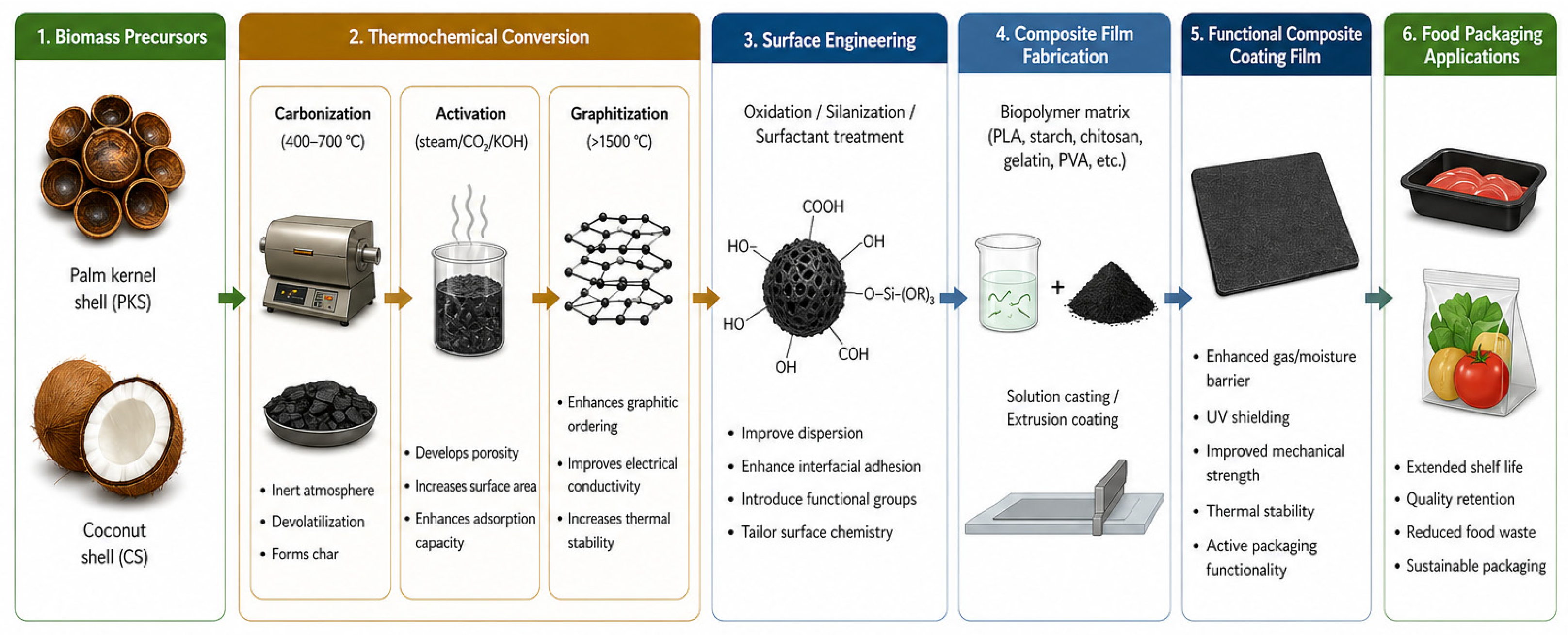
Figure 1 presents a schematic overview of the conversion of palm kernel shell (PKS) and coconut shell (CS) into biomass-derived carbon fillers through thermochemical processing, followed by surface engineering and incorporation. The figure highlights the relationship between precursor selection, processing route, composite fabrication, and the resulting improvements in barrier, mechanical, thermal, and biopolymer composite coating films for sustainable food packaging application and active packaging performance.
To further facilitate comparison between reported biomass-derived carbon composite systems,
Table 3 summarizes representative studies involving different lignocellulosic precursor sources, activation methods, polymer matrices, filler incorporation strategies, and associated functional applications in food packaging composites.
4. Dispersion and Interfacial Bonding
4.1. Dispersion and Filler Agglomeration
A critical factor governing the performance of carbon-filled bio-based food packaging films is the quality of filler dispersion within the polymer matrix. Carbonized fillers derived from PKS and CS are generally hydrophobic, whereas many biopolymer matrices such as starch, chitosan, gelatin, and cellulose derivatives exhibit relatively hydrophilic behavior [
1,
29]. This polarity mismatch frequently causes particle agglomeration during film formation, resulting in heterogeneous microstructures and weak filler distribution throughout the matrix. While starch-based matrices are highly hydrophilic and particularly sensitive to moisture, PLA exhibits comparatively lower water affinity due to its polyester structure, although its oxygen and moisture barrier properties may still be insufficient for demanding food packaging applications. From a composite mechanics perspective, poorly dispersed fillers act as defect sites that initiate microcracks under mechanical loading. These agglomerates disrupt stress distribution and reduce tensile strength and elongation at break. In contrast, homogeneous nanoscale or microscale dispersion enables more efficient stress transfer and improved structural integrity within the composite system [
30]. Therefore, the reinforcing efficiency of biomass-derived carbon fillers strongly depends on achieving stable and uniform dispersion throughout the polymer matrix [
30].
4.2. Interfacial Adhesion Mechanism
Beyond dispersion, interfacial adhesion between the carbon filler and polymer matrix plays a critical role in determining composite performance. Weak filler–matrix interaction limits stress transfer efficiency and may result in filler pull-out, interfacial void formation, and reduced mechanical stability [
30]. To mitigate these challenges, surface modification strategies are commonly employed to introduce polar functional groups onto the carbon surface. Chemical treatments such as oxidation using hydrogen peroxide (H
2O
2) or grafting with silane coupling agents (e.g., APTES) are instrumental in increasing filler surface energy and reactivity [
31].
For example, H
2O
2 oxidation can generate carboxyl and hydroxyl groups on the carbon surface, which facilitate hydrogen bonding with hydroxyl- and amine-containing biopolymers such as starch and chitosan [
31]. Similarly, silane grafting functions as a molecular bridge by covalently bonding to the oxidized carbon surface while simultaneously interacting with polymer chains, thereby improving filler anchoring and compatibility within the aqueous matrix [
1]. These surface engineering approaches are essential for enhancing filler–matrix interaction and maintaining stable composite morphology during processing.
4.3. Barrier Enhancement and Tortuous Diffusion
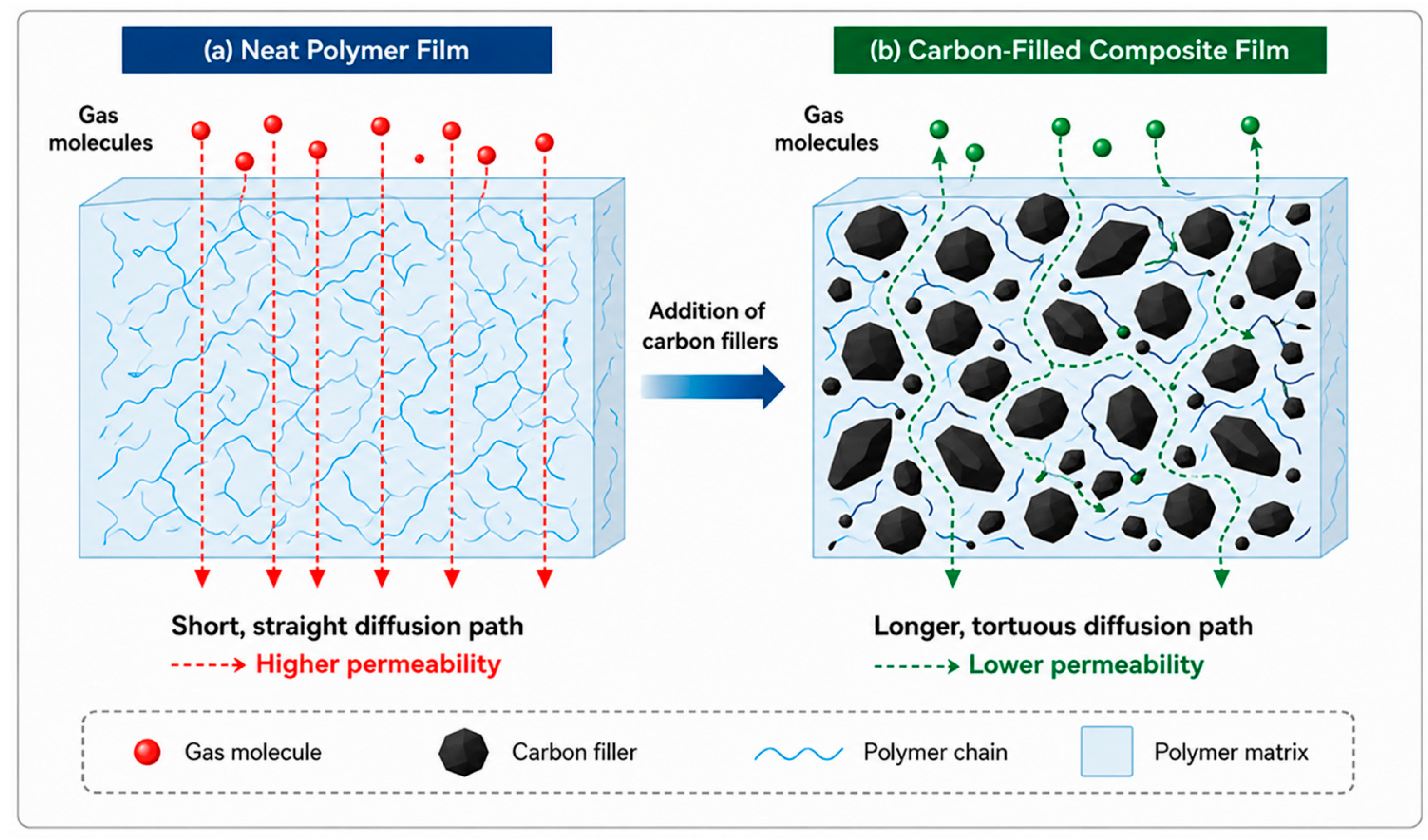
Achieving a high degree of nano-carbon dispersion is also important for improving gas barrier performance in food packaging applications. Carbon fillers dispersed within polymer matrices can obstruct direct gas transport pathways and force permeating molecules to follow longer and more complex diffusion routes. This mechanism, commonly referred to as the tortuous diffusion pathway, contributes to lower gas permeability and enhanced barrier resistance [
35,
36].
Cui et al. [
35] demonstrated that graphene layers in polymer nanocomposites generate highly tortuous diffusion pathways that significantly reduce gas permeability. However, unlike graphene nanosheets, PKS- and CS-derived carbon fillers generally possess irregular porous particulate morphology with a lower aspect ratio and less ordered orientation. Therefore, their barrier enhancement mechanisms are more likely governed by a combination of diffusion obstruction, pore adsorption, and filler-induced pathway elongation rather than ideal layered impermeable structures [
35]. In addition, the barrier efficiency of biomass-derived carbon fillers depends strongly on filler dispersion quality, particle size distribution, pore structure, and interfacial compatibility with the polymer matrix. Although porous fillers may enhance adsorption-related functionality, excessive porosity or poor dispersion can also introduce microvoids that facilitate gas permeation and reduce overall barrier performance. The resulting increase in diffusion distance can significantly reduce Oxygen Transmission Rate (OTR), which is a key parameter in preventing food oxidation and extending shelf life [
36].
4.4. Percolation and Filler Loading Effects
The formation of a percolated filler network at optimal loading levels can further enhance both mechanical stiffness and barrier performance in carbon-filled biopolymer composites [
29,
36]. At moderate concentrations, interconnected filler networks may improve stress distribution and create more effective diffusion barriers throughout the matrix. However, excessive filler loading frequently results in aggregation, microvoid formation, and poor interfacial continuity, ultimately reducing composite performance.
Studies on polymer nanocomposites have shown that exceeding the percolation threshold may increase brittleness, decrease elongation at break, and negatively affect transparency and film homogeneity [
29,
36]. Consequently, optimization of filler loading, dispersion method, particle morphology, and interfacial compatibility remains essential for balancing mechanical reinforcement, barrier enhancement, and processability in food packaging composite films.
5. Composite Film Performance in Food Packaging Applications
The incorporation of biomass-derived carbon fillers into polymer matrices results in multifunctional composite films whose performance depends on the interplay between filler characteristics, dispersion quality, and interfacial bonding. In addition to providing active packaging functionality, these fillers contribute to fundamental improvements in mechanical strength, barrier resistance, and thermal stability. The following sections summarize key structure–property relationships observed in carbon-filled biopolymer composites.
In the context of food packaging, a coating film serves as a functional layer applied onto a primary substrate—such as paper, cardboard, or a base polymer to enhance its structural and barrier performance. When incorporating carbonized biomass like PKS or CS, the discussion shifts from simple physical protection to Active Packaging. Unlike traditional passive barriers that merely act as a neutral shield, these carbon-infused coatings interact dynamically with the internal package environment [
1]. By leveraging the high porosity of activated PKS and CS carbons, these active layers can selectively adsorb off-odors or scavenge ethylene gas, which is critical for delaying the senescence of climacteric fruits [
37]. Furthermore, the integration of these carbonaceous fillers provides a secondary defense mechanism by blocking ultraviolet (UV) radiation and reinforcing the gas barrier, effectively transitioning the packaging from a static container into a functional system designed to extend shelf life and maintain food safety [
32,
38,
39,
40].
5.1. Gas Barrier
One of the primary challenges in modern food packaging is the reduction in the Oxygen Transmission Rate (OTR) and Water Vapor Transmission Rate (WVTR). While biopolymers such as starch and polylactic acid (PLA) offer sustainable alternatives to petroleum-based plastics, their barrier performance varies considerably depending on polymer chemistry and molecular structure [
41,
42]. Starch-based matrices are highly hydrophilic and therefore exhibit high moisture sensitivity and water vapor permeability, whereas PLA possesses comparatively lower water affinity due to its polyester structure. Nevertheless, PLA-based systems may still exhibit insufficient oxygen and moisture barrier performance for demanding food packaging applications [
41,
42]. These inherent vulnerabilities allow for the rapid permeation of gases and moisture, which can lead to the premature oxidation of lipids and the dehydration of fresh produce. To address these limitations, researchers have focused on reinforcing these bio-matrices with carbonaceous fillers to enhance their barrier efficiency [
29,
32,
43,
44].
By incorporating graphite or activated carbon derived from PKS or CS into the coating, a “tortuous path” is created within the polymer matrix. As illustrated in
Figure 2, the dispersed carbon fillers force gas molecules to follow a longer and more complex diffusion route through the polymer matrix, thereby decreasing oxygen and water vapor permeability. Certain graphitized or layered biomass-derived carbon structures force gas and water molecules to navigate a labyrinthine route rather than passing straight through the film [
32,
35]. This geometric obstruction significantly extends the diffusion path, effectively delaying the onset of oxidation in fatty foods and preventing critical moisture loss in fresh produce [
36]. Consequently, these carbon-reinforced coatings transform standard biopolymers into high-performance materials. Recent studies have demonstrated that the incorporation of carbon nanofillers can significantly reduce gas permeability when properly dispersed. For example, graphene oxide or activated carbon at low loading levels (0.5–3 wt%) has been reported to reduce oxygen transmission rate (OTR) by approximately 25–65% in biopolymer matrices such as PLA, gelatin, and chitosan due to the formation of tortuous diffusion pathways [
35,
36,
44]. However, excessive filler loading (>5 wt%) frequently results in particle agglomeration and microvoid formation, which may reverse the barrier improvement and increase permeability. Therefore, optimization of filler aspect ratio, loading level, and interfacial adhesion remains essential for practical food packaging applications [
35,
45].
5.2. Active Functionality: Ethylene and Odor Scavenging
The high internal surface area and intricate pore structure of CS derived activated carbon make it an effective adsorbent when integrated into a functional coating film. A primary application of this technology is ethylene adsorption, which is critical for the post-harvest management of climacteric fruits such as bananas and tomatoes [
46]. These fruits naturally release ethylene gas (C
2H
4), a plant hormone that hastens ripening and subsequent spoilage. By incorporating microporous activated carbon into the packaging film, the gas is effectively adsorbed within the carbon’s carbonaceous framework, reducing its concentration in the headspace. This process essentially places the produce into a delayed physiological ripening process, significantly extending shelf life by delaying senescence and maintaining the structural firmness of the fruit [
1,
4,
47].
Beyond gas scavenging, carbonized biomass acts as a high-efficiency molecular sieve for odor control, which is vital for maintaining the organoleptic integrity of packaged goods. For pungent foods or products sensitive to cross-contamination, the activated carbon traps volatile organic compounds (VOCs) that are responsible for off-odors and undesirable flavor transfers [
48]. This adsorption capability is particularly beneficial in multi-component food systems where the migration of aromatic compounds can compromise quality. By functioning as an active barrier that captures these molecules, CS-derived carbon coatings ensure that the food remains isolated from both internal and external odor pollutants, thereby preserving the original sensory profile and safety of the product [
3,
4].
5.3. UV Shielding
Light-induced oxidation serves as a primary catalyst for the degradation of essential nutrients and the development of rancidity in lipid-rich products, such as oils and dairy. Because carbonized biomass, including PKS, is inherently opaque and deep black in color, it acts as an exceptionally efficient light barrier when integrated into coating films. Even at relatively low loading levels typically ranging from 1% to 5% by weight, these carbonized particles are capable of blocking nearly 100% of ultraviolet (UV) radiation within the critical 200–400 nm range [
44]. Quantitative UV-shielding performance has been widely reported for carbon-based fillers. Chen et al. [
49] observed that carbon-dot reinforced films achieved over 95% blocking efficiency in the UV-B region (280–320 nm), while maintaining acceptable visible light transmission. Similarly, graphene- and carbon-black-filled biopolymer films commonly exhibit 90–99% UV shielding at filler contents of 1–5 wt% [
38,
49]. Nevertheless, higher carbon loading substantially reduces transparency and consumer visibility of packaged products, which limits application for display packaging where optical clarity is required. By preventing high-energy photons from penetrating the packaging, these bio-carbon fillers shield light-sensitive compounds from photochemical reactions, thereby preserving the nutritional value and sensory profile of the food [
36,
48].
However, the implementation of such high opacity barriers involves a significant aesthetic trade-off. While the resulting films become highly protective, they lose the transparency often desired by consumers who wish to inspect the product before purchase. A major focus of current research is navigating this compromise by developing “nano-carbon” coatings. These formulations utilize carbon particles refined to the nanoscale, which are thin enough to maintain a level of translucency while still providing the necessary UV-blocking capabilities [
49,
50]. By optimizing the dispersion and thickness of these nano-carbon layers, it is possible to achieve a functional balance between the visual appeal of the packaging and the rigorous protection required for shelf-stable food products [
1,
36]. From a composite perspective, the UV-shielding efficiency is influenced by filler dispersion and optical path interference within the matrix. Uniformly dispersed nano-sized carbon fillers provide more effective light attenuation compared to aggregated particles, while maintaining partial transparency in thin-film applications.
5.4. Mechanical and Thermal Reinforcement
Carbonized biomass fillers act as rigid reinforcing phases within biopolymer matrices, contributing to improved mechanical strength and thermal stability. The enhancement in tensile strength and modulus is primarily attributed to stress transfer from the polymer matrix to the stiff carbon particles. Well-dispersed fillers create strong interfacial interactions that allow load distribution across the composite structure [
33,
34].
Experimental studies have reported tensile strength improvements ranging from 10% to 35%, depending on filler type, loading level, and surface modification. For example, silane-modified carbon fillers have demonstrated superior reinforcement due to improved interfacial bonding, while unmodified fillers often result in weaker mechanical performance due to poor adhesion [
4,
30].
In terms of thermal behavior, carbon fillers can increase thermal stability and glass transition temperature (Tg) by restricting polymer chain mobility and acting as heat-resistant phases. However, excessive filler loading or poor dispersion may introduce stress concentration points, leading to reduced elongation at break and increased brittleness [
1,
4]. To improve readability and facilitate comparison between different composite systems,
Table 4 explicitly summarizes the reported performance of selected carbon-filled biopolymer composite films, including filler type, matrix, loading level, processing method, barrier improvement, mechanical enhancement, and associated limitations.
5.5. Practical Validation and Case Studies
Several studies have demonstrated practical potential through food simulation tests, shelf-life studies, and migration assessments. For example, activated carbon-containing films have been shown to delay ripening in climacteric fruits through ethylene adsorption, while UV-blocking carbon-dot films improved oxidative stability in light-sensitive products. However, more pilot-scale validation under commercial storage conditions is still needed.
6. Food Safety, Migration, and Regulatory Considerations
In addition to regulatory concerns, filler–matrix compatibility can indirectly influence migration behavior, since poorly bonded or agglomerated fillers may exhibit a greater tendency for particle release under service conditions. A key concern in carbon-filled polymer composites is the potential migration of micro- or nano-sized carbon particles, residual activating chemicals, or loosely bound surface species into food simulants during storage.
Migration behavior depends on several factors, including filler particle size, dispersion quality, matrix crystallinity, storage temperature, contact time, and the strength of filler–matrix interactions. Well-embedded fillers within dense polymer networks are expected to exhibit significantly lower migration risk than poorly bonded or agglomerated systems.
In the European Union, food-contact plastics are regulated under Commission Regulation (EU) No. 10/2011, which establishes an overall migration limit of 10 mg/dm2 of contact surface area. Nanoform additives are generally assessed on a case-by-case basis depending on migration potential and toxicological profile. In the United States, food-contact substances are evaluated through FDA safety authorization pathways based on expected dietary exposure and toxicological evidence.
Therefore, future development of PKS- and CS-derived carbon composites should include migration testing, extractables analysis, particle characterization, and long-term stability studies under realistic packaging conditions [
3,
4,
51]. Regulatory readiness will be essential for successful commercialization.
Although many biomass-derived carbons are considered relatively inert, nanoscale particles may exhibit size-dependent toxicological behavior. Therefore, cytotoxicity, oral exposure, and chronic migration studies remain essential before direct food-contact approval.
7. Surface Engineering Strategies for Carbon Fillers
A critical technical challenge in incorporating carbonized biomass into food packaging coatings is the interfacial incompatibility between the filler and matrix. To improve compatibility, dispersion stability, and bonding strength, several physical and chemical surface treatment methods have been investigated.
7.1. Oxidative Acid Treatment (Liquid Phase Oxidation)
The most common method involves oxidation using nitric acid (HNO
3), sulfuric acid (H
2SO
4), or hydrogen peroxide. These treatments introduce oxygen-containing functional groups such as carboxyl (-COOH), hydroxyl (-OH), and carbonyl (C=O) groups onto the carbon surface [
31]. The increased polarity improves hydrogen bonding with hydrophilic polymers such as starch and chitosan [
29,
52]. In addition, oxidation may remove residual ash and inorganic impurities, improving purity for food-contact applications [
1,
3].
7.2. Silane Coupling Agents
For superior bonding in high-performance films, silane coupling agents such as (3-Aminopropyl)triethoxysilane (APTES) or vinyl silanes function as a critical molecular bridge between the inorganic filler and the organic matrix. The mechanism involves the alkoxy groups of the silane reacting with the hydroxyl groups on the surface of the oxidized carbon, while the organofunctional group remains available to interact or react with the polymer matrix [
1]. This dual reactivity creates a robust covalent linkage (Si-O-C) that effectively anchors the filler to the film. Research indicates that this silane-mediated interfacial adhesion is highly effective; studies have shown that silane-modified carbon can increase the tensile strength of bio-films by over 30% compared to those utilizing untreated fillers, while also significantly improving moisture resistance by reducing the availability of free hydrophilic groups [
1,
30].
7.3. Surfactant-Assisted Dispersion
In cases where chemical modification is deemed too environmentally demanding, physical surfactants or compatibilizers are employed to bridge the incompatibility between dissimilar materials. Green surfactants, such as lecithin or sodium lignosulfonate, itself a biomass-derived surfactant, are particularly effective because they can adsorb onto carbon particle surfaces and provide steric or electrostatic stabilization [
53]. These agents reduce interfacial tension and stabilize filler particles through steric or electrostatic repulsion, helping maintain homogeneous suspension during casting, spraying, or coating operations [
1,
4,
30]. Various surface engineering strategies have been developed to improve dispersion stability, interfacial compatibility, and mechanical performance in carbon-filled biopolymer composites. To improve readability and facilitate comparison,
Table 5 summarizes the major modification methods, their dominant interfacial interactions, and the resulting benefits to composite film performance.
8. Challenges and Future Outlook
While the transition from biomass waste to high-value packaging is promising, several technical and commercial hurdles remain. A primary challenge is the dispersion of carbon particles within the polymer matrix; due to their high surface energy and hydrophobic nature, these particles tend to agglomerate, which can lead to structural defects and inconsistent barrier performance. To overcome this, sophisticated surface functionalization such as acid treatment or silane grafting is often required to ensure a smooth, homogeneous coating. Furthermore, the esthetic impact of carbonized fillers presents a significant barrier to consumer acceptance in certain markets. Because carbon-based coatings are typically black or opaque, they limit the visibility of the food product, which is a key preference for consumers who wish to inspect freshness before purchase.
The final, and perhaps most critical, hurdle is achieving comprehensive regulatory approval for food-contact applications. From a regulatory perspective, food-contact applications of biomass-derived carbon fillers must comply with existing migration and toxicological safety requirements. In the European Union, Commission Regulation (EU) No. 10/2011 establishes an overall migration limit of 10 mg/dm2 of food-contact surface (equivalent to approximately 60 mg/kg food under standard test assumptions), while nanoform substances are generally assessed on a case-by-case basis by EFSA depending on particle characteristics, migration potential, and toxicological profile. Similarly, in the United States, the FDA evaluates food-contact substances through premarket authorization pathways requiring evidence that expected dietary exposure remains within safe limits. Therefore, future commercialization of PKS- and CS-derived carbon fillers will require robust migration testing, particle characterization, and toxicological validation prior to industrial adoption.
It is essential to ensure that any potential migration of nano-scale carbon particles into the food remains well within established safety limits. Current research is heavily focused on the “bound” state of these particles to confirm that they are permanently anchored within the bio-polymer matrix and do not leach into the contents during storage or transport [
4]. Addressing these toxicological concerns and establishing standardized testing protocols for biomass-derived nano-carbons are essential steps for the successful commercialization and mass adoption of these active packaging technologies. Despite these promising functional properties, direct comparison among studies remains difficult because testing methods, filler particle sizes, loading percentages, and polymer matrices differ substantially. Standardized protocols for OTR, WVTR, UV-vis transmission, migration safety, and antimicrobial assessment are still required before industrial benchmarking can be fully established.
Most published studies remain laboratory-scale and use different matrices, filler loadings, and testing methods, making direct comparison difficult. Many reports focus on short-term performance but lack migration testing, shelf-life validation, recyclability analysis, or pilot-scale processing data. Furthermore, few studies systematically compare PKS and CS fillers under identical conditions.
From an industrial perspective, the economic competitiveness of PKS- and CS-derived fillers depends on collection logistics, activation energy demand, chemical consumption, and post-treatment costs. Nevertheless, these residues may remain cost-attractive compared with synthetic nanofillers such as graphene or carbon nanotubes, particularly in regions with established palm oil or coconut industries.
9. Conclusions
Biomass-derived carbon fillers produced from palm kernel shell (PKS) and coconut shell (CS) represent promising sustainable reinforcements for biodegradable polymer composite coating films. Their high carbon yield, tunable porosity, surface functionality, and structural rigidity enable simultaneous improvements in barrier resistance, ultraviolet shielding, thermal stability, and mechanical performance when properly incorporated into polymer matrices.
From a composite science perspective, final performance is strongly governed by filler morphology, dispersion quality, interfacial adhesion, and loading level. Well-dispersed carbon fillers can generate efficient stress-transfer pathways and tortuous diffusion barriers, whereas poor compatibility and agglomeration may reduce strength, increase brittleness, and compromise transparency.
Surface engineering strategies such as oxidation, silanization, and compatibilizer-assisted dispersion provide practical routes to improve matrix–filler interaction. Nevertheless, further progress is still required in standardized performance testing, migration safety validation, scalable processing methods, and long-term durability assessment.
Overall, PKS- and CS-derived carbon fillers offer a viable pathway toward next-generation sustainable composite packaging materials that combine renewable resource utilization with high functional performance.