
Influences of Different Solid Waste Powders on the Drying Shrinkage Characteristics of Metakaolin-Based Geopolymers

Abstract
1. Introduction
2. Test Program
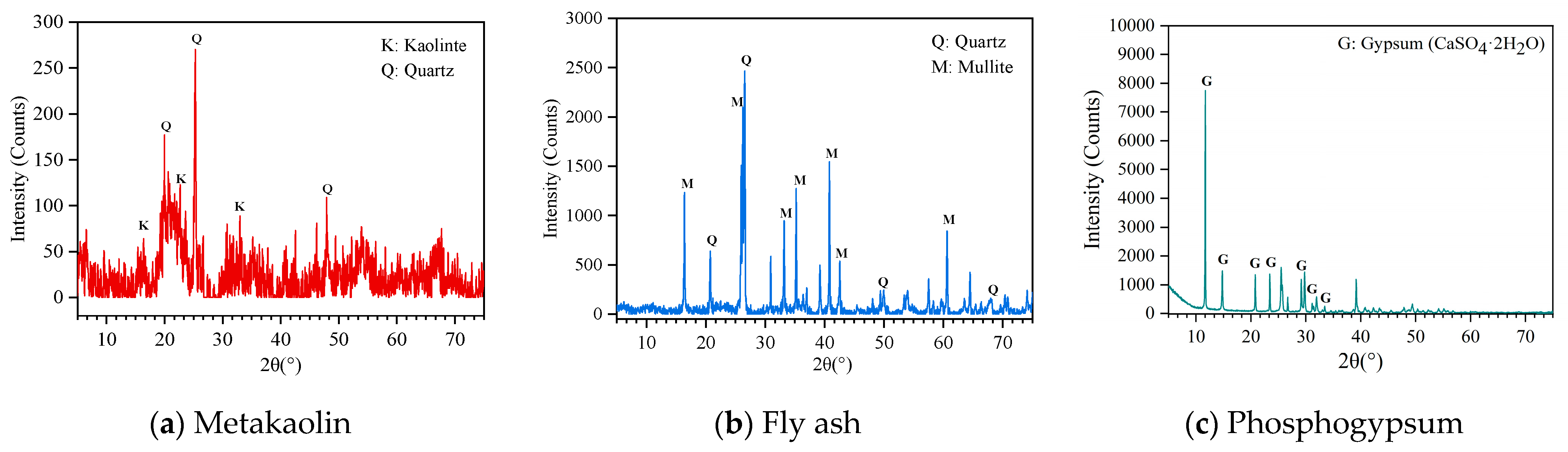
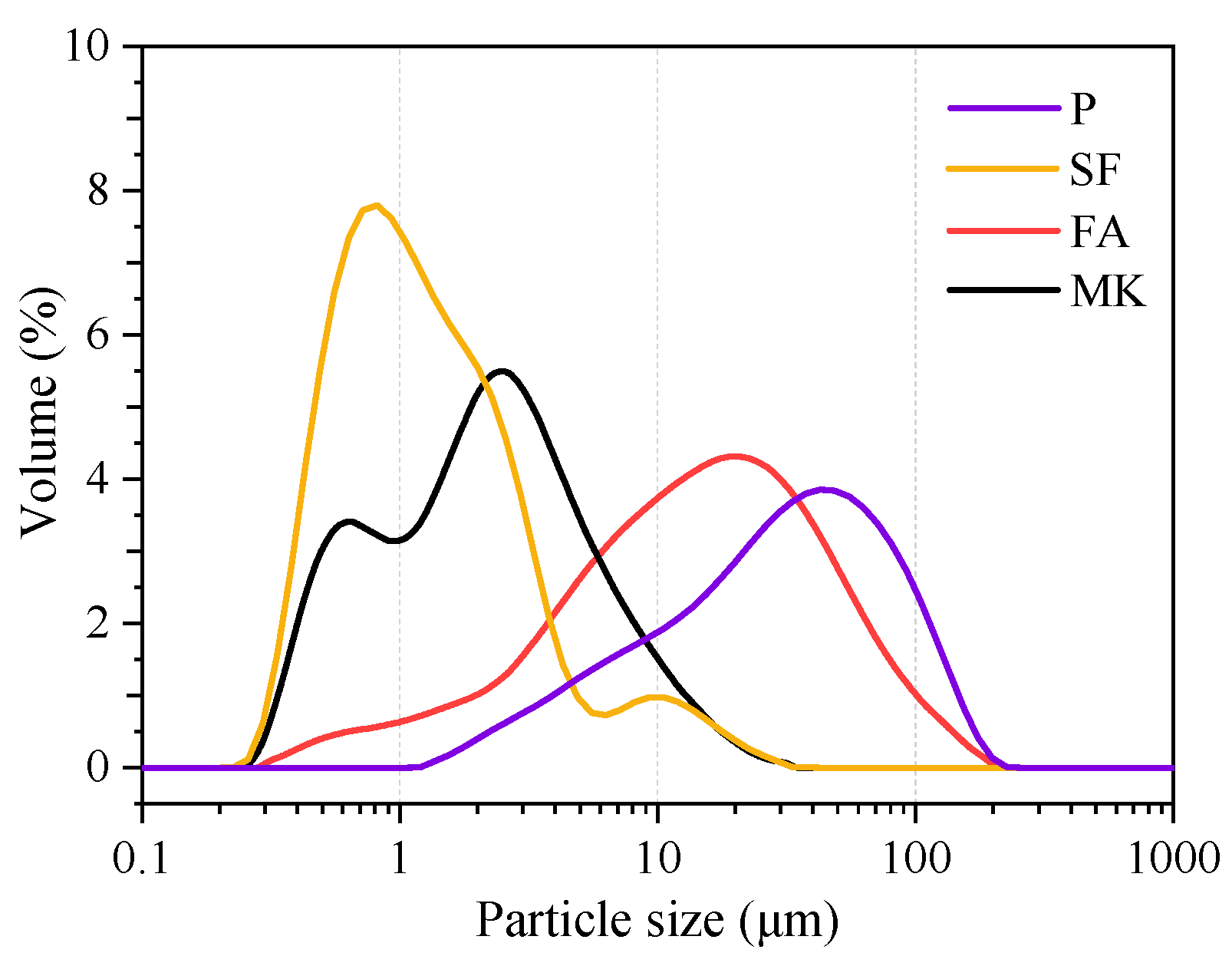
2.1. Test Materials
2.2. Specimen Mix Proportioning and Preparation
2.3. Testing Methods
3. Results and Analysis
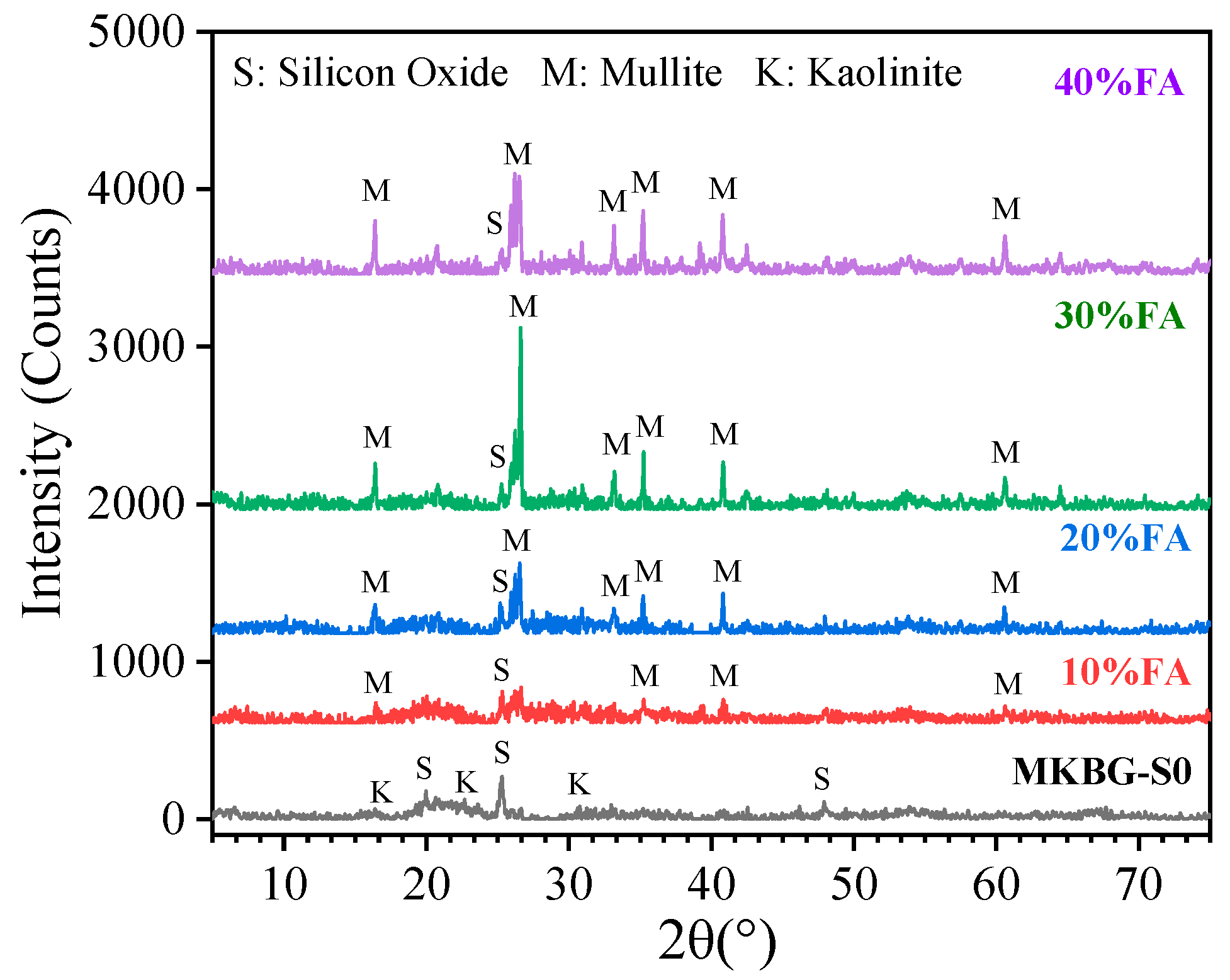
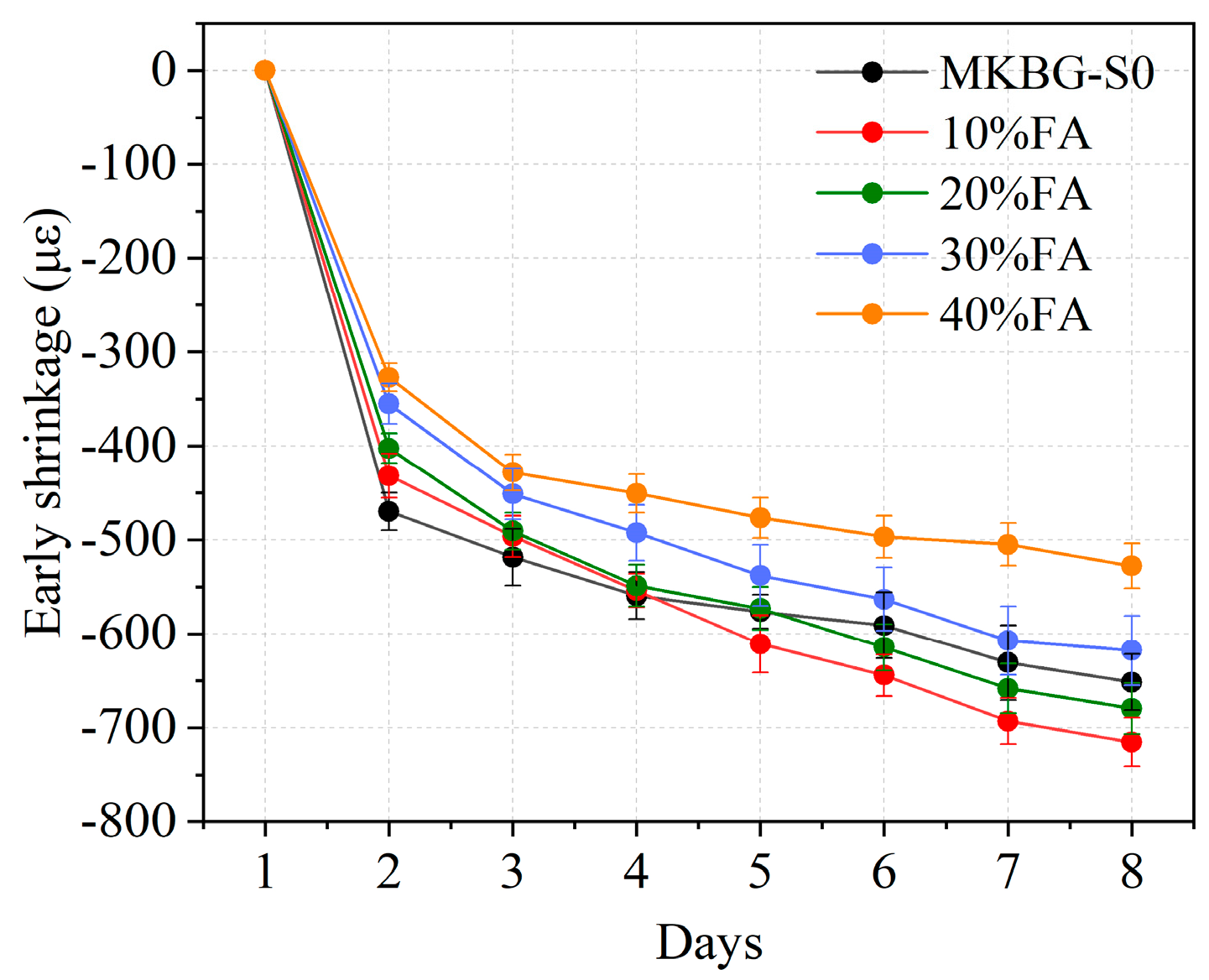
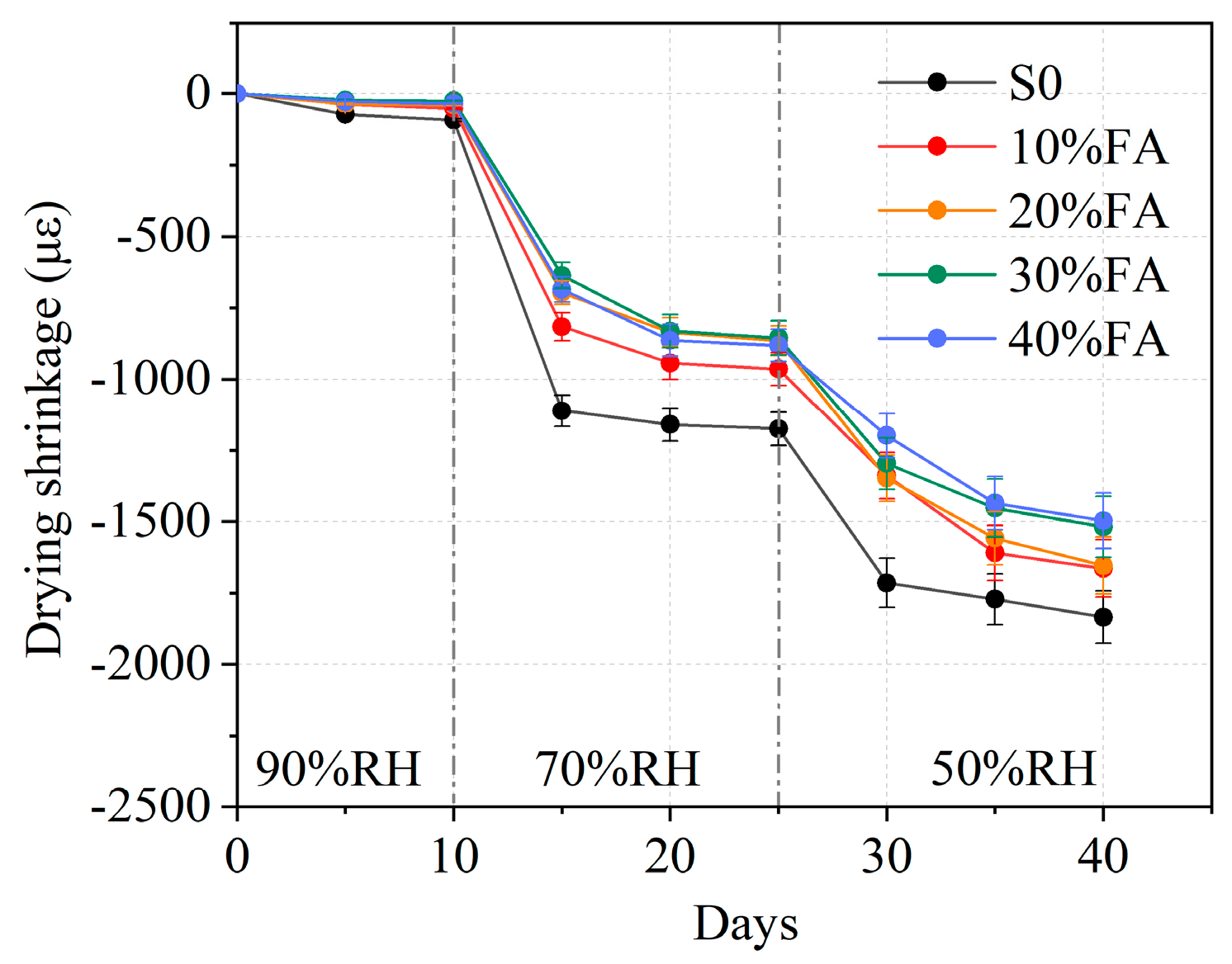
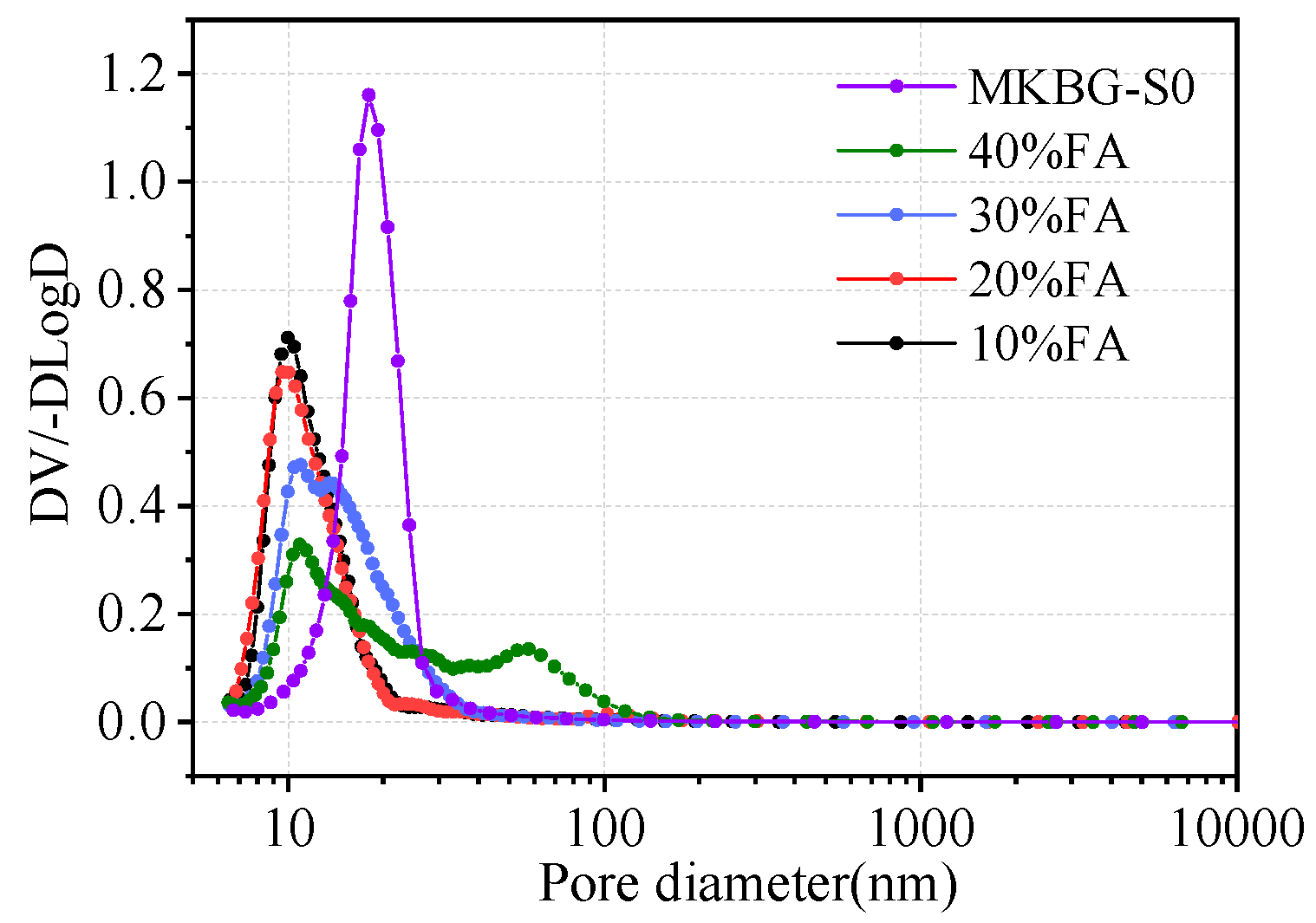
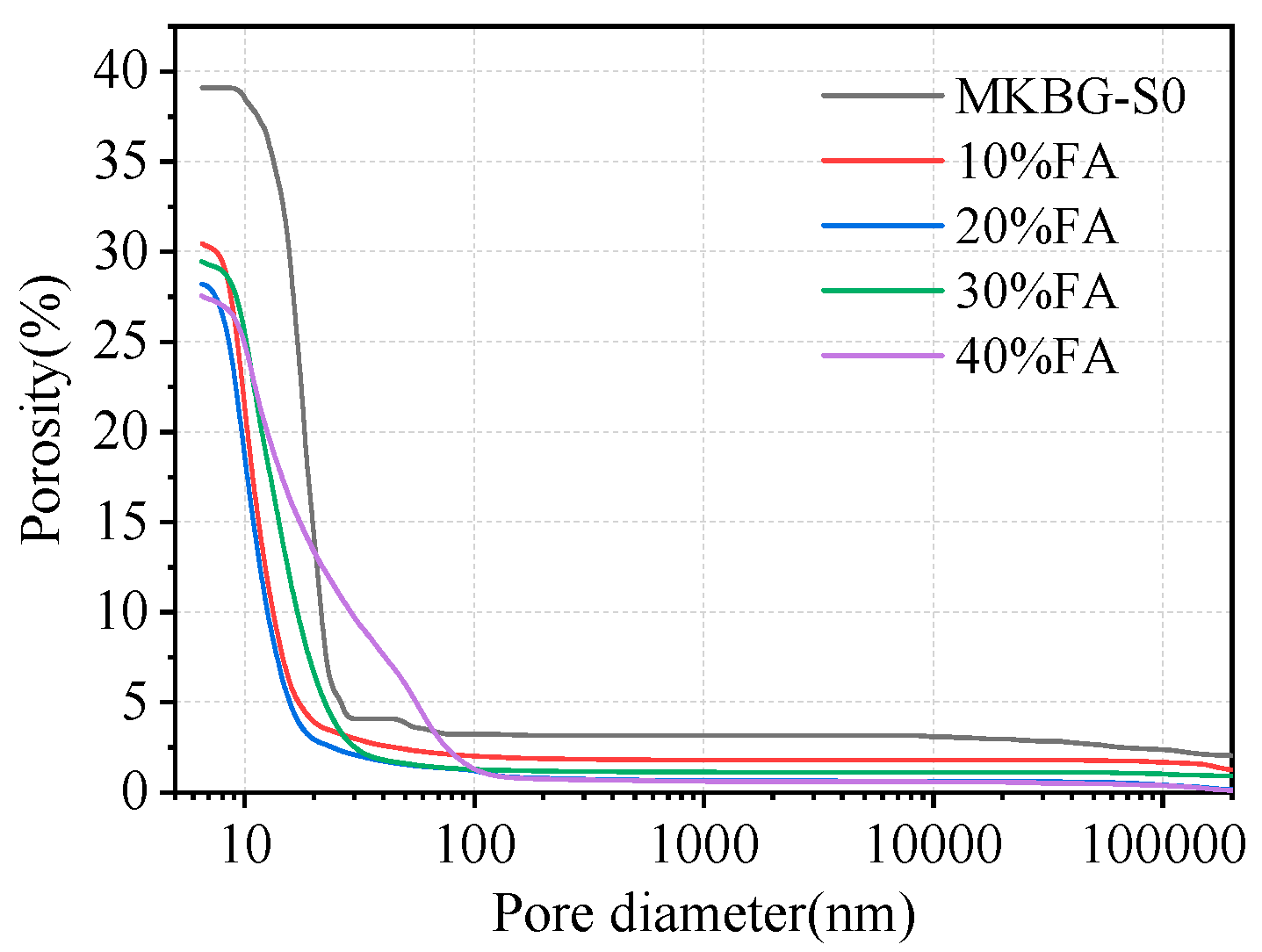
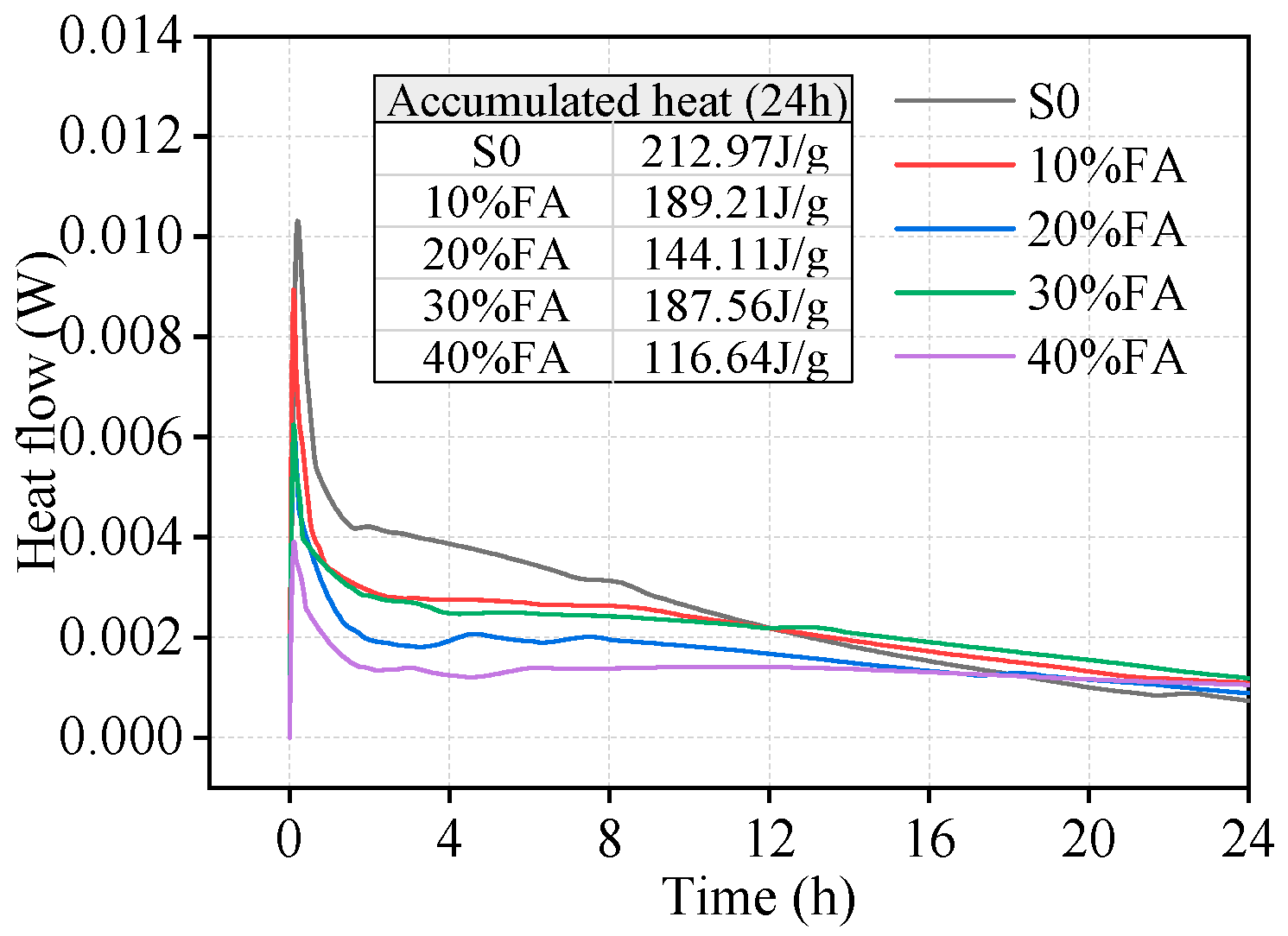
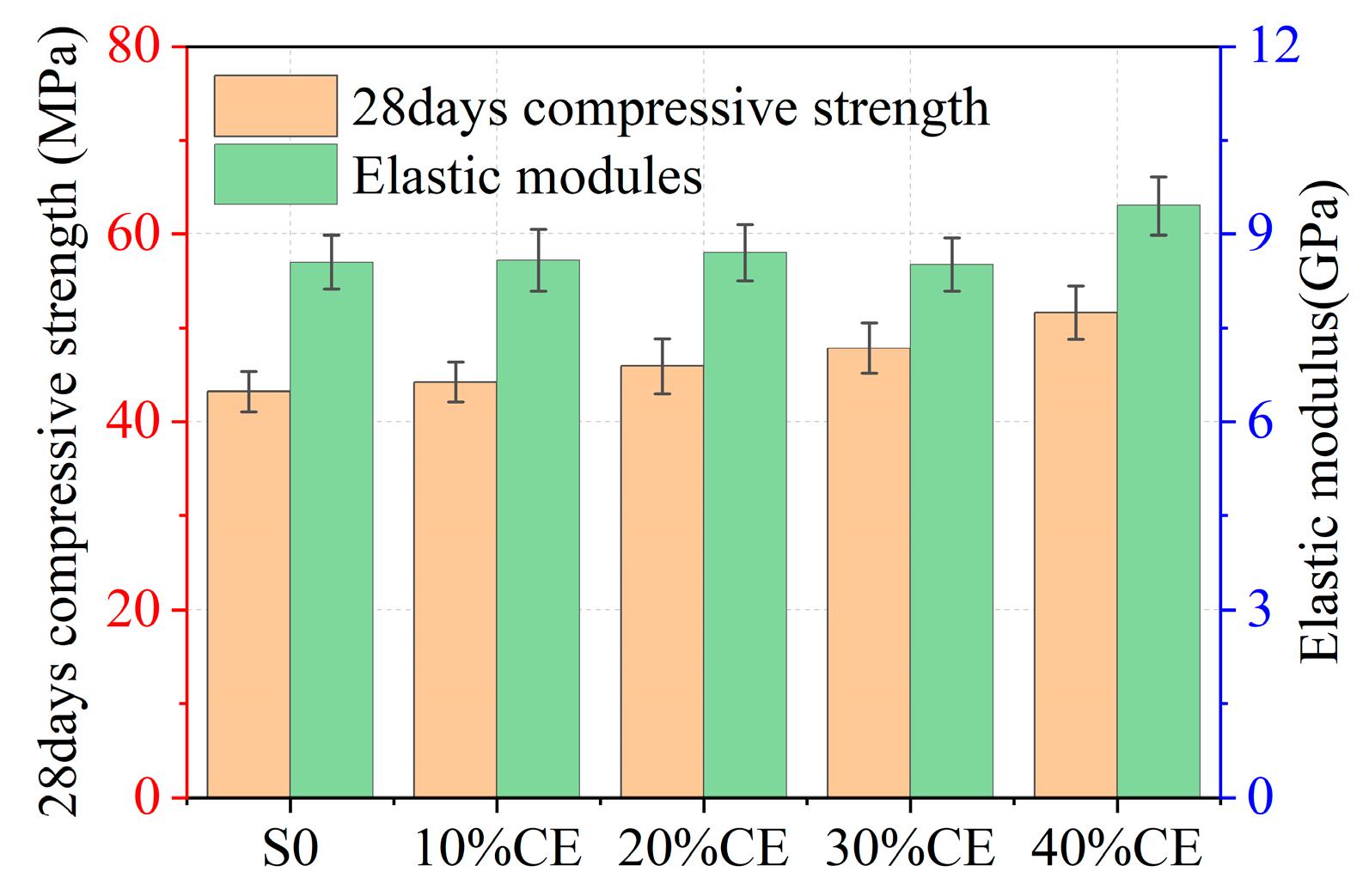
3.1. Effect of Fly Ash Incorporation on Drying Shrinkage
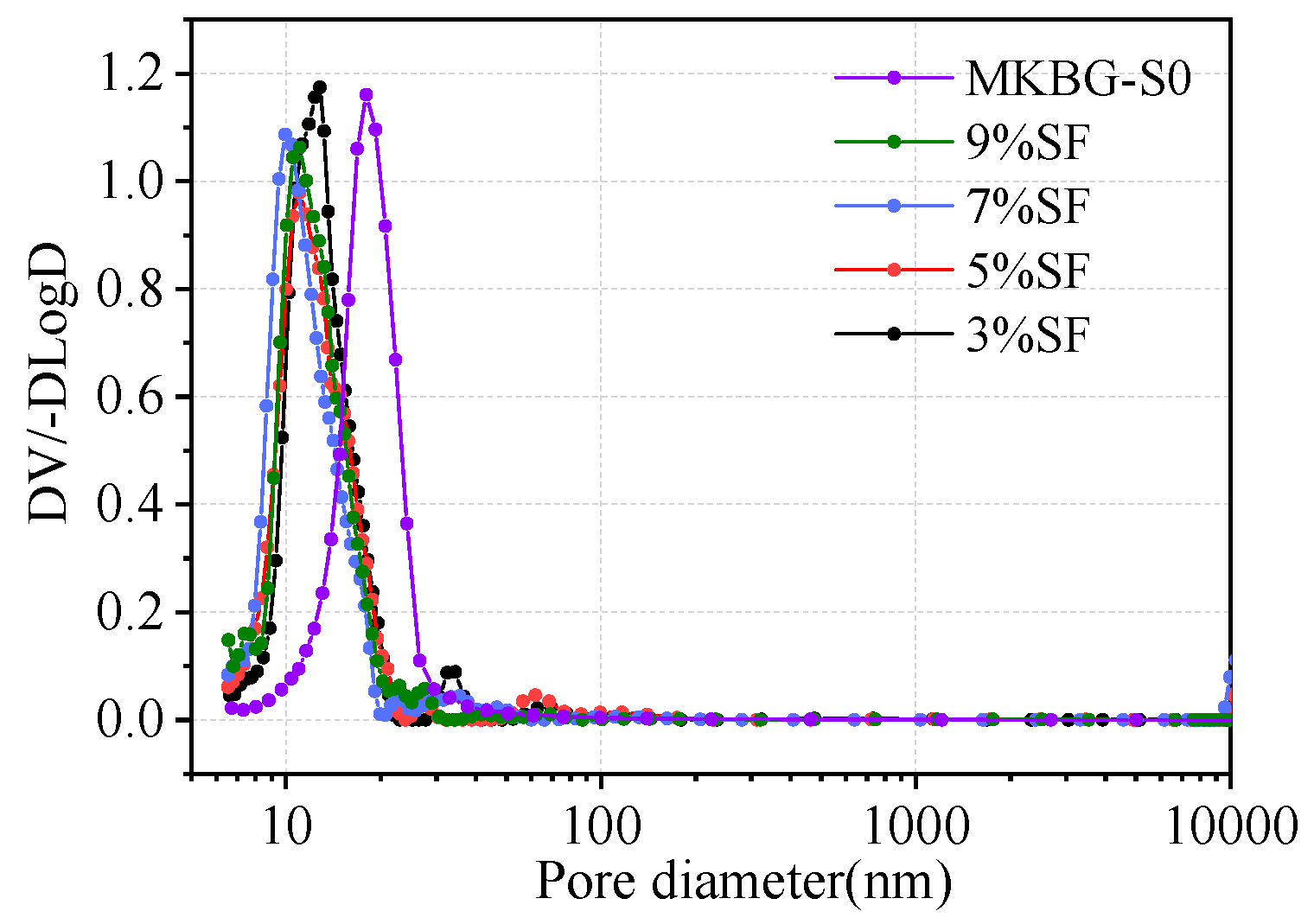
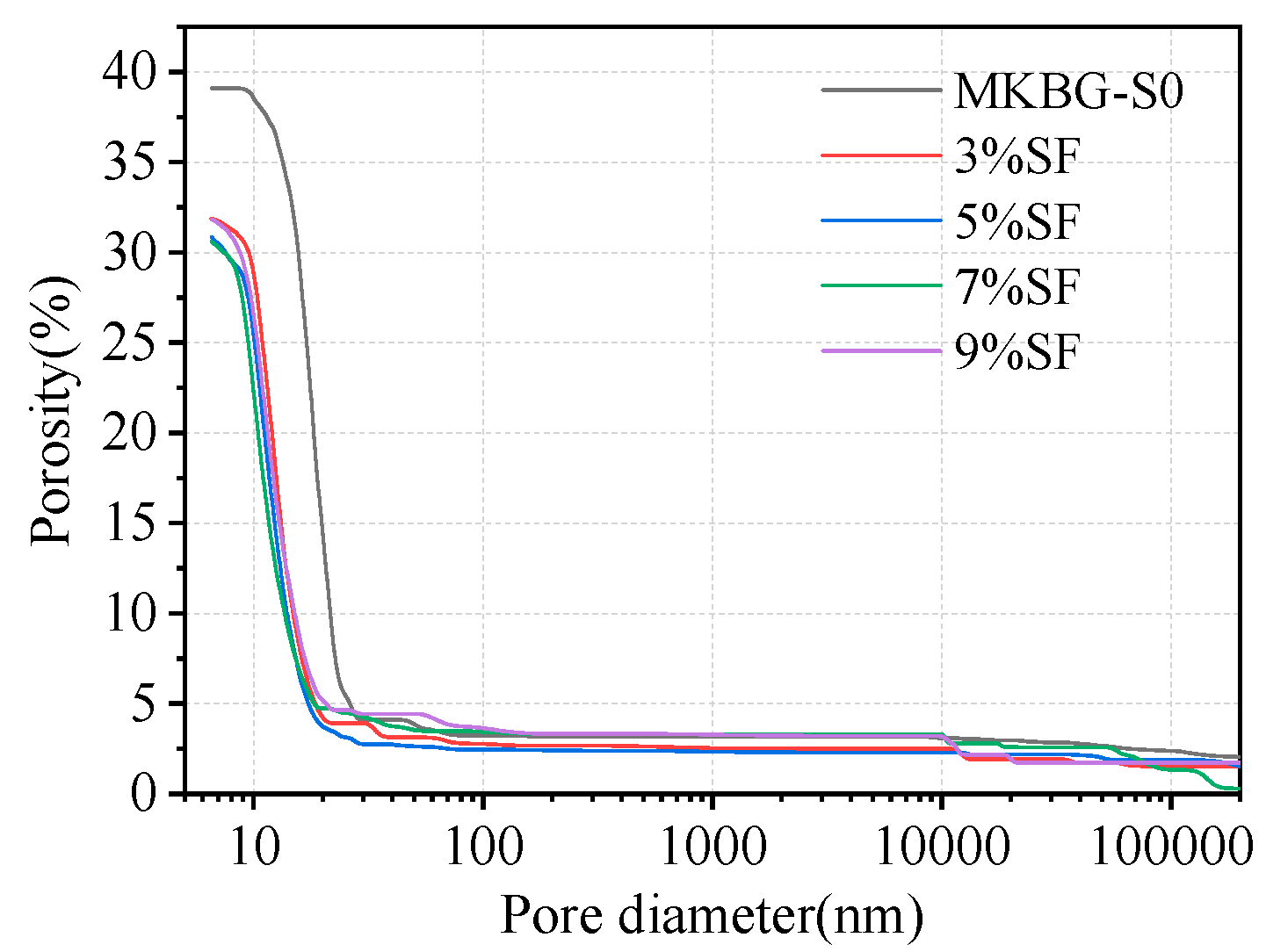
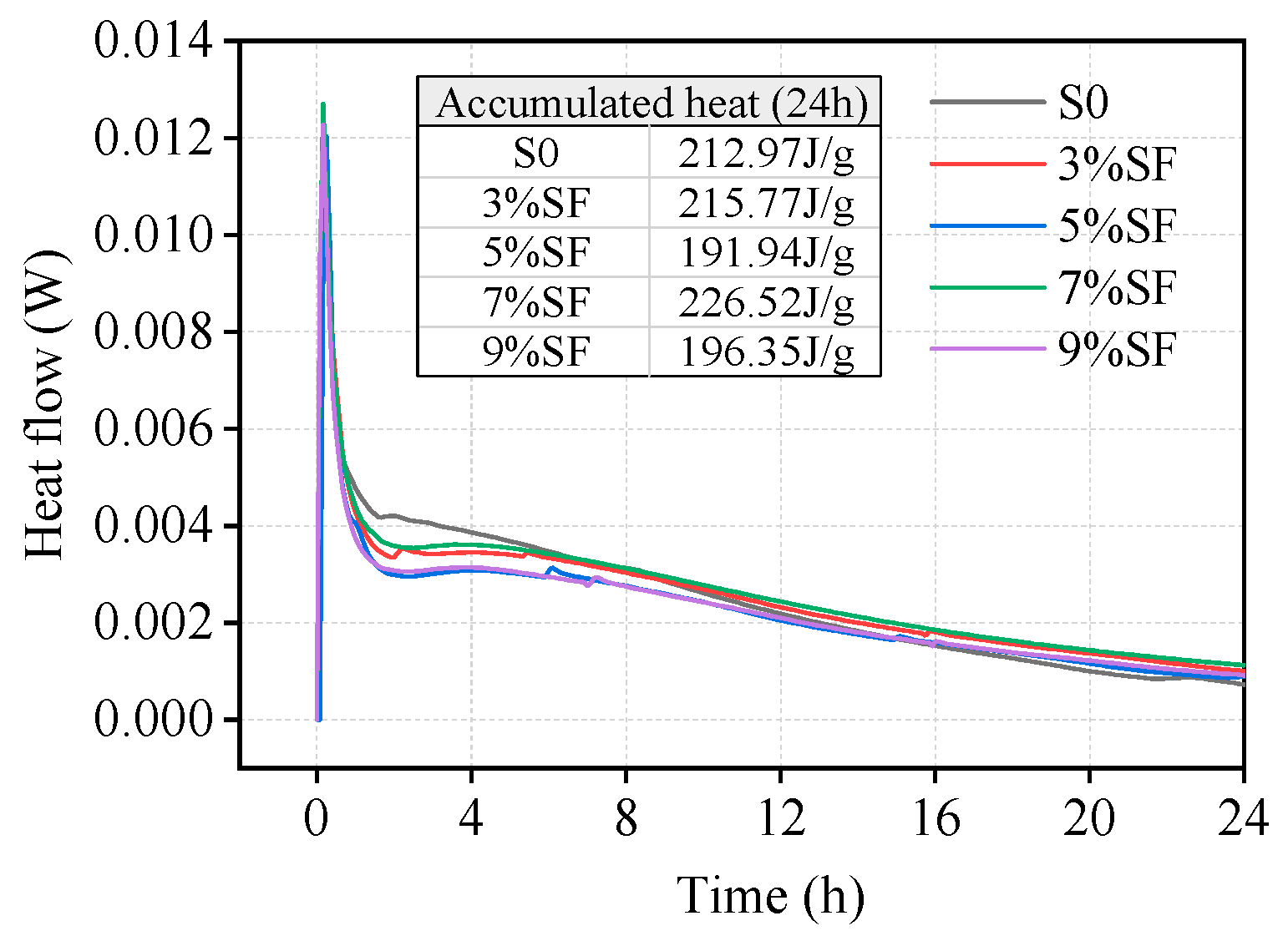
3.2. Effect of Silica Fume Incorporation on Drying Shrinkage
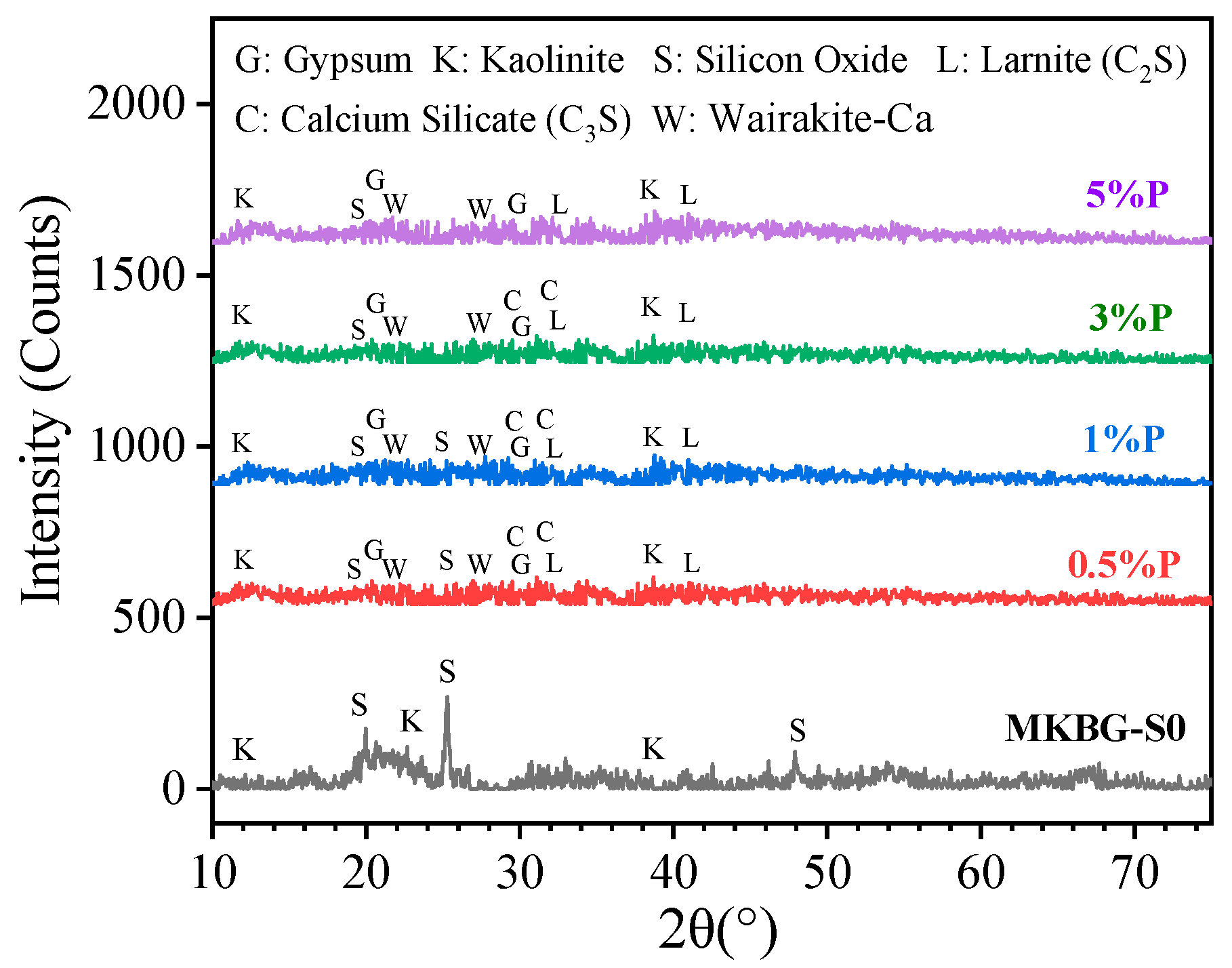
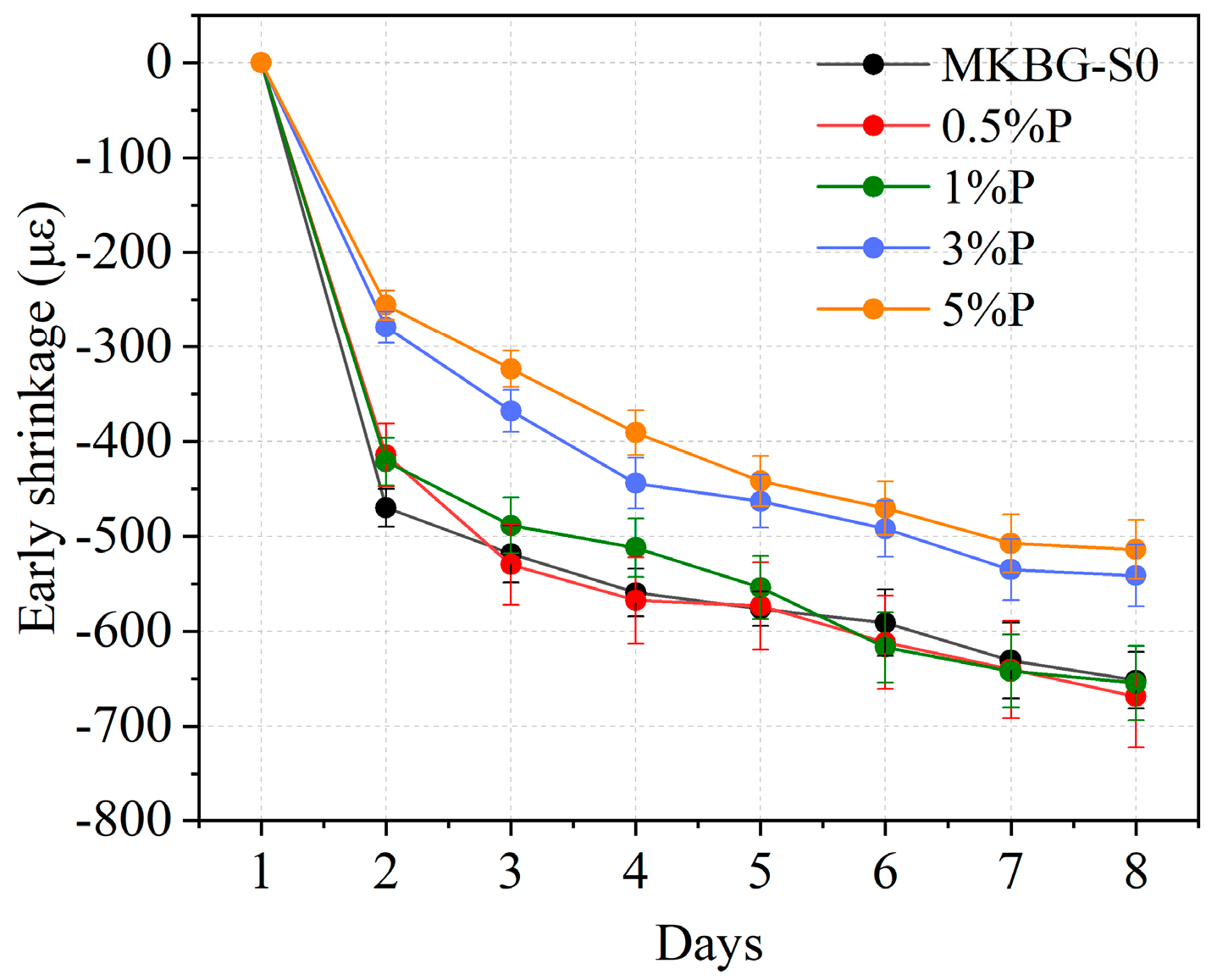
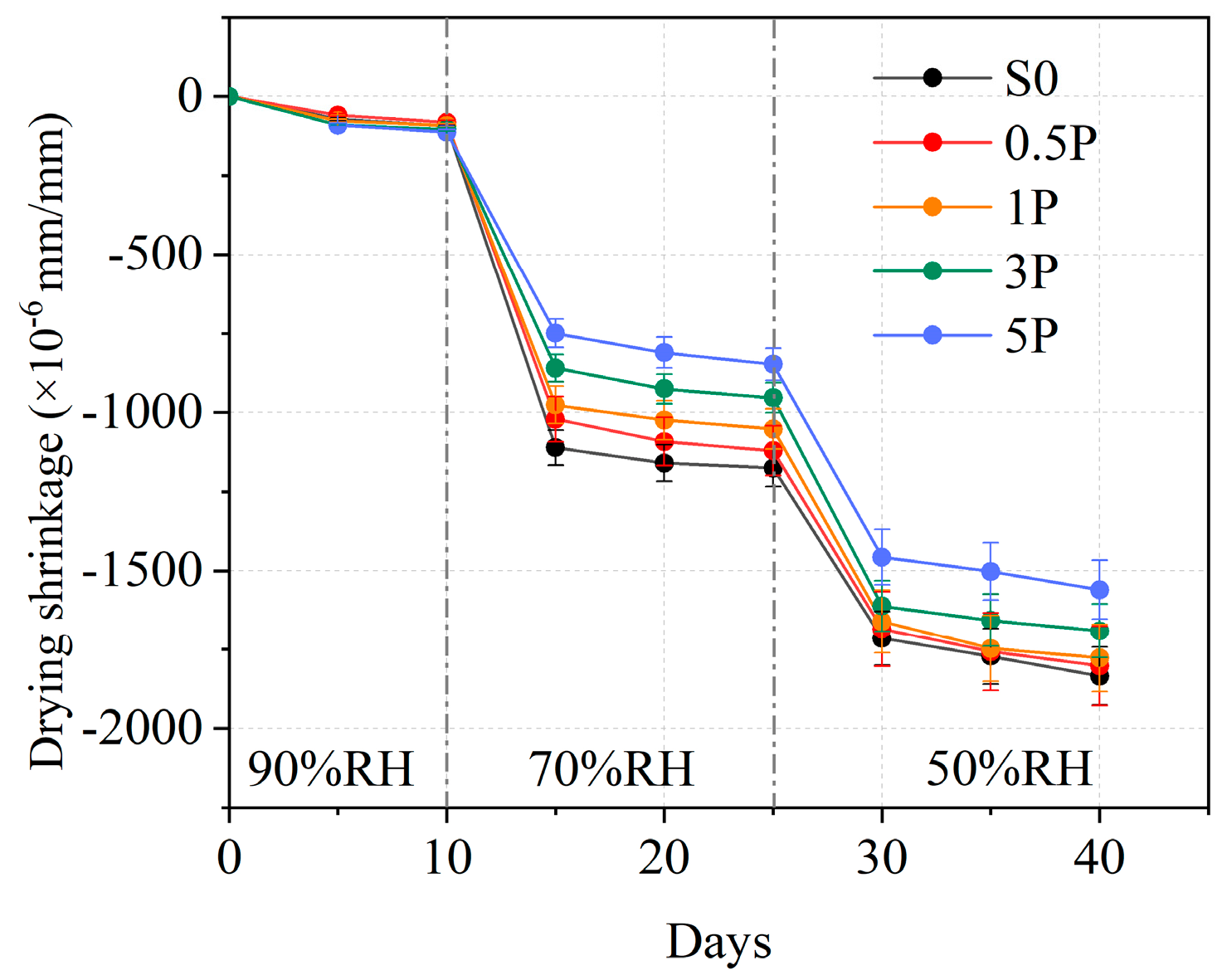
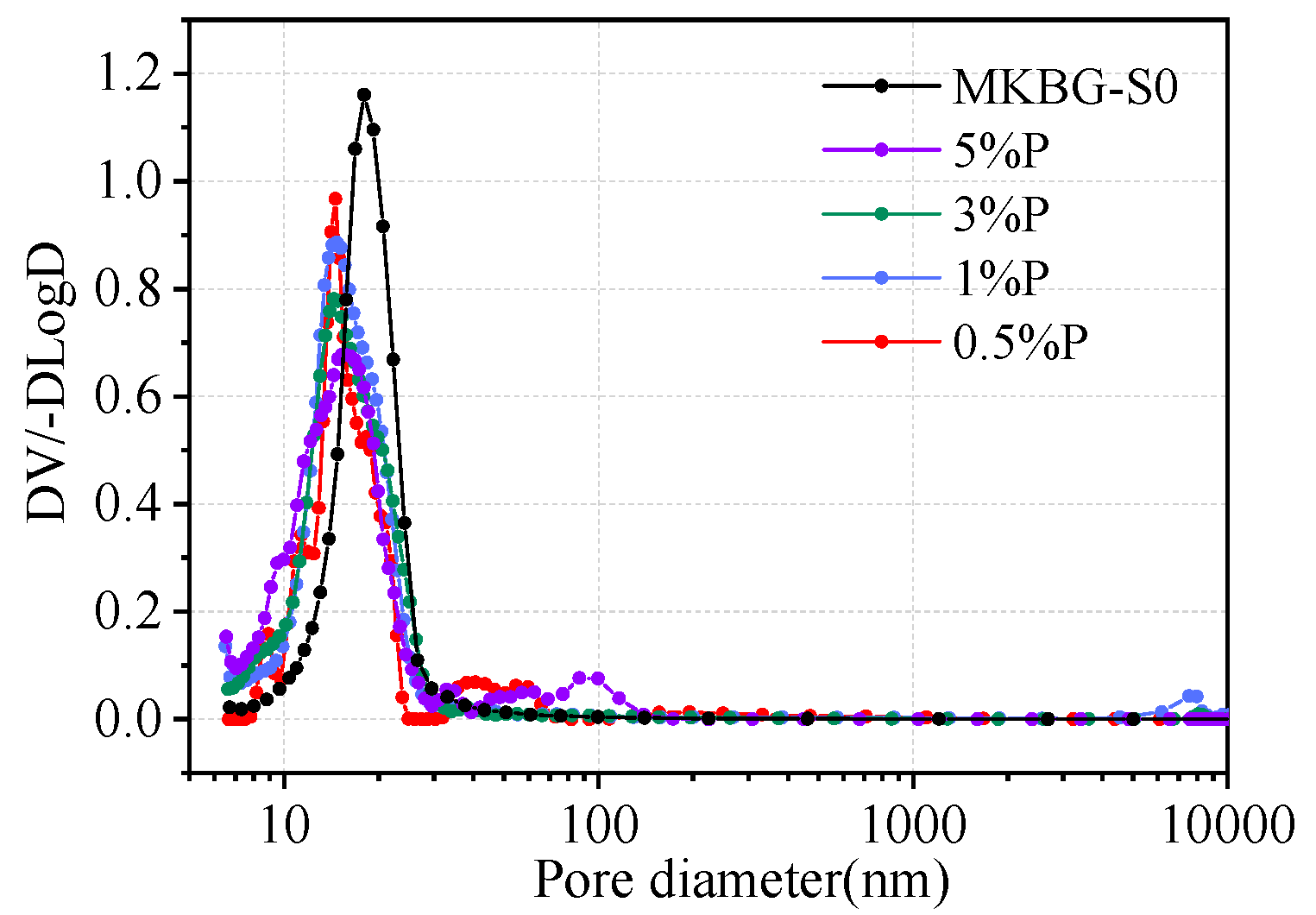
3.3. Effect of Phosphogypsum Incorporation on Drying Shrinkage
3.4. Comparative Analysis of Solid Waste Powders on Drying Shrinkage
4. Conclusions
- (1)
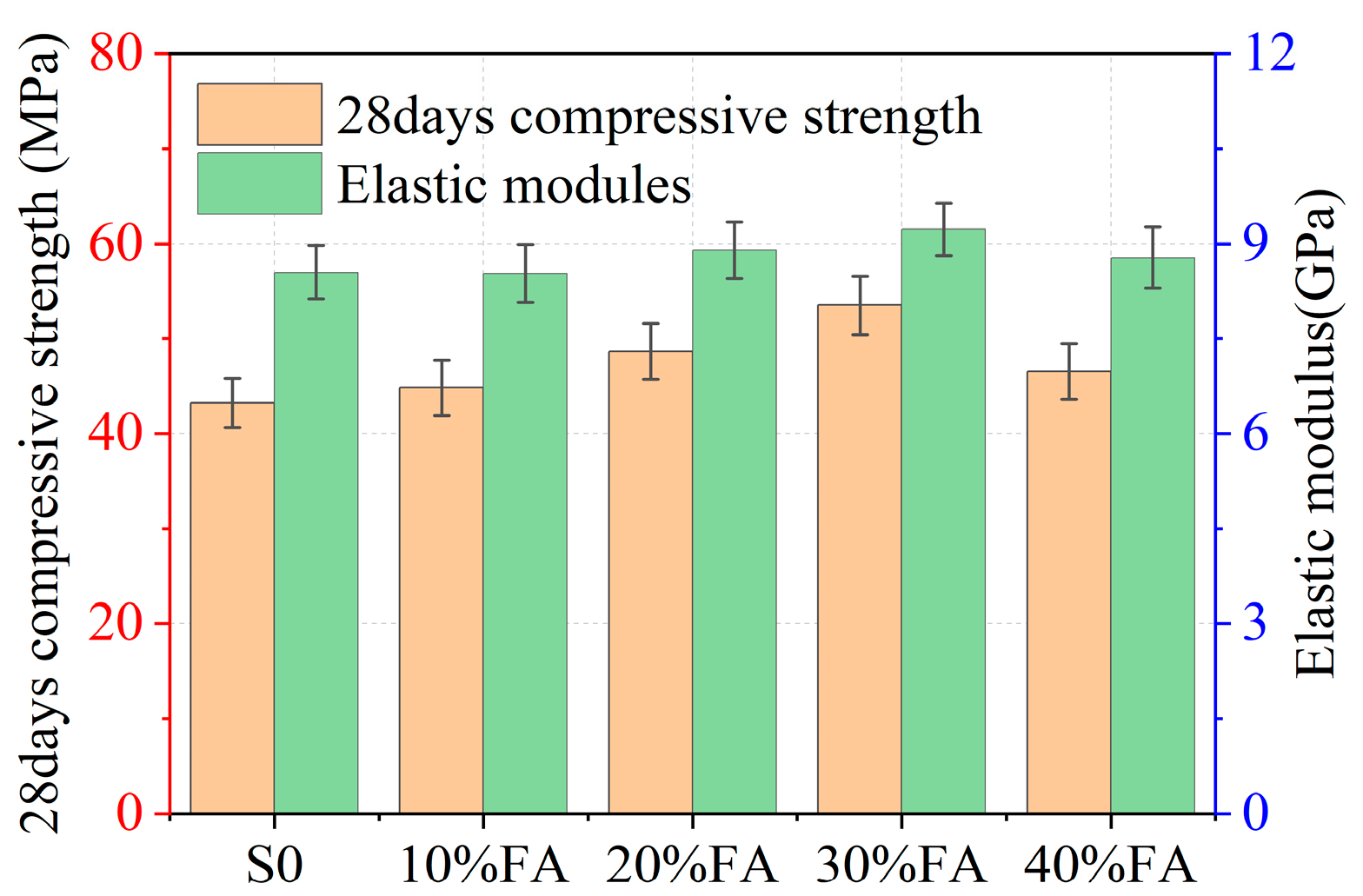
- FA incorporation significantly reduces drying shrinkage in MKBGs, serving as an effective shrinkage-suppressing additive. An optimal 30% FA content resulted in a peak compressive strength of 53.51 MPa and an elastic modulus of 9.23 GPa. Mechanistically, FA slows early-stage geopolymerization kinetics, allowing for a denser gel structure that reduces daily shrinkage increments to below 50 με by Day 4. Simultaneously, it reduces connectivity within the capillary pore network, thereby decreasing humidity sensitivity during the drying process.
- (2)
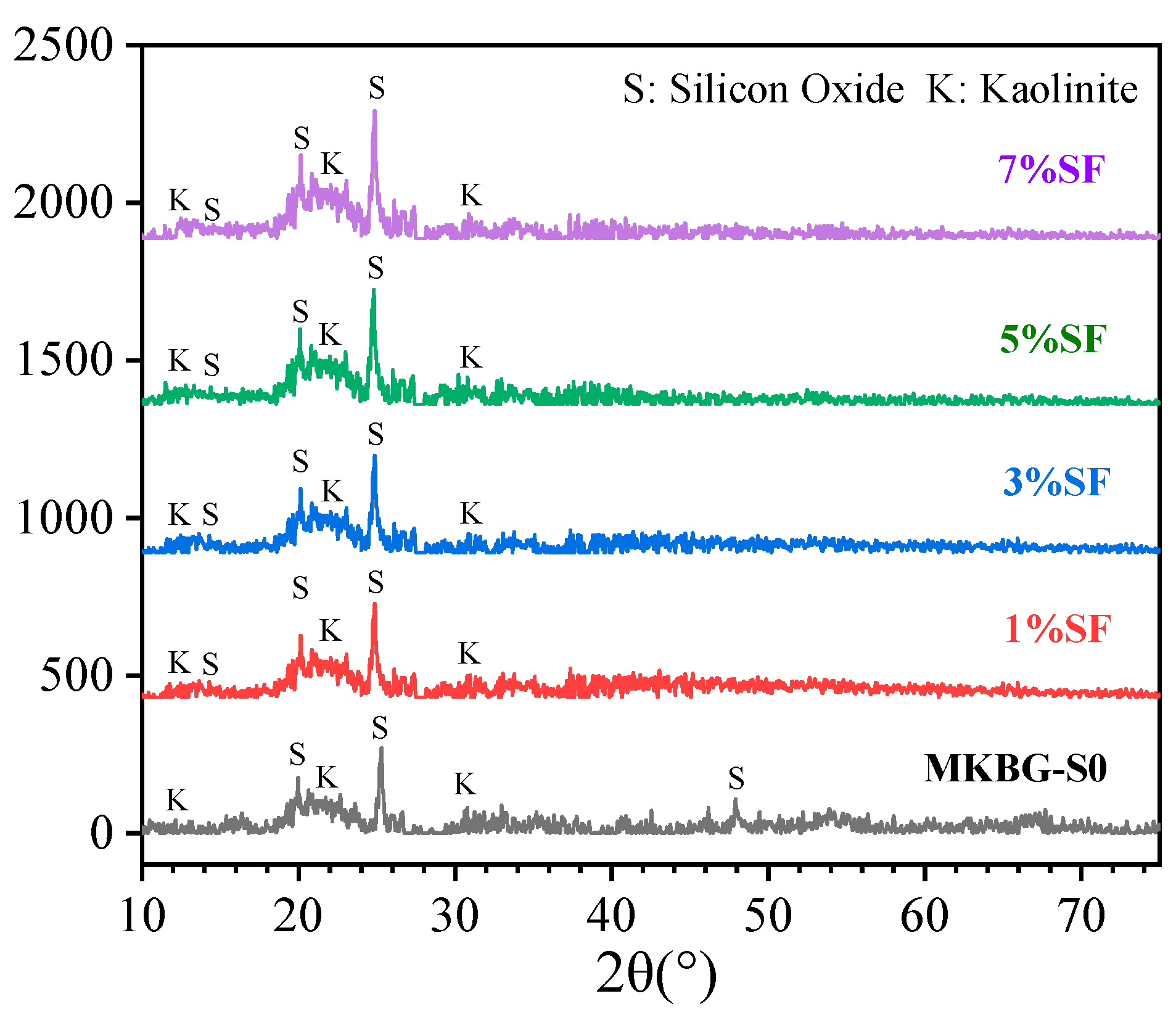
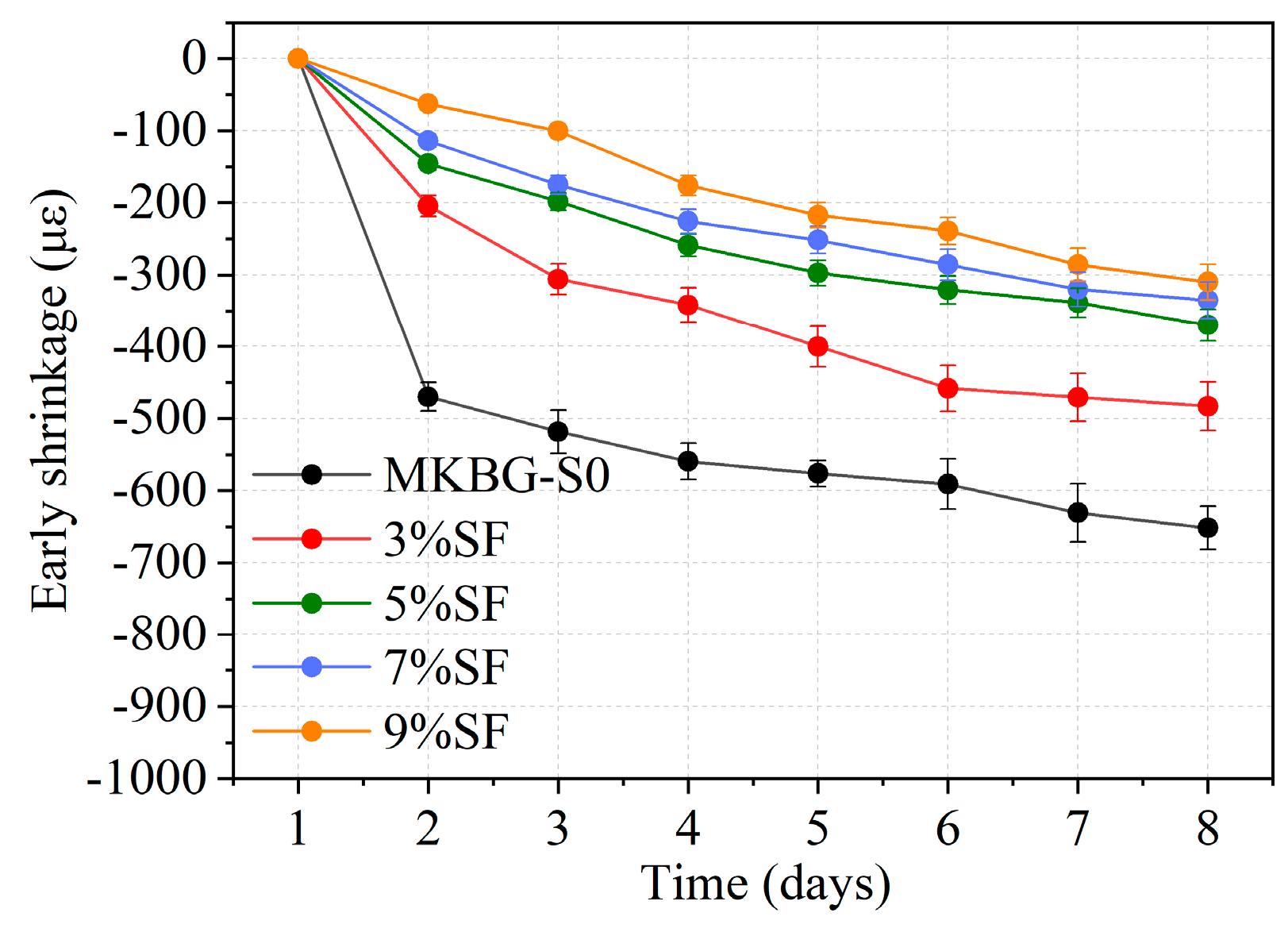
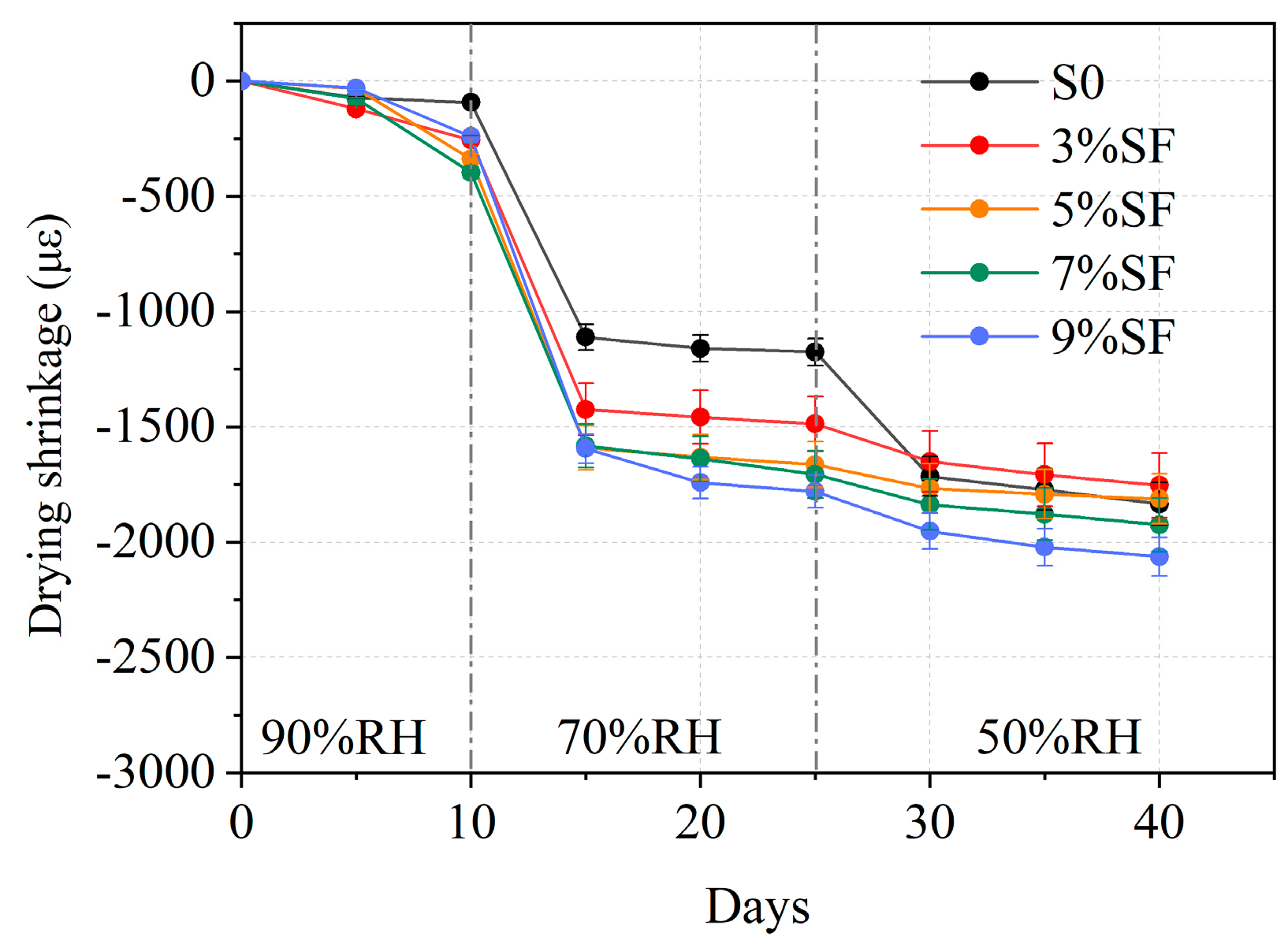
- SF exhibits a dual effect on shrinkage behavior. While a 7% dosage provides the highest mechanical boost—increasing compressive strength by 28.3% and elastic modulus by 12.4% compared to the control—it also refines the most probable pore diameter from 17.97 nm to 9.93 nm, which can increase capillary stress. Consequently, a 3% dosage is identified as the optimal balance for enhancing matrix resistance without detrimental pore refinement. Excessive SF hinders the geopolymerization reaction, weakening shrinkage resistance and ultimately increasing total shrinkage.
- (3)
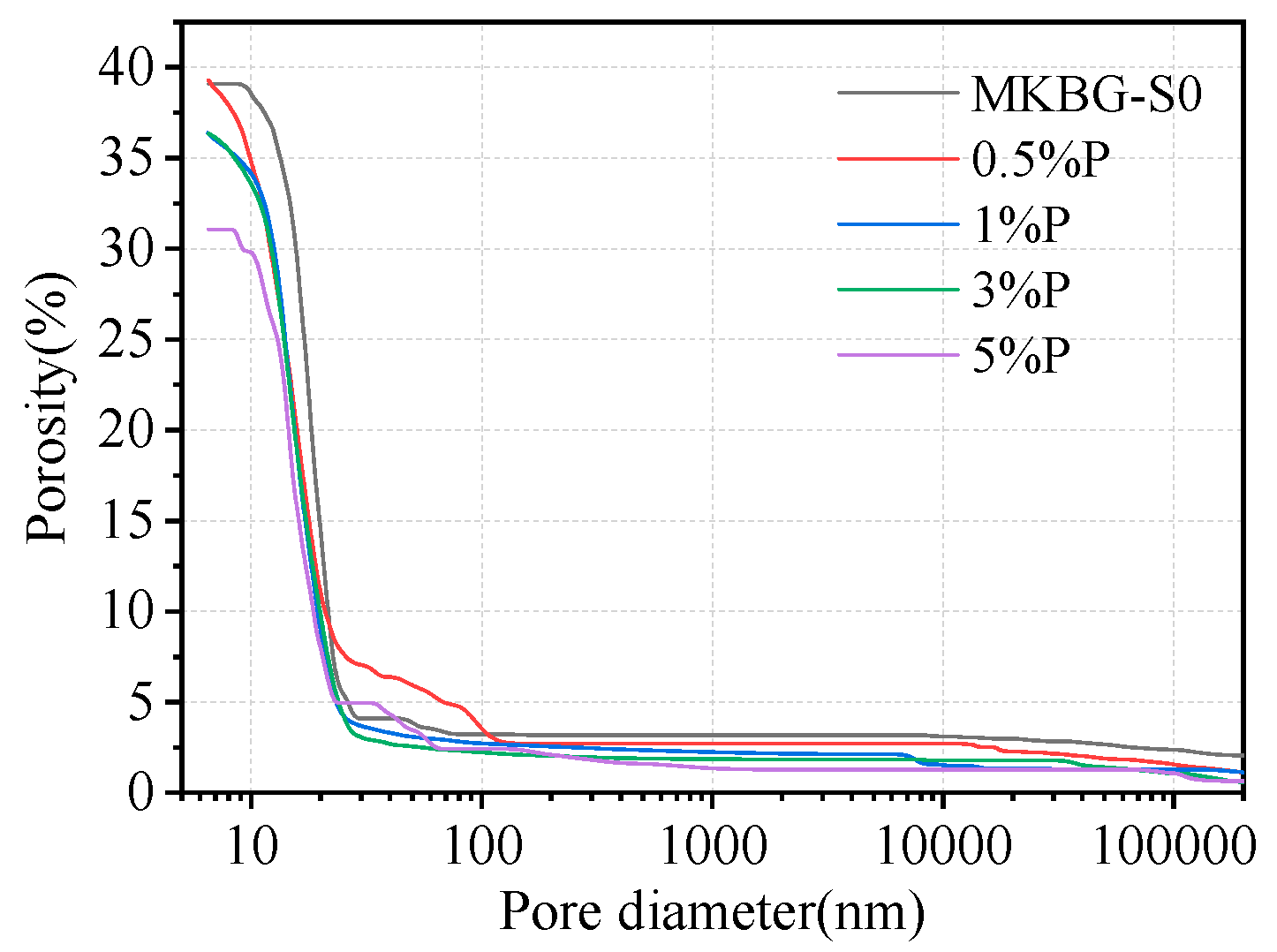
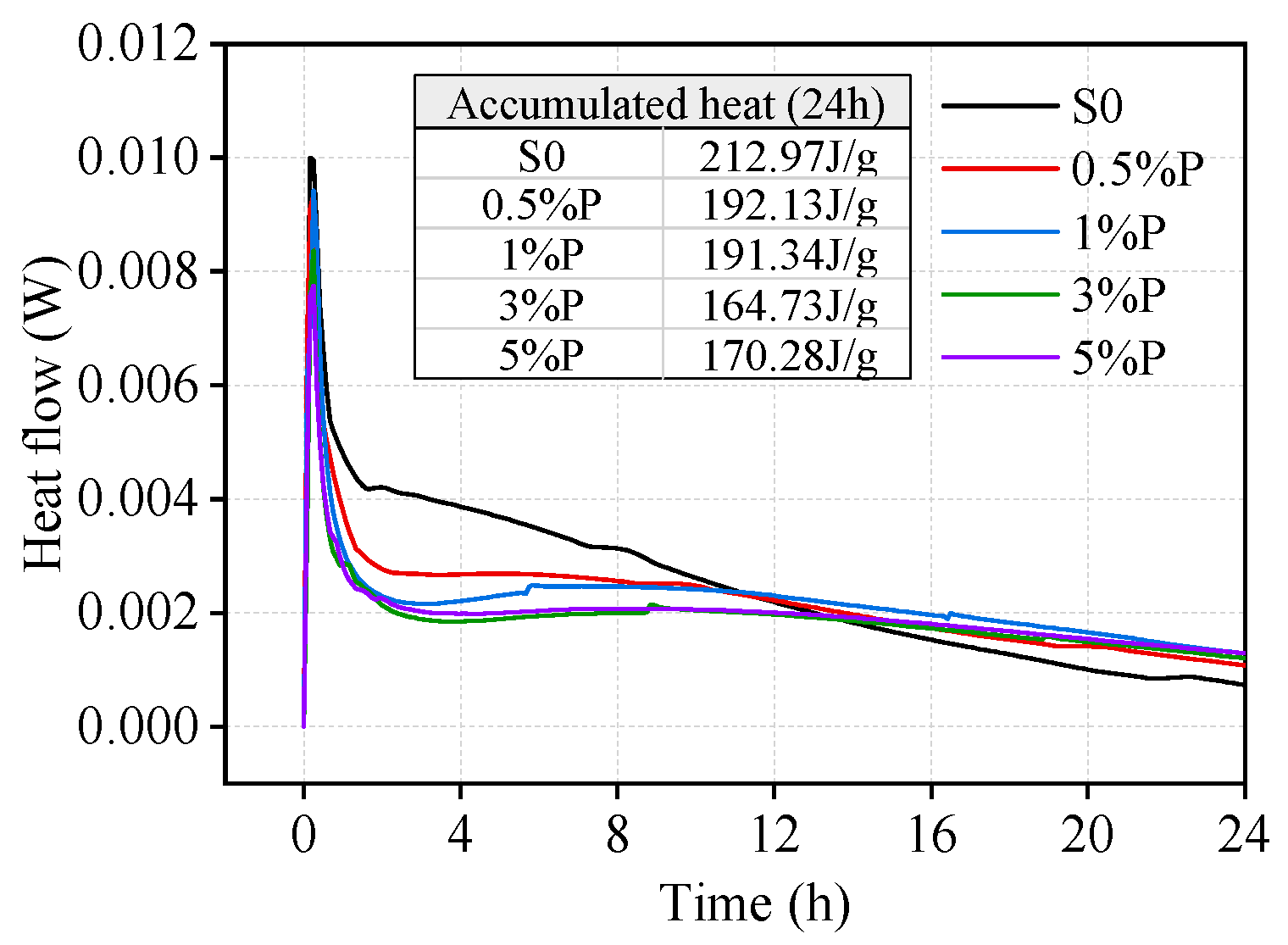
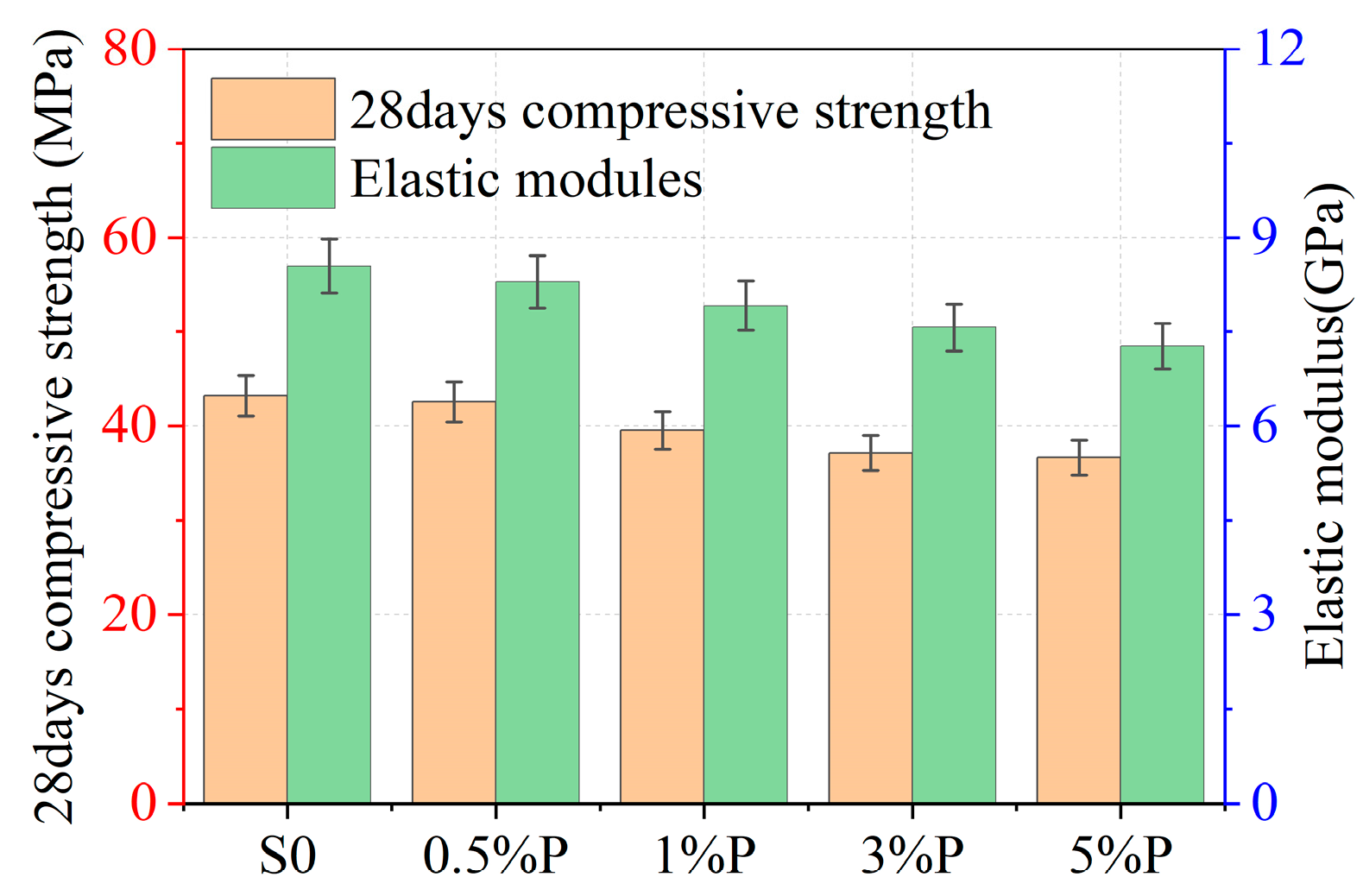
- P incorporation effectively reduces drying shrinkage within the tested dosages. At a 5% content, it reduced early-age shrinkage by 214.34 με compared to the control and decreased total porosity by up to 8%. Although its acidity slightly weakened the activator—reducing compressive strength from 43.20 MPa to 36.65 MPa—the formation of needle-like Wairakite-Ca crystals provides a micro-supporting framework. This structural reinforcement, combined with the reduction in capillary driving forces, results in a significant net reduction in shrinkage.
Author Contributions
Funding
Data Availability Statement
Conflicts of Interest
References
- Neto, A.A.M.; Cincotto, M.A.; Repette, W. Drying and autogenous shrinkage of pastes and mortars with activated slag cement. Cem. Concr. Res. 2008, 38, 565–574. [Google Scholar] [CrossRef]
- Castel, A.; Foster, S.J.; Ng, T.; Sanjayan, J.G.; Gilbert, R.I. CreePand drying shrinkage of a blended slag and low calcium fly ash geopolymer Concrete. Mater. Struct. 2016, 49, 1619–1628. [Google Scholar] [CrossRef]
- Ma, Y.; Ye, G. The shrinkage of alkali activated fly ash. Cem. Concr. Res. 2015, 68, 75–82. [Google Scholar] [CrossRef]
- Chen, S.K.; Wu, C.L.; Yan, D.M.; Ao, Y.; Ruan, S.Q.; Zheng, W.B.; Sun, X.L.; Lin, H. Relation between drying shrinkage behavior and the microstructure of MKBG. J. Zhejiang Univ. Sci. A Appl. Phys. Eng. 2021, 22, 16. [Google Scholar] [CrossRef]
- Bakharev, T.; Sanjayan, J.G.; Cheng, Y.B. Effect of admixtures on properties of alkali-activated slag concrete. Cem. Concr. Res. 2000, 30, 1367–1374. [Google Scholar] [CrossRef]
- Bentz, D.P.; Geiker, M.R.; Hansen, K.K. Shrinkage-reducing admixtures and early-age desiccation in cement pastes and mortars. Cem. Concr. Res. 2001, 37, 1075–1085. [Google Scholar] [CrossRef]
- Radlinska, A.; Rajabipour, F.; Bucher, B.; Henkensiefken, R.; Sant, G.; Weiss, J. Shrinkage Mitigation Strategies in Cementitious Systems: A Closer Look at Differences in Sealed and Unsealed Behavior. Transp. Res. Rec. J. Transp. Res. Board 2008, 2070, 59–67. [Google Scholar] [CrossRef]
- Weiss, J.; Lura, P.; Rajabipour, F.; Sant, G. Performance of Shrinkage-Reducing Admixtures at Different Humidities and at Early Ages. Aci Mater. J. 2008, 105, 478–486. [Google Scholar]
- Bentz, D.P.; Snyder, K.A. Protected paste volume in concrete: Extension to internal curing using saturated lightweight fine aggregate. Cem. Concr. Res. 1999, 29, 1863–1867. [Google Scholar] [CrossRef]
- Sakulich, A.R.; Bentz, D.P. Mitigation of autogenous shrinkage in alkali activated slag mortars by internal curing. Mater. Struct. 2013, 46, 1355–1367. [Google Scholar] [CrossRef]
- Kovler, K.; Zhutovsky, S. Overview and future trends of shrinkage research. Mater. Struct. 2006, 39, 827–847. [Google Scholar] [CrossRef]
- Wallah, S.E.; Rangan, B.V. Low-Calcium Fly Ash-Based Geopolymer Concrete: Long Term Properties; Research Report GC2; Faculty of Engineering, Curtin University of Technology: Perth, Australia, 2006. [Google Scholar]
- Çelik, A.İ.; Karalar, M.; Aksoylu, C.; Mydin, A.O.; Althaqafi, E.; Yılmaz, F.; Umiye, O.A.; Özkılıç, Y.O. Effect of GBFS ratio and recycled steel tire wire on the mechanical and microstructural properties of geopolymer concrete under ambient and oven curing conditions. Case Stud. Constr. Mater. 2024, 21, e03890. [Google Scholar] [CrossRef]
- Wang, G.S.; Ma, Y.W. Drying shrinkage of alkali-activated fly ash/slag blended system. J. Sustain. Cem.-Based Mater. 2018, 7, 203–213. [Google Scholar] [CrossRef]
- Humad, A.M.; Kothari, A.; Provis, J.L.; Cwirzen, A. The Effect of Blast Furnace Slag/Fly Ash Ratio on Setting, Strength, and Shrinkage of Alkali-Activated Pastes and Concretes. Front. Mater. 2019, 6, 9. [Google Scholar] [CrossRef]
- Yang, T.; Zhu, H.J.; Zhang, Z.H. Influence of fly ash on the pore structure and shrinkage characteristics of metakaolin-based geopolymer pastes and mortars. Constr. Build. Mater. 2017, 153, 284–293. [Google Scholar] [CrossRef]
- Yao, L.H.; Wang, Y.P.; Chen, C.X. Effect of silica fume on properties of fly ash-slag based polymer. New Build. Mater. 2022, 49, 48–52. (In Chinese) [Google Scholar]
- Khater, H.M. Effect of silica fume on the characterization of the geopolymer materials. Int. J. Adv. Struct. Eng. 2013, 5, 12. [Google Scholar] [CrossRef]
- Rao, G.A. Influence of silica fume replacement of cement on expansion and drying shrinkage. Cem. Concr. Res. 1998, 28, 1505–1509. [Google Scholar] [CrossRef]
- Saini, G.; Vattipalli, U. Assessing properties of alkali activated GGBS based self-coMPacting geopolymer concrete using nano-silica. Case Stud. Constr. Mater. 2020, 12, e00352. [Google Scholar] [CrossRef]
- Li, O.H.; Yun-Ming, L.; Cheng-Yong, H.; Bayuaji, R.; Abdullah, M.M.A.B.; Loong, F.K.; Jin, T.S.; Teng, N.H.; Nabiałek, M.; Jeż, B.; et al. Evaluation of the effect of silica fume on amorphous fly ash geopolymers exposed to elevated temperature. Magnetochemistry 2021, 7, 9. [Google Scholar] [CrossRef]
- Folek, S.; Walawska, B.; Wilczek, B.; Miśkiewicz, J. Use of phosphogypsum in road construction. Pol. J. Chem. Technol. 2011, 13, 18–22. [Google Scholar] [CrossRef]
- Majdoubi, H.; Makhlouf, R.; Haddaji, Y.; Nadi, M.; Mansouri, S.; Semllal, N.; Oumam, M.; Manoun, B.; Alami, J.; Hannache, H.; et al. Valorization of phosphogypsum waste through acid geopolymer technology: Synthesis, characterization, and environmental assessment. Constr. Build. Mater. 2023, 371, 130710. [Google Scholar] [CrossRef]
- Wang, Y.; Huo, H.; Chen, B.; Cui, Q. Development and optimization of phosphogypsum-based geopolymer cement. Constr. Build. Mater. 2023, 369, 130577. [Google Scholar] [CrossRef]
- Vaičiukynienė, D.; Nizevičienė, D.; Kielė, A.; Janavičius, E.; Pupeikis, D. Effect of phosphogypsum on the stability upon firing treatment of alkali-activated slag. Constr. Build. Mater. 2018, 184, 485–491. [Google Scholar] [CrossRef]
- Pratap, B.; Mondal, S.; Rao, B.H. Development of geopolymer concrete using fly ash and phosphogypsum as a pavement composite material. Mater. Today Proc. 2023, 93, 35–40. [Google Scholar] [CrossRef]
- Li, S.; Wang, D.; Tang, C.; Chen, Y. Optimization of synergy between cement, slag, and phosphogypsum for marine soft clay solidification. Constr. Build. Mater. 2023, 374, 130902. [Google Scholar] [CrossRef]
- JGJ/T 70-2009; Test Method for Basic Performance of Building Mortar. China Architecture & Building Press: Beijing, China, 2010.
- GB/T 50081-2002; Standard for Test Method of Mechanical Properties of Ordinary Concrete. China Architecture & Building Press: Beijing, China, 2003.
- Jensen, O.M.; Lura, P.; Goodwin, F.; Bentz, D.; Hooton, D.; Kovler, K.; Weiss, J. Standard Test Method for Autogenous Strain of Cement Paste and Mortar. In Proceedings of the International Conference of Logistics Engineering & Management 2007, Shanghai, China, 9–11 October 2014. [Google Scholar] [CrossRef]
- JC/T 603-2004; Standard for Test Method of Drying Shrinkage of Cement Mortar. China Building Materials Industry Press: Beijing, China, 2004.
- Wetzel, A.; Middendorf, B. Influence of silica fume on properties of fresh and hardened ultra -high performance concrete based on alkali-activated slag. Cem. Concr. Compos. 2019, 100, 53–59. [Google Scholar] [CrossRef]
- Zhang, Y.; Liu, H.; Ma, T.; Gu, G.; Chen, C.; Hu, J. Understanding the changes in engineering behaviors and microstructure of FA-GBFS based geopolymer paste with addition of silica fume. J. Build. Eng. 2023, 70, 106450. [Google Scholar] [CrossRef]
- Appa Rao, G. Long-term drying shrinkage of mortar—Influence of silica fume and size of fine aggregate. Cem. Concr. Res. 2001, 31, 171–175. [Google Scholar] [CrossRef]



| Oxides/% | SiO2 | Al2O3 | CaO | SO3 | TiO2 | K2O | L.O.I |
|---|---|---|---|---|---|---|---|
| Metakaolin | 52.53 | 45.42 | 0.26 | 0.04 | 0.97 | 0.18 | 0.6 |
| Oxides/% | SiO2 | Al2O3 | CaO | MgO | SO3 | TiO2 | K2O | Fe2O3 | Na2O | P2O5 | L.O.I |
|---|---|---|---|---|---|---|---|---|---|---|---|
| Fly ash | 56.9 | 31.24 | 3.05 | 0 | 0 | 1.34 | 2.06 | 3.8 | 0 | 0 | 1.61 |
| Silica fume | 97.08 | 0.34 | 0.07 | 0.06 | 0.02 | 0.04 | 0.04 | 0.37 | 0.06 | 0 | 1.92 |
| Phosphogypsum | 7.53 | 1.15 | 38.18 | 0.18 | 50.36 | 0.14 | 0.39 | 0.58 | 0.10 | 1.12 | 0.27 |
| Material | Replacement Ratio (% by Mass) | Group Designation |
|---|---|---|
| Fly ash | 10%/20%/30%/40% | 10%FA/20%FA/30%FA/40%FA |
| Silica fume | 1%/3%/5%/7% | 1%SF/3%SF/5%SF/7%SF |
| Phosphogypsum | 0.5%/1%/3%/5% | 0.5%P/1%P/3%P/5%P |
| Admixture Type | Structural Mechanism | Pore Distribution Effect | Impact on Mechanical Strength | Shrinkage Suppression Efficacy |
|---|---|---|---|---|
| Fly Ash | Micro-aggregate effect and N-A-S-H densification | Decreased connectivity with a shift to smaller diameters | Significant increase peaking at 30% dosage | High efficacy with reduced moisture sensitivity |
| Silica Fume | Nucleation sites and intense pozzolanic activity | Drastic refinement of the most probable pore diameter | Moderate increase peaking at 7% dosage | Optimal at 3% but limited at higher dosages |
| Phosphogypsum | Wairakite-Ca framework and physical filler effect | Reduced cumulative porosity with stable distribution | Progressive decrease due to weakened activation | Consistent reduction across all humidity levels |
Disclaimer/Publisher’s Note: The statements, opinions and data contained in all publications are solely those of the individual author(s) and contributor(s) and not of MDPI and/or the editor(s). MDPI and/or the editor(s) disclaim responsibility for any injury to people or property resulting from any ideas, methods, instructions or products referred to in the content. |
© 2026 by the authors. Licensee MDPI, Basel, Switzerland. This article is an open access article distributed under the terms and conditions of the Creative Commons Attribution (CC BY) license.
Share and Cite
Zhang, S.; Tang, C.; Chen, J.; Guo, N.; Yang, Y.; Dong, T. Influences of Different Solid Waste Powders on the Drying Shrinkage Characteristics of Metakaolin-Based Geopolymers. J. Compos. Sci. 2026, 10, 194. https://doi.org/10.3390/jcs10040194
Zhang S, Tang C, Chen J, Guo N, Yang Y, Dong T. Influences of Different Solid Waste Powders on the Drying Shrinkage Characteristics of Metakaolin-Based Geopolymers. Journal of Composites Science. 2026; 10(4):194. https://doi.org/10.3390/jcs10040194
Chicago/Turabian StyleZhang, Shanshan, Cheng Tang, Jing Chen, Niping Guo, Yiwei Yang, and Teng Dong. 2026. "Influences of Different Solid Waste Powders on the Drying Shrinkage Characteristics of Metakaolin-Based Geopolymers" Journal of Composites Science 10, no. 4: 194. https://doi.org/10.3390/jcs10040194
APA StyleZhang, S., Tang, C., Chen, J., Guo, N., Yang, Y., & Dong, T. (2026). Influences of Different Solid Waste Powders on the Drying Shrinkage Characteristics of Metakaolin-Based Geopolymers. Journal of Composites Science, 10(4), 194. https://doi.org/10.3390/jcs10040194